---
title: "It’s just a start"
subtitle: "The opportunities Meta's settlement opens on addictive design, and those it quietly buries"
author: "Lorenzo Ancona"
date: 2026-09-01
language: en
words: 1452
canonical: https://artifactstech.substack.com/p/its-just-a-start
license: CC BY 4.0
cite_as: "It’s just a start by Lorenzo Ancona, Artifacts, 2026-09-01. https://artifactstech.substack.com/p/its-just-a-start (CC BY 4.0)"
---
# It’s just a start
Meta said on Wednesday that it would change how teenagers in the US can use Instagram and Facebook as part of a landmark settlement with 47 states, the District of Columbia and U.S. territories over social media addiction claims.
The accusations were twofold: that Meta has designed products addictive for children, and that it stored the personal data of under-13s - forbidden under COPPA, the US child-privacy law.
That second charge, though, comes with a surprise. Buried in the settlement is a release freeing Meta from past, present and future COPPA claims from those states - and a carve-out that lets it keep using under-13 data to train its age-detection AI. A legal pass on kids’ data, tucked into a deal that was meant to protect them.
For all this, it will pay \$18 billion over the next ten years.
It is big - some called it the Big Tobacco moment for social media. But it could have been bigger.
 yes, the start of a cigarette, exactly
Meta - which, like most Big Tech platforms, denies ever having built addictive products - was facing a wall of claims from attorneys across the country and a potential \$200 billion fine. Instead of months of scrutiny, it settled in the second week of trial.
And \$18 billion is big, but not gigantic. It is about 8% of Meta’s record \$201 billion in 2025 revenue. Or roughly the ~\$16 billion that Meta reportedly expected to make in 2024 from ads for scams and banned goods.
And it has actually only committed to \$12.7 billion of it. The rest arrives only if TikTok and YouTube also settle and match the changes - a detail we’ll come back to.
As for the measures themselves, here is some of what was announced - all for accounts belonging to under-18s:
- A two-hour daily cap on Instagram and Facebook, liftable only by a parent.
- No access overnight, from midnight to 6am; notifications silenced from 10pm to 7am and through school hours.
- The option to turn off autoplay, and to switch off the personalized feed.
- Hidden “like” counts; extreme-makeup and cosmetic-surgery filters blocked.
- Stronger limits on unwanted contact from adults, and a new way to report harmful content.
- More investment in age verification to remove under-13s - overseen by an independent auditor with broad access to the company’s data.
As with the money, Meta will tighten the measures only if its competitors match them. The two-hour cap drops to one hour per app, and the nighttime block widens to 10pm to 7am, if YouTube and TikTok adopt the same standards. The company published a letter arguing that protection of children should be a common effort.
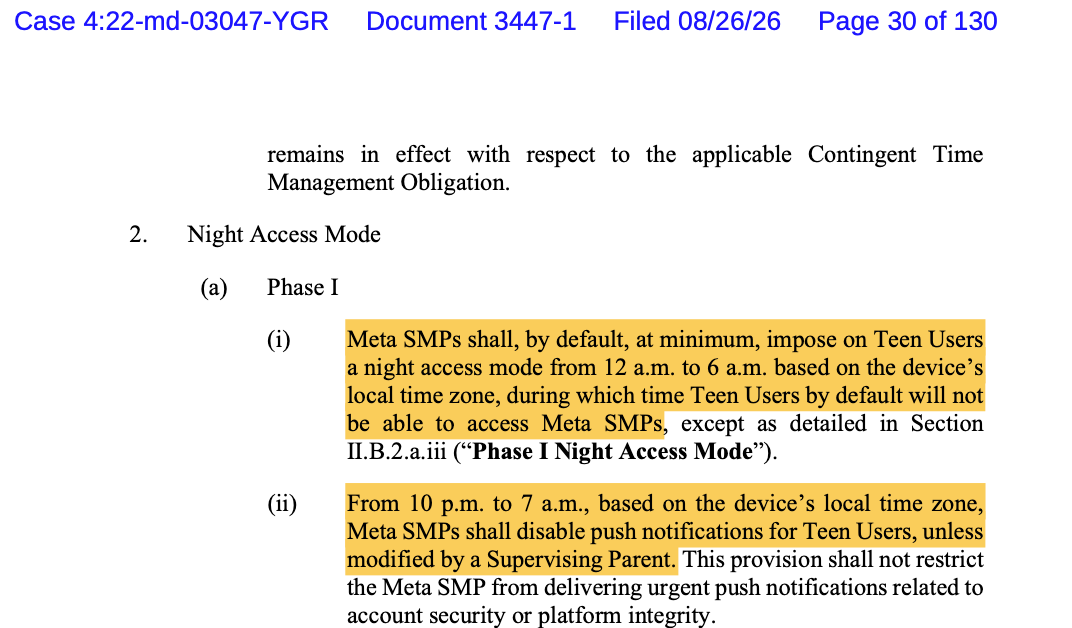 reading settlements is always fairly interesting
So, what do we take from this? It’s undeniably a historic moment, but just the start: a set of opportunities yet to be seized, and a moment where some of them have already gone unused.
Let’s start with the bright side. As with the New Mexico rulings we covered here, and some of the European Commission’s open investigations, we now see a clear shift in what platforms are held accountable for. Before, they were blamed for the content their users posted - which often earned them a shield under Section 230 in the US. Now the allegations and fines are about the design itself: how these products are built.
This is the founding idea of this newsletter too: the design of technology is never neutral, so be careful.
Courts have found their leverage, and cracked into the platforms through it. Unlike age verification - which we called a padlock on a building on fire - these design changes actually reshape the platforms, and with them what users see and can do.
Despite never conceding that its design was addictive by choice, Meta will have to make changes, and they will be quite visible to users and citizens.
As Nick Thompson put it, this will likely raise far more awareness about design and about the fact that how technology is built has real impact. It’s all good, really.
Then, between the bright and less-bright sits this: these changes come after years of risky features in production, as a reaction to cases in court.
It’s a cat-and-mouse game, and it’s not forward-looking: far better to state principles upfront and hold platforms to them. Here, the EU arguably does far better than the US with regulations like the Digital Services Act prescribing design measures.
Finally, we shouldn’t overlook the missed opportunities: months of trials, witnesses, media coverage and scrutiny of the design of the technologies that have shaped our societies, our politics, kids.
By settling early, Meta avoids all of it (along with that \$200 billion fine). Little surprise, then, that their stock jumped when the news broke - more than four percent before the opening bell.
Also, this would not have been just about Meta. The spotlight would have fallen on all platforms - a general reckoning with design. It would have been something to see Zuckerberg testify in court, and maybe an expansion to other platforms.
Getting out this early is a smart move for Meta: not just because it limits exposure and the fine, but because it’s now positioning itself as the author of the new industry standard for safety, so that the “meaningful progress” against the addictive design baked into these platforms reads as not one company’s doing, but a shared one, spreading any coverage and reputational damage along with it.
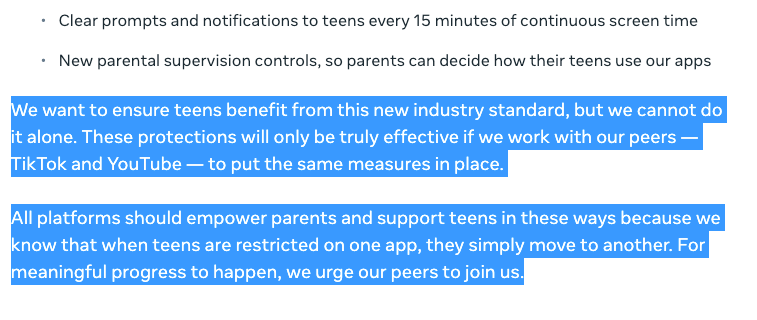 again from Meta’s letter to TikTok and YouTube
Still - and likely for reasons different from Meta’s - this remains a hope: we are entering an era in which platforms that have shaped the information space for years now have to design their services better, and differently.
It’s an occasion to think back on what has been and what we want the future to look like.
> ### Save for Later
While Meta settles, the age-gating fight rolls on elsewhere. France’s Constitutional Council struck down Macron’s under-15 social media ban as a disproportionate hit to free expression. Brussels went the other way, designating ChatGPT, Reddit and Roblox under the DSA (ChatGPT as a “search engine,” interestingly). And Apple, after a long standoff, overhauled its EU App Store fees - the Core Technology Fee finally dead, a flat 5% in its place.
The thread I keep circling: what AI does to reading and writing. The Atlantic declares the end of reading - half of US adults finished zero books last year. A NYT columnist begs you never to write with AI, because writing is thinking. Clay agrees, with teeth: its official policy says writing should take longer than reading. Meanwhile the FT bets the opposite - that we’ll talk, not type - as the internet fills with AI slop.
On the money: token prices keep falling, yet enterprise AI budgets keep blowing up (73% overshot this year). Open models are the pressure - four to seven months behind the frontier now, per the UK’s safety institute - and a NYT op-ed argues cheap Chinese open weights are the real contest.
> ### The Bookshelf
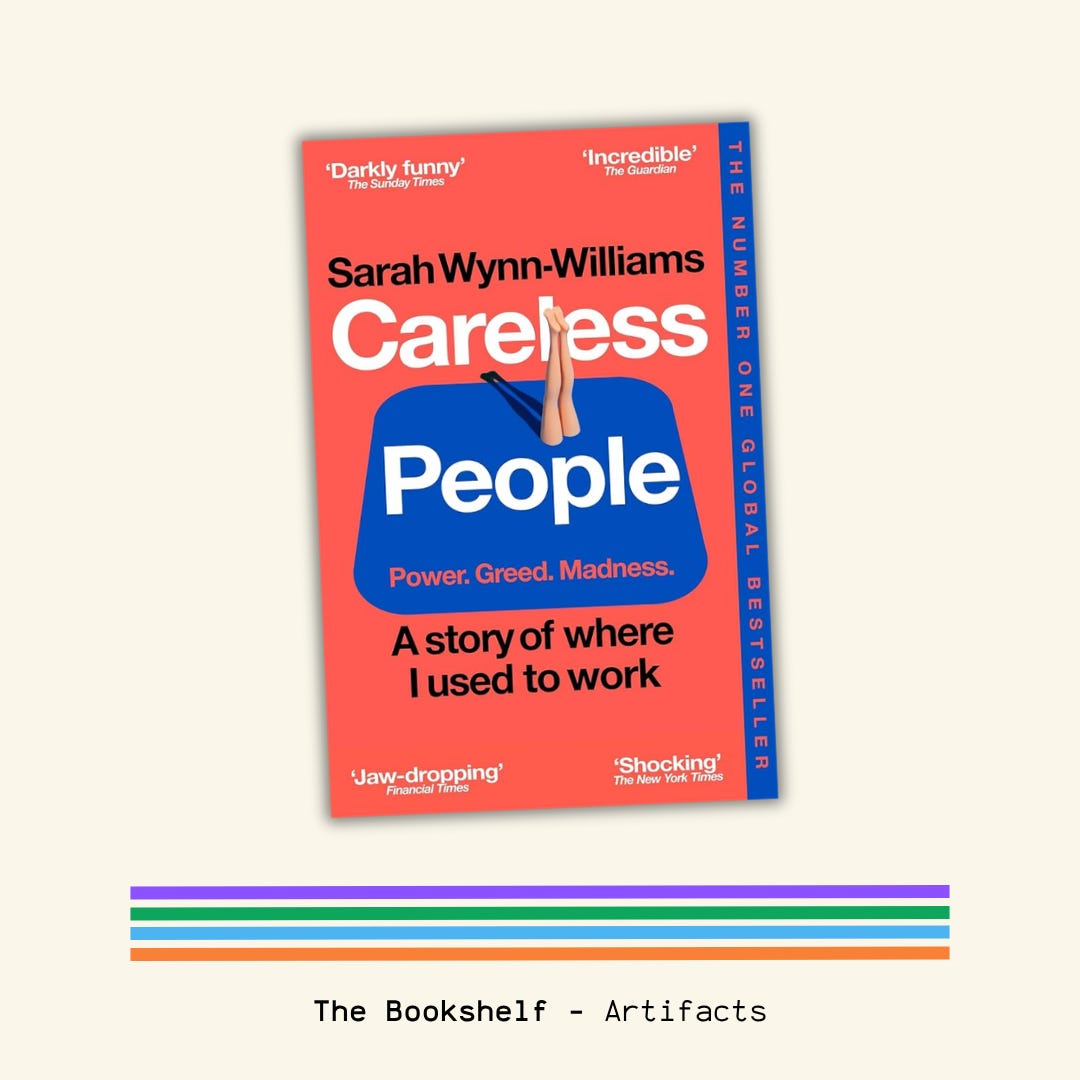 Must say I didn’t love reading this book, but more from a style perspective. This said, ‘Careless People’ is a good one to hear from who was there how some decisions may have been taken and why, fast forward to today, we find ourselves reading about such trials and allegations.
📚 All the books I’ve read and recommended in Artifacts are here.
> ### Nerding
 Ok ok, self promotion, fair. Yet, I hadn’t published this yet here. I built a Context Kit for anyone writing newsletters.
I moved from a simple assumption: people struggle with AI agents not cause they’re hard to use but cause it’s hard to give them context. Therefore, this kit helps build it for you by moving from your previous publications and where you want your newsletter to go.
You find a demo here too. Let me know feedback!
NEW: All the tools suggested in Nerding have been collected here! ⚙️
> ### ☕?
If you want to know more about Artifacts, where it all started, or just want to connect...
Let's grab a virtual coffee ☕

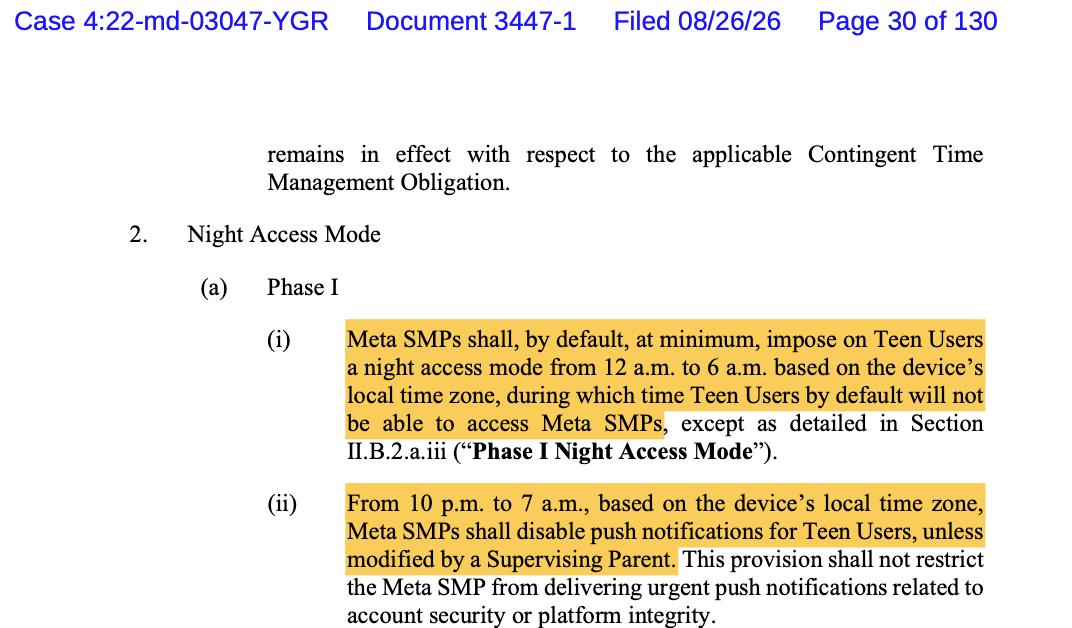 reading settlements is always fairly interesting
So, what do we take from this? It’s undeniably a historic moment, but just the start: a set of opportunities yet to be seized, and a moment where some of them have already gone unused.
Let’s start with the bright side. As with the New Mexico rulings we covered here, and some of the European Commission’s open investigations, we now see a clear shift in what platforms are held accountable for. Before, they were blamed for the content their users posted - which often earned them a shield under Section 230 in the US. Now the allegations and fines are about the design itself: how these products are built.
This is the founding idea of this newsletter too: the design of technology is never neutral, so be careful.
Courts have found their leverage, and cracked into the platforms through it. Unlike age verification - which we called a padlock on a building on fire - these design changes actually reshape the platforms, and with them what users see and can do.
Despite never conceding that its design was addictive by choice, Meta will have to make changes, and they will be quite visible to users and citizens.
As Nick Thompson put it, this will likely raise far more awareness about design and about the fact that how technology is built has real impact. It’s all good, really.
Then, between the bright and less-bright sits this: these changes come after years of risky features in production, as a reaction to cases in court.
It’s a cat-and-mouse game, and it’s not forward-looking: far better to state principles upfront and hold platforms to them. Here, the EU arguably does far better than the US with regulations like the Digital Services Act prescribing design measures.
Finally, we shouldn’t overlook the missed opportunities: months of trials, witnesses, media coverage and scrutiny of the design of the technologies that have shaped our societies, our politics, kids.
By settling early, Meta avoids all of it (along with that \$200 billion fine). Little surprise, then, that their stock jumped when the news broke - more than four percent before the opening bell.
Also, this would not have been just about Meta. The spotlight would have fallen on all platforms - a general reckoning with design. It would have been something to see Zuckerberg testify in court, and maybe an expansion to other platforms.
Getting out this early is a smart move for Meta: not just because it limits exposure and the fine, but because it’s now positioning itself as the author of the new industry standard for safety, so that the “meaningful progress” against the addictive design baked into these platforms reads as not one company’s doing, but a shared one, spreading any coverage and reputational damage along with it.
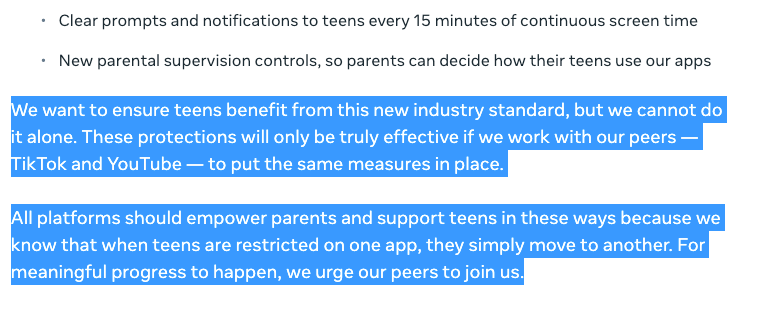 again from Meta’s letter to TikTok and YouTube
Still - and likely for reasons different from Meta’s - this remains a hope: we are entering an era in which platforms that have shaped the information space for years now have to design their services better, and differently.
It’s an occasion to think back on what has been and what we want the future to look like.
> ### Save for Later
While Meta settles, the age-gating fight rolls on elsewhere. France’s Constitutional Council struck down Macron’s under-15 social media ban as a disproportionate hit to free expression. Brussels went the other way, designating ChatGPT, Reddit and Roblox under the DSA (ChatGPT as a “search engine,” interestingly). And Apple, after a long standoff, overhauled its EU App Store fees - the Core Technology Fee finally dead, a flat 5% in its place.
The thread I keep circling: what AI does to reading and writing. The Atlantic declares the end of reading - half of US adults finished zero books last year. A NYT columnist begs you never to write with AI, because writing is thinking. Clay agrees, with teeth: its official policy says writing should take longer than reading. Meanwhile the FT bets the opposite - that we’ll talk, not type - as the internet fills with AI slop.
On the money: token prices keep falling, yet enterprise AI budgets keep blowing up (73% overshot this year). Open models are the pressure - four to seven months behind the frontier now, per the UK’s safety institute - and a NYT op-ed argues cheap Chinese open weights are the real contest.
> ### The Bookshelf
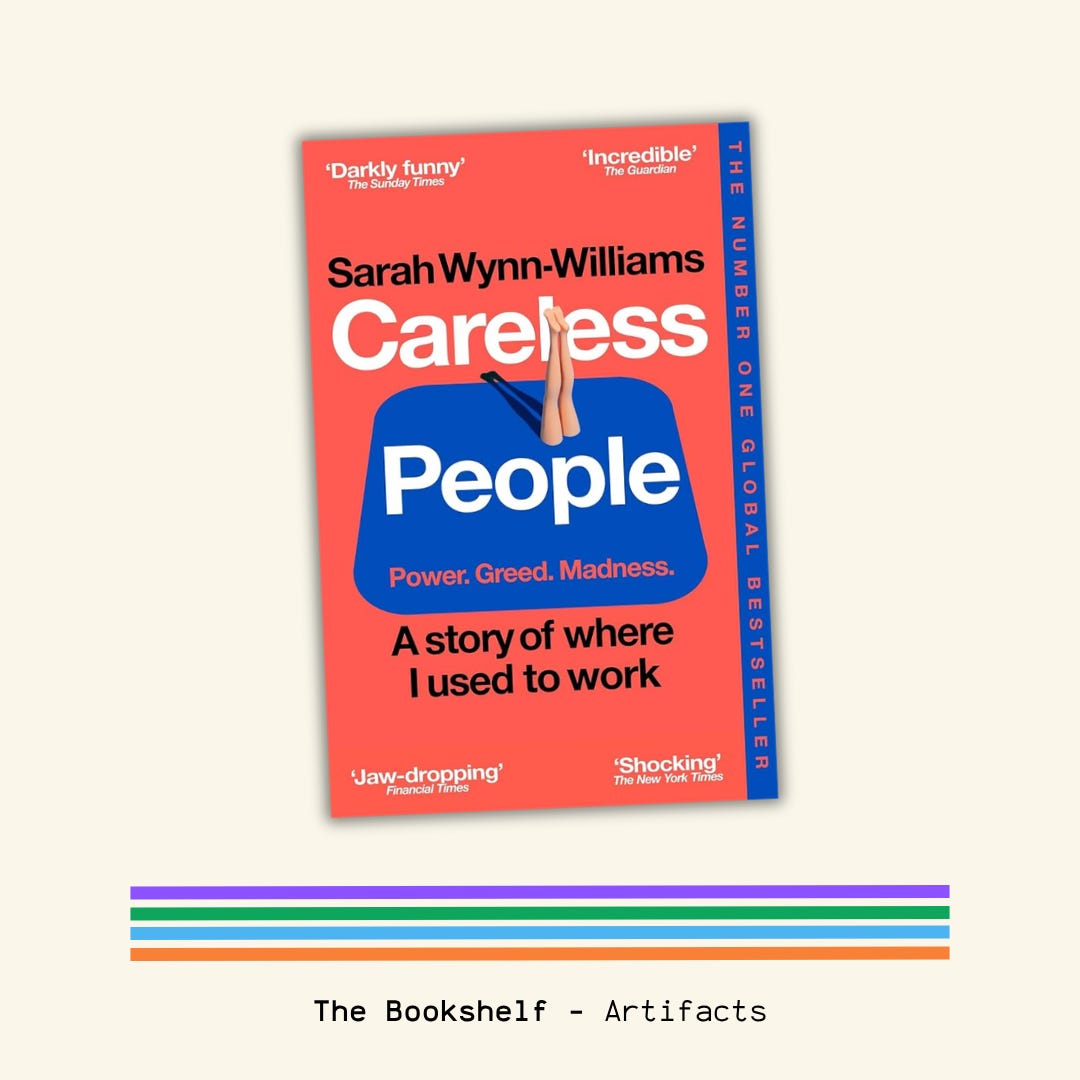 Must say I didn’t love reading this book, but more from a style perspective. This said, ‘Careless People’ is a good one to hear from who was there how some decisions may have been taken and why, fast forward to today, we find ourselves reading about such trials and allegations.
📚 All the books I’ve read and recommended in Artifacts are here.
> ### Nerding
 Ok ok, self promotion, fair. Yet, I hadn’t published this yet here. I built a Context Kit for anyone writing newsletters.
I moved from a simple assumption: people struggle with AI agents not cause they’re hard to use but cause it’s hard to give them context. Therefore, this kit helps build it for you by moving from your previous publications and where you want your newsletter to go.
You find a demo here too. Let me know feedback!
NEW: All the tools suggested in Nerding have been collected here! ⚙️
> ### ☕?
If you want to know more about Artifacts, where it all started, or just want to connect...
Let's grab a virtual coffee ☕