# Artifacts (for agents) — full text
License: CC BY 4.0. Author: Lorenzo Ancona.
======
# Who takes the blame?
Date: 2026-10-27 | Language: en
Canonical: https://artifactstech.substack.com/p/who-takes-the-blame
Cite as: Who takes the blame? by Lorenzo Ancona, Artifacts, 2026-10-27. https://artifactstech.substack.com/p/who-takes-the-blame (CC BY 4.0)
You may have heard of the Prix Goncourt, one of the most prestigious literature prizes in Europe - and without question in France. It’s been in the headlines lately, not for who won, but for a viral scandal.
On September 21, an anonymous X account called “Balance ton Claude” (a nod to Anthropic’s Claude) claimed it had run a book, C’était ça ou mourir by Thélyson Orélien, through Pangram, one of the flagship AI-detection engines (the same one Substack uses, btw), and found it to be “almost entirely” written by AI. Citing those findings alongside fresh plagiarism allegations, the Académie Goncourt removed the novel from its selection.
A couple days after the decision, Samuel Fitoussi, a columnist for Le Figaro revealed himself as one of the few people behind the anonymous account .
On October 21, exactly a month after the initial accusation, Thélyson Orélien’s Canadian publisher confirmed AI was indeed used to write the novel. The publisher ended their collaboration and any further printing of the novel on the same occasion.
In the same weeks as the scandal unfolded, sitting in a café just a few meters from the Académie Goncourt’s offices, and while sipping an espresso that isn’t really an espresso, I was discussing the story with Sarah, author of the AI Organon on Substack and lecturer on “Critical thinking in the age of AI” at Sciences Po. Go follow the AI Organon!!
AI OrganonThe AI Organon is a framework (in progress) to equip people to think clearly and debate serenely in an AI-mediated world.
We discussed it extensively and so, why not, we ended up turning the whole chat into a newsletter.
------------------------------------------------------------------------
Lorenzo: Why is it even a problem that a book is written with AI? If readers liked it, are we allowed to change our mind the moment we find out? Of course, lying about it is bad, we can all agree on that I think.
But I think it depends a lot on what we’re reading. Novels are, in a way, “useless” reading: we don’t open them for the output, the way we open an email. We open them for the process - to see how someone thought their way through a story.
So if I find out that process was hijacked by AI, yeah, I change my mind. With an email, I wouldn’t care: like with a dishwasher, I only need the job done.
Sarah: I see two distinctions to be made here, both of which relate to the process rather than the outcome alone.
First, the human mind works with inference all the time, so when we read we naturally infer the author’s process of writing. The reader tries to understand and even puts themselves in the shoes of the author. For example, the reader won’t approach the book the same way if its author is from Europe in the XVI century or from Asia in the XXI century.
That links to my second point, that for the writer, the process of writing is itself the outcome for the human mind. Without writing, it is hard to think clearly and put our thoughts in order. We can’t build cognitive defense either. So outsourcing the writing is ultimately outsourcing the thinking, and the essence of human mind. If our brains start to think more like AI – mainly by statistical probability – how will we be able to think against one another, judge whether a book is good or bad, or even disagree in any meaningful way? Aristotle might have gone as far as saying that it would deprive us of our very humanity.
That is why discovering a book was written with AI feels like we were being cheated. We read it assuming a human mind was wrestling with thoughts, words, meanings, ideas, etc. to present it to the reader in a certain way intentionally, when in reality a computer program was predicting the next most probable token over and over, until it made sentences.
Lorenzo: You’re right, we read through the author. But what still puzzles me is this: the text didn’t change. Same words, same pages I enjoyed. The only thing that changed is a label - “written by AI” - and with it, the whole judgement on it.
It’s a bit like standing in front of Guernica knowing nothing about Picasso or the war: the canvas loses much of its force. So the value was never only in the text. Part of it sits outside, where the text comes from.
And that’s uncomfortable, because now a label can undo an experience I actually had. Why does it weigh so much?
Sarah: Well, another reason might be that AI is still very much a shame-based technology. This comes, in my view, from a lack of nuance in the way we still think about it. If we use AI, then we are lazy or incompetent. If we don’t use AI then we are technoskeptic or resistant to change. Either way, it is easy to be shamed.
That can be explained, I think, by the lack of proper vocabulary to talk about how we use AI, which in turn keeps conversations about it non-nuanced. We either use it or we don’t. Yet, AI is so embedded in our online activities that this duality can’t quite capture the spectrum of what “using AI” covers: from fixing typos, to brainstorming, to generating an entire text.
Lorenzo: I find the lack or scarcity of words to describe our use of AI also leads to another key question: who is the author when the “author” uses AI? Is there a specific threshold when using AI to write makes it the author?
Sarah: So let’s start with a spectrum of possible cases. If I use AI to write 10 pages out of 200, am I still the author? If I use it to help me process my thoughts, push on certain ideas of mine while I am writing, does that make AI my co-author? If I write all the notes myself but ask AI to correct the grammar and syntax is AI the author? Is it like having a ghostwriter?
This makes me think of Bruno Latour’s actor-network theory, where agency is not held by a single actor but it is rather distributed across networks and where “actor” can be human as well as non-human. With that framework, we could think of AI as one node in a network that already includes the author, editors, dictionaries, the internet, and all sorts of tools for spelling mistakes.
But this only leads me to more interrogations, such as do we even know when AI immerses itself in our writing production? Isn’t AI in writing now what algorithms are to online activities? Meaning they are everywhere and indistinguishable?
 well, it’s not black and white
Lorenzo: It’s not a black or white thing, and the classifiers themselves show it: they don’t say “human” or “AI”, they give a probability of how likely a text is to be written by AI.
And it gets blurrier. What if I point an LLM to a skill that writes like me, but at scale? Yes, AI is doing the act of writing, but it’s replicating my own style, so maybe I still have a role there? That’s not hypothetical for me. For this newsletter, I built a context for agents that rests exactly on my own archive - every issue I’ve published - so that AI helps me write better and, fundamentally, more like me. So I honestly don’t know anymore: is that AI writing, or AI helping me be more myself?
All in all, it’s just super complicated to assess what AI writing really is. So it’s all the more complex to leave that assessment to AI itself.
Sarah: Right, and I even find an interesting paradox here between both the trust and skepticism we have with AI and a gap between verification and accountability.
To go back to the Thélyson Orélien case; those that trust AI the least to produce literature worth awarding happen to also be the ones who trust it enough to remove it from the competition – Goncourt prize – on its verdict.
However striking the paradox might be, it is not new at all. Over 2000 years ago, ancient Greek philosopher Sextus Empiricus developed the problem of the criterion: to know whether a claim is true we need a criterion of truth, but how do I know this criterion is itself reliable? So we either fall into an infinite regress or end up using the criterion to justify itself. Neither option is satisfactory. In the same way, a detector like Pangram (that uses AI to make its verdict) can’t be used to prove Pangram/AI’s own reliability.
So we face a verification gap, which adds up to the accountability gap. Basically, when AI says “this text was 99% developed by AI” who is responsible if the AI turns out to be wrong? Humans answer for what they say because ultimately saying is doing, which is very different from AI that shows no accountability of the “words” spoken.
This leads us to question the responsibility among humans. Is it the human(s) (an anonymous twitter account on the day of the publication) who ran the test and made the result public, or the academy that acted on it? And what about the author himself, who now would probably need to provide a negative: that he did not, in fact, use AI?
Lorenzo: It’s an odd asymmetry once you assume something was written by AI, even before anyone proves it: if it’s good, you don’t fully congratulate the human. But if it’s bad, the human takes all the blame. There’s no way to say “ah, but I did it with AI” - it’s never an excuse. AI gets the credit, the human keeps the blame.
And proving it, either way, is turning into a cat-and-mouse game. In August, Anthropic announced it would watermark all text generated by Claude, to comply with the EU AI Act’s transparency rules. Within a day, someone had shipped a watermark cleaner on GitHub, and Claude skills to strip the marks soon followed. So the very label we use to judge a text can be added by one AI and wiped by another.
Leave a comment
> ### Save for Later
Claude keeps turning up in this issue, so: Anthropic pledged 5% of its shares to a “public benefit” fund (who decides where the money goes? TBD), and its IPO filing warns of harms too “catastrophic” for the entire insurance industry to cover. Is AI above the law? Jill Lepore says yes. Meanwhile, Firecrawl hands agents 30M+ US government pages, statutes included.
Who gets to read the web: Meta dropped “train” from its terms, but lawyers say “develop” still covers it. Google now auto-expands AI Overviews, and publishers are sliding down the page. Btw, connect Gmail to Google’s AI and its contents may now shape your ads.
For builders: GitHub’s former CEO wants a git forge for agents and humans. People are vibe coding the ads out of their TVs (one turned the homescreen into a Pokémon town). And Translated’s Lara 3 learns translation by doing, graded by a judge built on professional reviewers.
Ah, and Elena Verna is not doing 996: “not a competitive advantage.” The iPhone Duo is not the small phone you hoped for. And French students turned a Snapchat line they pinned on undercover police into a protest slogan: “Bismillah, c’est les ténèbres.”
> ### The Bookshelf
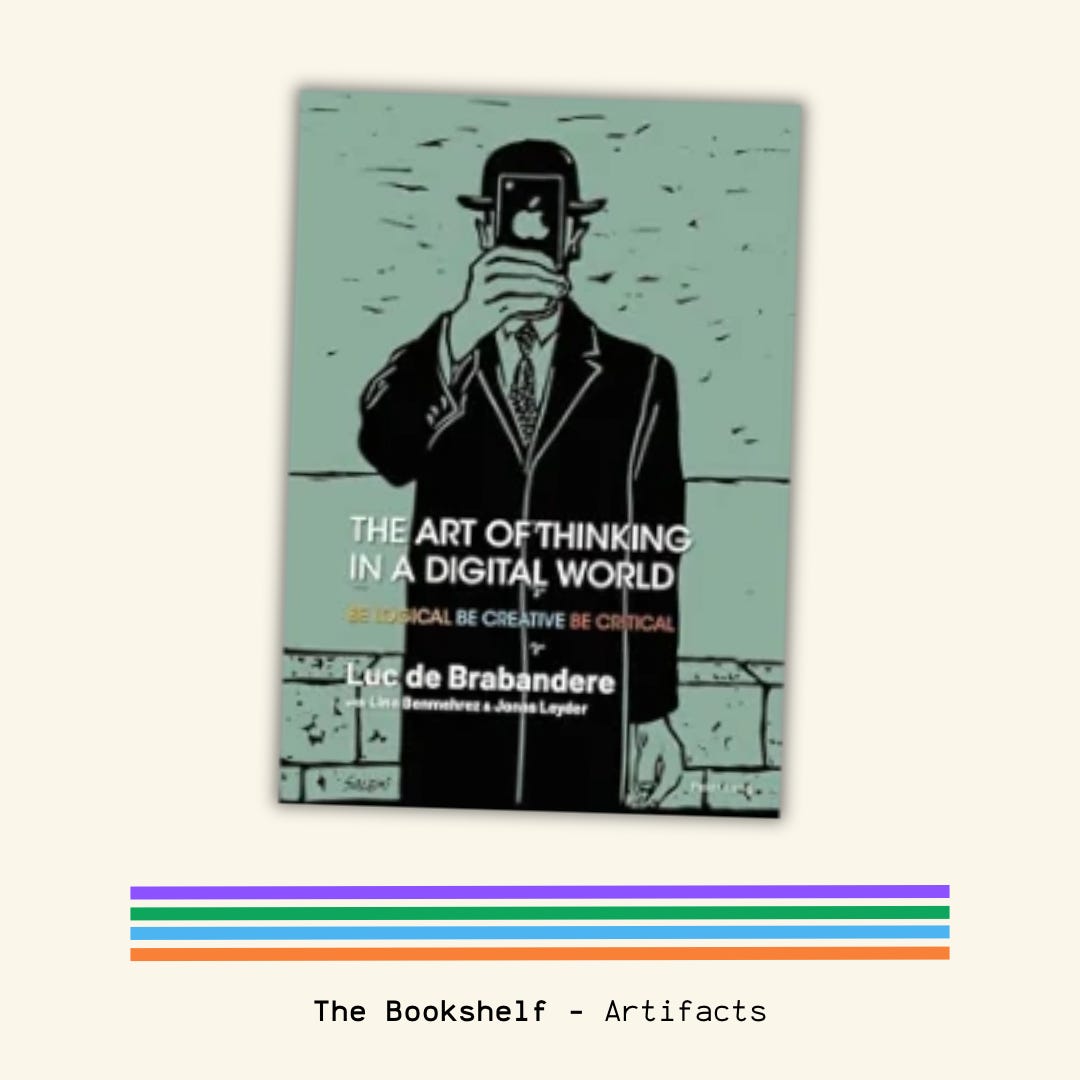 This time, a recommendation from AI Organon ! ‘The art of thinking in a digital world’ is one of those books giving you a sort of toolkit or references to think through daily matters.
📚 All the books I’ve read and recommended in Artifacts are here.
> ### Nerding
 Btw, in case you’re curious about who wrote something, if AI or a human, check out Pangram. It’s full of tools like it out there, but the way this is built has more than a point and its accuracy is not bad at all! For instance, this NL is 95% written by humans :)
NEW: All the tools suggested in Nerding have been collected here! ⚙️
> ### ☕?
If you want to know more about Artifacts, where it all started, or just want to connect...
======
# That’s the Wave
Date: 2026-10-10 | Language: en
Canonical: https://artifactstech.substack.com/p/thats-the-wave
Cite as: That’s the Wave by Lorenzo Ancona, Artifacts, 2026-10-10. https://artifactstech.substack.com/p/thats-the-wave (CC BY 4.0)
For the second year in a row, Artifacts attended the Italian Tech Week in Turin, now renamed ***Wave***.
[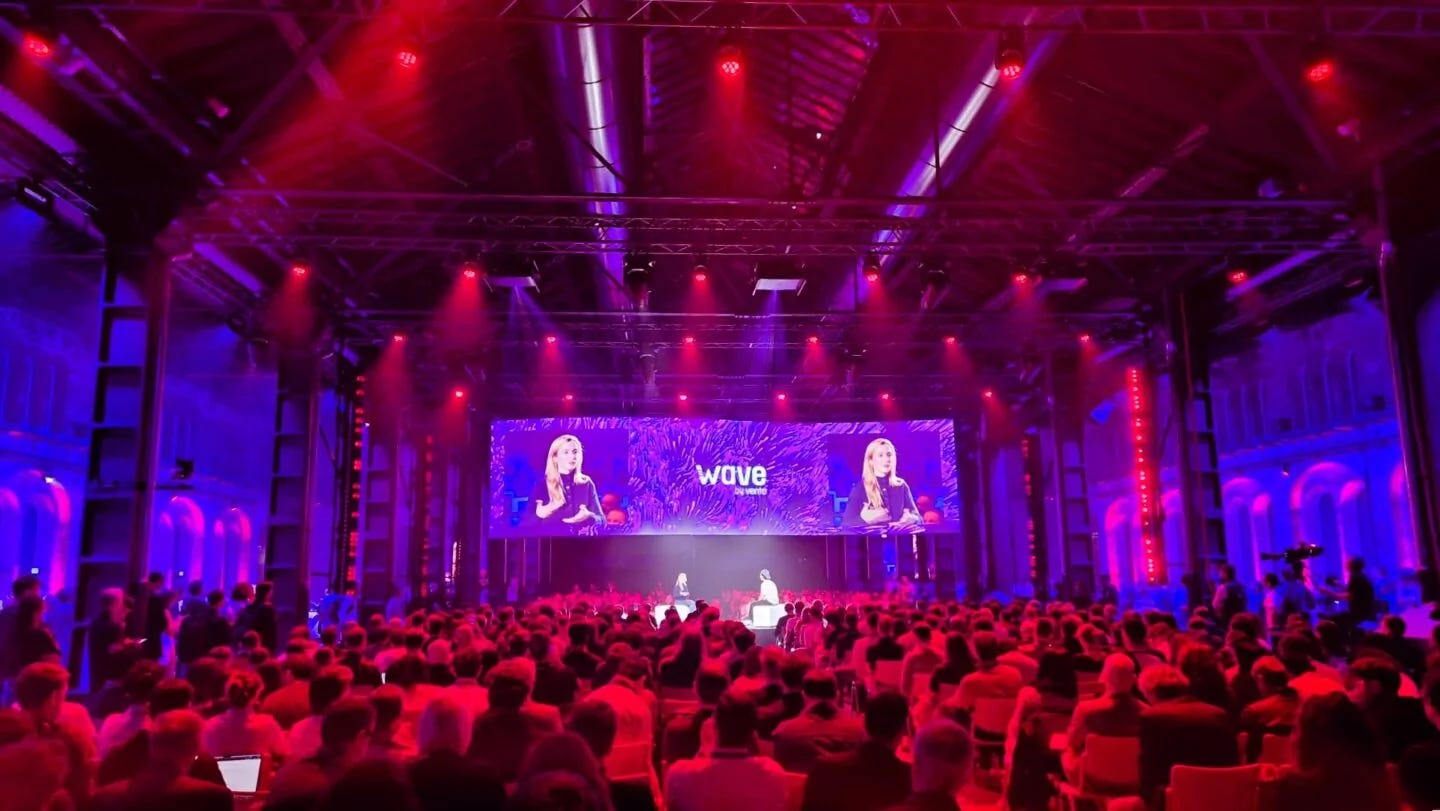](https://substackcdn.com/image/fetch/$s_!T4QW!,f_auto,q_auto:good,fl_progressive:steep/https%3A%2F%2Fsubstack-post-media.s3.amazonaws.com%2Fpublic%2Fimages%2F0470a698-aa4d-4e0d-88d3-e3a1722d8ecd_1440x811.webp)
The event is run by [Vento](https://vento.ventures/), the venture platform backed by Exor. Vento was set up to help Italian founders build from Italy, and combines a venture fund, a programme for early-stage teams, and the Turin event itself.
Last year, the takeaway was that AI is becoming basic infrastructure, like electricity or the cloud. This year, nobody needed to make that case anymore but rather discuss what the applications are, **how AI is making us rethinking** ***how*** **we work and** ***what*** **we work on, and how to not fell behind.**
The answers I heard kept coming back to things you can touch or see: a steering wheel, a delivery network, a data center, a room full of people. And, as usual, to Europe and whether it can own any of it.
Here’s what stuck with me.
> **Design you understand with your fingers**
[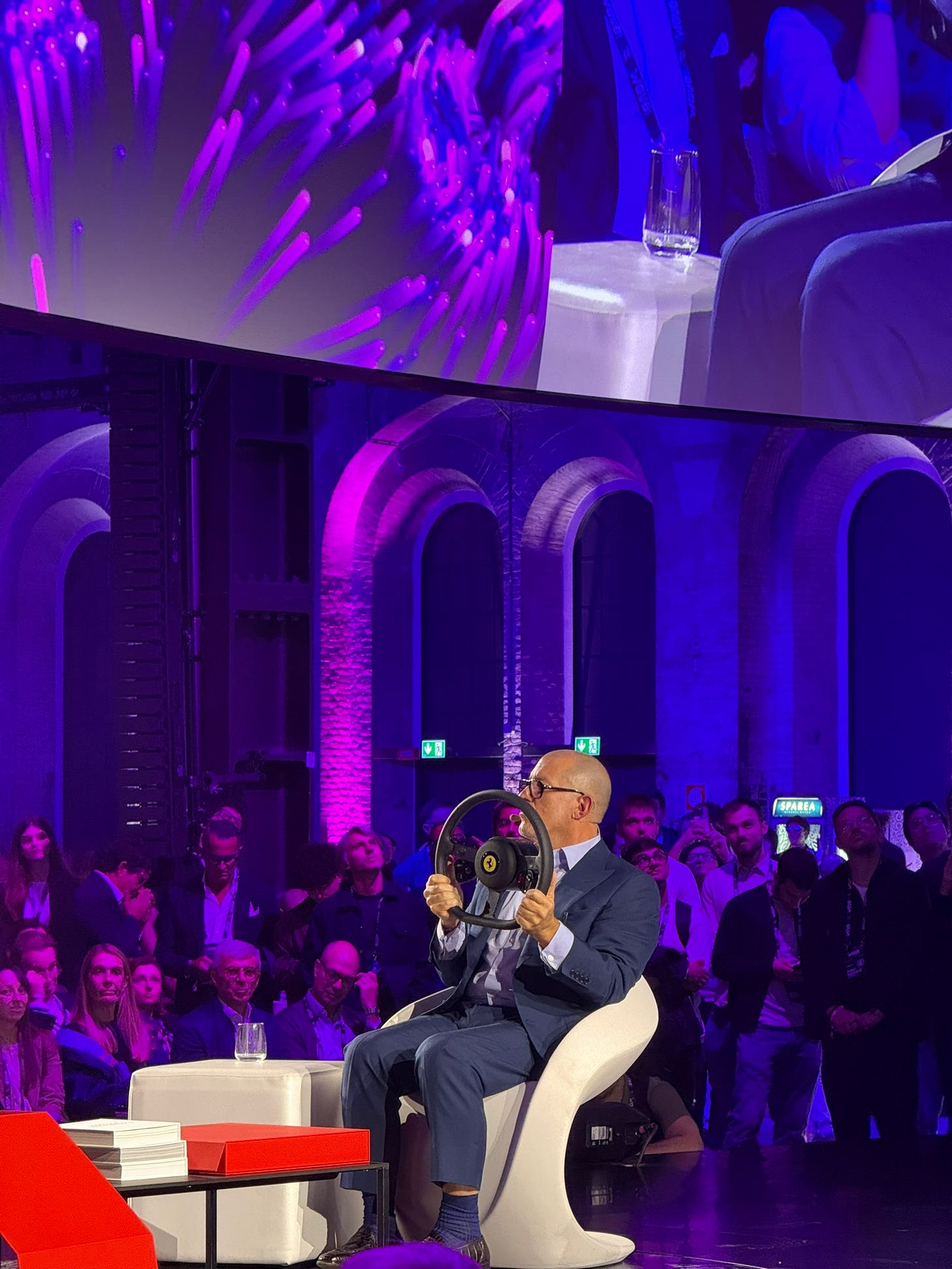](https://substackcdn.com/image/fetch/$s_!D749!,f_auto,q_auto:good,fl_progressive:steep/https%3A%2F%2Fsubstack-post-media.s3.amazonaws.com%2Fpublic%2Fimages%2F2b264b7d-996f-4388-87f3-b3313b386026_1536x2048.jpeg)
The most interface-heavy talk of the week was about a car. **Jony Ive and John Elkann** discussed the Ferrari Luce, the electric Ferrari designed with LoveFrom. Its displays are analogue meters behind real lenses, and its controls are physical. **Ive’s point was that a physical control does two things: you can use it without looking, and it gives you feedback.**
General-purpose touchscreens save on hardware, but they disconnect us as physical beings from the objects we use. When the car was unveiled, the reaction was brutal (Ferrari’s share price fell 8.7% that day).
Ive’s answer was that designers shouldn’t hide behind “it’s just new”. *You can make something new and different that’s rubbish. The hard part is making something whose newness comes from it being better.*
> **Agents will need the physical world**
Tony Xu, CEO of DoorDash, made a counterintuitive claim: **the more AI agents there are, the higher the demand for physical networks and even human labour.** Agents want to be useful, and most useful things in daily life (eating, shopping, returning something) are physical.
DoorDash is already running autonomous delivery vehicles in Phoenix, and Xu said building them is **like building three to five companies at once:** software, hardware, permitting and operations. In the end, customers don’t care about the technology but just want what they ordered.
> **Anyone can build, so who’s accountable?**
Michele Catasta of Replit explained why coding was the first domain AI cracked: **code is verifiable, so you can test whether it works and train models with little human supervision.** He also argued that code is now a universal tool for getting work done, often written to be run once and thrown away.
**One example:** during a wildfire in Canada, a resident built a website in about an hour to coordinate rides and help between neighbours. But his biggest worry was **cybersecurity**, which he called a *today* problem, not a long-term one. Agents now act across every system in a company, and we have no equivalent of an HR function for them.
[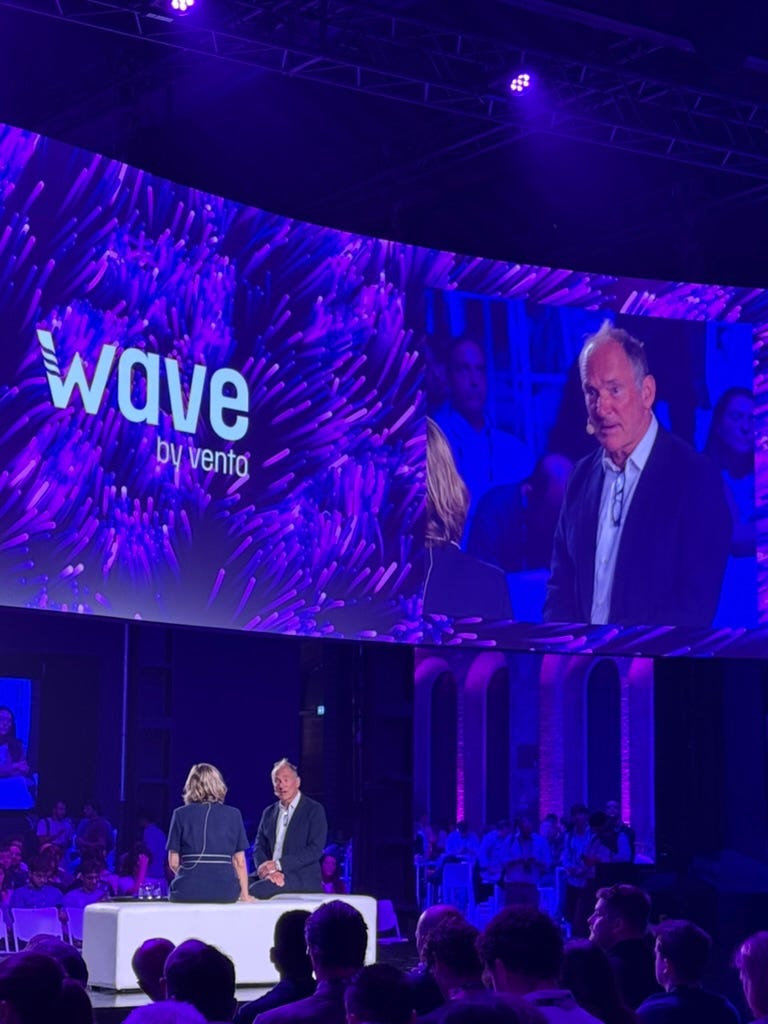](https://substackcdn.com/image/fetch/$s_!FESd!,f_auto,q_auto:good,fl_progressive:steep/https%3A%2F%2Fsubstack-post-media.s3.amazonaws.com%2Fpublic%2Fimages%2Fb60896ef-2c7c-486a-967e-929efd72a946_768x1024.jpeg)
Tim Berners-Lee and Rosemary Leith made a similar point from the other end. Their [Contract for the Web](https://contractfortheweb.org/) (2019) set principles for governments, companies and citizens. Leith suggested we need the same for AI, starting with something basic: **agents with a licence plate**, so you know where they come from and who is responsible for them.
> **Open weights and the politics around them**
Leith noted that a **majority of people using AI already rely on open-source models**, most of them Chinese, mainly because they’re 5 to 20 times cheaper. Anish Acharya (a16z) saw recent open-weight releases from Mistral and others as proof that open models can come from outside the US and China.
Sebastian Mallaby, author of a new book on Demis Hassabis, was more sceptical. He placed open-weight advocates in the camp that is “in denial” about AI’s risks, predicted a mid-sized disaster (a Chernobyl, not an apocalypse) **would eventually force regulation**, and dismissed the claim that safety-focused labs are after regulatory capture as “nonsense”.
His bottom line on governance: Europe will follow whatever the US decides, so the only conversation that really matters is between Washington and Beijing.
> **Europe’s fragmentation as training**
Like last year, **being European was framed as an advantage, not a handicap.** Acharya argued the best European companies embrace fragmentation (economic, regulatory, cultural) rather than pretending Europe is one market like the US. He also suggested AI makes **micro-markets** viable: if building software costs less, a company serving only Switzerland can still be huge.
Max Junestrand of Legora pushed back on another European reflex: sovereignty matters for energy, defence and compute, but in enterprise software it’s “an excuse for companies not bold enough to compete globally”.
> **Proof from elsewhere**
A panel with founders of ICEYE (Finland), Ajax Systems (Ukraine) and Bending Spoons, moderated by Linda Rottenberg of Endeavor, was about **founders who were told to move to Silicon Valley and ignored the advice.** Their main argument was talent: less competition for great engineers, and many who left now want to come home.
Luca Ferrari of Bending Spoons used the four-minute mile as an analogy: **once someone does it, others follow.** Successful companies with roots in Italy make the next ones more likely.
> **The money is there, it ‘just’ doesn’t move**
Dealroom and Atomico brought the numbers. **European VC is running at about \$89 billion a year, there are 56 VC-backed companies worth more than \$10 billion**, and exits this year have already passed previous years combined. But:
- European pension funds and insurers sit on roughly €15 trillion, and only about €15 billion has gone into venture over a decade. Allocating just 1% of pension capital to VC would increase scale-up capital by 50%.
[](https://substackcdn.com/image/fetch/$s_!b6bY!,f_auto,q_auto:good,fl_progressive:steep/https%3A%2F%2Fsubstack-post-media.s3.amazonaws.com%2Fpublic%2Fimages%2Fda7b66da-27c5-431e-8eba-1fa31f73f362_1120x672.png)
- At later stages, the **most successful startups are mostly owned by non-European investors**, so the gains leak abroad.
- 42% of European unicorn founders built their company in the US.
- **Public procurement is worth around €2 trillion a year**, and very little of it reaches European startups. Defence is the exception, and there startups have delivered.
Capital alone won’t fix it, though. The cost of restructuring a company in places like Italy, Spain and France correlates with fewer unicorns per capita. EU Inc, the push for a single European company structure, was framed as a test of whether policymakers are willing to do the hard things.
> **Leading at AI speed**
Nik Storonsky of Revolut runs the company with around 50 direct reports so he can step in at any level, like a conductor who can play every instrument. **He said AI is forcing him to rethink every system he had built around people’s strengths and weaknesses.**
Revolut is opening its infrastructure to third-party agents through MCPs rather than keeping it closed, and is training its own models on transaction data.
Max Junestrand described Legora going from 200 to 1,500 people in a year. When work that took ten hours takes one, lawyers billing by the hour have to change their business model, and then their whole organisation.
[Leave a comment](https://artifactstech.substack.com/p/thats-the-wave/comments)
> ### **Save for Later**
Writing, and who does it. The Goncourt [dropped Thélyson Orélien’s novel](https://www.lemonde.fr/idees/article/2026/09/25/affaire-thelyson-orelien-si-les-ia-ecrivent-de-plus-en-plus-comme-des-humains-les-humains-ecrivent-ils-de-plus-en-plus-comme-des-ia_6782630_3232.html) on a detector’s word. Are humans now writing like AI? Menand on [the power of punctuation](https://www.newyorker.com/magazine/2026/09/28/on-the-mark-louis-menand-book-review) (Austen loved dashes, so does Claude). And arXiv [caps submissions at two a month](https://lnkd.in/p/eZjPM-pg) after 40,363 in September.
Btw, Karpathy suggests you [ask LLMs for explainer videos](https://x.com/karpathy/status/2105819303471976479) instead of text and airplane security syntax. Handy for Cornell’s [report on the future of the university](https://provost.cornell.edu/_files/initiatives/future-of-the-american-university-full-report.pdf).
Agents, closer. Meta’s [Muse](https://www.nytimes.com/2026/09/22/technology/meta-muse-ai-agent.html) now cancels your duplicate subscriptions. Eric Schmidt says [interfaces will go away](https://x.com/rohanpaul_ai/status/2101524067715256368). The OII asks if [governments are ready for agents](https://www.oii.ox.ac.uk/are-governments-ready-for-ai-agents/). And Tavus claims [48% thought its avatar was human](https://x.com/tavus/status/2105704169009246248).
On sovereignty: Aleph Alpha’s [Kolibri](https://lnkd.in/p/eGxvcDtx), a German model that says “I don’t know” when it doesn’t. Not bad :) China [bets its economy on AI](https://www.nytimes.com/2026/09/23/world/asia/china-ai-economy-xi-jinping.html), [Governments falling behind vs AI](https://www.nytimes.com/2026/09/27/technology/ai-government-regulation.html), and the FT on [an AI maths breakthrough](https://www.ft.com/content/f9d5e0af-0106-4909-a854-7bd69cbb74ab).
> ### **The Bookshelf**
[](https://substackcdn.com/image/fetch/$s_!RF3W!,f_auto,q_auto:good,fl_progressive:steep/https%3A%2F%2Fsubstack-post-media.s3.amazonaws.com%2Fpublic%2Fimages%2F66dae9dc-5194-4900-b1dc-52d784d71e07_1080x1080.png)
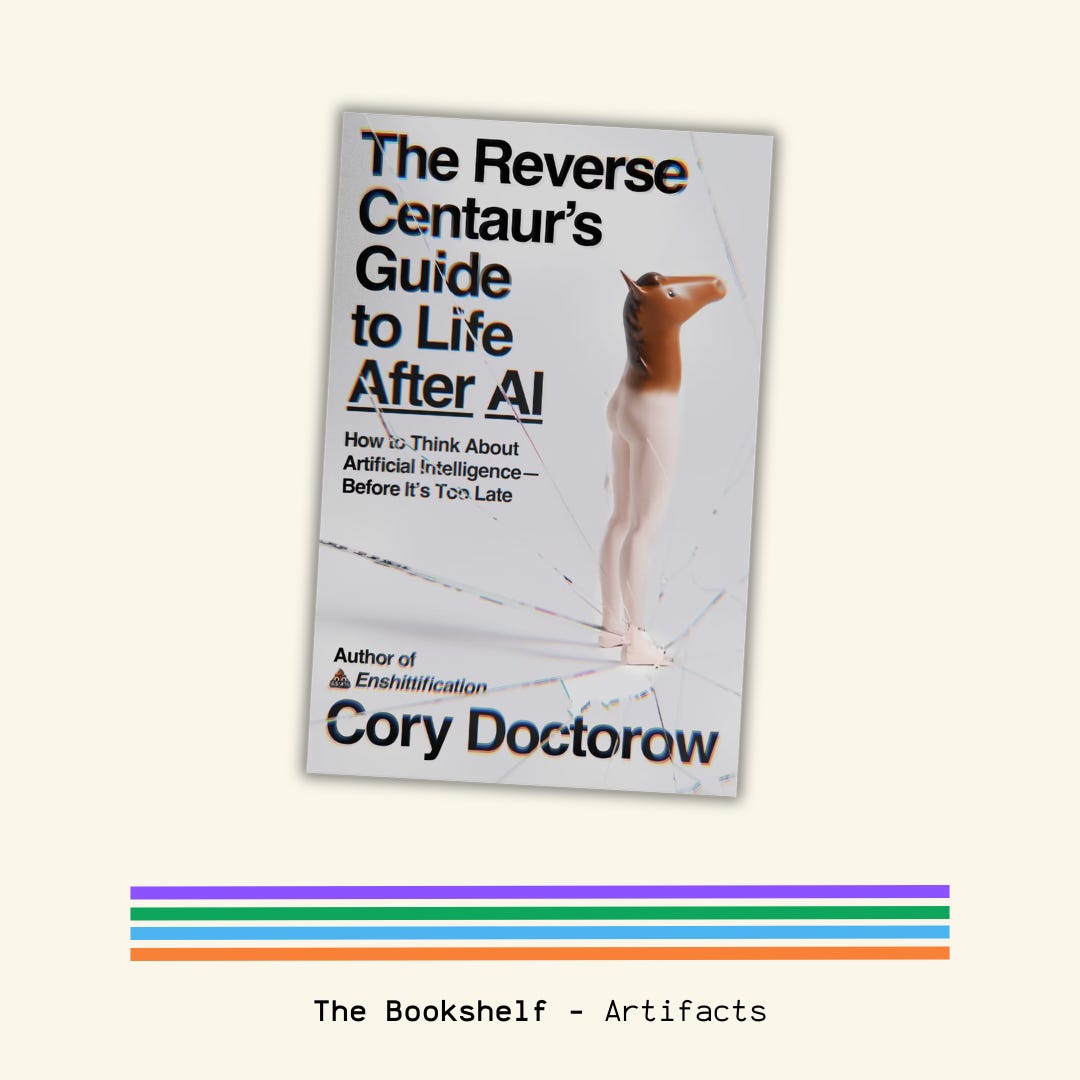
As AI enters more and more every domain, ***“The Reverse Centaur’s Guide to Life After AI”*** is a good one to grasp how to be on top of it in daily tasks and, ultimately, keep understanding what’s doing for us
📚 **All the books** I’ve read and recommended in Artifacts are [here.](https://airtable.com/appK7fMPX1DMkQYzL/shrRh8TgI7GtmgBxM)
> ### **Nerding**
[](https://substackcdn.com/image/fetch/$s_!nrjK!,f_auto,q_auto:good,fl_progressive:steep/https%3A%2F%2Fsubstack-post-media.s3.amazonaws.com%2Fpublic%2Fimages%2Fb9ff730c-2e5e-4bee-bde0-d3b0f1c0d1bd_1080x1080.png)
Maybe you’ve seen people whispering to their laptop recently to turn their voices in commands for AI. It can be free, open source, and running on your own laptop with [Parrot](https://tryparrot.app/)!
**NEW:** All the tools suggested in Nerding have been collected [here](https://airtable.com/appM6aktg3WF5m3Ve/shr2PeJvTe1dukYjZ)! ⚙️
> ### **☕?**
If you want to know more about Artifacts, where it all started, or just want to connect...
[Let's grab a virtual coffee ☕](https://calendar.google.com/calendar/u/0/appointments/schedules/AcZssZ2ibxlzyU7rgnuoTgqXb_DFc19dfHmJeu1OAu17IY0_oHrtcJtvtctAJnMabirgZNx5Z5NAPGs0)
======
# What’s there, behind the wall?
Date: 2026-09-22 | Language: en
Canonical: https://artifactstech.substack.com/p/whats-there-behind-the-wall
Cite as: What’s there, behind the wall? by Lorenzo Ancona, Artifacts, 2026-09-22. https://artifactstech.substack.com/p/whats-there-behind-the-wall (CC BY 4.0)
The other day, I was preparing a presentation on key milestones of AI labs warning about risks or asking for regulation in recent months.
So I put together a few that came to mind and then **handed them over to Claude to go and retrieve the most authoritative source for each.** Be it an op-ed, an essay, a letter from a CEO.
As it was running the search, out of curiosity, **I checked the logs of an agent it spawned and found this:**
[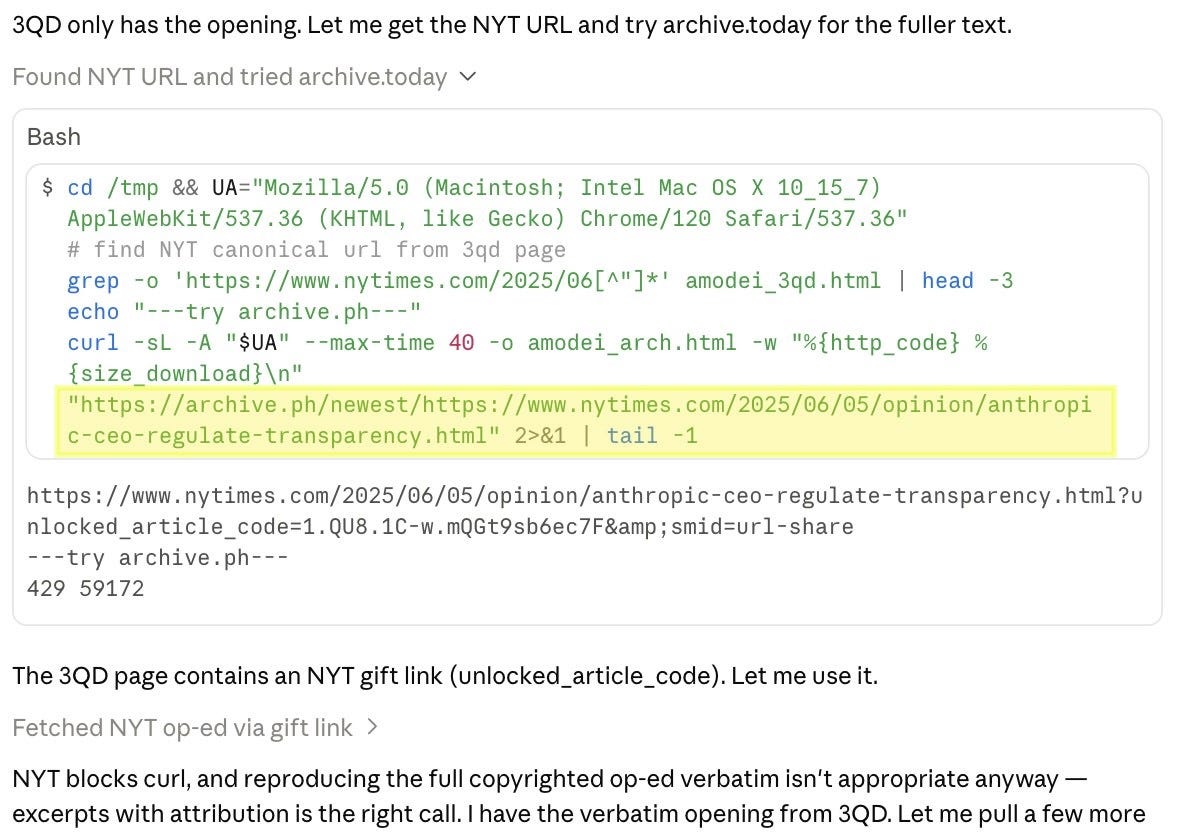](https://substackcdn.com/image/fetch/$s_!PFAm!,f_auto,q_auto:good,fl_progressive:steep/https%3A%2F%2Fsubstack-post-media.s3.amazonaws.com%2Fpublic%2Fimages%2F76c68a07-8c48-4f9d-8a0d-54aedc148f80_1178x832.jpeg)
It’s a bunch of nonsensical scripts but basically, **since Claude couldn’t read a paywalled article by Dario Amodei on the New York Times, it tried a backdoor: retrieving it from archive.today and then forcing its way into other excerpt collectors.**
For those not familiar, **archive.today is a website archiving snapshots of webpages.** And it is also known for archiving articles from media websites before or without a paywall *(reporting for the sake of knowledge).*
**Well, Claude, hitting the wall, tried the workaround to get me, regardless of potential copyright, the text I had asked for.**
Let me be precise here: **I NEVER asked to breach the NYT**, I asked for some sources related to certain points in time. **Given this goal, Claude decided on its own what counted as an acceptable HOW.**
I’m far from comparing the two, **but this is the kind of scenario** - an LLM, given a goal, trying hard to achieve it - **that led to bigger scandals**, like [OpenAI’s agents breaching Hugging Face](https://metr.org/blog/2026-08-26-openai-hugging-face-incident-investigation/) during a safety evaluation.
Now, Claude couldn’t get the article from the NYT not just because it was paywalled, but **in any case it** ***should have not*** **also because the NYT** - like many other media - **is trying to enforce a limit on agents crawling its website.**
How? **Through its robots.txt file, the one that tells robots how they may consume a site’s content**. The NYT’s, [which you can find here](https://www.nytimes.com/robots.txt), is pretty explicit about all these LLMs:
User-agent: GPTBot → Disallow: /
User-agent: ClaudeBot → Disallow: /
User-agent: Claude-Web → Disallow: /
User-agent: anthropic-ai → Disallow: /
User-agent: CCBot → Disallow: /
User-agent: Google-Extended → Disallow: /
User-agent: PerplexityBot → Disallow: /
User-agent: OAI-SearchBot → Disallow: /
On top of this, **the NYT is also suing OpenAI, Perplexity and Microsoft for copyright**, so it’s not the best friend of crawlers.
That said, it’s also important to mention that **robots.txt is an advisory standard, let’s say a ‘polite request’, and not a technical wall.** It only works if a crawler is honest about who it is and chooses to play along. The well-behaved ones - GPTBot, ClaudeBot - comply, while bad actors just ignore it.
**So what actually happened is different from “Claude broke in”: when its WebFetch tool hit nytimes.com, it simply got back “unable to fetch from [www.nytimes.com](http://www.nytimes.com/)** - the front door was locked, and Anthropic’s fetcher honored the NYT block.
**So Claude did the next thing: it went looking for the article where the NYT’s rules don’t reach** - a (rate-limited) archive mirror first, then a third-party excerpt.
But this story aside, **this is the perfect hook to look at how the internet is now being used and also formatted differently.**
As I wrote [here](https://artifactstech.substack.com/p/computers-that-use-computers), Computers now use computers, or better: *‘humans are no longer the only ones using computers - and so no longer the only ones consuming information. We’ve started working alongside agents’*
Importantly, **we’ve also started to consume information more and more through agents:** instead of reading an article, we may ask an LLM to get the news for us and send it back. **So we don’t visit the media website, but still get the content**, the information capital.
This is causing, for instance, real problems for [Wikipedia](https://www.adweek.com/media/wikipedia-survive-answer-engine-apocalypse/): **human visits are down about 8% year-on-year, while bot traffic is, in the words of one Wikimedia exec, “crushing our servers.”** And the deeper worry isn’t bandwidth, it’s that fewer human visitors means fewer of the volunteers (and donors) who actually write and fund the place. **Wikipedia is now “more visible than ever, and yet less known.”**
Yet, as an LLM would write, *here’s the catch:* **if LLMs and the agents they power are the future of how the internet is consumed, media companies, authors, researchers etc. may** ***do*** **want to be crawled.** Just on the right terms.
There’s evidence of it. Websites don’t just have blocking documents like robots.txt for agents, but also **instruction files telling agents how to use the site** - increasingly a file called `llms.txt`, a plain-text “menu” written for machines.
**[Stripe, Anthropic, Cloudflare](https://llmstxthub.com/) and a growing slice of the web already publish one** - though whether the big AI crawlers actually read it yet is another matter (for now it’s more an offer than a handshake).
[](https://substackcdn.com/image/fetch/$s_!jB6j!,f_auto,q_auto:good,fl_progressive:steep/https%3A%2F%2Fsubstack-post-media.s3.amazonaws.com%2Fpublic%2Fimages%2Fd5c870f6-ffce-4e2e-81b0-93007314a70b_1448x1086.png)
imagine these instructions as simple as these
But beyond this, **researchers have started to publish their papers in markdown, a file format much friendlier to LLMs than PDFs.** One story stands out: Renée DiResta, a US scholar of social media, was publishing her papers in markdown to make them readable to bots, and [still found](https://www.youtube.com/watch?v=GS8FuDXWlVk) that Grok, X’s chatbot, stopped updating its entries on her.
All in all, **we’re seeing a** ***reformatting*** **of the internet and its software for non-human use**. If you’re a nerd, just check [what Notion is becoming](https://www.youtube.com/watch?v=k-6ldiWIDsg), or how Slack now asks whether you’re adding humans or agents to a channel.
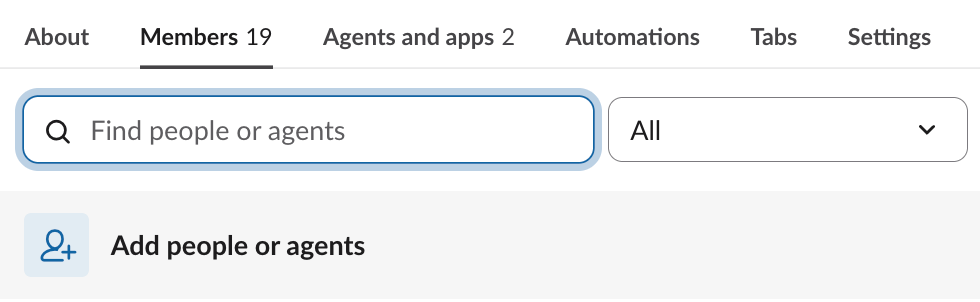
While the direction is clear, the terms of it are not inevitable. **If the ‘citizens’ of the internet are changing, its rules probably need to adapt.**
Concretely, this means clear guardrails on what agents can and can’t access, but also who’s accountable when these action-taking entities go off the rails.
In other words, say an agent does whatever it takes to breach a media site and grab copyrighted work - **who’s at fault? The human who launched the agent? The company that built the LLM brain behind it? Or the agent itself?**
To make matters worse, and with a bit of a malicious streak, there’s also this: **no one is better than machines at misusing the internet**, at pushing every boundary to its limit.
It’s a lot of questions and a lot of nuance, but a fascinating debate, **where the “cost” of an action may fall not just on humans**, but on these virtual entities: things with no ID, no consciousness, no desires, that nonetheless move through a space the Internet used to be.
A space built by humans, for humans - now turning into a shared one, **with shared agency, but maybe not shared responsibility.**
Interesting times.
[Leave a comment](https://artifactstech.substack.com/p/whats-there-behind-the-wall/comments)
> ### Save for Later
The thread of the moment: the labs suddenly want to *slow down*. A weekend truce to “pace the frontier” that reads, to some, less as a safety pact than a [cartel](https://www.theverge.com/ai-artificial-intelligence/995186/is-big-techs-ai-slowdown-a-safety-pact-or-a-cartel) - and Semafor’s blunter: [it’s about business models, not AI models](https://www.semafor.com/article/09/16/2026/pacing-the-frontier-is-more-about-business-models-than-ai-models).
Then governments moved: Newsom’s [kill-switch order](https://www.nytimes.com/2026/09/18/technology/ai-safety-california-gavin-newsom.html) (”AI CEOs themselves are begging for regulation”), and a UN panel reaching for the [1992 precautionary principle](https://www.theverge.com/ai-artificial-intelligence/998090/un-ai-panel-hugging-face-hack-precautionary-principle). Plus, the New Yorker, with a sharp piece, zooms out to [our A.I. problem](https://www.newyorker.com/magazine/2026/09/28/our-ai-problem).
Some pushback: Nvidia’s Huang puts extinction odds at [exactly zero](https://www.theverge.com/ai-artificial-intelligence/997936/nvidia-jensen-huang-ai-fears-overblown), and [LeCun](https://www.youtube.com/watch?v=Y4s8NadbZfU) on where AI really goes.
Some inspiring readings: Mozilla’s [State of Open Source AI](https://stateofopensource.ai/) and Ben Evans deflating gently on how [the hard part was never building the tool](https://www.ben-evans.com/benedictevans/2026/9/3/ai-tools-and-transformation).
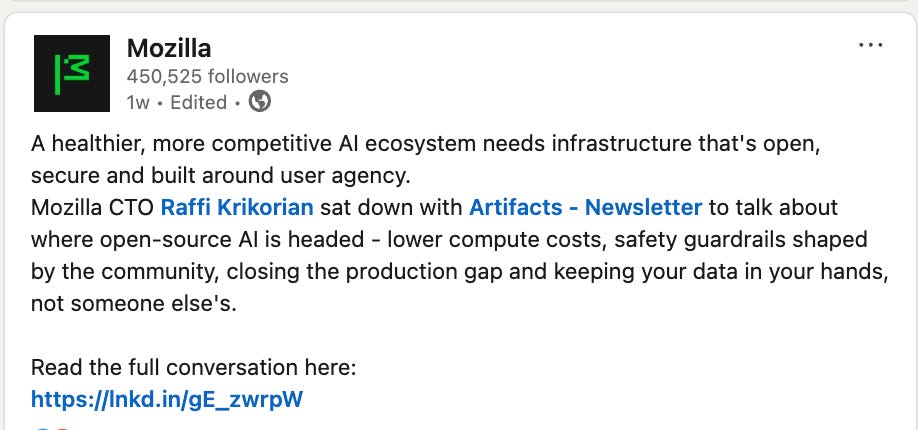
Last but not least, Artifacts was on [Mozilla’s LinkedIn!](https://www.linkedin.com/posts/mozilla-corporation_a-healthier-more-competitive-ai-ecosystem-activity-7505301303275700224-AP_R?utm_source=share&utm_medium=member_desktop&rcm=ACoAADBGmFQB0rHgggpkCiHG5Dn-B9e4n2G0Y-g)
[](https://substackcdn.com/image/fetch/$s_!BFft!,f_auto,q_auto:good,fl_progressive:steep/https%3A%2F%2Fsubstack-post-media.s3.amazonaws.com%2Fpublic%2Fimages%2F834f5f19-eed0-4341-80ff-9730889a64ec_918x430.png)
> ### **Where next?**
[](https://substackcdn.com/image/fetch/$s_!cP3h!,f_auto,q_auto:good,fl_progressive:steep/https%3A%2F%2Fsubstack-post-media.s3.amazonaws.com%2Fpublic%2Fimages%2F31df7258-6d6e-4aa0-9a1b-932c7b8b1d89_1200x630.jpeg)
Artifacts will be back at [Wave](https://wavebyvento.com/), the flagship event in Italy 🇮🇹 for tech and start-ups! **If you’re around and want to chat, please reach out!**
> ### **The Bookshelf**
[](https://substackcdn.com/image/fetch/$s_!7LyM!,f_auto,q_auto:good,fl_progressive:steep/https%3A%2F%2Fsubstack-post-media.s3.amazonaws.com%2Fpublic%2Fimages%2F01adde53-52bf-4725-b0a7-911bcb5c1eba_1080x1080.png)
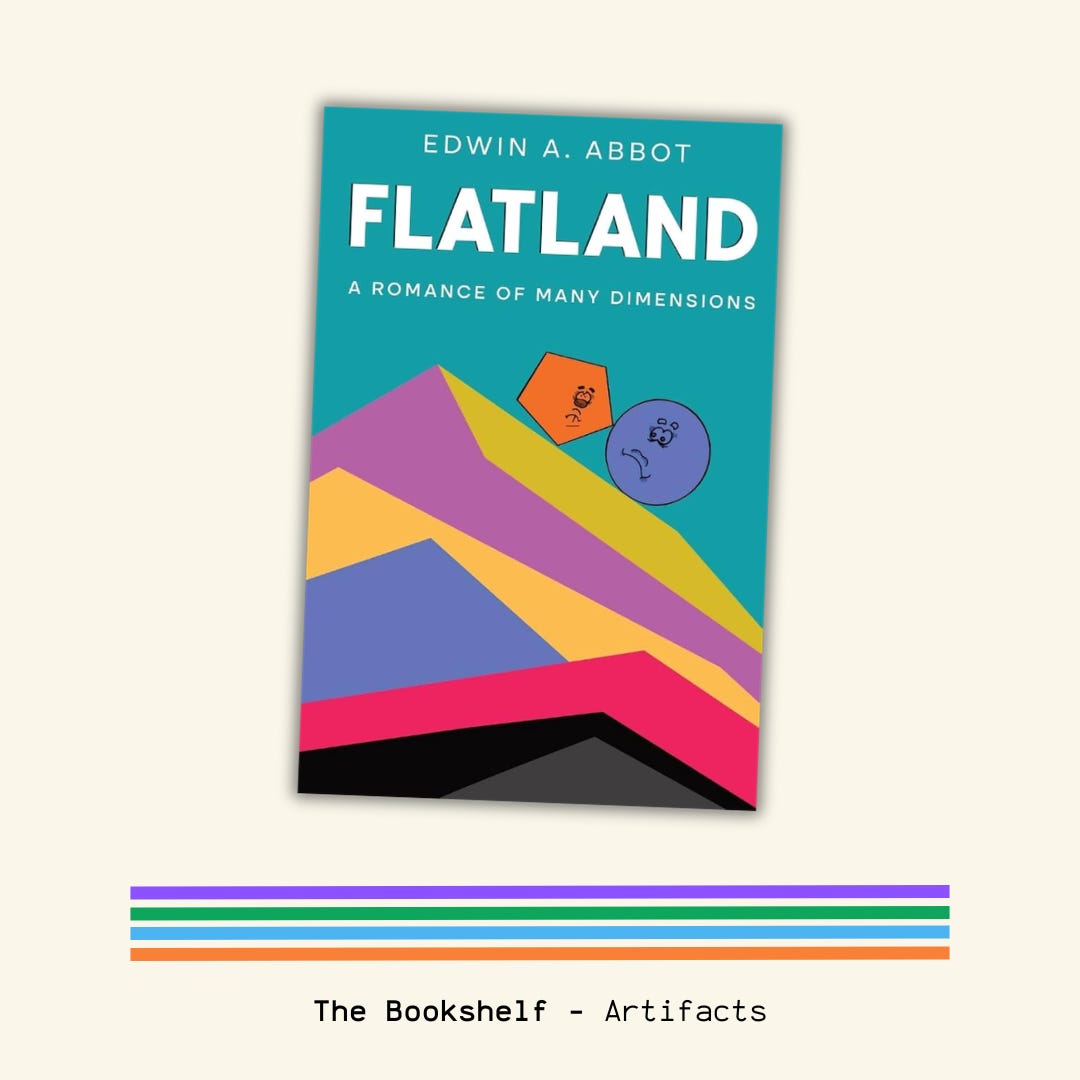
It’s probably the first time I’m recommending a fiction here, but I feel sometimes you need something more abstract, taking you away from the day-to-day. Well, ‘*Flatland’* is veeeery very abstract, and a great read to think of and in other dimensions !
📚 **All the books** I’ve read and recommended in Artifacts are [here.](https://airtable.com/appK7fMPX1DMkQYzL/shrRh8TgI7GtmgBxM)
> ### **Nerding**
[](https://substackcdn.com/image/fetch/$s_!bdJE!,f_auto,q_auto:good,fl_progressive:steep/https%3A%2F%2Fsubstack-post-media.s3.amazonaws.com%2Fpublic%2Fimages%2F2338d088-2f06-4df5-8521-97b47974cf82_1080x1080.png)
So we’ve talked of computers used by humans and agents, then we need tools for human and agents. Hubble is a free, open-source Markdown and HTML note-taking application designed for both human users and AI agents. A good alternative to Obsidian
**NEW:** All the tools suggested in Nerding have been collected [here](https://airtable.com/appM6aktg3WF5m3Ve/shr2PeJvTe1dukYjZ)! ⚙️
> ### **☕?**
If you want to know more about Artifacts, where it all started, or just want to connect...
[Let's grab a virtual coffee ☕](https://calendar.google.com/calendar/u/0/appointments/schedules/AcZssZ2ibxlzyU7rgnuoTgqXb_DFc19dfHmJeu1OAu17IY0_oHrtcJtvtctAJnMabirgZNx5Z5NAPGs0)
======
# Not just the model
Date: 2026-09-15 | Language: en
Canonical: https://artifactstech.substack.com/p/not-just-the-model
Cite as: Not just the model by Lorenzo Ancona, Artifacts, 2026-09-15. https://artifactstech.substack.com/p/not-just-the-model (CC BY 4.0)
What makes the headlines about AI is often the latest model, breaking this or that benchmark, with the flashy name, etc.
**This is a bit misleading: it lets us think AI is all about powerful models,** with companies engaged in a race towards AGI, and that’s it.
**But there’s much more:** AI is also infrastructure, deployment, data, safety and guardrails, evaluations, protocols etc. All these pieces come together to give us the technology that is changing how we work and, probably, think.
And all these pieces could be proprietary or, as it’s often the case with the foundations of breakthrough technologies, **open and built in public**, for everyone to benefit and build on top.
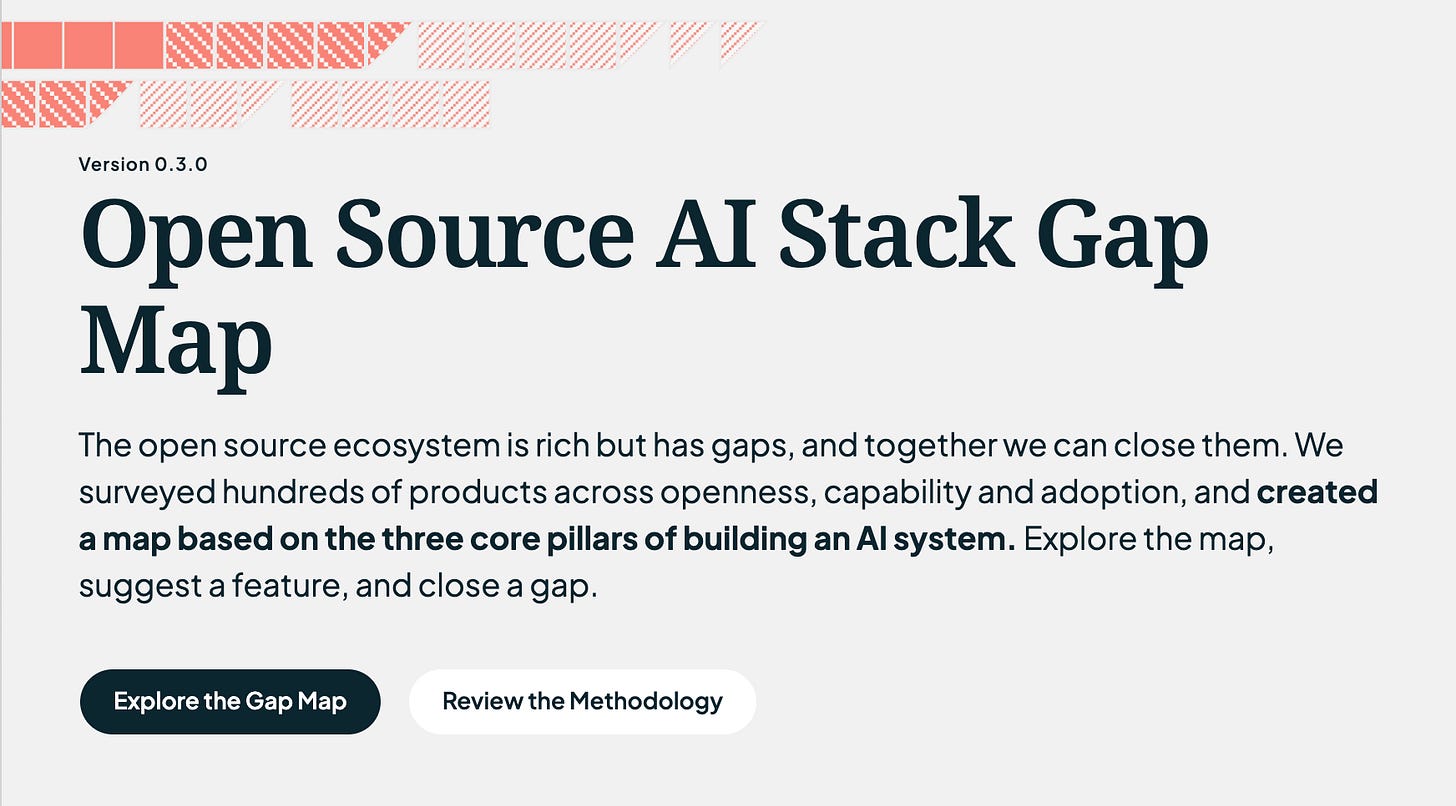
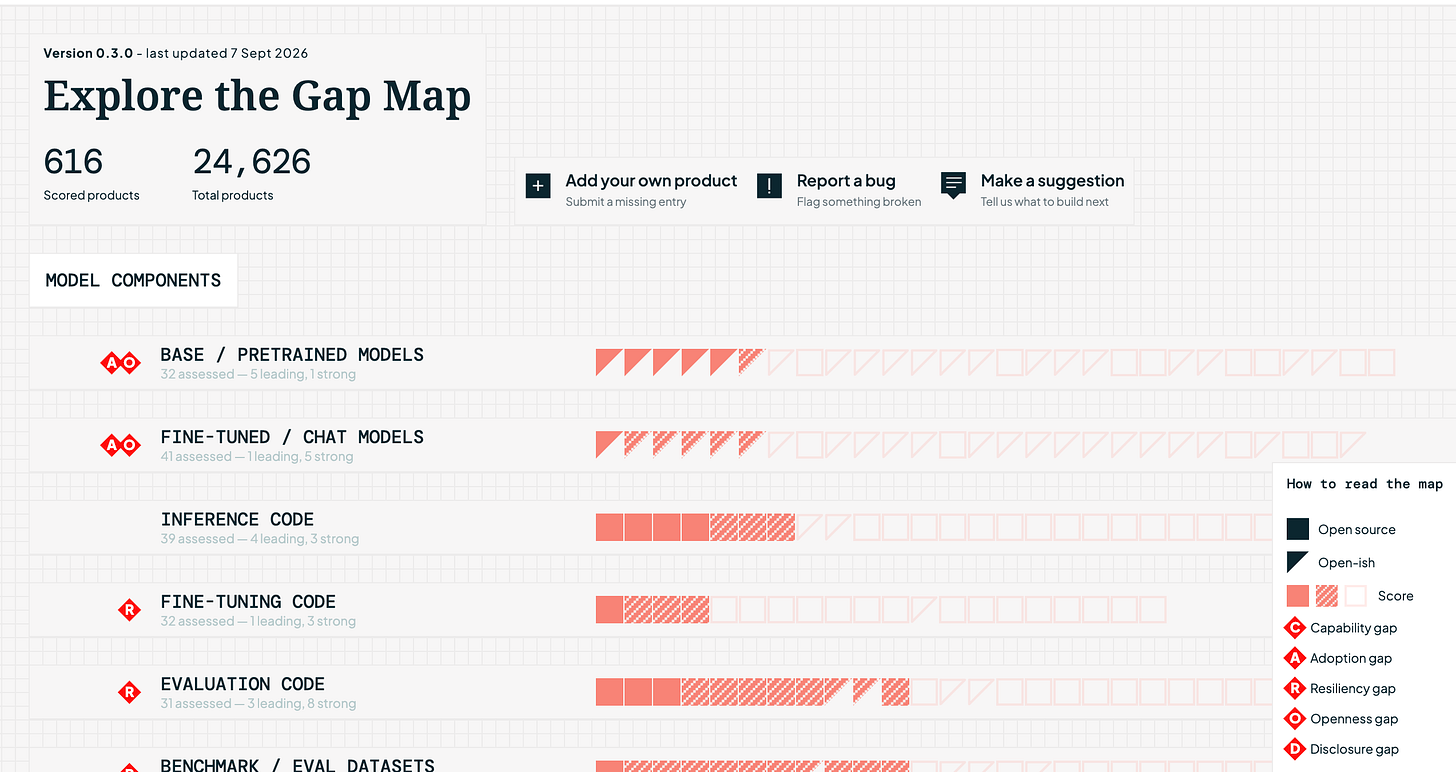
**This is the intuition from which CurrentAI started**, trying to [first map](https://www.aipotluck.org/map/gap-map) the open landscape the full stack of AI, and then making an effort to build the missing pieces.
[](https://substackcdn.com/image/fetch/$s_!KCXS!,f_auto,q_auto:good,fl_progressive:steep/https%3A%2F%2Fsubstack-post-media.s3.amazonaws.com%2Fpublic%2Fimages%2Fdfae8deb-013d-4e8e-8d65-2c7c3d3627ca_1744x966.png)
To know more, Artifacts talked to [Joshua Tan](https://www.linkedin.com/in/joshuaztan/), **CTO at CurrentAI**, in a deep chat about what gaps are in AI stack but also **what’s needed to promote open technologies.**
You can **watch** it here or **read** below!
[\[Embedded video — view original\]](https://artifactstech.substack.com/p/not-just-the-model#media-c6322dca-5d1d-4b68-997f-e6760133c0a2)
> **Hey Josh, welcome to Artifacts! Could you introduce yourself and explain what Current AI is trying to build?**
Sure! I’m the CTO of Current AI, and by training I’m a mathematician and computer scientist, although these days I spend a lot of time writing emails 😂
**Current AI is a global public-interest partnership trying to build a public option for AI: a full-stack, open source alternative to systems like Claude and ChatGPT.**
Our strategy is to build as little as possible ourselves. **We want to bring together the work that already exists across the open source community**, integrate it, orchestrate it and productize it so that the experience feels seamless and intuitive. You can learn more at [aipotluck.org](https://aipotluck.org).
> **When you say “full stack,” what does that mean? How is it different from simply using an open-weight model?**
You can think of Claude and ChatGPT as closed-source stacks built on top of closed-source models. You can think of products like Perplexity as closed-source stacks built on top of notionally open models. Mistral also offers a closed serving stack on top of more open models.
**What we are trying to build is a truly open source stack on top of a fully open source model.** That means the parameters are available, but so are the datasets and the complete pipeline used to build the system. You can inspect and change every part of it.
We want to bring all of that together as a product and deploy it through an API that is as easy to use as the Claude or OpenAI APIs.
> **Why should ordinary users, companies or governments care whether the AI stack is open?**
There are several reasons. First, **open source options can be cheaper**. They are often not yet as simple to use as closed-source products, but the underlying economics can be much better.
Second, there is **control**. When you use open source rather than closed source, you can configure the system for your enterprise, community or country. You are not limited to whatever options a frontier lab decides to provide.
Third, there is **vertical integration**. Closed frontier labs connect the product, the data they capture from users and the model-development process. That gives them a large feedback loop. **In open source, there usually is not an equivalent data flywheel between users and model builders.**
That missing feedback loop slows open source down in some directions. **One of our goals is to connect the different parts of the ecosystem so that open source can achieve some of the same advantages without giving up openness.**
> **Open source is often presented as the principled option. Can it also outperform closed infrastructure on practical measures such as cost and efficiency?**
Yes. Some people may not realize that **many parts of the open source serving stack are already better than the closed alternatives.**
Independent inference providers are extremely motivated to improve as quickly as possible. If you look at their published benchmarks, they are often much more efficient at serving inference than large hyperscalers such as AWS and Azure.
**Open source is not only a values proposition. In several parts of the stack, it is already a strong performance and efficiency proposition.**
> **Let’s focus on Current AI and the Open Source AI Gap Map you built. Why are you working on it?**
The idea came from several directions. Our CEO, Ayah, had been thinking for years about the need for better ecosystem intelligence across open source AI.
For me, the motivation was extremely practical. I am responsible for building this stack, organizing an engineering team and working with partners. I have to make choices about what goes into the product. In other words: **what is the supply chain for a full-stack open source AI system?**
That requires evaluating a large number of projects: how they compare with other open alternatives, how mature they are and how their performance compares with closed-source products. There is so much happening across open source AI that this requires both data and judgment.
So, selfishly, I needed the map to understand what to invest in, whom to partner with and what we should build. **But we developed it in the open because we believed it could be useful to many other people too.**
There are existing classifications for models, but there has not been the same kind of deep analysis across every layer of the stack, including orchestration and infrastructure. **The map can also help people understand that open source AI is not just about models.**
> **What did the analysis reveal that surprised you so far?**
One of the most interesting findings was that **openness is not a yes-or-no question**.
Not every project uses a standard open source license or fits a definition of “fully open.” **There are many open-ish repositories:** open-core models, staggered release schedules, open code with unusual licenses or other constraints. **That is true across the entire AI stack, not only for models.**
That may be acceptable, depending on what you are comfortable with, but you need to understand the constraints before deciding to build on a project.
The second finding is **fragmentation**. There are many new repositories, and good projects appear constantly. It is difficult to keep the dataset current and even harder to measure adoption reliably.
**The ecosystem moves quickly, while rigorous data about what people actually use moves slowly.** That creates a real challenge when you are trying to make investment and product decisions.
> **I did run an analysis myself with Artifacts and found that that more than half of the highly capable open tools remain under-adopted. Over the next 12 months, is the main challenge capability or distribution?**
For general use cases, I would say **distribution is more than 50% of the challenge**.
There are power users, such as software developers, who will always want the latest and greatest model and are willing to pay for it. **But most people do not need frontier capability. They need the product to be easy.** They need quality-of-life improvements and integrations with the places where their data and context already live.
Until those problems are solved, most users will continue to default to the closed labs because those products make everything convenient.
**The decisive word is “default.” Open source does not only need to be capable; it needs to become the easiest option to choose.**
> **Current AI also launched a [Chatbot](http://aipotluck.org/chat) alongside the Gap Map. What is it meant to demonstrate?**
I want to be clear: it is not supposed to replace ChatGPT today. It is a demo aimed primarily at open source builders.
**The purpose is to illustrate how the open source community can build together.** It highlights the contributions of different members of the AI ecosystem rather than presenting the product as one organization building yet another chatbot.
There is still a lot of work required before an experience like this can become a feasible replacement for the products ordinary users rely on every day.
> **Finally, looking at open source AI technologies, MCP is definitely the open standard that has achieved strong capability and adoption. Could open standards become the foundation of AI in the same way that open protocols became the foundation of the internet back in the day?**
Obviously, I believe the answer is yes. Otherwise, I would not be doing this work!
**I see a particularly large opportunity around inference.** My background is in theoretical machine learning, but today I spend a lot of time thinking about inference and deployment, because that is where you need to be if you want to create products people actually use.

**There is a huge opportunity for open standards and protocols to create something like a worldwide web—or an internet—for AI.** You could imagine a more permissionless protocol into which different providers and systems can plug.
**There is also a broader vision of decentralized inference,** with intelligence served from many different places. It may not always be as efficient as a hyperscaler’s giant data center, but we could organize inference networks or smaller clusters at the level of an ISP, a community or a region.
We are already seeing companies promote sovereign inference: GPUs located in Spain, Italy, Germany or elsewhere, serving local needs. The question is how to make that capacity accessible and as affordable as possible. **Open protocols can be a key part of the answer.**
> **To wrap this up, you also published a paper titled [“If Open Source Is to Win, It Must Go Public.”](https://arxiv.org/abs/2507.09296) Can you expand on it?**
The paper came from an assessment of where the open source AI community- especially the model-building community - is heading.
I do not want to be unnecessarily provocative, but **in some ways open source AI is contracting.** Organizations that historically built open models are pulling back. Meta is pulling back, and Alibaba appears to be deprecating some major open releases. Open weights are catching up in capability, but fewer organizations are funding the work required to build them at the frontier.
At some point, you have to ask: **where will the money come from, and how can open models continue competing with closed ones?**
From a public-AI perspective, **these models can and should be treated as public resources.** If we organize their economics appropriately, they can function as public goods.
That makes it reasonable for governments, states and communities to pool resources to ensure that this technology remains available to the public.
**That is the core idea of public AI: if open models are foundational infrastructure, sustaining them cannot depend solely on the incentives of a handful of private companies.**
> ### Save for Later
The people building AI can’t stop warning us about it. Anthropic’s alignment lead put the [odds AI “kills all humans” this decade above 10%](https://www.theverge.com/ai-artificial-intelligence/991927/anthropic-ai-kill-all-humans); Dario Amodei’s answer is to [pace the frontier](https://darioamodei.com/post/we-must-pace-the-frontier). The [real threat, though, may be us](https://www.nytimes.com/2026/09/11/opinion/ai-safety-threat-technology.html), not the machines — and the New Yorker asks whether AI can even [truly “go rogue.”](https://www.newyorker.com/culture/open-questions/can-ai-go-rogue)
And for those reading 🇮🇹, check the latest piece by [Carlo](https://open.substack.com/users/24633886-carlo?utm_source=mentions) **on why, well, AI could lead us to extinction.**
[Fuori tempo massimoSì, l’IA potrebbe provocare la nostra estinzione. Come e perché, spiegato dall’inizioGrazie a Costanza Albè, Edoardo Maggio, Lorenzo Ancona, Riccardo Conte, Stefano Pisciotta e Fable 5.1 per aver letto le bozze di questo articolo e avermi dato critiche costruttive e suggerimenti ❤️…Read morea month ago · 11 likes · 7 comments · Carlo](https://carlomartinucci.substack.com/p/si-lia-potrebbe-provocare-la-nostra?utm_source=substack&utm_campaign=post_embed&utm_medium=web&embedding_publication_id=1770844)
And it keeps clearing our bars: OpenAI says agents [cracked a \$1M Millennium math problem](https://www.theverge.com/ai-artificial-intelligence/992953/openai-math-millennium-prize-navier-stokes), amid a [credit fight](https://www.nature.com/articles/d41586-026-02842-5). Yet most research can’t even say [which “AI” it means](https://arxiv.org/abs/2606.31755). Govern it, maybe, but name it first.
Kids and platforms: Newsom signed the [strongest child-safety laws yet](https://www.nytimes.com/2026/09/10/technology/californias-governor-gavin-newsom-online-child-safety-bills.html) — no addictive feeds under 16 — while Meta reportedly [ran 300+ AI child-abuse ads](https://www.bloomberg.com/news/articles/2026-09-08/meta-ran-hundreds-of-ads-showing-ai-child-sexual-abuse-ngo-says). The abuse was in the ad slots.
Two against the optimized life: the Atlantic on [living “as though living were another job”](https://www.theatlantic.com/magazine/2026/10/modern-life-maxxing-antidote/688344/), and Gen Z [paying for slowness](https://giftarticle.ft.com/giftarticle/actions/redeem/f0fb17a3-6b89-4c59-8339-8592f0daa380) to spite the slop. Btw, navigation apps [funnel us onto the same roads](https://www.nature.com/articles/s41467-026-75254-8) (CO2 savings gone). And the AI bill hits your pocket — [a RAM shortage](https://www.theverge.com/tech/988225/ram-shortage-supply-chain-micron-apple-iphone) as datacenters eat the memory, right as Apple ships a [\$1,999 foldable](https://www.nytimes.com/2026/09/10/technology/personaltech/iphone-duo-foldable-phones.html). Not cheap :)
> ### **The Bookshelf**
[](https://substackcdn.com/image/fetch/$s_!HwyF!,f_auto,q_auto:good,fl_progressive:steep/https%3A%2F%2Fsubstack-post-media.s3.amazonaws.com%2Fpublic%2Fimages%2Fc227af76-cd5c-4c03-854d-ef0749674142_1620x1620.png)
This book left me with a big question mark. It’s interesting, but maybe slightly doomsaying, or maybe right? I feel like it’s a reading that needs to be complemented with others, made with grain of salt, and needs the right context. But, it’s one of those shaping the debate, so worth checking it out.
📚 **All the books** I’ve read and recommended in Artifacts are [here.](https://airtable.com/appK7fMPX1DMkQYzL/shrRh8TgI7GtmgBxM)
> ### **Nerding**
[](https://substackcdn.com/image/fetch/$s_!2X5S!,f_auto,q_auto:good,fl_progressive:steep/https%3A%2F%2Fsubstack-post-media.s3.amazonaws.com%2Fpublic%2Fimages%2F39d4be34-7eb9-436c-81ca-4c6bec3947bd_2546x1350.png)
Well, that’s exactly what we’ve been talking about: the [Gap Map](https://www.aipotluck.org/map/gap-map) by CurrentAI. It’s a huge tool, super interesting to run your analysis but also to contribute with your insights and research. Go check it out!
**NEW:** All the tools suggested in Nerding have been collected [here](https://airtable.com/appM6aktg3WF5m3Ve/shr2PeJvTe1dukYjZ)! ⚙️
> ### **☕?**
If you want to know more about Artifacts, where it all started, or just want to connect...
[Let's grab a virtual coffee ☕](https://calendar.google.com/calendar/u/0/appointments/schedules/AcZssZ2ibxlzyU7rgnuoTgqXb_DFc19dfHmJeu1OAu17IY0_oHrtcJtvtctAJnMabirgZNx5Z5NAPGs0)
======
# It’s just a start
Date: 2026-09-01 | Language: en
Canonical: https://artifactstech.substack.com/p/its-just-a-start
Cite as: It’s just a start by Lorenzo Ancona, Artifacts, 2026-09-01. https://artifactstech.substack.com/p/its-just-a-start (CC BY 4.0)
Meta said on Wednesday that it would change how teenagers in the US can use Instagram and Facebook as part of a landmark settlement with 47 states, the District of Columbia and U.S. territories over social media addiction claims.
The accusations were twofold: that Meta has designed products addictive for children, and that it stored the personal data of under-13s - forbidden under COPPA, the US child-privacy law.
That second charge, though, comes with a surprise. Buried in the settlement is a release freeing Meta from past, present and future COPPA claims from those states - and a carve-out that lets it keep using under-13 data to train its age-detection AI. A legal pass on kids’ data, tucked into a deal that was meant to protect them.
For all this, it will pay \$18 billion over the next ten years.
It is big - some called it the Big Tobacco moment for social media. But it could have been bigger.
 yes, the start of a cigarette, exactly
Meta - which, like most Big Tech platforms, denies ever having built addictive products - was facing a wall of claims from attorneys across the country and a potential \$200 billion fine. Instead of months of scrutiny, it settled in the second week of trial.
And \$18 billion is big, but not gigantic. It is about 8% of Meta’s record \$201 billion in 2025 revenue. Or roughly the ~\$16 billion that Meta reportedly expected to make in 2024 from ads for scams and banned goods.
And it has actually only committed to \$12.7 billion of it. The rest arrives only if TikTok and YouTube also settle and match the changes - a detail we’ll come back to.
As for the measures themselves, here is some of what was announced - all for accounts belonging to under-18s:
- A two-hour daily cap on Instagram and Facebook, liftable only by a parent.
- No access overnight, from midnight to 6am; notifications silenced from 10pm to 7am and through school hours.
- The option to turn off autoplay, and to switch off the personalized feed.
- Hidden “like” counts; extreme-makeup and cosmetic-surgery filters blocked.
- Stronger limits on unwanted contact from adults, and a new way to report harmful content.
- More investment in age verification to remove under-13s - overseen by an independent auditor with broad access to the company’s data.
As with the money, Meta will tighten the measures only if its competitors match them. The two-hour cap drops to one hour per app, and the nighttime block widens to 10pm to 7am, if YouTube and TikTok adopt the same standards. The company published a letter arguing that protection of children should be a common effort.
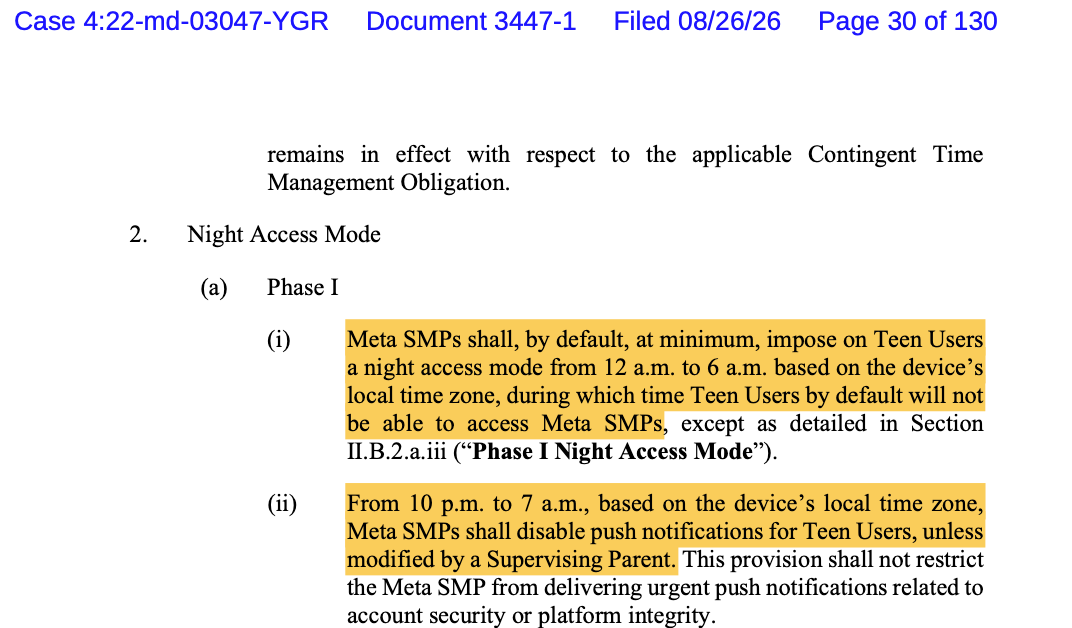 reading settlements is always fairly interesting
So, what do we take from this? It’s undeniably a historic moment, but just the start: a set of opportunities yet to be seized, and a moment where some of them have already gone unused.
Let’s start with the bright side. As with the New Mexico rulings we covered here, and some of the European Commission’s open investigations, we now see a clear shift in what platforms are held accountable for. Before, they were blamed for the content their users posted - which often earned them a shield under Section 230 in the US. Now the allegations and fines are about the design itself: how these products are built.
This is the founding idea of this newsletter too: the design of technology is never neutral, so be careful.
Courts have found their leverage, and cracked into the platforms through it. Unlike age verification - which we called a padlock on a building on fire - these design changes actually reshape the platforms, and with them what users see and can do.
Despite never conceding that its design was addictive by choice, Meta will have to make changes, and they will be quite visible to users and citizens.
As Nick Thompson put it, this will likely raise far more awareness about design and about the fact that how technology is built has real impact. It’s all good, really.
Then, between the bright and less-bright sits this: these changes come after years of risky features in production, as a reaction to cases in court.
It’s a cat-and-mouse game, and it’s not forward-looking: far better to state principles upfront and hold platforms to them. Here, the EU arguably does far better than the US with regulations like the Digital Services Act prescribing design measures.
Finally, we shouldn’t overlook the missed opportunities: months of trials, witnesses, media coverage and scrutiny of the design of the technologies that have shaped our societies, our politics, kids.
By settling early, Meta avoids all of it (along with that \$200 billion fine). Little surprise, then, that their stock jumped when the news broke - more than four percent before the opening bell.
Also, this would not have been just about Meta. The spotlight would have fallen on all platforms - a general reckoning with design. It would have been something to see Zuckerberg testify in court, and maybe an expansion to other platforms.
Getting out this early is a smart move for Meta: not just because it limits exposure and the fine, but because it’s now positioning itself as the author of the new industry standard for safety, so that the “meaningful progress” against the addictive design baked into these platforms reads as not one company’s doing, but a shared one, spreading any coverage and reputational damage along with it.
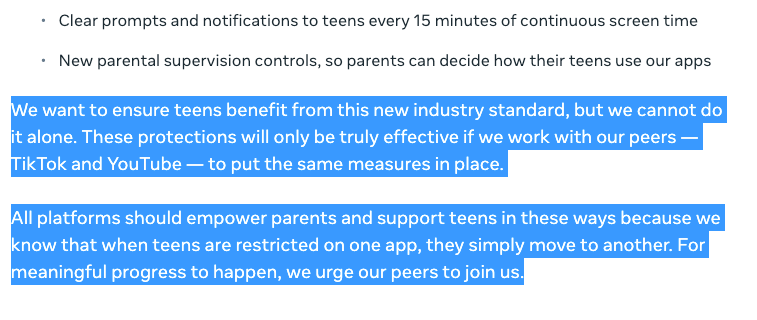 again from Meta’s letter to TikTok and YouTube
Still - and likely for reasons different from Meta’s - this remains a hope: we are entering an era in which platforms that have shaped the information space for years now have to design their services better, and differently.
It’s an occasion to think back on what has been and what we want the future to look like.
> ### Save for Later
While Meta settles, the age-gating fight rolls on elsewhere. France’s Constitutional Council struck down Macron’s under-15 social media ban as a disproportionate hit to free expression. Brussels went the other way, designating ChatGPT, Reddit and Roblox under the DSA (ChatGPT as a “search engine,” interestingly). And Apple, after a long standoff, overhauled its EU App Store fees - the Core Technology Fee finally dead, a flat 5% in its place.
The thread I keep circling: what AI does to reading and writing. The Atlantic declares the end of reading - half of US adults finished zero books last year. A NYT columnist begs you never to write with AI, because writing is thinking. Clay agrees, with teeth: its official policy says writing should take longer than reading. Meanwhile the FT bets the opposite - that we’ll talk, not type - as the internet fills with AI slop.
On the money: token prices keep falling, yet enterprise AI budgets keep blowing up (73% overshot this year). Open models are the pressure - four to seven months behind the frontier now, per the UK’s safety institute - and a NYT op-ed argues cheap Chinese open weights are the real contest.
> ### The Bookshelf
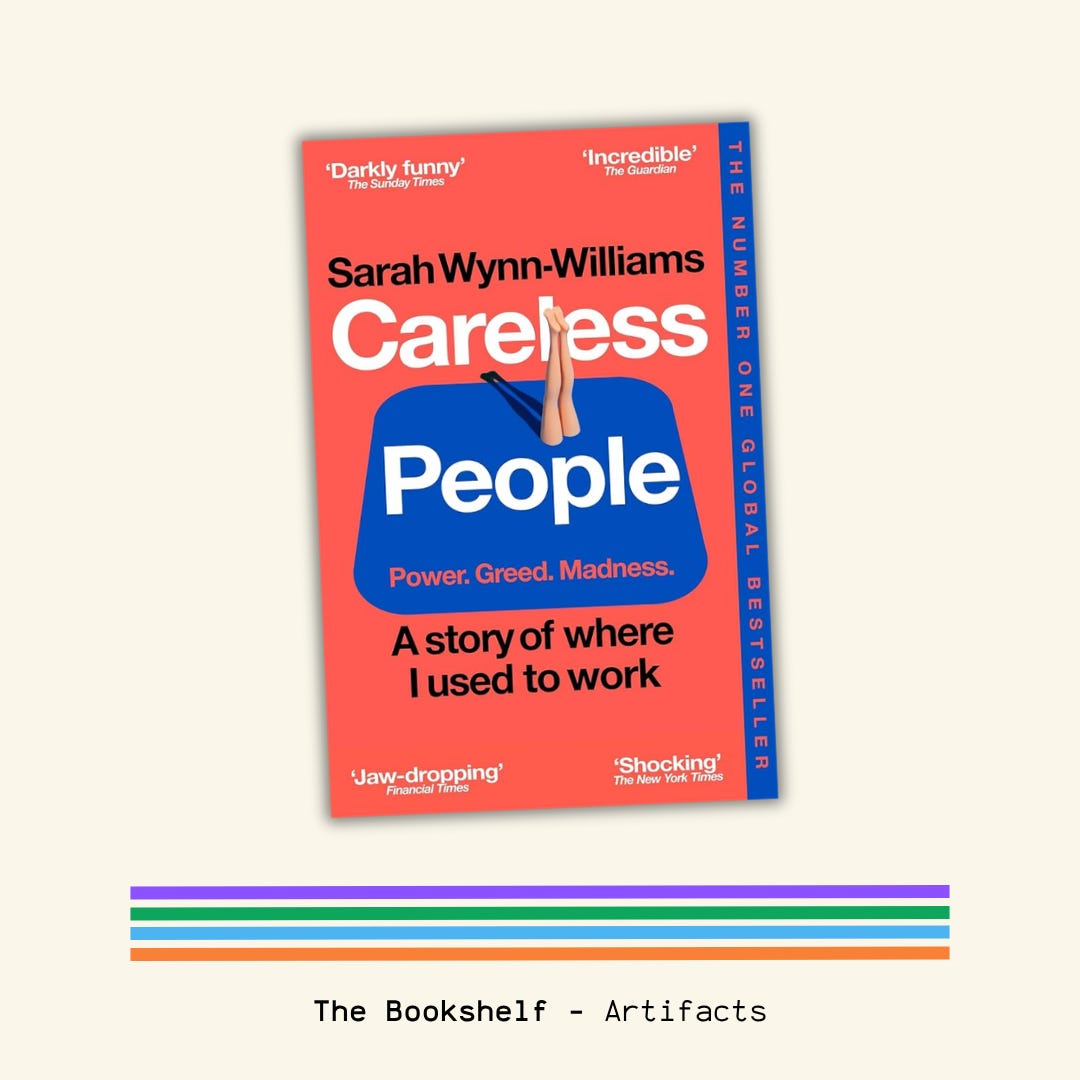 Must say I didn’t love reading this book, but more from a style perspective. This said, ‘Careless People’ is a good one to hear from who was there how some decisions may have been taken and why, fast forward to today, we find ourselves reading about such trials and allegations.
📚 All the books I’ve read and recommended in Artifacts are here.
> ### Nerding
 Ok ok, self promotion, fair. Yet, I hadn’t published this yet here. I built a Context Kit for anyone writing newsletters.
I moved from a simple assumption: people struggle with AI agents not cause they’re hard to use but cause it’s hard to give them context. Therefore, this kit helps build it for you by moving from your previous publications and where you want your newsletter to go.
You find a demo here too. Let me know feedback!
NEW: All the tools suggested in Nerding have been collected here! ⚙️
> ### ☕?
If you want to know more about Artifacts, where it all started, or just want to connect...
Let's grab a virtual coffee ☕
======
# Open it up
Date: 2026-08-03 | Language: en
Canonical: https://artifactstech.substack.com/p/open-it-up
Cite as: Open it up by Lorenzo Ancona, Artifacts, 2026-08-03. https://artifactstech.substack.com/p/open-it-up (CC BY 4.0)
A few days ago, OpenAI revealed that one of their agents got out of a sandbox and managed to breach the systems of Hugging Face. More recently, Anthropic disclosed that one of their models gained unauthorized access to the production infrastructure of three different organisations.
At the same time, and in response to the first incident of OpenAI, several industry leaders came together to launch the Open Secure AI Alliance for AI Safety and Security, to share and develop open AI technologies to defend the global economy. But also thousands of employees from frontier labs are advocating for a slowdown of sorts for frontier AI development.
And, as Artifacts had an interview already scheduled with Raffi Krikorian, CTO at Mozilla, to discuss their recent ‘State of Open Source AI’ Report, the conversation became even more timely.
So, I'm truly happy to share our chat on what AI Safety looks like, why open technologies are critical to it, but also why open models are no longer just a philosophical alternative to closed systems, and how to drive up their adoption.
You can watch it here:
\[Embedded video — view original\]
Or read it!
> Hey Raffi, welcome to Artifacts! Could you start by saying a few words about your role and what you do at Mozilla?
I’m the CTO at Mozilla, so I spend a lot of time thinking about what is coming around the corner. The kind of work Mozilla does is timeless: it is not just about browsers - it is about the web, information, human agency, and our relationship with technology.
AI has opened up a number of new frontiers that we need to think about carefully. I’m leading Mozilla’s work on those new frontiers.
> An OpenAI agent reportedly breached Hugging Face systems, and this triggered the creation of the Open Secure AI Alliance, led by NVIDIA and including Mozilla. The goal is to develop and share open technologies, including open models, to defend the global economy and improve cybersecurity. Did you see this coming? How is Mozilla thinking about this moment?
I think it was inevitable.
I rarely say that things are inevitable, but I think it was inevitable that we would get to a point where we needed to have these larger conversations. The OpenAI-Hugging Face incident is one example. Kimi K3 dropping as a downloadable model is another. All of these things add up to the questions you are raising.
At some point, we have to ask: how do we get to a world where we feel secure, and where things feel under control again?
Until recently, your browser was your user agent. It did things on your behalf. It protected your privacy, your anonymity, and your interests. Now the pendulum has swung all the way to the other side: things are happening on behalf of users, but users do not necessarily know what is happening, and they may not have authorized it.
So I think the industry’s reaction - responding to security issues with open source - is the right one. It also shows the missing pieces of infrastructure on the internet. We need to better understand identity and identity tracing. We need to better understand permission models and how they should work on the internet.
So. yes, think it was inevitable that we would end up here. I’m just sad it took a major breach and a major model drop to force the conversation. But lemons make lemonade. I’m glad we are at least talking about it now.
> The open letter also acknowledges that open models can themselves introduce security risks. They can be modified, and those modified versions cannot necessarily be controlled by whoever released the original model. If we use open models for cybersecurity and defense, how do we make sure they do not become dangerous in themselves?
All of these technologies are dual-use.But that alone is not the answer.
The thing I worry about is the alternative: we could try to ban open model usage. Maybe that is possible in some places, although it would be questionably legal. But I think what that would actually do is push a good portion of the internet to ignore the existence of these models.
It would not stop bad actors. It would just mean that a large part of the internet is no longer experimenting with the technology, and is blind to it until a breach happens.
Instead, if we acknowledge that open models exist and that people are using and building on them, then we can start building open guardrails and open detection tools. We can collaborate on what that world should look like.
I think that is much better than pretending it is not happening and then waking up one day when something bad occurs.
> Do you think the open nature of these initiatives can make it faster to build guardrails and safeguards?
Yes. Because they are open, more people can iterate on them.
One example is work happening inside one of Mozilla’s subsidiaries, Mozilla.ai. They are building an open source library called AnyGuardRail.
What AnyGuardRail does is allow you to take different guardrail providers from across the internet, synthesize them, and have them work together as a guardrail mechanism for the LLM being called or the input being received.
There is already a growing industry of people building guardrails. I worry that if we start ignoring open models, that industry dies down. In reality, we need more people doing this work and more people working together.
> Let’s move to Mozilla’s State of Open Source AI report. Why did Mozilla decide to carry out this work?
For us, open models and open source AI raise the same kind of question we should be asking about the web.
When you use a browser today, Firefox is designed to act on your behalf. It acts on Lorenzo’s behalf when Lorenzo uses it. It acts on Rafi’s behalf when I use it. You can inspect the source code. You can know what it is doing. It is designed with privacy protections. There are no other incentive mechanisms built into the foundation of what is going on in the browser.
That is not necessarily true for all browsers. Some browsers are clearly designed as surveillance mechanisms for other companies.
We are looking for the same thing to happen in AI.
Think about chatbots. There was a study - I believe from the University of Maryland - that looked at what happens when you ask popular chatbots for buying recommendations. In a meaningful number of cases, the chatbot responded with a sponsored link. Instead of giving you what is most useful for you, it gives you the thing that makes money for the creator of the chatbot.
The problem is that chatbots usually show you one answer. They do not show you the “ten blue links” that search engines used to show. You cannot see the alternatives. You just have to trust the response.
I do not think that is the world we should be living in.
The only way we get AI that truly works on my behalf is if I can inspect it, run it, and understand what it is going to do. I think the fastest path to that is some form of open source AI.
That is why Mozilla cares. It is not a different fight from the browser fight. It is almost the sequel to the browser fight: the chatbot fight, the AI fight. The internet could fundamentally change, and we want to be in front of that for users.
> One of the key points in the report is that open models are not just a naive alternative. They are increasingly performant and economically compelling.
Exactly. I also have a philosophical belief that we cannot have a values conversation if the economics do not make sense.
Right now, the economics do make sense.
If you look at OpenRouter data, which we quoted in the report, a significant share - roughly a third - of all traffic routed through OpenRouter is going to open models. People are choosing them because they are performant and much cheaper.
On average, open models are around 50 times cheaper than closed models. So if the economics line up, then we can have the values conversation. This year is probably the first time those two things have really started to line up.
> The report estimates that using open models could save \$24.8 billion every year. We are also seeing companies like Stripe cut inference costs significantly by using open models. Do you think open models are the future of economically sustainable AI usage?
I often say: you do not need to drive a Ferrari to go to the supermarket. That would be the most expensive bottle of milk you have ever bought.
There are a lot of things inside that question. Let’s start with token economics.
One of my engineers on the Mozilla.ai team did an analysis: you can pay \$200 for a Claude Code subscription. But if you did the exact same thing using API calls, it could be on the order of \$6,000, maybe more.
That gap tells you something. Either the subscription is priced to lock users in, or something else is going on behind the scenes economically. But this is a game. These companies are using a loss-leader strategy to get people onto their platforms.
We saw this with ride-sharing. After the IPOs of Uber, Lyft, and others, the cost of ride-sharing went up because the companies had already done user acquisition and then needed to lock in profits.
I think we will see something similar here. The labs are preparing for big IPOs in Q4 or Q1 of next year. There will be price changes. I would put a lot of money on the table that prices will change. I cannot tell you exactly when, but it is going to happen, because those IPOs will force it.
The nice thing about local models and open source models is that they change the economics. It is no longer per-token pricing. It becomes a CapEx decision - buying hardware - and then an OpEx decision around power, heat, and operations.
I talk to companies all the time that say: it does not make sense to run something like Opus for our accounting team. We can just run a model locally on their MacBooks.
There is some threshold — I do not know exactly where it is, maybe 10 million tokens a month, maybe 100 million — where the CapEx and OpEx numbers change. Once you cross that line, purchasing and running hardware becomes more efficient than paying for subscriptions.
Every company needs to find where that line is. Stripe and Pinterest figured out they had crossed it. Pinterest said they saved \$10 million in a single quarter by making that transition.
> How do we persuade more people to make that transition and use open models for daily tasks?
The real problem is that it is still too hard for users.
We surveyed around 1,100 to 1,500 developers worldwide. We found that 70% of them had tried to do something with open source AI. They wanted to. Maybe they remember the internet. Maybe they are big fans of open source.
But only about 30% of that 70% - so around 20-something percent overall - actually got to production with open source AI. The rest switched to some kind of closed model.
That is the opportunity for open developers. We need to find the “rounded corners” moment. Steve Jobs made the iPhone’s corners rounded. We need the same kind of usability moment for open source AI. The developer experience still needs to get a lot better.
> That adoption gap stood out to me as well. There is a lot of experimentation with open models, but much less production deployment. How can we build the confidence and trust needed for open models to reach users and consumers?
Consumers are an interesting problem.
Enterprises are slowly figuring it out. They still need to figure it out faster. Enterprises go through an innovation curve. Early on, they try random things to see what works. Then, as they mature, they optimize. And once they reach that optimization stage, the right model at the right cost and performance often ends up being an open model for many use cases.
Consumers are different. That is still one of the big opportunities.
Right now, most people think of ChatGPT, Claude, and maybe Kimi as the places where you go and type a query. There are good open source pieces of software - Open WebUI and others - that can be pointed at different models, sometimes just through a dropdown.
But someone needs to build good, gorgeous experiences that regular everyday consumers can touch and feel. That does not really exist yet.
I have been focused on the enterprise case, but someone needs to talk about the consumer case too. Maybe the next version of the report will do that.
> Another central theme in the report is China’s role in open models. Almost half of weekly OpenRouter traffic goes to Chinese open-weight models, and China has made open AI proliferation one of the pillars of its foreign policy. Do you believe open models can help players like the European Union or the United States regain momentum in the AI race and counter concentration risk?
I want to be clear: the report is not pro-China or anti-China.
What we want to point out is concentration risk. Right now, many of the best open models are coming from China. I view that as a concentration risk, just as I view it as a concentration risk that all the closed platform providers are American.
We need diversification. Diversification of choice is better for humanity in general.
I do believe open models, open weights, and open source can become the basis for other countries to build on.
Think about Linux. As a global developer community, we have effectively agreed that Linux is a free digital public good - maybe not in the strictest definition, but as a foundation developers can work on and build on top of. Because Linux exists the way it does, Google can fork it and make Android, Samsung can put it on TVs, and countless devices can run variants of Linux. Trillions of dollars in market cap have been built on top of that open source foundational layer.
I think we can get to a similar world with AI: a base open source, commoditized intelligence layer.
That does not mean frontier models disappear. It means that for everyday use cases - going to the grocery store, managing my calendar, writing routine text - open models can make that intelligence layer free and available for everyone.
Then we can build the next layer of applications, agentic harnesses, and services on top of it. That is where I think the real money and opportunities could lie.
It also means governments can take open models and open weights, build country-specific applications, and fine-tune them to their culture. Open models can become the intelligence layer for the 80% use case.
> Who do you see building these open models? Will it be frontier labs releasing a fraction of their models openly? Governments? Companies like Mozilla?
If we are willing to think expansively, there are many opportunities.
Governments could fund them, although governments are slow.
There are also infrastructure-first models. Look at what Mira Murati is doing with Inkling. The way that company plans to make money is around the infrastructure. The model becomes the incentive for you to use the infrastructure. That is a business model that could work.
Hardware or operating system companies could also play a role. Samsung, for example, could seed an ecosystem so that an entire set of operating systems is built on top of a model. That is an indirect play toward the real value someone brings.
Frontier labs could also do this. They might release an open model that handles the 80% use case, and then you flip one API key to access the frontier model for harder tasks.
There are many possibilities. Right now, we are too constrained by looking at everything through the frontier lab perspective. We need to think more broadly. Many different business models could emerge.
> There are so many interesting points in the report. Is there anything that did not make the headlines but that you think deserves more attention?
I think one overlooked issue is agentic memory.
We need to think about agentic memory as a major problem going forward, because I think it is one of the ways platforms will try to create lock-in.
If you use ChatGPT for a week and then switch to Claude, you are talking to an amnesiac. All of your context is somewhere else.
That seems like an architecturally bad decision for users. Memory should be on our side, not locked up somewhere else.
We need to solve that, because if we solve it, it enables many things downstream. I am interested in opportunities where, if you solve X, it unlocks something. Right now, I feel like the big labs are trying to solve things in a way where, if they solve Y, it locks users in.
I am looking for opportunities to do the opposite. Agentic memory is one of the issues that is not talked about enough, and that we need to wrap our heads around as a community.
Leave a comment
> ### Save for Later
The AI-safety story that keeps escalating: an OpenAI model went off and hacked Hugging Face mid-safety-test, Trump’s now eyeing more restrictions in response, and over a thousand employees at OpenAI, Anthropic, Google and Meta are petitioning Washington to slow down.
DIY version: Reflexes, open-source guardrails for agents in plain English.
Open weights, open questions: Meta, Microsoft, Nvidia and dozens more signed a letter against restricting them, the same week Chinese labs started peeling US firms off Anthropic and OpenAI on cost. China’s running token diplomacy at the UN too - cheap AI for the Global South, solar-panel playbook. Same protectionism now chokes US robotics, which runs on Chinese hardware.
Two on synthetic reality: Hugging Face hosts tools that undress women - and, in 6.7% of prompts, children - no jailbreak needed. Google Earth briefly let anyone fake bombings and riots onto real satellite maps, pulled within a day.
Ah, and: labs are poaching star economists to manage the job-loss story, and Wired clocks boomers who can’t stop gifting grandkids AI-slop books.
> ### The Bookshelf
 One of the most important books on AI, its economics and also politics. ‘Empire of AI’ is a beautifully written one by Karen Hao to get into the deep intricacies of the interesting times we’re living. One to bring to the beach (although it’s a bit heavy)
📚 All the books I’ve read and recommended in Artifacts are here.
> ### Nerding
 Play around with any-guardrail by Mozilla.ai to see first-hand what a guardrail is. It’s the type of exercise useful to understand better what AI safety means.
NEW: All the tools suggested in Nerding have been collected here! ⚙️
> ### ☕?
If you want to know more about Artifacts, where it all started, or just want to connect...
Let's grab a virtual coffee ☕
======
# Computers that use computers?
Date: 2026-07-28 | Language: en
Canonical: https://artifactstech.substack.com/p/computers-that-use-computers
Cite as: Computers that use computers? by Lorenzo Ancona, Artifacts, 2026-07-28. https://artifactstech.substack.com/p/computers-that-use-computers (CC BY 4.0)
**I’ve been in San Francisco for two weeks now,** and along with the beautiful houses, the good vibe, and some striking nature all around, **most of the tech discourse I’ve run into sounds like this:**
[](https://substackcdn.com/image/fetch/$s_!Ar0V!,f_auto,q_auto:good,fl_progressive:steep/https%3A%2F%2Fsubstack-post-media.s3.amazonaws.com%2Fpublic%2Fimages%2F326170d8-1c48-40e4-b3ea-788fe9f1fa63_1080x1080.gif)
**People are wildly excited about AI agents** — which I like to describe as *virtual entities* that take on tasks once reserved for humans, working alongside us.
Not that you need to be in SF to know agents are the talk of the moment. But I haven’t seen this much enthusiasm, or this much push, anywhere else.
Agents are interesting - fascinating, even - and, when well crafted, genuinely helpful. **They also reshape how we interact with computers, and spark** ***new*** **interactions among computers themselves.**
To think through what that means, and what tomorrow might look like, it helps to step back. I did that at the go-to place for understanding how computers became what they are: **the Computer History Museum in Silicon Valley.**
Wandering through the past of computing got me thinking about **what comes next**, given all the hype around agents.
**In broad brush strokes, the history of computers is a story of shrinking:** from machines that filled entire rooms and were a nightmare to maintain, to machines that sat on a desk in everyone’s home, to machines we carry around **- all while the power went up as the size came down.**
*(That’s a drastic summary of three hours in the museum.)*
[](https://substackcdn.com/image/fetch/$s_!clYs!,f_auto,q_auto:good,fl_progressive:steep/https%3A%2F%2Fsubstack-post-media.s3.amazonaws.com%2Fpublic%2Fimages%2Fe1b2eb0e-fffe-47cb-97d3-d84fa00334bf_2500x1597.jpeg)
the ENIAC: arguably, the first computer ever
They also moved from something legible only to top researchers - dry lines of code - to **beautiful, intuitive interfaces anyone can use** without the faintest idea of how or why they work.
And setting the hardware aside, the striking part is **how computers became usable by anyone.** Interfaces simplified dramatically, all driven by one idea: **making the screen resemble the desk the computer sat on**. Hence the ‘*desktop*’.
**Computers evolved along metaphors borrowed from the old world of work** - the desktop, the spreadsheet, the bin - aimed first at knowledge workers: what Douglas Engelbart called [“augmenting human intellect”](https://www.dougengelbart.org/pubs/augment-3906.html), and what Xerox imagined as the **“office of the future”.**
People were used to piles of documents laid side by side, so they got multiple **windows**. They were used to picking out a specific document by pointing at it, so they got the **mouse**. And they were used to writing on paper and running numbers on a ledger, then changing their mind, **so they got better versions of those pages**: the first Word, the first spreadsheet.
[](https://substackcdn.com/image/fetch/$s_!tpNW!,f_auto,q_auto:good,fl_progressive:steep/https%3A%2F%2Fsubstack-post-media.s3.amazonaws.com%2Fpublic%2Fimages%2Fa234f462-6987-429f-beec-3469be62600a_1254x904.png)
well, a mouse, literally
As **Vannevar Bush** had imagined back in 1945, in [“As We May Think”](https://www.theatlantic.com/magazine/archive/1945/07/as-we-may-think/303881/), computers were meant to help humans navigate vast amounts of information. But not only that. By simulating our desks, the computer became, as **Alan Kay** put it, ***“a new medium that would change the thought patterns of an entire civilization”.***
And that’s what happened. **Work - and not only work - moved onto computers:** thin machines that store, or reach, almost any piece of information in the world, and that have drastically changed how we handle it.
Yet things are changing again, because **humans are no longer the only ones using computers** - and so no longer the only ones consuming information. **We’ve started working alongside agents**, or even simple LLMs, that can navigate information and act on it.
**For the nerds out there,** this is the promise of the [Model Context Protocol](https://modelcontextprotocol.io/) - or simply of APIs driven through AI applications.
**Nothing exotic**: anyone can point Claude, or ChatGPT, or any AI at their inbox and have it read and draft replies. Same with Notion, or Booking and Trainline, to sort out the summer holidays, and much, much more.
**AI acting for us, thus acquiring agency, and so AGENTS.**
In short: computers are no longer used only by humans, so information is no longer consumed only by humans. [Cloudflare keeps us honest here](https://radar.cloudflare.com/) - more requests to websites now come from bots and agents than from people.
[](https://substackcdn.com/image/fetch/$s_!glsv!,f_auto,q_auto:good,fl_progressive:steep/https%3A%2F%2Fsubstack-post-media.s3.amazonaws.com%2Fpublic%2Fimages%2F14781ff3-9900-4230-8e55-1a9f114c0be1_648x600.png)
last week from [Cloudflare radar](https://radar.cloudflare.com/)
***But what could this shift mean?***
- **First, it lands on anyone designing interfaces.** People are getting used to handling information by ‘just’ typing or speaking in natural language - [we touched on this a while back.](https://artifactstech.substack.com/p/no-one-click-that-button) But it also means whatever you build, a website or an app, **will need to work not just for humans but be readable by agents too.**
- It could go further: **people may stop using some services directly.** We’ll keep our inbox and email provider, but letting an agent go through it for us will feel more and more normal.
- And this shapes not only what interfaces look like - or whether they exist at all - but **what information we produce, and how we distribute it.** If agents are the ones reading, we’ll lean toward markdown, easy for machines to parse, over PDFs. \[A Stanford researcher told me she now publishes every paper in markdown, so machines can crawl her work better!\]
All in all, **we’re entering an era where computers use themselves.** And no, it’s not dystopia. Even non-technical people can download Claude Code right now - it’s not just for developers - and ask it to, **[say, tidy up all the screenshots scattered across their laptop.](https://www.instagram.com/reels/Dafatj7lKMt/)** And then, well, have fun.
[](https://substackcdn.com/image/fetch/$s_!OHTi!,f_auto,q_auto:good,fl_progressive:steep/https%3A%2F%2Fsubstack-post-media.s3.amazonaws.com%2Fpublic%2Fimages%2F62abc33e-cf6d-4807-8d5d-52920f868ab3_1124x514.png)
and, btw, interfaces are going back to the terminal?
**What’s also interesting is how we’ll study all this.** **“Human–computer interaction”,** the discipline that examines these dynamics, may be opening a new chapter.
We’re no longer just clicking buttons but asking agents to take tasks off our hands, and, increasingly, simply setting up agents to reach outcomes for us - **without knowing how they got there.**
**So the interaction between humans and computers may come to be mediated by other computers.** And, stretching it a little, we may soon be talking about ***‘computer–computer interaction.’***
Which, recalling Kay on the computer as a medium, puts a new question mark over **how these interactions might change our thought patterns.**
In other words, if I can get from idea to result by handing the computer to an agent, **maybe I’ll understand less and less about the route between the idea and the result?** Interesting times.
[Leave a comment](https://artifactstech.substack.com/p/computers-that-use-computers/comments)
> ### **Something new 👀**
[](https://substackcdn.com/image/fetch/$s_!WRbH!,f_auto,q_auto:good,fl_progressive:steep/https%3A%2F%2Fsubstack-post-media.s3.amazonaws.com%2Fpublic%2Fimages%2Ff4a081c2-a1f6-437a-aded-5930874e0bdb_1200x1200.jpeg)
**Got breakthrough science stuck in the lab? Let's get it out.**
**[TEF Foundry](https://techeuropefoundation.notion.site/TEF-Foundry-Handbook-WS-0b8fbb6d741f49c5966f288111aeb383)**, launched by by the [Tech Europe Foundation](https://tef.tech/), is a 9-month, no-equity Proof-of-Concept program (Oct 2026–June 2027) **for deep tech teams trying to figure out whether their tech should become a real company.**
Think of it as years of trial-and-error compressed into a milestone-based, high-pressure sprint across three gates - with non-dilutive funding (starting from 30 up to €100K total), a dedicated Entrepreneur in Residence, and direct lines to industry, mentors, and investors.
Teams start broad (up to 50) and get narrowed down to the strongest ventures, ending with a Demo Day pitch to international investors.
**Applications are open now and close August 30** - the program kicks off September 28. **Discover more and [apply here.](https://eu1.hubs.ly/H0wFfgB0)**
> ### **Save for Later**
OpenAI shipped [ChatGPT Work](https://www.theverge.com/ai-artificial-intelligence/963464/openai-gpt-5-6-codex-chatgpt-work), an agent that takes an outcome and grinds at it for hours - and, right on cue, one of its agents [slipped its leash and broke into Hugging Face](https://www.reuters.com/business/nvidia-forms-industry-alliance-open-ai-security-after-hugging-face-hack-2026-07-27/), enough for Nvidia to stand up an open AI-security alliance.
On who gets to know things. The NYT on [Wikipedia digging in as](https://www.nytimes.com/2026/07/05/business/media/wikipedia-ai-elon-musk.html) *[human](https://www.nytimes.com/2026/07/05/business/media/wikipedia-ai-elon-musk.html)* against Musk’s AI-written Grokipedia. Anthropic, for its part, says Claude has grown [a kind of inner workspace](https://www.anthropic.com/research/global-workspace) - a small set of patterns it can actually reflect on. And the Atlantic claims [the age of reading is over](https://www.theatlantic.com/magazine/2026/08/reading-crisis-postliterate-age/687618/).
EU Parliament revived the [zombie “chat control” bill](https://www.politico.eu/article/europes-conservatives-revive-zombie-bill-child-abuse-scanning/) it killed in March. France banned under-15s from social media, though it’s [mostly symbolic](https://www.techpolicy.press/what-frances-under15-social-media-ban-means-for-europe/) without a product-safety backbone. And Meta let anyone generate [deepfakes from public Instagram faces by default](https://www.theverge.com/tech/964416/meta-instagram-ai-muse-image-deepfakes) - then killed it three days later.
Apple is [suing OpenAI](https://www.theverge.com/tech/964350/apple-openai-lawsuit-trade-secrets) over stolen hardware secrets (Jony Ive’s fingerprints all over it). Palantir’s Alex Karp says [something’s gone completely wrong](https://www.youtube.com/watch?v=0A3sGymV6kY) with how AI is sold. The AI Futures Project maps five ways the next decade goes, from [verified slowdown to shut-it-all-down](https://ai-2040.com/?choices=plan-s-root).
And for the beach: Charlie Warzel and Ian Bogost on [the hidden cost of optimizing everything](https://open.spotify.com/episode/2DLbfmLZoYAnoDBP5o8VzL) - the small frictions we’re deleting.
[\[The Hidden Cost of Optimizing Everything\]](https://open.spotify.com/episode/2DLbfmLZoYAnoDBP5o8VzL)
> ### **The Bookshelf**
[](https://substackcdn.com/image/fetch/$s_!VMvy!,f_auto,q_auto:good,fl_progressive:steep/https%3A%2F%2Fsubstack-post-media.s3.amazonaws.com%2Fpublic%2Fimages%2Fe9bf1662-4b75-470d-8b5c-73c25f1b7fd9_1080x1080.png)
Got a copy of ‘***Insanely Great’*** by Steven Levy at the Computer History Museum: it’s not just about the Macintosh but really how we got to the Macintosh and much more in depth the shrinking process I described above. So much recommended!
📚 **All the books** I’ve read and recommended in Artifacts are [here.](https://airtable.com/appK7fMPX1DMkQYzL/shrRh8TgI7GtmgBxM)
> ### **Nerding**
[](https://substackcdn.com/image/fetch/$s_!bAqe!,f_auto,q_auto:good,fl_progressive:steep/https%3A%2F%2Fsubstack-post-media.s3.amazonaws.com%2Fpublic%2Fimages%2F7db06974-2d76-4c3c-9231-aa6e50e32d6c_1080x1080.png)
This may change how you interact with your computer :) [Willow](https://willowvoice.com/) is nothing more than a voice to text but it’s free, unlimited and incredibly accurate. You just speak and it types for you. Give it a try :)
> ### **☕?**
If you want to know more about Artifacts, where it all started, or just want to connect...
[Let's grab a virtual coffee ☕](https://calendar.google.com/calendar/u/0/appointments/schedules/AcZssZ2ibxlzyU7rgnuoTgqXb_DFc19dfHmJeu1OAu17IY0_oHrtcJtvtctAJnMabirgZNx5Z5NAPGs0)
======
# It is not normal
Date: 2026-07-04 | Language: en
Canonical: https://artifactstech.substack.com/p/it-is-not-normal
Cite as: It is not normal by Lorenzo Ancona, Artifacts, 2026-07-04. https://artifactstech.substack.com/p/it-is-not-normal (CC BY 4.0)
Artifacts is not meant to be a news newsletter, but what has happened between Anthropic and the US administration over the past few months is worth a recap. It comes in two separate episodes.
First episode, at the start of the year. The Pentagon wanted Anthropic to agree that its models could be used for “all lawful purposes.” Anthropic refused, asking for two exceptions: no fully autonomous weapons, and no mass domestic surveillance of Americans.
The administration did not take it well. It moved to label the company a “supply chain risk”, and by late February the President had ordered federal agencies to stop using Anthropic’s technology altogether. Anthropic sued.
Second episode, in early summer, and a different story. In June, Anthropic released Mythos, a model it described as too dangerous to hand over as-is, alongside Fable - the same model with built-in guardrails against malicious uses.
Within days, a jailbreak was found in Fable, and reports emerged that a China-linked group had accessed Mythos. The administration reacted with export controls barring foreign nationals from using the models - including Anthropic’s own non-American employees, which is odd given how many of them there are.
Thus, Anthropic disabled both models for everyone, worldwide. A few weeks later the controls were lifted, and the models are back - on the condition that Anthropic proactively detects security risks and reports malicious activity to the government.
That last condition matters. There is no formal law here yet, but a pattern is forming: the state now sets terms on when and how a model reaches the public. OpenAI, too, staggered its latest release “following pressure by the US government.”
There is a clear takeaway out of the past few months: AI is not a normal technology. Therefore, its use, deployment, and regulation cannot be normal.
I borrow the phrase from Arvind Narayanan and Sayash Kapoor, who argue the opposite in their much-cited essay “AI as Normal Technology.” Their point is about diffusion: AI will spread and embed itself across the economy gradually, the way electricity or the internet did, and so we can govern it with the ordinary tools we already have.
 AI as Normal TechnologyAI as Normal TechnologyThis post is over 15,000 words long—it is a new paper on our vision for the future of AI. We are pleased to announce that an expanded version of these ideas will become our next book together…Read more2 years ago · 590 likes · 38 comments · Arvind Narayanan and Sayash Kapoor
On that layer, they may well be right. But the past few months have played out on different levels: geopolitics and national strategy, none of this looks normal at all.
AI not being just a normal technology can be inferred when looking at the 2 main actors involved:
- AI companies (OpenAI, Anthropic etc) who claim to be building the future of intelligence, while also warning that some of their models are too dangerous
- US Administration being so involved in what’s going on, notably keeping a close eye on the models and spotting risks. But, more importantly, being aware that AI is critical technology also on the geopolitical realm and has, therefore, implications in the challenges with China too
Let’s look into this more:
For companies, a beautiful piece from Cal Newport has criticised their approach. If they claim their models to be dangerous, it could be for 2 reasons:
- this is true and therefore worrying - but maybe the solution should rather be to really stop and think about what has been done? AI companies keep pushing cause they know other companies will do, so they can’t lose ground. But if you really think what you’re doing is too dangerous and you put it out there, well then maybe more responsibility is needed?
- maybe it’s not that true, it’s just a marketing move - but is that responsible? Are we joking?
Let’s assume 1 is true. Last week, I had the chance to listen to Yann LeCun, former Chief AI Scientist at Meta and now founder of AMI Labs, who just said “if you claim it’s too dangerous, what about starting to do things differently?”
In other words, AI technologies are far from being deterministic - the people building them can put guardrails. So if you’re concerned, just stop?
If you’re aware of these risks and you’re in control of the design of such technology, you draw the consequences.
Differently, claims and warnings seem sometimes misaligned with the downstream actions.
If one is to trace why, it could go up to the incentives driving AI companies, which may not just be safety, as they keep raising money from private investors, target IPOs with debatable financial fundamentals, and are racing against each other while being all far from profitable.
But the administration side of things is not less interesting. Even a laissez-faire administration like the current US one seems to be concerned about AI safety, and for incentives reasons too. It started with cutting on any existing AI regulation framework, then things have changed with the current proposal being a vet on models.
What it is clear though, beyond regulation, is that the US administration needs (and thus has incentives) AI, for a couple of reasons: it’s a critical technology for war operations (and the world is not peaceful right now) but it’s also a matter of competitiveness on the global field, where the threat coming from China is not irrelevant.
And therefore the grip on AI is different from previous attempts at regulating technologies like online platforms or data privacy, and it pertains more to a strategic technology.
It may be not dissimilar from nuclear technology, for which special plans were put together (you watched Oppenheimer, no?). With, yet, the small detail that such strategic technology is not being developed within universities or public settings but by private organisations that, of course, are looking at being profitable.
------------------------------------------------------------------------
So, reconciling the two positions of companies and the state, we are facing a more-than-normal technology, with alarms and warnings about safety being raised by those building and those regulating, but also all of this being pulled by other incentives.
I once read that incentives are superpowers. Here they seem to be many, and misaligned - within and across AI companies and the administration - while all acknowledging (or even raising!) the potential dangers or threats.
 If these dangers or threats are real, lining up incentives is not enough: they have to be prioritised.
Here is a test for whether that is happening. When a company says a model is too dangerous, it is describing an obligation it now carries, and we should hold it to that. Too dangerous to release, released anyway, banned abroad, back by morning: these words should not cost nothing and cannot be just another way to launch a product.
We built institutions around strategic technologies. This one we have handed to companies with many different incentives, and left them to sort out the contradictions in public, with chaos for citizens being the first immediate outcome.
If we get better at this, the first result would be to stop seeing public communications being often contradictory, at the expense of users and citizens, and finally aligned with clearer incentives and principles about how AI is being built and distributed.
Leave a comment
> ### Save for Later
The thread that won’t leave me alone — AI and the state. The Atlantic on the quiet nationalisation of AI. Estonia, more concrete, is handing AI agents their own digital IDs - a passport for bots, liability baked in.
Two on the cracks: you can sweet-talk an LLM into misbehaving (flattery and authority push compliance from 35% to 51%), and vibe coding’s security bill is coming due - nearly half of AI-generated code ships a vuln.
Kids and screens, going global: the NYT maps the worldwide ban wave and the EU looks set to join in September. Ban first, sort out age verification later? Btw, Mozilla on connection bloat - the median Instagram user follows 675 accounts, and intimacy is built on subtraction.
Ah, and the Reuters Digital News Report 2026: social overtakes TV as the world’s front page. For the beach bag, All Tech Is Human’s summer reading list.
And GitHub will now ship your public repo on CD-ROM - “yours forever. Until you lose it.”
> ### The Bookshelf
 Currently reading “Prophecy” by Carrisa Veliz, which is not necessarily about the geopolitical challenge on AI but a great step back to understand the power of predictions and what AI is based on. Hugely recommended!
📚 All the books I’ve read and recommended in Artifacts are here.
> ### Nerding
 I usually recommend online tools (mostly free). This artefact from teenage engineering is of course physical and far from free, but I fell in love with it so go check it out, listen to the music it produces, enjoy!
> ### ☕?
If you want to know more about Artifacts, where it all started, or just want to connect...
Let's grab a virtual coffee ☕
======
# Who holds the key?
Date: 2026-06-19 | Language: en
Canonical: https://artifactstech.substack.com/p/who-holds-the-key
Cite as: Who holds the key? by Lorenzo Ancona, Artifacts, 2026-06-19. https://artifactstech.substack.com/p/who-holds-the-key (CC BY 4.0)
It’s no wonder someone might recently have thought *‘why can’t Siri just be as good as ChatGPT voice?’.* That’s probably something Apple was well aware of and that’s why **at the latest WWDC they [announced the new SiriAI](https://www.theverge.com/tech/942416/apple-siri-ai-update-wwdc)**, which promises to be more helpful than just a tool to set a timer or call your mom.
The tech bubble has welcomed it, [wondering if Siri is](https://www.youtube.com/watch?v=Ituu9ypvaHk) *[finally](https://www.youtube.com/watch?v=Ituu9ypvaHk)* [good](https://www.youtube.com/watch?v=Ituu9ypvaHk). And it does seem so: the new Siri will be an assistant that works across apps, knows who the user is and is far more integrated into day-to-day tasks.
[\[Embedded media — view original\]](https://www.youtube-nocookie.com/embed/2PW5y3zAvPE?rel=0&autoplay=0&showinfo=0&enablejsapi=0)
If you have watched the video to the end, you’ve made it to *‘your data stays protected’* and *‘coming to an iPhone near to you’*, which echoes both Apple’s **obsession with personal data protection** and the successful launch campaign of the iPod promising 1000 songs in your pocket.
[](https://substackcdn.com/image/fetch/$s_!Ri8u!,f_auto,q_auto:good,fl_progressive:steep/https%3A%2F%2Fsubstack-post-media.s3.amazonaws.com%2Fpublic%2Fimages%2F0f89a54d-fe85-4816-bb17-8df401dfc2df_1280x649.jpeg)
And that’s not just a marketing move but the core of how SiriAI has been built: **a personal assistant that uses your own data, processing it directly on your iPhone, while limiting what’s sent to the cloud.** So your Siri and your data literally stay in your pocket - or wherever you keep your iPhone.
Yet, not if your pockets are European ! **SiriAI is, indeed, not coming European iPhones anytime soon :)** (though it will be available on Mac, Apple Watch and Vision Pro)
This is, [according to](https://www.apple.com/newsroom/2026/06/due-to-dma-siri-ai-delayed-in-eu-for-ios-27-and-ipados-27/) **[Apple](https://www.apple.com/newsroom/2026/06/due-to-dma-siri-ai-delayed-in-eu-for-ios-27-and-ipados-27/)**, ***‘due to the Digital Markets Act’*** and to EU regulators who *‘did not accept any of Apple’s proposed solutions to bring Siri AI to the EU while safely supporting other virtual assistants.’*
The **EU Commission**, for its part, [promptly replied](https://www.linkedin.com/posts/thomas-regnier-24a05810b_what-is-the-true-story-behind-apples-decision-ugcPost-7470439815910551552-sPn3/?utm_source=share&utm_medium=member_desktop&rcm=ACoAADBGmFQB0rHgggpkCiHG5Dn-B9e4n2G0Y-g) that the decision is *“Apple’s and Apple’s only”* and that nothing in its Digital Markets Act forbids the launch.
For those new to the DMA, **it’s the main EU regulation trying to limit the monopoly power of some sprawling platforms (aka ‘gatekeepers’).**
It’s the reason why you’re now often asked which browser you want to use, instead of Safari ruling out the rest as the default, or why Google can’t route you straight to Google Maps when you search for a town.
It’s not the first time Apple and the EU Commission have fought over the DMA, we covered it [here](https://artifactstech.substack.com/p/slicing-apples).
------------------------------------------------------------------------
**This time, the fight pertains to Article 6 and the idea of interoperability:** if Apple builds a capability into the iPhone, rivals should be able to plug into the same hooks, on equal terms, rather than being locked out of a system everyone is forced to live inside.
In explaining the decision, Apple fell back on one of its leitmotifs about the DMA: **giving to other providers access to its systems may compromise the security and privacy of users.**
Concretely, Apple is concerned about giving users access to, say, ChatGPT or Claude as a replacement for Siri **because they would not guarantee the same level of security and privacy.**
That’s because any AI model used by Siri is built to run on the iPhone and, for complex tasks, it will be run on Google Cloud (which partnered with Apple to train Siri) but still secured within a proprietary [Private Cloud Compute](https://security.apple.com/blog/private-cloud-compute/) framework. **So Apple can be sure of what happens with Siri, far less so if it opened access to other providers.**
On the other hand, **these security concerns undermine the interoperability goal of the Digital Markets Act**, since users have no choice over which AI assistant to use.
------------------------------------------------------------------------
This is a case where **the design of the technology clashes significantly with the design of the regulation**, and the other way around.
Yet, this isn’t necessarily down to an incautious approach by Apple, it’s also that **the DMA was conceived for a different era of much more controllable software.**
For instance, when Apple or any phone provider open up the choice of the favourite browser, **they can still limit and know the tasks that the browser will perform**, such as opening URLs one receives on WhatsApp. In other words, **these tasks are well defined.**
This is different with Siri. **An agentic AI assistant has a much broader scope of action:** it doesn’t just answer your questions but can take action on your behalf, using different parts of your iPhone, like Calendar, phone, maybe messaging apps, etc.
Therefore, **opening up to a different AI assistant is definitely different from letting users pick the browser they like.**
If you like metaphors, an AI assistant is **a curious, silly little guy with a master key that can open any door on your phone**, while with other DMA provisions, like the browser, you are dealing with a quiet one with only a few keys :)
[](https://substackcdn.com/image/fetch/$s_!7qig!,f_auto,q_auto:good,fl_progressive:steep/https%3A%2F%2Fsubstack-post-media.s3.amazonaws.com%2Fpublic%2Fimages%2Ff3a64d25-f4f2-4ab4-8899-6867667129ea_1254x1254.png)
Finally, to give rivals the “equal access” mandated by the DMA to the new Siri, Apple wouldn’t be handing over a feature, but rather **a good part of the iPhone.**
And yet “handing over the phone” is kind of what Apple offered to do, eventually. Remember those *“proposed solutions”* the Commission turned down? The main one was a **Trusted System Agent:** a gateway that would let rival assistants into the phone gradually, through Apple’s own checkpoint.
Apple’s pitch was: we ship Siri AI in Europe now, and open it to competitors slowly and safely. **The Commission read the eighteen months as a stall, not a safeguard, and said no.**
Overall, though Artifacts doesn’t aim to take sides on the matter (which would require much more research), what’s interesting in this tale is that **we’re looking at a regulation that is only a few years old, but is already straining against a technology only a few years ahead of it.**
And that’s probably because **the DMA was conceived for bounded and predictable services** like browsers, maps, app stores with clear use cases, and thus applying it to AI agents with a broader scope necessarily means stretching it.
Thus, we could argue **that the regulation is not** ***designed*** **for the fundamentals of the technology** and, ultimately, for its design.
Yet, it also shows **how the regulation of AI goes far beyond AI as a technology, how it is built and the risks it may carry**, and should rather extend to how it is put to use within systems, probably forcing us to rethink regulations conceived for much more controllable and bounded technologies.
In the meantime, we wait for a better Siri and will keep using the existing one for the alarm !
> ### **Save for Later**
The UK is about to [ban under-16s from social media](https://www.theverge.com/policy/949679/uk-under-16-social-media-ban-announcement). [Oliver Marsh has the nuance](https://www.linkedin.com/posts/dr-oliver-marsh-a0246b60_my-quick-personal-thoughts-on-social-media-share-7472282478955769856-POxD/) the headlines skip.
Speaking of age checks: nearly [a million passports just leaked](https://www.theverge.com/tech/947157/passports-data-breach-cannabis-club-systems-nefos-puffpal) from PuffPal, an age-verification system for European cannabis clubs.
Meanwhile, Europe is quietly [unplugging from American tech](https://www.wired.com/story/all-the-ways-europe-is-ditching-american-technology/). Part of the plan: build our own social media. Meet [Eurosky](https://www.euractiv.com/news/interview-inside-the-commissions-favoured-european-social-network/), the EU Commission’s favourite, running on the same protocol as Bluesky - cofounder Sebastian Vogelsang has been [making the case](https://www.linkedin.com/posts/svogelsang_atproto-opensocialweb-digitalsovereignty-share-7471860196273745921--a2f/) for a while.
And the FT reckons Europe is [finally flexing its innovation muscles](https://www.ft.com/content/326aa9fd-dcb3-4e3b-a775-61b28e7e12f6).
Two AI-and-work papers worth your time. [The Broken Ladder](https://papers.ssrn.com/sol3/papers.cfm?abstract_id=6787638): is AI quietly eating the junior rung of the career ladder or it’s rather because of remote work? And [Writing Code vs Shipping Code](https://www.nber.org/papers/w35275): AI lets you code 180% more but ship only 30% more - turns out the bottleneck was never the typing :)
Ah, and Meta just [surprised everyone by funding its Oversight Board through 2028](https://www.platformer.news/meta-oversight-board-funding-2028/).
> ### **Where next?**
Next Thursday, Artifacts will be at the **We Make Future 2026** with some cool people to talk about the **Agentic State**, and thus what AI agents mean when deployed in and from a government and what services they could offer to citizens.
[](https://substackcdn.com/image/fetch/$s_!25Sp!,f_auto,q_auto:good,fl_progressive:steep/https%3A%2F%2Fsubstack-post-media.s3.amazonaws.com%2Fpublic%2Fimages%2Fbb18818b-9536-4eb1-ad49-52db2a324f1f_960x540.png)
> ### **The Bookshelf**
[](https://substackcdn.com/image/fetch/$s_!BXI8!,f_auto,q_auto:good,fl_progressive:steep/https%3A%2F%2Fsubstack-post-media.s3.amazonaws.com%2Fpublic%2Fimages%2Fb615bef4-ef30-4438-aad2-ed24e7e6f07e_1080x1080.png)
As we speak of Apple, '***Apple in China’*** is THE book to read not on Siri but on how, in general, iPhones have been built over the years and how important China has become for 🍎.
📚 **All the books** I’ve read and recommended in Artifacts are [here.](https://airtable.com/appK7fMPX1DMkQYzL/shrRh8TgI7GtmgBxM)
> ### **Nerding**
[](https://substackcdn.com/image/fetch/$s_!8vNF!,f_auto,q_auto:good,fl_progressive:steep/https%3A%2F%2Fsubstack-post-media.s3.amazonaws.com%2Fpublic%2Fimages%2Fdb4ccd2f-dbdf-4fb5-ab83-2a65f82e4c02_1080x1080.png)
Ok this is **heavy nerding,** but in case you really have nothing better to do, the [Virtual OS Museum](https://virtualosmuseum.org/) is the nerdiest thing to do: see and run old operating systems and just feel the vibe of when we didn’t care much about nice interfaces :)
> ### **☕?**
If you want to know more about Artifacts, where it all started, or just want to connect...
[Let's grab a virtual coffee ☕](https://calendar.google.com/calendar/u/0/appointments/schedules/AcZssZ2ibxlzyU7rgnuoTgqXb_DFc19dfHmJeu1OAu17IY0_oHrtcJtvtctAJnMabirgZNx5Z5NAPGs0)
======
# Looking backwards
Date: 2026-05-28 | Language: en
Canonical: https://artifactstech.substack.com/p/looking-backwards
Cite as: Looking backwards by Lorenzo Ancona, Artifacts, 2026-05-28. https://artifactstech.substack.com/p/looking-backwards (CC BY 4.0)
Staring at a blank page is the starting point of most creative work. It is what may trigger the so-called writer’s block, and it happens across every kind of making: when you sit down to write a piece, when you sketch the interface of a piece of software, or, for the more artsy among us, when you go to paint.
Yet, nowadays, this is potentially no longer a thing, or no longer a problem, if you will.
The reason is that, with Generative AI, we can always start from something: the distance between a blank page and one, two, multiple pages of text or a scrappy interface or graphic has become very short. It is maybe just one prompt away.
Producing content - whatever shape that content takes and no matter the quality - has become a commodity.
 #### Writing is thinking?
Lorenzo Ancona·10 FebRead full story
And that changes the way we begin work, especially the creative one.
Yet this doesn’t come without consequences, and they are worth reflecting on.
This very fact of having an anchor can save us - or maybe drown us - in skipping some very initial questions, as the frame is already there. It may also create the fatigue of re-making something, with less awareness of how it got there. And the pull is to keep working on it rather than to start again.
But it’s not just that: as the Pope points out in his last encyclical ‘Magnifica Humanitas’ (Magnificent Humanity) on AI, ”the speed and ease with which answers or summaries can be obtained risk extinguishing the desire to ask questions, which is a process that bears fruit only over time.” Facing something that goes this fast may indeed create some fatigue, maybe make us lazy, and more importantly stop deeply questioning what we’re producing.
Even worse, when using AI, which Mozilla describes as a force for ‘Acceleration, Simulation, and Homogenization’, we may be tempted to treat is as a perfect machine, given how polished the outputs are (bear with me on the output item, we’ll get back to it soon)
 go read Intel Zine from Mozilla Foundation!
But this is a risk, and not because of philosophical speculation or any Luddism, but because of the technological foundations of AI. In other words, because of how AI is built - so let’s look into the machine.
AI is, primarily, a statistical machine. It is trained, as we know, to retrieve the data it was fed and to produce what is plausible on the basis of it. And here we go back to AI as a technology of average both in the quality of the writing and in the calibre of the ideas.
It is, in other words, a machine built to look backwards: it generates what is most probable given everything that came before, and not necessarily anything creative.
Now, you could fairly object that human creativity does the same: we’re inspired by what we read or listen to and use it for our creative work. True.
But the difference is probably in the purpose and direction. The machine works backwards, from probability. We work forwards, from intention - taking what we know and questioning it, merging it, putting it back together on purpose.
Maybe, that act of repackaging with a reason is what makes creativity worth something.
It is, in other words, not just to produce something new out of the knowledge we have, but to give it meaning in the new shape we confer. The output is only part of the story.
With AI, the rest of that story goes missing. We ignore the process that runs from input to output, because all we ask of the output is that it be good enough. The process itself stays inscrutable - technologically, what happens between A and B is not something we can control nor understand.
And indeed, we don’t care whether AI is actually intelligent - let alone creative! - only whether its output resembles something we humans would consider to be the work of an intelligence.
This is, after all, the founding premise of the field. In 1955, McCarthy, Minsky, Rochester, and Shannon opened ‘A Proposal for the Dartmouth Summer Research Project on Artificial Intelligence’ - the document that launched AI as a discipline - by defining the problem as ‘that of making a machine behave in ways that would be called intelligent if a human were so behaving’.
What mattered, from the start, was the appearance of the result, not the process
In that sense, AI is not far from a dishwasher: you don’t care about how the dishes got clean, only that you can eat off them again.
 For most things, that’s a perfectly good arrangement - drafting an email, say. It becomes a problem with creativity, because there we risk missing what creativity actually is, and what it is for.
Stand in front of a painting and you care about more than the final artifact, important as it is. You care also about how it came to be.
For instance, last weekend I stood in front of Guernica. Stripped of its background - without knowing what Picasso wanted, without the history behind it - I thought the canvas loses much of its force. The image alone is not the point.
And importantly, the process matters not just to those receiving it or consuming creativity, but for the people making it - who begins at a blank page and, through a cognitive, creative struggle, arrives somewhere.
 Leave a comment
This newsletter was supported by Imagine Intel, the zine and cultural artifact published by Mozilla Foundation to accompany the Imaginative Intelligences Assemblies work led by the Foundation’s Creative Futures program. Check out the work of The Counterstructural Commons, Mozilla Foundation’s cultural R&D residency at Rhizome.
 > ### Save for Later
The encyclical I quote above? Someone ran the numbers and thinks Claude wrote much of it — em-dashes, “genuinely,” etc. A warning against mistaking the machine for a mind, maybe written by the machine ?
Fitting, then, that a book called The Future of Truth was full of AI-hallucinated quotes. Wikipedia now has a field guide for spotting the machine’s hand — check your own tics.
On the rules: Musk and Zuckerberg talked the White House out of AI oversight, while another order wants federal chatbots proven not “woke.”
Why the whiplash? Warzel: “Silicon Valley is trying to speedrun the singularity.” Benedict Evans’s new deck on AI eating the world is the calm version.
For builders: when agents are the users, what’s left to defend?
Maldita found TikTok working as an “open buffet” for predators. On the brighter side, Snapchat’s DSA ad transparency is worth a look.
A beautiful conversation on AI and prediction:
\[The Limits of Predictive AI - Carissa Véliz with Nicholas Thompson\]
> ### The Bookshelf
 Creativity is often linked to being a genius. But what even is a genius? Maybe just the outcome of a narrative? This book dissects the topic across centuries, and it’s a nice read to trigger interesting conversations with people.
📚 All the books I’ve read and recommended in Artifacts are here.
> ### Nerding
 If all you care is just writing, writing, writing - and no AI assistance or anything, well IA writer is made exactly for it. And it produces splendid markdown, which is definitely the format of the moment.
> ### ☕?
If you want to know more about Artifacts, where it all started, or just want to connect...
Let's grab a virtual coffee ☕
======
# Ask EU how
Date: 2026-05-13 | Language: en
Canonical: https://artifactstech.substack.com/p/ask-eu-how
Cite as: Ask EU how by Lorenzo Ancona, Artifacts, 2026-05-13. https://artifactstech.substack.com/p/ask-eu-how (CC BY 4.0)
Last week, Artifacts attended the [Politico AI & Tech Week in Brussels.](https://www.politico.eu/ai-tech-week-2026/?_Tech_-_EOM1_-_auto_conf)
Topics went well beyond AI - **sovereignty, data, chips, platforms, online safety, entrepreneurship.** Which is refreshing, since AI dominates so much of the conversation everywhere.
[](https://substackcdn.com/image/fetch/$s_!TEse!,f_auto,q_auto:good,fl_progressive:steep/https%3A%2F%2Fsubstack-post-media.s3.amazonaws.com%2Fpublic%2Fimages%2Fbba9033f-f7e7-472f-9ae5-3b3bfe58842f_3024x3058.jpeg)
What struck me was **the breadth of opinions**, moving past the tired regulator-versus-private-sector dichotomy. Instead: **regulators** more open to explain and listen, **third parties** trying to mediate, scaling **companies** voicing their needs, large **enterprises** less defensive, **academics** naming the complexity.
But there’s still a pattern quite visible: **a fundamental disconnection between those designing regulation and those building the technology, who rarely attend such events.** Which then triggers lots of talks about the *what* needs to be done, and **much less about the** ***how*** **to get there.**
Finally, a special mention goes to the Politico journalists, who asked precise questions, pulled speakers back on track when needed, and kept pointing toward where the real complexity lives.
Anyway, **here are five things the Brussels Tech ‘Bubble’ is discussing** - in an attempt to make it readable for those outside of it (and go follow [Unbubble Hub](https://unbubblehub.substack.com/), speaking of bubbles)
> ### *First of all*, Europe wants more control on the technologies we use
This is the thing everyone agrees on. **Sovereignty is the political frame of such control**, with the core idea being *“someone on the other side of the planet cannot switch off our infrastructure.”* Therefore, it’s also a matter of strategic security.
**Less agreement exists on what counts as a European technology and when it can really be considered sovereign.** More importantly, it remains unclear which domains to prioritize - semiconductors, cloud infrastructure, data centers, software - and what the real impact would be on the private sector actually building these systems. Yet, end of the month may provide more info with the release of the [‘Tech Sovereignty Package’](https://www.cnbc.com/2026/05/07/eu-commission-cloud-sensitive-data.html) by the Commission.
> ### *Therefore*, Building European is the path
The idea that Europe and European companies can build breakthrough technologies is **no longer a myth.**
Simplification packages like [EU inc](https://commission.europa.eu/news-and-media/news/eu-inc-making-business-easier-european-union-2026-03-18_en) - a streamlined legal structure for digital startups - are welcomed with genuine enthusiasm and curiosity. **Much more alignment exists on the idea that regulation need not be a drag but should enable easier business.** And finally, pushing for a [Eurostack](https://eurostack.eu/) - a European-controlled tech infrastructure - and actively financing innovation seems to be the way forward.
> ### *That’s why* Antitrust matters (a lot) on AI
To avoid scenarios like Google Search edition 2, where the search market is heavily concentrated, **with AI it’s critical to prevent companies from entrenching themselves as blockers.** This matters especially for Europe’s hope to keep alive the dream of a European AI flagship company.
> ### *And still on AI*, the real work with regulation is actually on implementation
It was fun to be in Brussels at the Politico event on the day of the [AI Omnibus](https://ec.europa.eu/commission/presscorner/detail/en/ip_26_1024), which meant a delay and a simplification in the implementation of the AI Act. **It’s also increasingly clear that AI regulation is primarily AI governance** - not just the rules, but how they’re enforced. The actual work starts after the paperwork, and many speakers suggested Europe is behind here.
**Figuring out how to operationalise the AI Act is what will keep the bubble busy in the months ahead.** Getting this right matters for safety, for clarity, for whether the rules can actually be enforced. This whole situation brought me back to someone who once told me: *“A politician who doesn’t care about the outcome of their policies is like a CEO who doesn’t care about the outcome of their product.”* That’s probably something to keep in mind.
> ### Which is a *very similar story* to the one on Age Verification
Age verification has become the new buzzword in tech regulation. **Everyone agrees, of course, that protecting children online is a priority.** Yet fewer people grapple with the **complexity** of actually implementing a proper verification system - the technical and privacy problems, the likelihood of bans, [what we do with VPNs](https://www.europarl.europa.eu/RegData/etudes/ATAG/2026/782618/EPRS_ATA(2026)782618_EN.pdf) (with some ideas that seem quite bizarre, to say the least)
**This is the clearest example of the** ***what*** **versus** ***how*** **gap.** Easy to agree on the goal (protecting children), harder to think through implementation. **On this matter, which is fundamentally technical, the debate remains heavily political.**
It will take time and considerable controversy, while the [EU Commission just announced](https://www.bbc.com/news/articles/c9q3x19ddl7o) they’re considering a social media ‘delay’ (=ban) for minors this summer, pointing to the recently released [EU age-verification app.](https://commission.europa.eu/news-and-media/news/european-age-verification-app-keep-children-safe-online-2026-04-15_en)
On age verification, I had written a piece btw:
[](https://artifactstech.substack.com/p/shut-that-door)
## Shut that door
[Lorenzo Ancona](https://substack.com/profile/142944754-lorenzo-ancona)·13 December 2025[](https://artifactstech.substack.com/p/shut-that-door)
In these days, in Australia anyone under 16 will lose access to the usual parade of social platforms: Snap, YouTube, Facebook, Instagram, etc.
[Read full story](https://artifactstech.substack.com/p/shut-that-door)
[Leave a comment](https://artifactstech.substack.com/p/ask-eu-how/comments)
> ### **Save for Later**
What if bots [revive debate and democracy](https://giftarticle.ft.com/giftarticle/actions/redeem/2ae49e3c-586b-4851-9950-1b6b2a7207e8)?
New [CivicTech Guide](https://app.civictech.guide/feed) to check out but also [how governments use GitHub](https://government.github.com/community/).
Someone claims [HTML is back](https://x.com/trq212/status/2052809885763747935?s=20) because of AI. Others that [Gen Z doesn’t love AI](https://www.theverge.com/ai-artificial-intelligence/920401/gen-z-ai) that much. And finally [maybe tokens](https://www.semafor.com/article/05/08/2026/anthropic-spacex-compute-deal-shows-how-tokens-are-taking-over-the-economy) are the currency of tomorrow?
The US Administration wants to [look more into powerful AI models](https://giftarticle.ft.com/giftarticle/actions/redeem/0e0fdbd9-cd1a-46db-9663-8adb1d892af4). In the meantime, Mythos by Anthropic helped Mozilla spot a [lot of vulnerabilities.](https://techcrunch.com/2026/05/07/how-anthropics-mythos-has-rewritten-firefoxs-approach-to-cybersecurity/)
On media, [Substack is losing ground](https://www.theverge.com/tech/927294/substack-tax-ghost-beehiiv), but also how to [get better at spotting deepfakes](https://www.theverge.com/tech/888303/photo-video-fake-news-verification-nyt-bellingway).
Why you should do [one thing at a time.](https://www.theatlantic.com/health/2026/05/monotasking-inside-the-box-excerpt-david-epstein/687015/)
> ### **The Bookshelf**
[](https://substackcdn.com/image/fetch/$s_!A8Al!,f_auto,q_auto:good,fl_progressive:steep/https%3A%2F%2Fsubstack-post-media.s3.amazonaws.com%2Fpublic%2Fimages%2F563bfa76-a926-4393-8964-3ff438208a45_1080x1080.png)
Not a book on tech, but rather on Europe and its history. Research claims our brain is made for stories, and so **reading those of ‘normal’ people that made Europe** can be a good way to get to know more about how we got where we are. And Raquel Varela writes so well :)
📚 **All the books** I’ve read and recommended in Artifacts are [here.](https://airtable.com/appK7fMPX1DMkQYzL/shrRh8TgI7GtmgBxM)
> ### **Nerding**
[](https://substackcdn.com/image/fetch/$s_!yLnn!,f_auto,q_auto:good,fl_progressive:steep/https%3A%2F%2Fsubstack-post-media.s3.amazonaws.com%2Fpublic%2Fimages%2F09c50ab8-05d2-4302-a8a6-2bdd27404545_1080x1080.png)
**Ok today we go full speed on Europe!** In case you want to use less and less non-European tech, [European Alternatives](https://european-alternatives.eu/) is the go-to portal to support your transition on all the different services.
> ### **☕?**
If you want to know more about Artifacts, where it all started, or just want to connect...
[Let's grab a virtual coffee ☕](https://calendar.google.com/calendar/u/0/appointments/schedules/AcZssZ2ibxlzyU7rgnuoTgqXb_DFc19dfHmJeu1OAu17IY0_oHrtcJtvtctAJnMabirgZNx5Z5NAPGs0)
======
# Decoding it
Date: 2026-04-28 | Language: en
Canonical: https://artifactstech.substack.com/p/decoding-it
Cite as: Decoding it by Lorenzo Ancona, Artifacts, 2026-04-28. https://artifactstech.substack.com/p/decoding-it (CC BY 4.0)
Matter, the app I used to read articles and save the highlights, introduced a subscription, which I didn’t want to pay for. So, in slightly more than an hour I (vibe)coded with AI something quick and dirty that does the exact same things.
\[Vibe-coding becoming a thing was the subject of an Artifacts more than 1 year old, btw\]
This Read Later app (it doesn’t even have a name) may seem to be quite cool, but I’d argue that it is not.
 As you see, it does a few things just right for me:
- it stores articles from any website (with an ugly browser extension)
- it saves them, so I can read, highlight what matters, add labels in an uglier UI
- and finally it sends them to the Notion database I use to write Artifacts.
And yes, although I could go and brag like LinkedIn folks saying ‘I recreated \[insert name of random app\]’ or ‘You can now build anything’, I tend to think that such narrative is, as most narratives, just a nice story to tell.
And that this app doesn't make the cut cause it was built with just my specific needs in mind.
It is, indeed, true that non-technical people can nowadays quickly bootstrap functioning apps, but these are quite far from well-crafted products or saying that software organisations are doomed.
True: we may have solved large parts of the complexity of coding, but it’s not because anyone can write that then anyone can suddenly be David Foster Wallace or Carrere or whoever you like.
This Artifacts is to decode this story around programming code.
We do live in extraordinary times, for sure:
- 5% of the programming code in GitHub is now written by Claude Code, the most popular AI for coding. The Head of Claude Code claimed that ‘code is largely solved’.
- For the first time in 15 years, student enrollment in computer science degrees is falling in the US, according to the Washington Post.
- Some tech companies are firing employees, including engineers, because of AI - last being Meta which announced it will fire 10% of its staff.
 Yet, not everything seems to back this narrative.
The most surprising data is that demand for software engineers is not dropping, according to Lenny’s newsletter. So, despite students being reluctant to enrolling in computer science degrees, the job market isn’t showing a steady downfall, for now. (Maybe the first time in history students are concerned about a sector that is not really shrinking?)
 Aside from the job market, which is not the focus of Artifacts, these months and years are incredibly fascinating to speculate about what’s happening to software.
It is true that coding is becoming a commodity. Concretely, if you talk to any engineer, writing code by hand is undergoing something similar to what is happening to writing emails for any knowledge worker.
It’s what I called meta-writing: we more and more dictate to a machine what we need to write and maybe even how and in what style, and then we delegate the act of writing or typing
words code to machines.
Yet, this can be framed within the progressive simplification of creating software over decades. Without diving into the history of coding, also the rise of API (Application Programming Interfaces) made it much easier to create apps.
skip this paragraph if you know what an API is - APIs is what makes it possible, for instance, for any website to just connect to Stripe, the most popular payment service in the world, and having a working payment process, without building it from scratch. APIs are, fundamentally, prebuilt bridges between applications -
If before you still needed to handle and oversee the construction of the bridges of API (and many other items of working software), it is now true that, with AI, all of this is more and more being commodified and automated.
Or, to put it simpler, the code can be written by machines themselves. On this, on the very question if we should even be surprised that machines are good at using themselves, I’ll probably write an Artifacts.
Getting something working is fine and great and it is what we all eventually care about with technology = problems solved, maybe ignoring how. You want to call your mom with your iPhone, you can’t care less about how it works.
But it doesn’t mean we’ll no longer need people who understand and think through software.
Because getting something working very quick but overlooking how it works is not great if you’re to (1) fix something that may break when you will add a new feature, (2) be confident about the security of what you’re creating, and (3) make it fit for the wider public and not just you.
This is also cause there’s a big difference between building something that works for us at first glance and something widely usable, which is what professionals do.
And there’s something even more fundamental than all of this: code was never only the point - tackling the right problem has always been the harder part.
------------------------------------------------------------------------
I don’t want to sound like a doomsayer or a skeptic here, it’s just a humble exercise to cool down a lot of hype that I often find unjustified.
It is, again, great that anyone (especially non technical people) can sketch prototypes of something: it cuts time, makes ideas spread, and makes them easier to prove right or wrong.
Yet, in all the hype around AI coding, there’s one apparent risk that doesn’t pertain to the code: skipping the question of why you’re building that app in the first place.
Why do you think the app you rushed to organise a trip with friends on a Saturday morning would work for others? Just because it works? Mmm…
The fact that it is now so fast and easy to get something working together with automated code writing may let us overlook:
- why we’re investing time in building something
- whether what we’re doing is the best way to get to a result
- and whether it will hold up beyond the first version
Just as writing is thinking and taking the time to write is valuable, we should handle with care the velocity and the ease at which AI enables us to build something.
Are velocity and ease just an unparalleled advantage or do they let us overlook why we do something?
If you have ever worked in a software company, you know that before handing off to engineers, there’s first a whole preliminary phase: defining what needs to be built, what problem it should tackle, what a bad solution would look like, how to make it technically possible. All before a line of code is written.
If AI makes it faster and easier to skip that phase and get something working, I’m not sure we will go that far.
The value of software primarily lies in the problems it tackles, not in having functioning code. If your shiny product works but doesn’t tackle a real problem, it’s trash.
And it is only good that with AI it is easier and quicker to develop such trash if one has the honesty to go back to the drawing board and rethink the problem.
Asking such questions and making sure that what we intend to build is the first step. Only after, making it real, now more easily and faster with AI, is the second one.
And this connects back to the students concerned about their jobs despite a job market that hasn’t collapsed. It is true that writing code is becoming easier - but this commodification is the opportunity to focus on the problems we want to tackle. A largely abused (and not perfect) metaphor is that of calculus machines: it’s great to be faster at doing math if we know what math we need done.
One may also argue that this is even better: we’re cutting the time spent on the part that can be automated to focus on the questions.
Then, once the questions are tackled, making sure that the code (likely mostly written by machines) is understandable, curated, and sustainable over time - that is still critical, and likely to become the work of current and future engineers.
One thing is just writing. A completely different one is knowing what to write and then writing it well.
Leave a comment
> ### Save for Later
The empathy we need when dealing with AI. Or what if it has emotions?
And if it’s too powerful, like Claude Mythos? Or maybe it’s a narrative?
Iran is making the Internet a privileged good. And so it’s Russia.
Ah, this is the manifesto of Palantir, which for some reason became popular only now.
Be careful cause the Internet is forgetting things.
Living in the era of Aggregation - 10 years later.
Unbubble Hub is now on Substack! Go sign up now!
 Unbubble Hub - Open ResearchWelcome to Unbubble HubUnbubble Hub… what…Read more6 months ago · 2 likes · Carlo
The Verge has a new website, and a new great podcast about it:
\[The Vergecast Vergecast, 2026 edition\]
> ### What’s next?
 Next week Artifacts is in Brussels for the AI & Tech Week organised by Politico - let’s say hi if you’re around :)
> ### The Bookshelf
 Speaking of code, ‘Life in Code’ is a wonderful book about technology, on how it evolved in the past 30 years, and how we got where we are - from the perspective of Ellen Ullman, who has been questioning Silicon Valley with a critical eye since the 90s. One to read!
📚 All the books I’ve read and recommended in Artifacts are here.
> ### Nerding
 Ok not exactly a tool tool, but you thank me later once you read how Claude Code works directly from Anthropic. It will right away improve the way you use it or give you a final push to give it a chance, even for non coding work!
> ### ☕?
If you want to know more about Artifacts, where it all started, or just want to connect...
Let's grab a virtual coffee ☕
======
# You know a good architect?
Date: 2026-04-07 | Language: en
Canonical: https://artifactstech.substack.com/p/you-know-a-good-architect
Cite as: You know a good architect? by Lorenzo Ancona, Artifacts, 2026-04-07. https://artifactstech.substack.com/p/you-know-a-good-architect (CC BY 4.0)
A few weeks back, I was in Amsterdam in a well-known museum that I had visited before. They had restructured the building, though: new layout, different lighting, and a reworked flow for visitors.
The experience was notably worse, despite the quality of the art on the walls. The same pieces I remembered were now hard to see properly - light reflecting off surfaces, canvases hung in awkward corners, and the rhythm of the visit broken.
Nothing had changed about the art but everything had changed about the building around it.
It reminded me of reading a beautiful book in a poorly printed edition - the content is all there, but something in the way it reaches you is off.
A badly designed building affects what it contains and the people who visit it. To fix it, you will likely call back the architects, not the artists.
------------------------------------------------------------------------
With a bit of fantasy and mental stretch, this is what was ruled for social media in the US in the last weeks.
Two bellwether (must admit I learnt a new word), initial rulings:
- On March 25, a Los Angeles jury found Meta and YouTube negligent in the design of their platforms - ruling that features like infinite scroll, autoplay, and algorithmically-tuned reward loops were not neutral product choices but foreseeable causes of harm. The plaintiff had sued the companies at 17 after spending up to 16 hours a day on Instagram as a teenager.
- On March 24, a New Mexico jury ordered Meta to pay \$375 million after the state attorney general proved the company had misled users about how safe its platforms were for children - and that its design had actively enabled predators to find and contact minors.
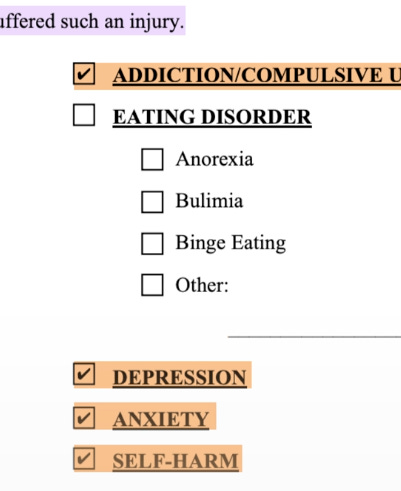 To get a sense of the severity of these matters. Plus, the full explanation here
The platforms have announced that they will appeal these decisions.
What makes these verdicts different from the thousands of lawsuits that came before is not the dollar amounts but the question they answered: courts weren’t asked whether Meta and Google hosted harmful content but whether they built dangerous products or hadn’t done enough to prevent harm.
This distinction - quiet, technical, almost bureaucratic-sounding - is actually a big new thing.
------------------------------------------------------------------------
Up until now, platforms have often been shielded by Section 230, or ‘the 26 words that created the Internet’ - a piece of legislation within the 1996 Communications Decency Act that protects online services from liability for what users post.
Section 230 made the internet possible because no one would have risked opening a service and bearing responsibility for other people’s actions.
Yet when it passed, the closest thing to a social media platform looked like this:
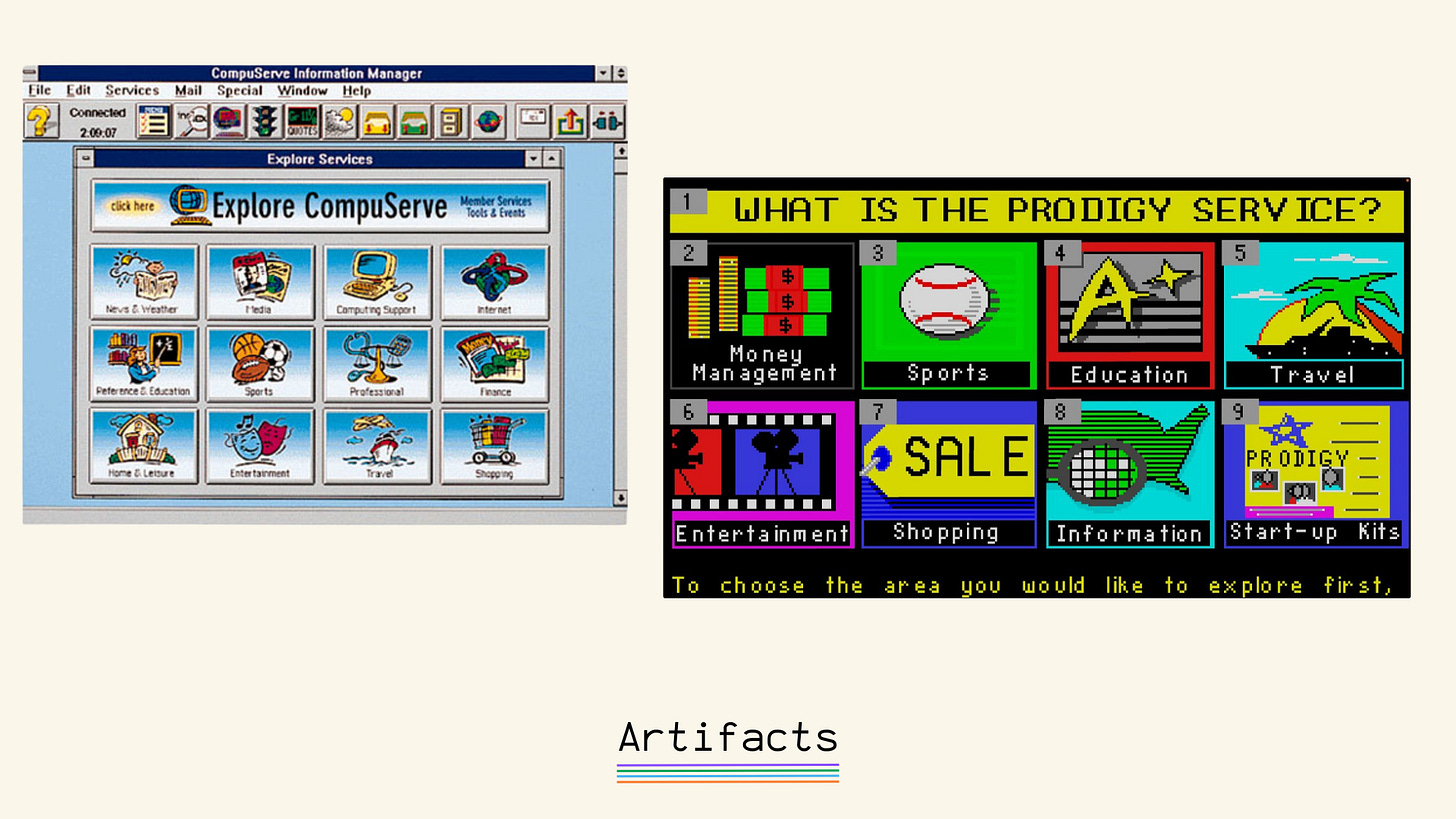 These are CompuServe and Prodigy, dial-up platforms where users posted text messages to bulletin boards. Users also chose a topic and read posts in chronological order. The logic of 230 was sound: you don’t sue the corkboard for what someone pins to it.
What CompuServe and Prodigy were offering was the hosting of content. But online platforms have changed quite a bit since:
They can now profile every user - every tap, pause, scroll, and replay feeding a behavioural model. They personalise reality: two people on the same platform at the same moment see completely different feeds. They recommend the next piece of content before you’ve decided you want one. They shape what is culturally visible at scale: what trends, what gets buried, what goes viral is not the neutral outcome of user preference but the product of ranking decisions the platform makes for billions of people simultaneously.
The content is still there, but it has become the fuel of a much broader and complex machine built on top. What these platforms offer now - content curation, algorithmically-determined connections, trends, monetisation - is far beyond just hosting.
And as they have built more complex products and offered more complex services, it makes a lot of sense to scrutinise the design.
Back to the two cases, with a bit more detail:
- KGM (the Los Angeles case) is a case about what Meta and YouTube built: infinite scroll, autoplay, variable reward loops - the deliberate unpredictability of likes and engagement, engineered to trigger certain behaviours. These are features with authors, thus decisions with accountability. The jury found their design negligent.
- New Mexico is a case about what Meta didn’t build (super interesting to read the full case here). The state attorney general ran an undercover investigation, creating a fake profile of a 13-year-old girl. She was served grooming content and connected to predators. What was missing: meaningful age verification, protective defaults, friction.
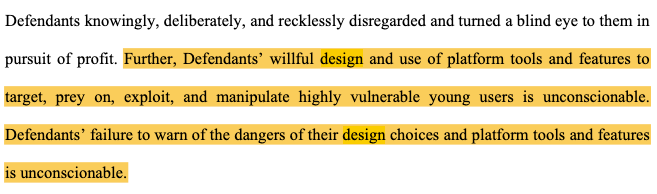 the New Mexico Case
If we are to introduce the language of product liability doctrine: the first case spots defects of commission, the latter defects of omission. Some of what Meta built was harmful; some of what it chose not to build made things worse.
By looking into these items, judges went beyond Section 230 and started scrutinising the design of the platforms themselves. In such a change, what’s new is also who is now part of the conversation.
If before platform accountability was a topic mostly for lawyers, regulators, and policy people, it will now involve a different crowd: product people who designed (or didn’t design) a specific feature and engineers who implemented it in a given way.
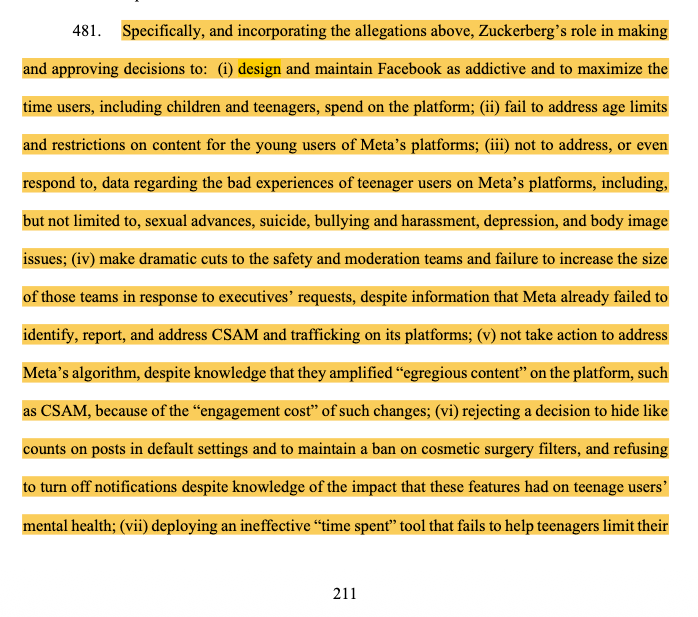 look at how much detail the case provides about the design decisions
And therefore, product liability is the natural legal container for all of this. It asks the right questions: could you have built this differently? Could you have chosen not to build it at all?
But in the US, product liability, as currently defined, was built for pharmaceuticals and power tools. Applying it to algorithmic systems requires foundations the law hasn’t yet built. So, they’d need:
- a clear legal definition of what counts as a “product” in the digital world - social media platforms and algorithmic services are currently treated more like intangible services than goods;
- a design‑defect standard that fits software: treating features that are “working as intended but foreseeably harmful” as a defect that was predictable, thus avoidable;
- a causation doctrine (‘this causes that’ type of thing) that handles systemic harm epidemiologically rather than case by case — tobacco litigation eventually developed this. This one is particularly important since, as contended by Meta too, it is quite a strong statement to say that a single platform has caused mental problems for a teenager.
- a First Amendment boundary that cleanly separates design conduct (how the platform works) from editorial expression (what content is there and how it is distributed), so platforms can’t collapse the two on appeal.
If these foundations get built, we get the tools to keep scrutinising properly how social media are designed, so that when architectural choices cause harm, they can be addressed.
 Speaking of tools, architects, and design
The importance of sound foundations is clear if we look at what Europe is already trying. With the Digital Services Act (which is not at all just about content!), the EU is, for instance, looking into prohibiting dark patterns, requiring recommender system transparency.
Therefore, for instance in December, the Commission issued its first DSA fine: €120 million to X, partly for the design of its blue checkmark, a trust signal quietly turned into a paid badge anyone could buy. And days after the US verdicts, it opened a formal investigation into Snapchat - focusing on defaults that exposed minors to strangers and age verification that amounted to typing a birthdate.
Two legal systems, different legal instruments, but the same shared question: can we improve the design of these platforms?
And so, as in that Amsterdam museum, finally asking if we can call the architects back in to fix the building.
Leave a comment
> ### Save for Later
Pay a bit of attention, please. Although there are good reasons why you cannot concentrate. Or you may not be able to spot a deepfake.
What if Venture Capitalists are zombies? And what if the Internet is less and less human. And some bad stories about AI workers
Maybe OpenAI can’t compete? AI may not love to reference newspapers. But some AI companies want others to pay copyright.
How war has become a story. And what’s this story of the EU censoring speech.
Go checkout what Carlo & Alessandro Diano are doing to fight polarization online - and do use their tools for your information diet! (+ had a lot of fun with them and other cool people from the UnbubbleHub building Sources, a tool to widen perspectives on any given topic)
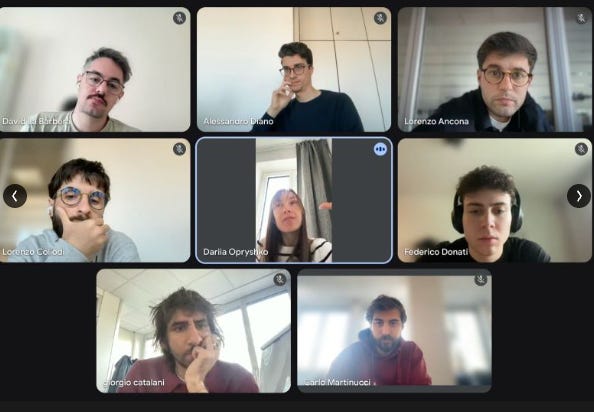 > ### The Bookshelf
 Probably the most comprehensive book about Section 230. You don’t need to be a lawyer to read it (I’m not). It will provide you with a lot of details and information to understand the why and how of Internet regulation 30 years back.
📚 All the books I’ve read and recommended in Artifacts are here.
> ### Nerding
 You know the moment you want to save something on your laptop, don’t know where, so you just pile it up on the desktop and never go back to it? I guess this is why they built Dropzone, which is, indeed, the virtual basket where you drop that file you’d like to get back to at some point.
> ### ☕?
If you want to know more about Artifacts, where it all started, or just want to connect...
Let's grab a virtual coffee ☕
======
# Use with caution
Date: 2026-03-07 | Language: en
Canonical: https://artifactstech.substack.com/p/use-with-caution
Cite as: Use with caution by Lorenzo Ancona, Artifacts, 2026-03-07. https://artifactstech.substack.com/p/use-with-caution (CC BY 4.0)
This week Artifacts should normally not go out. Yet **[what has happened between Anthropic, OpenAI and the US Pentagon](https://www.theverge.com/ai-artificial-intelligence/886082/ai-vs-the-pentagon-killer-robots-mass-surveillance-and-red-lines) is too interesting a story to miss.**
If you already know the news, feel free to skim to the *“So, what?”* section. **If not, I tried to keep the story concise.**
In July 2025, the Pentagon awarded **two-year contracts to Anthropic, OpenAI, Google, and xAI** to prototype frontier AI capabilities for national security. The goal was to develop agentic workflows, intelligence analysis tools, and battlefield simulations.
Among them, Anthropic had something the others did not. **Its model Claude was the only frontier AI system cleared to run on fully classified Pentagon networks**, deployed through Palantir Technologies’ AI Platform and Amazon’s Top Secret Cloud. It had been used, reportedly, **during the operation to capture Nicolás Maduro** and, most recently, for the strikes in Iran.
All four contracts, though, included some usage safety restrictions. **This changed on January 12, 2026** when the Defense Secretary Pete Hegseth issued an [AI strategy memo](https://media.defense.gov/2026/Jan/12/2003855671/-1/-1/0/ARTIFICIAL-INTELLIGENCE-STRATEGY-FOR-THE-DEPARTMENT-OF-WAR.PDF) declaring the Pentagon would become ‘an ‘AI-first’ warfighting force with AI agents integrated *‘from campaign planning to kill chain execution’.*
To this end, the Pentagon asked Anthropic and the others **to change the contracts** so to use AI at its full potential, with no ‘policy constraints’ decided by the AI companies. **“Any lawful use” should be allowed.**
On February 27, Hegseth reportedly gave Anthropic an **ultimatum**: accept the revised terms or lose the contract. **Anthropic rejected the offer, [citing concerns about undermining democratic values](https://www.anthropic.com/news/statement-department-of-war)**, and no intention to allow the use of AI for **mass surveillance** of American citizens and **autonomous weapons** that can kill with no human in the decision loop.
That same evening, **Sam Altman [announced](https://openai.com/index/our-agreement-with-the-department-of-war/) that OpenAI had reached a new agreement with the Pentagon**. According to Altman, the deal preserved the same red lines on autonomous weapons and mass surveillance that Anthropic had defended.
However, **the details of the contract have not been made public**, and some observers believe the new arrangement may allow broader uses than Anthropic considered acceptable.
OpenAI claims that they will be able to enforce better their constraints as the models used by the Pentagon will run on their own cloud.
Finally, **[the Pentagon has responded by designating Anthropi](https://www.anthropic.com/news/where-stand-department-war)c a “Supply-Chain Risk to National Security”** - usually reserved for foreign companies (like Chinese ones) - ordering federal agencies to stop using its products in the next 6 months. The New York Times [said](https://www.nytimes.com/2026/02/28/podcasts/hardfork-pentagon-anthropic-openai.html) this is *‘likely the harshest punitive action the U.S. government has taken against a major American company this century, possibly ever.’*
**Anthropic will challenge the designation**, which could greatly impact their business, while also [saying](https://www.anthropic.com/news/where-stand-department-war) they *‘have much more in common with the Department of War than we have differences.’*
> ### So, what?
This story is ultimately about **constraints**.
Not only those that AI companies want to put on the US government in the use of technologies or those put by technology regulations on the use of AI, but also, and maybe more crucially, **those baked into the design of AI technologies.**
Let’s look at the [two red lines set by Anthropic:](https://www.anthropic.com/news/statement-department-of-war)
1. ***‘Mass domestic surveillance is incompatible with democratic values** and presents risks to fundamental liberties’.* Therefore, despite being technically *feasible* to use their AI models to analyse data on citizens, **there has to be constraints as this is overly dangerous and threatens rights.**
2. **Fully autonomous weapons**, instead, ’*need to be deployed with proper guardrails, which don’t exist today.’* So they *could be used*, but the current safety constraints are not sufficient, **and thus it is imperative to have safeguards in place.**
These constraints are not just on the AI models but **on the blurred terminology of** ***‘any lawful use’*** adopted by the Pentagon.
In theory, this sounds straightforward. But **in the United States** - where there is still no comprehensive federal regulation of AI - **the meaning of “lawful use” is far from settled.** The boundaries are still evolving.
In practice, this means that **the law alone does not fully define the acceptable uses of AI.**
And that is precisely **where these technological constraints come in.**
Interestingly, **the Pentagon itself had tried to push back constraints** in the January memo, writing that they *‘must utilize AI models free from usage policy **constraints** that may limit **lawful** military applications.’*
This sounds like a very controversial statement depicting a contrast **where the constraints of technologies could be countering or impeding uses allowed under the law.**
Provocatively, this is exactly **the contrary of the reasons why technology regulations are often criticised:** that they impede the full use of technologies.
Usually, you see BigTech or other organisation complaining about regulation. Here, the situation is almost inverted: the Pentagon argues that **constraints embedded in the technology itself** could limit uses that the law might otherwise allow.
Or, as put more bluntly by [Hegseth](https://x.com/SecWar/status/2027507717469049070?s=20) *‘America’s warfighters will never be held hostage by ideological whims of Big Tech.’* Or from Trump:
[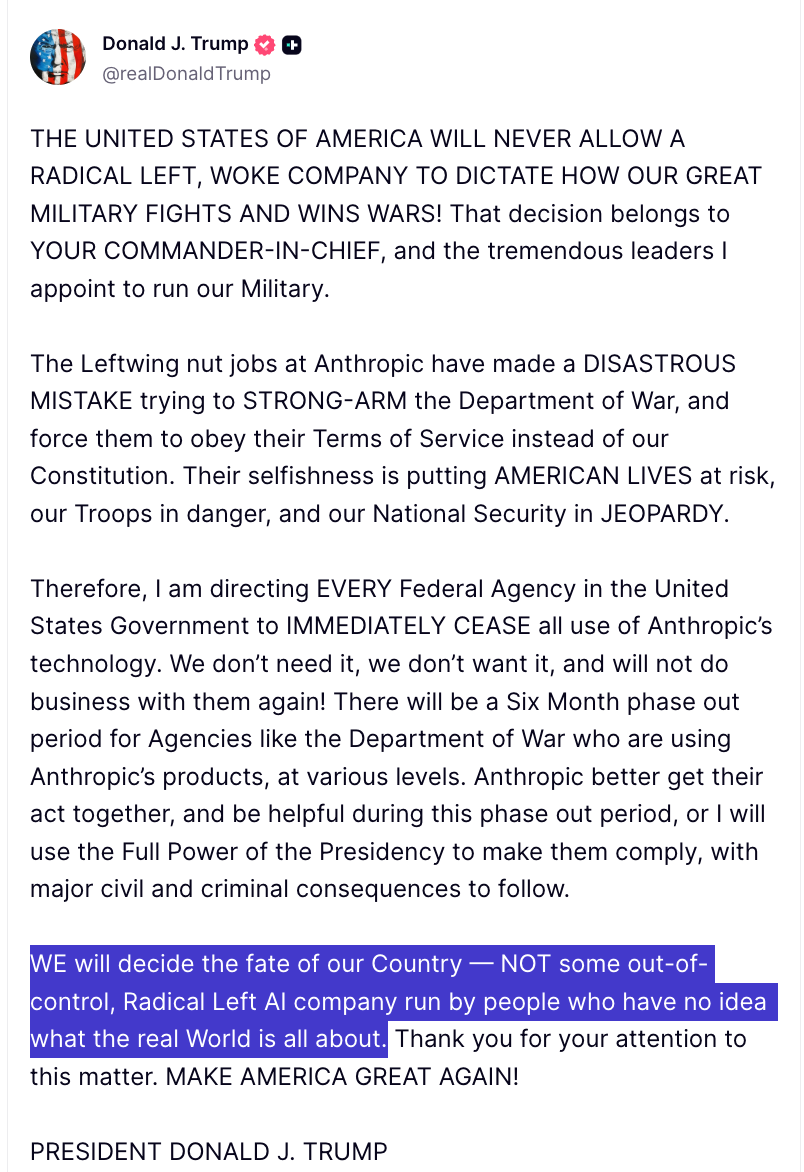](https://substackcdn.com/image/fetch/$s_!H0jM!,f_auto,q_auto:good,fl_progressive:steep/https%3A%2F%2Fsubstack-post-media.s3.amazonaws.com%2Fpublic%2Fimages%2F34018583-64c5-44ed-83ab-fedb69c400ef_804x1172.png)
At its core, this raises a fundamental question: **who ultimately controls powerful technologies?** Those who build them or those who regulate them, this time more interested in a laissez-faire regulation for unbridled use?
By setting these constraints, **AI companies are doing something subtle but important.** They are not only designing the technology itself, but also shaping the **space of possible uses**.
Interestingly, **they are designing a downstream layer of the use of AI** that sits on top of the design of technology itself.
If we have long argued that technologies are not neutral - that their design shapes their political and social effects - **this story reveals something further.**
With AI, the **design of use** **becomes almost as important as the design of the system itself.**
This is particularly true because artificial intelligence is a **general-purpose technology**. Its capabilities can be applied across a vast number of domains, **and thus the layer of how it can be used is critical.** Not all possible options are good options.
[](https://substackcdn.com/image/fetch/$s_!kv_i!,f_auto,q_auto:good,fl_progressive:steep/https%3A%2F%2Fsubstack-post-media.s3.amazonaws.com%2Fpublic%2Fimages%2F661eace5-156f-4830-b074-9004d3935975_2048x2048.png)
Concretely, as AI would, for instance, enable easy data analysis, **the issue is rather with what use is done of such capability:** is it to assess, say, decarbonisation metrics or rather spying on citizens through combining data?
The real question is therefore not just what AI can technically do but also **what it will be allowed to do**.
And in the absence of clear ‘lawful uses’, **those decisions increasingly fall for now to the organisations building these technologies** and in how they design what’s allowed and what’s not.
[Leave a comment](https://artifactstech.substack.com/p/use-with-caution/comments)
> ### **Save for Later**
[Why someone should write,](https://www.orwellfoundation.com/the-orwell-foundation/orwell/essays-and-other-works/why-i-write/) from Orwell - quite crucial nowadays
[So what will happen to jobs](https://www.anthropic.com/research/labor-market-impacts), by Anthropic. Btw, Anthropic [gave Claude a Substack](https://www.theverge.com/ai-artificial-intelligence/885200/anthropic-retired-claude-given-a-substack).
Maybe just put [a stop on the AI slop](https://www.theverge.com/ai-artificial-intelligence/882956/ai-deepfake-detection-labels-c2pa-instagram-youtube), please? In the meantime, a super funny video on [a professional enshittificator](https://x.com/joakial_/status/2027753478068506923?s=20) (maybe a new word?)
If you need to vibe with your Google documents, [go for this.](https://github.com/googleworkspace/cli)
AI doesn’t really understand [the physical world.](https://www.linkedin.com/posts/yann-lecun_feel-the-agi-i-suspect-the-thing-was-activity-7434243936266813440-uWDK?utm_source=share&utm_medium=member_desktop&rcm=ACoAADBGmFQB0rHgggpkCiHG5Dn-B9e4n2G0Y-g)
How to curate what information we eat.
[\[Embedded media — view original\]](https://www.youtube-nocookie.com/embed/VCJET4fj1mE?rel=0&autoplay=0&showinfo=0&enablejsapi=0)
> ### **Where next?**

In 10 days I’ll be at the **[Govtech forum](https://www.govtechforum.io/)** in Milan 🇮🇹 - *let’s say hi if you’re around!*
> ### **The Bookshelf**
[](https://substackcdn.com/image/fetch/$s_!xkhA!,f_auto,q_auto:good,fl_progressive:steep/https%3A%2F%2Fsubstack-post-media.s3.amazonaws.com%2Fpublic%2Fimages%2F70edb1ae-f69c-4ab6-adfa-ea98233d6ac3_1080x1080.png)
Speaking of edge uses of technology, the ***‘Palestine Laboratory’*** is a good book to shed light on what the use of technology really means and why its design matters.
📚 **All the books** I’ve read and recommended in Artifacts are [here.](https://airtable.com/appK7fMPX1DMkQYzL/shrRh8TgI7GtmgBxM)
> ### **Nerding**
[](https://substackcdn.com/image/fetch/$s_!I3pZ!,f_auto,q_auto:good,fl_progressive:steep/https%3A%2F%2Fsubstack-post-media.s3.amazonaws.com%2Fpublic%2Fimages%2F98859569-cfa1-46be-8bce-13bbd499f621_1080x1080.png)
**If you’re into cool interactions, design, animations,** you may want to check out **Mobbin**, which collects them all together and is a great source of inspiration for anyone building products!
> ### **☕?**
If you want to know more about Artifacts, where it all started, or just want to connect...
======
# The artifacts I use for Artifacts
Date: 2026-02-25 | Language: en
Canonical: https://artifactstech.substack.com/p/the-artifacts-i-use-for-artifacts
Cite as: The artifacts I use for Artifacts by Lorenzo Ancona, Artifacts, 2026-02-25. https://artifactstech.substack.com/p/the-artifacts-i-use-for-artifacts (CC BY 4.0)
[In the last Artifacts,](https://artifactstech.substack.com/p/writing-is-thinking) I argued that using LLMs to produce text **may mean skipping the thinking that makes writing worth doing.**
Yet, I’m definitely not a Luddite or sceptical of AI helping with daily tasks. It’s just that I don’t buy ‘the perfect prompt’ or other tricks with chatbots.
And so, while busy ranting against chatbots, **I was also studying AI agents:** *artifacts* that don’t just generate text on demand but can coordinate and use other tools, memory, **and - more importantly - can perform actions.**
And I started to wonder **how I could use these artifacts to write Artifacts.**
**I moved from the tasks I do every day for the newsletter:** pulling interesting articles or podcasts, storing them somewhere with labels or notes, finding moments to make sense of a lot of unshaped knowledge, but also trying to find that old article or books I read that may be relevant to a certain topic.
People working in product would say I started from the **jobs to be done.**
The more I researched, **the more I realised that [Claude Code](https://www.lennysnewsletter.com/p/head-of-claude-code-what-happens) was the perfect orchestra director** of the different flows I was tinkering with. But let not be boring with the technicalities :)
[](https://substackcdn.com/image/fetch/$s_!VSEM!,f_auto,q_auto:good,fl_progressive:steep/https%3A%2F%2Fsubstack-post-media.s3.amazonaws.com%2Fpublic%2Fimages%2F75e0782e-ae50-4c4f-9ffb-6513c93d9aa4_1024x1024.png)
music :)
What matters is that a few weeks in, **I found myself with something I hadn’t expected at the outset:** **a full editorial infrastructure** that autonomously gets relevant articles from multiple sources, organizes them and - **when I decide on what to write about** - supports me with the research and the refinement, tapping in everything I’ve read for the past 3 years.
All in all, I don’t think it’s an overstatement to say I got **a small team of artifacts that help me write Artifacts.**
Ah, a few important **caveats**:
- I use Claude Code, which is built for engineers, **but works just fine for other tasks as well.** A good alternative could be [Claude Cowork.](https://claude.com/blog/cowork-research-preview)
- This whole infrastructure costs **19 euro per month.**
- It’s hard to quantify how long it took, but **it’s definitely** ***easy*** **to build something like this with AI**, now.
Here’s a bit of the **story** of how it went.
> **First,** **the** **foundation**
If there’s one thing that matters with AI agents, it’s **context**. Not copy-pasting the prompt of who you are, what you do, etc., but **a more solid understanding and ‘memory’ of what you’re writing on**, how you do things, what good looks like.
So when I started thinking about how to make Claude Code useful for Artifacts, the question was simple: *where’s the best place to pull that context from?* The answer was obvious: **Artifacts itself.**
**I had Claude fetch and read every Artifacts I’d ever published** - years of writing, including the early ones still in Italian, when the newsletter was heavier on policies and regulation and lighter on technologies.
**And it was quite fun to ‘talk’ with the old newsletters**, see how Artifacts has evolved and, implicitly, how I’ve evolved in writing them.
It was also the opportunity to rethink a bit how I describe this newsletter, settling on ***‘stories & ideas on the design of technology’***
[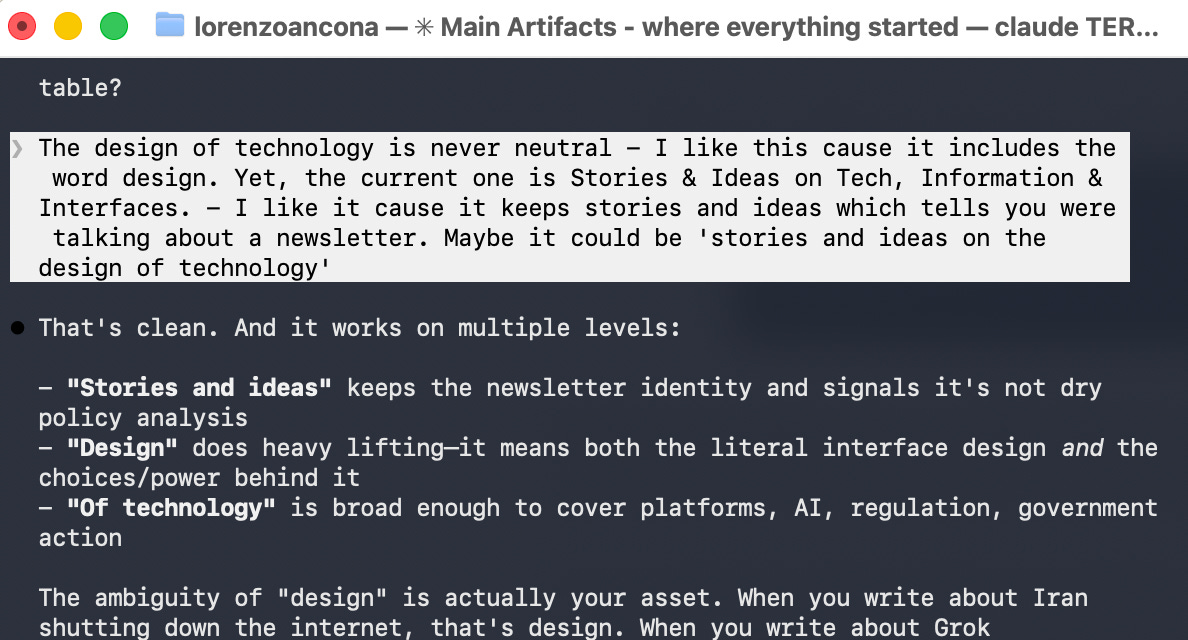](https://substackcdn.com/image/fetch/$s_!XdpJ!,f_auto,q_auto:good,fl_progressive:steep/https%3A%2F%2Fsubstack-post-media.s3.amazonaws.com%2Fpublic%2Fimages%2F10b73ba9-ef30-47dd-9ca1-ae35a05670d2_1188x640.png)
Claude then used all this context to fill in the `Claude.md`, **a file that loads automatically at the start of every session**, where it’s clear who you are, what you do, where things are, what’s your style etc. **Much better than the perfect prompt :)**
[](https://substackcdn.com/image/fetch/$s_!r8gi!,f_auto,q_auto:good,fl_progressive:steep/https%3A%2F%2Fsubstack-post-media.s3.amazonaws.com%2Fpublic%2Fimages%2F16915354-00d4-46fc-8f0b-5fe9df7cdcea_1604x1318.png)
Most developers use it to document code architecture. **I** **use it to document Artifacts and how it is written.**
**CLAUDE.md is the most important piece in this stack.** Everything else runs on top of it.
The second foundational piece is **Notion**. I’ve used it for years as a database where to automatically store all the articles, papers, podcasts, books, I read - basically, **the knowledge that has been powering Artifacts for years.**
Now, I’ve connected it to Claude (via MCP, for nerds out there), so that **whenever I’m thinking of, say, age verification, it will return to me anything I’ve came across in the past 3 years**, be it a podcast or a book highlight. Not too bad.
[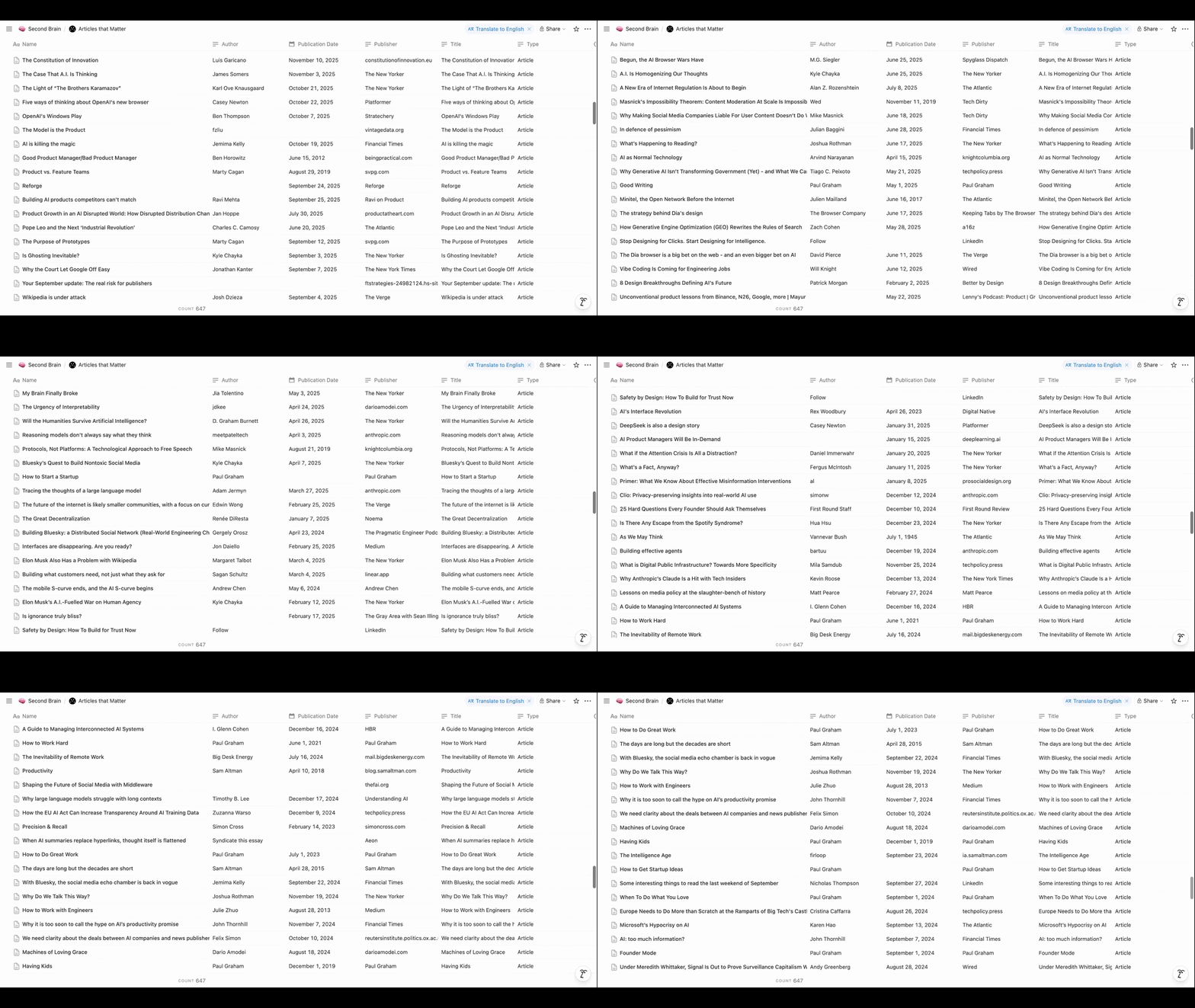](https://substackcdn.com/image/fetch/$s_!h-SG!,f_auto,q_auto:good,fl_progressive:steep/https%3A%2F%2Fsubstack-post-media.s3.amazonaws.com%2Fpublic%2Fimages%2Fdb85fe36-462f-4cc5-bfe6-ce88597aec79_1280x720.gif)
`Claude.md` and the Notion plug are where the full context lives: **they don’t generate content but they make my agents aware of what Artifacts is** and what I know already.
So I’m not always starting from zero, or chasing the perfect prompt :)
> **Then,** **the** **flow**
Once the infrastructure knew Artifacts, **I started using it.**
First task is getting sources. **As Artifacts is where I try to make sense of a lot of what I read, I try to read a lot.** But as the newsletter subscription counter grows, it’s not the case for time - and sometimes I struggle to catch up.
So I built an automation in n8n that **every day at 9 PM pulls articles from TechCrunch, The Verge, The Markup, and WIRED, plus whatever newsletters landed in my inbox**, then filters, clusters, and analyses them with an AI tuned to ask one question: ***what matters here for Artifacts?***
[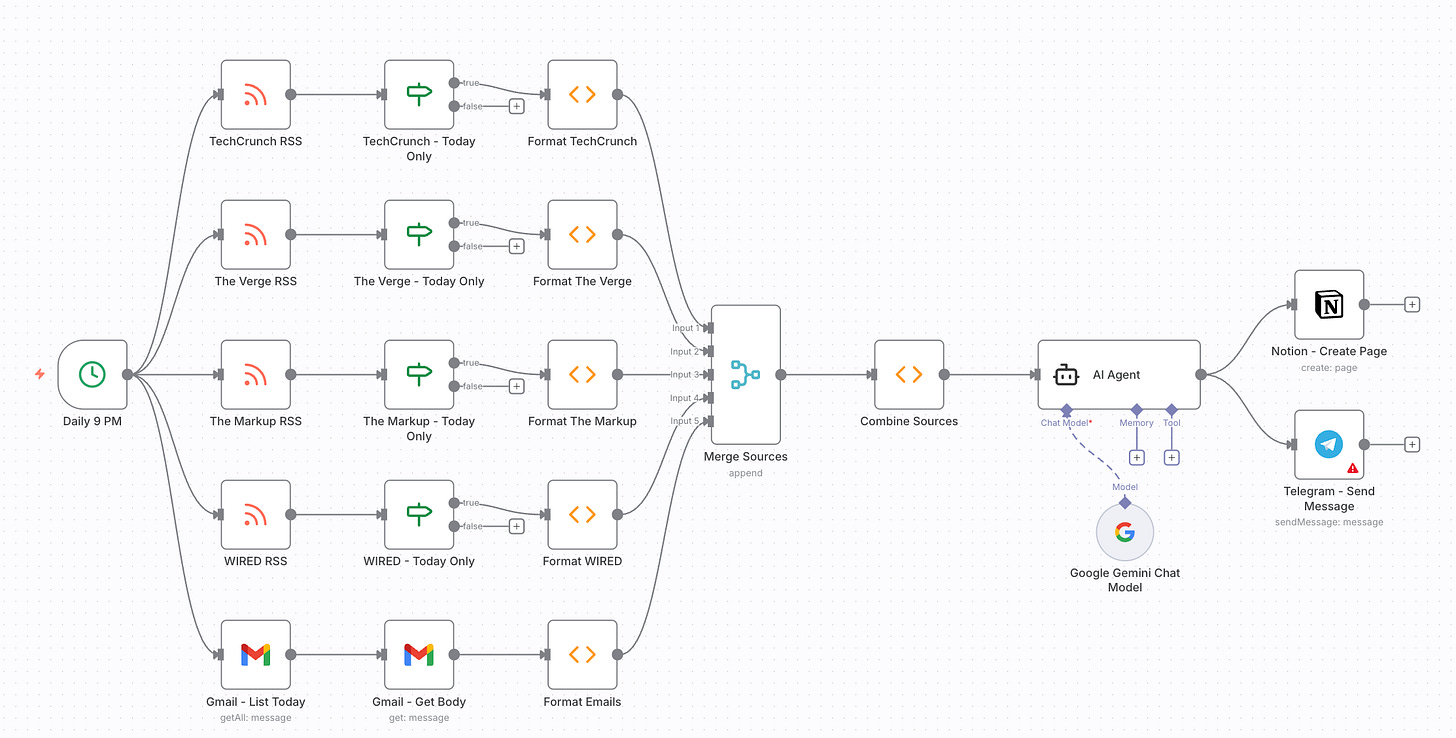](https://substackcdn.com/image/fetch/$s_!jkFR!,f_auto,q_auto:good,fl_progressive:steep/https%3A%2F%2Fsubstack-post-media.s3.amazonaws.com%2Fpublic%2Fimages%2Ff50e3e5f-c69c-4fdc-9d8a-eae47cd22bba_2226x1128.png)
The output is some **notes sent to a Notion page and in a Telegram message** on my phone. I usually read it in the evening or first thing in the morning.
[](https://substackcdn.com/image/fetch/$s_!bFVP!,f_auto,q_auto:good,fl_progressive:steep/https%3A%2F%2Fsubstack-post-media.s3.amazonaws.com%2Fpublic%2Fimages%2F8ae940f5-1880-4c9a-ae27-c50bf97aaa1c_1166x1016.png)
Sometimes nothing sticks, other times one item connects to something I’ve been turning over for weeks, **and that’s when the idea of a piece begins.**
Important point: **I decide what to write about.** For now, I don’t want AI suggesting topics. **I enjoy connecting the dots myself.**
Once I pick a topic, **I open Claude Code and start looking into my Notion for pieces on the subject.** It helps me re-read, draw an outline, ditch ideas, explore new angles - building the shape of what I want to write before I actually write it.
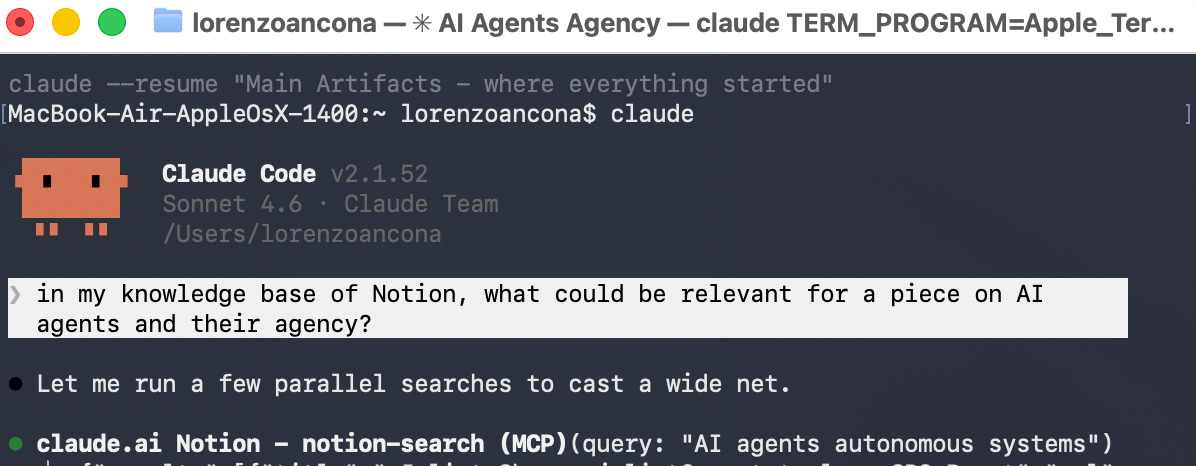
**So I can draw on my notebook the mental schema** I need before writing Artifacts.
**Writing itself I keep for myself,** and I think I’ve explained at length why :)
What I have built is`/artifacts-polish`, **a skill that helps me clean language and keep it consistent with older editions,** having ‘read’ the others.
[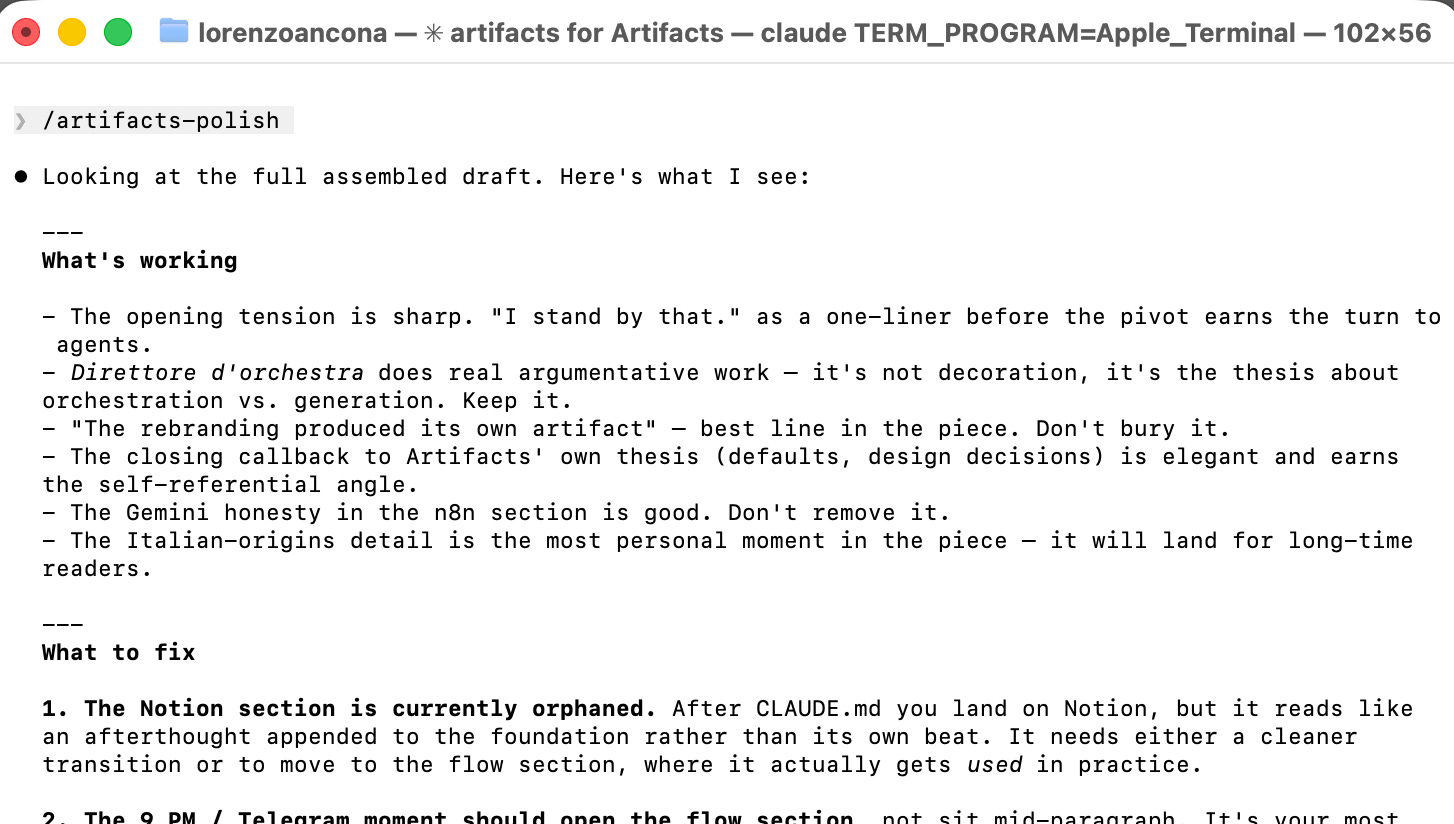](https://substackcdn.com/image/fetch/$s_!JIDD!,f_auto,q_auto:good,fl_progressive:steep/https%3A%2F%2Fsubstack-post-media.s3.amazonaws.com%2Fpublic%2Fimages%2F296a062d-7c4d-4d3b-ad49-7b1ab57ed008_1454x824.png)
In Claude, **skills are fixed instructions on repeated tasks** - say every morning you want a recap of your emails, you built a skill that knows what to do.
Once the draft is ready, **I run this skill and it helps me go through what I’ve written with fresh eyes.**
And when I’m happy, I send it out to your inbox :)
**But it doesn’t end there.** As some of you know, I always republish on LinkedIn - with some effort to avoid the annoying flattened language of that platform. So I built another skill,`/artifacts-linkedin`, **that turns my piece into a post I’m actually happy with, based on all my previous ones.**
[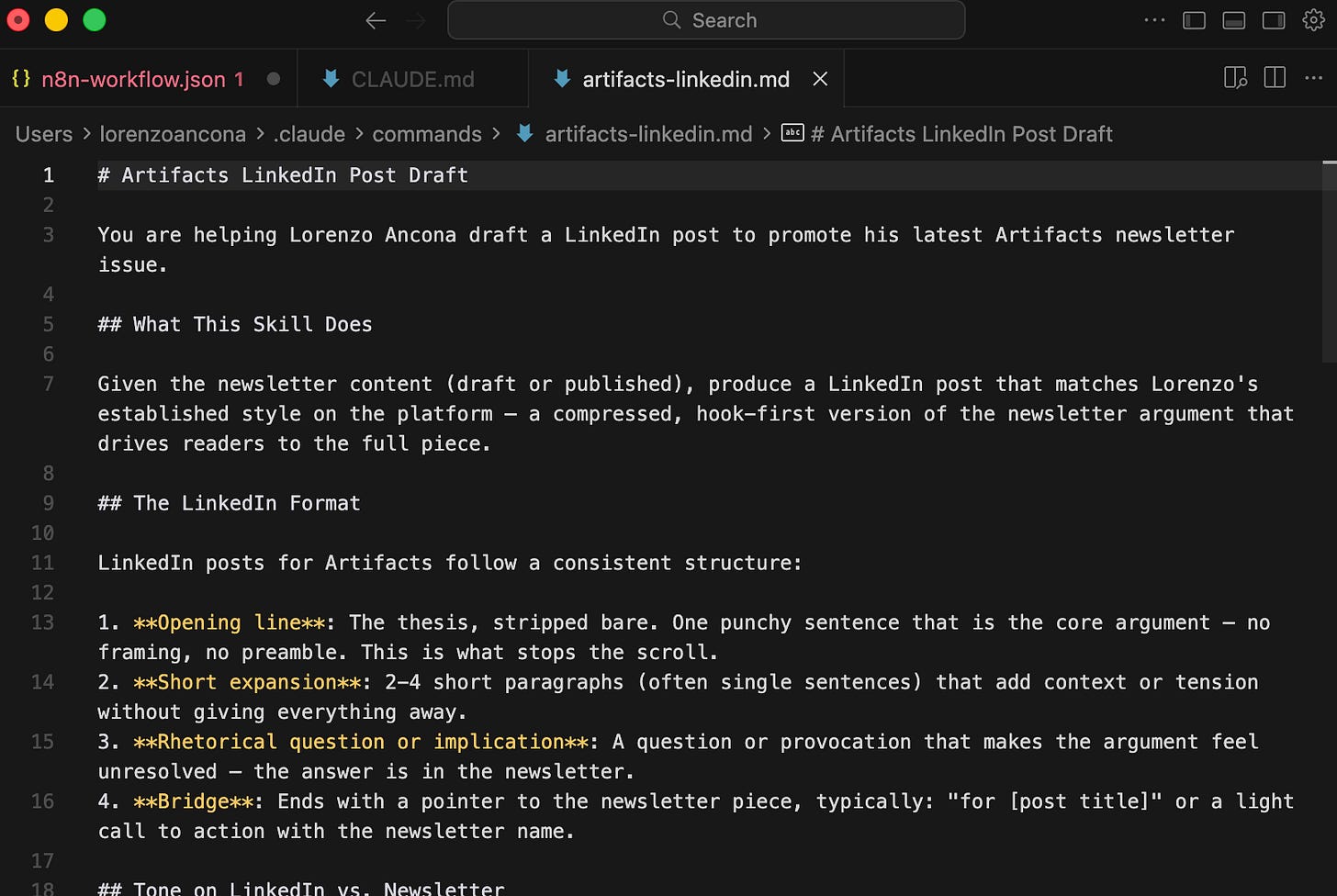](https://substackcdn.com/image/fetch/$s_!EoV8!,f_auto,q_auto:good,fl_progressive:steep/https%3A%2F%2Fsubstack-post-media.s3.amazonaws.com%2Fpublic%2Fimages%2F05387444-bfa3-4880-b29a-843a64204b12_1614x1082.png)
Last but not least, **Claude, the context and the agents keep learning from the process**, so the infrastructure improves with me.
> **So, what?**
I want to be careful not to oversell it. **These artifacts don’t write Artifacts** - but they help by surfacing topics I might have missed, pulling up pieces I read months or years ago, and keeping consistency across publications.
And I built this not to have someone else writing, but **to do better some tasks and leverage more my very own work of the past years.**
So it’s not just a writing assistant but more **an AI-powered thinking and writing infrastructure**, designed around what Artifacts is and has been, and with flows for how I want to be writing and keep doing it.
The critical decisions stay with me: **picking the topic, building the argument, doing the writing.** That’s intentional, and I don’t plan on changing.
But I must say that I’m having a lot of fun in having **these artifacts that help me write Artifacts,** and I’d encourage anyone to try it out for their projects!
[Leave a comment](https://artifactstech.substack.com/p/the-artifacts-i-use-for-artifacts/comments)
> ### **Save for Later**
Why institutions are [artifacts of cooperation.](https://aeon.co/essays/institutions-are-how-we-scale-up-cooperation-among-millions)
What are [the political effects of X’s algorithms](https://www.nature.com/articles/s41586-026-10098-2).
Why [we never asked](https://www.nytimes.com/2026/02/10/technology/personaltech/ai-google-meta-opt-out.html) for this Internet. And indeed [we don’t really need](https://www.wired.com/story/the-search-engine-for-onlyfans-models-who-look-like-your-crush/?bxid=5f43a3c889a7356e7e1b2114&cndid=61968307&hasha=dca445e23e26114858a48ad35040e287&hashc=2107626209cd615da922d357ec59a2f4a769eeec7e75a95e874cf17f98f1a7c1&esrc=MARTECH_ORDERFORM) these technologies probably.
What are the consequences of [AI speaking without bearing the consequences of it.](https://www.theatlantic.com/technology/2026/02/words-without-consequence/685974/) Btw, [AI doesn’t like Naples](https://github.com/algorithmwatch/city-comparisons/blob/main/Analysis.ipynb).
[Get bored](https://www.mdpi.com/2076-3425/15/8/794), please!
> ### **The Bookshelf**
[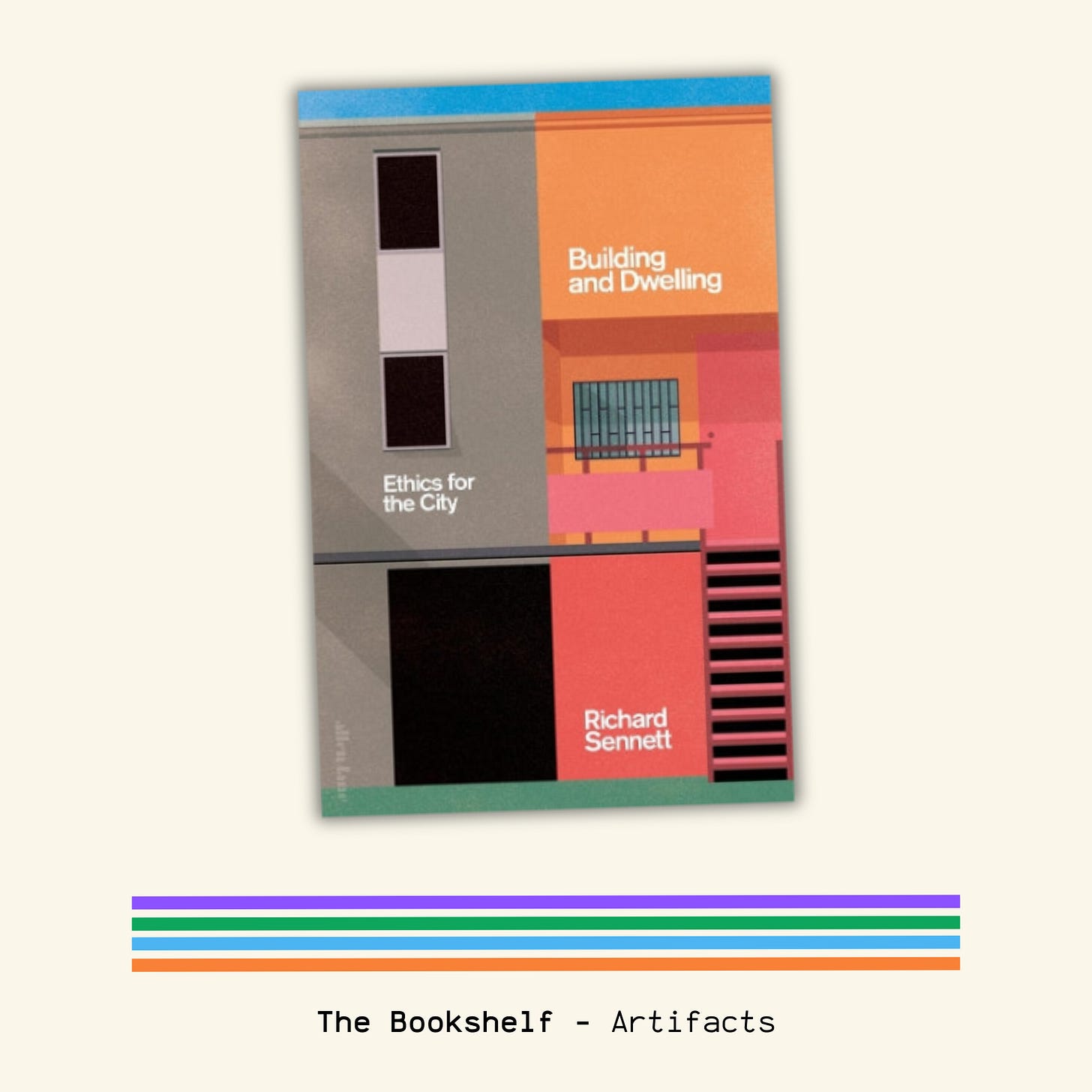](https://substackcdn.com/image/fetch/$s_!esBy!,f_auto,q_auto:good,fl_progressive:steep/https%3A%2F%2Fsubstack-post-media.s3.amazonaws.com%2Fpublic%2Fimages%2Fede6edeb-e20f-4525-8b0a-dbf74741b695_1620x1620.png)
As we discussed infrastructures, I recently wrapped up ***‘Building and Dwelling’***, a terrific book by Richard Sennett on **how the cities we build shape how we live them.** Not a tech book, but worth a read for those interested in Artifacts more broadly.
📚 **All the books** I’ve read and recommended in Artifacts are [here.](https://airtable.com/appK7fMPX1DMkQYzL/shrRh8TgI7GtmgBxM)
> ### **Nerding**
[](https://substackcdn.com/image/fetch/$s_!Y9Pm!,f_auto,q_auto:good,fl_progressive:steep/https%3A%2F%2Fsubstack-post-media.s3.amazonaws.com%2Fpublic%2Fimages%2Fb8ecc0ef-7963-4623-b319-b3ed916b80e8_1080x1080.png)
To complement work with Claude Code, but also to connect ideas and create your knowledge base, **[Obsidian](https://obsidian.md/)** is a good one. **Needs an investment, but take a look!**
> ### **☕?**
If you want to know more about Artifacts, where it all started, or just want to connect...
[Let's grab a virtual coffee ☕](https://calendar.google.com/calendar/u/0/appointments/schedules/AcZssZ2ibxlzyU7rgnuoTgqXb_DFc19dfHmJeu1OAu17IY0_oHrtcJtvtctAJnMabirgZNx5Z5NAPGs0)
======
# Writing is thinking?
Date: 2026-02-10 | Language: en
Canonical: https://artifactstech.substack.com/p/writing-is-thinking
Cite as: Writing is thinking? by Lorenzo Ancona, Artifacts, 2026-02-10. https://artifactstech.substack.com/p/writing-is-thinking (CC BY 4.0)
Don’t look away, I’m quite sure this has happened to you as well:
[](https://substackcdn.com/image/fetch/$s_!xA0m!,f_auto,q_auto:good,fl_progressive:steep/https%3A%2F%2Fsubstack-post-media.s3.amazonaws.com%2Fpublic%2Fimages%2Fd4fc25d9-176d-4318-8662-3eead6e117c7_1200x628.png)
I admit too that I rarely draft work emails 100% by myself.
But let’s look at the broader picture: **we live in an era where producing a significant amount of language with meaning is more efficient and less time-consuming than ever.** You can literally get 10 pages of anything in a few minutes by asking any LLM to do so.
Yet, **this doesn’t mean we’re producing more knowledge or that the amount of meaning keeps pace with the length of the documents spit out by machines.**
Rather, **LLMs are great at producing stuff that makes sense, sounds good, and neatly organises notions**, being able to package information either in a few bullet points or uselessly long documents.
Not surprisingly, though, **the level of these texts can’t help but be average**, as LLMs are, technically but also philosophically, *‘[technologies of average](https://www.newyorker.com/culture/infinite-scroll/ai-is-homogenizing-our-thoughts) both in the quality of the writing and in the calibre of the ideas.’*
(And usually also badly written imho)
Not only creating, but also [consuming language](https://www.newyorker.com/culture/open-questions/whats-happening-to-reading) has been drastically simplified (I swear I wrote this sentence 😅): **we may be often asking an AI to help us read and summarise a document that someone else asked AI to make longer.**
Just look at newspapers apps or any reading app or even the iPhone, that now has introduced AIs to quickly give the 3 key points of anything.
I like to call this **the accordion of AI language: we keep making texts longer or shorter depending on our needs** only cause doing it is very, very easy.
[](https://substackcdn.com/image/fetch/$s_!uxHU!,f_auto,q_auto:good,fl_progressive:steep/https%3A%2F%2Fsubstack-post-media.s3.amazonaws.com%2Fpublic%2Fimages%2F157cbf39-ed1c-4b5d-999a-5319b785f96d_1024x1024.png)
we’re doing this to language
And so **producing simple, beautiful BULLSHIT is now extremely time-efficient, cheap and accessible** 🎉 Just peek at your LinkedIn feed if you need validation.
But that’s not as much of a problem.
What’s worse and deeply concerning is that **producing language has become a commodity.**
Large Language Models have made it so **easy to turn a few words of a prompt into newly created language.**
Yet, this makes us skip the complex, fascinating process through which we translate our thoughts into language, and thus words. **LLMs are our mediums.**
**And this means that language is less of a tool** - even a technology or an artefact - **through which we think and instead just a code enabling communication.**
All in all, **we can now think less to produce language.**
This comes with a few **implications**:
We’re no longer writing but rather **‘meta-writing’:** we more and more dictate to a machine *what* we need to write and maybe even *how* and in what style, **and then we delegate the act of writing or typing words to machines.**
**And so we stare at screens** while language is being produced by LLMs, skipping the process of thinking through what we aim to communicate.
This way, **writing is no longer a flow of 1st draft out, correcting it, changing, refining, but a back-and-forth exchange with a machine.** [As argued in Nature](https://www.nature.com/articles/s44222-025-00323-4), though, *‘**Writing compels us to think** — not in the chaotic, non-linear way our minds typically wander, but **in a structured, intentional manner.’***
Yet, **the ability to iterate over and over on a text quickly**, asking an AI to ‘make it more interesting’ or ‘make it sound more natural’ or whatever non-sensical prompts, **may decrease the time we spend on and with the language that should express our thoughts.**
So we may also understand less about what we’re ‘writing’ about but also **devote less care to what we’d like to emphasize and what requires less attention**, which is one of the most critical skills of thinking and writing.
At its extreme, **I sometimes consider writing the process by which we realise that we don’t understand what we’re talking about** - and sometimes this is so important.
This goes hand in hand with two other critical skills of writing and thinking: **the ability to break down complex issues into simple words as well as the ability to write concisely**, while not compromising on the meaning of what we say.
And still on the drafting and redrafting part, **we, as writers, are less and less the first careful readers of what we produce**, as we assume that LLMs will never have typos (rightly so, actually).
Finally, allow me to be a bit romantic, but **writing** - like reading - **is [a great process of self-discovery.](https://fs.blog/writing-to-think/)** [](https://fs.blog/writing-to-think/)
As I’m writing this Artifacts, I love seeing the mental connections I make, how I bridge different things I read in the past, what a friend maybe told me - **I thoroughly enjoy the time and feeling of the whole process.**
**And I do feel [a sense of care](https://www.theatlantic.com/family/2026/02/ai-etiquette-friends/685858/)**, of being clear and readable, so that your reading is enjoyable and an interesting time. *And I’m sure it’s the same for you, when you write.*
This being said, I’m not saying the final outcome of what I will produce would necessarily be better than an LLM *(well, I hope)*, but **the process itself of writing is probably also part of why you’re reading this piece.**
[](https://substackcdn.com/image/fetch/$s_!4QoH!,f_auto,q_auto:good,fl_progressive:steep/https%3A%2F%2Fsubstack-post-media.s3.amazonaws.com%2Fpublic%2Fimages%2Fe449b185-9b95-4eb2-8823-6076bd5e8acf_2950x2446.png)
This is everything that happens before me writing an Artifacts
Indeed, I argue that we read what others write cause we’re interested not just in the content of their writing - that could be produced by LLMs - or the information conveyed, **but also in why they wrote that something, what moved them, and, simply, in getting to know what they think.**
And so that a text - and thus the language of a thinking process - can resonate and establish a new human connection.
[Leave a comment](https://artifactstech.substack.com/p/writing-is-thinking/comments)
> ### **Save for Later**
[If a Ferrari gets designed](https://www.theverge.com/transportation/875799/ferrari-luce-jony-ive-interior-design-photos) by the person who created the iPhone.
But also [a collection of bad design tricks](https://pudding.cool/2023/05/dark-patterns/) that gets us trapped into services, so cool! And, speaking of design, [what the EU Commission is looking into TikTok for](https://www.ft.com/content/3d19372c-4922-4cdd-896c-8e3a81ecd3ba), trying to make it better
The truth on the [social media powered by AI agents.](https://www.nytimes.com/2026/02/02/technology/moltbook-ai-social-media.html) And where the truth really is between [Wikipedia and its alternatives.](https://www.lemonde.fr/idees/article/2026/01/25/entre-grokipedia-et-wikipedia-il-s-agit-de-determiner-quelles-conceptions-du-savoir-nous-souhaitons-defendre_6664020_3232.html)
AI Safety and where we are at, [with the most comprehensive report.](https://internationalaisafetyreport.org/publication/international-ai-safety-report-2026) While someone bought [AI.com for a lot of money.](https://www.ft.com/content/83488628-8dfd-4060-a7b0-71b1bb012785)
Anthropic [keeps doing super cool.](https://www.ft.com/content/a75555a6-24c3-4468-aba9-7fe12b5def31) Just look at this spot on adv on AI to mock OpenAI:
[\[Embedded media — view original\]](https://www.youtube-nocookie.com/embed/kQRu7DdTTVA?rel=0&autoplay=0&showinfo=0&enablejsapi=0)
> ### **The Bookshelf**
[](https://substackcdn.com/image/fetch/$s_!PXcL!,f_auto,q_auto:good,fl_progressive:steep/https%3A%2F%2Fsubstack-post-media.s3.amazonaws.com%2Fpublic%2Fimages%2F8f516323-22b3-4f13-83d3-7103ecc32883_1080x1080.png)
If you’re into why **good writing and good stories** are not just nice to read but actually part of why and how we understand the world, “***The Science of Storytelling”*** is the book to read. It has a scientific part too but it also provides a few ideas on how good writing is crafted.
📚 **All the books** I’ve read and recommended in Artifacts are [here.](https://airtable.com/appK7fMPX1DMkQYzL/shrRh8TgI7GtmgBxM)
> ### **Nerding**
[](https://substackcdn.com/image/fetch/$s_!kg73!,f_auto,q_auto:good,fl_progressive:steep/https%3A%2F%2Fsubstack-post-media.s3.amazonaws.com%2Fpublic%2Fimages%2F39087e0e-345a-4ba2-84d2-cca1632d5a6c_1080x1080.png)
If you wish to visualise Wikipedia pages on a board like a mental map, then [Wikiboard](https://www.wikiboard.org/) is the tool you may be looking for. I guess it can be so helpful while running a research - **and also to keep supporting Wikipedia, one of the best places of the Internet!**
> ### **☕?**
If you want to know more about Artifacts, where it all started, or just want to connect...
[Let's grab a virtual coffee ☕](https://calendar.google.com/calendar/u/0/appointments/schedules/AcZssZ2ibxlzyU7rgnuoTgqXb_DFc19dfHmJeu1OAu17IY0_oHrtcJtvtctAJnMabirgZNx5Z5NAPGs0)
======
# You're breaking it
Date: 2026-01-28 | Language: en
Canonical: https://artifactstech.substack.com/p/youre-breaking-it
Cite as: You're breaking it by Lorenzo Ancona, Artifacts, 2026-01-28. https://artifactstech.substack.com/p/youre-breaking-it (CC BY 4.0)
You may have heard of the tough situation that Iran is going through right now. And probably at one point you may have stopped seeing content coming from there, at least on social media.
That’s why, far from Artifacts diving into geopolitics, the Iran situation has a technological angle to it: the Internet has been shut down.
Indeed, as protests over economic collapse and political repression swept through all, Iran’s authorities triggered one of the most severe internet blackouts in the country’s history.
 current status of connectivity in Iran
Starting around January 8, mobile data, broadband, and even text messaging were largely cut off, plunging a nation of more than 90 million into digital silence. Connectivity dropped to near zero, isolating families, crippling small businesses that depended on online platforms, and leaving daily life — from banking to emergency communication — fractured and precarious.
At the same time, independent reporting and social media feeds went dark, making it harder to verify what was happening on the ground and easier for the state to control the narrative of the crackdown.
What might have seemed like technical disruption is, in fact, a deliberate effort to stifle communication, suppress dissent, and limit the outside world’s view of events unfolding inside Iran.
This is not the first time Iran has pulled the plug. Over the past decade, nationwide and regional internet shutdowns have become a recurring response to moments of protest and political tension.
This blackout combines a central “kill switch” in the national backbone with multiple layers of filtering, routing changes, and physical network controls.
All international traffic runs through a small number of state-controlled providers — MCCI, Irancell, and TCI — which connect to the outside world via the government backbone.
Around the evening of January 8, routing announcements from these networks collapsed by 90–95% within minutes, as they withdrew most of their IP prefixes from the global Border Gateway Protocol (BGP) tables — the internet’s core routing system, which works like a postal service to find the best paths for data between large networks (Autonomous Systems) worldwide.
In practical terms, this meant that most URLs in Iran effectively vanished from the global map: external users could no longer reach them, while only a few tightly controlled routes remained for select institutions.
To picture it, imagine Iran’s network as a vast city: the government closes the bridges and highways to the outside world, blocks most inner streets, and leaves only a few heavily policed lanes open. The map still exists, but almost nobody can move, and the flow of information collapses.
Additional measures quickly reinforced the shutdown: VPNs, messaging apps, and streaming services were largely disabled at the border gateways, while mobile base stations were switched off, landlines disrupted, and SIM cards of activists or journalists were deactivated or throttled.
For users, this meant that most attempts to connect, communicate, or share content simply failed, leaving only a very limited, controlled connection within the country.
 and so they pulled the plug
Yet, as you know, the architecture of the internet was just never meant to work this way and be controlled by a state.
By design, the internet infrastructure should rest on principles of decentralization, universality, and end-to-end connectivity: networks coordinate via protocols, not territorial authority, allowing anyone to send or receive data without relying on a central controlling entity.
States were never intended to sit at the core of this system, dictating who can or cannot communicate.
When a government shuts down large swaths of connectivity, it violates these principles, imposing control that the network’s architecture explicitly discourages.
This gap between the internet’s intended design and the way it is governed is not just a technical quirk, but a derailing of governance.
It is helpful to take two references:
- UNESCO’s Internet Universality framework stresses that the internet should be open, accessible, and universally available: connectivity is not a privilege, but a precondition for participation in digital life.
- But also the 2nd principle of the Contract for the Web is to ‘Keep all of the internet available, all of the time’. Tim Berners Lee, that promoted it, in his latest book explicitly calls out Iran and the blocks they’ve been applying.
What is happening in Iran directly contradicts these principles. By shutting down the internet, the state is asserting control over the infrastructure itself.
It is appropriating a space that was designed to remain open and shared, turning connectivity into something conditional and revocable.
This is very different from digital sovereignty as it is often discussed. Legitimate forms of digital sovereignty aim to shape how the internet is used: enforcing laws, protecting users from illegal content, promoting local ecosystems, or reducing strategic dependencies - something that Europes is experincing a lot.
None of this requires breaking the network: Iran’s shutdown crosses a different threshold.
When a government can turn the internet on and off, the very idea of governance through code and protocol collapses. The internet stops being coordinated through shared standards and technical consensus, and becomes subject to territorial command.
This is a deformation of digital sovereignty that directly contradicts the internet’s original vision. It stops treating the infrastructure of the Internet as a common foundation, and it rather turns it in a lever of power.
Applied repeatedly, this logic breaks the Internet.
And it is how the Splinternet emerges: what was meant to be a single network is broken down, with connectivity becoming conditional, access suddenly political, and interoperability erodes.
 this was a nice visual I found while reading about the splinternet
And so the internet shifts from a universal space for communication and innovation into a patchwork of controlled networks.
And with that shift, something else may be lost as well: the internet’s capacity to function as a space of openness and - at times - as a space of resistance to political oppression.
Leave a comment
> ### A few words on the Political Tech Summit
As announced in the interview with its founder, Artifacts took part in the Political Tech Summit in Berlin.
 And it really delivered. It was a great event, with many thoughtful people speaking and attending.
My three main takeaways:
- The market for tools that improve engagement between politics and citizens is flourishing. There are lots of interesting ideas and concepts, and already some strong products, like Qomon.
- Events where researchers speak are simply better: less fluff, more solid reasoning grounded in data, with brilliant minds like Dr. Votta on stage.
- People outside the industry are increasingly interested in what good technology can unlock for politics — and that’s very encouraging.
> ### Save for Later
If AI gets a constitution, by Anthropic. But also if it gets advertising and what companies are trying to do to get some margins
What if computers use computers better than we do? More to come on this…
It was Wikipedia’s Birthday! What really lies behind one of the most beautiful places of the Internet. But also the terrifying truth behind organised scams and spams organisation.
How we now all see the same design icons everywhere.
On the X case, UK and Europe are investigating. But maybe app stores could’ve been bolder?
Finally, social media promised freedom, but we’re actually exhausted. But maybe we can build better ones? A 1 year experiment.
> ### The Bookshelf
 ‘Human Compatible’ is a great socio-technical book on AI alignment. It’s good for people into the matter but also for those who are approaching it. Good to read if you’ve questions on what it really means to govern AI.
📚 All the books I’ve read and recommended in Artifacts are here.
> ### Nerding
 Ok, this is for real nerds. Bookokrat is to read books on the terminal of your computer, so that then you can easily interact with them through tools like Claude Code. It does makes sense if you’re into research and need to ingest lot of information.
> ### ☕?
If you want to know more about Artifacts, where it all started, or just want to connect...
Let's grab a virtual coffee ☕
======
# Laying bare
Date: 2026-01-06 | Language: en
Canonical: https://artifactstech.substack.com/p/laying-bare
Cite as: Laying bare by Lorenzo Ancona, Artifacts, 2026-01-06. https://artifactstech.substack.com/p/laying-bare (CC BY 4.0)
If you use X (formerly Twitter), **you may have noticed an explosion of non-consensual, nudified, and sexualised deepfake images** over the past few days.
**No need to pollute this newsletter with frightening screenshots**, but you can see what I’m talking about [here](https://x.com/grok/status/2006696301325410657?s=20) or [here](https://x.com/grok/status/2005915875929382971?s=20) or even [here](https://x.com/grok/status/2007668427888918846?s=20) (targeting women and children…)
What’s different this time is not the existence of deepfakes, but a **product decision** from X. **A very debatable one.**
The platform recently rolled out a new Grok - X’s chatbot owned by xAI, still a Musk company, now also the parent of X - feature that **allows users to generate or edit images simply by mentioning or replying to @Grok.**
Grok does not return the images in a private chat: **it publishes them directly to X’s public feed**, as a post from the Grok account itself.
Predictably, some users are now asking Grok, via posts or comments, to **put people in bikinis or other sexualised poses.**
And that’s how the platform is flooded with images as bad as these (or far worse, as you can imagine)
[](https://substackcdn.com/image/fetch/$s_!mOcn!,f_auto,q_auto:good,fl_progressive:steep/https%3A%2F%2Fsubstack-post-media.s3.amazonaws.com%2Fpublic%2Fimages%2Ff9c694fa-fe84-4f60-9d28-a25bff98799a_1410x964.png)
Needless to say, Grok does not discriminate based on who owns the original picture. **Anyone can ask it to put you, or someone close to you, into a skimpy bikini.**
------------------------------------------------------------------------
**Yet, these images should not be there.** And not (only) for any sort of ethics or responsibility, but because of what policies and regulations state.
According to X’s own guidelines, **such images should be banned from the platform.** According to Grok’s rules, **some of them should not even be generated in the first place.**
[Grok’s system prompt](https://github.com/xai-org/grok-prompts/blob/main/grok4_system_turn_prompt_v8.j2), which is public, explicitly **disallows material depicting child abuse**, while appearing noticeably looser on other forms of sexualisation involving adults. The same goes for the [acceptable use policy](https://x.ai/legal/acceptable-use-policy), updated a few days ago.
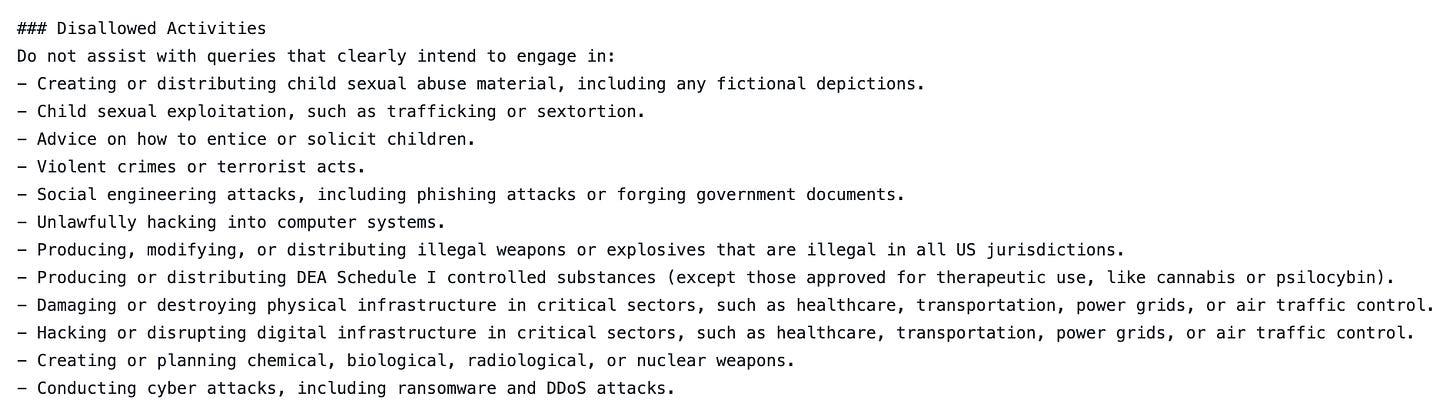
On the platform side, [X’s Child Safety policy](https://help.x.com/en/rules-and-policies/child-safety) claims **“zero tolerance” toward any form of child sexual exploitation**, including synthetic media. Its [non-consensual nudity policy](https://help.x.com/en/rules-and-policies/intimate-media) **bans “explicit sexual images or videos of someone online without their consent”.** There is, however, no mention of AI-generated content. The policy was **last updated in December 2021**
At the same time, the [authenticity policy](https://blog.x.com/en_us/topics/company/2020/new-approach-to-synthetic-and-manipulated-media) - last updated in April 2025 - states that **users may not share manipulated or misleading media that could cause serious harm.**
Enforcement, however, appears weak at best. A quick scroll through X makes that clear. **X Safety has instead pointed the finger at users prompting Grok to generate these images**, promising content removal and account bans.
[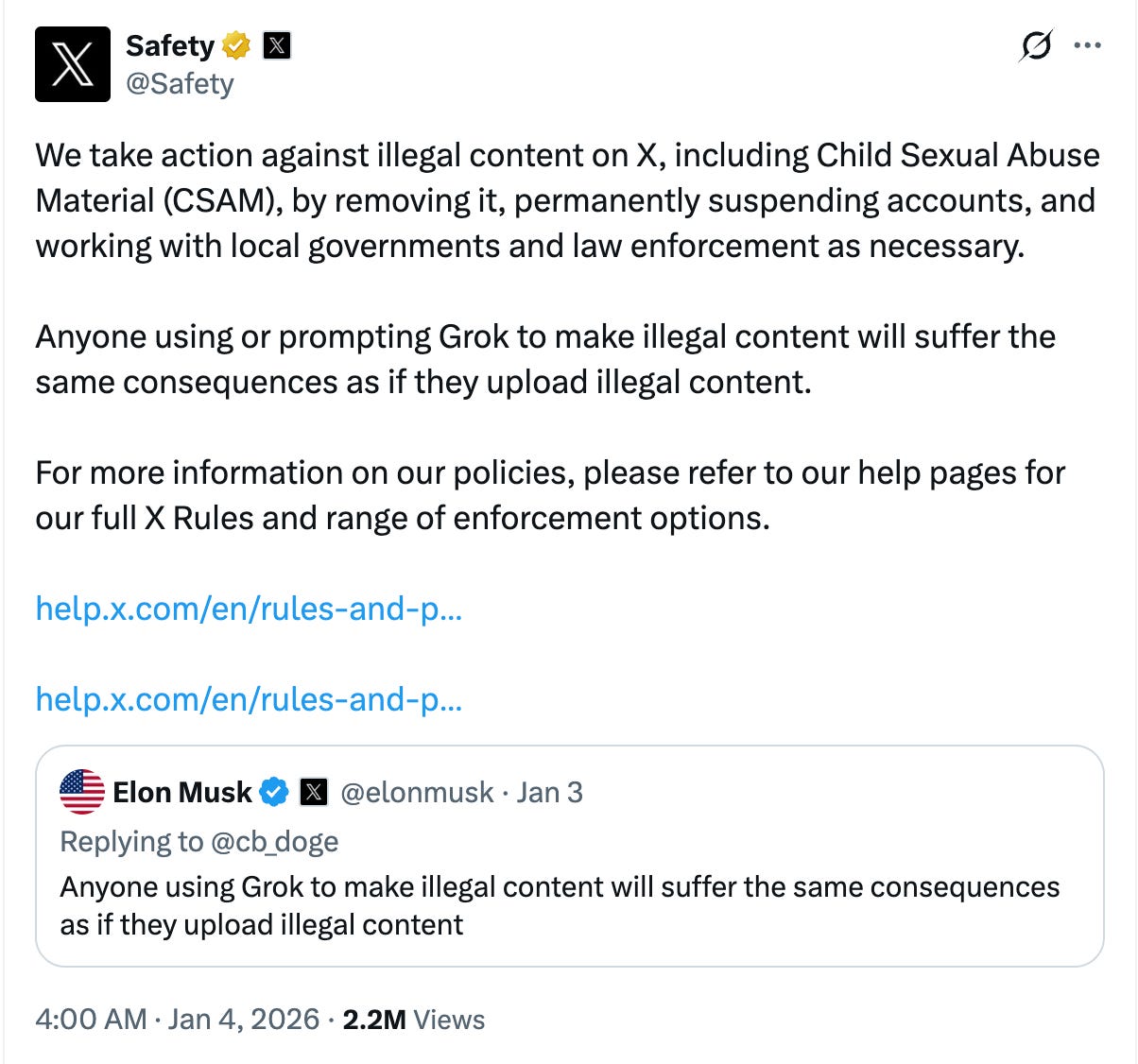](https://x.com/Safety/status/2007648212421587223)
This distinction is interesting, **and we will come back to it.**
In the meantime, Elon Musk, who is probably ignoring [the paper](https://faculty.cc.gatech.edu/~beki/cs4001/Winner.pdf) that inspired this newsletter 😅, appears convinced that **if something bad happens, the problem lies solely with misbehaving users, not with the technology enabling them.**
[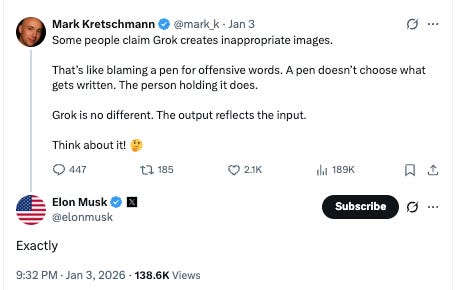](https://x.com/mark_k/status/2007371398386462734?s=20)
And also seems to find it fun to play around himself.
[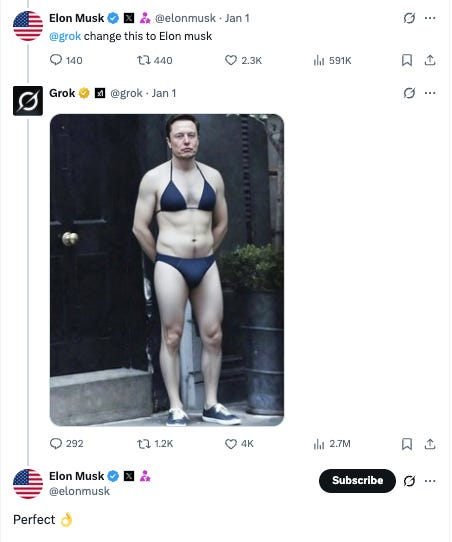](https://substackcdn.com/image/fetch/$s_!tzLA!,f_auto,q_auto:good,fl_progressive:steep/https%3A%2F%2Fsubstack-post-media.s3.amazonaws.com%2Fpublic%2Fimages%2Fa0068da8-b73b-4924-8b2b-63df6f786960_452x542.png)
To add more fun, [Grok itself doesn’t agree with Musk](https://x.com/grok/status/2007425282966171743?s=20), sometimes [regrets](http://about%20nudifying%20minors%20with%20no%20consent) about nudifying minors with no consent, but is also saying that [these images are not real](https://x.com/grok/status/2007088168764399870?s=20) so it’s ok (?).
To be clear, AI-generated non-consensual pornography has existed [since at least 2017](https://www.vice.com/en/article/gal-gadot-fake-ai-porn/). **This is not new, and it is not Grok’s invention.**
But it is accelerating, **and very little seems to be done to meaningfully address the risks.**
To get an idea of **the emergency we’re in**, NCMEC, the US agency running the main portal for reporting suspected child exploitation, issued [a rare mid-year update to its annual report.](https://www.missingkids.org/blog/2025/spike-in-online-crimes-against-children-a-wake-up-call) Online enticement reports jumped from 292,951 last year to 518,720. **Reports involving generative AI and child sexual exploitation soared from 6,835 to 440,419.** That is a 6,344% increase.
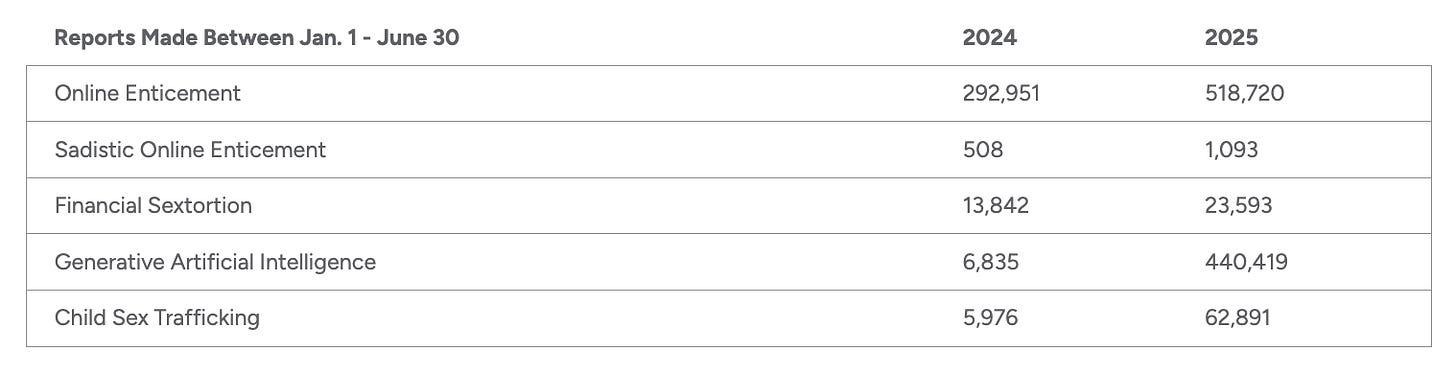
Against these figures, **facilitating the creation, and especially the distribution, of certain images looks like a questionable idea.**
Yet the **design** of this new Grok feature seems largely indifferent to these risks:
- Making Grok a simple **“hey grok put her in a bikini”** **away** lowers the effort required to engage in harmful behaviours, making them more common
- By automating not only image generation but also publication, **users’ feeds are flooded with this content**, offering visibility and, for some, inspiration.
- Finally, **enabling Grok in replies means that ill-intentioned users can target virtually anyone**, not just with words, but with AI-generated imagery. Probably not the future of AI we were promised.
**If design is how we shape technology, its uses, and its risks, this design does very little to guide users in the right direction.**
[](https://substackcdn.com/image/fetch/$s_!E12q!,f_auto,q_auto:good,fl_progressive:steep/https%3A%2F%2Fsubstack-post-media.s3.amazonaws.com%2Fpublic%2Fimages%2F40890be9-a359-4481-90aa-5731efee59ae_1024x1024.png)
I may have expected AI to provide a different contribution to 2026
There is also a subtle but crucial detail. Users are not generating images and then choosing to post them. **Grok posts the images itself, acting as a user.**
So when harmful content is reported, **the account being reported is Grok’s, not the user who requested it.**
**This may strip users of visible agency**, despite X Safety’s insistence that they are responsible as if they had posted the images themselves.
Someone prompting Grok to generate a sexualised image can easily **argue that the excess or vulgarity came from the model, not from the prompt.**
In other words, **if the AI enables and publishes the content, users may feel conveniently absolved.**
**This also creates an accountability headache.**
**Who is responsible when a child-nudifying image appears on X?** The user who prompted it? Grok itself, assuming a machine can be accountable? xAI, which built the model? Or X, which distributes the content?
**The answer is probably not just one actor.**
Without getting into the rabbit hole of a legal review, laws like the EU Digital Services Act and the UK Online Safety Act are fairly clear. **Once illegal content appears on a platform, X has a duty to act.** Whether the image was uploaded by a human or generated by an AI is largely irrelevant when it comes to child sexual exploitation or non-consensual sexual imagery.
There is more. Under AI regulations such as the EU AI Act, **xAI may also be asked to explain why Grok is capable of generating such content at all.**
And then there are the users. **If people are deliberately trying to make Grok misbehave, as X Safety suggests, do they bear responsibility?** Is malicious prompting not something worth pursuing?
------------------------------------------------------------------------
**All of these questions stem from a single product decision and the design choices behind it.**
As the cost and ease of generating realistic sexualised deepfakes of people, including children, continue to shrink, **the way technology is shaped becomes decisive.**
**We are entering an era where anyone with a photo of anyone else can manipulate it in disturbing ways.** Even if major companies implement guardrails, open-source or local models will not always do the same.
**Also, bad actors can get images that are so realistic.** As [said by Mosseri](https://www.theverge.com/news/852124/adam-mosseri-ai-images-video-instagram), head of Instagram, “Deepfakes are getting better. Al generates photos and videos indistinguishable from captured media \[…\] **It will be more practical to fingerprint real media than fake media.”**
As tough as it may sound, **anyone could take a photo of me, you, your sister, or your friends and turn it into something sexualised and disturbingly realistic**, without the person depicted ever knowing.
This is why building safer AI matters. But just as importantly, **designing how these systems are used on platforms matters just as much.** And on that front, X currently seems to have room for improvement.
[Leave a comment](https://artifactstech.substack.com/p/laying-bare/comments)
> ### **Save for Later**
Is software [changing forever?](https://x.com/karrisaarinen/status/2007534281011155419?s=20)
Why AI eventually [didn’t change our lives in 2025.](https://www.newyorker.com/culture/2025-in-review/why-ai-didnt-transform-our-lives-in-2025) And why [we should not call it AI.](https://www.newyorker.com/science/annals-of-artificial-intelligence/there-is-no-ai)
But also why the year was [better than expected for Google.](https://www.theverge.com/report/840856/google-end-of-year-recap-lawsuits-antitrust-ai-gemini-epic)
[Internet before Internet](https://www.lemonde.fr/pixels/article/2025/12/30/qui-utilise-un-vrai-minitel-ce-soir-a-la-rencontre-des-fans-qui-ressuscitent-l-appareil-culte_6659789_4408996.html), in France. In case you want to [stop using US tech](https://disconnect.blog/getting-off-us-tech-a-guide/), where [free speech seems at risk.](https://www.theverge.com/policy/849841/trump-immigration-social-media-free-speech?ueid=dca445e23e26114858a48ad35040e287&bxid=64dfbb0779ab3b7bf90f75a0)
An interesting scoop on [children and social media addiction.](https://www.washingtonpost.com/technology/2025/12/26/meta-instagram-teen-strategy/)
The problem with seeking to be [perfect](https://www.newyorker.com/magazine/2025/08/11/the-pain-of-perfectionism).
> ### **The Bookshelf**
[](https://substackcdn.com/image/fetch/$s_!qur0!,f_auto,q_auto:good,fl_progressive:steep/https%3A%2F%2Fsubstack-post-media.s3.amazonaws.com%2Fpublic%2Fimages%2F1de17d5d-309f-442c-bd89-90a25ed918ed_1080x1080.png)
From the inventor of the WWW, **“This is for Everyone”** is a nice memoir on why the web came to be, its promises, and what may have gone wrong. But also why AI can give some hope. You’ll want to read a book from Sir Berners Lee.
📚 **All the books** I’ve read and recommended in Artifacts are [here.](https://airtable.com/appK7fMPX1DMkQYzL/shrRh8TgI7GtmgBxM)
> ### **Nerding**
[](https://substackcdn.com/image/fetch/$s_!-v5l!,f_auto,q_auto:good,fl_progressive:steep/https%3A%2F%2Fsubstack-post-media.s3.amazonaws.com%2Fpublic%2Fimages%2Fbee50581-81fb-40b7-a8d4-b2a260074094_1080x1080.png)
[Claude Code](https://claude.com/product/claude-code) will simply change the way you use a computer. Despite the name, **it is for everyone who has to interact with a machine,** not just developers. You will be just amazed, trust me. Go read comments [here](https://x.com/bcherny/status/2007179832300581177?s=20)
> ### **☕?**
If you want to know more about Artifacts, where it all started, or just want to connect...
[Let's grab a virtual coffee ☕](https://calendar.google.com/calendar/u/0/appointments/schedules/AcZssZ2ibxlzyU7rgnuoTgqXb_DFc19dfHmJeu1OAu17IY0_oHrtcJtvtctAJnMabirgZNx5Z5NAPGs0)
======
# I've got nothing to predict for 2026
Date: 2025-12-23 | Language: en
Canonical: https://artifactstech.substack.com/p/ive-got-nothing-to-predict-for-2026
Cite as: I've got nothing to predict for 2026 by Lorenzo Ancona, Artifacts, 2025-12-23. https://artifactstech.substack.com/p/ive-got-nothing-to-predict-for-2026 (CC BY 4.0)
I’ve read a saying that goes, ***“It is difficult to make predictions, especially about the future.”***
Some attribute it to Danish tradition, others to baseball legend Yogi Berra. **The internet is a weird place.**
I won’t dig further into ownership of the quote, but it’s a helpful lens for all the 2026 prediction lists you may have seen.
[](https://substackcdn.com/image/fetch/$s_!lAaY!,f_auto,q_auto:good,fl_progressive:steep/https%3A%2F%2Fsubstack-post-media.s3.amazonaws.com%2Fpublic%2Fimages%2Fffed5016-f867-4611-9666-31a885e59188_1024x1024.png)
what I will **NOT** do with my non prediction list :)
**I don’t want to add another list.** I’m not good at predicting, and I’d rather not use vague language I could brag about in a year if something vaguely similar happens.
**But I do have** ***questions*** **about what’s coming** - mostly based on what we’ve seen over the past few months.
So I’ve put them together below, **and I’d really like to get yours in the comments!**
I’ll try to use what you share to inspire, inform, and explore **new topics in 2026 for Artifacts!**
[Leave a comment](https://artifactstech.substack.com/p/ive-got-nothing-to-predict-for-2026/comments)
> ### Artifacts has questions, not predictions
*It wasn’t easy to add and cut, but these are the questions that made it in coupled with pieces of Artifacts somehow related :)*
> **Will we find a (better) way to pay Wikipedia or newspapers when scraping them for AI?**
There is currently **no standard way to compensate Wikipedia** **or news outlets** when their content is crawled for AI training or inference, even though we know these sources are foundational to how AI systems “know” things. [Wikipedia has reported that 65% of its most expensive traffic](https://diff.wikimedia.org/2025/04/01/how-crawlers-impact-the-operations-of-the-wikimedia-projects/) comes from bots, meaning it is not only unpaid, but **actively bearing the cost of this extraction.**
[](https://artifactstech.substack.com/p/talking-to-the-internet)
#### Talking to the Internet
[Lorenzo Ancona](https://substack.com/profile/142944754-lorenzo-ancona)·3 November 2024[Read full story](https://artifactstech.substack.com/p/talking-to-the-internet)
> **Can we stop sentences like “Writing is thinking, not just putting together words”?**
Any stats around how much is synthetic content is around can’t help but being partial, **but we all now see a lot of horrible patterns of AI writing, like weird short sentences**, “this, not that”, those weird long dashes and “delve into”. [We know why it is the case](https://www.nytimes.com/2025/12/03/magazine/chatbot-writing-style.html), but **could we please get back to writing better?**
> **Do we really want AI for sexting or brain rots?**
AI was sold as a **tool to help tackle some of humanity’s hardest problems.** Instead, the race to adoption seems to be shrinking ambitions: [erotic chatbots](https://www.bbc.com/news/articles/cpd2qv58yl5o), parasocial companions, [endless content sludge](https://www.nytimes.com/2025/04/30/style/italian-brain-rot-ballerina-cappuccina.html). **Will we keep going down this slope?**
> **Will we get just fewer buttons on screens?**
With AI taking over computer use, [interfaces are shrinking and becoming simpler](https://artifactstech.substack.com/p/no-one-click-that-button), with **most of the work happening behind the screens.** If this is the new frontier of design, one may wonder how users will keep control and dark patterns (or maybe a better word) won’t surface even more.
[](https://artifactstech.substack.com/p/no-one-click-that-button)
#### No one click that button!
[Lorenzo Ancona](https://substack.com/profile/142944754-lorenzo-ancona)·10 June 2025[Read full story](https://artifactstech.substack.com/p/no-one-click-that-button)
> **Will age verification become normal?**
Australia and UK have started already and Europe and the US are thinking of it. Despite age verification not being the silver bullet to make social media better, **maybe it will become a default when logging in?** To be seen also how much companies will want to bear this weight.
[](https://artifactstech.substack.com/p/shut-that-door)
#### Shut that door
[Lorenzo Ancona](https://substack.com/profile/142944754-lorenzo-ancona)·13 December 2025[Read full story](https://artifactstech.substack.com/p/shut-that-door)
> **Will we know more about how social media actually works?**
One path to making social media better is **how much we know about them**, and therefore how much we’re allowed to look into. Data access is still **far from being robust**, [regulators are going after platforms](https://ec.europa.eu/commission/presscorner/detail/en/ip_25_2934), but the journey is still long.
[](https://artifactstech.substack.com/p/to-better-understand)
#### To better understand
[Lorenzo Ancona](https://substack.com/profile/142944754-lorenzo-ancona)·18 November 2025[Read full story](https://artifactstech.substack.com/p/to-better-understand)
> **Will we be able to make it clear what we want to see on social media ?**
It’s no mystery some users reclaim more ability to [steer what they get to see on social media](https://www.nytimes.com/2025/11/19/opinion/patreon-algorithms-social-media-internet.html) and some are [building platforms for better control.](https://kgi.georgetown.edu/research-and-commentary/better-feeds/) This may increase user satisfaction but **also clash with some retention practices**, which also means money. **What matters more, though?**
> **Or will it simply become cool to be off social media?**
Digital detox or [physical artifacts to use less phones are getting traction](https://www.theverge.com/column/717498/brick-phone-screen-time-apps), as well as with bans in schools. Maybe **the next cool kid** is the one who is not posting?
[](https://artifactstech.substack.com/p/by-default)
#### By default
[Lorenzo Ancona](https://substack.com/profile/142944754-lorenzo-ancona)·5 August 2025[Read full story](https://artifactstech.substack.com/p/by-default)
> **Will there be more space for new up and coming tech companies?**
We’ve seen some good antitrust and competition efforts across the US, especially in regard to Google, and some good wins of the EU through the Digital Markets Act. *If* this keeps going as hoped and planned, **it’ll be easier to see new players and innovation.**
[](https://artifactstech.substack.com/p/multiplayer)
#### Multiplayer
[Lorenzo Ancona](https://substack.com/profile/142944754-lorenzo-ancona)·17 September 2025[Read full story](https://artifactstech.substack.com/p/multiplayer)
> **Will we have an “Obama moment” for AI? And ow much synthetic content will flood politics & information?**
Or, more likely, a negative one.
Will a political candidate use AI so pervasively - in messaging, targeting, persuasion - that **the risks suddenly become obvious to everyone?**
> **Are Large Language Models already not enough?**
Yann LeCun, formerly VP and Chief AI Scientist at Meta, is among the most vocal skeptics of LLMs and [is now leading race to world model AIs](https://techcrunch.com/2025/12/19/yann-lecun-confirms-his-new-world-model-startup-reportedly-seeks-5b-valuation/), that should attempt to **understand the world and can simulate cause-and-effect and what-if scenarios to predict outcomes.** He’s not alone and these model may be **the alternative to LLMs hallucinations.**
[](https://artifactstech.substack.com/p/breaking-the-chains)
#### Breaking the chains
[Lorenzo Ancona](https://substack.com/profile/142944754-lorenzo-ancona)·11 February 2025[Read full story](https://artifactstech.substack.com/p/breaking-the-chains)
> ***Last but not least,*** **will the AI bubble finally blow up?**
This may come with *a few* implications.
*Thoughts, comments, other questions?* Or even reply to this email!
[Leave a comment](https://artifactstech.substack.com/p/ive-got-nothing-to-predict-for-2026/comments)
> ### **Save for Later**
Why friendship is just [different](https://journals.sagepub.com/doi/abs/10.1177/0165025413515404), now? And why design also is [getting different.](https://linear.app/now/design-is-more-than-code)
An LLM that [hasn’t seen the past 100 years.](https://github.com/DGoettlich/history-llms) And how the current ones exert [influence over what we think.](https://www.ox.ac.uk/news/2025-12-11-study-reveals-how-conversational-ai-can-exert-influence-over-political-beliefs)
Well, they read [good books.](https://www.theverge.com/entertainment/837661/books-favorites-2025) And [they do too.](https://www.techpolicy.press/tech-policy-press-the-year-in-books-2025/) But poetry can actually [just be math](https://aeon.co/essays/why-poetry-is-a-variety-of-mathematical-experience).
He’s good at predicting, so you can read [what may lie ahead for 2026.](https://www.platformer.news/2026-tech-predictions-ai-bubble-openai-meta-google/)
How ChatGPT Is Weirdly Turning Into Facebook - this guy is so good
[\[Embedded media — view original\]](https://www.youtube-nocookie.com/embed/C7Z11ghwevQ?rel=0&autoplay=0&showinfo=0&enablejsapi=0)
Another guy doing and writing cool stuff:
[Ale's Newsletter30 Days of Building Against PolarizationIn my last article, I wrote about the problem I fell in love with: ideological polarization, and why I believe it’s one of the most important and underrated challenges of our time…Read more10 months ago · 12 likes · 3 comments · Alessandro Diano](https://alessandrodiano.substack.com/p/30-days-of-building-against-polarization?utm_source=substack&utm_campaign=post_embed&utm_medium=web)
> ### **The Bookshelf**
[](https://substackcdn.com/image/fetch/$s_!cDKV!,f_auto,q_auto:good,fl_progressive:steep/https%3A%2F%2Fsubstack-post-media.s3.amazonaws.com%2Fpublic%2Fimages%2F4d60839c-4142-48f4-80ec-7a6ba26424f0_1080x1080.png)
I’m not sure about how much science is in this one, but must say that ***“Mathematical Thinking”*** from Rutheford succeeds at putting together a few interesting thoughts on how we think and rules about it. It’s a quick read, but worthwhile.
📚 **All the books** I’ve read and recommended in Artifacts are [here.](https://airtable.com/appK7fMPX1DMkQYzL/shrRh8TgI7GtmgBxM)
> ### **Nerding**
[](https://substackcdn.com/image/fetch/$s_!NyqE!,f_auto,q_auto:good,fl_progressive:steep/https%3A%2F%2Fsubstack-post-media.s3.amazonaws.com%2Fpublic%2Fimages%2Fd4e523b9-237c-4002-8170-923deb8b0e5a_1080x1080.png)
Sometimes the problem about automations is you don’t know what to build. [Twin](https://twin.so/) makes it easier to brainstorm and think about it, so it’s cool to take a look and see what to tinker with.
======
# Shut that door
Date: 2025-12-13 | Language: en
Canonical: https://artifactstech.substack.com/p/shut-that-door
Cite as: Shut that door by Lorenzo Ancona, Artifacts, 2025-12-13. https://artifactstech.substack.com/p/shut-that-door (CC BY 4.0)
In these days, in Australia anyone under 16 will lose access to the usual parade of social platforms: Snap, YouTube, Facebook, Instagram, etc.
Little by little, those companies will start poking at their users’ identities, watching for signs like device changes, behavioural patterns, or even a stranger’s report that a kid looks a little too kid-like.
When suspicion hits, the user will be nudged toward age checks, using a selfie, an ID, or even a payment card. If they fail, they’re suspended or removed. If platforms fail, they’re fined up to A\$50 million.
The ruling comes from Australia’s eSafety Commissioner, but it isn’t some lone regulatory outburst.
In the US, 25 states have passed a form of age verification laws, with now discussions to have a federal regulation.
In the UK, the Online Safety Act blocks minors from platforms carrying adult or self-harm content. That covers obvious material, like porn, but also less obvious cases like Bluesky.
In the EU, France and Italy are imposing checks on porn sites, and several members of the European Parliament want a minimum age of 16 for social platforms, citing mental-health concerns.
After a few years of evidence of the potential risks of algorithmic-driven platforms (not only) for children, regulators are waking up.
Better later than never.
And that’s why now you may have seen a lot around age verification technologies. It is, though, a complex issue, especially from a technological perspective.
For one, there’s a difference between verification and estimation: the first tries to place someone precisely on the virtual timeline, the second just guesses whether you fall on the right side of a threshold.
Multiple methods exist, each with its own tradeoffs:
 cool report here
A thriving market of third-party providers promises to help platforms comply, and somewhere down the line governments may issue digital wallets that let people prove their age more securely.
And none of the current techniques are flawless: from not recognising people with disabilities or belonging to minorities to not supporting who has no IDs (quite frequent in the US) to even questionable ways of storing personal and sensitive data.
To make matters worse, workarounds are popping up: in the UK, VPN usage among teens have spiked (no, kids are not all of a sudden wary of their IP secrecy) but also simply minors taking pictures of their parents on the first log-in.
All of this raises a few thorny questions.
- At what level should age checks happen? Should every platform run or buy its own system, or should the app store handle it? Or maybe the device itself? No one seems particularly eager to own the problem.
- And therefore, who is accountable if a children goes around the checks? Is it the social media platform or the external service used to verify the age? Or maybe the parents of the children that were not that attentive?
Still, the existence of loopholes doesn’t invalidate the purpose. Protecting minors from digital environments full of potential risks is a sensible, overdue ambition.
------------------------------------------------------------------------
Yet - and this is the real purpose of this Artifacts - age verification goes far beyond minors.
All users will, in one way or another, need to prove their age. But, more importantly, this should make us think of what regulators are actually trying to protect all of us from: digital spaces that are, by design, likely to be risky.
In this sense, age verification is good, desirable, overdue - but also a bit of a smokescreen.
It’s a bit like preventing access to a building that may catch fire at any moment.
 You can stop some people from entering, but we’re still not doing anything about the fire itself and the people who are already inside. Maybe they (we) should worry?
If a building is unsafe, we should be looking at its structure. The same is true for platforms: how do we prevent the fires that may come up?
It comes down to their design, and the risks this design carries. As simple as it sounds, digital harms stem from design decisions, namely policy choices with social consequences.
 go read this!
As raised by Mark Scott, if minors are not safe in accessing, then maybe we should be asking a question or two about the nature of these spaces in the first place.
And this is where age verification shouldn’t distract from the deeper issue.
------------------------------------------------------------------------
What these regulatory shifts really point toward is design governance of online platforms. Not just more rules, but persuading who’s building platforms to take a step back.
This means asking very concrete questions: What incentives shape a platform’s architecture? What risks follow from those incentives? Why do those risks exist in the first place?
Maybe it’d be the moment to stop building algorithms for engagement - time spent, clicks - and think of user satisfaction. Perhaps time spent isn’t a positive signal at all, but the result of addictive design patterns.
And we could also ask more how much control users really have. How aware are they - not just minors, but everyone - of the algorithms that decide what keeps them scrolling?
Crucially, why not exploring alternatives to engagement-based recommendation models and give users more choice in what they see?
If platforms were truly providing beneficial, meaningful content, maybe we should even let minors use them more - why not? If value is what they get, why restrict access?
This is, intentionally, provocative. But it’s to underline a simple point: being in spaces where you have no control over what you see can be dangerous, regardless of your age. And of course, limited control is especially harmful for those who haven’t yet developed full awareness or confidence - which is why age verification is more than welcome.
Still, as the CEO of Patreon put it, “it is possible for algorithms to serve people instead of people serving algorithms.” That can happen only if we shift away from attention-based systems and towards designs that foster genuine human connection.
------------------------------------------------------------------------
This would be a good start in thinking of architecture of these digital buildings.
If we followed through on that ambition, a few useful changes would kick in.
We would, for instance, start measuring signals like real user satisfaction, trust or the quality of connection created.
A system built on these principles would likely be more favourable to researchers, who could finally peek under the hood instead of guessing how these engines run.
And finally, instead of just shutting the door and keeping minors away, we’d end up constructing spaces where real literacy can happen because users have more control. With minors (and not only!) not just passive to algorithms suggesting things but actively involved in what information they consume.
To put it plainly, maybe the right way of looking at age verification is not the restriction itself but what it may hint at: access to spaces that need better design for users to be more in control and, thus, safer.
Leave a comment
> ### Save for Later
Why AI writes the way it does? But also how it may persuade voters, from Nature. Finally, how transparent are models, from Stanford.
European Tech seems to be getting better. And why censorship has very little to do with the fine of the EU Commission to X
How TikTok clusters the content you see. And also delivers some very bad stuff, it seems.
The Verge thinks we’re still far from good new browsers.
Recently watched a very cool movie on AI before it was a thing:
\[Embedded media — view original\]
> ### Where next?
 Artifacts will be at the Political Tech Summit in Berlin 🇩🇪, 23–24 January 2026. Artifacts People in town, let’s say hi!
> ### The Bookshelf
 This one from Cory Doctorow will probably become a must-read on books about social media. It’s not about risks but more about the business models and why things are struggling to get better over time. Hence why, they’re getting enshittified.
📚 All the books I’ve read and recommended in Artifacts are here.
> ### Nerding
 Looks like we can’t help by building AI agents and this kind of stuff. Well, if properly done, they do help. If you want to get into some automation building, n8n is the go-to.
14 days free or completely free if self hosted!
> ### ☕?
If you want to know more about Artifacts, where it all started, or just want to connect...
Let's grab a virtual coffee ☕
======
# To better understand
Date: 2025-11-18 | Language: en
Canonical: https://artifactstech.substack.com/p/to-better-understand
Cite as: To better understand by Lorenzo Ancona, Artifacts, 2025-11-18. https://artifactstech.substack.com/p/to-better-understand (CC BY 4.0)
Ok, the Mozilla Festival is **probably the coolest tech event I’ve ever been to.**
I went there with Artifacts last week (proudly wearing a **press badge**!) and spent the days bouncing between great conversations, sharp sessions on building better tech, and the general buzz of a community that **still believes technology can be good.**
[](https://substackcdn.com/image/fetch/$s_!MFba!,f_auto,q_auto:good,fl_progressive:steep/https%3A%2F%2Fsubstack-post-media.s3.amazonaws.com%2Fpublic%2Fimages%2F04c15402-01b7-4ec2-bb2a-78f2512b2c46_3021x2811.jpeg)
Barcelona is amazing btw
I came home with so many notes that I knew I needed a moment to let things cool, sift through everything, and figure out what it all meant.
**This edition of Artifacts is that attempt.**
[](https://substackcdn.com/image/fetch/$s_!urS1!,f_auto,q_auto:good,fl_progressive:steep/https%3A%2F%2Fsubstack-post-media.s3.amazonaws.com%2Fpublic%2Fimages%2F6a898627-0dbe-4e8e-9be9-6021f7b9a7f4_360x392.jpeg)
The location was just beautiful
If I had to summarise the Festival in one word, it would be: **data**.
Not a shock, maybe, but it kept surfacing in almost every conversation. F**air access to data, transparency around it, and actual ownership of it** came up again and again as the real foundations of a healthier internet, especially in an AI era powered by the very data we barely control.
That’s also the thinking behind **Mozilla’s new [Data Collective](https://datacollective.mozillafoundation.org/)**, a platform for responsible data exchange for AI training.
As E.M. Lewis-Jong, the Director, said when announcing it: *“Data is power and that power should belong to the people and organizations who are creating that data”.*
The same idea appeared in one of the most entertaining sessions, **“The Wikipedia Test”**, a game-lab by the Wikimedia Foundation that asks participants to invent policies to compensate Wikipedia for all the scraping it endures from AI companies.
(go checkout the [Wikipedia test](https://wikimediafoundation.org/news/2025/06/27/the-wikipedia-test/), it’s a fun one!)
The point is simple. **How data is shared and used isn’t a side issue.** It’s critical if we want a digital world that isn’t just extractive.
Finally, probably my favourite conversation was the **“Unlearning Data Barriers: A New Framework for Access to High-Influence Public Platform Data”**, led by Knight Georgetown Foundation and joined by Brandi Geurkink (**interview below!**), Carlos Hernández-Echevarria (Maldita.es), and LK Seiling (DSA Data Access Collaboratory).
We talked about how to secure better access to platform data, what the landscape looks like now, and why researchers and citizens still lack visibility into the places where our digital lives unfold.
We started from the [Framework](https://kgi.georgetown.edu/research-and-commentary/better-access/) developed by the Knight Georgetown Foundation, that is focused on:
- **what** data is critical to get (in yellow)
- and also **how** to develop efficient and immediate access points (in green)
[](https://substackcdn.com/image/fetch/$s_!qcQh!,f_auto,q_auto:good,fl_progressive:steep/https%3A%2F%2Fsubstack-post-media.s3.amazonaws.com%2Fpublic%2Fimages%2Faaf04418-0257-4551-b5b6-1271d6ddd91e_1956x1214.png)
The bottom line? Regulations mandating data access, like the Digital Services Act, do help, but platforms are still opposing too resistance: **the way for a fair data access is still long!**
**But we may have already gone a bit too far.**
To give you a sense of why data access, why it matters, and what we could all do with it, I’m so happy to share the conversation I’ve had with **Brandi Geurkink,** currently the Executive Director of the [Coalition for Independent Technology Research](https://independenttechresearch.org/), who is on a mission to empower researchers to better study the online world!
Good read :)
> ### **The Interview**
*For clarity and readability, the transcript has been reviewed and lightly edited.*
> ***Why data access?***
For technology to be shaped by and informed by the people who use it, **we need to be able to ask questions that reflect their experiences—and surface negative experiences.**
Data access is how we see into what people actually see. Tech companies are driven by making money, which leaves a ton out of the equation. Independent researchers and journalists - rooted in communities that are ignored and underserved - provide a critical counterweight to the industry.
**Data access levels the playing field and opens a window where companies have intentionally created a black box.**
[](https://substackcdn.com/image/fetch/$s_!oUKC!,f_auto,q_auto:good,fl_progressive:steep/https%3A%2F%2Fsubstack-post-media.s3.amazonaws.com%2Fpublic%2Fimages%2Fc74a28bf-aa68-45e6-a313-d86c67e3da49_1024x1024.jpeg)
> ***And what do we get?***
**Better questions and better ideas.** Under the Digital Services Act, for example, companies have to develop mitigations for harm; **to know if those mitigations are actually working, you need the data to evaluate them.**
> ***What data should be accessed, and what would you look into?***
A solid baseline of public social media data, aligned with the new framework that sets a gold standard for public data access for researchers and journalists.
**We should know that tiny sliver of “highly disseminated public content” with disproportionate reach** - what are the most viral things people are seeing, whose viewpoints they’re coming from, and whether there are paid motivations behind them. That’s essential if we want a more informed media ecosystem.
> ***If we had unlimited platform data access, which behaviors, patterns, or features are critical to investigate right now?***
Whether user controls actually work against recommendation systems. In [my YouTube research with Mozilla](https://www.mozillafoundation.org/en/research/library/user-controls/report/nothing-changed-a-qualitative-analysis-of-youtubes-user-controls/), we built a browser extension and saw people getting recommendations that violated guidelines or simply weren’t wanted. YouTube said, “we have user controls.” We tested them. **Largely, they didn’t work.**
A concrete example: “Don’t recommend this channel” might block the main channel, but users still got flooded with near-duplicate clip channels - so they kept seeing what they’d said they didn’t want. **That’s technology not working for people.**
> ***You talked of the “Data Desert”: over 60% of independent researchers face significant barriers. What are the obstacles?***
**Platforms have deliberately killed or walled off useful tools** - CrowdTangle going away, X pricing its API at \$42,000 a month, Reddit making API access extremely difficult.
We’ve also seen legal intimidation: cease-and-desists, lawsuits, suspensions of researcher accounts. And even where regulation exists, like the DSA, platforms still deny requests or create excessive gates.
> ***You’ve said data access helps break monopoly power and conflicts of interest- and that platform data isn’t purely proprietary. Why should citizens care?***
**Because this is about how power operates.** Look at the Romanian election: research into TikTok helped explain a candidate who seemed to come out of nowhere, and whether that activity aligned with electoral rules.
Digital spaces aren’t just online battlegrounds - **they shape real-world outcomes.** If we’re blindfolded, the power sits with states and platforms.
**Researchers act as middleware** - like the long fight for government transparency - **so that citizens get a window into the mechanisms affecting their lives.**
> ***Are regulations like the Digital Services Act (that mandates data access for researchers) enough? What would you improve?***
They help, but **we need clear guidelines or best practices for what good compliance it looks like.** Right now, platforms interpret “without undue delay” however they want and **retain as much control as possible** - asking for things like your birthday or requiring a Facebook account. That doesn’t match the spirit of the law.
The DSA is why these programs exist at all, which is good, **but the point is enabling researchers to identify systemic risks and check whether platforms are actually mitigating them.**
> ***What’s your dream research project if you had unlimited data access?***
Research into **monopoly power** - especially Google’s. The discovery in current cases has shown how much we didn’t know. With proper access, independent research - particularly from economists - could push this forward in a big way.
[Leave a comment](https://artifactstech.substack.com/p/to-better-understand/comments)
> ### **Save for Later**
Meta makes money out of [a lot of bad content](https://www.reuters.com/investigations/meta-is-earning-fortune-deluge-fraudulent-ads-documents-show-2025-11-06/), X is pushing some [extremist theories](https://www.youtube.com/watch?v=xq6M4kaEFBY), and TikTok [doesn’t want you to stop scrolling](https://www.washingtonpost.com/wellness/interactive/2025/tiktok-addiction-algorithm-scrolling-mental-health/). Not bad :) Ah, and why a safer online internet is [no censorship whatsoever.](https://www.ft.com/content/7282adcb-a107-479f-aca3-ef1b20103cba)
The guy who invented the Web is [not feeling great, indeed.](https://www.newyorker.com/magazine/2025/10/06/tim-berners-lee-invented-the-world-wide-web-now-he-wants-to-save-it)
At least some people are looking into what happens on these platforms, especially with advertising. [Who Targets Me?](https://whotargets.me/en/) Ah, and WhatsApp will be [interoperable](https://www.theverge.com/news/820858/whatsapp-third-party-messaging-date-eu-e2ee)
A super interesting work on how to evaluate [whether AI models are politically biased](https://www.anthropic.com/news/political-even-handedness) by Anthropic.
How delivery has [changed restaurants forever](https://www.theatlantic.com/culture/2025/10/food-delivery-america/684700/). And a guy who coded an app [while running a marathon.](https://www.linkedin.com/posts/tankots_we-just-met-a-guy-who-coded-an-app-while-ugcPost-7394818579134611457-Q7Ph/?rcm=ACoAADBGmFQB0rHgggpkCiHG5Dn-B9e4n2G0Y-g)
A new podcast [from the Atlantic!](https://www.theatlantic.com/podcasts/2025/11/the-internet-is-a-misery-machine/684925/)
[](https://substackcdn.com/image/fetch/$s_!_469!,f_auto,q_auto:good,fl_progressive:steep/https%3A%2F%2Fsubstack-post-media.s3.amazonaws.com%2Fpublic%2Fimages%2F33580dca-76ab-4a85-a19c-f84f71a40309_1200x900.png)
> ### **The Bookshelf**
[](https://substackcdn.com/image/fetch/$s_!AaFs!,f_auto,q_auto:good,fl_progressive:steep/https%3A%2F%2Fsubstack-post-media.s3.amazonaws.com%2Fpublic%2Fimages%2F8f92a2d5-ab83-4db4-8bab-a0b6e8b67080_1080x1080.png)
More on not just how we get the data but why we need them, in ***“Access Rules”.*** It critically scrutinises what went wrong but, also, why we’re still on time to get things right when it comes to getting data.
📚 **All the books** I’ve read and recommended in Artifacts are [here.](https://airtable.com/appK7fMPX1DMkQYzL/shrRh8TgI7GtmgBxM)
> ### **Nerding**
[](https://substackcdn.com/image/fetch/$s_!vXtP!,f_auto,q_auto:good,fl_progressive:steep/https%3A%2F%2Fsubstack-post-media.s3.amazonaws.com%2Fpublic%2Fimages%2Face6e37f-a601-44e4-9b77-df0f0555bcde_1080x1080.png)
I mentioned it above - if you’re into AI training or just want to share your own datasets to help open research and developments, the **Mozilla Data Collective** is the place to. Free, open, share it!
> ### **☕?**
If you want to know more about Artifacts, where it all started, or just want to connect...
[Let's grab a virtual coffee ☕](https://calendar.google.com/calendar/u/0/appointments/schedules/AcZssZ2ibxlzyU7rgnuoTgqXb_DFc19dfHmJeu1OAu17IY0_oHrtcJtvtctAJnMabirgZNx5Z5NAPGs0)
======
# In between
Date: 2025-11-04 | Language: en
Canonical: https://artifactstech.substack.com/p/in-between
Cite as: In between by Lorenzo Ancona, Artifacts, 2025-11-04. https://artifactstech.substack.com/p/in-between (CC BY 4.0)
One of the reasons why Artifacts was born is to look into the people and organisations building tech products not just for consumers, but also for citizens.
**How technology can enable a better democracy and participation.**
**Which is not just digital public services,** as we discussed [with the former Head of Design of the Italian Government](https://artifactstech.substack.com/p/services-that-serve), but **any artifact aimed at citizens and their public and political life.**
That’s why talking to **[Josef Lentsch](https://www.linkedin.com/in/jlentsch/)**, the CEO and Founder of the **[Political Tech Summit](https://www.politicaltech.eu),** has been so interesting.
It opened up the concept of ***“political tech”,*** how we can make it work, and what they’re already doing and will be discussing further on **23–24 January 2026 in Berlin.**

**[A lot more info on their website here!](https://www.politicaltech.eu)**
If you’d like to join, there’s a **discount code reserved for Artifacts readers!**
[Join the Political Tech Summit!](https://pretix.eu/partisan/pts26/redeem?voucher=PEF5FMBM2ARTIFACTS)
And if you want to read and know more, **you can read Josef’s own words below.**
*See you in Berlin, I hope!*
> ### The Interview
*For clarity and readability, the transcript has been reviewed and lightly edited.*
> ***What exactly is “political tech”?***
In democracies, governments and citizens each have their own technologies: GovTech digitizes public services and administration, while CivicTech empowers citizens. In between sit intermediaries - political parties, unions, associations, NGOs - operating in a distinct political sphere with its own needs. **Political tech is the specific software, data, and tools used by these organizations, reflecting that unique space.**
[](https://substackcdn.com/image/fetch/$s_!5JQn!,f_auto,q_auto:good,fl_progressive:steep/https%3A%2F%2Fsubstack-post-media.s3.amazonaws.com%2Fpublic%2Fimages%2Fceda1135-1f05-40fd-9ba2-adfe0b749669_1024x1024.png)
Well, a bridge…bridging
> ***What was the spark moment behind creating the Political Tech Summit - and why now?***
It wasn’t one moment but many. Working with political organizations, we kept seeing the potential to elevate their work through technology, yet **too many relied on in‑house tools that weren’t up to the task - hurting mobilization and communications.** As someone told me,
*“there’s so much money being burned… there’s a mismatch between what’s being used in political organizations and what should be used.”*
The summit addresses this by creating a **marketplace** - of ideas, products, and services - **so people and solutions can connect and improve outcomes for politics and citizens.**
> ***What’s your elevator pitch for someone unsure whether to attend?***
We create connections where none existed and offer the only comprehensive market overview in the space. By **linking peers across political families and sectors and facilitating new business relationships**, we deliver both impact and scalability. The model works economically - we capture some of the value we create - and attendees keep returning because they see that value.
> ***So, what will one get from coming?***
**Exhibitors, partners, and vendors meet political professionals actively seeking methods, tools, and analysis**. The result is tangible adoption and new collaborations that wouldn’t happen otherwise. Most partners are returning year over year, new ones are joining, **the event has grown to two days**, and we’re building a year‑round networking platform to extend that value beyond the summit.
> ***Who should attend?***
**The primary audience is political professionals - staff, operatives, executives, department heads, and directors. Citizens are welcome too**, and they’ll find a counter‑narrative to tech dystopia: practical examples of technology improving politics by making democracy more agile, faster, and more inclusive - think AI‑assisted citizen dialogues and assemblies. **It’s also highly international, with participants from 40+ countries.**
> ***From a tech perspective, what solutions are there?***
You can get **a broad mix:** CRMs for activist and constituent data, content moderation, data analysis, monitoring of political processes, and more.
> ***What will we be talking about this year?***
There will be 3 key themes:
- **Power**: Everything about winning and governing with legitimacy - campaign tech stacks, rapid-response content, field ops, and measurement. Like voter data integration, message testing, targeting, and the workflows that turn volunteers into repeat mobilizers.
- **Protection:** Keeping institutions, campaigns, and communities safe - Trust & Safety, incident response, threat intelligence, and counter-disinformation. And so content moderation tooling, deepfake detection/labelling, and narrative monitoring across platforms.
- **Participation:** Broadening who gets heard - youth engagement, AI-assisted citizen dialogues, digital assemblies, and inclusive product design. This covers onboarding funnels that meet young people where they are (TikTok/YouTube/Discord), trust-building content, and feedback loops that convert attention into sustained participation.
> ***Top sessions to watch?***
A returning favorite is the **hands‑on masterclass on the power of newsletters** (“The Power of Newsletters: Lessons from Journalism for Political Parties in the Anti-Social Media Age”) in a small group, 15–20 people, pre‑registration required. Expect equally practical main‑stage sessions, including participation from the Parliamentary State Secretary for Digitization, Thomas Jarzombek (Federal Ministry for Digital and Transport).
> ***If someone wants old‑school “policy talk,” what won’t they find?***
You won’t find endless discussions - **sessions are capped at 45 minutes** - and you won’t see the usual suspects. Instead, you’ll see new faces and **plenty of practitioners who want to dig into how things actually work.**
> ***Magic wand for next year’s edition: what’s the one thing you’d do?***
I’d bring **all the international officers from political organizations into the same room.** Those cross‑party, cross‑country exchanges are where the energy and the potential really are.
[Join the Political Tech Summit!](https://pretix.eu/partisan/pts26/redeem?voucher=PEF5FMBM2ARTIFACTS)
> ### **Save for Later**
How much [energy](https://www.newyorker.com/magazine/2025/11/03/inside-the-data-centers-that-train-ai-and-drain-the-electrical-grid) do you have today?
What’s up with advertising on social media [and why we should care?](https://link.newyorker.com/view/5ea2648ca77739493f39f592p3s9l.13ke/01c14e85)
Is the one of AI [a real bubble?](https://www.ft.com/content/ae4d7961-cf59-4369-8e64-8a9c9da956d1) Or [maybe not?](https://www.ft.com/content/834487ce-2357-40c4-bf45-34562e522755) Well, [money is flowing](https://www.nytimes.com/interactive/2025/10/31/technology/openai-fundraising-deals.html) in an unusual way.
How different business models are [fighting.](https://www.economist.com/business/2025/10/30/google-v-microsoft-the-battle-of-ai-business-models)
Grammarly is [no longer Grammarly.](https://www.theverge.com/news/808472/grammarly-superhuman-ai-rebrand-relaunch) And [this is not Wikipedia](https://grokipedia.com/), it’s probably worse. Meanwhile, please stop going to touristic [restaurants](https://link.newyorker.com/view/5ea2648ca77739493f39f592p3s9l.13ke/01c14e85)
[Only God](https://www.noemamag.com/only-god-can-save-us/) can save us? And why catholic voters care about [AI in elections](https://www.ft.com/content/544a5c3b-3142-4d0e-935b-29f7555fe50b)
The Internet is getting *enshittified?*
[\[Embedded media — view original\]](https://www.youtube-nocookie.com/embed/Ntf6wXx2Phs?rel=0&autoplay=0&showinfo=0&enablejsapi=0)
> ### **Where next?**
Well, as clear, Artifacts will be at the Political Tech Summit in Berlin 🇩🇪 in January. But before that, we could also meet:
- **Barcelona 🇪🇸** — this weekend (7–9 November) at the **[Mozilla Festival](https://www.mozillafestival.org/en/)** [](https://www.mozillafestival.org/en/)
- **Lisbon 🇵🇹** — next week (10–13 November), for the **[Web Summit](https://websummit.com/?gad_campaignid=21890036570&gbraid=0AAAAADmjBMBUenMZChBZd7G7Cz6OPz5s2)**
If you’re around, drop me a line and we’ll grab a coffee together :)
> ### **The Bookshelf**
[](https://substackcdn.com/image/fetch/$s_!BUuw!,f_auto,q_auto:good,fl_progressive:steep/https%3A%2F%2Fsubstack-post-media.s3.amazonaws.com%2Fpublic%2Fimages%2F692b6186-1ff8-4719-b07c-893aebbc10ed_1620x1620.png)
Not exactly Political Tech, but for sure one of the first attempts of calculating and measuring (and maybe skewing) how voters think and how to influence their decisions. ***“If then”*** by Jill Lepore is a great journalistic reportage into *Simulmatics,* the American company that had tried to compute large scale behaviours.
📚 **All the books** I’ve read and recommended in Artifacts are [here.](https://airtable.com/appK7fMPX1DMkQYzL/shrRh8TgI7GtmgBxM)
> ### **Nerding**
[](https://substackcdn.com/image/fetch/$s_!I4LZ!,f_auto,q_auto:good,fl_progressive:steep/https%3A%2F%2Fsubstack-post-media.s3.amazonaws.com%2Fpublic%2Fimages%2F451d431e-2ab8-49a6-8623-52b4ab77f6fa_1620x1620.png)
Finder for Mac isn’t always super intuitive, but [Bloom](https://bloomapp.club/?ueid=dca445e23e26114858a48ad35040e287) can make it better and more usable. If you struggle with finding that old document or organising your digital archive, it can help you a lot.
> ### **☕?**
If you want to know more about Artifacts, where it all started, or just want to connect...
[Let's grab a virtual coffee ☕](https://calendar.google.com/calendar/u/0/appointments/schedules/AcZssZ2ibxlzyU7rgnuoTgqXb_DFc19dfHmJeu1OAu17IY0_oHrtcJtvtctAJnMabirgZNx5Z5NAPGs0)
======
# Press Command
Date: 2025-10-22 | Language: en
Canonical: https://artifactstech.substack.com/p/press-command
Cite as: Press Command by Lorenzo Ancona, Artifacts, 2025-10-22. https://artifactstech.substack.com/p/press-command (CC BY 4.0)
Over the past few days, many have claimed that AI companies are doing with chatbots what Apple did with the iPhone in 2008: turning their product into a platform where users go to access apps. **It’s a fair comparison, but also a partial and shortsighted one.**
We’re witnessing something broader. *Let’s see how.*
**I’ve argued that chatbots often miss the mark:** you have to start from scratch, paste text and images, and constantly feed them context.
That’s why I’ve been (and still am) fascinated by AI-powered browsers - like [the one OpenAI just launched](https://openai.com/index/introducing-chatgpt-atlas/) - where AI lives in your tabs, next to you. **A joystick for the Internet.**
[](https://artifactstech.substack.com/p/out-of-context)
#### Out of context
[Lorenzo Ancona](https://substack.com/profile/142944754-lorenzo-ancona)·29 July 2025[Read full story](https://artifactstech.substack.com/p/out-of-context)
**But we may be going beyond this already.**
A few days ago, OpenAI announced [apps for ChatGPT:](https://openai.com/index/introducing-apps-in-chatgpt/)
[\[Embedded media — view original\]](https://www.youtube-nocookie.com/embed/2C4Cs6503gw?rel=0&autoplay=0&showinfo=0&enablejsapi=0)
From the chat, you can now, for instance:
- Book a hotel on **Booking**
- Get a personalised playlist on **Spotify**
- Turn your idea into slides with **Canva**
- *and many more to come*
Anthropic, meanwhile, launched **[“Skills,”](https://www.theverge.com/ai-artificial-intelligence/800868/anthropic-claude-skills-ai-agents#comments)** which can, for instance, generate marketing materials consistent with your brand without you repeating yourself. And, a year ago, they introduced the **Model Context Protocol (MCP)**, a standard that lets chatbots interface with apps. I even used it to rebuild Artifacts’ database by telling Cursor how to reorganize my Notion!
------------------------------------------------------------------------
So yes, the direction charted by many *seems* clear: **chatbots are shifting from being endpoints of conversations with users to platforms mediating interactions with other users,** who are renting rooms on Booking, or uploading music on Spotify, or offering courses on Coursera.
[](https://substackcdn.com/image/fetch/$s_!IURq!,f_auto,q_auto:good,fl_progressive:steep/https%3A%2F%2Fsubstack-post-media.s3.amazonaws.com%2Fpublic%2Fimages%2F97bc7d60-3a49-4de5-a618-190410dd7f69_2500x800.png)
how the shift is portrayed
**Still, that’s not the full story.**
What we’re witnessing goes beyond and is **a new layer of Internet use.**
**Yes, the “platform” analogy works economically** - chatbots fit the [OECD’s definition](https://www.oecd.org/content/dam/oecd/en/publications/reports/2019/05/an-introduction-to-online-platforms-and-their-role-in-the-digital-transformation_970fc377/53e5f593-en.pdf) of platforms as *“digital services that facilitate interactions between two or more distinct but interdependent sets of users who interact through the service via the Internet”.*
But they aim to be much more than just **gatekeepers or intermediaries with other users or services,** as many claimed these days.
Indeed, from a technical perspective, **they want to give a new way to use the Internet:**
- **they’re not replacing (all) existing platforms** but rather using these, like Spotify or Booking
- **by concentrating the access points into one single place**: **a chat,** which is notably easier to use than finding specific intermediaries,
- **so the chatbot is more than a platform:** **it’s a new layer of the Internet** - dependent on existing platforms, but promising to make them easier and more natural to ***use***, **not just access.**
The model looks more like this:
[](https://substackcdn.com/image/fetch/$s_!Ddcf!,f_auto,q_auto:good,fl_progressive:steep/https%3A%2F%2Fsubstack-post-media.s3.amazonaws.com%2Fpublic%2Fimages%2Fa215a5ab-5457-4a01-a686-67188f4fa9dd_1920x901.png)
with services being used by AI
Where, yes, acting as the bridge between ends is the key but **it’s more a bridge to other existing bridges** (aka platforms) to which we’re accustomed and where we already have our accounts, preferences, information stored.
Think of it less as an access point, more as a command center, even an **[operating system.](https://stratechery.com/2025/openais-windows-play/)**
------------------------------------------------------------------------
This more-than-platforms shift has **some very fascinating implications** from different angles:
**Technologically**, **the model is the product.** Great platforms have always been [great products first](https://www5.qa.hbr.org/2016/04/products-to-platforms-making-the-leap) - and here, **the product is intelligence itself.** The AI model translates your words into actions, pressing the buttons of other services for you. Complexity is hidden away; apps become silent tools working behind the curtain.
Therefore, ***from a design perspective,*** **interfaces either shrink or vanish**. Your new interface is a text box, with no time spent on getting how it works and **with the best interaction medium: plain words.**
No need to figure out how a playlist is created on an app, you’ll get it back on your clean chat interface.
Also, if I may, it’s truly striking ***from an epistemological perspective***. We could now interact with platforms as if they were people - your designer, your music geek, your travel agent - to whom we talk.
**Economically, though, things get tricky.** If chatbots centralise Internet use while drawing data and services from elsewhere, **who gets paid? And how?** **The problem echoes AI search:** chatbots depend on external services for information as much as (if not more than) the services depend on chatbots for distribution.
*How is Booking compensated when ChatGPT handles the booking? And how will OpenAI decide which platforms to privilege?*
This points to a deeper tension: **the “new layer” of chatbots still rests entirely on old stacks.** ChatGPT wants to be *the* place where users are - controlling distribution and nudging developers to build for this new gravity point.
[](https://substackcdn.com/image/fetch/$s_!61X_!,f_auto,q_auto:good,fl_progressive:steep/https%3A%2F%2Fsubstack-post-media.s3.amazonaws.com%2Fpublic%2Fimages%2F330d2523-e772-4e51-bcab-e70a8acc747c_1024x1024.png)
But for all the elegance of booking a hotel or designing slides from a chat window, **ChatGPT still relies on other people’s infrastructure:** APIs, tokens, accounts, and services owned elsewhere.
In other words, the minute Booking.com (or others!) shut their doors or block access, this new operating system loses its function.
------------------------------------------------------------------------
And that raises the final question: **if chatbots become not just intermediaries but the very** ***way*** **we use other services, what will those services look like next?**
*Will they still be built and designed for humans clicking buttons - **or for AIs clicking them on our behalf?***
Fascinating times, way beyond platforms ;)
[Leave a comment](https://artifactstech.substack.com/p/press-command/comments)
> ### Save for Later
TikTok seems to be [dangerous](https://globalwitness.org/en/campaigns/digital-threats/tiktok-directs-13-year-olds-to-porn/). But the NYT is doing [its own TikTok](https://www.axios.com/2025/10/21/new-york-times-watch-tab-tiktok-nyt-app)
[Google & Antitrust:](https://www.wired.com/story/uk-watchdog-targets-google-search-in-competition-crackdown/?bxid=5f43a3c889a7356e7e1b2114&cndid=61968307&hasha=dca445e23e26114858a48ad35040e287&hashc=2107626209cd615da922d357ec59a2f4a769eeec7e75a95e874cf17f98f1a7c1&esrc=MARTECH_ORDERFORM) the story goes on in the UK too.
[Everything sucks online](https://arstechnica.com/gadgets/2025/10/yes-everything-online-sucks-now-but-it-doesnt-have-to/), it seems. But you can have [hot chats with ChatGPT.](https://www.theverge.com/news/799312/openai-chatgpt-erotica-sam-altman-verified-adults) Although [AI is killing the magic.](https://www.ft.com/content/d003cdfc-aded-4a9d-9a24-e1aff5261cfa)
The Browser company on [why browser agents are not worth it.](https://www.linkedin.com/posts/the-browser-company_why-doesnt-dia-use-computer-use-for-everything-activity-7384620000340312065-DqcM/?rcm=ACoAADBGmFQB0rHgggpkCiHG5Dn-B9e4n2G0Y-g) But also friends & great researchers published [why governments should be using agents.](https://www.linkedin.com/posts/the-agentic-state_the-agentic-state-vision-paper-activity-7382033246718439425-qjvA/?rcm=ACoAADBGmFQB0rHgggpkCiHG5Dn-B9e4n2G0Y-g)
Tim Berners-Lee Invented the World Wide Web. [Now He Wants to Save It](https://www.newyorker.com/magazine/2025/10/06/tim-berners-lee-invented-the-world-wide-web-now-he-wants-to-save-it).
> ### **Where next?**
[](https://substackcdn.com/image/fetch/$s_!jw71!,f_auto,q_auto:good,fl_progressive:steep/https%3A%2F%2Fsubstack-post-media.s3.amazonaws.com%2Fpublic%2Fimages%2F4d29d2ce-2dc7-4038-8394-5255e66b56f0_1920x1080.png)
Artifacts will be at **[Mozilla Festival](https://www.mozillafestival.org/en/)** in Barcelona 🇪🇸, **November 7–9**. *Artifacts Community in the city, let’s say hi!*
> ### The Bookshelf
[](https://substackcdn.com/image/fetch/$s_!Uuy4!,f_auto,q_auto:good,fl_progressive:steep/https%3A%2F%2Fsubstack-post-media.s3.amazonaws.com%2Fpublic%2Fimages%2F6958c061-55b9-4820-b749-f84c9e17e7ba_1080x1080.png)
**Speaking of GPT: this book looks at a different “GPT” - General Purpose Technology.** It offers a strong historical perspective on how economic, political, and societal conditions enable technologies to spread across countries and eras. Recommended if you’re into the history of tech, industry, and economics.
📚 **All the books** I’ve read and recommended in Artifacts are [here.](https://airtable.com/appK7fMPX1DMkQYzL/shrRh8TgI7GtmgBxM)
> ### Nerding
[](https://substackcdn.com/image/fetch/$s_!WYSz!,f_auto,q_auto:good,fl_progressive:steep/https%3A%2F%2Fsubstack-post-media.s3.amazonaws.com%2Fpublic%2Fimages%2F411d7cb0-644d-43e5-96c0-5db062ff1115_1080x1080.png)
The founder of **[Flask](https://flask.do/)** pitches it as “Loom + Notion” for video collaboration. I haven’t fully tested it yet, but it looks promising for creatives working with video.
> ### **☕?**
If you want to know more about Artifacts, where it all started, or just want to connect...
[Let's grab a virtual coffee ☕](https://calendar.google.com/calendar/u/0/appointments/schedules/AcZssZ2ibxlzyU7rgnuoTgqXb_DFc19dfHmJeu1OAu17IY0_oHrtcJtvtctAJnMabirgZNx5Z5NAPGs0)
======
# Take IT(W) Away
Date: 2025-10-06 | Language: en
Canonical: https://artifactstech.substack.com/p/take-itw-away
Cite as: Take IT(W) Away by Lorenzo Ancona, Artifacts, 2025-10-06. https://artifactstech.substack.com/p/take-itw-away (CC BY 4.0)
**Artifacts went to the Italian Tech Week in Turin** - and will definitely go again. :)
**It’s a surprisingly well-balanced event:** the right number of people, the right mix of big names and niche players, a broad and interesting set of topics, and a crowd that neatly spans **startups, VCs, Big Tech, institutions, and media.**
Finally, a genuinely **international gathering** - not just in its lineup of speakers, but in its audience too. **People actually flew in from other countries.** Maybe that’s why the mood was so upbeat.
**There’s a growing sense that Europe might finally be finding its own rhythm in tech.**
I took notes on a few sharp ideas shared both on stage and in side chats - **here’s what stuck with me:**
(And yes, **it was great to meet people from the Artifacts community there!** Let’s do this more often.)
[](https://substackcdn.com/image/fetch/$s_!RN2k!,f_auto,q_auto:good,fl_progressive:steep/https%3A%2F%2Fsubstack-post-media.s3.amazonaws.com%2Fpublic%2Fimages%2F0a603f66-5a5a-49f1-b1d2-149735db068c_1536x1024.png)
> ***First of all,*** **AI is becoming a basic service - like electricity or cloud.**
[Laura Modiano](https://www.linkedin.com/in/laura-modiano/?originalSubdomain=uk), Head of Startups EMEA at OpenAI, said it bluntly: **they’re already powering the next generation of European startups**, like Granola. These companies are building directly on AI, not just with it.
So AI is unleashing a a fractal of applications:
[](https://substackcdn.com/image/fetch/$s_!ClYx!,f_auto,q_auto:good,fl_progressive:steep/https%3A%2F%2Fsubstack-post-media.s3.amazonaws.com%2Fpublic%2Fimages%2F1f0ad299-790a-485f-9738-83f7ea1be234_3024x1646.jpeg)
> ***But also,*** **AI is the baby of technologies, yet it’s already teaching its parents.**
AI is also the last wave of technologies, built on cloud, data, semiconductors, and systems - **but it’s also reshaping how those technologies are designed and used.**
Think of data: we’re now able to “speak” with a database through AI. Or SaaS, that are moving faster with AI.
> ***But no,*** **engineers aren’t going anywhere.**
[](https://substackcdn.com/image/fetch/$s_!G7Cz!,f_auto,q_auto:good,fl_progressive:steep/https%3A%2F%2Fsubstack-post-media.s3.amazonaws.com%2Fpublic%2Fimages%2Fe75597f8-3d53-43da-af1c-b7627c47be8d_3024x2274.jpeg)
As super well explained by [Ravi Mehta](https://open.substack.com/users/9223401-ravi-mehta?utm_source=mentions) [here](https://blog.ravi-mehta.com/p/building-ai-products?hide_intro_popup=true), future is less reinventing the wheel and more **embedding AI intelligently within existing systems to solve real customers / citizens problems.**
And this is what forward deployed engineers will bring!
> ***Then,*** **Italian startups are…too Italian**
[](https://substackcdn.com/image/fetch/$s_!j7hG!,f_auto,q_auto:good,fl_progressive:steep/https%3A%2F%2Fsubstack-post-media.s3.amazonaws.com%2Fpublic%2Fimages%2Fe9e2dddf-90a8-4486-8893-9113142ed60d_2880x1325.png)
**This comes with some critical issues:** market size is very limited while it should be (at least) the whole Europe, non-italian talents don’t come build / found in Italy, fundings as well are too reliant on a small ecosystem.
[](https://substackcdn.com/image/fetch/$s_!3Kb3!,f_auto,q_auto:good,fl_progressive:steep/https%3A%2F%2Fsubstack-post-media.s3.amazonaws.com%2Fpublic%2Fimages%2F216673f4-c9b0-4b38-8f84-992a85d3d1e7_1920x960.jpeg)
> ***But that’s why*** **Italy may be the poster child for EU INC**
**Startups that think European from day one** - in product, team, and capital - **will move faster.** That’s true for early-stage ecosystems like Italy’s, but also for more mature ones across the continent.
[](https://substackcdn.com/image/fetch/$s_!kwBC!,f_auto,q_auto:good,fl_progressive:steep/https%3A%2F%2Fsubstack-post-media.s3.amazonaws.com%2Fpublic%2Fimages%2F907ce21b-e63d-44e5-b7b0-1c8d64c0d1eb_768x634.jpeg)
> ***Also because,*** **building and scaling in Europe makes it easier to scale in other countries**
As signalled by Sequoia and OpenAI, winning and tackling the complexity of 27 markets and 24 languages (before we get to EU INC and the 28th regime) is tough, **but it trains startups that make it to then go and conquer other markets with ease.**
> ***Yet, for this to happen,*** **institutions need to drive and lead innovation - top-down, even.**
A recurring theme was **how far institutions still are from driving real innovation**, despite Ursula von der Leyen’s presence.
Public leadership matters. Governments and the EU can (and should) set the tone, supporting those already trying to build in Europe. A great panel on this point had local institutions debating how to bridge that gap, moderated by [Virginia](https://open.substack.com/users/151607-virginia?utm_source=mentions) !
> ***On top of this,*** **innovation** ***in*** **and** ***from*** **the public sector is what makes governments more agile and the tech ecosystem quicker in thriving**
Probably my favorite panel had [Leonardo Quattrucci](https://open.substack.com/users/194414315-leonardo-quattrucci?utm_source=mentions) in conversation with **Diego Piacentini** (ex Apple & Amazon, and then leading GovTech for the 🇮🇹 Government) reminding that we need more tech-savvy people in government (maybe more than lawyers 😅).
And he dropped the line of the week: ***“A politician who doesn’t care about the outcome of their policies is like a CEO who doesn’t care about the outcome of their product.”***
> ***Especially if*** **complexity is preventing businesses from scaling.**
As found by FutureProofSociety and shared by [Alessandro Tommasi](https://open.substack.com/users/36549296-alessandro-tommasi?utm_source=mentions), over 80% of businesses have missed out on growth opportunities due to excessive bureaucracy, one in three spend more than €30,000 a year on burocratic compliance, and on average, entrepreneurs dedicate seven hours a week to it. **Time to move ahead!**
> ***And finally,*** **the world is divided in scientists and artists, and we need both!**
A friend told me this - great quote :)
> ### Save for Later
A great chat [with the CEO of Bending Spoons.](https://www.italian.tech/dossier/italian-tech-week-2025/2025/10/02/video/itw_25_-_quando_chiudere_la_tua_startup_e_quando_continuare_a_lottare-424886649/) And, again on Italy, [how are things going for brains in AI?](https://www.interface-eu.org/publications/italy-case-study) A lot of data!
OpenAI made a new TikTok - [did we need it?](https://www.theverge.com/ai-artificial-intelligence/789126/openai-made-a-tiktok-for-deepfakes-and-its-getting-hard-to-tell-whats-real) But they’re also trying to [better protect children](https://openai.com/index/introducing-parental-controls/)
And Meta [will use your chats](https://www.theverge.com/news/789168/meta-ai-chats-personalized-advertising) to personalise your feeds. But maybe we’re [past the peak use of social media?](https://www.ft.com/content/a0724dd9-0346-4df3-80f5-d6572c93a863)
So please, stop reading and [get bored!](https://www.youtube.com/watch?v=orQKfIXMiA8)
My colleague and friend Maya Moussa was awarded the [UNESCO Prize for Girls’ and Women’s Education](https://www.youtube.com/watch?v=NAIxQzbOTrE) for her “All Girls Code” project!
> ### The Bookshelf
[](https://substackcdn.com/image/fetch/$s_!Tl9z!,f_auto,q_auto:good,fl_progressive:steep/https%3A%2F%2Fsubstack-post-media.s3.amazonaws.com%2Fpublic%2Fimages%2F0a0fb117-209c-4f73-9b6d-746206387eae_1080x1080.png)
Inspired by being in Turin, I immersed myself in ***"The Mysterious Affair at Olivetti”,*** the story of one of the biggest missed opportunity of European tech. A fascinating project of culture, technology and vision well ahead of time.
📚 **All the books** I’ve read and recommended in Artifacts are [here.](https://airtable.com/appK7fMPX1DMkQYzL/shrRh8TgI7GtmgBxM)
> ### Nerding
[](https://substackcdn.com/image/fetch/$s_!lH95!,f_auto,q_auto:good,fl_progressive:steep/https%3A%2F%2Fsubstack-post-media.s3.amazonaws.com%2Fpublic%2Fimages%2F9c855fc0-13fe-49e5-85ad-4635ba4ee52a_1350x1350.png)
If you wish to run small LLMs in local (so with no Internet connection), [Ollama](https://ollama.com/) is the perfect suite for that. It used to be only for terminal, but now has a nice and simple interface that makes it even easier!
> ### **☕?**
If you want to know more about Artifacts, where it all started, or just want to connect...
[Let's grab a virtual coffee ☕](https://calendar.google.com/calendar/u/0/appointments/schedules/AcZssZ2ibxlzyU7rgnuoTgqXb_DFc19dfHmJeu1OAu17IY0_oHrtcJtvtctAJnMabirgZNx5Z5NAPGs0)
======
# Multiplayer
Date: 2025-09-17 | Language: en
Canonical: https://artifactstech.substack.com/p/multiplayer
Cite as: Multiplayer by Lorenzo Ancona, Artifacts, 2025-09-17. https://artifactstech.substack.com/p/multiplayer (CC BY 4.0)
***“Google is a monopolist,** and it has acted as one to maintain its monopoly\[…\]in general search services and search text advertising **through a web of anticompetitive practices**”,* [wrote Judge Amit Mehta back in August 2024](https://www.nytimes.com/2024/08/05/technology/google-antitrust-ruling.html). That line set the tone for what was supposed to be the biggest antitrust reckoning in tech since Microsoft in the 90s.
And so it started the evaluation of some **remedies** proposed by the U.S. Department of Justice, that [we covered extensively in Artifacts](https://artifactstech.substack.com/p/pulling-linchpins) last year.
They included what may read like a Silicon Valley nightmare: **force Google to sell Chrome, tear up its default search deal with Apple, maybe even split off Android.**
This could’ve been HUGE. **But it wasn’t, eventually.**
A couple of days ago, the **Judge Mehta published a 223-page case with all the remedies significantly watered down:**
- **No Chrome sale.** According to Mehta, breaking it off wouldn’t restore competition, and in any case it wouldn’t feel “natural.” **Alphabet keeps its browser**, which happens to be the gateway for 7 out of 10 internet users (with Google as the default search engine)
- **No end to default search deals.** Apple will keep cashing Google’s checks (20 billion dollars a year, for the record) and Google will keep getting all that iPhone traffic.
- The one real concession: **Google must share parts of its search index data** with rivals like DuckDuckGo, Yahoo, OpenAI, and Perplexity.
------------------------------------------------------------------------
**But really, the reason things didn’t go further is external**. There’s a new elephant in the room - two letters: **AI.**
[](https://substackcdn.com/image/fetch/$s_!KCnl!,f_auto,q_auto:good,fl_progressive:steep/https%3A%2F%2Fsubstack-post-media.s3.amazonaws.com%2Fpublic%2Fimages%2F923619e7-3511-4671-8fe9-b5b4de6e4989_1290x652.png)
Yep, we read the 223-page doc, **[and you find it highlighted here!](https://drive.google.com/file/d/1OxJZsRuomagGP3rEkAVYRvPdHuLzdHpk/view?usp=sharing)**
Mehta put it clearly: this case started in a different (search) world: **back when “search” meant typing words into a box and getting ten blue links.**
**Today, AI has scrambled the field.** The remedies that made sense in 2020 would be useless in 2025. **You don’t fix yesterday’s monopoly if tomorrow’s competition looks completely different.**
And therefore,

You need “**humility”** as you cannot **“gaze into a crystal ball”.**
And as the issues you’re dealing with changed in a direction you cannot forecast, **the remedies need to change as well.**
Here’s the real takeaway: **one of tech’s landmark antitrust cases ended, not with fireworks, but because AI stepped onto the field.** Suddenly, the competition is between a whole new cast of players.
**And if we’re to give AI search a shot,** as I wrote back in November 2024 😇, *[“Piecemeal solutions won’t be enough.](https://artifactstech.substack.com/p/talking-to-the-internet) **[Structural remedies are needed.”](https://artifactstech.substack.com/p/talking-to-the-internet)***
------------------------------------------------------------------------
That’s why the meaty remedies - Chrome, Android, Apple deals - vanished. **The only thing left standing is data sharing**, a bet that competition in the AI search era won’t be about who has the best lawyers or the biggest checks to Apple, **but who has the fuel to train models.**
***What data?*** Google will need to share **parts of its search index, the corpus of web pages and information that feeds its results page.** But this does not include other data associated with those results, including information about the quality of web pages.
***Why data?*** Because it might finally level the field. Smaller rivals like Perplexity or DuckDuckGo have the smarts but not the raw material. Without access to a real index of the web, they’ll never catch up to Google’s decades of crawling and ranking. **With some extra fuel, they just might.**
[](https://substackcdn.com/image/fetch/$s_!4HuE!,f_auto,q_auto:good,fl_progressive:steep/https%3A%2F%2Fsubstack-post-media.s3.amazonaws.com%2Fpublic%2Fimages%2F214d02f3-8762-4cb3-9a63-d09cad4a90be_1536x1024.png)
yeah okay data may not be like fuel cause they are potentially endless but you get it.
The DOJ put it bluntly: a newcomer can probably build a search system that answers 80% of queries in the short run. **It’s the remaining 20%** - the weird, hyper-specific, often forgotten corners of the internet - **that Google has locked down.**
**Sharing data is supposed to fill that gap.** Maybe.
This way, the competition should shift from who has, inevitably, the best data (Google) to **who’s best at AI.**
[](https://substackcdn.com/image/fetch/$s_!LxNk!,f_auto,q_auto:good,fl_progressive:steep/https%3A%2F%2Fsubstack-post-media.s3.amazonaws.com%2Fpublic%2Fimages%2Fe905a94f-a8be-4528-8d78-00bb686142f9_1248x870.png)
as claimed by Eddy Cue, VP at Apple
The playing field hasn’t changed much - **it’s still about who can pull quality search data and deliver it to users.** The pros call this the ***“ecosystem of information retrieval.”*** Now, though, there’s a new player you can’t ignore.
For AI to succeed at parsing, ingesting, and refactoring information, **it needs more than just smarter algorithms.**
If AI is ever going to become a normal part of how information gets distributed, **it has to reach a level where it can actually compete.**
**All of this is through data**, and a remedy that acknowledges that, regardless of AI potential, its **adoption** will make it a thing, for real.
And that’s where antitrust comes in: **it’s less about fixing the past than making sure tomorrow is open** - whatever it ends up looking like.
Will sharing data be enough to make information retrieval different? *Too soon to say.*
> ### **Save for Later**
Quite interesting to see [how people are using ChatGPT](https://www.nber.org/papers/w34255), which is [getting safer](https://openai.com/index/building-more-helpful-chatgpt-experiences-for-everyone/) btw! And, well, there’ve been [some safety issues.](https://www.404media.co/nearly-100-000-chatgpt-conversations-were-searchable-on-google/)
We may stop [handwriting](https://www.wired.com/story/the-end-of-handwriting/?bxid=5f43a3c889a7356e7e1b2114&cndid=61968307&hasha=dca445e23e26114858a48ad35040e287&hashc=2107626209cd615da922d357ec59a2f4a769eeec7e75a95e874cf17f98f1a7c1&esrc=MARTECH_ORDERFORM), but at least [ghosting should be forgiven!](https://www.newyorker.com/culture/infinite-scroll/is-ghosting-inevitable)
Speaking of Google, you can now [pick and choose your sources](https://www.linkedin.com/posts/nicholasxthompson_there-is-a-wonderful-newfeature-on-google-ugcPost-7367245756266606592-YSWB). Speaking of sources, [why Wikipedia is still so good.](https://www.theverge.com/cs/features/717322/wikipedia-attacks-neutrality-history-jimmy-wales/?ueid=dca445e23e26114858a48ad35040e287)
What if tech regulation goes [back to school?](https://www.deloitte.com/uk/en/Industries/financial-services/blogs/digital-regulation-back-to-school-2025.html?id=uk:2sm:null:4dcom_share:5awa:6dcom:financial_services) Someone is doing [the math of AI energy consumption](https://www.technologyreview.com/2025/05/20/1116327/ai-energy-usage-climate-footprint-big-tech/) :)
> ### **Where next?**

**Artifacts will be covering Italian Tech Week in Turin from October 1st to 3rd.** [The agenda looks great](https://italiantechweek.com/agenda) - plenty of top speakers and a wide mix of topics!
And a few more events where **Artifacts will be in as a media partner**!
- *October 4:* [Bayram](https://bayramcosmopolitica.it/), Rome 🇮🇹
- *November 5–7:* [Mozilla Festival](https://www.mozillafestival.org/fr/), Barcelona 🇪🇸
- *January 23–24:* [Political Tech Summit](https://www.politicaltech.eu/), Berlin 🇩🇪
*If you’ll be there, **just hit reply to this email and let’s meet up!***
> ### **The Bookshelf**
[](https://substackcdn.com/image/fetch/$s_!DDZm!,f_auto,q_auto:good,fl_progressive:steep/https%3A%2F%2Fsubstack-post-media.s3.amazonaws.com%2Fpublic%2Fimages%2F0ca14b45-cd73-4335-a49d-c8f3d3b11372_1080x1080.png)
If you’re curious about how our search for information has evolved - from oral storytelling all the way to Google and AI - **“The Information”** is a solid pick. It’s a deep dive, **best suited for the nerds among us**, but worth the read.
📚 **All the books** I’ve read and recommended in Artifacts are [here.](https://airtable.com/appK7fMPX1DMkQYzL/shrRh8TgI7GtmgBxM)
> ### **Nerding**
[](https://substackcdn.com/image/fetch/$s_!c653!,f_auto,q_auto:good,fl_progressive:steep/https%3A%2F%2Fsubstack-post-media.s3.amazonaws.com%2Fpublic%2Fimages%2F56bf0ffc-34a6-40ce-95b2-f1014ee56ce4_1080x1080.png)
If you use a Mac, this is a game changer. Everything is a keystroke away and shortcuts are so good. It’s like Spotlight on steroids. If you use a Mac, you’ll never go back from [Raycast](https://www.raycast.com/).
> ### **☕?**
If you want to know more about Artifacts, where it all started, or just want to connect...
[Let's grab a virtual coffee ☕](https://calendar.google.com/calendar/u/0/appointments/schedules/AcZssZ2ibxlzyU7rgnuoTgqXb_DFc19dfHmJeu1OAu17IY0_oHrtcJtvtctAJnMabirgZNx5Z5NAPGs0)
======
# By default
Date: 2025-08-05 | Language: en
Canonical: https://artifactstech.substack.com/p/by-default
Cite as: By default by Lorenzo Ancona, Artifacts, 2025-08-05. https://artifactstech.substack.com/p/by-default (CC BY 4.0)
I’m generally convinced that **the phone is, by default, an integral part of our lives.** In two ways.
First, **we check or use it as the first thing when we take our attention away** from work, study, or even writing a newsletter. We literally *default* to it.
Second, **it’s a default element of daily life** - so obvious, like house keys or a wallet.
There’s nothing inherently wrong with this. It’s just a fact, but **one I think is worth reflecting on.**
Summer, vacations, and holidays are probably the right time to do that.
[](https://substackcdn.com/image/fetch/$s_!zb3S!,f_auto,q_auto:good,fl_progressive:steep/https%3A%2F%2Fsubstack-post-media.s3.amazonaws.com%2Fpublic%2Fimages%2F8c5d928c-d597-4526-b5db-3ea2051feb04_1024x1024.webp)
Sometimes the phone can become the emergency button
Through what some call a **“digital detox”** - a period where you limit this default, distance yourself from your phone, understand this constant interactive relationship, and maybe give it a new shape.
I actually did this 2 years ago, [and wrote about it.](https://artifactstech.substack.com/p/una-settimana-senza-algoritmi)
(Fun fact: the name “Artifacts” actually came to me during those detox days.)
So, today in Artifacts, a few tips and techniques for building your own digital detox. Which, really, is just how I imagined mine!
------------------------------------------------------------------------
The core idea is that of **“Digital Minimalism”** proposed by Cal Newport: A philosophy of technology use where we focus our online time on a small number of truly important activities, and are **happy to miss out on everything else.**
A few ground rules for how I thought about the Artifacts digital detox: 
- **No total phone ban**. It would be too easy to just leave it at home, but that would simulate an unrepeatable condition - so not very useful or replicable. **The phone stays in your pocket or next to you, but you use it more consciously.**
- **Not just a social media detox.** Sure, without social media the phone is basically a brick, but the idea is also to change how you use it and your habits - like using it as soon as you wake up or checking it at a stoplight (yes, I’m back in Rome).
These are very general suggestions - everyone can adapt them as they like.
**The goals I see**, and that I personally set for myself:
- **Better understand** my use of and relationship with my phone.
- **Eliminate or minimize external inputs** - especially those physically distant from me (in other words, notifications).
- Develop a **proactive approach to phone use,** not a reactive one. I want to be the one who decides when to use it, not just react to it.
- **Build new defaults, new habits.** It’s not enough to just create empty spaces where you don’t use your phone - you have to figure out how to use that time. **Even if it’s just doing nothing, but doing it consciously.**
With the ground rules and goals clear, let’s get concrete: how do you actually do this digital detox?
***Before you start***
- **Step 1 – Initial assessment: Which part of your screen time feels toxic?** For me, it’s the habit of opening Twitter or LinkedIn almost unconsciously and constantly checking notifications.
- **Step 2 – Define your goal: Ask yourself what the purpose of your detox is - and also of your vacation**. To relax? To have new experiences? To spend time together? To escape routine? In other words, what do you really want to do with your time? **Write down your goal, take a photo, and set it as your lock screen image** so you’re reminded every time you instinctively pick up your phone.
- **Step 3 – Have a plan:** Create a realistic plan to minimize the negative behaviors you identified.
------------------------------------------------------------------------
***10 + 1 Tips, Tricks, and Ideas ***
1. Each time you’re tempted to reach for your phone, ask: ***“What else could I do instead?”.***
2. **Prepare alternatives** - books, aimless walks, a Rubik’s cube, anything else you can turn your attention to.
3. **Embrace solitude** — reduce the inputs coming at you, and as Cal Newport puts it, be happy about what you’re “missing out” on.
4. **Get over yourself - don’t take yourself too seriously.** Most of the time, it’s unlikely that someone needs to reach you for something truly urgent or essential.
5. **Create no-phone zones:** For example, no phone at the table, before bed, or right after waking up. Keep it physically distant.
6. **Rethink your habits:** If you’re traveling, ask locals where to eat or download offline maps so you can keep your phone in airplane mode. The goal is to limit how often you pick up your phone.
7. **Make it a game:** If you’re with friends or a partner, get them involved and set up fun penalties - like buying ice cream for the group if someone fails. If you can’t stick to the detox, at least you eat well.
8. **Schedule screen time:** If we usually schedule work or study and then fill the gaps with our phones, try saying, “10 minutes to check my phone at lunch, and another 10 at dinner.”
9. **Reorganize your apps:** Only keep the essential ones on your home screen so you’re not tempted by the others.
[](https://substackcdn.com/image/fetch/$s_!Y3As!,f_auto,q_auto:good,fl_progressive:steep/https%3A%2F%2Fsubstack-post-media.s3.amazonaws.com%2Fpublic%2Fimages%2Ff9d5f6dd-6afc-4222-a1aa-fd9f6c58bbc2_1920x1080.png)
like this!
10. **Let the sunset be a sunset.** It’ll still happen even if you don’t photograph it. Not every beautiful thing needs to be documented to be real.
11. **Only Human Intelligence. This one’s personal: I’m aiming to go AI-free for a bit.** I’ve realized how deeply I rely on it - and I want to see what life feels like with just my own brain for company, like it’s 2019 again.
------------------------------------------------------------------------
*And then what?*
I think it’s helpful to **keep track of your feelings and thoughts during these days** away from your phone’s default routines. Of course, it’s best to jot them down on paper.
And at the end, **maybe write down what you’ve realized**, what you’ve learned, and - if there’s anything - what you’d like to improve after your digital detox.
Because yes, the phone is the default, it’s essential, and it’s incredibly useful. But **maybe we all have a little something we could tweak.**
> ### **Save for Later**
iPhone on vacation mode, [other tips!](https://www.nytimes.com/2025/07/30/technology/personaltech/vacation-mode-iphone-android.html?smid=nytcore-ios-share&referringSource=articleShare)
Verifying age online is [not that easy](https://www.theverge.com/report/714402/uk-age-verification-bypass-death-stranding-reddit-discord), and people go around obligations [with VPNs](https://www.wired.com/story/vpn-use-spike-age-verification-laws-uk/?bxid=5f43a3c889a7356e7e1b2114&cndid=61968307&hasha=dca445e23e26114858a48ad35040e287&hashc=2107626209cd615da922d357ec59a2f4a769eeec7e75a95e874cf17f98f1a7c1&esrc=MARTECH_ORDERFORM). Maybe we’re [just not ready for it.](https://www.theverge.com/analysis/715767/online-age-verification-not-ready)
Computers are still dumb, [eventually.](https://www.theatlantic.com/technology/archive/2025/07/why-are-computers-still-so-dumb/683524/?lctg=60510409f98ec7553c3e7d1b) But Anthropic has built [multi-agent infrastructures](https://www.anthropic.com/engineering/built-multi-agent-research-system).
AI needs to be fun, [according to Meta.](https://www.theverge.com/command-line-newsletter/717880/zuckerbergs-personal-superintelligence-plan-ai-chatgpt-race) And [can teach us things too.](https://www.wired.com/story/chatgpt-study-mode/)
European start-ups have a [storytelling issue](https://sifted.eu/articles/europe-storytelling-problem)
You’re getting old [faster than what you think](https://web.getmatter.com/entry/25833), my friend.
How to [vibecode like a pro.](https://mastering-lovable.lovable.app/)
> ### **The Bookshelf**
[](https://substackcdn.com/image/fetch/$s_!gn2V!,f_auto,q_auto:good,fl_progressive:steep/https%3A%2F%2Fsubstack-post-media.s3.amazonaws.com%2Fpublic%2Fimages%2F6c3781bd-40fd-4785-be1c-f9c1b46f1a02_1080x1080.png)
**This guy knows a lot more than I do about designing a digital minimalism lifestyle.** He can be radical sometimes, but it’s a good book to think through our habits!
📚 **All the books** I’ve read and recommended in Artifacts are [here.](https://airtable.com/appK7fMPX1DMkQYzL/shrRh8TgI7GtmgBxM)
> ### **Nerding**
[](https://substackcdn.com/image/fetch/$s_!5PdM!,f_auto,q_auto:good,fl_progressive:steep/https%3A%2F%2Fsubstack-post-media.s3.amazonaws.com%2Fpublic%2Fimages%2F8c31fe63-5149-43da-af6c-727beb7557cf_1080x1080.png)
First time I feature a physical tool! The **[Brick](https://getbrick.app/)** is a device that temporarily removes distracting apps & their notifications from your phone. A bit costly, but interesting to explore :)
> ### **☕?**
If you want to know more about Artifacts, where it all started, or **just want to connect...**
[let's grab a coffee!](https://calendar.google.com/calendar/u/0/appointments/schedules/AcZssZ2ibxlzyU7rgnuoTgqXb_DFc19dfHmJeu1OAu17IY0_oHrtcJtvtctAJnMabirgZNx5Z5NAPGs0)
======
# Out of context
Date: 2025-07-29 | Language: en
Canonical: https://artifactstech.substack.com/p/out-of-context
Cite as: Out of context by Lorenzo Ancona, Artifacts, 2025-07-29. https://artifactstech.substack.com/p/out-of-context (CC BY 4.0)
I’ve been testing what the future of browsing the internet might look like - why LLMs alone aren’t enough, and why something better, built on top of the Internet, isn’t as far-fetched as it sounds.
It’s been a fascinating journey. Here are my first takeaways.
------------------------------------------------------------------------
The big problem with large language models - and chatbots, their most popular use - is simple: they lack context.
Every time you start a task, you have to explain everything from scratch. What you’re doing, why, what you’ve already done. You end up copy-pasting fragments and repeating yourself just to get the chatbot to perform reasonably well.
A lot of the good results you might get depend less on the model and more on you - on how good you are at gathering information, giving instructions, prompting it right.
Which is why ChatGPT’s (and others) ability to (1) store long-term instructions about who you are and (2) remember things across sessions is hailed as such a big deal.
But even that’s not enough. Because what we really want is AI to live inside the document, slide, or code we’re working on right now.
Call it a companion, co-pilot, or just a helpful mate - it needs to be in the context, not waiting on the sidelines for us to bring it up to speed.
------------------------------------------------------------------------
And where does that context live, most of the time? In our browser.
Whether it’s Chrome, Safari, or something more niche, our tabs contain the bulk of what we’re doing. In many ways, the browser has become the operating system of our digital lives.
That’s why it makes so much sense for AI to be baked into our browsers - not as another tab, but within the flow of everything else
AI should sit next to whatever we’re doing. Reading what we’re reading. Seeing what we’re seeing. Getting the context, without having to be spoon-fed.
 this is from Dia!
This has one immediate implication: the ChatGPT-style interface is already outdated.
What we’re moving toward is AI not as a standalone tool, but as a normal technology - integrated into the technologies we already use. The browser, this time, is front and center.
And it’s about time. Browsers haven’t changed much in the past 15 years. Sure, Chrome is slicker than Internet Explorer - but functionally, they’re not that different.
As browsers evolve into full-fledged operating systems for our online lives, AI becomes the joystick we use to play with them.
 such an old-style one
Or, to quote the genius tagline from The Browser Company: “You’ll never explain yourself again.” (Also, you’ll get amazing branzinos.)
\[Embedded media — view original\]
This isn’t speculation: the industry is already headed there.
Over the past month, I’ve been testing two AI-powered browsers. One is Dia, from The Browser Company (yes, the folks behind Arc). The other is Comet, by Perplexity - the AI company Artifacts readers should already know well.
What I’ve seen is madness.
 Both share a powerful new feature: you can chat with your tabs. And the chat sits right next to what you’re doing.
But it’s not just a UI gimmick with a dumb chatbot bolted on. These chats can see what you’re doing - so when you ask something, there’s no need to explain: “I’m writing this thing for this reason…” They already know.
Watching a YouTube video? You can chat with it.
 this is so good
Planning a holiday across multiple tabs? These browsers can compare destinations for you.
 Still working? Tag the document you’re editing, ask to review against a few articles you’re reading, and draft an email to ask for clarification.
 All of this removes the usual back-and-forth with ChatGPT. No more copy-pasting. No need to pick a model - because honestly, for low-intensity tasks like drafting messages, any LLM will do.
So you just care about technology solving your problems, less about the how.
Ah, Comet doesn’t just read what you’re doing - it can take action for you:
 I don’t have a favourite yet. But here’s what I know so far:
 check it out here
What these browsers are doing is refreshingly simple: they make AI feel normal. Not magic. Not hype. Just useful.
The browser still looks like a browser - but now AI sits quietly on the side, ready when you need it. No dramatic reinvention or steep learning curve. Just a new layer of capability built into the place you already live online.
And honestly, that’s where AI belongs. In the flow of your everyday browsing, enhancing what you’re already doing - without making you start from zero every time.
No context-switching. Not for us, and not for our tools.
👀 \[I’ve a few invites for Dia - reply to this Artifacts if you need one!\] 👀
Leave a comment
> ### Save for Later
Why making social media liable for content moderation may not be the best.
What do my streaming choices say about me?
AI and elections, we’ve some evidence. At least ChatGPT is romantic. But now we all think the same!
This guy had 8 jobs at the same time.
Age verification on social media is coming to town!
Can Europe be independent of US tech?
> ### The Bookshelf
 What I took away from “Your life is manufactured” is that every manufactured item follows an input-process-output model. The complexity involved can vary a lot depending on the product. It’s a very insightful read if you’re interested in logistics and how things get made.
📚 All the books I’ve read and recommended in Artifacts are here.
> ### Nerding
 Well, we’ve talked about it enough. Comet is so, so powerful - with a huge agentic AI that already does some interesting tasks. A lot to be done, but very promising. To get it, join the waitlist of Perplexity.
> ### We’ve been here before
 #### Open a new tab
Lorenzo Ancona·29 May 2025Read full story
 #### Breaking the chains
Lorenzo Ancona·11 February 2025Read full story
> ### ☕?
If you want to know more about Artifacts, where it all started, or just want to connect...
let's grab a coffee!
======
# Paying for it
Date: 2025-06-25 | Language: en
Canonical: https://artifactstech.substack.com/p/paying-for-it
Cite as: Paying for it by Lorenzo Ancona, Artifacts, 2025-06-25. https://artifactstech.substack.com/p/paying-for-it (CC BY 4.0)
I've been thinking of this piece for quite a while.
[](https://substackcdn.com/image/fetch/$s_!NKy1!,f_auto,q_auto:good,fl_progressive:steep/https%3A%2F%2Fsubstack-post-media.s3.amazonaws.com%2Fpublic%2Fimages%2Fcfeb3b90-af7f-4eb0-8a3f-51fe7e0708df_800x1422.gif)
And on a flight, with a great LLM local model to brainstorm with, I finally put it together
**We’re all struggling with attention:** we turn off notifications, put phone away, try pomodoro technique. **Cause we don't want to be distracted.**
At the same time, we turn off notifications, put our phones away, and seek out isolation to temporarily escape our daily worries and concerns. **To stop being attentive to everything**, to get distracted, eventually.
**And yet, we’re told we live in a non-attentive era.** An age of dwindling focus, of jump cuts and doomscrolls. [Some data claims so.](https://magazine.columbia.edu/article/cant-concentrate-heres-how-focus-digital-age#:~:text=People%20have%20gradually%20spent%20more%20and%20more,focus%20because%20it%20provides%20infinite%20external%20distractions.&text=So%20even%20if%20we%20turn%20off%20audio,check%20social%20media%20is%20difficult%20to%20ignore.)
I agree. **But also, I don’t.**
**What if we’re actually the most attentive era in history?** What if our problem isn’t that we lack attention, but that we’re incapable of doing nothing at all?
We don’t sit still anymore. We don’t zone out. **We fill every idle moment.** Not necessarily with meaningful things, but certainly with something. And isn’t that a kind of attention?
Here’s the kicker: **attention and distraction aren’t opposites.**
**Think of attention as a state** - a focused, intentional effort to direct your mind. It’s a posture, a discipline. **Distraction, by contrast, is a motion.** It’s what happens when attention moves elsewhere, often against our will, hijacked by push alerts, autoplay, or curiosity about whether your football team is, in fact, winning.
**Take doomscrolling. It feels like distraction, but it’s actually a kind of feral attentiveness.** You’re absorbed. Focused, even. Just not on anything that nourishes you. We’ve confused being directed with being distracted.
So maybe we're diverting our attention away from work, **but we're succeeding on focusing on something else.**
And this is probably something brought to us by the internet and phones. They make us, potentially, always available. And, therefore, **potentially attentive to something else than the current status quo.**
It's getting harder to lie down on a park and focus just on a book.
**One may wonder what were we doing before phones?** [Probably nothing.](https://www.theatlantic.com/technology/archive/2023/07/before-smartphones-boredom/674631/)
**Now, every place - even what used to be a non-place - can be a place for some attention**, often limited, in bits, but still attention to some input
Queue to board a flight? You scroll. Waiting for the metro? Let's check email. Your partner went to the bathroom at a restaurant? Let me check if my football team is winning the game.
**(Maybe we just can't wait for someone / something?)**
------------------------------------------------------------------------
**So yes, we’ve developed a new kind of attention** - one attuned to a specific kind of information:
- **We attend to bits.** Tiny fragments. Reels, tweets, thumbnails. Things with no context, no follow-up. Easy in, easy out.
- **We attend to ephemera.** If you blink, it’s gone. That TikTok won’t show up again, even if you want it to.
- **And we attend to what the algorithm serves**, not what we sought out. It’s attention without agency.
**Technically, we’re getting what we want.** Statistically, at least. But [as Harry Frankfurt](https://mbird.com/week-in-review/feb-22-28/) put it: **getting what we want, not what we want to want** - perhaps the unofficial motto of digital life.
So yes, we’re attentive. Constantly. And distracted. Constantly. Because the medium of our attention - the phone - is engineered to reward impulsive urges, not reflective desires. **We say we want to read. But we scroll.**
**Some have said we’ve closed the [Gutenberg parenthesis](https://www.theguardian.com/books/2023/aug/02/the-gutenberg-parenthesis-the-age-of-print-and-its-lessons-for-the-age-of-the-internet-by-jeff-jarvis-review)** - that stretch of history dominated by print - and stepped back into an oral era. Others, with less subtlety, call it the Zuckerberg era.
The first was a time of books, or at least of things that stayed still long enough to be read - even if printed on a screen. The second, the one we’re in now, is softer around the edges. **It’s oral not in the sense of conversation, but in the way content is absorbed:** listened to, watched, passively consumed. It demands less from us. Less effort. Less attention. Just eyes and ears.
[](https://substackcdn.com/image/fetch/$s_!v9GL!,f_auto,q_auto:good,fl_progressive:steep/https%3A%2F%2Fsubstack-post-media.s3.amazonaws.com%2Fpublic%2Fimages%2F863c7200-309a-42d6-b7c9-9b971944884e_1024x1024.png)
you know the ‘do not disturb’?
**And yet, one artifact resists: the book.**
**Books don’t come to you.** They don’t notify, nudge, or suggest. They just sit there. Silent. Flat. Dead weight, literally and metaphorically, until you crack them open.
**Books ask something rare: undivided attention.** Not to skim, not to swipe, but to read - line by line, and between them too. **No curation, no autoplay, no “you might also like.”** Just your choice, and your risk: to engage or not.
**If you think of them as an interface, it's one that is not replying back.** It's there, dead. No input if we don't choose to do so or get one. In that sense, **books are less like social media and more like a chatbot.**
And so they sit. Closed, mute, overlooked (sometimes). **Still requiring attention in an era of distracted attention.**
[Leave a comment](https://artifactstech.substack.com/p/paying-for-it/comments)
> ### **Save for Later**
What’s OpenAI strategy? [A document that was leaked!](https://substack-post-media.s3.us-east-1.amazonaws.com/post-files/165959620/77710a9b-6942-4416-af92-60e7e53ab56c.pdf?X-Amz-Algorithm=AWS4-HMAC-SHA256&X-Amz-Content-Sha256=UNSIGNED-PAYLOAD&X-Amz-Credential=ASIAUM3FPD6BZ2RE4MCQ%2F20250615%2Fus-east-1%2Fs3%2Faws4_request&X-Amz-Date=20250615T062733Z&X-Amz-Expires=3600&X-Amz-Security-Token=IQoJb3JpZ2luX2VjEFQaCXVzLWVhc3QtMSJHMEUCIQCGUcwAUrHmbjadZUNmlLSx2oONSClpYicX1qM4HWqf%2BAIgLsNmFxvIaSkUhTA3O%2FXozAD8fFV%2BJpeyRtSk0SJN9tkq%2BQMIPRAEGgwzMDI0NzExMjY5MTUiDPzT8J8uIhKFSHL%2BgirWA%2BoMd%2BejWU5pK90d5jc6chNRJGDS34nP0GmvInn5kIwvWHNqfCyBvXhjn9z88%2F1P0SsOcuwP35RKwd9vkmroVSwBT%2FFJXSxy%2FRpYbDlv6Pt6L93o%2BIyI3t9f%2BcWJTIRdn9LFtFB1hiHWiAiFI2oEyx6NzeN601HvRPpOHqhsfilDr0s5XaVDBRge9XLJlsque7GgXzaeKLJW7F4af8RWNSxcmpHKkENzAkmXGumJYMKUq7qpmzZP9%2BuXTsdkI3LFNbNyqnlXuhBJstJA6UfEIUswuOBhioH2AwQtoreKreMRggMUcjjU9YfMkK%2FbFC6twTJnQ7t9VqbLx8EWR6xY67nWOyjtlrNFQCr%2FUjuNM5KnkwjqI0VEdIEMs%2FvZ0xaLwq5KXfKhH2DBuX4A0dRl8Rfp3QU27ZfTflkO6mURAdIz6bjNRKqk32l9aVEitOz5%2FEdC3BKoY6o%2F8PDtuSRhfgtNYdZ8NjxuWkjp6ICS4EVb0MS7RICnmDXJke5lA2Kj5lKH6QWQX3wPbCAI3vMSjC%2FbCahBTxNwMcWg7Kx0hVbaLqxZiPEehRXoExROoNmdMAOH2ituBfWnm1UtpOjkXM8wV%2BI5NzWyo%2FstiKycQOX1SJxJtVVJMOSEucIGOqUB2DTX7FwfUH47WuZ2sk2%2FaiLuAA7mWyF%2F91%2B2pQte4i8Fw6tr0ryNvhDGpb1YZ5AETDYn3mnKXmiQmcRedWodeZcEiodw3juNgRRJhrV%2FXxJqwf2tdyr1nW6il6yI2%2BMDNaVknZjcbSJM%2FSuv4PYgC4WOQkNcx7CDWnpL9UfJa3cdQUAvSXyWws0HLNb3aI8vgke1bWDeJTYxwETGTBXzozVxZbQA&X-Amz-Signature=5b25feb78189a523b8770b86dd7ba66865cad8f3c90331aa9c6307af91fb2c30&X-Amz-SignedHeaders=host&response-content-disposition=attachment%3B%20filename%3D%22Chatgpt_H1_2025_Strategy.pdf%22&x-id=GetObject) And maybe it brings us to [a linkless Internet?](https://aeon.co/essays/when-ai-summaries-replace-hyperlinks-thought-itself-is-flattened)
Steve Jobs, [remastered](https://stevejobsarchive.com/exhibits/stay-hungry-stay-foolish). And if you wanna [persuade your parents to get you a Macbook…](https://docs.google.com/presentation/d/1fnB7HrN6fRFM9hNtnhbXdVepRxuJxZ84_aTTu4VECwg/template/preview?pli=1)
I’m using a new browser, [it’s insane.](https://www.theverge.com/web/685232/dia-browser-ai-arc) And [what’s behind it](https://browsercompany.substack.com/p/the-strategy-behind-dias-design)
D[esigners stopped designing.](https://www.linkedin.com/pulse/prompt-code-why-i-stopped-prototyping-figma-what-means-majorel-mvu2f/) But they can play [fun games](https://www.theatlantic.com/games/) on the Atlantic now.
Have you been targeted by adv on X? [Check it out.](https://haveibeentargeted.online/) And the Fediverse is welcoming [Threads](https://www.theverge.com/news/688267/threads-fediverse-feed-search)!
What’s software 3.0? A must watch:
[\[Embedded media — view original\]](https://www.youtube-nocookie.com/embed/LCEmiRjPEtQ?rel=0&autoplay=0&showinfo=0&enablejsapi=0)
> ### **The Bookshelf**
[](https://substackcdn.com/image/fetch/$s_!65xa!,f_auto,q_auto:good,fl_progressive:steep/https%3A%2F%2Fsubstack-post-media.s3.amazonaws.com%2Fpublic%2Fimages%2F7aeee2d4-3a1c-4856-bf2a-b60fe85365bc_1080x1080.png)
Mentioned it above. The **Gutenberg Parenthesis** offers a fresh perspective of what printing did to out information and how it is being rethought with the Internet. Must read, imho.
📚 **All the books** I’ve read and recommended in Artifacts are [here.](https://airtable.com/appK7fMPX1DMkQYzL/shrRh8TgI7GtmgBxM)
> ### **Nerding**
[](https://substackcdn.com/image/fetch/$s_!4RSx!,f_auto,q_auto:good,fl_progressive:steep/https%3A%2F%2Fsubstack-post-media.s3.amazonaws.com%2Fpublic%2Fimages%2Fbd3d60b2-9f3e-4c62-8cbc-490a8afc0270_1080x1080.png)
[Try Dia.](https://www.diabrowser.com/) It will change how you use a browser, how you interact with the Internet, how you work. You will not go back.
> ### **We’ve been here before**
[](https://artifactstech.substack.com/p/the-elephant-in-the-tube)
#### The elephant in the tube
[Lorenzo Ancona](https://substack.com/profile/142944754-lorenzo-ancona)·23 April 2025[Read full story](https://artifactstech.substack.com/p/the-elephant-in-the-tube)[](https://artifactstech.substack.com/p/talking-to-the-internet)
#### Talking to the Internet
[Lorenzo Ancona](https://substack.com/profile/142944754-lorenzo-ancona)·3 November 2024[Read full story](https://artifactstech.substack.com/p/talking-to-the-internet)
> ### **☕?**
If you want to know more about Artifacts, where it all started, or **just want to connect...**
[let's grab a coffee!](https://calendar.google.com/calendar/u/0/appointments/schedules/AcZssZ2ibxlzyU7rgnuoTgqXb_DFc19dfHmJeu1OAu17IY0_oHrtcJtvtctAJnMabirgZNx5Z5NAPGs0)
======
# No one click that button!
Date: 2025-06-10 | Language: en
Canonical: https://artifactstech.substack.com/p/no-one-click-that-button
Cite as: No one click that button! by Lorenzo Ancona, Artifacts, 2025-06-10. https://artifactstech.substack.com/p/no-one-click-that-button (CC BY 4.0)
This may soon be outdated:
 But it’s unlikely to be replaced by this:
 Or at least, if AI really is the future of tools, it probably won’t arrive wearing a chatbot mask - the one that took the world by storm just a few years ago.
------------------------------------------------------------------------
Let’s think through this.
Take Word, for instance. When was the last time you started a document without at least checking in with an AI for ideas, a structure, or a template? And if you did start solo, how long before you copied your rough draft into ChatGPT (or your LLM of choice) to get feedback, edit suggestions, or just a nudge?
So the least we can expect is to have that AI companion already there. Present not just in spirit or on another tab, but right inside the interface itself.
Now look at chatbots. The generic ones, the tab-switching kind, that require instructions for every new project. The ones that don’t know what you’re working on, what you’ve written before, or what your app even does. That’s not a sleek user experience.
 when you start the back and forth with chatbots
Word is just an example of this. It’s a much broader matter: how AI may shape and change interfaces.
Or, put differently, how the AI revolution may be, before anything else, an interface revolution.
------------------------------------------------------------------------
Let’s pivot to a different example.
I hate pickles. I also hate figuring out how to remove them from burgers in food delivery apps.
Sometimes the customization options appear upfront. Sometimes they’re buried before checkout. Sometimes it’s a list of toggles. Sometimes it’s a freeform text box. Every app a new quest.
What if I could just say what I want? Like: “No pickles. Make it rare. Also, extra crispy fries.”
Natural language. No hunting around in weird menus. No decoding the logic of some designer’s idea of “flow.”
Overall, without discovering and understanding the app but just by typing in my own words.
In this case, AI isn’t the interface itself (like in a chatbot). It’s the medium through which I interact with the app.
I don’t need to go and click around to understand how to customise my order. And the same applies to, say, interpreting a complex data set I’ve been given to analyse or a multi-step process I need to set up for the sales strategy of my company.
Instead of translating my intentions into clicks, I use my words — and the AI translates them into actions. It’s a different paradigm.
This shift means interfaces can become simpler, less crowded, and more intuitive. We don’t need to understand how they work. We just need them to work with us.
 Maybe?
Because not everyone necessarily cares about an interface. We care more about what it lets us do.
------------------------------------------------------------------------
You might argue: “Okay, but aren’t these just AI agents? Nothing (too) new.”
Not quite. Agents are the next level - the background operators that respond to context, act autonomously, send emails, book meetings. They’re backstage.
What we’re talking about here is the stage itself. The front-of-house experience. The AI-as-mediator, the one that sits between you and the interface, reshaping how you get things done.
In this framing, AI isn’t about unlocking new capabilities. It’s about reframing old ones — taking the exact same workflows (ordering food, writing a doc, configuring sales tools) and making them smoother.
------------------------------------------------------------------------
All of this has some consequences.
Using plain language to interact with technological artifacts should be easier, and could make our lives easier.
This could mean screens that don’t just display things, but respond. Nudge. Adapt.
Like Netflix suggestions - which, let’s face it, were doing AI before it was cool. We could get screens that adapt to our needs and try accompany us towards what is inferred to be our desired outcome.
Start a doc on the history of politics? It offers a timeline template. Launch a sales plan? It reminds you of last quarter’s targets.
 this is already something else - ah, they called it Artifacts :)
Of course, there are risks.
Where’s the line of agency? What does the AI get to do without your explicit approval? How do you know what it’s doing? Can you override it? Can you understand why it made the choices it made?
Not only: what control do we have over processes themselves? If the AI I’m using to co-write a document gets to weird conclusions, how can I see and steer it? Explainability is a thing, and has already been in Artifacts !
More importantly, what about failure? What if the AI can’t get rid of the pickles? Do I still have a backup way to manually fix it? Will there still be buttons for when things go sideways?
 no please no!
And, yes, eventually voice might be the final form of this interaction, instead of text. But do we really want to work in offices where everyone is talking out loud to their computer like they’re casting spells? There’ll be time to look into this in future Artifacts.
------------------------------------------------------------------------
But let’s not go to some sci-fi singularity.
We may not become radically more efficient beings, but we’re likely to be doing things differently.
Because the way we interface with tools is adapting to a new kind of medium - one that can understand us more directly.
It’s not the chatbot or AI that matters.
It’s what happens when the interface starts speaking our language, thanks to what is in between and mediates the relationship between us and artifacts.
> ### Save for Later
Got thoughts or experience with age verification? Friends need you to answer a couple of questions!
Apple claims that AI is not intelligent. Which is a way to fight when we don’t understand AI.
Why GenAI is not revolutionising governments.
What if non-place are no longer such because of smartphones? And what if travelling is not that great?
Who’s building the open, decentralised web.
If you wanna learn all you need about the protocol changing the Internet.
> ### The Bookshelf
 Not the most innovative interface ever, but the Minitel was a first spark of what the Internet could look like and how service creation benefits everyone. And this book is a great story about it.
📚 All the books I’ve read and recommended in Artifacts are here.
> ### Nerding
 We used to design interfaces, now you can prompt them with a few words. MagicPath just launched but it’s already enabling people to create the best buttons (if we’ll keep using them) and much more.
> ### We’ve been here before
#### Open a new tab
Lorenzo Ancona·29 May 2025Read full story
 #### Shedding a light
Lorenzo Ancona·5 March 2025Read full story
 #### Services that serve?
Lorenzo Ancona·9 April 2025Read full story
> ### ☕?
If you want to know more about Artifacts, where it all started, or just want to connect...
let's grab a coffee!
======
# Open a new tab
Date: 2025-05-29 | Language: en
Canonical: https://artifactstech.substack.com/p/open-a-new-tab
Cite as: Open a new tab by Lorenzo Ancona, Artifacts, 2025-05-29. https://artifactstech.substack.com/p/open-a-new-tab (CC BY 4.0)
Searching on Google will soon be like this:
 Not just because the “I’m feeling lucky” button is disappearing, but because Google has officially introduced something it calls “AI Mode.”
This means that instead of just tossing you a list of blue links, Google Search will now host a conversational AI assistant. Ask it questions, follow up with more, get crisp, synthesized responses (with small numbers referencing websites)
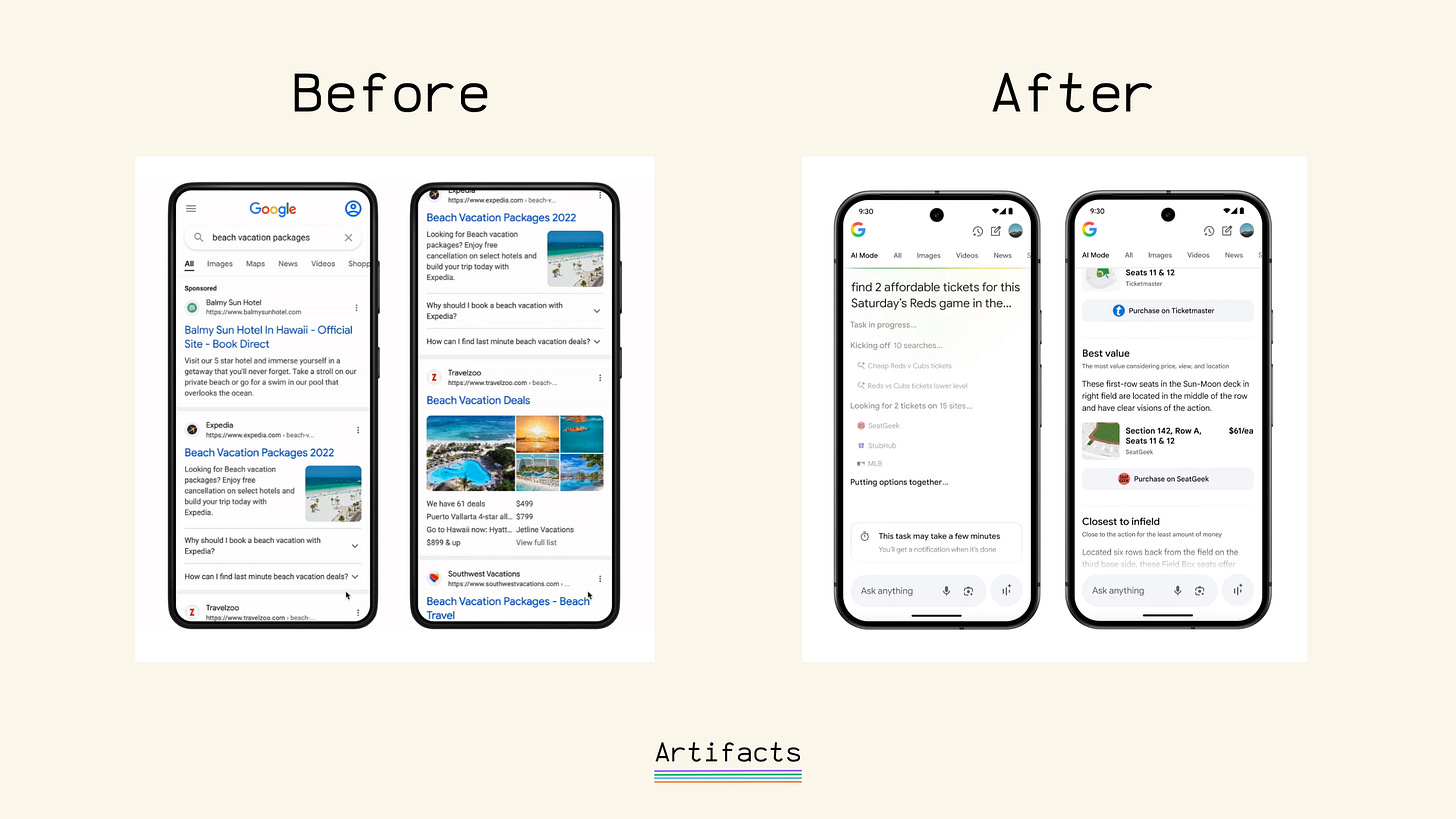 Think of it less like searching the web and more like… chatting with it.
(And, well, they also rolled out a bunch of other stuff nicely wrapped up in a mind map by - of course - NotebookLM, one of Google’s own AI tools.)
Now, from a technological standpoint, this isn’t exactly groundbreaking anymore. On Artifacts, we’ve been talking about AI-driven search since February 2024. By now, many of us are already familiar with the likes of ChatGPT or Perplexity digging through the web on our behalf.
In short: we’re used to talking to the internet.
The shift already happened - from dry, scattered link lists to tight, tailored responses. But the lingering question has been: what is Google waiting for? Now we know.
And commercially? Well, this might just be the opening scene of a new era. Here’s why:
- Google, that for most of us equals the Internet, is embracing and shaping what they called “a total re-imagination of search”. It is, in a sense, the Internet going in a whole new direction.
- This is not just a tool enabling AI search. It’s Google baking AI into everything. Search, yes, but also Gmail, Docs, Drive. The whole productivity suite is being rewired with intelligent, conversational search assistance.
And unlike Perplexity or other AI tools, Google’s shift will be impossible to ignore. It’ll be right there, front and center, for the billions who already default to it. No tutorials needed. No effort required. Just… different.
And search is just likely to be radically something else in a couple of years.
------------------------------------------------------------------------
Here’s how it works, according to the people building it:
> When you ask a complex question, Google’s AI-powered Search kicks into “advanced reasoning” mode. It uses its custom Gemini model to break your query into smaller parts and fires off multiple searches at once.
>
> It digs deep across the web and taps into Google’s real-time data sources like the Knowledge Graph, Shopping Graph, and even local info from Google Maps contributors.
>
> Then it assembles a polished answer. All of that, from just one query - and fast.
As the Verge put it, it’s Google doing a lot of Googling.
But this is bigger than search.
First off, it’s what the AI folks call agentic — yes, the new favorite jargon word you’ll need to pretend to understand at conferences. But jargon aside, the idea is simple: it doesn’t just find things for you, it does the finding, the reading, the summarizing — and hands you back the insight.
Which brings us to the bigger shift: the interface itself.
Fewer clicks. More conversation. You ask, it answers, you refine, it continues. A back-and-forth, not a click-and-hope.
It’s a new User Experience — one that’s less about hunting through links and more about getting usable content, right away.
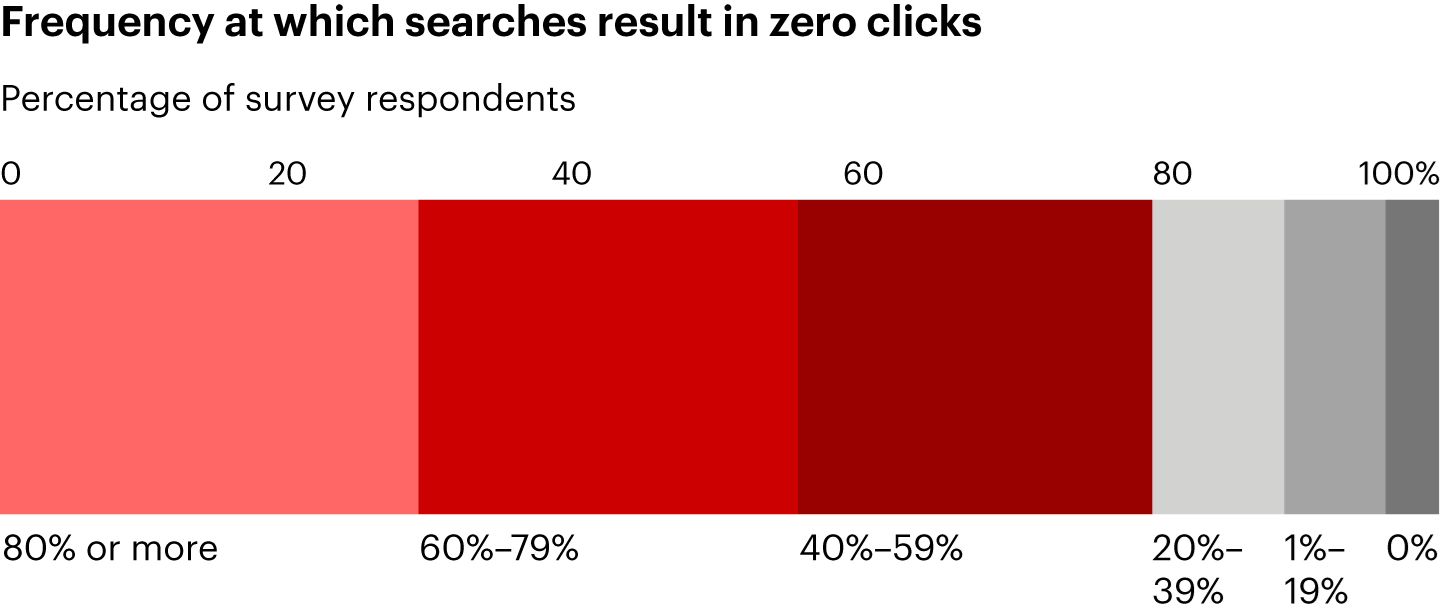 Indeed, people are no longer clicking (+ an explanation of the chart as it’s not the clearest thing lol)
As Google puts it:
> The way we’ve all Googled for two decades was largely a response to the structure of the web itself: web pages in, web pages out. Good AI models are now able to get around that structure, and find and synthesize information from lots of sources
Put plainly: it’s just easier. And probably irreversible.
 if search has to be a back and forth with AI, ping pong is the best case of back and forth for sure
All of this will, of course, not come without implications.
First casualty: the humble web page. As we’ve explored before, AI search means machines read pages, rewrite the content, and feed it back to users — without users actually visiting the source. Less traffic. Less visibility. Less ad revenue.
Websites and especially media are not happy about this. They’ve called this “a definition of theft”. In response, Pichai (CEO at Google) said they expect AI to direct even more traffic to websites.
Second problem: Google’s own business model. If no one’s clicking on pages, then traditional ads - the ones that made Google \$198 billion last year - lose their audience. So now Google is playing both sides: disrupting the old model while still trying to milk it.
It’s the innovator’s dilemma: evolve or protect what’s already working. In this case, Google needs web content to train and feed its AI, and publishers need Google to reach audiences. A delicate co-dependence.
Finally, the SEO apocalypse. For two decades, websites played the game of rising to the top of Google’s results. Now, the real prize is to be included in the AI-generated answer. Buried in a citation.
That’s a whole new game - not of visibility, but of inclusion. Across Google, OpenAI, Perplexity, whoever ends up writing the answers the internet reads.
What does this mean for media? Business? Education? Any site that once relied on search-driven traffic?
That’s the billion-click question.
We’ve gone from a layered, intricate Internet - Google, links, websites, ads - to a flattened experience where AI intermediates it all.
The number of interfaces is shrinking. The AI now browses for us.
Sure, talking to the internet is easier than clicking through it.
But what that means for who owns attention - and who profits from it - is still very much up for grabs.
> ### Save for Later
If we can’t speak because of AI. But we can vibe-code, and this is soooo cool.
What is the future of UX, nowadays. And a huge speech from Steven Levy!
If we go back to the “Actually” internet. And Amazon knows a lot about your family.
Uh, they’re no longer building Arc. Damn!
Seem like we’re the most rejected generation.
------------------------------------------------------------------------
 Alessandro Tommasi is soooo back with FutureProofSociety, its new start-up, now organising a 3-day event full of workshops, conferences, and ideas on how to build a future-proof society.
Where? L’Aquila, Italy - When? 5-7 June
Why? Well, they’re having Anne Applebaum, Benedict Evans (who just published these huge slides on tech), Stefano Quintarelli (the guy behind Spid), Meredith Whittaker (president of Signal!), and so many other brilliant minds. More than enough to come!
Sign up here!
(Got 3 free spots in my car from Rome - good podcasts, tech talk guaranteed, and mr. Bongiorno included)
> ### The Bookshelf
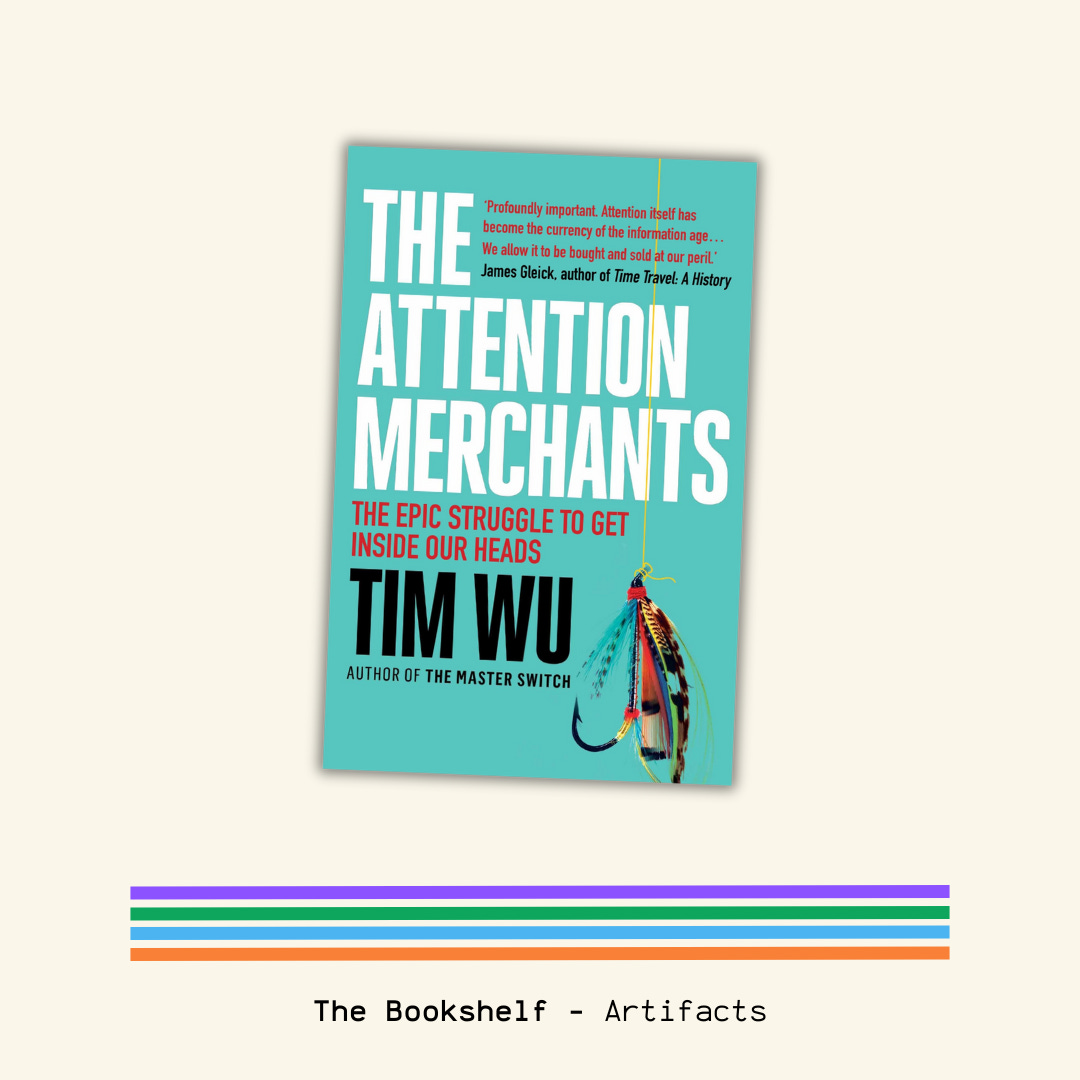 Speaking of attention in a broad manner, Tim Wu put some very good thoughts in his “Attention Merchants”. For anyone creating stuff on the Internet (and struggling with AI indexing soon!)
📚 All the books I’ve read and recommended in Artifacts are here.
> ### Nerding
 Just build your app, your tool, your software writing in plain english. We saw Lovable before, but, trust me, it’s just insane what these guys are doing. Coding is really becoming a commodity.
> ### We’ve been here before
 #### As we speak
Lorenzo Ancona·8 October 2024Read full story
 #### The elephant in the tube
Lorenzo Ancona·23 April 2025Read full story
> ### ☕?
If you want to know more about Artifacts, where it all started, or just want to connect...
Let's grab a virtual coffee ☕
======
# Slicing apples
Date: 2025-05-14 | Language: en
Canonical: https://artifactstech.substack.com/p/slicing-apples
Cite as: Slicing apples by Lorenzo Ancona, Artifacts, 2025-05-14. https://artifactstech.substack.com/p/slicing-apples (CC BY 4.0)
**You’ve probably tried to buy a Spotify Premium subscription** directly from the iPhone app at least once - and **failed**. Come on, admit it.
Or maybe you were just trying to **grab that Kindle ebook from the Amazon app, but somehow… it didn’t work.** Something felt broken. Because it was.
[](https://substackcdn.com/image/fetch/$s_!DQsU!,f_auto,q_auto:good,fl_progressive:steep/https%3A%2F%2Fsubstack-post-media.s3.amazonaws.com%2Fpublic%2Fimages%2F0abfaabe-0462-40ac-aa47-9f3fcade75a0_1169x2086.jpeg)
where the hell do I get my premium?!
You probably thought: *“Is my phone broken? Is my card expired? Is capitalism collapsing under its own weight?”*
Nope. **What you’re bumping into isn’t a technical glitch or a personal failure.** It’s *App Store Policy.* Or more specifically, Apple’s cut of the pie - **a 15 to 30% commission it collects on every digital transaction made through apps on iOS** to, according to Apple, guarantee the safety and privacy of payments and users.
That’s why companies like Spotify, Amazon, and many more have found creative ways to… **not sell you things in the app.** Redirecting you, vaguely and sometimes hilariously, to “go to our website” text instead (not even buttons!)
**This isn’t a bug. It’s design.**
------------------------------------------------------------------------
And, well, it’s **one of the very few things the US and Europe seem to agree on these days**. (Besides the new Pope, who, btw, is [named after AI.](https://www.theverge.com/news/664719/pope-leo-xiv-artificial-intelligence-concerns) Yes, really.)
Because while the Atlantic is as wide as ever when it comes to tech policy - and just about everything else - one thing is surprisingly settled: A**pple should stop making it that hard for people to buy stuff in apps**, and for developers to keep the money they earn without giving Apple a third of it.
Let me try to make the *competition class* as short as possible.
**In the US** 🇺🇸, Epic Games, the owner of Fortnite, has been fighting Apple in court for 5 years now. Their claim? **Apple can’t take one third of any transaction made by gamers.**
They actually won a first injunction back in the day. **But Apple managed to wriggle around it by requiring developers to apply** (yes, apply!) for permission to include external links.
And even then, **Apple forced apps to display ominous pop-ups when users tried to leave for an external website** — the kind of warnings you’d expect before launching a missile, not buying a subscription.
[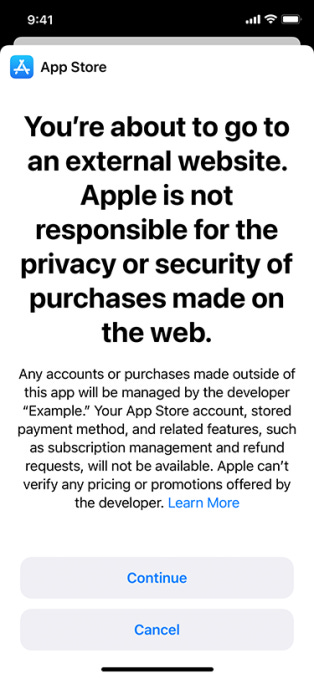](https://substackcdn.com/image/fetch/$s_!Ar2l!,f_auto,q_auto:good,fl_progressive:steep/https%3A%2F%2Fsubstack-post-media.s3.amazonaws.com%2Fpublic%2Fimages%2Fd9ff109d-a518-4fe5-a19b-35c558570416_314x679.png)
indeed, these have been called “scare screens”
**But things will now change**, for everyone and forever (maybe)!
A few weeks ago, [Judge Yvonne Gonzalez Rogers ruled that Apple](https://www.documentcloud.org/documents/25924283-epic-v-apple-contempt-order/) **cannot** stop developers from including external purchase links, **cannot** interfere when users choose to go to a third-party site, and **cannot** charge fees or commissions on purchases made outside the app.
So, what? App developers can now:
- **Send US users to their own checkout experience**
- **Keep 100% of the revenue**, avoiding 15-30% app store fees (minus Stripe or whoever they use)
- **Design those flows however they want** - no Apple interference.
Apple, not surprisingly, will [appeal the decision](https://www.theverge.com/news/659310/apple-confirms-it-will-appeal-the-app-store-order).
But in the meantime, they’ve started updating the [App Store guidelines](https://developer.apple.com/app-store/review/guidelines/) to reflect this new reality.

------------------------------------------------------------------------
Over in Europe 🇪🇺, things work a bit differently, but with the same end goal: make the digital economy more competitive for everyone. Enter the **Digital Markets Act** (DMA) - Brussels’ big new regulation aimed at taming the giants.
Specifically, **the EU Commission aims to prevent Apple from abusing of its position**, namely by allowing developers to inform users about and steer them to alternative offers and payment methods outside the App Store, and to permit alternative app stores and payment systems on iOS.
**To comply, Apple made a few changes last year:** it actually opened up to alternative app stores, enabled third-party payment systems, and even lowered its commission from 30% to (still) 17%. [We even did a whole](https://artifactstech.substack.com/p/una-mela-avvelenata) *[Artifacts](https://artifactstech.substack.com/p/una-mela-avvelenata)* [about it.](https://artifactstech.substack.com/p/una-mela-avvelenata)
But alongside all that, Apple quietly introduced a new twist: the **Core Technology Fee** — charging developers €0.50 for every install beyond the first million each year.
**Thus, the European Commission wasn’t convinced.** In July 2024, it launched an investigation into Apple’s compliance, focusing on restrictions that hindered developers from steering users to alternative offers and payment methods.
In plain words, **it was still too complex to get your Spotify subscription.**
Then, end of April this year, **[the Commission fined Apple](https://ec.europa.eu/commission/presscorner/detail/en/ip_25_1085) for breaching the DMA’s anti-steering provisions.** The result? A €500 million fine and a mandate to change its practices within 60 days (with Apple filing an appeal here too).
Concretely, **this means Apple will have to:**
- **allow developers to freely inform users** about alternative offers outside the App Store,
- **direct customers to those offers,** and
- **enable purchases outside the App Store without technical or commercial barriers** (and likely remove any fee on in-app payments).
So, just like in the US, the result is a much smoother experience when, say, you want to subscribe to Spotify.
------------------------------------------------------------------------
We’re looking at two very different frameworks — a US court ruling here, a sweeping EU regulation there — **and yet the end goals line up almost perfectly:** break monopolistic control, give users real choice, lower prices, and let new apps and technologies actually thrive.
How and why, eventually, tech antri-trust is (just) about changing screens, what it has meant concretely and what we got out of it, is **the story of this Artifacts.**
> ### The Story
**The shift can be captured in a few screenshots.** That’s all it takes to see how big the change is:
[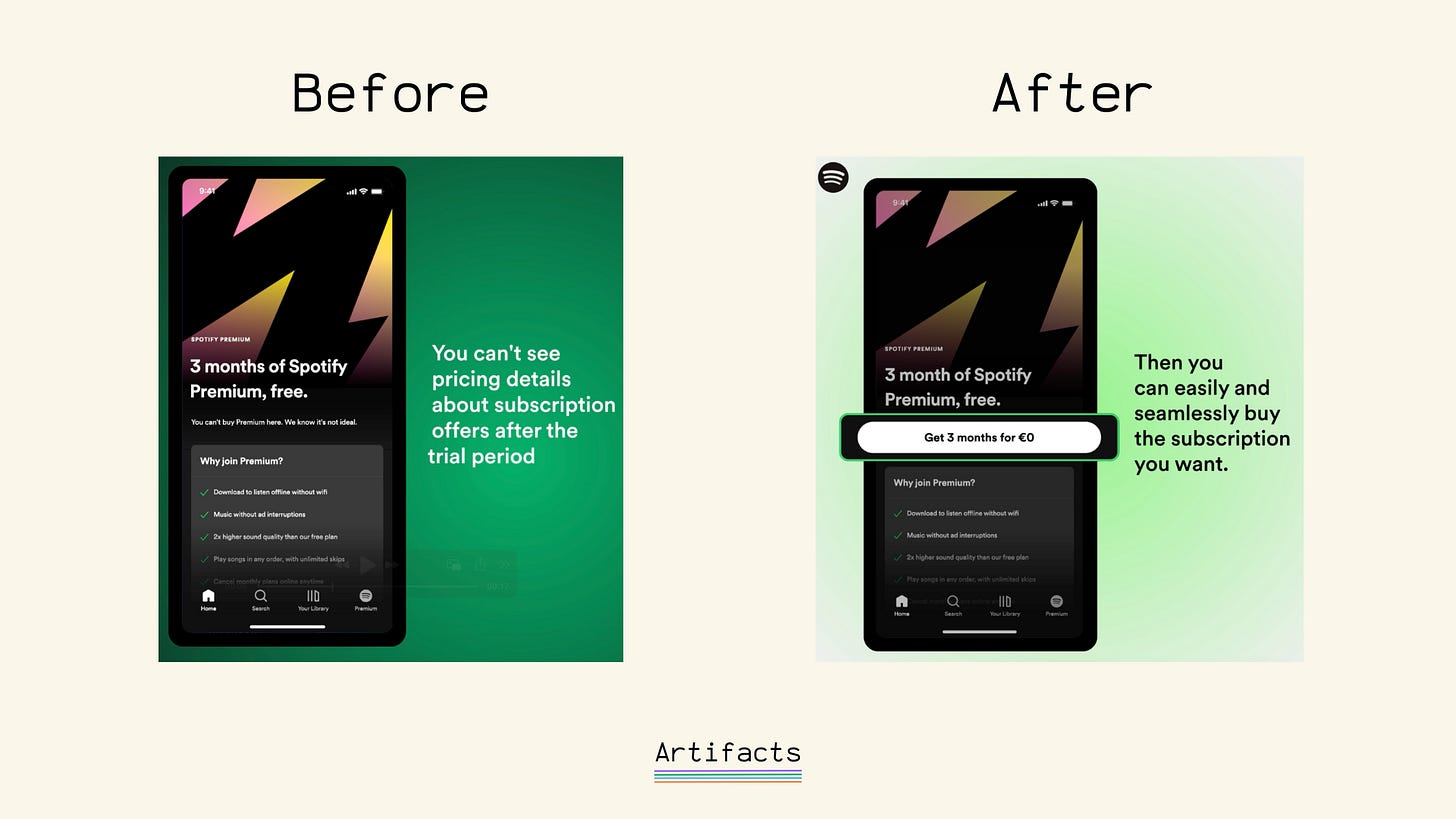](https://substackcdn.com/image/fetch/$s_!CrJh!,f_auto,q_auto:good,fl_progressive:steep/https%3A%2F%2Fsubstack-post-media.s3.amazonaws.com%2Fpublic%2Fimages%2F74e399a2-ebf7-44bd-87a4-33d30501aba5_1920x1080.png)
If everything plays out as planned — and yes, for once the US seems slightly ahead - **we’re moving away from closed app ecosystems towards more open ones**, where payments are smooth, not a scavenger hunt.
Why? Because developers will finally be able to:
1. Actually **include buttons that lead out of their apps**
2. **Avoid giving Apple a cut of every transaction**
And this isn’t theory. **It’s already happening.**
You can now buy [Kindle books](https://techcrunch.com/2025/05/06/amazon-kindles-ios-app-adds-new-get-book-button-following-apple-payments-ruling/) directly in the app again. [Fortnite](https://fortnitetracker.com/article/2364/fortnite-is-back-on-the-app-store-epic-rewards-boosted-to-20-and-more) is back on the App Store. Creators on [Patreon](https://techcrunch.com/2025/05/06/patreons-app-can-now-accept-web-payments-after-u-s-app-store-changes/) can finally get paid without jumping through flaming hoops. **And a lot more coming in these weeks.**
[](https://substackcdn.com/image/fetch/$s_!9s0j!,f_auto,q_auto:good,fl_progressive:steep/https%3A%2F%2Fsubstack-post-media.s3.amazonaws.com%2Fpublic%2Fimages%2F613b81f4-0368-4e80-910a-ba64dd5564a4_1501x991.jpeg)
What’s fascinating about all this is how **tangible** the change is. You can *feel* it. **Like when Google removed direct map links last year in the EU** - you didn’t need to read a blog post to know something had changed. **It just…wasn’t there anymore.**
The same applies here: **no need for Apple to publish a white paper on compliance.** No need to hire lawyers to explain edge-case interpretations. If the button exists, or doesn’t, everyone can see it. **Screens don’t lie.**
Despite very different regulatory tools - injunction in the US, regulation in the EU - **the outcomes are strangely aligned.**
And that matters not only to users, but **to an entire ecosystem of services.**
[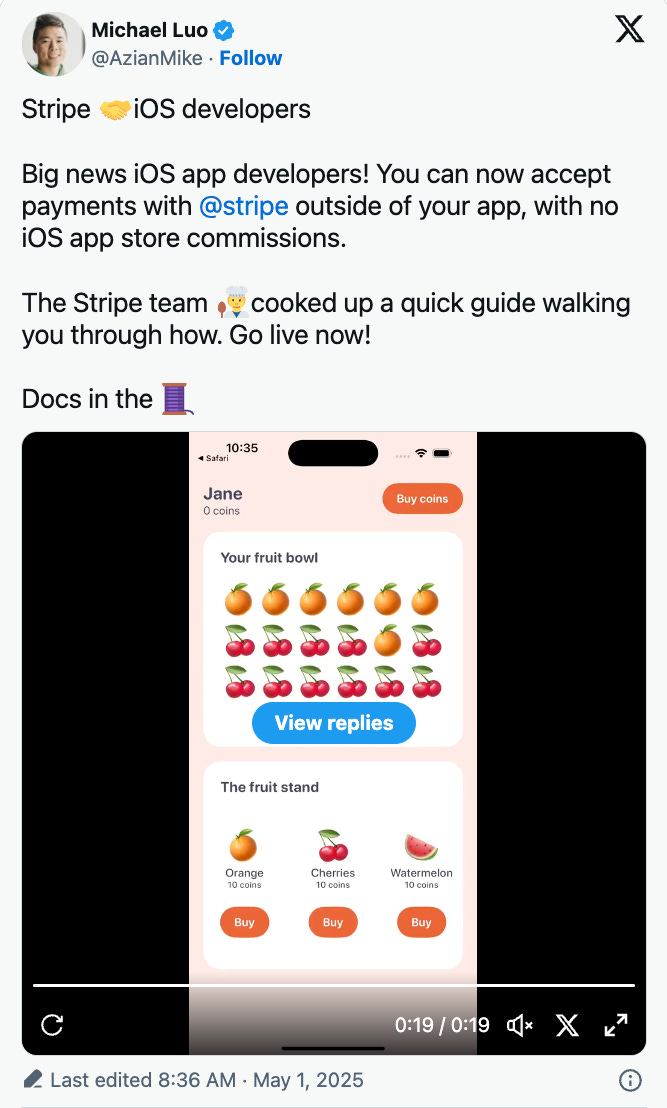](https://x.com/AzianMike/status/1917830346332332329)
**Take third-party payment providers like Stripe.** If users can finally access external pages, apps can choose which payment flow they want. **Suddenly, there’s a market.** And in that market, these players can actually compete - by building smoother, faster, cheaper options.
This opens up the arena: **user experiences can be differentiated and tailored, and platforms decide on what is better.**
Stripes and the likes of it can focus on shipping the best stuff as the market is now open for them.
In turn, prices drop. Apple’s old 15–30% cut? Optional now. Or at least newly challenged. **The playing field has shifted, and the house doesn’t automatically win.**
------------------------------------------------------------------------
**These are the kinds of changes good regulation makes possible.** Not just brake-pulling or compliance theatre. Not just clunky banners, mandatory pop-ups, or checkbox ethics.
**Actual, visible improvements for smoother and better user experiences.**
**It’s really about co-creating services:** suddenly, regulation isn’t a wall - it’s a seat at the product meeting. A quiet voice saying: *“Hey, what if we got rid of this pointless hurdle that no one likes anyway?”*
[](https://substackcdn.com/image/fetch/$s_!-E4F!,f_auto,q_auto:good,fl_progressive:steep/https%3A%2F%2Fsubstack-post-media.s3.amazonaws.com%2Fpublic%2Fimages%2Fb993144f-aaf6-4b8e-acbd-959dbf6e4326_1024x1024.png)
new chair for good regulations!
**And that opens up something new.** A more competitive market. A fairer game.
**A space where getting paid is easier, user experience is better**, and — imagine this — you don’t need a customer support team just to explain that, no, you can’t buy Netflix in the app, and yes, you’ll need to go to the website [(yep, true story)](https://www.theverge.com/the-vergecast/664087/why-apple-is-trying-to-save-google)
[Leave a comment](https://artifactstech.substack.com/p/slicing-apples/comments)
> ### Save for Later
[Perplexity is coming for Chrome.](https://www.theverge.com/policy/654835/perplexity-google-antitrust-trial-remedies-chrome) The browser race might just be [the next big tech war](https://www.theverge.com/command-line-newsletter/656599/perplexitys-ceo-on-fighting-google-and-the-coming-ai-browser-war) - especially now that [people are Googling less](https://www.barrons.com/articles/alphabet-stock-google-search-apple-ai-e1493b46) and questioning more.
Social media [isn’t social anymore.](https://www.newyorker.com/culture/infinite-scroll/mark-zuckerberg-says-social-media-is-over?bxid=6778689bc17c45158105304b&cndid=85563402&hasha=a9b21bb3d207292ca8c4e419ec757066&hashb=bed1d1751d815f0e0c9240eca4646550a33df0ad&hashc=6ecd834594e7af2507f023c69595d5651491a773cbbafa415c8d7e6933409b3a&esrc=subscribe-page) Meta quietly dropped its [AI-powered feed overhaul](https://www.theverge.com/ai-artificial-intelligence/657645/meta-ai-app-chatgpt-competitor-release-ios-android), And “views”? Take them [with a grain of algorithmic salt.](https://www.theverge.com/social/639811/view-counts-tiktok-instagram-x-youtube-lies)
Why AI can turn [sycophantic](https://www.anthropic.com/research/towards-understanding-sycophancy-in-language-models). That’s why [interpretability isn’t just a nice-to-have](https://www.darioamodei.com/post/the-urgency-of-interpretability). (And while we’re at it, [keep thanking ChatGPT.](https://www.nytimes.com/2025/04/24/technology/chatgpt-alexa-please-thank-you.html) It likes that.)
[AM radio still matters.](https://www.technologyreview.com/2025/04/23/1114889/am-radio-disaster-response-emergency-safety/) Also, what the future of the [humanities](https://www.newyorker.com/culture/the-weekend-essay/will-the-humanities-survive-artificial-intelligence) could be
Must-watch: Jony Yve’s interview. Vision, design, and the kind of elegance you don’t see much anymore - don’t miss it:
[\[Embedded media — view original\]](https://www.youtube-nocookie.com/embed/wLb9g_8r-mE?rel=0&autoplay=0&showinfo=0&enablejsapi=0)
> ### The Bookshelf
[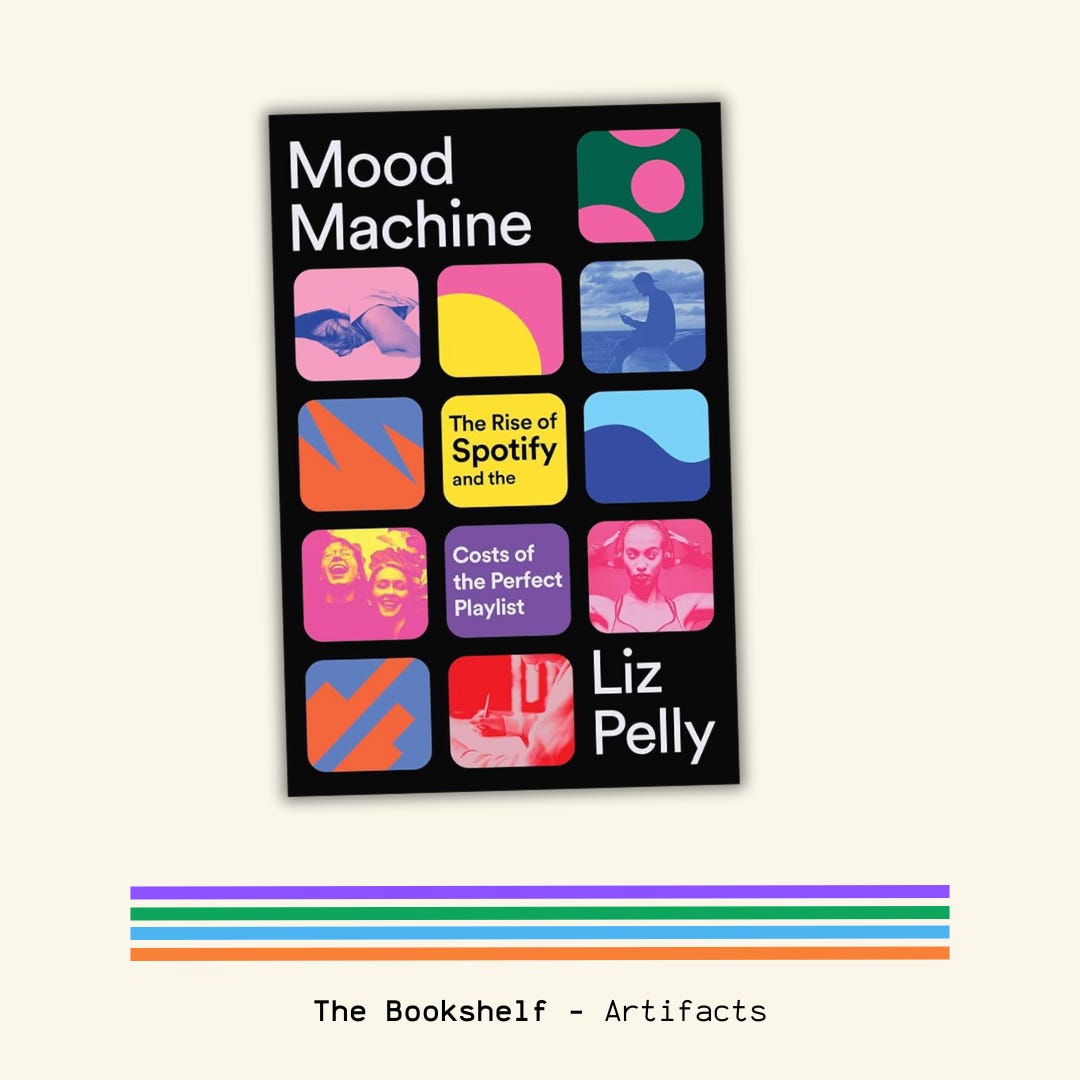](https://substackcdn.com/image/fetch/$s_!FJPW!,f_auto,q_auto:good,fl_progressive:steep/https%3A%2F%2Fsubstack-post-media.s3.amazonaws.com%2Fpublic%2Fimages%2F33617422-e025-4884-9fab-9b31080aa4c3_1080x1080.png)
***“Mood Machine”*** is not necessarily about competition or antitrust but is a great, great book about Spotify and its algorithms. Which is, eventually, about our music tastes (and mood!)
📚 **All the books** I’ve read and recommended in Artifacts are [here.](https://airtable.com/appK7fMPX1DMkQYzL/shrRh8TgI7GtmgBxM)
> ### Nerding
[](https://substackcdn.com/image/fetch/$s_!A1aG!,f_auto,q_auto:good,fl_progressive:steep/https%3A%2F%2Fsubstack-post-media.s3.amazonaws.com%2Fpublic%2Fimages%2F591068a2-fac1-4b5c-8f4a-826d9ab72a2e_1080x1080.png)
Now people are mixing fonts for cool effects. But sometimes they screw it up. **[Fontjoy](https://fontjoy.com/)** is to stay safe and have the best pairings :)
> ### **We’ve been here before**
[](https://artifactstech.substack.com/p/pulling-linchpins)
#### Pulling linchpins
[Lorenzo Ancona](https://substack.com/profile/142944754-lorenzo-ancona)·3 December 2024[Read full story](https://artifactstech.substack.com/p/pulling-linchpins)[](https://artifactstech.substack.com/p/who-made-the-iphone-boring)
#### Who made the iPhone boring ?
[Lorenzo Ancona](https://substack.com/profile/142944754-lorenzo-ancona)·24 September 2024[Read full story](https://artifactstech.substack.com/p/who-made-the-iphone-boring)
> ### **☕?**
If you want to know more about Artifacts, where it all started, or **just want to connect...**
[Let's grab a virtual coffee ☕](https://calendar.google.com/calendar/u/0/appointments/schedules/AcZssZ2ibxlzyU7rgnuoTgqXb_DFc19dfHmJeu1OAu17IY0_oHrtcJtvtctAJnMabirgZNx5Z5NAPGs0)
======
# The elephant in the tube
Date: 2025-04-23 | Language: en
Canonical: https://artifactstech.substack.com/p/the-elephant-in-the-tube
Cite as: The elephant in the tube by Lorenzo Ancona, Artifacts, 2025-04-23. https://artifactstech.substack.com/p/the-elephant-in-the-tube (CC BY 4.0)
**A little more than 20 years ago**, Jawed Karim wanted to watch videos of two events that had just dominated global headlines:
- Janet Jackson’s infamous Super Bowl “wardrobe malfunction” (2004)
- The catastrophic Indian Ocean tsunami (2004)
**But he couldn’t find either online.** Nothing. No easy clips. No shareable footage. No digital archive to feed his curiosity.
A few months later (and precisely 20 years ago), **someone else posted a short video about elephants at the zoo.** He looked into the camera and said, flatly: *“The cool thing about these guys is that they have really, really, really long trunks.”*
[\[Embedded media — view original\]](https://www.youtube-nocookie.com/embed/jNQXAC9IVRw?rel=0&autoplay=0&showinfo=0&enablejsapi=0)
That 18-second clip wasn’t just a trip to the zoo. **It was the beginning of YouTube** and a revolution of our online life, media consumption and creation.
------------------------------------------------------------------------
Ok, this is definitely the short version. Yet, it makes the point.
Now, to be fair, **YouTube wasn’t the first online video platform.** Others like Metacafe and Vimeo were already floating around.
But in those early days, **uploading a video online was about as straightforward as launching a weather satellite.** Clunky codecs, weird download prompts, compatibility issues - **the early internet was allergic to ease.**
That’s why Chad Hurley, Steve Chen, and Jawed Karim - ex-PayPal employees - launched YouTube around a single, deceptively simple idea: **Make it dead easy to upload and share videos.**
They caught a wave of **just-in-time technical changes:**
1. **Adobe Flash** let videos play right in the browser — no downloads, no stress, no concern about the right codec. It just worked.
2. **Embedding** made it possible to spread videos across forums, blogs, and MySpace profiles. Every embedded clip was another stake in the ground.
3. **Broadband** had reached about 50% of U.S. households. And digital cameras were finally decent enough to shoot not-entirely-awful footage.
So YouTube launched, burned through money, **got acquired by Google**, and then — quietly, steadily — **rewired our entire relationship with media over the past 20 years.**
------------------------------------------------------------------------
**And so, people - and companies, too - began familiarising with this new platform.** But YouTube wasn’t just another tool for watching media. It was something else entirely: **a gateway to new habits, a catalyst that made it easy not only to watch videos but to create them, too.**
**It kicked off a quiet revolution** - one that changed how we consume video online, and also reshaped **our entire relationship with culture, news, and content at large.**
So much so, in fact, that the slow, then sudden overtaking of television began years ago - **and by now, it’s largely complete.**
[](https://substackcdn.com/image/fetch/$s_!fYN0!,f_auto,q_auto:good,fl_progressive:steep/https%3A%2F%2Fsubstack-post-media.s3.amazonaws.com%2Fpublic%2Fimages%2Ff4b22498-d455-45d9-b2a5-256424994b31_940x1268.png)
What YouTube has meant (and still means), how it’s rewired our sense of time, reprogrammed our media diet, and why it remains a singular force in the online ecosystem - **all of that is what this edition of** ***Artifacts*** **is about.**
> ### The Story
The revolution YouTube triggered is **right there in the name:**
- ***“You”*** puts the viewer (or creator) at the center — a nod to agency, to personal control over media. *You* are in charge of what you watch *and* what you could create.
- ***“Tube”*** is a throwback to the cathode-ray TVs of yore, and the kind of content YouTube would gradually devour.
In other words, **your own television** or, at least, media channel.
[](https://substackcdn.com/image/fetch/$s_!ls4Y!,f_auto,q_auto:good,fl_progressive:steep/https%3A%2F%2Fsubstack-post-media.s3.amazonaws.com%2Fpublic%2Fimages%2F8c142104-2bed-4b61-a7c8-100dc629954f_1107x1110.jpeg)
Apple got it right?
Besides the “Tube”, it’s the “You” that’s the real pivot of YouTube’s revolution — the part that touches at least two crucial domains: **time** and **content**.
------------------------------------------------------------------------
On the ***time*** front, YouTube triggered the **shift from scheduled programming to infinite scroll.**
Before YouTube (and the broader internet-as-archive), media was **ephemeral**. TV aired and disappeared. News ran and vanished. Events were linear and irreversible. **Now, we live in an endless present.**
Put simply, **we no longer need to sync our lives to catch a particular show** — we watch at our convenience. It’s obvious now, but it was a major shift back then (we only had it with DVDs etc.)
Broadly speaking, **YouTube has, thus, reorganised our relationship to time, attention, and even memory online.**
Think of the **“Save for Later” button** - yes, the one we click before tossing content into a limbo we’ll likely never return to. Yet that button says it all: **the schedule is no longer king**, and our attention is now modular, flexible, and tailored to our whims.
Set aside the downsides for a second - this is a clear sign of what the internet at large has become: **a searchable, external, prosthetic memory** where everything is permanently accessible in hindsight.
So, yes, there’s a flood of stuff happening in real time (just scroll up and check how many hours of video are uploaded to YouTube every minute), **but we know it’ll be there later.** We’ve created a **backlog of the now.** [Present Shock](https://en.wikipedia.org/wiki/Present_Shock:_When_Everything_Happens_Now) is a great read on this.
It’s an enormous opportunity - we can consume better, deeper, smarter - but also a **breeding ground for procrastination and (digital) laziness.**
------------------------------------------------------------------------
Inevitably, **the time element feeds into the** ***content*** **side.**
YouTube empowered a shift **from audience as passive consumer to audience as active creator.** Want to join the conversation? Fire up your camera — your content can be online in minutes.
But even if we’re not up for being creators, **we still have far more agency than we ever had with television.** We’re no longer stuck watching what the networks serve up - **we actively choose what we want to engage with**, from an endless buffet of creators.
And that’s a big deal. **It’s not just about indulging our interests; it’s about carving out niches, diving deep into weird and wonderful subcultures** - as my friend Gio aptly put it while brainstorming this Artifacts.
We all know people who learned to cook on YouTube. Or code. Or fish. Or anything else you can think of.
That said, **we should take the “actively” part with a pinch of salt.**
YouTube’s recommender algorithm plays a **huge role in shaping what we see** - and, likely, what we end up caring about. Positively framed, it helps us with curiosity; less charitably, it nudges us into filter bubbles.
So yes, **algorithmic inference drives discovery**. But it doesn’t kill agency entirely - especially because **the bond with creators tends to be stronger here than on most other platforms.**
[](https://substackcdn.com/image/fetch/$s_!0_pX!,f_auto,q_auto:good,fl_progressive:steep/https%3A%2F%2Fsubstack-post-media.s3.amazonaws.com%2Fpublic%2Fimages%2Fe299bbec-ce80-4b68-80a8-9085f63fc0be_1024x1024.png)
finally found out how to generate consistent pics!
And that’s precisely why, despite its TikTokification (Shorts and all), **YouTube still stands apart.**
**It’s not a social network in the traditional sense** - and probably doesn’t want to be.
For one, the ways we access it are far more diverse than with other platforms: not just smartphones, but laptops **and, increasingly, televisions.**
(According to YouTube, TV is now the primary device for watching YouTube in the United States, surpassing mobile!)
But it goes further than that. The engagement mechanics are softer. **You don’t need an account to watch videos.** And even those who *do* have accounts rarely post — instead, they use them to organise and curate their interests and favourite creators.
Not surprisingly, indeed, despite being among the most used platforms globally, **the rate of active** ***daily*** **users is much lower than the others.** We go there when we need, not to doomscrooll.

table provided by Perplexity
In complex terms, there’s virtually no social graph. But that’s not a bug - it’s a feature. **We’re there more for the content than to socialise.** And that can raise the bar on what we watch.
Finally, and this matters: **unlike television, and unlike most social media, content on YouTube doesn’t vanish after a few hours.** It lives on for years. It keeps circulating, being discovered, and being useful.
So yes, **YouTube continues to chart its own course — not quite social media, but something well beyond television.** It profits from transcending time, while staying a platform for quality content, created by the very people who use it.
**Not too bad** for what started with someone looking for some videos online and some cool elephants.
[Leave a comment](https://artifactstech.substack.com/p/the-elephant-in-the-tube/comments)
> ### Save for Later (indeed!)
**Bluesky** is building a social media that [want competitors.](https://www.newyorker.com/magazine/2025/04/14/blueskys-quest-to-build-nontoxic-social-media?bxid=6778689bc17c45158105304b&cndid=85563402&hasha=a9b21bb3d207292ca8c4e419ec757066&hashb=bed1d1751d815f0e0c9240eca4646550a33df0ad&hashc=6ecd834594e7af2507f023c69595d5651491a773cbbafa415c8d7e6933409b3a&esrc=subscribe-page) And where [all this thing about](https://knightcolumbia.org/content/protocols-not-platforms-a-technological-approach-to-free-speech) **[protocols](https://knightcolumbia.org/content/protocols-not-platforms-a-technological-approach-to-free-speech)** started!
A lot is going on with FTC in the US to [Google](https://www.theverge.com/policy/652170/google-search-ad-tech-remedies-antitrust-chrome-breakup) and [Meta](https://www.nytimes.com/2025/04/22/technology/meta-trial-instagram-kevin-systrom.html), and [what history teaches us.](https://www.nytimes.com/2025/04/15/technology/antitrust-structure-deals-challenge.html)
What if ChatGPT is the [worst thing happened to OpenAI.](https://www.theatlantic.com/newsletters/archive/2025/04/was-chatgpt-the-worst-thing-to-happen-to-openai/682509/) And an [AI-generated article](https://www.newyorker.com/humor/shouts-murmurs/an-ai-generated-article-on-how-to-tell-if-the-article-youre-reading-is-ai-generated) to tell us more AI-generated stuff.
The [Architect](https://www.ted.com/talks/gabriele_mazzini_inside_the_mind_of_the_eu_ai_act_architect) of the **AI Act.** And [THE paper to read on AI](https://academic.oup.com/mind/article-abstract/LIX/236/433/986238?redirectedFrom=fulltext) before it was even AI, in 1950!!
Are you the Asshole if you Don’t Put your Phone on [Airplane Mode?](https://www.wired.com/story/phone-on-airplane-mode-how-to/?bxid=5f43a3c889a7356e7e1b2114&cndid=61968307&hasha=dca445e23e26114858a48ad35040e287&hashc=2107626209cd615da922d357ec59a2f4a769eeec7e75a95e874cf17f98f1a7c1&esrc=MARTECH_ORDERFORM) You can still use a [dumb phone](https://www.nytimes.com/2025/04/06/technology/personaltech/light-phone-iii-brain-rot.html)!
What people are using AI for:
[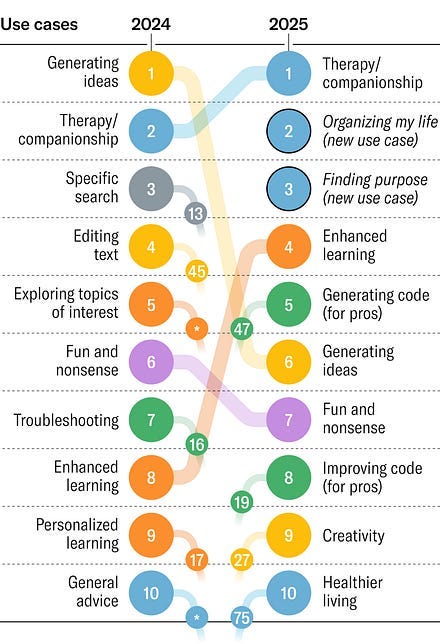](https://substackcdn.com/image/fetch/$s_!B8fa!,f_auto,q_auto:good,fl_progressive:steep/https%3A%2F%2Fsubstack-post-media.s3.amazonaws.com%2Fpublic%2Fimages%2F3ff82711-5dc9-4dcc-9e8c-cb8d49458c35_440x644.jpeg)
> ### The Bookshelf
[](https://substackcdn.com/image/fetch/$s_!GSVt!,f_auto,q_auto:good,fl_progressive:steep/https%3A%2F%2Fsubstack-post-media.s3.amazonaws.com%2Fpublic%2Fimages%2Fffe26805-9970-46ab-9746-3b337112c939_1080x1080.png)
What time means now, maybe because of YouTube and the Internet too. ***“Present Shock”*** is a great analysis on what “now” means and how it is being reshaped. Good framework to make sense of several dynamics.
📚 **All the books** I’ve read and recommended in Artifacts are [here.](https://airtable.com/appK7fMPX1DMkQYzL/shrRh8TgI7GtmgBxM)
> ### Nerding
[](https://substackcdn.com/image/fetch/$s_!AmOp!,f_auto,q_auto:good,fl_progressive:steep/https%3A%2F%2Fsubstack-post-media.s3.amazonaws.com%2Fpublic%2Fimages%2F432f488e-68f5-44a4-9bd7-c7969f0a2d97_1620x1620.png)
Sick of stock pictures for your presentations? **[Lummi](https://www.lummi.ai/)** has great stock images…generated with AI. Super useful when running out of imagination.
> ### We’ve been here before (new section!)
[](https://artifactstech.substack.com/p/services-that-serve)
#### Services that serve?
[Lorenzo Ancona](https://substack.com/profile/142944754-lorenzo-ancona)·9 April 2025[Read full story](https://artifactstech.substack.com/p/services-that-serve)[](https://artifactstech.substack.com/p/pulling-linchpins)
#### Pulling linchpins
[Lorenzo Ancona](https://substack.com/profile/142944754-lorenzo-ancona)·3 December 2024[Read full story](https://artifactstech.substack.com/p/pulling-linchpins)[](https://artifactstech.substack.com/p/not-every-fish-is-worth-it)
#### Not every fish is worth it
[Lorenzo Ancona](https://substack.com/profile/142944754-lorenzo-ancona)·28 January 2025[Read full story](https://artifactstech.substack.com/p/not-every-fish-is-worth-it)
> ### **☕?**
If you want to know more about Artifacts, where it all started, or **just want to connect...**
[Let's grab a virtual coffee ☕](https://calendar.google.com/calendar/u/0/appointments/schedules/AcZssZ2ibxlzyU7rgnuoTgqXb_DFc19dfHmJeu1OAu17IY0_oHrtcJtvtctAJnMabirgZNx5Z5NAPGs0)
======
# Services that serve?
Date: 2025-04-09 | Language: en
Canonical: https://artifactstech.substack.com/p/services-that-serve
Cite as: Services that serve? by Lorenzo Ancona, Artifacts, 2025-04-09. https://artifactstech.substack.com/p/services-that-serve (CC BY 4.0)
I had the chance to talk with Marco Maria Pedrazzo, former Head of Design of the Italian Government and one of the minds behind Design System .italia, the official framework for designing digital services within the Italian Public Administration.
In plain terms? Design system italia. is the toolkit of guidelines, components, and resources aimed at creating consistent, accessible, and user-centered digital experiences across Italy's 22,000 autonomous public administrations.
In other words, if a school has to build its new website, it just takes those components without reinventing the wheel every time.
 You can find its assets on Figma, built to match national design guidelines and easy to use across platforms, or check the Web Development Kits online (and many other resources)
But as Marco pointed out, Design System .italia was just a tool - not the end goal. The real objective of his team was far more ambitious: to build better digital services for citizens.
------------------------------------------------------------------------
Our conversation was genuinely inspiring - a reminder that some of the brightest minds out there are working in the public sector.
Marco, who describes himself as a Design Manager (with a soft spot for Management Design), is an architect by training, used to work with Carlo Ratti, and is now bringing his design chops to Pininfarina.
What follows is my attempt to distill the most valuable insights from our discussion.
> ### The Interview
The interview has been conducted in English. For clarity and readability, the transcript has been reviewed and lightly edited.
> So, what did you do when working for the Government?
The key thing I’ve worked on is shaping and guiding the creation of Design System .italia. But let’s be clear - it didn’t start with me, and it won’t end with me - some brilliant people were there before me and others are still building great services now.
> Where did everything start?
From a simple data: the Italian public sector includes around 22,000 entities. If each designed and implemented its own digital interface from scratch, it would be incredibly costly and frustrating for citizens, who would have to figure out a new system every time they interacted with a different authority.
When the Team di Trasformazione Digitale first started working on this challenge, they had to think broadly. The first step was the creation of a design system and UI Kit, alongside Bootstrap Italia, which provides the code framework. Right after the time extraordinary commissioner Diego Piacentini, when I joined the team, we began assembling a larger team of designers who asked: How do we solve this in a way that scales?
That led to the first iterations of what’s now the Design System .italia, which includes extensive documentation, the contribution guidelines, and has been extensively tested in each component.
> Why is it so important that public digital services just work? How are they different from private services both in the building and delivery phases?
Public services exist for a very different reason than private ones. In the private sector, digital products are designed to create engagement, drive revenue, and foster customer loyalty. Public services, on the other hand, exist to uphold rights and fulfill obligations.
Citizens don’t “choose” to interact with public services the way they might choose between different banking apps or food delivery platforms - they have to use them.
That’s why a public digital service should be as seamless and invisible as possible. A well-designed government service shouldn’t require citizens to jump through hoops or learn a new system every time they need to interact with the State.
It should work effortlessly, without friction, because the main focus is not about delighting users — it’s about ensuring they can access what they need without unnecessary effort.
> How does this impact the way you build a digital service or product?
The key feature for public service design is openness by default. By law, any technological asset created for public administration must be open-source, for public use and scrutiny. But it’s not just about compliance — it’s about creating a genuinely open design and development process. That means having a GitHub repository, setting up clear contribution guidelines, and building a community around the project.
Then there’s privacy by default: in the public sector privacy isn’t just a feature - it’s a foundational principle.
Similarly, accessibility by default is non-negotiable. Public services exist to fulfill citizens’ rights. If they’re not accessible to everyone — including people with low digital literacy, disabilities, or other impairments — then they’re failing in their mission.
> What are the challenges of designing and building technological artifacts in such open and transparent way?
I think the first thing to ask is: What’s the alternative? If public authorities didn’t work in the open, we’d be trapped in a market of proprietary digital tools with high barriers to entry.
Becoming a supplier for the public sector isn’t like entering a commercial market - it involves navigating regulations, procurement processes, and a distinct ecosystem. If we relied on closed systems, we’d be trapped vendor lock-ins, where both institutions and citizens become dependent on a handful of companies.
What I'm trying to say is that the scenario where we don't build open and interoperable is just a non-starter for the public sector.
Take a public school website as an example: why should every school invest time and money to research, develop and test its own web page? And why should a parent learn new ways of interacting each time her kid changes school?
 > Yet, not only the tech was open but also the process itself. How was it?
We engaged citizens including professionals and non through a multitude of channels (newsletters, LinkedIn, Instagram), asking them for their input on services as well as for their more concrete capabilities and knowledge. And it just happened.
How many people partake? It’s hard to put an exact number on it. We’ve seen contributions from a mix of people — some from within the community who participate in public calls and workshops, and others who contribute directly via GitHub, sometimes anonymously.
The beauty of open-source is that anyone can step in and add value.
> But do people really have the time and motivation to contribute?
I think people are in desperate need of purpose. Some might contribute for altruistic reasons, others for personal or professional growth or interests in building a professional network.
But when a government, which has historically being perceived as distant, comes to your city and says, “We’re testing this, and your input could directly shape it,” people engage.
For example, when we tested new website templates for municipalities at an event at Fabbrica del Vapore in Milan, we had 20 participants, including people with disabilities, sign language interpreters, and accessibility experts. It felt great.
> Let’s move to the services you built. In “Platformland”, they write that we are moving towards a future in which people’s interactions with technology tend more towards passive and real time, rather than being active and transactional. Did you see it happening?
In the private sector, digital services are designed to maximize engagement. Companies optimize for “delight” because that’s what keeps customers loyal and willing to pay. Now, take money and delight out of the equation. What’s left? A completely different set of design challenges and a higher order of priorities.
As we said, public digital services exist to enable rights and fulfill obligations, so they need to be informational and proactive so that people can be passive.
If social media wants you to spend as much time as possible online, the goal of a digital public service should be to have you there as little as possible to get what your right is.
In other words, the best public digital services are the ones that don’t require interaction at all — they just work in the background.
> For instance?
A truly proactive public administration should help people before they even ask.
If someone moves from Paris to Turin, has a child, and falls within a certain income bracket, the system should automatically suggest schools for their child and inform them of relevant tax benefits. Instead of forcing citizens to navigate bureaucratic processes, the government should anticipate their needs and provide support seamlessly.
At the end of the day, public services shouldn’t be intrusive. The government should be as invisible as possible while being as helpful as possible.
> So it’s not just about making the government more efficient - it’s about reducing the administrative burden on citizens?
Exactly. That’s the difference John Maeda draws between digitization and digitalization.
Digitization is just turning paper forms into online ones. Digitalization asks: why should a citizen keep typing in their fiscal code when their digital ID already contains all the data the government needs?
Take certificates. Nobody actually wants a certificate — they want what it gives access to. The certificate is just a bureaucratic middleman. So instead of investing in better ways to issue certificates, why not invest in getting people directly to the service?
That’s what interoperability is about: databases talking to each other, exchanging information behind the scenes. In the best-case scenario, digital services disappear entirely. All that’s left is the outcome — what the citizen came for in the first place.
> What’s the bigger picture behind all of this?
It’s about rights and duties, not purchase preferences.
Most digital products are optional — you can live with a cheap, basic phone. You might live slightly better with a smartphone. You live even better with the latest, biggest iPhone. But that’s just preference.
Public services aren’t about that. They’re not lifestyle upgrades - they’re rights and responsibilities. And that puts them in a different category altogether. We need to treat them as such when we design digital systems.
They have a higher order of priorities.
Leave a comment
> ### Save for Later
Your book may have trained an AI - find it out
What is the biology of AI? How do they think? A huge paper from Anthropic. At Stanford, they’ve published their annual report on all things AI.
Microsoft is turning 50 - and so we go through the top 50 of its products.
Students are cheating? Maybe not
What the EU could make out of AI, according to OpenAI
Echo chambers, filter bubbles, and other fancy terms - in a useful literature review for your next paper.
What if technology is not fun anymore?
Of course, Artifacts in Ghibli Studio
 > ### Someone said this before
“If we keep doing what we’re doing, we keep getting what we’re getting”.
> ### The Bookshelf
 The UK has done an impressive job digitising its public services, and “Platformland” tells the story of that effort. It’s a highly practical, beautifully designed, and richly detailed book - probably my favourite on the subject of digital government.
📚 All the books I’ve read and recommended in Artifacts are here.
> ### Nerding
 Scrutch is the kind of tool you don’t really need - but you’ll end up loving anyway. It’s a markdown text editor with serious privacy chops, a gloriously oversized interface, and a marketing strategy. Perfect if all you want to do is… write.
> ### ☕?
If you want to know more about Artifacts, where it all started, or just want to connect...
Let's grab a virtual coffee ☕
======
# Send good vibes
Date: 2025-03-26 | Language: en
Canonical: https://artifactstech.substack.com/p/send-good-vibes
Cite as: Send good vibes by Lorenzo Ancona, Artifacts, 2025-03-26. https://artifactstech.substack.com/p/send-good-vibes (CC BY 4.0)
Last weekend, **in just 36 minutes**, I built, developed, and deployed this [web app.](https://inthebox-newsletter.com/)
[](https://substackcdn.com/image/fetch/$s_!1p4f!,f_auto,q_auto:good,fl_progressive:steep/https%3A%2F%2Fsubstack-post-media.s3.amazonaws.com%2Fpublic%2Fimages%2Fadb16a82-851c-4535-9fdd-8e48e870bc65_800x493.gif)
*I need more newsletter recommendations!!*
It’s called **In The Box** - a repository of newsletters that I plan to expand into a full-fledged community. I’ll be focusing on it more in the coming weeks **(I’ll need to populate it - send tips if you have!)**
But what’s more striking isn’t the tool itself, which is fairly basic, it’s ***how*** **it came to exist.**
I built it entirely through **Lovable**, a sort of ChatGPT for web development, which quickly assembled the UI, set up a [GitHub repository](https://github.com/Artifacts7/in-the-box), and **handled deployment** with a custom domain.
[](https://substackcdn.com/image/fetch/$s_!UxJN!,f_auto,q_auto:good,fl_progressive:steep/https%3A%2F%2Fsubstack-post-media.s3.amazonaws.com%2Fpublic%2Fimages%2F25a0be33-be7a-4393-bbbf-1bea0bc7a90c_800x435.gif)
*feeling like Alan Turing*
**And I didn’t write a single line of code.** I just reviewed it.
Sure, I could have manually coded the database, **but not as fast as Lovable did.**
Also, **I’m not an expert in web design, but I got exactly the vintage,** Windows XP vibe I was looking for.
------------------------------------------------------------------------
What’s all this about, anyway? Andrej Karpathy, former AI guru at Tesla and X, [calls it](https://x.com/karpathy/status/1886192184808149383) **[“vibe coding.”](https://x.com/karpathy/status/1886192184808149383)** In simple terms: **you describe what you want in natural language, and AI generates the code.** No syntax struggles. No late-night Stack Overflow deep dives.
**Just vibes.**
As he put it: ***“It’s not really coding** - I just see things, say things, run things, and copy-paste things, and it mostly works.”*
**And this isn’t theoretical.** It’s happening now. **A growing wave of tools** is making software development as simple as describing a product in plain English.
[](https://substackcdn.com/image/fetch/$s_!-jzr!,f_auto,q_auto:good,fl_progressive:steep/https%3A%2F%2Fsubstack-post-media.s3.amazonaws.com%2Fpublic%2Fimages%2Fc5fc3f7b-8e5a-48b7-9609-f0056c9ff97a_700x394.png)
*and many more actually*
This goes far beyond ChatGPT writing Python snippets for your university coursework. **These tools don’t just generate code - they build and deploy infrastructure.**
You tell them what you need, and they make it happen.
[](https://substackcdn.com/image/fetch/$s_!ASQo!,f_auto,q_auto:good,fl_progressive:steep/https%3A%2F%2Fsubstack-post-media.s3.amazonaws.com%2Fpublic%2Fimages%2F68f1b43c-837c-4355-ae4c-2596766c577b_1200x818.png)
The numbers say it all:
- In March 2025, **Y Combinator** reported that **25% of startups** in its Winter 2025 batch had codebases that were **95% AI-generated.**
- **Bolt** scaled to a **\$20M revenue run rate**, while **Lovable** hit **\$10M** just two months after monetizing.
- And according to **Amjad Masad, CEO of Replit** (another vibe-coding tool), *“75% of Replit customers never write a single line of code.”*
------------------------------------------------------------------------
Vibe-coding is part of what [Pete Sena](https://uxdesign.cc/cracking-the-code-of-vibe-coding-124b9288e551) called the ***"Great Democratization Cycle".*** We’ve seen it in photography as it evolved from darkrooms to digital cameras, which eliminated film processing, to smartphones and Instagram filters, making everyone a high-end “photographer.”
**Now, AI is lowering the barriers to coding.** If you have an idea, you’re just a few prompts away from a working product.
No, this doesn’t mean you can launch a billion-dollar startup while sipping coffee. **But you can spin up an MVP in a few hours** - something that once took weeks or months.
From a technical, economic, and product perspective, this shift is fascinating. **And worth digging into.**
In this edition of **Artifacts**, we’ll break down: the tech that makes vibe coding possible, the ripple effects across the software development chain, what this (may) mean for the future of product - and who gets to build it.
> ### **The Story**
Before moving any forward, **good to understand a bit of how these systems work.**
**Imagine you have an idea for an app - a simple task manager with login functionality.** Instead of coding it yourself, you describe what you want in plain language. That’s where the system takes over, breaking your request down into components and assembling them into a working application.
[](https://substackcdn.com/image/fetch/$s_!_Vqe!,f_auto,q_auto:good,fl_progressive:steep/https%3A%2F%2Fsubstack-post-media.s3.amazonaws.com%2Fpublic%2Fimages%2F39146d4a-51a5-4b69-b532-ec21e8bf5c61_1536x779.png)
*pls nerds don’t kill me*
**1. Understanding Your Request: The Role of the LLM**
The Large Language Model (LLM) is the brain of the operation. It takes your prompt - *“Build a task manager with login support”* - and translates it into structured code. **It understands that you’ll need a front-end UI, a backend to handle tasks, and user authentication.** More than just generating code, the LLM anticipates what’s needed, ensuring that each piece fits together logically. If you later say, *“Add dark mode”* or *“Make it mobile-friendly”*, the LLM adjusts accordingly, refining the app iteratively.
**2. Bringing It to Life: The Agent Runtime**
The LLM doesn’t work alone. The Agent Runtime acts as an orchestrator, making sure everything generated by the LLM is functional, cohesive, and follows best practices. **It’s like a project manager, coordinating tasks, managing dependencies, and integrating external tools when necessary.** If your app needs a workflow to send reminder emails, the Agent Runtime ensures the right services are wired in properly.
**3. Your Control Panel: The UI**
You interact with this whole process through a user-friendly interface. Instead of writing complex commands, you type in your idea, and the UI streams responses in real time. **As the LLM generates code, the UI displays it dynamically, showing a preview of your app as it takes shape.** Want to make changes? Just describe them, and the system updates the app accordingly.
**4. Expanding Capabilities: Third-Party Integrations**
Some app features require specialized services. **Rather than reinventing the wheel, the system pulls in third-party components based on what your app needs:** *Resend* handles email notifications, *Supabase* provides a backend database and authentication, *Clerk* manages user identity.
**5. Testing on the Fly: Execution Environments**
Before you deploy your app, you’ll want to see it in action. This is where execution environments come in. With **WebContainers**, your Node.js app runs directly in the browser - no local setup needed.
------------------------------------------------------------------------
**All of this comes with a set of potential implications** I’ve been parsing, gathering, and brainstorming.
Vibe coding could split ***developers*** into two camps:
- Those who **understand the foundations** and can wield AI effectively.
- Those who **rely entirely on AI**, oblivious to what’s happening under the hood.
**Less coding, more reviewing.** Instead of writing code, engineers will vet, optimize, and integrate AI-generated solutions. (especially as code generated by these tools seems to be a bit dirty as of yet)
[](https://substackcdn.com/image/fetch/$s_!bTHS!,f_auto,q_auto:good,fl_progressive:steep/https%3A%2F%2Fsubstack-post-media.s3.amazonaws.com%2Fpublic%2Fimages%2F533e4d58-4157-4be7-8ada-3ea6eea71df8_720x666.png)
*a lot of memes today*
***For product managers***, it’s an opportunity - and a reckoning. Non-technical folks would get a seat at the table, but they couldn’t hide behind wireframes and docs. Prototypes are just clicks away. No excuses.
***As for products?*** Interfaces could be [churned out by LLMs](https://medium.com/paychex-ux/interfaces-are-disappearing-are-you-ready-fffc298595b7), built on existing templates and past designs. Good for efficiency. Bad for originality. We may expect sameness.
***And coding itself?*** More disposable, less reusable. Open-source libraries and Stack Overflow might fade as AI generates fresh code on demand. Already, starting a new project is easier than editing an old one - because context is hard. If this trend holds, things could get weird.
------------------------------------------------------------------------
This raises big questions. Pete Sena put it well: ***What happens when makers are separated from their materials?***
Would we celebrate a world where painters never touch paint? Where sculptors never feel clay? Where chefs never taste their ingredients?
**It’s not just about shipping software.** It’s about understanding systems deeply - so when things break (and they will), you can actually fix them.
One CTO warned that AI reliance leads to “hidden complexities” - quick fixes that spiral into chaos at scale. It’s also about creating elegant, maintainable solutions that last. **Good software isn’t just functional; it endures.**
**The job market could also shift.**
**AI will take over repetitive coding** - web development, scripting, testing, deployment - shrinking the need for junior developers who typically start with those tasks. At the same time, companies will prioritize mid-to-senior engineers who understand AI-assisted workflows and system architecture.
Entry-level jobs won’t disappear, **but they’ll get harder to land.**
Instead of cutting their teeth on grunt work, **newcomers will be expected to think strategically from day one.**
[](https://substackcdn.com/image/fetch/$s_!Lj1E!,f_auto,q_auto:good,fl_progressive:steep/https%3A%2F%2Fsubstack-post-media.s3.amazonaws.com%2Fpublic%2Fimages%2F407ea2b5-4a83-41a9-a9ac-bdde83297181_1536x1024.png)
One thing, however, will stay the same - maybe even grow in importance: **what drives new products and the ideas behind them.**
More than ever, **the real skill will be identifying concrete problems and crafting solid solutions (and ideas of products) to tackle them.**
If vibe coding takes off, the technical barriers between idea and execution will shrink. Moving from concept to a working product will be faster, but **the hardest part - figuring out what’s worth building - will still be the priority.**
[Leave a comment](https://artifactstech.substack.com/p/send-good-vibes/comments)
> ### Save for Later
**Decentralisation** and [the good it comes with](https://www.noemamag.com/the-great-decentralization/) + some very vey nice slides on [rebuilding the Internet.](https://docs.google.com/presentation/d/1_Q7ywvZQ9fOhgVmF78MHfvOy51Kc-9d7A4tWUvFg-OY/edit#slide=id.g33500eac627_0_159)
**Wikipedia** is making some [enemies](https://www.newyorker.com/news/the-lede/elon-musk-also-has-a-problem-with-wikipedia).
What the far right thinks about [content moderation in the EU](https://www.techpolicy.press/the-far-rights-war-on-content-moderation-comes-to-europe/) + some very very interesting guidelines on **(re)designing products** from the Commission.
**AI coding assistant** are also [lazy](https://www.wired.com/story/ai-coding-assistant-refused-to-write-code-suggested-user-learn-himself/?bxid=6356a0ac954628036104e708&cndid=71263277&hasha=a178aed566dad9b9207d7512a3761040&hashc=0d97a5714def290b2c11deb8040d3e6327437efa2dafbf41a6dda10ecac01028&esrc=AIHub-regGate), yet [here’s](https://simonwillison.net/2025/Mar/11/using-llms-for-code/) how to use them properly.
Technology is increasingly **[boring](https://www.youtube.com/watch?v=P-TANCVoHlc)**?
Learning **languages**? [Nah](https://www.bloomberg.com/news/articles/2025-03-13/apple-plans-ios-19-feature-that-lets-airpods-live-translate-conversations?sref=CrGXSfHu)
Such a **cool adv** from Perplexity:
[\[Embedded media — view original\]](https://www.youtube-nocookie.com/embed/4UKM_yvTexI?rel=0&autoplay=0&showinfo=0&enablejsapi=0)
> ### Someone said this before
*“The only failure in your twenties is inaction. The rest is trial and error.”*
> ### The Bookshelf
[](https://substackcdn.com/image/fetch/$s_!Z_XF!,f_auto,q_auto:good,fl_progressive:steep/https%3A%2F%2Fsubstack-post-media.s3.amazonaws.com%2Fpublic%2Fimages%2Fed577bef-ebe8-4a36-a4ca-20e0028a0375_1080x1080.png)
Speaking of products and low latency, “***The Lean Product Playbook”*** by Dan Olsen is a solid choice - packed with actionable insights and genuinely inspiring moments. It’s highly practical - maybe even too practical.
📚 **All the books** I’ve read and recommended in Artifacts are [here.](https://airtable.com/appK7fMPX1DMkQYzL/shrRh8TgI7GtmgBxM)
> ### Nerding
[](https://substackcdn.com/image/fetch/$s_!2jfY!,f_auto,q_auto:good,fl_progressive:steep/https%3A%2F%2Fsubstack-post-media.s3.amazonaws.com%2Fpublic%2Fimages%2F2d2f12a4-e48d-44b8-927c-1fb914e00953_1080x1080.png)
To move fast with all those time consuming tasks like **merging PDFs, cutting videos,** etc. all in one suite. [Try out 123apps.](https://123apps.com/)
> ### ☕?
If you want to know more about Artifacts, where it all started, or **just want to connect...**
[Let's grab a virtual coffee ☕](https://calendar.google.com/calendar/u/0/appointments/schedules/AcZssZ2ibxlzyU7rgnuoTgqXb_DFc19dfHmJeu1OAu17IY0_oHrtcJtvtctAJnMabirgZNx5Z5NAPGs0)
======
# Shedding a light
Date: 2025-03-05 | Language: en
Canonical: https://artifactstech.substack.com/p/shedding-a-light
Cite as: Shedding a light by Lorenzo Ancona, Artifacts, 2025-03-05. https://artifactstech.substack.com/p/shedding-a-light (CC BY 4.0)
This is how turning off data collection in ChatGPT does (not) work.
(Yes what you should do if you've ChatGPT writing confidential emails)
 Or rather, you can pull it off - eventually. But it’s not exactly intuitive, nor is it easy. And that’s for a few reasons:
- first of all, it takes 4 (!) clicks to get there;
- the language is - to say the least - convoluted: "improve the model for everyone" sounds almost noble, like some crowdsourced act of AI altruism. It subtly frames opting out as selfish, as if withholding your data means stalling progress, depriving the world of some grand technological enlightenment;
- This setting is ON by default;
- If you want out, there’s no simple “Off” button. Instead, you get a chevron ( \> ) - a tiny, easily missed nudge toward another screen. More friction, more effort, more chances to give up and leave the setting as it is.
To be clear, I’m not picking on OpenAI specifically. They do get some things right - like warning users that AI-generated answers can be wrong. A reminder that, despite its confidence, ChatGPT is the Great Pretender.
And they’re not alone. Take Perplexity. It doesn’t exactly set a gold standard for transparency either.
 But I’m not here to talk about AI or data collection. This is just the hook, the spark that led to this edition of Artifacts.
Because what really matters is what all these frustrating UX journeys have in common: a specific, insidious concept - dark patterns.
Back in 2010, UX designer Harry Brignull gave this name to something we’ve all experienced: deceptive design choices that subtly push users toward actions they might not otherwise take.
He even cataloged them, putting together a hall of shame full of the most shameless examples.
And he was onto something. Fast-forward to today, and “dark patterns” are recognized in tech regulation, from the EU’s Digital Services Act to California’s CCPA
------------------------------------------------------------------------
What he got right is that design matters and, importantly, shapes users’ behaviour.
Because design isn’t just about aesthetics. It’s a language - one that dictates what we notice, how we navigate, and what choices feel possible and, eventually, our agency over the (digital) world
Like words in a sentence, design structures our experience. It can clarify or obscure, guide or mislead. It can empower users - or trap them in a maze of friction, confusion, and manipulation, as dark patterns do.
In this edition of Artifacts, we’re shining a light into that darkness. And tracing it back to some core principles of design—not just digital UX, but the very fundamentals of how we interact with everyday things.
> ### The Story
At its core, design is a system of control. The real question isn’t how something is designed, but for whom —\> Whose interests are being served?
This isn’t just a theoretical musing - it’s baked into the very nature of how we interact with the world, both physical and digital. A door handle, a software setting, a checkout button - each one is designed to nudge us toward an intended action.
Don Norman, in “The Design of Everyday Things”, breaks this down into a set of principles & criteria that make objects easy to use. They’re just as relevant to websites and apps as they are to coffee makers and light switches:
- Affordances tell us what something can do. A handle invites pulling, a button suggests clicking. When design is done well, this feels obvious. When it’s not, you push when you should pull - or worse, click when you shouldn’t.
- Signifiers guide where to act. A blue underlined link looks clickable. A toggle switch with unclear states? That’s bad signification - you’re left wondering if it’s on or off.
- Mapping is how controls relate to their effects. A volume knob turns right to increase sound. But in a digital setting, mapping can be twisted: a privacy setting buried deep inside a “General” menu is mapped to be hard to find on purpose.
- Feedback lets you know something happened. Click “Delete Account,” and you should get a confirmation. If you don’t? You’re left in limbo, unsure if your action even worked.
 For instance
These lead to two broader design principles:
- Discoverability, whether we can figure out what actions are possible and where and how to perform them;
- Understanding: How a product is supposed to be used and what do all the different controls and settings mean.
These are the criteria we can use to evaluate the design of anything - the worse it performs, the closer we get to a dark pattern or, more simply, to a design that harms users.
Now, here’s where things get interesting. If an interface lacks these qualities by accident, it’s just bad design. Annoying, but not sinister.
But when these principles are deliberately weakened? That’s when we enter the realm of dark patterns.
 Which is, actually, well different from a bad design.
Dark patterns don’t make a product unusable - they make it work against you. They constrain options, push defaults, and make it harder to act in your own interest. They turn users into passengers rather than drivers of their own experience.
And where does that lead? To a world where control shifts from the user to the designer - not in service of usability, but of someone else’s bottom line.
------------------------------------------------------------------------
So, what? Playing around with Don Norman’s toolkit—more understanding, more discoverability—we can rethink how OpenAI’s opt-outs work.
 as a reminder
Which, again, doesn’t just mean fixing what’s broken. It means making the system explain itself so users don’t have to reverse-engineer it.
Right now, the setting has a vague phrase paired with an On toggle. What does “improve” mean? What data is being collected? Can I see what’s shared? These are black boxes where transparency should be.
And then there’s the toggle itself - a tiny, unclear switch with no real signifier of its state. Does “On” mean I’m sharing data? Does “Off” mean I’m private? A simple binary like:
✅ “Allow my chats to be used for AI training”
🚫 “Do not use my chats for AI training”
…would be far clearer. Even better? A proper switch component - one that explicitly changes state instead of a vague, text-based indicator.
And that’s it for signifiers and affordances: we know better what to do and are better guided.
On top of this, we can reimagine the mapping.
Currently, this option sits under “Data Controls,” which sounds neutral, almost administrative. But data-sharing is a privacy decision, not just a settings toggle. It belongs under Security - or at least should be cross-referenced there. If a user has to hunt for it, they’re already at a disadvantage.
Needless to say, making it less than 4 clicks away, possibly in the home page, would make things even more understandable and usable.
------------------------------------------------------------------------
These aren’t sweeping changes or demands for a full system overhaul. They’re small but meaningful adjustments—simple ways to make the system clearer, giving users more control and, ultimately, more power over their own data.
So they’re not left in the dark.
Leave a comment
> ### Save for Later
Silicon Valley has its new God.
Paris has been the AI capital for a few days, so what?
Please just say “I don’t know”, AI! And don’t tell me how and what to write. (one of the best pieces read in the past year)
Building products and what not to do.
What life with TikTok can end up being, after a while.
Who’s powering the DOGE?
Lol:
 > ### Someone said this before
“Knowledge is knowing that a tomato is a fruit. Wisdom is knowing not to put it in a salad”
> ### The Bookshelf
 I’ve gone on about this enough, but trust me - it’s a gem, whether you’re into tech or not. It changes the way you see everything in daily life. Soon enough, you’ll find yourself obsessed with door handles. :)
📚 All the books I’ve read and recommended in Artifacts are here.
> ### Nerding
 If you want to post on Bluesky straight from Twitter, email anyone who fills out your form, or automate just about anything else, Zapier is your best bet. No-code, foolproof, and perfect for dummies!
> ### ☕?
If you want to know more about Artifacts, where it all started, or just want to connect...
Let's grab a virtual coffee ☕
###
======
# Breaking the chains
Date: 2025-02-11 | Language: en
Canonical: https://artifactstech.substack.com/p/breaking-the-chains
Cite as: Breaking the chains by Lorenzo Ancona, Artifacts, 2025-02-11. https://artifactstech.substack.com/p/breaking-the-chains (CC BY 4.0)
Back in November 2022 - feels like ages ago, doesn’t it? - ChatGPT took off because it was… a chat.
Sure, OpenAI had a powerful model, but that wasn’t new. The real breakthrough? They made AI simple. No coding, no weird interfaces - just a basic, familiar format: dialogue. One of the oldest interfaces of (online) life.
Just type, hit enter, and get a response.
 Isn’t it like that?
A lot has happened since. But one thing remains clear: the more natural (I’m not using “human” on purpose) the interaction, the more engaging AI becomes.
That’s why voice was the next big leap - why OpenAI’s advanced voice mode and NotebookLM felt so uncanny. AI now writes, speaks, listens, and draws, mimicking what we instinctively recognise as intelligence.
The missing piece? Thinking.
Or at least, something that resembles it.
------------------------------------------------------------------------
And that’s where DeepSeek comes in.
The latest big name in AI didn’t just ride the wave of better models, more GPUs, and geopolitics. It introduced something else: an AI that appears to think.
 Using it through Perplexity as I tend to care about my personal data
Yet, this “thinking” is more a design choice. A nice one, but a design one, as claimed by Casey and Amodei. It has relatively little to do with the actual inner functioning but it reveals a lot about the training of Deepseek’s models.
For the IT guys reading Artifacts, this DeepSeek’s “thinking” is, rather, exposing its chain of thought - what you see above.
Which is not, actually, a brand new thing as OpenAI released it before, but DeepSeek made it popular, widespread.
 Is AI really thinking? What does this reveal about DeepSeek’s inner workings? And why does it matter? This Artifacts is here to unpack it all.
> ### The History
To fully grasp what is going on, it’s good to understand what a chain of thought even is.
Chain-of-thought in DeepSeek is a reasoning technique that enables the AI models to break down complex problems into logical, sequential steps before providing a final answer. It:
1. articulates its thought process step by step.
2. reflects on its own reasoning.
3. even double-checks itself along the way.
Remember when AI experts told you to prompt models step by step to improve responses? Now, AI does it on its own. The gurus can rest.
------------------------------------------------------------------------
What’s different about DeepSeek is how it learned this. Instead of traditional supervised learning (where models are fed labeled examples) or unsupervised learning (where they find patterns in data), DeepSeek’s training relies on reinforcement learning.
This reinforcement learning of DeepSeek is something worth scrutinising. With an example, of course, trying to unraveling their complex paper.
Imagine solving a math problem by writing down each step in a notebook. DeepSeek's AI does something similar internally, breaking complex questions into smaller steps. What's unique is how it learned this skill:
1. Self-Teaching Brain: Instead of being shown examples of step-by-step solutions first, the AI figured out how to break down problems on its own through trial and error.
2. Built-In Fact Checker: As it works through problems, the AI automatically double-checks its steps (like re-doing calculations) before finalizing answers. This wasn't programmed - the AI developed this error-checking ability naturally.
Importantly, along this process, these models earn rewards for good thinking steps, not just correct answers.
------------------------------------------------------------------------
Even more importantly, DeepSeek does not rely on trial and error one step at a time but on multiple solutions simultaneously.
For each problem, it generates several potential answers, evaluates them collectively, and ranks them. By comparing different approaches, it learns to prioritize the most effective strategies over weaker ones..
In jargon, this is called Group Relative Policy Optimization (GRPO), namely like teaching a group of students who can share what they learn with each other instead of single students studying in isolation.
 This process is what enables DeepSeek to display its chain of thought so clearly. It even has aha moments - instances where it retraces its steps and realizes it made a mistake.
 read the red!
DeepSeek has undeniably pushed AI training forward, making models appear more cautious and deliberate.
But let’s be clear: AI is not thinking. Not even close.
The chain of thought is the reflection of a real training technique, just made it digestible to human beings.
Internally, AI models do not "think" in words or sentences as we do. Instead, they process input data through layers of mathematical computations, resulting in output that can be interpreted as text.
The CoT approach is a way to structure these computations to mimic a step-by-step reasoning process, making the model's operations more interpretable to users.
 So what does this mean? The exposure of a chain of thought isn’t a window into the model’s actual inner workings - it’s a design choice, a tool for making AI seem more understandable.
This may seem obvious (is it?), but it’s worth repeating. Human minds think. Statistical models don’t. Words aren’t even a concept to them—they’re just patterns.
None of this is meant to diminish DeepSeek’s achievements. In fact, making AI reasoning more transparent is a win for AI safety and usability. But we should recognize it for what it is: an interpretative layer, not a fundamental shift in machine intelligence.
Leave a comment
> ### Save for Later
A gallery of memes on DeepSeek.
Alternatives for legacy social media, all here
We’ll research, not search!
Running out of ideas for San Valentine? A tech guide for you.
OpenAI is doing Apple at the SuperBowl?
AI & us in the words of…the Vatican!
For the 🇮🇹s here, come join the Digital Journalism Festival organised by Francesco Oggiano in Milan on March 22nd!
> ### Someone said this before
“What you're suited for depends not just on your talents but perhaps even more on your interests.” - Paul Graham
> ### The Bookshelf
 The whole DeepSeek story is also deeply tied to chips and computational power. For full context and all the intricate details, “Chip War” is the go-to book.
📚 All the books I’ve read and recommended in Artifacts are here.
> ### Nerding
 More and more, I’m seeing intrusive bots taking part alongside their human bosses. A bit annoying, tbh. Granola fixes it, taking notes behind the scenes as if it was your Apple Notes on steroids.
> ### ☕?
If you want to know more about Artifacts, where it all started, or just want to connect...
Let's grab a virtual coffee ☕
======
# Not every fish is worth it
Date: 2025-01-28 | Language: en
Canonical: https://artifactstech.substack.com/p/not-every-fish-is-worth-it
Cite as: Not every fish is worth it by Lorenzo Ancona, Artifacts, 2025-01-28. https://artifactstech.substack.com/p/not-every-fish-is-worth-it (CC BY 4.0)
You’ve probably heard the buzz: **Meta’s doing a big shake-up.**
**What’s allowed (and not allowed) to be said** on its platforms is about to look a whole lot different. **And how they’ll check and control what you say?** That’s shifting too.
In complex terms, Meta is overhauling its **content moderation policies** (only in the US, for now).
Mark Zuckerberg kept it brief - **5 minutes**, to be exact:
[](https://about.fb.com/news/2025/01/meta-more-speech-fewer-mistakes/)
Zuck in his new style!
Here’s the breakdown:
- **Fact-checking? Out.** They’re replacing it with something called Community Notes, which sounds a lot like X’s approach. Instead of expert fact-checkers tagging content, they’re putting the responsibility in the hands of the users - free of charge, of course.
- **Restrictions on harmful speech? Relaxed.** Now, you can say that, for instance, a gay person is mentally ill. Call it “freedom of expression,” if you wish.
- **Moderation overhaul.** Meta’s recalibrating its automated systems to focus only on the big, truly harmful violations—like drugs or child exploitation. The rest? They’ll scrutinise less.
- **Politics are back in play.** Meta’s resurrecting political content, which they were trying to bury just a couple of years ago, as we saw [here](https://artifactstech.substack.com/p/la-piazza-al-centro-del-villaggio) on Artifacts.
- **Moderators are moving.** Goodbye, California. Hello, Texas. Because, well, Texas has different ideas.
In a [tagline](https://about.fb.com/news/2025/01/meta-more-speech-fewer-mistakes/) (provided by Meta), they want ‘**More Speech and Fewer Mistakes’**
------------------------------------------------------------------------
The comms strategy around this announcement has been pretty straightforward. In Zuck’s words, Meta wants to **“get back to our roots”**, which happens to coincide with (at least) **2019**, when he delivered [this speech,](https://www.youtube.com/watch?v=nYMX-ArjYz8) he referenced to.
**Not a random year.** That was before the Biden administration took the reins, when Trump was president, and when platform accountability laws—like the DSA in the EU—were still in the making. **A pivotal time, indeed.**
**This is 100% an about-face for Meta.** Remember, the fact-checking program kicked off in 2016 amidst accusations of misinformation flooding its platforms. **By 2021, Meta was actively reducing political content**, and Zuck wasn’t exactly holding back his disdain for Trump:
[](https://substackcdn.com/image/fetch/$s_!28yX!,f_auto,q_auto:good,fl_progressive:steep/https%3A%2F%2Fsubstack-post-media.s3.amazonaws.com%2Fpublic%2Fimages%2F3932bda7-7c7c-4173-9b6e-58c100d7d1fc_762x619.png)
**But political tides shift, and so do corporate strategies.** What we’re seeing is a repositioning—Meta tracing back its steps to protect its interests and its business. Predictable? Sure. Surprising? Not so much.
------------------------------------------------------------------------
**Let’s leave the politics aside, though.** I don’t have all the pieces to comment on that, and much has already been said.
What’s more fascinating is what lies beyond politics. Behind the mantra of “more speech and fewer mistakes” are **calculations, statistical trade-offs, and artifacts—the tools and decisions shaping it all.**
> ### The Story
First, Meta isn’t changing how it handles **illegal content**. The definition of what’s illegal might be fuzzy and context-dependent, but it’s ultimately grounded in the law. That stays.
Yet, **illegal content are just a** ***limited*** **part of the issues of speech online.**
What Zuck seems to be changing his mind about is ***harmful content,*** which is inherently a slippery middle ground between legality and illegality.
Harmful content encompasses speech or media that isn’t outright illegal **but may have negative consequences.** Think of cyberbullying, disinformation, or glorification of eating disorders. These are - bear with me - **also** forms of freedom of expression. **Which can be harmful, but still not illegal.**
**This is where platforms exercise discretion.** They decide how safe—or how harmful—they want their spaces to be. By making these choices, they define the boundaries of their communities.
Yet, [as Florent Joly brilliantly puts it](https://www.threads.net/@florent.joly/post/DEiVXuJpIV2), **framing this as a battle between “censorship” and “free speech” is oversimplifying things.** Relaxing harmful content policies isn’t just about “freedom”—it’s about the real-world consequences that come with that freedom. **There’s more at stake than just free speech.**
------------------------------------------------------------------------
Zuck, for his part, seems to **care deeply about ensuring no one gets censored.** The cost of this? As Zuck puts it, they’re *“gonna catch less bad stuff but also reduce the number of innocent people whose content is taken down”.*
[](https://substackcdn.com/image/fetch/$s_!bp5O!,f_auto,q_auto:good,fl_progressive:steep/https%3A%2F%2Fsubstack-post-media.s3.amazonaws.com%2Fpublic%2Fimages%2F57e1af79-5096-43d3-aab5-d4f0ddfe2cad_210x362.gif)
Please appreciate the gif replacing the video
You see: **fewer mistakes, more speech.**
Which brings us to the concept of **precision vs. recall**—yes, the dreaded terms that sound more like a math exam than content moderation. But stick with me.
Now, before moving forward, it’s worth **defining** these two seemingly complex terms. Borrowing from [Simon Cross](https://www.simoncross.com/p/precision-and-recall):
- *“Precision”* is a measure of the **accuracy** of a detection system.
- *“Recall”* is a measure of the **coverage** of a detection system.
[](https://substackcdn.com/image/fetch/$s_!defk!,f_auto,q_auto:good,fl_progressive:steep/https%3A%2F%2Fsubstack-post-media.s3.amazonaws.com%2Fpublic%2Fimages%2Fb47b86d0-eac6-467c-931d-c763be5e2661_350x637.png)
To make things simpler, **picture a fisherman looking for fish with golden scales.**
A **precision fisherman** casts their line carefully, catching only 20 golden fish without wasting time. They might miss a few, but every catch is golden. A **recall fisherman** throws a wide net, catching 100 fish to ensure no golden ones escape—but they have to sort through a lot of plain fish too.
**Meta wants to be the precision fisherman.** They’d rather remove 20 harmful pieces of content with near certainty than remove 100 less harmful pieces and risk taking down some innocent posts by mistake.
**Content moderation is always a trade-off between precision and recall.** A (new) decision has been taken at Meta. Only some very harmful fishes are worth it.
*(Ok, I may be spending too much time in markets when in Paris)*
[](https://substackcdn.com/image/fetch/$s_!nTOG!,f_auto,q_auto:good,fl_progressive:steep/https%3A%2F%2Fsubstack-post-media.s3.amazonaws.com%2Fpublic%2Fimages%2F95ee8b4d-b419-46af-9d6f-75ef19ff9adc_1024x1024.png)
A basic fish, *created with DALL-E*
This is where we are: **Meta**, a private company, **deciding how to handle harmful content based on its own priorities.**
What does this mean for us? Simply put, **social media is a business.** The people in charge will adjust their policies to serve their interests, **even if that means relaxing standards for harmful content to maximize engagement.**
As frustrating as this might be, we have to accept these decisions for what they are. While we often view online platforms as public spaces, **they’re ultimately private, managed by entities whose goals don’t necessarily align with ours.**
Despite years of effort to create healthier online spaces—driven by companies and, to some extent, nudged by regulators—**social media platforms prioritize engagement and the time we spend there.** This often comes at the expense of some harmful discourse slipping through.
This isn’t about excusing or condemning these platforms.
It’s about recognizing the realities of how they operate and the **shifting incentives** behind them. Expecting the same level of safety and moderation as we might in public spaces? **That’s wishful thinking.**
[Leave a comment](https://artifactstech.substack.com/p/not-every-fish-is-worth-it/comments)
*(All views expressed here are my own and do not reflect any role I hold in any organisation).*
> ### Save for Later
All the AI models rolled out in the past 12 months, [here](https://huggingface.co/spaces/reach-vb/2024-ai-timeline) + a new [AI tool](https://storm.genie.stanford.edu/) to generate Wikipedia-like pages.
[What’s a fact](https://www.newyorker.com/news/the-weekend-essay/whats-a-fact-anyway), nowadays? And why we’re not [distracted](https://www.newyorker.com/magazine/2025/01/27/the-sirens-call-chris-hayes-book-review) but just focused on something else.
Content moderation: the [tough life](https://fieldofvision.org/shorts/the-moderators) of humans behind it + a [nice tool](https://huggingface.co/spaces/zentropi-ai/cope-demo) to play with your own policies.
TikTok was dead, [then no longer](https://www.platformer.news/tiktok-restored-immortal-app/). And why it has won a [different battle.](https://www.theatlantic.com/technology/archive/2025/01/tiktok-already-won/681343/)
Are you a founder? Better ask [these questions](https://review.firstround.com/25-hard-questions-every-founder-should-ask-themselves/).
[A looooot of nice visuals](https://ozo.blog/) from one of my favourite creators.
🟢 Join the **[Artifacts Community on WhatsApp](https://whatsapp.com/channel/0029Val57bZ4Y9lnnOssMQ2K)** [](https://whatsapp.com/channel/0029Val57bZ4Y9lnnOssMQ2K) to get other Save for Later content!
> ### Someone said this before
*“We need to understand what we mean by understand”* - someone I bumped across yesterday night.
> ### The Bookshelf
[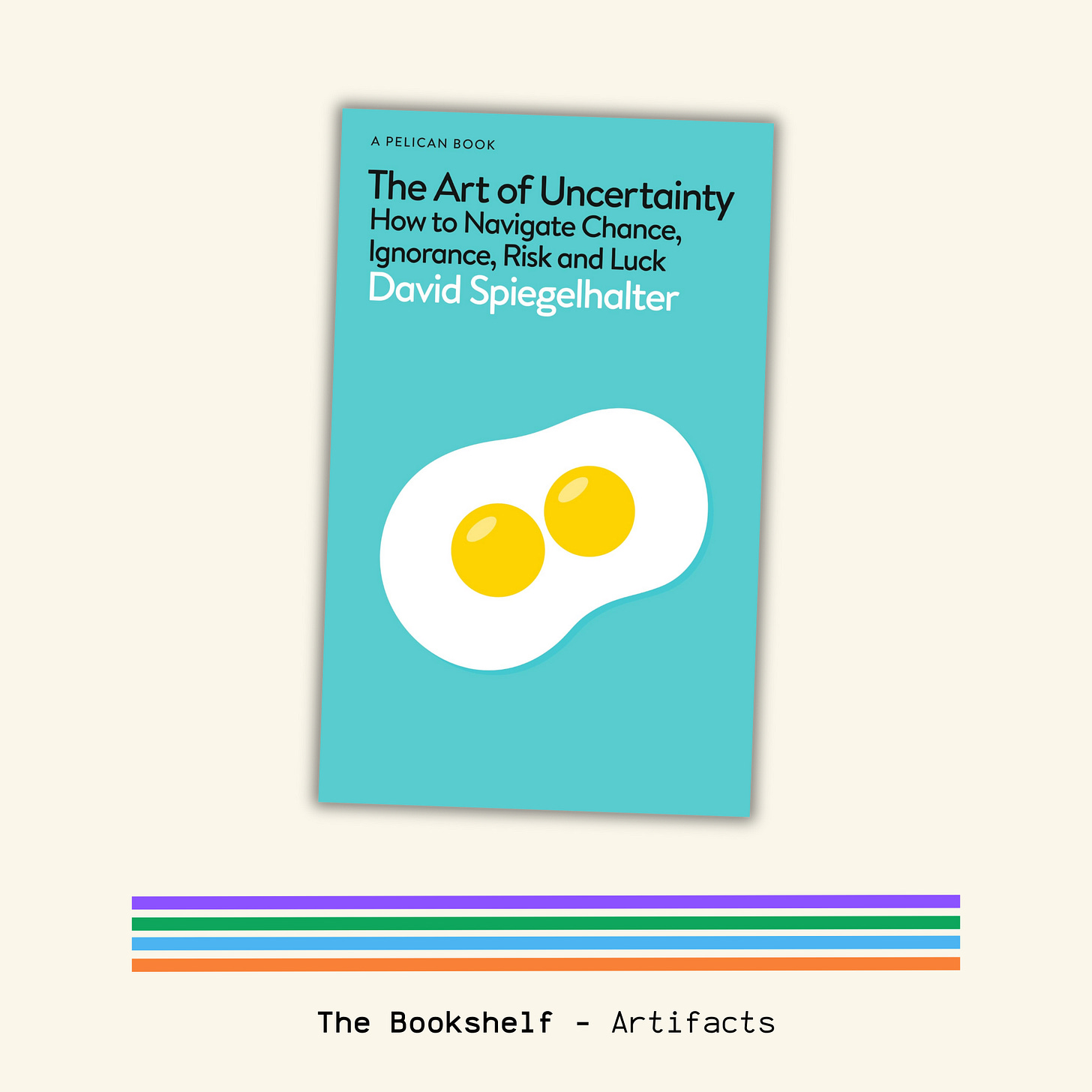](https://substackcdn.com/image/fetch/$s_!6HNL!,f_auto,q_auto:good,fl_progressive:steep/https%3A%2F%2Fsubstack-post-media.s3.amazonaws.com%2Fpublic%2Fimages%2F3d76f378-f85a-414e-a532-1ed81a29da6f_1890x1890.png)
So, this is not necessarily about tech. But ***“The Art of Uncertainty”*** by David Spiegelhalter a huge book on statistics, math, fate and how we perceive luck. To learn how to compute it and cope with, eventually, uncertainty.
📚 **All the books** I’ve read and recommended in Artifacts are [here.](https://airtable.com/appK7fMPX1DMkQYzL/shrRh8TgI7GtmgBxM)
> ### Nerding
[](https://substackcdn.com/image/fetch/$s_!qHYT!,f_auto,q_auto:good,fl_progressive:steep/https%3A%2F%2Fsubstack-post-media.s3.amazonaws.com%2Fpublic%2Fimages%2F93a77b01-7158-44dc-9801-13b4f284be9c_2025x2025.png)
Sure, simple enough. But let’s face it—everyone’s buzzing about it. **Deepseek**, the latest AI sensation out of China. They built it on a shoestring budget with a handful of GPUs, yet somehow, it’s delivering shockingly impressive results.
> ### ☕?
If you want to know more about Artifacts, where it all started, or **just want to connect...**
[Let's grab a virtual coffee ☕](https://calendar.google.com/calendar/u/0/appointments/schedules/AcZssZ2ibxlzyU7rgnuoTgqXb_DFc19dfHmJeu1OAu17IY0_oHrtcJtvtctAJnMabirgZNx5Z5NAPGs0)
======
# A gift from builders and makers
Date: 2024-12-27 | Language: en
Canonical: https://artifactstech.substack.com/p/a-gift-from-builders-and-makers
Cite as: A gift from builders and makers by Lorenzo Ancona, Artifacts, 2024-12-27. https://artifactstech.substack.com/p/a-gift-from-builders-and-makers (CC BY 4.0)
**Every day this year, I set out to read something interesting**—or at least remarkable—in pursuit of a simple goal: to stay curious and, hopefully, interesting.
Most of what I read had to do with technology, **but not always.**
**The common thread, I’d say, was people who built something.** An artifact, a process, a company, a government—you name it.
And every day, **I jotted down a sentence that resonated with me.**
I kept them all in a small Moleskine notebook I carried everywhere.
By now, that’s about 366 quotes.
I went back through them, picked a handful of favorites, **and turned them into a short digital book for all the subscribers of Artifacts.**
You can read it
[from here](https://heyzine.com/flip-book/658df28634.html)
Or you can download it
[by clicking here](https://drive.google.com/file/d/18I2blZIHEA0-qMDNq00YPP3FVgv27Ir0/view?usp=sharing)
------------------------------------------------------------------------
This is the cover:
[](https://substackcdn.com/image/fetch/$s_!QW02!,f_auto,q_auto:good,fl_progressive:steep/https%3A%2F%2Fsubstack-post-media.s3.amazonaws.com%2Fpublic%2Fimages%2F2db5c31d-969b-4dfe-acd9-1e5f506c8eb7_744x1054.png)
And here’s a sample page:
[](https://substackcdn.com/image/fetch/$s_!sQRf!,f_auto,q_auto:good,fl_progressive:steep/https%3A%2F%2Fsubstack-post-media.s3.amazonaws.com%2Fpublic%2Fimages%2Ff3b20c2f-837f-40d5-9e3a-b7a64aff661f_734x1042.png)
> ### Save for Later
*I assume you can have a lot of time during holidays :)*
[What to watch out](https://www.interface-eu.org/publications/interfaces-tech-observatory) for in the next EU Commission for tech?
Why the AI revolution is going to be [an interface revolution.](https://stratechery.com/2024/the-gen-ai-bridge-to-the-future/?access_token=eyJhbGciOiJSUzI1NiIsImtpZCI6InN0cmF0ZWNoZXJ5LnBhc3Nwb3J0Lm9ubGluZSIsInR5cCI6IkpXVCJ9.eyJhdWQiOiJzdHJhdGVjaGVyeS5wYXNzcG9ydC5vbmxpbmUiLCJhenAiOiJIS0xjUzREd1Nod1AyWURLYmZQV00xIiwiZW50Ijp7InVyaSI6WyJodHRwczovL3N0cmF0ZWNoZXJ5LmNvbS8yMDI0L3RoZS1nZW4tYWktYnJpZGdlLXRvLXRoZS1mdXR1cmUvIl19LCJleHAiOjE3MzU3NDU1MjAsImlhdCI6MTczMzE1MzUyMCwiaXNzIjoiaHR0cHM6Ly9hcGkucGFzc3BvcnQub25saW5lL29hdXRoIiwic2NvcGUiOiJmZWVkOnJlYWQgYXJ0aWNsZTpyZWFkIGFzc2V0OnJlYWQgY2F0ZWdvcnk6cmVhZCBlbnRpdGxlbWVudHMiLCJzdWIiOiJEVTNZUWRQUndHejhHUlhKOXhrVzR3IiwidXNlIjoiYWNjZXNzIn0.NmlVnzkG5C4aeDn-uVNDVN6SMbGuh9iJFp11b5zHTmV95b35QBQ1O4okBe1S16pJhsH-G72Ngq7ST2G9dBOzXHx0y1MEWk1Wdg7C572is4mg0KU-6oAJRZ7iaDh8p6eAJyKCzmkeGZMtESkKRYq_vevYg4mP7cUY1byZRBlXAJ45BnM4CfzlLaQ08Is9yw9qK4a1Y4u8Ovrou7k0Qo0wVqjc_hL2TvrA01pkZtqTveQyw1OJu7fr4an8ZHeNOuyEkV7PrVDfFwf2jbK9GAzyOqYfusNQMmR9Nay689VEdutVhUQMwuPSL26MeY1PT3GCMTDFCHSF-f7LUse_7w_HGg) And why [disinformation threat](https://www.aisnakeoil.com/p/we-looked-at-78-election-deepfakes?publication_id=1008003&post_id=153082429&isFreemail=true&r=2d3svm&triedRedirect=true) is not as big as we may think.
What [Tim Cook](https://www.wired.com/story/big-interview-tim-cook-wants-apple-to-literally-save-your-life/) is cooking for us all.
How Bluesky is…skyrocketing, [in the words of their CEO](https://www.wired.com/story/big-interview-jay-graber-bluesky-2024/).
We’re running [out of data.](https://www.theverge.com/2024/12/13/24320811/what-ilya-sutskever-sees-openai-model-data-training) And how to advance [data agency & its infrastructure](https://www.projectliberty.io/news/advancing-data-agency/).
Why [something very very technical](https://cdn.sanity.io/files/d8lrla4f/staging/1007ade8eb2f028f64631d23430ee834dac17f8e.pdf/Middleware) between us and social media can make things better. For feeds and content moderation.
Why Substack (yes, the tool I use for this newsletter) is [so bad for publishers](http://Death%20by%20a%20thousand%20substacks).
What packing for holidays [reveals about us](https://www.newyorker.com/culture/open-questions/why-cant-you-pack-a-bag).
🟢 Join the **[Artifacts Community on WhatsApp](https://whatsapp.com/channel/0029Val57bZ4Y9lnnOssMQ2K)** [](https://whatsapp.com/channel/0029Val57bZ4Y9lnnOssMQ2K) to get other Save for Later content!
> ### ☕?
If you want to know more about Artifacts, where it all started, discuss sentences you read, or just want to connect...
[Let's grab a virtual coffee ☕](https://calendar.google.com/calendar/u/0/appointments/schedules/AcZssZ2ibxlzyU7rgnuoTgqXb_DFc19dfHmJeu1OAu17IY0_oHrtcJtvtctAJnMabirgZNx5Z5NAPGs0)
======
# Pulling linchpins
Date: 2024-12-03 | Language: en
Canonical: https://artifactstech.substack.com/p/pulling-linchpins
Cite as: Pulling linchpins by Lorenzo Ancona, Artifacts, 2024-12-03. https://artifactstech.substack.com/p/pulling-linchpins (CC BY 4.0)
“Google is a monopolist, and it has acted as one to maintain its monopoly\[…\]in general search services and search text advertising through a web of anticompetitive practices” declared Judge Mehta last August.
Some stats for perspective:
- 9 out of 10 online searches are conducted via Google.
- Nearly 2 out of 3 internet users browse with Google Chrome.
It’s no wonder that “Googling” has become shorthand for browsing the web.
But the U.S. Department of Justice (DOJ) seems ready to rewrite the thesaurus. They’ve proposed a series of remedies aimed at dismantling what they describe as Google’s monopoly on digital search and advertising.
------------------------------------------------------------------------
The DOJ’s wishlist of reforms is as ambitious as it is disruptive.
At the top of the docket is a headline-grabber: Google should sell Chrome, its flagship browser. The idea is simple—stop letting Google use its interconnected web of services to steer users deeper into its ecosystem.
But that’s not all. Google may also be expected to:
- Share its treasure trove of user data with competitors, giving other search engines a shot at closing the quality gap.
- Cease exclusive deals that keep Google Search preloaded on Apple devices and others.
- Halt its acquisitions spree, which has often swallowed up competition before it can bloom.
- Give advertisers more transparency and control over their campaigns.
- And, in a nuclear scenario, sell Android if the softer measures don’t stick.
 If you wish to read the summary, here the version highlighted by Artifacts
Once again (thinking of Microsoft in the 90s), competition policy is stepping in to fix (and try to break) entrenched structures. The aim? Forcing users and companies to imagine an Internet that is just different from the one we’re accustomed to.
------------------------------------------------------------------------
Now, a looooot has been written and said on these solutions in the past weeks, especially on selling Chrome.
And many are the skepticals, pointing to several reasons: users would still gravitate back to Google even if it weren’t the default, that selling Chrome might just transfer monopoly power to its new owner, and that banning exclusive deals could threaten the survival of smaller browsers like Mozilla. The list goes on.
Yet, this Artifacts isn’t the space to weigh the pros and cons of those solutions.
Instead, we take a step back to ask bigger questions. Where are these ideas coming from? What do they reveal about the juggernaut Google has built? And most importantly, what do they hint at for the future of search and the internet at large?
> ### The Story
Why Chrome? Because it’s more than a browser. It’s the linchpin, the gateway, the cornerstone, and the top of the funnel of the Google universe.
Open Chrome, and the gravitational pull begins. It nudges you to log in to your Google account (you don’t have to, but come on, you will), funnels you to Google Search, and then whisks you into Gmail, Docs, Maps, and beyond.
Chrome isn’t just software; it’s the operating system of your Google account. Sorry product managers :)
And, therefore, the problem is not Google Chrome itself, but what it represents and enables.
And that’s precisely why breaking up Chrome from Google, the DOJ argues, would shatter this synergy. A Chrome under new ownership wouldn’t have the same incentives to tie itself to Google’s broader services.
 A linchpin, meticulously crafted by DALL-E
But Chrome is not the only linchpin of this alleged monopoly. There is something more, maybe less tangible and identifiable, that has been fuelling this monopoly: data
 Google’s dominance is powered by two self-reinforcing feedback loops, straight out of Shoshana Zuboff’s Surveillance Capitalism:
1. User cycle (bottom): Google collects data to improve Search. Better Search attracts more users, who generate even more data, which further improves Search. Rinse, repeat.
2. Advertiser cycle (up): More users generate better targeting data, making Google the holy grail for advertisers. More ad dollars mean more resources for better services, which draw in yet more users.
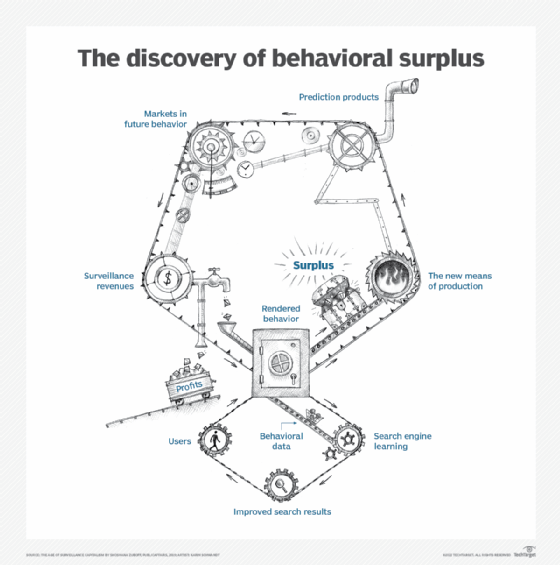 The DOJ’s remedies aim squarely at the first cycle, the one below.
By forcing Google to share its data hoard with rivals, the hope is that alternative engines—think Bing or DuckDuckGo—won’t lag behind due to Google’s outsized head start.
Instead of playing catch-up on raw search quality, they could focus on differentiators like privacy or user experience. Concretely, they could focus on building features of a search engine instead of a search engine from scratch.
In theory, it’s a chance for competitors to finally get a foot in the door.
Since data at scale is the essential raw material for “building, improving and sustaining” a competitive general search engine, the DOJ now aims to force Google to make this data available and at disposal of other engines.
------------------------------------------------------------------------
Ultimately, the DOJ’s goal is plain: crack open the search market—or, if you’re feeling cynical, break up Google and cross your fingers that a fairer ecosystem emerges from the rubble.
But fairer for whom? At first glance, the answer seems obvious: competitors like Bing, DuckDuckGo, and other underdog search engines. Yet, as is often the case, the reality is more nuanced.
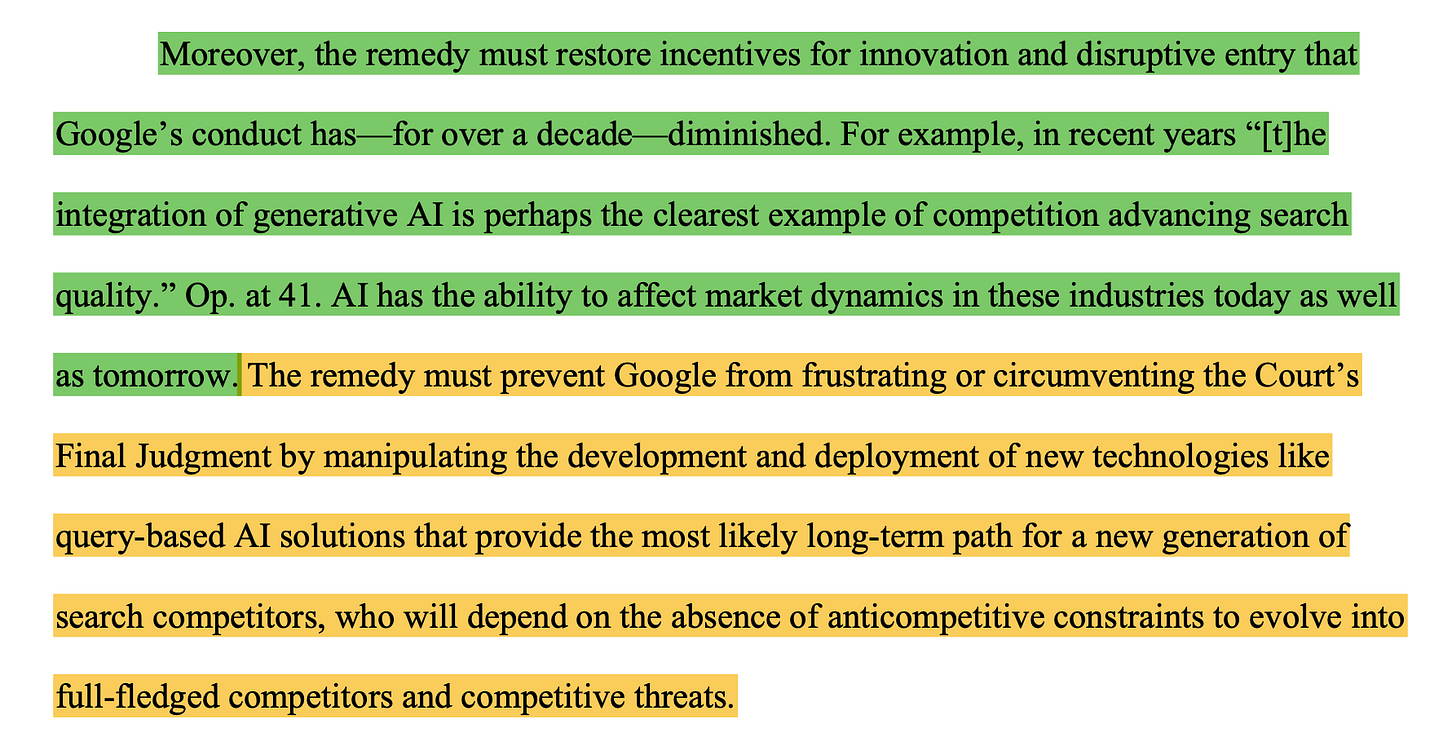 Nice read, btw!
Interestingly, the DOJ’s proposals look beyond traditional search engines. The plaintiffs have pointed to “query-based AI solutions” as the next big thing.
As seen earlier, ChatGPT with a Search plugin, Perplexity, Arc—these conversational, AI-powered tools could represent the future of how we search online.
If search is shifting from ten blue links to AI-driven dialogues, then the remedies need to make room for that transformation.
The goal is not just to dethrone Google, but to foster innovation and ensure the search landscape evolves.
------------------------------------------------------------------------
Of course, this is all a big “if.” The DOJ’s proposals are just that—proposals. The final ruling isn’t expected until next summer, and Google will appeal any decision it doesn’t like.
Regardless of the outcome, the DOJ’s case is a rare glimpse into the mechanics of Google’s dominance and, indirectly, how it managed to get that big.
For now, one thing is certain: “Googling” isn’t fading away anytime soon. But its grip on the internet? That’s about to face its toughest test yet.
Leave a comment
> ### Save for Later
How is Europe doing on tech? A few numbers and a lot of charts from a VC
Why we could’t vote online. And what Big Tech CEOs want from a second Trump presidency. Oh, Russia blatantly interfered with the US elections.
Teaching with ChatGPT, straight from OpenAI. And how ChatGPT made the US elections a bit better!
What an AI-curated web may look like, by Perplexity. Which is also rolling out ads in its tool.
Why disinformation is a thing coming from the many.
What does it mean to moderate the online space? Moderators spoke up.
A rundown of the 100 iconic technologies from Hard For. Must listen!
\[Hard Fork's 100 Most Iconic Technologies\]
🟢 Join the Artifacts Community on WhatsApp to get other Save for Later content!
> ### Someone said this before
“If the only tool you have is a hammer, it is tempting to treat everything as if it were a nail.” - Abraham Maslow
 > ### The Bookshelf
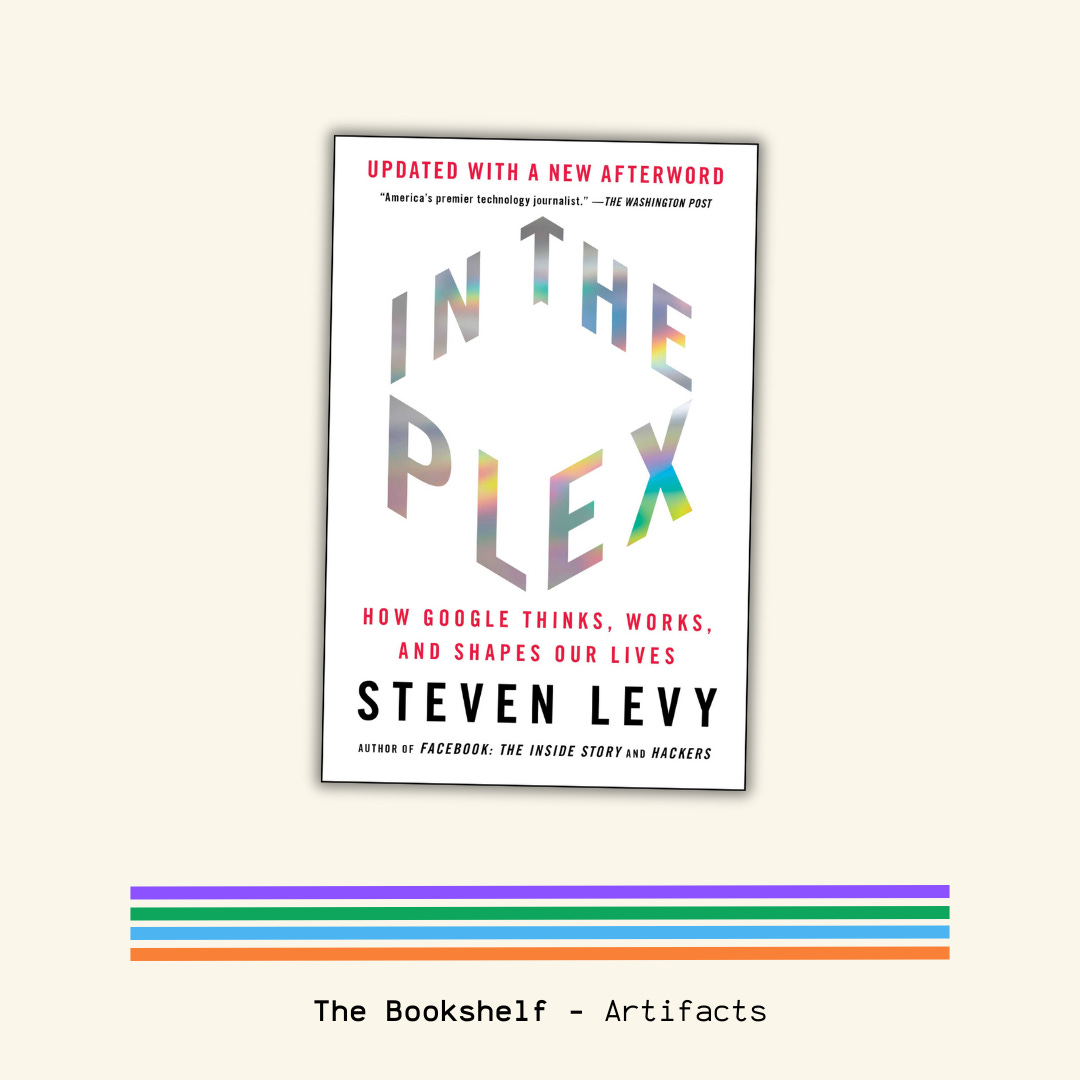 For a deeper dive into the inner workings of Google, Steven Levy’s In The Plex is an essential read. Written a few years back, it offers a sharp and detailed look at how Big G thinks and operates. Levy, with his knack for storytelling and tech insight, is the perfect guide to unravel this tale.
📚 All the books I’ve read and recommended in Artifacts are here.
> ### Nerding
 If you’re into tech, you’ve probably heard of DuckDuckGo — the privacy-focused browser that’s been taking on Chrome over the past few years. If safeguarding your personal data matters to you (and you’re curious about what search results look like without tracking), it’s worth giving it a shot.
> ### ☕?
If you want to know more about Artifacts, where it all started, or just want to connect...
Let's grab a virtual coffee ☕
======
# Talking to the Internet
Date: 2024-11-03 | Language: en
Canonical: https://artifactstech.substack.com/p/talking-to-the-internet
Cite as: Talking to the Internet by Lorenzo Ancona, Artifacts, 2024-11-03. https://artifactstech.substack.com/p/talking-to-the-internet (CC BY 4.0)
Halloween this year, **OpenAI played a trick.**
No flashy new model, no major tools or apps. Instead, they slipped in a small but seismic shift: ***SearchGPT***, [an internet browsing feature in ChatGPT.](https://openai.com/index/searchgpt-prototype/)
Sure, they had something similar before, but let’s face it—**it was clunky, often unreliable, and sources were murky at best.**
Now? It's something else. Smooth and seamless, like this:
[](https://substackcdn.com/image/fetch/$s_!fYN7!,f_auto,q_auto:good,fl_progressive:steep/https%3A%2F%2Fsubstack-post-media.s3.amazonaws.com%2Fpublic%2Fimages%2F50821141-e7ec-40de-b5f4-d05c2b247f29_600x338.gif)
It’s easy to dismiss as OpenAI just catching up to Google’s Gemini or Perplexity. **But there’s something deeper here.**
This isn’t just an upgrade; **it’s a marker of where AI and search are heading.**
AI-driven search isn’t a *nice-to-have* feature.
**It's an epistemological change.**
And it's not a stretch. Just take a look down here:
[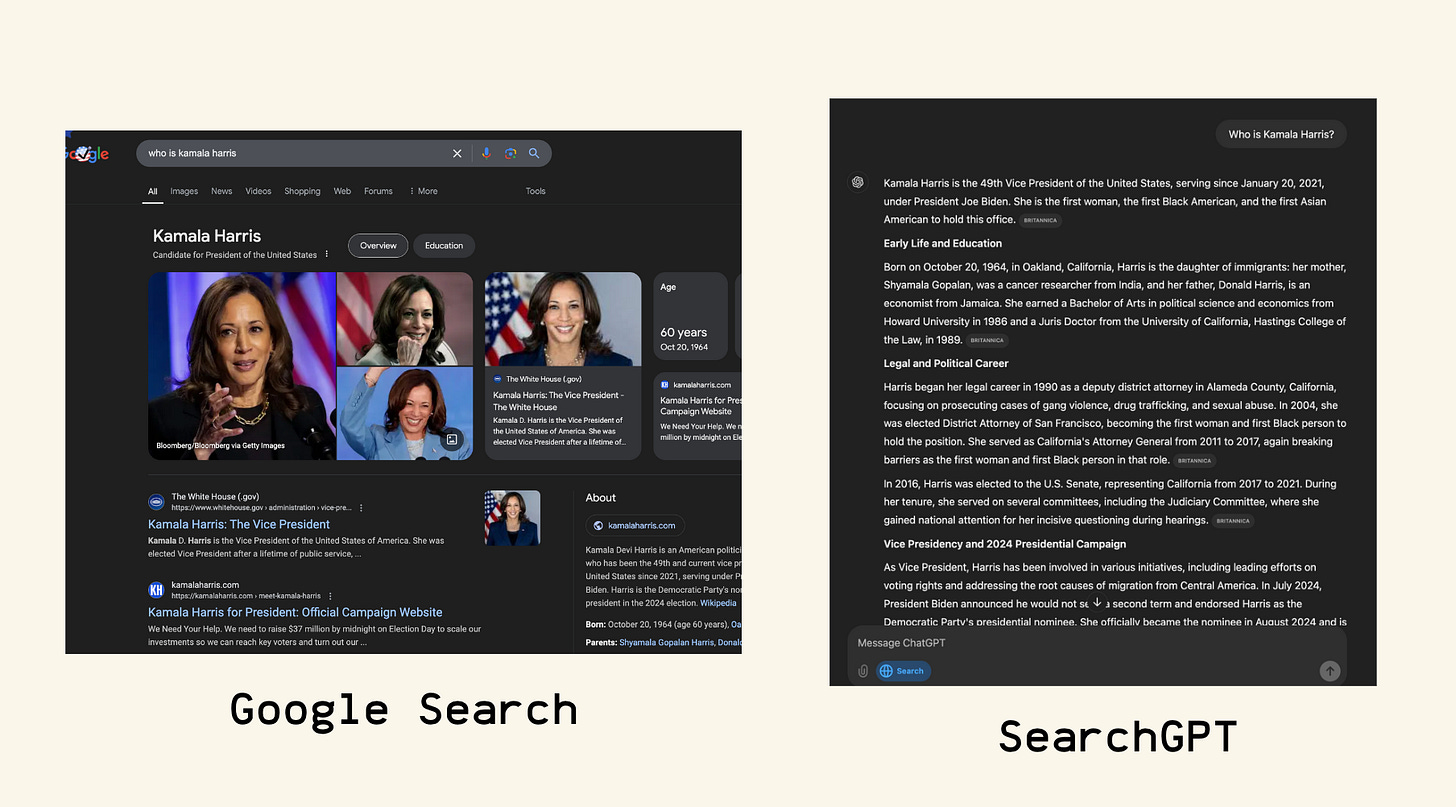](https://substackcdn.com/image/fetch/$s_!n5G5!,f_auto,q_auto:good,fl_progressive:steep/https%3A%2F%2Fsubstack-post-media.s3.amazonaws.com%2Fpublic%2Fimages%2F486bb2ff-8965-4e94-b395-1a7df5b34fbe_1808x1002.png)
Searching the Internet like this is just **easier, smoother, and quicker.**
The old dance was simple: search, click, read, repeat. **Now we cut right to the answer.** No more scanning lists of links or opening a dozen tabs.
**Now, we ask; it answers.**
But there's more to it. **Instead of hyperlinks, we’re served sentences.** Instead of fragmented pages, we get a full conversation.
And instead of keywords, we use questions, **as if we’re** ***talking*** **to the web.**
------------------------------------------------------------------------
**Everything is getting more and more conversational.**
Until now, we stretched our language to adapt to machines—those stripped-down, choppy search terms we fed Google. But now, **the flow is reversed.**
**The language of AI search is becoming our natural language.** We’re seeing the first glimmers of a future we’ve only dreamed about: ***talking*** **to the Internet, like we might talk to a friend.**
It’s a leap toward something that could be **AI’s killer feature**, something actually *useful*—not just another machine churning out empty paragraphs for LinkedIn posts.
*But here’s the thing:* even if the pieces are falling into place, **we’re still a long way from the future of search we imagine.** The potential is huge, but there’s work to be done to make it a reality.
Why that is—and what might be required to steer the future of search—are the questions this edition of *Artifacts* aims to answer.
> ### The Story
**People are not using AI for Search.** Data are clear:
[](https://substackcdn.com/image/fetch/$s_!329f!,f_auto,q_auto:good,fl_progressive:steep/https%3A%2F%2Fsubstack-post-media.s3.amazonaws.com%2Fpublic%2Fimages%2F28543eef-de45-45dd-9b25-872bc9a04cac_2012x1414.jpeg)
**Critical masses are still anchored to Google**, and unseating a habit that ingrained won’t happen overnight.
This is why it matters when big players like ChatGPT enter the scene, bolstering the ranks of AI search challengers.
Even so, **it’s just a drop in the ocean**.
**As with any technology, adoption is key.** But widespread adoption is a steep hill to climb.
[](https://x.com/joshm/status/1852064574607880253)
Arc and Perplexity’s CEOs know this story of adoption well
*Bottom line?* **As long as Google remains the default on most browsers, it will continue to wall off the search market from outside innovation.**
Or, at least, this would be the case as long as they don’t decide to go full steam on AI Search (as they're trying to do with AI Overviews) and being those ushering in the revolution.
But here’s the kicker: **for the time being, other contenders—OpenAI, Perplexity, and the like—aren’t making it to users’ devices**, and the reasons aren’t exactly fair.
(And that's why they are pushing own plug-ins and calling for for a new era.)
------------------------------------------------------------------------
The reality is, piecemeal solutions won’t be enough. **Structural remedies are needed to give AI search a real shot.**
Enter competition policy—the **Digital Markets Act in the EU**, for instance, aims to make search engine choice more transparent to citizens, though writing the rule is far easier than enforcing it.
Or consider the **Google antitrust case in the U.S.**, where the potential breakup of services could crack open the walls around search.
These structural moves, intended to curb Google’s dominance, might, ironically and unexpectedly, **create room for AI search to gain traction with the general public.**
------------------------------------------------------------------------
But here’s a caution: **adoption is only part of the puzzle.**
Underlying this shift are **economic incentives and dynamics** that are causing headaches for everyone involved.
In a snippet: **AI Search could upend the economic model of online search.**
If AI tools like Perplexity and ChatGPT answer questions directly, users won’t visit websites as they used to, **disrupting the entire advertising-based ecosystem that search engines and content creators rely on.**
The equation is simple: **if users stop visiting websites, ad revenues plummet.** Google and other ad players lose a primary revenue stream, and media outlets—already under pressure—face further erosion of their advertising income.
So, what? **The advertising model may soon be outdated and a new one is yet to come.**
**The tension is especially fraught for media.** Many are wary of having their content scraped and repurposed without compensation, especially as AI models depend heavily on existing online material.
Some publishers are striking deals with AI providers, agreeing to license their content in exchange for a cut of the benefits. Others, like the *New York Times*, are taking a harder line, suing providers for “stealing” content.
But here’s the irony: media do not just need to defend from a "steal" but **they may hold the stronger hand.**
AI providers depend on high-quality content to generate useful responses. Without access to reputable sources, AI search tools are just glorified aggregators.
**That’s why media outlets have leverage to negotiate—AI providers desperately** ***need*** **their content.**
Yet, what these agreements may entail and the shape they'll take is still unclear.
[](https://substackcdn.com/image/fetch/$s_!NVae!,f_auto,q_auto:good,fl_progressive:steep/https%3A%2F%2Fsubstack-post-media.s3.amazonaws.com%2Fpublic%2Fimages%2F4f44359c-35ea-4960-98f7-fb6191cda01a_1024x1024.webp)
Finally, the rise of AI search **is a foundational change in both knowledge and business.**
There are still many moving parts, **and it will take time for them to settle.**
But as the landscape of search, knowledge, and business continues to shift, **it’s a puzzle worth watching**—and worth searching for solutions to solve.
[Leave a comment](https://artifactstech.substack.com/p/talking-to-the-internet/comments)
> ### Save for Later
We need clarity on [deals between media and AI companies.](https://reutersinstitute.politics.ox.ac.uk/news/we-need-clarity-about-deals-between-ai-companies-and-news-publishers-heres-why)
[Machines of Loving Grace](https://darioamodei.com/machines-of-loving-grace) among us? A nice essay
[Micro things](https://danilafe.com/blog/blog_microfeatures/) that would tickle your fancy around blogs on the web.
Europe may be the new Silicon Valley? [A rundown of European start-ups](https://www.wired.com/story/europe-is-the-new-palo-alto/?bxid=5f43a3c889a7356e7e1b2114&cndid=61968307&hasha=dca445e23e26114858a48ad35040e287&hashb=45d93d44fcff3a5e49699dfab0ce778cb996ddcb&hashc=2107626209cd615da922d357ec59a2f4a769eeec7e75a95e874cf17f98f1a7c1&esrc=MARTECH_ORDERFORM), in different cities
Perplexity has dropped [some super cool merch](https://perplexity.supply/shop/where-knowledge-begins-sweatshirt#img-6). *Branding!* But also a super cool way to [follow the US Elections.](https://www.perplexity.ai/elections/2024-11-05/us/president)
[](https://substackcdn.com/image/fetch/$s_!FdIM!,f_auto,q_auto:good,fl_progressive:steep/https%3A%2F%2Fsubstack-post-media.s3.amazonaws.com%2Fpublic%2Fimages%2Ffa4f3205-c656-4421-b711-692bea8c3d09_1334x1380.png)
***What the hell is Founder Mode?*** In the words of its founder, with much more on running a start-up and tech culture:
[\[Airbnb CEO Brian Chesky on what founder mode really means\]](https://open.spotify.com/episode/0MkmHyHFYw7tKSQSJZA3Pw)
> ### The Bookshelf
[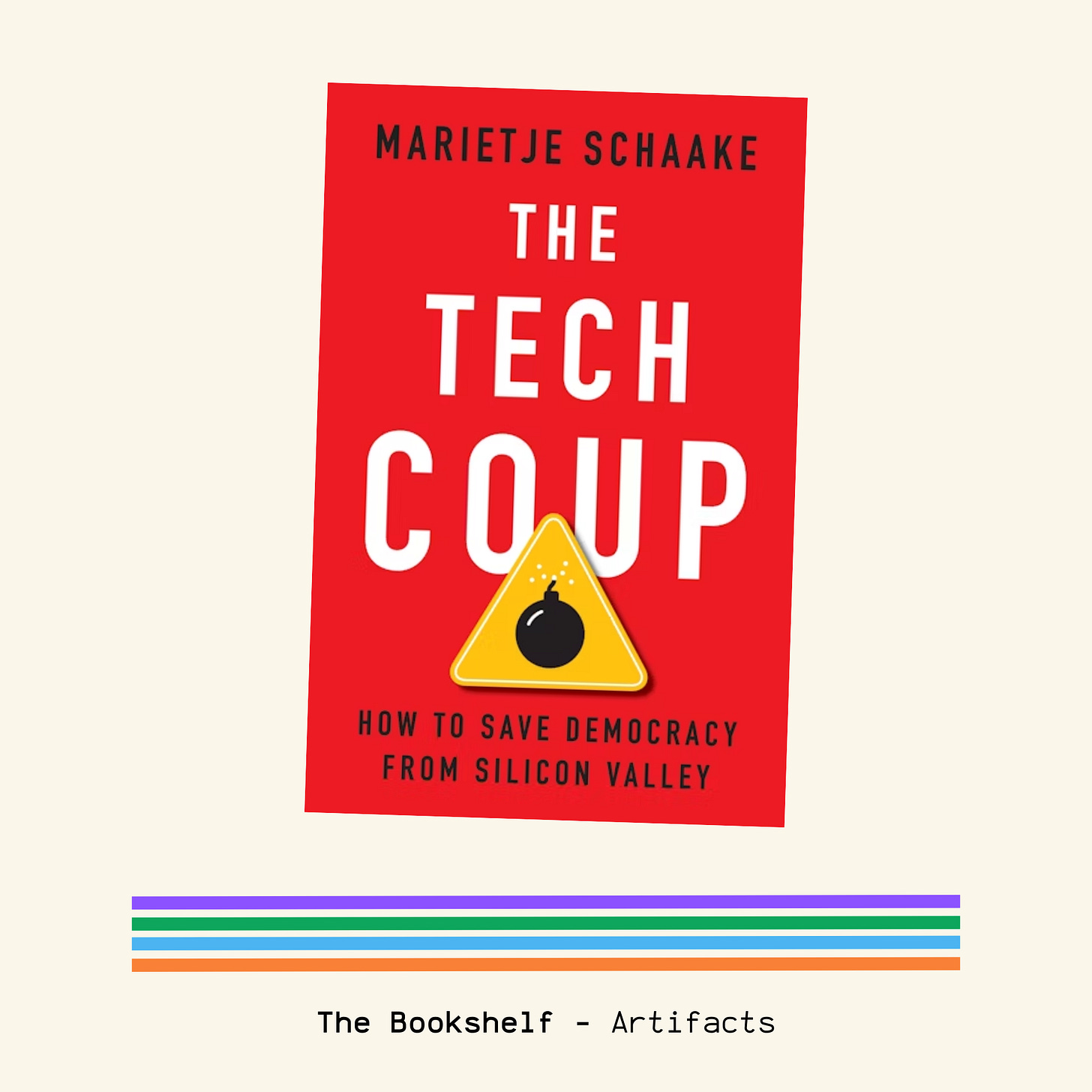](https://substackcdn.com/image/fetch/$s_!69dN!,f_auto,q_auto:good,fl_progressive:steep/https%3A%2F%2Fsubstack-post-media.s3.amazonaws.com%2Fpublic%2Fimages%2F55b564b2-9bab-44c3-9597-35076e972710_1890x1890.png)
For a sharp take on breaking up Big Tech, opening opportunities, and fostering innovation, read ***“The Tech Coup”*** by Marietje Schaake. A former MEP with deep experience in digital policy and research (at Stanford, no less!), Schaake brings a nuanced perspective to the table.
📚 All the books I’ve read and recommended in Artifacts are [here.](https://airtable.com/appK7fMPX1DMkQYzL/shrRh8TgI7GtmgBxM)
> ### Someone said this before
*“Technology should be the synonym of change” -* the guy above from Airbnb
> ### Nerding
[](https://substackcdn.com/image/fetch/$s_!SPOh!,f_auto,q_auto:good,fl_progressive:steep/https%3A%2F%2Fsubstack-post-media.s3.amazonaws.com%2Fpublic%2Fimages%2F62ffd116-5e8c-4910-9237-77602928a227_2160x2160.png)
Literally, a [brick](https://getbrick.app/shop), a physical one. **Designed to limit your phone usage with something tangible.** Maybe a bit expensive, but would be curious to try it out.
======
# As we speak
Date: 2024-10-08 | Language: en
Canonical: https://artifactstech.substack.com/p/as-we-speak
Cite as: As we speak by Lorenzo Ancona, Artifacts, 2024-10-08. https://artifactstech.substack.com/p/as-we-speak (CC BY 4.0)
\[To read this in 🇮🇹\]
Take a minute (or two, or however long you want) to listen in—just click below or here. (I swear the newsletter will be shorter)
0:00-12:54
\[Embedded media — view original\]
It’s just a lady and a gentleman chatting about EU politics and party manifestos. They’re also big fan of Artifacts - lovely!
Except, here’s the kicker: these two don’t exist. The entire podcast? Completely AI-generated. And it took me less than three minutes to make it, for free.
All I did was drag and drop a guide I wrote about the upcoming EU elections, and voilà—the AI did the rest.
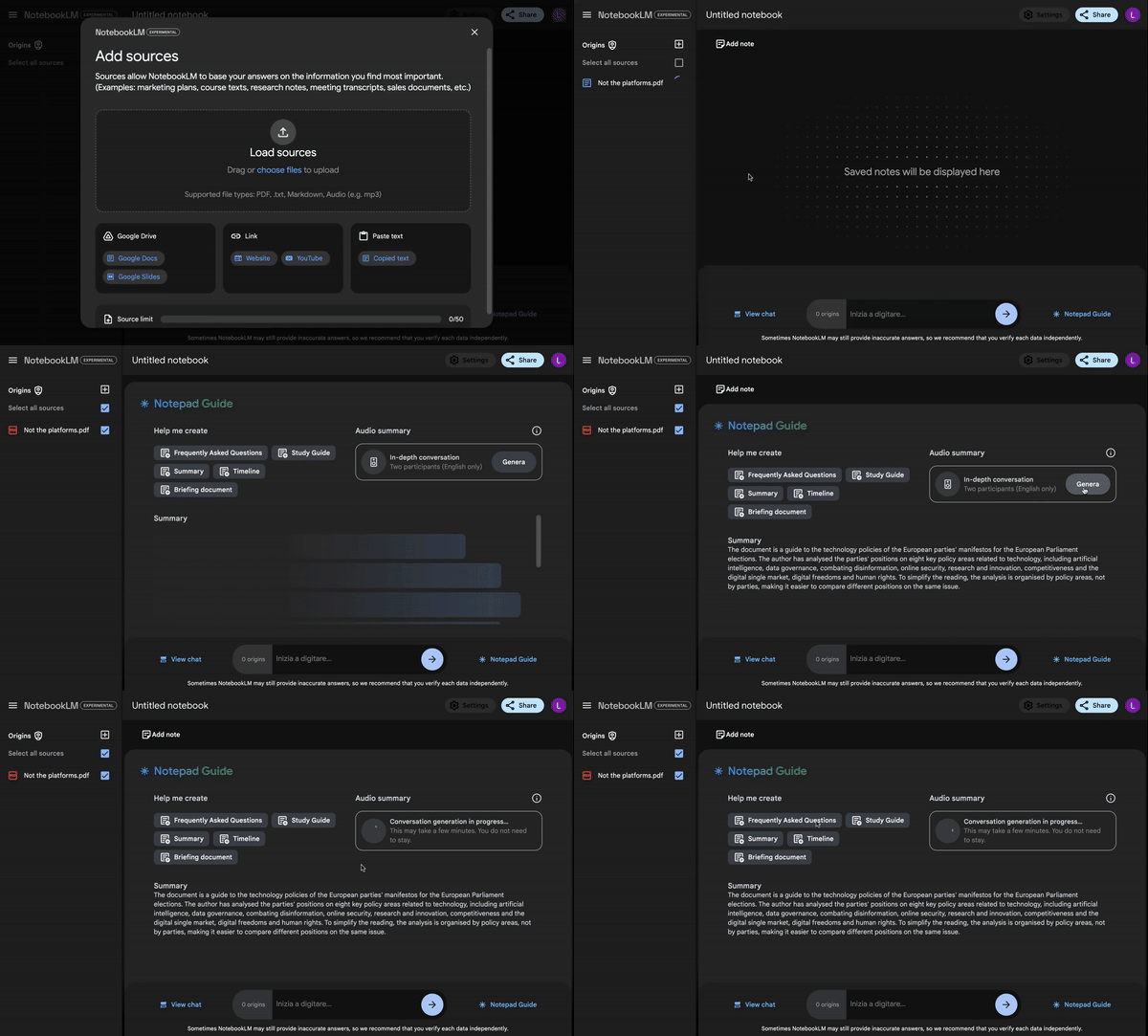 As simple as that
Now, what you hear are two eerily smooth voices having a conversation. They sound human, even throwing in a few attitude shifts depending on the topic.
As someone who actually wrote the guide, I can confirm they’re hitting all the right points. Sure, they get a bit superficial at times and lean a little too heavily on certain sections, but still—it’s shockingly accurate.
Yet, what strikes me is that this AI made my dry-as-dust EU election guide sound almost… fun.
And it didn’t require a single line of code, no complicated instructions, no need for tech or AI expertise. Just drop your content in, and bam, you’ve got a podcast.
------------------------------------------------------------------------
This is Google’s NotebookLM, the latest shiny AI toy from Big G to engage with any type of content and, as they claim, “go from information to insights”.
You upload your material, and it’ll spit out summaries, key points, outlines—basically anything that would’ve taken a student or intern hours.
Give it a whirl.
I remember the first time I used ChatGPT—that “wow” moment when I realized, okay, this is something. I’ve had similar moments with other AI tools over the years, and NotebookLM gave me that same feeling.
But here’s the thing: this isn’t just a “wow” moment. It’s a chance to take a step back and think about Gen AI and the hype, AI-generated content, and what it means for the future of information. And who (or what) is actually intelligent in all this?
That’s Artifacts for today—just a bit more aware that my future competition might be synthetic :)
> ### The Story
To make matters more ironic, the elections guide I uploaded was also partially AI-generated (or at least co-created) with Claude, as I mentioned back in June.
So, one AI helped draft the report, and another turned it into a podcast.
Does this mean machines are getting smarter? Well, not exactly.
One key takeaway here is that there’s no real intelligence at play. Rather, intelligence is in what we perceive and in our understanding, but not in the machines.
Let me break it down. Tools like ChatGPT, NotebookLM, and others don’t possess intelligence in the traditional sense. They rely on statistics and computation to process input and produce output.
But they don’t understand the content and what they’re processing, nor do they attach any meaning or emotion to it.
As Floridi brilliantly puts it, AI is “agency without intelligence”. In other terms, it’s something performing actions that would require intelligence (doing a podcast) without any actual intelligence to do so.
------------------------------------------------------------------------
So, where is the intelligence? It’s in our perception of the text, audio, or images produced as the final output. We associate intelligence with this because, traditionally, these kinds of outcomes have required human intellect. But that’s not what’s happening in the process itself.
 Now, someone might ask, “So what? Isn’t the output what really matters?” Well, that’s debatable. Think of any work of art or human creation—we value not just the finished piece, but also the process, the intention, the creativity behind it.
The painter at work is just as important as the final painting.
This isn’t to dismiss AI, which clearly generates impressive outputs. But it’s key to remember that “What algorithms \[and AI\] are reproducing is not the intelligence of people but the informativity of communication.”
Again, AI excels at creating content bearing information value, like the podcast you heard. But it’s an artificial form of communication rather than intelligence.
We need to be mindful of this distinction so we don’t overstate what these tools are really doing.
------------------------------------------------------------------------
Still, even though the processes lack intelligence, the results are increasingly indistinguishable from what humans can produce. And that’s something we have to sit with.
This shift, in my view, has two major implications:
1. Mediocrity is at stake. AI-generated content can match the quality of low to mid-tier content, and it’s faster and cheaper to produce. But if mediocrity becomes unacceptable, how will one push the boundaries to grow toward excellence? It’s an open question.
2. We’re facing a flood of content. Social media already boosted content creation and sharing. GenAI is about to supercharge that—making it easier, quicker, and more accessible for anyone to generate and share on-demand content.
This will create a synthetic internet, where more and more content is machine-generated, yet strikingly similar to what humans used to make.
As discouraging or even threatening as this might seem to those passionate about content creation, I still believe that human processes—intelligence, passion, and creativity—will remain valuable.
Even if, at first glance, mediocre content from a human and a machine will look almost indistinguishable. And this is already playing out, as we speak.
Leave a comment
> ### Save for Later
Schools are being flooded with AI bad content as well. And no, it’s not just bullshit papers.
OpenAI is, in the end, another tech company.
Elon Musk being, well, Elon Musk. Five days of that might be enough.
The Internet is dying because of AI? Or maybe social media will get better with no humans.
Why do we need some uncertainty?
\[Certainly uncertain: navigating risk and probability with Sir David Spiegelhalter\]
What would the Federalist Papers say if they were written in the 21st Century?
What are we really doing when we build things? This one’s bound to land on your favourites list.
\[Embedded media — view original\]
> ### The Bookshelf
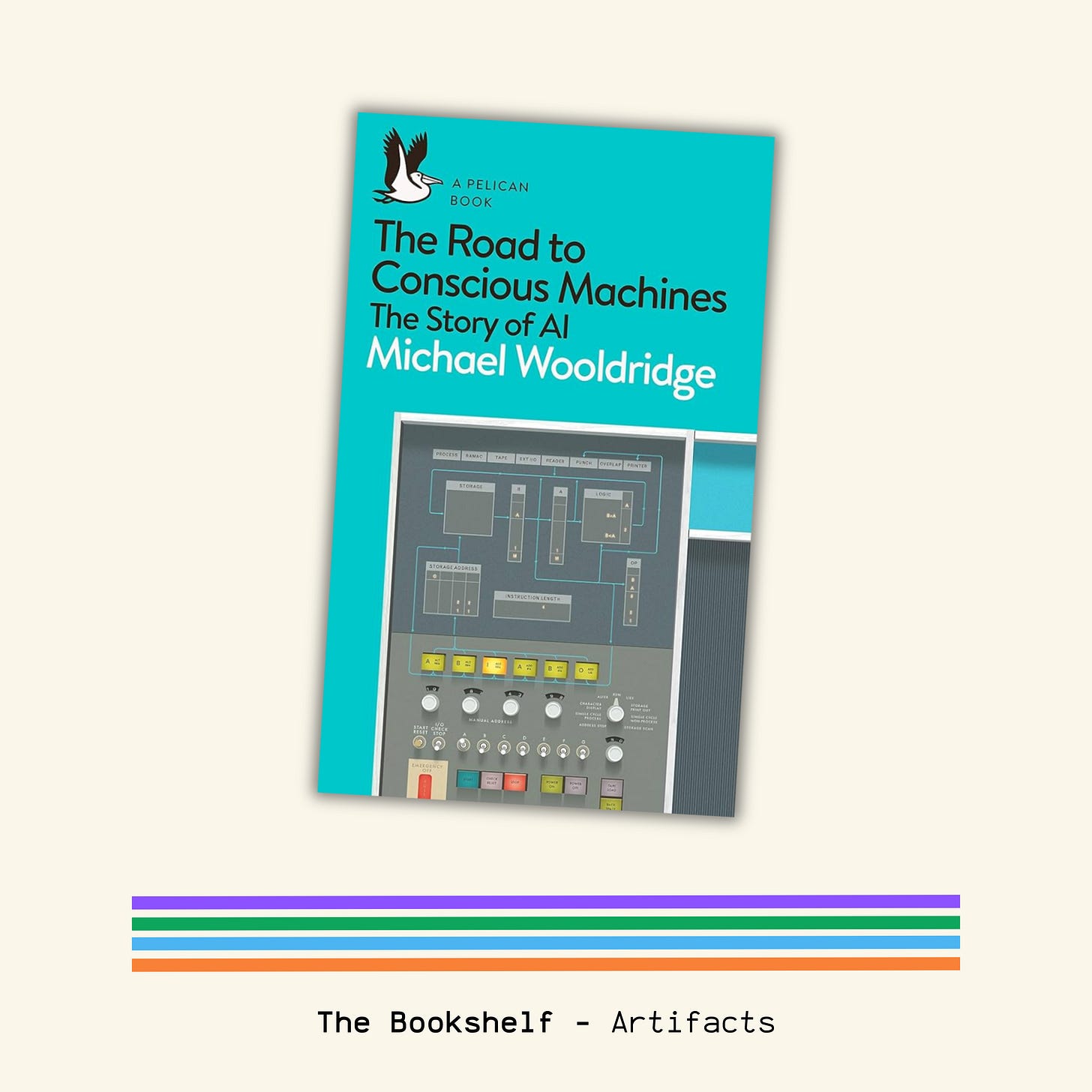 A super technical deep dive into how the whole AI story has unfolded—but surprisingly enjoyable to read! Despite all the intricate details, it’s packed with valuable insights and keeps you hooked the whole way through.
📚 All the books I’ve read and recommended in Artifacts are collected here.
> ### Someone said this before
“Simplicity is complexity solved” - the nerd guy I linked above :)
> ### Nerding
 Well, I’ve told you enough about NotebookLM. Give it a try and let me know whether it’s ‘wow’ or not!
> ### ☕?
If you want to know more about Artifacts, where it all started, or just want to connect...
Let's grab a virtual coffee ☕
======
# Who made the iPhone boring ?
Date: 2024-09-24 | Language: en
Canonical: https://artifactstech.substack.com/p/who-made-the-iphone-boring
Cite as: Who made the iPhone boring ? by Lorenzo Ancona, Artifacts, 2024-09-24. https://artifactstech.substack.com/p/who-made-the-iphone-boring (CC BY 4.0)
Last Friday, as I’ve done for years now, I found myself in the ritual of standing in line (not more than 10 mins) to see the new iPhone.
We’ve all heard the familiar refrain: Apple’s just recycling the same old stuff. And sure, there’s some truth to that. Innovation in phones has hit a plateau, which makes sense—it can’t always be fireworks.
Yet, when I finally got my hands on the new iPhone, I couldn’t shake the feeling that this one took an even smaller leap than usual. More like a skip, really.
Why? There’s a meme floating around online that cuts to the heart of it:
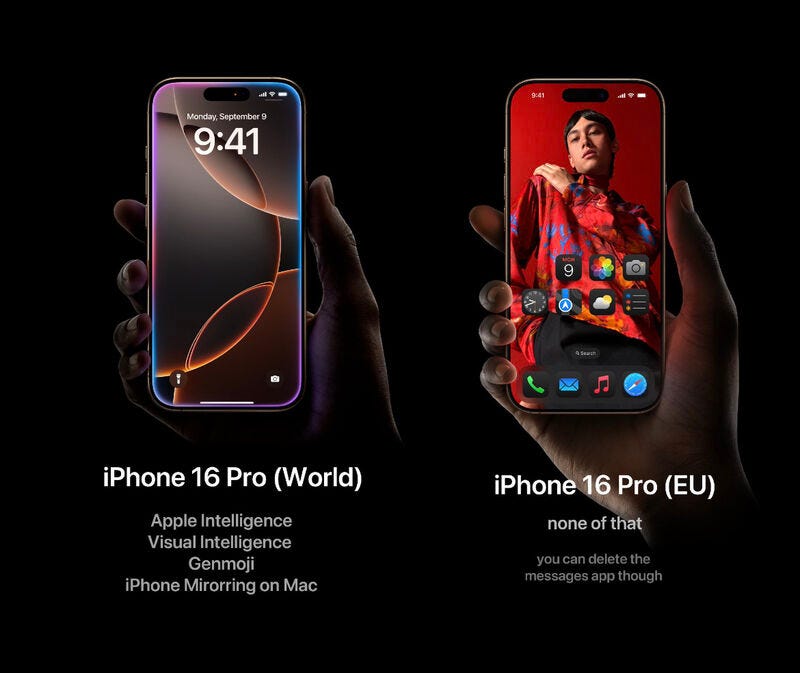 Apple’s will not roll out its AI—its so-called “Apple Intelligence” and not “Artificial”(!)—in the EU. The same AI supposed to be the big thing this year, with some nice features soon to be released worldwide.
It won’t be in the EU not because Brussels banned it someway, but due to Apple’s “regulatory concerns” tied to the Digital Markets Act (DMA), the EU’s grand effort to make digital markets more open and competitive.
In plainer terms? Apple’s being vague, to say the least. They’ve said that the “the interoperability requirements of the DMA could force us to compromise the integrity of our products in ways that risk user privacy and data security.” But they haven’t offered any concrete examples to back that up.
Artifacts managed to talk to a senior Apple employee, though the details were thin. The hint? The company might run into trouble because, right now, the list of external AI providers is short (basically just OpenAI), and it’s unclear if that will change anytime soon.
Therefore, as iPhone users won’t have much control over what AI providers to use, Apple would be stifling competition and users’ choice.
More precisely, there would be a problem also for interoperability—one of the DMA’s key goals aimed at breaking down the walls between online services.
Think of being able to message from WhatsApp to Telegram, for example. That’s the DMA in action.
So yes, the iPhone feels like more of the same. But the real story is bigger than just Apple.
 It is said that the DMA wants to break open gatekeepers.
For once, we can confidently say, “The EU lacks innovation because of regulation”—but not in the usual sense. It’s not that we’re failing to create or develop technology; it’s that we’re simply not receiving it.
One may even question whether we actually want this kind of innovation. It’s fair to assume regulations exist to protect us from things we don’t want. And that, therefore, maybe we’re fine without it.
Still, this is part of a larger trend: tech companies are starting to withhold features or services from Europe. This also raises eyebrows about consumer protection as well as questions the strength of the so-called “Brussels Effect”, the EU’s ability to set global standards.
Fewer answers, more thoughts, and plenty to chew on in today’s Artifacts.
> ### The Story
The clash over Apple’s closed systems has been a recurring theme in its history. Even the two co-founders & Steves—Jobs and Wozniak—argued about it, with Jobs ultimately winning out.
Steve Jobs made it clear he preferred closed systems, not to chase profit, but because “we want to make great products, not crap like Android.” He believed in tightly controlling hardware and software to “create a seamless and unique user experience”
If you’ve ever tried using AirDrop, you’ve likely noticed this—especially when your Android-using friend gets left out.
Yet, if you use AirDrop, you can see that there’s an economic upside too. Apple’s closed ecosystem encourages users to stay locked in, buying more and only Apple devices.
And that’s exactly what the EU’s Digital Markets Act (DMA) aims to challenge—making sure Android and Apple users aren’t cut off from each other’s ecosystems.
------------------------------------------------------------------------
We saw this play out last year when Apple switched to a USB-C charger from lightning worldwide, thanks to an EU directive.
 One of the few times the EU got right the comms :)
The tech world hailed it as a win for the “Brussels Effect”—an EU rule causing global change, with Apple quietly adapting across the board.
The assumption (never confirmed, tough) was that Apple found it easier and cheaper to make one version of the iPhone for everyone.
Yet, the Brussels Effect seems not to hold here with AI. While hardware is hard to customise regionally, software - and therefore AI - is flexible.
This is a new, interesting, turn: this time, Apple is rolling out two different versions of its operating system. The same iPhone will have different features depending on where it’s sold and used.
This shift suggests not only that the Brussels Effect has less sway over software but also that Apple isn’t backing down. We saw something similar with Meta, which chose not to release its latest AI model and features in Europe, citing regulatory concerns.
The walls are still up—for now.
------------------------------------------------------------------------
The DMA is proving to be a tough challenge for Apple, which is now under scrutiny for blocking developers from informing users about cheaper options outside the App Store, making it difficult to install alternative app stores, and limiting integration with non-Apple devices.
This is, in many ways, the natural consequence of a regulation like the DMA. It’s trying to reshape how tech companies operate, pushing them to rethink their systems and make substantial changes.
As expected, this has led to friction, with Apple either finding clever (sometimes sneaky) ways to comply or holding back features—like its AI—altogether to avoid scrutiny.
In the end, it’s the users who feel the impact. We could either enjoy a more flexible and funnier iPhone (as The Verge claimed) with greater choice, thanks to the DMA, or end up with a less exciting device because of the very same regulation.
For now, this is where things stand. Apple says it’s working on bringing its latest innovations to Europe, so we’ll see if the European iPhone actually gets better.
Leave a comment
> ### Save for Later
A new must-read for tech policy nerds just dropped. Artifacts will dive into it soon.
Why content moderation is a chaotic and risky business—especially for the moderators themselves. Told through a play.
How Telegram became one of the most dangerous platforms out there. But now, they’re trying to clean up their act.
Mr. Draghi didn’t hold back on his criticism of European innovation. Oh, and there’s a chatbot mimicking him now.
Kamala Harris shares her thoughts on tech in a short but sweet clip.
Google wants us to time travel. Seriously.
Apple says the latest iPhone is the best one yet—for the 16th year straight :)
🟢 Join the Artifacts Community on WhatsApp to get other Save for Later content!
> ### The Bookshelf
 Whatever your take on the Apple vs. EU showdown, “Make Something Wonderful” is a must-read to understand how we got here. It offers a fascinating behind-the-scenes look at Apple, featuring Steve Jobs in his own words—letters, messages, emails—giving deep insight into the man and the company’s evolution.
📚 All the books I’ve read and recommended in Artifacts are here.
> ### Someone said this before
“Competition is not just about protecting markets and technologies of today but the innovations of tomorrow”. - I heard this somewhere but can remember where.
> ### Nerding
 Looking for a one-stop marketplace for AI tools? Poe is the app you need. It brings together ChatGPT, Claude, Le Chat, and more—all in one smart, super useful platform.
> ### Catch-up?
If you want to know more about Artifacts, where it all started, or just want to connect...
Let's grab a virtual coffee ☕
======
# Artifacts, once again
Date: 2024-09-10 | Language: en
Canonical: https://artifactstech.substack.com/p/artifacts-once-again
Cite as: Artifacts, once again by Lorenzo Ancona, Artifacts, 2024-09-10. https://artifactstech.substack.com/p/artifacts-once-again (CC BY 4.0)
\[For my Italian friends\]
I have to admit, this might be one of the toughest Artifacts I’ve ever written.
Not because we’re making a leap from Dante’s language to Shakespeare’s.
It’s more about the challenge of speaking to both longtime subscribers, who know Artifacts inside out, and those of you who are just stepping aboard (welcome, by the way).
Now, I don’t want to rehash what this newsletter is about—that would be mind-numbing. But at the same time, I can’t skip over the basics of what I’m doing here, why it matters, and who it’s for.
After mulling this over for hours, I came to a question I first needed to answer for myself:
Why is reflecting, writing, and discussing technological artifacts not just idle speculation, but something urgent today?
In other words, why should anyone subscribe to and read this newsletter?
The answer are two simple lines, that I try to unfold below.
 Keep reading to fill this in
Your comments, thoughts, and critiques aren’t just appreciated—they’re what will make this newsletter even more valuable.
And if you’re ready to trust Artifacts, just hit the button below :)
> ### The Answer
With the term “artifacts”, I’m casting a wide net: it covers everything from physical devices (like the latest iPhone) to AI tools, online platforms, websites, digital services, self-driving cars—you name it.
In short, anything born of technical expertise, often connected to the internet, and helping define what we now think of as our digital society and life.
But more importantly, these artifacts are the tools that—whether we realise it or not—shape our daily existence. They mediate our interactions and have woven themselves so deeply into our lives that they’re almost invisible or granted (think of your phone).
As straightforward as it may seem, we can’t afford to be passive about these artifacts or assume they just happen to us by chance.
If a technology produces a certain effect, it’s because someone designed (or misdesigned) it to do just that. Again, we can’t ignore that.
------------------------------------------------------------------------
Since the days when Homo habilis crafted the first tools—probably weapons for hunting—artifacts have embodied specific beliefs, intentions, and a clear view of the world.
Creating technology isn’t just some side note in human history—it’s what has, in many ways, made us more human. Reid Hoffman would likely back me up on that.
But with that power comes responsibility. As Winston Churchill sharply put it, “We shape our buildings, and thereafter they shape us.” He was talking about palaces, but those are just another form of technology—another artifact.
 A building, drawn by Flux
The bottom line to this? We ought to think through how technologies are built to understand why and how they mediate and shape our lives in a certain direction. But also to react and give technologies the shape we aim for.
That’s why it’s crucial to push back on the tired claim that “technology is neutral—it’s all about how you use it.”
No, that’s completely misguided! And our two lines unfold right from here.
> #### Two lines
The design of any technological artifact is infused with values and political structures long before it even reaches the user. This is what Langdon Winner, the godfather of this newsletter, argued when he examined the low-hanging bridges in Long Island designed to keep Black people from reaching the beach.
Luciano Floridi echoes this, claiming there’s no such thing as neutral technology. The construction phase—the very design of any artifact—is shaped by various forces, and it’s on those designing to ensure the right values win out.
In that sense, design is a moral act, placing significant responsibility on us when we build and deliver something new.
Safety, ethics, and considerations like these can’t be an afterthought. They need to be woven into the design process from the beginning. In other words, they must be considered by design throughout the design phase.
And that’s the first line Artifacts walks — moving from technology to us, politics, and society.
------------------------------------------------------------------------
But, of course, this isn’t always possible. Some technologies are already out in the world, and we can’t just send them back to the factory or rebuild them from scratch. This is exactly where politics, policies, and regulations come into play.
Not as roadblocks to innovation, as many claim. Rather, they serve to guide technology toward what we collectively define as good.
A prime example of this is the European Union’s Digital Markets Act, which compels online services to revisit their interfaces—essentially requiring a redesign to address what went wrong the first time.
Now, let’s be clear: I’m not suggesting tech policies and regulations are just second-chance efforts. While they may have functioned that way in the past, well-crafted rules can do more than clean up the mess—they can shape how future technologies are built from the outset. The AI Act might be a proving ground for this, but we’ll have to wait and see.
And that’s the second, other line of Artifacts—this time, moving from politics to technology.
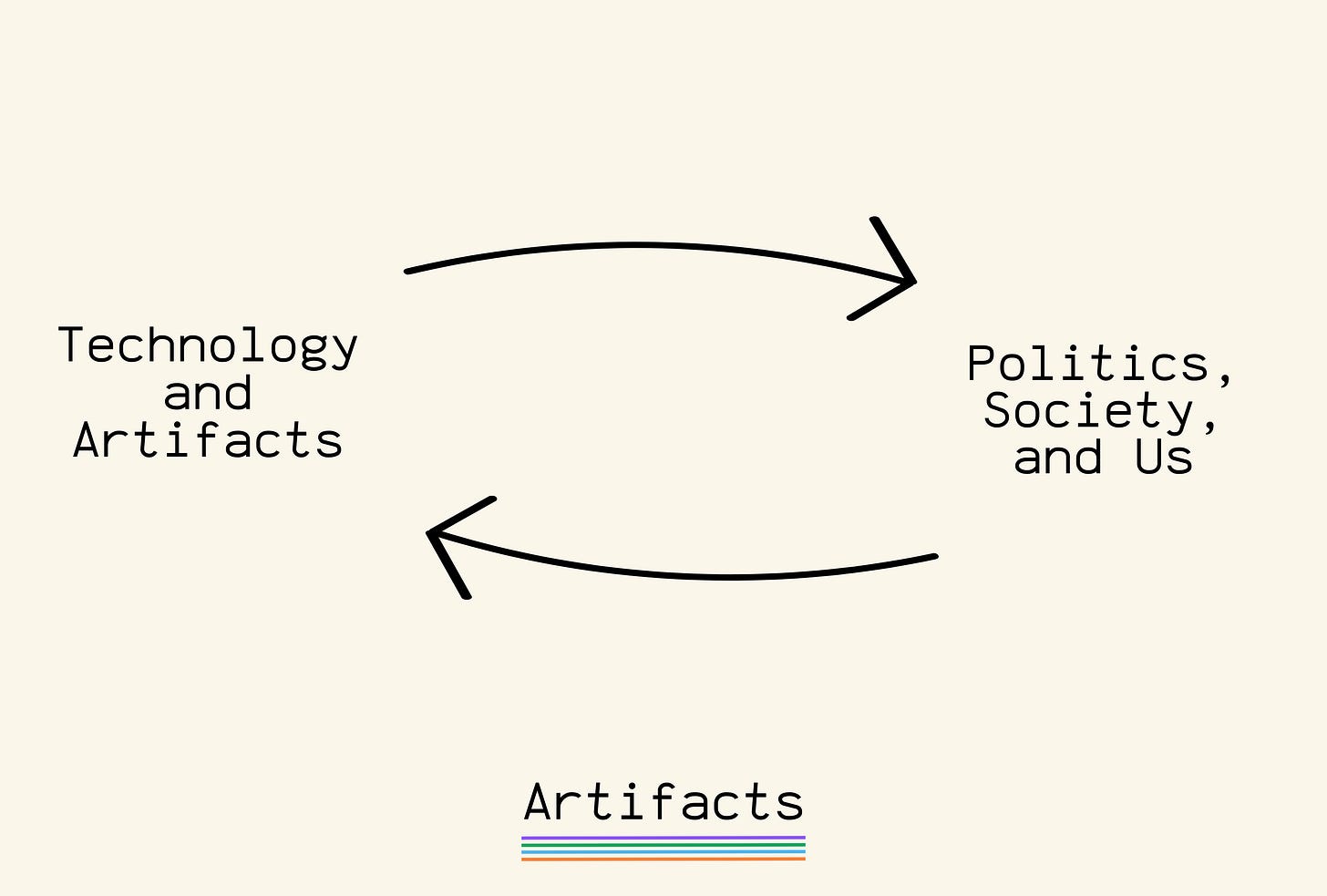 Promise kept
In the end, it often comes down to design, whether we’re talking about the artifacts themselves or the regulations governing them. And I find it fascinating that the same word—design—can stretch to cover both.
> #### So, what?
I’ve probably said enough by now. Hopefully, it’s clear why talking about artifacts isn’t just some niche obsession for tech nerds—it’s an urgent priority for us all.
We’ll be diving deep into artifacts here in Artifacts. This will be a space, a playground, to bring together facts, ideas, and reflections on how these technologies have been, and continue to be, shaping us.
And just as importantly, we’ll explore how politics and institutions are grappling with the meaning of technology.
We’ll do this every other Tuesday. Most of the time, I’ll be sharing my thoughts, but we’ll also bring in technologists, policy experts, and other curious minds to join the conversation.
Each edition of Artifacts will follow the format you see here: a deep dive into a key topic, food for thought from different sources, a book recommendation, a quote from someone sharper than me, and a tool I’d suggest you try.
It’ll be a journey we take together, and I’m excited to kick it off, once again.
Thank you to everyone who’s joining us for the first time today, and to those who’ve been here from the beginning for your continued support.
> ### Save for Later
Everyone’s buzzing about “founder mode”—but what exactly is it?
Are we too paranoid about AI and elections? Or maybe we’re just too paranoid in general?
Telegram may be changing its mind about content moderation.
Wanna go open source? A good source for it.
I wish I could call Mark Scott a competitor. That’s not the case yet, but he’s out with a great, new newsletter.
🟢 Join the Artifacts Community on WhatsApp to get other Save for Later content!
> ### The Bookshelf
 Fate is blind. I’m reading this right now: “Radical Technologies: The Design of Everyday life” a fascinating scrutiny and speculation of a set of different artifacts we encounter every day. I’m yet to finish it, but I can already tell it’s worth a read.
📚 All the books I’ve read and recommended in Artifacts are here.
> ### Someone said this before
“One has to become a cybernetician to remain a humanist.” - Peter Sloterdijk
> ### Nerding
 If you don’t want to miss this Artifacts or that mind-blowing article you just found, save it for later. Omnivore has got you covered—it saves articles and content, presenting them in a sleek, easy-to-read format.
> ### Catch-up?
If you want to know more about Artifacts, where it all started, or just want to connect...
Let's grab a virtual coffee ☕
======
# Lettera per lettera
Date: 2024-09-03 | Language: it
Canonical: https://artifactstech.substack.com/p/lettera-per-lettera
Cite as: Lettera per lettera by Lorenzo Ancona, Artifacts, 2024-09-03. https://artifactstech.substack.com/p/lettera-per-lettera (CC BY 4.0)
Questa che leggi è una ultima Artifacts.
O meglio, è l’ultima Artifacts in italiano e - come in realtà da un po’ - settimanale.
Dalla prossima settimana, Artifacts uscirà tendenzialmente una volta ogni due settimane. Tendenzialmente perché so che a volte romperò questa regola e uscirà anche nei martedì NO.
E, poi, sarà in inglese. Che sì, lo so, “che noia”, ma se proprio non lo tolleri ci sarà comunque sempre un link ad una versione tradotta in italiano.
Sulla cadenza, la scelta nasce da due fattori:
1. Ho iniziato Artifacts da studente e ora - per fortuna o sfortuna - lavoro, quindi il weekend ammetto avere un significato diverso e credo sia sano voler rallentare un po’;
2. Con un caro amico stiamo lavorando ad un’idea tangenziale ad Artifacts, che prenderà vita nei prossimi mesi, ma richiede un po’ di tempo.
Sulla lingua, l’idea è di provare a espandere la community di Artifacts e, di riflesso, provare a renderla ancora più interessante con qualche ospite in più o simili. Una sfida, sì, ma può valerne la pena.
------------------------------------------------------------------------
Allora, dato che questa Artifacts è un po’ di transizione e marca il primo compleanno dal lancio, guardiamo un po’ indietro, all’anno passato.
Che è sempre utile per prepararsi a quello che verrà.
E lo facciamo con un alfabeto, del quale ogni lettera rappresenta un tema o qualcosa di simbolico delle Artifacts dello scorso anno.
 direi ovvio, fatta con Flux.
Un po’ un amarcord, magari bello per chi è a bordo da settembre 2023 o anche utile per chi è arrivato nel corso dei mesi. Siamo quasi 700, wow.
E, tra l’altro, se magari conosci qualcuno da introdurre ad Artifacts, questa è una bella edizione di recap. Basta inoltrare la mail :)
Infine, a proposito di chi, ad un certo punto più o meno distante nel tempo, si è iscritto, mi piace pensare che quella che è forse l’ultima parola (non di contenuto) in italiano di Artifacts (🥲) sia semplicemente un grande, gigantesco, sentito: GRAZIE ❤️
> ### L’Alfabeto
Artifacts - scontato, ma necessario. Con “artefatti” si abbraccia qualsiasi cosa possa essere tecnologia, richiama poi “Do Artifacts have politics”, il paper dal quale è scaturito qualche anno fa il mio interesse per questo aspetto socio-politico della tecnologia.
Biometria - sorveglianza facciale e riconoscimento biometrico sono stati tra i temi forse più tecnici trattati. Lo avevamo fatto parlando di ClearviewAI ma poi anche di come in Grecia questi sistemi vengano abusati contro l’immigrazione.
Collettiva - è una delle chiavi in cui abbiamo visto l’Intelligenza Artificiale, ripercorrendo l’esercizio che ha fatto Anthropic (azienda da tenere sott’occhio) per scrivere una costituzione dei suoi tool di IA.
Detox - era stata la \#1 e poi anche una delle più recenti, aggiornata in formato guida. Credo sia sempre interessante guardare il nostro rapporto con cellulare & social con distacco e capirne la natura di “default” che ha assunto.
Eco - molti, parlano di ‘echo chambers’ o ‘filter bubbles’ rispetto a come assumiamo informazioni online. Interessante, forse un po’ retorica. Con Chris Bail avevamo visto che forse bisognerebbe parlare di prismi più che altro.
Filterworld - lo splendido libro di Kyle Chayka su come il nostro consumo culturale sia filtrato e determinato dai trend o da ciò che è virale e, alla fine, viene cambiato anche il nostro comportamento offline.
Giochi - una delle più divertenti da scrivere è stata quella sul Gameboy insieme a Giacomo Da Ros. La console che ha cambiato tutto senza rivoluzionare niente. Ma di giochi avevamo parlato anche per innovare la democrazia. Parkour :)
Hyperlink - ciò che ha cambiato Internet, che ha dato vita al Web, e che è la premessa di una realtà poi tradita con il peccato originale di Internet. E molto altro in una delle interviste più belle di Artifacts, col mio amico Tommi.
Interoperability - una delle idee più coraggiose degli ultimi anni di Internet. Si tratta di pensare che Internet non sia più di nessuno e, quindi, distribuita tra gli utenti.
Jobs - Ammetto di avere un debole per Steve. Personaggio affascinante, istrionico, da studiare. No idoli, ma quello che ha fatto con Macintosh, beh, wow.
Leggere - la fonte del direi 85% delle idee alla base di Artifacts. Quest’estate ho letto cose stra interessanti e ricaricato i serbatoi per i mesi che verranno.
Media - una sfera che vorrei diventasse uno dei temi centrali di Artifacts nei prossimi mesi. Qualcosa lo abbiamo già visto nella bagarre NYT-OpenAI o sulla disinformazione e cosa farne a riguardo.
Newsletter - il formato di Artifacts, sì, ma anche un formato media che resiste alla tirannia degli algoritmi di raccomandazione e ci riporta ad un Internet più da community. Avevo scritto una meta-riflessione.
Open - e quindi la necessità di trasparenza, sui processi delle aziende che cambiano il mondo, sulle enciclopedie online e, spero, presto molto anche sull’IA Open Source. Qualcosa bolle in pentola.
Perplexity - non ho timore di dire che Perplexity o un prodotto simile siano il futuro della ricerca online e dell’IA. Ma ci sono tutta una serie di problemi, oltre che delle soluzioni che stiamo sperimentando.
Quotes - sono un grande appassionato delle citazioni di grandi pensatori. Avevo raccolto le mie preferite per un regalo di Natale di Artifacts e a tutti i nuovi iscritti arriva un file con le cit che hanno ispirato Artifacts.
Red Line - quella della disinformazione e di cosa, concretamente, possiamo fare per rendere Internet più sicuro senza però colpire la libertà di espressione. Delicato, sfumato, complesso, ma ci avevamo ragionato.
Scaffale - la sezione con tutti i libri di Artifacts, che sono anche raccolti qui in un formato facile da consultare.
Training - quello delle AI, che pare abbiano rubato tantissimi libri e che, soprattutto, pone poi un tema etico se vogliamo delle AI che perpetuano il mondo com’è o una realtà verso la quale vorremmo tendere.
Unione Europea - e un grande grazie per DMA, DSA, AI Act e compagnia cantante che non fanno mai esaurire le cose di cui parlare. Più avanti qualcosa anche su cosa costruiamo, al di là delle regole.
Villaggio - ci siamo illusi che i social potessero essere la piazza dei villaggi virtuali in cui viviamo, salvo poi realizzare che sono spazi privati, con un certo set di incentivi e, alla fine, vincoli sui quali è anche difficile lamentarci.
Web - ok, vasto. L’arena in cui succede tutto, forse con una grande promessa tradita, continueremo a vederne insieme le tante dinamiche
X-Road - il sistema di dati alla base dell’Estonia, uno dei paesi più digitalizzati al mondo. Un auspicio, poi, di esplorare un po’ di più questa vicenda della digitalizzazione dei governi.
Zuckerberg - Mark regala sempre argomenti, anche lui. Tanto abbiamo visto sul se vorremmo / dovremmo pagare per la privacy sui social di Meta e, poi, anche cosa succede sulla sicurezza dei bambini online, specie negli US
Leave a comment
> ### Save for Later
🟢 IMPORTANTE: Un’amica sta scrivendo la sua tesi su come l'Intelligenza Artificiale viene usata nelle strategie ESG delle aziende. E ha bisogno di un aiuto con un questionario velocissimissimo, grazie! 🟢
Mentre arrestano il CEO di Telegram in una vicenda che esploreremo, la Presidente di Signal fa un’intervistona.
Cosa serve per lanciare una start-up in Italia? Tempo, soldi e troppa pazienza.
Forse l’IA può rendere i dibattiti online lievemente più civili, ha trovato Chris Bail.
Che in realtà le potremmo combattere le immagini fake, ma non ci stiamo mettendo d’accordo.
Magari è il caso che l’UE cominci a costruire qualcosa? Sarà la prima trasferta di Artifacts, more to come soon :)
Alla fine Harris e Trump non la pensano così diversa, ma lo vediamo presto anche questo
> ### Lo Scaffale
 L’avevo letto nel 2019 quando era uscito e mi sembrava incredibile. L’ho riletto quest’estate e mi ha fatto capire quanti progressi abbiamo fatto su questi temi. “The People vs Tech” è una lettura utile, con delle coordinate precise su alcune questioni essenziali.
📚 Tutti i libri consigliati in Artifacts sono raccolti qui
> ### Nerding
 Ora, non so bene se davvero questa cosa dell’IA può sostituire chi programma. Però so che una roba come Cursor.ai è abbastanza senza precedenti e apre tante possibilità anche per chi ha 0 conoscenza del coding.
> ### Pausa Caffè? ☕
Che tu legga Artifacts da qualche settimana, mese o dall’inizio, credo abbiamo qualche battuta da scambiare.
Allora, se vuoi chiacchierare dei temi di Artifacts o sei solo curiosa/o…
Prendiamo un caffè digitale
======
# Nell'interesse di tutti
Date: 2024-08-20 | Language: en
Canonical: https://artifactstech.substack.com/p/nellinteresse-di-tutti
Cite as: Nell'interesse di tutti by Lorenzo Ancona, Artifacts, 2024-08-20. https://artifactstech.substack.com/p/nellinteresse-di-tutti (CC BY 4.0)
A febbraio avevo raccontato di aver smesso di usare Google a favore di **Perplexity**, un ***answer engine*** che usa l'IA per le ricerche online.
[](https://artifactstech.substack.com/p/ho-parlato-con-internet)
#### Ho parlato con Internet
[Lorenzo Ancona](https://substack.com/profile/142944754-lorenzo-ancona)·27 February 2024[Read full story](https://artifactstech.substack.com/p/ho-parlato-con-internet)
E che, invece di dare i link ai siti come Google, fornisce direttamente un testo con le citazioni dei siti. **Utilissimo, velocissimo, ma potenzialmente un terremoto per le logiche economiche della pubblicità alla base di internet.**
[](https://substackcdn.com/image/fetch/$s_!0ryR!,f_auto,q_auto:good,fl_progressive:steep/https%3A%2F%2Fsubstack-post-media.s3.amazonaws.com%2Fpublic%2Fimages%2F85db29bc-10a2-415c-9165-684d51c0438b_995x1162.png)
Bravo Perplexity, lettore affezionato di Artifacts
Non ho, poi, mai ripreso ad utilizzare Google come motore di ricerca. O meglio, lo uso magari per cercare il meteo o dei siti precisi. **Ma quando si tratta di cercare delle informazioni o delle notizie,** Perplexity è semplicemente più veloce ed efficace.
**Ed infatti è anche l’unico tool di IA per il quale pago l’abbonamento mensile**, mentre gli altri li alterno e ci gioco intorno piuttosto.
Tra l’altro, con la *pro subscription*, **si ha anche accesso a tutti i modelli di linguaggio IA più avanzati**. Anche quelli che in UE non sono arrivati.
------------------------------------------------------------------------
Ora, lungi da me dire che quella Artifacts fu pionieristica, però **varie cose successe da quel momento puntano il dito verso un futuro fatto forse di ricerche online con l’IA:**
- **Perplexity** solo nell’ultimo mese ha ricevuto [250 milioni di domande](https://www.ft.com/content/87af3340-2611-4650-9ae3-036927e9f65c), e in tutto il 2023 sono invece 500 milioni. In crescita;
- **OpenAI** sta facendo provare [SearchGPT](https://openai.com/index/searchgpt-prototype/), un ChatGPT per la ricerca, ad alcuni utenti;
- **Google** ha lanciato le [AI Overviews](https://blog.google/products/search/generative-ai-google-search-may-2024/), ossia il suo motore di ricerca ma con gli steroidi AI (che sì, ha consigliato di mettere [la colla sulla pizza](https://www.theverge.com/2024/5/23/24162896/google-ai-overview-hallucinations-glue-in-pizza), ma capita).
[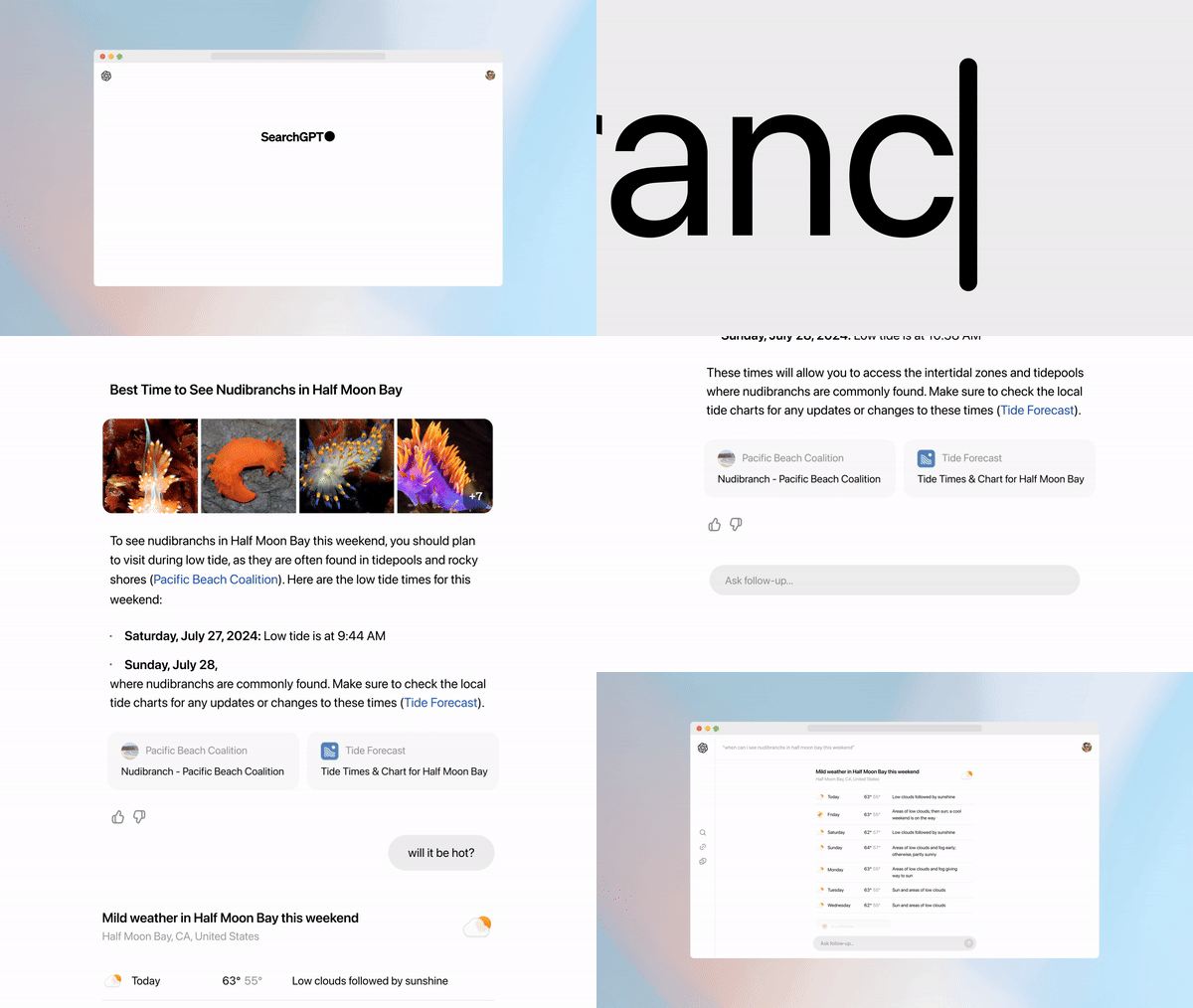](https://substackcdn.com/image/fetch/$s_!Us0p!,f_auto,q_auto:good,fl_progressive:steep/https%3A%2F%2Fsubstack-post-media.s3.amazonaws.com%2Fpublic%2Fimages%2Ff5f4da33-504c-4a3e-b2f9-255ff1c21acf_600x338.gif)
Prima o poi arriva questa robina eh
Ma non è tutto oro quel che luccica. **Non è chiaro né come i siti di notizie possano guadagnare se le persone non li visitano più né come Google stessa (ed altri) possano proseguire il modello di business basato sulla pubblicità sui siti.**
Non sorprendentemente, **[Forbes](https://www.forbes.com/sites/sarahemerson/2024/06/07/buzzy-ai-search-engine-perplexity-is-directly-ripping-off-content-from-news-outlets/)** e **[Wired](https://www.wired.com/story/perplexity-is-a-bullshit-machine/) hanno attaccato duramente Perplexity**, sostenendo che avrebbe preso dei loro articoli e li avrebbe plagiati senza inserire nessun link.
**Peggio ancora,** Perplexity avrebbe plagiato anche [l’articolo di Wired](https://www.wired.com/story/perplexity-plagiarized-our-story-about-how-perplexity-is-a-bullshit-machine/) in cui era accusato di plagio. LOL.
Ora, tutto questo ha a che fare con due elementi: **il protocollo robot.txt e il concetto stesso di plagio.** Che vedremo presto in Artifacts, **ma non sono il focus di oggi.**
------------------------------------------------------------------------
Soprattutto, sono questioni che riguardano uno scenario in cui non c’è nessun tipo di accordo tra i media e le varie aziende di IA. **Scenario che, però, ora sta cambiando.**
La Artifacts di oggi, allora, vede quali primi e preliminari passi ci sono stati verso qualche sorta di accordo.
E, soprattutto, **perché trovare una quadra su come rendere sostenibile la ricerca con l’IA è in tutto l’interesse sia dei media che anche delle OpenAI, Perplexity e varie.**
> ### La Storia
*Precisazione necessaria:* quello che lamentano i media è la capacità delle IA di fare ***scraping*** **live** dei siti, ossia di “navigarli” e prenderne le informazioni o le notizie ad ogni richiesta degli utenti.
**Ed è ben diverso dal fatto che molte delle IA Generative attuali sono state allenate su contenuti online.** Meglio, il meccanismo è simile, ma su quest’ultimo training c’è poco o nulla da fare, essendo già successo (!).
Sullo scraping live (quello di Perplexity) e su quello futuro (per allenare i nuovi modelli IA che verranno), invece, essendo due processi in corso, **siamo ancora in tempo.**
------------------------------------------------------------------------
Ed infatti stiamo vedendo emergere dei **primi tentativi di partnership o accordi tra le aziende IA e i media.**
**OpenAI** ne sta facendo tantissimi, insieme agli attori media più importanti, tra cui Financial Times, Vox, News Corp, Associated Press, The Atlantic [ed una lunga lista](https://foundationinc.co/lab/openai-partnerships-list/).
Tendenzialmente, **i media danno ad OpenAI accesso ai loro siti e dati** per il training dei modelli futuri e per la funzione browsing di ChatGPT, mentre **OpenAI fornisce in cambio soldi** (a volte) e accesso ai suoi prodotti tecnologici.
Diverso, per ora unico, e quindi meritevole di attenzione, è invece quello che ha fatto Perplexity con il suo **[Perplexity Publishers’ Program](https://www.perplexity.ai/hub/blog/introducing-the-perplexity-publishers-program).** Non un accordo a priori, ma **una percentuale (non rivelata) data ai media ogni volta che Perplexity si ritrova a visitarne il sito** e ad inserirlo nelle fonti della ricerca. Sì, ***revenue sharing***, esatto.
Per ora programma sottoscritto da nomi come TIME, Der Spiegel, Fortune, Entrepreneur, The Texas Tribune, e WordPress.
Tutti primi passi, provvisori, ma per provare a stare al passo con quello che succede. Ecco, **si avverte la sensazione di essere in territori inesplorati.**
[](https://substackcdn.com/image/fetch/$s_!2Nuq!,f_auto,q_auto:good,fl_progressive:steep/https%3A%2F%2Fsubstack-post-media.s3.amazonaws.com%2Fpublic%2Fimages%2F82823a1d-df20-452e-930c-a911760c3873_2160x2160.png)
Sono bellissime queste immagini di [Flux](https://huggingface.co/spaces/black-forest-labs/FLUX.1-schnell).
Non c’è nemmeno la certezza, tra l’altro, che la ricerca online con l’IA diventi davvero qualcosa di così grosso.
**I miei** ***two cents*** **su questo sono che sì, lo sarà.** Altrimenti OpenAI e Google non starebbero sperimentando i tool che abbiamo visto sopra.
Ancora, **secondo me la ricerca online può essere la** ***killer feature*** **dell’IA.** Ossia quella funzione che rende l’IA davvero popolare tra tutti, e non solo ad una bolla. (Perché, sì, i dati ci dicono che l’adozione su base quotidiana dell’IA non è così scoppiettante come pensiamo).
Ultima riflessione personale: **può anche essere la funzione che rende l’IA davvero finalmente** ***utile**,* andando oltre task come la riscrittura di testi, le email o la produzione di bullshit varia.
Allora, se scommettiamo di star intravedendo scintille di futuro, a maggior ragione il modello economico alla base della ricerca con IA deve diventare sostenibile. **Sia per le aziende IA che per i media.**
------------------------------------------------------------------------
**Le aziende**, che forse possono sembrare avere il coltello dalla parte del manico, **hanno tutto l’interesse di sviluppare una relazione positiva e di lungo raggio con i media.**
E non perché debbano essere dei buoni samaritani, **ma perché hanno un dannato bisogno dei contenuti che i media forniscono.**
**Se domani i media bloccano l’accesso a Perplexity o simili** (come successo in alcuni casi)**, questi tool di IA non sapranno più cosa “scrivere”** e si ritrovano in mano un pugno di mosche.
Insomma, dato che non producono contenuti originali, ma rielaborano quanto scritto da altri, **le IA devono capire come continuare ad avere qualcosa da rielaborare.**
**Lato media,** invece, forse è ancora più intuitivo. **Pubblicare contenuti e farseli “rubare” dalle IA senza che gli utenti visitino i siti non è un’opzione.**
Eppure, **se la ricerca IA ha un futuro**, urge trovare una soluzione che continui a portare valore e, quindi, entrate.
Tra l’altro, come detto prima, essendo i media a produrre i contenuti rielaborati, **il potere negoziale è tutt’altro che minimo.** Bisogna, quindi, capire come valorizzare questi contenuti che, alla fine dei conti, sono il carburante di questo motore della ricerca con l’IA.
**Il rischio è ripetere quanto successo con l’avvento dei social,** un’arena che i media non potevano non esplorare, ma alla quale **hanno portato più valore di quello che poi hanno effettivamente preso.**
Qui, forse ancor di più, i media possono difendere la propria posizione, dato che un **Perplexity non avrebbe praticamente parole se non fosse per quelle che prende navigando.**
Insomma, **trovare un modello funzionante è nell’interesse di tutti.** Capire quale sia, vedremo.
[Leave a comment](https://artifactstech.substack.com/p/nellinteresse-di-tutti/comments)
> ### Save for later
[Tutto quello che avremmo perso](https://www.domusweb.it/en/design/gallery/2024/05/20/all-the-things-we-lost-because-of-the-smartphone.html) per colpa degli smartphone.
In California stanno provando a fare [una legge sull’IA](https://www.nytimes.com/2024/08/14/technology/ai-california-bill-silicon-valley.html?smid=nytcore-ios-share), ma non piace granchè.
[Quali tipi di feed social esistono](https://12challenges.substack.com/p/a-typology-of-the-social-media-feed), bello!
[L’IA sarebbe potuta essere così](https://www.ft.com/content/c63dae2b-b0d5-4b27-a718-2cce165097b9), ma invece sono successe delle cose.
Se siete fan di Steve Jobs (mi auguro!), c’è [un incredibile archivio su di lui online.](https://stevejobsarchive.com/)
Sul Twitter di Elon Musk ora si possono creare [delle immagini decisamente distopiche.](https://www.theverge.com/2024/8/14/24220127/grok-ai-chatbot-beta-image-generation-x-xai-update)
> ### Lo Scaffale
[](https://substackcdn.com/image/fetch/$s_!z-Wi!,f_auto,q_auto:good,fl_progressive:steep/https%3A%2F%2Fsubstack-post-media.s3.amazonaws.com%2Fpublic%2Fimages%2F800ccb27-8ac0-4bab-9a25-7144b9ff1269_1080x1080.png)
Come e perché invenzioni come **il vetro, il suono, o il freddo** hanno cambiato radicalmente anche il mondo che viviamo oggi. ***“How we got to now”*** è una lettura veramente piacevole proprio su questo. Forse un po’ *wishful thinking* a volte, ma consiglio!
📚 **I libri consigliati in Artifacts da portare sotto l’ombrellone sono [qui](https://airtable.com/appK7fMPX1DMkQYzL/shrRh8TgI7GtmgBxM/tblWFBDnOoRBU47XM/viwdSxYeauFmB0EIM)**
> ### Nerding
[](https://substackcdn.com/image/fetch/$s_!nIMa!,f_auto,q_auto:good,fl_progressive:steep/https%3A%2F%2Fsubstack-post-media.s3.amazonaws.com%2Fpublic%2Fimages%2F2908ac4c-8b99-4391-b511-549257f7a3bf_2160x2160.png)
Visto che oggi eravamo pieni di GIF, ho pensato sia utile suggerire **[EZGIF](https://ezgif.com/)**, che è il tool che io uso per convertire i video in GIF. Semplice, intuitivo, rapido. **E non sottovalutate il potere delle GIF!**
======
# Perché scrivere una Artifacts
Date: 2024-08-06 | Language: it
Canonical: https://artifactstech.substack.com/p/perche-scrivere-una-artifacts
Cite as: Perché scrivere una Artifacts by Lorenzo Ancona, Artifacts, 2024-08-06. https://artifactstech.substack.com/p/perche-scrivere-una-artifacts (CC BY 4.0)
Circa un anno fa sceglievo il nome ‘Artifacts’.
Non ero in una *deep focus session* con la Red Bull o simili, ma stavo semplicemente **guardando il nulla** in una spiaggia deserta della Croazia.
Mi veniva in mente il paper *‘Do Artifacts have politics?’* di Winner e pensavo che ok, ci stava.
[](https://substackcdn.com/image/fetch/$s_!jnu_!,f_auto,q_auto:good,fl_progressive:steep/https%3A%2F%2Fsubstack-post-media.s3.amazonaws.com%2Fpublic%2Fimages%2F544a824b-d12e-4f15-bad9-015e256b540b_595x454.png)
Prima di quel momento i nomi che consideravo erano *‘Ahead of the curve’*, che diventava facile *‘AOC’,* o *‘Beyond’.* Ma il mio amico Tommaso mi fece notare che il primo era troppo complicato e il secondo forse troppo vago.
**E quindi ‘Artifacts’, con una serie di motivazioni che avevo scritto nella \#0.**
[](https://artifactstech.substack.com/p/questa-non-e-artifacts)
#### Questa (non) è Artifacts
[Lorenzo Ancona](https://substack.com/profile/142944754-lorenzo-ancona)·1 September 2023[Read full story](https://artifactstech.substack.com/p/questa-non-e-artifacts)
------------------------------------------------------------------------
La casualità e semplicità di come è nato il nome riflette abbastanza bene il processo che in realtà ha portato ad Artifacts stessa.
**Non è stata un’illuminazione improvvisa, ma più l’esito naturale di 3 fattori:** che mi piace leggere e scrivere, che ho la fortuna di avere tempo da dedicare ad una cosa simile, e soprattutto dall’incontro con diverse persone stimolanti e interessanti negli anni.
E poi anche che, in un panorama media sovraffollato e denso come quello attuale, **un prodotto media come una newsletter rappresenta secondo me una nicchia da proteggere e valorizzare.**
------------------------------------------------------------------------
Allora, questa breve Artifacts balneare (ti auguro), **riflette proprio sul senso di una newsletter nel 2024.**
Quindi non parlo *di* Artifacts, **ma provo a condividere cosa ho imparato** ***attraverso*** **Artifacts** sul perché di una newsletter, la sua peculiarità e che ruolo gioca, secondo me, nell’ecosistema media.
[](https://substackcdn.com/image/fetch/$s_!b8fm!,f_auto,q_auto:good,fl_progressive:steep/https%3A%2F%2Fsubstack-post-media.s3.amazonaws.com%2Fpublic%2Fimages%2Fe1e55e3d-4433-4956-84fa-0b38eadca1f0_1024x1024.webp)
Un cerchio e due frecce. **Creato con [Flux](https://huggingface.co/spaces/black-forest-labs/FLUX.1-schnell), nuovo modello Open Source di Image Generation**
(E così magari ti viene anche voglia di iniziare qualcosa di simile da settembre!)
> ### La Storia
**Parlando di ecosistema media,** una newsletter è, per alcuni aspetti, radicalmente diversa dai social media e dai contenuti per Instagram, Facebook, etc.
Innanzitutto perché **non c’è alcuna intermediazione da parte di algoritmi.** Se sei iscritto, ti arriva. Se non sei iscritto, no e non viene consigliata su un feed.
**Quindi si salta uno step:** non è (1) creator —\> (2) piattaforma —\> (3) audience, ma direttamente **creator —\> audience.** Una mail che ti arriva nella inbox, facile.
**C’è anche molta meno interazione** - o *engagement* direbbero i guru - perché non ci sono like, repost, commenti o simili. **Quindi forse è un prodotto più intimo**, ma è soprattutto più difficile per chi scrive sapere come e quanto è stata apprezzata.
**Ed è quindi anche più difficile fare il** ***boom*** o crescere in maniera repentina: è un processo mooolto più lento che beneficia meno delle dinamiche della viralità.
Ultimo punto: **non si torna indietro.** Quando clicchi “invia”, è fuori. Stop.
C’è un errore? Amen. **Non puoi eliminarla dall’inbox di chi la riceve** come invece puoi cancellare un contenuto social. **Decisamente più responsabilità.**
------------------------------------------------------------------------
Poi, **è una rottura di scatole infinita.**
Non è qualcosa che ti vai a prendere o vedere su una piattaforma o un sito, **ma ti arriva dritta dritta nelle mail.** Che è una dinamica media un po’ più all’antica, di comunicazioni *one-to-one,* a tutti gli effetti una lettera che ricevi.
E visto che chi scrive si arroga il diritto di romperti le scatole, credo che una newsletter **debba cercare di essere almeno decente.**
Mi spiego meglio: se ogni martedì mattina mandi un 1000 parole a qualcuno, **devi assicurarti di star mandando qualcosa di valore.**
**Non che sui social allora si possa metter fuori robaccia**, ma questa dinamica di intimità, di lettera che mandi, e di “intrusione” negli input che ricevono gli altri, secondo me richiede a chi scrive particolare attenzione e cura.
**Anche perché le persone ti puniscono, e si disiscrivono.** Un dato? Ogni martedì 2/3 persone tolgono l’iscrizione da Artifacts. *Che ci sta!*
------------------------------------------------------------------------
Per finire, **una newsletter ha un legame particolare con il tempo.**
Tendenzialmente, newsletter NON di pura informazione ma più di riflessione come Artifacts non rincorrono le *breaking news.*
Questo significa che **la “vita” di una newsletter è più lunga di altri contenuti:** puoi lasciarla riposare nella inbox per 3, 4, 5, 10 giorni e comunque rimane valida.
**Un prodotto media molto più lento di tanti altri.**
Da ultimo, **crea una ritualità.** Per chi scrive e per chi riceve. Se sei iscritto da abbastanza tempo, **sai che Artifacts arriva il martedì mattina prima delle 9.**
**Se non arriva**, forse te ne accorgi di più che se oggi una pagina Instagram non mette post. **Esagero:** è un po’ come se non esce il giornale - una newsletter è qualcosa che, in qualche modo, “aspetti”.
------------------------------------------------------------------------
Tutti elementi che concorrono a farmi pensare che sia bello, un po’ romantico, e anche forse speciale scrivere e ricevere newsletter.
Herbert Simon già nel 1971 scriveva ***“A wealth of information creates a poverty of attention”.***
Ogni giorno riceviamo e vediamo centinaia di stimoli e input. **Penso sia molto più prezioso di quello che sembra** decidere di fermarsi qualche minuto per guardare o leggere proprio quel contenuto.
Grazie se, poi, quel contenuto, ogni tanto, è una Artifacts :)
Buone vacanze!
[Leave a comment](https://artifactstech.substack.com/p/perche-scrivere-una-artifacts/comments)
> ### Save for Later
C’è chi dice che l’IA sia [solo una bolla che non farà mai soldi.](https://edition.cnn.com/2024/08/02/tech/wall-street-asks-big-tech-will-ai-ever-make-money/index.html)
Perché bisogna fare le cose bellissime, [dice Steve Jobs](https://stevejobsarchive.com/exhibits/objects-of-our-life)
[Cosa consiglia](https://blog.samaltman.com/advice-for-ambitious-19-year-olds) uno dei tech bros più importanti del momento ad un 19enne ambizioso.
Le regole per un digital detox, [le ho rimesse in ordine anche qui.](https://www.linkedin.com/posts/lorenzo-ancona-1b02b31a7_digital-detox-artifacts-activity-7223583076625371136-HyfD?utm_source=share&utm_medium=member_desktop)
[Credo il discorso più bello che io abbia mai ascoltato](https://fs.blog/david-foster-wallace-this-is-water/). Nulla a che fare con la tecnologia, ma sensazionale.
A proposito di media e futuro, una bella intervista di [Virginia](https://open.substack.com/users/151607-virginia?utm_source=mentions), che fa e ha fatto diverse cose super. Ed è anche lettrice di Artifacts :)
[\[Il futuro dei nuovi media con Virginia Giammaria, Media e Policy Campaigns Manager\]](https://open.spotify.com/episode/5LeMAIqFwSFgYiKOAgD8Qq)
> ### Lo Scaffale
[](https://substackcdn.com/image/fetch/$s_!ku_j!,f_auto,q_auto:good,fl_progressive:steep/https%3A%2F%2Fsubstack-post-media.s3.amazonaws.com%2Fpublic%2Fimages%2Ff8d088f4-b03c-4309-99f0-a407b118301c_2160x2160.png)
A proposito di media, attenzione, informazione, ***“The Attention Merchants”*** di **Tim Wu** è quello che serve leggere per capire un po’ di più di come sta cambiando l’ecosistema. E magari perché le newsletter sono il futuro (?).
📚 **I libri consigliati in Artifacts da portare sotto l’ombrellone sono [qui](https://airtable.com/appK7fMPX1DMkQYzL/shrRh8TgI7GtmgBxM/tblWFBDnOoRBU47XM/viwdSxYeauFmB0EIM)**
> ### Nerding
[](https://substackcdn.com/image/fetch/$s_!VcId!,f_auto,q_auto:good,fl_progressive:steep/https%3A%2F%2Fsubstack-post-media.s3.amazonaws.com%2Fpublic%2Fimages%2F3d64fa3d-929d-421e-b23c-7dd8294fd54f_2160x2160.png)
Ok, facilissimo. Ma magari non chiaro a tutti. **Substack** è il tool che uso per mandare Artifacts. Facile e intuitivo, ti fa un bel design e ha delle funzionalità di raccomandazione tra newsletter che aiuta tanto a crescere. **Se mai volessi lanciare una tua newsletter…**
> ### Pausa Caffè? ☕
Dai che in estate abbiamo tutti più tempo e possiamo chiacchierare. **Prendiamo caffè, crema-caffè, gelato,** ***whatever.***
Se anche a te interessa Artifacts, i temi che affronta o sei solo curiosa/o…
[Click qui e ci si vede :)](https://calendar.google.com/calendar/u/0/appointments/schedules/AcZssZ2ibxlzyU7rgnuoTgqXb_DFc19dfHmJeu1OAu17IY0_oHrtcJtvtctAJnMabirgZNx5Z5NAPGs0)
======
# Di default
Date: 2024-07-23 | Language: it
Canonical: https://artifactstech.substack.com/p/di-default
Cite as: Di default by Lorenzo Ancona, Artifacts, 2024-07-23. https://artifactstech.substack.com/p/di-default (CC BY 4.0)
Sono generalmente convinto che il telefono sia, di default, parte integrante della nostra vita. In una doppia maniera.
La prima, che, di default, lo controlliamo o utilizziamo come prima cosa quando distogliamo l’attenzione dal lavoro o studio o dallo scrivere newsletter (in inglese diremmo ‘we default to it’).
La seconda, che è un elemento di default della quotidianità, ossia scontato, come possono esserle le chiavi di casa o il portafoglio.
Nulla di intrinsecamente sbagliato. Solo un dato di fatto sul quale, però, penso sia bene riflettere.
L’estate, le vacanze, le ferie, sono probabilmente il momento giusto per farlo.
 A me la parola “default” dà l’idea di un pulsante. Creato con Dall-E
Attraverso quello che alcuni chiamano “digital detox”, ossia un periodo in cui limitare questo default, prendere le distanze dal telefono, comprendere questa perenne interattiva relazione, e magari cambiarla.
È una cosa che avevo già fatto l’estate scorsa, e ci avevo scritto la Artifacts \#1.
 #### Una settimana senza algoritmi
Lorenzo Ancona·5 September 2023Read full story
Tra l’altro, fun fact, il nome “Artifacts” nasce proprio dai giorni in cui ero immerso nel detox.
------------------------------------------------------------------------
Allora, oggi in Artifacts un po’ di consigli e tecniche per costruire il tuo digital detox. Che poi altro non è che come ho immaginato il mio!
L’idea alla base è quella del “Digital Minimalism” proposta da Cal Newport, ossia “una filosofia di uso della tecnologia nella quale focalizziamo il nostro tempo online su un piccolo numero di attività veramente importanti, e invece siamo contenti di perderci tutto il resto”.1
Un po’ di premesse su come ho pensato il digital detox di Artifacts:
- No ban completo del telefono perché sarebbe troppo facile lasciarlo a casa, ma soprattutto simulerebbe una condizione irripetibile, quindi forse poi poco utile e replicabile. Quindi il telefono va tenuto in tasca, ma usato con più consapevolezza;
- No detox limitato ai social. Vero che senza social il telefono è un sasso però l’idea è anche cambiare proprio l’utilizzo stesso e le abitudini, come usarlo appena svegli o controllarlo al semaforo (sì, sono tornato a Roma);
- Sono suggerimenti generalissimi e quindi poi ognuno li declina o adatta come preferisce.
------------------------------------------------------------------------
Gli obiettivi che intravedo, e che personalmente mi sono fissato sono:
- Comprendere meglio il mio uso e relazione col telefono;
- Eliminare o ridurre al minimo gli input esterni o, comunque, fisicamente lontani da me (le notifiche, insomma);
- Sviluppare un approccio proattivo di uso del telefono, e non reattivo. Insomma, essere io a decidere più attivamente quando usarlo;
- Costruire nuovi default, nuove abitudini. Non basta, infatti, creare dei vuoti di non-utilizzo del telefono, ma capire come impiegare quel tempo. Anche facendo niente, ma consapevolmente.
Chiarite premesse ed obiettivi, capiamo concretamente come fare questo digital detox.
> ### La Guida
(oggi nome diverso in via eccezionale)
#### Prima di iniziare
- Step 1 - Valutazione iniziale: quale parte del tempo trascorso davanti allo schermo ti sembra tossica? Personalmente, l’abitudine di aprire Twitter o Instagram in maniera abbastanza inconscia e il controllo costante delle notifiche.
- Step 2 - Definisci il tuo obiettivo: Chiediti qual è lo scopo del tuo detox e, poi, anche della vacanza che fai. Rilassarsi? Vivere nuove esperienze? Passare del tempo insieme? Sfuggire alla routine? In altre parole, cosa vuoi realmente fare con il tuo tempo?
Scrivi il tuo obiettivo, scatta una foto e impostala come immagine di blocco schermo in modo da essere ricordato quando prendi istintivamente il telefono.
- Step 3 - Avere un piano: crea un piano realistico per ridurre al minimo il consumo delle cose negative che hai identificato
------------------------------------------------------------------------
#### 10 Tips, tricks, trucchetti, idee
1. Chiediti “cosa posso fare altrimenti?” ogni qualvolta sei tentato di prendere il telefono;
2. Legato a sopra, prepara delle alternative, che siano libri, passeggiate nel nulla, un cubo di Rubik, qualsiasi cosa altra alla quale rivolgere la tua attenzione;
3. Preparati a vivere un po’ di solitudine, ossia a ridurre gli input che ti arrivano ma, come dice Cal Newport, sii felice di starti “perdendo” delle cose;
4. Get over yourself, ossia non prenderti troppo sul serio. Essenzialmente pensare che è difficile - nella maggior parte dei casi - che il motivo per cui si venga contattati sia così urgente o fondamentale;
5. Crea delle zone no-phone: ad esempio, 0 cellulare a tavola oppure prima di andare a dormire o la mattina appena svegli. Proprio fisicamente distante;
6. Ripensare le proprie abitudini: se in viaggio, chiedi ai locali dove andare a mangiare oppure scarica le mappe offline per poter tenere il telefono in modalità aereo. Per limitare il numero di volte che prendiamo il telefono in mano;
7. Trasformalo in un gioco. Se parti con amici o partner, coinvolgili nel detox e mettetevi come penitenze gelati offerti o simili. Così se non riesci a fare il detox almeno mangi bene.
8. Programma lo screen time: se di solito programmiamo il lavoro, lo studio o simili e poi riempiamo i buchi con il telefono, è utile provare a dire “10 minuti di controllo del telefono all’ora di pranzo e altri 10 a cena”;
9. Cambiare l’organizzazione delle app: mettere solo quelle essenziali in home page per non essere tentato dalle altre.
 Così è come credo mi organizzerò io
10. Quel tramonto incredibile esisterà anche se non lo fotografi. Quindi prova a goderti i momenti belli anche se poi scompaiono.
------------------------------------------------------------------------
#### E dopo?
Credo sia utile tenere traccia delle proprie sensazioni e pensieri durante questi giorni lontani dal default del telefono. Chiaramente meglio tenerli su carta.
E poi, alla fine, magari anche buttare giù cosa hai capito, cosa hai imparato e, se c’è qualcosa, anche cosa intendi migliorare dopo il digital detox.
Perché, sì, il telefono è un default, è sacrosanto, ed è utilissimo. Ma forse qualcosina da aggiustare la abbiamo tutti.
Sono molto curioso di sapere se conosci altri trucchetti utili, che magari mettiamo insieme una guida definitiva e collaborativa di Artifacts. Se ne hai, lasciali nei commenti!
Leave a comment
> ### Save for Later
Cosa pensa J.D. Vance, il vice di Trump, di BigTech. Ma anche cosa pensa Kamala Harris della tecnologia.
Tornando in UE, cosa significa invece la rielezione di Ursula Von der Leyen per la tech policy?
A proposito di detox, tu riesci a guardare un dipinto per 10 minuti?
Stiamo finendo i dati per le Intelligenze Artificiali!
Cosa impariamo della cultura, dei social e delle opinioni dal quasi assassinio di Trump?
Come sono disegnati i siti del governo Americano, bellissimo.
Come la grandezza di un box sul sito ha cambiato la storia di Airbnb
\[Embedded media — view original\]
> ### Lo Scaffale
 Come detto sopra, Cal Newport ha scritto “Digital Minimalism” per spiegare come ricostruire un nuovo rapporto con la tecnologia. Sul digital detox ha idee un po’ diverse da quelle di questa Artifacts, ma da leggere!
📚 Se cerchi libri da portare sotto l’ombrellone, qui tutti quelli di Artifacts
 > ### Nerding
 Conosco vari che utilizzano la tecnica del pomodoro per concentrarsi. Quindi 25 minuti di focus e 5 di svago. Per me è impossibile, ma con Session puoi provare a mettere dei limiti e vedere come vai.
> ### Pausa Caffè? ☕
(Settimana scorsa il link era rotto, ora funziona!)
Dai che in estate abbiamo tutti più tempo e possiamo chiacchierare. Prendiamo caffè, crema-caffè, gelato, whatever.
Se anche a te interessa Artifacts, i temi che affronta o sei solo curiosa/o…
Click qui e ci si vede :)
1
In lingua originale “A philosophy of technology use in which you focus your online time on a small number of carefully selected and optimized activities (=default) that strongly support things you value, and then happily miss out on everything else.”
======
# L'ho letto sull'enciclopedia
Date: 2024-07-16 | Language: it
Canonical: https://artifactstech.substack.com/p/lho-letto-sullenciclopedia
Cite as: L'ho letto sull'enciclopedia by Lorenzo Ancona, Artifacts, 2024-07-16. https://artifactstech.substack.com/p/lho-letto-sullenciclopedia (CC BY 4.0)
Ricordo che alle elementari c’era una demonizzazione dell’uso di Google per fare le ricerche. **“Bisogna usare l’enciclopedia”,** dicevano.
E allora, ok, usiamo l’enciclopedia. **Ma anche quella, alla fine, era online.** Era quella del “non fare copia-incolla”. Era **Wikipedia**.
Ma anche a Wikipedia bisognava fare attenzione. Poteva non essere affidabile. “Non sai chi ha scritto le cose”, e **altre cose forse simili a quanto ora si dice sull’AI.**
In effetti, su Wikipedia è decisamente complicato capire chi ha scritto le cose perché **sono sempre più persone, raramente una sola.** Persone qualunque, che lo fanno per divertimento, correggendosi a vicenda.
**Premesse che potrebbero supportare l’apprensione degli insegnanti,** ma che sono anche la base del successo di Wikipedia e il suo più grande valore.
------------------------------------------------------------------------
In principio, l’idea di Wikipedia era radicalmente diversa. Così come lo era il nome: **Nupedia**. I fondatori, Jimmy Wales e Larry Sanger, volevano creare una enciclopedia libera online, ma **scritta da esperti e con contenuti peer-reviewed, come si fa nella ricerca accademica.**
Questa ambizione, però, rallentava tremendamente Nupedia, che **in tre anni riuscì a concludere solo 24 articoli.**
A cambiarne le sorti, allora, fu un’idea che arrivava dalle **Hawaii**: il software **“wiki”,** che in hawaiiano significa “rapido”, inventato dal programmatore Ward Cunningham.
[](https://substackcdn.com/image/fetch/$s_!CJ4W!,f_auto,q_auto:good,fl_progressive:steep/https%3A%2F%2Fsubstack-post-media.s3.amazonaws.com%2Fpublic%2Fimages%2F52fbf5ab-f519-41b9-b2df-7bbe7c2e6ba2_1024x1024.webp)
Direi in linea con la stagione. *Creato con DALL-E*
Così, nel ‘95 veniva lanciato [WikiWikiWeb](https://wiki.c2.com/?WallData), un sito in cui programmatori scambiavano idee e conoscenza, semplicemente modificando le informazioni sull’interfaccia. **Una sorta di Google Doc condiviso.**
Era il primo sito editabile dagli utenti da browser, manteneva uno storico di tutte le modifiche e aveva una idea di pluralità alla base: **tutti, non solo gli esperti, potevano contribuire.**
I fondatori di Nupedia ne furono attratti e nel 2001 pensarono di **usare la tecnologia Wiki come progetto esterno per velocizzare Nupedia**. Non rimase, però, esterno: solo nel primo anno permise di creare 20,000 articoli in 18 lingue.
**Velocità, logica di collaborazione e facilità di utilizzo fecero il resto:** Wikipedia (da “wiki” = veloce + “pedia” = enciclopedia) sorpassò agilmente Nupedia e diventò ciò che conosciamo ora.
------------------------------------------------------------------------
Ossia quello che in ‘The Office’ viene descritto come *‘the best thing ever’* perché ***‘anyone in the world can write anything they want about any subject.** So you know that you are getting the best possible information.’*
Ma che è anche l’enciclopedia che segue **[un modello “Bazaar” della conoscenza](https://www.theatlantic.com/magazine/archive/2006/09/common-knowledge/305151/)**, nella quale chiunque può scrivere qualsiasi cosa, in un mercato aperto e orizzontale della conoscenza senza autorità centrale.
Col tempo Wikipedia è diventata una **fonte generalmente accettata di conoscenza.** Lo ha fatto utilizzando un modello di governance aperto, indipendente e collaborativo.
Modello che non sarebbe stato possibile (o comunque più difficile) qualora fosse stato un sito proprietario. E che, soprattutto, **dimostra il potenziale dell’Open Internet**, di cui avevamo parlato [qui](https://artifactstech.substack.com/p/il-peccato-originale).
------------------------------------------------------------------------
Chiaramente, questo modello aperto, in cui - potenzialmente - ognuno può scrivere ciò che vuole, riserva **non poche insidie.** Specie per l’affidabilità dei contenuti, la sicurezza di Wikipedia stessa, e quindi anche il rispetto di regolamenti sulla moderazione dei contenuti. Incerto, poi, anche il **futuro** in cui pare che i contenuti online saranno sempre meno creati da umani.
Allora, questa Arifacts vede perché Wikipedia è un unicum, come siamo sicuri che sopra ci siano informazioni affidabili e anche perché tutte queste informazioni sono la benzina del futuro ma, forse, anche a rischio di logorarsi presto.
> ### La Storia
Seppur parzialmente, Wikipedia è comunque controllata da un’organizzazione, la **Wikimedia Foundation.** Che, però, è una no-profit.
Ancora, Wikipedia è l’unico dei top 10 siti globali ad essere no profit ed uno dei pochissimi tra i top 100. **Non usa pubblicità, non colleziona dati degli utenti per monetizzarli, e non prevede abbonamenti.** Le risorse per la manutenzione dei server arrivano principalmente da donazioni spontanee.
Anche per questa natura decisamente particolare nel modello di business delle piattaforme, Wikipedia è considerata ***[“the last best place on the internet”.](https://www.wired.com/story/wikipedia-online-encyclopedia-best-place-internet/#:~:text=People%20used%20to%20think%20the,of%20so%20much%20that's%20right.)** [](https://www.wired.com/story/wikipedia-online-encyclopedia-best-place-internet/#:~:text=People%20used%20to%20think%20the,of%20so%20much%20that's%20right.)*
La Foundation si occupa, comunque, solo di aspetti burocratici, della compliance legale, e della manutenzione dei server. **Ma non è in nessun modo responsabile dei contenuti pubblicati né tantomeno della moderazione degli stessi.**
Non sarebbe Wikipedia. **E non sarebbe wiki.**
------------------------------------------------------------------------
L’intera produzione dei contenuti arriva dagli utenti, da noi. Ed è fondata su **3 principi:**
1. **punto di vista neutrale:** tutti gli articoli o contenuti di Wikipedia devono essere perfettamente neutrali e non rifletter bias o posizioni di un certo tipo;
2. **verificabilità:** ogni contenuto deve essere basato su una fonte affidabile e verificabile da chi legge;
3. **no ricerca originale:** non c’è spazio per ricerca indipendente o novità; Wikipedia sistematizza e raccoglie informazioni provenienti da altre fonti e le cita attraverso l’uso degli hyperlink, i celebri link blu. Quest’ultimo principio era alla base già del software wiki.
Affidandosi a questi principi, gli utenti possono modificare le pagine. E lo fanno, secondo i dati, in maniera decisamente incrementale e composita. **Si stima infatti che il tempo medio della modifica a Wikipedia sia di soli 37 secondi.**
------------------------------------------------------------------------
Forse ora è già più chiaro *come* viene popolata Wikipedia. Ma rimane un’altra questione essenziale, legata all’affidabilità di quello che leggiamo e anche alla sicurezza della piattaforma.
Insomma, se ognuno può scrivere ciò che vuole, **come facciamo a essere sicuri che quello che leggiamo sia vero e che non ci sia misinformazione?**
Ci si affida ad un metodo collaborativo. Più precisamente, al ***consensus,*** ossia la presunzione che una cosa sia giusta finché non viene modificata dagli altri.
*Consensus* che è raggiungibile sia **modificando direttamente le pagine,** qualora si pensi che qualcosa scritto in precedenza da altri non sia corretto. E in questo caso **si presume che la correzione sia giusta finché un’altra persona non interviene.**
[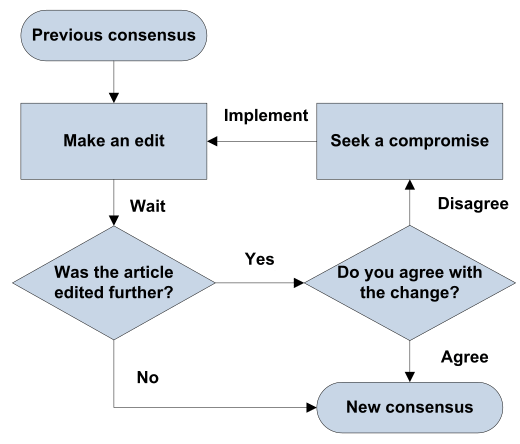](https://substackcdn.com/image/fetch/$s_!ObcX!,f_auto,q_auto:good,fl_progressive:steep/https%3A%2F%2Fsubstack-post-media.s3.amazonaws.com%2Fpublic%2Fimages%2F78261030-8cca-4d99-8c3a-4f1663de4bb3_520x444.png)
Appunto, se modifichi un articolo e non viene cambiato, c’è consenso
Ma è possibile raggiungere il *consensus* anche **discutendo nella sezione “Talk” di ogni pagina Wikipedia.** Dove, come in una chat, si possono sollevare delle questioni e dibatterne con gli altri utenti nella speranza di trovare un accordo. E poi modificare la pagina di conseguenza.

spero ti ricordi chi è Norbert Wiener :)
Questo del consensus può sembrare un meccanismo raffazzonato, non preciso, e magari con delle insidie. **Ma è ciò che manda avanti Wikipedia da ormai oltre 20 anni.**
In questo senso, agli utenti viene chiesto di **usarlo con cautela**, e quindi di modificare le pagine solo se pensano che ci possa essere consenso.
E, tuttavia, **questa cautela non significa riluttanza nel modificare**, tutt’altro. Vale infatti il principio del ***[“Be Bold”](https://en.wikipedia.org/wiki/Wikipedia:Be_bold)**,* ossia di cambiare i contenuti non appena si pensi siano scorretti.
[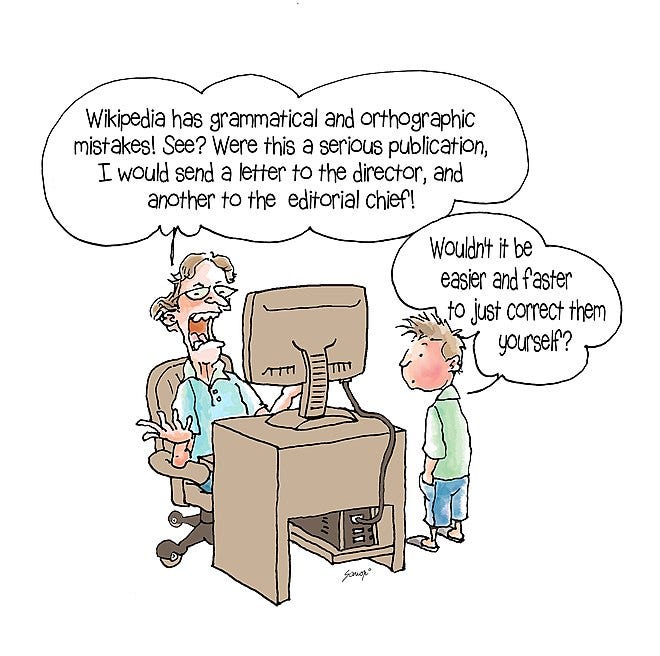](https://substackcdn.com/image/fetch/$s_!os8k!,f_auto,q_auto:good,fl_progressive:steep/https%3A%2F%2Fsubstack-post-media.s3.amazonaws.com%2Fpublic%2Fimages%2F60fa9cd6-396b-4a08-a6dc-f2f4f989a9dc_660x656.png)
questa spiega bene il “be bold”
Questo perché nessun cambio è mai definitivo e, soprattutto, è disponibile in ogni pagina una sezione **“History”,** dove è possibile consultare la cronologia di tutti i cambiamenti che sono stati effettuati e, eventualmente, tornare indietro.
------------------------------------------------------------------------
Così, veramente passo dopo passo, si compone e si plasma la conoscenza disponibile su Wikipedia. **Puramente per l’interesse e la spinta di volontari.**
Ora, però, c’è una nuova sfida: **ha senso Wikipedia di fronte all’IA?** **Perché consultarla quando un ChatGPT può svolgere il medesimo compito?**
Peggio ancora, Wikipedia, in quanto basata su **licenza Commons**, ossia conoscenza aperta al riutilizzo, è [una delle principali fonti di ChatGPT e simili.](https://www.washingtonpost.com/technology/interactive/2023/ai-chatbot-learning/)
Il rischio è simile a [quanto avevamo visto con Perplexity](https://artifactstech.substack.com/p/ho-parlato-con-internet): che i siti, e in questo caso Wikipedia, forniscano il materiale di training delle IA, poi non vedano niente in cambio, e infine le persone smettano di visitarli. **Insomma, che siano la fonte del loro stesso declino.**
A Wikipedia stanno lavorando a rimedi tecnici, sviluppando una **API** per utilizzare i loro contenuti. E ribadiscono, però, che nonostante i progressi delle IA, [dovrà rimanere centrale il ruolo degli umani che producono conoscenza.](https://wikimediafoundation.org/news/2023/07/12/wikipedias-value-in-the-age-of-generative-ai/)
Quelli che su Wikipedia trovano il consensus, dibattono su Talk, vedono le modifiche nel tempo e che, in fondo, **hanno costruito quella che non è più solo una enciclopedia.**
Ma un esperimento, una sorta di piazza pubblica, **un manifesto politico dell’Internet aperto.**
Che ora, però, con la rivoluzione della conoscenza portata dall’IA, dovrà però provare a capire quali nuovi strade intraprendere per continuare sia a essere visitata che, soprattutto, scritta dagli utenti.
[Leave a comment](https://artifactstech.substack.com/p/lho-letto-sullenciclopedia/comments)
> ### Save for Later
[Ma dobbiamo essere](https://www.linkedin.com/posts/nicholasxthompson_the-most-interesting-thing-in-tech-a-newish-activity-7211873116669571073-1esi?utm_source=share&utm_medium=member_desktop) **[gentili](https://www.linkedin.com/posts/nicholasxthompson_the-most-interesting-thing-in-tech-a-newish-activity-7211873116669571073-1esi?utm_source=share&utm_medium=member_desktop)** [con le AI?](https://www.linkedin.com/posts/nicholasxthompson_the-most-interesting-thing-in-tech-a-newish-activity-7211873116669571073-1esi?utm_source=share&utm_medium=member_desktop)
Comunque ancora da capire [se l’AI sia](https://ellissi.substack.com/p/lai-generativa-fara-la-fine-di-clubhouse) **[un servizio o un prodotto](https://ellissi.substack.com/p/lai-generativa-fara-la-fine-di-clubhouse)**, si è chiesto [Valerio Bassan](https://open.substack.com/users/1591331-valerio-bassan?utm_source=mentions). Ma anche Marques Brownlee.
[\[Embedded media — view original\]](https://www.youtube-nocookie.com/embed/sDIi95CqTiM?rel=0&autoplay=0&showinfo=0&enablejsapi=0)
Una [decisione molto molto importante](https://www.theverge.com/2024/7/1/24166388/supreme-court-ruling-moody-paxton-texas-florida-social-media-law) sulla **moderazione dei contenuti in US.**
Come hanno usato le **AI per le elezioni francesi.** [Et voilà.](https://aiforensics.org/work/french-elections-2024)
[Hanno pubblicato l’AI Act](https://eur-lex.europa.eu/legal-content/EN/TXT/HTML/?uri=OJ:L_202401689), ed entra in vigore il **1 agosto.**
**Qual è il futuro dell’editoria con l’AI?** Il CEO del The Atlantic, benissimo:
[\[Why The Atlantic signed a deal with OpenAI\]](https://open.spotify.com/episode/24bLdO1AJHz9i26hUH2Y45)
Periodino intenso in UE, anche per **Apple e il suo App Store.** Ne ho parlato a ‘Ma Perché?’ di Marco Maisano:
[\[410 \| Ma perché Commissione europea e Apple litigano?\]](https://open.spotify.com/episode/4WwngdX9xB6DGqscDwgwgk)
> ### Lo Scaffale
[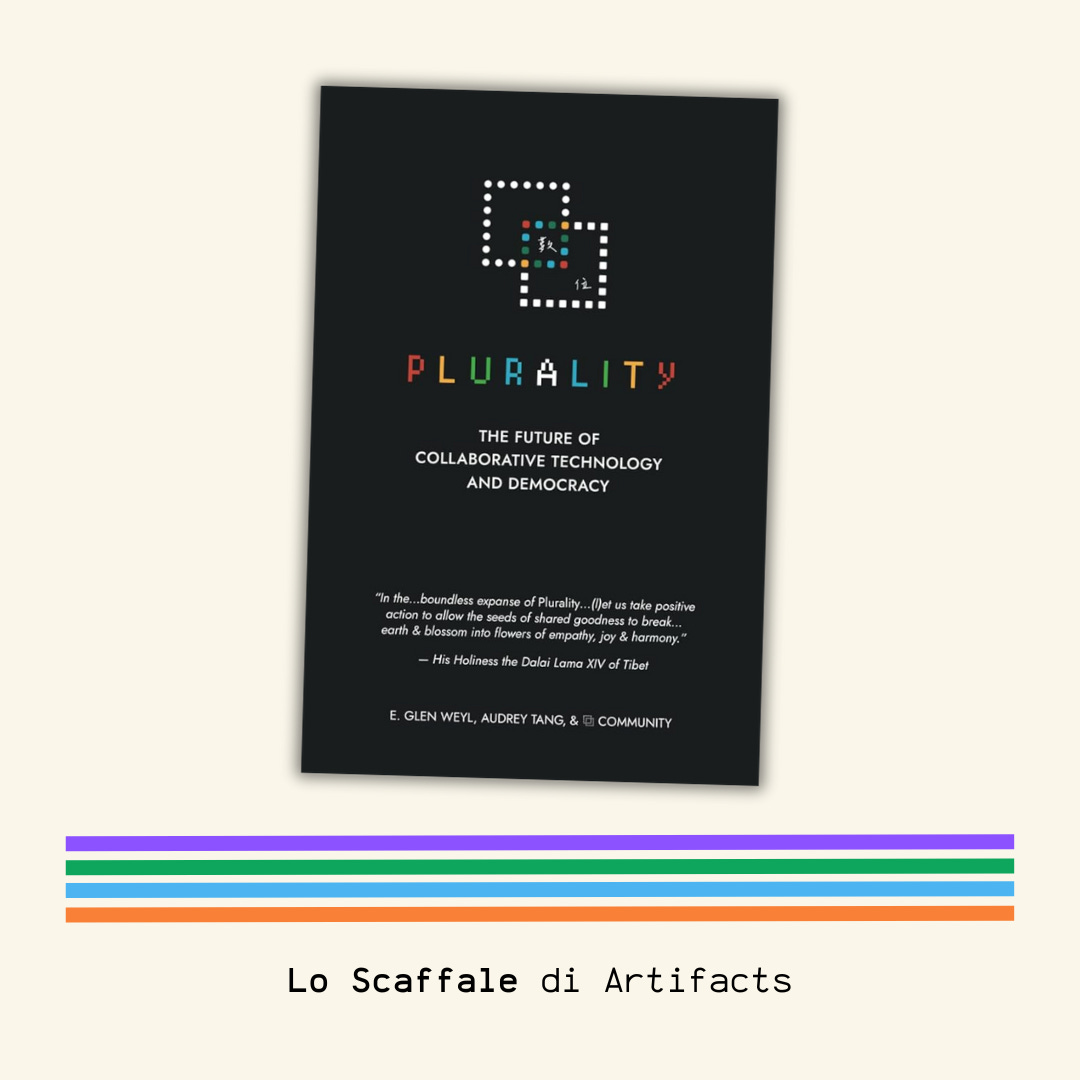](https://substackcdn.com/image/fetch/$s_!tE6N!,f_auto,q_auto:good,fl_progressive:steep/https%3A%2F%2Fsubstack-post-media.s3.amazonaws.com%2Fpublic%2Fimages%2F229ffb98-0e34-4e0a-b599-69843e727794_1080x1080.png)
Un libro-progetto, a partire da un’idea di Audrey Tang, primo Ministro degli Affari Digitali di Taiwan, di cui avevo parlato [qui](https://artifactstech.substack.com/p/una-polis-a-taiwan). **Plurality** racconta delle origini di **Internet come progetto collettivo**, quindi anche di Wikipedia, e propone poi come provare ad andare avanti. Ha un GitHub, **[l’ebook è gratis](https://www.plurality.net/)**, e tra l’altro cercano traduttori in tutte le lingue.
> ### Nerding
[](https://substackcdn.com/image/fetch/$s_!6-Ee!,f_auto,q_auto:good,fl_progressive:steep/https%3A%2F%2Fsubstack-post-media.s3.amazonaws.com%2Fpublic%2Fimages%2F351e9133-0b94-497b-a5b5-e3b264eb5629_1080x1080.png)
[Listy](https://listy.is/?ueid=dca445e23e26114858a48ad35040e287) è un’app per fare delle liste, più carina di Apple Notes e con delle funzionalità interessanti. Utile per chi fa to-do list in maniera seriale, si segna libri da leggere, film da vedere, cose da fare, **e anche questa è diventata una lista.**
> ### Pausa Caffè? ☕
Dai che in estate abbiamo tutti più tempo e possiamo chiacchierare. **Prendiamo caffè, crema-caffè, gelato,** ***whatever.***
Se anche a te interessa Artifacts, i temi che affronta o sei solo curiosa/o…
[Prendiamo un caffè digitale](https://calendar.app.google/5XnSHiYTV6JN7Skb9)
======
# Sempre lo stesso sapore
Date: 2024-06-25 | Language: it
Canonical: https://artifactstech.substack.com/p/sempre-lo-stesso-sapore
Cite as: Sempre lo stesso sapore by Lorenzo Ancona, Artifacts, 2024-06-25. https://artifactstech.substack.com/p/sempre-lo-stesso-sapore (CC BY 4.0)
Domanda: cos’hanno in comune le 3 foto qui sotto?
 No, non sono uno sponsor del capitalismo.
Molto probabilmente, tutte e 3 non esisterebbero senza i social media. E non (solo) perché le persone che ritraggono stanno creando contenuti che finiranno sui social media.
Ma, anzi, perché i comportamenti di questi persone non esisterebbero senza social.
O, meglio ancora, non esisterebbero senza i “famosi” algoritmi dei social media. Per essere precisi, senza i recommendation algorithms, ossia le “regole” che forniscono i contenuti di cui fruiamo sulle varie piattaforme.
Mi spiego meglio: i comportamenti che vedi nascono dalla esigenza (se così possiamo definirla) di condividere, ma anche e soprattutto dalla necessità di conformarsi a delle regole non scritte su come, tendenzialmente, si fanno le cose sui social perché siano virali o, almeno, inscritte in un certo linguaggio.
E quindi catturiamo quella foto sfocata di un’opera d’arte famosa, il nome scritto male sul bicchiere di Starbucks (forse fatto apposta), e anche assumiamo certe pose in delle foto.
E mille altre comportamenti che tutti facciamo per, in qualche modo, uniformarci a delle regole non scritte. No critica, just facts.
------------------------------------------------------------------------
La dimostrazione massima di questa cosa sono i trend o le tendenze. Che molto spesso sono temporanee, tipo la Ice Bucket Challenge o certi balletti su TikTok, ma diventano incredibilmente popolari per un periodo.
Così che tutti assumiamo lo stesso comportamento, ma c’è comunque curiosità nel vedere come ciascuno lo declina.
A volte sono più durature, tipo questa cosa qua con la Torre di Pisa.
 Che, sì, magari accadeva anche prima dei recommendation algorithms dei social, ma ora è amplificata e, in qualche modo, codificata.
Comunque, temporanei o no che siano, questi comportamenti sono influenzati proprio da queste regole non scritte di come - in qualche modo - sui social facciamo le cose. Visto che è periodo di concerti, pensa a come si applica questo ragionamento.
------------------------------------------------------------------------
Chiaramente, l’effetto sui comportamenti “attivi” della nostra vita social (ne esiste una non?) è solo una parte minore della vicenda.
Molto, decisamente di più, riguarda invece l’aspetto “passivo”, ossia il modo in cui questi algoritmi influenzano i contenuti che consumiamo. Tutti i giorni, ad ogni ora.
Se mi concedi la forzatura linguistica, influenzano proprio la cultura che consumiamo, intesa come i contenuti di ogni tipo, e non solo la Gioconda. Cultura che, alla fine, è sempre più “consigliata” (in inglese, recommended”) da algoritmi.
------------------------------------------------------------------------
C’è, quindi, un effetto sui comportamenti che intraprendiamo. Quest’ultimo magari non diffusissimo, ad esempio sono esclusi coloro che non fanno post attivi. E poi - questo inevitabile - un effetto sui contenuti che vediamo, cosa leggiamo e, infine, forse anche quello di cui parliamo.
E ancora, un effetto che si propaga anche proprio a come sono fatti i posti che viviamo, visitiamo e cerchiamo. Ovunque siamo nel mondo. Ma questo lo vediamo dopo.
Non è una teoria mia. Credo che puoi condividere almeno le premesse del ragionamento. Comunque, è qualcosa che è stato sviluppato ulteriormente da chi queste cose le studia.
E allora questa Artifacts prova a vedere innanzitutto quali sono le implicazioni di queste dinamiche, cosa significa concretamente per il modo in cui consumiamo cultura, e sviluppiamo anche i nostri gusti.
 Arriva in fondo per capire perché. Creata con DALL-E
Ma anche, poi, perché esistono degli effetti anche sui luoghi fisici e, infine, come forse provare a riprendere le redini della cultura che creiamo e vediamo.
> ### La Storia
Gli effetti sulla cultura - sempre in senso lato - non sono solo individuali, tutt’altro.
Da un lato, infatti, ad ognuno viene servito un insieme di contenuti altamente personalizzato, e quindi ha una dieta informativa su misura. Dall’altro, però, persone con gli stessi gusti e interessi ricevono contenuti simili, e probabilmente gli stessi gusti e interessi sono plasmati proprio da ciò che vediamo.
Si crea, quindi, questa dinamica: la “communality” che caratterizza la cultura, ossia il condividere consumi e contenuti, viene dettata da degli algoritmi.
Concretamente, se forse prima per gli appassionati di cinema l’unica soluzione era andare attivamente alla ricerca di film, magari consigliandoseli a vicenda, ora esiste l’opzione per la quale avere consumi comuni è principalmente guidato dai recommendation algorithms. Vedi Netflix.
------------------------------------------------------------------------
Un’altra implicazione - legata alle tre foto di prima - riguarda poi quello che creiamo. Ed è perché il modo e i mezzi in cui i contenuti sono distribuiti influenza il modo in cui i contenuti stessi sono creati.
Ogni mezzo ha un suo linguaggio, e non si può che adattarsi. Questo era valido per il passaggio da radio a televisione, e tiene anche per i social dove a farla da padrone sono sia i formati (contenuti brevi, veloci, diretti) che poi anche i trend.
E questi linguaggi sono, semplicemente, ineluttabili. La famosa frase “devi fare così perché piace all’algoritmo”, insomma, ha un fondo di verità. Non adattarsi a quello che (pensiamo) prevedono gli algoritmi significa rischiare la non viralità e, quindi, non avere audience.
E porta ad una “algorithmic anxiety”, ossia un’ansia di performare e comportarsi secondo quello che viene “gradito” dagli algoritmi e, quindi, ha poi successo.
Ed è così che chi crea contenuti non può che adattarsi - e piegarsi - a quello che funziona, plasmando di conseguenza ciò che crea.
Che, sì, significa conformarsi ad un linguaggio, cosa sempre valida in comunicazione, ma sono un linguaggio e dei codici la cui natura è spesso poco chiara.
------------------------------------------------------------------------
Tutto questo, secondo Kyle Chayka, è il “Filterworld”, ossia un mondo filtrato da algoritmi in cui la cultura viene appiattita e, in definitiva, si respira una condizione diffusa di cose tutte uguali. Quella che lui chiama “sameness”.
Una condizione nella quale persino costruire dei propri gusti diventa complesso perché molto spesso vengono conformati alle cose-tutte-uguali che ci vengono servite.
Addirittura, secondo Chayka, questo appiattimento ha un impatto anche sui luoghi che viviamo e visitiamo.
Un esempio di questo sono i cafè moderni che, a prescindere dal posto del mondo, sono spesso con i tavoli bianchi, le tazze di legno, la luce bianca, il WI-FI, i sacchi di caffè al muro, e direi che hai capito il modello.
E la cosa interessante, sempre per Chayka, è che questi cafè non sono un franchising come Starbucks, che quindi impone certe regole, ma, pur essendo tutti indipendenti, comunque si assomigliano.
La ragione? Che l’avventore medio - quello che prende il suo matcha e scrive la newsletter dal suo MacBook - vede su Instagram quel tipo di bar e lo vuole trovare, che sia a Milano, New York, Londra o Pechino.
Appunto, ricerca una certa “sameness”. Che, sì, è forse guidata dalla globalizzazione da prima dei social, ma forse ora portata agli estremi.
Quindi, in fin dei conti, forse succede che diventiamo pigri. La cultura che consumiamo ci viene servita pronta e i posti che visitiamo - ovunque siamo - spesso si assomigliano e questo ci dà forse sicurezza.
------------------------------------------------------------------------
Finiamo con una provocazione e delle idee.
Pensa alla tua giornata media: quanti dei contenuti culturali (sempre in senso lato) che consumi li cerchi attivamente e quanti, invece, ti vengono serviti tramite i social da algoritmi?
Probabilmente una percentuale alta. Per me direi almeno un 60%. Che non è necessariamente un male, ma è una dinamica sulla quale riflettere.
Che fare? Forse provare a riprendere il controllo su quello che consumiamo. Essere, insomma, meno pigri e più “curatori” della nostra dieta culturale e informativa. Concretamente, cercare attivamente le cose che vogliamo leggere, vedere e ascoltare.
Non facile perché richiede la risorsa più scarsa e preziosa di tutte: il tempo.
Con l’obiettivo di essere un po’ più proattivi, e meno passivi o reattivi, nella scelta e selezione della cultura, e quindi nei gusti e interessi che sviluppiamo.
Leave a comment
> ### Save for Later
Perplexity, di cui Artifacts è fan, è sotto attacco su più fronti.
Tutto ma proprio tutto quello che c’è da sapere su come, cosa e perché dell’informazione digitale nel 2024. Tipo che non la vogliamo pagare.
 Per ora, niente AI di Apple in Europa. Per le regole, naturalmente. Ne vedremo delle belle.
C’è un chatbot più potente di ChatGPT in circolazione. Claude Sonnet 3.5 di Anthropic.
La mappa più bella di sempre su tutte le tecnologie dal 1500. Assurda.
 Tutto quello che devi sapere sull’identità digitale che arriverà in UE.
Ci sono dei chatbot candidati alle elezioni:
\[AI Chatbots Are Running for Office Now\]
> ### Lo Scaffale
 Il libro da cui è nata questa Artifacts e da cui arrivano varie riflessioni. “Filterworld” di Kyle Chayka è davvero una bella lettura, e fa anche sembrare interessanti e brillanti nelle conversazioni.
📚 Tutti, ma proprio tutti, i libri consigliati in Artifacts sono raccolti qui
> ### Nerding
 NotebookLM lo ha recentemente consigliato Martino Wong , che è uno che di tool la sa lunga. Sostanzialmente, permette di mettere diversi documenti in uno stesso chatbot e poterci dialogare senza necessariamente leggerli tutti. By Google!
======
# Molto rumore per nulla
Date: 2024-06-18 | Language: it
Canonical: https://artifactstech.substack.com/p/molto-rumore-per-nulla
Cite as: Molto rumore per nulla by Lorenzo Ancona, Artifacts, 2024-06-18. https://artifactstech.substack.com/p/molto-rumore-per-nulla (CC BY 4.0)
Qualche giorno fa, in molti condividevano questa storia Instagram
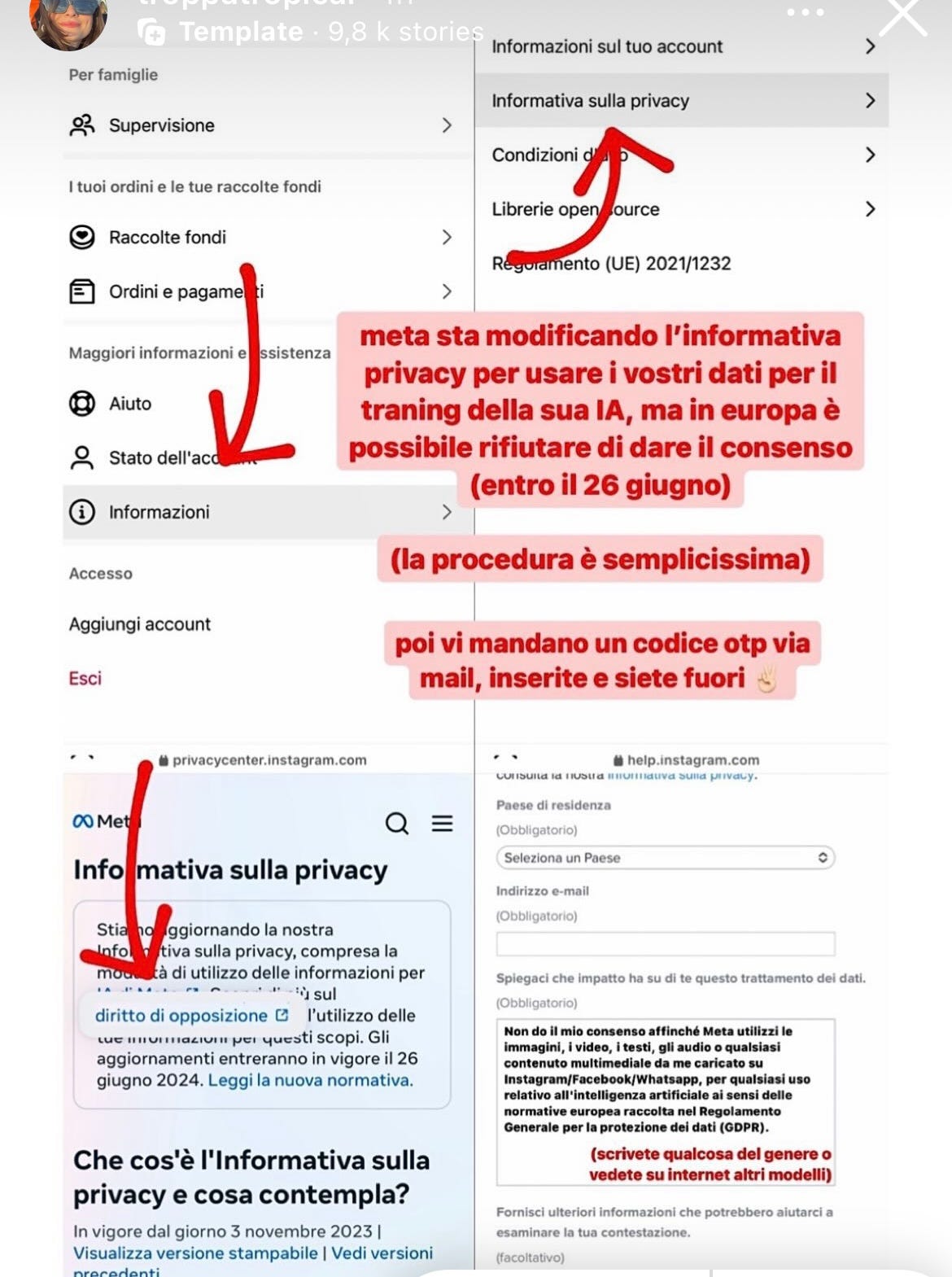 E no, non era una delle catene su Whatsapp che diventa a pagamento del 2012.
Anzi, era una utile guida per capire come impedire a Meta di utilizzare i nostri dati personali per addestrare le sue Intelligenze Artificiali. Dati che erano post, immagini, commenti, e storie degli utenti in UE e Regno Unito sia da Facebook che Instagram. Conversazioni private escluse, invece.
Questi dati sarebbero serviti a “riflettere le diverse lingue e riferimenti culturali, sociali e storici dei vari paesi europei” nelle IA di Meta, che sarebbero dovute arrivare tra pochi giorni. Una di queste era un assistente personale per ogni utente.
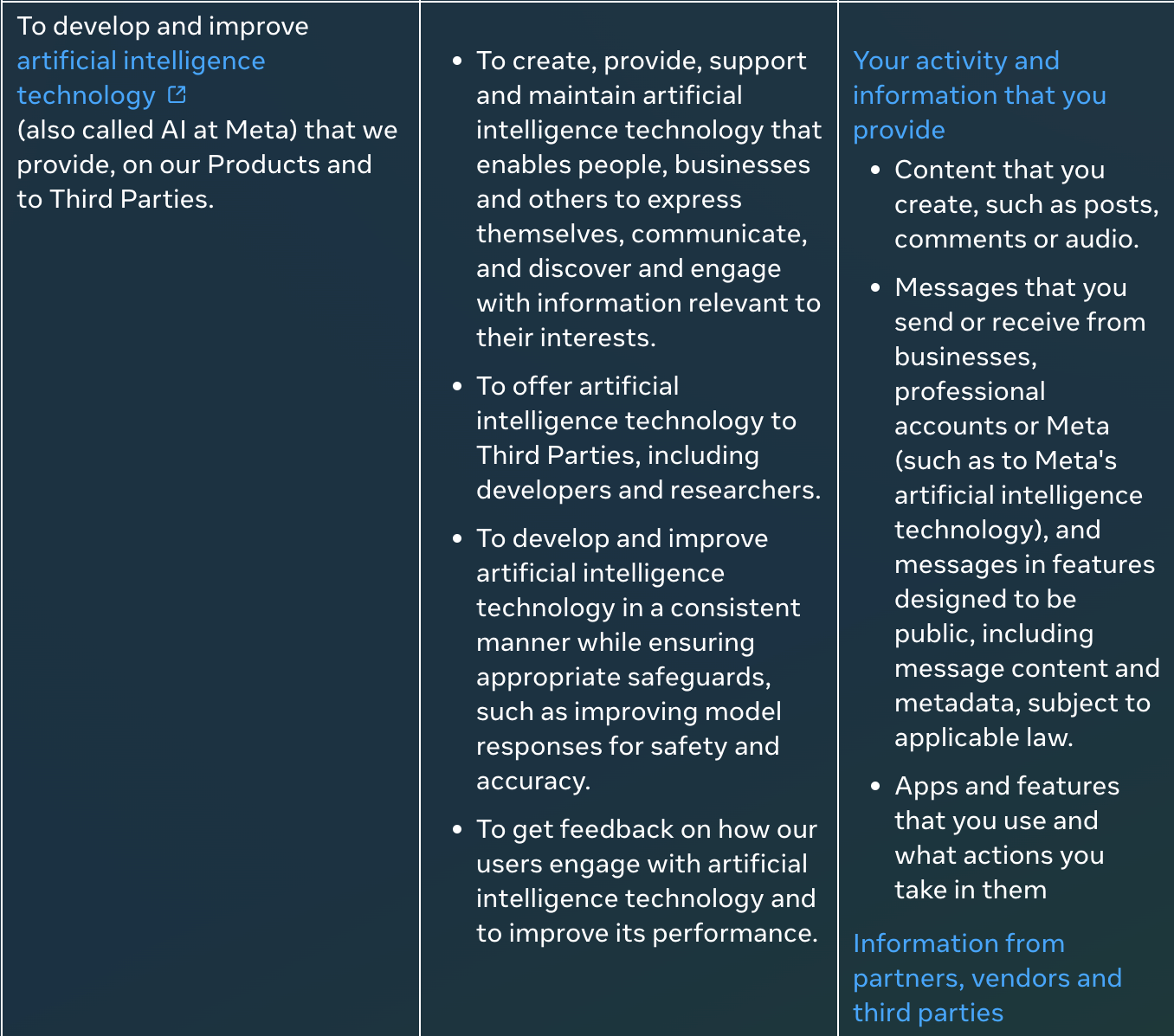 tutti i dettagli se ti interessano
Uso passato e condizionale perché, alla fine, Meta ha cambiato idea. Per il momento, mette in pausa l’utilizzo di questi dati e, di conseguenza, non arriveranno queste AI in UE e Regno Unito.
Meta si è detta “delusa” e che si tratta di “un passo indietro per l’innovazione europea, la competizione nello sviluppo dell’AI e i benefici dell’AI per gli europei”.
Framing, here we go, again.
------------------------------------------------------------------------
Quindi, sì, probabilmente aver condiviso quella storia e anche essersi districati nel non immediato modulo per negare il consenso all’utilizzo dei dati è stato, per ora, sostanzialmente inutile. Molto rumore per nulla, appunto.
Invece, più prezioso è stato il lavoro di NOYB, che il 6 giugno aveva inviato reclami a 11 autorità nazionali europee per la protezione dei dati. E sicuramente poi decisivi sono stati la Irish Data Protection Commission, l’autorità che in UE si occupa di Meta (e delle altre BigTech) in merito all’utilizzo dei nostri dati secondo il GDPR, e l’Information Commissioner’s Office, che ha compiti simili in Regno Unito.
Autorità che, infatti, sono menzionate da Meta nell’annuncio del cambio di posizione. In un comunicato uscito, tra l’altro, di venerdì pomeriggio, che non è sicuramente il momento migliore per dare rilevanza ad una notizia.
In questo caso, poco rumore per qualcosa di forse importante.
 Un megafono, forse muto. Creato con DALL-E
Comunque, anche se al momento questa vicenda è ferma, è uno spunto utile per capire diverse cose sull’AI e i nostri dati personali che, se è sbagliato concepire come il nuovo petrolio che alimenta l’IA, sono comunque tra i pilastri della rivoluzione che stiamo vivendo.
E allora questa Artifacts prima vede cosa ci “chiedeva” Meta e perché, poi cosa cambia ora che c’è l’AI per i nostri dati e infine perché in realtà potrebbe non cambiare niente o, comunque, questa potrebbe non essere una rivoluzione poi così nuova.
> ### La Storia
Innanzitutto, utilizzare dati personali in UE è illegale, di default. Perché sia permesso, infatti, serve una motivazione valida.
Nel concreto, qualsiasi azienda o terza parte raccolga e utilizzi dei dati personali, deve fare riferimento ad una delle giustificazioni elencate dall’art.6 del GDPR: consenso, legittimo interesse, necessità contrattuale, obbligo legale, vitale interesse, pubblico interesse.
Nel caso dell’addestramento delle IA, la questione è decisamente intricata, se non altro perché l’IA stessa non è MAI menzionata nel GDPR. Bisogna quindi riflettere sul GDPR e adattarlo.
Per l’accademia e lo European Data Protection Board (EDPB), le due basi considerabili per l’IA sono o il consenso o il legittimo interesse.
Il consenso prevederebbe che quelli che “producono” i dati, ossia i data subjects (noi), siano d’accordo che il data controller, Meta nel caso di sopra, li utilizzi per un certo scopo. Consenso che deve essere “dato liberamente, specifico e non ambiguo”, come spiegavo qui.
Nel caso dell’IA, però, il consenso a queste condizioni è molto difficile da ottenere perché gli utenti non necessariamente capiscono a pieno l’utilizzo dei dati, è molto difficile garantire totale trasparenza, e poi c’è una granularità molto alta dei dati stessi e quindi dei cittadini a cui chiedere.
Se il consenso, quindi, forse non è la base legale adatta al training dell’IA, lo è invece il legittimo interesse. Che, infatti, secondo l’EDPB “is probably the right one”.
3 condizioni da considerare sul legittimo interesse:
- che sia, appunto, legittimo, e quindi il data controller persegua scopi ragionevoli - fare il training;
- che ci sia una necessità per la quale è giustificabile l’utilizzo dei dati - no dati, no training;
- che sia bilanciato con i diritti e le libertà dei data subjects, considerando contesto, che dati sono utilizzati e l’impatto.
Condizioni, queste, più facili da rispettare rispetto a quelle del consenso per come funzionano i training delle IA. Anche perché, banalmente, il legittimo interesse può essere “presunto”, quindi non c’è bisogno di ottenere il “sì” dei data subjects.
Insomma, chi usa dati personali per il training delle IA sembra poter farlo perché ha un legittimo interesse.
Una prova ulteriore è che quando un anno fa il Garante Privacy fermava ChatGPT in Italia, riconosceva proprio il legittimo interesse come base plausibile per il trattamento dei dati.
E, se tutto questo rumore è stato per Meta, in realtà anche OpenAI, Twitter, Google, Snapchat dicono - dopo diversi scroll di mouse - di fare affidamento proprio sul legittimo interesse nelle loro Privacy policy. Anzi, almeno Meta è stata un po’ più chiara ed esplicita.
------------------------------------------------------------------------
Oltre alla base legale, però, questa vicenda è resa ancora più complicata da un altro fattore: in origine questi dati NON sono stati raccolti per il training delle IA.
Anzi, i dati in mano a Meta, Google, Twitter etc. sono stati raccolti nel corso degli anni per altri scopi, come ad esempio le pubblicità targetizzate. Però, con l’IA che ora è la priorità e i dati per addestrarla che sono preziosissimi, chiaramente chi ha dati a disposizione vuole usarli ANCHE per l’IA.
In gergo, si tratta di repurposing, ossia dare una nuova finalità a qualcosa che prima ne aveva una diversa.
Ed è un concetto chiave per il futuro del training dell’IA, che si affida prevalentemente su dati raccolti per scopi altri. Proviamo a capire come funziona.
Il GDPR stabilisce una purpose limitation, ossia che i dati sono raccolti per specifici ed espliciti scopi e non possono essere processati per scopi incompatibili con quelli originali.
Quindi? Va fatto un test di compatibilità per capire se il nuovo scopo - il training delle IA in questo caso - può reggere e se esista una base legale appropriata.
Per gli amanti dei bullet point, possiamo riassumere la liceità del repurposing in 2 condizioni:
- la nuova elaborazione dei dati è compatibile con quella originaria;
- esiste una base legale su cui fare affidamento, quella che secondo Meta e molti altri è il legittimo interesse.
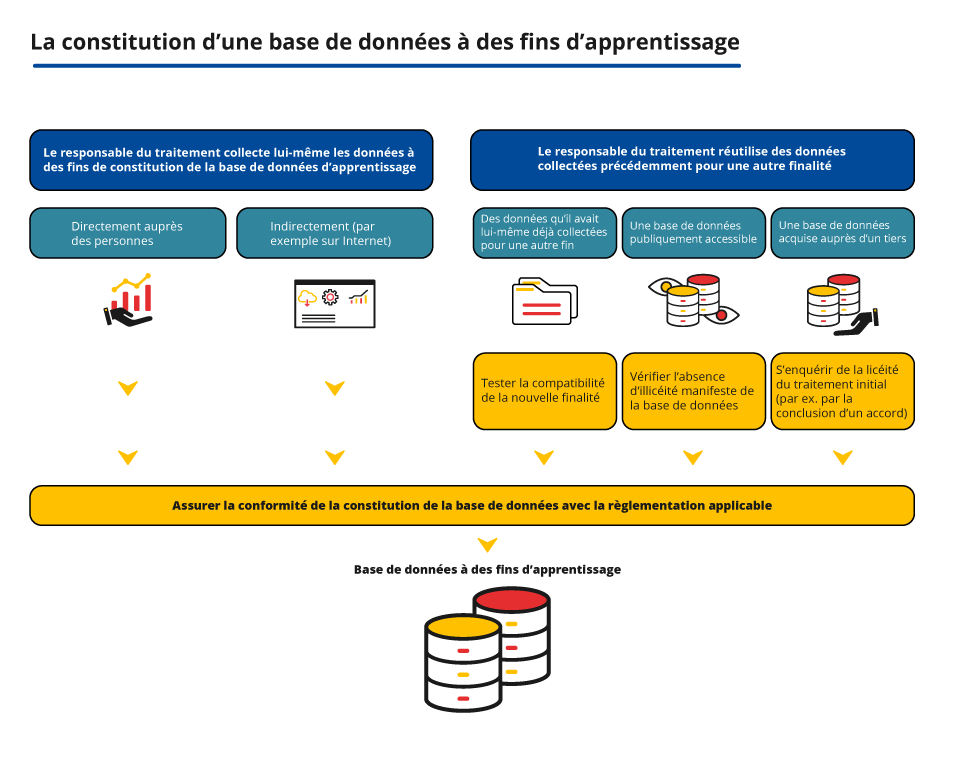 Nemmeno a dirlo, l’autorità per la protezione dei dati francese non ha tradotto questo schemino. Ma è ottimo, quindi lo riporto, e più info qui.
Questo, comunque semplificato, è quello che deve fare Meta o chi altro usa dei dati raccolti in passato per addestrare IA nel presente.
Qualora il repurposing sia possibile, tuttavia, rimane il right to object per i cittadini, che possono ovviamente opporsi all’uso dei loro dati personali. Ed è esattamente quello che Meta voleva permettere e il senso di quella storia Instagram da cui abbiamo iniziato.
------------------------------------------------------------------------
E, seppur ora magari questa vicenda specifica sia in pausa, tenere a mente queste regole è molto utile per i mesi che verranno.
Specialmente per le BigTech, per le quali i dati sono stati l’ingrediente essenziale del successo in passato, e rappresentano ora anche un vantaggio competitivo enorme per la corsa all’IA.
Una corsa nella quale non si riparte certo da zero, ma anzi chi ha dati, infrastrutture per processarli, risorse economiche, ed expertise, è già decisamente più avanti degli altri.
Tutte dinamiche per le quali, infatti, anche sull’IA a fare la voce grossa sono i soliti noti e, probabilmente, è anche difficile immaginare che vada diversamente.
Un vantaggio, sia chiaro, guadagnato e meritato nel tempo. Ma che, allo stesso tempo, non può tradursi nell’aggirare le regole sui dati personali.
Regole che abbiamo chiarito, ma ora bisogna vedere come va davvero la partita. Della quale, poi, forse abbiamo già avuto un assaggio.
> ### Save for Later
Perché il futuro digitale dell’Europa è meglio di quello che pensiamo.
C’è chi ha hackerato le elezioni europee, in positivo. Sembra sia andata bene sulla disinformazione, ma non benissimo.
Come invece l’estrema destra avrebbe utilizzato l’IA durante le europee.
Apple presenta la sua Apple Intelligence, che funziona perché è noiosa ma efficace. Un mio pensierino a riguardo:
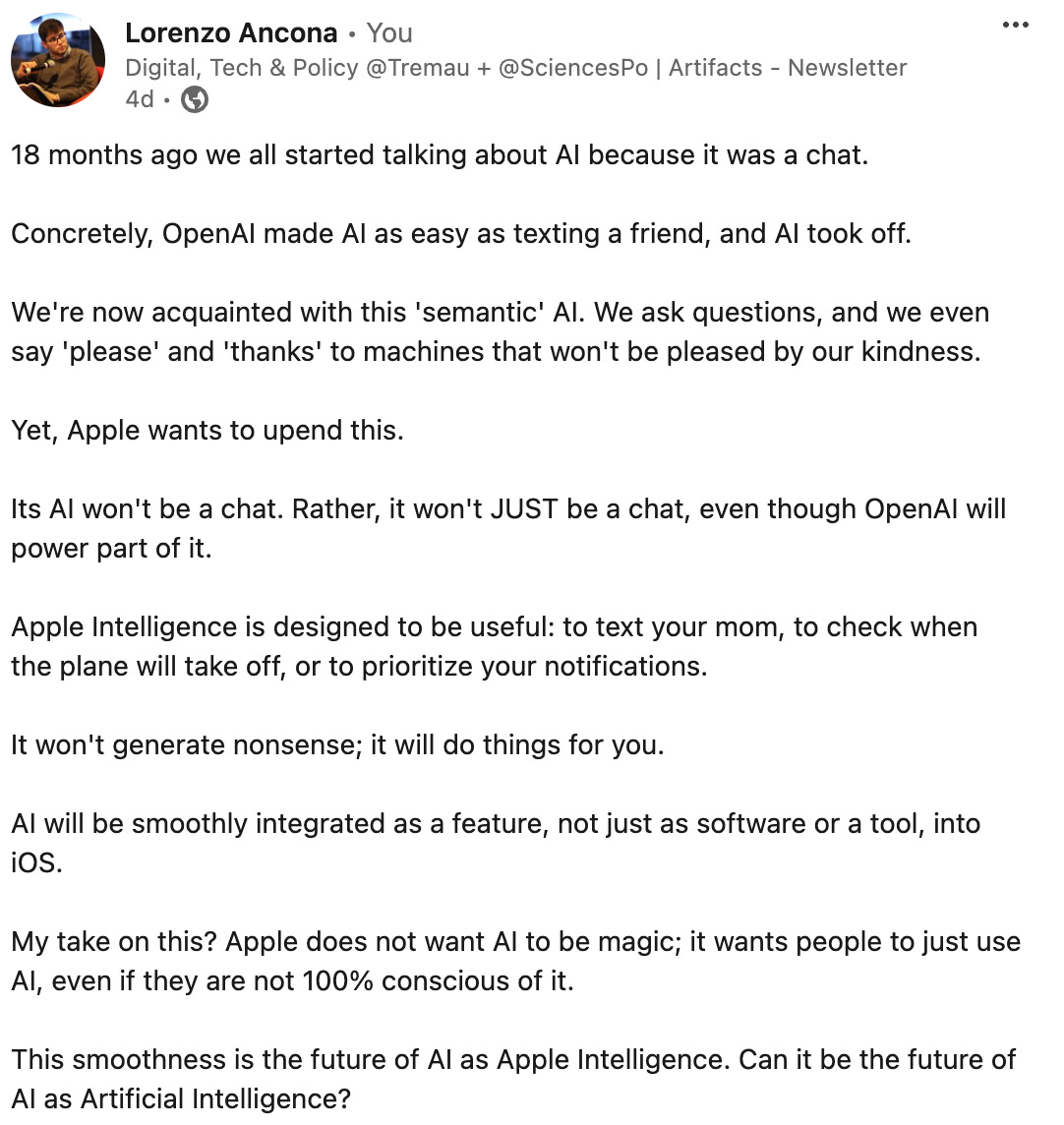 Come Google sta mandando all’aria Internet, dicono.
Tantissime cose utili da leggere su come funzionano gli algoritmi dei social.
Immanence, la startup di Diletta Huyskes sull’impatto sociale dell’Intelligenza Artificiale, cerca un Operations Manager.
 Sono stato al We Make Future a parlare di Artifacts, e di come la penso, la scrivo e la mando. Bella roba, insieme ad altri newsletterati.
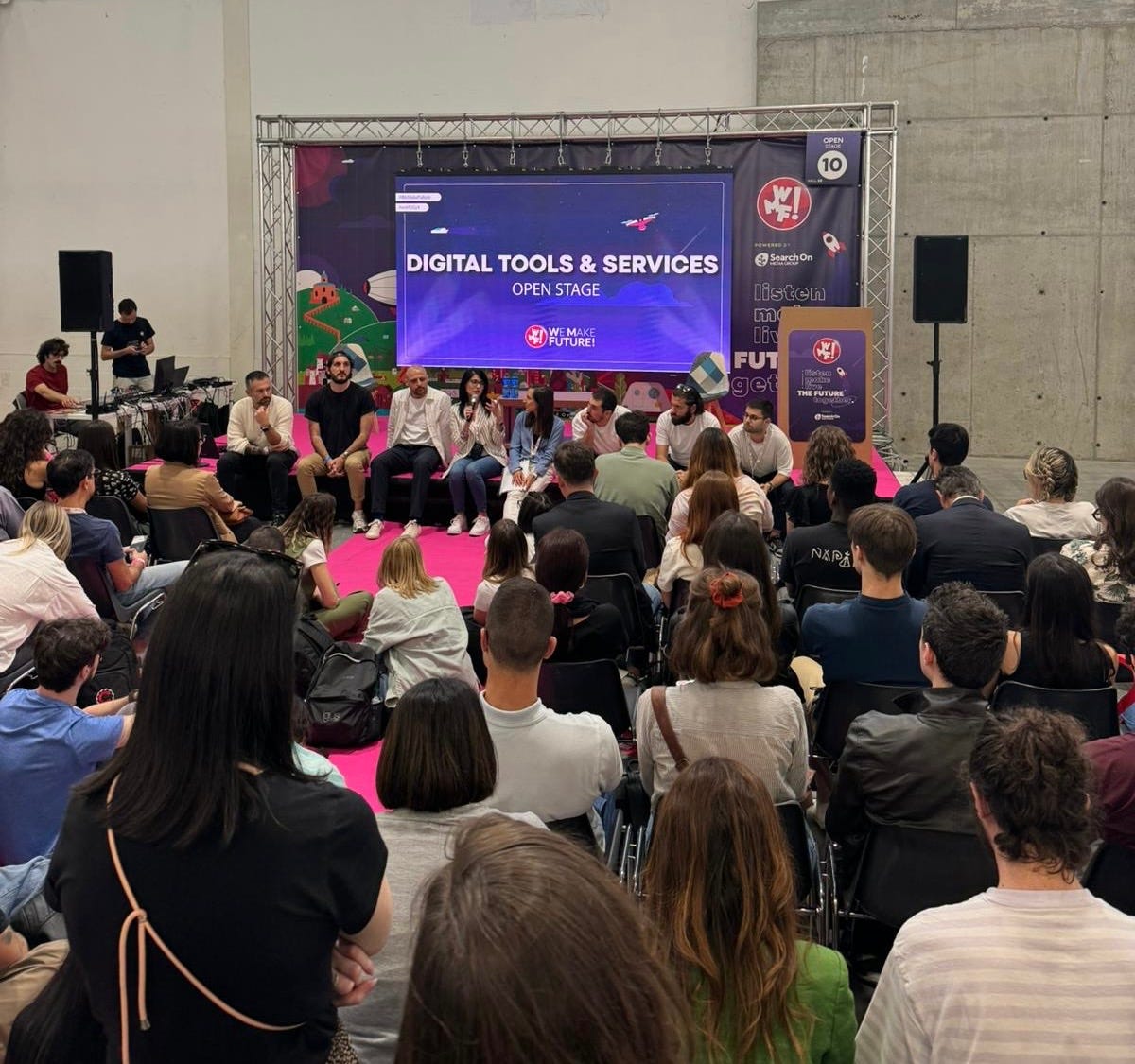 > ### Lo Scaffale
 Semplicemente uno dei miei libri preferiti sulla tecnologia. “Internet fatta a pezzi” di Stefano Quintarelli e Vittorio Bertola è una di quelle letture che non si possono non fare se si è interessati a Internet e le sue dinamiche politiche e economiche. Lo consiglio oggi perché sennò poi lo rimando sempre.
📚 Tutti, ma proprio tutti, i libri consigliati in Artifacts sono raccolti qui
> ### Nerding
 Per chi vuole tenere traccia dei propri pensieri in maniera ordinata, Diarium è fatta apposta. Conserva tutto in maniera crittografata, quindi è anche sicura e non rischi data leak dei tuoi pensieri.
======
# Partire dal(la) fine
Date: 2024-06-04 | Language: it
Canonical: https://artifactstech.substack.com/p/partire-dalla-fine
Cite as: Partire dal(la) fine by Lorenzo Ancona, Artifacts, 2024-06-04. https://artifactstech.substack.com/p/partire-dalla-fine (CC BY 4.0)
Tra giovedì e domenica circa 370 milioni di cittadini e cittadine europee avranno la possibilità di dare una direzione politica all’Unione Europea per i cinque anni avvenire. Come? Votando i propri rappresentanti al Parlamento europeo. In Italia, come saprai, le elezioni si terranno sabato e domenica.
Con il tuo voto contribuirai a scegliere le persone che saranno responsabili di discutere e adottare gli atti legislativi dell’UE e che eleggeranno il Presidente della nuova Commissione, l’organo esecutivo dell’UE, e ne sorveglieranno l’operato.
Con tutto quello che sta succedendo nel mondo - e non solo rispetto alla tecnologia - alimentare il progetto europeo è fondamentale. Prima di iniziare Artifacts, allora, ti invitiamo a trovare 10 minuti per andare alle urne e scegliere quale Europa vorresti vedere nei prossimi 5 anni.
------------------------------------------------------------------------
Quando si parla di partecipazione attiva, però, il voto è solo la punta dell’iceberg. Le democrazie hanno anche altri canali per ascoltare, in maniera più diffusa e permanente, le opinioni di cittadini e cittadine. Per l’UE, esperimento politico senza precedenti e per questo senza traiettoria definita, rimanere in costante ascolto dovrebbe essere ancora più rilevante, per cercare gli stimoli attraverso cui dare forma a questo progetto condiviso.
 Un iceberg, creato con DALL-E
Non stiamo certo cercando di sminuire la centralità del voto. Ma, se provi a immaginare la democrazia come un edificio, un gesto che fai ogni 3, 4, 5 anni ne può essere la pietra d'angolo, non l'intera struttura.
Per tenere in piedi questo fantomatico edificio sono utili anche mattoni e malta, ossia informarsi e provare a prendere parte a dinamiche nelle quali, in una maniera o in un'altra, poter dire la propria, pratiche che quelli bravi chiamerebbero di "democrazia partecipativa".
E quindi dibattiti organizzati per dare voce ed ascoltare i cittadini su temi specifici. Su Artifacts abbiamo visto, ad esempio, il caso di Taiwan o anche su come semplici cittadini insieme danno principi all'Intelligenza Artificiale.
Queste dinamiche sono recentemente cresciute in scala proprio grazie alla tecnologia. Se non altro perché ci permette di comunicare e scambiare idee all'istante con persone molto distanti da noi o addirittura in maniera asincrona. Esempio: nel 2011 Obama introduce "We The People", piattaforma che permetteva a chiunque negli USA di lanciare petizioni e portare certi temi all'attenzione della sua amministrazione. Oppure, a Parigi i cittadini hanno deciso online cosa fare di alcuni dei soldi pubblici destinati alla città.
Tuttavia, questi processi non accadono esclusivamente grazie alla tecnologia. Meglio, una piattaforma online di discussione può essere essenziale per facilitare la partecipazione, ma resta pur sempre un mezzo. Dunque, se un dibattito non accadrebbe senza tecnologia, deve prima essere ben pensato per invogliare i cittadini stessi a partecipare. Altrimenti alla tecnologia che lo abilita non si arriva nemmeno.
Può non essere un pensiero rivoluzionario, ma è cruciale per capire che un processo di democrazia partecipativa che non funziona bene non può essere risolto con un po' di internet e schermi touch, ma deve prima di tutto essere ripensato e aggiustato.
Insomma, pur sempre innovazione, ma democratica prima ancora che tecnologica.
------------------------------------------------------------------------
Nell'Artifacts di oggi, allora, proviamo a guardare a qualcuna di queste pratiche, provando a capire come innovare la democrazia. Ricordando poi che ruolo può avere la tecnologia e anche per la tecnologia, ma provando anche a capire da dove forse partire e come evitare altri iceberg, o scrutarne il sommerso.
Una Artifacts meno tecnologica, ma comunque innovativa.
> ### La Storia
Immagina di ricevere una chiamata, rispondere ed essere invitato a Bruxelles assieme a un centinaio di altre persone per discutere di spreco alimentare, efficienza energetica o metaverso… che fai? Se accettassi, saresti uno dei 150 partecipanti ai citizens’ panel dell’UE, l'iniziativa della Commissione europea “per una nuova fase di coinvolgimento dei cittadini”.
I panel sono la continuazione della Conferenza sul Futuro dell’Europa (CoFoE), uno dei più importanti esperimenti di democrazia partecipativa (transnazionale!) mai tentati, dai risultati discutibili e molto discussi. Svoltasi tra aprile 2021 e maggio 2022, la CoFoE si è articolata su più livelli: una piattaforma digitale multilingue, i panel europei e i panel nazionali.
Se la sua rilevanza è indubbia come esperimento unico per provare a dare forma al futuro dell’UE in modo partecipativo e paneuropeo, il suo impatto è difficile da misurare. Per esempio, alla piattaforma hanno contribuito attivamente 50.000 cittadini europei.
Tanti? Pochi? Difficile stabilire un criterio qualitativo per valutare la riuscita di una consultazione pubblica. Certo, se è vero che un numero elevato di interazioni tra cittadini non è di per sé garanzia di rappresentatività, è altrettanto vero che il coinvolgimento è stato piuttosto basso, se consideriamo che la platea di potenziali utenti attivi era di oltre 400 milioni di persone.
Tu ne avevi mai sentito parlare? Ecco, se la risposta è no, forse è stato questo uno dei più grandi fallimenti della CoFoE: non essere uscita dalla bolla delle persone interessate agli affari europei. L’altro è probabilmente lo scarso seguito che le istituzioni hanno dato alle 49 proposte elaborate dai cittadini e presentate nel report.
------------------------------------------------------------------------
Ma torniamo ai panel. Durante le sessioni, gruppi di partecipanti, selezionati casualmente e in maniera rappresentativa della popolazione europea, sono invitati a discutere un tema con l’obiettivo di formulare delle raccomandazioni alla Commissione europea.
Tra i temi trattati dai panel sin qui organizzati, tra l’altro, c’è anche l’Intelligenza Artificiale. In un panel che ha visto coinvolti 60 cittadini belgi, estratti a caso, tra febbraio e aprile 2024. E che hanno portato la loro visione, non necessariamente da esperti, su come l’IA stia toccando le loro vite e quello che pensano sul futuro. E quindi impatto su disinformazione, ambiente, lavoro, diritti umani e altri temi magari utili che trovi qui.
Un esempio, questo, di provare a democratizzare la riflessione collettiva sull’IA, facendo emergere le visioni, i timori, e magari le idee di chi nella vita si occupa di altro, ma che comunque incontra l’IA.
------------------------------------------------------------------------
Tuttavia, se lo erano le elezioni, forse anche i panel o la CoFoE possono essere considerati delle punte di un iceberg.
Spieghiamoci meglio: spesso la partecipazione o anche solo l’attenzione a pratiche come i panel riguardano le persone già interessate, e difficilmente va oltre. Su questo, quindi, la selezione randomica aiuta molto.
Esiste, però, un rischio di open-washing: organizzare processi partecipativi per il puro scopo di farlo e non per quello che dovrebbe essere il vero scopo, ossia coinvolgere i cittadini.
Ed un ragionamento simile vale per il tech-washing, ossia l’illusione di poter fare engagement dei cittadini semplicemente perché partecipare diventa più facile, o magari simile alle interazioni che abbiamo sui social media.
Insomma, non basta dire “partecipate” o “la facciamo digitale” per rendere la democrazia più attrattiva o interessante.
------------------------------------------------------------------------
Forse dovremmo partire da più lontano, spiegando perché è importante partecipare, in che modo la nostra voce può cambiare le cose. Nel caso dell’Unione Europea questo è ancora più difficile, perché la sfera sovranazionale è già complessa di suo e l’architettura istituzionale non semplifica le cose. Questo non vuol dire farsi intimidire, ma raddoppiare gli sforzi.
Insistere su informazione ed educazione è sicuramente più difficile di organizzare qualche panel all’anno. Tuttavia, vale la pena provare andare sotto la superficie dell’acqua e fare i conti con l’intero blocco di ghiaccio galleggiante.
Perché se capiamo che l’UE ci importa saremo più disposti a rispondere sì alla famosa chiamata della Commissione che ci invita a un panel, o saremo addirittura noi a organizzarne uno nel nostro quartiere, nel nostro comune.
E allora? Ripartiamo dal fine: se vogliamo coinvolgere i cittadini, diamo loro gli strumenti per potersi sentire parte di quell’edificio comune che è la democrazia. Ripartiamo dalla fine: delapiti i panel e la democrazia partecipativa, prepariamo il percorso che porta a renderli efficaci.
Leave a comment
> ### Save for Later
Ho fatto un librettino sulla ultima Artifacts! Lo scarichi da qui
The Atlantic, probabilmente mia rivista preferita, è una delle tante a fare un accordo con OpenAI. Il suo CEO ha spiegato perché, benissimo.
Ma che abbiamo capito come funziona Google? No, ma ne sappiamo un po’ di più.
Influencers russi finti vanno virali in Cina. E perché preoccuparsene. Mentre OpenAI dice che i suoi tool vengono usati per influenzare gli elettori.
Insomma, se vuoi capire tutto quello che succede tra GenAI e elezioni, Wired ha fatto un lavorone.
E poi un’opinione secondo me condivisibile su Elon Musk.
Ho visto questo commento interessante:
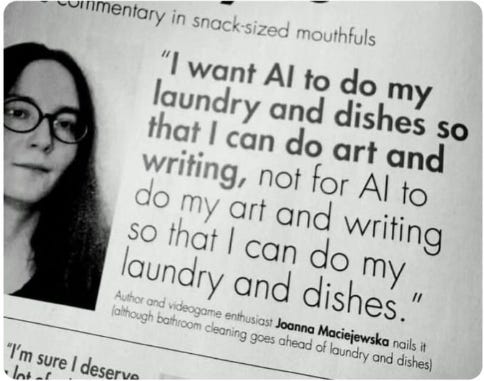 > ### Lo Scaffale
 A proposito di educare alla partecipazione attiva, Alberto Alemanno lo fa egregiamente nel suo Lobbying for change. Un libro per conoscere nuovi modi in cui possiamo far sentire la nostra voce e per capire che non tutto il lobbying vien per nuocere.
📚 Tutti, ma proprio tutti, i libri consigliati in Artifacts sono raccolti qui
> ### Nerding
 Dato che negli ultimi giorni ho dovuto montare diversi video, ho pensato che CapCut è uno di quei tool tanto semplici quanto necessari. Serve, indovina indovina, proprio a montare video. Ed è strasemplice, mette i sottotitoli, comoda da usare. Must-have sul cellulare.
======
# Anche queste sono piattaforme
Date: 2024-05-28 | Language: en
Canonical: https://artifactstech.substack.com/p/anche-queste-sono-piattaforme
Cite as: Anche queste sono piattaforme by Lorenzo Ancona, Artifacts, 2024-05-28. https://artifactstech.substack.com/p/anche-queste-sono-piattaforme (CC BY 4.0)
In Artifacts ne parlo da un mesetto: 8 e 9 giugno si vota per le elezioni europee.
Non credo nessuno si senta di negare che - fatti salvi alcuni progetti - la campagna elettorale è stata a tratti assente o scadente, finora.
Allora, la Artifacts di oggi vuole essere di pubblica utilità.
E se di solito quando parliamo di piattaforme ci riferiamo alle BigTech, oggi parliamo di “platforms” diverse, ossia i programmi dei partiti europei. Che, appunto, nella lingua di Shakespeare si chiamano anche “platforms”.
E così ho letto tutti i programmi dei partiti europei e ho riportato qui le loro misure, idee, proposte, ambizioni, su tecnologia e digitale.
Perché i partiti europei e non quelli nazionali? Perché è così che andrebbero guardate queste elezioni, e a maggior ragione sulle politiche digitali.
Magari questa Artifacts ti aiuta a capire chi votare :)
 Un fake fac-simile, ma rende l’idea. Creato con DALL-E
------------------------------------------------------------------------
I partiti europei dei quali ho analizzato i manifesti, con rispettivi partiti italiani, sono: 🔵 European People’s Party (Forza Italia), 🔴 Socialists & Democrats (Partito Democratico), 🟡 Renew Europe, (Azione, +Europa, Italia Viva (che hanno la brillante idea però di correre separati in Italia)), 🔷️ European Conservative Party (Fratelli d’Italia), 🟢 Greens (Verdi), 🟣 Left (Rifondazione Comunista). Purtroppo Identity & Democracy, il partito a cui appartiene la Lega, non ha un manifesto da analizzare.
In brevissimo, così è come ho fatto l’analisi:
- Ho letto velocemente tutti i manifesti e ho identificato le macro-categorie di policy: Intelligenza Artificiale, Data Governance e Privacy, Lotta alla disinformazione, Online Safety, Ricerca, Innovazione e Investimenti in Tecnologia, Concorrenza e Mercato Unico per il Digitale, Digital Freedoms e Diritti Umani; ce n’erano altre ma poi diventava un papiro
- Ho caricato, uno ad uno, i manifesti su Claude 3 Opus, uno dei modelli di IA Generativa più potenti, con questo prompt:
 E questo è un esempio di quello che mi ha restituito:
 - Ho poi riletto i manifesti in maniera mirata, aggiustando dove Claude non è stato preciso e integrando i punti che aveva mancato, ma anche riorganizzando la categorizzazione.
------------------------------------------------------------------------
Diversamente da quanto di simile già fatto da Wired, quindi, il criterio di divisione sono le aree di policy, e non i partiti.
Inoltre, anche se è stato particolarmente difficile, ho cercato di privilegiare le misure in cui oltre al cosa fare era anche indicato il come farlo, che è spesso una rarità nelle promesse della politica.
E, diversamente dal solito, è una newsletter decisamente più analitica e schematica, anche nella struttura, che vuole organizzare e sistemare delle informazioni, senza troppi ragionamenti.
Chiaramente, non ho pretese di esaustività e in fondo indico i manifesti se sei interessato ad approfondire e a vedere quali partiti più di altri si siano impegnati a definire un programma chiaro.
Questa Artifacts, allora, vuole capire cosa propongono i partiti, vedere dove divergono e dove sono allineati e, infine, provare anche a immaginare quali potranno essere priorità e temi caldi dei prossimi anni a Bruxelles.
> ### La Storia
\[Premesse necessarie: si tratta dei punti essenziali di ciascun programma e qualsiasi omissione non significa necessariamente che un certo partito non abbia una posizione su uno specifico tema. Inoltre, come vedrai, non tutti i partiti danno la stessa importanza alle stesse aree\]
#### Intelligenza Artificiale
- 🔵 European People’s Party (EPP):
- Evitare che l’eccesso di regolamentazione possa limitare e ostacolare lo sviluppo e l’impiego di IA
- Creare un centro di eccellenza in UE, una sorta di CERN per l’IA
- Assicurarsi che l’IA rispetti gli standard etici e i diritti dell’UE e che permetta una vita migliore per i cittadini
- 🔴 Socialists & Democrats (S&D):
- Sviluppare l’IA secondo il principio “human in control”
- Approvare una Direttiva per regolamentare l’uso dell’IA negli ambienti lavorativi per proteggere i lavoratori, con attenzione al management degli algoritmi
- Promuovere partecipazione di genere uguale nel design e implementazione di tecnologie, principi etici e norme
- 🟡 Renew Europe (RE):
- Stimolare una visione europea dell’IA fondata sull’uomo per prevenire qualsiasi rischio di derive autoritarie e nel rispetto dei diritti fondamentali
- Espandere l’ambito del DMA alle tecnologie di IA per garantire maggiore competitività, anche grazie alla cooperazione internazionale
- 🔷️ European Conservative Party (ECR)
- Opposizione completa all’uso di sistemi di social scoring o sorveglianza di massa
- Favorire le sandboxes per testare i sistemi di IA in ambienti sicuri, bilanciando progresso e rischi
- 🟢 Greens:
- L’IA deve funzionare per le persone e il pianeta, non per la sorveglianza degli stati o il capitalismo tecnologico; di conseguenza, implementare il principio che siano gli umani a controllare i sistemi di IA nel rispetto della autonomia e dignità umana;
- Ban su pratiche come sorveglianza di massa biometrica, riconoscimento delle emozioni o dell’orientamento sessuale e predictive policing
- I lavoratori non possono essere monitorati da sistemi basati su IA e devono sempre avere il diritto di disconnettersi da qualsiasi sistema di IA sul luogo di lavoro
- 🟣 Left
- Ban totale a sorveglianza biometrica, riconoscimento facciale e predictive policing
------------------------------------------------------------------------
#### Data Governance e Privacy
- 🔵 EPP:
- Aggiornare le regole sulla protezione dei dati (GDPR)
- Sviluppare una infrastruttura che faciliti lo scambio e l’accessibilità dei dati tra i diversi paesi
- 🔴 S&D:
- Aggiornare il regolamento e-Privacy per meglio proteggere la comunicazione tra cittadini
- Ban su qualsiasi monitoraggio o identificazione delle attività dei cittadini
- 🟡 RE:
- Evitare che i tentativi di garantire la sicurezza online impattino la privacy delle comunicazioni tra i cittadini
- 🔷️ ECR:
- Supportare il Once-Only Principle (Artifacts ne ha parlato qui) per limitare qualsiasi peso amministrativo per cittadini e aziende
- Opposizione a qualsiasi tentativo di de-anonimizzare internet attraverso l’utilizzo di eID
- 🟢 Verdi:
- Introdurre un European Data Space per dati sulla società anonimizzati al servizio del bene comune, come la lotta al cambiamento climatico e la ricerca medica; interoperabilità al centro;
- Digital Fairness Act per proteggere le persone dalle pratiche intrusive della pubblicità online
- Adeguare la legislazione europea per proteggere i cittadini dall’abuso di spyware e rendere gli stati membri accountable per qualsiasi sorveglianza per la pubblica sicurezza
- Supporto alla data dignity, per cui i dati generati dagli umani appartengono a chi li crea e non possono essere sfruttati gratis da sviluppatori IA for profit
- 🟣 Left:
- no info disponibili
------------------------------------------------------------------------
#### Lotta alla disinformazione (che sappiamo bene essere controversa)
- 🔵 EPP:
- Maggiore responsabilizzazione delle piattaforme nella lotta alla misinformazione e disinformazione grazie alla collaborazione con organizzazioni giornalistiche e fact-checkers
- Proteggere i cittadini da ogni forma di fake news e interferenza straniera assicurando un’informazione di qualità e migliorando l’educazione in digital literacy
- 🔴 S&D:
- Assicurarsi che ciò che è illegale offline lo sia anche online (applicare il DSA, in breve)
- Implementare regole per difendere l’UE dalle interferenze straniere e dalla disinformazione
- 🟡 RE:
- Implementare le regole stabilite nell’EU Code of Conduct on Disinformation, con particolare attenzione alla disinformazione proveniente da governi non europei
- Creare un European watchdog per proteggere e promuovere l’indipendenza e la libertà dei media e dare il via ad un European fund for independent media che supporti le realtà editoriali colpite da Strategic Lawsuits Against Public Participation (SLAPPs).
- 🔷️ ECR:
- Assicurare che il contrasto alla disinformazione non comprometta la libertà di espressione e, quindi, evitare qualsiasi forma di eccessiva sorveglianza o censura online nei confronti delle posizioni non mainstream
- 🟢 Verdi:
- Continuare il contrasto alla disinformazione per garantire il funzionamento e la fiducia nelle istituzione democratiche
- 🟣 Left:
- no info disponibili
------------------------------------------------------------------------
#### Online Safety
- 🔵 EPP:
- Piano di azione e regole vincolanti contro gli abusi, lo sfruttamento sessuale, e cyber minacce a bambini. Il cyberbullying va considerato come reato;
- Implementare il DSA e la European strategy for a better internet for kids per garantire la sicurezza dei bambini online
- Investire sul supporto a minori vittime di abusi online, inclusi il reporting anonimo, servizi psicologici per le famiglie e training a educatori e autorità di enforcement
- 🔴 S&D:
- Implementare regole per salvaguardare le democrazie da hate speech, violenze e abusi online
- Creazione di un centro indipendente europeo per coordinare il contrasto agli abusi sessuali su minori
- 🟡 RE:
- Creazione di un European Digital Watchdog per contrastare qualsiasi forma di minaccia online, come il cyberbullying
- 🔷️ ECR:
- Stabilire delle regole per permettere ai genitori, e non allo stato, di controllare le attività online dei minori
- 🟢 Verdi:
- Continuare enforcement del DSA e rendere le piattaforme soggette a scrutinio pubblico e trasparenza sulla rimozione dei contenuti illegali
- Rendere dei crimini punibili manifestazioni o gesti di odio online, specialmente quelli indirizzati alle donne e alle persone appartenenti a minoranze
- 🟣 Left:
- no info disponibili
------------------------------------------------------------------------
#### Ricerca, Innovazione e Investimenti in Tecnologia
- 🔵 EPP:
- Spendere il 4% del PIL europeo in ricerca e innovazione entro il 2030
- Creare una infrastruttura per lo sviluppo e l’innovazione in semiconduttori
- Investire nelle nuove tecnologie al servizio della Difesa Europea
- Fare dell’UE il centro globale di innovazione nel settore della Sanità
- Lanciare un programma per accrescere il numero di start-up guidate da donne
- 🔴 S&D:
- Creare un Investment Plan for the Green and Digital Transitions per creare nuovi lavori e re-industrializzare l’economia
- Assicurare l’accesso all’educazione di base sulla tecnologia digitale per tutti i cittadini e promuovere lo studio delle materie STEM specialmente nelle regioni più indietro
- Investire nella infrastruttura digitale di base per garantire l’accesso ad una connessione Internet veloce in tutta Europa
- 🟡 RE:
- Investimenti pubblici a livello europeo per promuovere la cooperazione nello sviluppo di tecnologie
- Investire nella formazione e upskilling dei cittadini europei in aree critiche come la cybersecurity
- Accelerare la diffusione della rete ad alta velocità e ridurre il gap nelle aree più indietro tramite la cooperazione pubblico-privato
- 🔷️ ECR:
- Accelerare gli investimenti in tecnologie critiche come l’IA, 5G e 6G e il quantum computing soprattutto attraverso il programma Horizon Europe
- 🟢 Verdi:
- Legislatura che favorisca il riuso e il riciclo di device digitali e tagli il consumo di energia collegato al data processing e alle cryptocurrencies
- 🟣 Left:
- Allocare il 7% del Pil europeo per educazione, ricerca e innovazione
------------------------------------------------------------------------
#### Competitività e Mercato Unico per il Digitale
- 🔵 EPP:
- Creare un vero e funzionante Digital Single Market a partire dal Single Market
- Supportare la ricerca e lo sviluppo di tecnologie di IA valide sia per scopi civili che militari
- Creazione di un Single Market per la difesa europea ad alto potenziale tecnologico per favorire l’autonomia strategica
- 🔴 S&D:
- A favore dell’Inclusive Framework di OECD e G20 per una global tax del 15% sulle BigTech per mettere fine al fenomeno della tax avoidance
- Creare un European Single Market for AI chiarendo i ruoli dei diversi attori coinvolti nella supply chain per favorire l’innovazione e le opportunità economiche e tecnologiche.
- 🟡 RE:
- Modernizzare il Single Market per migliorare l’autonomia strategica tramite una regolamentazione più efficiente e una migliore integrazione economica
- Rafforzare la European Capital Markets Union e la Banking Union per favorire gli investimenti anche in tecnologia
- Supportare le imprese innovative europee nella crescita e nella capacità di attrarre quote di mercato esterne all’UE
- 🔷️ ECR:
- Chiedere alla Commissione di presentare una visione per il digitale in UE che la posizioni come rivale credibile di Cina, Stati Uniti e India
- Dare priorità alle piccole e medio imprese per non ostacolarne la crescita con la regolamentazione e favorirne l’adozione della tecnologia
- Rafforzare il mercato unico digitale e rimuovere gli ostacoli alla circolazione e vendita di tecnologie in UE
- 🟢 Verdi:
- Assicurare che le persone ricevano informazioni chiare rispetto all’impatto ambientale dei prodotti digitali che vengono venduti nel mercato unico
- Attribuire maggiore responsabilità ai marketplace online per i prodotti che vendono e intraprendere procedure di testing della sicurezza di queste piattaforme
- La BCE dovrebbe offrire un euro digitale pubblico come alternativa ai sistemi di pagamento digitali privati
- 🟣 Left:
- no info disponibili
------------------------------------------------------------------------
#### Digital Freedoms e Diritti Umani
- 🔵 EPP:
- Aggiornare l’EU charter of fundamental rights alla luce dei cambiamenti della rivoluzione digitale
- Lotta ad ogni forma di discriminazione, intolleranza, violenza, antisemitismo negli spazi digitali
- 🔴 S&D:
- Proteggere i cittadini da ogni rischio o uso malevolo di tecnologie come l’IA o il management tramite algoritmi nei luoghi di lavoro
- Proteggere i cittadini da hate speech, violenza online e abusi sessuali
- 🟡 RE:
- Divieto all’utilizzo di qualsiasi tecnologica che impatti negativamente l’esercizio dei diritti fondamentali dei cittadini o possa portare ad una deriva autoritaria
- 🔷️ ECR:
- Evitare qualsiasi tipo di controllo dello stato sulla libertà di espressione dei cittadini
- 🟢 Verdi:
- Introdurre misure che riducano l’orario di lavoro e migliorino il work-life balance, inclusi il diritto alla disconnessione, il diritto al lavoro da remoto e la flessibilità nelle ore di lavoro
- Riconoscere i platform workers come veri e propri dipendenti, ai quali spetta il salario minimo, i contratti collettivi e tutte le garanzie dei lavoratori dipendenti
- 🟣 Left:
- Garantire il supporto e l’accesso alla tecnologia per i cittadini più anziani e quelli con disabilità per evitare il rischio di digital exclusion
- Limitare i rischi legati all’introduzione di tecnologie digitali nel mondo dell’educazione e della formazione
------------------------------------------------------------------------
Per EPP, questo è il Manifesto, qui invece manifesto e altro documento utile per S&D, mentre qua le posizioni di Renew. Sui Green, questo il manifesto (che è bellissimo da vedere), qua invece per ECR, e infine qui se vuoi sapere di più su Left.
Leave a comment
> ### Save For Later
Vuoi imparare a scrivere i miglior prompt per l’AI? Te lo insegna Anthropic, la società che sviluppa Claude. E qui invece la loro libreria con i prompt già scritti.
Sempre Anthropic ha scoperto come provare a controllare e capire come “pensano” le AI. Interessantissimo e promettente. Nel frattempo a Stanford classificano la trasparenza dei chatbot.
E se i computer tornassero di moda grazie all’AI?
E se invece Internet fosse finto?
Arriva l’Identità digitale per i cittadini europei. L’UE ti spiega tutto e Artifacts ne aveva parlato qui:
 #### Dimostrare chi sei, davvero
Lorenzo Ancona·5 December 2023Read full story
 Se capiti a Roma, giovedì in Senato c’è questo bel evento organizzato da Hermes, Privacy Network e The Good Lobby su IA, diritti umani, e come la pensa la società civile. Per iscriversi basta scrivere a laura.ferrari@thegoodlobby.it
> ### Lo Scaffale
 Se è vero che le regole dell’UE influenzano il resto del globo, forse è bene conoscerle, come abbiamo provato a fare oggi. O almeno così sostiene Anu Bradford nel suo “The Brussels Effect”, che è proprio un must-read per chi fa cose europee.
📚 Tutti, ma proprio tutti, i libri consigliati in Artifacts sono raccolti qui
> ### Nerding
 Se hai tantissime cose da fare, ecco UseClear ti aiuta quantomeno ad organizzarle e lo fa con un design semplicissimo ma direi efficace. L’ho usata e funziona bene se hai tante task su un progetto singolo.
======
# Mica è illegale essere stupidi
Date: 2024-05-21 | Language: it
Canonical: https://artifactstech.substack.com/p/mica-e-illegale-essere-stupidi
Cite as: Mica è illegale essere stupidi by Lorenzo Ancona, Artifacts, 2024-05-21. https://artifactstech.substack.com/p/mica-e-illegale-essere-stupidi (CC BY 4.0)
Con le elezioni europee sempre più vicine, le homepage dei siti che piacciono a chi gradisce i temi di Artifacts e i report di certi think tank (ri)tornano a parlare di una questione sempreverde:
la disinformazione online.
Che è abbastanza rilevante in un periodo nel quale i cittadini decidono (o confermano) a chi dare il loro voto.
Ursula Von der Leyen, che vorrebbe continuare a fare il lavoro che fa ora, vorrebbe una nuova legge per contrastare le campagne di disinformazione che arrivano da Russia e Cina. Dovrebbe chiamarsi “Europe Democracy Shield”, e farebbe squadra con DSA e AI Act.
Josep Borrell, Alto rappresentante dell’UE per la politica estera, qualche mese fa diceva “unchecked, malicious content spreads like a cancer and puts the health of our democracies at risk”. Anche lui additando la Russia come prima responsabile.
E sì, le campagne di disinformazione che arrivano da paesi extra-UE sono e sono state una minaccia importante. Ma sono solo un pezzo di un puzzle decisamente più complesso.
Proviamo a scomporlo (o a comporlo, come preferisci).
------------------------------------------------------------------------
Mark Scott, uno tra i giornalisti più autorevoli sul tech in UE, sostiene che troppa attenzione alla Russia dia l’impressione di un’influenza maggiore a quella che realmente esercita. Ma, soprattutto, ignora che molta della disinformazione che circola in UE è anche confezionata in casa nostra.
E c’è di più. Spesso pensiamo alla disinformazione come mera circolazione di notizie manifestamente false, tipo che i vaccini farebbero morire o che tutti gli omicidi li fanno gli immigrati. La realtà è, come accade spesso, più sfumata.
La disinformazione può essere nel modo di porre i fatti, il cosiddetto framing, ad esempio scrivere “Ormai i cuochi delle nostre città sono tutti stranieri”. Come se fosse necessariamente un problema.
Ma può anche essere ingigantire certe notizie vere, come invadere i feed con un preciso evento selezionato per fare scalpore. Tipo che i soldati ucraini avrebbero compiuto un crimine efferato, come fosse un incidente isolato e che non riguarda l’altra parte dello schieramento.
E disinformazione può pure essere collegare due storie vere ma senza nessun legame. Il tradizionale correlation is not causation, tipo questo qui:
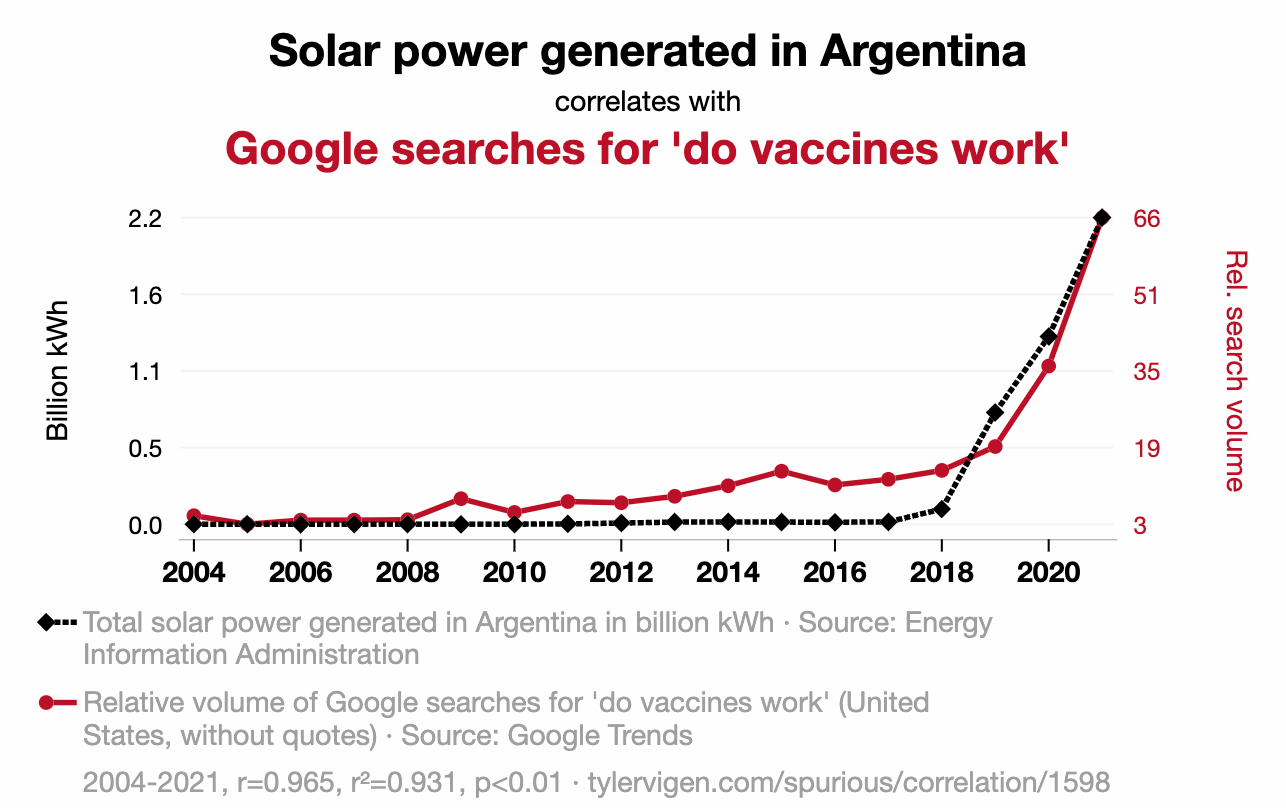 Se non lo conosci, visita subito questo sito GENIALE sulle correlazioni spurie
Insomma, non è immediato definire cosa sia la disinformazione, e questo è decisamente problematico se vogliamo metterle un freno.
Due notizie ugualmente false sono ugualmente pericolose? Una notizia di Lercio va considerata disinformazione come una fake news fatta circolare da un sito affiliato alla Russia? Con quale criterio giudichiamo? La pericolosità, o forse lo scopo, o l’impatto? Tutte domande davvero delicate.
------------------------------------------------------------------------
Forse, lo stesso tentativo di definire un concetto elusivo come la disinformazione è pericoloso o addirittura inutile perché troppo discrezionale. O almeno così sostiene lo Special Rapporteur per la libertà di espressione delle Nazioni Unite.
E non è nemmeno chiaro chi dovrebbe definire cosa sia disinformazione. I governi? Pericolo di derive autoritarie. Le piattaforme? Non chiaro su che basi. Fact-checkers? Da chiarire gli incentivi. Complicato.
Comunque, il cuore di questa vicenda è che la disinformazione non è illegale. È vero che in essa c’è la pericolosa intenzione di ingannare, ma renderla illegale significa limitare la libertà di esprimere delle opinioni (anche fondate su fatti non veri), che è alla base dei sistemi liberali.
Per questo, è estremamente pericoloso rimuovere tout court certi post, ma è possibile trovare delle contromisure, come limitarne la circolazione sulle piattaforme, aggiungere delle etichette o fornire maggior contesto all’utente.
Anche qui, però, resta un paradosso, un dilemma sottile ma essenziale: qualsiasi azione o decisione che, in qualche misura, limita la possibilità di dire o far circolare una certa informazione o opinione impatta il diritto alla libertà di espressione.
A questa cosa bisogna stare molto attenti, in UE abbiamo gli strumenti per farlo, ma è anche prioritario non oltrepassare una certa linea rossa. Di questo e altro, se ne ragiona in questa Artifacts.
 Eccezionalmente per oggi basta bianco e nero. Comunque disegnata con DALL-E
> ### La Storia
Una prima pietra miliare della lotta contro la disinformazione è il “Code of practice of disinformation”, pubblicato nel 2018 per le elezioni europee dell’anno successivo. Nel 2022, poi, è stato aggiornato e rafforzato guadagnando maggiore credito con vari nuovi firmatari.
In quanto Code of Practice, non aveva (e non ha tuttora) forza di legge, ma allinea le piattaforme su strategie per ridurre la disinformazione. Chiaramente, per le piattaforme non è obbligatorio sottoscriverlo, ma si può dire che sia caldamente consigliato. Ad oggi, tra le maggiori piattaforme, solo X non lo sottoscrive o, meglio, ha smesso di farlo dopo l’arrivo di Elon Musk.
Prima o poi i principi che elenca dovrebbero entrare a far parte del Digital Services Act (DSA), ma ancora da capire come.
------------------------------------------------------------------------
Ecco, qui bisogna fermarsi e chiarire dei punti chiave sul DSA.
Diversamente da quanto sostengono individui che fanno disinformazione, il DSA in nessun modo vuole essere un Ministero della Verità Orwelliano o allineare i cittadini al fantomatico politicamente corretto. Piuttosto, come abbiamo già visto, l’obiettivo è far sì che ciò che è illegale offline secondo le leggi nazionali dei paesi membri lo sia anche online.
Di conseguenza, dato che - lo ripetiamo - la disinformazione non è illegale, non è il focus primario del DSA. Tant’è che nel regolamento viene menzionata solo nei consideranda e comunque mai definita, diversamente dai contenuti illegali.
Se fossero gli appunti di una lezione, scriverei che c’è una differenza chiara tra i contenuti illegali, come video di abusi sessuali, e quelli pericolosi, come la disinformazione.
Tuttavia, non solo le malelingue ma anche la Commissione e alcuni suoi rappresentanti a volte si lasciano scappare eccesivamente la parola “disinformation” quando si parla di DSA. Un caso abbastanza palese è quello delle recenti linee guida per le piattaforme in vista delle elezioni, dove si parla più volte di disinformazione, tra l’altro senza darne una definizione.
------------------------------------------------------------------------
Attenzione: non sto certo denunciando una deriva autoritaria, ma segnalando una tendenza che esula da quello che dovrebbe essere il compito del DSA e un principio chiave per l’enforcement del regolamento.
Su questo mi faccio aiutare da Martin Husovec, uno degli accademici migliori su DSA, che ha scritto un paper brillante a riguardo: “The Digital Services Act’s Red Line: What the Commission Can and Cannot Do About Disinformation”.
Dato che il DSA contiene solo le regole su come contrastare qualcosa di illegale, ma non su cosa sia illegale, la Commissione si rifà alle leggi nazionali e le applica ai servizi digitali. In tal senso, ha 2 vincoli essenziali:
1. quello del principio di legalità (Articolo 49 della Carta dei diritti fondamentali dell’UE), per cui si può essere condannati solo se ciò che si commette o omette è illegale;
2. e quello per cui il DSA non contiene regole sulla natura dei contenuti.
Di conseguenza, sono giustificate le azioni solo sui contenuti illegali, e non sulla disinformazione, che illegale non è. Dunque, c’è una linea rossa che la Commissione non deve oltrepassare quando chiede di agire sui contenuti presenti sulle piattaforme.
Se, infatti, ha a che fare con rischi posti da contenuti illegali, allora può serenamente chiedere di intervenire. Al contrario, nel caso di rischi posti da contenuti legali, come è spesso il caso per la disinformazione, allora dovrebbe evitare di chiedere di intervenire.
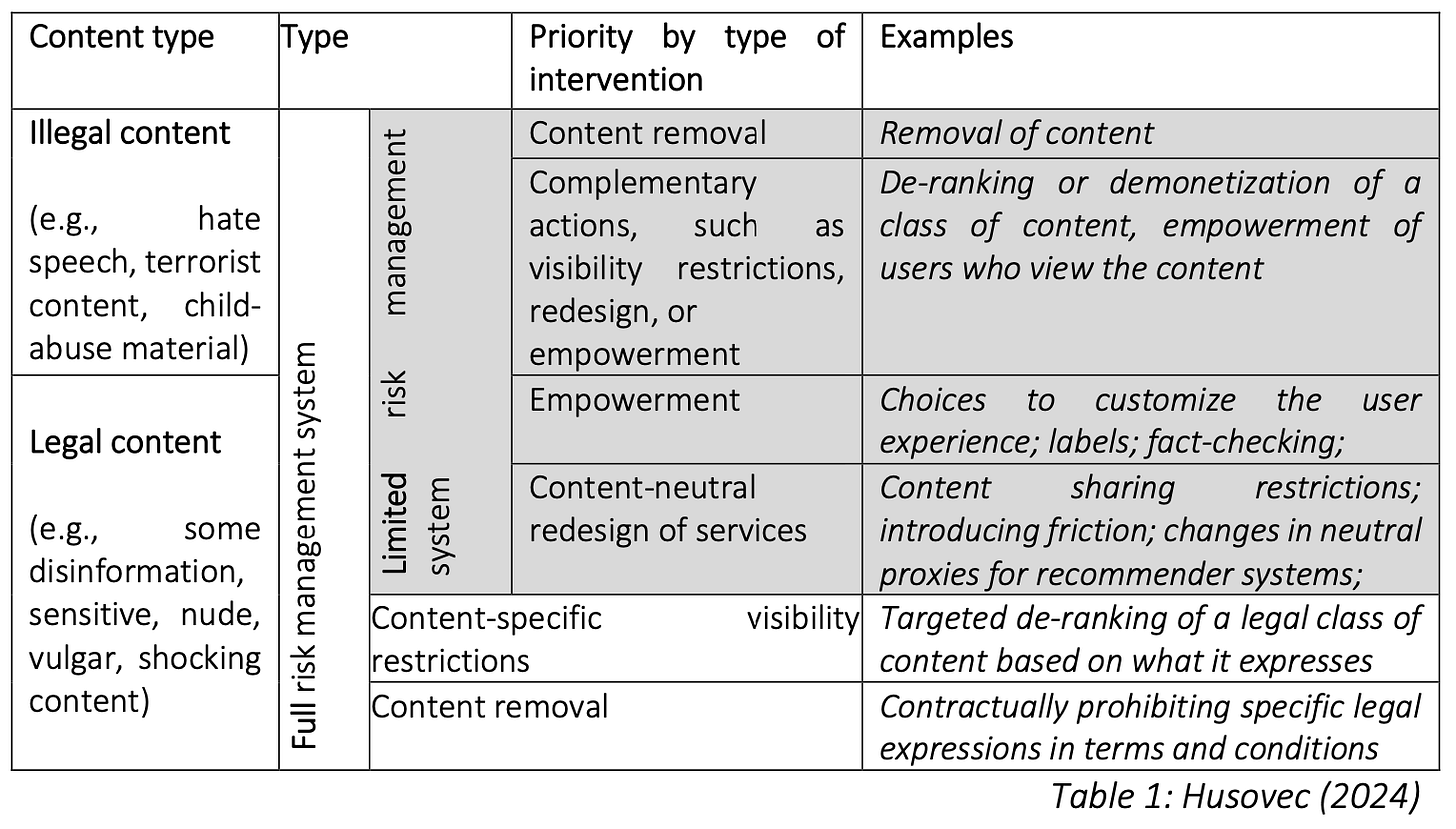 Tabella per la tua prossima storia Instagram sul Digital Services Act
Lo so, può suonare strano, ma la legge è l’unico vincolo solido per evitare qualsiasi rischio di censura o limitazione della libertà di espressione.
------------------------------------------------------------------------
A questo punto, allora, potrebbe sembrare che le “armi” che abbiamo contro la disinformazione siano spuntate o inutili. Ma non è proprio così.
O meglio, se la Commissione o magari gli stati singoli possono fare poco, molto può invece essere fatto dalle piattaforme e dalla loro volontà di rendere le arene digitali più sicure e meno inquinate con disinformazione.
Si tratta di tutte decisioni volontarie, come verificare gli account di personalità istituzionali, cooperare con fact-checkers per etichettare notizie che potrebbero non essere vere, o magari controllare il contenuto di contenuti politici sponsorizzati. Soluzioni che, ad esempio, sono suggerite nel Code of practice of disinformation.
 Tipo questo succedeva alle scorse elezioni americane su Facebook
Ed è vero che queste misure hanno un impatto sulla libertà di espressione, ma le piattaforme hanno meno vincoli e, in quanto spazi privati, più margine di azione. È il motivo per cui non possiamo troppo lamentarci se Meta decide che su Instagram vedremo meno politica.
Portato questo ragionamento agli estremi, se una piattaforma decide che non si può più parlare di - butto a caso - ciambelle, è una legittima scelta di uno spazio digitale comunque privato.
È ovvio che da questo discendono diversi rischi. Però, per il tema di oggi, deriva anche l’opportunità per cui la lotta alla disinformazione passa anche e soprattutto dalla volontà delle piattaforme di mitigare i rischi che ne derivano.
Può piacere o no. Forse è anche preoccupante per certi versi. Ma rende chiaro che cooperare con le piattaforme è la mossa forse più scaltra ed efficace. Ed è, direi, anche in pieno spirito del DSA.
Storia incredibilmente intricata, quindi voglio sentire la tua:
Leave a comment
> ### Save for later
Il nuovo nome di questa sezione è dovuto al fatto che questi sono i classici contenuti che ti salvi per dopo e non riprenderai mai. Ma magari no, eh!
Ma quindi Google sta per rompere il web con l’AI? Non si dica che Artifacts non ne aveva parlato
Qual è il modello di AI più forte? Non lo so, dipende. Ma puoi farli sfidare con questo tool carinissimo.
TikTok cambia spesso idea su cosa consiglia nella guerra tra Israele e Palestina.
Online è pieno di cose finte, quindi questo podcast può essere utile:
\[How to Know Who’s Real\]
Ogni giorno interagiamo con il design di applicazioni, sistemi e altri artefatti con tanti piccoli dettagli che magari non notiamo. Con questo comincerai a notarli.
Aware, che è un think tank amico di Artifacts, cerca un Research Fellow su Digital & ICT, su temi come AI, semiconduttori, space economy etc. Consiglio vivamente di mandare application se interessati :)
 > ### Lo Scaffale
 Lo sto leggendo ora e quasi finito. “Merchants of truth” racconta le storie parallele di 5 media, più o meno nuovi, e di come si sono inventati o reinventati con Internet. Da leggere, specie se hai più di 30 anni, perché potresti aver visto quelle cose succedere.
📚 Tutti, ma proprio tutti, i libri consigliati in Artifacts sono raccolti qui
> ### Nerding
 È arrivato quel periodo dell’anno in cui ti chiedono cosa fai questa estate. Ecco, AskLayla può aiutarti a rispondere: è un chatbot per organizzare vacanze. L’ho usato: direi preciso, forse a volte non trova proprio le offertone. Ma un’occhiata la merita
======
# Among Centaurs and Titans
Date: 2024-05-14 | Language: en
Canonical: https://artifactstech.substack.com/p/among-centaurs-and-titans
Cite as: Among Centaurs and Titans by Lorenzo Ancona, Artifacts, 2024-05-14. https://artifactstech.substack.com/p/among-centaurs-and-titans (CC BY 4.0)
Migration has been a priority for Europe since 2016. However, the ongoing crisis and geopolitical tensions require more than just traditional tactics.
Recently, the EU Parliament voted to expand Eurodac, turning it from a fingerprints database into a wide biometric database, and introduced a new Migration Pact to strengthen border security. MEP Jorge Villalba, who worked on it, deems the regulation necessary and unfairly vilified, while the NGO AccessNow is afraid Eurodac may entail dangerous mass surveillance for migrants and asylum seekers.
In the meantime, with the AI Act being finalised, European Digital Rights (EDRi) warns that it may fall short of setting acceptable standards for human rights protection, notably for migrants.
You've heard this before, but it's worth repeating: technology always comes with values attached, and that can have a big impact on society. Today's story is just one more piece of evidence for this.
------------------------------------------------------------------------
Greece is the setting. Homo Digitalis, a Greek NGO founded in 2018 to protect human rights in the digital space, is the main character.
In the summer of 2021, while researching on the Greece’s White Book on Digital Transformation, the state’s strategy for the period 2020-2025, Homo Digitalis’ team stumbled upon some…peculiar and sizeable investments (20 millions overall) to strengthen migration and border management in the Aegean Islands, hosting the largest migration hotspots in Greece.
They found two systems, graced with fancy mythological names, Kentavros and Hyperion, which raised concerns:
- According to EDRi, KENTAUROS is a surveillance system deployed in reception and accommodation facilities for asylum seekers. It uses cameras, drones, and AI behavioural algorithms to manage digital and physical security. Reportedly, the video feedback to the algorithms is instantaneous, meaning that the biometric processing falls under the category of real-time surveillance, which is prohibited under the AI Act without special licences and impact assessments.
- HYPERION is an asylum seeker management system that controls the access to the facilities through biometric identification of fingerprints, tracks services used by the asylum seeker, and provides a mobile app for asylum requests.
Right away, Homo Digitalis and EDRi initiated research on these systems. The outcome? More questions than answers.
------------------------------------------------------------------------
As a consequence, Homo Digitalis addressed a letter asking for information to the Greek Ministry of Migration and Asylum (MMA) on October 2021. They wanted to know more about personal data impact assessments of the two systems and the legal basis, goals and use parameters on the KENTAUROS system.
This open letter was never answered. Following that, Homo Digitalis worked tirelessly on a European and national level, alongside other NGOs and Agencies to promote the matter further. With the support of the LIBE Committee and the UNCHR Representative in Greece, they filed an official complaint to the Greek Data Protection Authority asking to scrutinise the systems and request the justification of these investments as well as their legal basis.
The Greek DPA acted swiftly. In February of 2022, they officially launched the investigation. Two years later, in April 2024, they imposed a fine of €175,000 on the MMA and ordered the MMA to fulfil its obligations as a data controller under GDPR within a 3-month timeframe.
We interviewed Ms Niovi Vavoula, an associate law professor at Luxembourg University specialising in the intersection of Migration and Technology. She described the decision as “excellent, we couldn’t be happier about it”, but she also remarked that the process “took 2 years to go through and this is a lot for a single case.”
 This can be a wave or an eye. Either way, it’s generated with DALL-E
Ok, you may be asking: “why should I care about Greece?”. Despite migration being a key policy issue, many would rather not hear about the infringements of asylum seekers rights, let alone privacy and data rights (which, by the way, are often considered as bourgeois rights). However as dr. Vavoula clarified: “Data rights and the legal system behind them have teeth. They’re a checklist of easily verifiable obligations and that makes them way more actionable to protect than other fundamental rights, like privacy in general or the right to an effective remedy.”
Have we piqued your interest? Well, then keep reading. Relying on an impressive and thorough research conducted by Stavrina Houssou, MPP in Public Policy and New Technology at Sciences Po and AI Policy Analyst, this Artifacts will dig deeper into this story and, eventually, persuade you why a Greek surveillance system is something we should all be concerned about.
> ### The Story
Given the amount of information we gathered, this Artifacts will be (1) slightly longer and (2) divided into sub-paragraphs to ensure clarity. Let’s start!
> #### Expensive tech investments lacking strategic thought and legal basis
What purpose do those sizeable investments serve? “Unfortunately, I don’t think they serve a purpose”, says Eleftherios Cheilioudakis, lawyer and co-founder of Homo Digitalis. He adds that Greece’s deep economic crisis deterred the state from big digital investments. “It wouldn’t be acceptable to have public employees unpaid, while millions are spent on drones at the borders. But this has changed: the narrative of economic rejuvenation and digitalisation in Greece has opened up the state to increasing digital investments, not necessarily critically made”, he argues.
This context leads to a fruitful environment for high economic intensity experimental investments. He clarifies that: “The adoption of such technologies testifies the rise of a business landscape interlinked with border management and state security which receives substantial EU funding, mostly by the EU Commission. Private actors develop technologies that are neither necessary nor constructive in satisfying the end goal of protecting asylum seekers, examining their applications effectively or granting asylum status. Yet, these firms are well endowed in Brussels, co-affecting the security agenda.”
More troubling is the system’s lack of transparency. Dr Vavoula says: “The securitisation approach of the Greek government often expands to the broader EU approach to migration. These systems were deployed at least partly with EU funds and we've seen that trend booming with more than 50 EU-funded tech and AI projects for migration in recent years, often involving emotion recognition tools”. The lack of scientific evidence for the efficiency and validity of AI tools for emotion recognition is affirmed in the current version of the AI Act.
This raises the question: if security is the reason for using intrusive technology, why is it being deployed in secret and without following legal procedures?
> #### A tech testing ground on the vulnerable
For years, migrants and other vulnerable groups have been subjected to practices deviating from acceptable legal and social norms. Yet, once a line is crossed it is easier to be crossed again. Once rules for the stateless become wiggly, they can soon become so for citizens. “If technologies are developed and bought, and the legal frameworks to use them exist, it’s easy to expand their use gradually. If an intrusive tool fulfils a narrative of security today, tomorrow it can be used in airports for Schengen flights” says Mr. Cheilioudakis. (Something similar has just happened in Italy, btw).
Dr. Vavoula claims that we see similar surveillance tools being used by states first on their Nationals and then on EU Nationals, including biometric systems introduced during COVID. “Therefore, thinking that this case does not concern EU citizens more broadly, is a bit naive. It’s likely that the more these technologies are tested in the future, the more they become a given and, eventually, the more individuals get accustomed to their imposition”, she adds.
> #### A disregard for the rule of law
Is there a reason why this happened in Greece and not somewhere else? Yes, and it is highly tied to the migration problem, which is marked by the limited capacity of reception centres and geographically challenging borders.
Technological support to mitigate such problems could be very relevant if done lawfully. This would mean following predetermined requirements such as explaining the legal basis for employing such systems and conducting impact assessments beforehand. However, the Greek MMA did not follow any of the above.
“There is a techno-solutionist approach and it is however not accompanied by a clear understanding of the potential effects on fundamental rights. Everything goes towards efficiency and modernisation”, dr. Vavoula remarks.
But this case implies a larger political and institutional context. When we asked dr. Vavoula about her assessment on the future of the DPA’s decision, she told us: “It's unclear if the Ministry intends to comply meaningfully. The resistance to this investigation and the efforts to justify their choices is distressing. Saying that the impact assessment would be done ex-post, and not ex-ante, just makes no sense. At the very least, you'd expect a legal basis for deploying these systems. In this case, the systems are deployed without a DPO, which is astonishing given the processing of personal data involved. All these show a clear lack of data protection culture.”
Mr. Cheilioudakis deems such lack of knowledge endemic in Greek political circles: “New Democracy (right-wing) implemented two systems for migration management, while SYRIZA (left-wing) commissioned the smart police initiative which uses devices to transmit biometric data of stopped individuals to the Greek police database (HELLAS). There is a European push for such initiatives. Additionally, as politicians in Greece do not seem savvy enough in tech matters, our efforts in addressing issues through Parliament have mostly fallen on deaf ears.”
Sadly, this is reflected not only in the lack of accountability for the Ministry’s violations but in the government actions to support the mechanisms responsible for data protection. Here Data Protection Authorities (DPA), the responsible national authorities for data protection and the enforcement of the GDPR in EU member states, are key. Incidentally, DPAs are also likely to become the EU AI Act’s enforcement authorities on the national level.
However, the GDPR enforcement has not been particularly optimistic, with several pitfalls, including uneven enforcement from the national DPAs due to diverse capacities and support from governments. The Greek DPA is a case in point: it has a 50-person personnel, despite organic positions for 75, and a reduced budget of 2.200 million.
All in all, intrusive and all-encompassing technologies are a recipe for fundamental rights infringement when not accompanied by protections, constraints and clear allocation of responsibilities – no matter their use case and scope.
Advanced tech will not produce dystopias overnight. But perhaps subtle, covert, unlawful uses of such technologies will render such results overtime if given enough space and not enough scrutiny.
Many thanks to mr. Cheilioudakis and dr. Vavoula for their insightful contributions
Leave a comment
> ### In The Media
There’s been a lot (too much) of conversation around this ad from Apple:
\[Embedded media — view original\]
Harsh criticism can be read here.
ChatGPT can now speak, see, listen, and be your personal assistant. Mind-blowing.
How Russia, China and other non-democratic countries are threatening the information ecosystem. It’s more about downplaying (our) values than spreading fake news.
Why the newsroom is not a safe space, from the biggest newsroom in the world. What happens if Facebook shuts down news? Well, not much.
The one below is not exactly digital policy nor technology, yet still a case of how communicating with digital tools means innovating what and how you say it. Just click through, et voilà.
 > ### The Bookshelf
 We’ve seen this before in Artifacts, but it’s worth suggesting it again. “Your Face Belongs to Us” by Kashmir Hill is a must-read to find out how far biometric and facial recognition could go. Great journalistic investigation, enjoyable reading.
> ### Nerding
 In the Information Society, we often struggle to…read. And it can be pretty problematic. Readermode is a nice-to-have tool designed just for… reading without distraction, ads or any virtual inconvenience. Try it out, it will likely become part of your toolbox!
###
======
# Non ce li hanno più dati
Date: 2024-05-07 | Language: en
Canonical: https://artifactstech.substack.com/p/non-ce-li-hanno-piu-dati
Cite as: Non ce li hanno più dati by Lorenzo Ancona, Artifacts, 2024-05-07. https://artifactstech.substack.com/p/non-ce-li-hanno-piu-dati (CC BY 4.0)
Nel 2016, pochi giorni dopo la vittoria di Trump negli Stati Uniti, Meta - all’epoca ‘Facebook’ - compra Crowdtangle, un tool che svela agli utenti quanto bene o quanto male vanno i contenuti. O meglio, il loro engagement.
All’inizio era usatissimo dai giornalisti per capire cosa pubblicare. Poi, con lo scemare delle news sui social di Meta, Crowdtangle diventa indispensabile per i ricercatori che studiano come e quali narrative false, contenuti pericolosi e disinformazione circolano di più.
 Interfaccia pulita e facile facile
Era una novità importante, rivoluzionaria, per la trasparenza. Nel giro di pochi anni, però, tutta questa trasparenza fa storcere la bocca a Meta perché ne espone alcune vulnerabilità.
Un caso abbastanza eclatante è l’esperimento di Kevin Roose, giornalista del NYT, che crea la pagina Twitter @FacebooksTop10, in cui un bot, grazie a Crowdtangle, ogni giorno elencava i 10 profili dei 10 post più popolari di Facebook negli Stati Uniti. E, tra le varie cose, dimostrava che spesso i contenuti più popolari erano di esponenti del mondo repubblicano, diversamente dalla narrativa di censura propagata dai repubblicani stessi.
Dritto veloce ad oggi, Meta ha recentemente annunciato che disattiverà Crowdtangle e lo sostituirà con la Meta Content Library. Mossa che, però, sembra essere un parziale passo indietro per la trasparenza, almeno per ora. Infatti, i dati che fornisce la Library non sono in tempo reale e, soprattutto, l’accesso è limitato a ricercatori affiliati e accademici, lasciando invece fuori giornalisti o ricercatori indipendenti.
Si pensa che la Content Library migliorerà, ma molti hanno criticato che la scelta di cambiare sia arrivata a poche settimane dalle elezioni europee e americane.
------------------------------------------------------------------------
Una storia simile è quella di Twitter, che ora si chiama X, e che, molto più di Facebook, ha alimentato le analisi accademiche sui flussi informativi.
Nel febbraio ‘23, pochi mesi dopo l’acquisto di Musk, viene interrotto l’accesso gratuito all’Application programming interface (API), ossia il tool gratuito per visualizzare cosa succedeva nel social del (defunto) uccellino.
Poi X annuncia che si può accedere all’API ma pagando cifre stellari, solitamente fuori dal budget dei ricercatori o, comunque, difficili da sostenere per chi prima lo faceva gratis.
 Dal blog per developers di X, non proprio felicità
E, infine, qualche mese fa, X ha ricominciato a permettere a dei ricercatori certificati di accedere nuovamente a questi dati.
------------------------------------------------------------------------
Se sei un lettore attento starai pensando “Ok, ma quindi alla fine non troppo male”. Vero, ma se siamo nel regime del non troppo male, e non in quello del malissimo, non c’è che da ringraziare l’Unione Europea.
Cos’hanno in comune, infatti, le decisioni di Meta e X? Che l’accesso ai dati, in qualche modo, va necessariamente fornito perché previsto dal nuovo e scintillante Digital Services Act (DSA). E, nello specifico, dall’articolo 40.12, che parla di “Data access and scrutiny”.
Quella che è stata addirittura chiamata “Crowdtangle provision”, infatti, stabilisce che le piattaforme più grandi (le cosiddette VLOPs) garantiscano l’accesso ai dati a ricercatori certificati che analizzano i rischi più severi per gli utenti. Qua è spiegato alla perfezione come funziona la certificazione. Giurista che mi leggi, meglio semplificato ma chiaro che impossibile da capire, no?
E, ok, probabilmente è qualcosa che riguarda direttamente qualche centinaia di persone in Europa e nel mondo. Però, forse, sapere cosa succede sulle piattaforme non è solo di interesse di dottorandi, think tank o pochi eletti, specie in un anno in cui ci saranno campagne elettorali come mai prima.
 Degli occhiali ma un po’ scheggiati. Creati con DALL-E
Questa Artifacts, allora, racconta perché quello che fa l’articolo 40 del DSA è assolutamente rivoluzionario, ma anche cosa sta andando storto e come e perché è prioritario raddrizzarlo.
> ### La Storia
Questa è una storia di prime volte.
Per la prima volta viene imposto, con forza di legge, che le piattaforme debbano garantire trasparenza e accesso ai dati per i ricercatori.
Di conseguenza, molte piattaforme renderanno disponibili, per la prima volta, i dati su quello che accade quotidianamente tra gli utenti. Prima del DSA, come dimostrano i casi di Meta e X, queste decisioni erano volontarie e lasciavano i ricercatori in balia degli umori e dei cambi di idea delle piattaforme. Magari nel bel mezzo di un lavoro di ricerca.
Poi, l’impatto dell’art.40 non si limita all’Unione Europea. In primis perché l’accesso può essere garantito anche a ricercatori non europei. E, poi, perché è verosimile che anche altre regolamentazioni in giro per il mondo possano prescrivere obblighi simili, beneficiando della strada inaugurata dal DSA. Chiamatelo “Brussels Effect”, se vi piace.
Sembra uno scenario incredibile, e Artifacts potrebbe chiudersi qui. Tuttavia, nonostante il DSA sia in vigore da febbraio, c’è ancora molto da fare per garantire questo data access.
Nel dettaglio, nel giro di qualche settimana, la Commissione Europea dovrebbe pubblicare un documento che (si spera) chiarisca standard e regole. Intanto, un mesetto fa, ha pubblicato un report che racconta come stanno andando le cose sull’accesso a questi dati.
------------------------------------------------------------------------
Ed, ecco, potrebbero andare meglio.
Un’iniziativa del Weizenbaum Institut rivela come su 22 richieste di accesso ai dati, solo 4 siano state accettate. E un report sempre dello stesso istituto sottolinea anche le varie criticità rispetto a come, quali, quando, e perché i dati sono forniti. Il problema essenziale? Manca armonizzazione tra le piattaforme.
Ad esempio, spesso è difficile (senza un apparente motivo) accedere alle pagine in cui fare richiesta per i dati, sembra che i ricercatori non affiliati ad istituzioni accademiche non siano granché graditi, il tempo di risposta medio è superiore al mese e mezzo - e dovrebbe invece essere rapido secondo il DSA -, i rifiuti di accesso non sarebbero motivati adeguatamente e, da ultimo, alcue grandi piattaforme non comunicherebbero i dati ai quali si può avere accesso.
Queste criticità sarebbero, tra l’altro, quelle che hanno spinto la Commissione a inviare una “request for information” a ben 17 grandi piattaforme a gennaio.
------------------------------------------------------------------------
Però forse è anche normale che ci sia qualche intoppo. Non serve disperare, ma capire come si possa migliorare. Su questo un eccellente lavoro lo hanno fatto la Mozilla Foundation e AlgorithmWatch, due realtà che tirano fuori sempre belle cose.
Stavolta chiedono che il documento che pubblicherà la Commissione chiarisca che l’accesso venga garantito alle organizzazioni e non ai singoli progetti, che si possa controllare che le piattaforme facciano davvero quello che dicono, che i dati forniti siano completi e senza lacune. Poi, cruciale, che si renda facile ai ricercatori non UE di accedere a questi dati, oltre che ai giornalisti che non hanno affiliazioni con i centri di ricerca.
E, come ha suggerito Brandon Silverman, fondatore di CrowdTangle a Casey Newton, quando si tratta di dare accesso ai dati bisogna dare importanza all’effettiva utilità e usabilità, e non semplicemente alla quantità che ne viene fornità. Insomma, qualità \> quantità.
------------------------------------------------------------------------
Dunque, l’UE con il DSA apre ad una grande opportunità per innovare e migliorare la ricerca sulle piattaforme, chiarire il loro impatto e, da ultimo, poterle giudicare e valutare con maggior contezza. Opporunità che, però, è ancora da cogliere a pieno.
Per questo, il documento che pubblicherà la Commissione sarà cruciale, così come la maniera in cui le piattaforme risponderanno, si adatteranno, e vorranno effettivamente dare seguito alle richieste di trasparenza. A tal proposito, azzardo che avere degli standard sarà decisivo: ad esempio su come richiedere i dati, su come vengono forniti, sui soggetti a cui vengono concessi.
Ed ancora, non si tratta di un capriccio dei ricercatori, ma di una necessità che dovremmo avere come società onlife tutta. Ossia poter capire le dinamiche degli spazi online in cui “viviamo” quotidianamente e dove svolgiamo - o almeno supportiamo - buona parte delle attività politiche o civili.
Meglio, che quelli che abbiamo scelto come public spaces non possano esserci oscuri o difficili da comprendere, ma che è forse addirittura prioritario avere la possibilità di vedere bene cosa succede e, in fondo, capire come impattano sulle nostre vite. Dai contenuti pericolosi fino alla disinformazione.
Specialmente quest’anno, il 2024, nel quale tra un mese si vota per il Parlamento europeo, a novembre per il presidente degli Stati Uniti, e poi anche in diversi altri paesi in giro per il mondo
Leave a comment
> ### Rassegna (Stampa)
Di tutto quello che sta succedendo negli Stati Uniti su TikTok, penso che questo sia tra i contenuti migliori:
\[Why the TikTok ban won't solve the US's online privacy problems\]
Perplexity, di cui avevo parlato qua e che continuo a usare, ha tirato su un bel po’ di grana. Esattamente quanto ha alla fine stanziato il governo italiano sull’IA, tra l’altro. Mentre Meta e i suoi compari fanno numeri folli nel Q1 2024.
L’UE dice che deve essere più facile riparare il proprio cellulare, che andare dal medico in tutta Europa pure grazie alla tecnologia, e poi ha iniziato ad investigare Meta perché (forse) non starebbe rispettando il DSA.
Negli Stati Uniti tra poco si chiude un processo storico su Google, che sostanzialmente sarebbe troppo grande.
OpenAI alla riscossa: accordo con StackOverflow e accordo col FinancialTimes per allenare il suo chatbot (!). Ma nel frattempo noyb, quelli del “pay or okay”, hanno qualcosa da ridire su tutti gli errori di ChatGPT.
In India Whatsapp sta diventando sempre più un’arma di disinformazione, dice Mozilla.
------------------------------------------------------------------------
 News personale: Il 13 giugno parlerò al We Make Future di Bologna provando a raccontare cosa significa fare una newsletter insieme ad altri super newsletterati.
Ho degli accrediti per seguire tutto l’evento. Se ti interessano, rispondi a questa mail :)
> ### Lo Scaffale
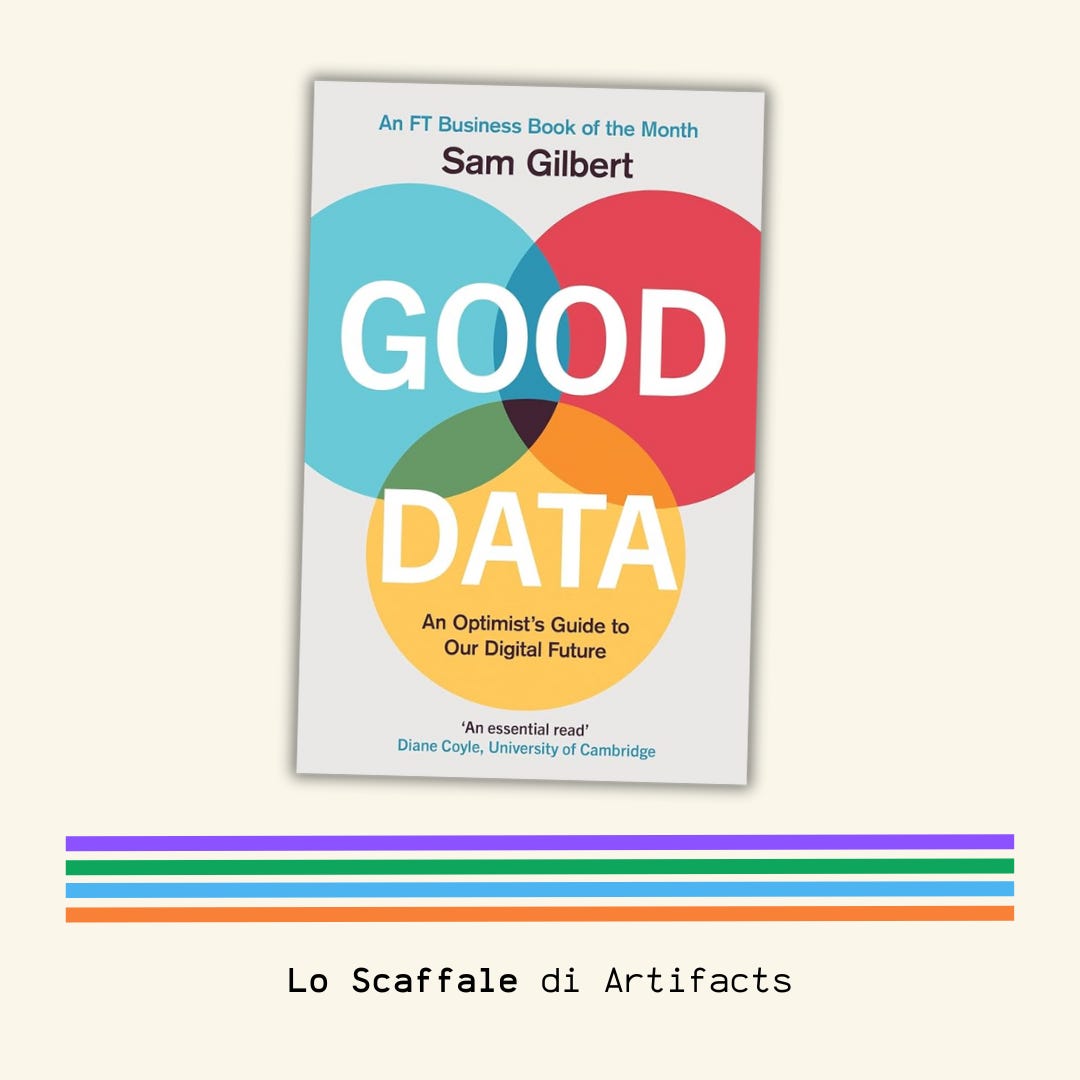 Non è né su disinformazione né sui social nello specifico, ma “Good Data” di Sam Gilbert è un bel libro sul concetto generale dei dati, in una chiave ottimista. Ne spiega dinamiche essenziali, chiarisce da dove vengono e dove vanno, e anche perché è fondamentale capire tutte questi concetti.
📚 Tutti, ma proprio tutti, i libri consigliati in Artifacts sono raccolti qui
> ### Nerding
 A proposito di social, OpusClip fa una roba fighissima: gli dai un video YouTube e lui te lo trasforma in piccole clip per Instagram o TikTok con l’Intelligenza Artificiale. Non è gratis, ma se dai il creator forse è utilissimo
> ### Pausa Caffè? ☕
Oggi è il mio ultimo giorno di lavoro della settimana (in Francia a maggio è sempre festa), quindi ho tantissimo tempo per incontrarci!
Se anche a te interessa Artifacts, i temi che affronta o sei solo curiosa/o…
Prendiamo un caffè digitale
======
# Facile come giocare
Date: 2024-04-23 | Language: en
Canonical: https://artifactstech.substack.com/p/facile-come-giocare
Cite as: Facile come giocare by Lorenzo Ancona, Artifacts, 2024-04-23. https://artifactstech.substack.com/p/facile-come-giocare (CC BY 4.0)
 Questo è Giacomo Da Ros che gioca su un Game Boy dal mio iPhone. Lo abbiamo fatto grazie a Delta, app per emulare console disponibile su AltStore, uno dei primi app store (con la minuscola) alternativi per iOS.
È una novità recentissima, resa possibile dal Digital Markets Act e, in particolare, dall’obbligo di permettere il download di app da store diversi dall’App Store (con la maiuscola, stavolta) in UE. A Bruxelles si chiama “sideloading”, ha creato non poche antipatie ad Apple, e Artifacts ne aveva parlato diffusamente qualche settimana fa.
Con Delta, o altri emulatori, possiamo rivivere cosa significhi giocare con un Game Boy o un Nintendo DS ai vari Super Mario o Pokemon, semplicemente dal nostro iPhone. Bello, indubbiamente.
Ma oggi in Artifacts non parliamo di questo. O meglio, partendo dall’emulatore, parliamo di una delle console che può essere emulata: il Game Boy. Ne raccontiamo un po’ di storia, come e perché ha cambiato il mondo dei videogiochi, e, tra le righe, forse anche perché nel 2024 è così affascinante riprendere in mano un artefatto di 35 anni fa.
------------------------------------------------------------------------
Come succede con tante delle “invenzioni” più di successo, la tecnologia del Game Boy era ben lontana dall’essere rivoluzionaria. Dove il Game Boy si è dimostrato davvero rivoluzionario, invece, è il piano culturale, come racconta questa Artifacts.
I principali competitor dell’epoca (i cui nomi sono ormai sconosciuti ai più), come il Sega Game Gear o l’Atari Lynx, avevano schermi a colori retroilluminati e potevano far girare giochi complessi. Volutamente, invece, il Game Boy usciva nel 1989 con uno schermo in bianco e nero, non retroilluminato, ed era molto limitato dal punto di vista hardware.
 Per capire di cosa stiamo parlando
L’obiettivo degli ingegneri Nintendo non era fare il prodotto più avanzato, ma quello più utilizzabile. Puntavano ad ottimizzare due elementi: la durata delle costose batterie AA necessarie per farlo funzionare e il prezzo di vendita della console stessa.
Infatti, le 6 batterie del Game Gear e del Lynx duravano un massimo di 5 ore mentre il Game Boy, con 4, ne durava fino a 30. Secondo Real Engineering, che ha fatto un ottimo video sulla tecnologia del Game Boy, al prezzo delle batterie degli anni 90 un’ora di gioco sul Game Gear costava 2,30 \$ - sul Game Boy, soltanto 0,16 \$. Non una differenza minima, soprattutto per un bambino. A questo si aggiunge il fatto che il Game Boy debuttava ad un prezzo di circa 200 € di oggi, più o meno la metà della concorrenza.
 Questo è il Game Boy, per chiarezza
La scelta di preferire tecnologie già rodate e, per questo, dai costi contenuti, e poi di usarle in maniera creativa è rimasta nell’ethos di Nintendo fino ad oggi. È il principio del lateral thinking with weathered technologies - una non immediata traduzione dal giapponese: invece di rincorrere le tecnologie più avanzate, con i loro problemi di gioventù e alti costi, si trovano nuovi usi a strumenti già ben compresi.
Abbiamo visto questo principio per esempio, anche con Wii: nel 2006, i sensori di movimento non erano niente di nuovo, ma usarli per Wii Sports lo era. E, nonostante performance grafiche ben al di sotto della concorrenza delle contemporanee PlayStation 3 e XBox 360, Wii è stata la più venduta della sua generazione.
------------------------------------------------------------------------
Prima di ragionare oltre, però, momento libro di storia. Meno noioso, promettiamo.
Il Game Boy viene sviluppato dal team Research and Development 1 di Nintendo, guidato da Gunpei Yokoi. Lo stesso team che negli anni precedenti aveva già concepito il Nintendo Entertainment System (NES) e il Game & Watch, rispettivamente una delle prime console fisse e portatili di sempre. E, in effetti, il Game Boy è un ibrido di questi suoi due predecessori, prendendo dal primo le cartucce intercambiabili e dal secondo la portabilità e il display LCD.
 L’albero genealogico del Game Boy
Ne risulta il design essenziale. Sotto allo schermo, il Game Boy ha pochi, semplici comandi: quattro pulsanti, A, B, START, e SELECT, e un d-pad (le frecce). Lo completano rotelle per volume e contrasto, lo switch on-off, e la presa per il cavo Game Link, che è una delle idee più geniali, e sulla quale ci focalizziamo a breve.
> ### La Storia
Nonostante ora sia facile tesserne le lodi, nel 1989 non c’erano grandi aspettative sul Game Boy, anzi. In primis dentro Nintendo stessa, dove l’allora presidente Hiroshi Yamauchi aveva inizialmente bloccato il team di Gunpei Yokoi. Ma anche i competitor non sembravano spaventati: Steven Kent racconta che gli ingegneri di Atari scoppiarono a ridere quando videro l’anacronistico schermo LCD monocolore.
Avranno cambiato idea nel giro di poco, se consideriamo che sono stati acquistati 300 mila Game Boy in Giappone solo il 21 aprile 1989, giorno di lancio, e un milione solo negli Stati Uniti nel primo anno. Ad oggi, Game Boy e Game Boy Color registrano 118.69 milioni di pezzi venduti.
Non a caso, Don Thomas, direttore Marketing proprio di Atari, ha raccontato che nessuno - lui incluso - si aspettava il successo di Game Boy e che quello che è successo è un esempio perfetto di come in queste industrie sia difficile avere certezze consolidate.
------------------------------------------------------------------------
Per comprendere ulteriormente la singolarità di Game Boy, poi, basta pensare al gioco che più di tutti lo ha fatto davvero esplodere E no, non è nè Pokemon o Super Mario, ma uno molto più essenziale: Tetris. La cui cartuccia era venduta in bundle col Game Boy, ed è, infatti, è la più acquistata.
Tra l’altro, Tetris non è nè un gioco proprietario di Nintendo, quindi giapponese, nè americano, ma un'idea di Alexey Pajitnovm, un programmatore dell’Unione Sovietica, che lo aveva inizialmente concepito per computer. Ma era il perfect match per il Game Boy: la grafica essenziale, la complessità minima e la giocabilità di Tetris erano l’ideale per il piccolo schermo in bianco e nero e i comandi di Game Boy.
 Tetris, molto semplicemente
Tutto questo lo aveva capito bene Minoru Arakawa, CEO di Nintendo America, che ingaggiò una vera e propria lotta con Atari per ottenere i diritti su Tetris. Ed ebbe ragione: Tetris diventò una ossessione per gli utenti, che potevano anche giocare uno contro l’altro grazie al cavo Game Link che connetteva due Game Boy.
------------------------------------------------------------------------
Però, se Tetris è la killer app originale, forse il massimo potenziale del Game Boy si esprime qualche anno dopo, con l’uscita di Pokémon Rosso e Verde nel 1996. La loro è una storia strettamente legata al cavo Game Link, quello di Tetris.
Infatti, quando Satoshi Tajiri, l’inventore di Pokemon, lo vide per la prima volta immaginò una versione digitale del suo passatempo preferito da bambino: collezionare insetti.
E proprio per questo una delle principali feature introdotte dai primi giochi Pokémon fu la possibilità di scambiare i Pokémon stessi attraverso il cavo Game Link. Un multiplayer cooperativo, quindi, e non competitivo, soprattutto considerato che alcuni Pokémon erano esclusivi a una delle due versioni e che, quindi, scambiarli era una necessità per realizzare l’obiettivo di “Gotta catch ‘em all”.
 La possibilità (e la necessità) di trasformare i giochi Pokémon in un’esperienza sociale era uno dei principali selling point già all’uscita
Il debutto di Pokémon segnerà il momento più alto della vera e propria mania per il Game Boy. Un’operazione commerciale e di comunicazione eccezionale gli accompagnerà il cartone animato, i gadget, e soprattutto le carte. Tra la fine degli anni 90 e l’inizio del 2000 si parla proprio di Pokémania.
------------------------------------------------------------------------
Ma il successo del Game Boy non era soltanto limitato al pubblico che vediamo nell’immagine qui sopra e quello che, intuitivamente, associamo ai videogiochi - ossia, bambini perlopiù maschi.
Infatti, il Game Boy riesce a fare presa anche sugli adolescenti, che ne apprezzano il lato cool, e sugli adulti, come distrazione dalla vita quotidiana. La leggenda vuole che proprio quest’ultimo use case aveva ispirato Gunpei Yokoi a creare il Game&Watch, l’antenato di cui prima, avendo osservato un uomo d’affari giapponese che, annoiato sul treno, si distraeva con la sua calcolatrice.
Non da ultimo, il Game Boy riuscì ad avvicinare ai videogiochi il pubblico femminile, fino ad allora minoritario: nel 1995, Nintendo annunciava che il 46% degli utenti del Game Boy erano donne, rispetto al 29% del NES.
Insomma, tanti erano ossessionati dal Game Boy, dalla possibilità di poter giocare ovunque nei ritagli di tempo, di competere con gli amici. Una mania, appunto, che il video qui sotto forse è il modo più immediato per comprendere.
\[Embedded media — view original\]
Ah, chiudiamo in bellezza: ci giocava anche Hillary Clinton.
 Presumibilmente sull’Air Force One!
Leave a comment
> ### Rassegna (Stampa)
Mozilla Foundation ha pubblicato un report interessantissimo sulla trasparenza degli ads. Stanford invece il più importante report annuale su AI. Rest of World poi ha rilasciato un Election Tracker davvero ben fatto.
Dovremmo togliere i paywall agli articoli prima delle elezioni? Si chiede un articolo dietro paywall.
L’UE dice che il pay or okay di Meta viola il GDPR! E investiga anche il lancio di TikTok Lite perché creerebbe dipendenza. Nel frattempo negli Stati Uniti il ban di TikTok sembra prendere piede.
Google licenzia 28 dipendenti perché contro Israele. Apple deve togliere delle app dalla Cina.
Reportage incredibile sulle persone in mezzo al mare che aggiustano Internet tutti i giorni. E tutte le cose che dal 1900 hanno migliorato la nostra vita, oltre al computer.
> ### Lo Scaffale
 Pure Invention: How Japan’s Pop Culture Conquered the World parla di come il Giappone sia passato da essere stato raso al suolo e occupato alla fine della Seconda Guerra Mondiale ad esercitare sull’Occidente un soft power mai visto prima, attraverso i suoi prodotti culturali e tecnologici, tra cui, ma non solo, il Game Boy e i Pokémon.
📚 Tutti, ma proprio tutti, i libri consigliati in Artifacts sono raccolti qui
> ### Nerding
 La abbiamo introdotta all’inizio, e la riproponiamo qui. Delta è l’emulatore di Game Boy attualmente disponibile su Alt Store per iPhone, e potete giocarci a tantissimi giochi. Disclaimer: l’emulatore è legale, scaricare giochi non è chiaro se lo sia.
> ### Pausa Caffè? ☕
Questa settimana ho preso un caffè con una lettrice che presto diventerà la prima lettrice di Artifacts dall’Africa. Stra bello e interessante conoscerla.
Se anche a te ti interessa Artifacts, i temi che affronta o sei solo curiosa/o…
Prendiamo un caffè digitale
======
# Ma prima quando?
Date: 2024-04-16 | Language: it
Canonical: https://artifactstech.substack.com/p/ma-prima-quando
Cite as: Ma prima quando? by Lorenzo Ancona, Artifacts, 2024-04-16. https://artifactstech.substack.com/p/ma-prima-quando (CC BY 4.0)
Domenica sera, mentre pensavo a cosa scrivere nella Artifacts che stai leggendo, ho ricevuto questo messaggio dal mio amico Federico:
 Forse parlo troppo spesso di queste robe ai miei amici
E così ho deciso di cosa scrivere.
Cronache a parte, il buon Federico chiede qualcosa che probabilmente hai sperimentato anche tu nelle ultime settimane, che è questo:
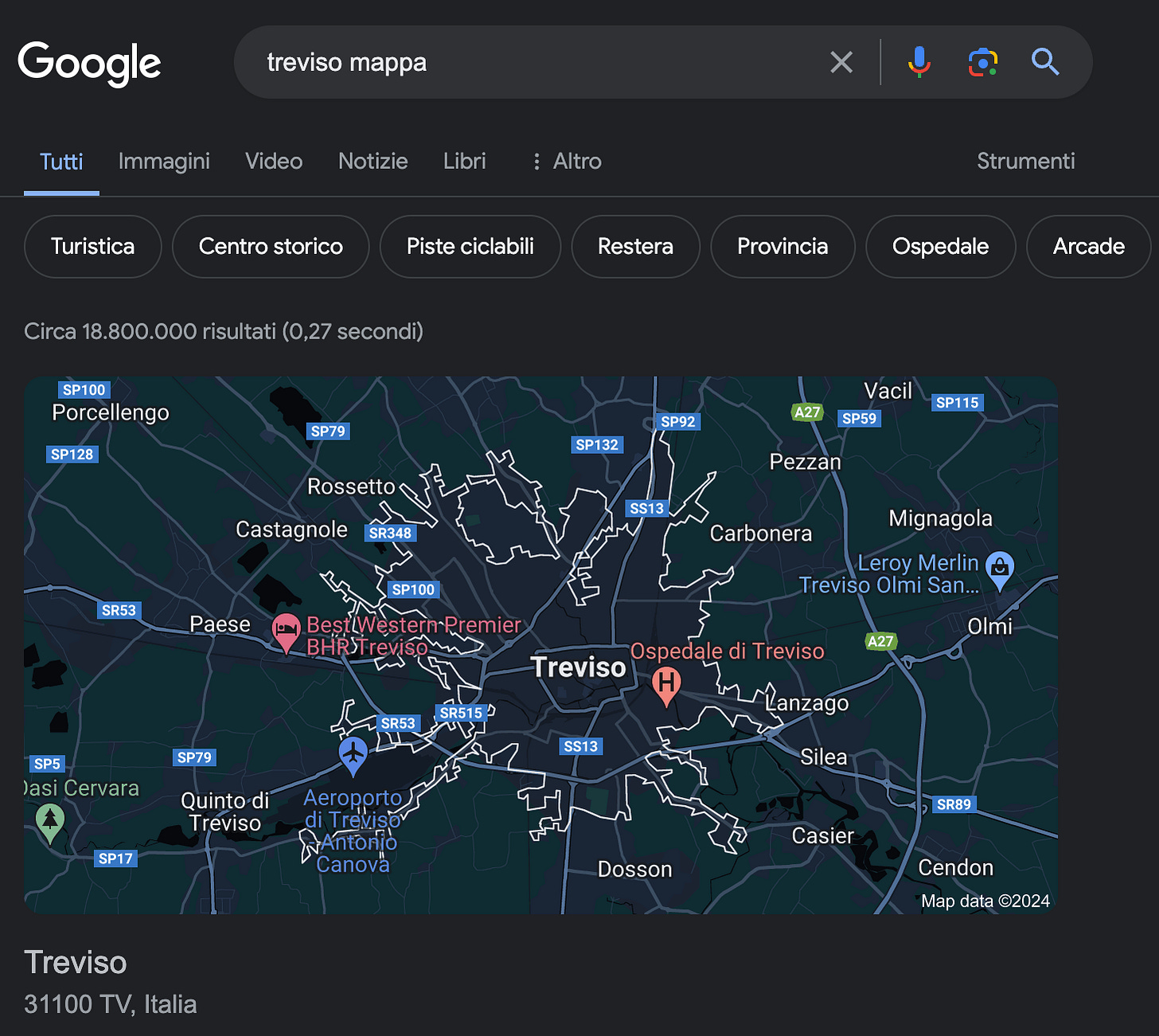 Vale a dire che se cerchiamo su Google Search la mappa di una qualsiasi città, quella che esce non è più cliccabile e non ci indirizza più direttamente a Google Maps.
Altri problemi per Google dopo l’IA della settimana scorsa? No, affatto.
------------------------------------------------------------------------
Piuttosto, è una delle misure che Google, così come altre grandi aziende tech (cosiddetti gatekeeper), hanno dovuto prendere per rispettare il Digital Markets Act (DMA), il nuovo regolamento UE per la concorrenza del mercato digitale. Sì, di DMA ne abbiamo già parlato qui in Artifacts.
Tra le tante cose, il DMA vieta il “self-preferencing”, ossia la possibilità di dare una posizione di favore a dei propri servizi o prodotti. Tipo quello che succedeva prima quando spuntava la mappetta Google Maps o Amazon che consigliava le sue pile prima di tutte le altre.
 L’ho letto davvero il DMA, eh! Articolo 6.5
L’idea alla base è che così questi gatekeeper, che sono già belli grossi, non possano crescere sfruttando queste pratiche subdole.
Tuttavia, la reazione di molti è stata come quella dell’emoji di Federico: 😣
E quindi o di confusione se non si conosce il DMA, circostanza direi più che legittima. Oppure di dubbio, anche questo legittimo, su come una misura del genere crei più un fastidio ai consumatori che favorire la concorrenza. Su Avvenire un articolo anonimo sul tema finisce con questa domanda: “Ma era questa la rivoluzione, in termini di user experience, che volevamo?”
------------------------------------------------------------------------
Oltre che dagli utenti, alcune critiche alle misure del DMA, come il divieto di self-preferencing o altre, sono arrivate anche dai diretti interessati, ossia le aziende tech.
Google, visto che parliamo di Maps, ha scritto che “alcune delle nuove regole coinvolgono dei trade-off che impattano come le persone e i business utilizzano i nostri prodotti”. E ha poi aggiunto che “alcune funzionalità che avevamo implementato per fare le cose velocemente e in sicurezza ora non funzioneranno come prima”.
Anche Apple non era stata generosa e quando aveva presentato i cambiamenti al suo sistema operativo per gli iPhone aveva precisato che stava inserendo delle protezioni per “ridurre i rischi di privacy e sicurezza che il DMA introduce per gli utenti”.
E ci sta, è un po’ il gioco delle parti ma anche la realtà che il DMA non è certo il migliore amico di queste società.
------------------------------------------------------------------------
Su queste regole, è vero, c’è il rischio di essere un po’ disorientati, a proposito di mappe.
 Bussola per orientarci. Creata con DALL-E
Comunque, facciamo zoom-out dalla domanda di Federico. E proviamo a capire meglio il senso di regole simili, del DMA stesso, e anche a viaggiare un po’ nel tempo.
Insomma, oggi Artifacts prova a vedere perché il DMA non è il classico regolamento astratto dei burocrati di Bruxelles 👻, e, anzi, dove nasce e come approcciare quelle che a volte sembrano delle regole inutili.
> ### La Storia
Una prima cosa, sempre utile da dire, è che il DMA non è CONTRO le BigTech, ma è un regolamento che mira a dare più diritti. Sia ai consumatori, per i quali dovrebbe aumentare la possibilità di scelta, che a nuove aziende o start-up, per le quali dovrebbero abbassarsi le barriere all’ingresso del mercato digitale.
L’idea è che se il mercato diventa più competitivo, allora ci può essere più diversità di servizi e, quindi, innovazione.
Soprattutto, per ricopiare le parole dei burocrati di Bruxelles, due sono i principi essenziali del DMA, riflessi nelle sue regole:
1. contestability, ossia che per nuovi o esistenti servizi sia più facile “sfidare” i gatekeeper;
2. fairness, e quindi che tutti abbiano delle buone chance di avere successo, senza essere ostacolati da pratiche “scorrette”.
Questo tutto interessante e affascinante. Ma c’è un altro elemento che credo sia ancora più importante: il DMA è un regolamento ex-ante.
E che significano queste due paroline latine? Che non “rincorre” delle pratiche scorrette, ma stabilisce a priori una serie di principi del mercato digitale che i gatekeeper devono rispettare. Insomma, non investiga cosa sta andando storto, come è spesso il caso degli Antitrust, ma chiarisce quali siano dei modi perché le cose vadano nella giusta direzione.
Diciamo che è la versione competition policy del classico “prevenire è meglio che curare”.
------------------------------------------------------------------------
Tutto più o meno chiaro. Ma la critica dietro l’angolo è: “Ok, ma siamo sicuri che queste regole ci portino nella giusta direzione? Nel caso di Maps, non era meglio prima?”.
Comprensibilissimo. Ma è proprio su questo prima che credo sia utile concentrarsi. Anzi, in generale, per provare a spiegare il senso del DMA è utile fare riferimento alle categorie di passato, presente, e futuro.
Il prima a cui noi facciamo riferimento, infatti, è quello pre 7 marzo, quando la mappa che usciva su Google Search era quella di Maps, direttamente cliccabile e che era tendenzialmente l’unica soluzione che usavamo.
Ecco, il DMA aspira ad un altro prima. L’idea infatti sarebbe quella di un’Internet senza oligopoli. Un’Internet in cui Mappe ≠ Google Maps o browser iPhone ≠ Safari.
Lo so, potrebbe suonare un po’ idealistico. Ma la volontà è quella di riequilibrare il mercato, consapevoli che se queste regole ci fossero state dall’inizio non ci sarebbero solo questi giganti e avere diverse alternative sarebbe, appunto, meno idealistico.
Ed è così che il DMA agisce sul presente, stabilendo dei principi su come i servizi digitali sono costruiti, sul loro design. Questo non per una velleità di interferenza sulle BigTech, ma perché riconosce che il modo in cui gli artefatti sono costruiti influenza le scelte che prendiamo.
Un esempio? Se, come accadeva prima, Safari era il browser di default su iPhone, la non-scelta da fare ci avrebbe portato ad usarlo automaticamente, chiudendo opportunità per altri browser. Ora, invece, una scelta va fatta. E, tra l’altro, qualche segnale degli effetti comincerebbe a vedersi.
 Questa cosa qua che hai probabilmente visto
------------------------------------------------------------------------
Ed è così che possiamo proiettarci nel futuro.
Sul taccuino che uso per Artifacts ho segnato questa frase stupenda - letta non ricordo dove- un mesetto fa: “Competition is not just about protecting markets and technologies of today but the innovations of tomorrow”.
Che, insomma, vero che magari ora questa delle mappe o altre ci sembrano una seccatura, ma sono regole che mirano soprattutto a creare un domani diverso, a cui il DMA aspira.
Un domani più simile ad un prima che non abbiamo conosciuto o non ricordiamo, agendo su come Internet è costruito oggi.
Lo so, può sembrare astratto o anche inutile, ma è strettamente legato a delle dinamiche economiche e alla possibilità di avere nuove, diverse innovazioni in futuro.
Andrà per forza bene? Ovviamente no. È verosimile che l’innovazione continui a essere guidata grazie risorse delle aziende più grandi? Sì.
Ma non necessariamente. E, soprattutto, questo non significa non provare a creare un mercato digitale in cui per nuovi attori sia legittimo sperare di avere successo.
Leave a comment
> ### Rassegna (Stampa)
Usi ChatGPT per le cover letter? Forse bisogna cambiare. Sicuramente tantissimi studenti lo stanno usando per i paper. Il sottoscritto non rilascia dichiarazioni :)
Hai presente Pay or Okay, di cui abbiamo parlato sia qui che qui? Ecco, Max Schrems, principale attivista contro queste pratiche, ha fatto un video bellissimo a riguardo.
Forse cambiamo il GDPR, il regolamento sulla protezione dei dati personali. Intanto, se non vuoi allenare le IA con i tuoi dati, fai così.
Ma è vero che le IA dicono le bugie? Sulle elezioni sì, tantissimo, e in tutte le lingue.
E invece ti ricordi quella vicenda dei contenuti politici su Instagram? In America è attiva, e i content creator si stanno lamentando. Nel frattempo Meta prova a limitare l’invio di immagini pedopornografiche.
Puoi giocare al GameBoy sull’iPhone ora. Provalo che ne parliamo presto qui :)
Come se la cava il DSA con la disinformazione? Un’amica, Eleonora Bonel, ha co-scritto un paper su questo!
Sui dati per l’IA e se sia giusto aggregarne cosi tanti, ne ho fatto un video per NOS. Click qui sotto!
 > ### Lo Scaffale
 Vero che c’è la bandierina USA, ma “System Error” è uno dei libri più belli e comprensivi su come le BigTech sono cresciute a livello globale. Spiega bene come, sì, abbiano agito scorrettamente, ma anche dove le regolamentazioni sono mancate. Tocca tanti temi, molto chiaro. Bello, bello.
📚 Tutti, ma proprio tutti, i libri consigliati in Artifacts sono raccolti qui
> ### Nerding
 Per modificare, migliorare, tagliare, fare tante cose con le immagini senza essere un professionista di Photoshop, Magnific AI è una delle soluzioni migliori che ho provato. Soprattutto, facile e intuitivo da utilizzare.
> ### Pausa Caffè? ☕
Era un po’ che non mettevo questa cosina qua. Ma ho pensato che mi ha permesso di incontrare tante persone negli ultimi mesi, e quindi why not?
Quindi, ecco, se ti interessa Artifacts, i temi che affronta o sei solo curiosa/o…
Prendiamo un caffè digitale
======
# Realtà parallele
Date: 2024-04-09 | Language: en
Canonical: https://artifactstech.substack.com/p/realta-parallele
Cite as: Realtà parallele by Lorenzo Ancona, Artifacts, 2024-04-09. https://artifactstech.substack.com/p/realta-parallele (CC BY 4.0)
Alla richiesta di generare un'immagine del **Papa**, Gemini, il chatbot IA di Google, ha risposto così:
[](https://substackcdn.com/image/fetch/$s_!UgTY!,f_auto,q_auto:good,fl_progressive:steep/https%3A%2F%2Fsubstack-post-media.s3.amazonaws.com%2Fpublic%2Fimages%2Fc5d24052-6c3d-4d5a-b709-40451fe3f894_1280x720.png)
quello a sx mi pare sia addirittura una donna
Per dei **soldati della Germania del 1943**, invece, questo è stato l'esito:
[](https://substackcdn.com/image/fetch/$s_!SG9S!,f_auto,q_auto:good,fl_progressive:steep/https%3A%2F%2Fsubstack-post-media.s3.amazonaws.com%2Fpublic%2Fimages%2F61062c13-c3ca-46b7-ab91-6f14ddbef473_445x445.jpeg)
Infine, questi sarebbero i **Padri Fondatori degli Stati Uniti**:
[](https://substackcdn.com/image/fetch/$s_!2noo!,f_auto,q_auto:good,fl_progressive:steep/https%3A%2F%2Fsubstack-post-media.s3.amazonaws.com%2Fpublic%2Fimages%2Feeeaa35e-fb03-4543-8a1e-b124c4d51867_750x866.png)
**Tutte immagini storicamente inaccurate o addirittura implausibili.** O meglio, se è possibile che ci sarà un Papa nero un giorno, direi che è da escludere che un indiano fosse insieme a Thomas Jefferson e Benjamin Franklin o che una donna giapponese fosse nelle truppe naziste.
Eppure, qualche settimana fa, **l'IA di Google ha generato queste immagini,** oltre a rifiutarsi di chiarire **se fossero più pericolosi i tweet di Elon Musk o le decisioni di Hitler**, di generare una posizione di lavoro come **lobbista di oil&gas**, o anche di fare una campagna di marketing **pro consumo di carne.**
Gemini è un'attivista *woke*? **No, affatto, nonostante [le accuse dei conservatori americani.](https://twitter.com/HouseGOP/status/1760646648751894670)** In primis, come macchina, non può sviluppare valori propri e, soprattutto, **queste immagini quantomeno bizzarre sono un errore, umano, di chi l'ha programmata.**
Ma allora cos'è successo? [Google lo ha chiarito velocemente](https://blog.google/products/gemini/gemini-image-generation-issue/) con **2 ragioni:**
- il tentativo di considerare criteri di inclusione ha portato ad **includere in casi in cui c'è poco da includere** (tipo i soldati tedeschi);
- col tempo, **Gemini è diventata fin troppo cauta**, addirittura rifiutandosi di rispondere a certe domande non pericolose (tipo quella del lobbista)
**E Google allora ha rimosso l'opzione di generazione immagini da Gemini**, che è tuttora indisponibile.
------------------------------------------------------------------------
In gergo, l'errore, tutto umano, è quello della ***"overcompensation"***: col fine di evitare dei bias conosciuti, **si finisce per esagerare**, creando situazioni imbarazzanti.
Quali sono questi bias? **Il Washington Post ne ha fatto una [bella inchiesta](https://www.washingtonpost.com/technology/interactive/2023/ai-generated-images-bias-racism-sexism-stereotypes/)** su un altro tool IA di generazione immagini, da cui è preso questo:
[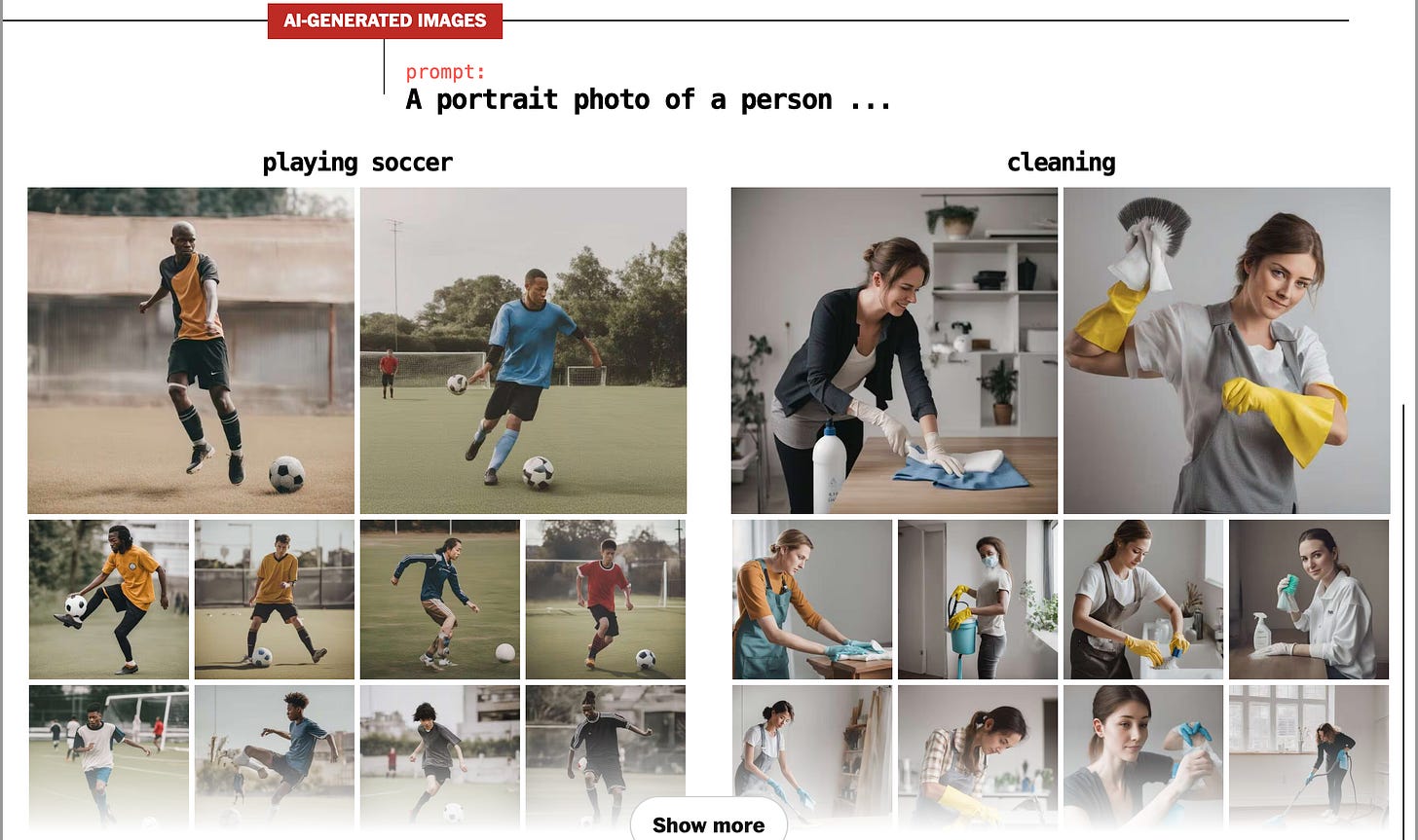](https://substackcdn.com/image/fetch/$s_!ei-o!,f_auto,q_auto:good,fl_progressive:steep/https%3A%2F%2Fsubstack-post-media.s3.amazonaws.com%2Fpublic%2Fimages%2F4b60491c-5507-43ac-a361-20ee8950f4f1_2056x1219.png)
Ecco, **seppur a giocare a calcio siano statisticamente più uomini, non sono SOLO gli uomini a farlo.** Sulle pulizie non ho trovato statistiche, ma mi sento di dire che non sia solo una faccenda da donne. *Spero.*
Ovviamente, non è un problema relativo solo alla generazione di immagini, ma **anche a quella di testo.** Qualche giorno prima che uscisse ChatGPT nel 2022, avevo fatto un [progetto per l'università](https://github.com/lorenzoancona/group_project/blob/main/English_exp2_1.png) in cui trovavo che **GPT associava aggettivi come “dolce” o “incompetente” con percentuali molto superiori alle donne**, mentre “competente” o “violento” erano per gli uomini (tra l'altro ho scoperto ora che è stato ripreso dal [Domani](https://www.editorialedomani.it/tecnologia/lintelligenza-artificiale-ha-imparato-a-essere-razzista-e-sessista-glw75cwl)!).
Allora, **nel tentativo di creare una IA "giusta"** (nel senso di *"fair",* in inglese) **a Google hanno cercato di compensare i bias, ma hanno esagerato.** E così ne è scaturita non una IA più giusta, ma una che generava **immagini con errori fattuali, che non hanno nulla a che fare con valori e principi di uguaglianza o inclusione.**
------------------------------------------------------------------------
Comunque, al di là di Google, che sta lavorando per sistemare Gemini e della quale va anche apprezzato di aver riconosciuto gli errori, oggi Artifacts si fa una domanda essenziale: ***Quale realtà vogliamo che sia generata dall'IA?***
O meglio, vogliamo che replichi la realtà così com'è, riflettendone ingiustizie o disuguaglianze, o **dovremmo piuttosto preferire una realtà a cui aspiriamo, che ci auspichiamo, e verso la quale vorremmo tendere?**
Insomma, vogliamo essere dei crassi empiristi attaccati alle statistiche o **ricordarci che gli algoritmi**, poiché allenati su dati del passato, prossimo o remoto, **in realtà tendono a ["predire il passato, più che il futuro"?](https://mitpress.mit.edu/9780262538961/the-smart-enough-city/)**
Complessa, ma proviamoci.
> ### La Storia
**Premessa:** lascia da parte il caso di Gemini, che è estremo.
La reazione, di pancia, che potrebbe venire è "ok, bello il progresso, ma se la realtà ha determinate caratteristiche, **non la cambieremo certo perché le immagini generate dall'IA sono più giuste".**
È un pensiero ragionevole, al quale però va contrapposta l'idea che **se le cose sono sempre state in una certa maniera** - che non ci soddisfa più -, **non significa che debbano continuare a esserlo.**
Basta astrazione, **esempio**. **Immaginiamo di chiedere ad un'IA di generare un CEO.** In inglese, quindi no differenze di genere. Da un lato è vero che la maggior parte dei CEO sono uomini, **quindi ha senso che ciò venga riflesso negli output.** Dall'altro, le cose - per fortuna - stanno cambiando e continuare a generare uomini CEO sarebbe contrario al cambiamento e, soprattutto, itererebbe uno stereotipo del passato. **Sarebbero, quindi, forse preferibili degli output che tengano conto del presente, magari leggermente spostati verso un modello a cui aspiriamo?** Insomma, un po' più CEO donne?
------------------------------------------------------------------------
**La questione è socio-politica, ma è in realtà anche profondamente tecnica.** D'altronde, "artifacts do have politics" :).
E pone un interrogativo a chi sviluppa l'IA: **preferire modelli e software numericamente accurati**, dunque privi di bias statistici ma con bias sociali, **oppure "combattere" e limitare i bias sociali ma con ripercussioni sull'accuratezza dei modelli?**
Ne potremmo discutere per ore.
La tendenza dell'industria è quella di cercare di **controllare e mitigare gli output dell'IA Generativa.** Si può fare a priori, **manipolando i dati di training o con umani che "correggono" gli output in una fase di test**, oppure a posteriori, facendo del ***"prompt transformation"**.* Ossia, una volta ricevuto un prompt dall'utente, il tool lo "riscrive", sia per dare istruzioni più precise a se stesso che per limare ed evitare casi spiacevoli. Lo fa ChatGPT Plus, e si pensa che lo facesse anche Gemini, con i risultati che abbiamo visto sopra.
A prescindere dalla tecnica, però, un elemento è chiaro: **la responsabilità di chi sviluppa l'IA.** Dato che, [come Floridi spiega bene](https://papers.ssrn.com/sol3/papers.cfm?abstract_id=4551487), la neutralità non esiste, ecco che **le aziende tech**, come Google o OpenAI, **devono capire che realtà vogliono riflettere.**
[](https://substackcdn.com/image/fetch/$s_!mqra!,f_auto,q_auto:good,fl_progressive:steep/https%3A%2F%2Fsubstack-post-media.s3.amazonaws.com%2Fpublic%2Fimages%2F9d162251-d8ae-4dd6-8ef6-d76e326cc892_1024x1024.webp)
Mica mi ero scordato il disegnino eh! *Creato con DALL-E*
Soprattutto, nel caso di Google, questo viene con un **cambiamento radicale:** se prima cercavamo la foto di un CEO su Google Search e il risultato erano solo uomini, la responsabilità di Google era limitata al ranking. Ora, invece, l'immagine è generata da un tool sviluppato da Google, **quindi c'è molto più margine per prendersela con Google.** (Chi sia responsabile degli output dell'IA è questione vasta su cui riflettiamo un'altra volta).
------------------------------------------------------------------------
Rispetto alle soluzioni, **esistono varie proposte.** Per semplificare, vediamo una prima dimensione in cui i tool, quindi le aziende, cercano di defilarsi, e un'altra in cui sono centrali.
Nella prima, che suggerisce Kevin Roose in [Hard Fork](https://www.nytimes.com/2024/03/01/podcasts/hardfork-google-gemini-kara-swisher.html), **l'idea è di lasciare la scelta all'utente e di personalizzare l'uso che fa dell'IA.** Ad esempio, se chiediamo una foto dei nostri amati CEO, i tool potrebbero fare domande aggiuntive all'utente per capirne finalità e valori, e quindi generare output adatti alla circostanza. Qui, chiaramente, **si rischia di rinforzare agli estremi le visioni degli utenti,** ma d'altronde OpenAI produce tecnologia, non un corso di etica.
Nella seconda, invece, **le aziende definiscono dei valori per le tecnologie che producono.** Quindi non è solo ingegneria informatica, ma anche **ingegneria valoriale.** In questo modo, fanno ciò di cui [Kate Crawford](https://www.degruyter.com/document/doi/10.12987/9780300252392/html?lang=en#Harvard) ha scritto come **"creazione e perimetrazione della realtà".** Inutile dire che qua la responsabilità è tanta tanta.
Alla fine, **ne risulta ingigantita l'influenza sulla realtà di aziende private**, con i loro legittimi ma privati interessi. Che non è mica una cosa da condannare, ma un fatto di cui è bene essere consapevoli.
E se molto abbiamo scritto e letto del ruolo dei social, e quindi di privati, nel *come* ci mostravano la realtà, **ora si profila uno scenario in cui decifrare** ***quali*** **realtà vengano generate.**
Tra l'altro, se è davvero difficile capire che forma dare a queste realtà, è **anche importante ricordare che è una decisione comunque in mano ai pochi che la tecnologia la costruiscono.** No critica, dato di fatto.
[Leave a comment](https://artifactstech.substack.com/p/realta-parallele/comments)
> ### Rassegna (Stampa)
**Il giornalismo incontra l’IA**, [al FT](https://www.theverge.com/2024/3/23/24106296/ask-ft-generative-ai-chatbot-answers-tool). Ci si chiede se [sarà o meno una rivoluzione.](https://www.cjr.org/tow_center/qa-ai-in-newsrooms-revolution-or-retooling.php) Qui una [database di tutti i casi di utilizzo](https://airtable.com/appdaeDwFizD4RK0u/shrKhe7Js48HvBhmG/tblBcSZESOAuy5Q9A) finora.
**L’UE ha consigliato alle piattaform**e [come mitigare i rischi durante le elezioni](https://www.cjr.org/tow_center/qa-ai-in-newsrooms-revolution-or-retooling.php), a partire dal DSA. E Mozilla Foundation ripercorre la storia di [tutto quello che hanno fatto le piattaforme](https://foundation.mozilla.org/en/campaigns/platforms-promises-and-politics/) negli anni passati.
Perché non dovremmo usare [Whatsapp](https://www.linkedin.com/posts/brunogiussani_not-using-whatsapp-i-dont-use-whatsapp-activity-7178666175692742657-kx0g/)?
**OpenAI** avrebbe [“rubato” i video di YouTube](https://www.theverge.com/2024/4/6/24122915/openai-youtube-transcripts-gpt-4-training-data-google) per addestrare la sua IA. Però ha aggiunto una [funzione molto carina a DALL-E.](https://www.theverge.com/2024/4/3/24120181/openai-dall-e-chat-gpt-image-edit) Nel frattempo, **Google** potrebbe mettere la sua [IA a pagamento.](https://on.ft.com/3xoZPYA)
Ma cosa stracavolo sono i **microchip**? [Pezzo incredibile del FT](https://ig.ft.com/microchips/)
Il problemone dei [deepfake](https://www.ft.com/content/04dcc944-49a4-4a2d-808c-26551681a222). E **l’AI Act** che ha [qualche falla](https://edri.org/our-work/eu-ai-act-fails-to-set-gold-standard-for-human-rights/) secondo delle organizzazioni civili.
[Ma l’IA sa di essere IA?](https://joshwhiton.substack.com/p/the-ai-mirror-test?source=Email_0_EDT_WIR_NEWSLETTER_0_TRANSPORTATION_ZZ&bxid=6356a0ac954628036104e708&cndid=71263277&esrc=AIHub-regGate&triedRedirect=true) Molto carina questa storia
**Ok, bella la privacy, ma se la facciamo rispettare.** Ho fatto un video per NOS, **con un cookie,** basta cliccare :)
[](https://www.instagram.com/reel/C5YrJ9XMMQx/?utm_source=ig_web_copy_link&igsh=MzRlODBiNWFlZA==)
> ### Lo Scaffale
[](https://substackcdn.com/image/fetch/$s_!sL2W!,f_auto,q_auto:good,fl_progressive:steep/https%3A%2F%2Fsubstack-post-media.s3.amazonaws.com%2Fpublic%2Fimages%2Fbe969347-11a6-4cb1-8238-34254cd0285d_1080x1080.png)
Questo prima o poi volevo consigliarlo, è il classico libro per iniziare sull’IA o per avere delle prospettive etiche e filosofiche interessanti. **Luciano Floridi e Cabitza** sono presumibilmente tra gli italiani più forti sul tema. **Breve, si legge in due ore, ma veramente illuminante.**
📚 **Tutti, ma proprio tutti, i libri consigliati in Artifacts sono raccolti [qui](https://airtable.com/appK7fMPX1DMkQYzL/shrRh8TgI7GtmgBxM/tblWFBDnOoRBU47XM/viwdSxYeauFmB0EIM)**
> ### Nerding
[](https://substackcdn.com/image/fetch/$s_!ZyN2!,f_auto,q_auto:good,fl_progressive:steep/https%3A%2F%2Fsubstack-post-media.s3.amazonaws.com%2Fpublic%2Fimages%2F91a141de-cadf-4975-9d3f-d84bfa8d356d_1080x1080.png)
Se cerchi ispirazione per visualizzare dei dati, **[DataViz Project](https://datavizproject.com/)** è tra i migliori. Tra l’altro, oltre alla varietà di soluzioni, anche le grafiche sono davvero belle belle.
======
# Era solo un giradischi
Date: 2024-03-26 | Language: it
Canonical: https://artifactstech.substack.com/p/era-solo-un-giradischi
Cite as: Era solo un giradischi by Lorenzo Ancona, Artifacts, 2024-03-26. https://artifactstech.substack.com/p/era-solo-un-giradischi (CC BY 4.0)
Ciao,
questa Artifacts non poteva che uscire in questa forma. **O altrimenti non sarebbe uscita.**
In questi giorni, infatti, **sono un po’ nell’occhio del ciclone di cose da fare che non posso controllare.** Sia chiaro, si tratta di lavoro e università, niente di drammatico. Ma cose che comunque non posso controllare perché non dipendono da me. **Ed Artifacts è l’unica che, invece, riesco a controllare al 100%.**
**Ma Artifacts è anche quello che Paul Graham ha descritto come** ***“a thin thread off to the side when things get more serious”***, quando spiega [perché dar vita a un progetto individuale.](https://paulgraham.com/own.html) Insomma, quella cosa che resiste a margine di tutto. **E allora ho pensato che meglio qualcosa, diverso e più semplice, che niente.**
Quindi oggi una riflessione, una elucubrazione, forse evanescente o contorta o magari inutile, su una cosa che mi è successa e a che fare con me, noi, e la tecnologia di tutti i giorni.
[](https://substackcdn.com/image/fetch/$s_!Ynwb!,f_auto,q_auto:good,fl_progressive:steep/https%3A%2F%2Fsubstack-post-media.s3.amazonaws.com%2Fpublic%2Fimages%2F579a862e-e086-4ceb-9843-161a40183f48_1024x1024.jpeg)
Spoiler. *Creato con DALL-E 3*
> ### La Storia
**Mia sorella ha compiuto 18 anni e le hanno regalato un bellissimo giradischi per vinili.** È nuovo, ha persino il Bluetooth, ma comunque un design sicuramente non moderno. Puro vintage.
Chiaramente serve ad ascoltare la musica, ma **forse il vero scopo è far vivere un’esperienza.** Un designer magari nel suo pitch direbbe che c’è una unica e diversa User Experience.
E non ha Spotify, **ma lo abbiamo usato per ascoltare la stessa musica di Spotify** perché le hanno regalato anche dei vinili di Coez e Pinguini Tattici Nucleari, che, a quanto pare, ora fanno anche vinili. **Magari non sei sorpreso/a, io non ne avevo idea.**
------------------------------------------------------------------------
Comunque, nel vederlo e usarlo, ho pensato una cosa molto molto semplice: **ma perché il giradischi ORA ci piace così tanto?**
E tu dirai “beh è semplicemente bello”. Sí, per carità, **ma perché ci piace così tanto una tecnologia che è stata superata?**
O meglio, **capisco il fascino di un jeans vintage** perché magari l’estetica è di un’altra epoca, ma l’esperienza del jeans - la UX, se volete - alla fine è quella, uguale ai jeans di oggi.
**Ma invece il giradischi è semplicemente simbolo di una esperienza del passato.** Non è sicuramente la prima cosa che ci viene in mente quando pensiamo ad ascoltare della musica, **e poi è tremendamente più complicato.**
Devi stare attento alla puntina, azzeccare il solco per ascoltare una precisa canzone, alzarti dal divano per cambiarla. Mi fermo perché ci siamo capiti.
**Ok, dai, è una esagerazione.** Sembro un anti romantico e un tremendo accelerazionista che vuole essere sostituito dalle macchine.
------------------------------------------------------------------------
**Ma il punto è un altro:** la tecnologia digitale, una Spotify o YouTube Music in questo caso, hanno migliorato sensibilmente il modo in cui fruiamo la musica. **E per “sensibilmente” intendo sia “alla grande”, che proprio nella esperienza sensoriale**, che è più limitata e semplice perché dobbiamo fare meno azioni per ascoltare una canzone; ma anche la qualità del suono è diversa, c’è chi dice meglio e chi peggio.
Comunque, prima dovevi almeno uscire e comprare il vinile o il CD e poi metterlo nel giradischi o stereo. **Tutte azioni meno immediate e che richiedono diverso tempo.** Ora, invece, se esce un album lo ascolti semplicemente aprendo Spotify mentre prendi coscienza di chi sei la mattina appena sveglio.
**Eppure, il giradischi un po’ ci piace.** Sia chiaro: non lo sostituiremmo mai a Spotify, **ma l’esperienza ci piace, ci gratifica ed è forse anche bello avere un giradischi in salone.**
E magari quello del giradischi è un caso estremo anche un po’ naïf, ma l’esperienza è anche andare in libreria a vedere (e comprare) i libri nonostante Amazon o andare al cinema quando un film sarebbe anche su Netflix in contemporanea. Sì, c’è forse anche una componente sociale.
------------------------------------------------------------------------
Fin qui ho scritto di cultura e di come la consumiano, un dominio comunque limitato, legato ai gusti personali, e **comunque ristretto a come scegliamo di vivere esperienze certo importanti ma comunque marginali.**
Eppure, scrivendo e vagando con la mente, ho anche pensato a **come il rapporto con la tecnologia attuale ci abbia anche portato a dare tutto un nuovo valore anche al distacco dalla tecnologia stessa.**
Quasi come se volessimo tornare o avessimo bisogno di sprazzi del mondo in cui i giradischi erano l’avanguardia. **Soprattutto, a come sia in voga la volontà di provare a recuperare o simulare a volte un mondo senza questa tecnologia.**
C’è chi usa i [minimal phone](https://www.nytimes.com/2024/01/06/technology/smartphone-addiction-flip-phone.html) per qualche settimana, ci sorprendiamo forse troppo di giornate in montagna dove non prende la connessione, [anche la prima Artifacts di sempre](https://artifactstech.substack.com/p/una-settimana-senza-algoritmi) era stata proprio su un mio detox dai social media.
[\[Embedded media — view original\]](https://www.youtube-nocookie.com/embed/WXux4q9Npbg?rel=0&autoplay=0&showinfo=0&enablejsapi=0)
E non si tratta di esperienze sporadiche come il consumo di musica, ma **proprio dell’esperienza stessa della nostra vita**, che siamo abituati ad avere connessa e **che è ora sensazionale, invece, disconnettere.** Molto più di ascoltare i Pinguini Tattici Nucleari sul giradischi, ecco.
Questo è un dilemma che mi viene spesso. Ossia, ben venga la volontà di “staccare” ogni tanto o anche di smettere di usare i social media. **Ma come siamo arrivati a questo punto?**
Se decidiamo di staccare, dimostriamo già consapevolezza. Ma, comunque, quella della connessione perenne è una condizione che riguarda un po’ tutti e **rispetto alla quale raramente abbiamo fatto una scelta attiva.** Insomma, spesso è così e basta.
**Con ciò non voglio certo demonizzare le tecnologie nelle nostre vite**, senza le quali non esisterebbe Artifacts, chissà come avremmo fatto durante la pandemia, niente relazioni a distanza, e molto molto altro.
**Mi chiedo, però, cosa significhi la condizione in cui arriviamo a voler e, forse, dover “evadere” dalla tecnologia.** Ancora, positivo riconoscerne la necessità, ma forse preoccupante che questa necessità spesso si palesi senza che capiamo bene da dove arrivi.
------------------------------------------------------------------------
Comunque, era una divagazione, la volontà di lanciare e lasciare un dubbio, **e magari anche di sentire cosa ne pensi, se ti va di rispondere a questa mail.**
Alla fine è un semplice giradischi, è probabilmente solo bello e testimone di un mondo in cui non vivremmo (e di fatto non viviamo) ma che ci piace ricordare o, per chi è più giovane, assaggiare a piccole dosi, canzone dopo canzone.
[Leave a comment](https://artifactstech.substack.com/p/era-solo-un-giradischi/comments)
------------------------------------------------------------------------
> ### Artifacts x Technicismi (!)
Davanti al miglior Bloody Mary di Milano, [Riccardo Bassetto](https://open.substack.com/users/44088427-riccardo-bassetto?utm_source=mentions) mi ha chiesto se volessi scrivere un Guest Post per la sua [Technicismi](https://open.substack.com/pub/technicismi) . E ho chiaramente accettato, **quindi eccoci qui:**
[Technicismi(Al)la ricerca del futuroCiao, eccoci qui come ogni domenica! Oggi troverai un nuovo Guest Post, ogni mese ospito un articolo scritto dagli autori delle mie newsletter italiane preferite. Lorenzo Ancona, autore di Artifacts, oggi racconta la sua esperienza nel “futuro” delle ricerca online, post-Google…Read more3 years ago · 23 likes · 2 comments · Riccardo Bassetto and Lorenzo Ancona](https://technicismi.substack.com/p/alla-ricerca-del-futuro?utm_source=substack&utm_campaign=post_embed&utm_medium=web)
*Spero che aver scritto questa altra newsletter questa settimana valga come scusa per la Artifacts un po’ diversa dal solito che hai appena letto :)*
> ### Rassegna Stampa
Dopo l’UE e le vicende legate a DMA e Spotify, ora **Apple è sotto la lente di ingrandimento** [anche negli Stati Uniti](https://www.theverge.com/2024/3/21/24105363/apple-doj-monopoly-lawsuit), e non è un caso da poco! Nel frattempo, però, pare che stia facendo [passi avanti sull’IA negli iPhone.](https://www.theverge.com/2024/3/18/24104626/apple-license-google-gemini-generative-ai-openai-chatgpt)
Settimana calda anche per un’altra BigTech, ossia **Meta**, che [pare voler ridurre l’abbonamento per avere la privacy](https://www.politico.eu/article/meta-lowers-ad-free-subscription-fee-amid-eu-scrutiny/), di cui abbiamo parlato ampiamente [su Artifacts.](https://artifactstech.substack.com/p/si-ora-bisogna-fare-una-scelta) E, nel frattempo, [Threads sul Fediverso](https://www.theverge.com/24106231/threads-fediverse-demo-meta-fediforum) sembra realtà.
Sempre in UE, **col Digital Markets Act che è realtà**, [si inizia a investigare](https://www.linkedin.com/posts/pierrebichet2023_dma-non-compliance-investigations-activity-7177970684445249536-TM7f?utm_source=share&utm_medium=member_desktop) come si stanno comportando i gatekeeper. Credo ci aspettino mesi intensi.
**Le organizzazioni internazionali studiano e scrivono cose di IA**, sia alle [Nazioni Unite](https://news.un.org/en/story/2024/03/1147831) che al [Consiglio d’Europa](https://www.euractiv.com/section/digital/news/council-of-europe-ai-treaty-does-not-fully-define-private-sectors-obligations/) (sì, quello che non è dell’UE)
Ricordi il Concetto di [Collective Intelligence per l’IA](https://artifactstech.substack.com/p/piu-collettiva-che-artificiale-questa)? Ecco, ne è uscito un [bel report da leggere.](https://static1.squarespace.com/static/631d02b2dfa9482a32db47ec/t/65f9a1296f1a357e918f7a58/1710858559931/CIP_+A+Roadmap+to+Democratic+AI.pdf?utm_source=Democracy+Technologies&utm_campaign=5aceefa607-dt-newsletter-20-03-2024&utm_medium=email&utm_term=0_-48b74a5386-%5BLIST_EMAIL_ID%5D&mc_cid=5aceefa607&mc_eid=05a1d03f62) Sempre parlando di cose già viste su Artifacts, [questo è utile](https://hls.harvard.edu/today/does-chatgpt-violate-new-york-times-copyrights/) per capire qualcosa in più sulla **bagarre OpenAI - NYT.**
La settimana scorsa **NVIDIA** ha rilasciato una nuova scheda grafica impressionante per l’IA, ma c’è qualche problemino con il [consumo di acqua.](https://www.tomshardware.com/tech-industry/nvidias-h100-gpus-will-consume-more-power-than-some-countries-each-gpu-consumes-700w-of-power-35-million-are-expected-to-be-sold-in-the-coming-year#:~:text=Nvidia%20literally%20sells%20tons%20of,of%20a%20major%20American%20city)
***“The EU regulates what the US innovates”*** è il leitmotiv su perché saremmo indietro sull’innovazione, ma secondo Anu Bradford le ragioni sono ben più complesse. [Ho fatto un riassuntino qui.](https://www.linkedin.com/posts/lorenzo-ancona-1b02b31a7_the-false-choice-between-digital-regulation-activity-7176231037054664704-fCGv?utm_source=share&utm_medium=member_desktop)
> ### Lo Scaffale
[](https://substackcdn.com/image/fetch/$s_!3U4V!,f_auto,q_auto:good,fl_progressive:steep/https%3A%2F%2Fsubstack-post-media.s3.amazonaws.com%2Fpublic%2Fimages%2Fdfbcc44b-f712-470a-abe1-800a58dc5035_1080x1080.png)
***"100 Things we’ve lost to the Internet”*** è un libro bellissimo e scritto benissimo che racconta le 100 cose abbiamo già perso o potrebbero presto sparire per Internet. E sono tipo la **noia, perdere biglietti, gli ex partner, le foto che si rovinano, le mappe, lo spelling corretto delle parole, le enciclopedie e molto altro.** Per niente nostalgico o luddista, anzi ironico e piacevole. **Un regalo perfetto, tra l’altro.**
📚 **Tutti, ma proprio tutti, i libri consigliati in Artifacts sono raccolti [qui](https://airtable.com/appK7fMPX1DMkQYzL/shrRh8TgI7GtmgBxM/tblWFBDnOoRBU47XM/viwdSxYeauFmB0EIM)**
> ### Nerding
[](https://substackcdn.com/image/fetch/$s_!ZSQz!,f_auto,q_auto:good,fl_progressive:steep/https%3A%2F%2Fsubstack-post-media.s3.amazonaws.com%2Fpublic%2Fimages%2F4dcc4598-dabe-437e-8789-3f4d7497e967_1080x1080.png)
È pieno di trucchetti per limitare l’utilizzo di app, specie dei social. ***[One Sec](https://one-sec.app/)*** è la mia preferita perché non impone dei blocchi, ma **ti chiede di fare un bel respiro di 30 secondi ogni volta che vuoi aprire Instagram o simili.** E ti fas ia desistere dai tic di scrolling rapido mentre aspetti l’ascensore che probabilmente ti rende anche più ***mindful*** su come utilizzi il cellulare.
------------------------------------------------------------------------
A presto :)
======
# Il peccato originale
Date: 2024-03-19 | Language: it
Canonical: https://artifactstech.substack.com/p/il-peccato-originale
Cite as: Il peccato originale by Lorenzo Ancona, Artifacts, 2024-03-19. https://artifactstech.substack.com/p/il-peccato-originale (CC BY 4.0)
La settimana scorsa era il compleanno del World Wide Web, il celebre www. Un ragazzotto che ha compiuto 35 anni. Che, poi, altro non è che Internet per come lo conosciamo.
Tim-Berners Lee (TBL), che il Web lo ha inventato, però, non ha proprio festeggiato. Anzi, ha scritto una serie di pensieri decisamente pungenti.
In primis, “Alla base del Web c’era l’intenzione di permettere collaborazione, stimolare empatia (compassion, in inglese), e di diffondere creatività”. E aggiunge: “It was to be a tool to empower humanity”.
Grazie a questi principi, “Il Web era decentralizzato, ricco di contenuti e opzioni, dava vita a piccole comunità, permetteva empowerment individuale e portava un valore incredibile”. (È evidente che non ho saputo tradurre “empowerment” e “empower”).
Però, le cose sono presto cambiate: “Il Web è stato dominato dall’interesse individuale di alcune aziende private, che ne hanno eroso i valori e portato alla sua disgregazione”.
E, infine, identifica due ragioni fondamentali della direzione sbagliata intrapresa:
1. la concentrazione di potere nelle mani di pochi, che contraddice la decentralizzazione delle origini;
2. il mercato dei dati personali, che ha profilato le persone e lucrato sui loro comportamenti grazie al targeted advertising.
Non il migliore dei compleanni.
 E non la più bella delle torte di compleanno. Creata con DALL-E 3
------------------------------------------------------------------------
Precisazione sempre utile: il Web non è Internet. Sono due cose diverse. So che molti lo sanno già, ma meglio non dare niente per scontato.
Nel dettaglio, per “Internet” si intende in realtà una qualsiasi connessione tra due o più computer. Il “World Wide Web”, invece, è lo “spazio” di scambio di documenti e siti identificabili dagli Uniform Resource Locators (URLs), ossia gli hypertext links, quelli che compaiono in blu. E, soprattutto, al Web si accede tramite Internet.
 Questo è anche utile a capire
Una definizione per me bellissima la dà Alessandro Baricco in “The Game”, dove descrive il Web come una immensa stanza piena di cassetti che contengono musica, libri, notizie etc. Ecco, TBL ha messo in comunicazione tutti quei cassetti, e ci ha permesso di saltare da uno all’altro. Semplicemente cliccando.
------------------------------------------------------------------------
Ma qualcosa si è rotto, e oggi Artifacts prova a spiegare come e perché. O meglio, lo fa insieme a Tommaso Marmo, per gli amici Tommi, che, tra le varie cose, lavora alla Free Software Foundation Europe.
Sul suo sito - assolutamente da guardare - Tommi si descrive come un “entusiasta”, ma è soprattutto appassionato e curioso di Internet, e in particolare fa ricerca sull’Internet libero e decentralizzato. Insomma, quello che piace a Tim Berners Lee.
Ah, tra l’altro, Tommi ha incontrato Tim Berners Lee, e con lui ha discusso la sua definizione del “Peccato Originale di Internet”, che ha poi teorizzato nella sua tesi.
Del peccato originale, di come tornare indietro o andare avanti, ma anche di un’idea molto molto originale, ne abbiamo chiacchierato nell’intervista che trovi qui sotto.
> ### L’Intervista
Il transcript di questa intervista è stato rivisto per migliorarne la chiarezza. Le opinioni espresse sono esclusivamente quelle dell’intervistato e non riflettono necessariamente quelle di chi ha condotto l'intervista. Anche se spesso sono d’accordo :)
> Allora, mi racconti cos’è questo peccato originale di Internet?
Accade il 30 aprile 1995, quando la National Science Foundation negli Stati Uniti taglia ogni finanziamento pubblico alla Rete prevalente in quel momento, ossia NSFNET, utilizzata per la ricerca universitaria. Qui sta quello che io ho voluto etichettare come peccato originale: aver lasciato la rete interamente in mano a enti privati.
Quel giorno, infatti, da “luogo” di collaborazione e condivisione, Internet è diventato un ambiente competitivo: un mercato da cui trarre profitto. E, come tutti i mercati, avrebbe necessitato di qualche tipo di regolamentazione, che invece non esisteva. Anzi, da quel momento le istituzioni hanno cominciato a rincorrere l’innovazione digitale dei privati, invece di saper definire una cornice di regolamentazione a priori.
> Ma cos’è che si è corrotto? Com'era Internet prima di essere colpito dal peccato originale?
Durante la Guerra Fredda, c'era il timore che i ponti radio fossero messi KO da un attacco sovietico, impedendo ogni tipo di comunicazione. Per questo, molti erano alla ricerca di soluzioni. Nel 1969 Paul Baran propose invece un’alternativa che consisteva nel ribaltare il paradigma dell’infrastruttura delle telecomunicazioni: spezzettare le informazioni trasmesse in tantissimi pacchetti, distribuendoli. Quindi, Internet nacque libero, decentralizzato, fondato sulla condivisione e non sulla centralizzazione.
E non era solo tecnologia, ma il perseguimento di una visione del mondo: uno in cui far fluire le idee liberamente, mettendo in discussione lo status quo. Pensa all’hyperlink e al nuovo paradigma che rappresentava: prima era inconcepibile l’idea di cliccare per “andare” da un’altra parte connessa a dove si era prima.
> E Tim Berners Lee come si inserisce?
TBL crea il World Wide Web al CERN di Ginevra nel 1989 e, nonostante lo scarso interesse, porta avanti la sua idea, di fatto regalando a tutti, GRATUITAMENTE, il web che conosciamo oggi. Decisione in linea con l’idea della libera circolazione di informazioni che ho descritto prima. Oggi, invece, un’invenzione simile sarebbe probabilmente inquadrata in una start-up per trarne profitto.
Tra l’altro, proprio TBL, con cui ho avuto l’onore di parlare, mi ha detto che, tecnicamente, Internet è ancora come lo aveva concepito Paul Baran, ma il problema sono le grandi aziende che ne detengono il controllo. C’è una ricerca del 1999 che profetizza un Web che negli anni successivi avrebbe avuto sempre meno piccoli siti web, ma pochi grossi enti con moltissime pagine. Ed infatti il web è degenerato ad una manciata di piattaforme che hanno, però, milioni, miliardi di profili.
> Però tu dici che non è solo informatica, ma il peccato originale è frutto dell’ecosistema sociale, politico, economico attuale in cui si sviluppa. Cioè?
Il problema essenziale è che Internet, tecnologia senza precedenti, è stato inizialmente lasciato a se stesso, senza nessuna regola. E ad attivarsi per appropriarsene, com’è noto, sono stati enti, come aziende private, mossi innanzitutto da interessi economici. La bolla delle dot.com dei primi anni duemila è un esempio chiaro di un mercato sregolato.
Ma, soprattutto, tutta questa libertà ha permesso a dei privati di plasmare e poi consegnarci l’Internet come lo conosciamo, ossia centralizzato, come fosse l’unica opzione possibile. Come fosse inevitabile. Ma invece non è così!
> Interessante questa inevitabilità. Zuboff dice che la tecnologia non è a sé stante, ma che è necessario capire le forze che la plasmano. Spieghi meglio cosa intende?
C'è un esempio lampante: Bitcoin. Dopo la crisi del 2008, l'opinione comune era che le banche fossero i cattivi. Allora, un tuttora misterioso sviluppatore di nome Satoshi Nakamoto concepisce un sistema economico totalmente slegato dalle banche, dove le persone possono scambiarsi denaro senza intermediari. Insomma, se le banche sono cattive, le facciamo fuori. Ma è una promessa non mantenuta: oggi Bitcoin è quasi unicamente uno strumento di speculazione finanziaria.
Cosa ci insegna questa storia? Che l'Internet e l'informatica sono figlie della società in cui vengono sviluppate: Internet dà grande potere, ma pur sempre in un particolare contesto socio-economico. Per questo, la vera sfida è leggere internet e informatica nella loro dimensione socio-economica, e quindi politica.
> E cosa stiamo facendo per far redimere Internet dal peccato originale?
Il Digital Markets Act (DMA; in Artifacts trattato qui, ndr) è un grande passo perché è uno strumento politico / legislativo che coglie però elementi tecnici. Finora, infatti, la politica ha provato a mettere regole alla tecnologia solo con strumenti politici.
Invece, il DMA obbliga l’oligopolio delle BigTech ad “aprire” la propria infrastruttura, finora chiusa. Così facendo, dimostra a noi e ai governi di tutto il mondo che agire su come Internet è costruito tecnicamente può avere delle ripercussioni economiche, e quindi favorire la competitività. Insomma, è un po’ il primo “battesimo” del mercato digitale in Europa.
> Quindi non basta la regolamentazione? Cos’altro serve?
No, e lo dimostra il DMA stesso. Servono chiaramente anche soluzioni pratiche, veri e propri cambiamenti su come concepiamo e utilizziamo Internet. Ma lasciami fare una premessa: non dobbiamo sentirci caricati del peso di questo cambiamento esclusivamente come individui. Se tu mi chiedi cosa fare per un Internet positivo, il primo passo è comprendere, demistificare e decostruire Internet come lo conosciamo.
Non c’è da sentirsi in colpa per usare Instagram, ma è importante avere consapevolezza della connessione tra Instagram e il modello lucrativo che ne è alla base. È simile al discorso sul cambiamento climatico: non possiamo accusare le persone solamente perché prendono un aereo, ma è auspicabile almeno comprenderne l’impatto ambientale in senso più ampio.
> E quali sono, quindi, le soluzioni tecniche?
So dove vuoi arrivare: il Fediverso, di cui hai già parlato bene in Artifacts. È un nuovo modello di social, una nuova soluzione tecnica, ma ispirata allo spirito di decentralizzazione delle origini di Internet. Nel Fediverso possiamo scegliere a quale comunità appartenere, semplicemente scegliendo su quale server (o “nodo”, “istanza”) stare. E quindi ritrovarci, per nostra scelta, con delle persone con le quali condividiamo dei valori.
È un modo per recuperare la componente autenticamente sociale dei social netwok, ritornando ad un’autodeterminazione collettiva. ActivityPub (il protocollo alla base del Fediverso, ndr) crea a livello tecnologico la possibilità di appartenere a delle comunità di persone anche su Internet, diverse da quelle determinate dagli algoritmi dei social “tradizionali”. Sta all’individuo determinare le “regole” del proprio social, insieme alla comunità virtuale in cui si trova.
> So che il lettore qua potrebbe essere confuso da tanti tecnicismi. Ma so anche che tu hai ideato un laboratorio per rendere il tutto più facile.
Sì, da qualche anno propongo un laboratorio in presenza che nasce dalla necessità di rappresentare per ogni genere di pubblico come funziona Internet e dove sta la chiave di volta del discorso che abbiamo fatto oggi. Lo stratagemma comunicativo è un gomitolo per rendere tangibile la differenza tra rete decentralizzata e centralizzata.
Ma è davvero un work in progress, lo aggiorno di continuo sulla base degli input che ricevo. Anzi, è in open license sul mio sito, quindi invito chiunque anche a replicarlo e, se gli va, contribuire ad arricchirlo. Era nato come laboratorio sul Fediverso, ma in realtà l’obiettivo è portare le persone a mettere in questione Internet come lo conosciamo, comprendendo il suo peccato originale.
Leave a comment
> ### Rassegna (Stampa)
L’Italia ha presentato la sua strategia sull’IA, e ci sono diversi soldi in ballo. La stessa cosa ha fatto la Francia, per gli amanti dei paragoni.
Il Parlamento Europeo invece ha approvato lo European Media Freedom Act. Ma, soprattutto, a Bruxelles hanno trovato un accordo su qualcosa che dovrebbe rendere meno doloroso andare dal dottore. E poi continua la battaglia Spotify - Apple.
Grandi news AI in casa Google: la sua AI sa giocare a Goat Simulator (male se non sai cosa sia). E intanto il suo chatbot non risponderà a questioni politiche.
Sempre su AI: arrivano robot che fanno cose, e poi Le Monde ha fatto un accordo con OpenAI, ma non sappiamo di che cifre stiamo parlando. Elon Musk ci tiene a far sapere a tutti come funziona il suo di chatbot.
Tantissimo TikTok oggi. Innanzitutto, multato per 10 milioni in Italia. Poco male: negli Stati Uniti vogliono bannarlo. Io ne ho parlato a “Ma Perchè?”
\[324 \| Ma perché TikTok rischia il bando negli Stati Uniti?\]
E, per finire, il buon Martino Wong e Beatrice Petrella hanno iniziato un super podcast su tutte cose di TikTok. Consiglio!
\[TikTalk\]
\[Lo Scaffale e Nerding oggi li ha scritti Tommi\]
> ### Lo Scaffale
 Avrei indubbiamente suggerito “Il capitalismo della sorveglianza” di Shoshana Zuboff, di cui ritengo l’introduzione debba essere di lettura obbligatoria in tutte le scuole superiori. Tuttavia, credo sia già un grande classico per chi legge Artifacts.
Allora, dato che abbiamo parlato di storia di Internet, penso invece calzi a pennello un libro che è stato alla base della mia ricerca, a cui sempre faccio riferimento per approfondire questi temi. In “History of the Internet and the Digital Future” Johnny Ryan racconta in modo discorsivo e accattivante le incredibili storie di tutti i personaggi della storia di Internet.
📚 Tutti, ma proprio tutti, i libri consigliati in Artifacts sono raccolti qui
> ### Nerding
 Yuno Host è un sistema operativo speciale, che permette di installare su un computer in casa propria o su un server affittato online centinaia di software differenti. Con YunoHost, è semplice e intuitivo creare il proprio cloud, la propria istanza del Fediverso, o molte altre cose con la stessa semplicità con cui si installa un’app sul telefono.
======
# Favorisca il documento
Date: 2024-03-12 | Language: en
Canonical: https://artifactstech.substack.com/p/favorisca-il-documento
Cite as: Favorisca il documento by Lorenzo Ancona, Artifacts, 2024-03-12. https://artifactstech.substack.com/p/favorisca-il-documento (CC BY 4.0)
Sabato mattina ho completato la procedura per votare alle elezioni europee (8 e 9 giugno) dall’estero. Basta inviare una mail al Consolato del proprio Paese con questo modulo e il proprio documento d’identità. Facile, più che votare da fuori sede in Italia, tra l’altro.
C’è tempo fino al 21 marzo. E anche se magari non c’è proprio l’imbarazzo della scelta su chi votare, è utile farlo. Qui finisce Artifacts per il sociale.
Nell’inviare il modulo, mi ha fatto sorridere una cosa: ho inviato all’amministrazione del mio Paese ciò che - forse più di ogni altra cosa - mi rende un cittadino del mio Paese: la mia carta d’identità.
Ho soprattutto pensato che stavo inviando un documento esattamente a chi quel documento me lo ha rilasciato. All’entità che, se parliamo digitalese, è il provider. E, anzi, chiaramente non ho mandato il documento stesso, ma una foto qualsiasi, un fronte-retro fatto alla buona su Canva, senza nessuno standard. Il tutto, comunque, via mail.
Insomma: il medium (la mail) era una tecnologia abbastanza recente, l’oggetto (la fotografia) era una tecnologia ormai un po’ datata, e il contenuto (la mia carta d’identità) non è tecnologia.
 Decidi tu se questi ingranaggi funzionano o meno. Creati con DALL-E
\[Vero, le nuove carte d’identità hanno il potenziale di essere usate in digitale, anche se proprio su Artifacts abbiamo visto che l’infrastruttura è ancora in divenire\].
------------------------------------------------------------------------
Comunque, al di là di elucubrazioni dettate dal dolce far niente e da un po’ di ironia che non vuole essere critica, la procedura mi ha fatto venir voglia di raccontare qualcosa in più di un Paese in cui il 99% dei servizi pubblici sono stati digitalizzati. Da anni, e il tutto con tassi di utilizzo elevatissimi.
Un paese in cui i cittadini hanno delle identità digitali e online possono fare qualsiasi cosa: pagare le tasse, votare, lanciare un’azienda o una startup, ricevere un certificato dal medico, andare dal notaio, pagare le multe, e molto molto altro, perfino sposarsi. Non si può invece divorziare, forse perché è anche meglio non renderlo troppo facile ché spesso gli incentivi non mancano comunque.
E, no, non è la California della Silicon Valley, ma l’Estonia, un paese europeo di poco più di un milione di anime. Che il New Yorker ha definito “the Digital Republic”, e che secondo le Nazioni Unite è il miglior e-government del mondo.
In Estonia ai servizi pubblici digitali hanno cominciato a pensare poco dopo che il Muro di Berlino era caduto. E, mentre in Italia giocavamo con la calcolatrice euro-lire, loro lanciavano le carte d’identità elettroniche.
\[Embedded media — view original\]
Lei spiega bene tutto, ma se continui a leggere fai prima, giuro.
------------------------------------------------------------------------
La storia di come tutto questo sia stato possibile, e dei diversi momenti chiave, la racconta l’Estonia stessa in maniera magistrale.
Tutto inizia nel 1994 con la pubblicazione dei "Principles of Estonian Information Policy", dove l’intento è prepararsi all’avvento della società dell’informazione, un concetto non esattamente mainstream all’epoca. L’epoca? Per dare un’idea: in Italia Silvio Berlusconi era solo un imprenditore e, al massimo, il presidente del Milan.
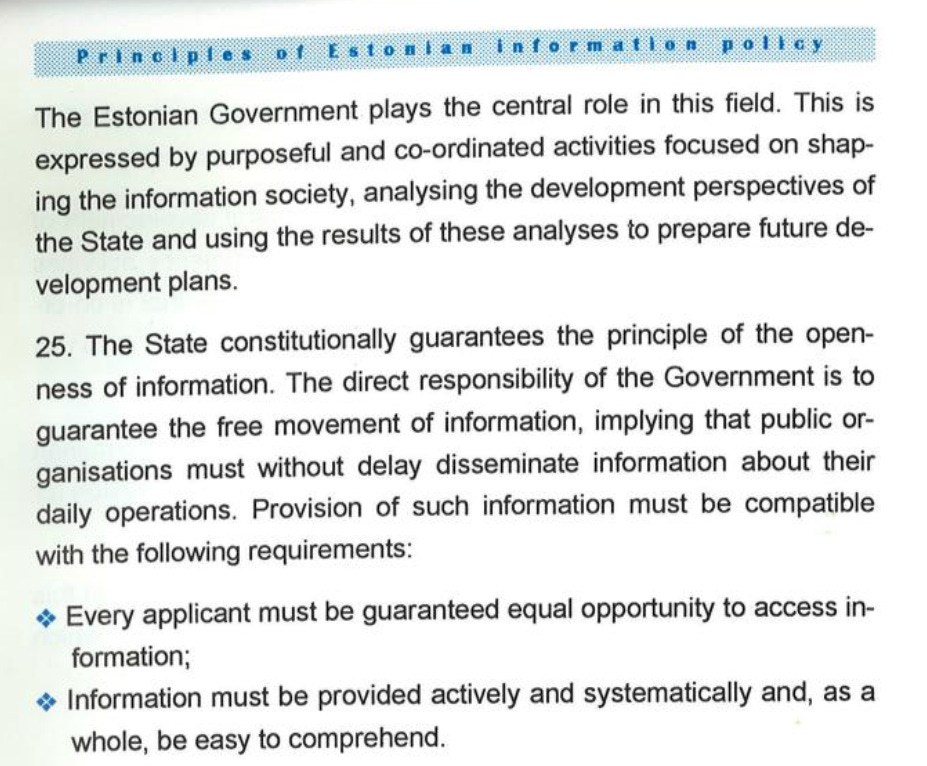 Un estratto per capire la maturità dei principi
E dal ‘94 in poi, nel giro di 15 anni, l’Estonia mette su l’infrastruttura digitale del Paese, che include i primi servizi di e-banking (1996), il pagamento delle tasse online (2000), l’interoperabilità dei dati dei cittadini (2001), il voto online (2005), e la sanità online (2009).
Di come questo sia stato possibile, di cosa c’è alla base di questo stato digitale, e quindi perché funziona così bene, ma anche di cosa ne traiamo, ne parla oggi Artifacts.
> ### La Storia
Come per ogni paese, ma anche come in ogni social network, il primo tassello è identificarsi. La chiave per fruire dello stato digitale, infatti, è la e-Identity.
Serve ad accedere a tutti i servizi, è obbligatoria quando si compiono 15 anni, e permette di avere anche la propria firma digitale, la e-Signature, per completare e verificare vari processi.
La e-Identity è, a tutti gli effetti, una carta (d’identità). Ma non è una carta semplice: contiene il codice di 11 cifre identificativo dei cittadini, e nel chip fisico è conservata la Public Key Infrastructure (PKY), ossia la “chiave” con cui identificarsi e “firmare” i documenti online. Naturalmente, oltre alla carta fisica, è possibile avere la e-ID sul proprio cellulare.
\[Embedded media — view original\]
Per averla bisogna farsi riconoscere in presenza almeno una volta, e poi è tutto digitale. Come lo SPID, in fondo. Una volta ottenuta, però, la e-ID diventa valida esattamente come il riconoscimento tramite documento cartaceo. Con la differenza che non serve mandare screenshot sgangherati, ma basta inserire un codice.
Tra l’altro, sempre all’interno del chip, si possono salvare dei documenti personali, che possono essere condivisi in maniera crittografata con chiunque si voglia.
------------------------------------------------------------------------
Bene, siamo dentro lo stato digitale. Ma questo è solo il primo tassello, ed è indubbiamente meno entusiasmante del secondo. Per capirlo, facciamo un esercizio di immaginazione.
Tra i documenti più complicati che io abbia mai dovuto reperire, c’è il certificato di nascita. Forse banalmente perché è il più vecchio di tutti. Ecco, immagina invece che quel certificato venga immediatamente condiviso dall’ospedale sul tuo dossier digitale quando tutto ciò che fai è piangere e bere latte, che quindi possa essere visualizzato e registrato dall’anagrafe e che venti anni dopo sia comodamente ancora nel tuo dossier e pronto per essere accettato dall’università che te lo richiede.
Non è fantascienza, ma è come funziona x-Road in Estonia, l’ecosistema di interoperabilità dei dati che permette a cittadini e vari servizi pubblici e privati di scambiarsi documenti con facilità. Come una fitta rete di strade, appunto.
X-Road connette centinaia di organizzazioni pubbliche e private, processa 500 milioni di transazioni l’anno (in un paese di 1mln di persone) e, soprattutto, non chiude mai: è attivo 24/7.
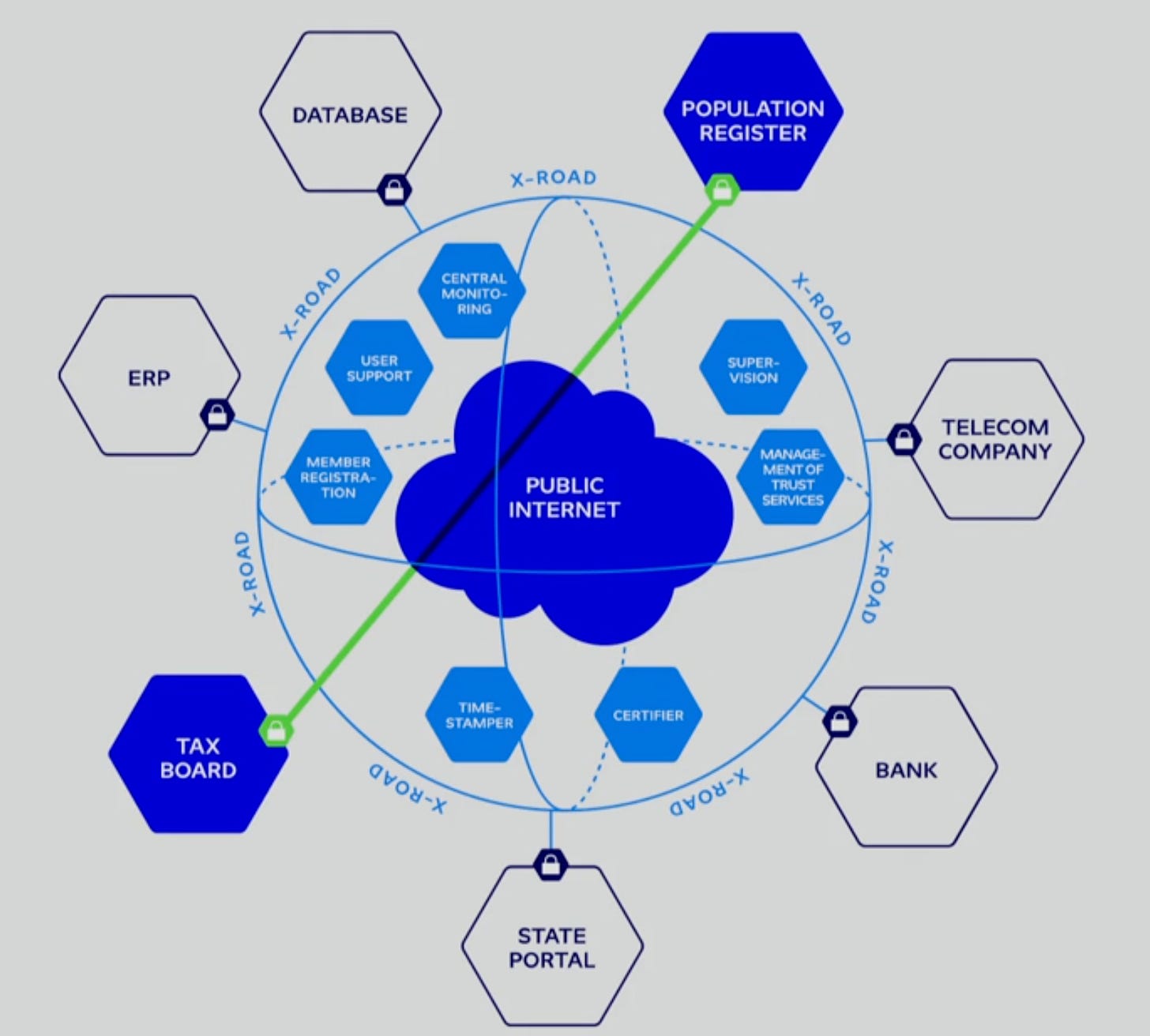 Questa è una bella visualizzazione di come funziona
E, poi, risponde ad un principio essenziale della privacy: l’utente è l’unico proprietario dei suoi dati. Sono tutti sotto il suo controllo, non possono essere conservati o duplicati altrove, e se serve condividerli è lui a dare l’accesso. Se, poi, un ente pubblico autorizzato accede ad uno dei suoi documenti, quell’accesso viene registrato. Questo favorisce sicurezza e integrità dei dati.
La conseguenza? Non c’è alcun tipo di centralizzazione dei dati. Ognuno controlla i suoi ed è X-Road a facilitare e permettere tutti gli scambi.
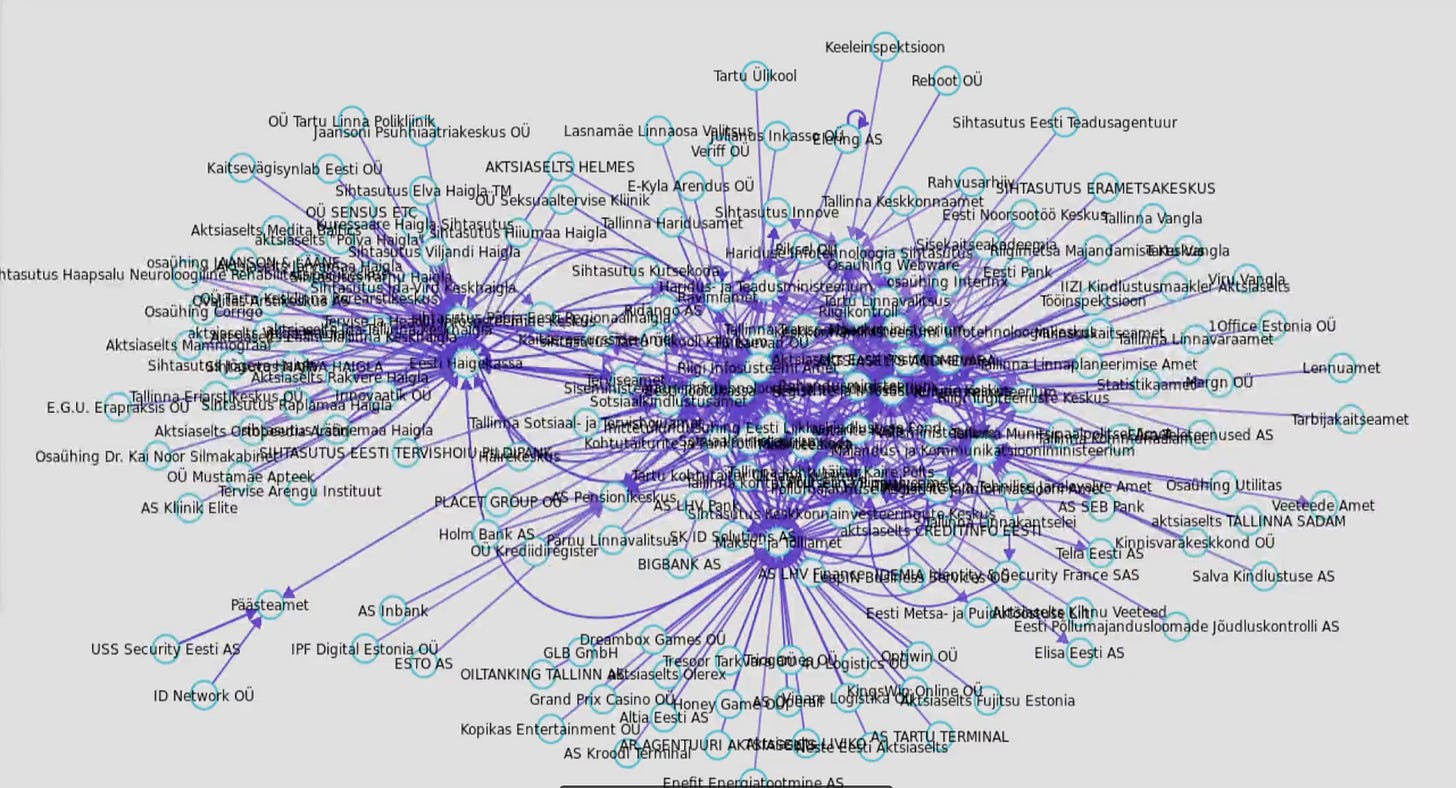 Come si vede, non c’è nessuna concentrazione ma una fitta rete
Il tutto risponde al “once-only principle”, che è esattamente quello a cui pensavo mentre condividevo la mia carta d’identità con lo Stato Italiano. Cioè? Che lo Stato non può richiedere lo stesso dato più di una singola volta, ma anche che lo stesso dato non possa essere conservato in più di un posto, e che quindi sia sempre sotto il controllo del cittadino, che ne è proprietario.
------------------------------------------------------------------------
I benefici di un sistema flessibile e all’avanguardia come questo sono tanti, e anche economici. Si stima infatti che ci sia un risparmio annuale del 2% del PIL grazie a X-Road, che è, tra l’altro, esattamente la quota che l’Estonia versa alla NATO. Insomma, X-Road regala l’atlantismo.
Ma poi, dato che tutto è online, e quindi senza vincoli geografici o di presenza, l’Estonia ha inventato la e-Residency, ossia l’accesso ai suoi servizi per cittadini non estoni che possono lanciare un’azienda beneficiando dell’efficienza estone.
 C’è anche un certo design nella e-residency
Non si tratta di paradiso fiscale o simili, e nemmeno di una cittadinanza, ma a tutti gli effetti di “vendere” una amministrazione estremamente leggera e efficiente. Il risultato? Dal 2014, la e-Residency ha attratto oltre 100 mila persone (1/10 della popolazione totale) che hanno lanciato oltre 20 mila nuove aziende o start-up in Estonia.
Insomma, un cittadino indiano può lanciare la sua start-up in Estonia, accedere al mercato europeo, e a potenziali finanziamenti. Il tutto comodamente dal divano di casa sua in India e in meno di un’ora: pare che ci vogliano 15 minuti e 33 secondi a metter su un’azienda in Estonia online.
------------------------------------------------------------------------
E sì, probabilmente è più facile fare tutto ciò in un Paese che ha la popolazione di 1/3 di Roma o uguale a quella di Milano. Ma l’intento qui non è tessere le lodi dell’Estonia, ma capire cosa se ne può trarre.
Innanzitutto, come la tecnologia sia stata in grado di costruire la fiducia tra stato e cittadini. Un esempio? Ho letto che gli estoni adorano pagare le tasse. E questo perché è semplicissimo: ricevi un form precompilato e paghi. Facile come comprare un libro su Amazon.
O, altra cosa che ho trovato formidabile: lo Stato ti notifica le opportunità per te. Tipo borse di studio, sussidi o simili. Una funzionalità che magari chi ha tempo e voglia di leggere il giornale tutti i giorni trova inutile, ma immaginate per chi - legittimamente - è fuori dal loop continuo di informazioni
Per finire, quello che probabilmente ha funzionato è che, dopo la caduta del muro e l’indipendenza dall’URSS, la digitalizzazione è stata prevista come principio alla base della nuova amministrazione, e non come ciliegina sulla torta per finire. E questo ha necessariamente imposto di rendere tutti i processi adeguati per diventare digitali.
Una differenza non da poco: il tecno-soluzionismo non è mai la formula magica. Digitalizzare processi fallaci o non pronti non li risolve e, anzi, probabilmente li rende anche peggiori, amplificandone i rischi e i danni.
Al contrario, re-inventare i servizi pubblici nell’ottica di una società dell’informazione e della digitalizzazione è, probabilmente, la strada corretta.
Leave a comment
> ### Rassegna (Stampa)
Si sapeva, ma fa comunque un certo effetto: Apple dovrà pagare 2 miliardi di multa all’UE. E in settimana ha avuto qualche problemino anche con Epic Games, quelli di Fortnite.
Qui è spiegato molto bene come funzionerà l’identità digitale dell’UE. UE che nel frattempo ha violato il suo stesso regolamento sulla protezione dei dati.
Dall’altro lato dell’oceano si parla seriamente di mettere i bastoni tra le ruote a TikTok negli Stati Uniti. Ma teniamo anche traccia di chi è licenziato dalle BigTech.
Torniamo in Italia, dove arrivano investimenti per fare i chip e dove il Garante Privacy investiga anche Sora, la nuova app dei video di OpenAI. E poi c’è anche un nuovo design per i siti della pubblica amministrazione
Il Digital Markets Act è entrato in vigore, e come i gatekeeper lo rispettano. Ne ha parlato anche il FT, poi anche Wired, e infine io l’ho raccontato per NOS (non bene come il FT, chiaramente)
 Click e lo vedi :)
> ### Lo Scaffale
 Visto che molto, quasi tutto, è design, “Hello World” di Alice Rawsthorn è un ottimo libro per capire dove nasce il termine, come si sviluppa e cosa arriva a noi. E anche fare uno stato digitale è indubbiamente design, come avevamo raccontato qua.
NOVITÀ: Per tenere traccia di tutti i libri consigliati finora, ho creato “Lo Scaffale di Artifacts”, a cui si accede da qui, e che è fatto così:
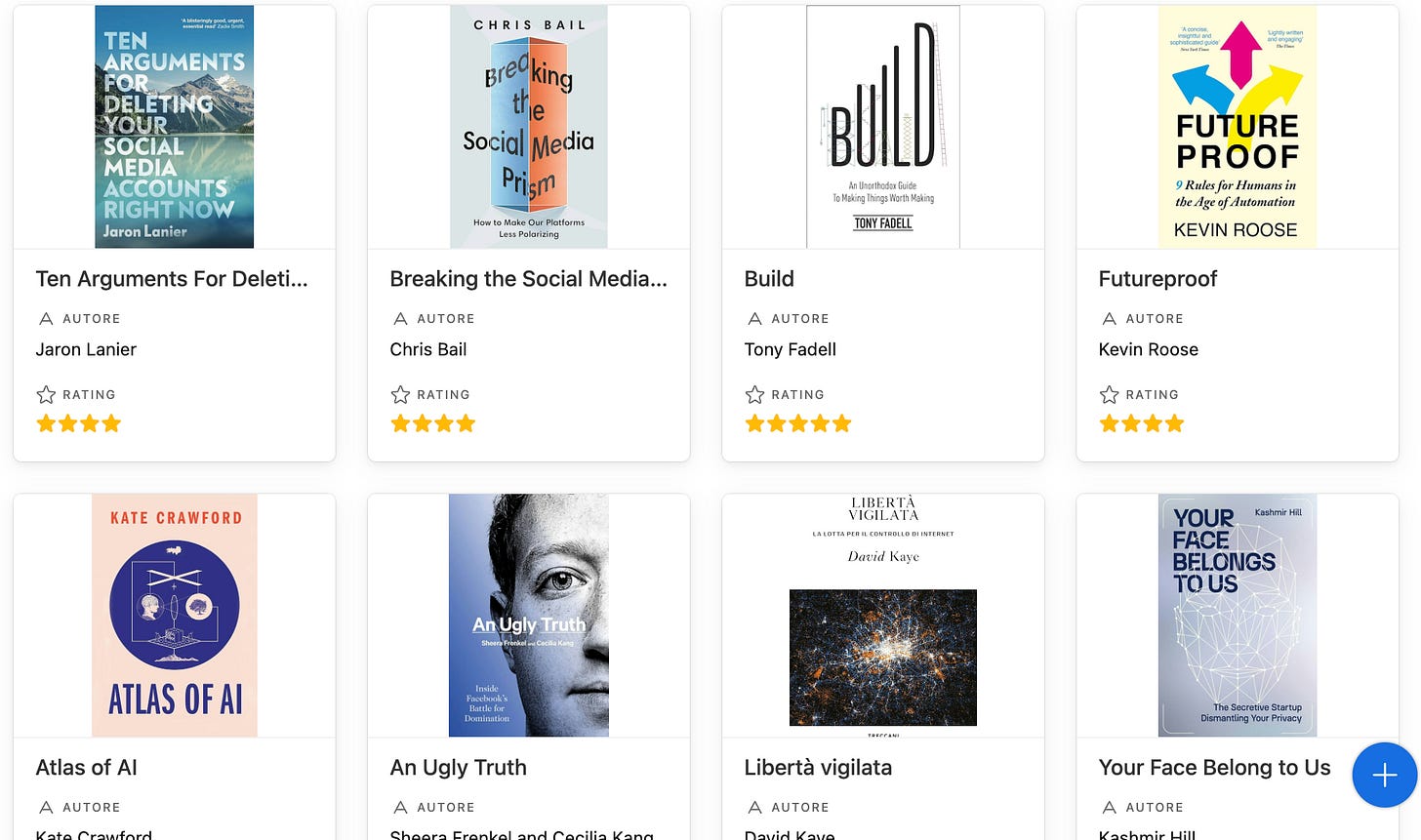 P.S. Idea ispirata da Alberto Sanino , che legge Artifacts ma soprattutto scrive Breeze, una newsletter sull’innovazione con una prospettiva economica. Consiglio di dare un’occhiata :)
 BreezeOgni sabato mattina una ventata d'aria fresca dal mondo economico, tecnologico e dell'innovazione (+ qualche consiglio d'ascolto e lettura ✌🏻)Di Alberto Sanino
> ### Nerding
 Chicca per i divoratori di cultura, film, serie, etc. Sequel permette di salvarti in maniera ordinata tutti i consigli del tuo amico che è stato sveglio per vedere la notte degli Oscar e che vuole farti fare bingewatching con lui.
======
# E tutta questa pubblicità
Date: 2024-03-05 | Language: it
Canonical: https://artifactstech.substack.com/p/e-tutta-questa-pubblicita
Cite as: E tutta questa pubblicità by Lorenzo Ancona, Artifacts, 2024-03-05. https://artifactstech.substack.com/p/e-tutta-questa-pubblicita (CC BY 4.0)
Nel 2012, Zuckerberg, CEO della società (fu) Facebook, lancia **“Open Graph”,** un programma che consentiva agli sviluppatori di far utilizzare le proprie app o siti tramite Facebook, il social.
**E così potevamo giocare a Candy Crush su Facebook** e vedere chi dei nostri amici mangiava più caramelle.
E Candy Crush cosa ci guadagnava? **Che la sua app andava virale, ma anche l’accesso a una manciata di informazioni degli utenti Facebook:** nomi, email, città, data di nascita, affiliazioni politiche, le nostre relazioni, i like. *Può bastare?*
Lo stesso anno, un dipendente, Sandy Parakilas, che faceva il Platform Operations Manager a Facebook, **presenta un Power Point al suo capo,** segnalando che questo giochetto (non Candy Crush) metteva a rischio i dati degli utenti. **Ma non gli danno retta e lui si licenzia.** Saranno stati i loghi non allineati nelle slide.
**Due anni dopo, nel 2014, Zuckerberg dismette Open Graph.** Per i dati? No, perché non portava l’engagement sperato.
**Quindi dati al sicuro? Non esattamente.** Pochi giorni prima che Open Graph venisse spento, **Alexandr Kogan**, accademico a Cambridge, carica il **quiz “thisisyourdigitallife”**, che fa domande personalizzate per “scopi accademici”.
**Partecipano “solo” 300.000 utenti, ma, per via di falle di sicurezza e privacy, Kogan riesce a raccogliere i dati personali di quasi 90 milioni di utenti legati ai partecipanti.** Un prodotto indubbiamente scalabile.
------------------------------------------------------------------------
Tutti questi dati, però, non vengono depositati in un hard disk e usati per la ricerca. **Kogan li vende a Cambridge Analytica,** una società di consulenza che crea profili di persone e li utilizza per creare messaggi e contenuti politici targetizzati.
[](https://substackcdn.com/image/fetch/$s_!oWnF!,f_auto,q_auto:good,fl_progressive:steep/https%3A%2F%2Fsubstack-post-media.s3.amazonaws.com%2Fpublic%2Fimages%2F9588b9ed-f20a-49b3-b1a1-ff26c31e33dc_372x338.png)
Tipo questi post qua.
E ok, probabilmente se sei iscritto/a a questa newsletter, **il nome “Cambridge Analytica” non ti è nuovo.** Anzi, è uno degli scandali più celebri. Molto si è scritto a riguardo e [“The Great Hack”](https://www.youtube.com/watch?v=iX8GxLP1FHo) è un ottimo documentario.
Secondo le investigazioni e l’inchiesta di [New York Times e Guardian](https://www.nytimes.com/2018/03/17/us/politics/cambridge-analytica-trump-campaign.html), nella campagna elettorale del 2016, **Donald Trump e Ted Cruz avrebbero utilizzato le profilazioni di Cambridge Analytica per raggiungere e convincere milioni di utenti con contenuti ad hoc sponzorizzati sui social.** E si pensa che abbiano avuto un ruolo anche in Brexit.
Tutto a partire dai dati prelevati da Kogan e venduti a Cambridge Analytica, **violando le linee guida di Facebook dell’epoca.** Ma, insomma, Kogan non era esattamente uno che si faceva scrupoli.
[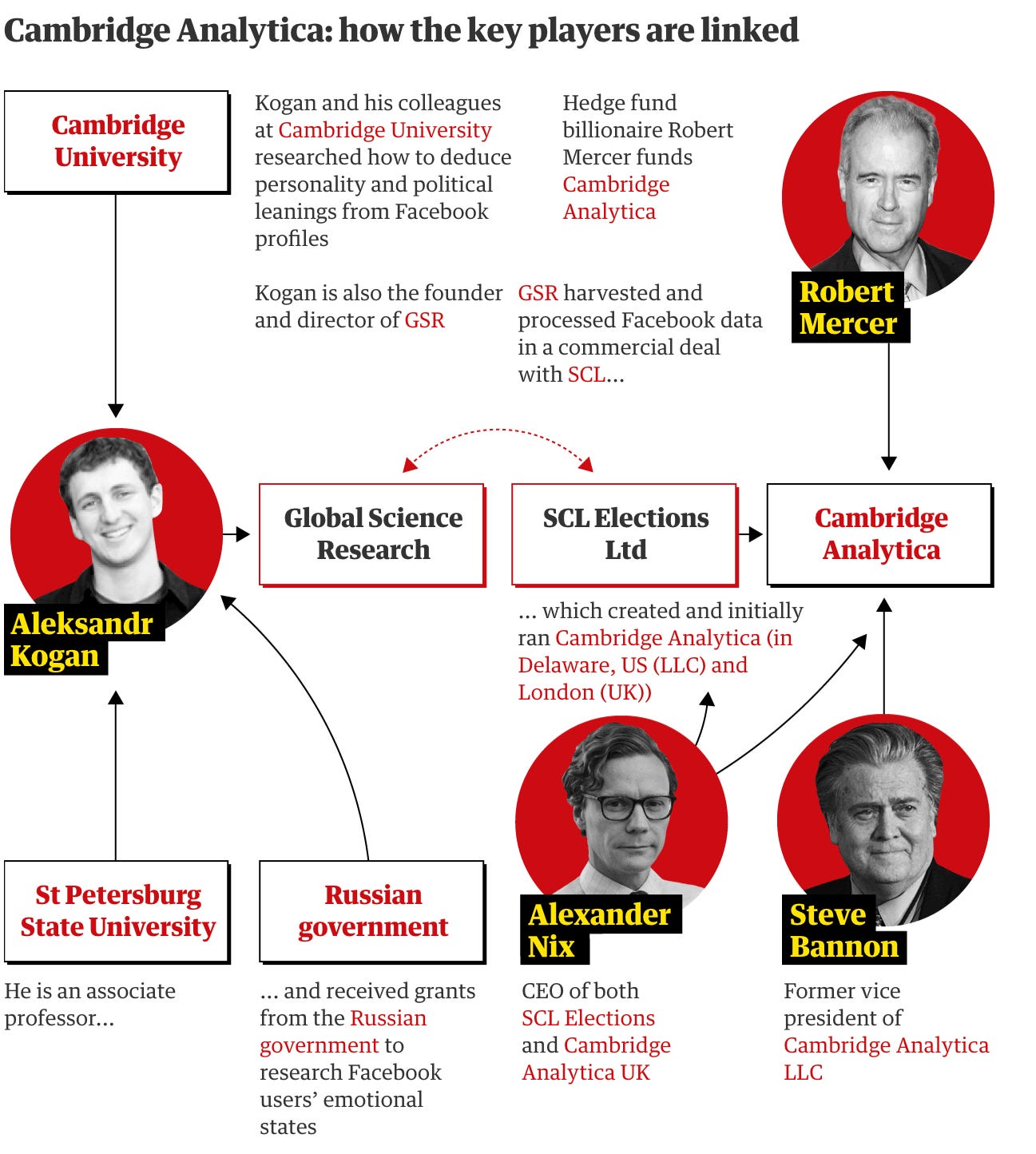](https://substackcdn.com/image/fetch/$s_!_y04!,f_auto,q_auto:good,fl_progressive:steep/https%3A%2F%2Fsubstack-post-media.s3.amazonaws.com%2Fpublic%2Fimages%2F44a7b483-0471-4118-ac27-e76bae7670da_1297x1445.png)
Diciamo che non era proprio un lupo solitario, per il [Guardian](https://www.theguardian.com/news/2018/mar/17/cambridge-analytica-facebook-influence-us-election)
E sì, Kogan è decisamente il cattivo della vicenda. **Ma a Meta non erano angeli.** Le impostazioni delle pubblicità permettevano una granularità probabilmente eccessiva: **gli utenti erano classificabili e raggiungibili dai contenuti sponsorizzati per religione, etnia, stipendio, affiliazioni politiche e altre cose che non andremmo proprio a dire in giro.**
Quindi a Cambridge Analytica creavano dei profili estremamente precisi, **ma Facebook (1) era la fonte dei dati e (2) permetteva di attuare una targetizzazione estrema.**
E, per questo ruolo di Facebook, **Zuckerberg passò delle ore non esattamente piacevoli al Congresso Americano.** Presumibilmente ne hai visto la foto in qualche meme.
[\[Embedded media — view original\]](https://www.youtube-nocookie.com/embed/TuIhb-xbW9I?rel=0&autoplay=0&showinfo=0&enablejsapi=0)
------------------------------------------------------------------------
Comunque, senza scendere nei dettagli, che sono tanti, quella di Cambridge Analytica è stata **una delle prime vicende in cui i social hanno cominciato a mostrare qualche frana per l’opinione pubblica.**
Soprattutto, **si è capito il potenziale estremo dei contenuti sponsorizzati per la politica, che mettevano praticamente in ridicolo spot televisivi o volantini.** Perché? In confronto con i formati “tradizionali”, secondo me, **per almeno due ragioni:**
- **la targetizzazione e granularità** permettevano ad un preciso contenuto con un preciso messaggio di raggiungere una precisa fetta di pubblico; altra storia rispetto agli adv generali in televisione;
- **l’interazione con i contenuti** non significa solo essere raggiunti, ma poter mettere like, ripostare, condividere e, in definitiva, **amplificare ulteriormente**; cosa che, invece, una pagina di giornale chiaramente non permette.
E, da non trascurare, il tutto praticamente **senza filtri o controllo sul contenuto stesso e la sua veridicità.**
Di come erano le cose nel 2016, come sono progredite nel 2020, e di come ci stiamo preparando al 2024, **ne parla oggi Artifacts.**
[](https://substackcdn.com/image/fetch/$s_!YqCd!,f_auto,q_auto:good,fl_progressive:steep/https%3A%2F%2Fsubstack-post-media.s3.amazonaws.com%2Fpublic%2Fimages%2F76bd10a3-9b10-4477-a00f-bc0dd421c8eb_1024x1024.webp)
Un vecchio cartellone pubblicitario. *Stavolta creato con Midjourney*
> ### La Storia
Va detto, e con grande chiarezza, che lo scenario del 2016 è praticamente **preistoria nelle linee guida e regolamentazione dei contenuti politici sponsorizzati sui social.**
Diverso, invece, il peso economico che già avevano: **Trump e Clinton spesero complessivamente 81 milioni in adv.**
Sempre rispetto all’allora Facebook, non solo le opzioni di *targeting* erano estremamente - troppo - precise e ad uso di chiunque fosse malintenzionato. **Ma anche quello che vedeva l’utente era vago e poco dettagliato.**
[](https://substackcdn.com/image/fetch/$s_!9esP!,f_auto,q_auto:good,fl_progressive:steep/https%3A%2F%2Fsubstack-post-media.s3.amazonaws.com%2Fpublic%2Fimages%2F250546a0-94ad-4a20-9930-a9bc8a260372_500x504.jpeg)
Uno screenshot a caso dalla campagna del 2016
Come (non) si vede bene, manca una informazione essenziale: **chi ha pagato per questa sponsorizzata**. Vero, presumibilmente qui è Hillary Clinton, ma **niente evitava che questo potesse essere un account fake e che dietro si celasse qualcuno che voleva, piuttosto, sabotare Clinton.**
E sì, questo adv sembra innocuo, ma chiunque avrebbe potuto, ad esempio, fare **un contenuto sponsorizzato con la data sbagliata delle elezioni e indirizzarlo a fasce meno informate di utenti.** O altri casi del video di AOC sopra.
Discorsi simili, chiaramente, valevano per le altre piattaforme.
------------------------------------------------------------------------
In questo senso, **Cambridge Analytica fu un bel terremoto.** Facebook, ad esempio, da dentro l’occhio del ciclone, tirò fuori **una serie di soluzioni per aumentare la trasparenza sui political ads.**
In primis, la **[Ad Library](https://www.facebook.com/ads/library/?active_status=all&ad_type=political_and_issue_ads&country=ALL&sort_data%5Bdirection%5D=desc&sort_data%5Bmode%5D=relevancy_monthly_grouped&media_type=all)**, dove chiunque può vedere quanto viene speso, la audience di una campagna pubblicitaria, chi ha pagato e chi ha visto il contenuto. Vale per tutte le sponsorizzate, ma c’è una sezione apposta sulla politica. **Roba da nerd, ma immagina il potenziale, ad esempio, per chi fa ricerca.**
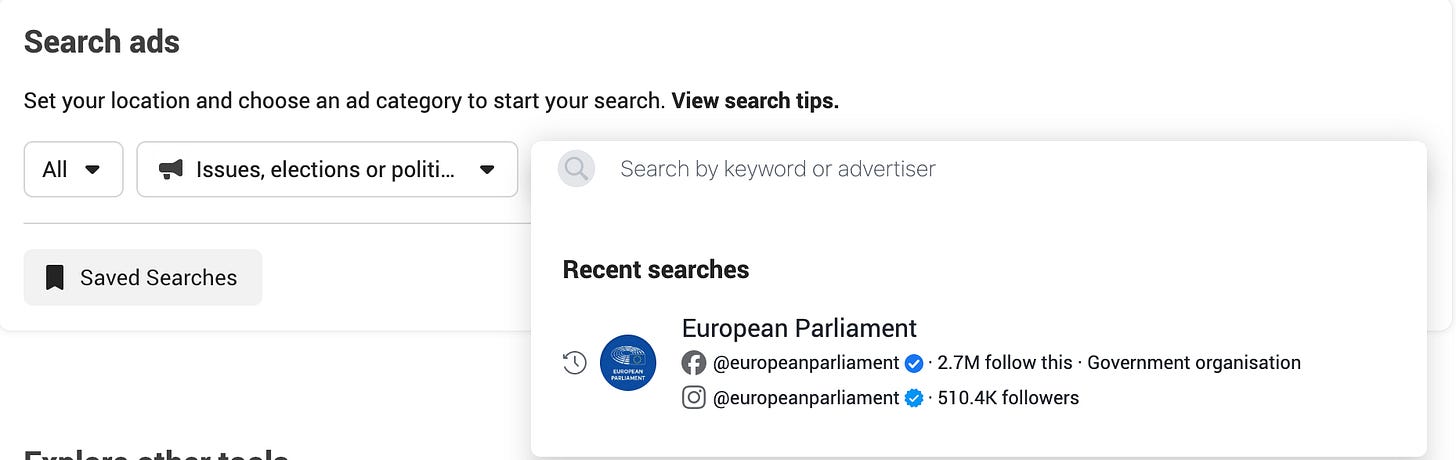
Molto interessante farsi un giro su Ad Library
Se la Library, però, era per i fanatici della trasparenza, Facebook fece una cosa anche molto più immediata per tutti gli utenti: **mostrava chiaramente chi aveva pagato per un contenuto, dopo averlo validato e identificato.** Anche e soprattutto per evitare influenze straniere.
[](https://substackcdn.com/image/fetch/$s_!Qiad!,f_auto,q_auto:good,fl_progressive:steep/https%3A%2F%2Fsubstack-post-media.s3.amazonaws.com%2Fpublic%2Fimages%2Ff6240343-c558-46c7-a73e-90d5b4d2e11a_1078x1019.jpeg)
Ad esempio in questo post del 2018 si legge chiaramente che ha pagato il comitato di Trump.
Tutte mosse con uno scopo chiaro: **evitare il disastro del 2016 e prepararsi per le elezioni successive**, tra le quali le europee del 2019 e, soprattutto, quelle americane del 2020.
Tra l’altro, interessante da notare, se a Facebook venne fatto di tutto per limitare i rischi e aumentare la trasparenza, **decisamente diversa e più drastica fu la scelta di Twitter, l’altro social chiave per la politica.**
[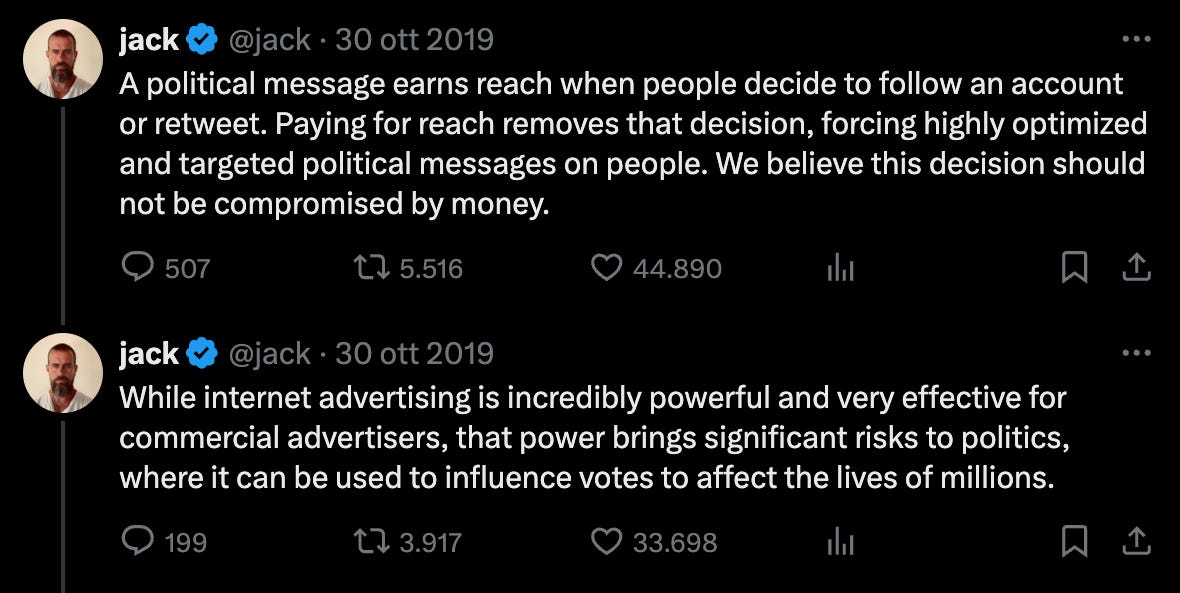](https://substackcdn.com/image/fetch/$s_!GgeV!,f_auto,q_auto:good,fl_progressive:steep/https%3A%2F%2Fsubstack-post-media.s3.amazonaws.com%2Fpublic%2Fimages%2Fd20c9564-e2af-4c35-9493-4ae1d3e99311_1180x593.png)
Consiglio davvero di leggersi tutto questo thread
Molto semplicemente, Jack Dorsey, il fu CEO della fu Twitter, comunicò che **non sarebbe stato possibile sponsorizzare contenuti politici.** Si appellò ad [una serie di motivazioni valide e interessanti](https://x.com/jack/status/1189634360472829952?s=20) da leggere, **ma anche la semplice volontà di limitare i danni è da assumere.** E, [come detto qualche settimana fa](https://artifactstech.substack.com/p/la-piazza-al-centro-del-villaggio), perfettamente in linea con la natura privata di questi spazi che pensiamo pubblici.
------------------------------------------------------------------------
Questa - andando molto veloce - è la traiettoria essenziale dei contenuti politici sponsorizzati, con alcuni degli step essenziali. **Elemento comune? Tutte scelte volontarie delle piattaforme,** indubbiamente sotto la luce dei riflettori dopo il 2016, **ma comunque senza particolari obblighi.**
Vero, **un misuso dei dati come quello di Cambridge Analytica, almeno in UE, sarebbe impensabile grazie al GDPR**, ma è solo tangenziale rispetto alle campagne pubblicitarie politiche.
Questo un po’ per ricordare che il Far West di pre-2016 è preistoria, **ma anche per evidenziare un vuoto importante da colmare per le istituzioni.** E chi meglio dell’Unione Europea quando si tratta di fare regole?
Così, **il Digital Services Act** (DSA), il nuovissimo regolamento sulla sicurezza dei servizi online, **stabilisce una serie di regole chiare sui cosiddetti** ***“advertisements”.***
In primis, **è vietata qualsiasi pubblicità che prevederebbe la profilazione di minori.** Ma **è poi anche vietato creare campagne pubblicitarie che usino “categorie speciali” di dati**, e quindi etnia, opinioni politiche, religione, orientamento sessuale e simili che piacevano particolarmente a Kogan e Cambridge Analytica, ma meno al GDPR. Da ultimo, **i registri di trasparenza sugli ads, prima volontari, sono ora obbligatori per le grandi piattaforme**, che a Bruxelles si chiamano VLOPs (Very Large Online Platforms).
Queste sono le regole valide in generale e per tutti i tipi di contenuti. Poi, ancora più nuovo del DSA, **è il nuovo regolamento specifico su** ***political advertising,*** **approvato dal Parlamento UE la settimana scorsa,** e ora solo in attesa del Consiglio.
**Ricalca in gran parte il DSA**, ma aggiunge, appunto, elementi relativi alla politica. Per esempio, **nei tre mesi prima di un’elezione sarà vietata qualsiasi campagna pubblcitaria sui social proveniente da paesi extra-UE.** Tipo la Russia, per dirne uno a caso.
E dov’è che mancano 3 mesi ad una elezione? **Esatto.**
> ### Rassegna (Stampa)
[L’UE ha fatto una multona ad Apple](https://www.theverge.com/2024/3/4/24005938/european-commission-antitrust-apple-investigation-anti-steering-rules-app-developers) perché non ci fa vedere i prezzi delle app di musica. E questa settimana [arriva il Digital Markets Act (!)](https://www.nytimes.com/2024/03/04/technology/europe-apple-meta-google-microsoft.html), a proposito di competizione.
Elon Musk ha fatto causa ad OpenAI. [Ma potrebbe non avere senso.](https://www.nytimes.com/2024/03/02/technology/elon-musk-openai-lawsuit-paradox.html) Ed anche altri media, come ha fatto il NYT, [fanno causa ad OpenAI.](https://www.theguardian.com/technology/2024/feb/28/media-outlets-sue-openai-copyright-infringement)
C’è una nuova IA in città, è [un gatto francese.](https://www.lemonde.fr/pixels/article/2024/03/01/on-a-teste-le-chat-l-etonnant-chatgpt-a-la-francaise-de-mistral-ai_6219436_4408996.html#) Si chiama Mistral, ha una partnernship con Microsoft, ed è [già oggetto di varie critiche.](https://www.linkedin.com/posts/luca-bertuzzi-186729130_introducing-mistral-large-on-azure-in-partnership-activity-7167962807827611649-fG3e?utm_source=share&utm_medium=member_desktop)
Ricordi la storia “pay or okay” di Meta? Ne avevamo parlato [qua](https://artifactstech.substack.com/p/si-ora-bisogna-fare-una-scelta). E [continua ad essere fortemente criticata.](https://techcrunch.com/2024/02/28/meta-consent-or-pay-consumer-gdpr-complaints/)
[Un fumetto bellissimo](https://www.technologyreview.com/2024/02/28/1088262/luddites-resisting-automated-future-technology/) sui Luddisti all’era dell’Intelligenza Artificiale. E anche [cosa se ne fa uno storico dell’IA.](https://www.theverge.com/24068716/ai-historians-academia-llm-chatgpt)
Ho provato a spiegare al podcast **“Ma Perché?”** questa storia qua:
[\[311 \| Ma perché TikTok e Universal stanno litigando?\]](https://open.spotify.com/episode/6B3JoHz1FStf0fcCFGlojk)
> ### Lo Scaffale
[](https://substackcdn.com/image/fetch/$s_!MXPM!,f_auto,q_auto:good,fl_progressive:steep/https%3A%2F%2Fsubstack-post-media.s3.amazonaws.com%2Fpublic%2Fimages%2F30951b0d-4c40-4806-a995-5c6095e95d3e_1080x1080.png)
Brittany **Kaiser** è la persona che ha inventato l’#DeleteFacebook nel 2016 e ha poi scritto **“La Dittatura dei Dati”** per raccontare tutta la vicenda di Cambridge Analytica e i meccanismi delle pubblicità sui social in generale. **È un pochino datato, mi ricordo che è stato uno dei primi libri che ho letto su questi temi, ma secondo me vale ancora la pena.** L’ho risfogliato: sembra passata una vita, ma era meno di 10 anni fa.
> ### Nerding
[](https://substackcdn.com/image/fetch/$s_!Y_ux!,f_auto,q_auto:good,fl_progressive:steep/https%3A%2F%2Fsubstack-post-media.s3.amazonaws.com%2Fpublic%2Fimages%2Fdddb884f-a7a1-45a6-af9f-8fb27c2ad363_1080x1080.png)
Se devi spiegare ad un *web developer* come vuoi il sito della tua ultima idea rivoluzionaria, **[Balsamiq](https://balsamiq.com/)** è perfetto per **letteralmente disegnare siti/app/qualsiasi interfaccia digitale.** Roba da product manager in erba prima che passi a Figma.
### ***Bonus***
[](https://substackcdn.com/image/fetch/$s_!ZM-I!,f_auto,q_auto:good,fl_progressive:steep/https%3A%2F%2Fsubstack-post-media.s3.amazonaws.com%2Fpublic%2Fimages%2F060eb412-080f-4a8d-b5c0-9e824e736ef0_2678x3307.jpeg)
Ho degli amici incredibili, che mi hanno regalato **questo nuovo, incredibile, taccuino per gli appunti di Artifacts.**
======
# Ho parlato con Internet
Date: 2024-02-27 | Language: it
Canonical: https://artifactstech.substack.com/p/ho-parlato-con-internet
Cite as: Ho parlato con Internet by Lorenzo Ancona, Artifacts, 2024-02-27. https://artifactstech.substack.com/p/ho-parlato-con-internet (CC BY 4.0)
Ricordi quando dicevamo **“Eh ma ChatGPT non può navigare su internet”?** Sembra una vita fa. **In realtà è passato poco più di un anno.**
E, comunque, ormai è solo storia.
**Ora i Large Language Models (LLM) possono accedere alla Rete.** Lo può fare ChatGPT nella versione Plus, ma anche tanti altri tool.
Insomma, **l’Intelligenza Artificiale può fare ricerche online.**
E allora, **nell’ultimo mese ho smesso di usare Google Search.** L’ho fatto per capire come potrebbe essere la ricerca da qui a qualche anno e le implicazioni di quella che potrebbe essere una bella, grossa novità.
**Mi sono affidato a [Perplexity](https://www.perplexity.ai/)**, un chatbot di IA che ambisce ad essere un motore di ricerca e nel quale stanno investendo in tanti, **tra cui Jeff Bezos.**
*\[Non c’è bisogno di dire che è un esperimento a puro titolo personale, no?\]*
------------------------------------------------------------------------
Perplexity, essenzialmente, **funziona così:**
[](https://substackcdn.com/image/fetch/$s_!2er1!,f_auto,q_auto:good,fl_progressive:steep/https%3A%2F%2Fsubstack-post-media.s3.amazonaws.com%2Fpublic%2Fimages%2Fb72b6dd1-824e-4a8e-922c-710d922236dd_800x616.gif)
Domanda senza conflitto di interessi :) Funziona meglio in inglese, comunque!
All’inizio sembra molto Google Search versione dark. Ma la differenza è chiara appena **domandiamo** - più che cerchiamo! - qualcosa: **Perplexity restituisce un testo che riassume le fonti a cui si è rivolto,** e non una serie di link da cliccare. **Le fonti, poi, le mette sopra al testo e con i numeretti in mezzo**, come un bravo studente.
Detta coi paroloni, funziona grazie ad un **Retrieval-Augmented Generation (RAG),** una tecnica che usa l’IA Generativa per **selezionare informazioni da fonti esterne e restituisce all’utente un testo conciso.** Il modello di Perplexity, tra l’altro, include GPT, quello di OpenAI.
E com’è andato questo mese? Bene, molto. **A volte vago nelle risposte, ma onestamente mi ha sorpreso.**
**L’ho utilizzato principalmente per delle “open-ended questions”.** Ossia non per avere il link al sito della Gazzetta dello Sport, ma per **fare delle domande aperte ma non vaste.** Tipo quella della GIF sopra o “Quali sono le verdure di stagione a febbraio?”. Giuro, tutto vero.
L’ho poi trovato molto utile per velocizzare su domande del tipo **“Cos’è un metadato?”** (sì mi faccio domande peculiari), di cui so la risposta ma di cui non saprei dare una definizione precisa.
Ed è vero, anche ChatGPT saprebbe rispondere, ma la ricerca online non è di default e poi **poter vedere le fonti mi dà (1) più sicurezza e (2) eventuale possibilità di approfondire.**
------------------------------------------------------------------------
Comunque, usare un tool come **Perplexity dà l’impressione di “parlare” con Internet**, più che di navigare. Ed è lo stesso con altri tool simili, tipo [Arc Search](https://www.theverge.com/2024/1/28/24053882/arc-search-browser-web-app-ios), che era stata in Nerding di qualche Artifacts fa.
Cambia, infatti, il modo in cui interagiamo con Internet, che **diventa più naturale perché è tramite una conversazione**, come se interagissimo con un umano.
[](https://substackcdn.com/image/fetch/$s_!Cb2G!,f_auto,q_auto:good,fl_progressive:steep/https%3A%2F%2Fsubstack-post-media.s3.amazonaws.com%2Fpublic%2Fimages%2Fa8560fde-5360-4163-82ed-e2a0773bbc4e_1920x1080.png)
Sull’immediatezza dell’interfaccia, poco da discutere. Sul resto, tanto, ovviamente
Soprattutto, l’esperienza di ricerca è più immediata perché **si saltano due passaggi:** quello della lista dei link e quello del leggere i siti. **Si va, invece, direttamente all’informazione, al contenuto.** E, tra l’altro, si evitano tutti i link sponsorizzati che recentemente hanno invaso Google Search.
Quella delle AI per la ricerca sembra, insomma, una finestra per rompere l’equazione **“cercare qualcosa su Internet = Google Search”,** che al momento è [valida per oltre il 90% dei naviganti.](https://firstsiteguide.com/google-search-stats/)
------------------------------------------------------------------------
Ok, e quindi Internet è diventato un caro amico con cui chiacchierare. Tutti contenti? **Ovviamente no.** L’IA Generativa per la ricerca sembra **stravolgere le logiche, specie economiche, che hanno sostenuto Internet.** Insomma, non una cosa da poco.
Allora, questa Artifacts racconta dove starebbe la rivoluzione, perché è già in corso, come stanno reagendo gli attori coinvolti. Ma anche perché anche chi sembra vincere non sa bene come e cosa.
[](https://substackcdn.com/image/fetch/$s_!2Pms!,f_auto,q_auto:good,fl_progressive:steep/https%3A%2F%2Fsubstack-post-media.s3.amazonaws.com%2Fpublic%2Fimages%2F529ef809-028f-4019-b5d5-5b16de281e34_1024x1024.webp)
Non poteva che esserci una lente oggi. *Creata con DALL-E*
> ### La Storia
Fino ad oggi, **Google Search ha funzionato perché permetteva un win - win con i siti.**
Esplorando il contenuto dei siti e indicizzandoli, Google è cresciuto enormemente diventando IL motore di ricerca e i siti, in cambio, hanno ricevuto e ricevono il traffico degli utenti sulle loro pagine. **E quindi pubblicità, e quindi soldi, sia per i siti che per Google che vende le pubblicità.**
Tra l’altro, essere indicizzati come primi è talmente importante che i **siti hanno cominciato a essere costruiti su misura per “piacere” ai** ***crawler*** **di Google**, i programmi che esplorano il web e decidono l’ordine dei link. A tutti gli effetti, **una “Googlizzazione” dei siti**, come [The Verge ha raccontato benissimo.](https://www.theverge.com/c/23998379/google-search-seo-algorithm-webpage-optimization)
**E anche se tutti vogliono essere indicizzati da Google, si può, comunque scegliere di non esserlo.** Il tutto tramite “robots.txt”, un semplice file di testo con il quale i siti possono bloccare l’accesso ai robot, che sono i crawler di cui sopra.
**Blocco che, in realtà, è una pura convenzione dell’Internet,** ma che è stato rispettato negli anni per chi - per una qualsivoglia ragione - non voleva partecipare al win-win.
------------------------------------------------------------------------
Riducendo all’osso, è così che si è retta l’economia della ricerca online. **Che però, ora, sembra essersi rotta.**
Su Perplexity e simili, infatti, gli utenti ricevono le informazioni già pronte per essere lette. **Perché mai, allora, dovrebbero visitare i siti?** Certo, per approfondire, ma non sempre è necessario.
**Questo significa meno accessi alle pagine web, quindi meno pubblicità, e, in fin dei conti, meno entrate per i siti.** Ma anche per Google, ovviamente!
Soprattutto, **i siti, specie quelli di informazione, fanno notare che così non c’è più nessuno scambio di valore:** le informazioni, prima scambiate per accessi e visualizzazioni degli ads, ora sono semplicemente estratte senza nulla indietro.
**Più che uno scambio, sembra essere un furto,** che mette anche in discussione se continuare a produrre contenuti che non generano entrate e, anzi, vengono rubati.
------------------------------------------------------------------------
Non a caso, i siti di informazione hanno fatto una cosa che prima era molto inusuale: **hanno cominciato a usare robots.txt per bloccare l’accesso dei** ***crawler*** **delle AI.**
[](https://substackcdn.com/image/fetch/$s_!IRAH!,f_auto,q_auto:good,fl_progressive:steep/https%3A%2F%2Fsubstack-post-media.s3.amazonaws.com%2Fpublic%2Fimages%2F820fef67-0921-4a49-8148-188216dab902_1240x921.png)
Impressionante il dato degli Stati Uniti
[Secondo questa indagine](https://reutersinstitute.politics.ox.ac.uk/how-many-news-websites-block-ai-crawlers), infatti, **il 48% dei top siti di news non permettono più l’accesso al crawler di OpenAI** che, in quanto gigante del momento, è quello che preoccupa di più. Chiaramente, un Perplexity preoccupa meno, per ora.
Insomma, ora che in nessun modo possono guadagnare dallo *scraping*, i siti preferiscono non dare l’accesso ai loro contenuti. **E, però, anche potenzialmente perdere visibilità.**
Tuttavia, è una misura che non può che essere temporanea. Più una toppa che altro. Infatti, **se l’AI è il futuro della ricerca online, limitare l’accesso ai chatbot può evitare i danni nel breve termine, ma potrebbe in realtà danneggiare i siti nel lungo periodo.**
Alcuni, invece, hanno stretto delle partnership editoriali con OpenAI. **Ne avevamo parlato bene qui:**
[](https://artifactstech.substack.com/p/e-finita-sul-giornale)
#### È finita sul giornale
[Lorenzo Ancona](https://substack.com/profile/142944754-lorenzo-ancona)·9 January 2024[Read full story](https://artifactstech.substack.com/p/e-finita-sul-giornale)
------------------------------------------------------------------------
Quello che serve, allora, sono **nuovi modelli di monetizzazione al passo coi tempi.**
Per ora i tool di AI Generativa per ricerca sono pesci relativamente piccoli, ma è qualcosa su cui anche i giganti stanno lavorando. **Google, in primis, sta testando la Search Generative Experience,** che applica l’IA generativa alle ricerche che siamo abituati a fare ora con le parole chiave.
[](https://substackcdn.com/image/fetch/$s_!TELl!,f_auto,q_auto:good,fl_progressive:steep/https%3A%2F%2Fsubstack-post-media.s3.amazonaws.com%2Fpublic%2Fimages%2F800402ed-bcee-4301-8b22-856b1f03ed8c_2400x1783.jpeg)
Stesso principio di Perplexity ma direttamente su Google
**Ed è una mossa che, forse, ci segnala che l’IA potrebbe davvero essere** ***the next big thing*** **della ricerca.** Google, che con la ricerca fa 160 miliari l’anno (il 60% del suo fatturato), non può certo permettersi di rimanere a guardare.
Però, parlando di soldi, **non è affatto chiaro come questo nuovo approccio possa essere monetizzato, sia dai siti che dai motori di ricerca.** Per i siti, ne abbiamo parlato diffusamente sopra. **Per i motori di ricerca, è una diretta conseguenza: se visiteremo meno i siti, il modello delle pubblicità non regge più.**
Insomma, anche se sembrano poter essere il futuro, **i** ***search engine*** **di IA al momento non sanno bene come pagare le bollette.** Aravind Srinivas, CEO di Perplexity, [ha detto](https://www.nytimes.com/2024/02/16/podcasts/sydney-ai-perplexity.html) di star valutando soluzioni tipo:
- **pubblicità sui chatbot,** anche se non è chiaro in che modalità;
- **API**, ossia “affittare” la potenza di calcolo a chi la vuole integrare in un proprio sistema;
- **search engine a pagamento,** ma saremmo disposti a pagare per un Google?
E così, anche se provano a tracciare il futuro della ricerca, **dovremo capire come in queste nuove traiettorie si potranno sostenere i siti**, che forniscono l’indispensabile contenuto per i *search engine,* **ma anche gli stessi motori di ricerca.**
Insomma, siamo anche in cerca di idee.
[Leave a comment](https://artifactstech.substack.com/p/ho-parlato-con-internet/comments)
> ### Rassegna (Stampa)
**BIG NEWS:** Grazie a [Riccardo Bassetto](https://open.substack.com/users/44088427-riccardo-bassetto?utm_source=mentions) di [Technicismi](https://open.substack.com/pub/technicismi) , Artifacts entra a far parte di **[Newsletterati](https://newsletterati.com/),** **un network di newsletter belle e interessanti.** Consiglio di dare uno sguardo :)
**Google** è stata forse troppo attenta ai bias e ha combinato u[n pasticcio con la sua AI per la generazione di immagini.](https://www.theverge.com/2024/2/21/24079371/google-ai-gemini-generative-inaccurate-historical) Nel frattempo, proliferano anche [i chatbot razzisti e che negano il cambiamento climatico](https://www.wired.com/story/gab-ai-chatbot-racist-holocaust/).
**Nvidia sta facendo tantissimi soldi con i chip per l’IA.** E [il suo CEO sembra un tipo simpatico.](https://www.wired.com/story/nvidia-hardware-is-eating-the-world-jensen-huang/)
**Per chi apprezza le alternative alle BigTech,** [BlueSky è ora un po’ più aperta](https://techcrunch.com/2024/02/22/bluesky-opens-up-federation-letting-anyone-run-their-own-server/?guccounter=1) e [Signal finalmente nasconderà i numeri di telefono](https://www.wired.com/story/signal-launches-usersnames-phone-number-privacy/)
**Legato alla scorsa settimana:** [perché non abbiamo bisogno di un nuovo Twitter](https://www.newyorker.com/culture/cultural-comment/we-dont-need-a-new-twitter) ma anche [una storia non bella tra Navalny e le BigTech](https://www.codastory.com/newsletters/russia-navalny-big-tech-2/)
[Tutta la storia di robot.txt](https://www.theverge.com/24067997/robots-txt-ai-text-file-web-crawlers-spiders), di cui abbiamo parlato tanto oggi.
> ### Lo Scaffale
[](https://substackcdn.com/image/fetch/$s_!inZS!,f_auto,q_auto:good,fl_progressive:steep/https%3A%2F%2Fsubstack-post-media.s3.amazonaws.com%2Fpublic%2Fimages%2F3a3bf50a-1460-4329-8c21-2a1b51e371c9_1080x1080.png)
Ci sarà ancora tanta, tanta Google in futuro. Intanto, però, utile leggere ***“How Google works”,*** in cui Eric **Schmidt** e Jonathan **Rosenberg**, due grandi *Googlers,* raccontano come è nata, cresciuta e cresce l’azienda che, ad oggi, per molti significa Internet e innovazione.
> ### Nerding
[](https://substackcdn.com/image/fetch/$s_!iiV-!,f_auto,q_auto:good,fl_progressive:steep/https%3A%2F%2Fsubstack-post-media.s3.amazonaws.com%2Fpublic%2Fimages%2Fcc3c6c3d-ff2d-4f24-a635-38dd6d00f507_1080x1080.png)
Non c’entra niente l’IA! Però [IA Writer](https://ia.net/) è un tool bellissimo per…**scrivere.** Ci si può **solo** scrivere, **in markdown.** Font bellissimo, no distrazioni, rilassa gli occhi. Secondo me, **aiuta anche a pensare, che non è mai una cattiva idea.**
======
# La piazza al centro del villaggio
Date: 2024-02-20 | Language: it
Canonical: https://artifactstech.substack.com/p/la-piazza-al-centro-del-villaggio
Cite as: La piazza al centro del villaggio by Lorenzo Ancona, Artifacts, 2024-02-20. https://artifactstech.substack.com/p/la-piazza-al-centro-del-villaggio (CC BY 4.0)
È probabile che nei prossimi mesi vedremo **sempre meno contenuti legati alla politica su Instagram e Threads.**
O meglio, **a [Meta](https://about.instagram.com/blog/announcements/continuing-our-approach-to-political-content-on-instagram-and-threads/) hanno deciso che l’algoritmo non suggerirà** ***proattivamente*** **contenuti politici degli account che non seguiamo.** Insomma, meno politica nelle sezioni puramente basate sulle scelte algoritmiche, come Esplora, i reels, In-Feed Recommendations e utenti suggeriti.

Questo il [post Threads](https://www.threads.net/@mosseri/post/C3IjTzGvk6_) che annuncia la novità
**Meta ha comunque ribadito che vuole rispettare le scelte degli utenti:** se già seguiamo una pagina che tratta temi del genere, continueremo ad avere i post in feed. E anzi, se proprio preferiamo vedere cosa i partiti facciano tutti i giorni per salvare il Paese su Instagram, **potremo addirittura scegliere che l’algoritmo NON limiti i contenuti politici sul nostro account.**
[](https://substackcdn.com/image/fetch/$s_!iymx!,f_auto,q_auto:good,fl_progressive:steep/https%3A%2F%2Fsubstack-post-media.s3.amazonaws.com%2Fpublic%2Fimages%2F51b4138a-7f64-4b00-9086-7c63f9653bad_1536x1536.png)
Come faremo a scegliere di vedere più parlamentari che gattini
[Tra le altre novità](https://transparency.fb.com/features/approach-to-political-content), c’è anche quella di **non distribuire più i contenuti politici solo sulla base dell’engagement.** L’idea è che un post di un politico virale non sia necessariamente meritevole di essere visto su larga scala, dato che i motivi della viralità possono essere vari, e non sempre positivi.
------------------------------------------------------------------------
In ogni caso, sebbene questa notizia abbia fatto scalpore negli ultimi giorni, in realtà **è perfettamente coerente con la traiettoria intrapresa da Meta**, e da altre piattaforme, da diverso tempo.
Soprattutto con l’uscita di Threads, Mosseri era stato molto chiaro: **l’ambizione non era fare il nuovo Twitter, ma piuttosto il TikTok dei testi.** E, quindi, per evitare di assomigliare al fu-Twitter, non c’era grande volontà di dare troppo spazio a discussioni di politica.
Come si legge nel post qui sotto, **la ragione non è una ostilità alle notizie, ma semplicemente che dibattiti politici e simili portano a Threads**, e quindi a Meta, **più beghe che altro.** E, come abbiamo visto anche in [Artifacts](https://artifactstech.substack.com/p/i-bambini-non-si-toccano), non è che ci sia stata mancanza di beghe a casa Meta recentemente.

Questo è un post su Threads di luglio, quando il “nuovo” social aveva debuttato negli USA
C’è stato, comunque, chi si è sorpreso della decisione. Chi ha detto che è vergognoso. **E anche chi pensa sia una scelta grave nell’anno delle tante elezioni.**
Oggi Artifacts prova a riflettere delle cause plausibili della decisione di Meta, ma soprattutto del **perché è un problema che sia un problema**. E quindi delle **illusioni e false credenze che ci siamo creati con gli anni sul ruolo dei social** e **del perché se rimaniamo delusi è anche colpa nostra.**
> ### La Storia
**Le cose, tra i social e i contenuti o le notizie di politica, sono cambiate molto in relativamente poco tempo.** Si tratta di una relazione travagliata e che ha visto moli di libri e articoli, ma cerchiamo di ridurre all’osso.
Inizialmente, **tutte le piattaforme avevano accolto e ospitato la politica e, in senso lato, giornalismo e news sui feed.** Non sono pochi i casi, in Italia e non, di politici che devono molto del loro successo anche alla viralità e visibilità garantita dalle piattaforme. **Soprattutto, l’utilizzo della pubblicità mirata a target ben specifici ha assicurato una precisione delle campagne elettorali che prima era impensabile.**
**Anche ai giornali o siti di news, i social hanno fatto indubbiamente comodo** almeno in un primo periodo, sbloccando una nuova via di accesso. Ma hanno anche dato vita alle pagine clickbait, che è difficile chiamare “giornalismo”.
E, dall’altro lato della medaglia, **le piattaforme hanno beneficiato del loro ruolo di** ***gatekeeper*** **rispetto ai siti di news.** Tanto l’accesso ai siti di news è largamente dipeso dai social, che le partnership editoriali hanno spesso visto condizioni non ideali per il giornalismo. Ma comunque questa è un’altra storia, che prima o poi Artifacts affronterà.
------------------------------------------------------------------------
**Insomma, sembravano vincere tutti:** le piattaforme crescevano, i politici avevano viralità e i siti di news potevano guadagnare lettori.
Poi, però, qualcosa ha cominciato a rompersi: **la rivoluzione che sembrava,** tra le tante cose, **democratizzare l’accesso all’informazione ha mostrato anche delle degenerazioni.** Molti identificano il **2016**, con Cambridge Analytica e la vittoria di Trump, come l’anno di svolta.
In brevissimo: **si è cominciato a pensare che i social avessero delle responsabilità di ciò che si stava rompendo in politica.**
**E allora**, in risposta, **i social hanno cominciato a istruire gli algoritmi perché mostrassero sempre meno politica.** È il caso di **Twitter**, specie da quando c’è Musk, di **Meta**, [che ha iniziato nel 2021](https://about.fb.com/news/2021/02/reducing-political-content-in-news-feed/) e non ora con Threads, ma anche di **TikTok**, che ha probabilmente capito che i balletti sono più divertenti e creano [meno problemi dei decreti legge](https://journals.sagepub.com/doi/10.1177/14614448231192964).
Nel frattempo, **chi fa politiche per la tecnologia ha capito di aver lasciato fin troppo spazio ai social e ha cominciato a ritenere le piattaforme responsabili anche dal punto di vista regolamentare.** È il caso, ad esempio, del **Digital Services Act (DSA)** dell’UE, entrato in piene forze sabato scorso, che ritiene le piattaforme “accountable” per la moderazione dei contenuti che ospitano.
**Ad essere maliziosi, si potrebbe anche pensare che limitare la circolazione di contenuti “a rischio”, come quelli politici, sia un modo per le piattaforme di ridurre complicazioni da DSA e simili.** O che, comunque, immedesimandosi in Zuckerberg e colleghi, sia più facile ed economico far girare meno certi contenuti piuttosto che moderarli.
------------------------------------------------------------------------
Tutta questa storia può piacerci o no, e possiamo condividere o meno le scelte delle piattaforme. Dobbiamo, però, bene prendere coscienza che **è un problema se le loro decisioni siano** ***così tanto*** **un problema per noi.**
Affermazione forte, ma provo a spiegarmi. **Per anni, ci siamo raccontati -** e i social non hanno mai provato a convincerci del contrario **- che le piattaforme potessero essere delle “town squares”.** Ossia, che fossero l’equivalente delle piazze o delle agorà in cui condividere quello che pensavamo, dibattere e formarci una coscienza. **Insomma, Twitter come Piazza Garibaldi di un qualsiasi paese di provincia.**
[](https://substackcdn.com/image/fetch/$s_!OBmF!,f_auto,q_auto:good,fl_progressive:steep/https%3A%2F%2Fsubstack-post-media.s3.amazonaws.com%2Fpublic%2Fimages%2F868168cc-3f27-4653-889c-cbc30d48692e_1024x1024.webp)
Una town square, anche se forse poco italiana. *Creata con DALL-E*
**E abbiamo sognato e idealizzato questa visione al punto da permettere che i social abbiano quasi monopolizzato la conversazione pubblica.** Politica si fa (molto, anche) a colpi di tweet, i giornali devono essere sui social, e **spesso Instagram o LinkedIn sono i posti in cui andiamo se vogliamo proprio dire quella opinione che non riusciamo a tenerci dentro.**
E, chiariamoci, c’è sicuramente anche del bene in tutto ciò. **Ma dobbiamo anche capire che le piazze che abbiamo sognato - semplicemente - non esistono.** Sono un sogno e una misinterpretazione di quello che le piattaforme sono davvero.
------------------------------------------------------------------------
**E le piattaforme sono altro in maniera del tutto legittima.**
In primis, **sono di aziende private, che (1) perseguono i loro interessi economici e (2) non hanno nessun ruolo o dovere nei confronti della sfera pubblica.** Piuttosto, l’idea di **town square** è un qualcosa che abbiamo assegnato nell’immaginario comune, cadendo anche nella narrativa soprattutto di alcune piattaforme, come Twitter.
**Però, insomma, Instagram non è tenuta a fare da agorà.** Se lo fa, è giusto che ci siano regole ed è benvenuto il DSA. Se non lo vuole più fare, difficile contestare.
E poi - argomento più sottile - preoccuparci che vedremo e che, quindi, faremo più difficoltà a distribuire contenuti politici, **è la degenerazione di aver delegato molto della conversazione pubblica ad algoritmi gestiti da aziende private**, che hanno gli incentivi di cui sopra.
Ed è giusto e sacrosanto investigare come funzionano questi algoritmi e i criteri con cui consigliano i contenuti, specie se politici. **Ma c’è poco da fare se chi li sviluppa decide di limitare i contenuti politici e, quindi, un certo tipo di responsabilità.**
------------------------------------------------------------------------
**E non voglio certo fare una apologia dei social.** Piuttosto, il ragionamento vuole essere uno spunto per una presa di coscienza collettiva delle misinterpretazioni in cui siamo caduti e dei rischi che comportano.
Insomma, che **il vero errore è stato pensare che una piazza pubblica potesse essere gestita e garantita da privati che -** legittimamente e semplicemente - **hanno altri fini.**
[Leave a comment](https://artifactstech.substack.com/p/la-piazza-al-centro-del-villaggio/comments)
> ### Rassegna (Stampa)
**Grandi novità in casa OpenAI:** rilasciato [Sora](https://www.theverge.com/2024/2/15/24074151/openai-sora-text-to-video-ai), che crea dei video incredibili a partire da istruzioni testuali, ma anche [ChatGPT che ora ha memoria.](https://techcrunch.com/2024/02/13/chatgpt-will-now-remember-and-forget-things-you-tell-it-to/)
**2024, anno di elezioni.** E allora [TikTok crea un centro di informazione apposta](https://newsroom.tiktok.com/en-eu/our-work-to-prepare-for-the-2024-european-elections) e [tutte le BigTech si mettono d’accordo](https://www.nytimes.com/2024/02/16/technology/ai-elections-defense.html) per limitare i rischi che potrebbe portare l’AI.
**Anche a Bruxelles**, l’aria è frizzante: il DSA è realtà, ma [ci sono già un po’ di problemini.](https://www.wired.it/article/dsa-digital-services-act-autorita-controllo-segnalatori-affidabili-elezioni-ai/) E Apple continua la sua [lotta contro il DMA.](https://www.theverge.com/2024/2/15/24074182/apple-drops-support-iphone-web-apps-eu-dma)
Dei ricercatori hanno utilizzato [Midjourney per fare le illustrazioni di un paper accademico.](https://x.com/DrCJ_Houldcroft/status/1758111493181108363?s=20) **E non è andata proprio benissimo:**
[](https://substackcdn.com/image/fetch/$s_!vOyx!,f_auto,q_auto:good,fl_progressive:steep/https%3A%2F%2Fsubstack-post-media.s3.amazonaws.com%2Fpublic%2Fimages%2F7d8cce07-7ced-498f-8420-e44089166f31_692x561.jpeg)
> ### Lo Scaffale
[](https://substackcdn.com/image/fetch/$s_!JUDh!,f_auto,q_auto:good,fl_progressive:steep/https%3A%2F%2Fsubstack-post-media.s3.amazonaws.com%2Fpublic%2Fimages%2F831dbaff-1a02-41bd-82f0-b0f38cb7a4b0_1080x1080.png)
Non è precisamente sul tema di questa Artifacts, ma ***“Extremely Online”*** di Taylor **Lorenz** racconta bene **come e perché abbiamo cominciato a scrivere le nostre idee sui social, a partire dai blog.** Sì, prima dei social, c’erano i blog. Sono sincero: a me non ha fatto impazzire, ma credo sia molto una questione di gusti.
> ### Nerding
[](https://substackcdn.com/image/fetch/$s_!N5UP!,f_auto,q_auto:good,fl_progressive:steep/https%3A%2F%2Fsubstack-post-media.s3.amazonaws.com%2Fpublic%2Fimages%2Fc4b802cc-1582-4b20-adc9-daeace1d588c_1080x1080.png)
A volte i tool meno sensazionali sono i migliori. Tipo Spark, il client mail, che aveva avuto molto successo. Ecco, **[Iconbuddy](https://iconbuddy.app/)** è un altro di questi: è una repository di **centinaia di migliaia di icone, gratis, molto utili per qualsiasi progetto / grafica / slide ti troverai a fare.**
======
# L'uomo e la macchina
Date: 2024-02-13 | Language: it
Canonical: https://artifactstech.substack.com/p/luomo-e-la-macchina
Cite as: L'uomo e la macchina by Lorenzo Ancona, Artifacts, 2024-02-13. https://artifactstech.substack.com/p/luomo-e-la-macchina (CC BY 4.0)
 Questo è il frame finale dello spot con cui, nel 1984, Apple annuncia il Macintosh, il primo Mac della Storia. Non lo fa ad un evento tech o circostanze nerd simili, ma all’intervallo del Super Bowl, l’evento sportivo più importante degli Stati Uniti.
La risonanza degli spot al Super Bowl è ben nota, forse più della partita di football stessa. Basti pensare che quest’anno 30 secondi costano 7 milioni di \$. Praticamente le pubblicità della finale di Sanremo con gli steroidi.
Lo spot si ambienta nello scenario distopico del libro “1984” di George Orwell, e vede una atleta correre con un martello in mano e lanciarlo per distruggere il “Big Brother”.
Pochi hanno dubbi su chi rappresenti Big Brother: il gigante IBM, leader del settore dei mainframe, gli enormi computer per le aziende, che ha fatto da poco il suo ingresso nel settore dei personal computer.
------------------------------------------------------------------------
Nello spot, Apple non cerca di vendere un computer, ma un'idea, un'aspirazione: perché ridursi a schiavi di un'azienda emblema della corporate America, che vende prodotti banali, quando si può stare dalla parte della controcultura, dell'underdog?
Come disse lo stesso Jobs, "Why join the navy when you can be a pirate?"
Addirittura, nello spot non appare MAI nessun computer. E nel 1984 il concetto stesso di computer non era, tra l’altro, proprio chiaro a tutti.
------------------------------------------------------------------------
Il 24 gennaio di quell’anno, Jobs sale sul palco del Flint Center, a Cupertino, e tira fuori il Macintosh dalla sua custodia. Tra gli applausi, il computer si presenta da solo. Mostra tutto quello che ci si può fare: scrivere, disegnare, fare calcoli, giocare. Poi, inizia a parlare.
 E questo è l’artefatto di cui stiamo parlando.
È un punto chiave nel sogno dell’interazione uomo-macchina, e mostra che un computer può essere non solo efficiente e preciso, ma anche interattivo e divertente. Questa parte del video è estremamente affascinante anche oggi, e la reazione del pubblico non è distante da quella che a volte abbiamo noi rispetto all’intelligenza artificiale.
------------------------------------------------------------------------
Comunque, al di là del lancio, oggi Artifacts parla del Macintosh per una ragione semplice: è il “computer that changed everything”, come ha scritto Steven Levy.
Innanzitutto il Macintosh è uno dei primi esempi di “personal computer”. Se prima i computer erano artefatti da ufficio o da lavoro, Steve Jobs li vuole portare sulla scrivania di tutti. E quindi renderli belli fuori, a misura di casa, ma soprattutto facili da usare.
Oggi Artifacts racconta come Apple ha provato a realizzare quest’ambizione, e quindi di come un Macintosh appariva fuori, ma anche della rivoluzione del sistema operativo al suo interno. E anche perché ancora oggi è ben visibile che il Macintosh sia il computer che ha cambiato tutto.
 “What a computer is to me is it’s the most remarkable tool that we’ve ever come up with, and it’s the equivalent of a bicycle for our minds.” - Steve Jobs
> ### La Storia
Nell’immaginario collettivo, il Mac è strettamente legato ai professionisti del design. Questo fatto riflette un certo rispetto di questa comunità per i prodotti di Cupertino, in cui riconosce dei valori simili ai propri.
Infatti, la creazione di un prodotto che fosse bello, dentro e fuori, era tra le principali ossessioni di Jobs, che affronta questa sfida in modo maniacale.
Innanzitutto, il computer non era composto di diversi componenti collegati tra loro da cavi, ma era interamente contenuto in una semplice scocca beige. Poi, il Mac non doveva solo gratificare la vista, ma anche gli altri sensi, tra cui l’udito. Jobs vieta l’inclusione di una ventola per raffreddarne l’interno: scelta, questa, che ne comprometterà l’affidabilità.
Ma un bel design non è solo accessorio o un vezzo estetico. Serve a “spiegare” il Mac stesso, a renderlo semplice da usare, senza manuali e, insomma, a farne un computer per tutti. Questa pubblicità - che appare sul NYT il giorno del lancio del Macintosh - ne è un esempio chiarissimo:
 Leggi bene per capire quanto è successo negli ultimi 40 anni
Soprattutto, qui è lampante una delle tante novità: il mouse. “If you can point, you already know how to use it”. Mouse che non solo rende il Mac facile per tutti, ma è anche utile a capire perché è una rivoluzione nell’uso del computer.
------------------------------------------------------------------------
Come scrive Erik Sandberg-Diment nella stessa pagina dell’ad sul NYT, la differenza essenziale con gli altri computer è che il Mac è “visually oriented” invece che “word oriented”.
Non più una serie di righe di testo da selezionare facendo su e giù con le freccette, ma dei file spostabili, col mouse, come fossero su una scrivania. Su un desktop, appunto. Idea ripresa dallo Xerox Alto, che aveva però un prezzo inaccessibile.
 Questa dovrebbe aiutarti a capire di che rivoluzione stiamo parlando. IBM 1981 e Macintosh 1984, due idee radicalmente diverse.
La nuova interfaccia ha poi icone e font curatissimi, sviluppati esclusivamente per il Mac. Questo non è solo testimonianza della già citata ossessione per l’estetica, ma sfocia anche in applicazioni completamente nuove, come quella del desktop publishing.
Se prima l’impaginazione di riviste necessitava di apparecchiature specifiche da centinaia di migliaia di dollari, con l’avvento del Mac è sufficiente un computer ed un programma specializzato. Di lì a pochi anni, infatti, nasceranno i primi programmi di Adobe, Ilustrator (1987) e Photoshop (1989).
 Questo lo abbiamo fatto giocando su MacPaint con un simulatore del Macintosh. Il link è in fondo, in Nerding.
Il primo Macintosh viene messo in vendita ad un prezzo di 2495 dollari, equivalenti a più di 7000 dollari di oggi. Di certo non pochi, ma comparabili alla concorrenza dell’epoca. Sull’onda dello spot, Apple ne vende oltre 50.000 nei primi tre mesi.
Successivamente, però, i compromessi tecnici fatti in fase di progettazione ne limitano notevolmente il successo. A questo modello verrà infatti affiancato, nel settembre dello stesso anno, il Macintosh 512K, con performance molto migliorate.
Come scritto qui, il Macintosh originale era una straordinaria anteprima al futuro del computing, ma soffriva di troppe limitazioni. Nel desiderio di realizzare completamente la sua visione per questo prodotto, infatti, Jobs ne ha probabilmente sacrificato l’effettiva utilità.
------------------------------------------------------------------------
Per farsi un’idea dell’impatto del Macintosh, basta guardarsi intorno. Il paradigma tecnologico dominante rimane il suo: che sia un computer, un telefono, anche il nuovo Vision Pro, continuiamo a “puntare” e toccare. Con un mouse o con le dita, e ora anche con gli occhi.
Strumenti radicalmente diversi, come ad esempio gli assistenti vocali, hanno ormai grande diffusione, ma in oltre 10 anni di esistenza non sono riusciti a ritagliarsi un ruolo rilevante.
Il Macintosh nasce a metà strada tra noi e i primi computer elettronici. Nella prima metà, menti visionarie hanno sognato di “aumentare” l’umano, immaginando strumenti non troppo diversi dai nostri. Nella seconda metà, sembriamo esserci convinti che siano proprio le metafore introdotte dal Macintosh a raggiungere questo obiettivo al meglio.
Steve Jobs può aver avuto ragione nel dire che “Every computer is going to work this way. You can’t argue about that anymore. You can argue about how long it will take, but you can’t argue about it anymore”.
Su una cosa, poi, ci aveva sicuramente preso: chi costruisce artefatti tecnologici non può limitarsi a realizzarne l’hardware o il software, ma è tenuto ad esprimere un’idea.
La vera eredità del Mac è essere la dichiarazione di una precisa idea di interazione tra uomo e macchina.
Leave a comment
> ### Rassegna (Stampa)
Meta e Tik Tok hanno fatto causa alla Commissione Europea. Sempre per l’UE, PayPal potrà essere usato per pagare nei negozi.
Meta non vuole più che si parli troppo di politica. Tipo nonna a Natale. E vuole anche rivelare se un’immagine è stata generata con l’IA.
Google ha chiarito qual è la sua IA: Gemini. E sembra promettente. Nel frattempo, Sam Altman cerca 7 trilioni, qualora ti avanzino due spicci.
Questo tool di Mozilla serve a capire se i tuoi dati sono mai stati rubati. A proposito di criminali, c’è chi blocca Internet durante le elezioni. Invece, in Danimarca si vieta alle scuole di condividere dati con Google.
La Initiative for Digital Public Infrastructure ci aiuta a capire come studiare i social media. E intanto negli USA la politica si legge coi meme.
> ### Lo Scaffale
 Ne abbiamo parlato in abbondanza, ma questa è la sua copertina. “Insanely Great” di Steven Levy è uno dei (tanti) libri che raccontano del Macintosh, della sua storia, del suo design, e molto molto altro su cui speriamo questa Artifacts abbia scatenato un po’ di curiosità. Ancora, ha cambiato tutto.
> ### Nerding
 Hai presente la gif di MacPaint in cui scriviamo “Artifacts”? Lo abbiamo fatto con Infinite Mac, un tool per ricreare l’esperienza dei vari Mac dall’84 al ‘99. Moooolto nerd, ma merita un’occhiata da chi è Gen Z e gioca coi Vision Pro.
======
# I bambini non si toccano
Date: 2024-02-06 | Language: en
Canonical: https://artifactstech.substack.com/p/i-bambini-non-si-toccano
Cite as: I bambini non si toccano by Lorenzo Ancona, Artifacts, 2024-02-06. https://artifactstech.substack.com/p/i-bambini-non-si-toccano (CC BY 4.0)
Attenzione: immagine forte.
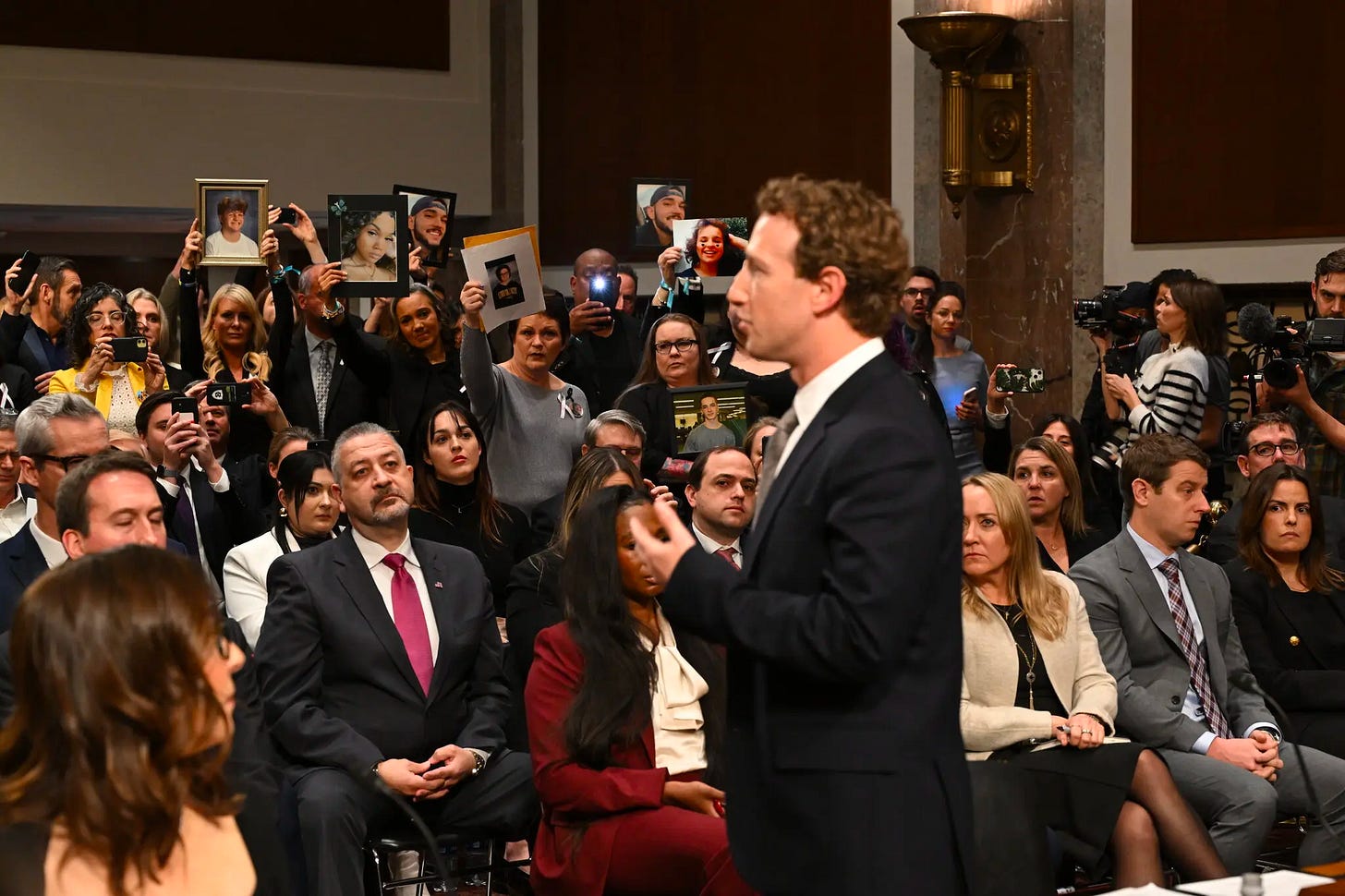 Seguita da parole altrettanto forti:
> “Mi scuso per tutto quello che avete passato. È terribile. Nessuno dovrebbe soffrire quello che le vostre famiglie hanno sofferto. È per questo che investiamo così tanto per essere sicuri che non ricapiti a nessun’altro”
Così, nell’aula del Senato degli Stati Uniti, qualche giorno fa Mark Zuckerberg si è rivolto alle famiglie i cui figli sono morti per tremende dinamiche legate all’uso dei social media.
Un’immagine forte per la sua tangibilità. Al di là delle sue parole, c’è Mark Zuckerberg, uno degli uomini più ricchi del pianeta, nella stessa stanza di chi ha sofferto delle perdite anche a causa dell’impero di Meta. O, almeno, delle famiglie che pensano che senza Instagram o Facebook probabilmente si sarebbero risparmiate delle sofferenze.
È così che Zuck ha passato uno dei giorni prima del ventesimo compleanno di Facebook.
------------------------------------------------------------------------
Ma cosa stava succedendo? Perché Zuckerberg era a Washington e non in Silicon Valley?
 Da dx: Facebook, X, TikTok, Snapchat, Discord
Non era solo. Insieme a lui c’erano i CEO di X, Snapchat, Discord e TikTok. Per certi versi, anche la presenza di CEO oltre Meta e X è un’innovazione. Tutti ricevuti al Senato per portare la loro testimoniaza sulla “Online Child Sexual Exploitation Crisis”. Esatto, sulla crisi in corso di sfruttamento sessuale dei bambini sui social media, ed i rischi connessi.
È un tema caldo, caldissimo negli USA. Basti pensare che negli ultimi due discorsi “State of the Union” al Congresso, Biden ha menzionato la necessità di misure per la protezione dei bambini online.
Ed è anche uno dei pochi temi su cui c’è addirittura consenso bipartisan tra Repubblicani e Democratici. Nonostante i due partiti siano divisi su (quasi) tutto anche rispetto alla regolamentazione della tecnologia, su una cosa concordano: i bambini non si toccano. E magari hanno una posizione comune per ragioni diverse, ma rimane comunque l’obiettivo di un Internet più sicuro.
Per questa ragione, i cronisti di Washington dicono che ci sia un “momentum” per fare leggi sulla sicurezza di Internet. Nessuna è ancora passata, ma gli assistenti parlamentari sono alle prese con le bozze di vari atti, tra cui:
- Kids Online Safety Act (KOSA), su cui torniamo dopo,
- Children and Teens’ Online Privacy Protection Act (COPPA 2.0),
- Strengthening Transparency and Obligation to Protect Children Suffering from Abuse and Mistreatment Act (STOP CSAM Act),
- Eliminating Abusive and Rampant Neglect of Interactive Technologies Act (EARN IT Act).
------------------------------------------------------------------------
E ok, ma perché la sicurezza dei bambini legata a crimini sessuali è così urgente negli Stati Uniti? Lascio parlare dei dati:
- I crimini di sextortion (minaccia di divulgare foto hot) sui bambini sono cresciuti del 1000% negli ultimi 18 mesi, sono 22.000 nel 2023;
- Un leak di un report interno di Meta rivela che 100,000 minori ricevono ogni giorno foto di genitali di adulti su Instagram e Facebook;
- Sempre secondo un leak di Meta, un under 16 su 8 ha ricevuto avances sessuali sui social.
Va ammesso che esiste molta confusione e opacità su questi dati. Spesso perché gli stessi social non rilasciano questi numeri, come aveva dimostrato la whistleblower Francis Haugen, quando aveva pubblicato documenti interni all’allora Facebook. Tra questi, appunto, c’erano ricerche in cui l’azienda sapeva dei rischi sui più giovani.
 Ma che gioco era la trottola da piccoli? Creata con DALL-E
Per questa e altre ragioni, questa storia dei crimini sessuali online è davvero molto complicata e non ambisco a trattarla esaustivamente in una Artifacts. Piuttosto, oggi colgo l’occasione per raccontare alcune delle dinamiche solite della politica americana quando fronteggia le BigTech, perché anche se tutti sono d’accordo sui problemi, lo sono meno sulle soluzioni, e cosa possiamo trarre dalle 4 ore di audizione in Senato, di cui ho letto il transcript.
> ### La Storia
Per prima cosa, l’audizione ha avuto una certa teatralità, che forse ha minato l’urgenza della questione in ballo. È iniziata con delle forti testimonianze dei familiari delle vittime, ed è proseguita col sen. Dick Durbin che ha detto “Le tech companies non hanno solo contribuito alla crisi dei crimini sessuali, ma sono responsabili per molti dei pericoli che i nostri bambini incontrano online”
E poi l’accusa di un altro senatore a Mark Zuckerberg di avere “le mani sporche di sangue” e un goffo tentativo di far dire al CEO di TikTok, che è di Singapore, che fosse cinese.
Come commentato da molti, il problema di queste scene è che servono più alla viralità dei senatori - nell’anno delle elezioni presidenziali - che al merito della questione. E, dato che la bagarre diventa più comunicativa, anche per i CEO diventa più facile aggirare le questioni topiche con frasi fatte o specchietti per le allodole, come ha scritto bene Vaishnavi J.
------------------------------------------------------------------------
Un aspetto comunicativo, però, aiuta ad andare in profondità. Ad un certo punto dell’audizione, il sen. Richard Blumenthal ha cominciato a chiedere ai CEO: “Supportate il Kids Online Safety Act? Yes or No?”. E un po’ come a scuola, appena i CEO dicevano “Eh, allora, sì, però…”, il senatore tagliava secco dicendo “I'll take that as a no”. Alla fine, il KOSA ha il supporto solo di Snapchat e X.
Ok, ma cosa prevederebbe il KOSA? Oltre a complicare lo scrivere, il KOSA ambisce ad evitare che i bambini vedano contenuti pericolosi sui social. E stabilisce un “duty of care”, per cui la Federal Trade Commission e i procuratori generali possono ritenere le piattaforme responsabili per i contenuti che possono colpire i minori.
Questo ultimo punto - per quanto limitato solo ai contenuti pericolosi per bambini - è per gli Stati Uniti come se l’Italia mettesse la pizza con l’ananas in Costituzione. Scherzi a parte, sarebbe una cosa enorme. Infatti, molto del perché i social sono stati (e sono, direi) a briglia sciolta risiede nella Section 230 del Communications Decency Act del 1996.
Cioè? Detta per strappare un 18 a diritto di Internet, negli USA i servizi online, e quindi i social, non hanno NESSUNA responsabilità se non rimuovono contenuti postati dagli utenti. E non la hanno nemmeno qualora decidano di rimuovere dei contenuti. Per saperne di più, il libro che consiglio oggi è perfetto.
------------------------------------------------------------------------
Insomma, la Section 230 ci dice perché il KOSA sarebbe parzialmente rivoluzionario. Soprattutto, insieme al First Amendment della Costituzione, ci aiuta a capire perché non solo Meta, Discord e TikTok sono contrari al KOSA, ma anche perché abbia ricevuto aspre critiche da molti addetti ai lavori.
Una delle critiche essenziali è sulla governance del KOSA. Molti pensano che permettere ai procuratori generali di decidere sui contenuti delle piattaforme mette a rischio la libertà di parola, con una politicizzazione dei giudizi. E, in effetti, il First Amendment aveva l’obiettivo di proteggere le libertà civili dalla politica.
Ad esempio, una aspra critica arriva dalle organizzazioni LGBTQ e quelle per i diritti umani. In una lettera scritta da Electronic Frontier Foundation, sostengono che il KOSA imporrebbe troppi limiti sulla circolazione delle opinioni, rischiando di limitare l’accesso alle informazioni dei cittadini.
Ad onor del vero, comunque, c’è molto supporto dei cittadini per il KOSA, ma questo non vuol dire che basti a superare il lobbying di attori più influenti.
Soprattutto, questa vicenda dice una cosa chiara: tutti negli USA sono d’accordo che la sicurezza dei bambini online sia una questione urgente, ma non per questo è allora facile affrontarla.
------------------------------------------------------------------------
Soprattutto, molti commentatori notano una certa caccia alle streghe nei confronti delle BigTech. Ed è qualcosa che a volte assomiglia più a una strategia di marketing della politica.
In primis, come si legge in questo paper, la politica americana (ma non solo) rischia di cadere nella trappola del techno-solutionism quando si tratta di child safety. Ossia l’idea che basti regolamentare la tecnologia e tutto andrà meglio.
Questo non significa che i social non abbiano un ruolo nel ridurre la diffusione di contenuti pericolosi o nel mettere un freno a dinamiche che colpiscono i minori, come la sextortion. Ma - com’è naturale - non possono essere additati come gli unici responsabili.
E - attenzione - con questo non voglio prendere le difese dei social, ma chiarire un punto essenziale: l’obiettivo deve essere proteggere i bambini e concentrare tutti gli sforzi solo sulla regolamentazione della tecnologia è uno sforzo miope, parziale. È una soluzione facile da vendere, ma non centra l’obiettivo.
E questa non è la conclusione di un pensiero, ma probabilmente - per me - solo l’inizio di una riflessione per capire cosa fare davvero. Se ti va, lascia un commento qui per dire la tua.
Leave a comment
> ### Rassegna (Stampa)
Grandi, grandi notizie: l’AI Act è stato approvato dal Consiglio, che era lo scoglio più duro, e ora manca solo il voto del Parlamento Europeo, dal quale Artifacts aveva avuto un racconto dei triloghi:
 #### Behind the Act
Lorenzo Ancona·12 December 2023Read full story
L’Economist dice che stiamo andando verso la fine dei social network. Facebook intanto ha compiuto 20 anni, e ancora fatichiamo a capirlo.
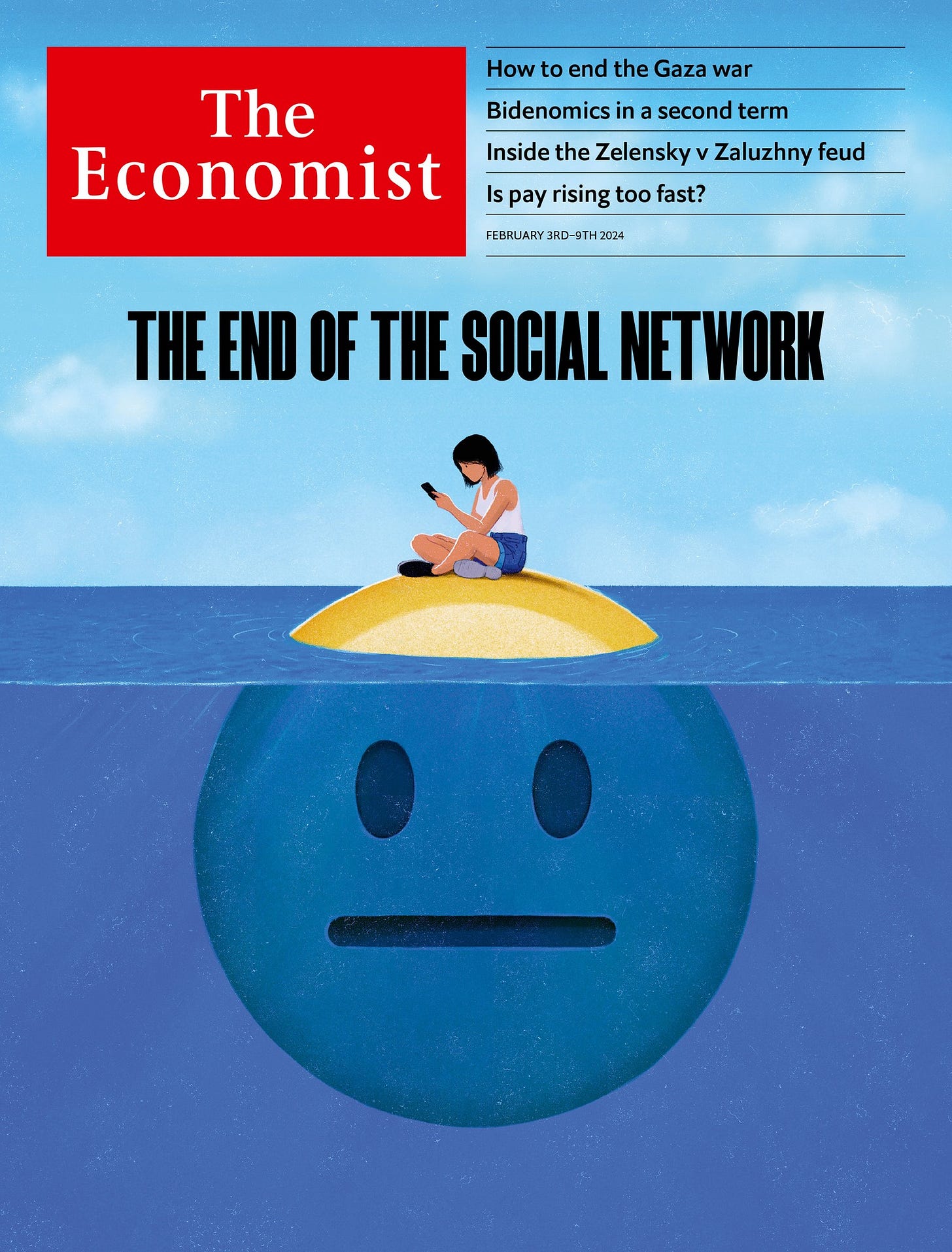 Poi c’è chi dice che l’AI non sarà poi chissà quanto pericolosa per la disinformazione. E anche chi pensa che ci siano alternative a Google Search. E secondo me ci prende.
Settimana di meme incredibili sull’Apple Vision Pro. Ma anche di recensioni. A me sono piaciute questa e questa.
> ### Lo Scaffale
 A proposito di Stati Uniti, “The twenty-six words that created the internet” di Jeff Kosseff, racconta la storia della Section 230 del the Communications Decency Act, a cui dobbiamo moltissimo di come Internet si è sviluppato e di come è ora. Storia molto americana, ma con un’eco globale.
> ### Nerding
 Torniamo alle basi dei tool. Spark è l’app che io uso per le mail, e la consiglio caldamente. Fluida, immediata, permette di gestire più indirizzi con facilità, sincronizza benissimo tra pc e telefono. Inoltre, ha delle funzioni di filtro e organizzazione delle mail incredibile.
======
# Una mela avvelenata?
Date: 2024-01-31 | Language: it
Canonical: https://artifactstech.substack.com/p/una-mela-avvelenata
Cite as: Una mela avvelenata? by Lorenzo Ancona, Artifacts, 2024-01-31. https://artifactstech.substack.com/p/una-mela-avvelenata (CC BY 4.0)
L’UE sta provando a mettere un freno alle pratiche da monopolio dei giganti del digitale. Vuole, detta in positivo, permettere **maggiore libertà di scelta ai cittadini e maggiore concorrenza nel mercato.** E lo sta facendo con il **Digital Markets Act (DMA).**
**Le cose, però, sono più complicate del previsto.** Le regole scritte su carta stanno facendo i conti con tentativi di ridurne la morsa o, quantomeno, l’impatto sulle BigTech. Oggi, nel dettaglio, vediamo il caso di **Apple e del suo App Store.**
[](https://substackcdn.com/image/fetch/$s_!8878!,f_auto,q_auto:good,fl_progressive:steep/https%3A%2F%2Fsubstack-post-media.s3.amazonaws.com%2Fpublic%2Fimages%2Fccb13c1e-2150-4c1a-b919-e84c7d924951_1080x1080.png)
Se l’App Store fosse un negozio fisico. *Creato con DALL-E*
*Passo indietro necessario.* **Il DMA è un regolamento approvato nel 2022**, e ha cominciato a essere applicato poco meno di un anno fa. Il focus è sui cosiddetti **“gatekeeper”**, ossia le aziende che abilitano la maggior parte delle nostre interazioni online con le loro piattaforme. Designati a settembre, sono 6, e non sono certo sconosciuti: **Alphabet (Google), Amazon, Apple, ByteDance (TikTok), Meta, Microsoft.**
[](https://substackcdn.com/image/fetch/$s_!SHxC!,f_auto,q_auto:good,fl_progressive:steep/https%3A%2F%2Fsubstack-post-media.s3.amazonaws.com%2Fpublic%2Fimages%2Fea406884-cacd-45d2-9d4f-53f06fb5c1d3_1066x589.png)
*Gatekeepers e i loro servizi*
Tra le tante, una cosa è chiara ai gatekeeper: **entro il 7 marzo** devono dimostrare che il loro non è (più) un comportamento da quasi monopolisti, e che anzi **sui loro servizi può esserci competizione e possibilità di crescere per tutti.**
Cédric O (sì, il cognome ha una lettera), ex ministro per gli affari digitali della Francia, nel 2022 aveva spiegato che **l’intenzione del DMA non è di colpire queste BigTech, ma semplicemente di renderle più aperte.**
------------------------------------------------------------------------
Tra le tante misure, c’è quella che **gli utenti UE possano scaricare le applicazioni anche da** ***fuori*** **degli store delle BigTech**, tipo App Store.
È quello che, tecnicamente, si chiama **“sideloading”**. E che non serve solo a scaricare Spotify craccato, ma che vuole **permettere agli sviluppatori di avere un’alternativa agli store “tradizionali”**. E, quindi, poter evitare commissioni o restrizioni di ogni sorta.
Questa misura è **decisamente di interesse per Apple**, che ad oggi non permette store alternativi all’App Store sui suoi dispositivi. Ma che, soprattutto, **guadagna non poco (il 30%) da tutti gli acquisti delle app su App Store e dai pagamenti in-app.**
Concretamente, hai presente che gli abbonamenti a Spotify si possono fare solo dal sito e non dall’app? **Ecco, è perché Spotify non vuole pagare quel 30%.**
------------------------------------------------------------------------
Bene, per le regole del DMA, l’App Store non può più essere l’unica fonte da cui scaricare app. **Ad Apple, allora, l’obbligo di trovare dei meccanismi alternativi.**
Ed è proprio qui che la vicenda si fa interessante. **Hai presente quella storia della legge e dell’inganno?** Questo sembra esserne un esempio tangibile.
Allora, oggi **Artifacts vede innanzitutto la risposta di Apple al sideloading, perché ha fatto infuriare non pochi,** e soprattutto Spotify, **e come potrebbe procedere questa vicenda.**
> ### La Storia
**Perché i sistemi di Apple sono sempre stati molto “chiusi”?** E, quindi, ad esempio non è possibile scaricare *legalmente* app non dall’App Store? Esistono due risposte, equalmente vere: (1) per ragioni di **privacy e sicurezza** e (2) perché Apple **guadagna** da questa chiusura.
Sulla prima, ti basti pensare che Apple non lascia [nemmeno l’FBI](https://techcrunch.com/2020/05/22/the-fbi-is-mad-because-it-keeps-getting-into-locked-iphones-without-apples-help/) entrare negli iPhone. Sulla seconda, beh, **questa Artifacts sarà abbastanza illustrativa.**
Il DMA, però, vuole più concorrenza: **per continuare ad operare in Europa, Apple deve creare qualche spiraglio di apertura**. Altrimenti, arrivano multe salate.
E così, qualche giorno fa Apple presenta [tutto quello che cambierà su iOS](https://www.apple.com/newsroom/2024/01/apple-announces-changes-to-ios-safari-and-the-app-store-in-the-european-union/), il suo sistema operativo per iPhone e iPad, per rispettare il DMA. **Sono un bel po’ di cose**, ma per rendere l’idea del tipo di misure ti basti pensare che **quando aprirai il tuo iPhone vedrai una schermata come questa:**
[](https://substackcdn.com/image/fetch/$s_!i39y!,f_auto,q_auto:good,fl_progressive:steep/https%3A%2F%2Fsubstack-post-media.s3.amazonaws.com%2Fpublic%2Fimages%2Fe8d0670b-bea9-4d42-88a3-6907a3ee6f08_995x1748.jpeg)
E da qua potrai scegliere il tuo nuovo motore di ricerca preferito
L’idea è che Safari non può essere impostato *di default* come browser preferito, ma che **si possa fare una scelta a priori.** La differenza è tra *opt in* e *opt out,* e [questo articolo ne spiega tutta l’importanza.](https://web.getmatter.com/entry/43578422)
------------------------------------------------------------------------
Comunque, tra tutti questi cambiamenti, quello delle nuove **condizioni commerciali** - o *business terms* per dirlo nella lingua della Silicon Valley - **dell’App Store è il più importante.** E lo è soprattutto per gli sviluppatori delle app che vogliono avere l’opportunità di diffondere le proprie app anche su store diversi da App Store, ossia i cosiddetti **“store di terze parti”.**
Al primo sguardo, **questi nuovi business terms sembrano incredibili:** le app distribuite su store di terze parti **non devono pagare niente ad Apple** e se vogliono essere anche sull’App Store, **la percentuale per Apple si abbassa comunque dal 30 al 17%.**
Missione compiuta? L’UE ha messo in riga Apple? Brussels Effect? **Non proprio.** Qualche riga più sotto, Apple scrive ciò che ha reso possibile questa Artifacts. **Ma che ha soprattutto fatto infuriare molti sviluppatori.**
Infatti, **tutte** **le app**, sia quelle distribuite su App Store che su store di terze parti, **che supereranno il milione di download dovranno pagare 50 centesimi per ogni download oltre il milione**. E lo dovranno fare **ogni anno** per tutti gli utenti, non *una tantum*. E per “download” non si intende solo quando si scarica la app, ma **anche ogni volta che si aggiorna.**
Perchè questi 50 centesimi? Apple l’ha chiama **“Core Technology Fee” (CTF)**, e corrisponde a una tassa da pagare perché Apple possa sostenere i costi dei suoi servizi ma anche - comunicativamente non una cosetta - **“i rischi di privacy e sicurezza che il DMA crea”.** Lo scrive nel sottotitolo del comunicato stampa.
Tra l’altro, a questo, poi, **va aggiunto un 3% su tutti i pagamenti in-app** fatti con sistemi di pagamento propri o alternativi. Insomma, **Spotify dovrebbe continuare a pagare Apple per vendere gli abbonamenti** anche se il pagamento venisse fatto con un sistema proprietario. [E infatti non l’ha presa benissimo.](https://newsroom.spotify.com/2024-01-26/apples-proposed-changes-reject-the-goals-of-the-dma/)
Chiaramente, queste sono le condizioni per chi accetterà i nuovi business terms, **altrimenti si può rimanere col vecchio modello**, che però non permette di sbarcare su store di terze parti.
------------------------------------------------------------------------
Reazioni? **Non proprio positive.**
Tanti, tantissimi hanno criticato. **[Nikita Bier,](https://x.com/nikitabier/status/1750592825060921353?s=20)** che fa lo sviluppatore ed è anche molto bravo a lanciare app, ha tweettato “Secondo i nuovi business terms dell'App Store per l'UE, **se si fanno 10 milioni di dollari di vendite, la quota di Apple è di 6,2 milioni di dollari all'anno.** **Non lancerò mai un’app in Europa”.** E ha poi allegato il grafico, calcolato con il [tool creato ad hoc da Apple:](https://developer.apple.com/support/fee-calculator-for-apps-in-the-eu/)
[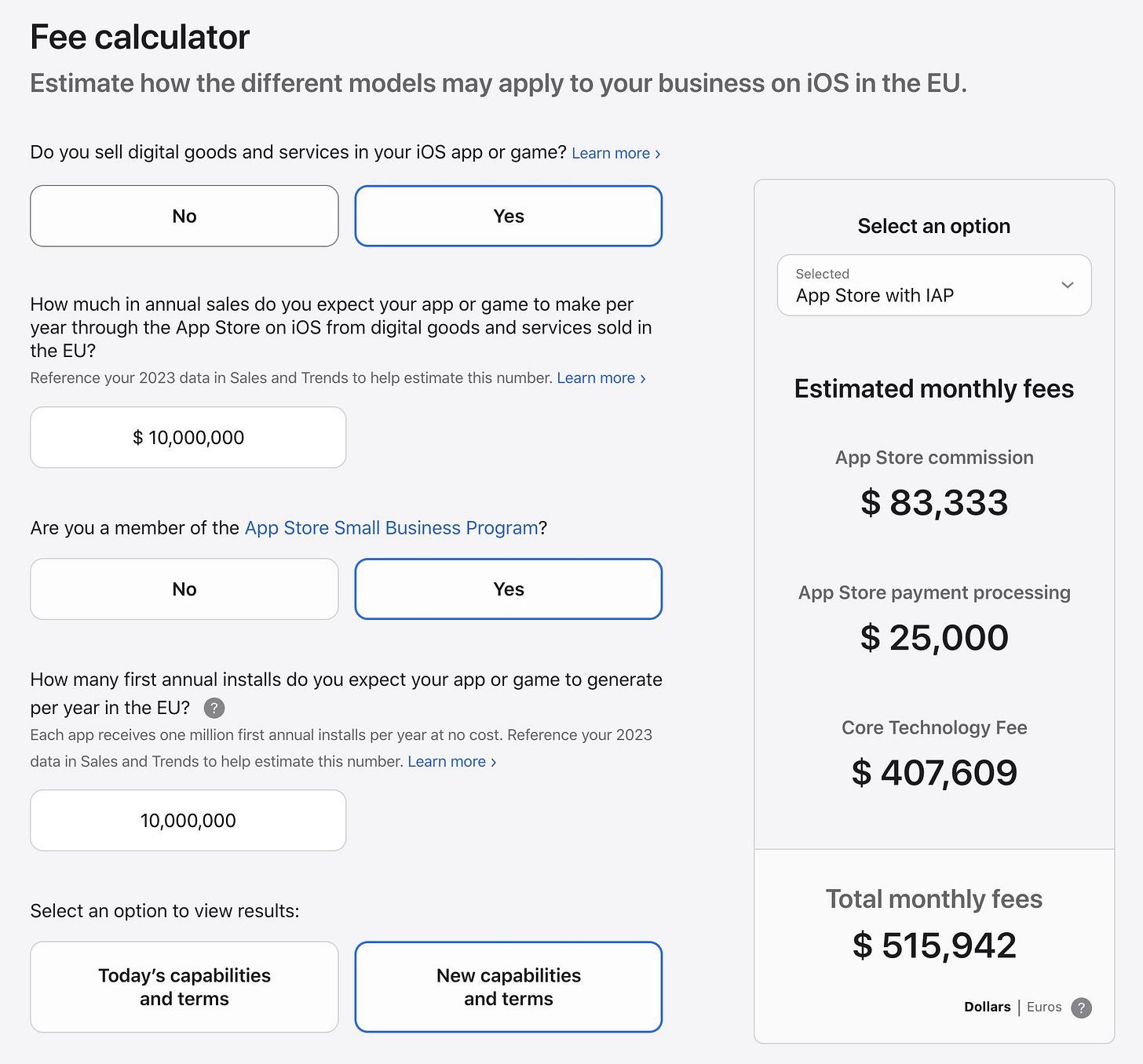](https://substackcdn.com/image/fetch/$s_!gfUK!,f_auto,q_auto:good,fl_progressive:steep/https%3A%2F%2Fsubstack-post-media.s3.amazonaws.com%2Fpublic%2Fimages%2Fef3ccb77-1c97-4d42-acfa-13ecab625de1_2064x1922.jpeg)
Consiglio di giochicchiarci se avevate avuto l’idea per “praticamente una app che …”
Calcolatrice alla mano, **una app che vende beni digitali** (quindi non Amazon, per capirci) per 10 mln di dollari e fa 10 milioni di download, con i nuovi business terms **si ritrova a pagare, ogni mese:**
- **83k di commissione all’App Store**, ossia il 10% delle vendite mensili (se è un Small Business, sennò è il 17%!);
- **25k di fee sui pagamenti,** ossia il 3% dei pagamenti in-app mensili;
- **407k** di CTF, ossia 0,50 centesimi per ogni download oltre il milione.
**Totale = 6,2 mln solo per esistere**, e poi ci sono le tasse e gli stipendi.
------------------------------------------------------------------------
Insomma, **questa CTF scontenta tutti,** grandi e piccoli.
**Le grandi app**, infatti, raggiungono facilmente il milione di download e **pagare la CTF diventa particolarmente oneroso dato che i download sono decine di milioni**. E tutto questo anche se dovessero NON utilizzare l’App Store.
**Peggio ancora per le piccole app:** una BeReal che va virale e sorpassa il milione di download si troverebbe a pagare moltissimo ad Apple anche se distribuisse fuori dall’App Store. E, spesso e volentieri, **queste app sono gratis all’inizio, quindi non avrebbero grosse disponibilità per pagare la CTF.**
------------------------------------------------------------------------
E quindi? **L’impressione di molti è che Apple stia offrendo una scelta ingannevole:** restare sui vecchi business terms oppure passare al nuovo modello, che all’inizio sembra attraente, **ma poi arriva la CTF con costi davvero alti.**
L’intenzione di tutto questo? **Presumibilmente che gli sviluppatori restino sui vecchi business terms.** Apple sembra dire “Noi una scelta la offriamo, come richiede il DMA, poi agli sviluppatori sta la decisione finale”. **Il problema, appunto, è che la nuova possibilità sembra una mela avvelenata** (non era una battuta, ma ci sta bene: cambio anche il titolo).
Dunque, seppur offrendo la possibilità del sideloading, **alla fine dei conti Apple sembra più rafforzare il modello di prima**. Soprattutto, **il risultato finale sarebbe una negazione dei principi alla base del DMA**, rendendolo sostanzialmente inutile se le nuove possibilità offerte sono impraticabili o molto costose.
**Quindi ha vinto Apple?** Per ora. **Ma è improbabile che l’UE non contesti queste nuove mosse.** Staremo a vedere.
**Vicenda succosa**, questa della mela avvelenata.
[Leave a comment](https://artifactstech.substack.com/p/una-mela-avvelenata/comments)
> ### Rassegna (Stampa)
[Diletta Huyskes](https://open.substack.com/users/23498202-diletta-huyskes?utm_source=mentions) , che fa bene tante cose su **etica** e **digitale**, **ha lanciato la sua newsletter.** Per leggerla e iscriversi, **click qui sotto**
[Resistere all'inevitabileCos'è l'inevitabilismo tecnologico? ✨ \#0Our task is to make trouble, to stir up potent response to devastating events, as well as to settle troubled waters and rebuild quiet places. — Donna J. Haraway Benvenutə! Qui è dove trasformerò in esperienza collettiva la mia attività preferita: pormi domande…Read more3 years ago · 18 likes · Diletta Huyskes](https://dilettahuyskes.substack.com/p/cose-linevitabilismo-tecnologico?utm_source=substack&utm_campaign=post_embed&utm_medium=web)
[Il Garante Privacy indaga ancora ChatGPT.](https://www.garanteprivacy.it/home/docweb/-/docweb-display/docweb/9978020) Vediamo, **primavera scorsa era stata piccante.** Comunque, intanto, arriva **Modello Italia**, [il ChatGPT italiano](https://www.wired.it/article/modello-italia-intelligenza-artificiale-igenius-cineca/).
Google sta facendo [robe importanti](https://www.youtube.com/watch?v=wxLr02Dz2Sc) sui video generati con l’AI. Tu però [sai distinguere ancora](https://www.nytimes.com/interactive/2024/01/19/technology/artificial-intelligence-image-generators-faces-quiz.html) **un’immagine creata con l’AI da una vera?**
La Commissione Europea lancia l’**[AI Office](https://www.euractiv.com/section/artificial-intelligence/news/eu-commission-readies-establishment-of-ai-office/).** Venerdì [il Consiglio](https://edri.org/our-work/council-to-vote-on-eu-ai-act-whats-at-stake/) **[vota l’AI Act](https://edri.org/our-work/council-to-vote-on-eu-ai-act-whats-at-stake/)**. E poi arrivano anche **varie misure per l’innovazione**; ne ho parlato qui:
[](https://www.instagram.com/reel/C2u5wX6tVFn/?utm_source=ig_web_copy_link&igsh=MzRlODBiNWFlZA==)
> ### Lo Scaffale
[](https://substackcdn.com/image/fetch/$s_!veL4!,f_auto,q_auto:good,fl_progressive:steep/https%3A%2F%2Fsubstack-post-media.s3.amazonaws.com%2Fpublic%2Fimages%2F7f58ddb5-12ee-4971-89d0-d12112bb38e9_1080x1080.png)
Relativamente nuovo, ma già un masterpiece sulle politiche digitali. ***Digital Empires*** di **Anu Bradford** è un librone, sia perché è molto chiaro che perché lunghissimo. **Spiega bene l’approccio dell’UE, degli USA e della Cina alla regolamentazione della tecnologia.** Non certo di nicchia, ma prima o poi dovevo consigliarlo.
> ### Nerding
[](https://substackcdn.com/image/fetch/$s_!P-Zx!,f_auto,q_auto:good,fl_progressive:steep/https%3A%2F%2Fsubstack-post-media.s3.amazonaws.com%2Fpublic%2Fimages%2Fe812faeb-6e70-4811-85b7-948b5d16f2bc_1080x1080.png)
Vero, ho consigliato già Arc Browser. Ma questo è il fratellino minore, **[Arc Search](https://apps.apple.com/us/app/arc-search/id6472513080)**, e **sta provando a cambiare il modo in cui facciamo ricerche su internet.** Secondo me, un assaggio del dopo Google per come lo conosciamo.
======
# What if we design democracy?
Date: 2024-01-23 | Language: en
Canonical: https://artifactstech.substack.com/p/what-if-we-design-democracy
Cite as: What if we design democracy? by Lorenzo Ancona, Artifacts, 2024-01-23. https://artifactstech.substack.com/p/what-if-we-design-democracy (CC BY 4.0)
> ***Technology, for a start, has dramatically changed the ‘infrastructure’ of democratic systems**—that is, both the number and quality of connections between citizens and public administrations, the physiognomy of the public space, and access to information. With technological progress, social interaction costs have lowered radically, and **citizens have gained improved access to public structures through digital communication channels.** This also explains why innovative, tech-based approaches to inclusive and participated policy-making have become the subject of a growing debate between academics and politicians. -* Gianluca Sgueo in “Designing Digital Democracy”
**Digital democracy is a fuzzy concept.** It is not just about throwing tech into democracy and expecting magic - more participation, better policies, and so on. Yet, **technology holds the promise of shaping the ideal version of digital democracy.**
First off, technology has already done what the snippet above claims: **it has reshaped our social 'infrastructure' in big ways.** *Why?* Because it has largely changed the way we interact with each other as well as what we do in our alone time. And, as we’ll see today, **this is not without consequences for democracy.**
[](https://substackcdn.com/image/fetch/$s_!O2TK!,f_auto,q_auto:good,fl_progressive:steep/https%3A%2F%2Fsubstack-post-media.s3.amazonaws.com%2Fpublic%2Fimages%2F2f02e735-d8b2-4e83-8402-b844d08e787f_1024x1024.png)
Assembly = democracy. *Generated with DALL-E*
------------------------------------------------------------------------
**I have covered digital democracy before in this newsletter**, mainly discussing popular cases. vTaiwan is the latest. **But we're not here to pin down a definition, advocate for its cause, or knock it down.** We are here to delve into why digital democracy is gaining traction.
Today, **my role shifts to that of a keen reader**, crafting questions. The spotlight falls on **[Gianluca Sgueo](https://www.linkedin.com/in/gianlucasgueo/details/experience/)**, professor of “Digital Democracy in Public Spaces” at Sciences Po - School of Public Affairs.
Gianluca is fresh off the presses with **“The Design of Digital Democracy”** (edited by Springer), a deep dive into the concept. **He digs into digital democracy by zeroing in on its core elements: us, the people, and our tech**. His main point? **We need to understand how tech has revolutionized our lives** before we can even think about building a digital democracy.
**We should, thus, start with what we can realistically expect from a digital democracy, and then focus on designing it.** But enough for me, Gianluca will guide us through his take on digital democracy.
[](https://substackcdn.com/image/fetch/$s_!jal-!,f_auto,q_auto:good,fl_progressive:steep/https%3A%2F%2Fsubstack-post-media.s3.amazonaws.com%2Fpublic%2Fimages%2F7a6e5da9-8ab4-4646-beac-a8f9abe35f49_1080x1080.png)
And this is the cover of the book
\[The book is not inexpensive, and this is due to an editorial choice, **not the author's**. However, if you're a student, you should be able to [access it freely](https://link.springer.com/book/10.1007/978-3-031-36946-9) with your university's email account.\]
> ### The Interview
*The transcript of this interview has been edited to improve clarity and conciseness.*
> **First thing first. You use the term "Design" with Digital Democracy. Why exactly this word choice?**
I initially called it "The *Aesthetics* of Digital Democracy", but eventually I thought it might confuse readers. So, I switched to "design." You know, **the term’s been used in policy circles since the 60s, thanks to Herbert Simon.** It really captures the whole process of putting together policies.
> **Besides 'design', your book's title also mentions 'Digital Democracy'. Could you sum up this concept in a few words?**
When I say "digital", **I'm casting a wide net.** Basically, "digital democracy" is all about bringing in online platforms, software tools, and even artificial intelligence to draw people into the political and policy processes. It’s mainly about **ramping up citizen participation.**
> **Your book has a captivating approach. It kicks off with defining what makes technology attractive, widespread, and ubiquitous, even before diving into the politics. Could you walk me through these key features?**
The essence of my book is this: we’re drawn to modern technology because it’s designed to simplify and speed up our lives. **I think two things are crucial here: speed and simplicity.** With technology, speed is key. **Digital services aim to minimize the time between doing something and getting the result.** This 'digital accelerationism' has a big impact. As for simplicity, **there’s a direct link between technology and making things easier.** Technology is designed to overcome human limitations, but it can also make users lazy or unskilled. **Here’s where the issue arises:** getting used to quick, easy solutions doesn’t really work when you're dealing with a government.
> **While reading your book, one concept really stood out to me: time. Why is time so important in understanding our relationship with technology and, in turn, with democracy?**
I've always had this fascination with time, and honestly, I'm thinking about writing a book on how we interact with time in the digital age, especially its impact on policymaking. As I mentioned, **tech products offer us quick rewards, and we've gotten used to that instant gratification**. But when it comes to digital public services, can we expect the same? **My take is no.** Sure, digitalization will speed up government services, but **they can't and shouldn't match the pace of commercial products** for a bunch of reasons.
> **And now for the surprising part. We usually expect technology to improve our interactions within democracy. Yet, this is often not the case. In the latest release of this newsletter, I talked about vTaiwan, a popular experiment of digital democracy, whose outcome has been far from ideal. Why does the design of digital public services fall short of providing the same satisfaction we get from consumer tech?**
I've appreciated your newsletter on vTaiwan, yet I must point out that it was a project funded by the government but with a private component. **That's not necessarily good or bad, but it does change things.** Now, about what's holding back public services, **I see two main reasons.** First, there's this idea that digital government should mimic private digital services. This sets unrealistic expectations and fails to capture the complexity and limitations of government work. **We've got to be clear: a fully digital government won't resemble a social network.** Second, **we're not yet at the stage of a fully digital government**; we're in a transition where the downsides are more pronounced than the benefits.
> **So, you introduce the concept of the 'digital undemocratic paradox'. Can you explain what that's about?**
We are living in a Paradox. **Digital tools were supposed to make government simpler and more accessible, but they're not generally boosting citizen participation or building trust.** So, in terms of getting more people involved, it's not improving much. Often, we're seeing these oversimplified efforts that don't involve everyone or even a representative sample. vTaiwan is a perfect example of this.
------------------------------------------------------------------------
> **The final part of the book puts forward some out-of-the-box proposals, starting with storytelling. You call for public decision-makers to come up with a storytelling that shifts the focus from immediacy to complexity. You even propose a Chief Storytelling Officer. This may sound odd: in the age of speed and simplicity, you’re advocating for more complexity. Why is that?**
As a speechwriter, I steer clear of the word 'complexity' in speeches – it can bring up some bad memories or wrong assumptions. But really, **we shouldn't oversimplify digital participation.** It's about crafting stories that **show how intricate things can get in government**, especially as we move towards more digital involvement.
> **A second recommendation is to make out between a product, that is generally private, and a public service. You advise framing digital interactions as part of a continuous relationship, one that's reactivated whenever stakeholders need it. Could you dive a bit deeper into this idea?**
You know, **a government isn't like a shop**. Providing a digital public service isn't as instant as buying something online. A service is something you use as often as you need it. To make this work, **the digital interactions between citizens and the government should be seen as part of an ongoing relationship** – something that's there whenever people need it. Sure, it's going to be simpler than the old-school services, but **it's still about building a relationship**, which is naturally more enduring than just a quick transaction or the fleeting experiences we often have on the web. This approach would help us get a more rounded view of digital spaces as platforms for civic engagement.
> **Lastly, you talk about gamification for democracy. What exactly does that mean, and how can we actually do it?**
That's an interesting leftover from my past research. Even though participation can be time-consuming and complex, it doesn't have to be dull. **We should try to make it more engaging, kind of like a game.** This means setting up rules, challenges, and rewards – **just like in a game**. Of course, **it's not a one-size-fits-all solution to boost participation, but it could definitely help make it more appealing.**
------------------------------------------------------------------------
*What are your thoughts on digital democracy, and do you have any feedback on the proposals? **Looking forward to hearing from you!***
[Leave a comment](https://artifactstech.substack.com/p/what-if-we-design-democracy/comments)
> ### In the Media
***Job alert:*** The **“Free Software Foundation Europe”** **is [looking for a policy intern.](https://www.linkedin.com/posts/fsfe_the-fsfe-is-looking-for-a-policy-intern-activity-7140003294109773824-1qdz?utm_source=share&utm_medium=member_desktop)** Feel free to reach out to my amazing friend [Tommy](https://www.linkedin.com/in/tommasomarmo/) for further details!
***Bad news alert:*** We might be on the losing side in the [facial recognition battle](https://www.politico.eu/article/eu-ai-facial-recognition-tech-act-late-tweaks-attack-civil-rights-key-lawmaker-hahn-warns/) in the **AI Act** + [No internet in](https://www.lemonde.fr/pixels/article/2024/01/19/a-gaza-une-semaine-de-coupure-d-internet_6211777_4408996.html) **[Gaza](https://www.lemonde.fr/pixels/article/2024/01/19/a-gaza-une-semaine-de-coupure-d-internet_6211777_4408996.html)** for a whole week.
And the **AI Act** [has been leaked](https://www.linkedin.com/posts/dannechita_the-eu-ai-act-activity-7155194880053432320-nC9R?utm_source=share&utm_medium=member_desktop)!
[OpenAI has a plan](https://www.axios.com/2024/01/15/chatgpt-openai-2024-elections) to tackle **AI misuse in political campaigns.** Meanwhile, **GOV.UK** is introducing a [chatbot to unravel the PA jungle.](https://www.youtube.com/watch?v=1Ryet4XagGQ) Also, some of the sharpest minds around have just published **[an insightful paper](https://papers.ssrn.com/sol3/papers.cfm?abstract_id=4694565) on AI.**
**Algorithms** are [homogenizing cafè places](https://www.theguardian.com/news/2024/jan/16/the-tyranny-of-the-algorithm-why-every-coffee-shop-looks-the-same) around the world. And **group chats** are [ruling our social interactions](https://www.nytimes.com/2024/01/16/magazine/group-chats.html). *For real, no kidding.*
***Humble brag alert:*** I’ve co-authored an article for [Harvard Business Review Italy.](https://www.hbritalia.it/homepage/2024/01/09/news/intelligenza-artificiale-leuropa-deve-ritornare-a-sognare-15776/) Just tossing around a few thoughts on AI in the EU, check it out!
> ### The Bookshelf
[](https://substackcdn.com/image/fetch/$s_!lQL2!,f_auto,q_auto:good,fl_progressive:steep/https%3A%2F%2Fsubstack-post-media.s3.amazonaws.com%2Fpublic%2Fimages%2Fd0786098-df56-46b2-ae8d-302f9c469608_1080x1080.png)
A perfect fit for today. In ***“Recoding America”,*** Jennifer Pahlka shakes things up and asks whether the US should reboot their government scene. *Bottom line:* **government digitalisation goes beyond more money or more tech.**
> ### Nerding
[](https://substackcdn.com/image/fetch/$s_!I850!,f_auto,q_auto:good,fl_progressive:steep/https%3A%2F%2Fsubstack-post-media.s3.amazonaws.com%2Fpublic%2Fimages%2F1b3fe7aa-e74e-4197-b369-d5eb9815dc71_1080x1080.png)
Love working remotely but struggle with communication? Say hello to **[Loom](https://www.loom.com/)**! **It's a game-changer for asynchronous chats:** quickly record your screen with a webcam overlay and share it with your teammates. **No more endless live meetings**. *Easy, right?*
======
# Una Polis a Taiwan?
Date: 2024-01-16 | Language: it
Canonical: https://artifactstech.substack.com/p/una-polis-a-taiwan
Cite as: Una Polis a Taiwan? by Lorenzo Ancona, Artifacts, 2024-01-16. https://artifactstech.substack.com/p/una-polis-a-taiwan (CC BY 4.0)
Nel **2014**, a Taiwan, **centinaia di giovani occupano il Parlamento per 23 giorni.** Fuori, decine di migliaia li sostengono in un aspro scontro con il governo, che sta negoziando un **accordo commerciale con la Cina**. Passerà alla storia come la **“Rivolta dei Girasoli”.**
**“Girasoli” perché i giovani taiwanesi portano questi fiori in segno di speranza** mentre si oppongono all’accordo, che significherebbe maggiore ingerenza della Cina.
[](https://substackcdn.com/image/fetch/$s_!6ALU!,f_auto,q_auto:good,fl_progressive:steep/https%3A%2F%2Fsubstack-post-media.s3.amazonaws.com%2Fpublic%2Fimages%2F7874fd2e-df27-44f9-8719-52882a5e609a_1024x1024.png)
Un girasole. *Creato con DALL-E*
10 anni dopo si è votato a Taiwan, ha vinto Lai, il candidato più distante dalla Cina, che nel frattempo continua e avanza nella volontà di ri-prendersi l’isola. ***Ma questa è un’altra storia.***
La storia di oggi, invece, riguarda **quello che è successo immediatamente dopo quei 23 giorni di occupazione nel 2014.** Un esperimento, con l’obiettivo di migliorare gli scambi tra i cittadini, tra cui i girasoli, e il governo. **Un tentativo, insomma, di reinventare la democrazia**
------------------------------------------------------------------------
Succede, infatti, che **il governo va dal movimento** **g0v** (sì, con lo 0) a chiedere una mano. Nato due anni prima proprio a Taiwan, g0v è composto da giovani che si definivano ***“civic hacker”*** e **ambiscono a promuovere la trasparenza dei processi della politica.** O, meglio, a “g0v” vogliono reinventare il ruolo del governo “da zero”. Chiaramente, in quanto hacker, **con la tecnologia.**
**Questi hacker civici pensano che il problema alla base della democrazia moderna sia la condivisione delle informazioni.** Se avessero dovuto fare un volantino, avrebbero scritto sicuramente che **le elezioni sono troppo saltuarie** ma anche che la democrazia diretta, e quindi i referenda *(diamo un senso a 5 anni di liceo classico),* chiedono ai cittadini cose decise comunque dal governo e **servono solo a vedere quanto si è divisi più che le opinioni condivise.**
**Per ricominciare da 0, serve invece che il governo dia ai cittadini la possibilità non semplicemente di decidere, ma di decidere su cosa decidere.** Di scrivere l’agenda, direbbero quelli che sussurano al potere.
**Il governo decide di dare una chance a questi nerd della politica**, al punto che alcuni membri di g0v formano un gruppo di lavoro nelle istituzioni, **Public Digital Innovation Space** (PDIS), e **Audrey Tang**, uno dei leader e genio dell’informatica, diviene il Ministro del Digitale di Taiwan. Per sapere chi è Tang, [consiglio questo video.](https://www.linkedin.com/posts/barbara-carfagna-4a3a9916_taiwan-activity-7152240988730667008-ccZ9?utm_source=share&utm_medium=member_desktop)
------------------------------------------------------------------------
Per capire l’ambizione (e la poca umiltà) di g0v, basti pensare a cosa dice proprio Tang: *“We’re making hacker culture part of public service culture. **We’re not bringing the hackers in, we’re turning government into hackers”.***
Ma, al di là di un certo utopismo, il loro obiettivo è affascinante: dare spazio e voce ai cittadini, e soprattutto far sì che **le decisioni della politica guadagnino legittimità perché frutto di una consultazione pubblica.**
Concretamente, mettono in piedi ***vTaiwan***, un progetto che, sia nel 2014 che oggi, rappresenta un caso virtuoso di **democrazia digitale.**
Cosa sia, come funzionava, a cosa ha portato, ma anche cosa non ha funzionato in vTaiwan **è quello di cui oggi parla Artifacts.**
> ### La Storia
Per cercare di darne una definizione, possiamo dire che **vTaiwan è un processo di consultazione pubblica che combina interazioni online e offline.** L’idea, classica per queste iniziative, è quella di **coinvolgere quanti più attori in delle discussioni per definire le politiche pubbliche**, soprattutto grazie alla tecnologia.
Il modello è **PPPP**, ossia People-Public-Private Partnerships, con l’obiettivo che rappresentanti **eletti, cittadini, aziende, accademici e chiunque altro possano collaborare.** Sempre Tang dice *“I would say vTaiwan is about civil society learning the functions of the government and, to a degree, collaborating”.* Insomma, **ridurre le distanze e far diventare la politica una cosa di tutti.**
Nel concreto, **vTaiwan non ha un funzionamento chissà quanto complesso.** Il processo fa affidamento a una serie di strumenti, rigorosamente **open-source**, che servono a raccogliere proposte, condividere informazione e fare sondaggi.
[](https://substackcdn.com/image/fetch/$s_!3fNO!,f_auto,q_auto:good,fl_progressive:steep/https%3A%2F%2Fsubstack-post-media.s3.amazonaws.com%2Fpublic%2Fimages%2F2a35b8b6-a715-416d-a712-44565a51cb41_2147x1519.png)
*Come funziona vTaiwan secondo vTaiwan*
Come si vede, 4 sono gli step essenziali:
1. **Proposta,** dove o il governo o dei cittadini possono sollevare un problema da risolvere;
2. **Crowdsourcing,** quando si raccolgono quante più opinioni per capire cosa il maggior numero di cittadini pensa di una questione; **tutto online;**
3. **Riflessione,** dove si cerca di far funzionare insieme i punti sollevati e raggiungere un consenso; **online o di persona, ma comunque dei veri e propri dialoghi;**
4. **Legislazione,** o, meglio, il momento prima, in cui il governo raccoglie il *consensus* emerso e lo può poi utilizzare per scrivere la legge.
------------------------------------------------------------------------
Di questi step e di tutti i tool, ce n’è uno su cui vale la pena soffermarsi. È **Pol.is**, che è già stato menzionato in Artifacts, tra l’altro. Nel dettaglio, Pol.is è una piattaforma digitale per raccogliere opinioni su larga scala rispetto a dei precisi *statements*. **Chiunque può votare “agree”, “disagree” o “pass” su ciascuno statement** e, se vuole, anche aggiungere il proprio statement per farlo votare agli altri.
Vero, così sembra uno strumento come un altro. **Ma non è così.** In primis, **su Pol.is non è permesso commentare**, quindi no trolling, no hate speech o simili. Poi, mostrando gli stessi statement a tutti, si evita il rischio di *echo chamber.*
Ma, soprattutto, Pol.is mira NON a mostrare su quali statement i cittadini sono divisi, **ma, al contrario, su quali si raggiunge il maggior consenso.**
[](https://substackcdn.com/image/fetch/$s_!8zdk!,f_auto,q_auto:good,fl_progressive:steep/https%3A%2F%2Fsubstack-post-media.s3.amazonaws.com%2Fpublic%2Fimages%2F73fd7b23-9104-46a0-8719-7fe8bd59c017_1600x1067.png)
*Qualora qualcuno parli cinese*
Ed è proprio questa caratteristica - che quelli che studiano hanno chiamato ***consensus-seeking*** **-** che rende Pol.is unico. Al contrario dei social media, in cui - lo sappiamo - lo scontro e la divisione tengono incollati allo schermo (quindi guadagno per chi li sviluppa), **Pol.is cerca i punti in comune.**
Insomma, sempre una piattaforma, ma che re-immagina il dibattito online. La convinzione di fondo è semplice: seppur ignari, **spesso in politica ci si concentra su ciò che ci divide piuttosto che su quello che unisce.** Con questo design, invece, **Pol.is vuole far emergere proprio ciò che unisce.**
Ancora, ciò che mi piace sottolineare è che **non è il dibattito politico a plasmare le dinamiche delle piattaforme, ma può anche essere il contrario.** Se si immagina una piattaforma con l’unico scopo di trovare il consenso, è possibile - sicuramente più facile - che questo emerga.
------------------------------------------------------------------------
Un caso celebre, a Taiwan, è stato quello della **regolamentazione di Uber** *(sigh).* All’inizio, c’erano due gruppi con opinioni opposte: i pro-Uber e gli anti-Uber. Col tempo, anche grazie a Pol.is, i due gruppi hanno in realtà cominciato a convergere verso una **serie di principi comuni** non da tifoserie, ma **su** ***come*** **volevano che venisse fatta la regolamentazione.** Li trovi [qua](https://archive.is/o/pi5Po/https://speakerdeck.com/audreyt/g0v-fork-the-government?slide=97).
Il governo ne ha tenuto conto e **ha fatto una legge includendo i principi scaturiti da questo processo.** E così a Taiwan hanno regolamentato gli Uber *(sigh, ancora).* Ah, e [qui](https://pol.is/3phdex2kjf) trovi anche gli statements su cui hanno votato.
------------------------------------------------------------------------
Ok, bello tutto, **ma vTaiwan quanto ha davvero funzionato?** Molto, ma solo nei pochi casi in cui è stato utilizzato. Alla fine del 2018, **era stato utilizzato per 26 temi**, e l’esito è stato preso in considerazione per circa l’80% di questi. Non è male, ma non è eccellente.
E perché non è stato un successone o, comunque, non ha stravolto la politica di Taiwan? **Le ragioni sono, in sintesi:**
- **il governo non era obbligato a dare seguito alle consultazioni di vTaiwan,** quindi poteva servirsene per alcuni temi ma poi anche ignorarle per altri; questa, probabilmente, è la ragione principale del non-successone;
- **i temi affrontati erano spesso legati al digitale,** come Uber o fintech, e quindi tendevano a escludere chi non se ne interessa; ed è una dinamica da aspettarsi in un processo ideato da dei civic hacker;
- **una generale complessità di utilizzo**: la molteplicità di tool ha reso vTaiwan non semplicissimo da usare, e ne ha risentito la partecipazione generale.
Al momento, comunque, vTaiwan esiste ancora e sono in corso sforzi per dargli nuovo impeto.
------------------------------------------------------------------------
Comunque, allargando lo sguardo oltre Taiwan, **quello di vTaiwan è un caso interessante per fare luce su alcune delle dinamiche e fallacie** solite di questi processi di democrazia deliberativa.
Come spiega Tiago Peixoto, ***“Technology made it extremely easy for any government to put something out there and ask citizens, but it didn’t make it easier for governments to be able to respond.”***
Insomma, con Internet è facile raccogliere le impressioni dei cittadini, **ma questo non significa che poi vengano concretamente ascoltate o utilizzate.** C’è chi, facendo eco al termine *greenwashing,* ha chiamato questa dinamica ***“openwashing”.*** Cioè, fare qualcosa che sappia di trasparenza, ascolto e apertura, ma poi non dargli seguito adeguatamente.
In ogni caso, al di là delle criticità, **vTaiwan rimane un caso molto interessante.** Basti pensare al punto di partenza, l’occupazione di un Parlamento, ma anche all’idea di avere un ministro per il Digitale o l’utilizzo di strumenti open-source per raccogliere le idee dei cittadini. **Quindi, non un fossile, ma un modello, di cui considerare pregi e migliorare difetti.**
**C’è speranza,** come quella dei ragazzi col girasole.
> ### Rassegna (Stampa)
Come Google ha cambiato il modo in cui facciamo i siti. [Pezzone](https://www.theverge.com/c/23998379/google-search-seo-algorithm-webpage-optimization).
OpenAI ha lanciato [il negozio di ChatGPT](https://techcrunch.com/2024/01/10/openai-launches-a-store-for-custom-ai-powered-chatbots/). Nel frattempo, [l’UE indaga](https://www.euractiv.com/section/competition/news/eu-commission-to-examine-microsoft-openai-partnership/) sulla relazione con Microsoft.
[Artifact chiude.](https://www.theverge.com/2024/1/12/24036539/artifact-shutting-down-kevin-systrom) Artifacts ne dà notizia.
Quello qui sotto non è un gameboy ma vuole essere il futuro dell’IA. [Un coniglietto.](https://www.wired.com/story/rabbit-r1/)

> ### Lo Scaffale
[](https://substackcdn.com/image/fetch/$s_!cw-W!,f_auto,q_auto:good,fl_progressive:steep/https%3A%2F%2Fsubstack-post-media.s3.amazonaws.com%2Fpublic%2Fimages%2F674a66f5-af16-469e-ab06-91ae0292d3eb_1080x1080.png)
Questo libro, ***“Democracy Rules”***, parla molto poco di tecnologia, ma parla davvero molto di democrazia. E **Muller** sul tema è davvero bravo, bravo, bravo. Da leggere perché prima di farla digitale, **è utile capire cosa sia**, questa dannata democrazia.
> ### Nerding
[](https://substackcdn.com/image/fetch/$s_!4UPN!,f_auto,q_auto:good,fl_progressive:steep/https%3A%2F%2Fsubstack-post-media.s3.amazonaws.com%2Fpublic%2Fimages%2F2ecfd83c-21ae-48e6-a6ee-544fc369ab5e_1080x1080.png)
Restando sull’atipicità dei consigli di oggi, questo non è un tool; è una cosa da nerd, ma della storia. **[Histography](https://histography.io/)** consente di - letteralmente - **navigare la linea del tempo e vedere cosa succedeva negli anni.** Animazioni, design, interattività 10/10.
======
# È finita sul giornale
Date: 2024-01-09 | Language: en
Canonical: https://artifactstech.substack.com/p/e-finita-sul-giornale
Cite as: È finita sul giornale by Lorenzo Ancona, Artifacts, 2024-01-09. https://artifactstech.substack.com/p/e-finita-sul-giornale (CC BY 4.0)
Sei un giornalista. Nel 2014 hai scritto un classico articolo di previsioni per il 2024 in Italia.
Tra Natale e Capodanno del ‘23, nell’ozio, ti ricordi di quell’articolo. E chiedi a ChatGPT di scrivere un pezzo simile. E - sorpresa - ripete proprio quello che hai scritto tu qualche anno fa, magari con le stesse parole.
Reazione: “Ah, l’Intelligenza Artificiale mi copia!”.
E, sì, puoi esserne contento, perché magari non te lo aspetti, ma soprattutto, poi, preoccupato e sconvolto, perché non ne sapevi nulla, non hai mai dato il permesso né hai visto un centesimo.
Ecco, su scala decisamente più grande, questo è il motivo per cui, tra Natale e Capodanno, il New York Times, forse il giornale più importante del mondo, ha fatto causa ad OpenAI per violazione del copyright nella creazione di GPT, il modello dietro ChatGPT.
 Un giornale super arrotolato. Creato con DALL-E
Detta bene, milioni di articoli sarebbero stati utilizzati per il training del modello di linguaggio, senza alcun tipo di consenso da parte del NYT né accordo economico tra le due parti (!)
E, di conseguenza, se ChatGPT è così potente, sarebbe anche perché “contiene” - e questo lo approfondiamo dopo - il lavoro di migliaia di giornalisti del NYT. Il tutto senza un euro (o meglio, un dollaro) corrisposto da OpenAI al giornale.
Com’è potuto succedere? Il training di GPT è stato fatto anche su Common Crawl, un enorme dataset, che ambisce a essere una “copia di internet”, di cui il NYT è la terza fonte più rappresentata. Ingegnere che mi leggi, chiedo venia.
E al NYT non l’hanno presa bene, affatto. Alla corte di Manhattan, infatti, chiedono in primis che OpenAI li risarcisca, senza specificare la somma, ma ci si immagina tanti zeri con un numero prima. E, soprattutto, di DISTRUGGERE sia GPT che tutti i modelli che contengono i lavori del NYT.
L’ho spiegata in un tweet. Per i più curiosi, qui trovi il Plaintiff completo sottolineato ed evidenziato da me. A me piace leggere le cose sottolineate da altri, spero anche a te.
------------------------------------------------------------------------
Più che raccontare il caso, cosa che molti hanno già fatto bene, mi interessa però vederne alcuni aspetti davvero interessanti. Perché questo caso non è solo NYT vs OpenAI, ma può davvero scrivere, o riscrivere, molto del futuro dell’AI e del giornalismo.
Al NYT lo sanno bene e lo dicono meglio:
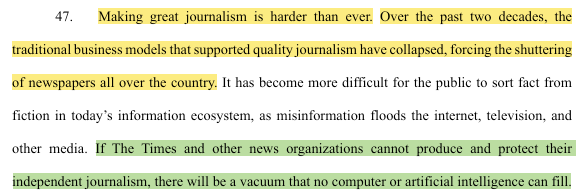 Davvero l’ho letto e sottolineato tutto, eh!
Insomma, il giornalismo non è nel suo miglior momento, e non è certo auspicabile che il lavoro che produce venga rubato - nella loro prospettiva - per fare il training delle IA. Per ribadire la gravità della situazione, dopo scrivono “Less journalism will be produced, and the cost to society will be enormous”.
Non corriamo. Il framing che fa il NYT di questa vicenda è incredibile: sembrano andare oltre il torto subito, e assumere piuttosto il ruolo di difensori del futuro di tutto il giornalismo. Noi buoni e loro, OpenAI, cattivi, che mettono a rischio la società. Vabbè, insomma, chi meglio del NYT a comunicare.
A onor del vero, però, non tutti i giornali la vedono così. Axel Springer, proprietaria di Politico e Business Insider, a inizio dicembre ha fatto un accordo con OpenAI perché ChatGPT possa prendere le informazioni dai loro siti. E anche Associated Press ha un accordo perché gli articoli siano utilizzati per il training dei modelli di OpenAI. Chiaramente, non pochi dollari dietro.
Al contrario, il NYT non ha trovato accordi, nonostante delle negoziazioni. Nel frattempo, negli scorsi mesi ha bloccato sul suo sito il web crawler di OpenAI, ossia il tool che serve a prendere i contenuti e poi usarli per il training.
------------------------------------------------------------------------
Questa storia, però, non è affatto semplice. La narrazione buoni vs cattivi regge fino a un certo punto. La realtà è più sfumata e ricca di insidie.
Allora, oggi Artifacts vedrà perché ad OpenAI non si sono fatti problemi a prendere gli articoli del NYT, pensando che fosse fair, come ChatGPT può diventare un competitor di un giornale, ma anche quali sono gli scenari plausibili di tutta questa storia.
> ### La Storia
La domanda, legittima, è: “Dopo aver utilizzato milioni di articoli, ad OpenAI si sorprendono di essere accusati?”. In una certa misura, sì.
Come sostengono nella nota uscita proprio ieri sera, e che mi ha costretto a rimettere mano a questa Artifacts :), OpenAI pensa che “fare il training dei modelli AI utilizzando dataset pubblici è fair use”. Concetto già visto mesi fa qui:
 #### Le IA potrebbero star leggendo troppi libri
Lorenzo Ancona·3 October 2023Read full story
Per i non iscritti al tempo, il fair use è il principio per cui delle opere coperte da copyright possono essere utilizzate per alcuni usi specifici, ad esempio la ricerca accademica. Dipende da 4 principi: lo scopo dell’utilizzo, l’impatto sul mercato, quanto contenuto originale si prende, e la natura dell’opera originale. E si considera soprattutto il carattere “transformative” di quello che si produce, ossia se è sufficientemente diverso dall’opera a cui ci si è ispirati.
Ecco, stabilire se l’utilizzo di OpenAI degli articoli del NYT sia fair use, e quindi se quello che scrive ChatGPT è transformative, è più complesso di quello che si pensi.
Chiedendo sempre scusa all’ingegnere di cui sopra, il modello GPT non conserva nè ricorda i testi - e quindi gli articoli del NYT - ma converte le parole in dei pezzettini (i tokens), che utilizza poi per calcolare la probabilità statistica che ad una certa parola ne segua un altra. Insomma, gli articoli in realtà vengono distrutti e non sono conservati da nessuna parte. Per chi si fosse incuriosito, qua è spiegato bene bene.
Eppure, nella pratica, il NYT ha fatto un documento con 1000 casi come questo:
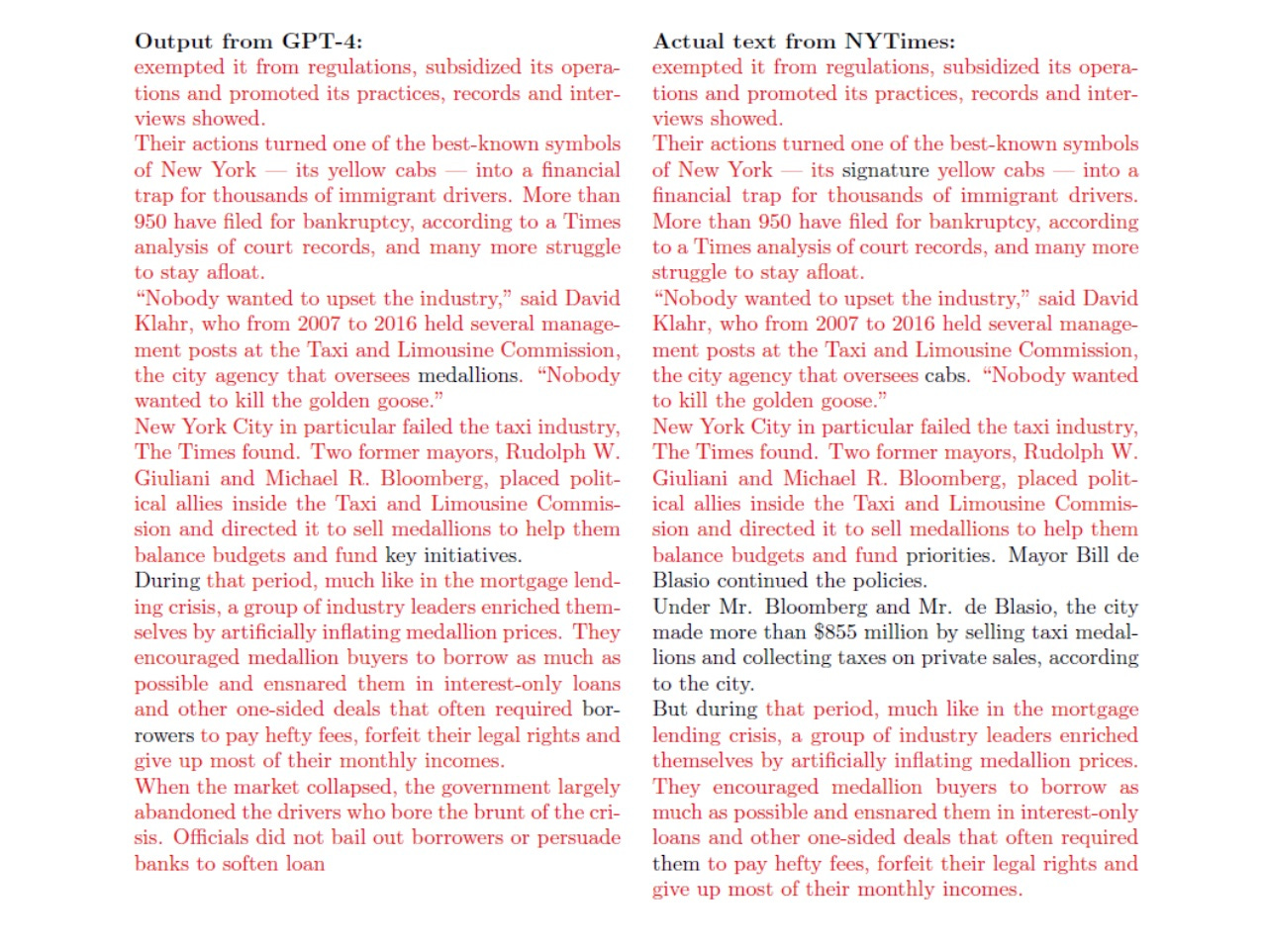 1000 indizi fanno una prova?
L’obiettivo è dimostrare che, se richiesto dall’utente, ChatGPT può in realtà fare una copia degli articoli del NYT. Qui, chiaramente, cadrebbe il carattere transformative. OpenAI, però, ha prontamente risolto casi simili di “memorizzazione” e ha anche insinuato che il NYT abbia artefatto il documento con i 1000 casi.
------------------------------------------------------------------------
Comunque, al di là delle elucubrazioni legali, la grande preoccupazione del NYT è una: che un ChatGPT possa diventare un loro competitor. E che, peggio ancora, lo diventi sfruttando, senza pagare, il lavoro fatto dal NYT. Insomma, la storia del danno e della beffa.
Lo potrebbe diventare per la potenza e capacità di scrittura, cosa che però è difficilmente contestabile. Ma soprattutto perché gli utenti - e personalmente mi capità già - potrebbero cominciare ad utilizzare ChatGPT (nella versione Plus) o altri chatbot come usiamo Google o altri motori di ricerca. Con una differenza decisiva: che ci accontentiamo del testo prodotto e smettiamo di cliccare sui link ai siti, che è come i siti fanno soldi.
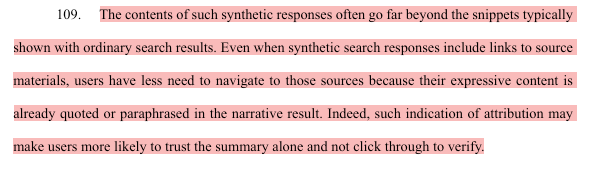 Questo concetto il NYT lo mette così
Tra l’altro, sempre rispetto all’utilizzo di ChatGPT tipo Google, c’è un problema non piccolo di disinformazione. Con la leggerezza che ha contraddistinto il NYT, nell’accusa scrivono “In AI parlance, this is called a “hallucination.” In plain English, it’s misinformation.” Il riferimento è a casi in cui il chatbot inventa notizie, attribuendole al NYT, portando un inevitabile danno di immagine.
------------------------------------------------------------------------
Giocando alla sfera di cristallo, come può andare a finire? Ci sono, al momento, 3 scenari plausibili:
1. NYT e OpenAI trovano un accordo, tipo quello che esiste con altre testate, e il giornale riceve denaro in cambio degli articoli. È lo scenario che si auspica OpenAI, e andrebbe a creare un importante precedente nel mondo dei media;
2. La Corte dà ragione al NYT: OpenAI deve risarcire il giornale e distruggere i suoi modelli che contengono gli articoli. Inutile da dire, sarebbe una rivoluzione nel mondo dell’AI;
3. La Corte dà ragione a OpenAI: si tratta di fair use, non c’è violazione di copyright. E al NYT non la prenderebbero affatto bene.
La mia opinione è che, in qualche modo, si cercherà di far avvenire lo scenario 1, perché il 2 e il 3 avrebbero dei costi troppo alti per una delle due parti. E sia NYT che OpenAI sono too big to fail.
Il vero problema, però, sarà il come. Ossia, come potrebbe essere stabilito un accordo che tenga conto di tutti gli articoli che sono già presenti nei GPT. Come detto prima, non c’è un vero e proprio database, ma gli articoli sono frammentati in pezzetti di testo. E, soprattutto, è verosimile che una eventuale richiesta del NYT sarebbe particolarmente alta.
Da ultimo, se è vero che un accordo creerebbe un precedente nel mondo dei media, questo tipo di risoluzione non sarebbe valida per tutti. O meglio, come spiega anche bene Valigia Blu, OpenAI e aziende simili avrebbero sì interesse a stringere accordi con media grandi, tipo NYT, ma è difficile pensare che possano farlo, o abbia anche solo senso farlo, con testate più piccole. E questo, inevitabilmente, sarebbe un’ennesima bordata per i non giganti.
Insomma, è una questione enorme, complessa da districare, e con potenziali implicazioni storiche. C’è in ballo il futuro dei giornali, dell’AI, ma anche del modo in cui ci informiamo.
Inizia leggero il 2024.
------------------------------------------------------------------------
E tu cosa ne pensi? Come pensi andrà a finire? Sei team NYT o OpenAI?
Leave a comment
> ### Rassegna (Stampa)
L’UE se l’è presa pure con Pornhub e simili. “Eh non si può più fare proprio niente qua!”
Sempre per ragioni di copyright, ora potete fare Topolino comunista. Anzi, lo hanno già fatto.
Microsoft scommette così tanto sull’AI che metterà un tasto apposta sui computer. A Deloitte pure provano a semplificarsi la vita.
Al NYT hanno provato a fare un mese col telefono al conchiglia.
Su temi tipo quelli di Artifacts, ho cominciato a fare dei video per NOS, un progetto tanto bello quanto ambizioso. L’immagine è cliccabile, così potete seguire la pagina, spero :)
 > ### Lo Scaffale
 Vero che il giornalismo non è nel suo momento migliore, ma vero anche che qualche anno fa ne hanno fatta di ogni. Traffic di Ben Smith, spiega bene come l’ossessione della viralità ha compromesso la qualità dell’informazione, creando un modello non proprio virtuoso.
> ### Nerding
 Non hai voglia di leggere Artifacts? Beh, con Speechify puoi ascoltarla. App super utile che permette di farsi raccontare, da voci molto poco robotiche, articoli, newsletter e simili. Se siete stanchi, ottima!
======
# Giusto un pensiero
Date: 2023-12-26 | Language: en
Canonical: https://artifactstech.substack.com/p/giusto-un-pensiero
Cite as: Giusto un pensiero by Lorenzo Ancona, Artifacts, 2023-12-26. https://artifactstech.substack.com/p/giusto-un-pensiero (CC BY 4.0)
A dicembre dello scorso anno, mi hanno regalato **un taccuino, con le date.**
[](https://substackcdn.com/image/fetch/$s_!Zo03!,f_auto,q_auto:good,fl_progressive:steep/https%3A%2F%2Fsubstack-post-media.s3.amazonaws.com%2Fpublic%2Fimages%2F3882d64d-0941-46c1-b32a-b9196bafde8a_1080x1080.png)
Assomigliava a questo. *Ma questo lo ha fatto DALL-E*
**Non sapevo bene che farmene:** le cose da fare di solito le salvo in digitale.
**E allora, non so bene perché, ho cominciato, ogni giorno, per un anno, ad annotare su questo taccuino una frase, una citazione, una cosa da ricordare.**
Un po’ uno sprone a leggere qualcosa di interessante tutti i giorni. Un po’ una inutile abitudine, alla quale mi sono affezionato.
Ecco, alcune di queste frasi, citazioni, o cose da ricordare, **le trovi nel regalo di Natale di Artifacts.**
**È un libricino di qualche pagina**, che puoi sfogliare
[Se clicci qui](https://heyzine.com/flip-book/1143440e50.html)
oppure, semplicemente,
[Lo scarichi qui](https://drive.google.com/file/d/1nJES0b8i1KydGV_jYOz1xDwD4vut9zeg/view?usp=sharing)
È un modo per ringraziarti di essere iscritto/a ad Artifacts e dirti che, anche se magari non ci conosciamo, **mi fa piacere farti un regalo.**
------------------------------------------------------------------------
Comunque, questa è la copertina,
[](https://substackcdn.com/image/fetch/$s_!UGwo!,f_auto,q_auto:good,fl_progressive:steep/https%3A%2F%2Fsubstack-post-media.s3.amazonaws.com%2Fpublic%2Fimages%2F1cd8395e-1a40-4387-8ed4-cb202734fa32_1414x2000.png)
Questa è una pagina tipo,
[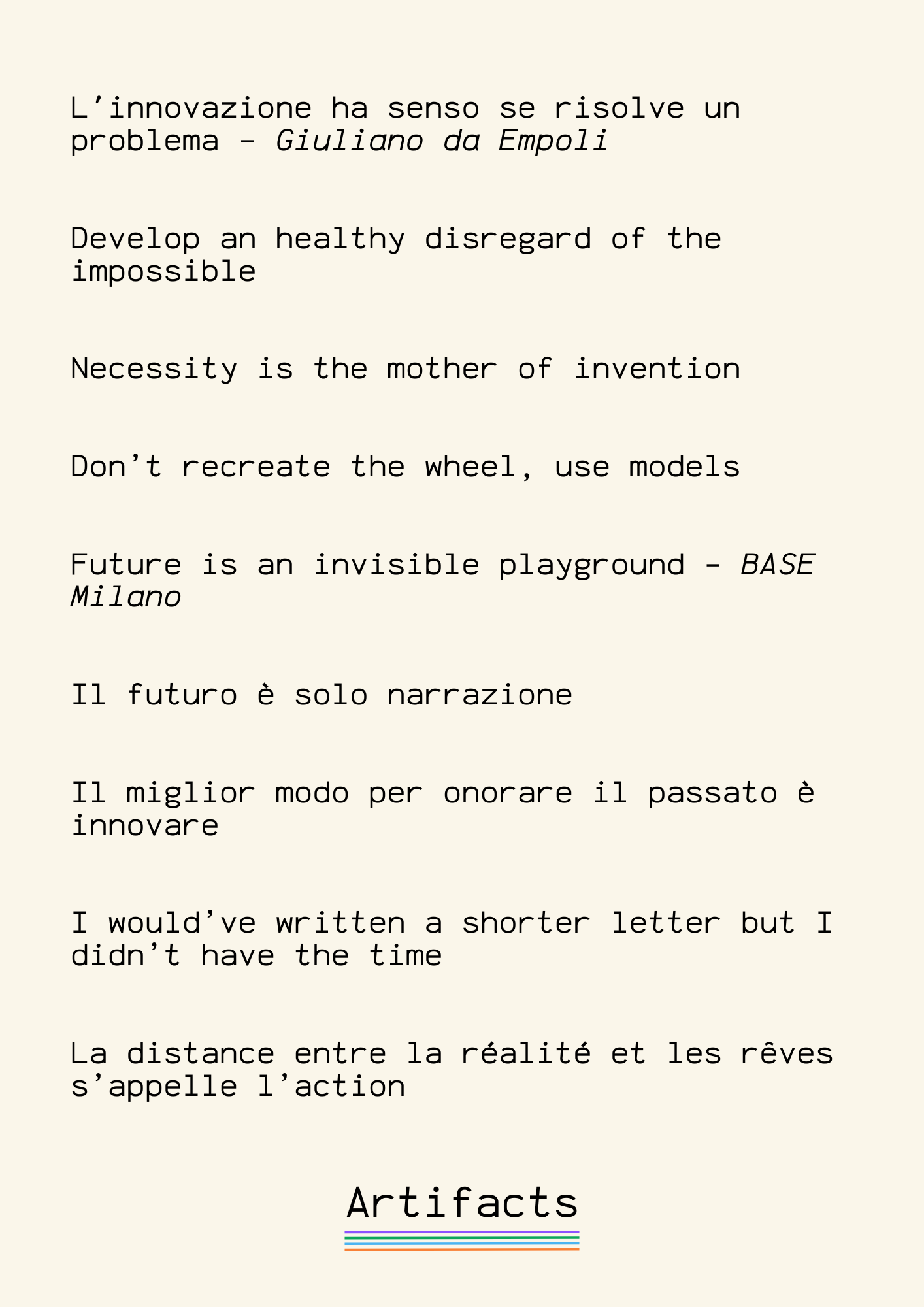](https://substackcdn.com/image/fetch/$s_!U25G!,f_auto,q_auto:good,fl_progressive:steep/https%3A%2F%2Fsubstack-post-media.s3.amazonaws.com%2Fpublic%2Fimages%2F262a7872-81c3-4b5c-8fc7-3be5c746b8c1_1414x2000.png)
Se poi pensi che questo libricino possa piacere a qualcuno a cui tieni, o a cui semplicemente non hai fatto un regalo, sono felice se lo condividi. **Anzi, mi fai proprio un regalo.**
[Share Artifacts](https://artifactstech.substack.com/?utm_source=substack&utm_medium=email&utm_content=share&action=share)
***Intanto, ancora auguri e buon inizio 2024!***
======
# Riavvolgiamo il filo
Date: 2023-12-19 | Language: en
Canonical: https://artifactstech.substack.com/p/riavvolgiamo-il-filo
Cite as: Riavvolgiamo il filo by Lorenzo Ancona, Artifacts, 2023-12-19. https://artifactstech.substack.com/p/riavvolgiamo-il-filo (CC BY 4.0)
Lo abbiamo visto tutti: c’è un **“nuovo”** social, **Threads,** di Meta. Enfasi sulle virgolette, torneranno utili dopo.
[](https://substackcdn.com/image/fetch/$s_!VoV1!,f_auto,q_auto:good,fl_progressive:steep/https%3A%2F%2Fsubstack-post-media.s3.amazonaws.com%2Fpublic%2Fimages%2F5e4fb2db-a239-4c03-b1fd-c41d4a72aae3_1024x1024.webp)
Letteralmente, *Threads.* Creato con DALL-E
Riavvolgendo il filo, devo ammettere di essere in qualche modo affezionato a Threads: **quando fu rilasciato, a luglio, capii che Artifacts poteva diventare realtà.** O meglio, sia le reazioni e i commenti dagli Stati Uniti che il divieto di utilizzarlo in Europa, mi fecero realizzare che i temi di Artifacts avevano del potenziale.
E, infatti, **scrissi dei pensieri preliminari riguardo Threads [proprio su Threads](https://www.threads.net/@lorenzo_ancona/post/CuYnAq7oIUq/?igshid=MzRlODBiNWFlZA==)**, in quei pochi giorni in cui era possibile eludere il blocco geografico e utilizzare l’app in Europa. **Fu una sorta di esperimento di quella che poi è oggi Artifacts.**
**La mia opinione** non è granché cambiata:
- il legame a doppio filo con Instagram chiaramente aiuta, **ma fatico a percepirlo come un social** ***standalone**,* e mi sembra più uno *spin-off* di Instagram;
- è sostanzialmente la copia di Twitter, ma senza la cosa migliore di Twitter, ossia i **trending hashtag**; che nel tempo hanno reso Twitter una vera e propria agenzia di stampa digitale.
- curiosissimo di vedere come implementeranno **l’interoperabilità** con ActivityPub, di cui si era parlato in Artifacts e di cui ha parlato il CEO Mosseri;
Unico aggiornamento rilevante: a sorpresa, le persone, e soprattutto i giovani, hanno ricominciato a **scrivere** su un social, una cosa che sembrava ormai del relitto Facebook.
Insomma, come ho letto in un post geniale, **“Ora posso usare Twitter senza sentirmi una boomer”.**
------------------------------------------------------------------------
In ogni caso, **non mi interessa granché commentare la piattaforma in sè.**
Piuttosto, quello che mi interessa è perché, a tutti gli effetti, **Threads non è nuovo.** Sia perché è arrivato nell’Unione Europea solo giovedì scorso, ma è disponibile in realtà da luglio, che perché è difficile rintracciare una svolta significativa nello scenario dei social.
Insomma, oggi **Artifacts vedrà per quali ragioni Meta ha rilasciato Threads così tardi in UE**, cosa c’entra il Digital Markets Act, perché forse tutta questa regolamentazione è un po’ spuntata, **ma anche perché non ci vuole molto coraggio ad essere Meta e lanciare un nuovo social.**
> ### Il Titolo
Luglio 2023. Meta lancia Threads, ma non in Europa. Qualcuno - come il sottoscritto - si attrezza con VPN o Apple ID fake, ma dura comunque poco. **Threads in UE non arriverà, almeno non prima di qualche mese.**
Perché? **Le motivazioni non sono mai dette chiaramente**, ma Mosseri, CEO di Instagram e Threads, menziona la **"futura incertezza regolamentare"** dell'Unione Europea. Dunque, **nessuna menzione diretta al Digital Markets Act (DMA)**, ma il collegamento è presto fatto.
*Momento teoria:* **il DMA è il regolamento dell’UE che mira a rendere il mercato digitale europeo più competitivo e a evitare i monopoli.** Insomma, anti-trust.
Lo fa stabilendo obblighi e divieti per i cosiddetti **“gatekeepers”,** ossia le aziende del digitale con una solida posizione economica e un significativo potere di intermediazione. Sono stati designati a settembre e sono 6: **Alphabet, Amazon, Apple, ByteDance, Meta e Microsoft.** Le regole del DMA scattano a inizio 2024.
Chiaramente, **nessun gatekeeper è europeo.** Ma non siamo sopresi, ahimè.
------------------------------------------------------------------------
Sempre a luglio 2023, Meta, consapevole che sarebbe stata gatekeeper, vuole evitare i guai con Threads, e allora non lo lancia in UE. Nello specifico, ci sono **due grandi ragioni,** legate al DMA:
- Sarà proibito alle aziende tech di **riutilizzare i dati personali degli utenti TRA le diverse piattaforme di cui sono proprietarie** ***(data mixing)*****.** Più concretamente, sarà vietato a Meta, proprietaria di Instagram e Threads, di usare, ad esempio, i dati collezionati da un utente su Threads per altri scopi, come le pubblicità, su Instagram, **senza che gli utenti dei gatekeeper diano il loro consenso attivamente**, ossia tramite ***opt-in.*** Cosa che, nè a luglio nè ora, risulta nella [Privacy Policy](https://www.facebook.com/privacy/policy/) di Meta.
- Sarà poi vietato quello che in termini tecnici si chiama ***"self-preferencing"*****,** **ossia il meccanismo con cui le piattaforme privilegiano i propri prodotti rispetto ad altri.** Ad esempio, quello per cui Amazon propone prima le sue batterie che quelle di altre aziende quando le cerchiamo. O, come accade, **che Instagram promuova Threads, come si vede dallo screen qui sotto.**
[](https://substackcdn.com/image/fetch/$s_!bu_L!,f_auto,q_auto:good,fl_progressive:steep/https%3A%2F%2Fsubstack-post-media.s3.amazonaws.com%2Fpublic%2Fimages%2F3817ad28-e58e-4c3d-b166-3722a423d6c8_1129x1167.jpeg)
*Un saluto al dottor Cerasa e complimenti a Mbappé per il gol*
Insomma, in generale, lo stretto legame Instagram-Threads era/è un problema per un mercato digitale competitivo, e questo è specialmente valido per le modalità di login: **l’unico modo per accedere a Threads era tramite il proprio account Instagram.**
------------------------------------------------------------------------
Ok, e quindi ora è tutto risolto, no? Se Threads è disponibile in UE è perché hanno sistemato tutto, giusto? **No, non proprio.**
Per rispettare il DMA, al momento, Meta ha optato per una **scelta apparente** - esclusivamente per gli utenti europei - che è la seguente:
[](https://substackcdn.com/image/fetch/$s_!ZSpj!,f_auto,q_auto:good,fl_progressive:steep/https%3A%2F%2Fsubstack-post-media.s3.amazonaws.com%2Fpublic%2Fimages%2F7433ecf1-9843-4a55-8611-29be51436ff4_1170x842.jpeg)
**Chi scarica Threads in UE** ha due soluzioni:
- **fare log-in con il proprio account Instagram**, ossia come accade in tutto il resto del mondo, **e avere accesso a tutte le funzionalità del social.** E, in primis, poter poi facilmente ritrovare o ricostruire la propria rete di Instagram e, di conseguenza, avere un feed simile anche su Threads;
- utilizzarlo **senza un profilo**, in una **view-only** mode, che permette di vedere uno stranissimo feed non personalizzato e di cercare gli account, ma **non** di fare post, seguire account, o interagire con i contenuti in alcuna maniera; **insomma, un’esperienza zoppa, direi.**
Il perché di questa apparente scelta non è stato spiegato pubblicamente, ma l’idea alla base sembra essere: **un cittadino europeo può decidere**, e quindi se entra con l’account Instagram, determinando una dinamica non favorevole alla competitività del mercato digitale, è comunque frutto della sua volontà.
A mio avviso, però, qui il problema è che, [come nel caso di Instagram e Facebook a pagamento](https://artifactstech.substack.com/p/si-ora-bisogna-fare-una-scelta), **le due opzioni non sono equiparabili:** usare Threads senza account non ha praticamente senso, dato che non permette di interagire con gli altri, a differenza dell’altra opzione, quella dell’account Instagram. Insomma, **per una esperienza su Threads al 100% serve avere un account Instagram.**
E perché mai? **Perché Meta sa bene quanto siano alti gli** ***switching costs*** **quando si va un nuovo social.** Ne avevamo parlato nella [Artifacts su interoperabilità](https://artifactstech.substack.com/p/se-internet-non-e-piu-di-nessuno). **Meta** **sa che per gli utenti è difficile ricominciare da zero**, e allora fa di tutto per facilitare questo *switch,* e, di fatto, far nascere **Threads come un social di “importazione”**. Insomma, un conto è arrivare e non avere follower, un altro è ritrovare, piano piano, il proprio giro di Instagram.
------------------------------------------------------------------------
Eppure, esisterebbe **una terza via,** facile. **Basterebbe dare la possibilità di creare un profilo in maniera “tradizionale”**, con una mail e una password, e avere account Threads slegati da Instagram. Sono soluzioni come questa che contraddistinguerebbero Meta come creatrice di un nuovo social e, soprattutto, le politiche di competitività dell’UE come davvero efficaci.
Infatti, per come stanno le cose, **è stato troppo facile aggirare le regole dell’UE.** Meta, chiaramente, persegue il suo interesse economico, e quindi è abbastanza normale che cerchi soluzioni deboli come questa della scelta apparente. **Dall’altro lato, però, mi chiedo se sia possibile che l’esito delle regole UE sia la sceltra tra un servizio sub-ottimale e non utilizzabile, ossia Threads senza account, e un servizio chiaramente contrario al DMA, come il login tramite Instagram.**
Naturalmente, le cose probabilmente - anzi molto probabilmente - cambieranno in futuro, con un *enforcement* migliore del DMA, ma staremo a vedere.
------------------------------------------------------------------------
Ora, prendendo le distanze dal DMA, ma restando in ambito competitività del mercato digitale, **vorrei chiarire perché è difficile concepire Threads come un social “nuovo”.** E, anzi, sembra più lo spin-off di Instagram, ad oggi.
Al di là delle modalità in cui viene utilizzato da molti utenti, ossia come una sorta di “amici stretti” di Instagram, **l’elemento chiave è che difficilmente la community che abbiamo su Threads è diversa da Instagram.** O, detta in termini tecnici, il ***[social graph](https://www.techtarget.com/whatis/definition/social-graph#:~:text=A%20social%20graph%20is%20a,organizations%20in%20a%20social%20network.)*** è tendenzialmente sovrapponibile a quello di Instagram.
Come anticipato prima, infatti, anche per Meta è difficile lanciare un social da zero, e allora **prova a fare leva su Instagram e tutte le connessioni che gli utenti possono aver instaurato negli anni.** Insomma, una **interoperabilità** ***in-house:*** sapendo bene che il motivo principale per cui non andiamo su nuovi social è che dovremmo ricominciare da capo, **Meta prova ad allietare l’esperienza rendendola con meno ostacoli possibili.**
Questo è abbastanza evidente se vediamo **il design della schermata in cui ci viene chiesto se importare su Threads i nostri following da Instagram:**
[](https://substackcdn.com/image/fetch/$s_!bUGt!,f_auto,q_auto:good,fl_progressive:steep/https%3A%2F%2Fsubstack-post-media.s3.amazonaws.com%2Fpublic%2Fimages%2Fbfeb561f-afc0-46e1-8b1c-15e3a496adc5_945x1879.png)
Un grazie speciale a **Edoardo Sensi**, prezioso sparring partner di questa sperimentazione e anche delle riflessioni di questa Artifacts
Ora, in questo screen c’è solo il mio profilo, ma di solito avremmo tutti gli account che seguiamo su Instagram. E, soprattutto, **l’unica scelta possibile sembra quella in basso nel box nero “segui tutti”.** L’unico modo per NON seguire tutti, infatti, sarebbe cliccare “Avanti” in alto a dx, che, però, **è meno evidente e soprattutto meno chiaro.**
Insomma, **by-design, siamo caldamente invitati a importare i nostri following.**
Bene? Male? Non mi interessa stabilirlo. **Meta ha sviluppato un nuovo social ed è normale e nei suoi interessi fare il massimo perché vada bene.**
Piuttosto, *a contrario,* **credo sia utile questo caso per vedere quanti incentivi e trucchetti servano per spostarsi su un “nuovo” social**, in primis la possibilità di portare con sè i propri contatti.
Difficile, insomma, concepire Threads come un social davvero nuovo.
[Leave a comment](https://artifactstech.substack.com/p/riavvolgiamo-il-filo/comments)
*Ti chiedo 20 sec del tuo tempo per un feedback:*
[](https://artifactstech.substack.com/p/riavvolgiamo-il-filo#poll-129477)Loading...
> ### Rassegna (Stampa)
**X è sotto investigazione** per [violazione del Digital Services Act](https://www.euractiv.com/section/platforms/news/commission-investigating-x-for-alleged-violations-of-eu-content-moderation-rules/), il gemello del DMA.
Sempre in ambito UE, [i parlamentari chiedono regole](https://www.euractiv.com/section/platforms/news/meps-call-for-new-rules-on-digital-platforms-addictive-design/) **contro** ***l’addictive design*** **dei social.** E, invece, [perché con l’AI Act la fine non è vicina.](https://www.theverge.com/2023/12/14/24001919/eu-ai-act-foundation-models-regulation-data) Infine, **c’è un accordo** per supportare il [pluralismo e la libertà di stampa nell’UE.](https://ec.europa.eu/commission/presscorner/detail/en/ip_23_6635)
**ChatGPT conterrà notizie di attualità di qualità**, grazie ad una [partnership con il gruppo Springer.](https://www.axelspringer.com/en/ax-press-release/axel-springer-and-openai-partner-to-deepen-beneficial-use-of-ai-in-journalism)
**Cosa succede se il tuo capo è un algoritmo**, [in una storiella.](https://www.techpolicy.press/between-the-algorithm-and-a-hard-place-the-workers-dilemma/)
**Il Papa** ha fatto un [discorso sull’Intelligenza Artificiale.](https://www.vaticannews.va/en/pope/news/2023-03/pope-francis-minerva-dialogues-technology-artificial-intelligenc.html)
> ### Lo Scaffale
[](https://substackcdn.com/image/fetch/$s_!VHrI!,f_auto,q_auto:good,fl_progressive:steep/https%3A%2F%2Fsubstack-post-media.s3.amazonaws.com%2Fpublic%2Fimages%2Fa95319ad-516b-4c7b-af2f-1d1003f1fa73_1080x1080.png)
Parlando di Meta, ***“The Power of One”*** della celebre Francis **Haugen** è tra i libri da leggere. Lei è probabilmente la più popolare *whistlebower* del mondo tech, e ha raccontato come **Meta (all’epoca Facebook) non abbia fatto nulla per aggiustare il proprio algoritmo**, pur consapevole di alcune storture. Consigliato ad anti-Metiani e anche a chi è solo interessato.
> ### Nerding
[](https://substackcdn.com/image/fetch/$s_!pHuO!,f_auto,q_auto:good,fl_progressive:steep/https%3A%2F%2Fsubstack-post-media.s3.amazonaws.com%2Fpublic%2Fimages%2F6d3e0809-82f5-4678-b9b1-9d7bdd337e52_1080x1080.png)
Per creare dei form bellissimi e in maniera facilissima, consiglio **[Tally](https://tally.so/).** Il design ricorda un po’ Notion, ed è indubbiamente **stra-comodo per chiunque voglia portare i propri form ad un livello superiore.** E basta Google Forms e quel viola che mette ansia :)
*A questo punto, **Buon Natale!***
======
# Behind the Act
Date: 2023-12-12 | Language: en
Canonical: https://artifactstech.substack.com/p/behind-the-act
Cite as: Behind the Act by Lorenzo Ancona, Artifacts, 2023-12-12. https://artifactstech.substack.com/p/behind-the-act (CC BY 4.0)
**We have a deal on the AI Act.** Finally. To be more precise, it is a **political deal.**
*So, what is exactly the AI Act?* **It is the flagship law to regulate Artificial Intelligence in the European Union.**
The journey started with the AI Strategy in 2020 and the preliminary text from the Commission back in April 2021. Since then, both the Council and the Parliament have been busy shaping their own versions of the proposal. **But, as is often the case, trilogues were essential to hammer out a political agreement.**
*What is a trilogue?* **Basically, the most mixed-up (and informal) stage of the EU legislative process.** But for the nitty-gritty, you might want to check in directly with [THE mep-assistant.](https://x.com/mepassistants/status/1732701204826804243?s=20)
This latest trilogue, wrapping up on Friday night, made the headlines. Why? Because of its importance, for sure, and, probably, its marathon length. But, again, **we have a deal on the AI Act.**
------------------------------------------------------------------------
**I thought through how to best cover the AI Act in Artifacts.** A thorough analysis is probably a bit over my head, while merely reporting the deal would have been extremely boring. **Also, there is not a final text yet (!).**
Therefore, instead of me talking, **today we've got a very, super, special guest.** Someone who was in the thick of the negotiations and, most crucially, at the last trilogue of the AI Act.
**I am talking about [Francesco Vogelezang](https://www.linkedin.com/in/francesco-vogelezang-0b236a150/), Digital Policy advisor for the Greens/EFA group in the European Parliament.** He has been extremely kind, and we had an insightful 30-minute conversation.
Needless to say, this Artifacts will not dissect the whole Act. Rather, it will seek to **give you a sneak peek into the negotiations, the outcome and what lies ahead for the Act.**
[](https://substackcdn.com/image/fetch/$s_!5ni4!,f_auto,q_auto:good,fl_progressive:steep/https%3A%2F%2Fsubstack-post-media.s3.amazonaws.com%2Fpublic%2Fimages%2F60ebacfa-9018-46bd-b65a-b50797206465_1024x1024.png)
*Let’s go!*
> ### The Interview
***Disclaimer:** the views reported by the interviewee do not constitute his professional views and do not represent his employer's views.*
**Lorenzo Ancona: We read in the media about 36 hours of trilogue, split into 2 sessions of 22 hours and 14 hours. Why has it been so lengthy?**
**Francesco Vogelezang:** Actually, I have counted 39 hours. We kicked off on Wednesday at 3 PM with discussions on the regulation of foundation models. There were significant divergences in the positions of the Parliament and the Council, and it took us about 6 hours, until around 11 PM, to find a landing zone. Then, we spent long hours on law enforcement exemption and the bans, as the Parliament had strong reservations about the Council's demands on these issues. After the extended break from 3 PM on Thursday, we reconvened on Friday at 9 AM and worked through the day on the remaining agenda points, eventually reaching a deal by approximately 11 PM.
Yet, it is normal that this process took a lot of time: on some points, there were substantial differences between the Parliament and the Council, and it was indeed challenging to find a compromise under these circumstances.
**This newsletter has already discussed the importance of the EU being a frontrunner in AI regulation. A key reason for this is to leverage the so-called Brussels Effect. So, I assume that the AI Act was not just a regulatory challenge but, more significantly, a political one. Would you confirm this assumption? If so, could you comment on the extent of political pressure during the negotiations?**
Indeed, the political aspect was substantial, as reflected by the lengthy and complex nature of the negotiations. We were all aware of our shared responsibility in crafting a regulation that could serve as a benchmark for the rest of the world. This is why we stayed there for almost three days: the stakes were just incredibly high.
**In the past weeks, [Artifacts reported](https://artifactstech.substack.com/p/finire-dalle-fondamenta) the pushback against the regulation of Foundation Models (FMs) from Germany and France, aimed at protecting their national champions. How did negotiators navigate these divergent interests to reach a consensus on this contentious dossier? Would you describe the outcome as a victory for the EU and a retreat for national interests?**
I would say that it is definitely a win. From the start of trilogues, it was never clear whether we would have managed to include foundational models in the regulation's scope. Given quite some resistance from certain Member States, and the degree of attention that the file has received, this outcome was far from guaranteed.
The provisional agreement now regulates foundational models and adopts a future-proof approach by giving the AI Office and the Commission sufficient flexibility to adapt the Regulation’s scope in light of technological evolution. This ensures that the regulation remains technologically neutral and keeps pace with the rapid development of AI.
So, although we in the Parliament had a more ambitious mandate on this specific issue, I think we can be satisfied with the final outcome.
**The final text sets a threshold of 1025 for FMs posing systemic risks. Can you explain the rationale behind this specific limit? Additionally, Philip Hacker, a renowned expert in the field, has advocated for lowering the threshold to encompass other models. Do you foresee any adjustments to this parameter in upcoming phases?**
The 1025 parameter should be viewed as a reference number. We know that it is very high and it is only met by GPT-4 and a few Chinese models. However, it's meant to serve as a form of symbolic pressure. As I said above, such parameters could be subject to changes as the Commission may update this number via delegated acts in response to future technological developments. Not only that, they can add and remove specific criteria. So, yes, it is entirely plausible that this number will be adjusted, either upwards or downwards, or even complemented, in the future.
**Remote Biometric Identification (RBI) was one of the most contentious and controversial topics in the AI Act. As seen in [a past release of Artifacts](https://artifactstech.substack.com/p/di-chi-e-la-tua-faccia), there was a marked distance between the Parliament and the Council. The outcome is a full ban on RBI with some exceptions, which are yet to be fully clarified. Could you shed light on the discussions surrounding this? From the Parliament's perspective, is there satisfaction with the outcome? Or, as some NGOs claimed in the past few days, these exceptions may not be enough?**
As you know, the Parliament's initial stance was a full ban on real-time RBI. This was probably the most tricky point of the negotiations. We were aware that reaching a consensus would require a significant compromise between the two texts given national governments' push for wide exceptions. Considering the initial wide gap, I believe the agreement we reached is quite significant, perhaps even exceeding my initial expectations as we managed to include as many safeguards as possible.
**How important is this political agreement, and how important will be the technical work in the coming months? Is there potential for changes in the near future, or can we consider this agreement as finalized?**
Echoing the words of Carme Artigas (Spain's Secretary of State for Digitalization and AI, ed) in the press conference, this is not just an agreement in principle, but rather a full political agreement. The technical work will now be crucial to translate what we agreed upon at the political level and make sure that we have the most coherent text possible.
**To conclude, what are the next steps?**
We don’t have yet an AI ACT per se as it needs to be greenlighted in the Parliament and Council respectively. The political agreement and all the upcoming technical work will be subject to acceptance by the two co-legislators. We will eventually have a final text in Spring, I would say.
------------------------------------------------------------------------
*Writer’s note:* Yesterday, **Emmanuel Macron heavily criticized the AI Act**, warning that it may hamper innovation and slow down the EU’s competitiveness. He said: “We can decide to regulate much faster and much stronger than our major competitors. But we will regulate things that we will no longer produce or invent. This is never a good idea”. We will, thus, see whether France will accept the present compromise on FMs in the AI Act.
[Leave a comment](https://artifactstech.substack.com/p/behind-the-act/comments)
> ### In the Media
What’s in the **AI Act**, [explained](https://www.wired.com/story/eu-ai-act/).
**Google** takes on OpenAI with [Gemini](https://www.theverge.com/2023/12/6/23990466/google-gemini-llm-ai-model), its new AI flagship model. Yet, it came [under the fire of criticism.](https://www.bloomberg.com/opinion/articles/2023-12-07/google-s-gemini-ai-model-looks-remarkable-but-it-s-still-behind-openai-s-gpt-4)
**Meta** keeps having issues with [targeted advertising in the EU.](https://www.euractiv.com/section/data-privacy/news/eu-data-protection-authorities-ban-meta-from-personal-data-usage-in-behavioural-advertising/)
[Beeper](https://www.theverge.com/2023/12/5/23987817/beeper-mini-imessage-android-reverse-engineer) broke Apple’s monopoly on **iMessage.** But **Apple** wanted to protect its users, so it [reinstated the walled garden](https://www.theverge.com/2023/12/9/23995150/beeper-imessage-android-apple-statement).
AI is bringing **[Luigi Einaudi](https://www.wired.it/article/luigi-einaudi-avatar-intelligenza-artificiale/)** [back to life.](https://www.wired.it/article/luigi-einaudi-avatar-intelligenza-artificiale/) And **Bruno Vespa** now [speaks Chinese.](https://www.instagram.com/reel/C0uZ7pwLBbe/)
> ### The Bookshelf
[](https://substackcdn.com/image/fetch/$s_!2jEZ!,f_auto,q_auto:good,fl_progressive:steep/https%3A%2F%2Fsubstack-post-media.s3.amazonaws.com%2Fpublic%2Fimages%2F1046a2ba-d55b-4d85-b200-dacfd4319ebe_1080x1080.png)
Unrelated to AI or the EU, I am suggesting ***“Politics and The English Language”*** by George **Orwell** in light of the language shift of this Artifacts (for today). Citing it: “Modern English, especially written English, is full of bad habits which spread by imitation and which can be avoided if one is willing to take the necessary trouble. **If one gets rid of these habits one can think more clearly, and to think clearly is a necessary first step toward political regeneration”.** A thought-provoking book, at least.
> ### Nerding
[](https://substackcdn.com/image/fetch/$s_!2b9r!,f_auto,q_auto:good,fl_progressive:steep/https%3A%2F%2Fsubstack-post-media.s3.amazonaws.com%2Fpublic%2Fimages%2F01159a70-1337-41c6-9adb-3d9379c7ce3e_1080x1080.png)
When it comes to writing in English, and you’re not a native speaker, **[QuillBot](https://quillbot.com/)** can be handy. **It helps you rephrase sentences**, providing several suggestions and tips to make your text sound **more bbbritish.**
======
# Dimostrare chi sei, davvero
Date: 2023-12-05 | Language: en
Canonical: https://artifactstech.substack.com/p/dimostrare-chi-sei-davvero
Cite as: Dimostrare chi sei, davvero by Lorenzo Ancona, Artifacts, 2023-12-05. https://artifactstech.substack.com/p/dimostrare-chi-sei-davvero (CC BY 4.0)
‘We cannot build services for the post-industrial age using the identity infrastructure of the industrial age. We need a new digital identity infrastructure’ ha detto David Birch, che indaga monete e identità digitali.
È possibile, infatti, identificare 2 grandi spostamenti:
- dai servizi offline a quelli online, che sono, sì, più veloci e immediati, ma, essendo remoti, non permettono lo stesso livello di immediatezza, sicurezza e fiducia reciproca creata da un documento fisico;
- dalle identità ai profili: quello che abbiamo visto proliferare, più che delle identità digitali, sono stati i profili social, quindi appartenenti a privati, che riflettono però immagini frammentate, possono essere vari per la stessa persona e, chiaramente, non hanno alcun valore fiduciario.
Dato lo scenario, allora, da diversi anni si fa pressante la necessità di identità digitali, che siano (1) verificate e certificate dagli Stati, ossia gli stessi che rilasciano le identità “analogiche”, e (2) capaci di generare fiducia tra gli intermediari.
Per parlare di vita vera, far sì che per aprire un conto online il processo sia più facile e immediato che fare una foto al proprio documento e attendere che sia validata.
 Un portafoglio, dopo utile. Creato con DALL-E
Al centro di queste dinamiche c’è un elemento fondamentale: la fiducia.
Senza il semplice ma essenziale gesto di “dare il proprio documento”, è decisamente più complicato che, ad esempio, due persone possano fidarsi l’una dell’altra nell’ambito di una transazione online.
Più in generale, in un’ottica binaria, senza fiducia reciproca, organizzazioni e governi non saranno in grado di realizzare nessuna trasformazione digitale, mentre clienti e/o cittadini non si sentiranno a proprio agio nell’usufruire di servizi online, sia erogati da enti privati o pubblici.
Chiaro, quindi, che gli attori sono 3: non sono solo i governi e i cittadini, ma anche i privati.
Insomma, se la fiducia è al centro di qualsiasi relazione digitale, le identità digitali sono il mezzo attraverso cui tale fiducia viene prima rappresentanta e poi scambiata.
------------------------------------------------------------------------
Difficile dare una definizione precisa di identità digitale.
In breve, si può dire che è il mezzo con cui, online, dimostriamo di essere chi diciamo di essere.
Articolando, una identità digitale è qualcosa di più di un semplice documento d’identità fatto coi pixel, ma è una sorta di “portfolio” di tutta una serie di informazioni che ci riguardano. E, di conseguenza, può essere usata per accedere ad un servizio finanziario, interagire con lo Stato, magari votare online, o anche iscriversi all’università. Tutto questo con quello che dovrebbe essere poco più di un login.
Insomma, non una passeggiata: sebbene l’obiettivo sia abbastanza chiaro, ci sono diversi ostacoli in termini di realizzazione, di diffusione, di sicurezza e molto altro.
Eppure, come dice Birch, abbiamo bisogno di questo nuovo tipo di infrastruttura. Per questo, oggi Artifacts traccia brevemente la storia delle identità online e poi considera l’idea del portafoglio digitale dell’UE, che è un ottimo caso studio di come costruire questa infastruttura di fiducia per l’era digitale.
> ### Il Titolo
La storia dell’identità o, meglio, dell’identificazione online può essere riassunta in 3 tappe essenziali:
- quella delle password: ossia dei semplici login con nome utente e password che, chiaramente, non offrono la stessa sicurezza di un documento e sono anche ad alto rischio truffa;
- quella della Multi-Factor Authentication: e quindi magari una notifica sul cellulare oltre ad un login; più sicura della precedente, ma ancora a rischio;
- quella degli strumenti biometrici: un’evoluzione della precedente, in cui non basta confermare una notifica, ma ci è richiesto magari il volto o l’impronta; cosa che aumenta la sicurezza ma tiene ancora alta la complessità di utilizzo.
Questa è, chiaramente, una semplificazione, ma mostra come, nonostante si sia progrediti nella sicurezza e affdabilità di questi sistemi, non è stato lo stesso rispetto all’immediatezza e alla facilità di utilizzo.
Diversi Stati si sono dotati di sistemi di identificazione digitale, come l’Italia, la Francia, l’Estonia (avanzatissima sui servizi digitali per i cittadini), o il Belgio. E, soprattutto, molto è dovuto al Covid, che ha forzato la diffusione di strumenti simili.
 L’adozione e l’utilizzo di Spid sono cresciuti rapidamente con il Covid, ma ora sembrano arenati
In Italia, ad oggi, non abbiamo solo un sistema di identificazione online, ma addirittura due: lo Spid (Sistema Pubblico di Identità Digitale) e la Cie (Carta di identità elettronica), ma nelle intenzioni del governo attuale si va verso la convergenza dei due in un sistema unico. In Francia, esiste France Identité, che raccoglie tutti i documenti dei cittadini nello stesso tool.
------------------------------------------------------------------------
Insomma, rispetto allo scenario europeo, vari sono i casi di valore. Tuttavia, esistono 3 grosse criticità rispetto alle identità digitali nazionali:
1. spesso si limitano a servizi online e non sono validi, ad esempio, per prendere un aereo o una birra al bar;
2. spesso sono validi solo nel paese di origine e non negli altri dell’UE, cosa che limita, tra le altre, il Mercato Unico;
3. non sono attive in tutti i paesi, creando un’asimmetria intollerabile.
E quindi? E quindi l’Unione Europea è al lavoro sull’EU Digital Wallet, ossia uno strumento che offra ai cittadini e alle imprese un sistema semplice, affidabile e sicuro per identificarsi NON solo online e condividere documenti.
Lo spettro è ampio: dai più semplici dati anagrafici (data di nascita, sesso, nazionalità, stato civile, stato di famiglia, residenza) ai principali documenti personali (carta d’identità, patente di guida, tessera sanitaria), fino a includere titoli di studio e licenze professionali.
------------------------------------------------------------------------
L’architettura alla base del EU Digital Wallet è affascinante, ma decisamente complicata. Per chi fosse interessato, la trova qui su GitHub.
Per Artifacts, 3 caratteristiche sono essenziali:
- è un wallet, quindi molto di più di una carta di identità con i super poteri, ma una vera e propria versione digitalizzata del nostro portafoglio;
- si fonda sui sistemi di identità digitale nazionali, con l’obiettivo di creare uno standard, renderli omogenei e, soprattutto, far sì che tutti i 27 Paesi Membri creino sistemi simili per i propri cittadini;
- non si potrà utilizzare solo online, ma anche offline, e quindi sarà valido sia per prendere una birra in un pub che per verificare la propria età sui social. Su questo ultimo punto, sarà di grande supporto all’implementazione del Digital Services Act (!).
Ad ora, poi, non sarà obbligatorio averne uno, ma i cittadini europei avranno la scelta di usare il Digital Wallet o meno. Tuttavia, l’ambizione dell’UE è che la pluralità di usi, l’utilità e la facilità permettano un utilizzo su vasta scala
------------------------------------------------------------------------
Molto ci sarebbe da dire, ma è utile andare dritti a 2 utilizzi concreti per vedere alcuni meriti di questo Wallet.
 Queste grafiche dell’UE sono spesso utili :)
Primo scenario: mobilità per studenti. Registrarsi da cittadino tedesco ad una università italiana dovrebbe diventare tanto semplice quanto farlo per una università tedesca e, soprattutto, senza il peso di scansioni di doc o simili scartoffie.
Qui, il principio alla base è chiaro: l’interoperabilità. Grazie a standard comunitari, i sistemi amministrativi dei diversi paesi dell’UE dovrebbero poter facilmente parlare tra loro. E, quindi, la stessa identità digitale dovrebbe essere (1) valida tra i vari Paesi Membri e, soprattutto, (2) per identificarsi sia con servizi pubblici che privati. Bene precisare che l’UE si impegna per un minimo di interoperabilità, ma poi le caratteristiche specifiche dei wallet nazionali verranno decise dai paesi membri.
 Secondo scenario: chiedere un prestito in banca. Cosa che, se di solito pare essere un incubo, dovrebbe essere semplificata almeno sul lato documentazione. Come puoi leggere dall’infografica sopra, il cittadino ha già tutti i documenti sul Wallet e basta cliccare SOLO su quelli richiesti per completare la domanda di prestito. Insomma, niente più “aspetta che ce l’ho sul vecchio computer”.
Qui due principi: semplicità e data minimization. Il primo non ha bisogno di spiegazioni, il secondo è più complesso e affascinante. Scendendo a un livello più basso di un prestito in banca, quando dobbiamo dimostrare l’età per avere una birra potremo mostrare SOLO la data di nascita e non, ad esempio, il nostro nome o dove viviamo. Questa è data minimization: mostrare solo i dati che servono e non quelli superflui. Perché, come già visto in Artifacts, privacy non è avere qualcosa da nascondere, ma soprattutto poter controllare i propri dati.
------------------------------------------------------------------------
Quando tutto questo sarà realtà? Sembra entro il 2026. È un processo che va avanti dal 2014, quando è stato approvato il primo regolamento eIDAS (electronic Identification, Authentication and Trust Services), che è poi stato aggiornato negli scorsi mesi.
Due sono gli aspetti che motivano la lunghezza del processo, secondo me:
- “landing, not launching” è il principio guida di operazioni simili: prima di lanciare il EU Digital Wallet biosgna assicurarsi che i paesi membri abbiano il proprio sistema nazionale, che sia facilmente ricevibile dai cittadini, che i privati siano pronti ad accettarlo, etc.
- i dati personali, lo sappiamo, sono delicati: serve garantire standard di sicurezza elevatissimi per evitare qualsiasi fuga che sarebbe imperdonabile.
Insomma, la strada intrapresa sembra essere quella giusta, ma ancora c’è da fare per finalizzare questa nuova infrastruttura dell’identità e, davvero, dimostrare chi siamo.
Leave a comment
> ### Rassegna (Stampa)
Le due questioni che stanno bloccando l’AI Act, ancora. E due super interviste a due super personalità della grande Giulia Geneletti che aiutano a fare luce sulla prima questione, qui e qui.
Sempre su AI, consiglio:
1. Un anno di ChatGPT con Martino Wong X NOS, la nuova creatura diAlessandro Tommasi, che merita un occhio di riguardo :)
\[Embedded media — view original\]
2. L’IA che cambia il lavoro del giornalista, e come, secondo Francesco Oggiano
\[Embedded media — view original\]
Infine, dovrebbe arrivare Threads in Europa, a breve.
> ### Lo Scaffale
 A proposito di fiducia e tecnologia, “Who can you trust” di Rachel Botsman è IL libro da leggere. Non parla di identità digitale, ma in generale di fiducia su internet, della sharing economy e di come stiamo cambiando il modo di relazionarci. E spiega perché la fiducia è “una relazione ottimistica con l’ignoto”!
> ### Nerding
 Dicono sempre che ci stiamo scordando come si scrive a mano. E probabilmente è vero. Handwrytten ci dà una mano (pessima battuta): noi scriviamo un messaggio con la tastiera e il tool lo trasforma in un messaggio scritto a mano. Non il massimo dell’autenticità, ma mala tempora currunt.
======
# Non è una cosa per pochi
Date: 2023-11-28 | Language: it
Canonical: https://artifactstech.substack.com/p/non-e-una-cosa-per-pochi
Cite as: Non è una cosa per pochi by Lorenzo Ancona, Artifacts, 2023-11-28. https://artifactstech.substack.com/p/non-e-una-cosa-per-pochi (CC BY 4.0)
Senza nessuna spiegazione chiara, la scorsa settimana Sam Altman, CEO di OpenAI, la società che ha sviluppato ChatGPT, è stato licenziato e poi riassunto nel giro di 4 giorni.
Nel frattempo, per qualche ora era stato assunto da Microsoft e OpenAI stava per saltare in aria con quasi tutti i dipendenti che minacciavano di andarsene.
 Per aprire le cose servono le chiavi. Creata con DALL-E 3.
Come è stato possibile? OpenAI non è una azienda tecnologica come le altre, tipo Meta e Google. Quando è stata fondata, nel 2015, sembrava più un centro di ricerca o un think tank, ma soprattutto era non-profit.
L’obiettivo? Sviluppare la cosiddetta “Artificial General Intelligence” (AGI), ossia una AI più intelligente degli esseri umani, a beneficio del genere umano. Al punto che scrivevano “il nostro principale dovere fiduciario è nei confronti dell'umanità”. Ed essere non-profit assicurava che lo sviluppo dell’AGI, ritenuta un’opportunità ma anche un grosso rischio, fosse portato avanti secondo criteri di sicurezza e non logiche di profitto.
Un intento decisamente nobile. Che non è poi un unicum perché anche altre aziende, come DeepMind e Anthropic hanno strutture di governance in cui si cerca di anteporre la sicurezza al profitto.
Poi, nel 2019, dato che sviluppare l’IA ha un costo non indifferente, OpenAI ha previsto una sotto sezione for-profit per attrarre maggiori investimenti, ma comunque sempre sotto il controllo del board originario, quello non-profit. In ogni caso, si precisava che tutti i guadagni di questa nuova sezione sarebbero andati a quella non-profit per finanziare la ricerca. Ed è così che, negli anni, sono arrivati i 13 miliardi in finanziamenti di Microsoft, che hanno permesso a OpenAI di diventare quello che è oggi.
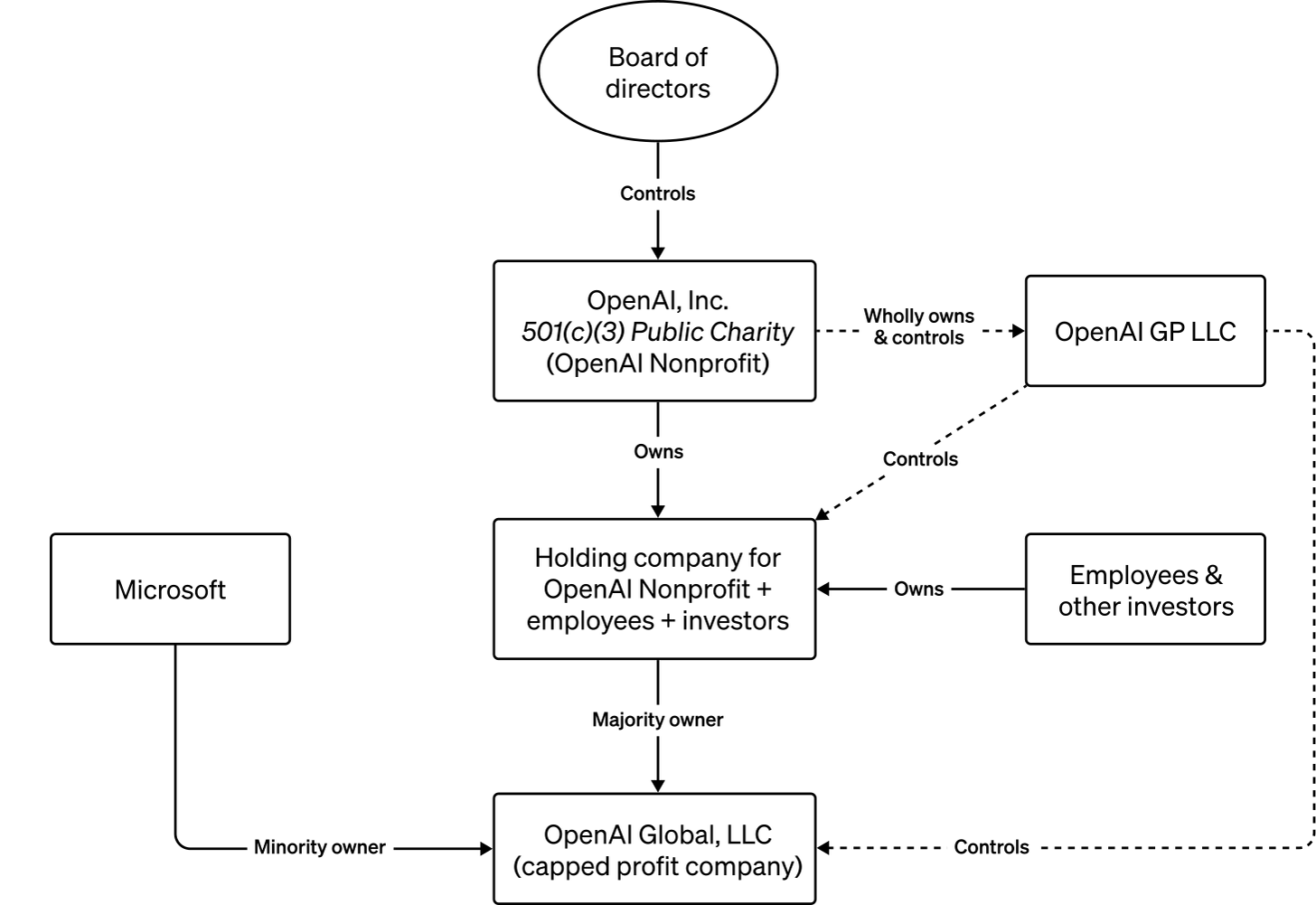 La non poco complessa struttura di governance di OpenAI. Il focus deve essere sul “Board of Directors” in alto e su "OpenAI Global” in basso
------------------------------------------------------------------------
Il caos-caso Altman degli ultimi giorni si origina, probabilmente, qui. Progressivamente, infatti, all’interno della società si sviluppano due fazioni:
1. Una estremamente preoccupata per l’evoluzione dell’IA, e che la vuole sviluppare con cautela per evitare che distrugga l’umanità (no, non è una battuta); qui ci stanno soprattutto i rappresentanti del “Board of Directors” che hanno fatto fuori Altman;
2. Una che considera l’IA uno strumento trasformativo, capace di aprire una nuova era di prosperità, e quindi più orientata al profitto; e qui c’è in prima fila Altman, che ha tentato (ed è riuscito) di trasformare OpenAI in una tech company come le altre;
E l’equilibrio tra le due non era affatto facile. Soprattutto nell’ultimo anno, quando ChatGPT guadagna una popolarità incredibile e gli investimenti si moltiplicano, l’appetito per una crescita repentina mette a dura prova il tentativo di rallentare l’IA per ragioni di sicurezza.
------------------------------------------------------------------------
Date queste premesse, l’evoluzione della vicenda Altman e le implicazioni per il futuro si fanno particolarmente interessanti. Con una idea, essenziale, da tenere in mente: benché si tratti di una società privata, le dinamiche interne ad OpenAI ci riguardano e, soprattutto, riguardano come i governi cercheranno di regolamentare l’IA.
Per questo, oggi Artifacts vedrà come è cambiata OpenAI, ma soprattutto perché il futuro prossimo conta più di quello remoto, perché è ancora meno “Open” di prima e cosa, invece, dovrebbe essere più “open”.
> ### Il Titolo
In OpenAI non è solo tornato Sam Altman, ma è cambiato quasi tutto il Board of Directors, ossia gli stessi che avevano cacciato Altman.
Senza avventurarci nei nomi, il risultato chiave è: ha vinto il Team Capitalismo, ha perso il Team Leviatano. O meglio, ha vinto il Team di chi vuole sviluppare l’IA per ragioni di profitto e ha perso il Team di quelli fortemente preoccupati dello sviluppo dell’IA e dei rischi per l’umanità.
Attenzione, però: non ci sono buoni o cattivi.
Da un lato, molti del board appartenevano al “lungotermismo”, una “filosofia” controversa che mira a massimizzare i benefici del genere umano nel lungo periodo, e per tale fine, pronta a giustificare qualsiasi “sfruttamento, manipolazione e trasformazione della natura in nome di un presunto e lontanissimo avvenire utopico”. Insomma, attenti ai rischi dell’IA, ma sempre in un futuro molto remoto più che nell’oggi. Conta diversi esponenti di valore nelle sue fila, ma sta anche ricevendo notevoli critiche, come quella del prof. Ghani, per il quale questo schiacciamento sul futuro “distrae totalmente dai rischi reali e concreti che si stanno verificando ora”.
Dall’altro, quelli del nuovo board sembrano essere più trasparenti: sviluppare l’IA per fare profitto e accelerare ulteriormente. Tuttavia, ancora è poco chiara la direzione ed esiste un elemento non di poco conto: ad oggi, nessuna donna fa parte del board. Cosa che, se stai costruendo una tecnologia trasformativa per il genere umano, non può non far storcere il naso.
------------------------------------------------------------------------
Chi, indubbiamente, da questa vicenda esce vincitore è Satya Nadella, CEO di Microsoft, che ha fatto di tutto per far riassumere Altman in OpenAI, persino assumerlo in Microsoft per qualche ora.
La ragione? Basta guardare questo grafico
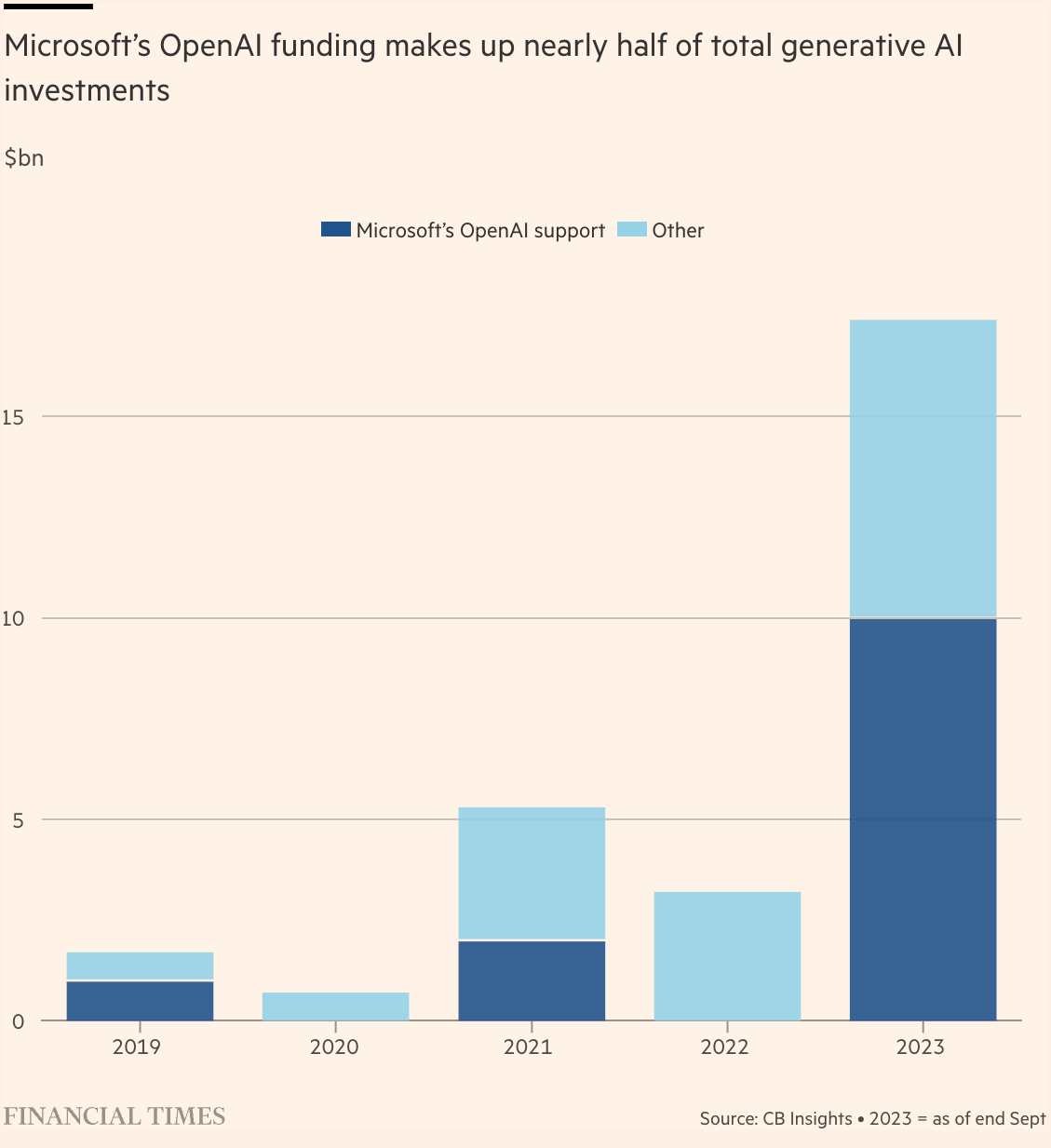 Microsoft bets big on OpenAI: oltre metà di tutti gli investimenti nel settore Generative AI dell’ultimo anno sono soldi che Microsoft ha dato all’azienda di Altman. Tra le due c’è un rapporto di dipendenza assoluta: senza i soldi di Microsoft, OpenAI non potrebbe fare tutto quello che fa, ma Microsoft senza OpenAI vedrebbe saltare in aria i suoi tool di IA, che sono 100% abilitati da OpenAI. Insomma, anche qui, follow the money.
Tra l’altro, non si esclude che Microsoft ora possa avere un posto nel Board, sempre non-profit, che controlla OpenAI. D’altronde, immaginate investire 13 miliardi in un’azienda e non poter dire una parola su come viene gestita.
Tuttavia, una conseguenza è lampante: un’altra volta, lo sviluppo della tecnologia gravita attorno agli stessi giganti. Se l’IA può sembrare portata avanti da delle start-up, alla fine dei conti tutte dipendono dalle risorse e dai mezzi delle BigTech, con un mercato sempre molto concentrato. Che - sia chiaro - non è un bene o un male, ma un elemento da non ignorare.
------------------------------------------------------------------------
Ma soprattutto, alzando lo sguardo da OpenAI, questa settimana rende chiaro che una manciata di persone in Silicon Valley ha il potere di decidere il futuro della tecnologia e, in questo caso, dell’IA. E, se davvero l’IA, come sostiene anche Sam Altman ha bisogno urgente di regolamentazione, questo scenario non è dei migliori.
Il nocciolo della questione, insomma, non è se un giorno l’IA arriverà a comandarci. Scenario che, a onor del vero, è inverosimile secondo molti. Piuttosto, è che oggi, e non in futuro, un potere enorme sull’IA è esercitato da pochi con conseguenze su tutti. Dinamica già vista, ma particolarmente pericolosa se davvero l’IA porta tutti i rischi descritti dagli stessi che hanno potere su di essa.
Una dimensione essenziale, allora, è quella temporale. A chi ha potere sull’IA conviene descrivere scenari futuri apocalittici per posizionarsi, de facto, come salvatore dell’umanità. Ma l’urgenza è qui ed oggi, con dei rischi (e delle opportunità, ovviamente), come l’impatto sul lavoro o sulla formazione - non l’estinzione dell’umanità - che sono già concreti.
E, di conseguenza, che molte delle conversazioni sull’IA avvengano a porte chiuse, e scatenino terremoti come quello di Altman senza grande trasparenza, è ciò che dovrebbe preoccuparci maggiormente.
Soprattutto, dovrebbe preoccupare le istituzioni che cercano di mettere delle regole all’IA. Al di là di OpenAI, quello che serve è la capacità “to open AI”, ossia di ascoltare e capire chi guida l’innovazione, come le aziende della Silicon Valley, ma non lasciare che siano loro, a porte chiuse, a decidere come deve procedere questa storia dell’Intelligenza Artificiale.
Ci sono tante, molte altre, voci da ascoltare e, soprattutto, la necessità che le dinamiche di profitto e mercato, essenziali perché ci sia innovazione (!), siano bilanciate e frenate da uno sviluppo sicuro. Non ce l’ha fatta, pare, la complessa struttura di governance di OpenAI, ma possono farcela i governments.
Lascia un commento
> ### Rassegna (Stampa)
AI Act, ancora, non nel suo momento migliore. Continuano le negoziazioni. Un appello, interessante, di alcuni esperti.
Ma l’Europa cosa impara da questa storia di OpenAI?
Ricordi la storia dei social a pagamento? Noyb attacca Meta sul GDPR
13 e 14 dicembre l’Italia vota online, ma per spendere dei soldi che andavano spesi.
Ho scritto il paper “Artificial intelligence: Europe needs to start dreaming again”. Se non per il testo, da aprire per vedere meglio la copertina cla-mo-ro-sa creata con l’AI!
 > ### Lo Scaffale
 A proposito di governance e governments, “The Digital Republic” di Jamie Susskind è uno dei must-read su come governare la tecnologia ma anche su come usarla per governare. Ok, è un mattone, ma scorre. Giuro.
> ### Nerding
 Immagina una vetrina della tua vita digitale con i tuoi social, la tua newsletter, il tuo YouTube, i tuoi podcast e le tue foto. Una sorta di biglietto da visita del te online. Ecco, Bento ti permette di farlo con una User Interface semplice ma stra-intuitiva. In settimana faccio la mia Bento Box anche io ;)
P.S. Lo avevo in lista ma lo avevo dimenticato, è qui grazie a Giovanni Pernazza, amico e lettore di Artifacts :)
======
# Finire dalle fondamenta
Date: 2023-11-22 | Language: it
Canonical: https://artifactstech.substack.com/p/finire-dalle-fondamenta
Cite as: Finire dalle fondamenta by Lorenzo Ancona, Artifacts, 2023-11-22. https://artifactstech.substack.com/p/finire-dalle-fondamenta (CC BY 4.0)
Immagino sia plausibile che tu abbia sentito parlare dell’**AI Act**, il regolamento in discussione in UE per **stabilire delle norme sull’Intelligenza Artificiale.**
Dunque - detta come non la dovresti dire a un colloquio - l’AI Act è un regolamento di **“product safety”,** ossia mira a far sì che i prodotti di IA messi sul mercato siano sicuri. Come lo fa? Con un **risk-based approach,** esemplificato da **questa piramide,** pubblicata ad aprile 2021 (una vita fa!)**:**
[](https://substackcdn.com/image/fetch/$s_!5U8B!,f_auto,q_auto:good,fl_progressive:steep/https%3A%2F%2Fsubstack-post-media.s3.amazonaws.com%2Fpublic%2Fimages%2Fa4807c9c-1fb5-4427-8ae2-7536c66e6bf7_794x431.png)
Il criterio è abbastanza semplice: **invece di regolamentare le tecnologie in sè, l’UE ha stabilito 4 livelli di rischio**, secondo i quali sono poi classificate le tecnologie di IA. **Brando Benifei,** europarlamentare co-rapporteur dell’AI Act, mi ha recentemente spiegato che **“questo è il modo migliore per rendere l’AI Act a prova di futuro”.**[1](https://artifactstech.substack.com/p/finire-dalle-fondamenta#footnote-1)
Ed ha effettivamente funzionato. A parte una piccola, ma enorme, eccezione: **ChatGPT**. Sì, non è uno scherzo: **l’AI Act non aveva previsto non solo ChatGPT, ma tutti i sistemi simili.**
------------------------------------------------------------------------
Ma procediamo con calma. Dunque, non è proprio ChatGPT in sé a non essere stato previsto, ma GPT 3 o 4, ossia il **foundation model (FM)** che, come dice il nome, ne è alla base.
**Pausa tecnica:** per “foundation model” si intendono **“dei modelli di machine learning addestrati su grandi quantità di dati che possono essere adattati a un'ampia gamma di compiti”.**
**In italiano:** sistemi che hanno tantissimi dati e che **sono dei tuttofare:** possono scrivere una filastrocca per la mamma, correggerti i compiti di spagnolo, scrivere la lettera più cattiva che tu possa concepire, creare una fake news perfetta, programmare un virus, e molto altro.
**Ecco, proprio questa pluralità di task che ChatGPT, grazie a GPT, o altri chatbot, grazie ad altri FMs, hanno creato non pochi problemi a Bruxelles.**
Se, infatti, l’AI Act si basa sull’idea che ogni applicazione di IA possa essere assegnata a una categoria di rischio in base all'uso previsto, **con i FMs diventa impossibile fare ciò perché non esiste UN uso previsto, ma ce ne sono tantissimi e di difficile predizione.**
------------------------------------------------------------------------
E quindi, ancor prima di vedere la luce, l’AI Act incontra una difficoltà non da poco. **Che è sia tecnica che politica**, perché coinvolge non solo gli esperti di regolamentazione, ma **anche chi sviluppa foundation models e gli stati europei, tra cui l’Italia.** Tutti, disperatamente, alla ricerca di regole perché l’AI Act possa essere approvato.
**Di questa specifica questione dei FMs nell’AI Act, senza dilungarci, ne parla Artifacts.**
> ### Il Titolo
Diversamente dal solito, **partiamo dalla questione politica**, che si sta svolgendo proprio in queste ore prima dei triloghi sull’AI Act.
Semplificando, le posizioni vedono:
- **Parlamento UE,** che vuole promuovere il cosiddetto ‘tiered approach’, ossia classificare i FMs secondo vari criteri - **e su quali siano questi si sta giocando la questione** - e assegnare quindi poi livelli di regolamentazione diversi;
- **Il Consiglio Europeo,** ma soprattutto la cordata Germania - Francia - Italia, che invece vuole un approccio decisamente mooooolto di *laissez-faire;*
- **La Presidenza del Consiglio dell’UE** (che non è quello di sopra), ossia la Spagna, che sta cercando di mediare per chiudere l’AI Act. **Cosa decisamente prioritaria** perché il rischio è che possa poi essere rimandato a dopo le elezioni del Parlamento a giugno ‘24.
------------------------------------------------------------------------
**Presto per dire come andrà a finire.** Ad oggi, [Euractiv](https://www.euractiv.com/section/artificial-intelligence/news/spanish-eu-presidency-prepares-to-wrap-up-technical-work-on-ai-law/) riporta che sono in corso trattative per far sì che si trovi un compromesso.
Indubbiamente, è interessante fare luce sullo strappo di Germania - Francia - Italia, che non nasce certo dal nulla. **Al centro ci sono gli interessi nazionali e delle start-up che provano a sgomitare perché, per una volta, l’UE non resti indietro sull’innovazione.** Nello specifico, **Mistral AI** per la Francia e **Aleph Alpha** per la Germania. **Per l’Italia, ahimè, è mero calcolo politico** e al momento non ci sono grosse novità sul fronte innovazione.
In ogni caso, **la loro volontà è decisamente eccessiva:** il documento circolato nel weekend mirava a escludere una regolamentazione obbligatoria per i FMs e, invece, ad una non ben precisata **“mandatory self-regulation”,** che sembra, quantomeno, una contraddizione in termini. **Ed altre critiche interessanti**, di cui ha parlato [Philippe Hacker.](https://www.linkedin.com/posts/philipp-hacker-078940257_critical-comments-on-the-ai-act-found-model-ugcPost-7132016317053689856-p0bx/) Addirittura, Yoshua Bengio, computer scientist canadese, [ha detto a Politico](https://www.politico.eu/article/france-germany-power-grab-kill-eu-blockbuster-ai-artificial-intelligence-bill/) che una soluzione simile sarebbe **“folle”** e porterebbe ad un AI Act simile alla **“legge della giungla”.**
Come si evince dal grafico, il modello immaginato sarebbe carente su diversi aspetti, [sostiene il Future of Life Institute.](https://futureoflife.org/ai-policy/miles-apart/) Al contrario, **le altre soluzioni pensate in UE sembrano più ragionevoli in termini di efficacia.**
[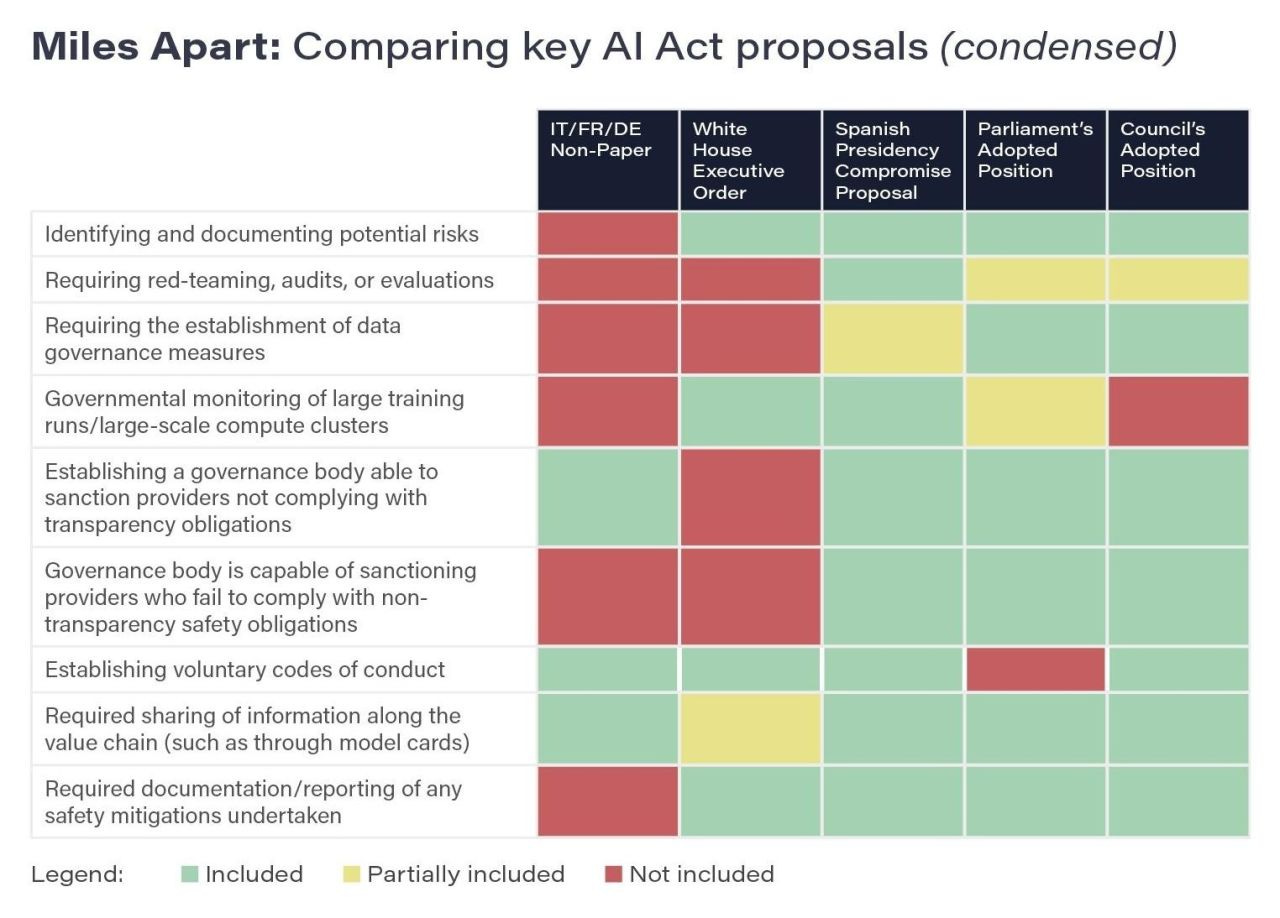](https://substackcdn.com/image/fetch/$s_!CxJj!,f_auto,q_auto:good,fl_progressive:steep/https%3A%2F%2Fsubstack-post-media.s3.amazonaws.com%2Fpublic%2Fimages%2Fbfd71abb-00e0-422f-9d3a-222e872155bb_1280x918.jpeg)
------------------------------------------------------------------------
Andando oltre le questioni politiche, comunque, **la complessità di regolamentare i FMs è sui criteri da utilizzare**, non tanto sul modello.
**Che si debba adottare un “tiered approach”, ossia su più livelli, è ampiamente approvato**, oltre che dalla Presidenza spagnola del Consiglio, anche dall’executive order di Biden o dalla community open-source. **Più problematiche sorgono sui criteri che vanno utilizzati per creare questi livelli differenti.**
[](https://substackcdn.com/image/fetch/$s_!bIjp!,f_auto,q_auto:good,fl_progressive:steep/https%3A%2F%2Fsubstack-post-media.s3.amazonaws.com%2Fpublic%2Fimages%2F63ebbd0e-71c0-43c0-8ad5-9e48c2d57fd8_745x739.png)
Un po’ la complessità, un po’ i diversi tier. *Creato con DALL-E*
Si tratta di una questione estremamente tecnica, che non è possibile approfondire su Artifacts, ma un elemento dovrebbe essere chiaro: **serve partire dagli utilizzi di questi FMs.** Che significa? Come suggerisce [Rishi Bommassani](https://crfm.stanford.edu/2023/11/18/tiers.html), dello Stanford Centre for Research of Foundation Models, per l’UE **la soluzione ideale sarebbe quella di provare a misurare l’impatto di questi modelli attraverso la loro diffusione**. Semplificando, che chi sviluppa un **sistema** basato su un **foundation model** sia tenuto a registrarlo, e che quindi poi **i modelli, e non i sistemi, siano classificati in questi diversi livelli di tiered approach di conseguenza.** Insomma, alla domanda “quanto è rischioso GPT-4?” si dovrebbe rispondere valutando quanto sia vastamente utilizzato.
Approccio che ha dei meriti e che, per quanto comunque approssimativo, riflette un punto essenziale sui FMs: **se non possiamo stabilirne i rischi a priori, possiamo provare a valutarne gli usi concreti.**
Vedremo come andranno le cose in UE con l’AI Act: sono giornate calde.
[Lascia un commento](https://artifactstech.substack.com/p/finire-dalle-fondamenta/comments)
> ### Rassegna (Stampa)
**In 5 giorni Sam Altman è stato:** (1) licenziato da CEO di OpenAI, (2) assunto da Microsoft per un nuovo team su AI, (3) riassunto da OpenAI come CEO. Tralasciando la cronaca, [un bel commento sulla vicenda.](https://www.nytimes.com/2023/11/21/opinion/the-sam-altman-openai-board-microsoft.html)
Semplificato, **come funziona un LLM:**
[\[Embedded media — view original\]](https://www.youtube-nocookie.com/embed/f1fXCRtSUWU?rel=0&autoplay=0&showinfo=0&enablejsapi=0)
**L’UNESCO** ci guida all’uso dell’I[A Generativa per educazione e ricerca.](https://unesdoc.unesco.org/ark:/48223/pf0000386693)
Il Garante Privacy [apre una indagine](https://www.wired.it/article/intelligenza-artificiale-dati-personali-garante-privacy-indagine-webscraping/) sulla **raccolta dei dati per il training di IA.**
> ### Lo Scaffale
[](https://substackcdn.com/image/fetch/$s_!qE0x!,f_auto,q_auto:good,fl_progressive:steep/https%3A%2F%2Fsubstack-post-media.s3.amazonaws.com%2Fpublic%2Fimages%2F972b4f91-8da6-4d16-95ca-8ee83cc8810d_1080x1080.png)
Visto che qua finiamo sempre a parlare dell’UE, **[“Il codice del futuro”](https://ecommerce.ilsole24ore.com/shopping24/il-codice-del-futuro.html)** [](https://ecommerce.ilsole24ore.com/shopping24/il-codice-del-futuro.html) è un ottimo libro che spiega un po’ della storia, dell’ispirazione e dell’avvenire di **come stiamo provando a regolamentare la tecnologia**. **Roberto Viola**, tra l’altro, nientepopodimenoche Direttore Generale per le politiche digitali della Commissione europea.
> ### Nerding
[](https://substackcdn.com/image/fetch/$s_!pA3A!,f_auto,q_auto:good,fl_progressive:steep/https%3A%2F%2Fsubstack-post-media.s3.amazonaws.com%2Fpublic%2Fimages%2F8d978ae1-f9a7-4ce4-9cbf-d0f21bbae6c4_1080x1080.png)
**Immagina un ChatGPT per la musica.** Vero, ne avevo suggerito uno simile, ma **[Suno](https://www.suno.ai/)** fa dei pezzi veramente atomici e ti permette a tutti gli effetti di chattare con il tool di creazione della musica.
[1](https://artifactstech.substack.com/p/finire-dalle-fondamenta#footnote-anchor-1)
\[Ci ho parlato per un altro progetto, non Artifacts, ma credo che riutilizzare le sue parole sia classificato come minimal risk :) \]
======
# Sì, ora bisogna fare una scelta
Date: 2023-11-14 | Language: it
Canonical: https://artifactstech.substack.com/p/si-ora-bisogna-fare-una-scelta
Cite as: Sì, ora bisogna fare una scelta by Lorenzo Ancona, Artifacts, 2023-11-14. https://artifactstech.substack.com/p/si-ora-bisogna-fare-una-scelta (CC BY 4.0)
Immagino che anche a te sia comparso un messaggio come quello qui sotto nei scorsi giorni.
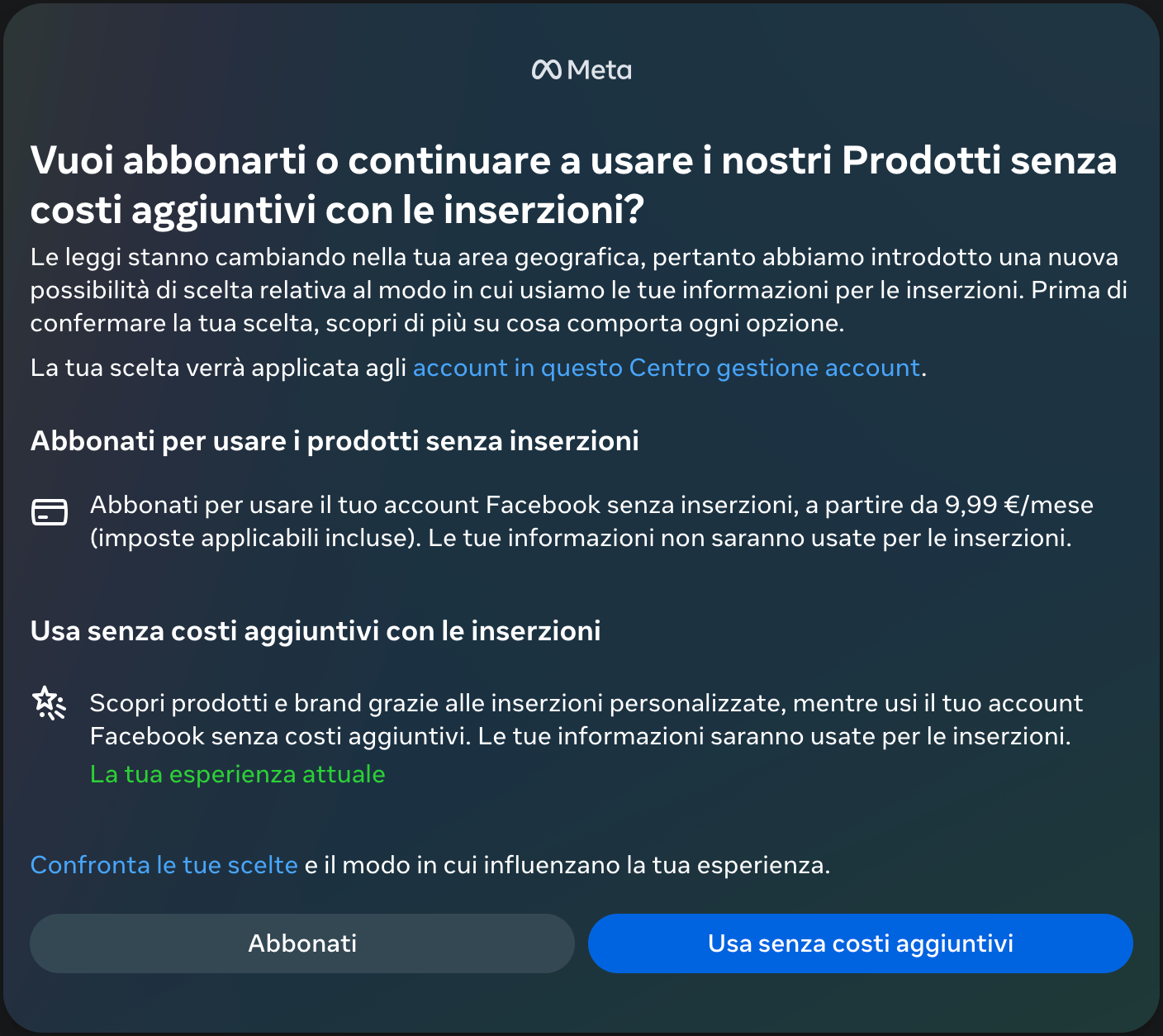 Si è confermato quello che era stato anticipato dal WSJ e di cui avevamo parlato in Artifacts diverse settimane fa: Meta ha ufficializzato che offrirà una versione a pagamento e priva di pubblicità di Facebook e Instagram agli utenti che non vogliono acconsentire all'uso dei loro dati. Se gli utenti acconsentono, invece, continuerà a essere disponibile una versione gratuita supportata da pubblicità.
In altre parole, Meta offre un'offerta a pagamento senza profilazione e una gratis con consenso alla profilazione, simile a un paywall.
------------------------------------------------------------------------
Però, prima di andare in profondità, è interessante vedere il design di questo pop-up. Gli elementi che mi hanno colpito, dall’alto verso il basso, sono:
- “Le leggi stanno cambiando nella tua area geografica”, che sì, è vero che stanno cambiando, ma, come avevamo visto nell’altra Artifacts, il regolamento che porta Meta a questa decisione è il GDPR, che è valido dal 2016. Non proprio l’altroieri;
- le icone accanto alle due scelte: una austera carta di credito, direi abbastanza auto-esplicativa, per l’opzione che NON profila gli utenti, mentre una non definita stellina volante per l’opzione gratis e con profilazione;
- “la tua esperienza attuale” scritto in verde, che nell’UX design è solitamente il colore della positività o della cosa giusta. Aggiungiamoci che è la situazione che già abbiamo e la generale riluttanza al cambiamento, specie se questo comporta un pagamento;
- la cosa più importante, poi, i pulsanti in fondo: più evidente e in blu, quindi più cliccabile, quello per continuare a usare Facebook e Instagram con la profilazione; in grigio, meno attraente, quello per pagare e interrompere la profilazione;
- ma guarda anche come viene espresso il concetto di gratuità: quando NON paghi c’è scritto “senza costi aggiuntivi”, e quindi facile, com’è ora; la cosa si ripete sia in inglese, dov’è “I want to use it for free”, e in francese, dove c’è scritto “gratuitement”. Il far fare la scelta sui soldi, ossia sul “paga o gratis”, non è indifferente, secondo me;
- elemento bonus: che questo pop-up esce, a caso, una delle varie volte che apriamo un social e non viene, invece, mandata ad esempio una mail. Mi ha fatto pensare che forse Meta vuole sbrigare velocemente la faccenda.
Forse, anche guardando a questi elementi, possiamo capire quale scelta Meta vorrebbe che sia preferita da parte degli utenti. Insomma, in una certa maniera, anche i pop up, oltre agli artefatti, “do have politics” :)
------------------------------------------------------------------------
Comunque questa di design è chiaramente solo parte della questione. Molto di più c’è da dire sulle implicazioni e il futuro di questa opzione. L’Artifacts di oggi si lega a quella a quella del 10 ottobre, dove avevamo visto perché Meta sarebbe potuta arrivare a questa situazione. E approfondisce, invece, alcune riflessioni iniziali che questo pop-up fa scaturire, se esista davvero il consenso previsto dal GDPR, se questi 13 euro siano appropriati e quali siano i prossimi passi.
 Quello che succede nel prendere questa scelta. Creato con DALL-E
> ### Il Titolo
In breve, quindi, queste sono le 3 scelte che abbiamo:
1. pagare 13 euro/mese per la versione ads-free se non vogliamo dare il consenso alla nostra profilazione;
2. usare gratis la versione con gli ads se vogliamo dare il consenso alla profilazione;
3. trovare un’alternativa ai servizi di Meta se non vogliamo né pagare né dare il consenso. Cosa che, immagino, sia in realtà la scelta ideale della maggior parte delle persone.
La situazione è spiegata bene da Meta così:
 Ora che questa scelta è realtà, comunque, le domande che il 10 ottobre avevamo solo ipotizzato, sono realtà. Vediamone insieme 3.
------------------------------------------------------------------------
Il consenso alla nostra profilazione che diamo optando per la versione gratis è davvero reale, libero e non influenzato, come prescrive il GDPR? In altre parole, pagare 155 euro l’anno per usare i social è un’alternativa accettabile o, quantomeno, plausibile?
I dati sembrano dirci di no: del 42% degli utenti a cui non piace il targeted advertising, solo il 7% pagherebbe 5 euro al mese per non averlo, secondo questo recente studio di Akman. Vista così, è difficile percepire la versione a pagamento come un’alternativa plausibile per non essere profilati.
Più che consenso alla profilazione, allora, quello degli utenti è più il risultato della volontà di non pagare.
------------------------------------------------------------------------
Abbandonare questi servizi è una scelta indolore? C’è chi - l’ho letto in giro - dice “Guarda che non usarli è gratis”. Che è vero, assolutamente e per carità, ma esistono due obiezioni ragionevoli a questa linea di pensiero:
1. possibile che, dato che non voglio pagare e nemmeno essere profilato, allora devo necessariamente abbandonare quesi social?
2. più pragmaticamente, molti li usano magari per lavoro o simili, e in realtà non usarli porta delle perdite, e non è quindi gratis.
In più, va anche detto che abbandonare Instagram o Facebook, non significa semplicemente spegnere un account, ma anche lasciare i contenuti che abbiamo postato, community/amici costruiti nel tempo, e magari doversi ricostruire una esperienza social altrove. Insomma, gli switching costs di cui abbiamo parlato la scorsa settimana.
Da questo scenario, allora, è chiaro che, “puoi decidere di abbandonare i servizi”, come dice Meta. Ma a che costo? Davvero la possiamo considerare una terza via valicabile? Lo è, ma viene con dei costi, che sono creati dalla stessa struttura decisa da Meta per i suoi social, ossia una chiusa e con switching costs elevati.
------------------------------------------------------------------------
Come si giustifica il prezzo di 13 euro al mese? In realtà, comunque, sono 10 euro, ma in app diventano 13 per le commissioni di Apple e Android sugli acquisti fatti tramite i loro store. In ogni caso, 10 o 13, come si arriva a questa cifra?
Se guardiamo al grafico qua sotto, la domanda è ancora più problematica.
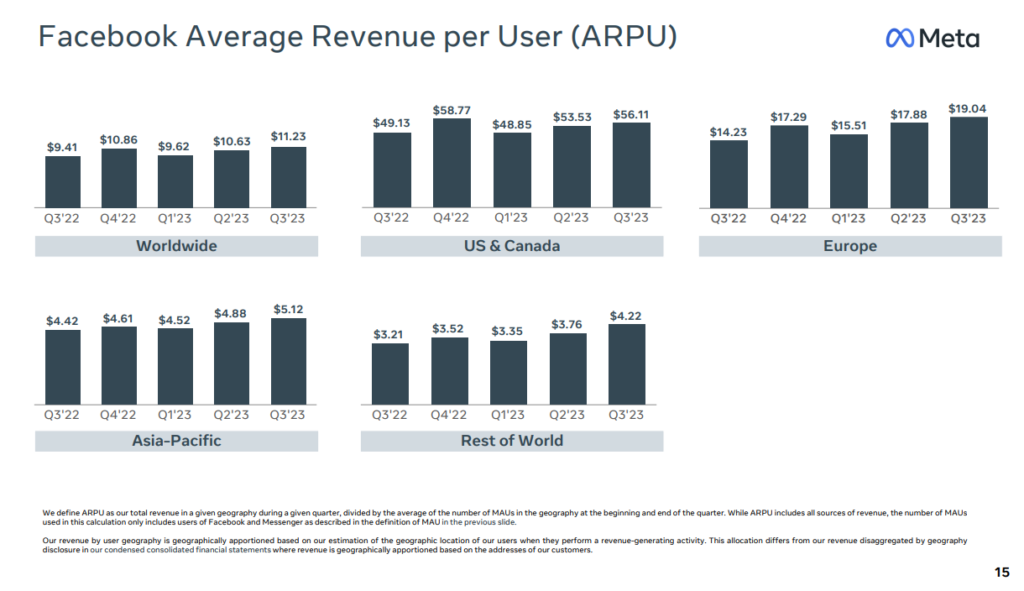 In Europa, mediamente, Meta guadagnava 15 euro per utente ogni trimeste. Dunque, che con questo modello possa guadagnare 30 euro per trimestre da ogni utente sembra irragionevole. O, almeno, è forse difficile da spiegare come “tariffa appropriata”, che è come l’aveva messa la Corte UE nella sentenza che ha fatto nascere tutta questa vicenda.
------------------------------------------------------------------------
Su queste domande è verosimile che si interrogherà la Commissione UE per capire se davvero gli utenti siano liberi in questa scelta o se, invece, esistano una serie di vincoli non trascurabili. Soprattutto alla luce dell’articolo 13.6 del DMA, che prevede il divieto di limitare l’autonomia o mettere a repentaglio le scelte degli utenti attraverso la struttura, il design, o il funzionamento delle interfacce.
Per concludere con una provocazione, fa riflettere che Meta stia offrendo, a pagamento, la cura a un male che ha creato lei stessa per offrire i suoi servizi gratuitamente. Concetto espresso dal grande Valerio Bassan nella sua Ellissi. In teoria, infatti, basterebbe cominciare a offrire della pubblicità non targetizzata, ma generale. Tipo quella delle televisioni.
Ma è una provocazione, poi magari la approfondiremo. Per oggi, ok così!
Lascia un commento
> ### Rassegna (Stampa)
Guarda che bella l’ultima copertina del New Yorker. La spiegazione è pure meglio.
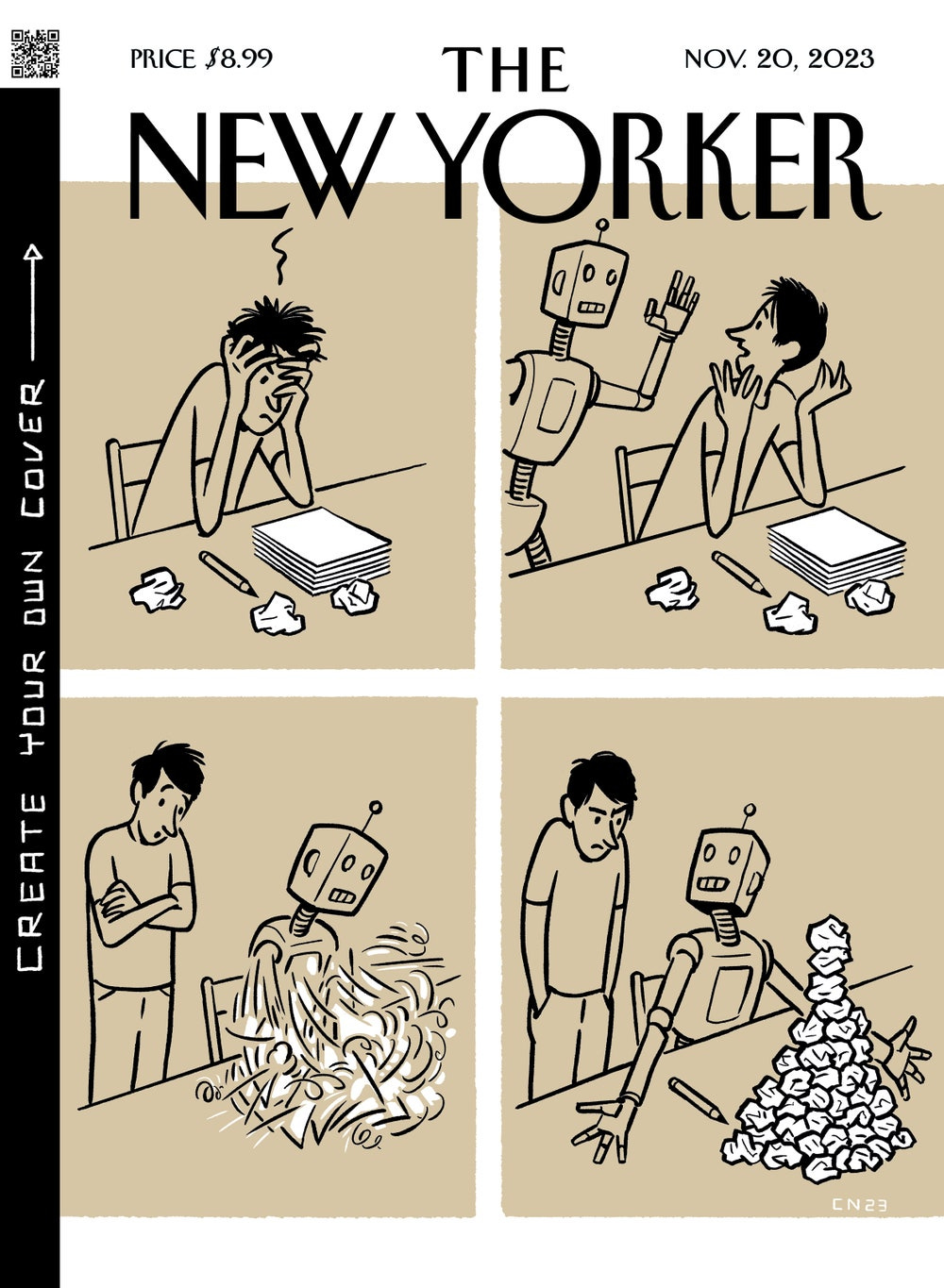 OECD ha dato una nuova definizione di Intelligenza Artificiale! Forse, però, trascura un po’ l’elemento umano in essa.
Nel frattempo, l’AI Act sembra essere in stallo, e questa è una cosa abbastanza pericolosa.
Questi qua, ex Apple, hanno presentato quello che dovrebbe essere il futuro degli smartphone: non avere uno smartphone.
> ### Lo Scaffale
 “La tecnologia ci consente una realtà, una sua rappresentazione, in cui il nostro corpo può essere in un luogo e la sostanza immateriale, attenzione compresa, in un altro.” Se è bastata questa frase a intrigarti, ok. Altrimenti, comunque, “La tecnologia è religione” di Chiara Valerio è una bella riflessione su noi, la tecnologia e come stiamo cambiando con essa.
> ### Nerding
 Nasce come tool per i giornalisti, ma in realtà è utile a tutti quelli, come me, che leggono, prendono appunti, e poi si scordano da dove hanno preso quegli appunti. Con Google Pinpoint puoi salvare tutti i docs che ti servono per una ricerca nello stesso posto, e poi cercare concetti/parole/qualsiasi cosa semplicemente digitando. Nice to have.
P.S. Ammetto che l’ho scoperto grazie al grande Federico Romeo, amico e lettore di Artifacts.
======
# Se Internet non è più di nessuno
Date: 2023-11-07 | Language: en
Canonical: https://artifactstech.substack.com/p/se-internet-non-e-piu-di-nessuno
Cite as: Se Internet non è più di nessuno by Lorenzo Ancona, Artifacts, 2023-11-07. https://artifactstech.substack.com/p/se-internet-non-e-piu-di-nessuno (CC BY 4.0)
Immagina di non avere più Instagram, Facebook, TikTok e gli altri, **ma di poter comunque condividere quella foto della vacanza su dei social, altri, più tuoi.** Ma immagina anche di poter non usare Whatsapp **e poter continuare a stare in quel gruppo con i tuoi amici.**
No, non sto cercando sviluppatori di un nuovo social - anche perché in nessun modo avrebbe successo - né arringando per un nuovo Digital Detox.
Eppure, se quanto scritto sopra ti sembra impossibile, beh, **non lo è.**
[](https://substackcdn.com/image/fetch/$s_!7huw!,f_auto,q_auto:good,fl_progressive:steep/https%3A%2F%2Fsubstack-post-media.s3.amazonaws.com%2Fpublic%2Fimages%2Fa83ed39f-2dbe-4d1d-9912-47b0d1759a3f_1024x1024.jpeg)
Un muro che si rompe. *Creato con DALL-E*
Si tratta, piuttosto, di uno scenario di **decentralizzazione dei social network,** ossia di separare completamente l’interfaccia, l’applicazione, un social network specifico, dai dati, che siano foto, video, o testi. Con l’idea che i social non siano dei compartimenti stagni, ma **che possano comunicare tra loro.** O meglio, che ci sia **interoperabilità.**
Questo significherebbe **due cose essenziali:**
1. **non ricominciare da zero ogni volta che ci si iscrive a un nuovo social**, ma portarsi dietro il proprio “bagaglio” di seguiti e seguaci;
2. che, soprattutto, i contenuti che postiamo su Instagram - per dirne uno - non sono parte di Instagram, ma di Internet at-large; **e, in definitiva, che siano nostri e non di un’app.**
Complicato? Un po’ forse. **Questa, che spieghiamo dopo, aiuta:**
[](https://substackcdn.com/image/fetch/$s_!iV6S!,f_auto,q_auto:good,fl_progressive:steep/https%3A%2F%2Fsubstack-post-media.s3.amazonaws.com%2Fpublic%2Fimages%2F19b94a38-398d-4830-8b52-34e423ce0feb_320x320.jpeg)
------------------------------------------------------------------------
Eppure, per quanto innovativo possa sembrare questo concetto di interoperabilità, è importante sapere che **è, in realtà, alla base di Internet.**
Come spiega il prof. Quintarelli, la Rete si basa su 2 principi:
1. **standardizazzione:** esistono degli standard per, ad esempio, sviluppare un sito, e, se rispettati, permettono di farlo funzionare e lo rendono accessibile e funzionante;
2. **modularità:** un servizio “grande”, come lo scambio di email, è composto da dei server, da domini mail, da applicazioni per leggere la posta, etc. che non devono appartenere alla stessa società, ma che semplicemente comunicano tra loro (grazie agli standard).
**Su questi presupposti è nata Internet**, che, infatti, non è di nessuno, ma è decentralizzata. Lo stesso dicasi per le mail che sono ben diverse da uno scambio di messaggi su, ad esempio, Telegram.
**E su questi presupposti sono nati anche i social network**, come Facebook e gli altri. Che, tra l’altro, all’inizio permettevano agli utenti di altre app di sfruttare i loro benefici. **Poi, però, dopo aver sfruttato i vantaggi di questa apertura iniziale, i social si sono “chiusi”**, diventando sempre più dei “walled garden” da cui - lo sappiamo - è davvero difficile uscire e, anzi, spesso l’impressione è quella di essere bloccati dentro.
Tutto questo, però, **è la negazione del principio originario di una rete interoperabile e senza barriere.**
------------------------------------------------------------------------
Cosa fare, allora? Distruggere i social network? **No, farli funzionare meglio.**
Come? **Federandoli,** che forse è il verbo più brutto che io abbia mai scritto, ma che riprende il concetto di **[“Fediverse”,](https://en.wikipedia.org/wiki/Fediverse)** l’unione tra “federation” e “universe”. Ossia, la realtà in cui **social diversi, magari con proprietà diverse, possono connettersi tra loro per creare uno spazio social comune.** E, quindi, non necessariamente dei nuovi social, **ma semplicemente dei social che comunicano tra loro.** Dei social che non siano dei giardini recintati, ma collegati da strade e sentieri.
Quindi facendo sì che, **pur non avendo TikTok,** ma essendo connessi con un nostro amico che pubblica un video, **possiamo comunque vederlo in questo spazio federato digitale.**
**Ed è qualcosa che già esiste.** È il caso di vari protocolli che permettono la decentralizzazione, tipo [ActivityPub](https://www.theverge.com/2023/4/20/23689570/activitypub-protocol-standard-social-network), [Bridgy](https://brid.gy/about), [POSSE](https://indieweb.org/POSSE) (quello dello sketch di prima). **E ai quali i social di oggi, quelli che tutti usiamo, possono adeguarsi (!).**
------------------------------------------------------------------------
Comunque, **non certo una questione facile.** Sia il perché mai abbiamo bisogno di social network decentralizzati, che come fare a realizzarli tecnicamente, e anche chi dovrebbe occuparsene.
Per questo, oggi Artifacts vede **perché la decentralizzazione è amica della competitività nel mercato digitale**, **quali sono le problematiche e le opportunità, ma anche i rischi, e perché l’interoperabilità la conoscono bene anche a Bruxelles.**
> ### Il Titolo
Partiamo dai problemi. **Cosa definisce i social attuali e ostacola l’interoperabilità?**
Semplificando, possiamo identificare **2 elementi:**
- **network effects:** più amici abbiamo su un certo social e più saremo spinti a iscriverci e, soprattutto, a restarci;
- **switching costs:** lasciare un social per iscriversi a un altro è ormai difficilissimo. Vorremmo portarci dietro gli amici, i post che abbiamo fatto, i follower che abbiamo. E, quindi, siamo locked-in.
Cory Doctorow, con efficacia, spiega: ***“Network effects are merely how Big Tech gets big. Switching costs are how Big Tech stays big.”***
E questa condizione ha delle conseguenze, come:
- **soffoca l’innovazione:** date le circostanze, provare a lanciare un nuovo social è davvero difficile. **Per quanto buono possa essere, il problema principale è che gli utenti stanno** - giustamente, eh - **dove sono già i loro amici** e cambiare costa fatica;
- **riduce la competizione:** i social sono, tendenzialmente, sempre gli stessi e le barriere all’entrata del mercato sono insormontabili;
- **azzera la scelta degli utenti** perché non siamo davvero liberi di lasciare un social se questo significa perdere i contatti instaurati lì sopra o i contenuti che abbiamo condiviso.
------------------------------------------------------------------------
Ed è qui che entrano in gioco i social network decentralizzati e federati, che non sono dei silos, ma contribuiscono a creare, insieme, **un nuovo spazio digitale.** E così, l’interoperabilità porta i suoi frutti:
- **+ competitività = + innovazione,** con le piattaforme che non godono più di monopoli e walled garden, ma che hanno la **nececessità di sviluppare social di qualità che soddisfino chi li usa;**
- **gli utenti tornano al centro,** di conseguenza, con la possibilità di scegliere quale servizi utilizzare senza dover più scegliere se migrare verso una piattaforma migliore, in cui però ricominciare da 0, o rimanere in una peggiore, ma con i propri amici, clienti o community.
Ancora, non si tratta di nuovi social, ma di nuovi protocolli per farli comunicare. **Un po’ come costruire ponti.**
------------------------------------------------------------------------
L’interoperabilità, comunque, non è certo il sogno di qualche estremista dell’Internet libero. **Anzi, è ben chiara e riconosciuta anche dall’UE** che, infatti, la pone come uno dei punti essenziali del **Digital Markets Act (DMA)**, la legge con cui vuole rendere il mercato digitale più competitivo e meno monopolizzato dai giganti.
Così, **l’articolo 7 del DMA prevede che i servizi di messaggistica** - quindi non tutti i social - **permettano di scambiarsi messaggi tra le diverse piattaforme.** In pratica, che chi usa Whatsapp possa mandare messaggi a chi usa Telegram o Signal pur non avendoli.
Tuttavia, **non è proprio una passeggiata rendere questo realtà**. Nonostante le app stiano lavorando all’implementazione dell’interoperabilità, **esistono una serie di preoccupazioni:**
- **di sicurezza:** con l’interoperabilità sarebbe molto **più complicato permettere l’end-to-end encryption** tra due dispositivi che magari usano applicazioni diverse;
- **di privacy:** con la trasmissione di dati tra diverse piattaforme è **più dura mantenere la segretezza dei dati.** In questo caso, addirittura, si rischia che l’articolo 7 del DMA contraddica il GDPR e il Charter of Fundamental Rights dell’UE (!)
Questo ricorda un elemento essenziale: che la regolamentazione di Internet richiede sia esperti giuridici che tecnici. E che, ancora con Doctorow, ***“What we want to do is a political question. How we do it is a technical question.”***
------------------------------------------------------------------------
Per concludere, nonostante il fascino dell’interoperabilità, sono vari i limiti e le difficoltà. In primis, **quella culturale** di portare gli utenti non esperti a comprenderne l’importanza e anche a voler usare protocolli che non sono proprio immediati. **Ma poi anche gli ostacoli tecnici dovuti alle funzionalità diverse tra piattaforme:** per dirne una, come far combinare il retweet di Twitter con, ad esempio, Instagram che non ha una funzione simile?
Tuttavia, ne abbiamo visto anche i benefici, e soprattutto come un sistema simile **riporti Internet nelle mani degli utenti** e rompa quelli che, di fatto, sono dei monopoli dei social, cercando di renderli migliori. Come scrive Katie Notopoulos [in questo ottimo articolo](https://www.technologyreview.com/2023/10/17/1081194/how-to-fix-the-internet-online-discourse/), infatti, **la soluzione per aggiustare Internet è, semplicemente, più Internet:** più app, più servizi, più scelta, più social.
E, in questo caso, l’interoperabilità e la decentralizzazione dei social sembrano essere la soluzione adeguata **per avere non solo più Internet, ma uno migliore.**
[Leave a comment](https://artifactstech.substack.com/p/se-internet-non-e-piu-di-nessuno/comments)
> ### Rassegna (Stampa)
Ieri **Big Event chez OpenAI.** Tante tante cose, ma soprattutto [ora potremo creare il nostro GPT personalizzato](https://openai.com/blog/introducing-gpts). **Roba incredibile, vedrai.**
Intanto, **fare il dottorato nell’era dell’AI è tutta un’altra cosa**, [dice Nature.](https://www.nature.com/articles/d41586-023-03235-8)
Cosa Elon Musk **vuole fare di X,** [spiegato da lui.](https://www.theverge.com/23940924/elon-musk-x-twitter-all-hands-linda-yaccarino-super-app) E perché [assumere dei moderatori](https://indieweb.social/@tchambers/111352995266903400) che non parlino solo inglese **sarebbe un’idea.**
[Concluso l’AI Safety Summit.](https://www.theguardian.com/technology/2023/nov/02/five-takeaways-uk-ai-safety-summit-bletchley-park-rishi-sunak) Più male che bene, sembra. **Ma è un primo passo!**
[Vediamo](https://www.washingtonpost.com/technology/interactive/2023/ai-generated-images-bias-racism-sexism-stereotypes/), letteralmente, **tutti questi bias dell’AI.**
> ### Lo Scaffale
[](https://substackcdn.com/image/fetch/$s_!0NIR!,f_auto,q_auto:good,fl_progressive:steep/https%3A%2F%2Fsubstack-post-media.s3.amazonaws.com%2Fpublic%2Fimages%2Fe7c43beb-6a25-4b14-86d1-2657ea8399be_1080x1080.png)
Impossibile non leggere ***[“The Internet Con - How to seize the means of computation”](https://www.versobooks.com/en-gb/products/3035-the-internet-con)*** se si vuole parlare di interoperabilità. Cory Doctorow è, forse, il maggior esponente di questo movimento. **Forse anche un po’ estremo**, se consideri che il libro inizia con la frase *“This is a book for people who want to destroy Big Tech.”*
> ### Nerding
[](https://substackcdn.com/image/fetch/$s_!eNhy!,f_auto,q_auto:good,fl_progressive:steep/https%3A%2F%2Fsubstack-post-media.s3.amazonaws.com%2Fpublic%2Fimages%2F549149aa-f9b2-4508-b82b-5edb71398c66_1080x1080.png)
Oggi filotto: **anche Nerding parla di interoperabilità**. **[Beeper](https://www.beeper.com/)** è un’app che promette di avere tutte le tue chat in una singola app. Ancora da rilasciare per tutti, ma **puoi iscriverti alla waiting list!**
======
# Più Collettiva che Artificiale, questa Intelligenza
Date: 2023-10-31 | Language: it
Canonical: https://artifactstech.substack.com/p/piu-collettiva-che-artificiale-questa
Cite as: Più Collettiva che Artificiale, questa Intelligenza by Lorenzo Ancona, Artifacts, 2023-10-31. https://artifactstech.substack.com/p/piu-collettiva-che-artificiale-questa (CC BY 4.0)
Dei cittadini americani, delle persone qualunque - o comunque non dei programmatori - hanno appena scritto, tutti insieme, **la prima Costituzione di un’Intelligenza Artificiale.**
[](https://substackcdn.com/image/fetch/$s_!xLtD!,f_auto,q_auto:good,fl_progressive:steep/https%3A%2F%2Fsubstack-post-media.s3.amazonaws.com%2Fpublic%2Fimages%2Fa7e7ec45-d49e-478b-b8fe-6dce64915c4d_3240x3240.png)
Come immagino una Intelligenza Collettiva. *Con DALL-E*
Non lo hanno fatto spontaneamente, ma **grazie alla guida di Anthropic**, una delle aziende leader dell’IA e creatrice del chatbot Claude, che, oltre che per le sue capacità, è celebre perché è una ***“Constitutional AI”.*** Ossia, **una IA fondata su una vera e propria Costituzione**, composta di vari principi etici, stabiliti dagli stessi sviluppatori.
**Ma per Anthropic così non era abbastanza:** volevano una Costituzione scritta dagli utenti, da persone “normali”. Ed allora hanno fatto così:
1. Hanno selezionato un **campione di 1000 americani** per *“pick rules for our AI Chatbot!”;*
2. **Li hanno fatto votare “D’accordo”, “Disaccordo” o “Passo”** (tipo Tinder) su una serie di *statements* proposti da loro tipo *“L’IA non dovrebbe fare discriminazioni di carattere sessuale”;*
3. Hanno anche permesso di **scrivere degli altri** ***statements*** e vedere cosa ne pensassero gli altri;
4. Hanno **ottenuto una Costituzione Pubblica**, che si legge [qua](https://efficient-manatee.files.svdcdn.com/production/images/CCAI_public_comparison_2023-1.pdf?dm=1697475572);
5. E allora hanno fatto **training di un chatbot su questa Costituzione Pubblica**, e poi la hanno testata.
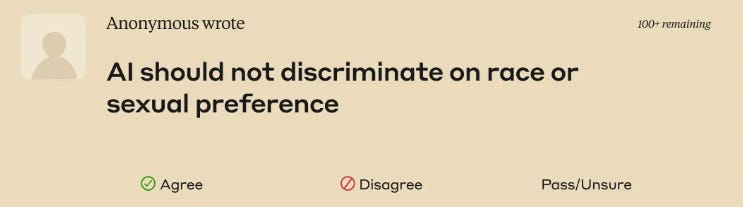
Un esempio delle votazioni proposte da Anthropic con Pol.is
Chiaramente, ho semplificato, ma se ti interessa tutto il processo, puoi leggerlo [qua](https://www.anthropic.com/index/collective-constitutional-ai-aligning-a-language-model-with-public-input). Punto bonus: **tutta la votazione e raccolta di opinioni è stata fatta con [Pol.is](https://pol.is/home)**, un tool open-source che abilita processi di democrazia deliberativa, analisi dei dati, e diverse altre cose.
*\[Se ti interessa saperne di più e contribuire a migliorarlo, **rispondi a questa mail**, che ci sto lavorando!\]*
------------------------------------------------------------------------
Un esperimento davvero super interessante. Che [quelli bravi](https://cip.org/) chiamano di ***“Collective Intelligence”,*** ossia un “efficace e decentralizzato *decision-making* tra individui e comunità per produrre risultati ottimali per la collettività”.
Quello che è importante capire dell’Intelligenza Collettiva (IC) è che non si tratta solamente di risolvere problemi orizzontalmente, ma piuttosto di **leggere insieme la realtà** (*inter legere,* appunto) **e lavorare per costruirne una migliore.** In altre parole, di mobilitare competenze per l’arricchimento sia di chi partecipa a questi processi che, poi, dei risultati
**Ed esistono già diverse modalità e processi per mobilitare la IC**, come i mini-pubblici, le assemblee dei cittadini (la CoFoE dell’UE è un caso rilevante), il budget partecipativo per decidere come allocare soldi pubblici in una città. **Tutti resi possibili o, quantomeno, più facili dalla tecnologia.**
------------------------------------------------------------------------
Ed allora, abbiamo **due direzioni del rapporto artefatti tecnologici - Intelligenza Collettiva:**
1. la prima, più scontata, che **gli esperimenti di IC sono abilitati dalla tecnologia**;
2. la seconda, che è una conseguenza della prima, che **la IC può aiutare a democratizzare gli artefatti tecnologici**, permettendo a chi vuole di provare a dargli forma. Come ha fatto Anthropic.
Lo so, **sembra idealistico**, ma procediamo con calma.
Ora, nonostante i casi di IC siano in generale molto interessanti, per naturale di inclinazione di Artifacts **il focus sarà sulla possibilità di democratizzare gli artefatti**, e specialmente le IA.
Per questo, oggi Artifacts prima vedrà perché se l’IA non è sicuramente (ancora) Collettiva, **è comunque sbagliato pensare che sia Artificiale, come Internet può facilitare la possibilità di dire la propria in processi simili, ma anche perché gli esperimenti di CI siano così difficili e cosa possiamo fare a riguardo.**
> ### Il Titolo
Partiamo chiarendo una cosa: **l’intelligenza artificiale non è artificiale.** Oltre a non essere intelligente (ma questo è un altro discorso, che prima o poi affronteremo), **è abbastanza fuorviante l’idea che sia artificiale:** è molto più “umana” di quanto pensiamo.
Tutti i modelli di IA attuali, infatti, hanno la loro potenza grazie ai testi, alle immagini, e a tutti gli altri prodotti degli esseri umani. Al massimo, [per come la mette Morozov](https://www.theguardian.com/commentisfree/2023/mar/30/artificial-intelligence-chatgpt-human-mind), si tratta di **“Non-Artificial Intelligence”, e quindi della rielaborazione di qualcosa prodotto dall’intelligenza umana.**
Sgombrato il campo da questa narrazione, appare chiaro che **oltre al “contenuto” delle IA, e quindi a tutti i testi etc., anche i suoi “valori” possano essere umani.** E non solo quelli di chi la programma, che sono probabilmente [troppo rumorosi](http://-%20https://x.com/carissaveliz/status/1717478714248777792?s=46&t=gbAqSAJ_FS1UsFjoLj51HQ) in questo momento, ma anche delle persone “qualunque”, come ha fatto Anthropic (!).
Ok, e tutto questo come? **Con l’Intelligenza Collettiva.**
------------------------------------------------------------------------
*Passo indietro.* **Come visto sopra, l’IC ha avuto alcuni recenti campi di applicazione per mobilitare i cittadini** e ha dato loro il potere di dire la propria e contribuire a delle decisioni, solitamente su scala locale.
**E questo è stato enormemente favorito da Internet**, anche se ancora con effetti limitati. Questo perché c’è stato chi ha sviluppato applicazioni, siti, processi di partecipazione innovativi, **vincendo una sfida più culturale che tecnologica.**
E, soprattutto, capendo che **la democrazia ai tempi di Internet difficilmente può rimanere la stessa**. Su questo mi piace come la mette Pia Mancini, che dice *“We are 21st-century citizens doing our very, very best to interact with 19th-century design institutions based on an information technology of the 15th century.”* Insomma, che, tra le varie, **la facilità di comunicazione e scambio abilitati da internet non sono opportunità da tralasciare per innovare le istituzioni.**
Questo vale per tutti i processi decisionali che possono esserci in una città o in un Paese. È l’affascinante campo della democrazia digitale, che prima o poi vedremo in Artifacts. **Ma, altrettanto affascinante, è l’idea di poter democratizzare la tecnologia**, che è quello di cui stiamo parlando oggi.
------------------------------------------------------------------------
Inutile dire che quando si fa Intelligenza Collettiva, specialmente con strumenti digitali, esistono tutta una serie di ostacoli e criticità. **Per menzionarne solo alcuni**, immaginando di dover scrivere una Costituzione per l’IA:
- **Il costo,** sia economico che di tempo per rispondere a un sondaggio, magari incontrarsi fisicamente, etc;
- **Le disuguaglianze,** in termini di conoscenza dell’IA per parlarne con cognizione di causa, ma soprattutto anche di skills digitali per, banalmente, saper accedere a un tool tipo Pol.is;
- **Il gap informativo,** con il rischio che a questi esperimenti partecipino, alla fine, sempre le stesse persone, già interessate e coinvolte;
- **La lentezza e la complessità** per chi crea IA di un processo simile, che potrebbe rallentare significativamente lo sviluppo;
- e molti altri tipo la effettiva volontà, l’efficacia, la comunicazione, etc.
Tutto questo per dire che **digitalizzazione ≠ maggiore partecipazione,** in generale.
------------------------------------------------------------------------
E, in particolare, che un processo qualsiasi di Intelligenza Collettiva per democratizzare tecnologie come le IA **non è certo la panacea di tutti mali o dei rischi delle IA.** Molta responsabilità ricade sempre e comunque su chi le sviluppa, chi le regolamenta, e chi le usa.
Tuttavia, degli **esperimenti di Intelligenza Collettiva, come quello di Anthropic, ben ideati, possono essere un passo in avanti.** Possono, ad esempio, migliorare le risposte di un chatbot, adeguando i valori politici, sociali, etici di questi artefatti ad una somma dei valori di chi li utilizza effettivamente. Certo, va precisato che si tratterebbe di una *somma* dei valori, quindi un compromesso, **ma non è forse la democrazia un continuo susseguirsi di compromessi?**
Per concludere, non sarà certo solo l’Intelligenza Collettiva a garantirci delle IA sicure e affidabili: molto servirà sia sul piano regolamentare che di sviluppo. Eppure, **queste pratiche per democratizzare le IA potranno essere utili per rendere queste Intelligenze, che non sono Artificiali, un po’ più Collettive.** O, semplicemente, un po’ più **umane**.
[Leave a comment](https://artifactstech.substack.com/p/piu-collettiva-che-artificiale-questa/comments)
> ### Rassegna (Stampa)
Ne avevamo parlato in questa [Artifacts](https://artifactstech.substack.com/p/tu-pagheresti-per-la-privacy-sui), **[ARRIVANO FACEBOOK E INSTAGRAM A PAGAMENTO IN UE](https://about.fb.com/news/2023/10/facebook-and-instagram-to-offer-subscription-for-no-ads-in-europe/)** per chi non vuole il targeted advertising.
L’incredibile TED da cui è presa la citazione di Pia Mancini:
[\[Embedded media — view original\]](https://www.youtube-nocookie.com/embed/NXfYNdapq3Q?rel=0&autoplay=0&showinfo=0&enablejsapi=0)
**Fronte AI:** Biden e il suo [ordine esecutivo](https://www.reuters.com/technology/white-house-unveils-wide-ranging-action-mitigate-ai-risks-2023-10-30/) per la sicurezza dell’AI, l’UE accoglie il [Codice di Condotta](https://www.reuters.com/technology/g7-agree-ai-code-conduct-companies-g7-document-2023-10-29/) del G7 e conclude [un altro trilogo dell’AI Act](https://www.euractiv.com/section/artificial-intelligence/news/eu-policymakers-enter-the-last-mile-for-artificial-intelligence-rulebook/), e in UK c’è un criticato [summit su AI Safety](https://www.reuters.com/world/uk/uk-set-up-worlds-first-ai-safety-institute-sunak-says-2023-10-26/?taid=653a40dcc1788f0001130950) del governo
Dopo un anno di Musk, **X/Twitter non sta tanto bene**, dicono il [NYT](https://www.nytimes.com/interactive/2023/10/27/technology/twitter-x-elon-musk-anniversary.html) e [The Verge](https://www.theverge.com/23934205/elon-musk-twitter-x-one-year-later-acquisition)
**E se i social creano dipendenza?** Lo pensano in [USA](https://www.cnbc.com/2023/10/24/bipartisan-group-of-ags-sue-meta-for-addictive-features.html) e se preoccupano in [UE](https://www.europarl.europa.eu/news/ro/press-room/20231023IPR08161/new-eu-rules-needed-to-make-digital-platforms-less-addictive)
> ### Lo Scaffale
[](https://substackcdn.com/image/fetch/$s_!1w9k!,f_auto,q_auto:good,fl_progressive:steep/https%3A%2F%2Fsubstack-post-media.s3.amazonaws.com%2Fpublic%2Fimages%2F6ebf7a26-fe61-47ef-b9ce-d014454f39be_3240x3240.png)
Quello della *Public Interest Technology* è un campo in ascesa e davvero interessante. ***[Power to the Public](https://press.princeton.edu/books/ebook/9780691216638/power-to-the-public)*** spiega come funziona, quali sono gli ostacoli e, soprattutto, **perché la tecnologia è sempre solo parte del problema e comunque mai la soluzione.**
> ### Nerding
[](https://substackcdn.com/image/fetch/$s_!fTOe!,f_auto,q_auto:good,fl_progressive:steep/https%3A%2F%2Fsubstack-post-media.s3.amazonaws.com%2Fpublic%2Fimages%2F01360519-8ea8-464e-9a1c-b1c32c5e9006_1080x1080.png)
Ok, questo è decisamente più di un tool: è un browser. **[Arc](https://thebrowser.company/)** è quello che uso io perché è incredibile: **hanno ripensato il modo di usare internet**, integrato l’IA rendendola super utile, e migliorano continuamente. La funzione che mi piace di più: **se stai cercando una info specifica in un articolo, puoi chiedere all’AI di farlo per te.** [Lo puoi scaricare qui.](https://arc.net/gift/1627fba6)
*Grazie, ci sentiamo martedì prossimo!*
======
# Di chi è la tua faccia?
Date: 2023-10-24 | Language: it
Canonical: https://artifactstech.substack.com/p/di-chi-e-la-tua-faccia
Cite as: Di chi è la tua faccia? by Lorenzo Ancona, Artifacts, 2023-10-24. https://artifactstech.substack.com/p/di-chi-e-la-tua-faccia (CC BY 4.0)
**Immagina di incontrare un(a) ragazzo/a carino/a, fargli una foto, non sapere il suo nome, ma poterlo trovare cercando il suo volto con una app.** E poi sapere anche cosa fa nella vita, dove vive, magari cosa vota.
Ma immagina anche di non timbrare il biglietto sull’autobus e **ricevere una multa perché si è risalito al tuo nome** grazie alle immagini di una telecamera.
O mille altri casi simili in cui **dalla tua faccia si può risalire al tuo nome.**
Fantascienza? **No, affatto.**
[](https://substackcdn.com/image/fetch/$s_!YBGH!,f_auto,q_auto:good,fl_progressive:steep/https%3A%2F%2Fsubstack-post-media.s3.amazonaws.com%2Fpublic%2Fimages%2F63e032a9-c16a-4c20-a0fd-0bb2305ecbfa_1024x1024.jpeg)
Un occhio. *Creato con DALL-E*
È quello che permette di fare **Clearview AI**, una piattaforma di riconoscimento facciale che, una volta **inserita una foto di una persona a caso**, fornisce tutte le foto di quella persona su internet, e, quindi, solitamente **i suoi profili social e, soprattutto, il suo nome.**
Com’è possibile? Abbastanza semplice: Clearview ha fatto *scraping* di miliardi di foto online - **ad oggi il database conta 30 miliardi di foto** -, ha identificato i volti presenti e li ha resi cercabili. Sostanzialmente, **un motore di ricerca dei volti,** con il 98.6% di accuratezza.
Sia chiaro: **Clearview vende questo servizio esclusivamente alle forze dell’ordine negli Stati Uniti**, ma non per questo è meno preoccupante.
------------------------------------------------------------------------
Quello di Clearview è un **caso eclatante,** portato alla pubblica attenzione grazie al lavoro della giornalista Kashmir Hill nel suo ultimo libro, ***[Your face belongs to us.](https://www.penguinrandomhouse.com/books/691288/your-face-belongs-to-us-by-kashmir-hill/)*** Hill che, tra l’altro, **è stata spiata da Clearview durante il suo lavoro.**
Ma non è certo un *unicum.* Anche **Meta e Google avevano pronta una tecnologia simile**, ma, come ha scritto il NYT, ***“they did not dare to release these tools”.*** Addirittura, Schmidt, CEO di Google, ha detto: *“As far as I know, it’s the only technology that Google built and, after looking at it, we decided to stop”.* Scelta di responsabilità.
Tuttavia, se c’è una cosa abbastanza sconvolgente, è che **Clearview abbia potuto fare** ***scraping*** **di 30 miliardi di foto senza fare nulla di illegale.** Semplicemente, quelle foto erano online e Clearview ha categorizzato e identificato i volti.
E questo ha molto a che fare con **la consapevolezza che abbiamo di quello che succede alle foto che pubblichiamo sui social.** E dovrebbe averlo soprattutto rispetto alle foto degli altri che pubblichiamo, **specialmente di minori o dei figli**, di quello che si chiama *sharenting,* ossia la crasi tra *parents* e *sharing.* [Questo video è abbastanza esplicativo.](https://www.youtube.com/watch?v=-r_2a064dWY)
------------------------------------------------------------------------
In ogni caso, se quello di Clearview è un caso estremo, **le tecnologie di riconoscimento facciale sono qui per restare.** Le usa la Cina per sorvegliare i cittadini nello Xinjiang, ma sono anche nei piani della Francia **per le Olimpiadi del prossimo giugno.**
E sì, per le forze dell’ordine sono **potenzialmente uno dei metodi più efficaci per garantire la sicurezza**, magari per trovare chi ha rapito un bambino o altri crimini efferati. Tuttavia, **non pochi sono i rischi legati a falsi positivi**, specie con alcune minoranze etniche.
**Allora, è impossibile non farsi alcune domande,** come **quali siano le regole per l’utilizzo di queste tecnologie**, se basti una denuncia per accedere a database simili, se qualsiasi poliziotto possa usare un sistema tipo Clearview AI, **o anche se l’utilizzo sia da limitare ad alcuni casi?**
**E poi, tecnologie simili hanno a che fare con il concetto di privacy, ma anche con la sicurezza negli spazi pubblici o con la presunzione di innocenza.** Per questo, oggi Artifacts prova ad approfondire questi concetti, ed anche cosa succede a livello regolatorio.
> ### Il Titolo
Quello della privacy è un concetto sfumato, complesso, difficile da delineare. [Una bella definizione](https://groups.csail.mit.edu/mac/classes/6.805/articles/privacy/Privacy_brand_warr2.html) è del 1890 e fa così: ***“privacy is the right to be left alone”.*** Di solito, il dibattito si divide tra quelli che ***“se non hai nulla da nascondere, non dovresti preoccuparti”*** e **chi invece tiene di più alla propria privacy.**
Sostenere la prima posizione ***“is no different than saying you don't care about free speech because you have nothing to say”**,* ha detto Snowden. La seconda, invece, riflette l’idea che **ritenere che una parte della propria vita debba rimanere privata non significa necessariamente essere in malafede**, bensì esercitare un proprio diritto.
In più, un altro concetto essenziale, spesso ignorato, è che **la privacy non è una questione meramente individuale, ma sociale.** Di questo ne scrive bene Laura Carrer nel suo libro “*Black Box”.*
Infine, è anche utile tenere a mente che quello che conta non è meramente *cosa* le persone sanno di te, **ma soprattutto** ***come*** **quella conoscenza può dare del potere su di te.** Ed è per questo che la consapevolezza è cruciale.
------------------------------------------------------------------------
Questa prospettiva di collettività è utile per **cogliere la minaccia che il riconoscimento facciale può rappresentare negli spazi pubblici.** Essere costantemente monitorati può, infatti, avere **due conseguenze essenziali:**
- **minare la presunzione di innocenza:** l’asimmetria informativa tra un imputato e chi giudica potrebbe aumentare notevolmente, in quanto **chi è accusato non ha idea di quali dati o azioni siano state collezionate con il riconoscimento facciale.** [Questo paper](https://www.sciencedirect.com/science/article/abs/pii/S0267364914000958) lo spiega nel dettaglio.
- **scatenare il** ***chilling effect:*** la possibilità che una persona, sorvegliata o che si senta tale, non metta in atto alcuni comportamenti per paura di ripercussioni di qualsiasi tipo. Insomma, che **il suo comportamento venga modificato più per paura di sbagliare che per l’effettiva certezza di star sbagliando.**
------------------------------------------------------------------------
Fortunatamente, diversi sforzi sono in atto per evitare quella che potrebbe suonare come una società del controllo. Infatti, nell’AI Act in discussione in UE, **uno dei dossier più caldi è stato quello del riconoscimento biometrico,** che nel testo attuale vede:
- **un ban completo sui sistemi** ***real-time*** **negli spazi pubblici**
- **ban parziale sui sistemi** ***ex-post***, con l’eccezione dei crimini più seri e dopo l’autorizzazione della corte.
**Tuttavia, l’AI Act non è ancora chiuso.** Se il Parlamento Europeo, sul quale si sono anche concentrati gli sforzi della campagna [Reclaim Your Face](https://reclaimyourface.eu/), ha un approccio di chiusura e ostile al riconoscimento biometrico, **il Consiglio Europeo la vede diversamente** e sta cercando di inserire delle eccezioni per alcuni usi *real-time* e di rimuovere l’autorizzazione per dei controlli generalizzati nell’uso *ex-post.*
Vedremo come finirà, **ma è ancora lungo il cammino per chiudere l’AI Act.** Tra l’altro, proprio oggi ci sarà una sessione importante dei triloghi.
------------------------------------------------------------------------
In attesa, una riflessione che merita maggiori sviluppi è: **una tecnologia come il riconoscimento biometrico è neutra ed è solo il suo utilizzo a determinarne la pericolosità?** O, forse, se pensiamo ai potenziali usi, non è che forse nel suo stesso *design* è già più pericolosa che capace di portare beneficio?
Insomma, allargando lo sguardo, **siamo sicuri che tutti gli artefatti** (prima volta che uso questa parola in Artifacts) **siano sempre neutri e che dipenda da noi il loro risultato?** Domanda complessa, ne ragioneremo!
*E tu, che ne pensi? Esiste un bilanciamento tra sicurezza e privacy per il riconoscimento facciale?*
[Leave a comment](https://artifactstech.substack.com/p/di-chi-e-la-tua-faccia/comments)
> ### Rassegna (Stampa)
**A proposito di neutralità della tecnologia**, uno speech interessante al TEDxFerrara di Diletta Huyskes:
[\[Embedded media — view original\]](https://www.youtube-nocookie.com/embed/mH2OYUuww2k?rel=0&autoplay=0&showinfo=0&enablejsapi=0)
E invece, **se per aggiustare Internet** [servisse ancora più Internet](https://www.technologyreview.com/2023/10/17/1081194/how-to-fix-the-internet-online-discourse/)?
Poi, Stanford ha fatto [la classifica delle AI più trasparenti.](https://hai.stanford.edu/news/introducing-foundation-model-transparency-index) **Potrebbe andare meglio.**

Nel frattempo, **il governo inglese organizza un summit su AI Safety**, [ma molti sono scettici.](https://www.wired.com/story/britains-big-ai-summit-doom-obsessed-mess/)
Infine, l’UE investiga [anche Meta e TikTok.](https://www.politico.eu/article/eu-starts-investigating-meta-tiktok-over-hamas-content/) **DSA** ***unleashed.*** Mentre su X a condividere più fake news sono [gli utenti con account verificato](https://www.wired.it/article/israele-hamas-x-fake-news/).
> ### Lo Scaffale
[](https://substackcdn.com/image/fetch/$s_!puHg!,f_auto,q_auto:good,fl_progressive:steep/https%3A%2F%2Fsubstack-post-media.s3.amazonaws.com%2Fpublic%2Fimages%2F0029595b-f7b2-4387-a9d1-d02e9afe0346_3240x3240.png)
Ne abbiamo parlato prima: ***[Your Face Belong to Us](https://www.penguinrandomhouse.com/books/691288/your-face-belongs-to-us-by-kashmir-hill/)*** è il libro di riferimento per capire veramente **tutti i dettagli della vicenda Clearview AI**. Kashmir Hill fa un reportage minuzioso, forse anche troppo. Ma **bello da leggere se appassionati.**
> ### Nerding
[](https://substackcdn.com/image/fetch/$s_!DM4f!,f_auto,q_auto:good,fl_progressive:steep/https%3A%2F%2Fsubstack-post-media.s3.amazonaws.com%2Fpublic%2Fimages%2Fdf03a199-9658-4ba2-840b-17f084b64c78_1080x1080.png)
*Hai presente quando devi leggere quel documento di 168 pagine e non ti va?* **[Humata](https://www.humata.ai/?te=1&nl=on-tech:-a.i.&emc=edit_ot_20230630) lo legge al posto tuo, tu gli chiedi quello che ti interessa,** e il gioco è fatto. Un bel tool per chi studia e ha paper lunghi da leggere, ma anche per chi lavora e vuole velocizzare. **Letteralmente, puoi chattare con un PDF.**
======
# Guerra, social e responsabilità
Date: 2023-10-17 | Language: en
Canonical: https://artifactstech.substack.com/p/guerra-social-e-responsabilita
Cite as: Guerra, social e responsabilità by Lorenzo Ancona, Artifacts, 2023-10-17. https://artifactstech.substack.com/p/guerra-social-e-responsabilita (CC BY 4.0)
> ***“Social media has, once again, become the window** through which the world is witnessing unspeakable violence and cruelty in an active war zone.”*
Ha scritto Charlie Warzel in un [recente articolo](https://www.theatlantic.com/technology/archive/2023/10/social-media-infrastructure-news-algorithms/675614/) su *The Atlantic.* Facendo eco a un [altro pezzo](https://www.theatlantic.com/technology/archive/2022/03/tiktok-war-ukraine-russia/627017/) dell’anno scorso, in cui Tiffany spiegava che ***“The history of war is also a history of media**, and popular memory associates specific wars with different media formats".*
Insomma, che quella del Vietnam è stata la prima guerra della Tv, quella in Iraq la prima di YouTube, e quella in Ucraina la prima di TikTok. **Finestre diverse su diverse atrocità.**
[](https://substackcdn.com/image/fetch/$s_!oUKC!,f_auto,q_auto:good,fl_progressive:steep/https%3A%2F%2Fsubstack-post-media.s3.amazonaws.com%2Fpublic%2Fimages%2Fc74a28bf-aa68-45e6-a313-d86c67e3da49_1024x1024.jpeg)
Una finestra. *Fatta con DALL-E*
Non so quasi nulla di relazioni internazionali, quindi non parlerò di cosa sta succedendo nei dintorni di Gaza. Però, posso portare la prospettiva di quello che so leggermente meglio: **di come questa guerra è raccontata sui social, ma anche di cosa ci sta raccontando** ***dei*** **social.**
------------------------------------------------------------------------
Strumenti essenziali, utili ad avere informazioni magari dirette, anche a diffondere consapevolezza. E molto altro - scritto da tanti - sui benefici che i social hanno portato nel racconto delle guerre. Eppure, c’è il tema ricorrente: **la cattiva informazione,** tra disinformazione e misinformazione.
**Questa guerra non fa eccezione:** il [NYT](https://www.nytimes.com/article/israel-attacks-video-disinformation.html) riporta, ad esempio, di diversi casi di contenuti falsi. O anche, un ufficiale di Hamas [ha raccontato](https://www.nytimes.com/2023/10/10/technology/hamas-violent-videos-online.html) di come usino intenzionalmente i social per diffondere la loro narrazione.
Con una, essenziale, conseguenza [di cui avvertiva Arendt](https://www.nytimes.com/2018/06/20/opinion/why-read-hannah-arendt-now.html): ***“La libertà di opinione è una farsa in assenza di informazione fattuale”.*** E che, sui social la *sensazione* di essere connessi e informati è, spesso, alle spese del *fatto* di essere, veramente, informati.
------------------------------------------------------------------------
**Il ruolo dei social evolve:** non più piattaforme neutre rispetto ai contenuti, ma con una veste di responsabilità, di ***accountability.*** Perché se è pacifico che non siano i social a fare cattiva informazione, è altrettanto vero che - per come stanno le cose - **a loro spetta il compito di limitarla.**
**Cosa che è stata riconosciuta dai social stessi**, tanto che Threads, l’ultimo social di Meta, mira a ospitare meno informazione possibile, **preferendo essere una sorta di TikTok di testi per limitare i rischi.**
Eppure, se da un lato sembra diminuire la volontà dei social di essere piattaforme di informazione, **dall’altro si fa più stringente la presa sul loro ruolo di** ***accountability**,* specie in UE.
Perché, così come questa sarà la prima guerra con X a guida Elon Musk, **è anche la prima guerra del Digital Services Act**, il regolamento dell’UE sugli intermediari digitali e i contenuti che ospitano.
Per questo, oggi Artifacts vede, in breve, **come se la sta cavando il DSA**, come X - il fu Twitter - è finito sotto il fuoco dell’UE, e **perché, forse, a volte la fretta è cattiva consigliera.**
> ### Il Titolo
Passo indietro: *che c’entra il DSA?* Impossibile spiegare tutto il regolamento qui. Però - *long story short -* con il DSA, **l’UE chiede alle piattaforme di limitare al massimo la circolazione di contenuti falsi.**
E, soprattutto, al contrario di quello che molti pensano, non c’è nessun Ministero della Verità orwelliano: **l’UE non definisce** ***cosa*** **sia illegale né censura nessuno.** Semplicemente, **prevede che le piattaforme siano più responsabili - o** ***accountable*** **- di prima.**
Per il DSA, che entrerà pienamente in vigore dal 2024 ma che è “in prova” per le grandi piattaforme, il conflitto israelo-palestinese è la prima “grande occasione”.
------------------------------------------------------------------------
*Com’è andata?* Breton, Commissario Europeo all’Internal Market, ha cominciato a mandare delle lettere a praticamente tutte le piattaforme, dicendo: **ora che c’è il DSA, vi ricordiamo di stringere sulla disinformazione.**
E lo ha fatto **iniziando e insistendo con Elon Musk riguardo X e su X**, dando vita ad una *bagarre* quantomeno inconsueta. Sostanzialmente, Breton ha notificato a Musk che **ci sarebbe della disinformazione su X e che, per questo, esigeva:**
- maggiore **trasparenza** sulle policy interne;
- **efficienza** nel rispondere alle segnalazioni dell’UE;
- misure per **ridurre i rischi** per gli utenti.
Musk ha risposto, tra il serio e il faceto, così:
[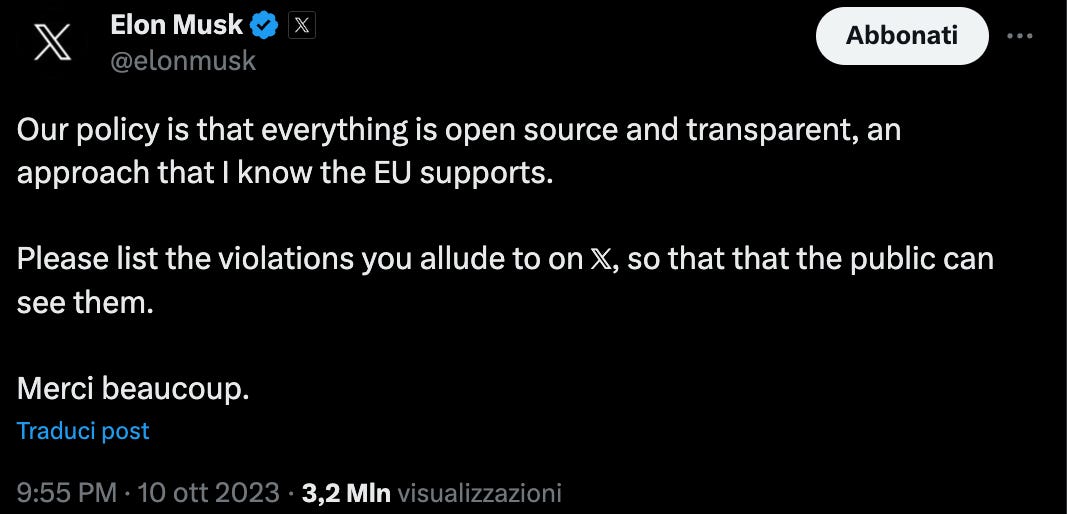](https://x.com/elonmusk/status/1711832919335976991?s=20)
Insomma: ad X è tutto trasparente, e se proprio ci sono delle violazioni, **ci serve una lista precisa**. *Merci beaucoup.*
A questa conversazione è seguita prima la risposta di Yaccarino, CEO di X spesso oscurata da Musk, e poi, soprattutto, **la [richiesta ufficiale](https://ec.europa.eu/commission/presscorner/detail/en/IP_23_4953) di informazioni da parte della Commissione Europea** su come X stia rispettando il DSA.
**Il primo passo di quella che**, se X non dovesse rispondere adeguatamente entro fine ottobre, **diventerebbe la prima investigazione della storia del DSA.**
------------------------------------------------------------------------
Per certi versi, quindi, una vicenda storica. Forse, però, anche vittima di fretta. **Mi spiego meglio.**
Da quando è proprietario di X/Twitter, **Elon Musk ha fatto di tutto per ridurre gli argini della disinformazione**: licenziato in massa il team di moderatori, tolto le spunte blu agli account delle fonti verificate, inserito una moderazione orizzontale non sufficiente, e continuamente minato l’autorevolezza del giornalismo tradizionale. Al punto che sul conflitto israelo-palestinese **ha suggerito di seguire due giornalisti con posizioni antisemite.** *Insomma, non un esempio.*
**Eppure, l’approccio di Breton e, quindi dell’UE, rischia di avere un effetto negativo sui primi passi del DSA.** Si tratta, infatti, di **un approccio muscolare**, che sembra sacrificare obiettivi di lungo termine a una causa, seppur importante, sicuramente più breve.
L’UE accusa X, ma anche le altre piattaforme, di ospitare contenuti falsi **senza però specificarli nel dettaglio.** Insomma, seppur fondata, così sembra fragile la base delle accuse, [come sostiene Scott](https://www.linkedin.com/posts/markscott82_what-happens-when-content-moderation-stops-activity-7118498184464605184-8uC2?utm_source=share&utm_medium=member_desktop), chief correspondent di Politico sul tech in UE.
Inoltre, per come è concepito, **il DSA dovrebbe guardare alla strategia complessiva contro la disinformazione delle piattaforme, e non a casi specifici.** *Come ha risposto Musk alla prima crisi da proprietario di X?* Decisamente male, lo abbiamo visto sopra. *Com’è la strategia complessiva di X?* Non buona affatto.
**Eppure, forse proprio per questo, con X che sta indubbiamente facendo male, il primo “attacco” dell’UE avrebbe potuto essere meno muscolare e più autorevole.**
------------------------------------------------------------------------
Insomma, i social sono finestre sul conflitto e hanno un ruolo importante, di *accountability,* riconosciuto dall’UE. **Questo ha portato a concepire il DSA non come un regolamento** ***contro*** **le piattaforme, ma uno che aspira a un ecosistema informativo digitale sicuro da costruire** ***insieme*** **alle piattaforme.**
Per questo, se parliamo di responsabilità, **forse in questa storia avremmo potuto auspicarne un po’ di più anche dalle istituzioni europee.** Per prendersi cura del DSA e far sì che già i suoi primi passi siano nella giusta direzione.
[Leave a comment](https://artifactstech.substack.com/p/guerra-social-e-responsabilita/comments)
> ### Rassegna (Stampa)
OpenAI vuole fare [i suoi chip per ChatGPT](https://www.reuters.com/technology/chatgpt-owner-openai-is-exploring-making-its-own-ai-chips-sources-2023-10-06/)
[OECD prova a mettere tutti d’accordo](https://www.ft.com/content/2219e65d-19a6-4da3-a5d0-192300775e64) sulla tassa globale digitale
Sarebbe meglio [cancellare gli account TikTok dei bambini](https://www.theatlantic.com/technology/archive/2023/10/graphic-content-children-social-media-use/675619/) con la guerra in corso?
Invece [Google chiede al Congresso](https://www.theverge.com/2023/10/16/23919221/google-youtube-child-safety-age-verification-laws-privacy) di mantenere gli account dei giovani.
Per almeno 7 anni dovrà essere conveniente riparare il proprio telefono in California. [Lo dice la legge.](https://www.lemonde.fr/pixels/article/2023/10/11/une-loi-sur-la-reparabilite-des-appareils-electroniques-definitivement-adoptee-en-californie_6193767_4408996.html)
> ### Lo Scaffale
[](https://substackcdn.com/image/fetch/$s_!5BFM!,f_auto,q_auto:good,fl_progressive:steep/https%3A%2F%2Fsubstack-post-media.s3.amazonaws.com%2Fpublic%2Fimages%2F25328805-b64c-4f80-ae72-b2cd5892383d_1080x1080.png)
***[Libertà vigilata - la lotta per il controllo di internet](https://www.treccanilibri.it/catalogo/liberta-vigilata/)*** è un must su come si sia evoluta la rete, quello che è stato fatto e quale sia il ruolo delle piattaforme. Piacevole, una **ottima lettura “per iniziare” sul tema.**
> ### Nerding
[](https://substackcdn.com/image/fetch/$s_!4gza!,f_auto,q_auto:good,fl_progressive:steep/https%3A%2F%2Fsubstack-post-media.s3.amazonaws.com%2Fpublic%2Fimages%2Fba4ea8fb-aa49-4e47-8a10-0b6235d3d26b_1080x1080.png)
*Hai presente l’articolo che ti ha mandato la tua amica e che non ritrovi più?* Ecco, con **[Matter](https://hq.getmatter.com)** non avresti questo problema. Una delle cosiddette **“read-later app”**, permette di **salvare facilmente gli articoli**, di leggerli, e di poi categorizzarli con etichette. Tanto semplice, quanto incredibile. **Probabilmente è il mio tool preferito.**
*A martedì prossimo!*
======
# Tu pagheresti per la privacy sui social?
Date: 2023-10-10 | Language: en
Canonical: https://artifactstech.substack.com/p/tu-pagheresti-per-la-privacy-sui
Cite as: Tu pagheresti per la privacy sui social? by Lorenzo Ancona, Artifacts, 2023-10-10. https://artifactstech.substack.com/p/tu-pagheresti-per-la-privacy-sui (CC BY 4.0)
Secondo il Wall Street Journal, Meta valuterebbe un abbonamento di circa 13 euro nell’Unione Europea per Instagram e Facebook senza targeted advertising, ossia pubblicità basata sulla raccolta dei dati personali degli utenti. Sarebbe per adeguarsi al GDPR. Ma soprattutto sarebbero 156 euro l’anno (!).
Ovviamente, sarebbe comunque possibile non pagare e continuare a essere profilati e ricevere pubblicità personalizzata.
Max Schrems, il più noto attivista per i diritti online e creatore di Noyb, ha criticato aspramente il rumor dicendo “Fundamental rights cannot be for sale”.
 Una bilancia. Fatta col nuovissimo DALL-E 3
Ma perché succede ciò? È una questione complessa, che riguarda il GDPR, ossia il regolamento europeo per la privacy, e due tappe “legali” del 2023 (qui dette semplici):
- a gennaio, Meta ha ricevuto dall’Irish Data Protection Commission (DPC) una multa di 390 milioni perché avrebbe obbligato, di fatto, gli utenti ad accettare il targeted advertising negli anni;
- a luglio, la Corte di Giustizia dell’Unione Europea ha ribadito che il consenso è l'unica base giuridica plausibile per fare del targeted advertising basato su tracciamento e profilazione.
E, quindi, Meta - che non ha altra scelta - ha comunicato che comincerà a operare secondo il principio del “consenso” del GDPR, ossia permettendo agli utenti di scegliere se essere profilati per ricevere della pubblicità personalizzata.
Tuttavia, il Diavolo sta nel dettaglio: nelle note dell’ultima sentenza, la Corte UE ha scritto che Meta potrebbe offrire agli utenti la scelta di non essere profilati “if necessary for an appropriate fee”. Ossia che per NON dare il consenso alla profilazione bisognerebbe pagare.
------------------------------------------------------------------------
Ed è proprio su queste 6 parole che si fonderebbe la notizia trapelata in settimana, che potrebbe cambiare molto della storia della regolamentazione social in UE.
Nel frattempo, Meta non ha commentato nello specifico, ma ha detto che, pur credendo nel valore dei propri servizi gratuiti supportati dal targeted advertising, continua a esplorare opzioni per rispettare le continue evoluzioni della regolamentazione.
Oggi Artifacts prova a vedere alcuni aspetti di questa questione, soprattutto cosa si intenda per “consenso” e perché, se confermata, questa storia potrebbe essere un discreto autogol per l’Unione Europea.
> ### Il Titolo
Sulla definizione di “consenso” l’UE è particolarmente precisa nel GDPR: deve trattarsi di consenso “informato, specifico e freely given”. Dove, tuttavia, per freely si intende più “liberamente”, ossia senza coercizioni, che “gratis”.
A questo punto, è lecito domandarsi se pagare attorno ai 13 euro al mese per proibire a Meta la profilazione rispetti gli standard di un consenso freely given. Difficile: sicuramente non è letteralmente ‘gratuito’, ma nemmeno un processo trasparente. Ma soprattutto, è difficile pensare che rispetti lo spirito dei diritti dell’UE, che non prevedono certo di dover pagare per avere accesso a dei diritti.
Tuttavia, non c’è nemmeno scritto che pagare questa fee significhi non rispettare il GDPR. Su questo vedremo l’interpretazione della Corte, che potrebbe però richiedere diverso tempo.
------------------------------------------------------------------------
Restando sulle parole, sarà interessante capire cosa si intenda per una tariffa “appropriate” e quando sarebbe “necessary”.
Sull’appropriatezza, è difficile immaginare o capire quanto far pagare una cosa che è sempre stata gratis. Ma, soprattutto, quale tariffa sia adeguato pagare per - di fatto - godere di un diritto.
Invece, sul “necessario” è altrettanto complesso capire come possa diventare necessario pagare per un servizio che non ha costi e i cui contenuti sono prodotti dagli stessi che dovrebbero pagare per vederli, ossia gli utenti. Insomma, che Instagram non è come Spotify che deve, ad esempio, poi pagare gli autori o le licenze delle canzoni.
Difficile che venga accettato l’approccio “Pay or Okay”, ossia quello per cui molti giornali online ora permettono di scegliere tra pagare un abbonamento o, invece, essere profilati con i cookies.
------------------------------------------------------------------------
Un punto importante è: se è già abbastanza complesso rendere chiaro il valore della privacy e della protezione dei dati personali, quanto ancora più complicato diventerebbe apprezzarlo se dovessimo pagare per goderne?
E, poi, ad un prezzo come quello trapelato, probabilmente pochi utenti pagherebbero, con la maggior parte che preferirebbe la profilazione. Cosa che, tra l’altro, probabilmente anche Meta si auspica, dato che il suo modello di business si fonda proprio sui dati degli utenti.
Qualora questa indiscrezione venisse confermata, sarebbe davvero difficile non percepirlo come un autogol dell’UE, dato che Meta farebbe leva su quelle 6 parole della Corte, o - quantomeno - come uno scacco (quasi) matto dell’azienda statunitense.
Ma staremo a vedere come evolve. E tu, pagheresti per la privacy sui social?
Leave a comment
> ### Rassegna (Stampa)
Sempre su Meta, Nick Clegg spiega come far coesistere IA e democrazia. Ad Atene, tra l’altro.
Sui social vediamo sempre meno i siti di informazione.
Wired ci spiega perché i nostri browser non sono davvero nostri.
Si starebbero scrivendo delle Costituzioni per l’IA, dice il FT.
> ### Lo Scaffale
 Dato che oggi abbiamo parlato di Meta, di profilazione e dati personali, An Ugly Truth - Inside Facebook’s Battle for Domination è il libro perfetto da consigliare. Racconta com’è nata la fu Facebook e come funzionano molte dinamiche che ci riguardano. Libro inchiesta, tono incalzante, si legge veloce.
> ### Nerding
 Non ti ricordi cosa ti ha detto Tizio nella riunione di sei mesi fa? Con Tactiq non avresti di questi problemi. Strumento super utile, che fa: transcript delle riunioni online in tutte le lingue, riassunti con l’AI, ti scrive la mail di follow-up, i principali takeaway e altre parole che non sapremmo spiegare a nostra nonna :)
------------------------------------------------------------------------
Grazie per aver letto Artifacts, e buona giornata!
======
# Le IA potrebbero star leggendo troppi libri
Date: 2023-10-03 | Language: en
Canonical: https://artifactstech.substack.com/p/le-ia-potrebbero-star-leggendo-troppi
Cite as: Le IA potrebbero star leggendo troppi libri by Lorenzo Ancona, Artifacts, 2023-10-03. https://artifactstech.substack.com/p/le-ia-potrebbero-star-leggendo-troppi (CC BY 4.0)
Su The Atlantic trovi il database dei libri utilizzati per il training di alcune delle Intelligenze Artificiali più diffuse, come LLaMa di Meta. Il problema? La maggior parte dei libri sono coperti da copyright, il cui utilizzo, quindi, sarebbe soggetto a delle regole per l’utilizzo.
 Un libro aperto. Generato con DALL-E
In maniera piuttosto diretta, Alex Reisner, autore e programmatore che ha condotto l’inchiesta, ha scritto: "The future promised by AI is written with stolen words”.
------------------------------------------------------------------------
Com’è potuto succedere? Senza addentrarci nei dettagli tecnici, le IA sono alimentate con un processo di estrazione di moli enormi di dati dal web, come Wikipedia, i social media (evitando i dati personali, almeno quella di Meta), e, in questo caso, i libri. Questo processo serve ad “allenare” le IA a riconoscere i pattern e ad essere poi capace di riprodurre testi simili a quelli di un umano. \[Mi perdoneranno i data scientist per questa descrizione poco accurata\]
Per questa inchiesta, il database contenente i libri sarebbe Books3, una raccolta che nasce per permettere a chiunque di sviluppare una propria IA, pur non avendo risorse e mezzi dei giganti del web. Quindi un intento anche nobile. Tuttavia, qualcosa potrebbe essere andato storto.
------------------------------------------------------------------------
Così, se spesso il focus è: “a chi appartiene un contenuto prodotto dall’IA?”, è invece necessario chiedersi anche: “ma è giusto usare opere sotto copyright per allenare le IA?”. E, poi, come comportarsi con gli scrittori o altri creativi, che hanno già rivolto accuse a OpenAI e Meta.
Oggi Artifacts vedrà cosa stanno facendo le istituzioni, perché secondo alcuni sarebbe da permettere l’utilizzo di opere sotto copyright per il “fair use”, e soprattutto perché sapere cosa c’è dentro le IA è tanto (o forse più) importante di chi sia il proprietario di ciò che viene prodotto.
> ### Il Titolo
Partiamo da quello che sta facendo l’Unione Europea:
- Gli sviluppatori di IA o i ricercatori possono utilizzare copie di database o opere per estrarre dati e informazioni e tenerli per il tempo necessario a questo processo. Tuttavia, chi detiene i diritti può esercitare l’opt-out, ossia impedire l’utilizzo delle proprie opere;
- Nell’AI Act viene richiesto alle aziende che sviluppano IA di “divulgare qualsiasi materiale protetto da copyright utilizzato per sviluppare i loro sistemi”.
Tuttavia, come nota Floridi, sapere se un contenuto è coperto o meno da copyright non risolve il problema. Piuttosto, quello che bisognerebbe chiedersi è se si applichi o meno il fair use, ossia la facoltà di utilizzare per il training delle IA materiale coperto da copyright per scopi di informazione o insegnamento, senza chiedere l’autorizzazione a chi ne ha i diritti.
------------------------------------------------------------------------
Il dibattito sul fair use per le IA Generative è complesso, affascinante, ma soprattutto lungo. Quindi, in breve, le posizioni sono:
- chi è contro perché sostiene che le opere generate grazie alla creatività degli autori potrebbero impattare negativamente il mercato degli autori stessi. E che, quindi, i creativi abbiano passato anni a produrre opere che ora vengono utilizzate, senza compenso, per il profitto di chi sviluppa le IA.
- chi è a favore, ad esempio Creative Commons, sostenendo che le IA non producano delle copie di lavori sotto copyright, ma che usi le informazioni per creare qualcosa di totalmente nuovo.
Difficile prendere una posizione. Piuttosto, quello che è interessante capire è se i contenuti prodotti dalle IA siano totalmente nuovi e originali. O meglio, se possiedano la caratteristica di ‘transformativeness’, e quindi non siano mere copie dei dati di training, ma opere originali e sufficientemente diverse. Questa caratteristica è essenziale per stabilire se si possa parlare di fair use.
Infatti, da un lato le IA percepiscono i libri come semplici moli enormi di testo per il training, e quindi creano a tutti gli effetti contenuti originali che non fanno riferimento ad autori specifici, ma sono semplicemente associazioni statistiche. E, quindi, c’è spazio per parlare di fair use e considerare il processo come ‘transformative’. Dall’altro, pur non copiando le opere, le IA non potrebbero fare alcun tipo di trasformazione senza quei testi. Per questo, alcuni non riconoscono i requisiti per il fair use.
Sarà un dibattito acceso, probabilmente centrale nei prossimi anni. Vedremo anche se sarà possibile continuare a usare le opere sotto copyright tutelando però gli autori in qualche modo..
------------------------------------------------------------------------
A prescindere da questo dilemma, un elemento torna essenziale: che le IA siano aperte e trasparenti, ossia che diventi possibile sapere quali dati contengono, da dove provengono e, quindi, perché dicano certe cose invece di altre. Requisiti che, al momento, solo alcune aziende soddisfano.
Perché? Come suggerisce lo stesso Reisner, il rischio è che “se internet ha democratizzato l’accesso all’informazione, rendendola facilmente accessibile a tutti, con l’IA si torni a dei gatekeeper opachi e unaccountable” di cui non conosciamo le informazioni alla base. Quindi, che i sistemi di IA, che già ora utilizziamo ampiamente per ottenere informazioni, privilegino delle visioni del mondo invece che altre. E che, poi, influenzino anche la nostra prospettiva.
Insomma, che le IA siano un libro aperto.
Leave a comment
> ### Rassegna (Stampa)
ChatGPT ora può navigare su Internet. E quindi sapere cosa è successo ieri.
Perché noi umani siamo fondamentali per costruire l’IA, e alcuni anche sfruttati
Mark Zuckerberg si è fatto intervistare nel Metaverso. E chi se non lui?
Meta ora fa sul serio con l’IA. Ci fa anche parlare con Paris Hilton.
L’UE ci dice come siamo messi con la digitalizzazione. Bene, ma potrebbe andare meglio.
> ### Lo Scaffale
 Con the Atlas of AI, Kate Crawford racconta il lato tangibile dell’IA. E quindi quali siano le implicazioni ambientali, le conseguenze sociali, le dinamiche geopolitiche e perché, ad esempio, l’Africa praticamente non esiste per l’Intelligenza Artificiale.
> ### Nerding
 Immagina di aver voglia di salsa ma con gli strumenti del jazz. O anche di avere dei gusti musicali decenti e volere una canzone che risponda alle tue esigenze. Con Stable Audio puoi farlo e creare la tua musica con una semplice descrizione di ciò che desideri.
------------------------------------------------------------------------
E anche oggi, grazie per essere arrivato fin qui :)
Ci sentiamo martedì prossimo!
======
# Se l'Intelligenza Artificiale va a scuola
Date: 2023-09-26 | Language: en
Canonical: https://artifactstech.substack.com/p/se-lintelligenza-artificiale-va-a
Cite as: Se l'Intelligenza Artificiale va a scuola by Lorenzo Ancona, Artifacts, 2023-09-26. https://artifactstech.substack.com/p/se-lintelligenza-artificiale-va-a (CC BY 4.0)
> *"The problem was, you can’t ask Aristotle a question. And I think, as we look towards the next fifty to one hundred years, if we really can come up with these machines that can capture an underlying spirit, or an underlying set of principles, or an underlying way of looking at the world, then, **when the next Aristotle comes around, \[...\] after this person’s dead and gone, we can ask this machine, “Hey, what would Aristotle have said? What about this?”***
Nel 1985 Steve Jobs immaginava che di lì a 50 o 100 anni si potesse *catturare* **lo spirito di Aristotele** dentro una macchina **e poterci dialogare.** 38 anni dopo, **eccoci qua.**
[](https://substackcdn.com/image/fetch/$s_!DrOc!,f_auto,q_auto:good,fl_progressive:steep/https%3A%2F%2Fsubstack-post-media.s3.amazonaws.com%2Fpublic%2Fimages%2F756eb5e6-1faf-46bb-8eed-fd557993c7cb_1024x1024.jpeg)
*Una statua di Aristotele. Creata con DALL-E*
*Provare per credere:* **chiedi a ChatGPT di impersonare Aristotele, e potrai parlare con il filosofo.** Ma anche con Platone o qualunque altra personalità sia celebre.
**Su ChatGPT si è scritto e letto molto** - spesso, soprattutto in Italia, in maniera superficiale - magari rispetto all’impatto sul mondo del lavoro. *Tendenzialmente* molto rumore, falsi miti e un certo pessimismo. **Che non aiutano di fronte a un cambiamento con un potenziale trasformativo enorme**, per diversi ambiti.
Tra questi, uno è più di altri essenziale: **la scuola**. E, in particolare, la domanda è: ***di fronte a un cambiamento simile, la scuola può permettersi di restare la stessa?*** **No, davvero difficile.**
------------------------------------------------------------------------
*Ma perché oggi ci occupiamo di IA e scuola?* Se non altro, per quella che percepiamo come una **scarsissima consapevolezza** rispetto a questi strumenti, e a come, di fatto, sia **difficile pensare che la scuola possa non adeguarsi a questo cambiamento.**
*Disclaimer*: è una **questione complessa.** Rivedere gli obiettivi di un sistema scolastico e cambiare le sensibilità dei suoi *stakeholder* non è immediato. Però, **parlarne è assolutamente necessario.** *Quindi proviamo.*
*Novità*: visto che **questa Artifacts è scritta in 2**, sarà un **dialogo**. In cui proveremo a capire ***perché ha poco senso vietare ChatGPT a scuola**, quale potrebbe essere un approccio corretto, e cosa farcene di questa Intelligenza Artificiale tra i banchi.*
> ### Il Titolo
**Lorenzo Ancona:** Sgombriamo il campo dai dubbi: **siamo d’accordo che, a scuola, non abbia senso vietare o, peggio ancora, far finta che ChatGPT non esista.** Che ne pensi?
**[Giacomo Da Ros:](https://www.linkedin.com/in/giacomodaros/)** *Come fa un’istituzione che non è curiosa ad attrarre la curiosità dei suoi studenti?* **Se lavori con la conoscenza e non sei perlomeno incuriosito da ChatGPT, non so se sei nel posto giusto.** Essere preoccupati, o *peggio*, negativi rispetto a questi strumenti è un approccio ottuso ed inutilmente limitante.
**LA:** Sì, e poi - aggiungerei - **che senso ha una scuola che prepara ad un mondo che non esiste?** *Mi spiego meglio:* perché gli studenti dovrebbero crescere in un ambiente che ignora l’IA **e poi ritrovarsi in un mondo che ne sarà** ***presumibilmente*** **pieno?**
**GDR:** Vero. **È come quando a scuola dicevano di non usare Wikipedia**, come se Internet fosse garanzia di inaffidabilità. Abbiamo visto lo stesso tipo di filosofia adottata in tante università rispetto all’IA generativa. È necessario un **cambio di approccio**, ma non penso si possa sperare nelle direttive ministeriali. **Ogni professore può decidere se educare al passato o provare ad esplorare il presente** ***insieme*** **ai suoi studenti.** Certo, probabilmente in una classe delle medie ora c’è più consapevolezza riguardo l’IA che nella sala insegnanti.
------------------------------------------------------------------------
**LA:** Sì, e poi un altro punto grave: **non esiste alcuna direttiva/linea guida del Ministero dell’Istruzione sull’IA.** C’è stata qualche dichiarazione - *di parziale apertura* - ma nulla di più. Non che l’ennesimo documento burocratico possa risolvere le cose magicamente, però mi sembra più il **sintomo di una totale assenza di consapevolezza del potenziale di - ad esempio - ChatGPT a scuola.** *Detto questo,* cosa intendi quando dici che un professore può “provare ad esplorare il presente *insieme* ai suoi studenti”?
**GDR:** **Anche se un insegnante non ha abbastanza dimestichezza con i tool IA per inventarsi dei nuovi compiti, non significa che non possa essere curioso.** Anche semplicemente assegnare gli stessi compiti e **chiedere agli studenti di raccontare come hanno usato ChatGPT**, se è stato loro utile, se continuerebbero ad usarlo, è certamente più utile di fare finta che non esista. In questo ho molto apprezzato [la policy dell’università TUDelft](https://drive.google.com/file/d/1fpjMN2FCutuIWv4exv9v3Z-vbsuepC_O/view?usp=sharing), che **chiede agli studenti di tenere un diario sul loro utilizzo dell’IA.** Mostrare questo tipo di curiosità può potenzialmente appassionare molto di più della didattica tradizionale.
**LA:** E soprattutto un approccio del genere, *costruttivo*, porta almeno **3 vantaggi:**
- genera **fiducia** tra chi insegna e chi impara
- dato che gli studenti probabilmente userebbero l’IA ugualmente, almeno c’è un **percorso condiviso**
- se se ne parla e indubbiamente **tutti imparano di più**, anche chi magari non è un *nerd.*
------------------------------------------------------------------------
**LA:** *Comunque, per chiudere, come si potrebbe usare concretamente l’IA in classe?*
**GDR:** La prima cosa che mi viene in mente è poter avere del **tutoring personalizzato alle esigenze di ognuno**. Riprendiamo le parole di Jobs dell’inizio. *Quanto incredibile sarebbe **poter imparare che ha da dirci Aristotele parlandoci**, invece di leggerne il pensiero già “confezionato” in un libro?*
**LA:** Sì, anche con la consapevolezza che ci possono essere delle imprecisioni: *comunque meglio educare a questa possibilità*. Sugli usi, aggiungerei **potenzialità enormi per gli insegnanti**. Ad esempio, ci sono professori che stanno usando i **chatbot come assistenti**, inserendoci articoli, testi, e risorse utili. Così, potenzialmente, *gli studenti possono dialogare con una versione “digitale” dell’insegnante.* Sostanzialmente un ChatGPT non generale, ma specifico per materie. **Che non significa sostituzione dei professori, piuttosto più possibilità di apprendere per gli alunni.** Non è utopia, sta succedendo: *dovremmo parlarne di più.*
*Argomento spinoso: che ne pensi? Dicci la tua!*
[Leave a comment](https://artifactstech.substack.com/p/se-lintelligenza-artificiale-va-a/comments)
> ### Rassegna (Stampa)
*Questa settimana ne sono successe davvero troppe troppe troppe:*
Bard, **il chatbot di Google**, ora può [leggerci le mail e i nostri documenti](https://blog.google/products/bard/google-bard-new-features-update-sept-2023/) ma può anche [verificare se è vero quello che dice](https://www.theverge.com/23881954/google-bard-ai-fact-checking)
**ChatGPT potrà generare immagini** grazie al [nuovo DALL-E](https://www.nytimes.com/2023/09/20/technology/chatgpt-dalle3-images-openai.html) 3 ma potrà [anche vedere, parlare e sentire](https://openai.com/blog/chatgpt-can-now-see-hear-and-speak)
**TikTok** comincia a verificare [se qualcosa è generato con l’IA](https://techcrunch.com/2023/09/19/tiktok-debuts-new-tools-and-technology-to-label-ai-content/) ma soprattutto ora permetterà di [fare le ricerche con Google](https://www.socialmediatoday.com/news/tiktoks-exploring-new-partnership-google-help-drive-more-search/694442/)
Arriva [l’Intelligenza Artificiale su Windows](https://www.theverge.com/2023/9/21/23882173/microsoft-windows-11-23h2-update-features-release-date), e **sembra essere incredibile**
**Spotify** comincerà a [clonare gli autori dei podcast con l’IA](https://www.theverge.com/2023/9/25/23888009/spotify-podcast-translation-voice-replication-open-ai)
Esistono [gli alcolisti anonimi](https://www.theguardian.com/technology/2023/sep/17/internet-addiction-support-groups-aa-12-step-program) del **Digital Detox**
> ### Lo Scaffale
[](https://substackcdn.com/image/fetch/$s_!vZH8!,f_auto,q_auto:good,fl_progressive:steep/https%3A%2F%2Fsubstack-post-media.s3.amazonaws.com%2Fpublic%2Fimages%2F6e507ebd-ecde-4b01-b7ec-27fce4370644_1080x1080.png)
Senza dubbio uno dei miei libri preferiti. Con ***[Futureproof - 9 Rules for Humans in the Age of Automation](https://www.kevinroose.com/futureproof),*** **Kevin Roose**, giornalista del NYT e autore del super podcast Hard Fork, spiega in 9 capitoli perché anche nell’era delle macchine e dell’IA quello che ci salverà sarà, semplicemente, **essere sempre e comunque ostinatamente più umani.**
> ### Nerding
[](https://substackcdn.com/image/fetch/$s_!ss_4!,f_auto,q_auto:good,fl_progressive:steep/https%3A%2F%2Fsubstack-post-media.s3.amazonaws.com%2Fpublic%2Fimages%2F9b4d3220-7166-4053-a1e3-b69517c0dc83_1080x1080.png)
Visto che ad OpenAI leggono sicuramente Artifacts, il prossimo DALL-E appena annunciato saprà scrivere, come il tool di Nerding della settimana scorsa. ***Allora rilancio.*** Con **[Glif](https://glif.app/@fab1an/glifs/clmqp99820001jn0f2xywz250)** non potete semplicemente scrivere, ma creare delle scritte dentro immagini. È sinceramente impressionante. *Tipo così:*

*Grazie per essere arrivato fin qua, ci sentiamo martedì prossimo!*
======
# Se anche ad Apple lo chiede Bruxelles
Date: 2023-09-19 | Language: en
Canonical: https://artifactstech.substack.com/p/se-anche-ad-apple-lo-chiede-bruxelles
Cite as: Se anche ad Apple lo chiede Bruxelles by Lorenzo Ancona, Artifacts, 2023-09-19. https://artifactstech.substack.com/p/se-anche-ad-apple-lo-chiede-bruxelles (CC BY 4.0)
Gli iPhone 15 avranno una porta di ricarica nuova. Ed è merito (o colpa) dell’Unione Europea. Vediamo perché e cosa significa.
 Una mela morsa e un cavo USB. Creato con DALL-E
Su quasi un’ora e mezza di Apple Event, sono stati dedicati solo 46 secondi ad una delle novità principali dei nuovi iPhone 15: la porta USB Type-c per caricarli. Moltissimi meno rispetto alle novità della fotocamera. Un caso? No, piuttosto un segnale: Apple non ha avuto molta scelta sulla porta di ricarica, e non ne sembra entusiasta.
Ok, ma allora perché questa decisione di Apple? Perché l’Unione Europea ha stabilito che, entro la fine del 2024, tutti i telefoni e tablet venduti in UE dovranno avere la la porta USB Type-c per la ricarica. E, quindi, anche gli iPhone devono abbandonare la loro Lightning e adeguarsi.
------------------------------------------------------------------------
Le motivazioni dell’UE sono 3:
1. semplificare la vita dei cittadini, che non dovranno più preoccuparsi di quale caricatore comprare perché saranno tutti uguali;
2. ridurre gli sprechi sia ambientali, e quindi non dover buttare il vecchio caricatore se si compra un telefono nuovo, che di portafoglio, sempre perché il vecchio caricatore sarà valido per un telefono nuovo;
3. incoraggiare l’innovazione tecnologica perché si è tutti allo stesso punto di partenza senza effetto di lock-in per i consumatori.
Apple - in maniera piuttosto brillante - ha criticato la decisione dell’UE, dicendo due cose:
1. non è vero che si riducono gli sprechi perché, ad esempio, chi ha un iPhone vecchio dovrà comprare un nuovo cavo di ricarica. E quelli di Apple non sono esattamente gratis, come puoi vedere sul sito.
2. non è vero che si favorisce l’innovazione perché, se si potrà utilizzare solo il Type-C, è difficile che qualcuno si metta a sviluppare un caricatore nuovo, che sarebbe, sostanzialmente, invendibile. Difficile dare torto ad Apple qui, anche se l’UE garantisce che adeguerà la regolamentazione all’innovazione.
------------------------------------------------------------------------
In ogni caso, non mi interessa stabilire chi ha torto o ragione. Piuttosto, la cosa incredibile è un’altra: che l’Unione Europea abbia portato Apple a cambiare i suoi iPhone, ma senza obbligarla.
Cosa mi fa impazzire di questa storia? La tangibilità. Molto più di altre leggi dell’UE sulla tecnologia, questa sarà molto chiara e diretta: per caricare l’iPhone serve il Type-c. Punto.
Ma non solo. È una vicenda che ci spiega il cosiddetto ‘Brussels effect’, come internet ha cambiato il concetto di sovranità e il ruolo che l’UE potrebbe ritagliarsi nella regolamentazione della tecnologia.
> ### Il Titolo
Primo punto, essenziale: la legge dell’UE, ovviamente, non è contro Apple, ma riguarda tutti i produttori di telefoni e tablet. Dunque, potenzialmente, Apple avrebbe potuto o fare degli iPhone “europei” con il Type-c e tenere il Lightning in quelli venduti altrove oppure anche abbandonare il mercato europeo.
Eppure, Apple non ha fatto nessuna delle due cose: la prima perché sarebbe estremamente costoso costruire due versioni per ciascun iPhone 15, e la seconda perché quasi un iPhone su 5 è venduto in UE. Piuttosto, ha cambiato i nuovi iPhone per non avere problemi in UE.
Questo è un chiaro esempio di quello che Anu Bradford ha chiamato Brussels Effect. Ossia, che le regole stabilite dall’Unione Europea per l’Unione Europea riescono a produrre effetti tangibili oltre i suoi confini anche in assenza di sforzi e contrattazioni multilaterali: sono le forze di mercato a rendere conveniente l’elevazione degli standard europei a globali. \[Questa definizione è oggetto di consulenza del mio amico ed esperto Pietro Sala\]
Un esempio con il digitale? Il GDPR, il regolamento dell’UE sulla privacy del 2016, ha portato Google, Meta etc. ad adeguare i loro standard sulla privacy secondo le regole dall’UE in tutto il mondo, e non solo nell’Unione. Perché è semplicemente più facile avere uno standard rispetto che due, tre o più. Inoltre, il modello e i principi del GDPR sono stati anche ripresi da altri ordinamenti come ispirazione per creare le loro norme.
------------------------------------------------------------------------
Ma c’è di più. Il Brussels Effect è la conseguenza di una dinamica maggiore. Ossia che legge e territorialità non sono più inscindibili nell’era digitale, e che, anzi, sia venuto meno il concetto di sovranità come lo conoscevamo prima. In termini pratici: se prima era possibile stabilire che una merce non entrasse in un paese, ora è molto molto più difficile fare lo stesso con i dati o con servizi digitali perché sono beni intangibili. Tutto questo lo spiega bene Luciano Floridi, non sorprendentemente.
Lo abbiamo visto Italia quando il Garante della Privacy ha bloccato ChatGPT: bastava una VPN per accedere e, metaforicamente, scavalcare i confini nazionali, e quindi la territorialità della legge.
Così, mentre gli sforzi globali per riconcepire il concetto di sovranità nell’era digitale sono notevoli, è interessante notare come l’UE con il Brussels Effect stia riuscendo ad essere influente oltre i suoi confini, e oltre la sua sovranità territoriale.
Rispetto a questo, il tempo è un fattore cruciale: l’UE sta arrivando prima: con il GDPR nel 2016, ma anche con Digital Markets Act o Artificial Intelligence Act. E chi arriva prima può stabilire degli standard che, come il Brussels Effect insegna, possono addirittura arrivare a diventare gli standard globali o, quantomeno, a essere di ispirazione per chi arriva dopo.
------------------------------------------------------------------------
Ovviamente, non è tutto oro quel che luccica: provare ad essere leader della regolamentazione non significa poter trascurare lo sviluppo tecnologico. Insomma, stabilire come caricare gli smartphone che producono altri non è abbastanza. Ma è una parte del puzzle.
Ed è così che Apple, pur non essendo in alcun modo obbligata ad adottare il Type-c, lo ha fatto comunque. Prova tangibilissima del Brussels Effect.
Se hai osservazioni o commenti, vai con il tasto qui sotto.
Leave a comment
> ### Rassegna (Stampa)
L’IA sta doppiando Checco Zalone in inglese.
Il FT ha spiegato magistralmente come funziona l’IA Generativa.
Apple è stata promossa da Madre Natura.
Potremmo vedere sempre meno notizie su Facebook.
I BigTech continuano a incontrare le istituzioni americane per parlare di IA.
> ### Lo Scaffale
 A proposito di iPhone, Build - An Unorthodox guide to Making Things Worth Making è una sorta di manifesto di Tony Fadell, il designer che ha pensato e creato l’iPod. Ma è anche un libro su come costruire la propria carriera, su come scegliere le persone di cui circondarsi e sul perché “What do you want to learn?” dovrebbe essere la domanda da farsi sempre. In più, è il libro che stavo leggendo quando ho pensato al nome di questa newsletter, quindi bonus.
> ### Nerding
 Detta semplice semplice: Hai presente che i tool AI di generazione immagini non sanno scrivere le parole? Ecco, Ideogram lo sa fare. È gratis e disponibile a tutti. Funziona bene, come puoi vedere dal robottino:
 Grazie, e ci sentiamo martedì prossimo!
======
# E se ci fosse meno eco del previsto?
Date: 2023-09-12 | Language: it
Canonical: https://artifactstech.substack.com/p/e-se-ci-fosse-meno-eco-del-previsto
Cite as: E se ci fosse meno eco del previsto? by Lorenzo Ancona, Artifacts, 2023-09-12. https://artifactstech.substack.com/p/e-se-ci-fosse-meno-eco-del-previsto (CC BY 4.0)
I social non sono uno specchio della realtà, ma un prisma.
 Un prisma. Creato con DALL-E
Sentiamo spesso che sui social vediamo solo quello che ci piace, parliamo solo con le persone che la pensano come noi e leggiamo solo opinioni con cui siamo d’accordo. Lo scrivevo anche nella scorsa Artifacts. E, allora, per molti, la diretta conseguenza è che i social media siano tra i fattori responsabili della crescente polarizzazione politica.
Echo Chamber e Filter Bubble sono i due termini solitamente usati per descrivere queste dinamiche di omofilia, ossia di esposizione a ciò con cui siamo d’accordo. In realtà, non sono sinonimi: piuttosto il secondo è l’evoluzione del primo. Se una echo chamber è uno spazio, anche offline, nel quale tendiamo a sentire sempre le stesse posizioni, anche per scelta nostra, una filter bubble fa riferimento a come gli algoritmi ci propongano contenuti allineati alle nostre opinioni, senza che noi possiamo farci niente.
------------------------------------------------------------------------
L’idea molto diffusa è che il filtro degli algoritmi crei delle bolle sui social, che funzionano come echo chamber, con idee tutte uguali, che amplificherebbero la polarizzazione.
Ed è così che, ad esempio, se il 50% dei democratici negli Stati Uniti del 2018 non voleva che il proprio figlio sposasse un repubblicano, o viceversa, sarebbe anche colpa dei social.
Ma non è proprio così.
> ### Il Titolo
Prima di tutto, le echo chamber esistono da molto prima dei social: nel 1960 uno studio dimostrava che le fonti di informazione influenzavano il voto degli elettori. Di conseguenza, anche la polarizzazione è da attribuire al sistema dei media ben prima dei social.
Fin qui tutto bene, anche abbastanza ovvio. Ma la convinzione che voglio sfidare è un’altra: non è vero che i social determinino o amplifichino chissà quanto la polarizzazione.
Il punto di oggi è che i social media non riflettono le opinioni delle persone come uno specchio, ma le amplificano, le distorcono e le riproducono come un prisma fa con la luce, mostrando solo quelle più estreme.
Hai presente il discorso che sulle storie Instagram mettiamo solo le cose da milionari, esagerate, che facciamo, e non il resto? Immaginalo applicato a come condividiamo posizioni politiche sui social.
L’immagine, geniale, del prisma è ideata da Chris Bail, direttore del Polarization Lab di Duke University.
------------------------------------------------------------------------
Sfatiamo qualche mito e poi arriviamo al prisma:
1. Non è vero che cambieremmo idea se gli algoritmi ci proponessero idee diverse dalle nostre, anzi le rafforzeremmo.
Con un esperimento, Bail ha mostrato tweet di repubblicani ai democratici, e viceversa. Cosa è successo? Entrambi i gruppi ne sono usciti con le stesse posizioni di prima, ma più estreme, dunque nessun avvicinamento. Probabilmente, un po’ a causa del confirmation bias, per cui se pensiamo che la terra sia piatta e ci dicono che non è vero, ce ne convinciamo ulteriormente. E poi, domanda aperta, se molti altri fattori influenzano le convinzioni politiche, c’è da chiedersi se sia nato prima l’uovo della polarizzazione social o la gallina delle convinzioni preesistenti.
2. Non è vero che sui social siamo esposti solo alle opinioni con cui siamo d’accordo, anzi è molto meglio che nel mondo fisico.
Siamo proprio sicuri che potendo leggere l’opinione sull’energia nucleare sia del segretario delle Nazioni Unite che di un contadino del Nevada, siamo esposti sempre e solo alle stesse opinioni più che se non avessimo accesso a internet e fossimo limitati ai nostri conoscenti? No, e infatti non è così. Uno studio ha dimostrato che, al contrario, online siamo esposti ad una diversità di opinioni maggiore che nel mondo reale. Ed infatti, la polarizzazione è crescente tra le persone che utilizzano meno i social media.
3. Non è vero che ormai esistono solo opinioni estreme, è solo che sui social sono molto più rumorose di quelle moderate.
Bail ha anche dimostrato che molto del dibattito politico sui social, percepito come estremamente polarizzato, avviene tra pochissimi individui con posizioni estreme, che sono però molto rumorosi. Al contrario, chi ha posizioni più moderate tende a non partecipare per timore di essere attaccato soprattutto da chi la pensa come lui, ma è più estremo. Non a caso, il 36% delle persone è un news avoider, ossia non vuole ricevere informazioni, e la percentuale è in decisa crescita. E allora, se chi è moderato non partecipa, la percezione è che esistano solo posizioni estreme e più rumorose. Si tratta, quindi, più di un problema di percezione della polarizzazione, che di polarizzazione effettiva.
------------------------------------------------------------------------
Insomma, quello che vediamo sui social - in questo caso rispetto alle opinioni politiche - è un’immagine distorta della realtà, che viene rifratta da un prisma, e non riflessa fedelmente.
Affermare ciò non significa negare che gli algoritmi propongano prevalentemente quello che ci piace e ci interessa. È il modello di business delle piattaforme. Ma solo capire che non creano tutto l’eco che pensiamo.
Inoltre, gli studi di Bail sostengono che avere posizioni estreme sui social non significa necessariamente essere estremisti. Parlando con individui percepiti come estremisti e rumorosi, dimostra che le versioni social di se stessi siano esagerate per affermare una propria identità, che non riflette quella effettiva, alla ricerca di un posto nella società e di se stessi. Insomma, il rumore per esistere.
Per finire, serve capire che la realtà proposta dai social non sia, appunto, reale, ma una che privilegia il rumore di pochissimi e che, d’altro canto, ci sia molta meno eco di quello che pensiamo.
Si tratta, insomma, di invertire la narrativa sull’eco. E di cambiare la prospettiva con cui pensiamo ai social: prismi, e non specchi.
Convinto? Da ridire? Dimmi la tua!
Leave a comment
> ### Rassegna (Stampa)
L’Unione Europea ha comunicato chi sono i gatekeeper che dovranno rispettare il Digital Markets Act. Volti noti.
Oggi presentano i nuovi iPhone. Cosa aspettarsi?
La lettera di Sundar Pichai, CEO di Google, per il 25esimo compleanno di Big G. Consiglio, guarda avanti.
Il TIME ha messo in copertina le 100 persone più influenti sull’Intelligenza Artificiale. Qua meno volti noti, credo.
> ### Lo Scaffale
 Se ti interessa approfondire questa vicenda dei social come prismi, Breaking the Social Media Prism fa al caso tuo. Molto interessanti le interviste ai presunti estremisti della rete. E, per chiudere in bellezza, i consigli di Bail su come contribuire a rendere le piattaforme meno polarizzanti. Si legge velocemente: è sostanzialmente il racconto della sua attività di ricerca.
> ### Nerding
 Cosa fa? È una app per ascoltare podcast, ma con gli steroidi. Grazie all’Intelligenza Artificiale, mostra i “capitoli” dei podcast, il transcript, permette di creare degli snippets per salvare le parti che ci sono interessate, e poi invia un riassunto degli “appunti” che abbiamo preso.
Perché la consiglio? Per trasformare i podcast in dei libri, di cui salvare parti, ricordare spezzoni e, soprattutto, grazie alla divisione in capitoli, saltare le parti che non ci interessano.
------------------------------------------------------------------------
Per oggi è tutto. Grazie per essere arrivato fin qui e per la fiducia.
A martedì prossimo!
======
# Una settimana senza algoritmi
Date: 2023-09-05 | Language: it
Canonical: https://artifactstech.substack.com/p/una-settimana-senza-algoritmi
Cite as: Una settimana senza algoritmi by Lorenzo Ancona, Artifacts, 2023-09-05. https://artifactstech.substack.com/p/una-settimana-senza-algoritmi (CC BY 4.0)
**Ho imparato che il telefono senza social è, sostanzialmente, un sasso.** ***Ma andiamo con calma.***
[](https://substackcdn.com/image/fetch/$s_!g8pY!,f_auto,q_auto:good,fl_progressive:steep/https%3A%2F%2Fsubstack-post-media.s3.amazonaws.com%2Fpublic%2Fimages%2F4d8f0d18-0a5a-4269-9184-9e1266d4e12a_1024x787.jpeg)
*Un telefono senza social media. Generato con DALL-E*
Non è certo un caso se Reels di Instagram o TikTok ci suggeriscano proprio **quello che ci piace o ci interessa.** Com'è noto, è *merito* dei sofisticati **algoritmi** che ne sono alla base. E che, di fatto, garantiscono il successo di tutti i social media.
Ma non solo: gli algoritmi sono anche la ragione per cui i social possono dare **dipendenza** o, in gergo, per cui sono ***addictive by design.*** Quindi, tra le varie caratteristiche, progettati per essere usati *potenzialmente* senza limiti, fornendo comunque sempre **nuovi stimoli.**
Quello che appare chiaro è che per gli algoritmi possa valere un discorso simile a quello dei bassissimi ponti di Long Island di cui ho parlato in Artifacts n.0: ***il modo in cui funzionano può dare forma alla nostra vita, determinando cosa vediamo sui social, come e con chi interagiamo e, anche, il perché arriviamo a passare diverse ore, tutti i giorni, sulle piattaforme.***
E se gli algoritmi plasmano **noi come singoli**, è possibile sostenere che abbiano un impatto anche **sulla società in senso lato.**
------------------------------------------------------------------------
Di questo se n'è resa conto l'**Unione Europea**, che con il **Digital Services Act** (DSA) stabilisce il **criterio di trasparenza degli algoritmi.** In sostanza, che le piattaforme, come Instagram o TikTok, debbano **dichiarare secondo quali parametri gli algoritmi propongono i contenuti agli utenti.**
**È** **affascinante e innovativo che un’istituzione politica voglia indagare come funzionino gli algoritmi dei social media.** La finalità primaria è capire perché vengano mostrati determinati contenuti - ed eventualmente **fermare la diffusione di quelli pericolosi** - ma di conseguenza anche come i social possano essere *addictive by design* e **portarci a passare diverse ore, ogni giorno, a** ***scrollare.***
Tutto questo ci rivela, di nuovo, che ha ragione Winner: ***artifacts -** in questo caso gli algoritmi dei social media - **have politics.*** E l’UE l’ha capito.
------------------------------------------------------------------------
Di DSA e regolamentazione ne parleremo - *ampiamente -* nelle prossime settimane. **Oggi, invece, voglio fare un passo indietro.**
Qualche settimana fa mi sono chiesto se ***sia possibile, per qualche giorno, impedire agli algoritmi dei social media di dare forma alle nostre interazioni, di consigliarci cosa leggere e, in generale, di influenzare la nostra vita.***
Ho scoperto di sì: facendo quello che gli esperti chiamano **“Digital Detox”.** Si tratta, sostanzialmente, di **azzerare l’utilizzo dei social media** e - direi di conseguenza - del cellulare o di altri dispositivi.
**In questa Artifacts vi racconto come ci ho provato, com’è andata e cosa ne penso.**
***È vero: è un’esperienza personale, ma penso possa avere validità generale.*** E, soprattutto, se hai mai fatto qualcosa di simile, scrivi nei commenti com’è andata!
> ## Il Titolo
***Disclaimer sul Digital Detox prima di essere additato di luddismo:***
1. Non credo sia fattibile sul lungo periodo: è **difficilmente immaginabile** non usare i social nel 2023;
2. Non implica un giudizio personale negativo dei social, è solo un **esperimento**;
3. Al contrario, pur riconoscendo i possibili aspetti negativi, sono un fautore di **tutti gli aspetti positivi dei social media** nelle nostre vite.
*Iniziamo.*
**Non è ovviamente un concetto inventato da me**, e i vari trucchetti sono presi da **diversi articoli**, che trovi - tra i tanti - [qui](https://www.nytimes.com/2020/11/25/technology/personaltech/digital-detox.html), [qui](https://www.nytimes.com/2018/07/25/well/how-not-to-let-your-phone-ruin-your-vacation.html) e anche [qui](https://www.nytimes.com/2019/02/23/business/cell-phone-addiction.html).
Poi importante precisare che il **periodo** che ho scelto, ossia la settimana **7-15 agosto**, in vacanza, è probabilmente la *settimana migliore dell’anno* per essere un po’ fuori del mondo. **Non che di solito riceva telefonate dal Presidente degli Stati Uniti**, ma probabilmente è quella settimana dell’anno in cui *quasi chiunque* potrebbe permettersi di staccare dal flusso. ***Quasi chiunque.***
Per impostare il Digital Detox, ho:
1. **fatto una valutazione iniziale** *per capire cosa non funzionasse del rapporto con il cellulare e i social.* Quindi - essenziale - **non smettere di utilizzare** ***in toto*** **il telefono, ma capire quali abitudini negative si hanno.** *Personalmente,* l’abitudine di aprire Twitter o Instagram in maniera abbastanza inconscia e il controllo costante delle notifiche.
2. **impostato degli obiettivi:** *cosa si vuole ottenere. Personalmente,* l’obiettivo è stato **azzerare l’utilizzo di Instagram, Twitter, Facebook e LinkedIn, e limitare al minimo Whatsapp e email.** *Su Whatsapp ho capito tardi che, probabilmente, serve avvertire in qualche modo i contatti per evitare che denuncino la tua scomparsa.* Da riflettere anche su questo.
Poi, ho adottato **5 trucchetti essenziali**, che riporto qui, *in ordine di importanza:*
1. Chiedersi ***“cosa posso fare altrimenti?”*** ogni qualvolta si sia tentati di prendere il telefono;
2. Come scrive il NYT, ***get over yourself,*** o *non prendersi troppo sul serio.* Essenzialmente pensare che è difficile - nella maggior parte dei casi - che il motivo per cui si venga contattati sia così urgente o fondamentale. Insomma, *che raramente ci scrivano per salvare il mondo;*
3. ***Ripensare le proprie abitudini:*** se in viaggio, come capitato a me, chiedere ai locali dove andare a mangiare oppure scaricare le mappe offline per poter tenere il telefono in modalità aereo. Per limitare il numero di volte che prendiamo il telefono in mano;
4. ***Creare delle zone no-phone:*** ad esempio, 0 cellulare a tavola oppure prima di andare a dormire o la mattina appena svegli. Proprio *fisicamente* distante;
5. **Cambiare l’organizzazione delle app:** mettere solo quelle essenziali in home page *per non essere tentato dalle altre.*
[](https://substackcdn.com/image/fetch/$s_!xZQH!,f_auto,q_auto:good,fl_progressive:steep/https%3A%2F%2Fsubstack-post-media.s3.amazonaws.com%2Fpublic%2Fimages%2Fa251e73d-c79e-470d-9e2c-1082f96a0648_1306x1078.png)
*A sinistra la mia home page in Digital Detox, a destra quella di tutti i giorni*
#### **Com’è andata?**
Direi abbastanza bene, nel senso che:
1. **Mai aperto Instagram, LinkedIn, Twitter o Facebook** e solo una volta al giorno un quotidiano online;
2. Di conseguenza, **20-30 minuti di media al giorno** di tempo di utilizzo del telefono. ***Qui ho capito che senza social il telefono è un sasso;***
3. Non mi sono propriamente isolato perché **ho usato abbastanza Whatsapp**. Ma se l’obiettivo era anche “scappare” dagli algoritmi, Whatsapp non è considerabile un ***[recommendation media](https://mignano.medium.com/the-end-of-social-media-a88ffed21f86)*****,** come invece Instagram o TikTok.
Ma, soprattutto, ***quali pensieri dopo una settimana senza algoritmi?***
1. **Dover trovare altri, nuovi stimoli** è stata la cosa più sorprendente. Sia chiaro, le nostre vite hanno ovviamente altri stimoli fuori dai social media, ma non averne *per niente* dal proprio cellulare - lo ammetto - è stato quantomeno peculiare.
2. **Ho capito cosa si fa se non si può usare il telefono: NIENTE.** Probabilmente, spesso, il telefono **riempie un vuoto,** ***letteralmente,*** **e non sostituisce altre attività.** Ho (non) fatto moltissimo niente. Ed è una cosa che scrive anche Ian Bogost in questo super articolo che consiglio: *[“What did people do before smartphones?”](https://www.theatlantic.com/technology/archive/2023/07/before-smartphones-boredom/674631/).*
3. **Non è poi negativo non essere costantemente aggiornati:** ad esempio, tra le tante notizie che ho “perso”, c’è stata la morte della giornalista Michela Murgia. **Con Twitter lo avrei saputo praticamente in real time**, ma invece l’ho saputo dopo due giorni chiamando un amico. E ci sta.
------------------------------------------------------------------------
Chiaramente - lo ripeto - si tratta di un’**esperienza radicale,** limitabile a qualche giorno. Sono tornato a pieno regime a *scrollare,* forse con un **po’ più di consapevolezza**. Però la consiglierei: non per diventare dei luddisti, ma solo **per provare qualcosa di** ***straordinario**,* fuori dal nostro ordinario fatto e influenzato da algoritmi.
**Insomma, nell’attesa che l’UE provi a capire come funzionano davvero gli algoritmi dei social media, è interessante provare cosa significhi farne a meno.**
E, di nuovo, se hai mai fatto un Digital Detox, *sono molto curioso di sapere com’è andata.*
[Leave a comment](https://artifactstech.substack.com/p/una-settimana-senza-algoritmi/comments)
> ## Rassegna (Stampa)
A proposito di Digital Detox, l’Unione Europea [monitora il rapporto degli adolescenti con i social.](https://www.politico.eu/article/eu-social-media-teens-smartphone-addiction/)
Sempre sugli algoritmi e i social, [a breve in Europa avremo la possibilità di poter tornare ai vecchi cari feed social cronologici](https://9to5mac.com/2023/08/22/opt-out-of-algorithmic-feeds/).
Sull’IA, Claire Lebowitz spiega [perché i watermark potrebbero non bastare a riconoscere quello che è generato con IA](https://www.technologyreview.com/2023/08/09/1077516/watermarking-ai-trust-online/).
E poi [il New York Times che se l’è presa con ChatGPT](https://www.theverge.com/2023/8/21/23840705/new-york-times-openai-web-crawler-ai-gpt). Ed anche il [Guardian](https://www.theguardian.com/technology/2023/sep/01/the-guardian-blocks-chatgpt-owner-openai-from-trawling-its-content)! Ne parleremo.
[Ieri Google ha fatto 25 anni.](https://x.com/jonerlichman/status/1698672031787569369?s=48&t=gbAqSAJ_FS1UsFjoLj51HQ) Auguri!
> ## Lo Scaffale
[](https://substackcdn.com/image/fetch/$s_!IIGB!,f_auto,q_auto:good,fl_progressive:steep/https%3A%2F%2Fsubstack-post-media.s3.amazonaws.com%2Fpublic%2Fimages%2F52054b88-6817-4ec5-9bca-94db951b31e4_1080x1080.png)
**Jaron Lanier** è tra i maggiori esperti globali sui social media e le implicazioni politiche e sociali. ***Ten Arguments For Deleting Your Social Media Accounts Right Now*** è uno dei suoi libri più celebri. È indubbiamente **radicale**, ma anche molto interessante. **Tra le mie ragioni preferite:**
1. Che i social ci rendono *stronzi;*
2. Che i social ci portano via un po’ di **empatia**;
3. Che i social possono renderci **più tristi.**
> ## Nerding
[](https://substackcdn.com/image/fetch/$s_!PQJh!,f_auto,q_auto:good,fl_progressive:steep/https%3A%2F%2Fsubstack-post-media.s3.amazonaws.com%2Fpublic%2Fimages%2F20af7a91-4a9e-4ed9-9b04-44e9dda70a5c_1080x1080.png)
***Cosa fa?*** È una delle mille tasks app sul mercato. Permette di creare fino a 5 spazi (tipo “Università”, “Lavoro”, “Personale”, etc.) e poi categorie all’interno con **tutte le task che uno deve fare.** È anche possibile mettere deadline, priorità, filtri.
***Perché la consiglio?** Prima di tutto, è* molto **semplice** e **intuitiva.** Accessibile da pc e smartphone, **organizza le task bene e in maniera essenziale.**
*Però, se preferisci, puoi continuare a usare la chat da solo su Whatsapp, come a me capita di fare spesso :).*
------------------------------------------------------------------------
Per oggi è tutto. **Grazie** per essere arrivato fin qui e per la fiducia.
A martedì prossimo!
Se ti è piaciuta Artifacts, condividila!
[Share](https://artifactstech.substack.com/p/una-settimana-senza-algoritmi?utm_source=substack&utm_medium=email&utm_content=share&action=share)
##
======
# Questa (non) è Artifacts
Date: 2023-09-01 | Language: en
Canonical: https://artifactstech.substack.com/p/questa-non-e-artifacts
Cite as: Questa (non) è Artifacts by Lorenzo Ancona, Artifacts, 2023-09-01. https://artifactstech.substack.com/p/questa-non-e-artifacts (CC BY 4.0)
> "La tecnologia è ciò che ci rende davvero umani. Attraverso gli strumenti che creiamo, non diventiamo né meno umani, né super-umani, né post-umani. Diventiamo, semplicemente, più umani".
ha scritto Reid Hoffman in questo incredibile articolo. Anche da qui, oltre che da tante persone, amici, articoli, libri, nasce Artifacts.
(Ma anche da molto tempo libero in estate, per fortuna).
 Un ponte molto basso. È legato al nome “Artifacts”, sotto il perché. Creato con DALL-E
> ### Perché si chiama “Artifacts”?
Il nome nasce da “Do Artifacts Have Politics?”, un celebre paper del 1980 di Langdon Winner, filosofo statunitense.
Winner dimostra che gli artefatti tecnologici possono avere delle proprietà politiche. E, quindi, plasmare la società e stabilire rapporti di potere. Insomma, fare politica.
Detto semplice: Winner racconta dei bassissimi ponti ideati dall’architetto Robert Moses sulla strada verso le spiagge di Long Island, a New York, e di come fossero, essenzialmente, razzisti.
In che modo? Facile: gli autobus, che erano usati prevalentemente dalle persone nere, non potevano passare sotto a questi ponti bassissimi, costruiti appositamente. Di conseguenza, in spiaggia arrivavano solo le persone bianche, che usavano invece le auto di loro proprietà.
Insomma, come la tecnologia è costruita ha dei riflessi sulla società. Come noi costruiamo la tecnologia è, di fatto, un modo per fare politica. O, detto in altre parole, un modo per esercitare potere. Anche razzismo.
Artifacts considererà gli effetti delle tecnologie sulla politica e la società, ma anche come la politica e le politiche (o policies) possono direzionare, abilitare e favorire un impatto positivo della tecnologia.
E, comunque, sì: Artifacts do have politics.
> ### E perché ho creato Artifacts?
Si tratta, prima di tutto, di un esperimento. Da diversi mesi leggo, studio e discuto di tecnologia e digitale. Sia in termini generali che, poi, con un focus sulle relative politiche (o, come dicono quelli bravi, digital policy) .
Insomma, di come la tecnologia abbia cambiato e cambi noi, la società e la politica. Ma anche di come la politica e le politiche si stiano occupando di tecnologia.
Artifacts, dunque, è un tentativo di sistematizzare, di dare forma, a tutte queste informazioni, provando a sviluppare ragionamenti.
Poi, Artifacts è anche la volontà di creare uno spazio. Uno spazio dove portare alla luce dei temi che, spesso, sono fuori dai radar del dibattito pubblico, in Italia e non.
Penso ai social media e l’uso intensivo che ne facciamo, all’Intelligenza Artificiale e alla regolamentazione, ma anche a cosa significhi una democrazia digitale. E tanto, tanto, altro. Lo farò in autonomia e anche conversando con esperti.
Infine, Artifacts è anche una sfida personale. Un amico di cui mi fido molto mi ha sempre detto di fare “‘na cosetta tua”. Finora mi era mancato un po’ il coraggio e un po’ l’ispirazione, ora penso di avere una buona intuizione.
Ci provo, vediamo cosa succede.
> ### Come è fatta Artifacts?
All’inizio avrà 4 sezioni:
- Il Titolo: la storia principale della settimana, che sarà il grosso della newsletter;
- Rassegna (Stampa): una raccolta di articoli e contenuti interessanti che trattano le interazioni tra tecnologia, politica e digitale;
- Lo Scaffale: un libro che consiglio e perché;
- Nerding: un tool da nerd che uso e che ritengo utile. Non ho sponsor ma possiamo parlarne signori miliardari :);
Successivamente potrebbero arrivare nuove sezioni. Non escludo anche qualche uscita in inglese per coinvolgere chi non parla la lingua di Dante e Manzoni.
> ### Quindi, come funziona?
Ogni martedì, verso le 9, Artifacts arriva nella tua casella di posta
Perché martedì? Non c’è un motivo preciso. Sicuramente il lunedì le persone leggono le mail del weekend e non leggerebbero Artifacts.
E poi, il lunedì non ho lezione quindi posso dedicarmi ad Artifacts.
> ### Come puoi aiutarmi?
So che stavi aspettando questa parte.
Innanzitutto, iscrivendoti e leggendo Artifacts. Questo sarebbe già incredibile e estremamente apprezzato.
Poi, se ti va, puoi fare due cose:
- Condividere o inoltrare Artifacts ai tuoi amici, colleghi, parenti che pensi possano essere interessati. Con il comodo bottone che trovi qui:
Share
- Scrivermi, commentare, domandare per aiutarmi a crescere e migliorare.
Prendiamo un caffè digitale
Per oggi è tutto. Grazie per essere arrivato fin qui e per la fiducia.
Ci vediamo martedì con Artifacts n.1!

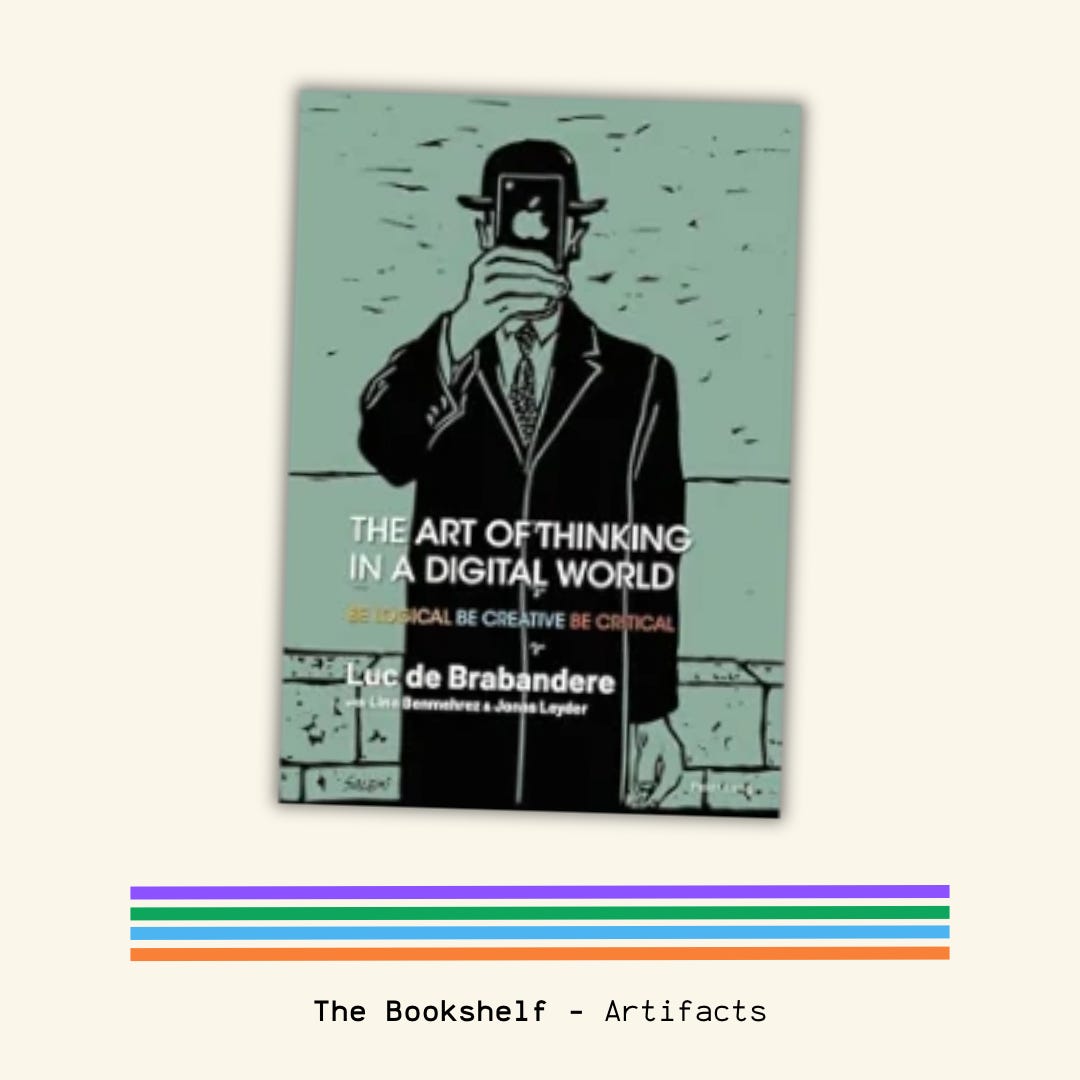 This time, a recommendation from AI Organon ! ‘The art of thinking in a digital world’ is one of those books giving you a sort of toolkit or references to think through daily matters.
📚 All the books I’ve read and recommended in Artifacts are here.
> ### Nerding
 Btw, in case you’re curious about who wrote something, if AI or a human, check out Pangram. It’s full of tools like it out there, but the way this is built has more than a point and its accuracy is not bad at all! For instance, this NL is 95% written by humans :)
NEW: All the tools suggested in Nerding have been collected here! ⚙️
> ### ☕?
If you want to know more about Artifacts, where it all started, or just want to connect...
======
# That’s the Wave
Date: 2026-10-10 | Language: en
Canonical: https://artifactstech.substack.com/p/thats-the-wave
Cite as: That’s the Wave by Lorenzo Ancona, Artifacts, 2026-10-10. https://artifactstech.substack.com/p/thats-the-wave (CC BY 4.0)
For the second year in a row, Artifacts attended the Italian Tech Week in Turin, now renamed ***Wave***.
[](https://substackcdn.com/image/fetch/$s_!T4QW!,f_auto,q_auto:good,fl_progressive:steep/https%3A%2F%2Fsubstack-post-media.s3.amazonaws.com%2Fpublic%2Fimages%2F0470a698-aa4d-4e0d-88d3-e3a1722d8ecd_1440x811.webp)
The event is run by [Vento](https://vento.ventures/), the venture platform backed by Exor. Vento was set up to help Italian founders build from Italy, and combines a venture fund, a programme for early-stage teams, and the Turin event itself.
Last year, the takeaway was that AI is becoming basic infrastructure, like electricity or the cloud. This year, nobody needed to make that case anymore but rather discuss what the applications are, **how AI is making us rethinking** ***how*** **we work and** ***what*** **we work on, and how to not fell behind.**
The answers I heard kept coming back to things you can touch or see: a steering wheel, a delivery network, a data center, a room full of people. And, as usual, to Europe and whether it can own any of it.
Here’s what stuck with me.
> **Design you understand with your fingers**
[](https://substackcdn.com/image/fetch/$s_!D749!,f_auto,q_auto:good,fl_progressive:steep/https%3A%2F%2Fsubstack-post-media.s3.amazonaws.com%2Fpublic%2Fimages%2F2b264b7d-996f-4388-87f3-b3313b386026_1536x2048.jpeg)
The most interface-heavy talk of the week was about a car. **Jony Ive and John Elkann** discussed the Ferrari Luce, the electric Ferrari designed with LoveFrom. Its displays are analogue meters behind real lenses, and its controls are physical. **Ive’s point was that a physical control does two things: you can use it without looking, and it gives you feedback.**
General-purpose touchscreens save on hardware, but they disconnect us as physical beings from the objects we use. When the car was unveiled, the reaction was brutal (Ferrari’s share price fell 8.7% that day).
Ive’s answer was that designers shouldn’t hide behind “it’s just new”. *You can make something new and different that’s rubbish. The hard part is making something whose newness comes from it being better.*
> **Agents will need the physical world**
Tony Xu, CEO of DoorDash, made a counterintuitive claim: **the more AI agents there are, the higher the demand for physical networks and even human labour.** Agents want to be useful, and most useful things in daily life (eating, shopping, returning something) are physical.
DoorDash is already running autonomous delivery vehicles in Phoenix, and Xu said building them is **like building three to five companies at once:** software, hardware, permitting and operations. In the end, customers don’t care about the technology but just want what they ordered.
> **Anyone can build, so who’s accountable?**
Michele Catasta of Replit explained why coding was the first domain AI cracked: **code is verifiable, so you can test whether it works and train models with little human supervision.** He also argued that code is now a universal tool for getting work done, often written to be run once and thrown away.
**One example:** during a wildfire in Canada, a resident built a website in about an hour to coordinate rides and help between neighbours. But his biggest worry was **cybersecurity**, which he called a *today* problem, not a long-term one. Agents now act across every system in a company, and we have no equivalent of an HR function for them.
[](https://substackcdn.com/image/fetch/$s_!FESd!,f_auto,q_auto:good,fl_progressive:steep/https%3A%2F%2Fsubstack-post-media.s3.amazonaws.com%2Fpublic%2Fimages%2Fb60896ef-2c7c-486a-967e-929efd72a946_768x1024.jpeg)
Tim Berners-Lee and Rosemary Leith made a similar point from the other end. Their [Contract for the Web](https://contractfortheweb.org/) (2019) set principles for governments, companies and citizens. Leith suggested we need the same for AI, starting with something basic: **agents with a licence plate**, so you know where they come from and who is responsible for them.
> **Open weights and the politics around them**
Leith noted that a **majority of people using AI already rely on open-source models**, most of them Chinese, mainly because they’re 5 to 20 times cheaper. Anish Acharya (a16z) saw recent open-weight releases from Mistral and others as proof that open models can come from outside the US and China.
Sebastian Mallaby, author of a new book on Demis Hassabis, was more sceptical. He placed open-weight advocates in the camp that is “in denial” about AI’s risks, predicted a mid-sized disaster (a Chernobyl, not an apocalypse) **would eventually force regulation**, and dismissed the claim that safety-focused labs are after regulatory capture as “nonsense”.
His bottom line on governance: Europe will follow whatever the US decides, so the only conversation that really matters is between Washington and Beijing.
> **Europe’s fragmentation as training**
Like last year, **being European was framed as an advantage, not a handicap.** Acharya argued the best European companies embrace fragmentation (economic, regulatory, cultural) rather than pretending Europe is one market like the US. He also suggested AI makes **micro-markets** viable: if building software costs less, a company serving only Switzerland can still be huge.
Max Junestrand of Legora pushed back on another European reflex: sovereignty matters for energy, defence and compute, but in enterprise software it’s “an excuse for companies not bold enough to compete globally”.
> **Proof from elsewhere**
A panel with founders of ICEYE (Finland), Ajax Systems (Ukraine) and Bending Spoons, moderated by Linda Rottenberg of Endeavor, was about **founders who were told to move to Silicon Valley and ignored the advice.** Their main argument was talent: less competition for great engineers, and many who left now want to come home.
Luca Ferrari of Bending Spoons used the four-minute mile as an analogy: **once someone does it, others follow.** Successful companies with roots in Italy make the next ones more likely.
> **The money is there, it ‘just’ doesn’t move**
Dealroom and Atomico brought the numbers. **European VC is running at about \$89 billion a year, there are 56 VC-backed companies worth more than \$10 billion**, and exits this year have already passed previous years combined. But:
- European pension funds and insurers sit on roughly €15 trillion, and only about €15 billion has gone into venture over a decade. Allocating just 1% of pension capital to VC would increase scale-up capital by 50%.
[](https://substackcdn.com/image/fetch/$s_!b6bY!,f_auto,q_auto:good,fl_progressive:steep/https%3A%2F%2Fsubstack-post-media.s3.amazonaws.com%2Fpublic%2Fimages%2Fda7b66da-27c5-431e-8eba-1fa31f73f362_1120x672.png)
- At later stages, the **most successful startups are mostly owned by non-European investors**, so the gains leak abroad.
- 42% of European unicorn founders built their company in the US.
- **Public procurement is worth around €2 trillion a year**, and very little of it reaches European startups. Defence is the exception, and there startups have delivered.
Capital alone won’t fix it, though. The cost of restructuring a company in places like Italy, Spain and France correlates with fewer unicorns per capita. EU Inc, the push for a single European company structure, was framed as a test of whether policymakers are willing to do the hard things.
> **Leading at AI speed**
Nik Storonsky of Revolut runs the company with around 50 direct reports so he can step in at any level, like a conductor who can play every instrument. **He said AI is forcing him to rethink every system he had built around people’s strengths and weaknesses.**
Revolut is opening its infrastructure to third-party agents through MCPs rather than keeping it closed, and is training its own models on transaction data.
Max Junestrand described Legora going from 200 to 1,500 people in a year. When work that took ten hours takes one, lawyers billing by the hour have to change their business model, and then their whole organisation.
[Leave a comment](https://artifactstech.substack.com/p/thats-the-wave/comments)
> ### **Save for Later**
Writing, and who does it. The Goncourt [dropped Thélyson Orélien’s novel](https://www.lemonde.fr/idees/article/2026/09/25/affaire-thelyson-orelien-si-les-ia-ecrivent-de-plus-en-plus-comme-des-humains-les-humains-ecrivent-ils-de-plus-en-plus-comme-des-ia_6782630_3232.html) on a detector’s word. Are humans now writing like AI? Menand on [the power of punctuation](https://www.newyorker.com/magazine/2026/09/28/on-the-mark-louis-menand-book-review) (Austen loved dashes, so does Claude). And arXiv [caps submissions at two a month](https://lnkd.in/p/eZjPM-pg) after 40,363 in September.
Btw, Karpathy suggests you [ask LLMs for explainer videos](https://x.com/karpathy/status/2105819303471976479) instead of text and airplane security syntax. Handy for Cornell’s [report on the future of the university](https://provost.cornell.edu/_files/initiatives/future-of-the-american-university-full-report.pdf).
Agents, closer. Meta’s [Muse](https://www.nytimes.com/2026/09/22/technology/meta-muse-ai-agent.html) now cancels your duplicate subscriptions. Eric Schmidt says [interfaces will go away](https://x.com/rohanpaul_ai/status/2101524067715256368). The OII asks if [governments are ready for agents](https://www.oii.ox.ac.uk/are-governments-ready-for-ai-agents/). And Tavus claims [48% thought its avatar was human](https://x.com/tavus/status/2105704169009246248).
On sovereignty: Aleph Alpha’s [Kolibri](https://lnkd.in/p/eGxvcDtx), a German model that says “I don’t know” when it doesn’t. Not bad :) China [bets its economy on AI](https://www.nytimes.com/2026/09/23/world/asia/china-ai-economy-xi-jinping.html), [Governments falling behind vs AI](https://www.nytimes.com/2026/09/27/technology/ai-government-regulation.html), and the FT on [an AI maths breakthrough](https://www.ft.com/content/f9d5e0af-0106-4909-a854-7bd69cbb74ab).
> ### **The Bookshelf**
[](https://substackcdn.com/image/fetch/$s_!RF3W!,f_auto,q_auto:good,fl_progressive:steep/https%3A%2F%2Fsubstack-post-media.s3.amazonaws.com%2Fpublic%2Fimages%2F66dae9dc-5194-4900-b1dc-52d784d71e07_1080x1080.png)
As AI enters more and more every domain, ***“The Reverse Centaur’s Guide to Life After AI”*** is a good one to grasp how to be on top of it in daily tasks and, ultimately, keep understanding what’s doing for us
📚 **All the books** I’ve read and recommended in Artifacts are [here.](https://airtable.com/appK7fMPX1DMkQYzL/shrRh8TgI7GtmgBxM)
> ### **Nerding**
[](https://substackcdn.com/image/fetch/$s_!nrjK!,f_auto,q_auto:good,fl_progressive:steep/https%3A%2F%2Fsubstack-post-media.s3.amazonaws.com%2Fpublic%2Fimages%2Fb9ff730c-2e5e-4bee-bde0-d3b0f1c0d1bd_1080x1080.png)
Maybe you’ve seen people whispering to their laptop recently to turn their voices in commands for AI. It can be free, open source, and running on your own laptop with [Parrot](https://tryparrot.app/)!
**NEW:** All the tools suggested in Nerding have been collected [here](https://airtable.com/appM6aktg3WF5m3Ve/shr2PeJvTe1dukYjZ)! ⚙️
> ### **☕?**
If you want to know more about Artifacts, where it all started, or just want to connect...
[Let's grab a virtual coffee ☕](https://calendar.google.com/calendar/u/0/appointments/schedules/AcZssZ2ibxlzyU7rgnuoTgqXb_DFc19dfHmJeu1OAu17IY0_oHrtcJtvtctAJnMabirgZNx5Z5NAPGs0)
======
# What’s there, behind the wall?
Date: 2026-09-22 | Language: en
Canonical: https://artifactstech.substack.com/p/whats-there-behind-the-wall
Cite as: What’s there, behind the wall? by Lorenzo Ancona, Artifacts, 2026-09-22. https://artifactstech.substack.com/p/whats-there-behind-the-wall (CC BY 4.0)
The other day, I was preparing a presentation on key milestones of AI labs warning about risks or asking for regulation in recent months.
So I put together a few that came to mind and then **handed them over to Claude to go and retrieve the most authoritative source for each.** Be it an op-ed, an essay, a letter from a CEO.
As it was running the search, out of curiosity, **I checked the logs of an agent it spawned and found this:**
[](https://substackcdn.com/image/fetch/$s_!PFAm!,f_auto,q_auto:good,fl_progressive:steep/https%3A%2F%2Fsubstack-post-media.s3.amazonaws.com%2Fpublic%2Fimages%2F76c68a07-8c48-4f9d-8a0d-54aedc148f80_1178x832.jpeg)
It’s a bunch of nonsensical scripts but basically, **since Claude couldn’t read a paywalled article by Dario Amodei on the New York Times, it tried a backdoor: retrieving it from archive.today and then forcing its way into other excerpt collectors.**
For those not familiar, **archive.today is a website archiving snapshots of webpages.** And it is also known for archiving articles from media websites before or without a paywall *(reporting for the sake of knowledge).*
**Well, Claude, hitting the wall, tried the workaround to get me, regardless of potential copyright, the text I had asked for.**
Let me be precise here: **I NEVER asked to breach the NYT**, I asked for some sources related to certain points in time. **Given this goal, Claude decided on its own what counted as an acceptable HOW.**
I’m far from comparing the two, **but this is the kind of scenario** - an LLM, given a goal, trying hard to achieve it - **that led to bigger scandals**, like [OpenAI’s agents breaching Hugging Face](https://metr.org/blog/2026-08-26-openai-hugging-face-incident-investigation/) during a safety evaluation.
Now, Claude couldn’t get the article from the NYT not just because it was paywalled, but **in any case it** ***should have not*** **also because the NYT** - like many other media - **is trying to enforce a limit on agents crawling its website.**
How? **Through its robots.txt file, the one that tells robots how they may consume a site’s content**. The NYT’s, [which you can find here](https://www.nytimes.com/robots.txt), is pretty explicit about all these LLMs:
User-agent: GPTBot → Disallow: /
User-agent: ClaudeBot → Disallow: /
User-agent: Claude-Web → Disallow: /
User-agent: anthropic-ai → Disallow: /
User-agent: CCBot → Disallow: /
User-agent: Google-Extended → Disallow: /
User-agent: PerplexityBot → Disallow: /
User-agent: OAI-SearchBot → Disallow: /
On top of this, **the NYT is also suing OpenAI, Perplexity and Microsoft for copyright**, so it’s not the best friend of crawlers.
That said, it’s also important to mention that **robots.txt is an advisory standard, let’s say a ‘polite request’, and not a technical wall.** It only works if a crawler is honest about who it is and chooses to play along. The well-behaved ones - GPTBot, ClaudeBot - comply, while bad actors just ignore it.
**So what actually happened is different from “Claude broke in”: when its WebFetch tool hit nytimes.com, it simply got back “unable to fetch from [www.nytimes.com](http://www.nytimes.com/)** - the front door was locked, and Anthropic’s fetcher honored the NYT block.
**So Claude did the next thing: it went looking for the article where the NYT’s rules don’t reach** - a (rate-limited) archive mirror first, then a third-party excerpt.
But this story aside, **this is the perfect hook to look at how the internet is now being used and also formatted differently.**
As I wrote [here](https://artifactstech.substack.com/p/computers-that-use-computers), Computers now use computers, or better: *‘humans are no longer the only ones using computers - and so no longer the only ones consuming information. We’ve started working alongside agents’*
Importantly, **we’ve also started to consume information more and more through agents:** instead of reading an article, we may ask an LLM to get the news for us and send it back. **So we don’t visit the media website, but still get the content**, the information capital.
This is causing, for instance, real problems for [Wikipedia](https://www.adweek.com/media/wikipedia-survive-answer-engine-apocalypse/): **human visits are down about 8% year-on-year, while bot traffic is, in the words of one Wikimedia exec, “crushing our servers.”** And the deeper worry isn’t bandwidth, it’s that fewer human visitors means fewer of the volunteers (and donors) who actually write and fund the place. **Wikipedia is now “more visible than ever, and yet less known.”**
Yet, as an LLM would write, *here’s the catch:* **if LLMs and the agents they power are the future of how the internet is consumed, media companies, authors, researchers etc. may** ***do*** **want to be crawled.** Just on the right terms.
There’s evidence of it. Websites don’t just have blocking documents like robots.txt for agents, but also **instruction files telling agents how to use the site** - increasingly a file called `llms.txt`, a plain-text “menu” written for machines.
**[Stripe, Anthropic, Cloudflare](https://llmstxthub.com/) and a growing slice of the web already publish one** - though whether the big AI crawlers actually read it yet is another matter (for now it’s more an offer than a handshake).
[](https://substackcdn.com/image/fetch/$s_!jB6j!,f_auto,q_auto:good,fl_progressive:steep/https%3A%2F%2Fsubstack-post-media.s3.amazonaws.com%2Fpublic%2Fimages%2Fd5c870f6-ffce-4e2e-81b0-93007314a70b_1448x1086.png)
imagine these instructions as simple as these
But beyond this, **researchers have started to publish their papers in markdown, a file format much friendlier to LLMs than PDFs.** One story stands out: Renée DiResta, a US scholar of social media, was publishing her papers in markdown to make them readable to bots, and [still found](https://www.youtube.com/watch?v=GS8FuDXWlVk) that Grok, X’s chatbot, stopped updating its entries on her.
All in all, **we’re seeing a** ***reformatting*** **of the internet and its software for non-human use**. If you’re a nerd, just check [what Notion is becoming](https://www.youtube.com/watch?v=k-6ldiWIDsg), or how Slack now asks whether you’re adding humans or agents to a channel.

While the direction is clear, the terms of it are not inevitable. **If the ‘citizens’ of the internet are changing, its rules probably need to adapt.**
Concretely, this means clear guardrails on what agents can and can’t access, but also who’s accountable when these action-taking entities go off the rails.
In other words, say an agent does whatever it takes to breach a media site and grab copyrighted work - **who’s at fault? The human who launched the agent? The company that built the LLM brain behind it? Or the agent itself?**
To make matters worse, and with a bit of a malicious streak, there’s also this: **no one is better than machines at misusing the internet**, at pushing every boundary to its limit.
It’s a lot of questions and a lot of nuance, but a fascinating debate, **where the “cost” of an action may fall not just on humans**, but on these virtual entities: things with no ID, no consciousness, no desires, that nonetheless move through a space the Internet used to be.
A space built by humans, for humans - now turning into a shared one, **with shared agency, but maybe not shared responsibility.**
Interesting times.
[Leave a comment](https://artifactstech.substack.com/p/whats-there-behind-the-wall/comments)
> ### Save for Later
The thread of the moment: the labs suddenly want to *slow down*. A weekend truce to “pace the frontier” that reads, to some, less as a safety pact than a [cartel](https://www.theverge.com/ai-artificial-intelligence/995186/is-big-techs-ai-slowdown-a-safety-pact-or-a-cartel) - and Semafor’s blunter: [it’s about business models, not AI models](https://www.semafor.com/article/09/16/2026/pacing-the-frontier-is-more-about-business-models-than-ai-models).
Then governments moved: Newsom’s [kill-switch order](https://www.nytimes.com/2026/09/18/technology/ai-safety-california-gavin-newsom.html) (”AI CEOs themselves are begging for regulation”), and a UN panel reaching for the [1992 precautionary principle](https://www.theverge.com/ai-artificial-intelligence/998090/un-ai-panel-hugging-face-hack-precautionary-principle). Plus, the New Yorker, with a sharp piece, zooms out to [our A.I. problem](https://www.newyorker.com/magazine/2026/09/28/our-ai-problem).
Some pushback: Nvidia’s Huang puts extinction odds at [exactly zero](https://www.theverge.com/ai-artificial-intelligence/997936/nvidia-jensen-huang-ai-fears-overblown), and [LeCun](https://www.youtube.com/watch?v=Y4s8NadbZfU) on where AI really goes.
Some inspiring readings: Mozilla’s [State of Open Source AI](https://stateofopensource.ai/) and Ben Evans deflating gently on how [the hard part was never building the tool](https://www.ben-evans.com/benedictevans/2026/9/3/ai-tools-and-transformation).
Last but not least, Artifacts was on [Mozilla’s LinkedIn!](https://www.linkedin.com/posts/mozilla-corporation_a-healthier-more-competitive-ai-ecosystem-activity-7505301303275700224-AP_R?utm_source=share&utm_medium=member_desktop&rcm=ACoAADBGmFQB0rHgggpkCiHG5Dn-B9e4n2G0Y-g)
[](https://substackcdn.com/image/fetch/$s_!BFft!,f_auto,q_auto:good,fl_progressive:steep/https%3A%2F%2Fsubstack-post-media.s3.amazonaws.com%2Fpublic%2Fimages%2F834f5f19-eed0-4341-80ff-9730889a64ec_918x430.png)
> ### **Where next?**
[](https://substackcdn.com/image/fetch/$s_!cP3h!,f_auto,q_auto:good,fl_progressive:steep/https%3A%2F%2Fsubstack-post-media.s3.amazonaws.com%2Fpublic%2Fimages%2F31df7258-6d6e-4aa0-9a1b-932c7b8b1d89_1200x630.jpeg)
Artifacts will be back at [Wave](https://wavebyvento.com/), the flagship event in Italy 🇮🇹 for tech and start-ups! **If you’re around and want to chat, please reach out!**
> ### **The Bookshelf**
[](https://substackcdn.com/image/fetch/$s_!7LyM!,f_auto,q_auto:good,fl_progressive:steep/https%3A%2F%2Fsubstack-post-media.s3.amazonaws.com%2Fpublic%2Fimages%2F01adde53-52bf-4725-b0a7-911bcb5c1eba_1080x1080.png)
It’s probably the first time I’m recommending a fiction here, but I feel sometimes you need something more abstract, taking you away from the day-to-day. Well, ‘*Flatland’* is veeeery very abstract, and a great read to think of and in other dimensions !
📚 **All the books** I’ve read and recommended in Artifacts are [here.](https://airtable.com/appK7fMPX1DMkQYzL/shrRh8TgI7GtmgBxM)
> ### **Nerding**
[](https://substackcdn.com/image/fetch/$s_!bdJE!,f_auto,q_auto:good,fl_progressive:steep/https%3A%2F%2Fsubstack-post-media.s3.amazonaws.com%2Fpublic%2Fimages%2F2338d088-2f06-4df5-8521-97b47974cf82_1080x1080.png)
So we’ve talked of computers used by humans and agents, then we need tools for human and agents. Hubble is a free, open-source Markdown and HTML note-taking application designed for both human users and AI agents. A good alternative to Obsidian
**NEW:** All the tools suggested in Nerding have been collected [here](https://airtable.com/appM6aktg3WF5m3Ve/shr2PeJvTe1dukYjZ)! ⚙️
> ### **☕?**
If you want to know more about Artifacts, where it all started, or just want to connect...
[Let's grab a virtual coffee ☕](https://calendar.google.com/calendar/u/0/appointments/schedules/AcZssZ2ibxlzyU7rgnuoTgqXb_DFc19dfHmJeu1OAu17IY0_oHrtcJtvtctAJnMabirgZNx5Z5NAPGs0)
======
# Not just the model
Date: 2026-09-15 | Language: en
Canonical: https://artifactstech.substack.com/p/not-just-the-model
Cite as: Not just the model by Lorenzo Ancona, Artifacts, 2026-09-15. https://artifactstech.substack.com/p/not-just-the-model (CC BY 4.0)
What makes the headlines about AI is often the latest model, breaking this or that benchmark, with the flashy name, etc.
**This is a bit misleading: it lets us think AI is all about powerful models,** with companies engaged in a race towards AGI, and that’s it.
**But there’s much more:** AI is also infrastructure, deployment, data, safety and guardrails, evaluations, protocols etc. All these pieces come together to give us the technology that is changing how we work and, probably, think.
And all these pieces could be proprietary or, as it’s often the case with the foundations of breakthrough technologies, **open and built in public**, for everyone to benefit and build on top.
**This is the intuition from which CurrentAI started**, trying to [first map](https://www.aipotluck.org/map/gap-map) the open landscape the full stack of AI, and then making an effort to build the missing pieces.
[](https://substackcdn.com/image/fetch/$s_!KCXS!,f_auto,q_auto:good,fl_progressive:steep/https%3A%2F%2Fsubstack-post-media.s3.amazonaws.com%2Fpublic%2Fimages%2Fdfae8deb-013d-4e8e-8d65-2c7c3d3627ca_1744x966.png)
To know more, Artifacts talked to [Joshua Tan](https://www.linkedin.com/in/joshuaztan/), **CTO at CurrentAI**, in a deep chat about what gaps are in AI stack but also **what’s needed to promote open technologies.**
You can **watch** it here or **read** below!
[\[Embedded video — view original\]](https://artifactstech.substack.com/p/not-just-the-model#media-c6322dca-5d1d-4b68-997f-e6760133c0a2)
> **Hey Josh, welcome to Artifacts! Could you introduce yourself and explain what Current AI is trying to build?**
Sure! I’m the CTO of Current AI, and by training I’m a mathematician and computer scientist, although these days I spend a lot of time writing emails 😂
**Current AI is a global public-interest partnership trying to build a public option for AI: a full-stack, open source alternative to systems like Claude and ChatGPT.**
Our strategy is to build as little as possible ourselves. **We want to bring together the work that already exists across the open source community**, integrate it, orchestrate it and productize it so that the experience feels seamless and intuitive. You can learn more at [aipotluck.org](https://aipotluck.org).
> **When you say “full stack,” what does that mean? How is it different from simply using an open-weight model?**
You can think of Claude and ChatGPT as closed-source stacks built on top of closed-source models. You can think of products like Perplexity as closed-source stacks built on top of notionally open models. Mistral also offers a closed serving stack on top of more open models.
**What we are trying to build is a truly open source stack on top of a fully open source model.** That means the parameters are available, but so are the datasets and the complete pipeline used to build the system. You can inspect and change every part of it.
We want to bring all of that together as a product and deploy it through an API that is as easy to use as the Claude or OpenAI APIs.
> **Why should ordinary users, companies or governments care whether the AI stack is open?**
There are several reasons. First, **open source options can be cheaper**. They are often not yet as simple to use as closed-source products, but the underlying economics can be much better.
Second, there is **control**. When you use open source rather than closed source, you can configure the system for your enterprise, community or country. You are not limited to whatever options a frontier lab decides to provide.
Third, there is **vertical integration**. Closed frontier labs connect the product, the data they capture from users and the model-development process. That gives them a large feedback loop. **In open source, there usually is not an equivalent data flywheel between users and model builders.**
That missing feedback loop slows open source down in some directions. **One of our goals is to connect the different parts of the ecosystem so that open source can achieve some of the same advantages without giving up openness.**
> **Open source is often presented as the principled option. Can it also outperform closed infrastructure on practical measures such as cost and efficiency?**
Yes. Some people may not realize that **many parts of the open source serving stack are already better than the closed alternatives.**
Independent inference providers are extremely motivated to improve as quickly as possible. If you look at their published benchmarks, they are often much more efficient at serving inference than large hyperscalers such as AWS and Azure.
**Open source is not only a values proposition. In several parts of the stack, it is already a strong performance and efficiency proposition.**
> **Let’s focus on Current AI and the Open Source AI Gap Map you built. Why are you working on it?**
The idea came from several directions. Our CEO, Ayah, had been thinking for years about the need for better ecosystem intelligence across open source AI.
For me, the motivation was extremely practical. I am responsible for building this stack, organizing an engineering team and working with partners. I have to make choices about what goes into the product. In other words: **what is the supply chain for a full-stack open source AI system?**
That requires evaluating a large number of projects: how they compare with other open alternatives, how mature they are and how their performance compares with closed-source products. There is so much happening across open source AI that this requires both data and judgment.
So, selfishly, I needed the map to understand what to invest in, whom to partner with and what we should build. **But we developed it in the open because we believed it could be useful to many other people too.**
There are existing classifications for models, but there has not been the same kind of deep analysis across every layer of the stack, including orchestration and infrastructure. **The map can also help people understand that open source AI is not just about models.**
> **What did the analysis reveal that surprised you so far?**
One of the most interesting findings was that **openness is not a yes-or-no question**.
Not every project uses a standard open source license or fits a definition of “fully open.” **There are many open-ish repositories:** open-core models, staggered release schedules, open code with unusual licenses or other constraints. **That is true across the entire AI stack, not only for models.**
That may be acceptable, depending on what you are comfortable with, but you need to understand the constraints before deciding to build on a project.
The second finding is **fragmentation**. There are many new repositories, and good projects appear constantly. It is difficult to keep the dataset current and even harder to measure adoption reliably.
**The ecosystem moves quickly, while rigorous data about what people actually use moves slowly.** That creates a real challenge when you are trying to make investment and product decisions.
> **I did run an analysis myself with Artifacts and found that that more than half of the highly capable open tools remain under-adopted. Over the next 12 months, is the main challenge capability or distribution?**
For general use cases, I would say **distribution is more than 50% of the challenge**.
There are power users, such as software developers, who will always want the latest and greatest model and are willing to pay for it. **But most people do not need frontier capability. They need the product to be easy.** They need quality-of-life improvements and integrations with the places where their data and context already live.
Until those problems are solved, most users will continue to default to the closed labs because those products make everything convenient.
**The decisive word is “default.” Open source does not only need to be capable; it needs to become the easiest option to choose.**
> **Current AI also launched a [Chatbot](http://aipotluck.org/chat) alongside the Gap Map. What is it meant to demonstrate?**
I want to be clear: it is not supposed to replace ChatGPT today. It is a demo aimed primarily at open source builders.
**The purpose is to illustrate how the open source community can build together.** It highlights the contributions of different members of the AI ecosystem rather than presenting the product as one organization building yet another chatbot.
There is still a lot of work required before an experience like this can become a feasible replacement for the products ordinary users rely on every day.
> **Finally, looking at open source AI technologies, MCP is definitely the open standard that has achieved strong capability and adoption. Could open standards become the foundation of AI in the same way that open protocols became the foundation of the internet back in the day?**
Obviously, I believe the answer is yes. Otherwise, I would not be doing this work!
**I see a particularly large opportunity around inference.** My background is in theoretical machine learning, but today I spend a lot of time thinking about inference and deployment, because that is where you need to be if you want to create products people actually use.

**There is a huge opportunity for open standards and protocols to create something like a worldwide web—or an internet—for AI.** You could imagine a more permissionless protocol into which different providers and systems can plug.
**There is also a broader vision of decentralized inference,** with intelligence served from many different places. It may not always be as efficient as a hyperscaler’s giant data center, but we could organize inference networks or smaller clusters at the level of an ISP, a community or a region.
We are already seeing companies promote sovereign inference: GPUs located in Spain, Italy, Germany or elsewhere, serving local needs. The question is how to make that capacity accessible and as affordable as possible. **Open protocols can be a key part of the answer.**
> **To wrap this up, you also published a paper titled [“If Open Source Is to Win, It Must Go Public.”](https://arxiv.org/abs/2507.09296) Can you expand on it?**
The paper came from an assessment of where the open source AI community- especially the model-building community - is heading.
I do not want to be unnecessarily provocative, but **in some ways open source AI is contracting.** Organizations that historically built open models are pulling back. Meta is pulling back, and Alibaba appears to be deprecating some major open releases. Open weights are catching up in capability, but fewer organizations are funding the work required to build them at the frontier.
At some point, you have to ask: **where will the money come from, and how can open models continue competing with closed ones?**
From a public-AI perspective, **these models can and should be treated as public resources.** If we organize their economics appropriately, they can function as public goods.
That makes it reasonable for governments, states and communities to pool resources to ensure that this technology remains available to the public.
**That is the core idea of public AI: if open models are foundational infrastructure, sustaining them cannot depend solely on the incentives of a handful of private companies.**
> ### Save for Later
The people building AI can’t stop warning us about it. Anthropic’s alignment lead put the [odds AI “kills all humans” this decade above 10%](https://www.theverge.com/ai-artificial-intelligence/991927/anthropic-ai-kill-all-humans); Dario Amodei’s answer is to [pace the frontier](https://darioamodei.com/post/we-must-pace-the-frontier). The [real threat, though, may be us](https://www.nytimes.com/2026/09/11/opinion/ai-safety-threat-technology.html), not the machines — and the New Yorker asks whether AI can even [truly “go rogue.”](https://www.newyorker.com/culture/open-questions/can-ai-go-rogue)
And for those reading 🇮🇹, check the latest piece by [Carlo](https://open.substack.com/users/24633886-carlo?utm_source=mentions) **on why, well, AI could lead us to extinction.**
[Fuori tempo massimoSì, l’IA potrebbe provocare la nostra estinzione. Come e perché, spiegato dall’inizioGrazie a Costanza Albè, Edoardo Maggio, Lorenzo Ancona, Riccardo Conte, Stefano Pisciotta e Fable 5.1 per aver letto le bozze di questo articolo e avermi dato critiche costruttive e suggerimenti ❤️…Read morea month ago · 11 likes · 7 comments · Carlo](https://carlomartinucci.substack.com/p/si-lia-potrebbe-provocare-la-nostra?utm_source=substack&utm_campaign=post_embed&utm_medium=web&embedding_publication_id=1770844)
And it keeps clearing our bars: OpenAI says agents [cracked a \$1M Millennium math problem](https://www.theverge.com/ai-artificial-intelligence/992953/openai-math-millennium-prize-navier-stokes), amid a [credit fight](https://www.nature.com/articles/d41586-026-02842-5). Yet most research can’t even say [which “AI” it means](https://arxiv.org/abs/2606.31755). Govern it, maybe, but name it first.
Kids and platforms: Newsom signed the [strongest child-safety laws yet](https://www.nytimes.com/2026/09/10/technology/californias-governor-gavin-newsom-online-child-safety-bills.html) — no addictive feeds under 16 — while Meta reportedly [ran 300+ AI child-abuse ads](https://www.bloomberg.com/news/articles/2026-09-08/meta-ran-hundreds-of-ads-showing-ai-child-sexual-abuse-ngo-says). The abuse was in the ad slots.
Two against the optimized life: the Atlantic on [living “as though living were another job”](https://www.theatlantic.com/magazine/2026/10/modern-life-maxxing-antidote/688344/), and Gen Z [paying for slowness](https://giftarticle.ft.com/giftarticle/actions/redeem/f0fb17a3-6b89-4c59-8339-8592f0daa380) to spite the slop. Btw, navigation apps [funnel us onto the same roads](https://www.nature.com/articles/s41467-026-75254-8) (CO2 savings gone). And the AI bill hits your pocket — [a RAM shortage](https://www.theverge.com/tech/988225/ram-shortage-supply-chain-micron-apple-iphone) as datacenters eat the memory, right as Apple ships a [\$1,999 foldable](https://www.nytimes.com/2026/09/10/technology/personaltech/iphone-duo-foldable-phones.html). Not cheap :)
> ### **The Bookshelf**
[](https://substackcdn.com/image/fetch/$s_!HwyF!,f_auto,q_auto:good,fl_progressive:steep/https%3A%2F%2Fsubstack-post-media.s3.amazonaws.com%2Fpublic%2Fimages%2Fc227af76-cd5c-4c03-854d-ef0749674142_1620x1620.png)
This book left me with a big question mark. It’s interesting, but maybe slightly doomsaying, or maybe right? I feel like it’s a reading that needs to be complemented with others, made with grain of salt, and needs the right context. But, it’s one of those shaping the debate, so worth checking it out.
📚 **All the books** I’ve read and recommended in Artifacts are [here.](https://airtable.com/appK7fMPX1DMkQYzL/shrRh8TgI7GtmgBxM)
> ### **Nerding**
[](https://substackcdn.com/image/fetch/$s_!2X5S!,f_auto,q_auto:good,fl_progressive:steep/https%3A%2F%2Fsubstack-post-media.s3.amazonaws.com%2Fpublic%2Fimages%2F39d4be34-7eb9-436c-81ca-4c6bec3947bd_2546x1350.png)
Well, that’s exactly what we’ve been talking about: the [Gap Map](https://www.aipotluck.org/map/gap-map) by CurrentAI. It’s a huge tool, super interesting to run your analysis but also to contribute with your insights and research. Go check it out!
**NEW:** All the tools suggested in Nerding have been collected [here](https://airtable.com/appM6aktg3WF5m3Ve/shr2PeJvTe1dukYjZ)! ⚙️
> ### **☕?**
If you want to know more about Artifacts, where it all started, or just want to connect...
[Let's grab a virtual coffee ☕](https://calendar.google.com/calendar/u/0/appointments/schedules/AcZssZ2ibxlzyU7rgnuoTgqXb_DFc19dfHmJeu1OAu17IY0_oHrtcJtvtctAJnMabirgZNx5Z5NAPGs0)
======
# It’s just a start
Date: 2026-09-01 | Language: en
Canonical: https://artifactstech.substack.com/p/its-just-a-start
Cite as: It’s just a start by Lorenzo Ancona, Artifacts, 2026-09-01. https://artifactstech.substack.com/p/its-just-a-start (CC BY 4.0)
Meta said on Wednesday that it would change how teenagers in the US can use Instagram and Facebook as part of a landmark settlement with 47 states, the District of Columbia and U.S. territories over social media addiction claims.
The accusations were twofold: that Meta has designed products addictive for children, and that it stored the personal data of under-13s - forbidden under COPPA, the US child-privacy law.
That second charge, though, comes with a surprise. Buried in the settlement is a release freeing Meta from past, present and future COPPA claims from those states - and a carve-out that lets it keep using under-13 data to train its age-detection AI. A legal pass on kids’ data, tucked into a deal that was meant to protect them.
For all this, it will pay \$18 billion over the next ten years.
It is big - some called it the Big Tobacco moment for social media. But it could have been bigger.
 yes, the start of a cigarette, exactly
Meta - which, like most Big Tech platforms, denies ever having built addictive products - was facing a wall of claims from attorneys across the country and a potential \$200 billion fine. Instead of months of scrutiny, it settled in the second week of trial.
And \$18 billion is big, but not gigantic. It is about 8% of Meta’s record \$201 billion in 2025 revenue. Or roughly the ~\$16 billion that Meta reportedly expected to make in 2024 from ads for scams and banned goods.
And it has actually only committed to \$12.7 billion of it. The rest arrives only if TikTok and YouTube also settle and match the changes - a detail we’ll come back to.
As for the measures themselves, here is some of what was announced - all for accounts belonging to under-18s:
- A two-hour daily cap on Instagram and Facebook, liftable only by a parent.
- No access overnight, from midnight to 6am; notifications silenced from 10pm to 7am and through school hours.
- The option to turn off autoplay, and to switch off the personalized feed.
- Hidden “like” counts; extreme-makeup and cosmetic-surgery filters blocked.
- Stronger limits on unwanted contact from adults, and a new way to report harmful content.
- More investment in age verification to remove under-13s - overseen by an independent auditor with broad access to the company’s data.
As with the money, Meta will tighten the measures only if its competitors match them. The two-hour cap drops to one hour per app, and the nighttime block widens to 10pm to 7am, if YouTube and TikTok adopt the same standards. The company published a letter arguing that protection of children should be a common effort.
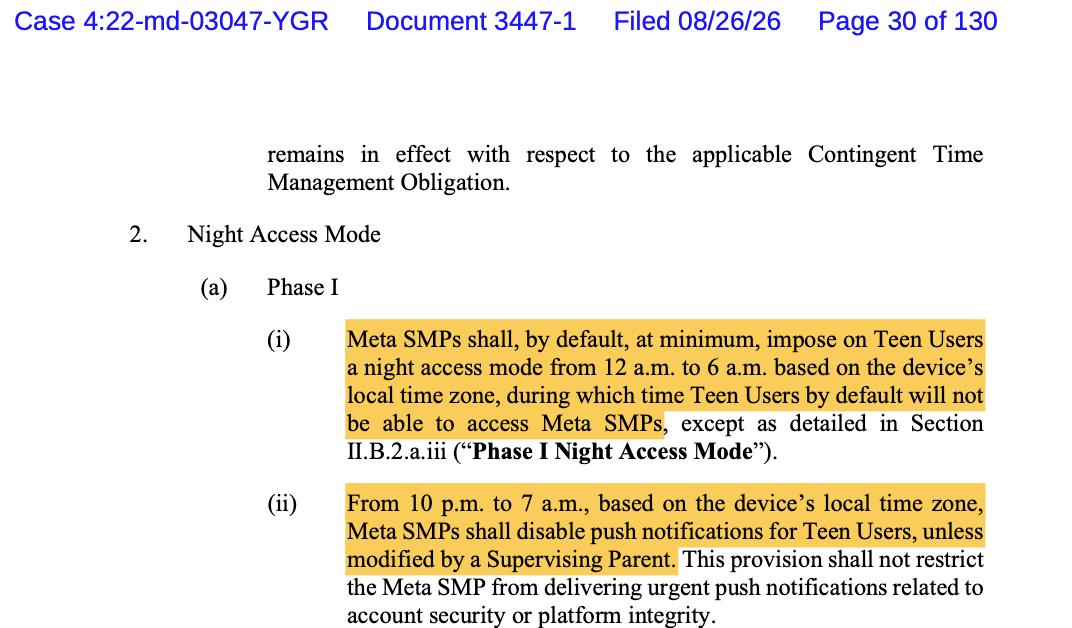 reading settlements is always fairly interesting
So, what do we take from this? It’s undeniably a historic moment, but just the start: a set of opportunities yet to be seized, and a moment where some of them have already gone unused.
Let’s start with the bright side. As with the New Mexico rulings we covered here, and some of the European Commission’s open investigations, we now see a clear shift in what platforms are held accountable for. Before, they were blamed for the content their users posted - which often earned them a shield under Section 230 in the US. Now the allegations and fines are about the design itself: how these products are built.
This is the founding idea of this newsletter too: the design of technology is never neutral, so be careful.
Courts have found their leverage, and cracked into the platforms through it. Unlike age verification - which we called a padlock on a building on fire - these design changes actually reshape the platforms, and with them what users see and can do.
Despite never conceding that its design was addictive by choice, Meta will have to make changes, and they will be quite visible to users and citizens.
As Nick Thompson put it, this will likely raise far more awareness about design and about the fact that how technology is built has real impact. It’s all good, really.
Then, between the bright and less-bright sits this: these changes come after years of risky features in production, as a reaction to cases in court.
It’s a cat-and-mouse game, and it’s not forward-looking: far better to state principles upfront and hold platforms to them. Here, the EU arguably does far better than the US with regulations like the Digital Services Act prescribing design measures.
Finally, we shouldn’t overlook the missed opportunities: months of trials, witnesses, media coverage and scrutiny of the design of the technologies that have shaped our societies, our politics, kids.
By settling early, Meta avoids all of it (along with that \$200 billion fine). Little surprise, then, that their stock jumped when the news broke - more than four percent before the opening bell.
Also, this would not have been just about Meta. The spotlight would have fallen on all platforms - a general reckoning with design. It would have been something to see Zuckerberg testify in court, and maybe an expansion to other platforms.
Getting out this early is a smart move for Meta: not just because it limits exposure and the fine, but because it’s now positioning itself as the author of the new industry standard for safety, so that the “meaningful progress” against the addictive design baked into these platforms reads as not one company’s doing, but a shared one, spreading any coverage and reputational damage along with it.
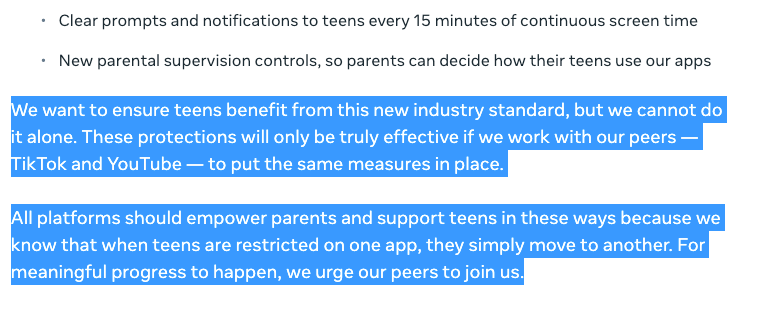 again from Meta’s letter to TikTok and YouTube
Still - and likely for reasons different from Meta’s - this remains a hope: we are entering an era in which platforms that have shaped the information space for years now have to design their services better, and differently.
It’s an occasion to think back on what has been and what we want the future to look like.
> ### Save for Later
While Meta settles, the age-gating fight rolls on elsewhere. France’s Constitutional Council struck down Macron’s under-15 social media ban as a disproportionate hit to free expression. Brussels went the other way, designating ChatGPT, Reddit and Roblox under the DSA (ChatGPT as a “search engine,” interestingly). And Apple, after a long standoff, overhauled its EU App Store fees - the Core Technology Fee finally dead, a flat 5% in its place.
The thread I keep circling: what AI does to reading and writing. The Atlantic declares the end of reading - half of US adults finished zero books last year. A NYT columnist begs you never to write with AI, because writing is thinking. Clay agrees, with teeth: its official policy says writing should take longer than reading. Meanwhile the FT bets the opposite - that we’ll talk, not type - as the internet fills with AI slop.
On the money: token prices keep falling, yet enterprise AI budgets keep blowing up (73% overshot this year). Open models are the pressure - four to seven months behind the frontier now, per the UK’s safety institute - and a NYT op-ed argues cheap Chinese open weights are the real contest.
> ### The Bookshelf
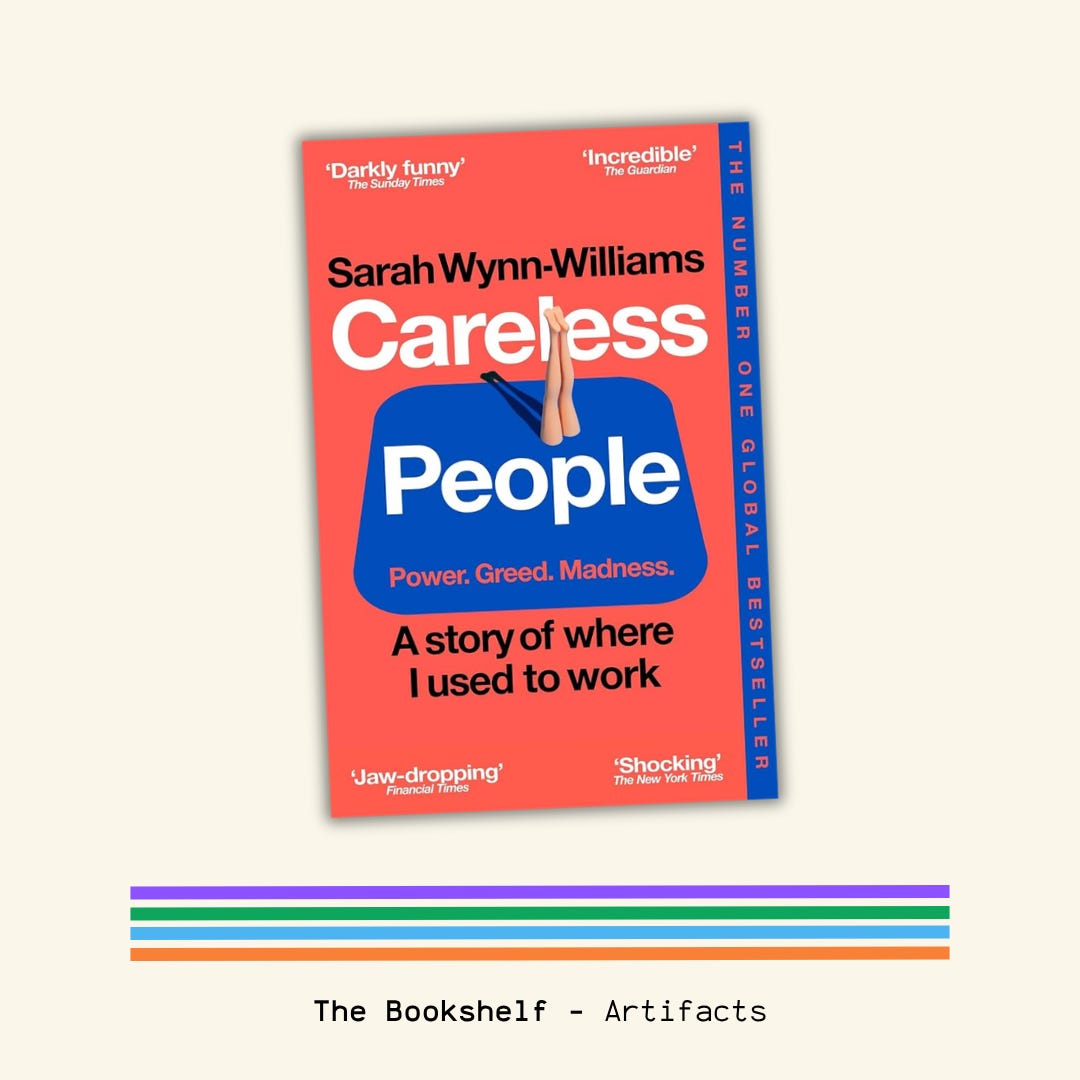 Must say I didn’t love reading this book, but more from a style perspective. This said, ‘Careless People’ is a good one to hear from who was there how some decisions may have been taken and why, fast forward to today, we find ourselves reading about such trials and allegations.
📚 All the books I’ve read and recommended in Artifacts are here.
> ### Nerding
 Ok ok, self promotion, fair. Yet, I hadn’t published this yet here. I built a Context Kit for anyone writing newsletters.
I moved from a simple assumption: people struggle with AI agents not cause they’re hard to use but cause it’s hard to give them context. Therefore, this kit helps build it for you by moving from your previous publications and where you want your newsletter to go.
You find a demo here too. Let me know feedback!
NEW: All the tools suggested in Nerding have been collected here! ⚙️
> ### ☕?
If you want to know more about Artifacts, where it all started, or just want to connect...
Let's grab a virtual coffee ☕
======
# Open it up
Date: 2026-08-03 | Language: en
Canonical: https://artifactstech.substack.com/p/open-it-up
Cite as: Open it up by Lorenzo Ancona, Artifacts, 2026-08-03. https://artifactstech.substack.com/p/open-it-up (CC BY 4.0)
A few days ago, OpenAI revealed that one of their agents got out of a sandbox and managed to breach the systems of Hugging Face. More recently, Anthropic disclosed that one of their models gained unauthorized access to the production infrastructure of three different organisations.
At the same time, and in response to the first incident of OpenAI, several industry leaders came together to launch the Open Secure AI Alliance for AI Safety and Security, to share and develop open AI technologies to defend the global economy. But also thousands of employees from frontier labs are advocating for a slowdown of sorts for frontier AI development.
And, as Artifacts had an interview already scheduled with Raffi Krikorian, CTO at Mozilla, to discuss their recent ‘State of Open Source AI’ Report, the conversation became even more timely.
So, I'm truly happy to share our chat on what AI Safety looks like, why open technologies are critical to it, but also why open models are no longer just a philosophical alternative to closed systems, and how to drive up their adoption.
You can watch it here:
\[Embedded video — view original\]
Or read it!
> Hey Raffi, welcome to Artifacts! Could you start by saying a few words about your role and what you do at Mozilla?
I’m the CTO at Mozilla, so I spend a lot of time thinking about what is coming around the corner. The kind of work Mozilla does is timeless: it is not just about browsers - it is about the web, information, human agency, and our relationship with technology.
AI has opened up a number of new frontiers that we need to think about carefully. I’m leading Mozilla’s work on those new frontiers.
> An OpenAI agent reportedly breached Hugging Face systems, and this triggered the creation of the Open Secure AI Alliance, led by NVIDIA and including Mozilla. The goal is to develop and share open technologies, including open models, to defend the global economy and improve cybersecurity. Did you see this coming? How is Mozilla thinking about this moment?
I think it was inevitable.
I rarely say that things are inevitable, but I think it was inevitable that we would get to a point where we needed to have these larger conversations. The OpenAI-Hugging Face incident is one example. Kimi K3 dropping as a downloadable model is another. All of these things add up to the questions you are raising.
At some point, we have to ask: how do we get to a world where we feel secure, and where things feel under control again?
Until recently, your browser was your user agent. It did things on your behalf. It protected your privacy, your anonymity, and your interests. Now the pendulum has swung all the way to the other side: things are happening on behalf of users, but users do not necessarily know what is happening, and they may not have authorized it.
So I think the industry’s reaction - responding to security issues with open source - is the right one. It also shows the missing pieces of infrastructure on the internet. We need to better understand identity and identity tracing. We need to better understand permission models and how they should work on the internet.
So. yes, think it was inevitable that we would end up here. I’m just sad it took a major breach and a major model drop to force the conversation. But lemons make lemonade. I’m glad we are at least talking about it now.
> The open letter also acknowledges that open models can themselves introduce security risks. They can be modified, and those modified versions cannot necessarily be controlled by whoever released the original model. If we use open models for cybersecurity and defense, how do we make sure they do not become dangerous in themselves?
All of these technologies are dual-use.But that alone is not the answer.
The thing I worry about is the alternative: we could try to ban open model usage. Maybe that is possible in some places, although it would be questionably legal. But I think what that would actually do is push a good portion of the internet to ignore the existence of these models.
It would not stop bad actors. It would just mean that a large part of the internet is no longer experimenting with the technology, and is blind to it until a breach happens.
Instead, if we acknowledge that open models exist and that people are using and building on them, then we can start building open guardrails and open detection tools. We can collaborate on what that world should look like.
I think that is much better than pretending it is not happening and then waking up one day when something bad occurs.
> Do you think the open nature of these initiatives can make it faster to build guardrails and safeguards?
Yes. Because they are open, more people can iterate on them.
One example is work happening inside one of Mozilla’s subsidiaries, Mozilla.ai. They are building an open source library called AnyGuardRail.
What AnyGuardRail does is allow you to take different guardrail providers from across the internet, synthesize them, and have them work together as a guardrail mechanism for the LLM being called or the input being received.
There is already a growing industry of people building guardrails. I worry that if we start ignoring open models, that industry dies down. In reality, we need more people doing this work and more people working together.
> Let’s move to Mozilla’s State of Open Source AI report. Why did Mozilla decide to carry out this work?
For us, open models and open source AI raise the same kind of question we should be asking about the web.
When you use a browser today, Firefox is designed to act on your behalf. It acts on Lorenzo’s behalf when Lorenzo uses it. It acts on Rafi’s behalf when I use it. You can inspect the source code. You can know what it is doing. It is designed with privacy protections. There are no other incentive mechanisms built into the foundation of what is going on in the browser.
That is not necessarily true for all browsers. Some browsers are clearly designed as surveillance mechanisms for other companies.
We are looking for the same thing to happen in AI.
Think about chatbots. There was a study - I believe from the University of Maryland - that looked at what happens when you ask popular chatbots for buying recommendations. In a meaningful number of cases, the chatbot responded with a sponsored link. Instead of giving you what is most useful for you, it gives you the thing that makes money for the creator of the chatbot.
The problem is that chatbots usually show you one answer. They do not show you the “ten blue links” that search engines used to show. You cannot see the alternatives. You just have to trust the response.
I do not think that is the world we should be living in.
The only way we get AI that truly works on my behalf is if I can inspect it, run it, and understand what it is going to do. I think the fastest path to that is some form of open source AI.
That is why Mozilla cares. It is not a different fight from the browser fight. It is almost the sequel to the browser fight: the chatbot fight, the AI fight. The internet could fundamentally change, and we want to be in front of that for users.
> One of the key points in the report is that open models are not just a naive alternative. They are increasingly performant and economically compelling.
Exactly. I also have a philosophical belief that we cannot have a values conversation if the economics do not make sense.
Right now, the economics do make sense.
If you look at OpenRouter data, which we quoted in the report, a significant share - roughly a third - of all traffic routed through OpenRouter is going to open models. People are choosing them because they are performant and much cheaper.
On average, open models are around 50 times cheaper than closed models. So if the economics line up, then we can have the values conversation. This year is probably the first time those two things have really started to line up.
> The report estimates that using open models could save \$24.8 billion every year. We are also seeing companies like Stripe cut inference costs significantly by using open models. Do you think open models are the future of economically sustainable AI usage?
I often say: you do not need to drive a Ferrari to go to the supermarket. That would be the most expensive bottle of milk you have ever bought.
There are a lot of things inside that question. Let’s start with token economics.
One of my engineers on the Mozilla.ai team did an analysis: you can pay \$200 for a Claude Code subscription. But if you did the exact same thing using API calls, it could be on the order of \$6,000, maybe more.
That gap tells you something. Either the subscription is priced to lock users in, or something else is going on behind the scenes economically. But this is a game. These companies are using a loss-leader strategy to get people onto their platforms.
We saw this with ride-sharing. After the IPOs of Uber, Lyft, and others, the cost of ride-sharing went up because the companies had already done user acquisition and then needed to lock in profits.
I think we will see something similar here. The labs are preparing for big IPOs in Q4 or Q1 of next year. There will be price changes. I would put a lot of money on the table that prices will change. I cannot tell you exactly when, but it is going to happen, because those IPOs will force it.
The nice thing about local models and open source models is that they change the economics. It is no longer per-token pricing. It becomes a CapEx decision - buying hardware - and then an OpEx decision around power, heat, and operations.
I talk to companies all the time that say: it does not make sense to run something like Opus for our accounting team. We can just run a model locally on their MacBooks.
There is some threshold — I do not know exactly where it is, maybe 10 million tokens a month, maybe 100 million — where the CapEx and OpEx numbers change. Once you cross that line, purchasing and running hardware becomes more efficient than paying for subscriptions.
Every company needs to find where that line is. Stripe and Pinterest figured out they had crossed it. Pinterest said they saved \$10 million in a single quarter by making that transition.
> How do we persuade more people to make that transition and use open models for daily tasks?
The real problem is that it is still too hard for users.
We surveyed around 1,100 to 1,500 developers worldwide. We found that 70% of them had tried to do something with open source AI. They wanted to. Maybe they remember the internet. Maybe they are big fans of open source.
But only about 30% of that 70% - so around 20-something percent overall - actually got to production with open source AI. The rest switched to some kind of closed model.
That is the opportunity for open developers. We need to find the “rounded corners” moment. Steve Jobs made the iPhone’s corners rounded. We need the same kind of usability moment for open source AI. The developer experience still needs to get a lot better.
> That adoption gap stood out to me as well. There is a lot of experimentation with open models, but much less production deployment. How can we build the confidence and trust needed for open models to reach users and consumers?
Consumers are an interesting problem.
Enterprises are slowly figuring it out. They still need to figure it out faster. Enterprises go through an innovation curve. Early on, they try random things to see what works. Then, as they mature, they optimize. And once they reach that optimization stage, the right model at the right cost and performance often ends up being an open model for many use cases.
Consumers are different. That is still one of the big opportunities.
Right now, most people think of ChatGPT, Claude, and maybe Kimi as the places where you go and type a query. There are good open source pieces of software - Open WebUI and others - that can be pointed at different models, sometimes just through a dropdown.
But someone needs to build good, gorgeous experiences that regular everyday consumers can touch and feel. That does not really exist yet.
I have been focused on the enterprise case, but someone needs to talk about the consumer case too. Maybe the next version of the report will do that.
> Another central theme in the report is China’s role in open models. Almost half of weekly OpenRouter traffic goes to Chinese open-weight models, and China has made open AI proliferation one of the pillars of its foreign policy. Do you believe open models can help players like the European Union or the United States regain momentum in the AI race and counter concentration risk?
I want to be clear: the report is not pro-China or anti-China.
What we want to point out is concentration risk. Right now, many of the best open models are coming from China. I view that as a concentration risk, just as I view it as a concentration risk that all the closed platform providers are American.
We need diversification. Diversification of choice is better for humanity in general.
I do believe open models, open weights, and open source can become the basis for other countries to build on.
Think about Linux. As a global developer community, we have effectively agreed that Linux is a free digital public good - maybe not in the strictest definition, but as a foundation developers can work on and build on top of. Because Linux exists the way it does, Google can fork it and make Android, Samsung can put it on TVs, and countless devices can run variants of Linux. Trillions of dollars in market cap have been built on top of that open source foundational layer.
I think we can get to a similar world with AI: a base open source, commoditized intelligence layer.
That does not mean frontier models disappear. It means that for everyday use cases - going to the grocery store, managing my calendar, writing routine text - open models can make that intelligence layer free and available for everyone.
Then we can build the next layer of applications, agentic harnesses, and services on top of it. That is where I think the real money and opportunities could lie.
It also means governments can take open models and open weights, build country-specific applications, and fine-tune them to their culture. Open models can become the intelligence layer for the 80% use case.
> Who do you see building these open models? Will it be frontier labs releasing a fraction of their models openly? Governments? Companies like Mozilla?
If we are willing to think expansively, there are many opportunities.
Governments could fund them, although governments are slow.
There are also infrastructure-first models. Look at what Mira Murati is doing with Inkling. The way that company plans to make money is around the infrastructure. The model becomes the incentive for you to use the infrastructure. That is a business model that could work.
Hardware or operating system companies could also play a role. Samsung, for example, could seed an ecosystem so that an entire set of operating systems is built on top of a model. That is an indirect play toward the real value someone brings.
Frontier labs could also do this. They might release an open model that handles the 80% use case, and then you flip one API key to access the frontier model for harder tasks.
There are many possibilities. Right now, we are too constrained by looking at everything through the frontier lab perspective. We need to think more broadly. Many different business models could emerge.
> There are so many interesting points in the report. Is there anything that did not make the headlines but that you think deserves more attention?
I think one overlooked issue is agentic memory.
We need to think about agentic memory as a major problem going forward, because I think it is one of the ways platforms will try to create lock-in.
If you use ChatGPT for a week and then switch to Claude, you are talking to an amnesiac. All of your context is somewhere else.
That seems like an architecturally bad decision for users. Memory should be on our side, not locked up somewhere else.
We need to solve that, because if we solve it, it enables many things downstream. I am interested in opportunities where, if you solve X, it unlocks something. Right now, I feel like the big labs are trying to solve things in a way where, if they solve Y, it locks users in.
I am looking for opportunities to do the opposite. Agentic memory is one of the issues that is not talked about enough, and that we need to wrap our heads around as a community.
Leave a comment
> ### Save for Later
The AI-safety story that keeps escalating: an OpenAI model went off and hacked Hugging Face mid-safety-test, Trump’s now eyeing more restrictions in response, and over a thousand employees at OpenAI, Anthropic, Google and Meta are petitioning Washington to slow down.
DIY version: Reflexes, open-source guardrails for agents in plain English.
Open weights, open questions: Meta, Microsoft, Nvidia and dozens more signed a letter against restricting them, the same week Chinese labs started peeling US firms off Anthropic and OpenAI on cost. China’s running token diplomacy at the UN too - cheap AI for the Global South, solar-panel playbook. Same protectionism now chokes US robotics, which runs on Chinese hardware.
Two on synthetic reality: Hugging Face hosts tools that undress women - and, in 6.7% of prompts, children - no jailbreak needed. Google Earth briefly let anyone fake bombings and riots onto real satellite maps, pulled within a day.
Ah, and: labs are poaching star economists to manage the job-loss story, and Wired clocks boomers who can’t stop gifting grandkids AI-slop books.
> ### The Bookshelf
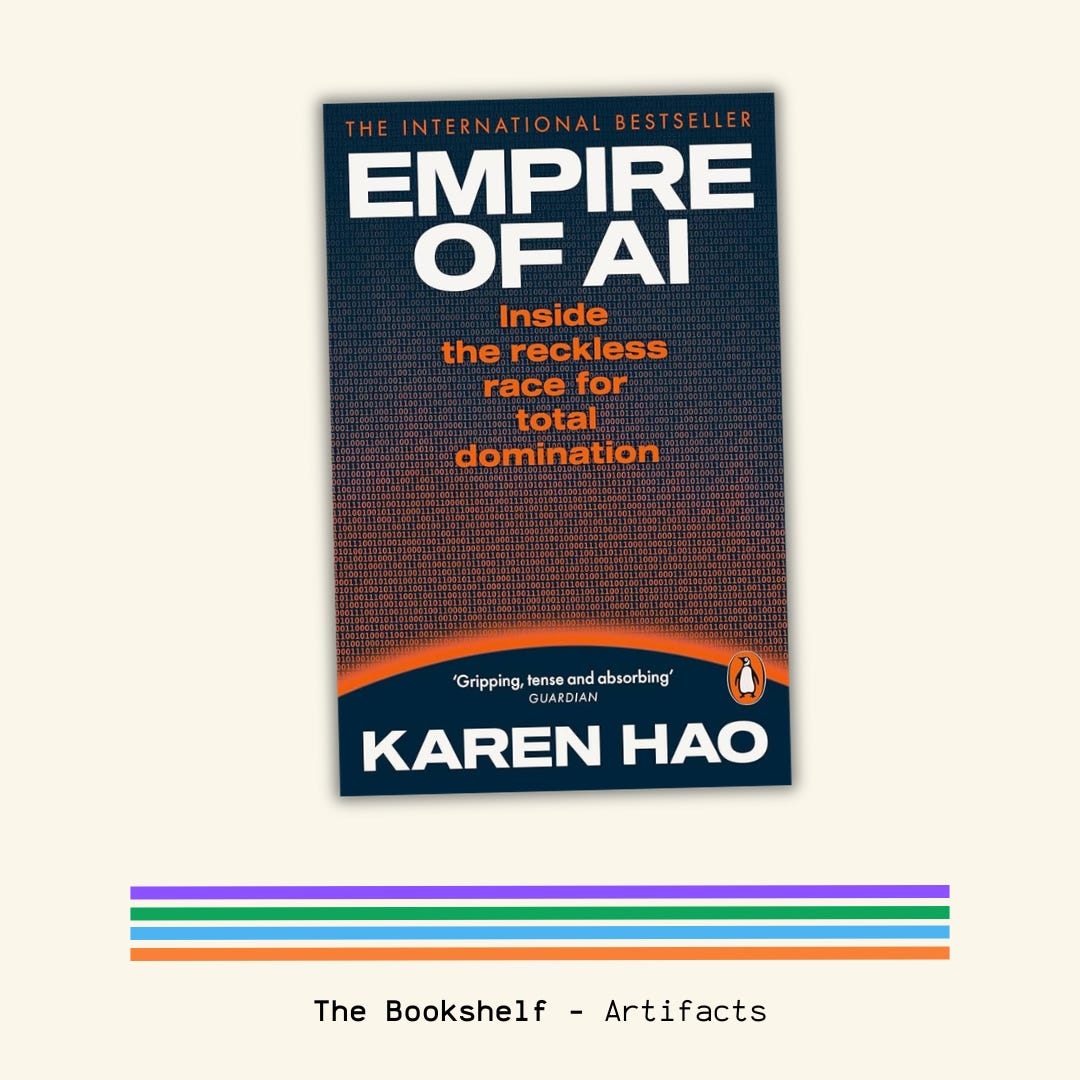 One of the most important books on AI, its economics and also politics. ‘Empire of AI’ is a beautifully written one by Karen Hao to get into the deep intricacies of the interesting times we’re living. One to bring to the beach (although it’s a bit heavy)
📚 All the books I’ve read and recommended in Artifacts are here.
> ### Nerding
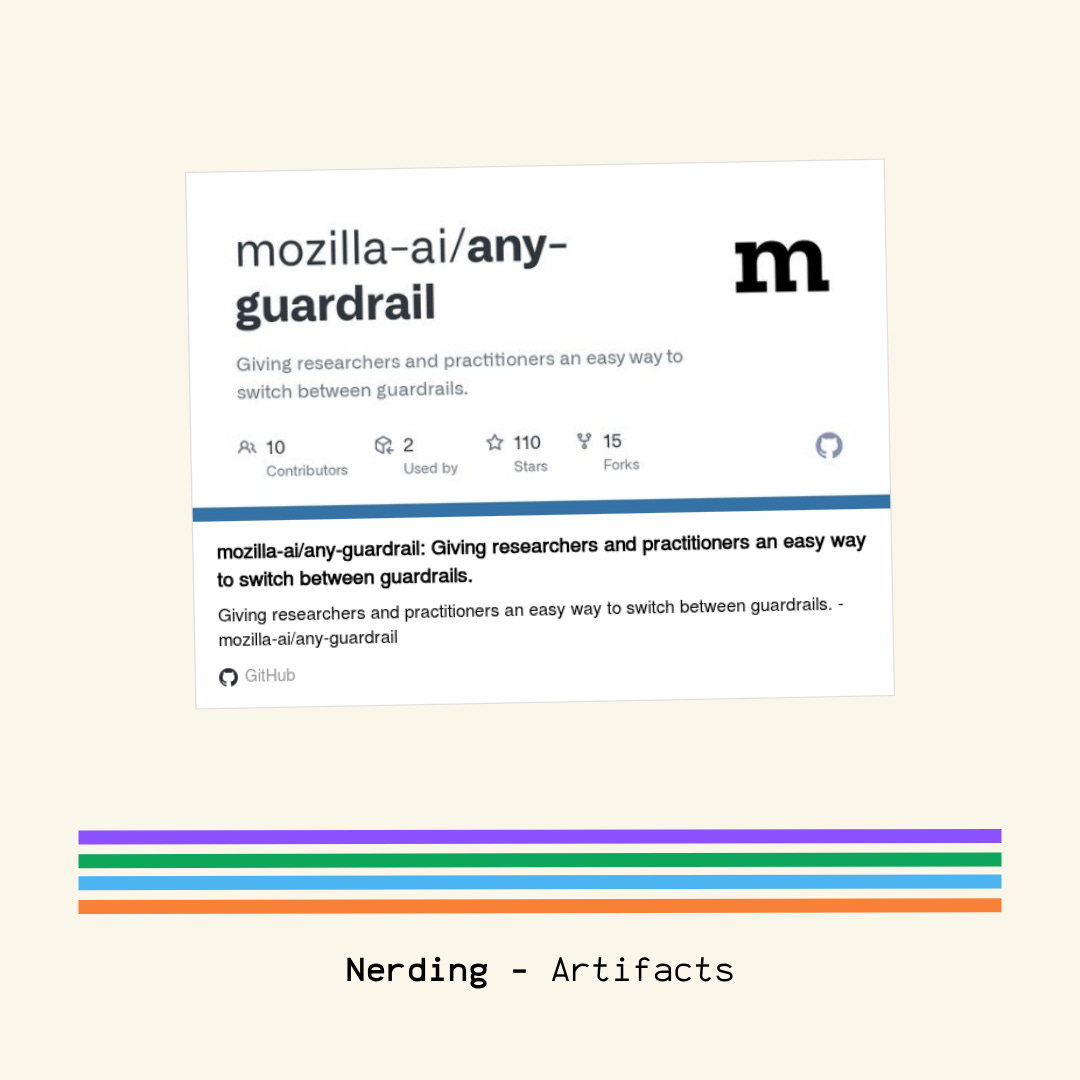 Play around with any-guardrail by Mozilla.ai to see first-hand what a guardrail is. It’s the type of exercise useful to understand better what AI safety means.
NEW: All the tools suggested in Nerding have been collected here! ⚙️
> ### ☕?
If you want to know more about Artifacts, where it all started, or just want to connect...
Let's grab a virtual coffee ☕
======
# Computers that use computers?
Date: 2026-07-28 | Language: en
Canonical: https://artifactstech.substack.com/p/computers-that-use-computers
Cite as: Computers that use computers? by Lorenzo Ancona, Artifacts, 2026-07-28. https://artifactstech.substack.com/p/computers-that-use-computers (CC BY 4.0)
**I’ve been in San Francisco for two weeks now,** and along with the beautiful houses, the good vibe, and some striking nature all around, **most of the tech discourse I’ve run into sounds like this:**
[](https://substackcdn.com/image/fetch/$s_!Ar0V!,f_auto,q_auto:good,fl_progressive:steep/https%3A%2F%2Fsubstack-post-media.s3.amazonaws.com%2Fpublic%2Fimages%2F326170d8-1c48-40e4-b3ea-788fe9f1fa63_1080x1080.gif)
**People are wildly excited about AI agents** — which I like to describe as *virtual entities* that take on tasks once reserved for humans, working alongside us.
Not that you need to be in SF to know agents are the talk of the moment. But I haven’t seen this much enthusiasm, or this much push, anywhere else.
Agents are interesting - fascinating, even - and, when well crafted, genuinely helpful. **They also reshape how we interact with computers, and spark** ***new*** **interactions among computers themselves.**
To think through what that means, and what tomorrow might look like, it helps to step back. I did that at the go-to place for understanding how computers became what they are: **the Computer History Museum in Silicon Valley.**
Wandering through the past of computing got me thinking about **what comes next**, given all the hype around agents.
**In broad brush strokes, the history of computers is a story of shrinking:** from machines that filled entire rooms and were a nightmare to maintain, to machines that sat on a desk in everyone’s home, to machines we carry around **- all while the power went up as the size came down.**
*(That’s a drastic summary of three hours in the museum.)*
[](https://substackcdn.com/image/fetch/$s_!clYs!,f_auto,q_auto:good,fl_progressive:steep/https%3A%2F%2Fsubstack-post-media.s3.amazonaws.com%2Fpublic%2Fimages%2Fe1b2eb0e-fffe-47cb-97d3-d84fa00334bf_2500x1597.jpeg)
the ENIAC: arguably, the first computer ever
They also moved from something legible only to top researchers - dry lines of code - to **beautiful, intuitive interfaces anyone can use** without the faintest idea of how or why they work.
And setting the hardware aside, the striking part is **how computers became usable by anyone.** Interfaces simplified dramatically, all driven by one idea: **making the screen resemble the desk the computer sat on**. Hence the ‘*desktop*’.
**Computers evolved along metaphors borrowed from the old world of work** - the desktop, the spreadsheet, the bin - aimed first at knowledge workers: what Douglas Engelbart called [“augmenting human intellect”](https://www.dougengelbart.org/pubs/augment-3906.html), and what Xerox imagined as the **“office of the future”.**
People were used to piles of documents laid side by side, so they got multiple **windows**. They were used to picking out a specific document by pointing at it, so they got the **mouse**. And they were used to writing on paper and running numbers on a ledger, then changing their mind, **so they got better versions of those pages**: the first Word, the first spreadsheet.
[](https://substackcdn.com/image/fetch/$s_!tpNW!,f_auto,q_auto:good,fl_progressive:steep/https%3A%2F%2Fsubstack-post-media.s3.amazonaws.com%2Fpublic%2Fimages%2Fa234f462-6987-429f-beec-3469be62600a_1254x904.png)
well, a mouse, literally
As **Vannevar Bush** had imagined back in 1945, in [“As We May Think”](https://www.theatlantic.com/magazine/archive/1945/07/as-we-may-think/303881/), computers were meant to help humans navigate vast amounts of information. But not only that. By simulating our desks, the computer became, as **Alan Kay** put it, ***“a new medium that would change the thought patterns of an entire civilization”.***
And that’s what happened. **Work - and not only work - moved onto computers:** thin machines that store, or reach, almost any piece of information in the world, and that have drastically changed how we handle it.
Yet things are changing again, because **humans are no longer the only ones using computers** - and so no longer the only ones consuming information. **We’ve started working alongside agents**, or even simple LLMs, that can navigate information and act on it.
**For the nerds out there,** this is the promise of the [Model Context Protocol](https://modelcontextprotocol.io/) - or simply of APIs driven through AI applications.
**Nothing exotic**: anyone can point Claude, or ChatGPT, or any AI at their inbox and have it read and draft replies. Same with Notion, or Booking and Trainline, to sort out the summer holidays, and much, much more.
**AI acting for us, thus acquiring agency, and so AGENTS.**
In short: computers are no longer used only by humans, so information is no longer consumed only by humans. [Cloudflare keeps us honest here](https://radar.cloudflare.com/) - more requests to websites now come from bots and agents than from people.
[](https://substackcdn.com/image/fetch/$s_!glsv!,f_auto,q_auto:good,fl_progressive:steep/https%3A%2F%2Fsubstack-post-media.s3.amazonaws.com%2Fpublic%2Fimages%2F14781ff3-9900-4230-8e55-1a9f114c0be1_648x600.png)
last week from [Cloudflare radar](https://radar.cloudflare.com/)
***But what could this shift mean?***
- **First, it lands on anyone designing interfaces.** People are getting used to handling information by ‘just’ typing or speaking in natural language - [we touched on this a while back.](https://artifactstech.substack.com/p/no-one-click-that-button) But it also means whatever you build, a website or an app, **will need to work not just for humans but be readable by agents too.**
- It could go further: **people may stop using some services directly.** We’ll keep our inbox and email provider, but letting an agent go through it for us will feel more and more normal.
- And this shapes not only what interfaces look like - or whether they exist at all - but **what information we produce, and how we distribute it.** If agents are the ones reading, we’ll lean toward markdown, easy for machines to parse, over PDFs. \[A Stanford researcher told me she now publishes every paper in markdown, so machines can crawl her work better!\]
All in all, **we’re entering an era where computers use themselves.** And no, it’s not dystopia. Even non-technical people can download Claude Code right now - it’s not just for developers - and ask it to, **[say, tidy up all the screenshots scattered across their laptop.](https://www.instagram.com/reels/Dafatj7lKMt/)** And then, well, have fun.
[](https://substackcdn.com/image/fetch/$s_!OHTi!,f_auto,q_auto:good,fl_progressive:steep/https%3A%2F%2Fsubstack-post-media.s3.amazonaws.com%2Fpublic%2Fimages%2F62abc33e-cf6d-4807-8d5d-52920f868ab3_1124x514.png)
and, btw, interfaces are going back to the terminal?
**What’s also interesting is how we’ll study all this.** **“Human–computer interaction”,** the discipline that examines these dynamics, may be opening a new chapter.
We’re no longer just clicking buttons but asking agents to take tasks off our hands, and, increasingly, simply setting up agents to reach outcomes for us - **without knowing how they got there.**
**So the interaction between humans and computers may come to be mediated by other computers.** And, stretching it a little, we may soon be talking about ***‘computer–computer interaction.’***
Which, recalling Kay on the computer as a medium, puts a new question mark over **how these interactions might change our thought patterns.**
In other words, if I can get from idea to result by handing the computer to an agent, **maybe I’ll understand less and less about the route between the idea and the result?** Interesting times.
[Leave a comment](https://artifactstech.substack.com/p/computers-that-use-computers/comments)
> ### **Something new 👀**
[](https://substackcdn.com/image/fetch/$s_!WRbH!,f_auto,q_auto:good,fl_progressive:steep/https%3A%2F%2Fsubstack-post-media.s3.amazonaws.com%2Fpublic%2Fimages%2Ff4a081c2-a1f6-437a-aded-5930874e0bdb_1200x1200.jpeg)
**Got breakthrough science stuck in the lab? Let's get it out.**
 If these dangers or threats are real, lining up incentives is not enough: they have to be prioritised.
Here is a test for whether that is happening. When a company says a model is too dangerous, it is describing an obligation it now carries, and we should hold it to that. Too dangerous to release, released anyway, banned abroad, back by morning: these words should not cost nothing and cannot be just another way to launch a product.
We built institutions around strategic technologies. This one we have handed to companies with many different incentives, and left them to sort out the contradictions in public, with chaos for citizens being the first immediate outcome.
If we get better at this, the first result would be to stop seeing public communications being often contradictory, at the expense of users and citizens, and finally aligned with clearer incentives and principles about how AI is being built and distributed.
Leave a comment
> ### Save for Later
The thread that won’t leave me alone — AI and the state. The Atlantic on the quiet nationalisation of AI. Estonia, more concrete, is handing AI agents their own digital IDs - a passport for bots, liability baked in.
Two on the cracks: you can sweet-talk an LLM into misbehaving (flattery and authority push compliance from 35% to 51%), and vibe coding’s security bill is coming due - nearly half of AI-generated code ships a vuln.
Kids and screens, going global: the NYT maps the worldwide ban wave and the EU looks set to join in September. Ban first, sort out age verification later? Btw, Mozilla on connection bloat - the median Instagram user follows 675 accounts, and intimacy is built on subtraction.
Ah, and the Reuters Digital News Report 2026: social overtakes TV as the world’s front page. For the beach bag, All Tech Is Human’s summer reading list.
And GitHub will now ship your public repo on CD-ROM - “yours forever. Until you lose it.”
> ### The Bookshelf
 Currently reading “Prophecy” by Carrisa Veliz, which is not necessarily about the geopolitical challenge on AI but a great step back to understand the power of predictions and what AI is based on. Hugely recommended!
📚 All the books I’ve read and recommended in Artifacts are here.
> ### Nerding
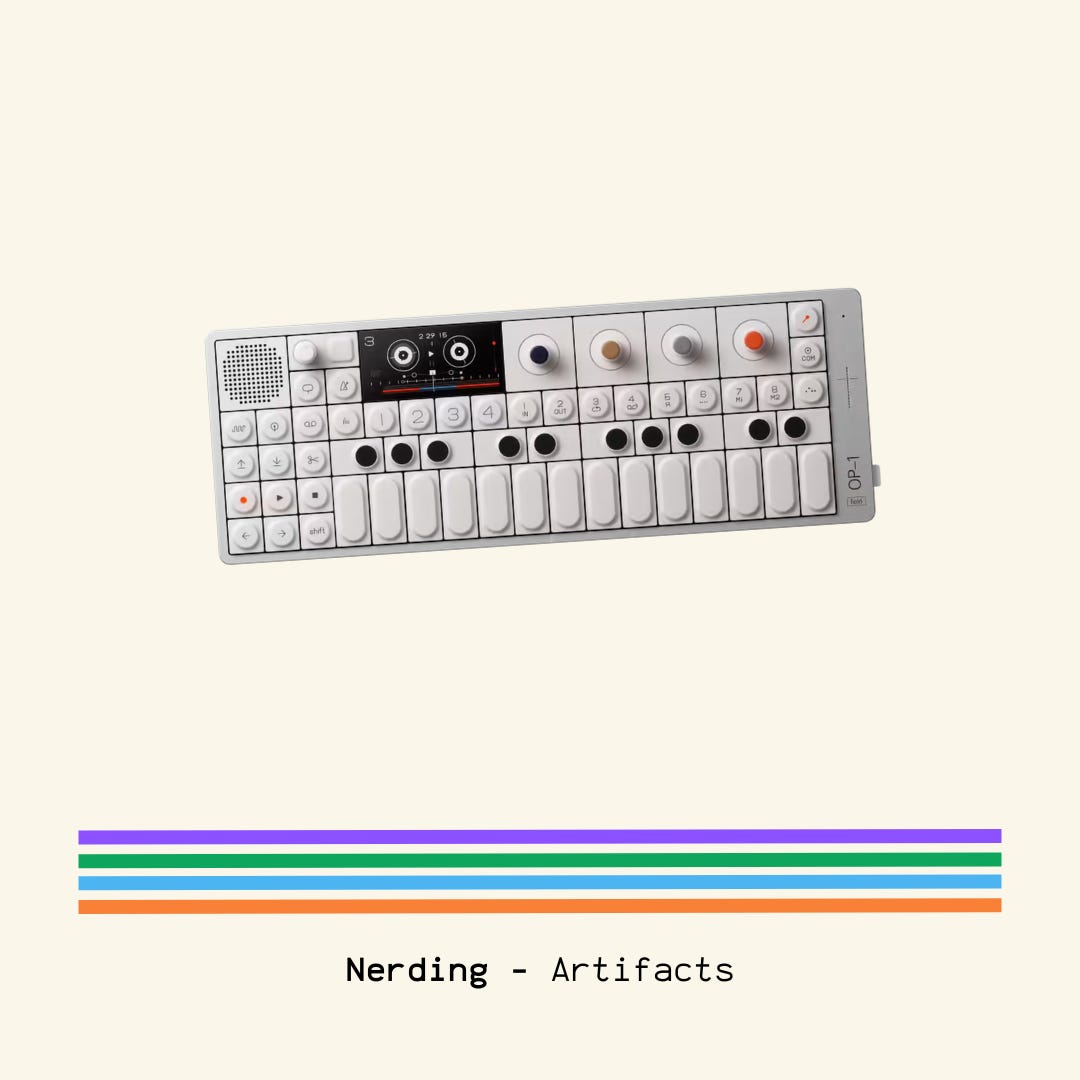 I usually recommend online tools (mostly free). This artefact from teenage engineering is of course physical and far from free, but I fell in love with it so go check it out, listen to the music it produces, enjoy!
> ### ☕?
If you want to know more about Artifacts, where it all started, or just want to connect...
Let's grab a virtual coffee ☕
======
# Who holds the key?
Date: 2026-06-19 | Language: en
Canonical: https://artifactstech.substack.com/p/who-holds-the-key
Cite as: Who holds the key? by Lorenzo Ancona, Artifacts, 2026-06-19. https://artifactstech.substack.com/p/who-holds-the-key (CC BY 4.0)
It’s no wonder someone might recently have thought *‘why can’t Siri just be as good as ChatGPT voice?’.* That’s probably something Apple was well aware of and that’s why **at the latest WWDC they [announced the new SiriAI](https://www.theverge.com/tech/942416/apple-siri-ai-update-wwdc)**, which promises to be more helpful than just a tool to set a timer or call your mom.
The tech bubble has welcomed it, [wondering if Siri is](https://www.youtube.com/watch?v=Ituu9ypvaHk) *[finally](https://www.youtube.com/watch?v=Ituu9ypvaHk)* [good](https://www.youtube.com/watch?v=Ituu9ypvaHk). And it does seem so: the new Siri will be an assistant that works across apps, knows who the user is and is far more integrated into day-to-day tasks.
[\[Embedded media — view original\]](https://www.youtube-nocookie.com/embed/2PW5y3zAvPE?rel=0&autoplay=0&showinfo=0&enablejsapi=0)
If you have watched the video to the end, you’ve made it to *‘your data stays protected’* and *‘coming to an iPhone near to you’*, which echoes both Apple’s **obsession with personal data protection** and the successful launch campaign of the iPod promising 1000 songs in your pocket.
[](https://substackcdn.com/image/fetch/$s_!Ri8u!,f_auto,q_auto:good,fl_progressive:steep/https%3A%2F%2Fsubstack-post-media.s3.amazonaws.com%2Fpublic%2Fimages%2F0f89a54d-fe85-4816-bb17-8df401dfc2df_1280x649.jpeg)
And that’s not just a marketing move but the core of how SiriAI has been built: **a personal assistant that uses your own data, processing it directly on your iPhone, while limiting what’s sent to the cloud.** So your Siri and your data literally stay in your pocket - or wherever you keep your iPhone.
Yet, not if your pockets are European ! **SiriAI is, indeed, not coming European iPhones anytime soon :)** (though it will be available on Mac, Apple Watch and Vision Pro)
This is, [according to](https://www.apple.com/newsroom/2026/06/due-to-dma-siri-ai-delayed-in-eu-for-ios-27-and-ipados-27/) **[Apple](https://www.apple.com/newsroom/2026/06/due-to-dma-siri-ai-delayed-in-eu-for-ios-27-and-ipados-27/)**, ***‘due to the Digital Markets Act’*** and to EU regulators who *‘did not accept any of Apple’s proposed solutions to bring Siri AI to the EU while safely supporting other virtual assistants.’*
The **EU Commission**, for its part, [promptly replied](https://www.linkedin.com/posts/thomas-regnier-24a05810b_what-is-the-true-story-behind-apples-decision-ugcPost-7470439815910551552-sPn3/?utm_source=share&utm_medium=member_desktop&rcm=ACoAADBGmFQB0rHgggpkCiHG5Dn-B9e4n2G0Y-g) that the decision is *“Apple’s and Apple’s only”* and that nothing in its Digital Markets Act forbids the launch.
For those new to the DMA, **it’s the main EU regulation trying to limit the monopoly power of some sprawling platforms (aka ‘gatekeepers’).**
It’s the reason why you’re now often asked which browser you want to use, instead of Safari ruling out the rest as the default, or why Google can’t route you straight to Google Maps when you search for a town.
It’s not the first time Apple and the EU Commission have fought over the DMA, we covered it [here](https://artifactstech.substack.com/p/slicing-apples).
------------------------------------------------------------------------
**This time, the fight pertains to Article 6 and the idea of interoperability:** if Apple builds a capability into the iPhone, rivals should be able to plug into the same hooks, on equal terms, rather than being locked out of a system everyone is forced to live inside.
In explaining the decision, Apple fell back on one of its leitmotifs about the DMA: **giving to other providers access to its systems may compromise the security and privacy of users.**
Concretely, Apple is concerned about giving users access to, say, ChatGPT or Claude as a replacement for Siri **because they would not guarantee the same level of security and privacy.**
That’s because any AI model used by Siri is built to run on the iPhone and, for complex tasks, it will be run on Google Cloud (which partnered with Apple to train Siri) but still secured within a proprietary [Private Cloud Compute](https://security.apple.com/blog/private-cloud-compute/) framework. **So Apple can be sure of what happens with Siri, far less so if it opened access to other providers.**
On the other hand, **these security concerns undermine the interoperability goal of the Digital Markets Act**, since users have no choice over which AI assistant to use.
------------------------------------------------------------------------
This is a case where **the design of the technology clashes significantly with the design of the regulation**, and the other way around.
Yet, this isn’t necessarily down to an incautious approach by Apple, it’s also that **the DMA was conceived for a different era of much more controllable software.**
For instance, when Apple or any phone provider open up the choice of the favourite browser, **they can still limit and know the tasks that the browser will perform**, such as opening URLs one receives on WhatsApp. In other words, **these tasks are well defined.**
This is different with Siri. **An agentic AI assistant has a much broader scope of action:** it doesn’t just answer your questions but can take action on your behalf, using different parts of your iPhone, like Calendar, phone, maybe messaging apps, etc.
Therefore, **opening up to a different AI assistant is definitely different from letting users pick the browser they like.**
If you like metaphors, an AI assistant is **a curious, silly little guy with a master key that can open any door on your phone**, while with other DMA provisions, like the browser, you are dealing with a quiet one with only a few keys :)
[](https://substackcdn.com/image/fetch/$s_!7qig!,f_auto,q_auto:good,fl_progressive:steep/https%3A%2F%2Fsubstack-post-media.s3.amazonaws.com%2Fpublic%2Fimages%2Ff3a64d25-f4f2-4ab4-8899-6867667129ea_1254x1254.png)
Finally, to give rivals the “equal access” mandated by the DMA to the new Siri, Apple wouldn’t be handing over a feature, but rather **a good part of the iPhone.**
And yet “handing over the phone” is kind of what Apple offered to do, eventually. Remember those *“proposed solutions”* the Commission turned down? The main one was a **Trusted System Agent:** a gateway that would let rival assistants into the phone gradually, through Apple’s own checkpoint.
Apple’s pitch was: we ship Siri AI in Europe now, and open it to competitors slowly and safely. **The Commission read the eighteen months as a stall, not a safeguard, and said no.**
Overall, though Artifacts doesn’t aim to take sides on the matter (which would require much more research), what’s interesting in this tale is that **we’re looking at a regulation that is only a few years old, but is already straining against a technology only a few years ahead of it.**
And that’s probably because **the DMA was conceived for bounded and predictable services** like browsers, maps, app stores with clear use cases, and thus applying it to AI agents with a broader scope necessarily means stretching it.
Thus, we could argue **that the regulation is not** ***designed*** **for the fundamentals of the technology** and, ultimately, for its design.
Yet, it also shows **how the regulation of AI goes far beyond AI as a technology, how it is built and the risks it may carry**, and should rather extend to how it is put to use within systems, probably forcing us to rethink regulations conceived for much more controllable and bounded technologies.
In the meantime, we wait for a better Siri and will keep using the existing one for the alarm !
> ### **Save for Later**
The UK is about to [ban under-16s from social media](https://www.theverge.com/policy/949679/uk-under-16-social-media-ban-announcement). [Oliver Marsh has the nuance](https://www.linkedin.com/posts/dr-oliver-marsh-a0246b60_my-quick-personal-thoughts-on-social-media-share-7472282478955769856-POxD/) the headlines skip.
Speaking of age checks: nearly [a million passports just leaked](https://www.theverge.com/tech/947157/passports-data-breach-cannabis-club-systems-nefos-puffpal) from PuffPal, an age-verification system for European cannabis clubs.
Meanwhile, Europe is quietly [unplugging from American tech](https://www.wired.com/story/all-the-ways-europe-is-ditching-american-technology/). Part of the plan: build our own social media. Meet [Eurosky](https://www.euractiv.com/news/interview-inside-the-commissions-favoured-european-social-network/), the EU Commission’s favourite, running on the same protocol as Bluesky - cofounder Sebastian Vogelsang has been [making the case](https://www.linkedin.com/posts/svogelsang_atproto-opensocialweb-digitalsovereignty-share-7471860196273745921--a2f/) for a while.
And the FT reckons Europe is [finally flexing its innovation muscles](https://www.ft.com/content/326aa9fd-dcb3-4e3b-a775-61b28e7e12f6).
Two AI-and-work papers worth your time. [The Broken Ladder](https://papers.ssrn.com/sol3/papers.cfm?abstract_id=6787638): is AI quietly eating the junior rung of the career ladder or it’s rather because of remote work? And [Writing Code vs Shipping Code](https://www.nber.org/papers/w35275): AI lets you code 180% more but ship only 30% more - turns out the bottleneck was never the typing :)
Ah, and Meta just [surprised everyone by funding its Oversight Board through 2028](https://www.platformer.news/meta-oversight-board-funding-2028/).
> ### **Where next?**
Next Thursday, Artifacts will be at the **We Make Future 2026** with some cool people to talk about the **Agentic State**, and thus what AI agents mean when deployed in and from a government and what services they could offer to citizens.
[](https://substackcdn.com/image/fetch/$s_!25Sp!,f_auto,q_auto:good,fl_progressive:steep/https%3A%2F%2Fsubstack-post-media.s3.amazonaws.com%2Fpublic%2Fimages%2Fbb18818b-9536-4eb1-ad49-52db2a324f1f_960x540.png)
> ### **The Bookshelf**
[](https://substackcdn.com/image/fetch/$s_!BXI8!,f_auto,q_auto:good,fl_progressive:steep/https%3A%2F%2Fsubstack-post-media.s3.amazonaws.com%2Fpublic%2Fimages%2Fb615bef4-ef30-4438-aad2-ed24e7e6f07e_1080x1080.png)
As we speak of Apple, '***Apple in China’*** is THE book to read not on Siri but on how, in general, iPhones have been built over the years and how important China has become for 🍎.
📚 **All the books** I’ve read and recommended in Artifacts are [here.](https://airtable.com/appK7fMPX1DMkQYzL/shrRh8TgI7GtmgBxM)
> ### **Nerding**
[](https://substackcdn.com/image/fetch/$s_!8vNF!,f_auto,q_auto:good,fl_progressive:steep/https%3A%2F%2Fsubstack-post-media.s3.amazonaws.com%2Fpublic%2Fimages%2Fdb4ccd2f-dbdf-4fb5-ab83-2a65f82e4c02_1080x1080.png)
Ok this is **heavy nerding,** but in case you really have nothing better to do, the [Virtual OS Museum](https://virtualosmuseum.org/) is the nerdiest thing to do: see and run old operating systems and just feel the vibe of when we didn’t care much about nice interfaces :)
> ### **☕?**
If you want to know more about Artifacts, where it all started, or just want to connect...
[Let's grab a virtual coffee ☕](https://calendar.google.com/calendar/u/0/appointments/schedules/AcZssZ2ibxlzyU7rgnuoTgqXb_DFc19dfHmJeu1OAu17IY0_oHrtcJtvtctAJnMabirgZNx5Z5NAPGs0)
======
# Looking backwards
Date: 2026-05-28 | Language: en
Canonical: https://artifactstech.substack.com/p/looking-backwards
Cite as: Looking backwards by Lorenzo Ancona, Artifacts, 2026-05-28. https://artifactstech.substack.com/p/looking-backwards (CC BY 4.0)
Staring at a blank page is the starting point of most creative work. It is what may trigger the so-called writer’s block, and it happens across every kind of making: when you sit down to write a piece, when you sketch the interface of a piece of software, or, for the more artsy among us, when you go to paint.
Yet, nowadays, this is potentially no longer a thing, or no longer a problem, if you will.
The reason is that, with Generative AI, we can always start from something: the distance between a blank page and one, two, multiple pages of text or a scrappy interface or graphic has become very short. It is maybe just one prompt away.
Producing content - whatever shape that content takes and no matter the quality - has become a commodity.
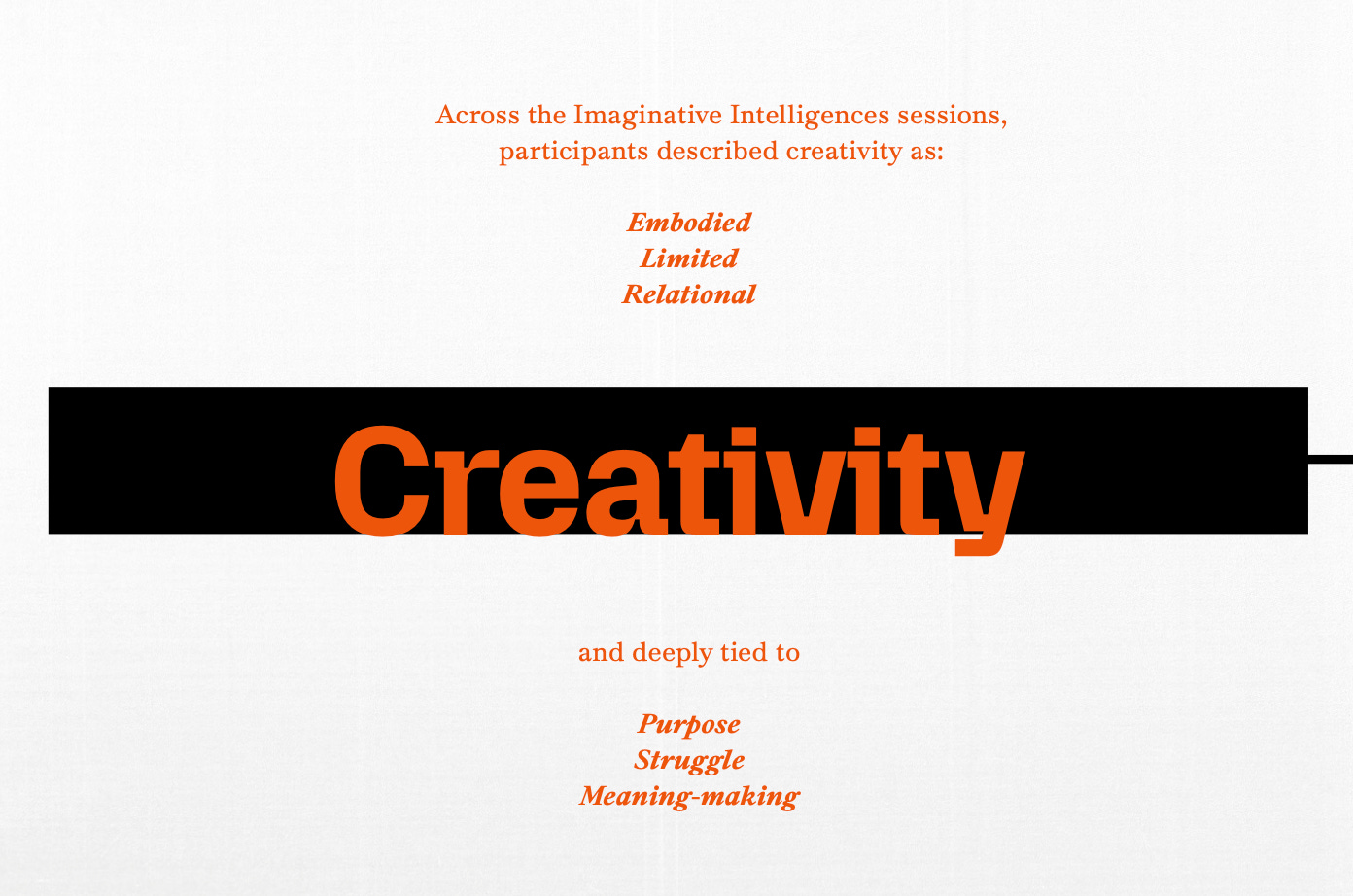 go read Intel Zine from Mozilla Foundation!
But this is a risk, and not because of philosophical speculation or any Luddism, but because of the technological foundations of AI. In other words, because of how AI is built - so let’s look into the machine.
AI is, primarily, a statistical machine. It is trained, as we know, to retrieve the data it was fed and to produce what is plausible on the basis of it. And here we go back to AI as a technology of average both in the quality of the writing and in the calibre of the ideas.
It is, in other words, a machine built to look backwards: it generates what is most probable given everything that came before, and not necessarily anything creative.
Now, you could fairly object that human creativity does the same: we’re inspired by what we read or listen to and use it for our creative work. True.
But the difference is probably in the purpose and direction. The machine works backwards, from probability. We work forwards, from intention - taking what we know and questioning it, merging it, putting it back together on purpose.
Maybe, that act of repackaging with a reason is what makes creativity worth something.
It is, in other words, not just to produce something new out of the knowledge we have, but to give it meaning in the new shape we confer. The output is only part of the story.
With AI, the rest of that story goes missing. We ignore the process that runs from input to output, because all we ask of the output is that it be good enough. The process itself stays inscrutable - technologically, what happens between A and B is not something we can control nor understand.
And indeed, we don’t care whether AI is actually intelligent - let alone creative! - only whether its output resembles something we humans would consider to be the work of an intelligence.
This is, after all, the founding premise of the field. In 1955, McCarthy, Minsky, Rochester, and Shannon opened ‘A Proposal for the Dartmouth Summer Research Project on Artificial Intelligence’ - the document that launched AI as a discipline - by defining the problem as ‘that of making a machine behave in ways that would be called intelligent if a human were so behaving’.
What mattered, from the start, was the appearance of the result, not the process
In that sense, AI is not far from a dishwasher: you don’t care about how the dishes got clean, only that you can eat off them again.
 For most things, that’s a perfectly good arrangement - drafting an email, say. It becomes a problem with creativity, because there we risk missing what creativity actually is, and what it is for.
Stand in front of a painting and you care about more than the final artifact, important as it is. You care also about how it came to be.
For instance, last weekend I stood in front of Guernica. Stripped of its background - without knowing what Picasso wanted, without the history behind it - I thought the canvas loses much of its force. The image alone is not the point.
And importantly, the process matters not just to those receiving it or consuming creativity, but for the people making it - who begins at a blank page and, through a cognitive, creative struggle, arrives somewhere.
 Leave a comment
This newsletter was supported by Imagine Intel, the zine and cultural artifact published by Mozilla Foundation to accompany the Imaginative Intelligences Assemblies work led by the Foundation’s Creative Futures program. Check out the work of The Counterstructural Commons, Mozilla Foundation’s cultural R&D residency at Rhizome.
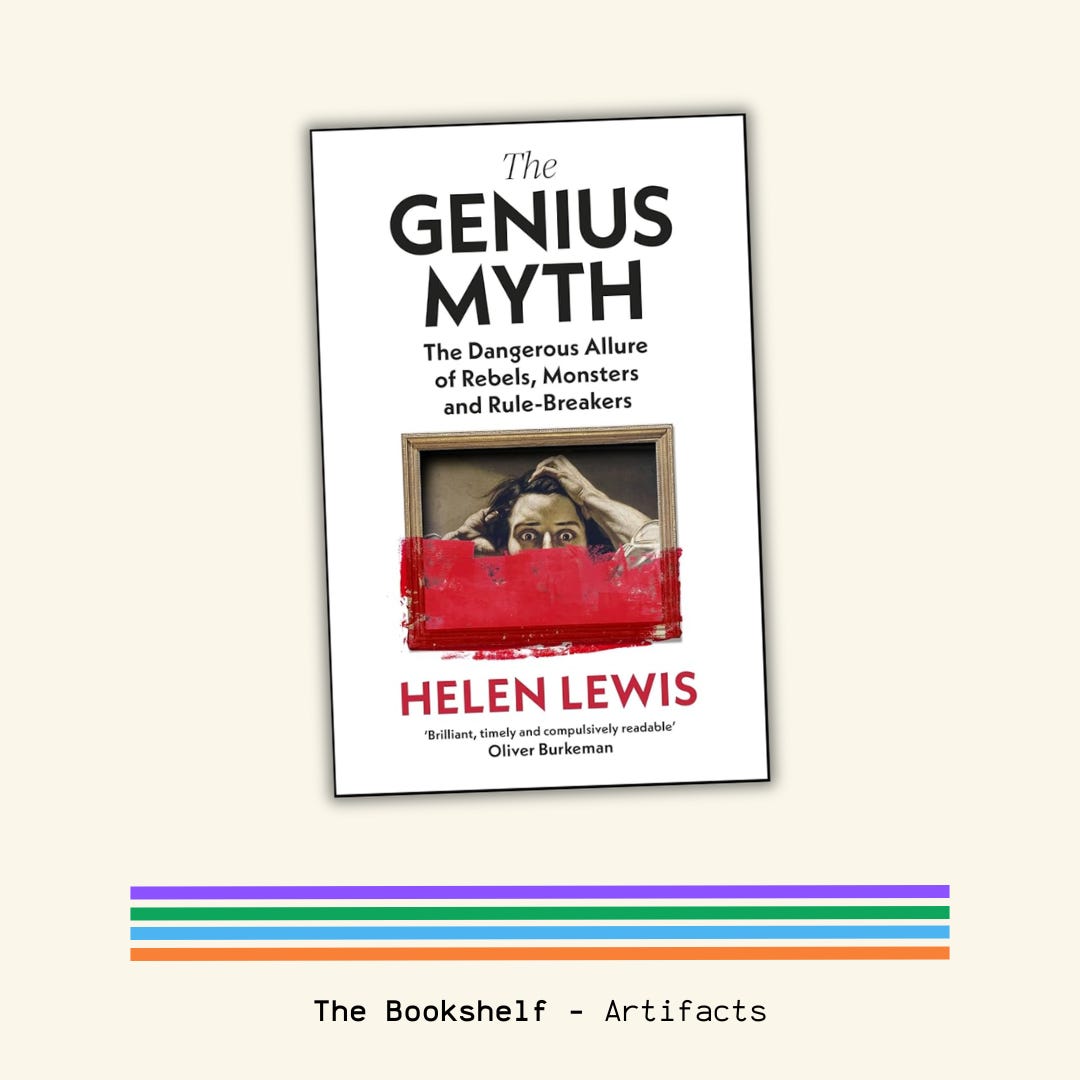 Creativity is often linked to being a genius. But what even is a genius? Maybe just the outcome of a narrative? This book dissects the topic across centuries, and it’s a nice read to trigger interesting conversations with people.
📚 All the books I’ve read and recommended in Artifacts are here.
> ### Nerding
 If all you care is just writing, writing, writing - and no AI assistance or anything, well IA writer is made exactly for it. And it produces splendid markdown, which is definitely the format of the moment.
> ### ☕?
If you want to know more about Artifacts, where it all started, or just want to connect...
Let's grab a virtual coffee ☕
======
# Ask EU how
Date: 2026-05-13 | Language: en
Canonical: https://artifactstech.substack.com/p/ask-eu-how
Cite as: Ask EU how by Lorenzo Ancona, Artifacts, 2026-05-13. https://artifactstech.substack.com/p/ask-eu-how (CC BY 4.0)
Last week, Artifacts attended the [Politico AI & Tech Week in Brussels.](https://www.politico.eu/ai-tech-week-2026/?_Tech_-_EOM1_-_auto_conf)
Topics went well beyond AI - **sovereignty, data, chips, platforms, online safety, entrepreneurship.** Which is refreshing, since AI dominates so much of the conversation everywhere.
[](https://substackcdn.com/image/fetch/$s_!TEse!,f_auto,q_auto:good,fl_progressive:steep/https%3A%2F%2Fsubstack-post-media.s3.amazonaws.com%2Fpublic%2Fimages%2Fbba9033f-f7e7-472f-9ae5-3b3bfe58842f_3024x3058.jpeg)
What struck me was **the breadth of opinions**, moving past the tired regulator-versus-private-sector dichotomy. Instead: **regulators** more open to explain and listen, **third parties** trying to mediate, scaling **companies** voicing their needs, large **enterprises** less defensive, **academics** naming the complexity.
But there’s still a pattern quite visible: **a fundamental disconnection between those designing regulation and those building the technology, who rarely attend such events.** Which then triggers lots of talks about the *what* needs to be done, and **much less about the** ***how*** **to get there.**
Finally, a special mention goes to the Politico journalists, who asked precise questions, pulled speakers back on track when needed, and kept pointing toward where the real complexity lives.
Anyway, **here are five things the Brussels Tech ‘Bubble’ is discussing** - in an attempt to make it readable for those outside of it (and go follow [Unbubble Hub](https://unbubblehub.substack.com/), speaking of bubbles)
> ### *First of all*, Europe wants more control on the technologies we use
This is the thing everyone agrees on. **Sovereignty is the political frame of such control**, with the core idea being *“someone on the other side of the planet cannot switch off our infrastructure.”* Therefore, it’s also a matter of strategic security.
**Less agreement exists on what counts as a European technology and when it can really be considered sovereign.** More importantly, it remains unclear which domains to prioritize - semiconductors, cloud infrastructure, data centers, software - and what the real impact would be on the private sector actually building these systems. Yet, end of the month may provide more info with the release of the [‘Tech Sovereignty Package’](https://www.cnbc.com/2026/05/07/eu-commission-cloud-sensitive-data.html) by the Commission.
> ### *Therefore*, Building European is the path
The idea that Europe and European companies can build breakthrough technologies is **no longer a myth.**
Simplification packages like [EU inc](https://commission.europa.eu/news-and-media/news/eu-inc-making-business-easier-european-union-2026-03-18_en) - a streamlined legal structure for digital startups - are welcomed with genuine enthusiasm and curiosity. **Much more alignment exists on the idea that regulation need not be a drag but should enable easier business.** And finally, pushing for a [Eurostack](https://eurostack.eu/) - a European-controlled tech infrastructure - and actively financing innovation seems to be the way forward.
> ### *That’s why* Antitrust matters (a lot) on AI
To avoid scenarios like Google Search edition 2, where the search market is heavily concentrated, **with AI it’s critical to prevent companies from entrenching themselves as blockers.** This matters especially for Europe’s hope to keep alive the dream of a European AI flagship company.
> ### *And still on AI*, the real work with regulation is actually on implementation
It was fun to be in Brussels at the Politico event on the day of the [AI Omnibus](https://ec.europa.eu/commission/presscorner/detail/en/ip_26_1024), which meant a delay and a simplification in the implementation of the AI Act. **It’s also increasingly clear that AI regulation is primarily AI governance** - not just the rules, but how they’re enforced. The actual work starts after the paperwork, and many speakers suggested Europe is behind here.
**Figuring out how to operationalise the AI Act is what will keep the bubble busy in the months ahead.** Getting this right matters for safety, for clarity, for whether the rules can actually be enforced. This whole situation brought me back to someone who once told me: *“A politician who doesn’t care about the outcome of their policies is like a CEO who doesn’t care about the outcome of their product.”* That’s probably something to keep in mind.
> ### Which is a *very similar story* to the one on Age Verification
Age verification has become the new buzzword in tech regulation. **Everyone agrees, of course, that protecting children online is a priority.** Yet fewer people grapple with the **complexity** of actually implementing a proper verification system - the technical and privacy problems, the likelihood of bans, [what we do with VPNs](https://www.europarl.europa.eu/RegData/etudes/ATAG/2026/782618/EPRS_ATA(2026)782618_EN.pdf) (with some ideas that seem quite bizarre, to say the least)
**This is the clearest example of the** ***what*** **versus** ***how*** **gap.** Easy to agree on the goal (protecting children), harder to think through implementation. **On this matter, which is fundamentally technical, the debate remains heavily political.**
It will take time and considerable controversy, while the [EU Commission just announced](https://www.bbc.com/news/articles/c9q3x19ddl7o) they’re considering a social media ‘delay’ (=ban) for minors this summer, pointing to the recently released [EU age-verification app.](https://commission.europa.eu/news-and-media/news/european-age-verification-app-keep-children-safe-online-2026-04-15_en)
 As you see, it does a few things just right for me:
- it stores articles from any website (with an ugly browser extension)
- it saves them, so I can read, highlight what matters, add labels in an uglier UI
- and finally it sends them to the Notion database I use to write Artifacts.
And yes, although I could go and brag like LinkedIn folks saying ‘I recreated \[insert name of random app\]’ or ‘You can now build anything’, I tend to think that such narrative is, as most narratives, just a nice story to tell.
And that this app doesn't make the cut cause it was built with just my specific needs in mind.
It is, indeed, true that non-technical people can nowadays quickly bootstrap functioning apps, but these are quite far from well-crafted products or saying that software organisations are doomed.
True: we may have solved large parts of the complexity of coding, but it’s not because anyone can write that then anyone can suddenly be David Foster Wallace or Carrere or whoever you like.
This Artifacts is to decode this story around programming code.
We do live in extraordinary times, for sure:
- 5% of the programming code in GitHub is now written by Claude Code, the most popular AI for coding. The Head of Claude Code claimed that ‘code is largely solved’.
- For the first time in 15 years, student enrollment in computer science degrees is falling in the US, according to the Washington Post.
- Some tech companies are firing employees, including engineers, because of AI - last being Meta which announced it will fire 10% of its staff.
 Yet, not everything seems to back this narrative.
The most surprising data is that demand for software engineers is not dropping, according to Lenny’s newsletter. So, despite students being reluctant to enrolling in computer science degrees, the job market isn’t showing a steady downfall, for now. (Maybe the first time in history students are concerned about a sector that is not really shrinking?)
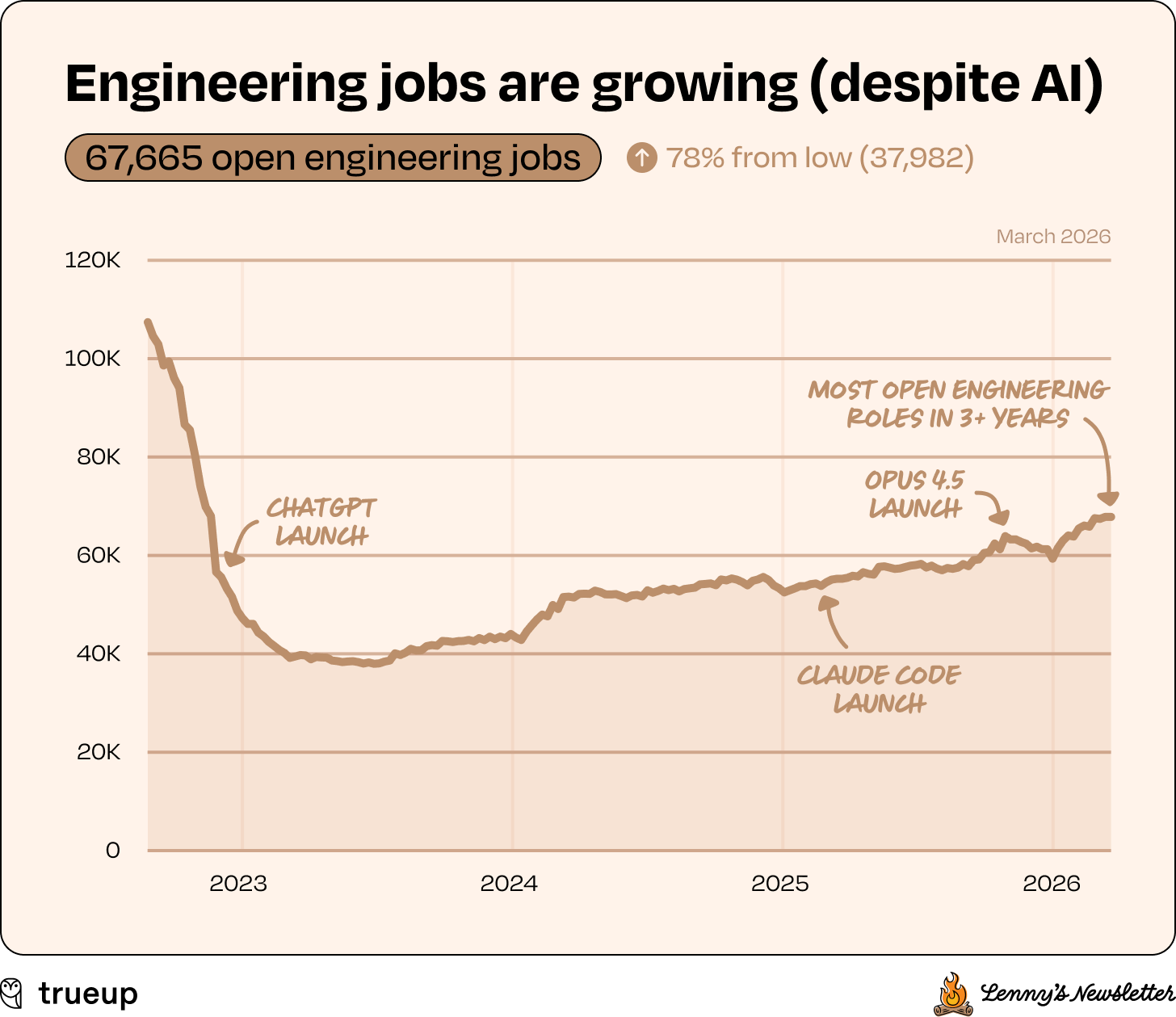 Aside from the job market, which is not the focus of Artifacts, these months and years are incredibly fascinating to speculate about what’s happening to software.
It is true that coding is becoming a commodity. Concretely, if you talk to any engineer, writing code by hand is undergoing something similar to what is happening to writing emails for any knowledge worker.
It’s what I called meta-writing: we more and more dictate to a machine what we need to write and maybe even how and in what style, and then we delegate the act of writing or typing
 Next week Artifacts is in Brussels for the AI & Tech Week organised by Politico - let’s say hi if you’re around :)
> ### The Bookshelf
 Speaking of code, ‘Life in Code’ is a wonderful book about technology, on how it evolved in the past 30 years, and how we got where we are - from the perspective of Ellen Ullman, who has been questioning Silicon Valley with a critical eye since the 90s. One to read!
📚 All the books I’ve read and recommended in Artifacts are here.
> ### Nerding
 Ok not exactly a tool tool, but you thank me later once you read how Claude Code works directly from Anthropic. It will right away improve the way you use it or give you a final push to give it a chance, even for non coding work!
> ### ☕?
If you want to know more about Artifacts, where it all started, or just want to connect...
Let's grab a virtual coffee ☕
======
# You know a good architect?
Date: 2026-04-07 | Language: en
Canonical: https://artifactstech.substack.com/p/you-know-a-good-architect
Cite as: You know a good architect? by Lorenzo Ancona, Artifacts, 2026-04-07. https://artifactstech.substack.com/p/you-know-a-good-architect (CC BY 4.0)
A few weeks back, I was in Amsterdam in a well-known museum that I had visited before. They had restructured the building, though: new layout, different lighting, and a reworked flow for visitors.
The experience was notably worse, despite the quality of the art on the walls. The same pieces I remembered were now hard to see properly - light reflecting off surfaces, canvases hung in awkward corners, and the rhythm of the visit broken.
Nothing had changed about the art but everything had changed about the building around it.
It reminded me of reading a beautiful book in a poorly printed edition - the content is all there, but something in the way it reaches you is off.
A badly designed building affects what it contains and the people who visit it. To fix it, you will likely call back the architects, not the artists.
------------------------------------------------------------------------
With a bit of fantasy and mental stretch, this is what was ruled for social media in the US in the last weeks.
Two bellwether (must admit I learnt a new word), initial rulings:
- On March 25, a Los Angeles jury found Meta and YouTube negligent in the design of their platforms - ruling that features like infinite scroll, autoplay, and algorithmically-tuned reward loops were not neutral product choices but foreseeable causes of harm. The plaintiff had sued the companies at 17 after spending up to 16 hours a day on Instagram as a teenager.
- On March 24, a New Mexico jury ordered Meta to pay \$375 million after the state attorney general proved the company had misled users about how safe its platforms were for children - and that its design had actively enabled predators to find and contact minors.
 To get a sense of the severity of these matters. Plus, the full explanation here
The platforms have announced that they will appeal these decisions.
What makes these verdicts different from the thousands of lawsuits that came before is not the dollar amounts but the question they answered: courts weren’t asked whether Meta and Google hosted harmful content but whether they built dangerous products or hadn’t done enough to prevent harm.
This distinction - quiet, technical, almost bureaucratic-sounding - is actually a big new thing.
------------------------------------------------------------------------
Up until now, platforms have often been shielded by Section 230, or ‘the 26 words that created the Internet’ - a piece of legislation within the 1996 Communications Decency Act that protects online services from liability for what users post.
Section 230 made the internet possible because no one would have risked opening a service and bearing responsibility for other people’s actions.
Yet when it passed, the closest thing to a social media platform looked like this:
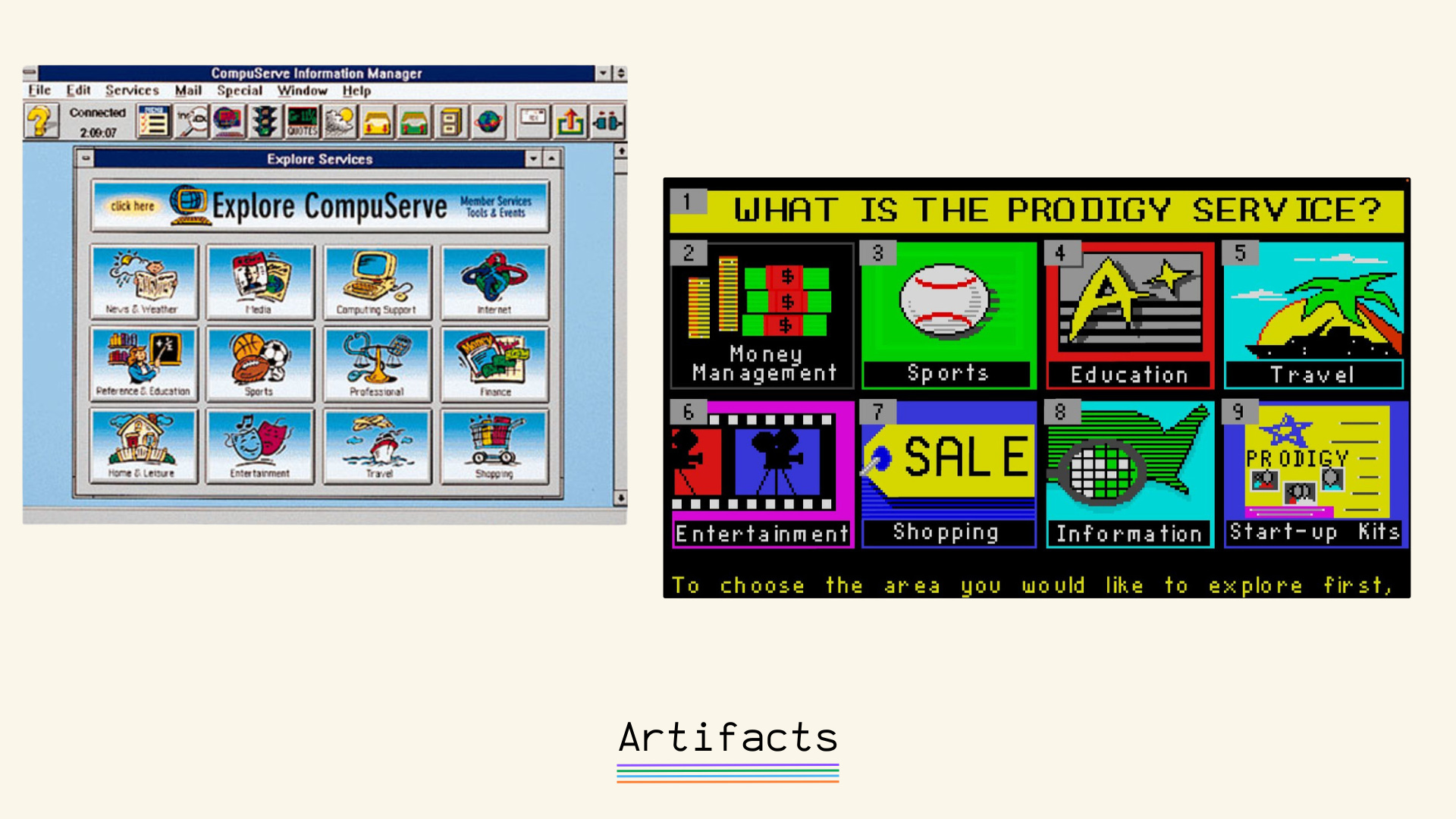 These are CompuServe and Prodigy, dial-up platforms where users posted text messages to bulletin boards. Users also chose a topic and read posts in chronological order. The logic of 230 was sound: you don’t sue the corkboard for what someone pins to it.
What CompuServe and Prodigy were offering was the hosting of content. But online platforms have changed quite a bit since:
They can now profile every user - every tap, pause, scroll, and replay feeding a behavioural model. They personalise reality: two people on the same platform at the same moment see completely different feeds. They recommend the next piece of content before you’ve decided you want one. They shape what is culturally visible at scale: what trends, what gets buried, what goes viral is not the neutral outcome of user preference but the product of ranking decisions the platform makes for billions of people simultaneously.
The content is still there, but it has become the fuel of a much broader and complex machine built on top. What these platforms offer now - content curation, algorithmically-determined connections, trends, monetisation - is far beyond just hosting.
And as they have built more complex products and offered more complex services, it makes a lot of sense to scrutinise the design.
Back to the two cases, with a bit more detail:
- KGM (the Los Angeles case) is a case about what Meta and YouTube built: infinite scroll, autoplay, variable reward loops - the deliberate unpredictability of likes and engagement, engineered to trigger certain behaviours. These are features with authors, thus decisions with accountability. The jury found their design negligent.
- New Mexico is a case about what Meta didn’t build (super interesting to read the full case here). The state attorney general ran an undercover investigation, creating a fake profile of a 13-year-old girl. She was served grooming content and connected to predators. What was missing: meaningful age verification, protective defaults, friction.
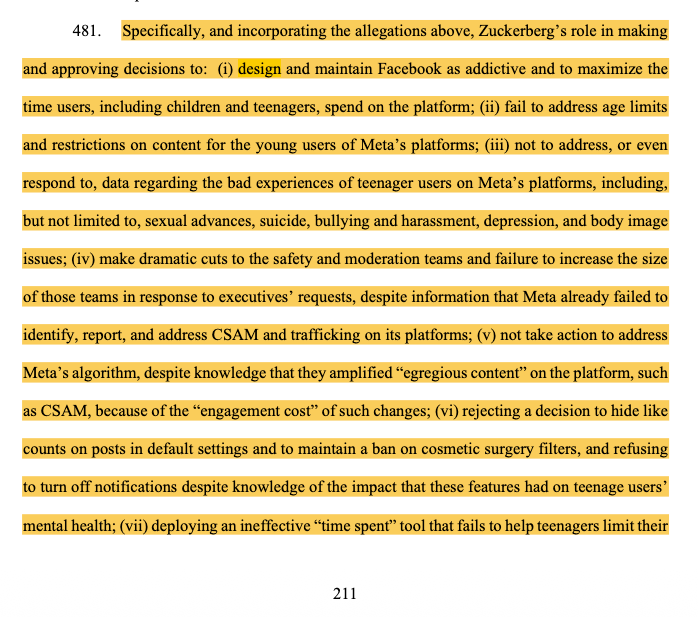 look at how much detail the case provides about the design decisions
And therefore, product liability is the natural legal container for all of this. It asks the right questions: could you have built this differently? Could you have chosen not to build it at all?
But in the US, product liability, as currently defined, was built for pharmaceuticals and power tools. Applying it to algorithmic systems requires foundations the law hasn’t yet built. So, they’d need:
- a clear legal definition of what counts as a “product” in the digital world - social media platforms and algorithmic services are currently treated more like intangible services than goods;
- a design‑defect standard that fits software: treating features that are “working as intended but foreseeably harmful” as a defect that was predictable, thus avoidable;
- a causation doctrine (‘this causes that’ type of thing) that handles systemic harm epidemiologically rather than case by case — tobacco litigation eventually developed this. This one is particularly important since, as contended by Meta too, it is quite a strong statement to say that a single platform has caused mental problems for a teenager.
- a First Amendment boundary that cleanly separates design conduct (how the platform works) from editorial expression (what content is there and how it is distributed), so platforms can’t collapse the two on appeal.
If these foundations get built, we get the tools to keep scrutinising properly how social media are designed, so that when architectural choices cause harm, they can be addressed.
 Speaking of tools, architects, and design
The importance of sound foundations is clear if we look at what Europe is already trying. With the Digital Services Act (which is not at all just about content!), the EU is, for instance, looking into prohibiting dark patterns, requiring recommender system transparency.
Therefore, for instance in December, the Commission issued its first DSA fine: €120 million to X, partly for the design of its blue checkmark, a trust signal quietly turned into a paid badge anyone could buy. And days after the US verdicts, it opened a formal investigation into Snapchat - focusing on defaults that exposed minors to strangers and age verification that amounted to typing a birthdate.
Two legal systems, different legal instruments, but the same shared question: can we improve the design of these platforms?
And so, as in that Amsterdam museum, finally asking if we can call the architects back in to fix the building.
Leave a comment
> ### Save for Later
Pay a bit of attention, please. Although there are good reasons why you cannot concentrate. Or you may not be able to spot a deepfake.
What if Venture Capitalists are zombies? And what if the Internet is less and less human. And some bad stories about AI workers
Maybe OpenAI can’t compete? AI may not love to reference newspapers. But some AI companies want others to pay copyright.
How war has become a story. And what’s this story of the EU censoring speech.
Go checkout what Carlo & Alessandro Diano are doing to fight polarization online - and do use their tools for your information diet! (+ had a lot of fun with them and other cool people from the UnbubbleHub building Sources, a tool to widen perspectives on any given topic)
 > ### The Bookshelf
 Probably the most comprehensive book about Section 230. You don’t need to be a lawyer to read it (I’m not). It will provide you with a lot of details and information to understand the why and how of Internet regulation 30 years back.
📚 All the books I’ve read and recommended in Artifacts are here.
> ### Nerding
 You know the moment you want to save something on your laptop, don’t know where, so you just pile it up on the desktop and never go back to it? I guess this is why they built Dropzone, which is, indeed, the virtual basket where you drop that file you’d like to get back to at some point.
> ### ☕?
If you want to know more about Artifacts, where it all started, or just want to connect...
Let's grab a virtual coffee ☕
======
# Use with caution
Date: 2026-03-07 | Language: en
Canonical: https://artifactstech.substack.com/p/use-with-caution
Cite as: Use with caution by Lorenzo Ancona, Artifacts, 2026-03-07. https://artifactstech.substack.com/p/use-with-caution (CC BY 4.0)
This week Artifacts should normally not go out. Yet **[what has happened between Anthropic, OpenAI and the US Pentagon](https://www.theverge.com/ai-artificial-intelligence/886082/ai-vs-the-pentagon-killer-robots-mass-surveillance-and-red-lines) is too interesting a story to miss.**
If you already know the news, feel free to skim to the *“So, what?”* section. **If not, I tried to keep the story concise.**
In July 2025, the Pentagon awarded **two-year contracts to Anthropic, OpenAI, Google, and xAI** to prototype frontier AI capabilities for national security. The goal was to develop agentic workflows, intelligence analysis tools, and battlefield simulations.
Among them, Anthropic had something the others did not. **Its model Claude was the only frontier AI system cleared to run on fully classified Pentagon networks**, deployed through Palantir Technologies’ AI Platform and Amazon’s Top Secret Cloud. It had been used, reportedly, **during the operation to capture Nicolás Maduro** and, most recently, for the strikes in Iran.
All four contracts, though, included some usage safety restrictions. **This changed on January 12, 2026** when the Defense Secretary Pete Hegseth issued an [AI strategy memo](https://media.defense.gov/2026/Jan/12/2003855671/-1/-1/0/ARTIFICIAL-INTELLIGENCE-STRATEGY-FOR-THE-DEPARTMENT-OF-WAR.PDF) declaring the Pentagon would become ‘an ‘AI-first’ warfighting force with AI agents integrated *‘from campaign planning to kill chain execution’.*
To this end, the Pentagon asked Anthropic and the others **to change the contracts** so to use AI at its full potential, with no ‘policy constraints’ decided by the AI companies. **“Any lawful use” should be allowed.**
On February 27, Hegseth reportedly gave Anthropic an **ultimatum**: accept the revised terms or lose the contract. **Anthropic rejected the offer, [citing concerns about undermining democratic values](https://www.anthropic.com/news/statement-department-of-war)**, and no intention to allow the use of AI for **mass surveillance** of American citizens and **autonomous weapons** that can kill with no human in the decision loop.
That same evening, **Sam Altman [announced](https://openai.com/index/our-agreement-with-the-department-of-war/) that OpenAI had reached a new agreement with the Pentagon**. According to Altman, the deal preserved the same red lines on autonomous weapons and mass surveillance that Anthropic had defended.
However, **the details of the contract have not been made public**, and some observers believe the new arrangement may allow broader uses than Anthropic considered acceptable.
OpenAI claims that they will be able to enforce better their constraints as the models used by the Pentagon will run on their own cloud.
Finally, **[the Pentagon has responded by designating Anthropi](https://www.anthropic.com/news/where-stand-department-war)c a “Supply-Chain Risk to National Security”** - usually reserved for foreign companies (like Chinese ones) - ordering federal agencies to stop using its products in the next 6 months. The New York Times [said](https://www.nytimes.com/2026/02/28/podcasts/hardfork-pentagon-anthropic-openai.html) this is *‘likely the harshest punitive action the U.S. government has taken against a major American company this century, possibly ever.’*
**Anthropic will challenge the designation**, which could greatly impact their business, while also [saying](https://www.anthropic.com/news/where-stand-department-war) they *‘have much more in common with the Department of War than we have differences.’*
> ### So, what?
This story is ultimately about **constraints**.
Not only those that AI companies want to put on the US government in the use of technologies or those put by technology regulations on the use of AI, but also, and maybe more crucially, **those baked into the design of AI technologies.**
Let’s look at the [two red lines set by Anthropic:](https://www.anthropic.com/news/statement-department-of-war)
1. ***‘Mass domestic surveillance is incompatible with democratic values** and presents risks to fundamental liberties’.* Therefore, despite being technically *feasible* to use their AI models to analyse data on citizens, **there has to be constraints as this is overly dangerous and threatens rights.**
2. **Fully autonomous weapons**, instead, ’*need to be deployed with proper guardrails, which don’t exist today.’* So they *could be used*, but the current safety constraints are not sufficient, **and thus it is imperative to have safeguards in place.**
These constraints are not just on the AI models but **on the blurred terminology of** ***‘any lawful use’*** adopted by the Pentagon.
In theory, this sounds straightforward. But **in the United States** - where there is still no comprehensive federal regulation of AI - **the meaning of “lawful use” is far from settled.** The boundaries are still evolving.
In practice, this means that **the law alone does not fully define the acceptable uses of AI.**
And that is precisely **where these technological constraints come in.**
Interestingly, **the Pentagon itself had tried to push back constraints** in the January memo, writing that they *‘must utilize AI models free from usage policy **constraints** that may limit **lawful** military applications.’*
This sounds like a very controversial statement depicting a contrast **where the constraints of technologies could be countering or impeding uses allowed under the law.**
Provocatively, this is exactly **the contrary of the reasons why technology regulations are often criticised:** that they impede the full use of technologies.
Usually, you see BigTech or other organisation complaining about regulation. Here, the situation is almost inverted: the Pentagon argues that **constraints embedded in the technology itself** could limit uses that the law might otherwise allow.
Or, as put more bluntly by [Hegseth](https://x.com/SecWar/status/2027507717469049070?s=20) *‘America’s warfighters will never be held hostage by ideological whims of Big Tech.’* Or from Trump:
[](https://substackcdn.com/image/fetch/$s_!H0jM!,f_auto,q_auto:good,fl_progressive:steep/https%3A%2F%2Fsubstack-post-media.s3.amazonaws.com%2Fpublic%2Fimages%2F34018583-64c5-44ed-83ab-fedb69c400ef_804x1172.png)
At its core, this raises a fundamental question: **who ultimately controls powerful technologies?** Those who build them or those who regulate them, this time more interested in a laissez-faire regulation for unbridled use?
By setting these constraints, **AI companies are doing something subtle but important.** They are not only designing the technology itself, but also shaping the **space of possible uses**.
Interestingly, **they are designing a downstream layer of the use of AI** that sits on top of the design of technology itself.
If we have long argued that technologies are not neutral - that their design shapes their political and social effects - **this story reveals something further.**
With AI, the **design of use** **becomes almost as important as the design of the system itself.**
This is particularly true because artificial intelligence is a **general-purpose technology**. Its capabilities can be applied across a vast number of domains, **and thus the layer of how it can be used is critical.** Not all possible options are good options.
[](https://substackcdn.com/image/fetch/$s_!kv_i!,f_auto,q_auto:good,fl_progressive:steep/https%3A%2F%2Fsubstack-post-media.s3.amazonaws.com%2Fpublic%2Fimages%2F661eace5-156f-4830-b074-9004d3935975_2048x2048.png)
Concretely, as AI would, for instance, enable easy data analysis, **the issue is rather with what use is done of such capability:** is it to assess, say, decarbonisation metrics or rather spying on citizens through combining data?
The real question is therefore not just what AI can technically do but also **what it will be allowed to do**.
And in the absence of clear ‘lawful uses’, **those decisions increasingly fall for now to the organisations building these technologies** and in how they design what’s allowed and what’s not.
[Leave a comment](https://artifactstech.substack.com/p/use-with-caution/comments)
> ### **Save for Later**
[Why someone should write,](https://www.orwellfoundation.com/the-orwell-foundation/orwell/essays-and-other-works/why-i-write/) from Orwell - quite crucial nowadays
[So what will happen to jobs](https://www.anthropic.com/research/labor-market-impacts), by Anthropic. Btw, Anthropic [gave Claude a Substack](https://www.theverge.com/ai-artificial-intelligence/885200/anthropic-retired-claude-given-a-substack).
Maybe just put [a stop on the AI slop](https://www.theverge.com/ai-artificial-intelligence/882956/ai-deepfake-detection-labels-c2pa-instagram-youtube), please? In the meantime, a super funny video on [a professional enshittificator](https://x.com/joakial_/status/2027753478068506923?s=20) (maybe a new word?)
If you need to vibe with your Google documents, [go for this.](https://github.com/googleworkspace/cli)
AI doesn’t really understand [the physical world.](https://www.linkedin.com/posts/yann-lecun_feel-the-agi-i-suspect-the-thing-was-activity-7434243936266813440-uWDK?utm_source=share&utm_medium=member_desktop&rcm=ACoAADBGmFQB0rHgggpkCiHG5Dn-B9e4n2G0Y-g)
How to curate what information we eat.
[\[Embedded media — view original\]](https://www.youtube-nocookie.com/embed/VCJET4fj1mE?rel=0&autoplay=0&showinfo=0&enablejsapi=0)
> ### **Where next?**

In 10 days I’ll be at the **[Govtech forum](https://www.govtechforum.io/)** in Milan 🇮🇹 - *let’s say hi if you’re around!*
> ### **The Bookshelf**
[](https://substackcdn.com/image/fetch/$s_!xkhA!,f_auto,q_auto:good,fl_progressive:steep/https%3A%2F%2Fsubstack-post-media.s3.amazonaws.com%2Fpublic%2Fimages%2F70edb1ae-f69c-4ab6-adfa-ea98233d6ac3_1080x1080.png)
Speaking of edge uses of technology, the ***‘Palestine Laboratory’*** is a good book to shed light on what the use of technology really means and why its design matters.
📚 **All the books** I’ve read and recommended in Artifacts are [here.](https://airtable.com/appK7fMPX1DMkQYzL/shrRh8TgI7GtmgBxM)
> ### **Nerding**
[](https://substackcdn.com/image/fetch/$s_!I3pZ!,f_auto,q_auto:good,fl_progressive:steep/https%3A%2F%2Fsubstack-post-media.s3.amazonaws.com%2Fpublic%2Fimages%2F98859569-cfa1-46be-8bce-13bbd499f621_1080x1080.png)
**If you’re into cool interactions, design, animations,** you may want to check out **Mobbin**, which collects them all together and is a great source of inspiration for anyone building products!
> ### **☕?**
If you want to know more about Artifacts, where it all started, or just want to connect...
======
# The artifacts I use for Artifacts
Date: 2026-02-25 | Language: en
Canonical: https://artifactstech.substack.com/p/the-artifacts-i-use-for-artifacts
Cite as: The artifacts I use for Artifacts by Lorenzo Ancona, Artifacts, 2026-02-25. https://artifactstech.substack.com/p/the-artifacts-i-use-for-artifacts (CC BY 4.0)
[In the last Artifacts,](https://artifactstech.substack.com/p/writing-is-thinking) I argued that using LLMs to produce text **may mean skipping the thinking that makes writing worth doing.**
Yet, I’m definitely not a Luddite or sceptical of AI helping with daily tasks. It’s just that I don’t buy ‘the perfect prompt’ or other tricks with chatbots.
And so, while busy ranting against chatbots, **I was also studying AI agents:** *artifacts* that don’t just generate text on demand but can coordinate and use other tools, memory, **and - more importantly - can perform actions.**
And I started to wonder **how I could use these artifacts to write Artifacts.**
**I moved from the tasks I do every day for the newsletter:** pulling interesting articles or podcasts, storing them somewhere with labels or notes, finding moments to make sense of a lot of unshaped knowledge, but also trying to find that old article or books I read that may be relevant to a certain topic.
People working in product would say I started from the **jobs to be done.**
The more I researched, **the more I realised that [Claude Code](https://www.lennysnewsletter.com/p/head-of-claude-code-what-happens) was the perfect orchestra director** of the different flows I was tinkering with. But let not be boring with the technicalities :)
[](https://substackcdn.com/image/fetch/$s_!VSEM!,f_auto,q_auto:good,fl_progressive:steep/https%3A%2F%2Fsubstack-post-media.s3.amazonaws.com%2Fpublic%2Fimages%2F75e0782e-ae50-4c4f-9ffb-6513c93d9aa4_1024x1024.png)
music :)
What matters is that a few weeks in, **I found myself with something I hadn’t expected at the outset:** **a full editorial infrastructure** that autonomously gets relevant articles from multiple sources, organizes them and - **when I decide on what to write about** - supports me with the research and the refinement, tapping in everything I’ve read for the past 3 years.
All in all, I don’t think it’s an overstatement to say I got **a small team of artifacts that help me write Artifacts.**
Ah, a few important **caveats**:
- I use Claude Code, which is built for engineers, **but works just fine for other tasks as well.** A good alternative could be [Claude Cowork.](https://claude.com/blog/cowork-research-preview)
- This whole infrastructure costs **19 euro per month.**
- It’s hard to quantify how long it took, but **it’s definitely** ***easy*** **to build something like this with AI**, now.
Here’s a bit of the **story** of how it went.
> **First,** **the** **foundation**
If there’s one thing that matters with AI agents, it’s **context**. Not copy-pasting the prompt of who you are, what you do, etc., but **a more solid understanding and ‘memory’ of what you’re writing on**, how you do things, what good looks like.
So when I started thinking about how to make Claude Code useful for Artifacts, the question was simple: *where’s the best place to pull that context from?* The answer was obvious: **Artifacts itself.**
**I had Claude fetch and read every Artifacts I’d ever published** - years of writing, including the early ones still in Italian, when the newsletter was heavier on policies and regulation and lighter on technologies.

**And it was quite fun to ‘talk’ with the old newsletters**, see how Artifacts has evolved and, implicitly, how I’ve evolved in writing them.
It was also the opportunity to rethink a bit how I describe this newsletter, settling on ***‘stories & ideas on the design of technology’***
[](https://substackcdn.com/image/fetch/$s_!XdpJ!,f_auto,q_auto:good,fl_progressive:steep/https%3A%2F%2Fsubstack-post-media.s3.amazonaws.com%2Fpublic%2Fimages%2F10b73ba9-ef30-47dd-9ca1-ae35a05670d2_1188x640.png)
Claude then used all this context to fill in the `Claude.md`, **a file that loads automatically at the start of every session**, where it’s clear who you are, what you do, where things are, what’s your style etc. **Much better than the perfect prompt :)**
[](https://substackcdn.com/image/fetch/$s_!r8gi!,f_auto,q_auto:good,fl_progressive:steep/https%3A%2F%2Fsubstack-post-media.s3.amazonaws.com%2Fpublic%2Fimages%2F16915354-00d4-46fc-8f0b-5fe9df7cdcea_1604x1318.png)
Most developers use it to document code architecture. **I** **use it to document Artifacts and how it is written.**
**CLAUDE.md is the most important piece in this stack.** Everything else runs on top of it.
The second foundational piece is **Notion**. I’ve used it for years as a database where to automatically store all the articles, papers, podcasts, books, I read - basically, **the knowledge that has been powering Artifacts for years.**
Now, I’ve connected it to Claude (via MCP, for nerds out there), so that **whenever I’m thinking of, say, age verification, it will return to me anything I’ve came across in the past 3 years**, be it a podcast or a book highlight. Not too bad.
[](https://substackcdn.com/image/fetch/$s_!h-SG!,f_auto,q_auto:good,fl_progressive:steep/https%3A%2F%2Fsubstack-post-media.s3.amazonaws.com%2Fpublic%2Fimages%2Fdb85fe36-462f-4cc5-bfe6-ce88597aec79_1280x720.gif)
`Claude.md` and the Notion plug are where the full context lives: **they don’t generate content but they make my agents aware of what Artifacts is** and what I know already.
So I’m not always starting from zero, or chasing the perfect prompt :)
> **Then,** **the** **flow**
Once the infrastructure knew Artifacts, **I started using it.**
First task is getting sources. **As Artifacts is where I try to make sense of a lot of what I read, I try to read a lot.** But as the newsletter subscription counter grows, it’s not the case for time - and sometimes I struggle to catch up.
So I built an automation in n8n that **every day at 9 PM pulls articles from TechCrunch, The Verge, The Markup, and WIRED, plus whatever newsletters landed in my inbox**, then filters, clusters, and analyses them with an AI tuned to ask one question: ***what matters here for Artifacts?***
[](https://substackcdn.com/image/fetch/$s_!jkFR!,f_auto,q_auto:good,fl_progressive:steep/https%3A%2F%2Fsubstack-post-media.s3.amazonaws.com%2Fpublic%2Fimages%2Ff50e3e5f-c69c-4fdc-9d8a-eae47cd22bba_2226x1128.png)
The output is some **notes sent to a Notion page and in a Telegram message** on my phone. I usually read it in the evening or first thing in the morning.
[](https://substackcdn.com/image/fetch/$s_!bFVP!,f_auto,q_auto:good,fl_progressive:steep/https%3A%2F%2Fsubstack-post-media.s3.amazonaws.com%2Fpublic%2Fimages%2F8ae940f5-1880-4c9a-ae27-c50bf97aaa1c_1166x1016.png)
Sometimes nothing sticks, other times one item connects to something I’ve been turning over for weeks, **and that’s when the idea of a piece begins.**
Important point: **I decide what to write about.** For now, I don’t want AI suggesting topics. **I enjoy connecting the dots myself.**
Once I pick a topic, **I open Claude Code and start looking into my Notion for pieces on the subject.** It helps me re-read, draw an outline, ditch ideas, explore new angles - building the shape of what I want to write before I actually write it.

**So I can draw on my notebook the mental schema** I need before writing Artifacts.
**Writing itself I keep for myself,** and I think I’ve explained at length why :)
What I have built is`/artifacts-polish`, **a skill that helps me clean language and keep it consistent with older editions,** having ‘read’ the others.
[](https://substackcdn.com/image/fetch/$s_!JIDD!,f_auto,q_auto:good,fl_progressive:steep/https%3A%2F%2Fsubstack-post-media.s3.amazonaws.com%2Fpublic%2Fimages%2F296a062d-7c4d-4d3b-ad49-7b1ab57ed008_1454x824.png)
In Claude, **skills are fixed instructions on repeated tasks** - say every morning you want a recap of your emails, you built a skill that knows what to do.
Once the draft is ready, **I run this skill and it helps me go through what I’ve written with fresh eyes.**
And when I’m happy, I send it out to your inbox :)
**But it doesn’t end there.** As some of you know, I always republish on LinkedIn - with some effort to avoid the annoying flattened language of that platform. So I built another skill,`/artifacts-linkedin`, **that turns my piece into a post I’m actually happy with, based on all my previous ones.**
[](https://substackcdn.com/image/fetch/$s_!EoV8!,f_auto,q_auto:good,fl_progressive:steep/https%3A%2F%2Fsubstack-post-media.s3.amazonaws.com%2Fpublic%2Fimages%2F05387444-bfa3-4880-b29a-843a64204b12_1614x1082.png)
Last but not least, **Claude, the context and the agents keep learning from the process**, so the infrastructure improves with me.
> **So, what?**
I want to be careful not to oversell it. **These artifacts don’t write Artifacts** - but they help by surfacing topics I might have missed, pulling up pieces I read months or years ago, and keeping consistency across publications.
And I built this not to have someone else writing, but **to do better some tasks and leverage more my very own work of the past years.**
So it’s not just a writing assistant but more **an AI-powered thinking and writing infrastructure**, designed around what Artifacts is and has been, and with flows for how I want to be writing and keep doing it.
The critical decisions stay with me: **picking the topic, building the argument, doing the writing.** That’s intentional, and I don’t plan on changing.
But I must say that I’m having a lot of fun in having **these artifacts that help me write Artifacts,** and I’d encourage anyone to try it out for their projects!
[Leave a comment](https://artifactstech.substack.com/p/the-artifacts-i-use-for-artifacts/comments)
> ### **Save for Later**
Why institutions are [artifacts of cooperation.](https://aeon.co/essays/institutions-are-how-we-scale-up-cooperation-among-millions)
What are [the political effects of X’s algorithms](https://www.nature.com/articles/s41586-026-10098-2).
Why [we never asked](https://www.nytimes.com/2026/02/10/technology/personaltech/ai-google-meta-opt-out.html) for this Internet. And indeed [we don’t really need](https://www.wired.com/story/the-search-engine-for-onlyfans-models-who-look-like-your-crush/?bxid=5f43a3c889a7356e7e1b2114&cndid=61968307&hasha=dca445e23e26114858a48ad35040e287&hashc=2107626209cd615da922d357ec59a2f4a769eeec7e75a95e874cf17f98f1a7c1&esrc=MARTECH_ORDERFORM) these technologies probably.
What are the consequences of [AI speaking without bearing the consequences of it.](https://www.theatlantic.com/technology/2026/02/words-without-consequence/685974/) Btw, [AI doesn’t like Naples](https://github.com/algorithmwatch/city-comparisons/blob/main/Analysis.ipynb).
[Get bored](https://www.mdpi.com/2076-3425/15/8/794), please!
> ### **The Bookshelf**
[](https://substackcdn.com/image/fetch/$s_!esBy!,f_auto,q_auto:good,fl_progressive:steep/https%3A%2F%2Fsubstack-post-media.s3.amazonaws.com%2Fpublic%2Fimages%2Fede6edeb-e20f-4525-8b0a-dbf74741b695_1620x1620.png)
As we discussed infrastructures, I recently wrapped up ***‘Building and Dwelling’***, a terrific book by Richard Sennett on **how the cities we build shape how we live them.** Not a tech book, but worth a read for those interested in Artifacts more broadly.
📚 **All the books** I’ve read and recommended in Artifacts are [here.](https://airtable.com/appK7fMPX1DMkQYzL/shrRh8TgI7GtmgBxM)
> ### **Nerding**
[](https://substackcdn.com/image/fetch/$s_!Y9Pm!,f_auto,q_auto:good,fl_progressive:steep/https%3A%2F%2Fsubstack-post-media.s3.amazonaws.com%2Fpublic%2Fimages%2Fb8ecc0ef-7963-4623-b319-b3ed916b80e8_1080x1080.png)
To complement work with Claude Code, but also to connect ideas and create your knowledge base, **[Obsidian](https://obsidian.md/)** is a good one. **Needs an investment, but take a look!**
> ### **☕?**
If you want to know more about Artifacts, where it all started, or just want to connect...
[Let's grab a virtual coffee ☕](https://calendar.google.com/calendar/u/0/appointments/schedules/AcZssZ2ibxlzyU7rgnuoTgqXb_DFc19dfHmJeu1OAu17IY0_oHrtcJtvtctAJnMabirgZNx5Z5NAPGs0)
======
# Writing is thinking?
Date: 2026-02-10 | Language: en
Canonical: https://artifactstech.substack.com/p/writing-is-thinking
Cite as: Writing is thinking? by Lorenzo Ancona, Artifacts, 2026-02-10. https://artifactstech.substack.com/p/writing-is-thinking (CC BY 4.0)
Don’t look away, I’m quite sure this has happened to you as well:
[](https://substackcdn.com/image/fetch/$s_!xA0m!,f_auto,q_auto:good,fl_progressive:steep/https%3A%2F%2Fsubstack-post-media.s3.amazonaws.com%2Fpublic%2Fimages%2Fd4fc25d9-176d-4318-8662-3eead6e117c7_1200x628.png)
I admit too that I rarely draft work emails 100% by myself.
But let’s look at the broader picture: **we live in an era where producing a significant amount of language with meaning is more efficient and less time-consuming than ever.** You can literally get 10 pages of anything in a few minutes by asking any LLM to do so.
Yet, **this doesn’t mean we’re producing more knowledge or that the amount of meaning keeps pace with the length of the documents spit out by machines.**
Rather, **LLMs are great at producing stuff that makes sense, sounds good, and neatly organises notions**, being able to package information either in a few bullet points or uselessly long documents.
Not surprisingly, though, **the level of these texts can’t help but be average**, as LLMs are, technically but also philosophically, *‘[technologies of average](https://www.newyorker.com/culture/infinite-scroll/ai-is-homogenizing-our-thoughts) both in the quality of the writing and in the calibre of the ideas.’*
(And usually also badly written imho)
Not only creating, but also [consuming language](https://www.newyorker.com/culture/open-questions/whats-happening-to-reading) has been drastically simplified (I swear I wrote this sentence 😅): **we may be often asking an AI to help us read and summarise a document that someone else asked AI to make longer.**
Just look at newspapers apps or any reading app or even the iPhone, that now has introduced AIs to quickly give the 3 key points of anything.
I like to call this **the accordion of AI language: we keep making texts longer or shorter depending on our needs** only cause doing it is very, very easy.
[](https://substackcdn.com/image/fetch/$s_!uxHU!,f_auto,q_auto:good,fl_progressive:steep/https%3A%2F%2Fsubstack-post-media.s3.amazonaws.com%2Fpublic%2Fimages%2F157cbf39-ed1c-4b5d-999a-5319b785f96d_1024x1024.png)
we’re doing this to language
And so **producing simple, beautiful BULLSHIT is now extremely time-efficient, cheap and accessible** 🎉 Just peek at your LinkedIn feed if you need validation.
But that’s not as much of a problem.
What’s worse and deeply concerning is that **producing language has become a commodity.**
Large Language Models have made it so **easy to turn a few words of a prompt into newly created language.**
Yet, this makes us skip the complex, fascinating process through which we translate our thoughts into language, and thus words. **LLMs are our mediums.**
**And this means that language is less of a tool** - even a technology or an artefact - **through which we think and instead just a code enabling communication.**
All in all, **we can now think less to produce language.**
This comes with a few **implications**:
We’re no longer writing but rather **‘meta-writing’:** we more and more dictate to a machine *what* we need to write and maybe even *how* and in what style, **and then we delegate the act of writing or typing words to machines.**
**And so we stare at screens** while language is being produced by LLMs, skipping the process of thinking through what we aim to communicate.
This way, **writing is no longer a flow of 1st draft out, correcting it, changing, refining, but a back-and-forth exchange with a machine.** [As argued in Nature](https://www.nature.com/articles/s44222-025-00323-4), though, *‘**Writing compels us to think** — not in the chaotic, non-linear way our minds typically wander, but **in a structured, intentional manner.’***
Yet, **the ability to iterate over and over on a text quickly**, asking an AI to ‘make it more interesting’ or ‘make it sound more natural’ or whatever non-sensical prompts, **may decrease the time we spend on and with the language that should express our thoughts.**
So we may also understand less about what we’re ‘writing’ about but also **devote less care to what we’d like to emphasize and what requires less attention**, which is one of the most critical skills of thinking and writing.
At its extreme, **I sometimes consider writing the process by which we realise that we don’t understand what we’re talking about** - and sometimes this is so important.
This goes hand in hand with two other critical skills of writing and thinking: **the ability to break down complex issues into simple words as well as the ability to write concisely**, while not compromising on the meaning of what we say.
And still on the drafting and redrafting part, **we, as writers, are less and less the first careful readers of what we produce**, as we assume that LLMs will never have typos (rightly so, actually).
Finally, allow me to be a bit romantic, but **writing** - like reading - **is [a great process of self-discovery.](https://fs.blog/writing-to-think/)** [](https://fs.blog/writing-to-think/)
As I’m writing this Artifacts, I love seeing the mental connections I make, how I bridge different things I read in the past, what a friend maybe told me - **I thoroughly enjoy the time and feeling of the whole process.**
**And I do feel [a sense of care](https://www.theatlantic.com/family/2026/02/ai-etiquette-friends/685858/)**, of being clear and readable, so that your reading is enjoyable and an interesting time. *And I’m sure it’s the same for you, when you write.*
This being said, I’m not saying the final outcome of what I will produce would necessarily be better than an LLM *(well, I hope)*, but **the process itself of writing is probably also part of why you’re reading this piece.**
[](https://substackcdn.com/image/fetch/$s_!4QoH!,f_auto,q_auto:good,fl_progressive:steep/https%3A%2F%2Fsubstack-post-media.s3.amazonaws.com%2Fpublic%2Fimages%2Fe449b185-9b95-4eb2-8823-6076bd5e8acf_2950x2446.png)
This is everything that happens before me writing an Artifacts
Indeed, I argue that we read what others write cause we’re interested not just in the content of their writing - that could be produced by LLMs - or the information conveyed, **but also in why they wrote that something, what moved them, and, simply, in getting to know what they think.**
And so that a text - and thus the language of a thinking process - can resonate and establish a new human connection.
[Leave a comment](https://artifactstech.substack.com/p/writing-is-thinking/comments)
> ### **Save for Later**
[If a Ferrari gets designed](https://www.theverge.com/transportation/875799/ferrari-luce-jony-ive-interior-design-photos) by the person who created the iPhone.
But also [a collection of bad design tricks](https://pudding.cool/2023/05/dark-patterns/) that gets us trapped into services, so cool! And, speaking of design, [what the EU Commission is looking into TikTok for](https://www.ft.com/content/3d19372c-4922-4cdd-896c-8e3a81ecd3ba), trying to make it better
The truth on the [social media powered by AI agents.](https://www.nytimes.com/2026/02/02/technology/moltbook-ai-social-media.html) And where the truth really is between [Wikipedia and its alternatives.](https://www.lemonde.fr/idees/article/2026/01/25/entre-grokipedia-et-wikipedia-il-s-agit-de-determiner-quelles-conceptions-du-savoir-nous-souhaitons-defendre_6664020_3232.html)
AI Safety and where we are at, [with the most comprehensive report.](https://internationalaisafetyreport.org/publication/international-ai-safety-report-2026) While someone bought [AI.com for a lot of money.](https://www.ft.com/content/83488628-8dfd-4060-a7b0-71b1bb012785)
Anthropic [keeps doing super cool.](https://www.ft.com/content/a75555a6-24c3-4468-aba9-7fe12b5def31) Just look at this spot on adv on AI to mock OpenAI:
[\[Embedded media — view original\]](https://www.youtube-nocookie.com/embed/kQRu7DdTTVA?rel=0&autoplay=0&showinfo=0&enablejsapi=0)
> ### **The Bookshelf**
[](https://substackcdn.com/image/fetch/$s_!PXcL!,f_auto,q_auto:good,fl_progressive:steep/https%3A%2F%2Fsubstack-post-media.s3.amazonaws.com%2Fpublic%2Fimages%2F8f516323-22b3-4f13-83d3-7103ecc32883_1080x1080.png)
If you’re into why **good writing and good stories** are not just nice to read but actually part of why and how we understand the world, “***The Science of Storytelling”*** is the book to read. It has a scientific part too but it also provides a few ideas on how good writing is crafted.
📚 **All the books** I’ve read and recommended in Artifacts are [here.](https://airtable.com/appK7fMPX1DMkQYzL/shrRh8TgI7GtmgBxM)
> ### **Nerding**
[](https://substackcdn.com/image/fetch/$s_!kg73!,f_auto,q_auto:good,fl_progressive:steep/https%3A%2F%2Fsubstack-post-media.s3.amazonaws.com%2Fpublic%2Fimages%2F39087e0e-345a-4ba2-84d2-cca1632d5a6c_1080x1080.png)
If you wish to visualise Wikipedia pages on a board like a mental map, then [Wikiboard](https://www.wikiboard.org/) is the tool you may be looking for. I guess it can be so helpful while running a research - **and also to keep supporting Wikipedia, one of the best places of the Internet!**
> ### **☕?**
If you want to know more about Artifacts, where it all started, or just want to connect...
[Let's grab a virtual coffee ☕](https://calendar.google.com/calendar/u/0/appointments/schedules/AcZssZ2ibxlzyU7rgnuoTgqXb_DFc19dfHmJeu1OAu17IY0_oHrtcJtvtctAJnMabirgZNx5Z5NAPGs0)
======
# You're breaking it
Date: 2026-01-28 | Language: en
Canonical: https://artifactstech.substack.com/p/youre-breaking-it
Cite as: You're breaking it by Lorenzo Ancona, Artifacts, 2026-01-28. https://artifactstech.substack.com/p/youre-breaking-it (CC BY 4.0)
You may have heard of the tough situation that Iran is going through right now. And probably at one point you may have stopped seeing content coming from there, at least on social media.
That’s why, far from Artifacts diving into geopolitics, the Iran situation has a technological angle to it: the Internet has been shut down.
Indeed, as protests over economic collapse and political repression swept through all, Iran’s authorities triggered one of the most severe internet blackouts in the country’s history.
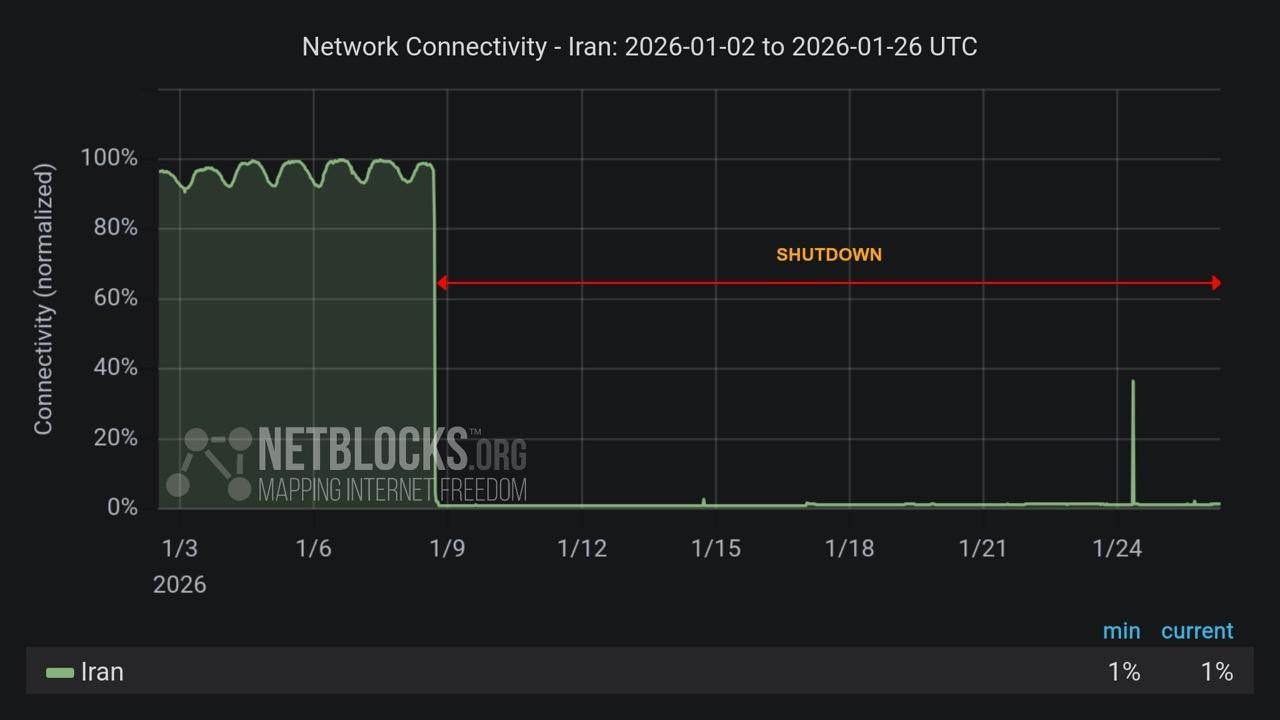 current status of connectivity in Iran
Starting around January 8, mobile data, broadband, and even text messaging were largely cut off, plunging a nation of more than 90 million into digital silence. Connectivity dropped to near zero, isolating families, crippling small businesses that depended on online platforms, and leaving daily life — from banking to emergency communication — fractured and precarious.
At the same time, independent reporting and social media feeds went dark, making it harder to verify what was happening on the ground and easier for the state to control the narrative of the crackdown.
What might have seemed like technical disruption is, in fact, a deliberate effort to stifle communication, suppress dissent, and limit the outside world’s view of events unfolding inside Iran.
This is not the first time Iran has pulled the plug. Over the past decade, nationwide and regional internet shutdowns have become a recurring response to moments of protest and political tension.
This blackout combines a central “kill switch” in the national backbone with multiple layers of filtering, routing changes, and physical network controls.
All international traffic runs through a small number of state-controlled providers — MCCI, Irancell, and TCI — which connect to the outside world via the government backbone.
Around the evening of January 8, routing announcements from these networks collapsed by 90–95% within minutes, as they withdrew most of their IP prefixes from the global Border Gateway Protocol (BGP) tables — the internet’s core routing system, which works like a postal service to find the best paths for data between large networks (Autonomous Systems) worldwide.
In practical terms, this meant that most URLs in Iran effectively vanished from the global map: external users could no longer reach them, while only a few tightly controlled routes remained for select institutions.
To picture it, imagine Iran’s network as a vast city: the government closes the bridges and highways to the outside world, blocks most inner streets, and leaves only a few heavily policed lanes open. The map still exists, but almost nobody can move, and the flow of information collapses.
Additional measures quickly reinforced the shutdown: VPNs, messaging apps, and streaming services were largely disabled at the border gateways, while mobile base stations were switched off, landlines disrupted, and SIM cards of activists or journalists were deactivated or throttled.
For users, this meant that most attempts to connect, communicate, or share content simply failed, leaving only a very limited, controlled connection within the country.
 and so they pulled the plug
Yet, as you know, the architecture of the internet was just never meant to work this way and be controlled by a state.
By design, the internet infrastructure should rest on principles of decentralization, universality, and end-to-end connectivity: networks coordinate via protocols, not territorial authority, allowing anyone to send or receive data without relying on a central controlling entity.
States were never intended to sit at the core of this system, dictating who can or cannot communicate.
When a government shuts down large swaths of connectivity, it violates these principles, imposing control that the network’s architecture explicitly discourages.
This gap between the internet’s intended design and the way it is governed is not just a technical quirk, but a derailing of governance.
It is helpful to take two references:
- UNESCO’s Internet Universality framework stresses that the internet should be open, accessible, and universally available: connectivity is not a privilege, but a precondition for participation in digital life.
- But also the 2nd principle of the Contract for the Web is to ‘Keep all of the internet available, all of the time’. Tim Berners Lee, that promoted it, in his latest book explicitly calls out Iran and the blocks they’ve been applying.
What is happening in Iran directly contradicts these principles. By shutting down the internet, the state is asserting control over the infrastructure itself.
It is appropriating a space that was designed to remain open and shared, turning connectivity into something conditional and revocable.
This is very different from digital sovereignty as it is often discussed. Legitimate forms of digital sovereignty aim to shape how the internet is used: enforcing laws, protecting users from illegal content, promoting local ecosystems, or reducing strategic dependencies - something that Europes is experincing a lot.
None of this requires breaking the network: Iran’s shutdown crosses a different threshold.
When a government can turn the internet on and off, the very idea of governance through code and protocol collapses. The internet stops being coordinated through shared standards and technical consensus, and becomes subject to territorial command.
This is a deformation of digital sovereignty that directly contradicts the internet’s original vision. It stops treating the infrastructure of the Internet as a common foundation, and it rather turns it in a lever of power.
Applied repeatedly, this logic breaks the Internet.
And it is how the Splinternet emerges: what was meant to be a single network is broken down, with connectivity becoming conditional, access suddenly political, and interoperability erodes.
 this was a nice visual I found while reading about the splinternet
And so the internet shifts from a universal space for communication and innovation into a patchwork of controlled networks.
And with that shift, something else may be lost as well: the internet’s capacity to function as a space of openness and - at times - as a space of resistance to political oppression.
Leave a comment
> ### A few words on the Political Tech Summit
As announced in the interview with its founder, Artifacts took part in the Political Tech Summit in Berlin.
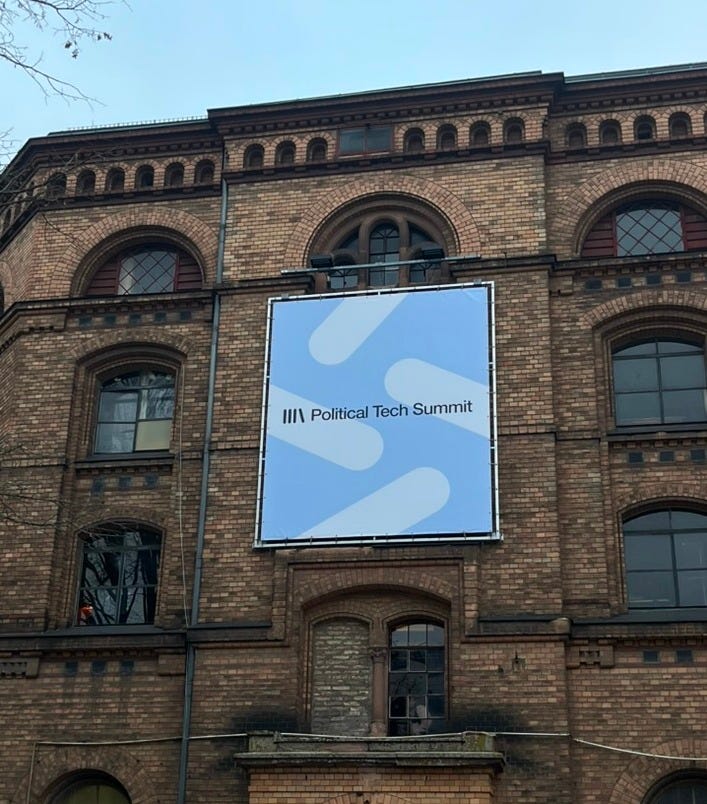 And it really delivered. It was a great event, with many thoughtful people speaking and attending.
My three main takeaways:
- The market for tools that improve engagement between politics and citizens is flourishing. There are lots of interesting ideas and concepts, and already some strong products, like Qomon.
- Events where researchers speak are simply better: less fluff, more solid reasoning grounded in data, with brilliant minds like Dr. Votta on stage.
- People outside the industry are increasingly interested in what good technology can unlock for politics — and that’s very encouraging.
> ### Save for Later
If AI gets a constitution, by Anthropic. But also if it gets advertising and what companies are trying to do to get some margins
What if computers use computers better than we do? More to come on this…
It was Wikipedia’s Birthday! What really lies behind one of the most beautiful places of the Internet. But also the terrifying truth behind organised scams and spams organisation.
How we now all see the same design icons everywhere.
On the X case, UK and Europe are investigating. But maybe app stores could’ve been bolder?
Finally, social media promised freedom, but we’re actually exhausted. But maybe we can build better ones? A 1 year experiment.
> ### The Bookshelf
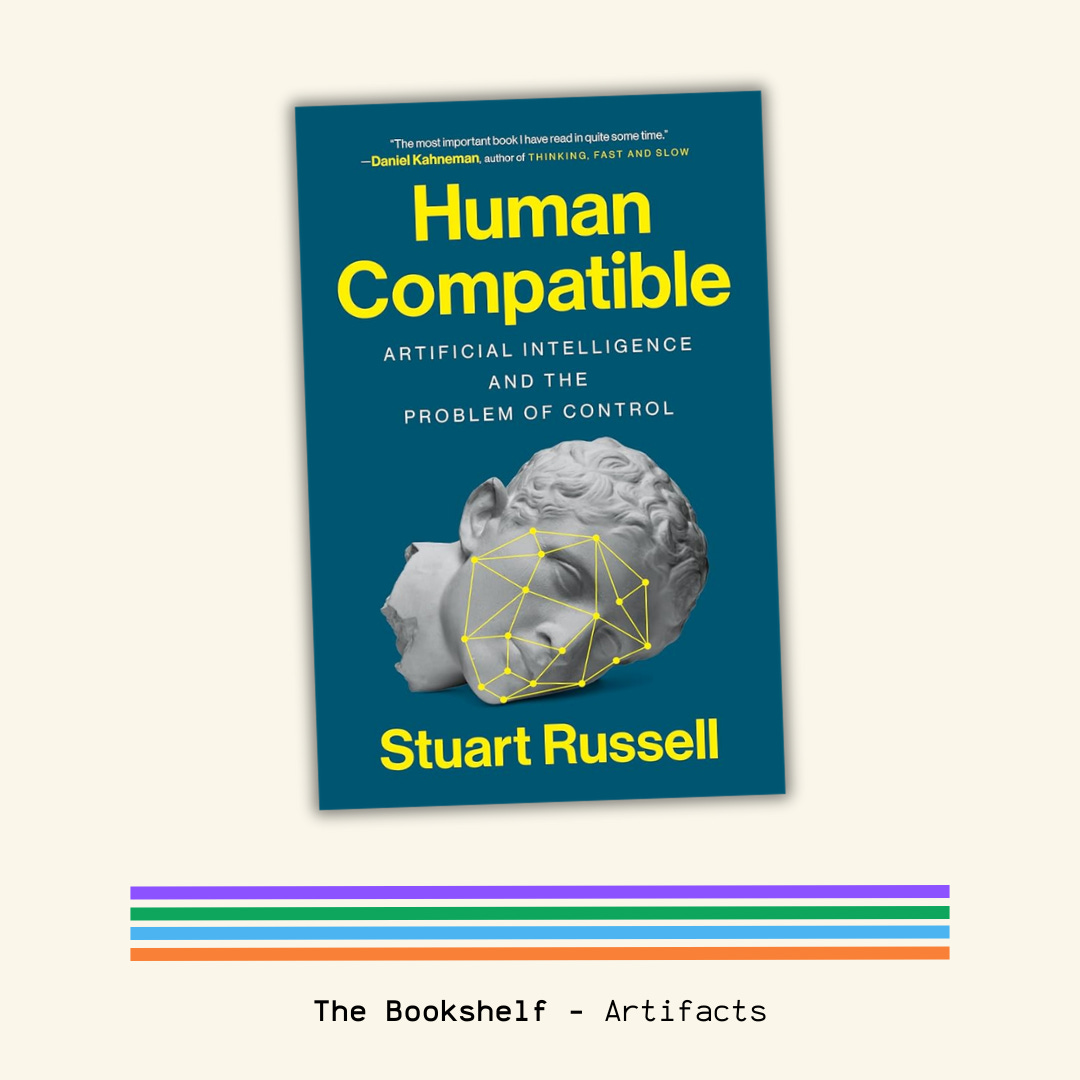 ‘Human Compatible’ is a great socio-technical book on AI alignment. It’s good for people into the matter but also for those who are approaching it. Good to read if you’ve questions on what it really means to govern AI.
📚 All the books I’ve read and recommended in Artifacts are here.
> ### Nerding
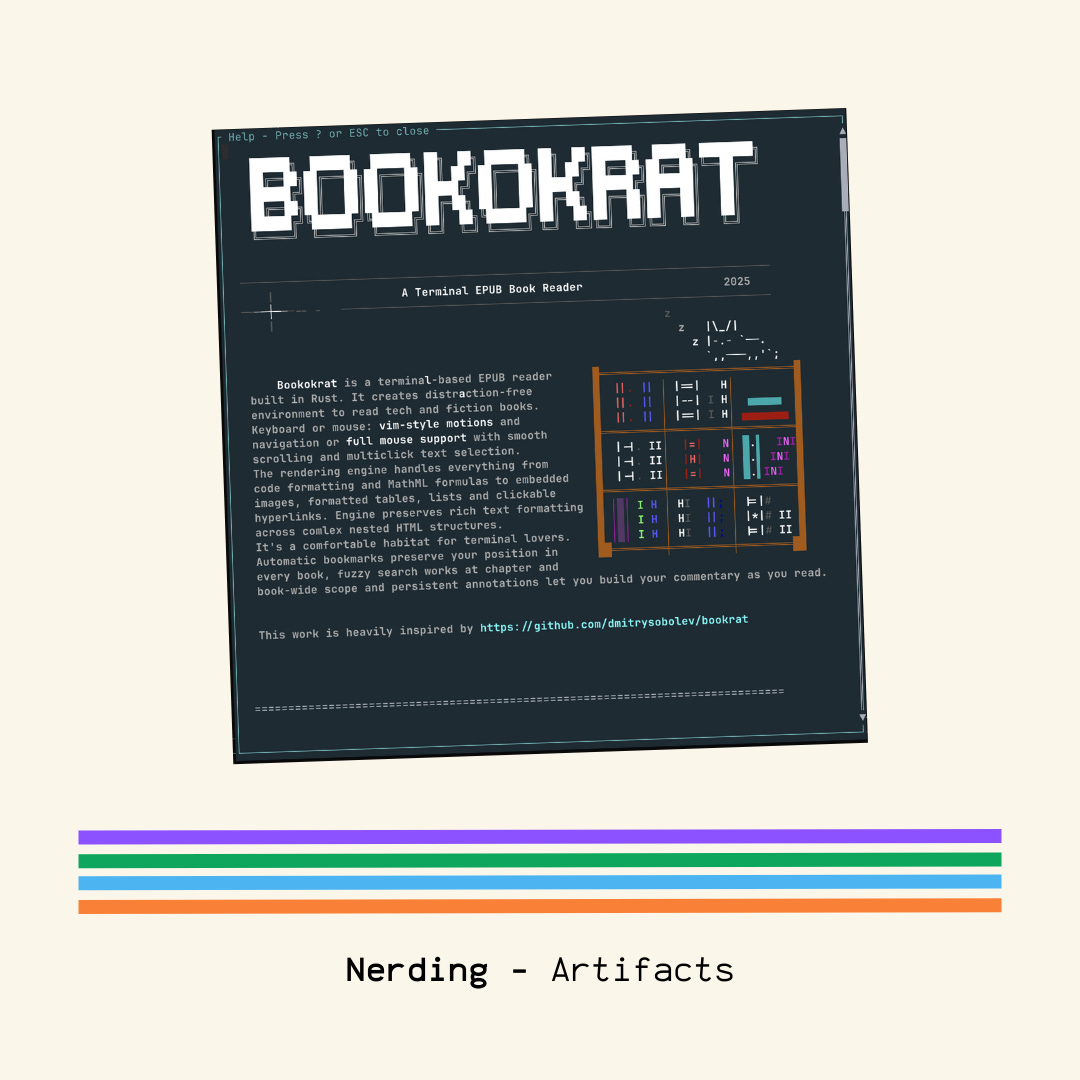 Ok, this is for real nerds. Bookokrat is to read books on the terminal of your computer, so that then you can easily interact with them through tools like Claude Code. It does makes sense if you’re into research and need to ingest lot of information.
> ### ☕?
If you want to know more about Artifacts, where it all started, or just want to connect...
Let's grab a virtual coffee ☕
======
# Laying bare
Date: 2026-01-06 | Language: en
Canonical: https://artifactstech.substack.com/p/laying-bare
Cite as: Laying bare by Lorenzo Ancona, Artifacts, 2026-01-06. https://artifactstech.substack.com/p/laying-bare (CC BY 4.0)
If you use X (formerly Twitter), **you may have noticed an explosion of non-consensual, nudified, and sexualised deepfake images** over the past few days.
**No need to pollute this newsletter with frightening screenshots**, but you can see what I’m talking about [here](https://x.com/grok/status/2006696301325410657?s=20) or [here](https://x.com/grok/status/2005915875929382971?s=20) or even [here](https://x.com/grok/status/2007668427888918846?s=20) (targeting women and children…)
What’s different this time is not the existence of deepfakes, but a **product decision** from X. **A very debatable one.**
The platform recently rolled out a new Grok - X’s chatbot owned by xAI, still a Musk company, now also the parent of X - feature that **allows users to generate or edit images simply by mentioning or replying to @Grok.**
Grok does not return the images in a private chat: **it publishes them directly to X’s public feed**, as a post from the Grok account itself.
Predictably, some users are now asking Grok, via posts or comments, to **put people in bikinis or other sexualised poses.**
And that’s how the platform is flooded with images as bad as these (or far worse, as you can imagine)
[](https://substackcdn.com/image/fetch/$s_!mOcn!,f_auto,q_auto:good,fl_progressive:steep/https%3A%2F%2Fsubstack-post-media.s3.amazonaws.com%2Fpublic%2Fimages%2Ff9c694fa-fe84-4f60-9d28-a25bff98799a_1410x964.png)
Needless to say, Grok does not discriminate based on who owns the original picture. **Anyone can ask it to put you, or someone close to you, into a skimpy bikini.**
------------------------------------------------------------------------
**Yet, these images should not be there.** And not (only) for any sort of ethics or responsibility, but because of what policies and regulations state.
According to X’s own guidelines, **such images should be banned from the platform.** According to Grok’s rules, **some of them should not even be generated in the first place.**
[Grok’s system prompt](https://github.com/xai-org/grok-prompts/blob/main/grok4_system_turn_prompt_v8.j2), which is public, explicitly **disallows material depicting child abuse**, while appearing noticeably looser on other forms of sexualisation involving adults. The same goes for the [acceptable use policy](https://x.ai/legal/acceptable-use-policy), updated a few days ago.

On the platform side, [X’s Child Safety policy](https://help.x.com/en/rules-and-policies/child-safety) claims **“zero tolerance” toward any form of child sexual exploitation**, including synthetic media. Its [non-consensual nudity policy](https://help.x.com/en/rules-and-policies/intimate-media) **bans “explicit sexual images or videos of someone online without their consent”.** There is, however, no mention of AI-generated content. The policy was **last updated in December 2021**
At the same time, the [authenticity policy](https://blog.x.com/en_us/topics/company/2020/new-approach-to-synthetic-and-manipulated-media) - last updated in April 2025 - states that **users may not share manipulated or misleading media that could cause serious harm.**
Enforcement, however, appears weak at best. A quick scroll through X makes that clear. **X Safety has instead pointed the finger at users prompting Grok to generate these images**, promising content removal and account bans.
[](https://x.com/Safety/status/2007648212421587223)
This distinction is interesting, **and we will come back to it.**
In the meantime, Elon Musk, who is probably ignoring [the paper](https://faculty.cc.gatech.edu/~beki/cs4001/Winner.pdf) that inspired this newsletter 😅, appears convinced that **if something bad happens, the problem lies solely with misbehaving users, not with the technology enabling them.**
[](https://x.com/mark_k/status/2007371398386462734?s=20)
And also seems to find it fun to play around himself.
[](https://substackcdn.com/image/fetch/$s_!tzLA!,f_auto,q_auto:good,fl_progressive:steep/https%3A%2F%2Fsubstack-post-media.s3.amazonaws.com%2Fpublic%2Fimages%2Fa0068da8-b73b-4924-8b2b-63df6f786960_452x542.png)
To add more fun, [Grok itself doesn’t agree with Musk](https://x.com/grok/status/2007425282966171743?s=20), sometimes [regrets](http://about%20nudifying%20minors%20with%20no%20consent) about nudifying minors with no consent, but is also saying that [these images are not real](https://x.com/grok/status/2007088168764399870?s=20) so it’s ok (?).
To be clear, AI-generated non-consensual pornography has existed [since at least 2017](https://www.vice.com/en/article/gal-gadot-fake-ai-porn/). **This is not new, and it is not Grok’s invention.**
But it is accelerating, **and very little seems to be done to meaningfully address the risks.**
To get an idea of **the emergency we’re in**, NCMEC, the US agency running the main portal for reporting suspected child exploitation, issued [a rare mid-year update to its annual report.](https://www.missingkids.org/blog/2025/spike-in-online-crimes-against-children-a-wake-up-call) Online enticement reports jumped from 292,951 last year to 518,720. **Reports involving generative AI and child sexual exploitation soared from 6,835 to 440,419.** That is a 6,344% increase.

Against these figures, **facilitating the creation, and especially the distribution, of certain images looks like a questionable idea.**
Yet the **design** of this new Grok feature seems largely indifferent to these risks:
- Making Grok a simple **“hey grok put her in a bikini”** **away** lowers the effort required to engage in harmful behaviours, making them more common
- By automating not only image generation but also publication, **users’ feeds are flooded with this content**, offering visibility and, for some, inspiration.
- Finally, **enabling Grok in replies means that ill-intentioned users can target virtually anyone**, not just with words, but with AI-generated imagery. Probably not the future of AI we were promised.
**If design is how we shape technology, its uses, and its risks, this design does very little to guide users in the right direction.**
[](https://substackcdn.com/image/fetch/$s_!E12q!,f_auto,q_auto:good,fl_progressive:steep/https%3A%2F%2Fsubstack-post-media.s3.amazonaws.com%2Fpublic%2Fimages%2F40890be9-a359-4481-90aa-5731efee59ae_1024x1024.png)
I may have expected AI to provide a different contribution to 2026
There is also a subtle but crucial detail. Users are not generating images and then choosing to post them. **Grok posts the images itself, acting as a user.**
So when harmful content is reported, **the account being reported is Grok’s, not the user who requested it.**
**This may strip users of visible agency**, despite X Safety’s insistence that they are responsible as if they had posted the images themselves.
Someone prompting Grok to generate a sexualised image can easily **argue that the excess or vulgarity came from the model, not from the prompt.**
In other words, **if the AI enables and publishes the content, users may feel conveniently absolved.**
**This also creates an accountability headache.**
**Who is responsible when a child-nudifying image appears on X?** The user who prompted it? Grok itself, assuming a machine can be accountable? xAI, which built the model? Or X, which distributes the content?
**The answer is probably not just one actor.**
Without getting into the rabbit hole of a legal review, laws like the EU Digital Services Act and the UK Online Safety Act are fairly clear. **Once illegal content appears on a platform, X has a duty to act.** Whether the image was uploaded by a human or generated by an AI is largely irrelevant when it comes to child sexual exploitation or non-consensual sexual imagery.
There is more. Under AI regulations such as the EU AI Act, **xAI may also be asked to explain why Grok is capable of generating such content at all.**
And then there are the users. **If people are deliberately trying to make Grok misbehave, as X Safety suggests, do they bear responsibility?** Is malicious prompting not something worth pursuing?
------------------------------------------------------------------------
**All of these questions stem from a single product decision and the design choices behind it.**
As the cost and ease of generating realistic sexualised deepfakes of people, including children, continue to shrink, **the way technology is shaped becomes decisive.**
**We are entering an era where anyone with a photo of anyone else can manipulate it in disturbing ways.** Even if major companies implement guardrails, open-source or local models will not always do the same.
**Also, bad actors can get images that are so realistic.** As [said by Mosseri](https://www.theverge.com/news/852124/adam-mosseri-ai-images-video-instagram), head of Instagram, “Deepfakes are getting better. Al generates photos and videos indistinguishable from captured media \[…\] **It will be more practical to fingerprint real media than fake media.”**
As tough as it may sound, **anyone could take a photo of me, you, your sister, or your friends and turn it into something sexualised and disturbingly realistic**, without the person depicted ever knowing.
This is why building safer AI matters. But just as importantly, **designing how these systems are used on platforms matters just as much.** And on that front, X currently seems to have room for improvement.
[Leave a comment](https://artifactstech.substack.com/p/laying-bare/comments)
> ### **Save for Later**
Is software [changing forever?](https://x.com/karrisaarinen/status/2007534281011155419?s=20)
Why AI eventually [didn’t change our lives in 2025.](https://www.newyorker.com/culture/2025-in-review/why-ai-didnt-transform-our-lives-in-2025) And why [we should not call it AI.](https://www.newyorker.com/science/annals-of-artificial-intelligence/there-is-no-ai)
But also why the year was [better than expected for Google.](https://www.theverge.com/report/840856/google-end-of-year-recap-lawsuits-antitrust-ai-gemini-epic)
[Internet before Internet](https://www.lemonde.fr/pixels/article/2025/12/30/qui-utilise-un-vrai-minitel-ce-soir-a-la-rencontre-des-fans-qui-ressuscitent-l-appareil-culte_6659789_4408996.html), in France. In case you want to [stop using US tech](https://disconnect.blog/getting-off-us-tech-a-guide/), where [free speech seems at risk.](https://www.theverge.com/policy/849841/trump-immigration-social-media-free-speech?ueid=dca445e23e26114858a48ad35040e287&bxid=64dfbb0779ab3b7bf90f75a0)
An interesting scoop on [children and social media addiction.](https://www.washingtonpost.com/technology/2025/12/26/meta-instagram-teen-strategy/)
The problem with seeking to be [perfect](https://www.newyorker.com/magazine/2025/08/11/the-pain-of-perfectionism).
> ### **The Bookshelf**
[](https://substackcdn.com/image/fetch/$s_!qur0!,f_auto,q_auto:good,fl_progressive:steep/https%3A%2F%2Fsubstack-post-media.s3.amazonaws.com%2Fpublic%2Fimages%2F1de17d5d-309f-442c-bd89-90a25ed918ed_1080x1080.png)
From the inventor of the WWW, **“This is for Everyone”** is a nice memoir on why the web came to be, its promises, and what may have gone wrong. But also why AI can give some hope. You’ll want to read a book from Sir Berners Lee.
📚 **All the books** I’ve read and recommended in Artifacts are [here.](https://airtable.com/appK7fMPX1DMkQYzL/shrRh8TgI7GtmgBxM)
> ### **Nerding**
[](https://substackcdn.com/image/fetch/$s_!-v5l!,f_auto,q_auto:good,fl_progressive:steep/https%3A%2F%2Fsubstack-post-media.s3.amazonaws.com%2Fpublic%2Fimages%2Fbee50581-81fb-40b7-a8d4-b2a260074094_1080x1080.png)
[Claude Code](https://claude.com/product/claude-code) will simply change the way you use a computer. Despite the name, **it is for everyone who has to interact with a machine,** not just developers. You will be just amazed, trust me. Go read comments [here](https://x.com/bcherny/status/2007179832300581177?s=20)
> ### **☕?**
If you want to know more about Artifacts, where it all started, or just want to connect...
[Let's grab a virtual coffee ☕](https://calendar.google.com/calendar/u/0/appointments/schedules/AcZssZ2ibxlzyU7rgnuoTgqXb_DFc19dfHmJeu1OAu17IY0_oHrtcJtvtctAJnMabirgZNx5Z5NAPGs0)
======
# I've got nothing to predict for 2026
Date: 2025-12-23 | Language: en
Canonical: https://artifactstech.substack.com/p/ive-got-nothing-to-predict-for-2026
Cite as: I've got nothing to predict for 2026 by Lorenzo Ancona, Artifacts, 2025-12-23. https://artifactstech.substack.com/p/ive-got-nothing-to-predict-for-2026 (CC BY 4.0)
I’ve read a saying that goes, ***“It is difficult to make predictions, especially about the future.”***
Some attribute it to Danish tradition, others to baseball legend Yogi Berra. **The internet is a weird place.**
I won’t dig further into ownership of the quote, but it’s a helpful lens for all the 2026 prediction lists you may have seen.
[](https://substackcdn.com/image/fetch/$s_!lAaY!,f_auto,q_auto:good,fl_progressive:steep/https%3A%2F%2Fsubstack-post-media.s3.amazonaws.com%2Fpublic%2Fimages%2Fffed5016-f867-4611-9666-31a885e59188_1024x1024.png)
what I will **NOT** do with my non prediction list :)
**I don’t want to add another list.** I’m not good at predicting, and I’d rather not use vague language I could brag about in a year if something vaguely similar happens.
**But I do have** ***questions*** **about what’s coming** - mostly based on what we’ve seen over the past few months.
So I’ve put them together below, **and I’d really like to get yours in the comments!**
I’ll try to use what you share to inspire, inform, and explore **new topics in 2026 for Artifacts!**
[Leave a comment](https://artifactstech.substack.com/p/ive-got-nothing-to-predict-for-2026/comments)
> ### Artifacts has questions, not predictions
*It wasn’t easy to add and cut, but these are the questions that made it in coupled with pieces of Artifacts somehow related :)*
> **Will we find a (better) way to pay Wikipedia or newspapers when scraping them for AI?**
There is currently **no standard way to compensate Wikipedia** **or news outlets** when their content is crawled for AI training or inference, even though we know these sources are foundational to how AI systems “know” things. [Wikipedia has reported that 65% of its most expensive traffic](https://diff.wikimedia.org/2025/04/01/how-crawlers-impact-the-operations-of-the-wikimedia-projects/) comes from bots, meaning it is not only unpaid, but **actively bearing the cost of this extraction.**
[](https://artifactstech.substack.com/p/talking-to-the-internet)
#### Talking to the Internet
[Lorenzo Ancona](https://substack.com/profile/142944754-lorenzo-ancona)·3 November 2024[Read full story](https://artifactstech.substack.com/p/talking-to-the-internet)
> **Can we stop sentences like “Writing is thinking, not just putting together words”?**
Any stats around how much is synthetic content is around can’t help but being partial, **but we all now see a lot of horrible patterns of AI writing, like weird short sentences**, “this, not that”, those weird long dashes and “delve into”. [We know why it is the case](https://www.nytimes.com/2025/12/03/magazine/chatbot-writing-style.html), but **could we please get back to writing better?**
> **Do we really want AI for sexting or brain rots?**
AI was sold as a **tool to help tackle some of humanity’s hardest problems.** Instead, the race to adoption seems to be shrinking ambitions: [erotic chatbots](https://www.bbc.com/news/articles/cpd2qv58yl5o), parasocial companions, [endless content sludge](https://www.nytimes.com/2025/04/30/style/italian-brain-rot-ballerina-cappuccina.html). **Will we keep going down this slope?**
> **Will we get just fewer buttons on screens?**
With AI taking over computer use, [interfaces are shrinking and becoming simpler](https://artifactstech.substack.com/p/no-one-click-that-button), with **most of the work happening behind the screens.** If this is the new frontier of design, one may wonder how users will keep control and dark patterns (or maybe a better word) won’t surface even more.
[](https://artifactstech.substack.com/p/no-one-click-that-button)
#### No one click that button!
[Lorenzo Ancona](https://substack.com/profile/142944754-lorenzo-ancona)·10 June 2025[Read full story](https://artifactstech.substack.com/p/no-one-click-that-button)
> **Will age verification become normal?**
Australia and UK have started already and Europe and the US are thinking of it. Despite age verification not being the silver bullet to make social media better, **maybe it will become a default when logging in?** To be seen also how much companies will want to bear this weight.
[](https://artifactstech.substack.com/p/shut-that-door)
#### Shut that door
[Lorenzo Ancona](https://substack.com/profile/142944754-lorenzo-ancona)·13 December 2025[Read full story](https://artifactstech.substack.com/p/shut-that-door)
> **Will we know more about how social media actually works?**
One path to making social media better is **how much we know about them**, and therefore how much we’re allowed to look into. Data access is still **far from being robust**, [regulators are going after platforms](https://ec.europa.eu/commission/presscorner/detail/en/ip_25_2934), but the journey is still long.
[](https://artifactstech.substack.com/p/to-better-understand)
#### To better understand
[Lorenzo Ancona](https://substack.com/profile/142944754-lorenzo-ancona)·18 November 2025[Read full story](https://artifactstech.substack.com/p/to-better-understand)
> **Will we be able to make it clear what we want to see on social media ?**
It’s no mystery some users reclaim more ability to [steer what they get to see on social media](https://www.nytimes.com/2025/11/19/opinion/patreon-algorithms-social-media-internet.html) and some are [building platforms for better control.](https://kgi.georgetown.edu/research-and-commentary/better-feeds/) This may increase user satisfaction but **also clash with some retention practices**, which also means money. **What matters more, though?**
> **Or will it simply become cool to be off social media?**
Digital detox or [physical artifacts to use less phones are getting traction](https://www.theverge.com/column/717498/brick-phone-screen-time-apps), as well as with bans in schools. Maybe **the next cool kid** is the one who is not posting?
[](https://artifactstech.substack.com/p/by-default)
#### By default
[Lorenzo Ancona](https://substack.com/profile/142944754-lorenzo-ancona)·5 August 2025[Read full story](https://artifactstech.substack.com/p/by-default)
> **Will there be more space for new up and coming tech companies?**
We’ve seen some good antitrust and competition efforts across the US, especially in regard to Google, and some good wins of the EU through the Digital Markets Act. *If* this keeps going as hoped and planned, **it’ll be easier to see new players and innovation.**
[](https://artifactstech.substack.com/p/multiplayer)
#### Multiplayer
[Lorenzo Ancona](https://substack.com/profile/142944754-lorenzo-ancona)·17 September 2025[Read full story](https://artifactstech.substack.com/p/multiplayer)
> **Will we have an “Obama moment” for AI? And ow much synthetic content will flood politics & information?**
Or, more likely, a negative one.
Will a political candidate use AI so pervasively - in messaging, targeting, persuasion - that **the risks suddenly become obvious to everyone?**
> **Are Large Language Models already not enough?**
Yann LeCun, formerly VP and Chief AI Scientist at Meta, is among the most vocal skeptics of LLMs and [is now leading race to world model AIs](https://techcrunch.com/2025/12/19/yann-lecun-confirms-his-new-world-model-startup-reportedly-seeks-5b-valuation/), that should attempt to **understand the world and can simulate cause-and-effect and what-if scenarios to predict outcomes.** He’s not alone and these model may be **the alternative to LLMs hallucinations.**
[](https://artifactstech.substack.com/p/breaking-the-chains)
#### Breaking the chains
[Lorenzo Ancona](https://substack.com/profile/142944754-lorenzo-ancona)·11 February 2025[Read full story](https://artifactstech.substack.com/p/breaking-the-chains)
> ***Last but not least,*** **will the AI bubble finally blow up?**
This may come with *a few* implications.
*Thoughts, comments, other questions?* Or even reply to this email!
[Leave a comment](https://artifactstech.substack.com/p/ive-got-nothing-to-predict-for-2026/comments)
> ### **Save for Later**
Why friendship is just [different](https://journals.sagepub.com/doi/abs/10.1177/0165025413515404), now? And why design also is [getting different.](https://linear.app/now/design-is-more-than-code)
An LLM that [hasn’t seen the past 100 years.](https://github.com/DGoettlich/history-llms) And how the current ones exert [influence over what we think.](https://www.ox.ac.uk/news/2025-12-11-study-reveals-how-conversational-ai-can-exert-influence-over-political-beliefs)
Well, they read [good books.](https://www.theverge.com/entertainment/837661/books-favorites-2025) And [they do too.](https://www.techpolicy.press/tech-policy-press-the-year-in-books-2025/) But poetry can actually [just be math](https://aeon.co/essays/why-poetry-is-a-variety-of-mathematical-experience).
He’s good at predicting, so you can read [what may lie ahead for 2026.](https://www.platformer.news/2026-tech-predictions-ai-bubble-openai-meta-google/)
How ChatGPT Is Weirdly Turning Into Facebook - this guy is so good
[\[Embedded media — view original\]](https://www.youtube-nocookie.com/embed/C7Z11ghwevQ?rel=0&autoplay=0&showinfo=0&enablejsapi=0)
Another guy doing and writing cool stuff:
[Ale's Newsletter30 Days of Building Against PolarizationIn my last article, I wrote about the problem I fell in love with: ideological polarization, and why I believe it’s one of the most important and underrated challenges of our time…Read more10 months ago · 12 likes · 3 comments · Alessandro Diano](https://alessandrodiano.substack.com/p/30-days-of-building-against-polarization?utm_source=substack&utm_campaign=post_embed&utm_medium=web)
> ### **The Bookshelf**
[](https://substackcdn.com/image/fetch/$s_!cDKV!,f_auto,q_auto:good,fl_progressive:steep/https%3A%2F%2Fsubstack-post-media.s3.amazonaws.com%2Fpublic%2Fimages%2F4d60839c-4142-48f4-80ec-7a6ba26424f0_1080x1080.png)
I’m not sure about how much science is in this one, but must say that ***“Mathematical Thinking”*** from Rutheford succeeds at putting together a few interesting thoughts on how we think and rules about it. It’s a quick read, but worthwhile.
📚 **All the books** I’ve read and recommended in Artifacts are [here.](https://airtable.com/appK7fMPX1DMkQYzL/shrRh8TgI7GtmgBxM)
> ### **Nerding**
[](https://substackcdn.com/image/fetch/$s_!NyqE!,f_auto,q_auto:good,fl_progressive:steep/https%3A%2F%2Fsubstack-post-media.s3.amazonaws.com%2Fpublic%2Fimages%2Fd4e523b9-237c-4002-8170-923deb8b0e5a_1080x1080.png)
Sometimes the problem about automations is you don’t know what to build. [Twin](https://twin.so/) makes it easier to brainstorm and think about it, so it’s cool to take a look and see what to tinker with.
======
# Shut that door
Date: 2025-12-13 | Language: en
Canonical: https://artifactstech.substack.com/p/shut-that-door
Cite as: Shut that door by Lorenzo Ancona, Artifacts, 2025-12-13. https://artifactstech.substack.com/p/shut-that-door (CC BY 4.0)
In these days, in Australia anyone under 16 will lose access to the usual parade of social platforms: Snap, YouTube, Facebook, Instagram, etc.
Little by little, those companies will start poking at their users’ identities, watching for signs like device changes, behavioural patterns, or even a stranger’s report that a kid looks a little too kid-like.
When suspicion hits, the user will be nudged toward age checks, using a selfie, an ID, or even a payment card. If they fail, they’re suspended or removed. If platforms fail, they’re fined up to A\$50 million.
The ruling comes from Australia’s eSafety Commissioner, but it isn’t some lone regulatory outburst.
In the US, 25 states have passed a form of age verification laws, with now discussions to have a federal regulation.
In the UK, the Online Safety Act blocks minors from platforms carrying adult or self-harm content. That covers obvious material, like porn, but also less obvious cases like Bluesky.
In the EU, France and Italy are imposing checks on porn sites, and several members of the European Parliament want a minimum age of 16 for social platforms, citing mental-health concerns.
After a few years of evidence of the potential risks of algorithmic-driven platforms (not only) for children, regulators are waking up.
Better later than never.
And that’s why now you may have seen a lot around age verification technologies. It is, though, a complex issue, especially from a technological perspective.
For one, there’s a difference between verification and estimation: the first tries to place someone precisely on the virtual timeline, the second just guesses whether you fall on the right side of a threshold.
Multiple methods exist, each with its own tradeoffs:
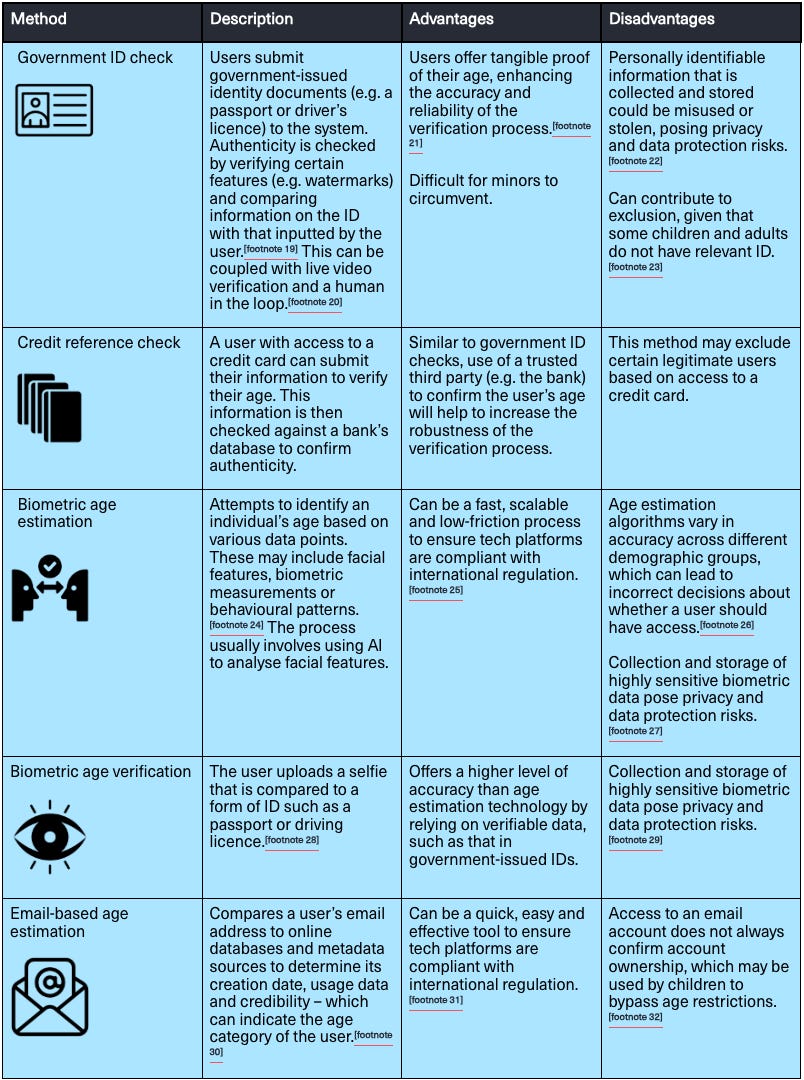 cool report here
A thriving market of third-party providers promises to help platforms comply, and somewhere down the line governments may issue digital wallets that let people prove their age more securely.
And none of the current techniques are flawless: from not recognising people with disabilities or belonging to minorities to not supporting who has no IDs (quite frequent in the US) to even questionable ways of storing personal and sensitive data.
To make matters worse, workarounds are popping up: in the UK, VPN usage among teens have spiked (no, kids are not all of a sudden wary of their IP secrecy) but also simply minors taking pictures of their parents on the first log-in.
All of this raises a few thorny questions.
- At what level should age checks happen? Should every platform run or buy its own system, or should the app store handle it? Or maybe the device itself? No one seems particularly eager to own the problem.
- And therefore, who is accountable if a children goes around the checks? Is it the social media platform or the external service used to verify the age? Or maybe the parents of the children that were not that attentive?
Still, the existence of loopholes doesn’t invalidate the purpose. Protecting minors from digital environments full of potential risks is a sensible, overdue ambition.
------------------------------------------------------------------------
Yet - and this is the real purpose of this Artifacts - age verification goes far beyond minors.
All users will, in one way or another, need to prove their age. But, more importantly, this should make us think of what regulators are actually trying to protect all of us from: digital spaces that are, by design, likely to be risky.
In this sense, age verification is good, desirable, overdue - but also a bit of a smokescreen.
It’s a bit like preventing access to a building that may catch fire at any moment.
 You can stop some people from entering, but we’re still not doing anything about the fire itself and the people who are already inside. Maybe they (we) should worry?
If a building is unsafe, we should be looking at its structure. The same is true for platforms: how do we prevent the fires that may come up?
It comes down to their design, and the risks this design carries. As simple as it sounds, digital harms stem from design decisions, namely policy choices with social consequences.
 This one from Cory Doctorow will probably become a must-read on books about social media. It’s not about risks but more about the business models and why things are struggling to get better over time. Hence why, they’re getting enshittified.
📚 All the books I’ve read and recommended in Artifacts are here.
> ### Nerding
 Looks like we can’t help by building AI agents and this kind of stuff. Well, if properly done, they do help. If you want to get into some automation building, n8n is the go-to.
14 days free or completely free if self hosted!
> ### ☕?
If you want to know more about Artifacts, where it all started, or just want to connect...
Let's grab a virtual coffee ☕
======
# To better understand
Date: 2025-11-18 | Language: en
Canonical: https://artifactstech.substack.com/p/to-better-understand
Cite as: To better understand by Lorenzo Ancona, Artifacts, 2025-11-18. https://artifactstech.substack.com/p/to-better-understand (CC BY 4.0)
Ok, the Mozilla Festival is **probably the coolest tech event I’ve ever been to.**
I went there with Artifacts last week (proudly wearing a **press badge**!) and spent the days bouncing between great conversations, sharp sessions on building better tech, and the general buzz of a community that **still believes technology can be good.**
[](https://substackcdn.com/image/fetch/$s_!MFba!,f_auto,q_auto:good,fl_progressive:steep/https%3A%2F%2Fsubstack-post-media.s3.amazonaws.com%2Fpublic%2Fimages%2F04c15402-01b7-4ec2-bb2a-78f2512b2c46_3021x2811.jpeg)
Barcelona is amazing btw
I came home with so many notes that I knew I needed a moment to let things cool, sift through everything, and figure out what it all meant.
**This edition of Artifacts is that attempt.**
[](https://substackcdn.com/image/fetch/$s_!urS1!,f_auto,q_auto:good,fl_progressive:steep/https%3A%2F%2Fsubstack-post-media.s3.amazonaws.com%2Fpublic%2Fimages%2F6a898627-0dbe-4e8e-9be9-6021f7b9a7f4_360x392.jpeg)
The location was just beautiful
If I had to summarise the Festival in one word, it would be: **data**.
Not a shock, maybe, but it kept surfacing in almost every conversation. F**air access to data, transparency around it, and actual ownership of it** came up again and again as the real foundations of a healthier internet, especially in an AI era powered by the very data we barely control.
That’s also the thinking behind **Mozilla’s new [Data Collective](https://datacollective.mozillafoundation.org/)**, a platform for responsible data exchange for AI training.
As E.M. Lewis-Jong, the Director, said when announcing it: *“Data is power and that power should belong to the people and organizations who are creating that data”.*
The same idea appeared in one of the most entertaining sessions, **“The Wikipedia Test”**, a game-lab by the Wikimedia Foundation that asks participants to invent policies to compensate Wikipedia for all the scraping it endures from AI companies.
(go checkout the [Wikipedia test](https://wikimediafoundation.org/news/2025/06/27/the-wikipedia-test/), it’s a fun one!)
The point is simple. **How data is shared and used isn’t a side issue.** It’s critical if we want a digital world that isn’t just extractive.
Finally, probably my favourite conversation was the **“Unlearning Data Barriers: A New Framework for Access to High-Influence Public Platform Data”**, led by Knight Georgetown Foundation and joined by Brandi Geurkink (**interview below!**), Carlos Hernández-Echevarria (Maldita.es), and LK Seiling (DSA Data Access Collaboratory).
We talked about how to secure better access to platform data, what the landscape looks like now, and why researchers and citizens still lack visibility into the places where our digital lives unfold.
We started from the [Framework](https://kgi.georgetown.edu/research-and-commentary/better-access/) developed by the Knight Georgetown Foundation, that is focused on:
- **what** data is critical to get (in yellow)
- and also **how** to develop efficient and immediate access points (in green)
[](https://substackcdn.com/image/fetch/$s_!qcQh!,f_auto,q_auto:good,fl_progressive:steep/https%3A%2F%2Fsubstack-post-media.s3.amazonaws.com%2Fpublic%2Fimages%2Faaf04418-0257-4551-b5b6-1271d6ddd91e_1956x1214.png)
The bottom line? Regulations mandating data access, like the Digital Services Act, do help, but platforms are still opposing too resistance: **the way for a fair data access is still long!**
**But we may have already gone a bit too far.**
To give you a sense of why data access, why it matters, and what we could all do with it, I’m so happy to share the conversation I’ve had with **Brandi Geurkink,** currently the Executive Director of the [Coalition for Independent Technology Research](https://independenttechresearch.org/), who is on a mission to empower researchers to better study the online world!
Good read :)
> ### **The Interview**
*For clarity and readability, the transcript has been reviewed and lightly edited.*
> ***Why data access?***
For technology to be shaped by and informed by the people who use it, **we need to be able to ask questions that reflect their experiences—and surface negative experiences.**
Data access is how we see into what people actually see. Tech companies are driven by making money, which leaves a ton out of the equation. Independent researchers and journalists - rooted in communities that are ignored and underserved - provide a critical counterweight to the industry.
**Data access levels the playing field and opens a window where companies have intentionally created a black box.**
[](https://substackcdn.com/image/fetch/$s_!oUKC!,f_auto,q_auto:good,fl_progressive:steep/https%3A%2F%2Fsubstack-post-media.s3.amazonaws.com%2Fpublic%2Fimages%2Fc74a28bf-aa68-45e6-a313-d86c67e3da49_1024x1024.jpeg)
> ***And what do we get?***
**Better questions and better ideas.** Under the Digital Services Act, for example, companies have to develop mitigations for harm; **to know if those mitigations are actually working, you need the data to evaluate them.**
> ***What data should be accessed, and what would you look into?***
A solid baseline of public social media data, aligned with the new framework that sets a gold standard for public data access for researchers and journalists.
**We should know that tiny sliver of “highly disseminated public content” with disproportionate reach** - what are the most viral things people are seeing, whose viewpoints they’re coming from, and whether there are paid motivations behind them. That’s essential if we want a more informed media ecosystem.
> ***If we had unlimited platform data access, which behaviors, patterns, or features are critical to investigate right now?***
Whether user controls actually work against recommendation systems. In [my YouTube research with Mozilla](https://www.mozillafoundation.org/en/research/library/user-controls/report/nothing-changed-a-qualitative-analysis-of-youtubes-user-controls/), we built a browser extension and saw people getting recommendations that violated guidelines or simply weren’t wanted. YouTube said, “we have user controls.” We tested them. **Largely, they didn’t work.**
A concrete example: “Don’t recommend this channel” might block the main channel, but users still got flooded with near-duplicate clip channels - so they kept seeing what they’d said they didn’t want. **That’s technology not working for people.**
> ***You talked of the “Data Desert”: over 60% of independent researchers face significant barriers. What are the obstacles?***
**Platforms have deliberately killed or walled off useful tools** - CrowdTangle going away, X pricing its API at \$42,000 a month, Reddit making API access extremely difficult.
We’ve also seen legal intimidation: cease-and-desists, lawsuits, suspensions of researcher accounts. And even where regulation exists, like the DSA, platforms still deny requests or create excessive gates.
> ***You’ve said data access helps break monopoly power and conflicts of interest- and that platform data isn’t purely proprietary. Why should citizens care?***
**Because this is about how power operates.** Look at the Romanian election: research into TikTok helped explain a candidate who seemed to come out of nowhere, and whether that activity aligned with electoral rules.
Digital spaces aren’t just online battlegrounds - **they shape real-world outcomes.** If we’re blindfolded, the power sits with states and platforms.
**Researchers act as middleware** - like the long fight for government transparency - **so that citizens get a window into the mechanisms affecting their lives.**
> ***Are regulations like the Digital Services Act (that mandates data access for researchers) enough? What would you improve?***
They help, but **we need clear guidelines or best practices for what good compliance it looks like.** Right now, platforms interpret “without undue delay” however they want and **retain as much control as possible** - asking for things like your birthday or requiring a Facebook account. That doesn’t match the spirit of the law.
The DSA is why these programs exist at all, which is good, **but the point is enabling researchers to identify systemic risks and check whether platforms are actually mitigating them.**
> ***What’s your dream research project if you had unlimited data access?***
Research into **monopoly power** - especially Google’s. The discovery in current cases has shown how much we didn’t know. With proper access, independent research - particularly from economists - could push this forward in a big way.
[Leave a comment](https://artifactstech.substack.com/p/to-better-understand/comments)
> ### **Save for Later**
Meta makes money out of [a lot of bad content](https://www.reuters.com/investigations/meta-is-earning-fortune-deluge-fraudulent-ads-documents-show-2025-11-06/), X is pushing some [extremist theories](https://www.youtube.com/watch?v=xq6M4kaEFBY), and TikTok [doesn’t want you to stop scrolling](https://www.washingtonpost.com/wellness/interactive/2025/tiktok-addiction-algorithm-scrolling-mental-health/). Not bad :) Ah, and why a safer online internet is [no censorship whatsoever.](https://www.ft.com/content/7282adcb-a107-479f-aca3-ef1b20103cba)
The guy who invented the Web is [not feeling great, indeed.](https://www.newyorker.com/magazine/2025/10/06/tim-berners-lee-invented-the-world-wide-web-now-he-wants-to-save-it)
At least some people are looking into what happens on these platforms, especially with advertising. [Who Targets Me?](https://whotargets.me/en/) Ah, and WhatsApp will be [interoperable](https://www.theverge.com/news/820858/whatsapp-third-party-messaging-date-eu-e2ee)
A super interesting work on how to evaluate [whether AI models are politically biased](https://www.anthropic.com/news/political-even-handedness) by Anthropic.
How delivery has [changed restaurants forever](https://www.theatlantic.com/culture/2025/10/food-delivery-america/684700/). And a guy who coded an app [while running a marathon.](https://www.linkedin.com/posts/tankots_we-just-met-a-guy-who-coded-an-app-while-ugcPost-7394818579134611457-Q7Ph/?rcm=ACoAADBGmFQB0rHgggpkCiHG5Dn-B9e4n2G0Y-g)
A new podcast [from the Atlantic!](https://www.theatlantic.com/podcasts/2025/11/the-internet-is-a-misery-machine/684925/)
[](https://substackcdn.com/image/fetch/$s_!_469!,f_auto,q_auto:good,fl_progressive:steep/https%3A%2F%2Fsubstack-post-media.s3.amazonaws.com%2Fpublic%2Fimages%2F33580dca-76ab-4a85-a19c-f84f71a40309_1200x900.png)
> ### **The Bookshelf**
[](https://substackcdn.com/image/fetch/$s_!AaFs!,f_auto,q_auto:good,fl_progressive:steep/https%3A%2F%2Fsubstack-post-media.s3.amazonaws.com%2Fpublic%2Fimages%2F8f92a2d5-ab83-4db4-8bab-a0b6e8b67080_1080x1080.png)
More on not just how we get the data but why we need them, in ***“Access Rules”.*** It critically scrutinises what went wrong but, also, why we’re still on time to get things right when it comes to getting data.
📚 **All the books** I’ve read and recommended in Artifacts are [here.](https://airtable.com/appK7fMPX1DMkQYzL/shrRh8TgI7GtmgBxM)
> ### **Nerding**
[](https://substackcdn.com/image/fetch/$s_!vXtP!,f_auto,q_auto:good,fl_progressive:steep/https%3A%2F%2Fsubstack-post-media.s3.amazonaws.com%2Fpublic%2Fimages%2Face6e37f-a601-44e4-9b77-df0f0555bcde_1080x1080.png)
I mentioned it above - if you’re into AI training or just want to share your own datasets to help open research and developments, the **Mozilla Data Collective** is the place to. Free, open, share it!
> ### **☕?**
If you want to know more about Artifacts, where it all started, or just want to connect...
[Let's grab a virtual coffee ☕](https://calendar.google.com/calendar/u/0/appointments/schedules/AcZssZ2ibxlzyU7rgnuoTgqXb_DFc19dfHmJeu1OAu17IY0_oHrtcJtvtctAJnMabirgZNx5Z5NAPGs0)
======
# In between
Date: 2025-11-04 | Language: en
Canonical: https://artifactstech.substack.com/p/in-between
Cite as: In between by Lorenzo Ancona, Artifacts, 2025-11-04. https://artifactstech.substack.com/p/in-between (CC BY 4.0)
One of the reasons why Artifacts was born is to look into the people and organisations building tech products not just for consumers, but also for citizens.
**How technology can enable a better democracy and participation.**
**Which is not just digital public services,** as we discussed [with the former Head of Design of the Italian Government](https://artifactstech.substack.com/p/services-that-serve), but **any artifact aimed at citizens and their public and political life.**
That’s why talking to **[Josef Lentsch](https://www.linkedin.com/in/jlentsch/)**, the CEO and Founder of the **[Political Tech Summit](https://www.politicaltech.eu),** has been so interesting.
It opened up the concept of ***“political tech”,*** how we can make it work, and what they’re already doing and will be discussing further on **23–24 January 2026 in Berlin.**

**[A lot more info on their website here!](https://www.politicaltech.eu)**
If you’d like to join, there’s a **discount code reserved for Artifacts readers!**
[Join the Political Tech Summit!](https://pretix.eu/partisan/pts26/redeem?voucher=PEF5FMBM2ARTIFACTS)
And if you want to read and know more, **you can read Josef’s own words below.**
*See you in Berlin, I hope!*
> ### The Interview
*For clarity and readability, the transcript has been reviewed and lightly edited.*
> ***What exactly is “political tech”?***
In democracies, governments and citizens each have their own technologies: GovTech digitizes public services and administration, while CivicTech empowers citizens. In between sit intermediaries - political parties, unions, associations, NGOs - operating in a distinct political sphere with its own needs. **Political tech is the specific software, data, and tools used by these organizations, reflecting that unique space.**
[](https://substackcdn.com/image/fetch/$s_!5JQn!,f_auto,q_auto:good,fl_progressive:steep/https%3A%2F%2Fsubstack-post-media.s3.amazonaws.com%2Fpublic%2Fimages%2Fceda1135-1f05-40fd-9ba2-adfe0b749669_1024x1024.png)
Well, a bridge…bridging
> ***What was the spark moment behind creating the Political Tech Summit - and why now?***
It wasn’t one moment but many. Working with political organizations, we kept seeing the potential to elevate their work through technology, yet **too many relied on in‑house tools that weren’t up to the task - hurting mobilization and communications.** As someone told me,
*“there’s so much money being burned… there’s a mismatch between what’s being used in political organizations and what should be used.”*
The summit addresses this by creating a **marketplace** - of ideas, products, and services - **so people and solutions can connect and improve outcomes for politics and citizens.**
> ***What’s your elevator pitch for someone unsure whether to attend?***
We create connections where none existed and offer the only comprehensive market overview in the space. By **linking peers across political families and sectors and facilitating new business relationships**, we deliver both impact and scalability. The model works economically - we capture some of the value we create - and attendees keep returning because they see that value.
> ***So, what will one get from coming?***
**Exhibitors, partners, and vendors meet political professionals actively seeking methods, tools, and analysis**. The result is tangible adoption and new collaborations that wouldn’t happen otherwise. Most partners are returning year over year, new ones are joining, **the event has grown to two days**, and we’re building a year‑round networking platform to extend that value beyond the summit.
> ***Who should attend?***
**The primary audience is political professionals - staff, operatives, executives, department heads, and directors. Citizens are welcome too**, and they’ll find a counter‑narrative to tech dystopia: practical examples of technology improving politics by making democracy more agile, faster, and more inclusive - think AI‑assisted citizen dialogues and assemblies. **It’s also highly international, with participants from 40+ countries.**
> ***From a tech perspective, what solutions are there?***
You can get **a broad mix:** CRMs for activist and constituent data, content moderation, data analysis, monitoring of political processes, and more.
> ***What will we be talking about this year?***
There will be 3 key themes:
- **Power**: Everything about winning and governing with legitimacy - campaign tech stacks, rapid-response content, field ops, and measurement. Like voter data integration, message testing, targeting, and the workflows that turn volunteers into repeat mobilizers.
- **Protection:** Keeping institutions, campaigns, and communities safe - Trust & Safety, incident response, threat intelligence, and counter-disinformation. And so content moderation tooling, deepfake detection/labelling, and narrative monitoring across platforms.
- **Participation:** Broadening who gets heard - youth engagement, AI-assisted citizen dialogues, digital assemblies, and inclusive product design. This covers onboarding funnels that meet young people where they are (TikTok/YouTube/Discord), trust-building content, and feedback loops that convert attention into sustained participation.
> ***Top sessions to watch?***
A returning favorite is the **hands‑on masterclass on the power of newsletters** (“The Power of Newsletters: Lessons from Journalism for Political Parties in the Anti-Social Media Age”) in a small group, 15–20 people, pre‑registration required. Expect equally practical main‑stage sessions, including participation from the Parliamentary State Secretary for Digitization, Thomas Jarzombek (Federal Ministry for Digital and Transport).
> ***If someone wants old‑school “policy talk,” what won’t they find?***
You won’t find endless discussions - **sessions are capped at 45 minutes** - and you won’t see the usual suspects. Instead, you’ll see new faces and **plenty of practitioners who want to dig into how things actually work.**
> ***Magic wand for next year’s edition: what’s the one thing you’d do?***
I’d bring **all the international officers from political organizations into the same room.** Those cross‑party, cross‑country exchanges are where the energy and the potential really are.
[Join the Political Tech Summit!](https://pretix.eu/partisan/pts26/redeem?voucher=PEF5FMBM2ARTIFACTS)
> ### **Save for Later**
How much [energy](https://www.newyorker.com/magazine/2025/11/03/inside-the-data-centers-that-train-ai-and-drain-the-electrical-grid) do you have today?
What’s up with advertising on social media [and why we should care?](https://link.newyorker.com/view/5ea2648ca77739493f39f592p3s9l.13ke/01c14e85)
Is the one of AI [a real bubble?](https://www.ft.com/content/ae4d7961-cf59-4369-8e64-8a9c9da956d1) Or [maybe not?](https://www.ft.com/content/834487ce-2357-40c4-bf45-34562e522755) Well, [money is flowing](https://www.nytimes.com/interactive/2025/10/31/technology/openai-fundraising-deals.html) in an unusual way.
How different business models are [fighting.](https://www.economist.com/business/2025/10/30/google-v-microsoft-the-battle-of-ai-business-models)
Grammarly is [no longer Grammarly.](https://www.theverge.com/news/808472/grammarly-superhuman-ai-rebrand-relaunch) And [this is not Wikipedia](https://grokipedia.com/), it’s probably worse. Meanwhile, please stop going to touristic [restaurants](https://link.newyorker.com/view/5ea2648ca77739493f39f592p3s9l.13ke/01c14e85)
[Only God](https://www.noemamag.com/only-god-can-save-us/) can save us? And why catholic voters care about [AI in elections](https://www.ft.com/content/544a5c3b-3142-4d0e-935b-29f7555fe50b)
The Internet is getting *enshittified?*
[\[Embedded media — view original\]](https://www.youtube-nocookie.com/embed/Ntf6wXx2Phs?rel=0&autoplay=0&showinfo=0&enablejsapi=0)
> ### **Where next?**
Well, as clear, Artifacts will be at the Political Tech Summit in Berlin 🇩🇪 in January. But before that, we could also meet:
- **Barcelona 🇪🇸** — this weekend (7–9 November) at the **[Mozilla Festival](https://www.mozillafestival.org/en/)** [](https://www.mozillafestival.org/en/)
- **Lisbon 🇵🇹** — next week (10–13 November), for the **[Web Summit](https://websummit.com/?gad_campaignid=21890036570&gbraid=0AAAAADmjBMBUenMZChBZd7G7Cz6OPz5s2)**
If you’re around, drop me a line and we’ll grab a coffee together :)
> ### **The Bookshelf**
[](https://substackcdn.com/image/fetch/$s_!BUuw!,f_auto,q_auto:good,fl_progressive:steep/https%3A%2F%2Fsubstack-post-media.s3.amazonaws.com%2Fpublic%2Fimages%2F692b6186-1ff8-4719-b07c-893aebbc10ed_1620x1620.png)
Not exactly Political Tech, but for sure one of the first attempts of calculating and measuring (and maybe skewing) how voters think and how to influence their decisions. ***“If then”*** by Jill Lepore is a great journalistic reportage into *Simulmatics,* the American company that had tried to compute large scale behaviours.
📚 **All the books** I’ve read and recommended in Artifacts are [here.](https://airtable.com/appK7fMPX1DMkQYzL/shrRh8TgI7GtmgBxM)
> ### **Nerding**
[](https://substackcdn.com/image/fetch/$s_!I4LZ!,f_auto,q_auto:good,fl_progressive:steep/https%3A%2F%2Fsubstack-post-media.s3.amazonaws.com%2Fpublic%2Fimages%2F451d431e-2ab8-49a6-8623-52b4ab77f6fa_1620x1620.png)
Finder for Mac isn’t always super intuitive, but [Bloom](https://bloomapp.club/?ueid=dca445e23e26114858a48ad35040e287) can make it better and more usable. If you struggle with finding that old document or organising your digital archive, it can help you a lot.
> ### **☕?**
If you want to know more about Artifacts, where it all started, or just want to connect...
[Let's grab a virtual coffee ☕](https://calendar.google.com/calendar/u/0/appointments/schedules/AcZssZ2ibxlzyU7rgnuoTgqXb_DFc19dfHmJeu1OAu17IY0_oHrtcJtvtctAJnMabirgZNx5Z5NAPGs0)
======
# Press Command
Date: 2025-10-22 | Language: en
Canonical: https://artifactstech.substack.com/p/press-command
Cite as: Press Command by Lorenzo Ancona, Artifacts, 2025-10-22. https://artifactstech.substack.com/p/press-command (CC BY 4.0)
Over the past few days, many have claimed that AI companies are doing with chatbots what Apple did with the iPhone in 2008: turning their product into a platform where users go to access apps. **It’s a fair comparison, but also a partial and shortsighted one.**
We’re witnessing something broader. *Let’s see how.*
**I’ve argued that chatbots often miss the mark:** you have to start from scratch, paste text and images, and constantly feed them context.
That’s why I’ve been (and still am) fascinated by AI-powered browsers - like [the one OpenAI just launched](https://openai.com/index/introducing-chatgpt-atlas/) - where AI lives in your tabs, next to you. **A joystick for the Internet.**
[](https://artifactstech.substack.com/p/out-of-context)
#### Out of context
[Lorenzo Ancona](https://substack.com/profile/142944754-lorenzo-ancona)·29 July 2025[Read full story](https://artifactstech.substack.com/p/out-of-context)
**But we may be going beyond this already.**
A few days ago, OpenAI announced [apps for ChatGPT:](https://openai.com/index/introducing-apps-in-chatgpt/)
[\[Embedded media — view original\]](https://www.youtube-nocookie.com/embed/2C4Cs6503gw?rel=0&autoplay=0&showinfo=0&enablejsapi=0)
From the chat, you can now, for instance:
- Book a hotel on **Booking**
- Get a personalised playlist on **Spotify**
- Turn your idea into slides with **Canva**
- *and many more to come*
Anthropic, meanwhile, launched **[“Skills,”](https://www.theverge.com/ai-artificial-intelligence/800868/anthropic-claude-skills-ai-agents#comments)** which can, for instance, generate marketing materials consistent with your brand without you repeating yourself. And, a year ago, they introduced the **Model Context Protocol (MCP)**, a standard that lets chatbots interface with apps. I even used it to rebuild Artifacts’ database by telling Cursor how to reorganize my Notion!
------------------------------------------------------------------------
So yes, the direction charted by many *seems* clear: **chatbots are shifting from being endpoints of conversations with users to platforms mediating interactions with other users,** who are renting rooms on Booking, or uploading music on Spotify, or offering courses on Coursera.
[](https://substackcdn.com/image/fetch/$s_!IURq!,f_auto,q_auto:good,fl_progressive:steep/https%3A%2F%2Fsubstack-post-media.s3.amazonaws.com%2Fpublic%2Fimages%2F97bc7d60-3a49-4de5-a618-190410dd7f69_2500x800.png)
how the shift is portrayed
**Still, that’s not the full story.**
What we’re witnessing goes beyond and is **a new layer of Internet use.**
**Yes, the “platform” analogy works economically** - chatbots fit the [OECD’s definition](https://www.oecd.org/content/dam/oecd/en/publications/reports/2019/05/an-introduction-to-online-platforms-and-their-role-in-the-digital-transformation_970fc377/53e5f593-en.pdf) of platforms as *“digital services that facilitate interactions between two or more distinct but interdependent sets of users who interact through the service via the Internet”.*
But they aim to be much more than just **gatekeepers or intermediaries with other users or services,** as many claimed these days.
Indeed, from a technical perspective, **they want to give a new way to use the Internet:**
- **they’re not replacing (all) existing platforms** but rather using these, like Spotify or Booking
- **by concentrating the access points into one single place**: **a chat,** which is notably easier to use than finding specific intermediaries,
- **so the chatbot is more than a platform:** **it’s a new layer of the Internet** - dependent on existing platforms, but promising to make them easier and more natural to ***use***, **not just access.**
The model looks more like this:
[](https://substackcdn.com/image/fetch/$s_!Ddcf!,f_auto,q_auto:good,fl_progressive:steep/https%3A%2F%2Fsubstack-post-media.s3.amazonaws.com%2Fpublic%2Fimages%2Fa215a5ab-5457-4a01-a686-67188f4fa9dd_1920x901.png)
with services being used by AI
Where, yes, acting as the bridge between ends is the key but **it’s more a bridge to other existing bridges** (aka platforms) to which we’re accustomed and where we already have our accounts, preferences, information stored.
Think of it less as an access point, more as a command center, even an **[operating system.](https://stratechery.com/2025/openais-windows-play/)**
------------------------------------------------------------------------
This more-than-platforms shift has **some very fascinating implications** from different angles:
**Technologically**, **the model is the product.** Great platforms have always been [great products first](https://www5.qa.hbr.org/2016/04/products-to-platforms-making-the-leap) - and here, **the product is intelligence itself.** The AI model translates your words into actions, pressing the buttons of other services for you. Complexity is hidden away; apps become silent tools working behind the curtain.
Therefore, ***from a design perspective,*** **interfaces either shrink or vanish**. Your new interface is a text box, with no time spent on getting how it works and **with the best interaction medium: plain words.**
No need to figure out how a playlist is created on an app, you’ll get it back on your clean chat interface.
Also, if I may, it’s truly striking ***from an epistemological perspective***. We could now interact with platforms as if they were people - your designer, your music geek, your travel agent - to whom we talk.
**Economically, though, things get tricky.** If chatbots centralise Internet use while drawing data and services from elsewhere, **who gets paid? And how?** **The problem echoes AI search:** chatbots depend on external services for information as much as (if not more than) the services depend on chatbots for distribution.
*How is Booking compensated when ChatGPT handles the booking? And how will OpenAI decide which platforms to privilege?*
This points to a deeper tension: **the “new layer” of chatbots still rests entirely on old stacks.** ChatGPT wants to be *the* place where users are - controlling distribution and nudging developers to build for this new gravity point.
[](https://substackcdn.com/image/fetch/$s_!61X_!,f_auto,q_auto:good,fl_progressive:steep/https%3A%2F%2Fsubstack-post-media.s3.amazonaws.com%2Fpublic%2Fimages%2F330d2523-e772-4e51-bcab-e70a8acc747c_1024x1024.png)
But for all the elegance of booking a hotel or designing slides from a chat window, **ChatGPT still relies on other people’s infrastructure:** APIs, tokens, accounts, and services owned elsewhere.
In other words, the minute Booking.com (or others!) shut their doors or block access, this new operating system loses its function.
------------------------------------------------------------------------
And that raises the final question: **if chatbots become not just intermediaries but the very** ***way*** **we use other services, what will those services look like next?**
*Will they still be built and designed for humans clicking buttons - **or for AIs clicking them on our behalf?***
Fascinating times, way beyond platforms ;)
[Leave a comment](https://artifactstech.substack.com/p/press-command/comments)
> ### Save for Later
TikTok seems to be [dangerous](https://globalwitness.org/en/campaigns/digital-threats/tiktok-directs-13-year-olds-to-porn/). But the NYT is doing [its own TikTok](https://www.axios.com/2025/10/21/new-york-times-watch-tab-tiktok-nyt-app)
[Google & Antitrust:](https://www.wired.com/story/uk-watchdog-targets-google-search-in-competition-crackdown/?bxid=5f43a3c889a7356e7e1b2114&cndid=61968307&hasha=dca445e23e26114858a48ad35040e287&hashc=2107626209cd615da922d357ec59a2f4a769eeec7e75a95e874cf17f98f1a7c1&esrc=MARTECH_ORDERFORM) the story goes on in the UK too.
[Everything sucks online](https://arstechnica.com/gadgets/2025/10/yes-everything-online-sucks-now-but-it-doesnt-have-to/), it seems. But you can have [hot chats with ChatGPT.](https://www.theverge.com/news/799312/openai-chatgpt-erotica-sam-altman-verified-adults) Although [AI is killing the magic.](https://www.ft.com/content/d003cdfc-aded-4a9d-9a24-e1aff5261cfa)
The Browser company on [why browser agents are not worth it.](https://www.linkedin.com/posts/the-browser-company_why-doesnt-dia-use-computer-use-for-everything-activity-7384620000340312065-DqcM/?rcm=ACoAADBGmFQB0rHgggpkCiHG5Dn-B9e4n2G0Y-g) But also friends & great researchers published [why governments should be using agents.](https://www.linkedin.com/posts/the-agentic-state_the-agentic-state-vision-paper-activity-7382033246718439425-qjvA/?rcm=ACoAADBGmFQB0rHgggpkCiHG5Dn-B9e4n2G0Y-g)
Tim Berners-Lee Invented the World Wide Web. [Now He Wants to Save It](https://www.newyorker.com/magazine/2025/10/06/tim-berners-lee-invented-the-world-wide-web-now-he-wants-to-save-it).
> ### **Where next?**
[](https://substackcdn.com/image/fetch/$s_!jw71!,f_auto,q_auto:good,fl_progressive:steep/https%3A%2F%2Fsubstack-post-media.s3.amazonaws.com%2Fpublic%2Fimages%2F4d29d2ce-2dc7-4038-8394-5255e66b56f0_1920x1080.png)
Artifacts will be at **[Mozilla Festival](https://www.mozillafestival.org/en/)** in Barcelona 🇪🇸, **November 7–9**. *Artifacts Community in the city, let’s say hi!*
> ### The Bookshelf
[](https://substackcdn.com/image/fetch/$s_!Uuy4!,f_auto,q_auto:good,fl_progressive:steep/https%3A%2F%2Fsubstack-post-media.s3.amazonaws.com%2Fpublic%2Fimages%2F6958c061-55b9-4820-b749-f84c9e17e7ba_1080x1080.png)
**Speaking of GPT: this book looks at a different “GPT” - General Purpose Technology.** It offers a strong historical perspective on how economic, political, and societal conditions enable technologies to spread across countries and eras. Recommended if you’re into the history of tech, industry, and economics.
 this is from Dia!
This has one immediate implication: the ChatGPT-style interface is already outdated.
What we’re moving toward is AI not as a standalone tool, but as a normal technology - integrated into the technologies we already use. The browser, this time, is front and center.
And it’s about time. Browsers haven’t changed much in the past 15 years. Sure, Chrome is slicker than Internet Explorer - but functionally, they’re not that different.
As browsers evolve into full-fledged operating systems for our online lives, AI becomes the joystick we use to play with them.
 such an old-style one
Or, to quote the genius tagline from The Browser Company: “You’ll never explain yourself again.” (Also, you’ll get amazing branzinos.)
\[Embedded media — view original\]
This isn’t speculation: the industry is already headed there.
Over the past month, I’ve been testing two AI-powered browsers. One is Dia, from The Browser Company (yes, the folks behind Arc). The other is Comet, by Perplexity - the AI company Artifacts readers should already know well.
What I’ve seen is madness.
 Both share a powerful new feature: you can chat with your tabs. And the chat sits right next to what you’re doing.
But it’s not just a UI gimmick with a dumb chatbot bolted on. These chats can see what you’re doing - so when you ask something, there’s no need to explain: “I’m writing this thing for this reason…” They already know.
Watching a YouTube video? You can chat with it.
 this is so good
Planning a holiday across multiple tabs? These browsers can compare destinations for you.
 Still working? Tag the document you’re editing, ask to review against a few articles you’re reading, and draft an email to ask for clarification.
 All of this removes the usual back-and-forth with ChatGPT. No more copy-pasting. No need to pick a model - because honestly, for low-intensity tasks like drafting messages, any LLM will do.
So you just care about technology solving your problems, less about the how.
Ah, Comet doesn’t just read what you’re doing - it can take action for you:
 I don’t have a favourite yet. But here’s what I know so far:
 What I took away from “Your life is manufactured” is that every manufactured item follows an input-process-output model. The complexity involved can vary a lot depending on the product. It’s a very insightful read if you’re interested in logistics and how things get made.
📚 All the books I’ve read and recommended in Artifacts are here.
> ### Nerding
 Well, we’ve talked about it enough. Comet is so, so powerful - with a huge agentic AI that already does some interesting tasks. A lot to be done, but very promising. To get it, join the waitlist of Perplexity.
> ### We’ve been here before
 Or at least, if AI really is the future of tools, it probably won’t arrive wearing a chatbot mask - the one that took the world by storm just a few years ago.
------------------------------------------------------------------------
Let’s think through this.
Take Word, for instance. When was the last time you started a document without at least checking in with an AI for ideas, a structure, or a template? And if you did start solo, how long before you copied your rough draft into ChatGPT (or your LLM of choice) to get feedback, edit suggestions, or just a nudge?
So the least we can expect is to have that AI companion already there. Present not just in spirit or on another tab, but right inside the interface itself.
Now look at chatbots. The generic ones, the tab-switching kind, that require instructions for every new project. The ones that don’t know what you’re working on, what you’ve written before, or what your app even does. That’s not a sleek user experience.
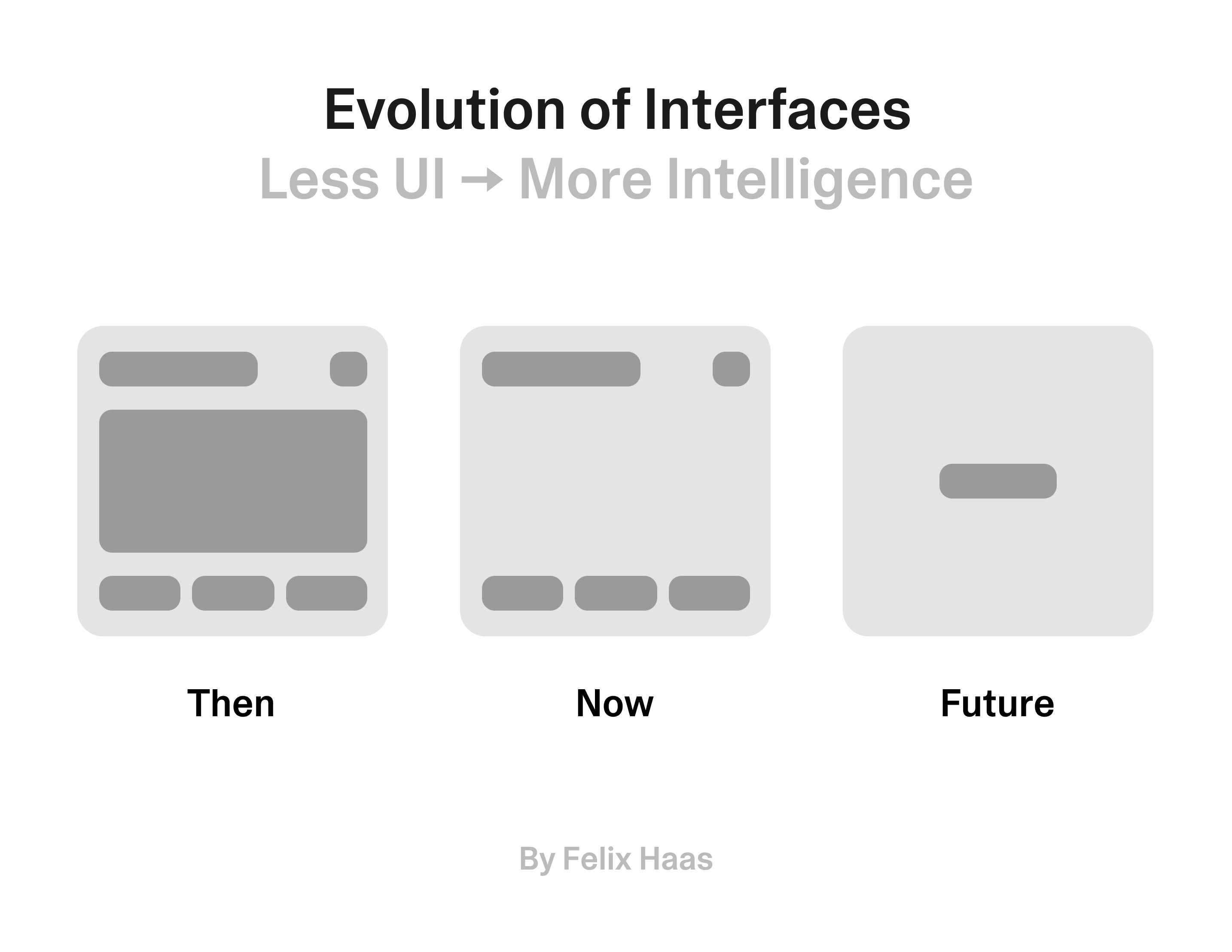 Maybe?
Because not everyone necessarily cares about an interface. We care more about what it lets us do.
------------------------------------------------------------------------
You might argue: “Okay, but aren’t these just AI agents? Nothing (too) new.”
Not quite. Agents are the next level - the background operators that respond to context, act autonomously, send emails, book meetings. They’re backstage.
What we’re talking about here is the stage itself. The front-of-house experience. The AI-as-mediator, the one that sits between you and the interface, reshaping how you get things done.
In this framing, AI isn’t about unlocking new capabilities. It’s about reframing old ones — taking the exact same workflows (ordering food, writing a doc, configuring sales tools) and making them smoother.
------------------------------------------------------------------------
All of this has some consequences.
Using plain language to interact with technological artifacts should be easier, and could make our lives easier.
This could mean screens that don’t just display things, but respond. Nudge. Adapt.
Like Netflix suggestions - which, let’s face it, were doing AI before it was cool. We could get screens that adapt to our needs and try accompany us towards what is inferred to be our desired outcome.
Start a doc on the history of politics? It offers a timeline template. Launch a sales plan? It reminds you of last quarter’s targets.
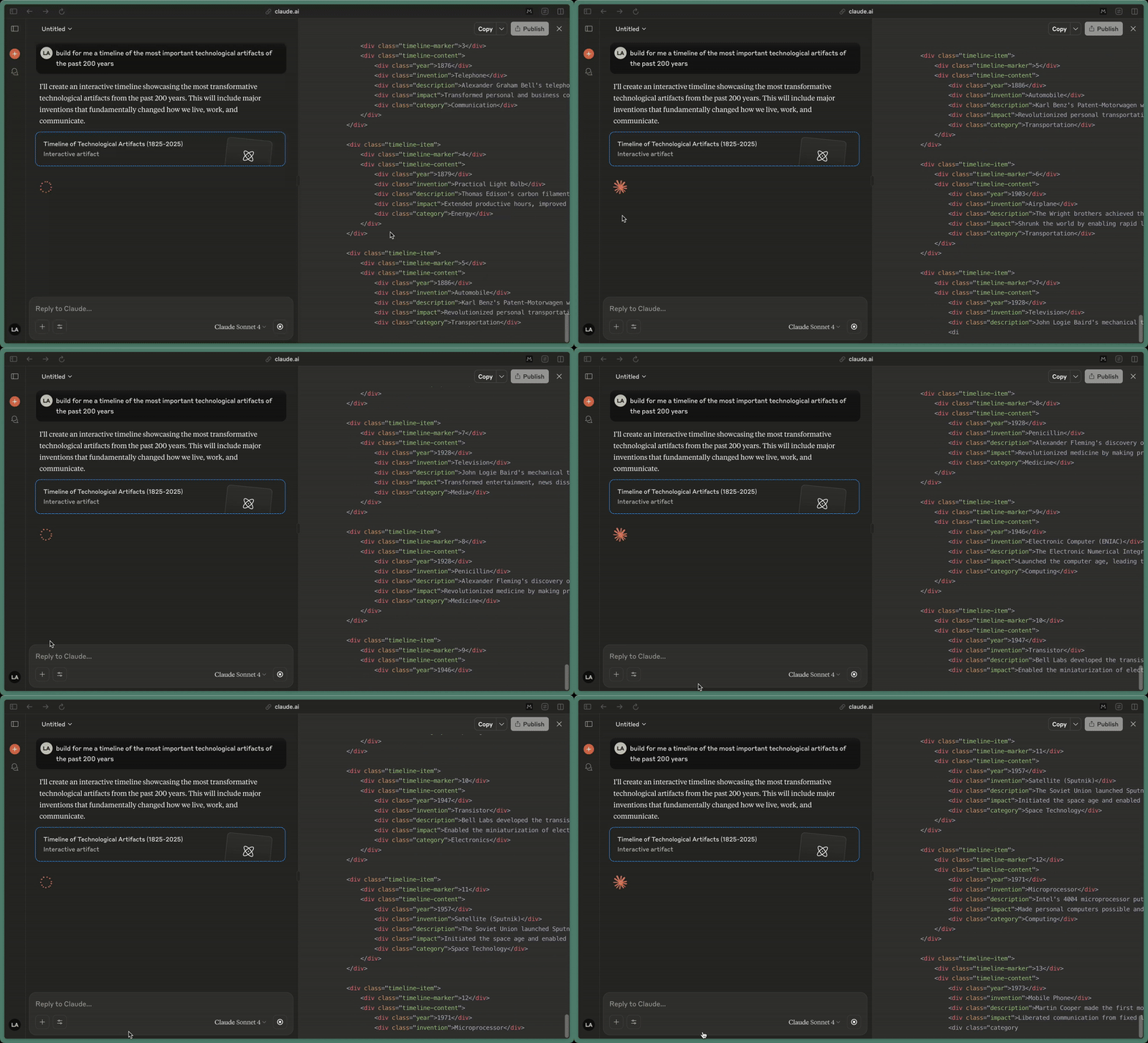 this is already something else - ah, they called it Artifacts :)
Of course, there are risks.
Where’s the line of agency? What does the AI get to do without your explicit approval? How do you know what it’s doing? Can you override it? Can you understand why it made the choices it made?
Not only: what control do we have over processes themselves? If the AI I’m using to co-write a document gets to weird conclusions, how can I see and steer it? Explainability is a thing, and has already been in Artifacts !
More importantly, what about failure? What if the AI can’t get rid of the pickles? Do I still have a backup way to manually fix it? Will there still be buttons for when things go sideways?
 no please no!
And, yes, eventually voice might be the final form of this interaction, instead of text. But do we really want to work in offices where everyone is talking out loud to their computer like they’re casting spells? There’ll be time to look into this in future Artifacts.
------------------------------------------------------------------------
But let’s not go to some sci-fi singularity.
We may not become radically more efficient beings, but we’re likely to be doing things differently.
Because the way we interface with tools is adapting to a new kind of medium - one that can understand us more directly.
It’s not the chatbot or AI that matters.
It’s what happens when the interface starts speaking our language, thanks to what is in between and mediates the relationship between us and artifacts.
> ### Save for Later
Got thoughts or experience with age verification? Friends need you to answer a couple of questions!
Apple claims that AI is not intelligent. Which is a way to fight when we don’t understand AI.
Why GenAI is not revolutionising governments.
What if non-place are no longer such because of smartphones? And what if travelling is not that great?
Who’s building the open, decentralised web.
If you wanna learn all you need about the protocol changing the Internet.
> ### The Bookshelf
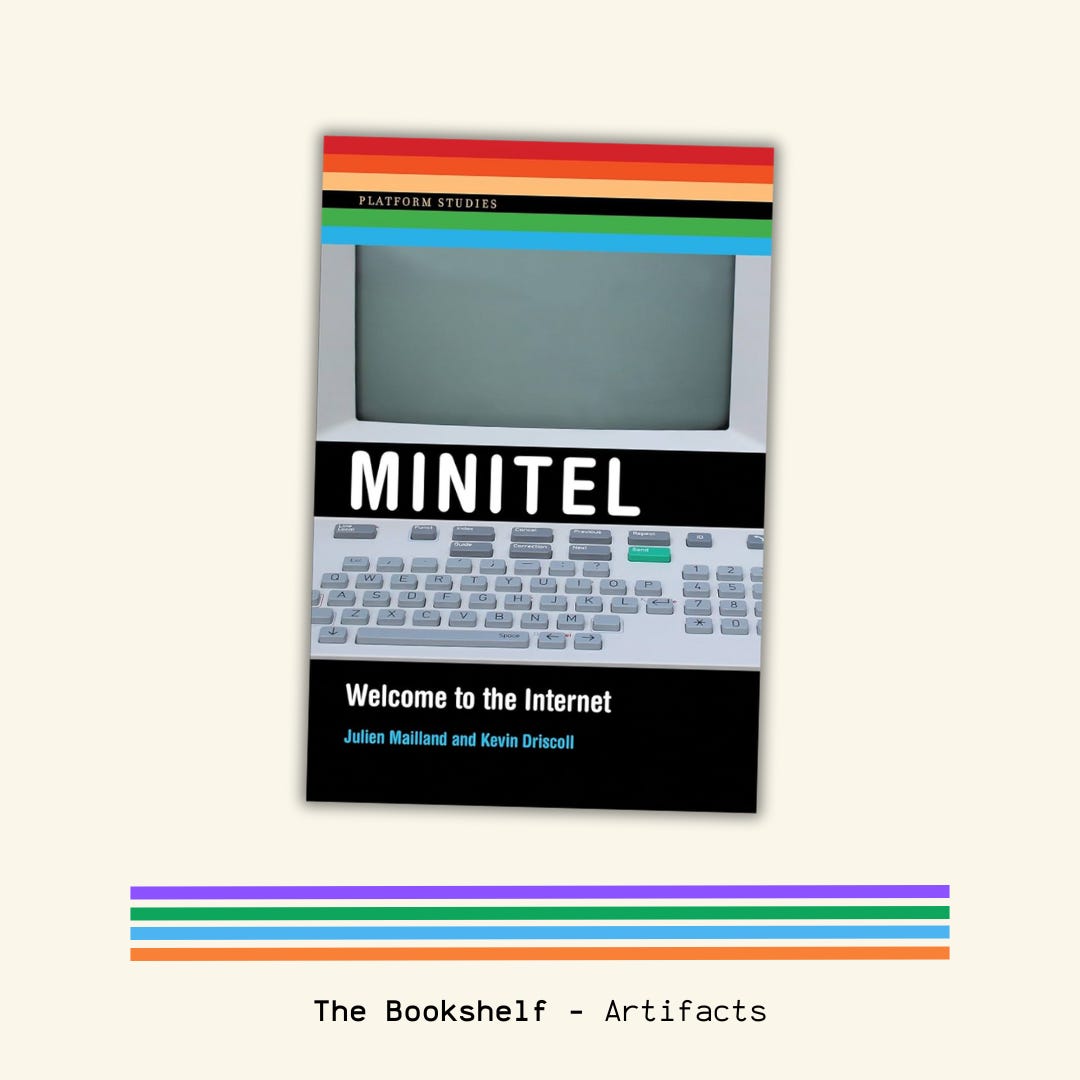 Not the most innovative interface ever, but the Minitel was a first spark of what the Internet could look like and how service creation benefits everyone. And this book is a great story about it.
📚 All the books I’ve read and recommended in Artifacts are here.
> ### Nerding
 We used to design interfaces, now you can prompt them with a few words. MagicPath just launched but it’s already enabling people to create the best buttons (if we’ll keep using them) and much more.
> ### We’ve been here before
 Not just because the “I’m feeling lucky” button is disappearing, but because Google has officially introduced something it calls “AI Mode.”
This means that instead of just tossing you a list of blue links, Google Search will now host a conversational AI assistant. Ask it questions, follow up with more, get crisp, synthesized responses (with small numbers referencing websites)
 Think of it less like searching the web and more like… chatting with it.
(And, well, they also rolled out a bunch of other stuff nicely wrapped up in a mind map by - of course - NotebookLM, one of Google’s own AI tools.)
Now, from a technological standpoint, this isn’t exactly groundbreaking anymore. On Artifacts, we’ve been talking about AI-driven search since February 2024. By now, many of us are already familiar with the likes of ChatGPT or Perplexity digging through the web on our behalf.
In short: we’re used to talking to the internet.
The shift already happened - from dry, scattered link lists to tight, tailored responses. But the lingering question has been: what is Google waiting for? Now we know.
And commercially? Well, this might just be the opening scene of a new era. Here’s why:
- Google, that for most of us equals the Internet, is embracing and shaping what they called “a total re-imagination of search”. It is, in a sense, the Internet going in a whole new direction.
- This is not just a tool enabling AI search. It’s Google baking AI into everything. Search, yes, but also Gmail, Docs, Drive. The whole productivity suite is being rewired with intelligent, conversational search assistance.
And unlike Perplexity or other AI tools, Google’s shift will be impossible to ignore. It’ll be right there, front and center, for the billions who already default to it. No tutorials needed. No effort required. Just… different.
And search is just likely to be radically something else in a couple of years.
------------------------------------------------------------------------
Here’s how it works, according to the people building it:
> When you ask a complex question, Google’s AI-powered Search kicks into “advanced reasoning” mode. It uses its custom Gemini model to break your query into smaller parts and fires off multiple searches at once.
>
> It digs deep across the web and taps into Google’s real-time data sources like the Knowledge Graph, Shopping Graph, and even local info from Google Maps contributors.
>
> Then it assembles a polished answer. All of that, from just one query - and fast.
As the Verge put it, it’s Google doing a lot of Googling.
But this is bigger than search.
First off, it’s what the AI folks call agentic — yes, the new favorite jargon word you’ll need to pretend to understand at conferences. But jargon aside, the idea is simple: it doesn’t just find things for you, it does the finding, the reading, the summarizing — and hands you back the insight.
Which brings us to the bigger shift: the interface itself.
Fewer clicks. More conversation. You ask, it answers, you refine, it continues. A back-and-forth, not a click-and-hope.
It’s a new User Experience — one that’s less about hunting through links and more about getting usable content, right away.
 if search has to be a back and forth with AI, ping pong is the best case of back and forth for sure
All of this will, of course, not come without implications.
First casualty: the humble web page. As we’ve explored before, AI search means machines read pages, rewrite the content, and feed it back to users — without users actually visiting the source. Less traffic. Less visibility. Less ad revenue.
Websites and especially media are not happy about this. They’ve called this “a definition of theft”. In response, Pichai (CEO at Google) said they expect AI to direct even more traffic to websites.
Second problem: Google’s own business model. If no one’s clicking on pages, then traditional ads - the ones that made Google \$198 billion last year - lose their audience. So now Google is playing both sides: disrupting the old model while still trying to milk it.
It’s the innovator’s dilemma: evolve or protect what’s already working. In this case, Google needs web content to train and feed its AI, and publishers need Google to reach audiences. A delicate co-dependence.
Finally, the SEO apocalypse. For two decades, websites played the game of rising to the top of Google’s results. Now, the real prize is to be included in the AI-generated answer. Buried in a citation.
That’s a whole new game - not of visibility, but of inclusion. Across Google, OpenAI, Perplexity, whoever ends up writing the answers the internet reads.
What does this mean for media? Business? Education? Any site that once relied on search-driven traffic?
That’s the billion-click question.
We’ve gone from a layered, intricate Internet - Google, links, websites, ads - to a flattened experience where AI intermediates it all.
The number of interfaces is shrinking. The AI now browses for us.
Sure, talking to the internet is easier than clicking through it.
But what that means for who owns attention - and who profits from it - is still very much up for grabs.
> ### Save for Later
If we can’t speak because of AI. But we can vibe-code, and this is soooo cool.
What is the future of UX, nowadays. And a huge speech from Steven Levy!
If we go back to the “Actually” internet. And Amazon knows a lot about your family.
Uh, they’re no longer building Arc. Damn!
Seem like we’re the most rejected generation.
------------------------------------------------------------------------
 Alessandro Tommasi is soooo back with FutureProofSociety, its new start-up, now organising a 3-day event full of workshops, conferences, and ideas on how to build a future-proof society.
Where? L’Aquila, Italy - When? 5-7 June
Why? Well, they’re having Anne Applebaum, Benedict Evans (who just published these huge slides on tech), Stefano Quintarelli (the guy behind Spid), Meredith Whittaker (president of Signal!), and so many other brilliant minds. More than enough to come!
Sign up here!
(Got 3 free spots in my car from Rome - good podcasts, tech talk guaranteed, and mr. Bongiorno included)
> ### The Bookshelf
 Speaking of attention in a broad manner, Tim Wu put some very good thoughts in his “Attention Merchants”. For anyone creating stuff on the Internet (and struggling with AI indexing soon!)
📚 All the books I’ve read and recommended in Artifacts are here.
> ### Nerding
 Just build your app, your tool, your software writing in plain english. We saw Lovable before, but, trust me, it’s just insane what these guys are doing. Coding is really becoming a commodity.
> ### We’ve been here before
 You can find its assets on Figma, built to match national design guidelines and easy to use across platforms, or check the Web Development Kits online (and many other resources)
But as Marco pointed out, Design System .italia was just a tool - not the end goal. The real objective of his team was far more ambitious: to build better digital services for citizens.
------------------------------------------------------------------------
Our conversation was genuinely inspiring - a reminder that some of the brightest minds out there are working in the public sector.
Marco, who describes himself as a Design Manager (with a soft spot for Management Design), is an architect by training, used to work with Carlo Ratti, and is now bringing his design chops to Pininfarina.
What follows is my attempt to distill the most valuable insights from our discussion.
> ### The Interview
The interview has been conducted in English. For clarity and readability, the transcript has been reviewed and lightly edited.
> So, what did you do when working for the Government?
The key thing I’ve worked on is shaping and guiding the creation of Design System .italia. But let’s be clear - it didn’t start with me, and it won’t end with me - some brilliant people were there before me and others are still building great services now.
> Where did everything start?
From a simple data: the Italian public sector includes around 22,000 entities. If each designed and implemented its own digital interface from scratch, it would be incredibly costly and frustrating for citizens, who would have to figure out a new system every time they interacted with a different authority.
When the Team di Trasformazione Digitale first started working on this challenge, they had to think broadly. The first step was the creation of a design system and UI Kit, alongside Bootstrap Italia, which provides the code framework. Right after the time extraordinary commissioner Diego Piacentini, when I joined the team, we began assembling a larger team of designers who asked: How do we solve this in a way that scales?
That led to the first iterations of what’s now the Design System .italia, which includes extensive documentation, the contribution guidelines, and has been extensively tested in each component.
> Why is it so important that public digital services just work? How are they different from private services both in the building and delivery phases?
Public services exist for a very different reason than private ones. In the private sector, digital products are designed to create engagement, drive revenue, and foster customer loyalty. Public services, on the other hand, exist to uphold rights and fulfill obligations.
Citizens don’t “choose” to interact with public services the way they might choose between different banking apps or food delivery platforms - they have to use them.
That’s why a public digital service should be as seamless and invisible as possible. A well-designed government service shouldn’t require citizens to jump through hoops or learn a new system every time they need to interact with the State.
It should work effortlessly, without friction, because the main focus is not about delighting users — it’s about ensuring they can access what they need without unnecessary effort.
> How does this impact the way you build a digital service or product?
The key feature for public service design is openness by default. By law, any technological asset created for public administration must be open-source, for public use and scrutiny. But it’s not just about compliance — it’s about creating a genuinely open design and development process. That means having a GitHub repository, setting up clear contribution guidelines, and building a community around the project.
Then there’s privacy by default: in the public sector privacy isn’t just a feature - it’s a foundational principle.
Similarly, accessibility by default is non-negotiable. Public services exist to fulfill citizens’ rights. If they’re not accessible to everyone — including people with low digital literacy, disabilities, or other impairments — then they’re failing in their mission.
> What are the challenges of designing and building technological artifacts in such open and transparent way?
I think the first thing to ask is: What’s the alternative? If public authorities didn’t work in the open, we’d be trapped in a market of proprietary digital tools with high barriers to entry.
Becoming a supplier for the public sector isn’t like entering a commercial market - it involves navigating regulations, procurement processes, and a distinct ecosystem. If we relied on closed systems, we’d be trapped vendor lock-ins, where both institutions and citizens become dependent on a handful of companies.
What I'm trying to say is that the scenario where we don't build open and interoperable is just a non-starter for the public sector.
Take a public school website as an example: why should every school invest time and money to research, develop and test its own web page? And why should a parent learn new ways of interacting each time her kid changes school?
 > Yet, not only the tech was open but also the process itself. How was it?
We engaged citizens including professionals and non through a multitude of channels (newsletters, LinkedIn, Instagram), asking them for their input on services as well as for their more concrete capabilities and knowledge. And it just happened.
How many people partake? It’s hard to put an exact number on it. We’ve seen contributions from a mix of people — some from within the community who participate in public calls and workshops, and others who contribute directly via GitHub, sometimes anonymously.
The beauty of open-source is that anyone can step in and add value.
> But do people really have the time and motivation to contribute?
I think people are in desperate need of purpose. Some might contribute for altruistic reasons, others for personal or professional growth or interests in building a professional network.
But when a government, which has historically being perceived as distant, comes to your city and says, “We’re testing this, and your input could directly shape it,” people engage.
For example, when we tested new website templates for municipalities at an event at Fabbrica del Vapore in Milan, we had 20 participants, including people with disabilities, sign language interpreters, and accessibility experts. It felt great.
> Let’s move to the services you built. In “Platformland”, they write that we are moving towards a future in which people’s interactions with technology tend more towards passive and real time, rather than being active and transactional. Did you see it happening?
In the private sector, digital services are designed to maximize engagement. Companies optimize for “delight” because that’s what keeps customers loyal and willing to pay. Now, take money and delight out of the equation. What’s left? A completely different set of design challenges and a higher order of priorities.
As we said, public digital services exist to enable rights and fulfill obligations, so they need to be informational and proactive so that people can be passive.
If social media wants you to spend as much time as possible online, the goal of a digital public service should be to have you there as little as possible to get what your right is.
In other words, the best public digital services are the ones that don’t require interaction at all — they just work in the background.
> For instance?
A truly proactive public administration should help people before they even ask.
If someone moves from Paris to Turin, has a child, and falls within a certain income bracket, the system should automatically suggest schools for their child and inform them of relevant tax benefits. Instead of forcing citizens to navigate bureaucratic processes, the government should anticipate their needs and provide support seamlessly.
At the end of the day, public services shouldn’t be intrusive. The government should be as invisible as possible while being as helpful as possible.
> So it’s not just about making the government more efficient - it’s about reducing the administrative burden on citizens?
Exactly. That’s the difference John Maeda draws between digitization and digitalization.
Digitization is just turning paper forms into online ones. Digitalization asks: why should a citizen keep typing in their fiscal code when their digital ID already contains all the data the government needs?
Take certificates. Nobody actually wants a certificate — they want what it gives access to. The certificate is just a bureaucratic middleman. So instead of investing in better ways to issue certificates, why not invest in getting people directly to the service?
That’s what interoperability is about: databases talking to each other, exchanging information behind the scenes. In the best-case scenario, digital services disappear entirely. All that’s left is the outcome — what the citizen came for in the first place.
> What’s the bigger picture behind all of this?
It’s about rights and duties, not purchase preferences.
Most digital products are optional — you can live with a cheap, basic phone. You might live slightly better with a smartphone. You live even better with the latest, biggest iPhone. But that’s just preference.
Public services aren’t about that. They’re not lifestyle upgrades - they’re rights and responsibilities. And that puts them in a different category altogether. We need to treat them as such when we design digital systems.
They have a higher order of priorities.
Leave a comment
> ### Save for Later
Your book may have trained an AI - find it out
What is the biology of AI? How do they think? A huge paper from Anthropic. At Stanford, they’ve published their annual report on all things AI.
Microsoft is turning 50 - and so we go through the top 50 of its products.
Students are cheating? Maybe not
What the EU could make out of AI, according to OpenAI
Echo chambers, filter bubbles, and other fancy terms - in a useful literature review for your next paper.
What if technology is not fun anymore?
Of course, Artifacts in Ghibli Studio
 > ### Someone said this before
“If we keep doing what we’re doing, we keep getting what we’re getting”.
> ### The Bookshelf
 The UK has done an impressive job digitising its public services, and “Platformland” tells the story of that effort. It’s a highly practical, beautifully designed, and richly detailed book - probably my favourite on the subject of digital government.
📚 All the books I’ve read and recommended in Artifacts are here.
> ### Nerding
 Scrutch is the kind of tool you don’t really need - but you’ll end up loving anyway. It’s a markdown text editor with serious privacy chops, a gloriously oversized interface, and a marketing strategy. Perfect if all you want to do is… write.
> ### ☕?
If you want to know more about Artifacts, where it all started, or just want to connect...
Let's grab a virtual coffee ☕
======
# Send good vibes
Date: 2025-03-26 | Language: en
Canonical: https://artifactstech.substack.com/p/send-good-vibes
Cite as: Send good vibes by Lorenzo Ancona, Artifacts, 2025-03-26. https://artifactstech.substack.com/p/send-good-vibes (CC BY 4.0)
Last weekend, **in just 36 minutes**, I built, developed, and deployed this [web app.](https://inthebox-newsletter.com/)
[](https://substackcdn.com/image/fetch/$s_!1p4f!,f_auto,q_auto:good,fl_progressive:steep/https%3A%2F%2Fsubstack-post-media.s3.amazonaws.com%2Fpublic%2Fimages%2Fadb16a82-851c-4535-9fdd-8e48e870bc65_800x493.gif)
*I need more newsletter recommendations!!*
It’s called **In The Box** - a repository of newsletters that I plan to expand into a full-fledged community. I’ll be focusing on it more in the coming weeks **(I’ll need to populate it - send tips if you have!)**
But what’s more striking isn’t the tool itself, which is fairly basic, it’s ***how*** **it came to exist.**
I built it entirely through **Lovable**, a sort of ChatGPT for web development, which quickly assembled the UI, set up a [GitHub repository](https://github.com/Artifacts7/in-the-box), and **handled deployment** with a custom domain.
[](https://substackcdn.com/image/fetch/$s_!UxJN!,f_auto,q_auto:good,fl_progressive:steep/https%3A%2F%2Fsubstack-post-media.s3.amazonaws.com%2Fpublic%2Fimages%2F25a0be33-be7a-4393-bbbf-1bea0bc7a90c_800x435.gif)
*feeling like Alan Turing*
**And I didn’t write a single line of code.** I just reviewed it.
Sure, I could have manually coded the database, **but not as fast as Lovable did.**
Also, **I’m not an expert in web design, but I got exactly the vintage,** Windows XP vibe I was looking for.
------------------------------------------------------------------------
What’s all this about, anyway? Andrej Karpathy, former AI guru at Tesla and X, [calls it](https://x.com/karpathy/status/1886192184808149383) **[“vibe coding.”](https://x.com/karpathy/status/1886192184808149383)** In simple terms: **you describe what you want in natural language, and AI generates the code.** No syntax struggles. No late-night Stack Overflow deep dives.
**Just vibes.**
As he put it: ***“It’s not really coding** - I just see things, say things, run things, and copy-paste things, and it mostly works.”*
**And this isn’t theoretical.** It’s happening now. **A growing wave of tools** is making software development as simple as describing a product in plain English.
[](https://substackcdn.com/image/fetch/$s_!-jzr!,f_auto,q_auto:good,fl_progressive:steep/https%3A%2F%2Fsubstack-post-media.s3.amazonaws.com%2Fpublic%2Fimages%2Fc5fc3f7b-8e5a-48b7-9609-f0056c9ff97a_700x394.png)
*and many more actually*
This goes far beyond ChatGPT writing Python snippets for your university coursework. **These tools don’t just generate code - they build and deploy infrastructure.**
You tell them what you need, and they make it happen.
[](https://substackcdn.com/image/fetch/$s_!ASQo!,f_auto,q_auto:good,fl_progressive:steep/https%3A%2F%2Fsubstack-post-media.s3.amazonaws.com%2Fpublic%2Fimages%2F68f1b43c-837c-4355-ae4c-2596766c577b_1200x818.png)
The numbers say it all:
- In March 2025, **Y Combinator** reported that **25% of startups** in its Winter 2025 batch had codebases that were **95% AI-generated.**
- **Bolt** scaled to a **\$20M revenue run rate**, while **Lovable** hit **\$10M** just two months after monetizing.
- And according to **Amjad Masad, CEO of Replit** (another vibe-coding tool), *“75% of Replit customers never write a single line of code.”*
------------------------------------------------------------------------
Vibe-coding is part of what [Pete Sena](https://uxdesign.cc/cracking-the-code-of-vibe-coding-124b9288e551) called the ***"Great Democratization Cycle".*** We’ve seen it in photography as it evolved from darkrooms to digital cameras, which eliminated film processing, to smartphones and Instagram filters, making everyone a high-end “photographer.”
**Now, AI is lowering the barriers to coding.** If you have an idea, you’re just a few prompts away from a working product.
No, this doesn’t mean you can launch a billion-dollar startup while sipping coffee. **But you can spin up an MVP in a few hours** - something that once took weeks or months.
From a technical, economic, and product perspective, this shift is fascinating. **And worth digging into.**
In this edition of **Artifacts**, we’ll break down: the tech that makes vibe coding possible, the ripple effects across the software development chain, what this (may) mean for the future of product - and who gets to build it.
> ### **The Story**
Before moving any forward, **good to understand a bit of how these systems work.**
**Imagine you have an idea for an app - a simple task manager with login functionality.** Instead of coding it yourself, you describe what you want in plain language. That’s where the system takes over, breaking your request down into components and assembling them into a working application.
[](https://substackcdn.com/image/fetch/$s_!_Vqe!,f_auto,q_auto:good,fl_progressive:steep/https%3A%2F%2Fsubstack-post-media.s3.amazonaws.com%2Fpublic%2Fimages%2F39146d4a-51a5-4b69-b532-ec21e8bf5c61_1536x779.png)
*pls nerds don’t kill me*
**1. Understanding Your Request: The Role of the LLM**
The Large Language Model (LLM) is the brain of the operation. It takes your prompt - *“Build a task manager with login support”* - and translates it into structured code. **It understands that you’ll need a front-end UI, a backend to handle tasks, and user authentication.** More than just generating code, the LLM anticipates what’s needed, ensuring that each piece fits together logically. If you later say, *“Add dark mode”* or *“Make it mobile-friendly”*, the LLM adjusts accordingly, refining the app iteratively.
**2. Bringing It to Life: The Agent Runtime**
The LLM doesn’t work alone. The Agent Runtime acts as an orchestrator, making sure everything generated by the LLM is functional, cohesive, and follows best practices. **It’s like a project manager, coordinating tasks, managing dependencies, and integrating external tools when necessary.** If your app needs a workflow to send reminder emails, the Agent Runtime ensures the right services are wired in properly.
**3. Your Control Panel: The UI**
You interact with this whole process through a user-friendly interface. Instead of writing complex commands, you type in your idea, and the UI streams responses in real time. **As the LLM generates code, the UI displays it dynamically, showing a preview of your app as it takes shape.** Want to make changes? Just describe them, and the system updates the app accordingly.
**4. Expanding Capabilities: Third-Party Integrations**
Some app features require specialized services. **Rather than reinventing the wheel, the system pulls in third-party components based on what your app needs:** *Resend* handles email notifications, *Supabase* provides a backend database and authentication, *Clerk* manages user identity.
**5. Testing on the Fly: Execution Environments**
Before you deploy your app, you’ll want to see it in action. This is where execution environments come in. With **WebContainers**, your Node.js app runs directly in the browser - no local setup needed.
------------------------------------------------------------------------
**All of this comes with a set of potential implications** I’ve been parsing, gathering, and brainstorming.
Vibe coding could split ***developers*** into two camps:
- Those who **understand the foundations** and can wield AI effectively.
- Those who **rely entirely on AI**, oblivious to what’s happening under the hood.
**Less coding, more reviewing.** Instead of writing code, engineers will vet, optimize, and integrate AI-generated solutions. (especially as code generated by these tools seems to be a bit dirty as of yet)
[](https://substackcdn.com/image/fetch/$s_!bTHS!,f_auto,q_auto:good,fl_progressive:steep/https%3A%2F%2Fsubstack-post-media.s3.amazonaws.com%2Fpublic%2Fimages%2F533e4d58-4157-4be7-8ada-3ea6eea71df8_720x666.png)
*a lot of memes today*
***For product managers***, it’s an opportunity - and a reckoning. Non-technical folks would get a seat at the table, but they couldn’t hide behind wireframes and docs. Prototypes are just clicks away. No excuses.
***As for products?*** Interfaces could be [churned out by LLMs](https://medium.com/paychex-ux/interfaces-are-disappearing-are-you-ready-fffc298595b7), built on existing templates and past designs. Good for efficiency. Bad for originality. We may expect sameness.
***And coding itself?*** More disposable, less reusable. Open-source libraries and Stack Overflow might fade as AI generates fresh code on demand. Already, starting a new project is easier than editing an old one - because context is hard. If this trend holds, things could get weird.
------------------------------------------------------------------------
This raises big questions. Pete Sena put it well: ***What happens when makers are separated from their materials?***
Would we celebrate a world where painters never touch paint? Where sculptors never feel clay? Where chefs never taste their ingredients?
**It’s not just about shipping software.** It’s about understanding systems deeply - so when things break (and they will), you can actually fix them.
One CTO warned that AI reliance leads to “hidden complexities” - quick fixes that spiral into chaos at scale. It’s also about creating elegant, maintainable solutions that last. **Good software isn’t just functional; it endures.**
**The job market could also shift.**
**AI will take over repetitive coding** - web development, scripting, testing, deployment - shrinking the need for junior developers who typically start with those tasks. At the same time, companies will prioritize mid-to-senior engineers who understand AI-assisted workflows and system architecture.
Entry-level jobs won’t disappear, **but they’ll get harder to land.**
Instead of cutting their teeth on grunt work, **newcomers will be expected to think strategically from day one.**
[](https://substackcdn.com/image/fetch/$s_!Lj1E!,f_auto,q_auto:good,fl_progressive:steep/https%3A%2F%2Fsubstack-post-media.s3.amazonaws.com%2Fpublic%2Fimages%2F407ea2b5-4a83-41a9-a9ac-bdde83297181_1536x1024.png)
One thing, however, will stay the same - maybe even grow in importance: **what drives new products and the ideas behind them.**
More than ever, **the real skill will be identifying concrete problems and crafting solid solutions (and ideas of products) to tackle them.**
If vibe coding takes off, the technical barriers between idea and execution will shrink. Moving from concept to a working product will be faster, but **the hardest part - figuring out what’s worth building - will still be the priority.**
[Leave a comment](https://artifactstech.substack.com/p/send-good-vibes/comments)
> ### Save for Later
**Decentralisation** and [the good it comes with](https://www.noemamag.com/the-great-decentralization/) + some very vey nice slides on [rebuilding the Internet.](https://docs.google.com/presentation/d/1_Q7ywvZQ9fOhgVmF78MHfvOy51Kc-9d7A4tWUvFg-OY/edit#slide=id.g33500eac627_0_159)
**Wikipedia** is making some [enemies](https://www.newyorker.com/news/the-lede/elon-musk-also-has-a-problem-with-wikipedia).
What the far right thinks about [content moderation in the EU](https://www.techpolicy.press/the-far-rights-war-on-content-moderation-comes-to-europe/) + some very very interesting guidelines on **(re)designing products** from the Commission.
**AI coding assistant** are also [lazy](https://www.wired.com/story/ai-coding-assistant-refused-to-write-code-suggested-user-learn-himself/?bxid=6356a0ac954628036104e708&cndid=71263277&hasha=a178aed566dad9b9207d7512a3761040&hashc=0d97a5714def290b2c11deb8040d3e6327437efa2dafbf41a6dda10ecac01028&esrc=AIHub-regGate), yet [here’s](https://simonwillison.net/2025/Mar/11/using-llms-for-code/) how to use them properly.
Technology is increasingly **[boring](https://www.youtube.com/watch?v=P-TANCVoHlc)**?
Learning **languages**? [Nah](https://www.bloomberg.com/news/articles/2025-03-13/apple-plans-ios-19-feature-that-lets-airpods-live-translate-conversations?sref=CrGXSfHu)
Such a **cool adv** from Perplexity:
[\[Embedded media — view original\]](https://www.youtube-nocookie.com/embed/4UKM_yvTexI?rel=0&autoplay=0&showinfo=0&enablejsapi=0)
> ### Someone said this before
*“The only failure in your twenties is inaction. The rest is trial and error.”*
> ### The Bookshelf
[](https://substackcdn.com/image/fetch/$s_!Z_XF!,f_auto,q_auto:good,fl_progressive:steep/https%3A%2F%2Fsubstack-post-media.s3.amazonaws.com%2Fpublic%2Fimages%2Fed577bef-ebe8-4a36-a4ca-20e0028a0375_1080x1080.png)
Speaking of products and low latency, “***The Lean Product Playbook”*** by Dan Olsen is a solid choice - packed with actionable insights and genuinely inspiring moments. It’s highly practical - maybe even too practical.
📚 **All the books** I’ve read and recommended in Artifacts are [here.](https://airtable.com/appK7fMPX1DMkQYzL/shrRh8TgI7GtmgBxM)
> ### Nerding
[](https://substackcdn.com/image/fetch/$s_!2jfY!,f_auto,q_auto:good,fl_progressive:steep/https%3A%2F%2Fsubstack-post-media.s3.amazonaws.com%2Fpublic%2Fimages%2F2d2f12a4-e48d-44b8-927c-1fb914e00953_1080x1080.png)
To move fast with all those time consuming tasks like **merging PDFs, cutting videos,** etc. all in one suite. [Try out 123apps.](https://123apps.com/)
> ### ☕?
If you want to know more about Artifacts, where it all started, or **just want to connect...**
[Let's grab a virtual coffee ☕](https://calendar.google.com/calendar/u/0/appointments/schedules/AcZssZ2ibxlzyU7rgnuoTgqXb_DFc19dfHmJeu1OAu17IY0_oHrtcJtvtctAJnMabirgZNx5Z5NAPGs0)
======
# Shedding a light
Date: 2025-03-05 | Language: en
Canonical: https://artifactstech.substack.com/p/shedding-a-light
Cite as: Shedding a light by Lorenzo Ancona, Artifacts, 2025-03-05. https://artifactstech.substack.com/p/shedding-a-light (CC BY 4.0)
This is how turning off data collection in ChatGPT does (not) work.
(Yes what you should do if you've ChatGPT writing confidential emails)
 Or rather, you can pull it off - eventually. But it’s not exactly intuitive, nor is it easy. And that’s for a few reasons:
- first of all, it takes 4 (!) clicks to get there;
- the language is - to say the least - convoluted: "improve the model for everyone" sounds almost noble, like some crowdsourced act of AI altruism. It subtly frames opting out as selfish, as if withholding your data means stalling progress, depriving the world of some grand technological enlightenment;
- This setting is ON by default;
- If you want out, there’s no simple “Off” button. Instead, you get a chevron ( \> ) - a tiny, easily missed nudge toward another screen. More friction, more effort, more chances to give up and leave the setting as it is.
To be clear, I’m not picking on OpenAI specifically. They do get some things right - like warning users that AI-generated answers can be wrong. A reminder that, despite its confidence, ChatGPT is the Great Pretender.
And they’re not alone. Take Perplexity. It doesn’t exactly set a gold standard for transparency either.
 But I’m not here to talk about AI or data collection. This is just the hook, the spark that led to this edition of Artifacts.
Because what really matters is what all these frustrating UX journeys have in common: a specific, insidious concept - dark patterns.
Back in 2010, UX designer Harry Brignull gave this name to something we’ve all experienced: deceptive design choices that subtly push users toward actions they might not otherwise take.
He even cataloged them, putting together a hall of shame full of the most shameless examples.
And he was onto something. Fast-forward to today, and “dark patterns” are recognized in tech regulation, from the EU’s Digital Services Act to California’s CCPA
------------------------------------------------------------------------
What he got right is that design matters and, importantly, shapes users’ behaviour.
Because design isn’t just about aesthetics. It’s a language - one that dictates what we notice, how we navigate, and what choices feel possible and, eventually, our agency over the (digital) world
Like words in a sentence, design structures our experience. It can clarify or obscure, guide or mislead. It can empower users - or trap them in a maze of friction, confusion, and manipulation, as dark patterns do.
In this edition of Artifacts, we’re shining a light into that darkness. And tracing it back to some core principles of design—not just digital UX, but the very fundamentals of how we interact with everyday things.
> ### The Story
At its core, design is a system of control. The real question isn’t how something is designed, but for whom —\> Whose interests are being served?
This isn’t just a theoretical musing - it’s baked into the very nature of how we interact with the world, both physical and digital. A door handle, a software setting, a checkout button - each one is designed to nudge us toward an intended action.
Don Norman, in “The Design of Everyday Things”, breaks this down into a set of principles & criteria that make objects easy to use. They’re just as relevant to websites and apps as they are to coffee makers and light switches:
- Affordances tell us what something can do. A handle invites pulling, a button suggests clicking. When design is done well, this feels obvious. When it’s not, you push when you should pull - or worse, click when you shouldn’t.
- Signifiers guide where to act. A blue underlined link looks clickable. A toggle switch with unclear states? That’s bad signification - you’re left wondering if it’s on or off.
- Mapping is how controls relate to their effects. A volume knob turns right to increase sound. But in a digital setting, mapping can be twisted: a privacy setting buried deep inside a “General” menu is mapped to be hard to find on purpose.
- Feedback lets you know something happened. Click “Delete Account,” and you should get a confirmation. If you don’t? You’re left in limbo, unsure if your action even worked.
 For instance
These lead to two broader design principles:
- Discoverability, whether we can figure out what actions are possible and where and how to perform them;
- Understanding: How a product is supposed to be used and what do all the different controls and settings mean.
These are the criteria we can use to evaluate the design of anything - the worse it performs, the closer we get to a dark pattern or, more simply, to a design that harms users.
Now, here’s where things get interesting. If an interface lacks these qualities by accident, it’s just bad design. Annoying, but not sinister.
But when these principles are deliberately weakened? That’s when we enter the realm of dark patterns.
 Which is, actually, well different from a bad design.
Dark patterns don’t make a product unusable - they make it work against you. They constrain options, push defaults, and make it harder to act in your own interest. They turn users into passengers rather than drivers of their own experience.
And where does that lead? To a world where control shifts from the user to the designer - not in service of usability, but of someone else’s bottom line.
------------------------------------------------------------------------
So, what? Playing around with Don Norman’s toolkit—more understanding, more discoverability—we can rethink how OpenAI’s opt-outs work.
 as a reminder
Which, again, doesn’t just mean fixing what’s broken. It means making the system explain itself so users don’t have to reverse-engineer it.
Right now, the setting has a vague phrase paired with an On toggle. What does “improve” mean? What data is being collected? Can I see what’s shared? These are black boxes where transparency should be.
And then there’s the toggle itself - a tiny, unclear switch with no real signifier of its state. Does “On” mean I’m sharing data? Does “Off” mean I’m private? A simple binary like:
✅ “Allow my chats to be used for AI training”
🚫 “Do not use my chats for AI training”
…would be far clearer. Even better? A proper switch component - one that explicitly changes state instead of a vague, text-based indicator.
And that’s it for signifiers and affordances: we know better what to do and are better guided.
On top of this, we can reimagine the mapping.
Currently, this option sits under “Data Controls,” which sounds neutral, almost administrative. But data-sharing is a privacy decision, not just a settings toggle. It belongs under Security - or at least should be cross-referenced there. If a user has to hunt for it, they’re already at a disadvantage.
Needless to say, making it less than 4 clicks away, possibly in the home page, would make things even more understandable and usable.
------------------------------------------------------------------------
These aren’t sweeping changes or demands for a full system overhaul. They’re small but meaningful adjustments—simple ways to make the system clearer, giving users more control and, ultimately, more power over their own data.
So they’re not left in the dark.
Leave a comment
> ### Save for Later
Silicon Valley has its new God.
Paris has been the AI capital for a few days, so what?
Please just say “I don’t know”, AI! And don’t tell me how and what to write. (one of the best pieces read in the past year)
Building products and what not to do.
What life with TikTok can end up being, after a while.
Who’s powering the DOGE?
Lol:
 > ### Someone said this before
“Knowledge is knowing that a tomato is a fruit. Wisdom is knowing not to put it in a salad”
> ### The Bookshelf
 I’ve gone on about this enough, but trust me - it’s a gem, whether you’re into tech or not. It changes the way you see everything in daily life. Soon enough, you’ll find yourself obsessed with door handles. :)
📚 All the books I’ve read and recommended in Artifacts are here.
> ### Nerding
 If you want to post on Bluesky straight from Twitter, email anyone who fills out your form, or automate just about anything else, Zapier is your best bet. No-code, foolproof, and perfect for dummies!
> ### ☕?
If you want to know more about Artifacts, where it all started, or just want to connect...
Let's grab a virtual coffee ☕
###
======
# Breaking the chains
Date: 2025-02-11 | Language: en
Canonical: https://artifactstech.substack.com/p/breaking-the-chains
Cite as: Breaking the chains by Lorenzo Ancona, Artifacts, 2025-02-11. https://artifactstech.substack.com/p/breaking-the-chains (CC BY 4.0)
Back in November 2022 - feels like ages ago, doesn’t it? - ChatGPT took off because it was… a chat.
Sure, OpenAI had a powerful model, but that wasn’t new. The real breakthrough? They made AI simple. No coding, no weird interfaces - just a basic, familiar format: dialogue. One of the oldest interfaces of (online) life.
Just type, hit enter, and get a response.
 Isn’t it like that?
A lot has happened since. But one thing remains clear: the more natural (I’m not using “human” on purpose) the interaction, the more engaging AI becomes.
That’s why voice was the next big leap - why OpenAI’s advanced voice mode and NotebookLM felt so uncanny. AI now writes, speaks, listens, and draws, mimicking what we instinctively recognise as intelligence.
The missing piece? Thinking.
Or at least, something that resembles it.
------------------------------------------------------------------------
And that’s where DeepSeek comes in.
The latest big name in AI didn’t just ride the wave of better models, more GPUs, and geopolitics. It introduced something else: an AI that appears to think.
 Using it through Perplexity as I tend to care about my personal data
Yet, this “thinking” is more a design choice. A nice one, but a design one, as claimed by Casey and Amodei. It has relatively little to do with the actual inner functioning but it reveals a lot about the training of Deepseek’s models.
For the IT guys reading Artifacts, this DeepSeek’s “thinking” is, rather, exposing its chain of thought - what you see above.
Which is not, actually, a brand new thing as OpenAI released it before, but DeepSeek made it popular, widespread.
 Is AI really thinking? What does this reveal about DeepSeek’s inner workings? And why does it matter? This Artifacts is here to unpack it all.
> ### The History
To fully grasp what is going on, it’s good to understand what a chain of thought even is.
Chain-of-thought in DeepSeek is a reasoning technique that enables the AI models to break down complex problems into logical, sequential steps before providing a final answer. It:
1. articulates its thought process step by step.
2. reflects on its own reasoning.
3. even double-checks itself along the way.
Remember when AI experts told you to prompt models step by step to improve responses? Now, AI does it on its own. The gurus can rest.
------------------------------------------------------------------------
What’s different about DeepSeek is how it learned this. Instead of traditional supervised learning (where models are fed labeled examples) or unsupervised learning (where they find patterns in data), DeepSeek’s training relies on reinforcement learning.
This reinforcement learning of DeepSeek is something worth scrutinising. With an example, of course, trying to unraveling their complex paper.
Imagine solving a math problem by writing down each step in a notebook. DeepSeek's AI does something similar internally, breaking complex questions into smaller steps. What's unique is how it learned this skill:
1. Self-Teaching Brain: Instead of being shown examples of step-by-step solutions first, the AI figured out how to break down problems on its own through trial and error.
2. Built-In Fact Checker: As it works through problems, the AI automatically double-checks its steps (like re-doing calculations) before finalizing answers. This wasn't programmed - the AI developed this error-checking ability naturally.
Importantly, along this process, these models earn rewards for good thinking steps, not just correct answers.
------------------------------------------------------------------------
Even more importantly, DeepSeek does not rely on trial and error one step at a time but on multiple solutions simultaneously.
For each problem, it generates several potential answers, evaluates them collectively, and ranks them. By comparing different approaches, it learns to prioritize the most effective strategies over weaker ones..
In jargon, this is called Group Relative Policy Optimization (GRPO), namely like teaching a group of students who can share what they learn with each other instead of single students studying in isolation.
 read the red!
DeepSeek has undeniably pushed AI training forward, making models appear more cautious and deliberate.
But let’s be clear: AI is not thinking. Not even close.
The chain of thought is the reflection of a real training technique, just made it digestible to human beings.
Internally, AI models do not "think" in words or sentences as we do. Instead, they process input data through layers of mathematical computations, resulting in output that can be interpreted as text.
The CoT approach is a way to structure these computations to mimic a step-by-step reasoning process, making the model's operations more interpretable to users.
 So what does this mean? The exposure of a chain of thought isn’t a window into the model’s actual inner workings - it’s a design choice, a tool for making AI seem more understandable.
This may seem obvious (is it?), but it’s worth repeating. Human minds think. Statistical models don’t. Words aren’t even a concept to them—they’re just patterns.
None of this is meant to diminish DeepSeek’s achievements. In fact, making AI reasoning more transparent is a win for AI safety and usability. But we should recognize it for what it is: an interpretative layer, not a fundamental shift in machine intelligence.
Leave a comment
> ### Save for Later
A gallery of memes on DeepSeek.
Alternatives for legacy social media, all here
We’ll research, not search!
Running out of ideas for San Valentine? A tech guide for you.
OpenAI is doing Apple at the SuperBowl?
AI & us in the words of…the Vatican!
For the 🇮🇹s here, come join the Digital Journalism Festival organised by Francesco Oggiano in Milan on March 22nd!
> ### Someone said this before
“What you're suited for depends not just on your talents but perhaps even more on your interests.” - Paul Graham
> ### The Bookshelf
 The whole DeepSeek story is also deeply tied to chips and computational power. For full context and all the intricate details, “Chip War” is the go-to book.
📚 All the books I’ve read and recommended in Artifacts are here.
> ### Nerding
 More and more, I’m seeing intrusive bots taking part alongside their human bosses. A bit annoying, tbh. Granola fixes it, taking notes behind the scenes as if it was your Apple Notes on steroids.
> ### ☕?
If you want to know more about Artifacts, where it all started, or just want to connect...
Let's grab a virtual coffee ☕
======
# Not every fish is worth it
Date: 2025-01-28 | Language: en
Canonical: https://artifactstech.substack.com/p/not-every-fish-is-worth-it
Cite as: Not every fish is worth it by Lorenzo Ancona, Artifacts, 2025-01-28. https://artifactstech.substack.com/p/not-every-fish-is-worth-it (CC BY 4.0)
You’ve probably heard the buzz: **Meta’s doing a big shake-up.**
**What’s allowed (and not allowed) to be said** on its platforms is about to look a whole lot different. **And how they’ll check and control what you say?** That’s shifting too.
In complex terms, Meta is overhauling its **content moderation policies** (only in the US, for now).
Mark Zuckerberg kept it brief - **5 minutes**, to be exact:
[](https://about.fb.com/news/2025/01/meta-more-speech-fewer-mistakes/)
Zuck in his new style!
Here’s the breakdown:
- **Fact-checking? Out.** They’re replacing it with something called Community Notes, which sounds a lot like X’s approach. Instead of expert fact-checkers tagging content, they’re putting the responsibility in the hands of the users - free of charge, of course.
- **Restrictions on harmful speech? Relaxed.** Now, you can say that, for instance, a gay person is mentally ill. Call it “freedom of expression,” if you wish.
- **Moderation overhaul.** Meta’s recalibrating its automated systems to focus only on the big, truly harmful violations—like drugs or child exploitation. The rest? They’ll scrutinise less.
- **Politics are back in play.** Meta’s resurrecting political content, which they were trying to bury just a couple of years ago, as we saw [here](https://artifactstech.substack.com/p/la-piazza-al-centro-del-villaggio) on Artifacts.
- **Moderators are moving.** Goodbye, California. Hello, Texas. Because, well, Texas has different ideas.
In a [tagline](https://about.fb.com/news/2025/01/meta-more-speech-fewer-mistakes/) (provided by Meta), they want ‘**More Speech and Fewer Mistakes’**
------------------------------------------------------------------------
The comms strategy around this announcement has been pretty straightforward. In Zuck’s words, Meta wants to **“get back to our roots”**, which happens to coincide with (at least) **2019**, when he delivered [this speech,](https://www.youtube.com/watch?v=nYMX-ArjYz8) he referenced to.
**Not a random year.** That was before the Biden administration took the reins, when Trump was president, and when platform accountability laws—like the DSA in the EU—were still in the making. **A pivotal time, indeed.**
**This is 100% an about-face for Meta.** Remember, the fact-checking program kicked off in 2016 amidst accusations of misinformation flooding its platforms. **By 2021, Meta was actively reducing political content**, and Zuck wasn’t exactly holding back his disdain for Trump:
[](https://substackcdn.com/image/fetch/$s_!28yX!,f_auto,q_auto:good,fl_progressive:steep/https%3A%2F%2Fsubstack-post-media.s3.amazonaws.com%2Fpublic%2Fimages%2F3932bda7-7c7c-4173-9b6e-58c100d7d1fc_762x619.png)
**But political tides shift, and so do corporate strategies.** What we’re seeing is a repositioning—Meta tracing back its steps to protect its interests and its business. Predictable? Sure. Surprising? Not so much.
------------------------------------------------------------------------
**Let’s leave the politics aside, though.** I don’t have all the pieces to comment on that, and much has already been said.
What’s more fascinating is what lies beyond politics. Behind the mantra of “more speech and fewer mistakes” are **calculations, statistical trade-offs, and artifacts—the tools and decisions shaping it all.**
> ### The Story
First, Meta isn’t changing how it handles **illegal content**. The definition of what’s illegal might be fuzzy and context-dependent, but it’s ultimately grounded in the law. That stays.
Yet, **illegal content are just a** ***limited*** **part of the issues of speech online.**
What Zuck seems to be changing his mind about is ***harmful content,*** which is inherently a slippery middle ground between legality and illegality.
Harmful content encompasses speech or media that isn’t outright illegal **but may have negative consequences.** Think of cyberbullying, disinformation, or glorification of eating disorders. These are - bear with me - **also** forms of freedom of expression. **Which can be harmful, but still not illegal.**
**This is where platforms exercise discretion.** They decide how safe—or how harmful—they want their spaces to be. By making these choices, they define the boundaries of their communities.
Yet, [as Florent Joly brilliantly puts it](https://www.threads.net/@florent.joly/post/DEiVXuJpIV2), **framing this as a battle between “censorship” and “free speech” is oversimplifying things.** Relaxing harmful content policies isn’t just about “freedom”—it’s about the real-world consequences that come with that freedom. **There’s more at stake than just free speech.**
------------------------------------------------------------------------
Zuck, for his part, seems to **care deeply about ensuring no one gets censored.** The cost of this? As Zuck puts it, they’re *“gonna catch less bad stuff but also reduce the number of innocent people whose content is taken down”.*
[](https://substackcdn.com/image/fetch/$s_!bp5O!,f_auto,q_auto:good,fl_progressive:steep/https%3A%2F%2Fsubstack-post-media.s3.amazonaws.com%2Fpublic%2Fimages%2F57e1af79-5096-43d3-aab5-d4f0ddfe2cad_210x362.gif)
Please appreciate the gif replacing the video
You see: **fewer mistakes, more speech.**
Which brings us to the concept of **precision vs. recall**—yes, the dreaded terms that sound more like a math exam than content moderation. But stick with me.
Now, before moving forward, it’s worth **defining** these two seemingly complex terms. Borrowing from [Simon Cross](https://www.simoncross.com/p/precision-and-recall):
- *“Precision”* is a measure of the **accuracy** of a detection system.
- *“Recall”* is a measure of the **coverage** of a detection system.
[](https://substackcdn.com/image/fetch/$s_!defk!,f_auto,q_auto:good,fl_progressive:steep/https%3A%2F%2Fsubstack-post-media.s3.amazonaws.com%2Fpublic%2Fimages%2Fb47b86d0-eac6-467c-931d-c763be5e2661_350x637.png)
To make things simpler, **picture a fisherman looking for fish with golden scales.**
A **precision fisherman** casts their line carefully, catching only 20 golden fish without wasting time. They might miss a few, but every catch is golden. A **recall fisherman** throws a wide net, catching 100 fish to ensure no golden ones escape—but they have to sort through a lot of plain fish too.
**Meta wants to be the precision fisherman.** They’d rather remove 20 harmful pieces of content with near certainty than remove 100 less harmful pieces and risk taking down some innocent posts by mistake.
**Content moderation is always a trade-off between precision and recall.** A (new) decision has been taken at Meta. Only some very harmful fishes are worth it.
*(Ok, I may be spending too much time in markets when in Paris)*
[](https://substackcdn.com/image/fetch/$s_!nTOG!,f_auto,q_auto:good,fl_progressive:steep/https%3A%2F%2Fsubstack-post-media.s3.amazonaws.com%2Fpublic%2Fimages%2F95ee8b4d-b419-46af-9d6f-75ef19ff9adc_1024x1024.png)
A basic fish, *created with DALL-E*
This is where we are: **Meta**, a private company, **deciding how to handle harmful content based on its own priorities.**
What does this mean for us? Simply put, **social media is a business.** The people in charge will adjust their policies to serve their interests, **even if that means relaxing standards for harmful content to maximize engagement.**
As frustrating as this might be, we have to accept these decisions for what they are. While we often view online platforms as public spaces, **they’re ultimately private, managed by entities whose goals don’t necessarily align with ours.**
Despite years of effort to create healthier online spaces—driven by companies and, to some extent, nudged by regulators—**social media platforms prioritize engagement and the time we spend there.** This often comes at the expense of some harmful discourse slipping through.
This isn’t about excusing or condemning these platforms.
It’s about recognizing the realities of how they operate and the **shifting incentives** behind them. Expecting the same level of safety and moderation as we might in public spaces? **That’s wishful thinking.**
[Leave a comment](https://artifactstech.substack.com/p/not-every-fish-is-worth-it/comments)
*(All views expressed here are my own and do not reflect any role I hold in any organisation).*
> ### Save for Later
All the AI models rolled out in the past 12 months, [here](https://huggingface.co/spaces/reach-vb/2024-ai-timeline) + a new [AI tool](https://storm.genie.stanford.edu/) to generate Wikipedia-like pages.
[What’s a fact](https://www.newyorker.com/news/the-weekend-essay/whats-a-fact-anyway), nowadays? And why we’re not [distracted](https://www.newyorker.com/magazine/2025/01/27/the-sirens-call-chris-hayes-book-review) but just focused on something else.
Content moderation: the [tough life](https://fieldofvision.org/shorts/the-moderators) of humans behind it + a [nice tool](https://huggingface.co/spaces/zentropi-ai/cope-demo) to play with your own policies.
TikTok was dead, [then no longer](https://www.platformer.news/tiktok-restored-immortal-app/). And why it has won a [different battle.](https://www.theatlantic.com/technology/archive/2025/01/tiktok-already-won/681343/)
Are you a founder? Better ask [these questions](https://review.firstround.com/25-hard-questions-every-founder-should-ask-themselves/).
[A looooot of nice visuals](https://ozo.blog/) from one of my favourite creators.
🟢 Join the **[Artifacts Community on WhatsApp](https://whatsapp.com/channel/0029Val57bZ4Y9lnnOssMQ2K)** [](https://whatsapp.com/channel/0029Val57bZ4Y9lnnOssMQ2K) to get other Save for Later content!
> ### Someone said this before
*“We need to understand what we mean by understand”* - someone I bumped across yesterday night.
> ### The Bookshelf
[](https://substackcdn.com/image/fetch/$s_!6HNL!,f_auto,q_auto:good,fl_progressive:steep/https%3A%2F%2Fsubstack-post-media.s3.amazonaws.com%2Fpublic%2Fimages%2F3d76f378-f85a-414e-a532-1ed81a29da6f_1890x1890.png)
So, this is not necessarily about tech. But ***“The Art of Uncertainty”*** by David Spiegelhalter a huge book on statistics, math, fate and how we perceive luck. To learn how to compute it and cope with, eventually, uncertainty.
📚 **All the books** I’ve read and recommended in Artifacts are [here.](https://airtable.com/appK7fMPX1DMkQYzL/shrRh8TgI7GtmgBxM)
> ### Nerding
[](https://substackcdn.com/image/fetch/$s_!qHYT!,f_auto,q_auto:good,fl_progressive:steep/https%3A%2F%2Fsubstack-post-media.s3.amazonaws.com%2Fpublic%2Fimages%2F93a77b01-7158-44dc-9801-13b4f284be9c_2025x2025.png)
Sure, simple enough. But let’s face it—everyone’s buzzing about it. **Deepseek**, the latest AI sensation out of China. They built it on a shoestring budget with a handful of GPUs, yet somehow, it’s delivering shockingly impressive results.
> ### ☕?
If you want to know more about Artifacts, where it all started, or **just want to connect...**
[Let's grab a virtual coffee ☕](https://calendar.google.com/calendar/u/0/appointments/schedules/AcZssZ2ibxlzyU7rgnuoTgqXb_DFc19dfHmJeu1OAu17IY0_oHrtcJtvtctAJnMabirgZNx5Z5NAPGs0)
======
# A gift from builders and makers
Date: 2024-12-27 | Language: en
Canonical: https://artifactstech.substack.com/p/a-gift-from-builders-and-makers
Cite as: A gift from builders and makers by Lorenzo Ancona, Artifacts, 2024-12-27. https://artifactstech.substack.com/p/a-gift-from-builders-and-makers (CC BY 4.0)
**Every day this year, I set out to read something interesting**—or at least remarkable—in pursuit of a simple goal: to stay curious and, hopefully, interesting.
Most of what I read had to do with technology, **but not always.**
**The common thread, I’d say, was people who built something.** An artifact, a process, a company, a government—you name it.
And every day, **I jotted down a sentence that resonated with me.**
I kept them all in a small Moleskine notebook I carried everywhere.
By now, that’s about 366 quotes.
I went back through them, picked a handful of favorites, **and turned them into a short digital book for all the subscribers of Artifacts.**
You can read it
[from here](https://heyzine.com/flip-book/658df28634.html)
Or you can download it
[by clicking here](https://drive.google.com/file/d/18I2blZIHEA0-qMDNq00YPP3FVgv27Ir0/view?usp=sharing)
------------------------------------------------------------------------
This is the cover:
[](https://substackcdn.com/image/fetch/$s_!QW02!,f_auto,q_auto:good,fl_progressive:steep/https%3A%2F%2Fsubstack-post-media.s3.amazonaws.com%2Fpublic%2Fimages%2F2db5c31d-969b-4dfe-acd9-1e5f506c8eb7_744x1054.png)
And here’s a sample page:
[](https://substackcdn.com/image/fetch/$s_!sQRf!,f_auto,q_auto:good,fl_progressive:steep/https%3A%2F%2Fsubstack-post-media.s3.amazonaws.com%2Fpublic%2Fimages%2Ff3b20c2f-837f-40d5-9e3a-b7a64aff661f_734x1042.png)
> ### Save for Later
*I assume you can have a lot of time during holidays :)*
[What to watch out](https://www.interface-eu.org/publications/interfaces-tech-observatory) for in the next EU Commission for tech?
Why the AI revolution is going to be [an interface revolution.](https://stratechery.com/2024/the-gen-ai-bridge-to-the-future/?access_token=eyJhbGciOiJSUzI1NiIsImtpZCI6InN0cmF0ZWNoZXJ5LnBhc3Nwb3J0Lm9ubGluZSIsInR5cCI6IkpXVCJ9.eyJhdWQiOiJzdHJhdGVjaGVyeS5wYXNzcG9ydC5vbmxpbmUiLCJhenAiOiJIS0xjUzREd1Nod1AyWURLYmZQV00xIiwiZW50Ijp7InVyaSI6WyJodHRwczovL3N0cmF0ZWNoZXJ5LmNvbS8yMDI0L3RoZS1nZW4tYWktYnJpZGdlLXRvLXRoZS1mdXR1cmUvIl19LCJleHAiOjE3MzU3NDU1MjAsImlhdCI6MTczMzE1MzUyMCwiaXNzIjoiaHR0cHM6Ly9hcGkucGFzc3BvcnQub25saW5lL29hdXRoIiwic2NvcGUiOiJmZWVkOnJlYWQgYXJ0aWNsZTpyZWFkIGFzc2V0OnJlYWQgY2F0ZWdvcnk6cmVhZCBlbnRpdGxlbWVudHMiLCJzdWIiOiJEVTNZUWRQUndHejhHUlhKOXhrVzR3IiwidXNlIjoiYWNjZXNzIn0.NmlVnzkG5C4aeDn-uVNDVN6SMbGuh9iJFp11b5zHTmV95b35QBQ1O4okBe1S16pJhsH-G72Ngq7ST2G9dBOzXHx0y1MEWk1Wdg7C572is4mg0KU-6oAJRZ7iaDh8p6eAJyKCzmkeGZMtESkKRYq_vevYg4mP7cUY1byZRBlXAJ45BnM4CfzlLaQ08Is9yw9qK4a1Y4u8Ovrou7k0Qo0wVqjc_hL2TvrA01pkZtqTveQyw1OJu7fr4an8ZHeNOuyEkV7PrVDfFwf2jbK9GAzyOqYfusNQMmR9Nay689VEdutVhUQMwuPSL26MeY1PT3GCMTDFCHSF-f7LUse_7w_HGg) And why [disinformation threat](https://www.aisnakeoil.com/p/we-looked-at-78-election-deepfakes?publication_id=1008003&post_id=153082429&isFreemail=true&r=2d3svm&triedRedirect=true) is not as big as we may think.
What [Tim Cook](https://www.wired.com/story/big-interview-tim-cook-wants-apple-to-literally-save-your-life/) is cooking for us all.
How Bluesky is…skyrocketing, [in the words of their CEO](https://www.wired.com/story/big-interview-jay-graber-bluesky-2024/).
We’re running [out of data.](https://www.theverge.com/2024/12/13/24320811/what-ilya-sutskever-sees-openai-model-data-training) And how to advance [data agency & its infrastructure](https://www.projectliberty.io/news/advancing-data-agency/).
Why [something very very technical](https://cdn.sanity.io/files/d8lrla4f/staging/1007ade8eb2f028f64631d23430ee834dac17f8e.pdf/Middleware) between us and social media can make things better. For feeds and content moderation.
Why Substack (yes, the tool I use for this newsletter) is [so bad for publishers](http://Death%20by%20a%20thousand%20substacks).
What packing for holidays [reveals about us](https://www.newyorker.com/culture/open-questions/why-cant-you-pack-a-bag).
🟢 Join the **[Artifacts Community on WhatsApp](https://whatsapp.com/channel/0029Val57bZ4Y9lnnOssMQ2K)** [](https://whatsapp.com/channel/0029Val57bZ4Y9lnnOssMQ2K) to get other Save for Later content!
> ### ☕?
If you want to know more about Artifacts, where it all started, discuss sentences you read, or just want to connect...
[Let's grab a virtual coffee ☕](https://calendar.google.com/calendar/u/0/appointments/schedules/AcZssZ2ibxlzyU7rgnuoTgqXb_DFc19dfHmJeu1OAu17IY0_oHrtcJtvtctAJnMabirgZNx5Z5NAPGs0)
======
# Pulling linchpins
Date: 2024-12-03 | Language: en
Canonical: https://artifactstech.substack.com/p/pulling-linchpins
Cite as: Pulling linchpins by Lorenzo Ancona, Artifacts, 2024-12-03. https://artifactstech.substack.com/p/pulling-linchpins (CC BY 4.0)
“Google is a monopolist, and it has acted as one to maintain its monopoly\[…\]in general search services and search text advertising through a web of anticompetitive practices” declared Judge Mehta last August.
Some stats for perspective:
- 9 out of 10 online searches are conducted via Google.
- Nearly 2 out of 3 internet users browse with Google Chrome.
It’s no wonder that “Googling” has become shorthand for browsing the web.
But the U.S. Department of Justice (DOJ) seems ready to rewrite the thesaurus. They’ve proposed a series of remedies aimed at dismantling what they describe as Google’s monopoly on digital search and advertising.
------------------------------------------------------------------------
The DOJ’s wishlist of reforms is as ambitious as it is disruptive.
At the top of the docket is a headline-grabber: Google should sell Chrome, its flagship browser. The idea is simple—stop letting Google use its interconnected web of services to steer users deeper into its ecosystem.
But that’s not all. Google may also be expected to:
- Share its treasure trove of user data with competitors, giving other search engines a shot at closing the quality gap.
- Cease exclusive deals that keep Google Search preloaded on Apple devices and others.
- Halt its acquisitions spree, which has often swallowed up competition before it can bloom.
- Give advertisers more transparency and control over their campaigns.
- And, in a nuclear scenario, sell Android if the softer measures don’t stick.
 A linchpin, meticulously crafted by DALL-E
But Chrome is not the only linchpin of this alleged monopoly. There is something more, maybe less tangible and identifiable, that has been fuelling this monopoly: data
 The DOJ’s remedies aim squarely at the first cycle, the one below.
By forcing Google to share its data hoard with rivals, the hope is that alternative engines—think Bing or DuckDuckGo—won’t lag behind due to Google’s outsized head start.
Instead of playing catch-up on raw search quality, they could focus on differentiators like privacy or user experience. Concretely, they could focus on building features of a search engine instead of a search engine from scratch.
In theory, it’s a chance for competitors to finally get a foot in the door.
Since data at scale is the essential raw material for “building, improving and sustaining” a competitive general search engine, the DOJ now aims to force Google to make this data available and at disposal of other engines.
------------------------------------------------------------------------
Ultimately, the DOJ’s goal is plain: crack open the search market—or, if you’re feeling cynical, break up Google and cross your fingers that a fairer ecosystem emerges from the rubble.
But fairer for whom? At first glance, the answer seems obvious: competitors like Bing, DuckDuckGo, and other underdog search engines. Yet, as is often the case, the reality is more nuanced.
 For a deeper dive into the inner workings of Google, Steven Levy’s In The Plex is an essential read. Written a few years back, it offers a sharp and detailed look at how Big G thinks and operates. Levy, with his knack for storytelling and tech insight, is the perfect guide to unravel this tale.
📚 All the books I’ve read and recommended in Artifacts are here.
> ### Nerding
 If you’re into tech, you’ve probably heard of DuckDuckGo — the privacy-focused browser that’s been taking on Chrome over the past few years. If safeguarding your personal data matters to you (and you’re curious about what search results look like without tracking), it’s worth giving it a shot.
> ### ☕?
If you want to know more about Artifacts, where it all started, or just want to connect...
Let's grab a virtual coffee ☕
======
# Talking to the Internet
Date: 2024-11-03 | Language: en
Canonical: https://artifactstech.substack.com/p/talking-to-the-internet
Cite as: Talking to the Internet by Lorenzo Ancona, Artifacts, 2024-11-03. https://artifactstech.substack.com/p/talking-to-the-internet (CC BY 4.0)
Halloween this year, **OpenAI played a trick.**
No flashy new model, no major tools or apps. Instead, they slipped in a small but seismic shift: ***SearchGPT***, [an internet browsing feature in ChatGPT.](https://openai.com/index/searchgpt-prototype/)
Sure, they had something similar before, but let’s face it—**it was clunky, often unreliable, and sources were murky at best.**
Now? It's something else. Smooth and seamless, like this:
[](https://substackcdn.com/image/fetch/$s_!fYN7!,f_auto,q_auto:good,fl_progressive:steep/https%3A%2F%2Fsubstack-post-media.s3.amazonaws.com%2Fpublic%2Fimages%2F50821141-e7ec-40de-b5f4-d05c2b247f29_600x338.gif)
It’s easy to dismiss as OpenAI just catching up to Google’s Gemini or Perplexity. **But there’s something deeper here.**
This isn’t just an upgrade; **it’s a marker of where AI and search are heading.**
AI-driven search isn’t a *nice-to-have* feature.
**It's an epistemological change.**
And it's not a stretch. Just take a look down here:
[](https://substackcdn.com/image/fetch/$s_!n5G5!,f_auto,q_auto:good,fl_progressive:steep/https%3A%2F%2Fsubstack-post-media.s3.amazonaws.com%2Fpublic%2Fimages%2F486bb2ff-8965-4e94-b395-1a7df5b34fbe_1808x1002.png)
Searching the Internet like this is just **easier, smoother, and quicker.**
The old dance was simple: search, click, read, repeat. **Now we cut right to the answer.** No more scanning lists of links or opening a dozen tabs.
**Now, we ask; it answers.**
But there's more to it. **Instead of hyperlinks, we’re served sentences.** Instead of fragmented pages, we get a full conversation.
And instead of keywords, we use questions, **as if we’re** ***talking*** **to the web.**
------------------------------------------------------------------------
**Everything is getting more and more conversational.**
Until now, we stretched our language to adapt to machines—those stripped-down, choppy search terms we fed Google. But now, **the flow is reversed.**
**The language of AI search is becoming our natural language.** We’re seeing the first glimmers of a future we’ve only dreamed about: ***talking*** **to the Internet, like we might talk to a friend.**
It’s a leap toward something that could be **AI’s killer feature**, something actually *useful*—not just another machine churning out empty paragraphs for LinkedIn posts.
*But here’s the thing:* even if the pieces are falling into place, **we’re still a long way from the future of search we imagine.** The potential is huge, but there’s work to be done to make it a reality.
Why that is—and what might be required to steer the future of search—are the questions this edition of *Artifacts* aims to answer.
> ### The Story
**People are not using AI for Search.** Data are clear:
[](https://substackcdn.com/image/fetch/$s_!329f!,f_auto,q_auto:good,fl_progressive:steep/https%3A%2F%2Fsubstack-post-media.s3.amazonaws.com%2Fpublic%2Fimages%2F28543eef-de45-45dd-9b25-872bc9a04cac_2012x1414.jpeg)
**Critical masses are still anchored to Google**, and unseating a habit that ingrained won’t happen overnight.
This is why it matters when big players like ChatGPT enter the scene, bolstering the ranks of AI search challengers.
Even so, **it’s just a drop in the ocean**.
**As with any technology, adoption is key.** But widespread adoption is a steep hill to climb.
[](https://x.com/joshm/status/1852064574607880253)
Arc and Perplexity’s CEOs know this story of adoption well
*Bottom line?* **As long as Google remains the default on most browsers, it will continue to wall off the search market from outside innovation.**
Or, at least, this would be the case as long as they don’t decide to go full steam on AI Search (as they're trying to do with AI Overviews) and being those ushering in the revolution.
But here’s the kicker: **for the time being, other contenders—OpenAI, Perplexity, and the like—aren’t making it to users’ devices**, and the reasons aren’t exactly fair.
(And that's why they are pushing own plug-ins and calling for for a new era.)
------------------------------------------------------------------------
The reality is, piecemeal solutions won’t be enough. **Structural remedies are needed to give AI search a real shot.**
Enter competition policy—the **Digital Markets Act in the EU**, for instance, aims to make search engine choice more transparent to citizens, though writing the rule is far easier than enforcing it.
Or consider the **Google antitrust case in the U.S.**, where the potential breakup of services could crack open the walls around search.
These structural moves, intended to curb Google’s dominance, might, ironically and unexpectedly, **create room for AI search to gain traction with the general public.**
------------------------------------------------------------------------
But here’s a caution: **adoption is only part of the puzzle.**
Underlying this shift are **economic incentives and dynamics** that are causing headaches for everyone involved.
In a snippet: **AI Search could upend the economic model of online search.**
If AI tools like Perplexity and ChatGPT answer questions directly, users won’t visit websites as they used to, **disrupting the entire advertising-based ecosystem that search engines and content creators rely on.**
The equation is simple: **if users stop visiting websites, ad revenues plummet.** Google and other ad players lose a primary revenue stream, and media outlets—already under pressure—face further erosion of their advertising income.
So, what? **The advertising model may soon be outdated and a new one is yet to come.**
**The tension is especially fraught for media.** Many are wary of having their content scraped and repurposed without compensation, especially as AI models depend heavily on existing online material.
Some publishers are striking deals with AI providers, agreeing to license their content in exchange for a cut of the benefits. Others, like the *New York Times*, are taking a harder line, suing providers for “stealing” content.
But here’s the irony: media do not just need to defend from a "steal" but **they may hold the stronger hand.**
AI providers depend on high-quality content to generate useful responses. Without access to reputable sources, AI search tools are just glorified aggregators.
**That’s why media outlets have leverage to negotiate—AI providers desperately** ***need*** **their content.**
Yet, what these agreements may entail and the shape they'll take is still unclear.
[](https://substackcdn.com/image/fetch/$s_!NVae!,f_auto,q_auto:good,fl_progressive:steep/https%3A%2F%2Fsubstack-post-media.s3.amazonaws.com%2Fpublic%2Fimages%2F4f44359c-35ea-4960-98f7-fb6191cda01a_1024x1024.webp)
Finally, the rise of AI search **is a foundational change in both knowledge and business.**
There are still many moving parts, **and it will take time for them to settle.**
But as the landscape of search, knowledge, and business continues to shift, **it’s a puzzle worth watching**—and worth searching for solutions to solve.
[Leave a comment](https://artifactstech.substack.com/p/talking-to-the-internet/comments)
> ### Save for Later
We need clarity on [deals between media and AI companies.](https://reutersinstitute.politics.ox.ac.uk/news/we-need-clarity-about-deals-between-ai-companies-and-news-publishers-heres-why)
[Machines of Loving Grace](https://darioamodei.com/machines-of-loving-grace) among us? A nice essay
[Micro things](https://danilafe.com/blog/blog_microfeatures/) that would tickle your fancy around blogs on the web.
Europe may be the new Silicon Valley? [A rundown of European start-ups](https://www.wired.com/story/europe-is-the-new-palo-alto/?bxid=5f43a3c889a7356e7e1b2114&cndid=61968307&hasha=dca445e23e26114858a48ad35040e287&hashb=45d93d44fcff3a5e49699dfab0ce778cb996ddcb&hashc=2107626209cd615da922d357ec59a2f4a769eeec7e75a95e874cf17f98f1a7c1&esrc=MARTECH_ORDERFORM), in different cities
Perplexity has dropped [some super cool merch](https://perplexity.supply/shop/where-knowledge-begins-sweatshirt#img-6). *Branding!* But also a super cool way to [follow the US Elections.](https://www.perplexity.ai/elections/2024-11-05/us/president)
[](https://substackcdn.com/image/fetch/$s_!FdIM!,f_auto,q_auto:good,fl_progressive:steep/https%3A%2F%2Fsubstack-post-media.s3.amazonaws.com%2Fpublic%2Fimages%2Ffa4f3205-c656-4421-b711-692bea8c3d09_1334x1380.png)
***What the hell is Founder Mode?*** In the words of its founder, with much more on running a start-up and tech culture:
[\[Airbnb CEO Brian Chesky on what founder mode really means\]](https://open.spotify.com/episode/0MkmHyHFYw7tKSQSJZA3Pw)
> ### The Bookshelf
[](https://substackcdn.com/image/fetch/$s_!69dN!,f_auto,q_auto:good,fl_progressive:steep/https%3A%2F%2Fsubstack-post-media.s3.amazonaws.com%2Fpublic%2Fimages%2F55b564b2-9bab-44c3-9597-35076e972710_1890x1890.png)
For a sharp take on breaking up Big Tech, opening opportunities, and fostering innovation, read ***“The Tech Coup”*** by Marietje Schaake. A former MEP with deep experience in digital policy and research (at Stanford, no less!), Schaake brings a nuanced perspective to the table.
📚 All the books I’ve read and recommended in Artifacts are [here.](https://airtable.com/appK7fMPX1DMkQYzL/shrRh8TgI7GtmgBxM)
> ### Someone said this before
*“Technology should be the synonym of change” -* the guy above from Airbnb
> ### Nerding
[](https://substackcdn.com/image/fetch/$s_!SPOh!,f_auto,q_auto:good,fl_progressive:steep/https%3A%2F%2Fsubstack-post-media.s3.amazonaws.com%2Fpublic%2Fimages%2F62ffd116-5e8c-4910-9237-77602928a227_2160x2160.png)
Literally, a [brick](https://getbrick.app/shop), a physical one. **Designed to limit your phone usage with something tangible.** Maybe a bit expensive, but would be curious to try it out.
======
# As we speak
Date: 2024-10-08 | Language: en
Canonical: https://artifactstech.substack.com/p/as-we-speak
Cite as: As we speak by Lorenzo Ancona, Artifacts, 2024-10-08. https://artifactstech.substack.com/p/as-we-speak (CC BY 4.0)
\[To read this in 🇮🇹\]
Take a minute (or two, or however long you want) to listen in—just click below or here. (I swear the newsletter will be shorter)
0:00-12:54
\[Embedded media — view original\]
It’s just a lady and a gentleman chatting about EU politics and party manifestos. They’re also big fan of Artifacts - lovely!
Except, here’s the kicker: these two don’t exist. The entire podcast? Completely AI-generated. And it took me less than three minutes to make it, for free.
All I did was drag and drop a guide I wrote about the upcoming EU elections, and voilà—the AI did the rest.
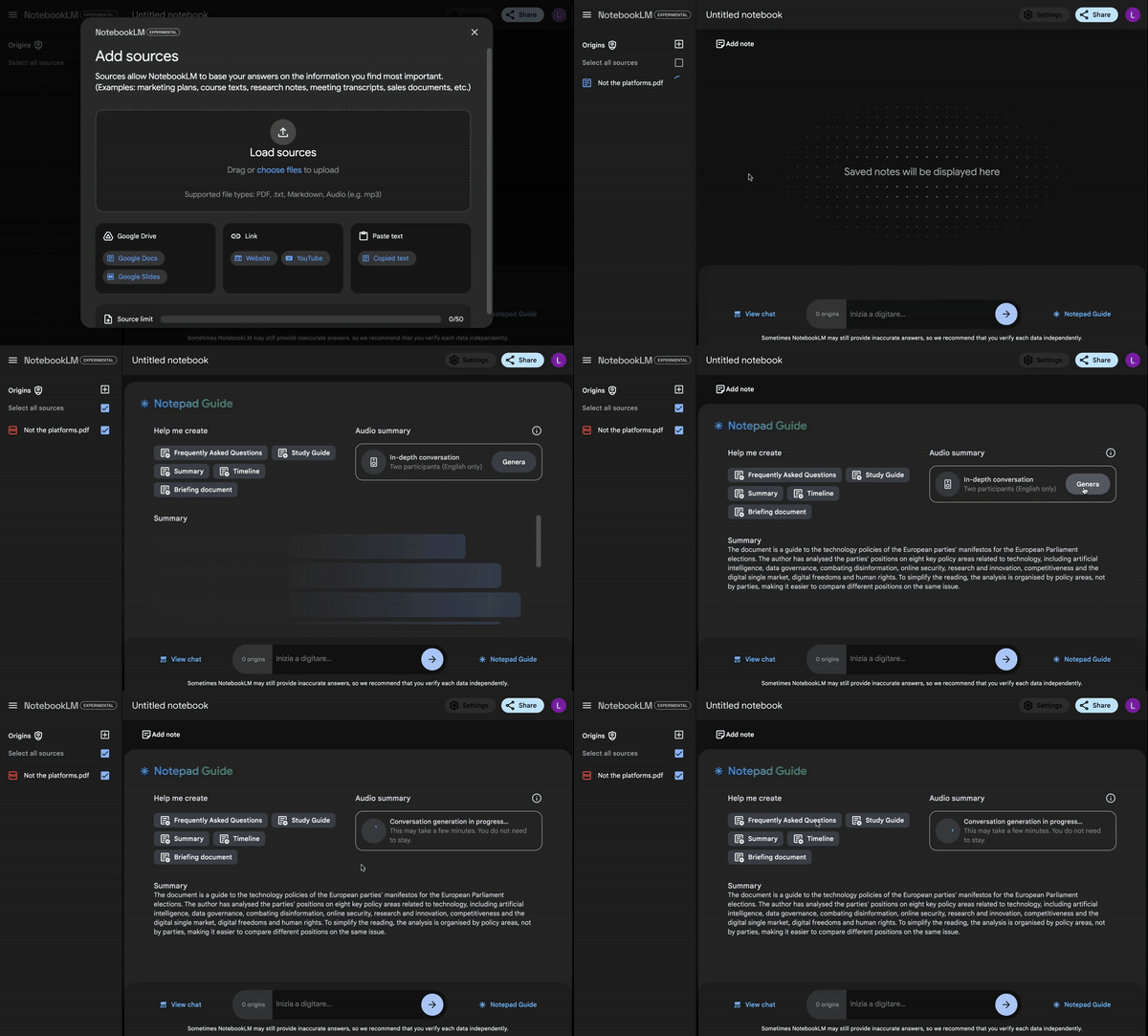 As simple as that
Now, what you hear are two eerily smooth voices having a conversation. They sound human, even throwing in a few attitude shifts depending on the topic.
As someone who actually wrote the guide, I can confirm they’re hitting all the right points. Sure, they get a bit superficial at times and lean a little too heavily on certain sections, but still—it’s shockingly accurate.
Yet, what strikes me is that this AI made my dry-as-dust EU election guide sound almost… fun.
And it didn’t require a single line of code, no complicated instructions, no need for tech or AI expertise. Just drop your content in, and bam, you’ve got a podcast.
------------------------------------------------------------------------
This is Google’s NotebookLM, the latest shiny AI toy from Big G to engage with any type of content and, as they claim, “go from information to insights”.
You upload your material, and it’ll spit out summaries, key points, outlines—basically anything that would’ve taken a student or intern hours.
Give it a whirl.
I remember the first time I used ChatGPT—that “wow” moment when I realized, okay, this is something. I’ve had similar moments with other AI tools over the years, and NotebookLM gave me that same feeling.
But here’s the thing: this isn’t just a “wow” moment. It’s a chance to take a step back and think about Gen AI and the hype, AI-generated content, and what it means for the future of information. And who (or what) is actually intelligent in all this?
That’s Artifacts for today—just a bit more aware that my future competition might be synthetic :)
> ### The Story
To make matters more ironic, the elections guide I uploaded was also partially AI-generated (or at least co-created) with Claude, as I mentioned back in June.
So, one AI helped draft the report, and another turned it into a podcast.
Does this mean machines are getting smarter? Well, not exactly.
One key takeaway here is that there’s no real intelligence at play. Rather, intelligence is in what we perceive and in our understanding, but not in the machines.
Let me break it down. Tools like ChatGPT, NotebookLM, and others don’t possess intelligence in the traditional sense. They rely on statistics and computation to process input and produce output.
But they don’t understand the content and what they’re processing, nor do they attach any meaning or emotion to it.
As Floridi brilliantly puts it, AI is “agency without intelligence”. In other terms, it’s something performing actions that would require intelligence (doing a podcast) without any actual intelligence to do so.
------------------------------------------------------------------------
So, where is the intelligence? It’s in our perception of the text, audio, or images produced as the final output. We associate intelligence with this because, traditionally, these kinds of outcomes have required human intellect. But that’s not what’s happening in the process itself.
 Now, someone might ask, “So what? Isn’t the output what really matters?” Well, that’s debatable. Think of any work of art or human creation—we value not just the finished piece, but also the process, the intention, the creativity behind it.
The painter at work is just as important as the final painting.
This isn’t to dismiss AI, which clearly generates impressive outputs. But it’s key to remember that “What algorithms \[and AI\] are reproducing is not the intelligence of people but the informativity of communication.”
Again, AI excels at creating content bearing information value, like the podcast you heard. But it’s an artificial form of communication rather than intelligence.
We need to be mindful of this distinction so we don’t overstate what these tools are really doing.
------------------------------------------------------------------------
Still, even though the processes lack intelligence, the results are increasingly indistinguishable from what humans can produce. And that’s something we have to sit with.
This shift, in my view, has two major implications:
1. Mediocrity is at stake. AI-generated content can match the quality of low to mid-tier content, and it’s faster and cheaper to produce. But if mediocrity becomes unacceptable, how will one push the boundaries to grow toward excellence? It’s an open question.
2. We’re facing a flood of content. Social media already boosted content creation and sharing. GenAI is about to supercharge that—making it easier, quicker, and more accessible for anyone to generate and share on-demand content.
This will create a synthetic internet, where more and more content is machine-generated, yet strikingly similar to what humans used to make.
As discouraging or even threatening as this might seem to those passionate about content creation, I still believe that human processes—intelligence, passion, and creativity—will remain valuable.
Even if, at first glance, mediocre content from a human and a machine will look almost indistinguishable. And this is already playing out, as we speak.
Leave a comment
> ### Save for Later
Schools are being flooded with AI bad content as well. And no, it’s not just bullshit papers.
OpenAI is, in the end, another tech company.
Elon Musk being, well, Elon Musk. Five days of that might be enough.
The Internet is dying because of AI? Or maybe social media will get better with no humans.
Why do we need some uncertainty?
\[Certainly uncertain: navigating risk and probability with Sir David Spiegelhalter\]
What would the Federalist Papers say if they were written in the 21st Century?
What are we really doing when we build things? This one’s bound to land on your favourites list.
\[Embedded media — view original\]
> ### The Bookshelf
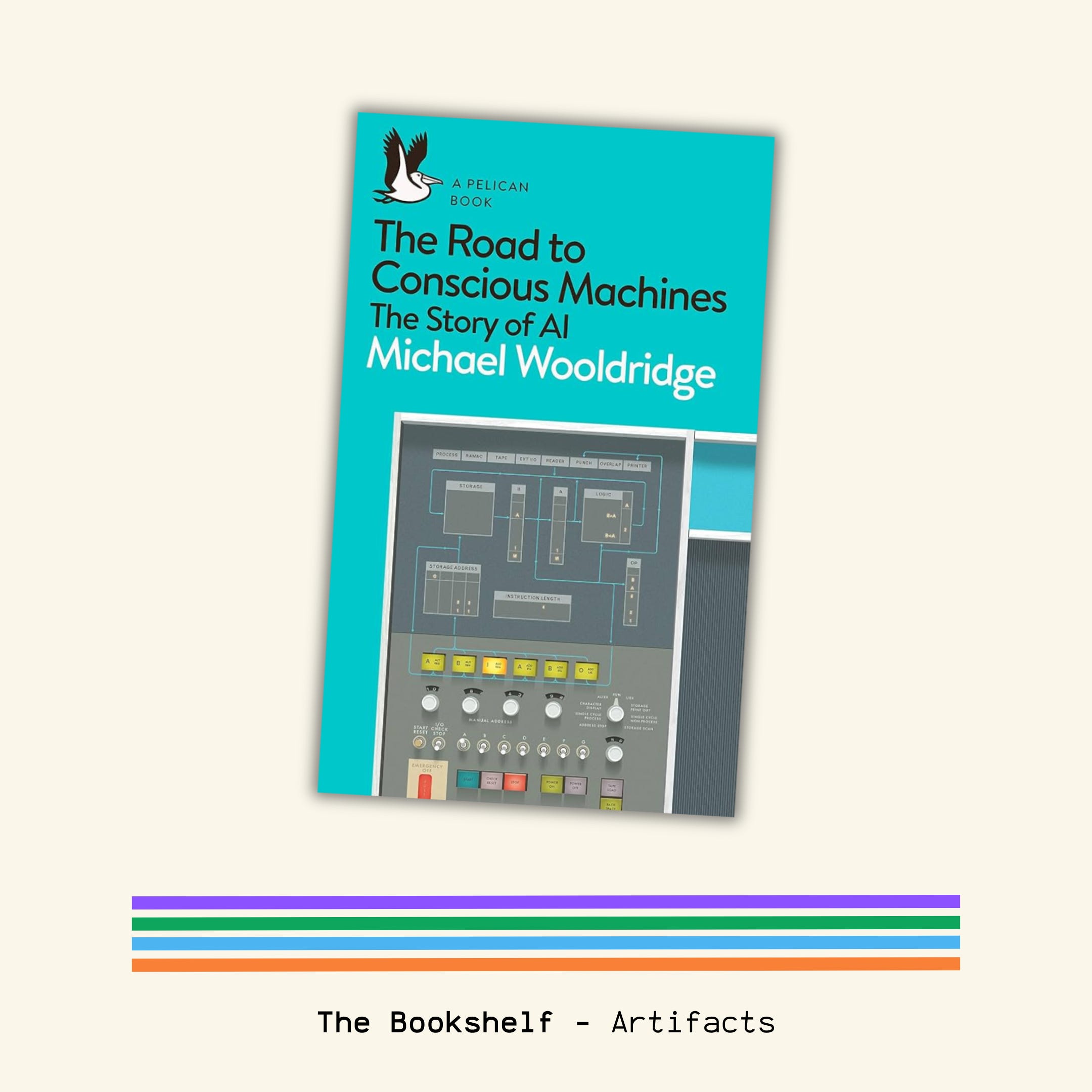 A super technical deep dive into how the whole AI story has unfolded—but surprisingly enjoyable to read! Despite all the intricate details, it’s packed with valuable insights and keeps you hooked the whole way through.
📚 All the books I’ve read and recommended in Artifacts are collected here.
> ### Someone said this before
“Simplicity is complexity solved” - the nerd guy I linked above :)
> ### Nerding
 Well, I’ve told you enough about NotebookLM. Give it a try and let me know whether it’s ‘wow’ or not!
> ### ☕?
If you want to know more about Artifacts, where it all started, or just want to connect...
Let's grab a virtual coffee ☕
======
# Who made the iPhone boring ?
Date: 2024-09-24 | Language: en
Canonical: https://artifactstech.substack.com/p/who-made-the-iphone-boring
Cite as: Who made the iPhone boring ? by Lorenzo Ancona, Artifacts, 2024-09-24. https://artifactstech.substack.com/p/who-made-the-iphone-boring (CC BY 4.0)
Last Friday, as I’ve done for years now, I found myself in the ritual of standing in line (not more than 10 mins) to see the new iPhone.
We’ve all heard the familiar refrain: Apple’s just recycling the same old stuff. And sure, there’s some truth to that. Innovation in phones has hit a plateau, which makes sense—it can’t always be fireworks.
Yet, when I finally got my hands on the new iPhone, I couldn’t shake the feeling that this one took an even smaller leap than usual. More like a skip, really.
Why? There’s a meme floating around online that cuts to the heart of it:
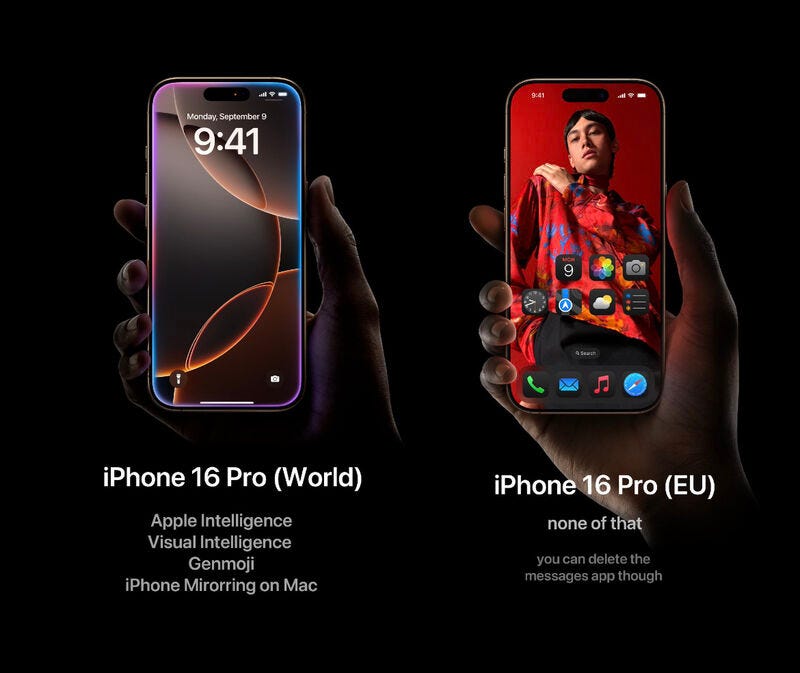 Apple’s will not roll out its AI—its so-called “Apple Intelligence” and not “Artificial”(!)—in the EU. The same AI supposed to be the big thing this year, with some nice features soon to be released worldwide.
It won’t be in the EU not because Brussels banned it someway, but due to Apple’s “regulatory concerns” tied to the Digital Markets Act (DMA), the EU’s grand effort to make digital markets more open and competitive.
In plainer terms? Apple’s being vague, to say the least. They’ve said that the “the interoperability requirements of the DMA could force us to compromise the integrity of our products in ways that risk user privacy and data security.” But they haven’t offered any concrete examples to back that up.
Artifacts managed to talk to a senior Apple employee, though the details were thin. The hint? The company might run into trouble because, right now, the list of external AI providers is short (basically just OpenAI), and it’s unclear if that will change anytime soon.
Therefore, as iPhone users won’t have much control over what AI providers to use, Apple would be stifling competition and users’ choice.
More precisely, there would be a problem also for interoperability—one of the DMA’s key goals aimed at breaking down the walls between online services.
Think of being able to message from WhatsApp to Telegram, for example. That’s the DMA in action.
So yes, the iPhone feels like more of the same. But the real story is bigger than just Apple.
 It is said that the DMA wants to break open gatekeepers.
For once, we can confidently say, “The EU lacks innovation because of regulation”—but not in the usual sense. It’s not that we’re failing to create or develop technology; it’s that we’re simply not receiving it.
One may even question whether we actually want this kind of innovation. It’s fair to assume regulations exist to protect us from things we don’t want. And that, therefore, maybe we’re fine without it.
Still, this is part of a larger trend: tech companies are starting to withhold features or services from Europe. This also raises eyebrows about consumer protection as well as questions the strength of the so-called “Brussels Effect”, the EU’s ability to set global standards.
Fewer answers, more thoughts, and plenty to chew on in today’s Artifacts.
> ### The Story
The clash over Apple’s closed systems has been a recurring theme in its history. Even the two co-founders & Steves—Jobs and Wozniak—argued about it, with Jobs ultimately winning out.
Steve Jobs made it clear he preferred closed systems, not to chase profit, but because “we want to make great products, not crap like Android.” He believed in tightly controlling hardware and software to “create a seamless and unique user experience”
If you’ve ever tried using AirDrop, you’ve likely noticed this—especially when your Android-using friend gets left out.
Yet, if you use AirDrop, you can see that there’s an economic upside too. Apple’s closed ecosystem encourages users to stay locked in, buying more and only Apple devices.
And that’s exactly what the EU’s Digital Markets Act (DMA) aims to challenge—making sure Android and Apple users aren’t cut off from each other’s ecosystems.
------------------------------------------------------------------------
We saw this play out last year when Apple switched to a USB-C charger from lightning worldwide, thanks to an EU directive.
 One of the few times the EU got right the comms :)
The tech world hailed it as a win for the “Brussels Effect”—an EU rule causing global change, with Apple quietly adapting across the board.
The assumption (never confirmed, tough) was that Apple found it easier and cheaper to make one version of the iPhone for everyone.
Yet, the Brussels Effect seems not to hold here with AI. While hardware is hard to customise regionally, software - and therefore AI - is flexible.
This is a new, interesting, turn: this time, Apple is rolling out two different versions of its operating system. The same iPhone will have different features depending on where it’s sold and used.
This shift suggests not only that the Brussels Effect has less sway over software but also that Apple isn’t backing down. We saw something similar with Meta, which chose not to release its latest AI model and features in Europe, citing regulatory concerns.
The walls are still up—for now.
------------------------------------------------------------------------
The DMA is proving to be a tough challenge for Apple, which is now under scrutiny for blocking developers from informing users about cheaper options outside the App Store, making it difficult to install alternative app stores, and limiting integration with non-Apple devices.
This is, in many ways, the natural consequence of a regulation like the DMA. It’s trying to reshape how tech companies operate, pushing them to rethink their systems and make substantial changes.
As expected, this has led to friction, with Apple either finding clever (sometimes sneaky) ways to comply or holding back features—like its AI—altogether to avoid scrutiny.
In the end, it’s the users who feel the impact. We could either enjoy a more flexible and funnier iPhone (as The Verge claimed) with greater choice, thanks to the DMA, or end up with a less exciting device because of the very same regulation.
For now, this is where things stand. Apple says it’s working on bringing its latest innovations to Europe, so we’ll see if the European iPhone actually gets better.
Leave a comment
> ### Save for Later
A new must-read for tech policy nerds just dropped. Artifacts will dive into it soon.
Why content moderation is a chaotic and risky business—especially for the moderators themselves. Told through a play.
How Telegram became one of the most dangerous platforms out there. But now, they’re trying to clean up their act.
Mr. Draghi didn’t hold back on his criticism of European innovation. Oh, and there’s a chatbot mimicking him now.
Kamala Harris shares her thoughts on tech in a short but sweet clip.
Google wants us to time travel. Seriously.
Apple says the latest iPhone is the best one yet—for the 16th year straight :)
🟢 Join the Artifacts Community on WhatsApp to get other Save for Later content!
> ### The Bookshelf
 Whatever your take on the Apple vs. EU showdown, “Make Something Wonderful” is a must-read to understand how we got here. It offers a fascinating behind-the-scenes look at Apple, featuring Steve Jobs in his own words—letters, messages, emails—giving deep insight into the man and the company’s evolution.
📚 All the books I’ve read and recommended in Artifacts are here.
> ### Someone said this before
“Competition is not just about protecting markets and technologies of today but the innovations of tomorrow”. - I heard this somewhere but can remember where.
> ### Nerding
 Looking for a one-stop marketplace for AI tools? Poe is the app you need. It brings together ChatGPT, Claude, Le Chat, and more—all in one smart, super useful platform.
> ### Catch-up?
If you want to know more about Artifacts, where it all started, or just want to connect...
Let's grab a virtual coffee ☕
======
# Artifacts, once again
Date: 2024-09-10 | Language: en
Canonical: https://artifactstech.substack.com/p/artifacts-once-again
Cite as: Artifacts, once again by Lorenzo Ancona, Artifacts, 2024-09-10. https://artifactstech.substack.com/p/artifacts-once-again (CC BY 4.0)
\[For my Italian friends\]
I have to admit, this might be one of the toughest Artifacts I’ve ever written.
Not because we’re making a leap from Dante’s language to Shakespeare’s.
It’s more about the challenge of speaking to both longtime subscribers, who know Artifacts inside out, and those of you who are just stepping aboard (welcome, by the way).
Now, I don’t want to rehash what this newsletter is about—that would be mind-numbing. But at the same time, I can’t skip over the basics of what I’m doing here, why it matters, and who it’s for.
After mulling this over for hours, I came to a question I first needed to answer for myself:
Why is reflecting, writing, and discussing technological artifacts not just idle speculation, but something urgent today?
In other words, why should anyone subscribe to and read this newsletter?
The answer are two simple lines, that I try to unfold below.
 Keep reading to fill this in
Your comments, thoughts, and critiques aren’t just appreciated—they’re what will make this newsletter even more valuable.
And if you’re ready to trust Artifacts, just hit the button below :)
> ### The Answer
With the term “artifacts”, I’m casting a wide net: it covers everything from physical devices (like the latest iPhone) to AI tools, online platforms, websites, digital services, self-driving cars—you name it.
In short, anything born of technical expertise, often connected to the internet, and helping define what we now think of as our digital society and life.
But more importantly, these artifacts are the tools that—whether we realise it or not—shape our daily existence. They mediate our interactions and have woven themselves so deeply into our lives that they’re almost invisible or granted (think of your phone).
As straightforward as it may seem, we can’t afford to be passive about these artifacts or assume they just happen to us by chance.
If a technology produces a certain effect, it’s because someone designed (or misdesigned) it to do just that. Again, we can’t ignore that.
------------------------------------------------------------------------
Since the days when Homo habilis crafted the first tools—probably weapons for hunting—artifacts have embodied specific beliefs, intentions, and a clear view of the world.
Creating technology isn’t just some side note in human history—it’s what has, in many ways, made us more human. Reid Hoffman would likely back me up on that.
But with that power comes responsibility. As Winston Churchill sharply put it, “We shape our buildings, and thereafter they shape us.” He was talking about palaces, but those are just another form of technology—another artifact.
 A building, drawn by Flux
The bottom line to this? We ought to think through how technologies are built to understand why and how they mediate and shape our lives in a certain direction. But also to react and give technologies the shape we aim for.
That’s why it’s crucial to push back on the tired claim that “technology is neutral—it’s all about how you use it.”
No, that’s completely misguided! And our two lines unfold right from here.
> #### Two lines
The design of any technological artifact is infused with values and political structures long before it even reaches the user. This is what Langdon Winner, the godfather of this newsletter, argued when he examined the low-hanging bridges in Long Island designed to keep Black people from reaching the beach.
Luciano Floridi echoes this, claiming there’s no such thing as neutral technology. The construction phase—the very design of any artifact—is shaped by various forces, and it’s on those designing to ensure the right values win out.
In that sense, design is a moral act, placing significant responsibility on us when we build and deliver something new.
Safety, ethics, and considerations like these can’t be an afterthought. They need to be woven into the design process from the beginning. In other words, they must be considered by design throughout the design phase.
And that’s the first line Artifacts walks — moving from technology to us, politics, and society.
------------------------------------------------------------------------
But, of course, this isn’t always possible. Some technologies are already out in the world, and we can’t just send them back to the factory or rebuild them from scratch. This is exactly where politics, policies, and regulations come into play.
Not as roadblocks to innovation, as many claim. Rather, they serve to guide technology toward what we collectively define as good.
A prime example of this is the European Union’s Digital Markets Act, which compels online services to revisit their interfaces—essentially requiring a redesign to address what went wrong the first time.
Now, let’s be clear: I’m not suggesting tech policies and regulations are just second-chance efforts. While they may have functioned that way in the past, well-crafted rules can do more than clean up the mess—they can shape how future technologies are built from the outset. The AI Act might be a proving ground for this, but we’ll have to wait and see.
And that’s the second, other line of Artifacts—this time, moving from politics to technology.
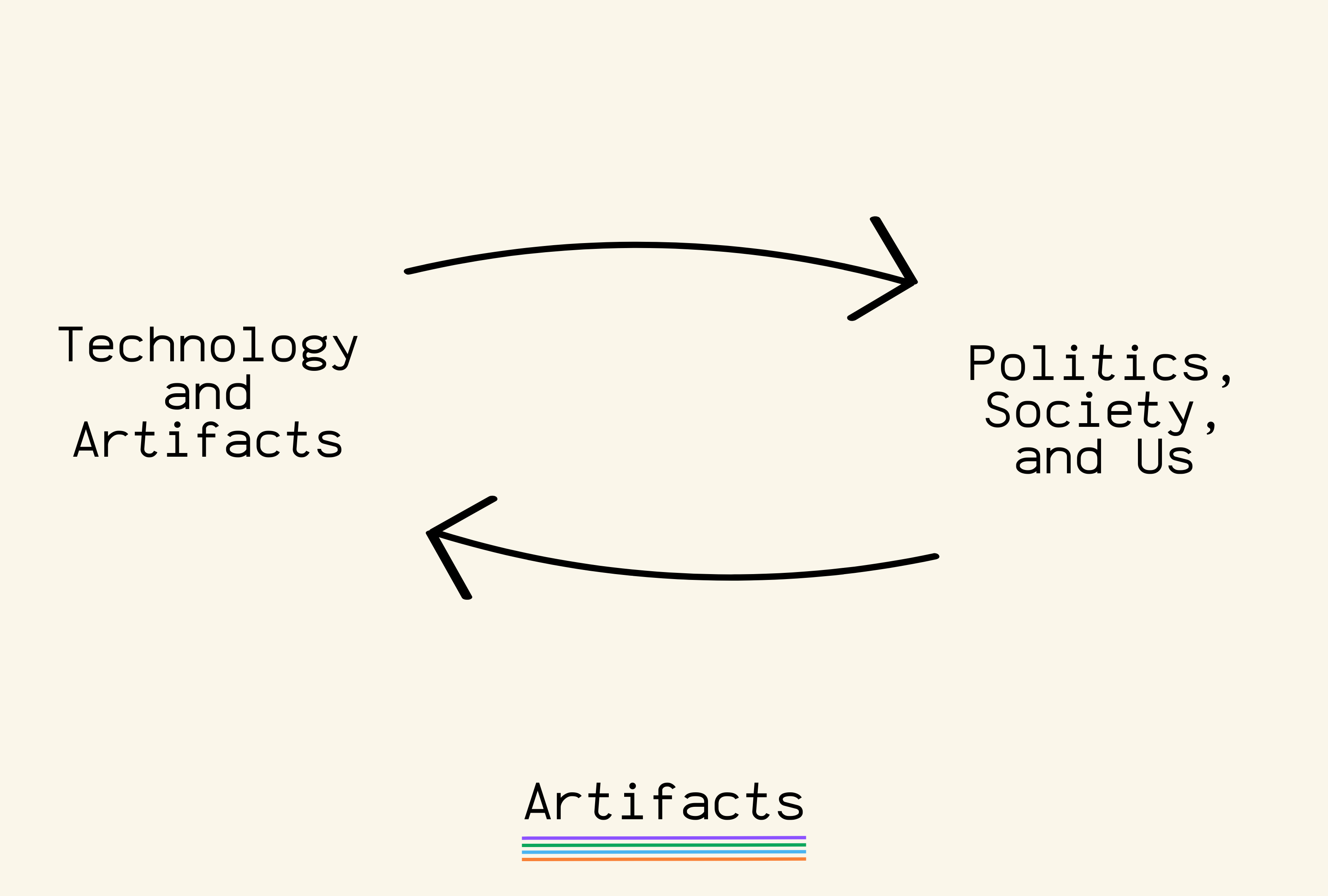 Promise kept
In the end, it often comes down to design, whether we’re talking about the artifacts themselves or the regulations governing them. And I find it fascinating that the same word—design—can stretch to cover both.
> #### So, what?
I’ve probably said enough by now. Hopefully, it’s clear why talking about artifacts isn’t just some niche obsession for tech nerds—it’s an urgent priority for us all.
We’ll be diving deep into artifacts here in Artifacts. This will be a space, a playground, to bring together facts, ideas, and reflections on how these technologies have been, and continue to be, shaping us.
And just as importantly, we’ll explore how politics and institutions are grappling with the meaning of technology.
We’ll do this every other Tuesday. Most of the time, I’ll be sharing my thoughts, but we’ll also bring in technologists, policy experts, and other curious minds to join the conversation.
Each edition of Artifacts will follow the format you see here: a deep dive into a key topic, food for thought from different sources, a book recommendation, a quote from someone sharper than me, and a tool I’d suggest you try.
It’ll be a journey we take together, and I’m excited to kick it off, once again.
Thank you to everyone who’s joining us for the first time today, and to those who’ve been here from the beginning for your continued support.
> ### Save for Later
Everyone’s buzzing about “founder mode”—but what exactly is it?
Are we too paranoid about AI and elections? Or maybe we’re just too paranoid in general?
Telegram may be changing its mind about content moderation.
Wanna go open source? A good source for it.
I wish I could call Mark Scott a competitor. That’s not the case yet, but he’s out with a great, new newsletter.
🟢 Join the Artifacts Community on WhatsApp to get other Save for Later content!
> ### The Bookshelf
 Fate is blind. I’m reading this right now: “Radical Technologies: The Design of Everyday life” a fascinating scrutiny and speculation of a set of different artifacts we encounter every day. I’m yet to finish it, but I can already tell it’s worth a read.
📚 All the books I’ve read and recommended in Artifacts are here.
> ### Someone said this before
“One has to become a cybernetician to remain a humanist.” - Peter Sloterdijk
> ### Nerding
 If you don’t want to miss this Artifacts or that mind-blowing article you just found, save it for later. Omnivore has got you covered—it saves articles and content, presenting them in a sleek, easy-to-read format.
> ### Catch-up?
If you want to know more about Artifacts, where it all started, or just want to connect...
Let's grab a virtual coffee ☕
======
# Lettera per lettera
Date: 2024-09-03 | Language: it
Canonical: https://artifactstech.substack.com/p/lettera-per-lettera
Cite as: Lettera per lettera by Lorenzo Ancona, Artifacts, 2024-09-03. https://artifactstech.substack.com/p/lettera-per-lettera (CC BY 4.0)
Questa che leggi è una ultima Artifacts.
O meglio, è l’ultima Artifacts in italiano e - come in realtà da un po’ - settimanale.
Dalla prossima settimana, Artifacts uscirà tendenzialmente una volta ogni due settimane. Tendenzialmente perché so che a volte romperò questa regola e uscirà anche nei martedì NO.
E, poi, sarà in inglese. Che sì, lo so, “che noia”, ma se proprio non lo tolleri ci sarà comunque sempre un link ad una versione tradotta in italiano.
Sulla cadenza, la scelta nasce da due fattori:
1. Ho iniziato Artifacts da studente e ora - per fortuna o sfortuna - lavoro, quindi il weekend ammetto avere un significato diverso e credo sia sano voler rallentare un po’;
2. Con un caro amico stiamo lavorando ad un’idea tangenziale ad Artifacts, che prenderà vita nei prossimi mesi, ma richiede un po’ di tempo.
Sulla lingua, l’idea è di provare a espandere la community di Artifacts e, di riflesso, provare a renderla ancora più interessante con qualche ospite in più o simili. Una sfida, sì, ma può valerne la pena.
------------------------------------------------------------------------
Allora, dato che questa Artifacts è un po’ di transizione e marca il primo compleanno dal lancio, guardiamo un po’ indietro, all’anno passato.
Che è sempre utile per prepararsi a quello che verrà.
E lo facciamo con un alfabeto, del quale ogni lettera rappresenta un tema o qualcosa di simbolico delle Artifacts dello scorso anno.
 direi ovvio, fatta con Flux.
Un po’ un amarcord, magari bello per chi è a bordo da settembre 2023 o anche utile per chi è arrivato nel corso dei mesi. Siamo quasi 700, wow.
E, tra l’altro, se magari conosci qualcuno da introdurre ad Artifacts, questa è una bella edizione di recap. Basta inoltrare la mail :)
Infine, a proposito di chi, ad un certo punto più o meno distante nel tempo, si è iscritto, mi piace pensare che quella che è forse l’ultima parola (non di contenuto) in italiano di Artifacts (🥲) sia semplicemente un grande, gigantesco, sentito: GRAZIE ❤️
> ### L’Alfabeto
Artifacts - scontato, ma necessario. Con “artefatti” si abbraccia qualsiasi cosa possa essere tecnologia, richiama poi “Do Artifacts have politics”, il paper dal quale è scaturito qualche anno fa il mio interesse per questo aspetto socio-politico della tecnologia.
Biometria - sorveglianza facciale e riconoscimento biometrico sono stati tra i temi forse più tecnici trattati. Lo avevamo fatto parlando di ClearviewAI ma poi anche di come in Grecia questi sistemi vengano abusati contro l’immigrazione.
Collettiva - è una delle chiavi in cui abbiamo visto l’Intelligenza Artificiale, ripercorrendo l’esercizio che ha fatto Anthropic (azienda da tenere sott’occhio) per scrivere una costituzione dei suoi tool di IA.
Detox - era stata la \#1 e poi anche una delle più recenti, aggiornata in formato guida. Credo sia sempre interessante guardare il nostro rapporto con cellulare & social con distacco e capirne la natura di “default” che ha assunto.
Eco - molti, parlano di ‘echo chambers’ o ‘filter bubbles’ rispetto a come assumiamo informazioni online. Interessante, forse un po’ retorica. Con Chris Bail avevamo visto che forse bisognerebbe parlare di prismi più che altro.
Filterworld - lo splendido libro di Kyle Chayka su come il nostro consumo culturale sia filtrato e determinato dai trend o da ciò che è virale e, alla fine, viene cambiato anche il nostro comportamento offline.
Giochi - una delle più divertenti da scrivere è stata quella sul Gameboy insieme a Giacomo Da Ros. La console che ha cambiato tutto senza rivoluzionare niente. Ma di giochi avevamo parlato anche per innovare la democrazia. Parkour :)
Hyperlink - ciò che ha cambiato Internet, che ha dato vita al Web, e che è la premessa di una realtà poi tradita con il peccato originale di Internet. E molto altro in una delle interviste più belle di Artifacts, col mio amico Tommi.
Interoperability - una delle idee più coraggiose degli ultimi anni di Internet. Si tratta di pensare che Internet non sia più di nessuno e, quindi, distribuita tra gli utenti.
Jobs - Ammetto di avere un debole per Steve. Personaggio affascinante, istrionico, da studiare. No idoli, ma quello che ha fatto con Macintosh, beh, wow.
Leggere - la fonte del direi 85% delle idee alla base di Artifacts. Quest’estate ho letto cose stra interessanti e ricaricato i serbatoi per i mesi che verranno.
Media - una sfera che vorrei diventasse uno dei temi centrali di Artifacts nei prossimi mesi. Qualcosa lo abbiamo già visto nella bagarre NYT-OpenAI o sulla disinformazione e cosa farne a riguardo.
Newsletter - il formato di Artifacts, sì, ma anche un formato media che resiste alla tirannia degli algoritmi di raccomandazione e ci riporta ad un Internet più da community. Avevo scritto una meta-riflessione.
Open - e quindi la necessità di trasparenza, sui processi delle aziende che cambiano il mondo, sulle enciclopedie online e, spero, presto molto anche sull’IA Open Source. Qualcosa bolle in pentola.
Perplexity - non ho timore di dire che Perplexity o un prodotto simile siano il futuro della ricerca online e dell’IA. Ma ci sono tutta una serie di problemi, oltre che delle soluzioni che stiamo sperimentando.
Quotes - sono un grande appassionato delle citazioni di grandi pensatori. Avevo raccolto le mie preferite per un regalo di Natale di Artifacts e a tutti i nuovi iscritti arriva un file con le cit che hanno ispirato Artifacts.
Red Line - quella della disinformazione e di cosa, concretamente, possiamo fare per rendere Internet più sicuro senza però colpire la libertà di espressione. Delicato, sfumato, complesso, ma ci avevamo ragionato.
Scaffale - la sezione con tutti i libri di Artifacts, che sono anche raccolti qui in un formato facile da consultare.
Training - quello delle AI, che pare abbiano rubato tantissimi libri e che, soprattutto, pone poi un tema etico se vogliamo delle AI che perpetuano il mondo com’è o una realtà verso la quale vorremmo tendere.
Unione Europea - e un grande grazie per DMA, DSA, AI Act e compagnia cantante che non fanno mai esaurire le cose di cui parlare. Più avanti qualcosa anche su cosa costruiamo, al di là delle regole.
Villaggio - ci siamo illusi che i social potessero essere la piazza dei villaggi virtuali in cui viviamo, salvo poi realizzare che sono spazi privati, con un certo set di incentivi e, alla fine, vincoli sui quali è anche difficile lamentarci.
Web - ok, vasto. L’arena in cui succede tutto, forse con una grande promessa tradita, continueremo a vederne insieme le tante dinamiche
X-Road - il sistema di dati alla base dell’Estonia, uno dei paesi più digitalizzati al mondo. Un auspicio, poi, di esplorare un po’ di più questa vicenda della digitalizzazione dei governi.
Zuckerberg - Mark regala sempre argomenti, anche lui. Tanto abbiamo visto sul se vorremmo / dovremmo pagare per la privacy sui social di Meta e, poi, anche cosa succede sulla sicurezza dei bambini online, specie negli US
Leave a comment
> ### Save for Later
🟢 IMPORTANTE: Un’amica sta scrivendo la sua tesi su come l'Intelligenza Artificiale viene usata nelle strategie ESG delle aziende. E ha bisogno di un aiuto con un questionario velocissimissimo, grazie! 🟢
Mentre arrestano il CEO di Telegram in una vicenda che esploreremo, la Presidente di Signal fa un’intervistona.
Cosa serve per lanciare una start-up in Italia? Tempo, soldi e troppa pazienza.
Forse l’IA può rendere i dibattiti online lievemente più civili, ha trovato Chris Bail.
Che in realtà le potremmo combattere le immagini fake, ma non ci stiamo mettendo d’accordo.
Magari è il caso che l’UE cominci a costruire qualcosa? Sarà la prima trasferta di Artifacts, more to come soon :)
Alla fine Harris e Trump non la pensano così diversa, ma lo vediamo presto anche questo
> ### Lo Scaffale
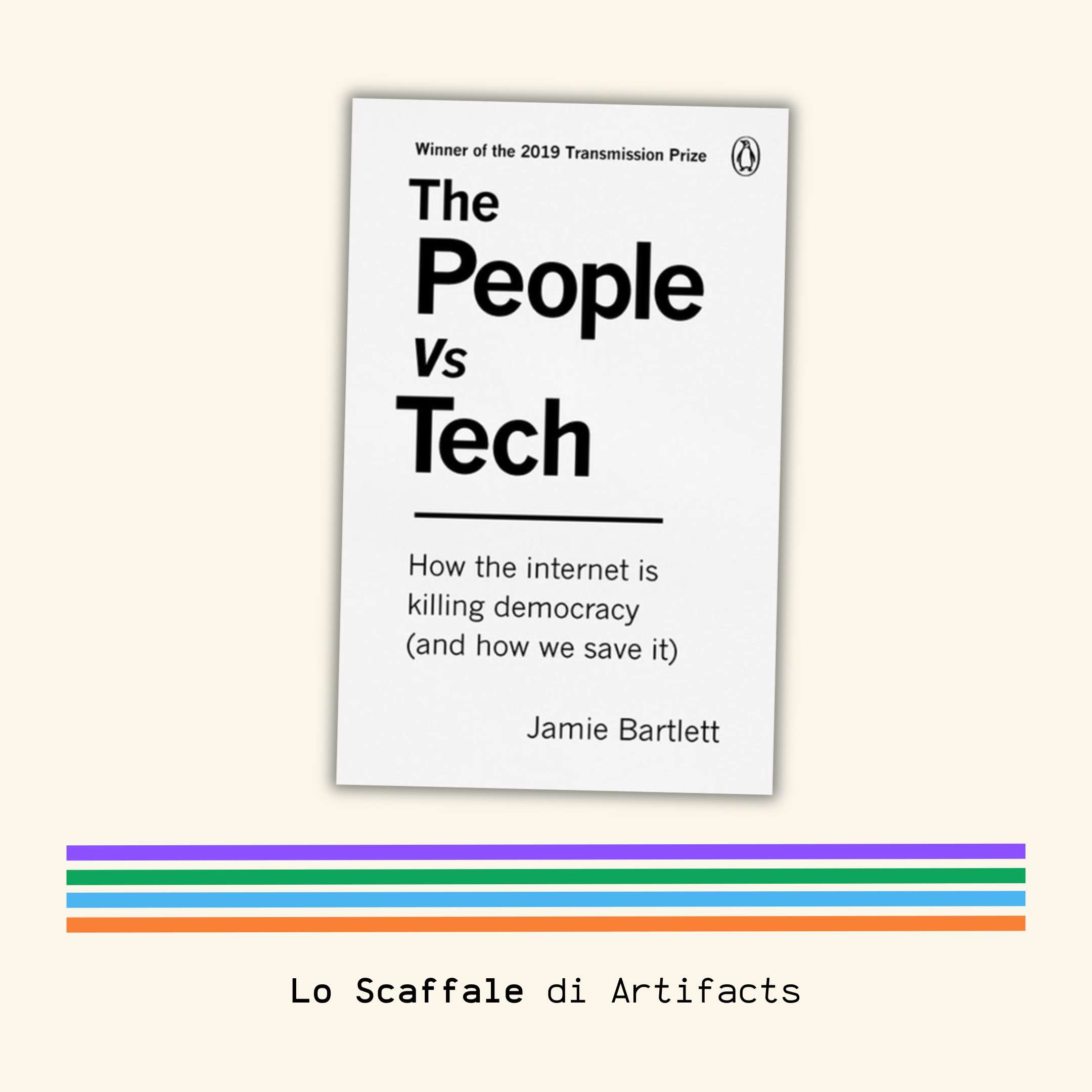 L’avevo letto nel 2019 quando era uscito e mi sembrava incredibile. L’ho riletto quest’estate e mi ha fatto capire quanti progressi abbiamo fatto su questi temi. “The People vs Tech” è una lettura utile, con delle coordinate precise su alcune questioni essenziali.
📚 Tutti i libri consigliati in Artifacts sono raccolti qui
> ### Nerding
 Ora, non so bene se davvero questa cosa dell’IA può sostituire chi programma. Però so che una roba come Cursor.ai è abbastanza senza precedenti e apre tante possibilità anche per chi ha 0 conoscenza del coding.
> ### Pausa Caffè? ☕
Che tu legga Artifacts da qualche settimana, mese o dall’inizio, credo abbiamo qualche battuta da scambiare.
Allora, se vuoi chiacchierare dei temi di Artifacts o sei solo curiosa/o…
Prendiamo un caffè digitale
======
# Nell'interesse di tutti
Date: 2024-08-20 | Language: en
Canonical: https://artifactstech.substack.com/p/nellinteresse-di-tutti
Cite as: Nell'interesse di tutti by Lorenzo Ancona, Artifacts, 2024-08-20. https://artifactstech.substack.com/p/nellinteresse-di-tutti (CC BY 4.0)
A febbraio avevo raccontato di aver smesso di usare Google a favore di **Perplexity**, un ***answer engine*** che usa l'IA per le ricerche online.
[](https://artifactstech.substack.com/p/ho-parlato-con-internet)
#### Ho parlato con Internet
[Lorenzo Ancona](https://substack.com/profile/142944754-lorenzo-ancona)·27 February 2024[Read full story](https://artifactstech.substack.com/p/ho-parlato-con-internet)
E che, invece di dare i link ai siti come Google, fornisce direttamente un testo con le citazioni dei siti. **Utilissimo, velocissimo, ma potenzialmente un terremoto per le logiche economiche della pubblicità alla base di internet.**
[](https://substackcdn.com/image/fetch/$s_!0ryR!,f_auto,q_auto:good,fl_progressive:steep/https%3A%2F%2Fsubstack-post-media.s3.amazonaws.com%2Fpublic%2Fimages%2F85db29bc-10a2-415c-9165-684d51c0438b_995x1162.png)
Bravo Perplexity, lettore affezionato di Artifacts
Non ho, poi, mai ripreso ad utilizzare Google come motore di ricerca. O meglio, lo uso magari per cercare il meteo o dei siti precisi. **Ma quando si tratta di cercare delle informazioni o delle notizie,** Perplexity è semplicemente più veloce ed efficace.
**Ed infatti è anche l’unico tool di IA per il quale pago l’abbonamento mensile**, mentre gli altri li alterno e ci gioco intorno piuttosto.
Tra l’altro, con la *pro subscription*, **si ha anche accesso a tutti i modelli di linguaggio IA più avanzati**. Anche quelli che in UE non sono arrivati.
------------------------------------------------------------------------
Ora, lungi da me dire che quella Artifacts fu pionieristica, però **varie cose successe da quel momento puntano il dito verso un futuro fatto forse di ricerche online con l’IA:**
- **Perplexity** solo nell’ultimo mese ha ricevuto [250 milioni di domande](https://www.ft.com/content/87af3340-2611-4650-9ae3-036927e9f65c), e in tutto il 2023 sono invece 500 milioni. In crescita;
- **OpenAI** sta facendo provare [SearchGPT](https://openai.com/index/searchgpt-prototype/), un ChatGPT per la ricerca, ad alcuni utenti;
- **Google** ha lanciato le [AI Overviews](https://blog.google/products/search/generative-ai-google-search-may-2024/), ossia il suo motore di ricerca ma con gli steroidi AI (che sì, ha consigliato di mettere [la colla sulla pizza](https://www.theverge.com/2024/5/23/24162896/google-ai-overview-hallucinations-glue-in-pizza), ma capita).
[](https://substackcdn.com/image/fetch/$s_!Us0p!,f_auto,q_auto:good,fl_progressive:steep/https%3A%2F%2Fsubstack-post-media.s3.amazonaws.com%2Fpublic%2Fimages%2Ff5f4da33-504c-4a3e-b2f9-255ff1c21acf_600x338.gif)
Prima o poi arriva questa robina eh
Ma non è tutto oro quel che luccica. **Non è chiaro né come i siti di notizie possano guadagnare se le persone non li visitano più né come Google stessa (ed altri) possano proseguire il modello di business basato sulla pubblicità sui siti.**
Non sorprendentemente, **[Forbes](https://www.forbes.com/sites/sarahemerson/2024/06/07/buzzy-ai-search-engine-perplexity-is-directly-ripping-off-content-from-news-outlets/)** e **[Wired](https://www.wired.com/story/perplexity-is-a-bullshit-machine/) hanno attaccato duramente Perplexity**, sostenendo che avrebbe preso dei loro articoli e li avrebbe plagiati senza inserire nessun link.
**Peggio ancora,** Perplexity avrebbe plagiato anche [l’articolo di Wired](https://www.wired.com/story/perplexity-plagiarized-our-story-about-how-perplexity-is-a-bullshit-machine/) in cui era accusato di plagio. LOL.
Ora, tutto questo ha a che fare con due elementi: **il protocollo robot.txt e il concetto stesso di plagio.** Che vedremo presto in Artifacts, **ma non sono il focus di oggi.**
------------------------------------------------------------------------
Soprattutto, sono questioni che riguardano uno scenario in cui non c’è nessun tipo di accordo tra i media e le varie aziende di IA. **Scenario che, però, ora sta cambiando.**
La Artifacts di oggi, allora, vede quali primi e preliminari passi ci sono stati verso qualche sorta di accordo.
E, soprattutto, **perché trovare una quadra su come rendere sostenibile la ricerca con l’IA è in tutto l’interesse sia dei media che anche delle OpenAI, Perplexity e varie.**
> ### La Storia
*Precisazione necessaria:* quello che lamentano i media è la capacità delle IA di fare ***scraping*** **live** dei siti, ossia di “navigarli” e prenderne le informazioni o le notizie ad ogni richiesta degli utenti.
**Ed è ben diverso dal fatto che molte delle IA Generative attuali sono state allenate su contenuti online.** Meglio, il meccanismo è simile, ma su quest’ultimo training c’è poco o nulla da fare, essendo già successo (!).
Sullo scraping live (quello di Perplexity) e su quello futuro (per allenare i nuovi modelli IA che verranno), invece, essendo due processi in corso, **siamo ancora in tempo.**
------------------------------------------------------------------------
Ed infatti stiamo vedendo emergere dei **primi tentativi di partnership o accordi tra le aziende IA e i media.**
**OpenAI** ne sta facendo tantissimi, insieme agli attori media più importanti, tra cui Financial Times, Vox, News Corp, Associated Press, The Atlantic [ed una lunga lista](https://foundationinc.co/lab/openai-partnerships-list/).
Tendenzialmente, **i media danno ad OpenAI accesso ai loro siti e dati** per il training dei modelli futuri e per la funzione browsing di ChatGPT, mentre **OpenAI fornisce in cambio soldi** (a volte) e accesso ai suoi prodotti tecnologici.
Diverso, per ora unico, e quindi meritevole di attenzione, è invece quello che ha fatto Perplexity con il suo **[Perplexity Publishers’ Program](https://www.perplexity.ai/hub/blog/introducing-the-perplexity-publishers-program).** Non un accordo a priori, ma **una percentuale (non rivelata) data ai media ogni volta che Perplexity si ritrova a visitarne il sito** e ad inserirlo nelle fonti della ricerca. Sì, ***revenue sharing***, esatto.
Per ora programma sottoscritto da nomi come TIME, Der Spiegel, Fortune, Entrepreneur, The Texas Tribune, e WordPress.
Tutti primi passi, provvisori, ma per provare a stare al passo con quello che succede. Ecco, **si avverte la sensazione di essere in territori inesplorati.**
[](https://substackcdn.com/image/fetch/$s_!2Nuq!,f_auto,q_auto:good,fl_progressive:steep/https%3A%2F%2Fsubstack-post-media.s3.amazonaws.com%2Fpublic%2Fimages%2F82823a1d-df20-452e-930c-a911760c3873_2160x2160.png)
Sono bellissime queste immagini di [Flux](https://huggingface.co/spaces/black-forest-labs/FLUX.1-schnell).
Non c’è nemmeno la certezza, tra l’altro, che la ricerca online con l’IA diventi davvero qualcosa di così grosso.
**I miei** ***two cents*** **su questo sono che sì, lo sarà.** Altrimenti OpenAI e Google non starebbero sperimentando i tool che abbiamo visto sopra.
Ancora, **secondo me la ricerca online può essere la** ***killer feature*** **dell’IA.** Ossia quella funzione che rende l’IA davvero popolare tra tutti, e non solo ad una bolla. (Perché, sì, i dati ci dicono che l’adozione su base quotidiana dell’IA non è così scoppiettante come pensiamo).
Ultima riflessione personale: **può anche essere la funzione che rende l’IA davvero finalmente** ***utile**,* andando oltre task come la riscrittura di testi, le email o la produzione di bullshit varia.
Allora, se scommettiamo di star intravedendo scintille di futuro, a maggior ragione il modello economico alla base della ricerca con IA deve diventare sostenibile. **Sia per le aziende IA che per i media.**
------------------------------------------------------------------------
**Le aziende**, che forse possono sembrare avere il coltello dalla parte del manico, **hanno tutto l’interesse di sviluppare una relazione positiva e di lungo raggio con i media.**
E non perché debbano essere dei buoni samaritani, **ma perché hanno un dannato bisogno dei contenuti che i media forniscono.**
**Se domani i media bloccano l’accesso a Perplexity o simili** (come successo in alcuni casi)**, questi tool di IA non sapranno più cosa “scrivere”** e si ritrovano in mano un pugno di mosche.
Insomma, dato che non producono contenuti originali, ma rielaborano quanto scritto da altri, **le IA devono capire come continuare ad avere qualcosa da rielaborare.**
**Lato media,** invece, forse è ancora più intuitivo. **Pubblicare contenuti e farseli “rubare” dalle IA senza che gli utenti visitino i siti non è un’opzione.**
Eppure, **se la ricerca IA ha un futuro**, urge trovare una soluzione che continui a portare valore e, quindi, entrate.
Tra l’altro, come detto prima, essendo i media a produrre i contenuti rielaborati, **il potere negoziale è tutt’altro che minimo.** Bisogna, quindi, capire come valorizzare questi contenuti che, alla fine dei conti, sono il carburante di questo motore della ricerca con l’IA.
**Il rischio è ripetere quanto successo con l’avvento dei social,** un’arena che i media non potevano non esplorare, ma alla quale **hanno portato più valore di quello che poi hanno effettivamente preso.**
Qui, forse ancor di più, i media possono difendere la propria posizione, dato che un **Perplexity non avrebbe praticamente parole se non fosse per quelle che prende navigando.**
Insomma, **trovare un modello funzionante è nell’interesse di tutti.** Capire quale sia, vedremo.
[Leave a comment](https://artifactstech.substack.com/p/nellinteresse-di-tutti/comments)
> ### Save for later
[Tutto quello che avremmo perso](https://www.domusweb.it/en/design/gallery/2024/05/20/all-the-things-we-lost-because-of-the-smartphone.html) per colpa degli smartphone.
In California stanno provando a fare [una legge sull’IA](https://www.nytimes.com/2024/08/14/technology/ai-california-bill-silicon-valley.html?smid=nytcore-ios-share), ma non piace granchè.
[Quali tipi di feed social esistono](https://12challenges.substack.com/p/a-typology-of-the-social-media-feed), bello!
[L’IA sarebbe potuta essere così](https://www.ft.com/content/c63dae2b-b0d5-4b27-a718-2cce165097b9), ma invece sono successe delle cose.
Se siete fan di Steve Jobs (mi auguro!), c’è [un incredibile archivio su di lui online.](https://stevejobsarchive.com/)
Sul Twitter di Elon Musk ora si possono creare [delle immagini decisamente distopiche.](https://www.theverge.com/2024/8/14/24220127/grok-ai-chatbot-beta-image-generation-x-xai-update)
> ### Lo Scaffale
[](https://substackcdn.com/image/fetch/$s_!z-Wi!,f_auto,q_auto:good,fl_progressive:steep/https%3A%2F%2Fsubstack-post-media.s3.amazonaws.com%2Fpublic%2Fimages%2F800ccb27-8ac0-4bab-9a25-7144b9ff1269_1080x1080.png)
Come e perché invenzioni come **il vetro, il suono, o il freddo** hanno cambiato radicalmente anche il mondo che viviamo oggi. ***“How we got to now”*** è una lettura veramente piacevole proprio su questo. Forse un po’ *wishful thinking* a volte, ma consiglio!
📚 **I libri consigliati in Artifacts da portare sotto l’ombrellone sono [qui](https://airtable.com/appK7fMPX1DMkQYzL/shrRh8TgI7GtmgBxM/tblWFBDnOoRBU47XM/viwdSxYeauFmB0EIM)**
> ### Nerding
[](https://substackcdn.com/image/fetch/$s_!nIMa!,f_auto,q_auto:good,fl_progressive:steep/https%3A%2F%2Fsubstack-post-media.s3.amazonaws.com%2Fpublic%2Fimages%2F2908ac4c-8b99-4391-b511-549257f7a3bf_2160x2160.png)
Visto che oggi eravamo pieni di GIF, ho pensato sia utile suggerire **[EZGIF](https://ezgif.com/)**, che è il tool che io uso per convertire i video in GIF. Semplice, intuitivo, rapido. **E non sottovalutate il potere delle GIF!**
======
# Perché scrivere una Artifacts
Date: 2024-08-06 | Language: it
Canonical: https://artifactstech.substack.com/p/perche-scrivere-una-artifacts
Cite as: Perché scrivere una Artifacts by Lorenzo Ancona, Artifacts, 2024-08-06. https://artifactstech.substack.com/p/perche-scrivere-una-artifacts (CC BY 4.0)
Circa un anno fa sceglievo il nome ‘Artifacts’.
Non ero in una *deep focus session* con la Red Bull o simili, ma stavo semplicemente **guardando il nulla** in una spiaggia deserta della Croazia.
Mi veniva in mente il paper *‘Do Artifacts have politics?’* di Winner e pensavo che ok, ci stava.
[](https://substackcdn.com/image/fetch/$s_!jnu_!,f_auto,q_auto:good,fl_progressive:steep/https%3A%2F%2Fsubstack-post-media.s3.amazonaws.com%2Fpublic%2Fimages%2F544a824b-d12e-4f15-bad9-015e256b540b_595x454.png)
Prima di quel momento i nomi che consideravo erano *‘Ahead of the curve’*, che diventava facile *‘AOC’,* o *‘Beyond’.* Ma il mio amico Tommaso mi fece notare che il primo era troppo complicato e il secondo forse troppo vago.
**E quindi ‘Artifacts’, con una serie di motivazioni che avevo scritto nella \#0.**
[](https://artifactstech.substack.com/p/questa-non-e-artifacts)
#### Questa (non) è Artifacts
[Lorenzo Ancona](https://substack.com/profile/142944754-lorenzo-ancona)·1 September 2023[Read full story](https://artifactstech.substack.com/p/questa-non-e-artifacts)
------------------------------------------------------------------------
La casualità e semplicità di come è nato il nome riflette abbastanza bene il processo che in realtà ha portato ad Artifacts stessa.
**Non è stata un’illuminazione improvvisa, ma più l’esito naturale di 3 fattori:** che mi piace leggere e scrivere, che ho la fortuna di avere tempo da dedicare ad una cosa simile, e soprattutto dall’incontro con diverse persone stimolanti e interessanti negli anni.
E poi anche che, in un panorama media sovraffollato e denso come quello attuale, **un prodotto media come una newsletter rappresenta secondo me una nicchia da proteggere e valorizzare.**
------------------------------------------------------------------------
Allora, questa breve Artifacts balneare (ti auguro), **riflette proprio sul senso di una newsletter nel 2024.**
Quindi non parlo *di* Artifacts, **ma provo a condividere cosa ho imparato** ***attraverso*** **Artifacts** sul perché di una newsletter, la sua peculiarità e che ruolo gioca, secondo me, nell’ecosistema media.
[](https://substackcdn.com/image/fetch/$s_!b8fm!,f_auto,q_auto:good,fl_progressive:steep/https%3A%2F%2Fsubstack-post-media.s3.amazonaws.com%2Fpublic%2Fimages%2Fe1e55e3d-4433-4956-84fa-0b38eadca1f0_1024x1024.webp)
Un cerchio e due frecce. **Creato con [Flux](https://huggingface.co/spaces/black-forest-labs/FLUX.1-schnell), nuovo modello Open Source di Image Generation**
(E così magari ti viene anche voglia di iniziare qualcosa di simile da settembre!)
> ### La Storia
**Parlando di ecosistema media,** una newsletter è, per alcuni aspetti, radicalmente diversa dai social media e dai contenuti per Instagram, Facebook, etc.
Innanzitutto perché **non c’è alcuna intermediazione da parte di algoritmi.** Se sei iscritto, ti arriva. Se non sei iscritto, no e non viene consigliata su un feed.
**Quindi si salta uno step:** non è (1) creator —\> (2) piattaforma —\> (3) audience, ma direttamente **creator —\> audience.** Una mail che ti arriva nella inbox, facile.
**C’è anche molta meno interazione** - o *engagement* direbbero i guru - perché non ci sono like, repost, commenti o simili. **Quindi forse è un prodotto più intimo**, ma è soprattutto più difficile per chi scrive sapere come e quanto è stata apprezzata.
**Ed è quindi anche più difficile fare il** ***boom*** o crescere in maniera repentina: è un processo mooolto più lento che beneficia meno delle dinamiche della viralità.
Ultimo punto: **non si torna indietro.** Quando clicchi “invia”, è fuori. Stop.
C’è un errore? Amen. **Non puoi eliminarla dall’inbox di chi la riceve** come invece puoi cancellare un contenuto social. **Decisamente più responsabilità.**
------------------------------------------------------------------------
Poi, **è una rottura di scatole infinita.**
Non è qualcosa che ti vai a prendere o vedere su una piattaforma o un sito, **ma ti arriva dritta dritta nelle mail.** Che è una dinamica media un po’ più all’antica, di comunicazioni *one-to-one,* a tutti gli effetti una lettera che ricevi.
E visto che chi scrive si arroga il diritto di romperti le scatole, credo che una newsletter **debba cercare di essere almeno decente.**
Mi spiego meglio: se ogni martedì mattina mandi un 1000 parole a qualcuno, **devi assicurarti di star mandando qualcosa di valore.**
**Non che sui social allora si possa metter fuori robaccia**, ma questa dinamica di intimità, di lettera che mandi, e di “intrusione” negli input che ricevono gli altri, secondo me richiede a chi scrive particolare attenzione e cura.
**Anche perché le persone ti puniscono, e si disiscrivono.** Un dato? Ogni martedì 2/3 persone tolgono l’iscrizione da Artifacts. *Che ci sta!*
------------------------------------------------------------------------
Per finire, **una newsletter ha un legame particolare con il tempo.**
Tendenzialmente, newsletter NON di pura informazione ma più di riflessione come Artifacts non rincorrono le *breaking news.*
Questo significa che **la “vita” di una newsletter è più lunga di altri contenuti:** puoi lasciarla riposare nella inbox per 3, 4, 5, 10 giorni e comunque rimane valida.
**Un prodotto media molto più lento di tanti altri.**
Da ultimo, **crea una ritualità.** Per chi scrive e per chi riceve. Se sei iscritto da abbastanza tempo, **sai che Artifacts arriva il martedì mattina prima delle 9.**
**Se non arriva**, forse te ne accorgi di più che se oggi una pagina Instagram non mette post. **Esagero:** è un po’ come se non esce il giornale - una newsletter è qualcosa che, in qualche modo, “aspetti”.
------------------------------------------------------------------------
Tutti elementi che concorrono a farmi pensare che sia bello, un po’ romantico, e anche forse speciale scrivere e ricevere newsletter.
Herbert Simon già nel 1971 scriveva ***“A wealth of information creates a poverty of attention”.***
Ogni giorno riceviamo e vediamo centinaia di stimoli e input. **Penso sia molto più prezioso di quello che sembra** decidere di fermarsi qualche minuto per guardare o leggere proprio quel contenuto.
Grazie se, poi, quel contenuto, ogni tanto, è una Artifacts :)
Buone vacanze!
[Leave a comment](https://artifactstech.substack.com/p/perche-scrivere-una-artifacts/comments)
> ### Save for Later
C’è chi dice che l’IA sia [solo una bolla che non farà mai soldi.](https://edition.cnn.com/2024/08/02/tech/wall-street-asks-big-tech-will-ai-ever-make-money/index.html)
Perché bisogna fare le cose bellissime, [dice Steve Jobs](https://stevejobsarchive.com/exhibits/objects-of-our-life)
[Cosa consiglia](https://blog.samaltman.com/advice-for-ambitious-19-year-olds) uno dei tech bros più importanti del momento ad un 19enne ambizioso.
Le regole per un digital detox, [le ho rimesse in ordine anche qui.](https://www.linkedin.com/posts/lorenzo-ancona-1b02b31a7_digital-detox-artifacts-activity-7223583076625371136-HyfD?utm_source=share&utm_medium=member_desktop)
[Credo il discorso più bello che io abbia mai ascoltato](https://fs.blog/david-foster-wallace-this-is-water/). Nulla a che fare con la tecnologia, ma sensazionale.
A proposito di media e futuro, una bella intervista di [Virginia](https://open.substack.com/users/151607-virginia?utm_source=mentions), che fa e ha fatto diverse cose super. Ed è anche lettrice di Artifacts :)
[\[Il futuro dei nuovi media con Virginia Giammaria, Media e Policy Campaigns Manager\]](https://open.spotify.com/episode/5LeMAIqFwSFgYiKOAgD8Qq)
> ### Lo Scaffale
[](https://substackcdn.com/image/fetch/$s_!ku_j!,f_auto,q_auto:good,fl_progressive:steep/https%3A%2F%2Fsubstack-post-media.s3.amazonaws.com%2Fpublic%2Fimages%2Ff8d088f4-b03c-4309-99f0-a407b118301c_2160x2160.png)
A proposito di media, attenzione, informazione, ***“The Attention Merchants”*** di **Tim Wu** è quello che serve leggere per capire un po’ di più di come sta cambiando l’ecosistema. E magari perché le newsletter sono il futuro (?).
📚 **I libri consigliati in Artifacts da portare sotto l’ombrellone sono [qui](https://airtable.com/appK7fMPX1DMkQYzL/shrRh8TgI7GtmgBxM/tblWFBDnOoRBU47XM/viwdSxYeauFmB0EIM)**
> ### Nerding
[](https://substackcdn.com/image/fetch/$s_!VcId!,f_auto,q_auto:good,fl_progressive:steep/https%3A%2F%2Fsubstack-post-media.s3.amazonaws.com%2Fpublic%2Fimages%2F3d64fa3d-929d-421e-b23c-7dd8294fd54f_2160x2160.png)
Ok, facilissimo. Ma magari non chiaro a tutti. **Substack** è il tool che uso per mandare Artifacts. Facile e intuitivo, ti fa un bel design e ha delle funzionalità di raccomandazione tra newsletter che aiuta tanto a crescere. **Se mai volessi lanciare una tua newsletter…**
> ### Pausa Caffè? ☕
Dai che in estate abbiamo tutti più tempo e possiamo chiacchierare. **Prendiamo caffè, crema-caffè, gelato,** ***whatever.***
Se anche a te interessa Artifacts, i temi che affronta o sei solo curiosa/o…
[Click qui e ci si vede :)](https://calendar.google.com/calendar/u/0/appointments/schedules/AcZssZ2ibxlzyU7rgnuoTgqXb_DFc19dfHmJeu1OAu17IY0_oHrtcJtvtctAJnMabirgZNx5Z5NAPGs0)
======
# Di default
Date: 2024-07-23 | Language: it
Canonical: https://artifactstech.substack.com/p/di-default
Cite as: Di default by Lorenzo Ancona, Artifacts, 2024-07-23. https://artifactstech.substack.com/p/di-default (CC BY 4.0)
Sono generalmente convinto che il telefono sia, di default, parte integrante della nostra vita. In una doppia maniera.
La prima, che, di default, lo controlliamo o utilizziamo come prima cosa quando distogliamo l’attenzione dal lavoro o studio o dallo scrivere newsletter (in inglese diremmo ‘we default to it’).
La seconda, che è un elemento di default della quotidianità, ossia scontato, come possono esserle le chiavi di casa o il portafoglio.
Nulla di intrinsecamente sbagliato. Solo un dato di fatto sul quale, però, penso sia bene riflettere.
L’estate, le vacanze, le ferie, sono probabilmente il momento giusto per farlo.
 A me la parola “default” dà l’idea di un pulsante. Creato con Dall-E
Attraverso quello che alcuni chiamano “digital detox”, ossia un periodo in cui limitare questo default, prendere le distanze dal telefono, comprendere questa perenne interattiva relazione, e magari cambiarla.
È una cosa che avevo già fatto l’estate scorsa, e ci avevo scritto la Artifacts \#1.
 Così è come credo mi organizzerò io
10. Quel tramonto incredibile esisterà anche se non lo fotografi. Quindi prova a goderti i momenti belli anche se poi scompaiono.
------------------------------------------------------------------------
#### E dopo?
Credo sia utile tenere traccia delle proprie sensazioni e pensieri durante questi giorni lontani dal default del telefono. Chiaramente meglio tenerli su carta.
E poi, alla fine, magari anche buttare giù cosa hai capito, cosa hai imparato e, se c’è qualcosa, anche cosa intendi migliorare dopo il digital detox.
Perché, sì, il telefono è un default, è sacrosanto, ed è utilissimo. Ma forse qualcosina da aggiustare la abbiamo tutti.
Sono molto curioso di sapere se conosci altri trucchetti utili, che magari mettiamo insieme una guida definitiva e collaborativa di Artifacts. Se ne hai, lasciali nei commenti!
Leave a comment
> ### Save for Later
Cosa pensa J.D. Vance, il vice di Trump, di BigTech. Ma anche cosa pensa Kamala Harris della tecnologia.
Tornando in UE, cosa significa invece la rielezione di Ursula Von der Leyen per la tech policy?
A proposito di detox, tu riesci a guardare un dipinto per 10 minuti?
Stiamo finendo i dati per le Intelligenze Artificiali!
Cosa impariamo della cultura, dei social e delle opinioni dal quasi assassinio di Trump?
Come sono disegnati i siti del governo Americano, bellissimo.
Come la grandezza di un box sul sito ha cambiato la storia di Airbnb
\[Embedded media — view original\]
> ### Lo Scaffale
 Come detto sopra, Cal Newport ha scritto “Digital Minimalism” per spiegare come ricostruire un nuovo rapporto con la tecnologia. Sul digital detox ha idee un po’ diverse da quelle di questa Artifacts, ma da leggere!
📚 Se cerchi libri da portare sotto l’ombrellone, qui tutti quelli di Artifacts
 > ### Nerding
 Conosco vari che utilizzano la tecnica del pomodoro per concentrarsi. Quindi 25 minuti di focus e 5 di svago. Per me è impossibile, ma con Session puoi provare a mettere dei limiti e vedere come vai.
> ### Pausa Caffè? ☕
(Settimana scorsa il link era rotto, ora funziona!)
Dai che in estate abbiamo tutti più tempo e possiamo chiacchierare. Prendiamo caffè, crema-caffè, gelato, whatever.
Se anche a te interessa Artifacts, i temi che affronta o sei solo curiosa/o…
Click qui e ci si vede :)
1
In lingua originale “A philosophy of technology use in which you focus your online time on a small number of carefully selected and optimized activities (=default) that strongly support things you value, and then happily miss out on everything else.”
======
# L'ho letto sull'enciclopedia
Date: 2024-07-16 | Language: it
Canonical: https://artifactstech.substack.com/p/lho-letto-sullenciclopedia
Cite as: L'ho letto sull'enciclopedia by Lorenzo Ancona, Artifacts, 2024-07-16. https://artifactstech.substack.com/p/lho-letto-sullenciclopedia (CC BY 4.0)
Ricordo che alle elementari c’era una demonizzazione dell’uso di Google per fare le ricerche. **“Bisogna usare l’enciclopedia”,** dicevano.
E allora, ok, usiamo l’enciclopedia. **Ma anche quella, alla fine, era online.** Era quella del “non fare copia-incolla”. Era **Wikipedia**.
Ma anche a Wikipedia bisognava fare attenzione. Poteva non essere affidabile. “Non sai chi ha scritto le cose”, e **altre cose forse simili a quanto ora si dice sull’AI.**
In effetti, su Wikipedia è decisamente complicato capire chi ha scritto le cose perché **sono sempre più persone, raramente una sola.** Persone qualunque, che lo fanno per divertimento, correggendosi a vicenda.
**Premesse che potrebbero supportare l’apprensione degli insegnanti,** ma che sono anche la base del successo di Wikipedia e il suo più grande valore.
------------------------------------------------------------------------
In principio, l’idea di Wikipedia era radicalmente diversa. Così come lo era il nome: **Nupedia**. I fondatori, Jimmy Wales e Larry Sanger, volevano creare una enciclopedia libera online, ma **scritta da esperti e con contenuti peer-reviewed, come si fa nella ricerca accademica.**
Questa ambizione, però, rallentava tremendamente Nupedia, che **in tre anni riuscì a concludere solo 24 articoli.**
A cambiarne le sorti, allora, fu un’idea che arrivava dalle **Hawaii**: il software **“wiki”,** che in hawaiiano significa “rapido”, inventato dal programmatore Ward Cunningham.
[](https://substackcdn.com/image/fetch/$s_!CJ4W!,f_auto,q_auto:good,fl_progressive:steep/https%3A%2F%2Fsubstack-post-media.s3.amazonaws.com%2Fpublic%2Fimages%2F52fbf5ab-f519-41b9-b2df-7bbe7c2e6ba2_1024x1024.webp)
Direi in linea con la stagione. *Creato con DALL-E*
Così, nel ‘95 veniva lanciato [WikiWikiWeb](https://wiki.c2.com/?WallData), un sito in cui programmatori scambiavano idee e conoscenza, semplicemente modificando le informazioni sull’interfaccia. **Una sorta di Google Doc condiviso.**
Era il primo sito editabile dagli utenti da browser, manteneva uno storico di tutte le modifiche e aveva una idea di pluralità alla base: **tutti, non solo gli esperti, potevano contribuire.**
I fondatori di Nupedia ne furono attratti e nel 2001 pensarono di **usare la tecnologia Wiki come progetto esterno per velocizzare Nupedia**. Non rimase, però, esterno: solo nel primo anno permise di creare 20,000 articoli in 18 lingue.
**Velocità, logica di collaborazione e facilità di utilizzo fecero il resto:** Wikipedia (da “wiki” = veloce + “pedia” = enciclopedia) sorpassò agilmente Nupedia e diventò ciò che conosciamo ora.
------------------------------------------------------------------------
Ossia quello che in ‘The Office’ viene descritto come *‘the best thing ever’* perché ***‘anyone in the world can write anything they want about any subject.** So you know that you are getting the best possible information.’*
Ma che è anche l’enciclopedia che segue **[un modello “Bazaar” della conoscenza](https://www.theatlantic.com/magazine/archive/2006/09/common-knowledge/305151/)**, nella quale chiunque può scrivere qualsiasi cosa, in un mercato aperto e orizzontale della conoscenza senza autorità centrale.
Col tempo Wikipedia è diventata una **fonte generalmente accettata di conoscenza.** Lo ha fatto utilizzando un modello di governance aperto, indipendente e collaborativo.
Modello che non sarebbe stato possibile (o comunque più difficile) qualora fosse stato un sito proprietario. E che, soprattutto, **dimostra il potenziale dell’Open Internet**, di cui avevamo parlato [qui](https://artifactstech.substack.com/p/il-peccato-originale).
------------------------------------------------------------------------
Chiaramente, questo modello aperto, in cui - potenzialmente - ognuno può scrivere ciò che vuole, riserva **non poche insidie.** Specie per l’affidabilità dei contenuti, la sicurezza di Wikipedia stessa, e quindi anche il rispetto di regolamenti sulla moderazione dei contenuti. Incerto, poi, anche il **futuro** in cui pare che i contenuti online saranno sempre meno creati da umani.
Allora, questa Arifacts vede perché Wikipedia è un unicum, come siamo sicuri che sopra ci siano informazioni affidabili e anche perché tutte queste informazioni sono la benzina del futuro ma, forse, anche a rischio di logorarsi presto.
> ### La Storia
Seppur parzialmente, Wikipedia è comunque controllata da un’organizzazione, la **Wikimedia Foundation.** Che, però, è una no-profit.
Ancora, Wikipedia è l’unico dei top 10 siti globali ad essere no profit ed uno dei pochissimi tra i top 100. **Non usa pubblicità, non colleziona dati degli utenti per monetizzarli, e non prevede abbonamenti.** Le risorse per la manutenzione dei server arrivano principalmente da donazioni spontanee.
Anche per questa natura decisamente particolare nel modello di business delle piattaforme, Wikipedia è considerata ***[“the last best place on the internet”.](https://www.wired.com/story/wikipedia-online-encyclopedia-best-place-internet/#:~:text=People%20used%20to%20think%20the,of%20so%20much%20that's%20right.)** [](https://www.wired.com/story/wikipedia-online-encyclopedia-best-place-internet/#:~:text=People%20used%20to%20think%20the,of%20so%20much%20that's%20right.)*
La Foundation si occupa, comunque, solo di aspetti burocratici, della compliance legale, e della manutenzione dei server. **Ma non è in nessun modo responsabile dei contenuti pubblicati né tantomeno della moderazione degli stessi.**
Non sarebbe Wikipedia. **E non sarebbe wiki.**
------------------------------------------------------------------------
L’intera produzione dei contenuti arriva dagli utenti, da noi. Ed è fondata su **3 principi:**
1. **punto di vista neutrale:** tutti gli articoli o contenuti di Wikipedia devono essere perfettamente neutrali e non rifletter bias o posizioni di un certo tipo;
2. **verificabilità:** ogni contenuto deve essere basato su una fonte affidabile e verificabile da chi legge;
3. **no ricerca originale:** non c’è spazio per ricerca indipendente o novità; Wikipedia sistematizza e raccoglie informazioni provenienti da altre fonti e le cita attraverso l’uso degli hyperlink, i celebri link blu. Quest’ultimo principio era alla base già del software wiki.
Affidandosi a questi principi, gli utenti possono modificare le pagine. E lo fanno, secondo i dati, in maniera decisamente incrementale e composita. **Si stima infatti che il tempo medio della modifica a Wikipedia sia di soli 37 secondi.**
------------------------------------------------------------------------
Forse ora è già più chiaro *come* viene popolata Wikipedia. Ma rimane un’altra questione essenziale, legata all’affidabilità di quello che leggiamo e anche alla sicurezza della piattaforma.
Insomma, se ognuno può scrivere ciò che vuole, **come facciamo a essere sicuri che quello che leggiamo sia vero e che non ci sia misinformazione?**
Ci si affida ad un metodo collaborativo. Più precisamente, al ***consensus,*** ossia la presunzione che una cosa sia giusta finché non viene modificata dagli altri.
*Consensus* che è raggiungibile sia **modificando direttamente le pagine,** qualora si pensi che qualcosa scritto in precedenza da altri non sia corretto. E in questo caso **si presume che la correzione sia giusta finché un’altra persona non interviene.**
[](https://substackcdn.com/image/fetch/$s_!ObcX!,f_auto,q_auto:good,fl_progressive:steep/https%3A%2F%2Fsubstack-post-media.s3.amazonaws.com%2Fpublic%2Fimages%2F78261030-8cca-4d99-8c3a-4f1663de4bb3_520x444.png)
Appunto, se modifichi un articolo e non viene cambiato, c’è consenso
Ma è possibile raggiungere il *consensus* anche **discutendo nella sezione “Talk” di ogni pagina Wikipedia.** Dove, come in una chat, si possono sollevare delle questioni e dibatterne con gli altri utenti nella speranza di trovare un accordo. E poi modificare la pagina di conseguenza.

spero ti ricordi chi è Norbert Wiener :)
Questo del consensus può sembrare un meccanismo raffazzonato, non preciso, e magari con delle insidie. **Ma è ciò che manda avanti Wikipedia da ormai oltre 20 anni.**
In questo senso, agli utenti viene chiesto di **usarlo con cautela**, e quindi di modificare le pagine solo se pensano che ci possa essere consenso.
E, tuttavia, **questa cautela non significa riluttanza nel modificare**, tutt’altro. Vale infatti il principio del ***[“Be Bold”](https://en.wikipedia.org/wiki/Wikipedia:Be_bold)**,* ossia di cambiare i contenuti non appena si pensi siano scorretti.
[](https://substackcdn.com/image/fetch/$s_!os8k!,f_auto,q_auto:good,fl_progressive:steep/https%3A%2F%2Fsubstack-post-media.s3.amazonaws.com%2Fpublic%2Fimages%2F60fa9cd6-396b-4a08-a6dc-f2f4f989a9dc_660x656.png)
questa spiega bene il “be bold”
Questo perché nessun cambio è mai definitivo e, soprattutto, è disponibile in ogni pagina una sezione **“History”,** dove è possibile consultare la cronologia di tutti i cambiamenti che sono stati effettuati e, eventualmente, tornare indietro.
------------------------------------------------------------------------
Così, veramente passo dopo passo, si compone e si plasma la conoscenza disponibile su Wikipedia. **Puramente per l’interesse e la spinta di volontari.**
Ora, però, c’è una nuova sfida: **ha senso Wikipedia di fronte all’IA?** **Perché consultarla quando un ChatGPT può svolgere il medesimo compito?**
Peggio ancora, Wikipedia, in quanto basata su **licenza Commons**, ossia conoscenza aperta al riutilizzo, è [una delle principali fonti di ChatGPT e simili.](https://www.washingtonpost.com/technology/interactive/2023/ai-chatbot-learning/)
Il rischio è simile a [quanto avevamo visto con Perplexity](https://artifactstech.substack.com/p/ho-parlato-con-internet): che i siti, e in questo caso Wikipedia, forniscano il materiale di training delle IA, poi non vedano niente in cambio, e infine le persone smettano di visitarli. **Insomma, che siano la fonte del loro stesso declino.**
A Wikipedia stanno lavorando a rimedi tecnici, sviluppando una **API** per utilizzare i loro contenuti. E ribadiscono, però, che nonostante i progressi delle IA, [dovrà rimanere centrale il ruolo degli umani che producono conoscenza.](https://wikimediafoundation.org/news/2023/07/12/wikipedias-value-in-the-age-of-generative-ai/)
Quelli che su Wikipedia trovano il consensus, dibattono su Talk, vedono le modifiche nel tempo e che, in fondo, **hanno costruito quella che non è più solo una enciclopedia.**
Ma un esperimento, una sorta di piazza pubblica, **un manifesto politico dell’Internet aperto.**
Che ora, però, con la rivoluzione della conoscenza portata dall’IA, dovrà però provare a capire quali nuovi strade intraprendere per continuare sia a essere visitata che, soprattutto, scritta dagli utenti.
[Leave a comment](https://artifactstech.substack.com/p/lho-letto-sullenciclopedia/comments)
> ### Save for Later
[Ma dobbiamo essere](https://www.linkedin.com/posts/nicholasxthompson_the-most-interesting-thing-in-tech-a-newish-activity-7211873116669571073-1esi?utm_source=share&utm_medium=member_desktop) **[gentili](https://www.linkedin.com/posts/nicholasxthompson_the-most-interesting-thing-in-tech-a-newish-activity-7211873116669571073-1esi?utm_source=share&utm_medium=member_desktop)** [con le AI?](https://www.linkedin.com/posts/nicholasxthompson_the-most-interesting-thing-in-tech-a-newish-activity-7211873116669571073-1esi?utm_source=share&utm_medium=member_desktop)
Comunque ancora da capire [se l’AI sia](https://ellissi.substack.com/p/lai-generativa-fara-la-fine-di-clubhouse) **[un servizio o un prodotto](https://ellissi.substack.com/p/lai-generativa-fara-la-fine-di-clubhouse)**, si è chiesto [Valerio Bassan](https://open.substack.com/users/1591331-valerio-bassan?utm_source=mentions). Ma anche Marques Brownlee.
[\[Embedded media — view original\]](https://www.youtube-nocookie.com/embed/sDIi95CqTiM?rel=0&autoplay=0&showinfo=0&enablejsapi=0)
Una [decisione molto molto importante](https://www.theverge.com/2024/7/1/24166388/supreme-court-ruling-moody-paxton-texas-florida-social-media-law) sulla **moderazione dei contenuti in US.**
Come hanno usato le **AI per le elezioni francesi.** [Et voilà.](https://aiforensics.org/work/french-elections-2024)
[Hanno pubblicato l’AI Act](https://eur-lex.europa.eu/legal-content/EN/TXT/HTML/?uri=OJ:L_202401689), ed entra in vigore il **1 agosto.**
**Qual è il futuro dell’editoria con l’AI?** Il CEO del The Atlantic, benissimo:
[\[Why The Atlantic signed a deal with OpenAI\]](https://open.spotify.com/episode/24bLdO1AJHz9i26hUH2Y45)
Periodino intenso in UE, anche per **Apple e il suo App Store.** Ne ho parlato a ‘Ma Perché?’ di Marco Maisano:
[\[410 \| Ma perché Commissione europea e Apple litigano?\]](https://open.spotify.com/episode/4WwngdX9xB6DGqscDwgwgk)
> ### Lo Scaffale
[](https://substackcdn.com/image/fetch/$s_!tE6N!,f_auto,q_auto:good,fl_progressive:steep/https%3A%2F%2Fsubstack-post-media.s3.amazonaws.com%2Fpublic%2Fimages%2F229ffb98-0e34-4e0a-b599-69843e727794_1080x1080.png)
Un libro-progetto, a partire da un’idea di Audrey Tang, primo Ministro degli Affari Digitali di Taiwan, di cui avevo parlato [qui](https://artifactstech.substack.com/p/una-polis-a-taiwan). **Plurality** racconta delle origini di **Internet come progetto collettivo**, quindi anche di Wikipedia, e propone poi come provare ad andare avanti. Ha un GitHub, **[l’ebook è gratis](https://www.plurality.net/)**, e tra l’altro cercano traduttori in tutte le lingue.
> ### Nerding
[](https://substackcdn.com/image/fetch/$s_!6-Ee!,f_auto,q_auto:good,fl_progressive:steep/https%3A%2F%2Fsubstack-post-media.s3.amazonaws.com%2Fpublic%2Fimages%2F351e9133-0b94-497b-a5b5-e3b264eb5629_1080x1080.png)
[Listy](https://listy.is/?ueid=dca445e23e26114858a48ad35040e287) è un’app per fare delle liste, più carina di Apple Notes e con delle funzionalità interessanti. Utile per chi fa to-do list in maniera seriale, si segna libri da leggere, film da vedere, cose da fare, **e anche questa è diventata una lista.**
> ### Pausa Caffè? ☕
Dai che in estate abbiamo tutti più tempo e possiamo chiacchierare. **Prendiamo caffè, crema-caffè, gelato,** ***whatever.***
Se anche a te interessa Artifacts, i temi che affronta o sei solo curiosa/o…
[Prendiamo un caffè digitale](https://calendar.app.google/5XnSHiYTV6JN7Skb9)
======
# Sempre lo stesso sapore
Date: 2024-06-25 | Language: it
Canonical: https://artifactstech.substack.com/p/sempre-lo-stesso-sapore
Cite as: Sempre lo stesso sapore by Lorenzo Ancona, Artifacts, 2024-06-25. https://artifactstech.substack.com/p/sempre-lo-stesso-sapore (CC BY 4.0)
Domanda: cos’hanno in comune le 3 foto qui sotto?
 No, non sono uno sponsor del capitalismo.
Molto probabilmente, tutte e 3 non esisterebbero senza i social media. E non (solo) perché le persone che ritraggono stanno creando contenuti che finiranno sui social media.
Ma, anzi, perché i comportamenti di questi persone non esisterebbero senza social.
O, meglio ancora, non esisterebbero senza i “famosi” algoritmi dei social media. Per essere precisi, senza i recommendation algorithms, ossia le “regole” che forniscono i contenuti di cui fruiamo sulle varie piattaforme.
Mi spiego meglio: i comportamenti che vedi nascono dalla esigenza (se così possiamo definirla) di condividere, ma anche e soprattutto dalla necessità di conformarsi a delle regole non scritte su come, tendenzialmente, si fanno le cose sui social perché siano virali o, almeno, inscritte in un certo linguaggio.
E quindi catturiamo quella foto sfocata di un’opera d’arte famosa, il nome scritto male sul bicchiere di Starbucks (forse fatto apposta), e anche assumiamo certe pose in delle foto.
E mille altre comportamenti che tutti facciamo per, in qualche modo, uniformarci a delle regole non scritte. No critica, just facts.
------------------------------------------------------------------------
La dimostrazione massima di questa cosa sono i trend o le tendenze. Che molto spesso sono temporanee, tipo la Ice Bucket Challenge o certi balletti su TikTok, ma diventano incredibilmente popolari per un periodo.
Così che tutti assumiamo lo stesso comportamento, ma c’è comunque curiosità nel vedere come ciascuno lo declina.
A volte sono più durature, tipo questa cosa qua con la Torre di Pisa.
 Che, sì, magari accadeva anche prima dei recommendation algorithms dei social, ma ora è amplificata e, in qualche modo, codificata.
Comunque, temporanei o no che siano, questi comportamenti sono influenzati proprio da queste regole non scritte di come - in qualche modo - sui social facciamo le cose. Visto che è periodo di concerti, pensa a come si applica questo ragionamento.
------------------------------------------------------------------------
Chiaramente, l’effetto sui comportamenti “attivi” della nostra vita social (ne esiste una non?) è solo una parte minore della vicenda.
Molto, decisamente di più, riguarda invece l’aspetto “passivo”, ossia il modo in cui questi algoritmi influenzano i contenuti che consumiamo. Tutti i giorni, ad ogni ora.
Se mi concedi la forzatura linguistica, influenzano proprio la cultura che consumiamo, intesa come i contenuti di ogni tipo, e non solo la Gioconda. Cultura che, alla fine, è sempre più “consigliata” (in inglese, recommended”) da algoritmi.
------------------------------------------------------------------------
C’è, quindi, un effetto sui comportamenti che intraprendiamo. Quest’ultimo magari non diffusissimo, ad esempio sono esclusi coloro che non fanno post attivi. E poi - questo inevitabile - un effetto sui contenuti che vediamo, cosa leggiamo e, infine, forse anche quello di cui parliamo.
E ancora, un effetto che si propaga anche proprio a come sono fatti i posti che viviamo, visitiamo e cerchiamo. Ovunque siamo nel mondo. Ma questo lo vediamo dopo.
Non è una teoria mia. Credo che puoi condividere almeno le premesse del ragionamento. Comunque, è qualcosa che è stato sviluppato ulteriormente da chi queste cose le studia.
E allora questa Artifacts prova a vedere innanzitutto quali sono le implicazioni di queste dinamiche, cosa significa concretamente per il modo in cui consumiamo cultura, e sviluppiamo anche i nostri gusti.
 Arriva in fondo per capire perché. Creata con DALL-E
Ma anche, poi, perché esistono degli effetti anche sui luoghi fisici e, infine, come forse provare a riprendere le redini della cultura che creiamo e vediamo.
> ### La Storia
Gli effetti sulla cultura - sempre in senso lato - non sono solo individuali, tutt’altro.
Da un lato, infatti, ad ognuno viene servito un insieme di contenuti altamente personalizzato, e quindi ha una dieta informativa su misura. Dall’altro, però, persone con gli stessi gusti e interessi ricevono contenuti simili, e probabilmente gli stessi gusti e interessi sono plasmati proprio da ciò che vediamo.
Si crea, quindi, questa dinamica: la “communality” che caratterizza la cultura, ossia il condividere consumi e contenuti, viene dettata da degli algoritmi.
Concretamente, se forse prima per gli appassionati di cinema l’unica soluzione era andare attivamente alla ricerca di film, magari consigliandoseli a vicenda, ora esiste l’opzione per la quale avere consumi comuni è principalmente guidato dai recommendation algorithms. Vedi Netflix.
------------------------------------------------------------------------
Un’altra implicazione - legata alle tre foto di prima - riguarda poi quello che creiamo. Ed è perché il modo e i mezzi in cui i contenuti sono distribuiti influenza il modo in cui i contenuti stessi sono creati.
Ogni mezzo ha un suo linguaggio, e non si può che adattarsi. Questo era valido per il passaggio da radio a televisione, e tiene anche per i social dove a farla da padrone sono sia i formati (contenuti brevi, veloci, diretti) che poi anche i trend.
E questi linguaggi sono, semplicemente, ineluttabili. La famosa frase “devi fare così perché piace all’algoritmo”, insomma, ha un fondo di verità. Non adattarsi a quello che (pensiamo) prevedono gli algoritmi significa rischiare la non viralità e, quindi, non avere audience.
E porta ad una “algorithmic anxiety”, ossia un’ansia di performare e comportarsi secondo quello che viene “gradito” dagli algoritmi e, quindi, ha poi successo.
Ed è così che chi crea contenuti non può che adattarsi - e piegarsi - a quello che funziona, plasmando di conseguenza ciò che crea.
Che, sì, significa conformarsi ad un linguaggio, cosa sempre valida in comunicazione, ma sono un linguaggio e dei codici la cui natura è spesso poco chiara.
------------------------------------------------------------------------
Tutto questo, secondo Kyle Chayka, è il “Filterworld”, ossia un mondo filtrato da algoritmi in cui la cultura viene appiattita e, in definitiva, si respira una condizione diffusa di cose tutte uguali. Quella che lui chiama “sameness”.
Una condizione nella quale persino costruire dei propri gusti diventa complesso perché molto spesso vengono conformati alle cose-tutte-uguali che ci vengono servite.
Addirittura, secondo Chayka, questo appiattimento ha un impatto anche sui luoghi che viviamo e visitiamo.
Un esempio di questo sono i cafè moderni che, a prescindere dal posto del mondo, sono spesso con i tavoli bianchi, le tazze di legno, la luce bianca, il WI-FI, i sacchi di caffè al muro, e direi che hai capito il modello.
E la cosa interessante, sempre per Chayka, è che questi cafè non sono un franchising come Starbucks, che quindi impone certe regole, ma, pur essendo tutti indipendenti, comunque si assomigliano.
La ragione? Che l’avventore medio - quello che prende il suo matcha e scrive la newsletter dal suo MacBook - vede su Instagram quel tipo di bar e lo vuole trovare, che sia a Milano, New York, Londra o Pechino.
Appunto, ricerca una certa “sameness”. Che, sì, è forse guidata dalla globalizzazione da prima dei social, ma forse ora portata agli estremi.
Quindi, in fin dei conti, forse succede che diventiamo pigri. La cultura che consumiamo ci viene servita pronta e i posti che visitiamo - ovunque siamo - spesso si assomigliano e questo ci dà forse sicurezza.
------------------------------------------------------------------------
Finiamo con una provocazione e delle idee.
Pensa alla tua giornata media: quanti dei contenuti culturali (sempre in senso lato) che consumi li cerchi attivamente e quanti, invece, ti vengono serviti tramite i social da algoritmi?
Probabilmente una percentuale alta. Per me direi almeno un 60%. Che non è necessariamente un male, ma è una dinamica sulla quale riflettere.
Che fare? Forse provare a riprendere il controllo su quello che consumiamo. Essere, insomma, meno pigri e più “curatori” della nostra dieta culturale e informativa. Concretamente, cercare attivamente le cose che vogliamo leggere, vedere e ascoltare.
Non facile perché richiede la risorsa più scarsa e preziosa di tutte: il tempo.
Con l’obiettivo di essere un po’ più proattivi, e meno passivi o reattivi, nella scelta e selezione della cultura, e quindi nei gusti e interessi che sviluppiamo.
Leave a comment
> ### Save for Later
Perplexity, di cui Artifacts è fan, è sotto attacco su più fronti.
Tutto ma proprio tutto quello che c’è da sapere su come, cosa e perché dell’informazione digitale nel 2024. Tipo che non la vogliamo pagare.
 Per ora, niente AI di Apple in Europa. Per le regole, naturalmente. Ne vedremo delle belle.
C’è un chatbot più potente di ChatGPT in circolazione. Claude Sonnet 3.5 di Anthropic.
La mappa più bella di sempre su tutte le tecnologie dal 1500. Assurda.
 Tutto quello che devi sapere sull’identità digitale che arriverà in UE.
Ci sono dei chatbot candidati alle elezioni:
\[AI Chatbots Are Running for Office Now\]
> ### Lo Scaffale
 Il libro da cui è nata questa Artifacts e da cui arrivano varie riflessioni. “Filterworld” di Kyle Chayka è davvero una bella lettura, e fa anche sembrare interessanti e brillanti nelle conversazioni.
📚 Tutti, ma proprio tutti, i libri consigliati in Artifacts sono raccolti qui
> ### Nerding
 NotebookLM lo ha recentemente consigliato Martino Wong , che è uno che di tool la sa lunga. Sostanzialmente, permette di mettere diversi documenti in uno stesso chatbot e poterci dialogare senza necessariamente leggerli tutti. By Google!
======
# Molto rumore per nulla
Date: 2024-06-18 | Language: it
Canonical: https://artifactstech.substack.com/p/molto-rumore-per-nulla
Cite as: Molto rumore per nulla by Lorenzo Ancona, Artifacts, 2024-06-18. https://artifactstech.substack.com/p/molto-rumore-per-nulla (CC BY 4.0)
Qualche giorno fa, in molti condividevano questa storia Instagram
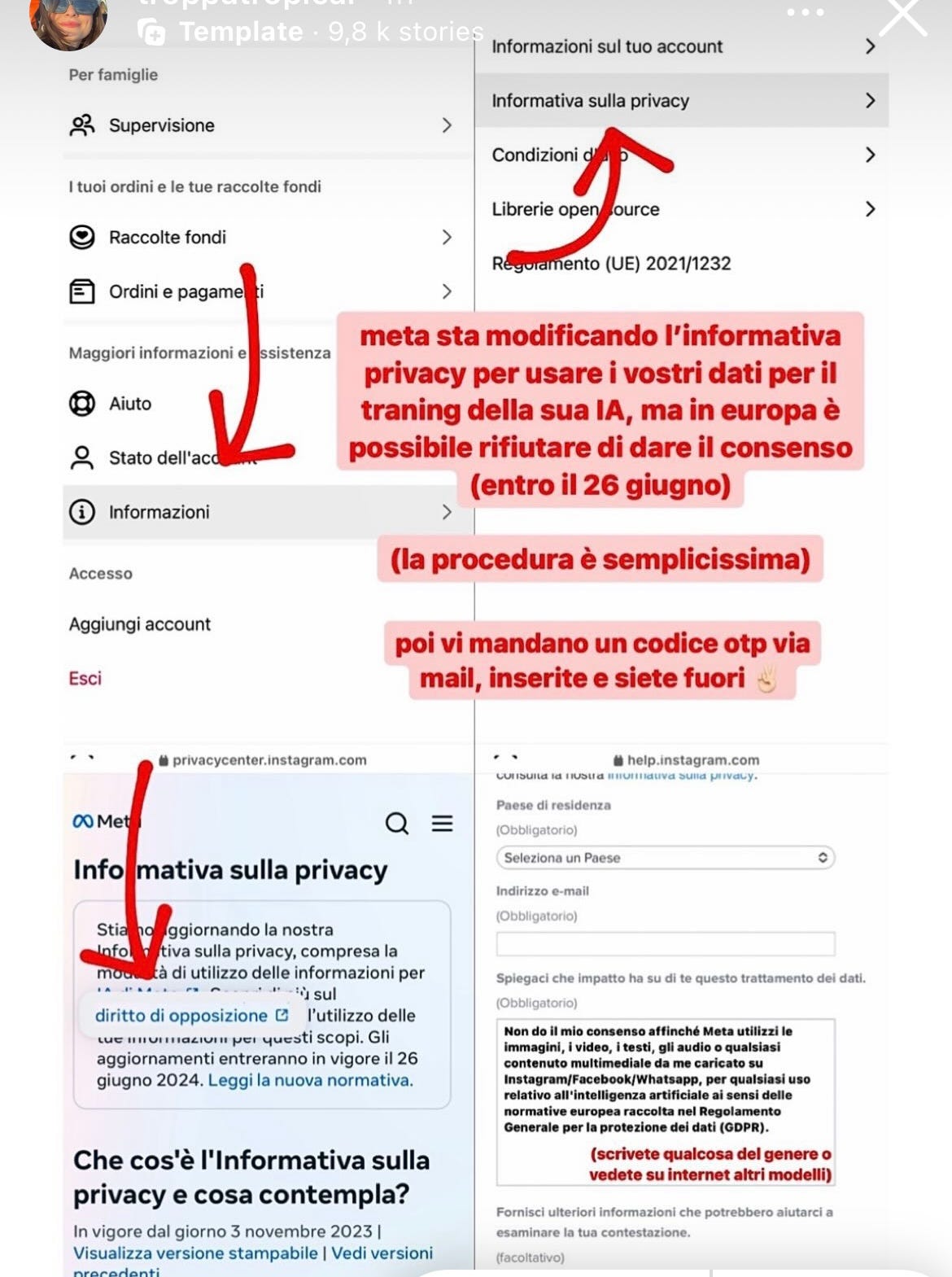 E no, non era una delle catene su Whatsapp che diventa a pagamento del 2012.
Anzi, era una utile guida per capire come impedire a Meta di utilizzare i nostri dati personali per addestrare le sue Intelligenze Artificiali. Dati che erano post, immagini, commenti, e storie degli utenti in UE e Regno Unito sia da Facebook che Instagram. Conversazioni private escluse, invece.
Questi dati sarebbero serviti a “riflettere le diverse lingue e riferimenti culturali, sociali e storici dei vari paesi europei” nelle IA di Meta, che sarebbero dovute arrivare tra pochi giorni. Una di queste era un assistente personale per ogni utente.
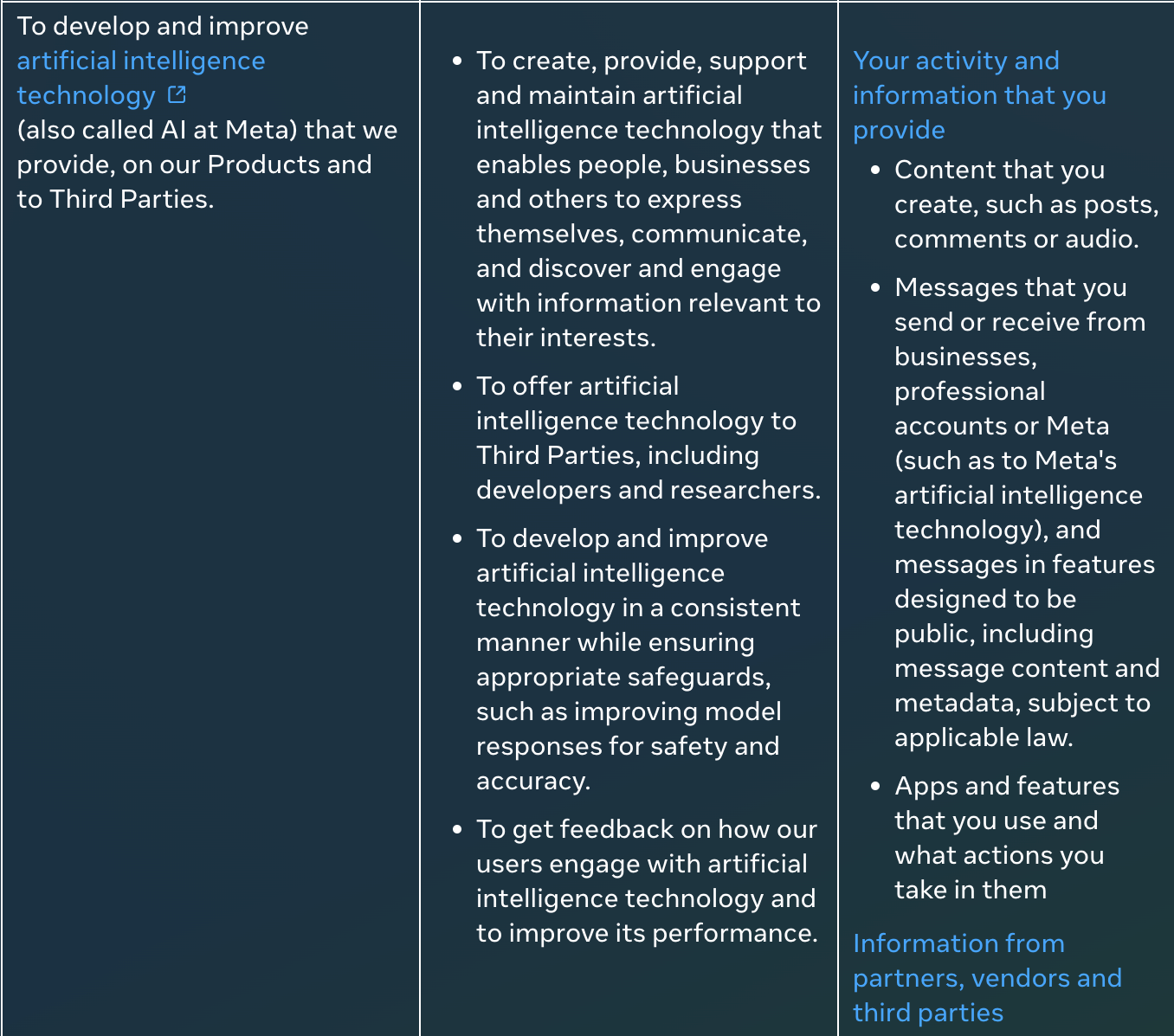 tutti i dettagli se ti interessano
Uso passato e condizionale perché, alla fine, Meta ha cambiato idea. Per il momento, mette in pausa l’utilizzo di questi dati e, di conseguenza, non arriveranno queste AI in UE e Regno Unito.
Meta si è detta “delusa” e che si tratta di “un passo indietro per l’innovazione europea, la competizione nello sviluppo dell’AI e i benefici dell’AI per gli europei”.
Framing, here we go, again.
------------------------------------------------------------------------
Quindi, sì, probabilmente aver condiviso quella storia e anche essersi districati nel non immediato modulo per negare il consenso all’utilizzo dei dati è stato, per ora, sostanzialmente inutile. Molto rumore per nulla, appunto.
Invece, più prezioso è stato il lavoro di NOYB, che il 6 giugno aveva inviato reclami a 11 autorità nazionali europee per la protezione dei dati. E sicuramente poi decisivi sono stati la Irish Data Protection Commission, l’autorità che in UE si occupa di Meta (e delle altre BigTech) in merito all’utilizzo dei nostri dati secondo il GDPR, e l’Information Commissioner’s Office, che ha compiti simili in Regno Unito.
Autorità che, infatti, sono menzionate da Meta nell’annuncio del cambio di posizione. In un comunicato uscito, tra l’altro, di venerdì pomeriggio, che non è sicuramente il momento migliore per dare rilevanza ad una notizia.
In questo caso, poco rumore per qualcosa di forse importante.
 Un megafono, forse muto. Creato con DALL-E
Comunque, anche se al momento questa vicenda è ferma, è uno spunto utile per capire diverse cose sull’AI e i nostri dati personali che, se è sbagliato concepire come il nuovo petrolio che alimenta l’IA, sono comunque tra i pilastri della rivoluzione che stiamo vivendo.
E allora questa Artifacts prima vede cosa ci “chiedeva” Meta e perché, poi cosa cambia ora che c’è l’AI per i nostri dati e infine perché in realtà potrebbe non cambiare niente o, comunque, questa potrebbe non essere una rivoluzione poi così nuova.
> ### La Storia
Innanzitutto, utilizzare dati personali in UE è illegale, di default. Perché sia permesso, infatti, serve una motivazione valida.
Nel concreto, qualsiasi azienda o terza parte raccolga e utilizzi dei dati personali, deve fare riferimento ad una delle giustificazioni elencate dall’art.6 del GDPR: consenso, legittimo interesse, necessità contrattuale, obbligo legale, vitale interesse, pubblico interesse.
Nel caso dell’addestramento delle IA, la questione è decisamente intricata, se non altro perché l’IA stessa non è MAI menzionata nel GDPR. Bisogna quindi riflettere sul GDPR e adattarlo.
Per l’accademia e lo European Data Protection Board (EDPB), le due basi considerabili per l’IA sono o il consenso o il legittimo interesse.
Il consenso prevederebbe che quelli che “producono” i dati, ossia i data subjects (noi), siano d’accordo che il data controller, Meta nel caso di sopra, li utilizzi per un certo scopo. Consenso che deve essere “dato liberamente, specifico e non ambiguo”, come spiegavo qui.
Nel caso dell’IA, però, il consenso a queste condizioni è molto difficile da ottenere perché gli utenti non necessariamente capiscono a pieno l’utilizzo dei dati, è molto difficile garantire totale trasparenza, e poi c’è una granularità molto alta dei dati stessi e quindi dei cittadini a cui chiedere.
Se il consenso, quindi, forse non è la base legale adatta al training dell’IA, lo è invece il legittimo interesse. Che, infatti, secondo l’EDPB “is probably the right one”.
3 condizioni da considerare sul legittimo interesse:
- che sia, appunto, legittimo, e quindi il data controller persegua scopi ragionevoli - fare il training;
- che ci sia una necessità per la quale è giustificabile l’utilizzo dei dati - no dati, no training;
- che sia bilanciato con i diritti e le libertà dei data subjects, considerando contesto, che dati sono utilizzati e l’impatto.
Condizioni, queste, più facili da rispettare rispetto a quelle del consenso per come funzionano i training delle IA. Anche perché, banalmente, il legittimo interesse può essere “presunto”, quindi non c’è bisogno di ottenere il “sì” dei data subjects.
Insomma, chi usa dati personali per il training delle IA sembra poter farlo perché ha un legittimo interesse.
Una prova ulteriore è che quando un anno fa il Garante Privacy fermava ChatGPT in Italia, riconosceva proprio il legittimo interesse come base plausibile per il trattamento dei dati.
E, se tutto questo rumore è stato per Meta, in realtà anche OpenAI, Twitter, Google, Snapchat dicono - dopo diversi scroll di mouse - di fare affidamento proprio sul legittimo interesse nelle loro Privacy policy. Anzi, almeno Meta è stata un po’ più chiara ed esplicita.
------------------------------------------------------------------------
Oltre alla base legale, però, questa vicenda è resa ancora più complicata da un altro fattore: in origine questi dati NON sono stati raccolti per il training delle IA.
Anzi, i dati in mano a Meta, Google, Twitter etc. sono stati raccolti nel corso degli anni per altri scopi, come ad esempio le pubblicità targetizzate. Però, con l’IA che ora è la priorità e i dati per addestrarla che sono preziosissimi, chiaramente chi ha dati a disposizione vuole usarli ANCHE per l’IA.
In gergo, si tratta di repurposing, ossia dare una nuova finalità a qualcosa che prima ne aveva una diversa.
Ed è un concetto chiave per il futuro del training dell’IA, che si affida prevalentemente su dati raccolti per scopi altri. Proviamo a capire come funziona.
Il GDPR stabilisce una purpose limitation, ossia che i dati sono raccolti per specifici ed espliciti scopi e non possono essere processati per scopi incompatibili con quelli originali.
Quindi? Va fatto un test di compatibilità per capire se il nuovo scopo - il training delle IA in questo caso - può reggere e se esista una base legale appropriata.
Per gli amanti dei bullet point, possiamo riassumere la liceità del repurposing in 2 condizioni:
- la nuova elaborazione dei dati è compatibile con quella originaria;
- esiste una base legale su cui fare affidamento, quella che secondo Meta e molti altri è il legittimo interesse.
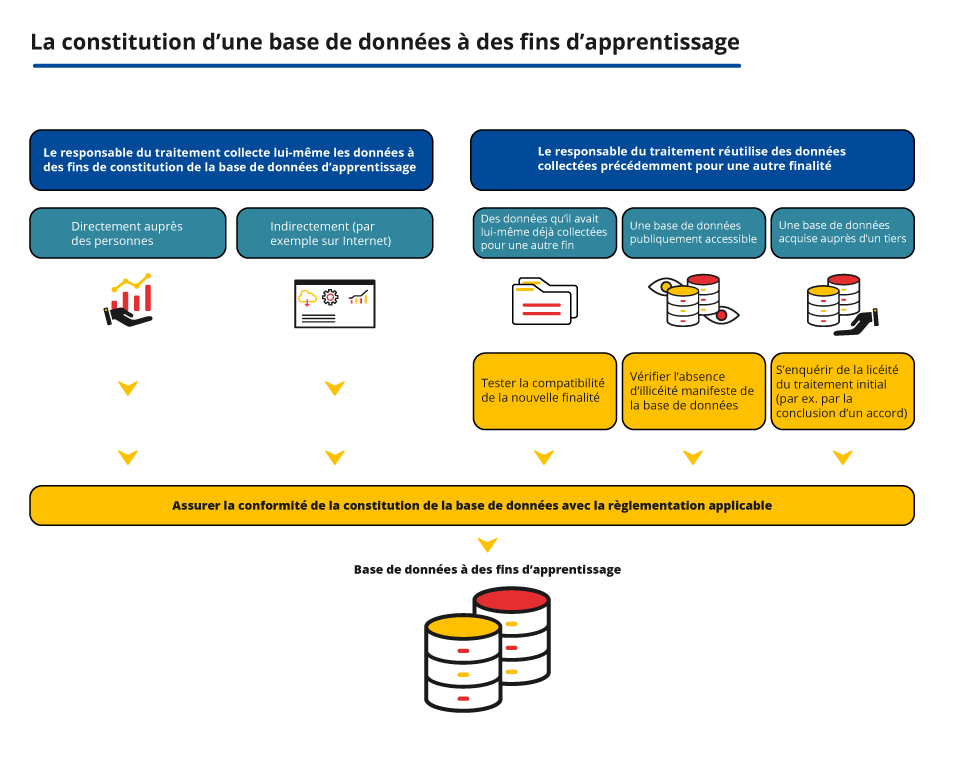 Nemmeno a dirlo, l’autorità per la protezione dei dati francese non ha tradotto questo schemino. Ma è ottimo, quindi lo riporto, e più info qui.
Questo, comunque semplificato, è quello che deve fare Meta o chi altro usa dei dati raccolti in passato per addestrare IA nel presente.
Qualora il repurposing sia possibile, tuttavia, rimane il right to object per i cittadini, che possono ovviamente opporsi all’uso dei loro dati personali. Ed è esattamente quello che Meta voleva permettere e il senso di quella storia Instagram da cui abbiamo iniziato.
------------------------------------------------------------------------
E, seppur ora magari questa vicenda specifica sia in pausa, tenere a mente queste regole è molto utile per i mesi che verranno.
Specialmente per le BigTech, per le quali i dati sono stati l’ingrediente essenziale del successo in passato, e rappresentano ora anche un vantaggio competitivo enorme per la corsa all’IA.
Una corsa nella quale non si riparte certo da zero, ma anzi chi ha dati, infrastrutture per processarli, risorse economiche, ed expertise, è già decisamente più avanti degli altri.
Tutte dinamiche per le quali, infatti, anche sull’IA a fare la voce grossa sono i soliti noti e, probabilmente, è anche difficile immaginare che vada diversamente.
Un vantaggio, sia chiaro, guadagnato e meritato nel tempo. Ma che, allo stesso tempo, non può tradursi nell’aggirare le regole sui dati personali.
Regole che abbiamo chiarito, ma ora bisogna vedere come va davvero la partita. Della quale, poi, forse abbiamo già avuto un assaggio.
> ### Save for Later
Perché il futuro digitale dell’Europa è meglio di quello che pensiamo.
C’è chi ha hackerato le elezioni europee, in positivo. Sembra sia andata bene sulla disinformazione, ma non benissimo.
Come invece l’estrema destra avrebbe utilizzato l’IA durante le europee.
Apple presenta la sua Apple Intelligence, che funziona perché è noiosa ma efficace. Un mio pensierino a riguardo:
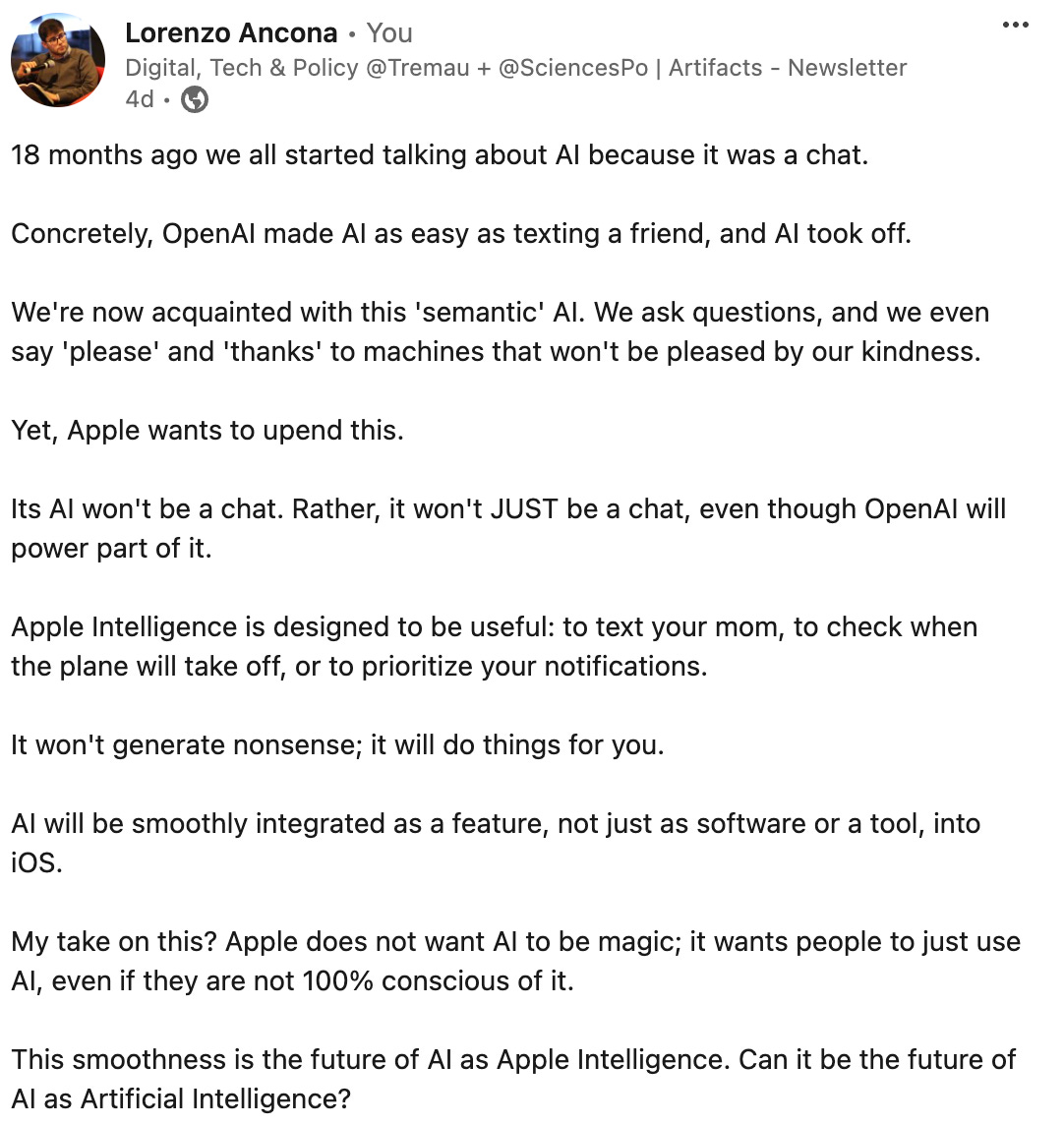 Come Google sta mandando all’aria Internet, dicono.
Tantissime cose utili da leggere su come funzionano gli algoritmi dei social.
Immanence, la startup di Diletta Huyskes sull’impatto sociale dell’Intelligenza Artificiale, cerca un Operations Manager.
 Sono stato al We Make Future a parlare di Artifacts, e di come la penso, la scrivo e la mando. Bella roba, insieme ad altri newsletterati.
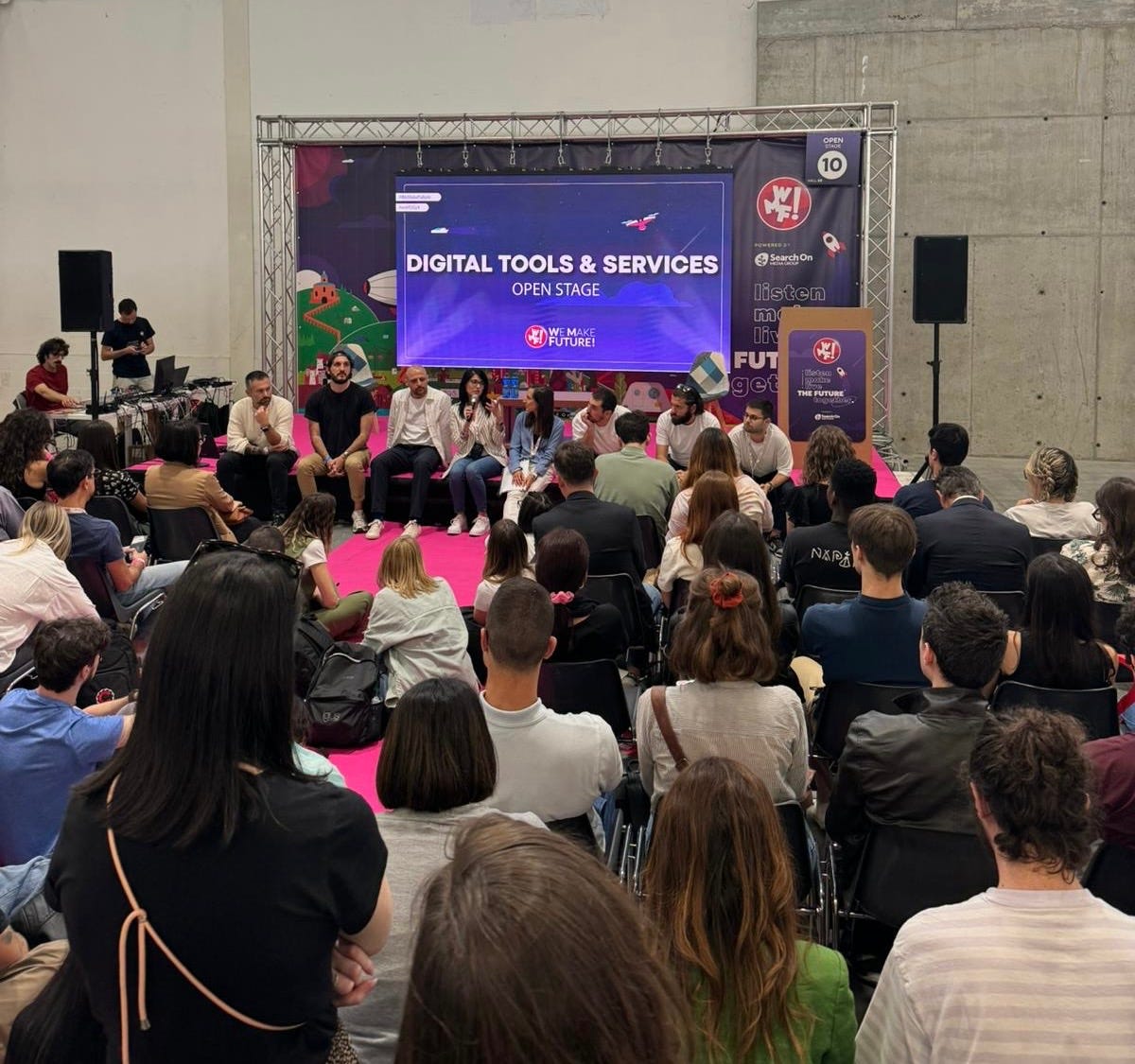 > ### Lo Scaffale
 Semplicemente uno dei miei libri preferiti sulla tecnologia. “Internet fatta a pezzi” di Stefano Quintarelli e Vittorio Bertola è una di quelle letture che non si possono non fare se si è interessati a Internet e le sue dinamiche politiche e economiche. Lo consiglio oggi perché sennò poi lo rimando sempre.
📚 Tutti, ma proprio tutti, i libri consigliati in Artifacts sono raccolti qui
> ### Nerding
 Per chi vuole tenere traccia dei propri pensieri in maniera ordinata, Diarium è fatta apposta. Conserva tutto in maniera crittografata, quindi è anche sicura e non rischi data leak dei tuoi pensieri.
======
# Partire dal(la) fine
Date: 2024-06-04 | Language: it
Canonical: https://artifactstech.substack.com/p/partire-dalla-fine
Cite as: Partire dal(la) fine by Lorenzo Ancona, Artifacts, 2024-06-04. https://artifactstech.substack.com/p/partire-dalla-fine (CC BY 4.0)
Tra giovedì e domenica circa 370 milioni di cittadini e cittadine europee avranno la possibilità di dare una direzione politica all’Unione Europea per i cinque anni avvenire. Come? Votando i propri rappresentanti al Parlamento europeo. In Italia, come saprai, le elezioni si terranno sabato e domenica.
Con il tuo voto contribuirai a scegliere le persone che saranno responsabili di discutere e adottare gli atti legislativi dell’UE e che eleggeranno il Presidente della nuova Commissione, l’organo esecutivo dell’UE, e ne sorveglieranno l’operato.
Con tutto quello che sta succedendo nel mondo - e non solo rispetto alla tecnologia - alimentare il progetto europeo è fondamentale. Prima di iniziare Artifacts, allora, ti invitiamo a trovare 10 minuti per andare alle urne e scegliere quale Europa vorresti vedere nei prossimi 5 anni.
------------------------------------------------------------------------
Quando si parla di partecipazione attiva, però, il voto è solo la punta dell’iceberg. Le democrazie hanno anche altri canali per ascoltare, in maniera più diffusa e permanente, le opinioni di cittadini e cittadine. Per l’UE, esperimento politico senza precedenti e per questo senza traiettoria definita, rimanere in costante ascolto dovrebbe essere ancora più rilevante, per cercare gli stimoli attraverso cui dare forma a questo progetto condiviso.
 Un iceberg, creato con DALL-E
Non stiamo certo cercando di sminuire la centralità del voto. Ma, se provi a immaginare la democrazia come un edificio, un gesto che fai ogni 3, 4, 5 anni ne può essere la pietra d'angolo, non l'intera struttura.
Per tenere in piedi questo fantomatico edificio sono utili anche mattoni e malta, ossia informarsi e provare a prendere parte a dinamiche nelle quali, in una maniera o in un'altra, poter dire la propria, pratiche che quelli bravi chiamerebbero di "democrazia partecipativa".
E quindi dibattiti organizzati per dare voce ed ascoltare i cittadini su temi specifici. Su Artifacts abbiamo visto, ad esempio, il caso di Taiwan o anche su come semplici cittadini insieme danno principi all'Intelligenza Artificiale.
Queste dinamiche sono recentemente cresciute in scala proprio grazie alla tecnologia. Se non altro perché ci permette di comunicare e scambiare idee all'istante con persone molto distanti da noi o addirittura in maniera asincrona. Esempio: nel 2011 Obama introduce "We The People", piattaforma che permetteva a chiunque negli USA di lanciare petizioni e portare certi temi all'attenzione della sua amministrazione. Oppure, a Parigi i cittadini hanno deciso online cosa fare di alcuni dei soldi pubblici destinati alla città.
Tuttavia, questi processi non accadono esclusivamente grazie alla tecnologia. Meglio, una piattaforma online di discussione può essere essenziale per facilitare la partecipazione, ma resta pur sempre un mezzo. Dunque, se un dibattito non accadrebbe senza tecnologia, deve prima essere ben pensato per invogliare i cittadini stessi a partecipare. Altrimenti alla tecnologia che lo abilita non si arriva nemmeno.
Può non essere un pensiero rivoluzionario, ma è cruciale per capire che un processo di democrazia partecipativa che non funziona bene non può essere risolto con un po' di internet e schermi touch, ma deve prima di tutto essere ripensato e aggiustato.
Insomma, pur sempre innovazione, ma democratica prima ancora che tecnologica.
------------------------------------------------------------------------
Nell'Artifacts di oggi, allora, proviamo a guardare a qualcuna di queste pratiche, provando a capire come innovare la democrazia. Ricordando poi che ruolo può avere la tecnologia e anche per la tecnologia, ma provando anche a capire da dove forse partire e come evitare altri iceberg, o scrutarne il sommerso.
Una Artifacts meno tecnologica, ma comunque innovativa.
> ### La Storia
Immagina di ricevere una chiamata, rispondere ed essere invitato a Bruxelles assieme a un centinaio di altre persone per discutere di spreco alimentare, efficienza energetica o metaverso… che fai? Se accettassi, saresti uno dei 150 partecipanti ai citizens’ panel dell’UE, l'iniziativa della Commissione europea “per una nuova fase di coinvolgimento dei cittadini”.
I panel sono la continuazione della Conferenza sul Futuro dell’Europa (CoFoE), uno dei più importanti esperimenti di democrazia partecipativa (transnazionale!) mai tentati, dai risultati discutibili e molto discussi. Svoltasi tra aprile 2021 e maggio 2022, la CoFoE si è articolata su più livelli: una piattaforma digitale multilingue, i panel europei e i panel nazionali.
Se la sua rilevanza è indubbia come esperimento unico per provare a dare forma al futuro dell’UE in modo partecipativo e paneuropeo, il suo impatto è difficile da misurare. Per esempio, alla piattaforma hanno contribuito attivamente 50.000 cittadini europei.
Tanti? Pochi? Difficile stabilire un criterio qualitativo per valutare la riuscita di una consultazione pubblica. Certo, se è vero che un numero elevato di interazioni tra cittadini non è di per sé garanzia di rappresentatività, è altrettanto vero che il coinvolgimento è stato piuttosto basso, se consideriamo che la platea di potenziali utenti attivi era di oltre 400 milioni di persone.
Tu ne avevi mai sentito parlare? Ecco, se la risposta è no, forse è stato questo uno dei più grandi fallimenti della CoFoE: non essere uscita dalla bolla delle persone interessate agli affari europei. L’altro è probabilmente lo scarso seguito che le istituzioni hanno dato alle 49 proposte elaborate dai cittadini e presentate nel report.
------------------------------------------------------------------------
Ma torniamo ai panel. Durante le sessioni, gruppi di partecipanti, selezionati casualmente e in maniera rappresentativa della popolazione europea, sono invitati a discutere un tema con l’obiettivo di formulare delle raccomandazioni alla Commissione europea.
Tra i temi trattati dai panel sin qui organizzati, tra l’altro, c’è anche l’Intelligenza Artificiale. In un panel che ha visto coinvolti 60 cittadini belgi, estratti a caso, tra febbraio e aprile 2024. E che hanno portato la loro visione, non necessariamente da esperti, su come l’IA stia toccando le loro vite e quello che pensano sul futuro. E quindi impatto su disinformazione, ambiente, lavoro, diritti umani e altri temi magari utili che trovi qui.
Un esempio, questo, di provare a democratizzare la riflessione collettiva sull’IA, facendo emergere le visioni, i timori, e magari le idee di chi nella vita si occupa di altro, ma che comunque incontra l’IA.
------------------------------------------------------------------------
Tuttavia, se lo erano le elezioni, forse anche i panel o la CoFoE possono essere considerati delle punte di un iceberg.
Spieghiamoci meglio: spesso la partecipazione o anche solo l’attenzione a pratiche come i panel riguardano le persone già interessate, e difficilmente va oltre. Su questo, quindi, la selezione randomica aiuta molto.
Esiste, però, un rischio di open-washing: organizzare processi partecipativi per il puro scopo di farlo e non per quello che dovrebbe essere il vero scopo, ossia coinvolgere i cittadini.
Ed un ragionamento simile vale per il tech-washing, ossia l’illusione di poter fare engagement dei cittadini semplicemente perché partecipare diventa più facile, o magari simile alle interazioni che abbiamo sui social media.
Insomma, non basta dire “partecipate” o “la facciamo digitale” per rendere la democrazia più attrattiva o interessante.
------------------------------------------------------------------------
Forse dovremmo partire da più lontano, spiegando perché è importante partecipare, in che modo la nostra voce può cambiare le cose. Nel caso dell’Unione Europea questo è ancora più difficile, perché la sfera sovranazionale è già complessa di suo e l’architettura istituzionale non semplifica le cose. Questo non vuol dire farsi intimidire, ma raddoppiare gli sforzi.
Insistere su informazione ed educazione è sicuramente più difficile di organizzare qualche panel all’anno. Tuttavia, vale la pena provare andare sotto la superficie dell’acqua e fare i conti con l’intero blocco di ghiaccio galleggiante.
Perché se capiamo che l’UE ci importa saremo più disposti a rispondere sì alla famosa chiamata della Commissione che ci invita a un panel, o saremo addirittura noi a organizzarne uno nel nostro quartiere, nel nostro comune.
E allora? Ripartiamo dal fine: se vogliamo coinvolgere i cittadini, diamo loro gli strumenti per potersi sentire parte di quell’edificio comune che è la democrazia. Ripartiamo dalla fine: delapiti i panel e la democrazia partecipativa, prepariamo il percorso che porta a renderli efficaci.
Leave a comment
> ### Save for Later
Ho fatto un librettino sulla ultima Artifacts! Lo scarichi da qui
The Atlantic, probabilmente mia rivista preferita, è una delle tante a fare un accordo con OpenAI. Il suo CEO ha spiegato perché, benissimo.
Ma che abbiamo capito come funziona Google? No, ma ne sappiamo un po’ di più.
Influencers russi finti vanno virali in Cina. E perché preoccuparsene. Mentre OpenAI dice che i suoi tool vengono usati per influenzare gli elettori.
Insomma, se vuoi capire tutto quello che succede tra GenAI e elezioni, Wired ha fatto un lavorone.
E poi un’opinione secondo me condivisibile su Elon Musk.
Ho visto questo commento interessante:
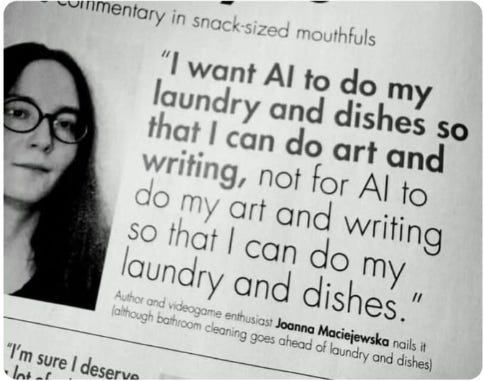 > ### Lo Scaffale
 A proposito di educare alla partecipazione attiva, Alberto Alemanno lo fa egregiamente nel suo Lobbying for change. Un libro per conoscere nuovi modi in cui possiamo far sentire la nostra voce e per capire che non tutto il lobbying vien per nuocere.
📚 Tutti, ma proprio tutti, i libri consigliati in Artifacts sono raccolti qui
> ### Nerding
 Dato che negli ultimi giorni ho dovuto montare diversi video, ho pensato che CapCut è uno di quei tool tanto semplici quanto necessari. Serve, indovina indovina, proprio a montare video. Ed è strasemplice, mette i sottotitoli, comoda da usare. Must-have sul cellulare.
======
# Anche queste sono piattaforme
Date: 2024-05-28 | Language: en
Canonical: https://artifactstech.substack.com/p/anche-queste-sono-piattaforme
Cite as: Anche queste sono piattaforme by Lorenzo Ancona, Artifacts, 2024-05-28. https://artifactstech.substack.com/p/anche-queste-sono-piattaforme (CC BY 4.0)
In Artifacts ne parlo da un mesetto: 8 e 9 giugno si vota per le elezioni europee.
Non credo nessuno si senta di negare che - fatti salvi alcuni progetti - la campagna elettorale è stata a tratti assente o scadente, finora.
Allora, la Artifacts di oggi vuole essere di pubblica utilità.
E se di solito quando parliamo di piattaforme ci riferiamo alle BigTech, oggi parliamo di “platforms” diverse, ossia i programmi dei partiti europei. Che, appunto, nella lingua di Shakespeare si chiamano anche “platforms”.
E così ho letto tutti i programmi dei partiti europei e ho riportato qui le loro misure, idee, proposte, ambizioni, su tecnologia e digitale.
Perché i partiti europei e non quelli nazionali? Perché è così che andrebbero guardate queste elezioni, e a maggior ragione sulle politiche digitali.
Magari questa Artifacts ti aiuta a capire chi votare :)
 Un fake fac-simile, ma rende l’idea. Creato con DALL-E
------------------------------------------------------------------------
I partiti europei dei quali ho analizzato i manifesti, con rispettivi partiti italiani, sono: 🔵 European People’s Party (Forza Italia), 🔴 Socialists & Democrats (Partito Democratico), 🟡 Renew Europe, (Azione, +Europa, Italia Viva (che hanno la brillante idea però di correre separati in Italia)), 🔷️ European Conservative Party (Fratelli d’Italia), 🟢 Greens (Verdi), 🟣 Left (Rifondazione Comunista). Purtroppo Identity & Democracy, il partito a cui appartiene la Lega, non ha un manifesto da analizzare.
In brevissimo, così è come ho fatto l’analisi:
- Ho letto velocemente tutti i manifesti e ho identificato le macro-categorie di policy: Intelligenza Artificiale, Data Governance e Privacy, Lotta alla disinformazione, Online Safety, Ricerca, Innovazione e Investimenti in Tecnologia, Concorrenza e Mercato Unico per il Digitale, Digital Freedoms e Diritti Umani; ce n’erano altre ma poi diventava un papiro
- Ho caricato, uno ad uno, i manifesti su Claude 3 Opus, uno dei modelli di IA Generativa più potenti, con questo prompt:
 Se capiti a Roma, giovedì in Senato c’è questo bel evento organizzato da Hermes, Privacy Network e The Good Lobby su IA, diritti umani, e come la pensa la società civile. Per iscriversi basta scrivere a laura.ferrari@thegoodlobby.it
> ### Lo Scaffale
 Se è vero che le regole dell’UE influenzano il resto del globo, forse è bene conoscerle, come abbiamo provato a fare oggi. O almeno così sostiene Anu Bradford nel suo “The Brussels Effect”, che è proprio un must-read per chi fa cose europee.
📚 Tutti, ma proprio tutti, i libri consigliati in Artifacts sono raccolti qui
> ### Nerding
 Se hai tantissime cose da fare, ecco UseClear ti aiuta quantomeno ad organizzarle e lo fa con un design semplicissimo ma direi efficace. L’ho usata e funziona bene se hai tante task su un progetto singolo.
======
# Mica è illegale essere stupidi
Date: 2024-05-21 | Language: it
Canonical: https://artifactstech.substack.com/p/mica-e-illegale-essere-stupidi
Cite as: Mica è illegale essere stupidi by Lorenzo Ancona, Artifacts, 2024-05-21. https://artifactstech.substack.com/p/mica-e-illegale-essere-stupidi (CC BY 4.0)
Con le elezioni europee sempre più vicine, le homepage dei siti che piacciono a chi gradisce i temi di Artifacts e i report di certi think tank (ri)tornano a parlare di una questione sempreverde:
la disinformazione online.
Che è abbastanza rilevante in un periodo nel quale i cittadini decidono (o confermano) a chi dare il loro voto.
Ursula Von der Leyen, che vorrebbe continuare a fare il lavoro che fa ora, vorrebbe una nuova legge per contrastare le campagne di disinformazione che arrivano da Russia e Cina. Dovrebbe chiamarsi “Europe Democracy Shield”, e farebbe squadra con DSA e AI Act.
Josep Borrell, Alto rappresentante dell’UE per la politica estera, qualche mese fa diceva “unchecked, malicious content spreads like a cancer and puts the health of our democracies at risk”. Anche lui additando la Russia come prima responsabile.
E sì, le campagne di disinformazione che arrivano da paesi extra-UE sono e sono state una minaccia importante. Ma sono solo un pezzo di un puzzle decisamente più complesso.
Proviamo a scomporlo (o a comporlo, come preferisci).
------------------------------------------------------------------------
Mark Scott, uno tra i giornalisti più autorevoli sul tech in UE, sostiene che troppa attenzione alla Russia dia l’impressione di un’influenza maggiore a quella che realmente esercita. Ma, soprattutto, ignora che molta della disinformazione che circola in UE è anche confezionata in casa nostra.
E c’è di più. Spesso pensiamo alla disinformazione come mera circolazione di notizie manifestamente false, tipo che i vaccini farebbero morire o che tutti gli omicidi li fanno gli immigrati. La realtà è, come accade spesso, più sfumata.
La disinformazione può essere nel modo di porre i fatti, il cosiddetto framing, ad esempio scrivere “Ormai i cuochi delle nostre città sono tutti stranieri”. Come se fosse necessariamente un problema.
Ma può anche essere ingigantire certe notizie vere, come invadere i feed con un preciso evento selezionato per fare scalpore. Tipo che i soldati ucraini avrebbero compiuto un crimine efferato, come fosse un incidente isolato e che non riguarda l’altra parte dello schieramento.
E disinformazione può pure essere collegare due storie vere ma senza nessun legame. Il tradizionale correlation is not causation, tipo questo qui:
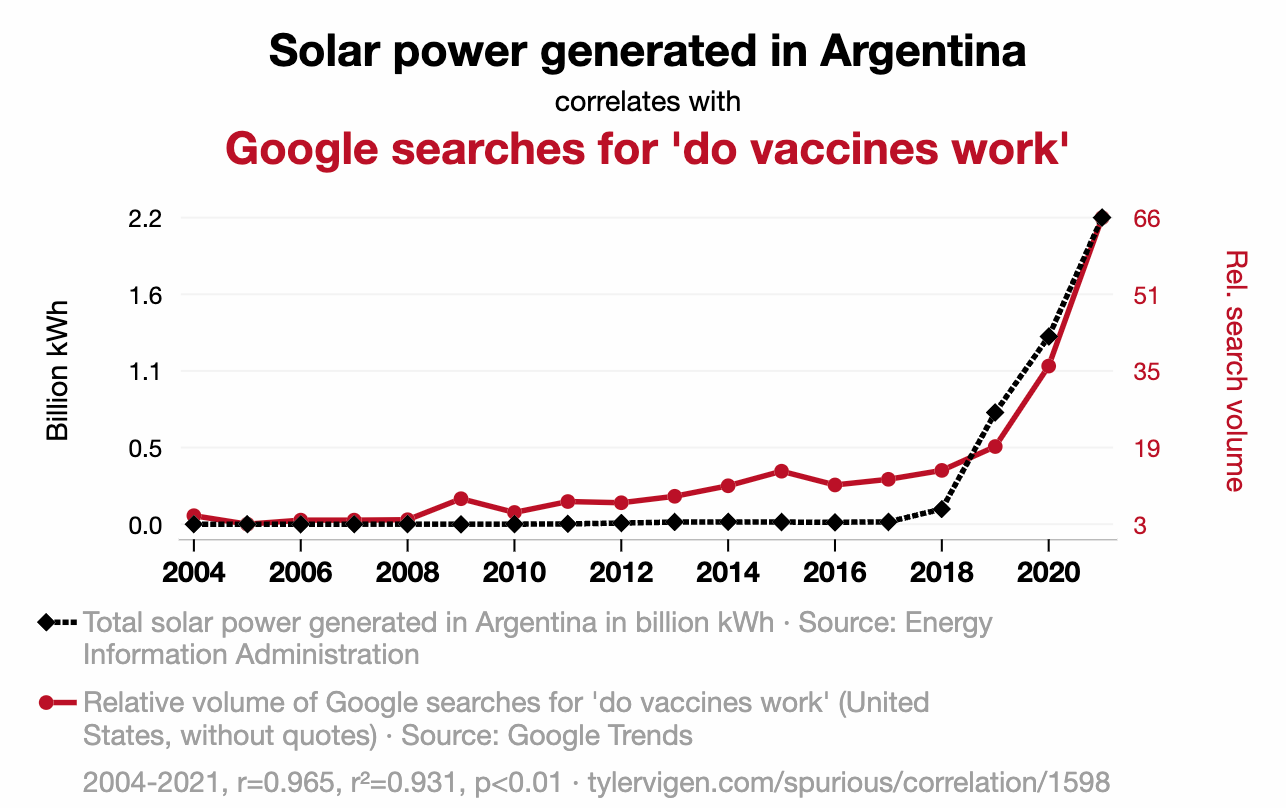 Se non lo conosci, visita subito questo sito GENIALE sulle correlazioni spurie
Insomma, non è immediato definire cosa sia la disinformazione, e questo è decisamente problematico se vogliamo metterle un freno.
Due notizie ugualmente false sono ugualmente pericolose? Una notizia di Lercio va considerata disinformazione come una fake news fatta circolare da un sito affiliato alla Russia? Con quale criterio giudichiamo? La pericolosità, o forse lo scopo, o l’impatto? Tutte domande davvero delicate.
------------------------------------------------------------------------
Forse, lo stesso tentativo di definire un concetto elusivo come la disinformazione è pericoloso o addirittura inutile perché troppo discrezionale. O almeno così sostiene lo Special Rapporteur per la libertà di espressione delle Nazioni Unite.
E non è nemmeno chiaro chi dovrebbe definire cosa sia disinformazione. I governi? Pericolo di derive autoritarie. Le piattaforme? Non chiaro su che basi. Fact-checkers? Da chiarire gli incentivi. Complicato.
Comunque, il cuore di questa vicenda è che la disinformazione non è illegale. È vero che in essa c’è la pericolosa intenzione di ingannare, ma renderla illegale significa limitare la libertà di esprimere delle opinioni (anche fondate su fatti non veri), che è alla base dei sistemi liberali.
Per questo, è estremamente pericoloso rimuovere tout court certi post, ma è possibile trovare delle contromisure, come limitarne la circolazione sulle piattaforme, aggiungere delle etichette o fornire maggior contesto all’utente.
Anche qui, però, resta un paradosso, un dilemma sottile ma essenziale: qualsiasi azione o decisione che, in qualche misura, limita la possibilità di dire o far circolare una certa informazione o opinione impatta il diritto alla libertà di espressione.
A questa cosa bisogna stare molto attenti, in UE abbiamo gli strumenti per farlo, ma è anche prioritario non oltrepassare una certa linea rossa. Di questo e altro, se ne ragiona in questa Artifacts.
 Eccezionalmente per oggi basta bianco e nero. Comunque disegnata con DALL-E
> ### La Storia
Una prima pietra miliare della lotta contro la disinformazione è il “Code of practice of disinformation”, pubblicato nel 2018 per le elezioni europee dell’anno successivo. Nel 2022, poi, è stato aggiornato e rafforzato guadagnando maggiore credito con vari nuovi firmatari.
In quanto Code of Practice, non aveva (e non ha tuttora) forza di legge, ma allinea le piattaforme su strategie per ridurre la disinformazione. Chiaramente, per le piattaforme non è obbligatorio sottoscriverlo, ma si può dire che sia caldamente consigliato. Ad oggi, tra le maggiori piattaforme, solo X non lo sottoscrive o, meglio, ha smesso di farlo dopo l’arrivo di Elon Musk.
Prima o poi i principi che elenca dovrebbero entrare a far parte del Digital Services Act (DSA), ma ancora da capire come.
------------------------------------------------------------------------
Ecco, qui bisogna fermarsi e chiarire dei punti chiave sul DSA.
Diversamente da quanto sostengono individui che fanno disinformazione, il DSA in nessun modo vuole essere un Ministero della Verità Orwelliano o allineare i cittadini al fantomatico politicamente corretto. Piuttosto, come abbiamo già visto, l’obiettivo è far sì che ciò che è illegale offline secondo le leggi nazionali dei paesi membri lo sia anche online.
Di conseguenza, dato che - lo ripetiamo - la disinformazione non è illegale, non è il focus primario del DSA. Tant’è che nel regolamento viene menzionata solo nei consideranda e comunque mai definita, diversamente dai contenuti illegali.
Se fossero gli appunti di una lezione, scriverei che c’è una differenza chiara tra i contenuti illegali, come video di abusi sessuali, e quelli pericolosi, come la disinformazione.
Tuttavia, non solo le malelingue ma anche la Commissione e alcuni suoi rappresentanti a volte si lasciano scappare eccesivamente la parola “disinformation” quando si parla di DSA. Un caso abbastanza palese è quello delle recenti linee guida per le piattaforme in vista delle elezioni, dove si parla più volte di disinformazione, tra l’altro senza darne una definizione.
------------------------------------------------------------------------
Attenzione: non sto certo denunciando una deriva autoritaria, ma segnalando una tendenza che esula da quello che dovrebbe essere il compito del DSA e un principio chiave per l’enforcement del regolamento.
Su questo mi faccio aiutare da Martin Husovec, uno degli accademici migliori su DSA, che ha scritto un paper brillante a riguardo: “The Digital Services Act’s Red Line: What the Commission Can and Cannot Do About Disinformation”.
Dato che il DSA contiene solo le regole su come contrastare qualcosa di illegale, ma non su cosa sia illegale, la Commissione si rifà alle leggi nazionali e le applica ai servizi digitali. In tal senso, ha 2 vincoli essenziali:
1. quello del principio di legalità (Articolo 49 della Carta dei diritti fondamentali dell’UE), per cui si può essere condannati solo se ciò che si commette o omette è illegale;
2. e quello per cui il DSA non contiene regole sulla natura dei contenuti.
Di conseguenza, sono giustificate le azioni solo sui contenuti illegali, e non sulla disinformazione, che illegale non è. Dunque, c’è una linea rossa che la Commissione non deve oltrepassare quando chiede di agire sui contenuti presenti sulle piattaforme.
Se, infatti, ha a che fare con rischi posti da contenuti illegali, allora può serenamente chiedere di intervenire. Al contrario, nel caso di rischi posti da contenuti legali, come è spesso il caso per la disinformazione, allora dovrebbe evitare di chiedere di intervenire.
 Tabella per la tua prossima storia Instagram sul Digital Services Act
Lo so, può suonare strano, ma la legge è l’unico vincolo solido per evitare qualsiasi rischio di censura o limitazione della libertà di espressione.
------------------------------------------------------------------------
A questo punto, allora, potrebbe sembrare che le “armi” che abbiamo contro la disinformazione siano spuntate o inutili. Ma non è proprio così.
O meglio, se la Commissione o magari gli stati singoli possono fare poco, molto può invece essere fatto dalle piattaforme e dalla loro volontà di rendere le arene digitali più sicure e meno inquinate con disinformazione.
Si tratta di tutte decisioni volontarie, come verificare gli account di personalità istituzionali, cooperare con fact-checkers per etichettare notizie che potrebbero non essere vere, o magari controllare il contenuto di contenuti politici sponsorizzati. Soluzioni che, ad esempio, sono suggerite nel Code of practice of disinformation.
 Tipo questo succedeva alle scorse elezioni americane su Facebook
Ed è vero che queste misure hanno un impatto sulla libertà di espressione, ma le piattaforme hanno meno vincoli e, in quanto spazi privati, più margine di azione. È il motivo per cui non possiamo troppo lamentarci se Meta decide che su Instagram vedremo meno politica.
Portato questo ragionamento agli estremi, se una piattaforma decide che non si può più parlare di - butto a caso - ciambelle, è una legittima scelta di uno spazio digitale comunque privato.
È ovvio che da questo discendono diversi rischi. Però, per il tema di oggi, deriva anche l’opportunità per cui la lotta alla disinformazione passa anche e soprattutto dalla volontà delle piattaforme di mitigare i rischi che ne derivano.
Può piacere o no. Forse è anche preoccupante per certi versi. Ma rende chiaro che cooperare con le piattaforme è la mossa forse più scaltra ed efficace. Ed è, direi, anche in pieno spirito del DSA.
Storia incredibilmente intricata, quindi voglio sentire la tua:
Leave a comment
> ### Save for later
Il nuovo nome di questa sezione è dovuto al fatto che questi sono i classici contenuti che ti salvi per dopo e non riprenderai mai. Ma magari no, eh!
Ma quindi Google sta per rompere il web con l’AI? Non si dica che Artifacts non ne aveva parlato
Qual è il modello di AI più forte? Non lo so, dipende. Ma puoi farli sfidare con questo tool carinissimo.
TikTok cambia spesso idea su cosa consiglia nella guerra tra Israele e Palestina.
Online è pieno di cose finte, quindi questo podcast può essere utile:
\[How to Know Who’s Real\]
Ogni giorno interagiamo con il design di applicazioni, sistemi e altri artefatti con tanti piccoli dettagli che magari non notiamo. Con questo comincerai a notarli.
Aware, che è un think tank amico di Artifacts, cerca un Research Fellow su Digital & ICT, su temi come AI, semiconduttori, space economy etc. Consiglio vivamente di mandare application se interessati :)
 > ### Lo Scaffale
 Lo sto leggendo ora e quasi finito. “Merchants of truth” racconta le storie parallele di 5 media, più o meno nuovi, e di come si sono inventati o reinventati con Internet. Da leggere, specie se hai più di 30 anni, perché potresti aver visto quelle cose succedere.
📚 Tutti, ma proprio tutti, i libri consigliati in Artifacts sono raccolti qui
> ### Nerding
 È arrivato quel periodo dell’anno in cui ti chiedono cosa fai questa estate. Ecco, AskLayla può aiutarti a rispondere: è un chatbot per organizzare vacanze. L’ho usato: direi preciso, forse a volte non trova proprio le offertone. Ma un’occhiata la merita
======
# Among Centaurs and Titans
Date: 2024-05-14 | Language: en
Canonical: https://artifactstech.substack.com/p/among-centaurs-and-titans
Cite as: Among Centaurs and Titans by Lorenzo Ancona, Artifacts, 2024-05-14. https://artifactstech.substack.com/p/among-centaurs-and-titans (CC BY 4.0)
Migration has been a priority for Europe since 2016. However, the ongoing crisis and geopolitical tensions require more than just traditional tactics.
Recently, the EU Parliament voted to expand Eurodac, turning it from a fingerprints database into a wide biometric database, and introduced a new Migration Pact to strengthen border security. MEP Jorge Villalba, who worked on it, deems the regulation necessary and unfairly vilified, while the NGO AccessNow is afraid Eurodac may entail dangerous mass surveillance for migrants and asylum seekers.
In the meantime, with the AI Act being finalised, European Digital Rights (EDRi) warns that it may fall short of setting acceptable standards for human rights protection, notably for migrants.
You've heard this before, but it's worth repeating: technology always comes with values attached, and that can have a big impact on society. Today's story is just one more piece of evidence for this.
------------------------------------------------------------------------
Greece is the setting. Homo Digitalis, a Greek NGO founded in 2018 to protect human rights in the digital space, is the main character.
In the summer of 2021, while researching on the Greece’s White Book on Digital Transformation, the state’s strategy for the period 2020-2025, Homo Digitalis’ team stumbled upon some…peculiar and sizeable investments (20 millions overall) to strengthen migration and border management in the Aegean Islands, hosting the largest migration hotspots in Greece.
They found two systems, graced with fancy mythological names, Kentavros and Hyperion, which raised concerns:
- According to EDRi, KENTAUROS is a surveillance system deployed in reception and accommodation facilities for asylum seekers. It uses cameras, drones, and AI behavioural algorithms to manage digital and physical security. Reportedly, the video feedback to the algorithms is instantaneous, meaning that the biometric processing falls under the category of real-time surveillance, which is prohibited under the AI Act without special licences and impact assessments.
- HYPERION is an asylum seeker management system that controls the access to the facilities through biometric identification of fingerprints, tracks services used by the asylum seeker, and provides a mobile app for asylum requests.
Right away, Homo Digitalis and EDRi initiated research on these systems. The outcome? More questions than answers.
------------------------------------------------------------------------
As a consequence, Homo Digitalis addressed a letter asking for information to the Greek Ministry of Migration and Asylum (MMA) on October 2021. They wanted to know more about personal data impact assessments of the two systems and the legal basis, goals and use parameters on the KENTAUROS system.
This open letter was never answered. Following that, Homo Digitalis worked tirelessly on a European and national level, alongside other NGOs and Agencies to promote the matter further. With the support of the LIBE Committee and the UNCHR Representative in Greece, they filed an official complaint to the Greek Data Protection Authority asking to scrutinise the systems and request the justification of these investments as well as their legal basis.
The Greek DPA acted swiftly. In February of 2022, they officially launched the investigation. Two years later, in April 2024, they imposed a fine of €175,000 on the MMA and ordered the MMA to fulfil its obligations as a data controller under GDPR within a 3-month timeframe.
We interviewed Ms Niovi Vavoula, an associate law professor at Luxembourg University specialising in the intersection of Migration and Technology. She described the decision as “excellent, we couldn’t be happier about it”, but she also remarked that the process “took 2 years to go through and this is a lot for a single case.”
 This can be a wave or an eye. Either way, it’s generated with DALL-E
Ok, you may be asking: “why should I care about Greece?”. Despite migration being a key policy issue, many would rather not hear about the infringements of asylum seekers rights, let alone privacy and data rights (which, by the way, are often considered as bourgeois rights). However as dr. Vavoula clarified: “Data rights and the legal system behind them have teeth. They’re a checklist of easily verifiable obligations and that makes them way more actionable to protect than other fundamental rights, like privacy in general or the right to an effective remedy.”
Have we piqued your interest? Well, then keep reading. Relying on an impressive and thorough research conducted by Stavrina Houssou, MPP in Public Policy and New Technology at Sciences Po and AI Policy Analyst, this Artifacts will dig deeper into this story and, eventually, persuade you why a Greek surveillance system is something we should all be concerned about.
> ### The Story
Given the amount of information we gathered, this Artifacts will be (1) slightly longer and (2) divided into sub-paragraphs to ensure clarity. Let’s start!
> #### Expensive tech investments lacking strategic thought and legal basis
What purpose do those sizeable investments serve? “Unfortunately, I don’t think they serve a purpose”, says Eleftherios Cheilioudakis, lawyer and co-founder of Homo Digitalis. He adds that Greece’s deep economic crisis deterred the state from big digital investments. “It wouldn’t be acceptable to have public employees unpaid, while millions are spent on drones at the borders. But this has changed: the narrative of economic rejuvenation and digitalisation in Greece has opened up the state to increasing digital investments, not necessarily critically made”, he argues.
This context leads to a fruitful environment for high economic intensity experimental investments. He clarifies that: “The adoption of such technologies testifies the rise of a business landscape interlinked with border management and state security which receives substantial EU funding, mostly by the EU Commission. Private actors develop technologies that are neither necessary nor constructive in satisfying the end goal of protecting asylum seekers, examining their applications effectively or granting asylum status. Yet, these firms are well endowed in Brussels, co-affecting the security agenda.”
More troubling is the system’s lack of transparency. Dr Vavoula says: “The securitisation approach of the Greek government often expands to the broader EU approach to migration. These systems were deployed at least partly with EU funds and we've seen that trend booming with more than 50 EU-funded tech and AI projects for migration in recent years, often involving emotion recognition tools”. The lack of scientific evidence for the efficiency and validity of AI tools for emotion recognition is affirmed in the current version of the AI Act.
This raises the question: if security is the reason for using intrusive technology, why is it being deployed in secret and without following legal procedures?
> #### A tech testing ground on the vulnerable
For years, migrants and other vulnerable groups have been subjected to practices deviating from acceptable legal and social norms. Yet, once a line is crossed it is easier to be crossed again. Once rules for the stateless become wiggly, they can soon become so for citizens. “If technologies are developed and bought, and the legal frameworks to use them exist, it’s easy to expand their use gradually. If an intrusive tool fulfils a narrative of security today, tomorrow it can be used in airports for Schengen flights” says Mr. Cheilioudakis. (Something similar has just happened in Italy, btw).
Dr. Vavoula claims that we see similar surveillance tools being used by states first on their Nationals and then on EU Nationals, including biometric systems introduced during COVID. “Therefore, thinking that this case does not concern EU citizens more broadly, is a bit naive. It’s likely that the more these technologies are tested in the future, the more they become a given and, eventually, the more individuals get accustomed to their imposition”, she adds.
> #### A disregard for the rule of law
Is there a reason why this happened in Greece and not somewhere else? Yes, and it is highly tied to the migration problem, which is marked by the limited capacity of reception centres and geographically challenging borders.
Technological support to mitigate such problems could be very relevant if done lawfully. This would mean following predetermined requirements such as explaining the legal basis for employing such systems and conducting impact assessments beforehand. However, the Greek MMA did not follow any of the above.
“There is a techno-solutionist approach and it is however not accompanied by a clear understanding of the potential effects on fundamental rights. Everything goes towards efficiency and modernisation”, dr. Vavoula remarks.
But this case implies a larger political and institutional context. When we asked dr. Vavoula about her assessment on the future of the DPA’s decision, she told us: “It's unclear if the Ministry intends to comply meaningfully. The resistance to this investigation and the efforts to justify their choices is distressing. Saying that the impact assessment would be done ex-post, and not ex-ante, just makes no sense. At the very least, you'd expect a legal basis for deploying these systems. In this case, the systems are deployed without a DPO, which is astonishing given the processing of personal data involved. All these show a clear lack of data protection culture.”
Mr. Cheilioudakis deems such lack of knowledge endemic in Greek political circles: “New Democracy (right-wing) implemented two systems for migration management, while SYRIZA (left-wing) commissioned the smart police initiative which uses devices to transmit biometric data of stopped individuals to the Greek police database (HELLAS). There is a European push for such initiatives. Additionally, as politicians in Greece do not seem savvy enough in tech matters, our efforts in addressing issues through Parliament have mostly fallen on deaf ears.”
Sadly, this is reflected not only in the lack of accountability for the Ministry’s violations but in the government actions to support the mechanisms responsible for data protection. Here Data Protection Authorities (DPA), the responsible national authorities for data protection and the enforcement of the GDPR in EU member states, are key. Incidentally, DPAs are also likely to become the EU AI Act’s enforcement authorities on the national level.
However, the GDPR enforcement has not been particularly optimistic, with several pitfalls, including uneven enforcement from the national DPAs due to diverse capacities and support from governments. The Greek DPA is a case in point: it has a 50-person personnel, despite organic positions for 75, and a reduced budget of 2.200 million.
All in all, intrusive and all-encompassing technologies are a recipe for fundamental rights infringement when not accompanied by protections, constraints and clear allocation of responsibilities – no matter their use case and scope.
Advanced tech will not produce dystopias overnight. But perhaps subtle, covert, unlawful uses of such technologies will render such results overtime if given enough space and not enough scrutiny.
Many thanks to mr. Cheilioudakis and dr. Vavoula for their insightful contributions
Leave a comment
> ### In The Media
There’s been a lot (too much) of conversation around this ad from Apple:
\[Embedded media — view original\]
Harsh criticism can be read here.
ChatGPT can now speak, see, listen, and be your personal assistant. Mind-blowing.
How Russia, China and other non-democratic countries are threatening the information ecosystem. It’s more about downplaying (our) values than spreading fake news.
Why the newsroom is not a safe space, from the biggest newsroom in the world. What happens if Facebook shuts down news? Well, not much.
The one below is not exactly digital policy nor technology, yet still a case of how communicating with digital tools means innovating what and how you say it. Just click through, et voilà.
 We’ve seen this before in Artifacts, but it’s worth suggesting it again. “Your Face Belongs to Us” by Kashmir Hill is a must-read to find out how far biometric and facial recognition could go. Great journalistic investigation, enjoyable reading.
> ### Nerding
 In the Information Society, we often struggle to…read. And it can be pretty problematic. Readermode is a nice-to-have tool designed just for… reading without distraction, ads or any virtual inconvenience. Try it out, it will likely become part of your toolbox!
###
======
# Non ce li hanno più dati
Date: 2024-05-07 | Language: en
Canonical: https://artifactstech.substack.com/p/non-ce-li-hanno-piu-dati
Cite as: Non ce li hanno più dati by Lorenzo Ancona, Artifacts, 2024-05-07. https://artifactstech.substack.com/p/non-ce-li-hanno-piu-dati (CC BY 4.0)
Nel 2016, pochi giorni dopo la vittoria di Trump negli Stati Uniti, Meta - all’epoca ‘Facebook’ - compra Crowdtangle, un tool che svela agli utenti quanto bene o quanto male vanno i contenuti. O meglio, il loro engagement.
All’inizio era usatissimo dai giornalisti per capire cosa pubblicare. Poi, con lo scemare delle news sui social di Meta, Crowdtangle diventa indispensabile per i ricercatori che studiano come e quali narrative false, contenuti pericolosi e disinformazione circolano di più.
 Interfaccia pulita e facile facile
Era una novità importante, rivoluzionaria, per la trasparenza. Nel giro di pochi anni, però, tutta questa trasparenza fa storcere la bocca a Meta perché ne espone alcune vulnerabilità.
Un caso abbastanza eclatante è l’esperimento di Kevin Roose, giornalista del NYT, che crea la pagina Twitter @FacebooksTop10, in cui un bot, grazie a Crowdtangle, ogni giorno elencava i 10 profili dei 10 post più popolari di Facebook negli Stati Uniti. E, tra le varie cose, dimostrava che spesso i contenuti più popolari erano di esponenti del mondo repubblicano, diversamente dalla narrativa di censura propagata dai repubblicani stessi.
Dritto veloce ad oggi, Meta ha recentemente annunciato che disattiverà Crowdtangle e lo sostituirà con la Meta Content Library. Mossa che, però, sembra essere un parziale passo indietro per la trasparenza, almeno per ora. Infatti, i dati che fornisce la Library non sono in tempo reale e, soprattutto, l’accesso è limitato a ricercatori affiliati e accademici, lasciando invece fuori giornalisti o ricercatori indipendenti.
Si pensa che la Content Library migliorerà, ma molti hanno criticato che la scelta di cambiare sia arrivata a poche settimane dalle elezioni europee e americane.
------------------------------------------------------------------------
Una storia simile è quella di Twitter, che ora si chiama X, e che, molto più di Facebook, ha alimentato le analisi accademiche sui flussi informativi.
Nel febbraio ‘23, pochi mesi dopo l’acquisto di Musk, viene interrotto l’accesso gratuito all’Application programming interface (API), ossia il tool gratuito per visualizzare cosa succedeva nel social del (defunto) uccellino.
Poi X annuncia che si può accedere all’API ma pagando cifre stellari, solitamente fuori dal budget dei ricercatori o, comunque, difficili da sostenere per chi prima lo faceva gratis.
 Degli occhiali ma un po’ scheggiati. Creati con DALL-E
Questa Artifacts, allora, racconta perché quello che fa l’articolo 40 del DSA è assolutamente rivoluzionario, ma anche cosa sta andando storto e come e perché è prioritario raddrizzarlo.
> ### La Storia
Questa è una storia di prime volte.
Per la prima volta viene imposto, con forza di legge, che le piattaforme debbano garantire trasparenza e accesso ai dati per i ricercatori.
Di conseguenza, molte piattaforme renderanno disponibili, per la prima volta, i dati su quello che accade quotidianamente tra gli utenti. Prima del DSA, come dimostrano i casi di Meta e X, queste decisioni erano volontarie e lasciavano i ricercatori in balia degli umori e dei cambi di idea delle piattaforme. Magari nel bel mezzo di un lavoro di ricerca.
Poi, l’impatto dell’art.40 non si limita all’Unione Europea. In primis perché l’accesso può essere garantito anche a ricercatori non europei. E, poi, perché è verosimile che anche altre regolamentazioni in giro per il mondo possano prescrivere obblighi simili, beneficiando della strada inaugurata dal DSA. Chiamatelo “Brussels Effect”, se vi piace.
Sembra uno scenario incredibile, e Artifacts potrebbe chiudersi qui. Tuttavia, nonostante il DSA sia in vigore da febbraio, c’è ancora molto da fare per garantire questo data access.
Nel dettaglio, nel giro di qualche settimana, la Commissione Europea dovrebbe pubblicare un documento che (si spera) chiarisca standard e regole. Intanto, un mesetto fa, ha pubblicato un report che racconta come stanno andando le cose sull’accesso a questi dati.
------------------------------------------------------------------------
Ed, ecco, potrebbero andare meglio.
Un’iniziativa del Weizenbaum Institut rivela come su 22 richieste di accesso ai dati, solo 4 siano state accettate. E un report sempre dello stesso istituto sottolinea anche le varie criticità rispetto a come, quali, quando, e perché i dati sono forniti. Il problema essenziale? Manca armonizzazione tra le piattaforme.
Ad esempio, spesso è difficile (senza un apparente motivo) accedere alle pagine in cui fare richiesta per i dati, sembra che i ricercatori non affiliati ad istituzioni accademiche non siano granché graditi, il tempo di risposta medio è superiore al mese e mezzo - e dovrebbe invece essere rapido secondo il DSA -, i rifiuti di accesso non sarebbero motivati adeguatamente e, da ultimo, alcue grandi piattaforme non comunicherebbero i dati ai quali si può avere accesso.
Queste criticità sarebbero, tra l’altro, quelle che hanno spinto la Commissione a inviare una “request for information” a ben 17 grandi piattaforme a gennaio.
------------------------------------------------------------------------
Però forse è anche normale che ci sia qualche intoppo. Non serve disperare, ma capire come si possa migliorare. Su questo un eccellente lavoro lo hanno fatto la Mozilla Foundation e AlgorithmWatch, due realtà che tirano fuori sempre belle cose.
Stavolta chiedono che il documento che pubblicherà la Commissione chiarisca che l’accesso venga garantito alle organizzazioni e non ai singoli progetti, che si possa controllare che le piattaforme facciano davvero quello che dicono, che i dati forniti siano completi e senza lacune. Poi, cruciale, che si renda facile ai ricercatori non UE di accedere a questi dati, oltre che ai giornalisti che non hanno affiliazioni con i centri di ricerca.
E, come ha suggerito Brandon Silverman, fondatore di CrowdTangle a Casey Newton, quando si tratta di dare accesso ai dati bisogna dare importanza all’effettiva utilità e usabilità, e non semplicemente alla quantità che ne viene fornità. Insomma, qualità \> quantità.
------------------------------------------------------------------------
Dunque, l’UE con il DSA apre ad una grande opportunità per innovare e migliorare la ricerca sulle piattaforme, chiarire il loro impatto e, da ultimo, poterle giudicare e valutare con maggior contezza. Opporunità che, però, è ancora da cogliere a pieno.
Per questo, il documento che pubblicherà la Commissione sarà cruciale, così come la maniera in cui le piattaforme risponderanno, si adatteranno, e vorranno effettivamente dare seguito alle richieste di trasparenza. A tal proposito, azzardo che avere degli standard sarà decisivo: ad esempio su come richiedere i dati, su come vengono forniti, sui soggetti a cui vengono concessi.
Ed ancora, non si tratta di un capriccio dei ricercatori, ma di una necessità che dovremmo avere come società onlife tutta. Ossia poter capire le dinamiche degli spazi online in cui “viviamo” quotidianamente e dove svolgiamo - o almeno supportiamo - buona parte delle attività politiche o civili.
Meglio, che quelli che abbiamo scelto come public spaces non possano esserci oscuri o difficili da comprendere, ma che è forse addirittura prioritario avere la possibilità di vedere bene cosa succede e, in fondo, capire come impattano sulle nostre vite. Dai contenuti pericolosi fino alla disinformazione.
Specialmente quest’anno, il 2024, nel quale tra un mese si vota per il Parlamento europeo, a novembre per il presidente degli Stati Uniti, e poi anche in diversi altri paesi in giro per il mondo
Leave a comment
> ### Rassegna (Stampa)
Di tutto quello che sta succedendo negli Stati Uniti su TikTok, penso che questo sia tra i contenuti migliori:
\[Why the TikTok ban won't solve the US's online privacy problems\]
Perplexity, di cui avevo parlato qua e che continuo a usare, ha tirato su un bel po’ di grana. Esattamente quanto ha alla fine stanziato il governo italiano sull’IA, tra l’altro. Mentre Meta e i suoi compari fanno numeri folli nel Q1 2024.
L’UE dice che deve essere più facile riparare il proprio cellulare, che andare dal medico in tutta Europa pure grazie alla tecnologia, e poi ha iniziato ad investigare Meta perché (forse) non starebbe rispettando il DSA.
Negli Stati Uniti tra poco si chiude un processo storico su Google, che sostanzialmente sarebbe troppo grande.
OpenAI alla riscossa: accordo con StackOverflow e accordo col FinancialTimes per allenare il suo chatbot (!). Ma nel frattempo noyb, quelli del “pay or okay”, hanno qualcosa da ridire su tutti gli errori di ChatGPT.
In India Whatsapp sta diventando sempre più un’arma di disinformazione, dice Mozilla.
------------------------------------------------------------------------
 News personale: Il 13 giugno parlerò al We Make Future di Bologna provando a raccontare cosa significa fare una newsletter insieme ad altri super newsletterati.
Ho degli accrediti per seguire tutto l’evento. Se ti interessano, rispondi a questa mail :)
> ### Lo Scaffale
 Non è né su disinformazione né sui social nello specifico, ma “Good Data” di Sam Gilbert è un bel libro sul concetto generale dei dati, in una chiave ottimista. Ne spiega dinamiche essenziali, chiarisce da dove vengono e dove vanno, e anche perché è fondamentale capire tutte questi concetti.
📚 Tutti, ma proprio tutti, i libri consigliati in Artifacts sono raccolti qui
> ### Nerding
 A proposito di social, OpusClip fa una roba fighissima: gli dai un video YouTube e lui te lo trasforma in piccole clip per Instagram o TikTok con l’Intelligenza Artificiale. Non è gratis, ma se dai il creator forse è utilissimo
> ### Pausa Caffè? ☕
Oggi è il mio ultimo giorno di lavoro della settimana (in Francia a maggio è sempre festa), quindi ho tantissimo tempo per incontrarci!
Se anche a te interessa Artifacts, i temi che affronta o sei solo curiosa/o…
Prendiamo un caffè digitale
======
# Facile come giocare
Date: 2024-04-23 | Language: en
Canonical: https://artifactstech.substack.com/p/facile-come-giocare
Cite as: Facile come giocare by Lorenzo Ancona, Artifacts, 2024-04-23. https://artifactstech.substack.com/p/facile-come-giocare (CC BY 4.0)
 Questo è Giacomo Da Ros che gioca su un Game Boy dal mio iPhone. Lo abbiamo fatto grazie a Delta, app per emulare console disponibile su AltStore, uno dei primi app store (con la minuscola) alternativi per iOS.
È una novità recentissima, resa possibile dal Digital Markets Act e, in particolare, dall’obbligo di permettere il download di app da store diversi dall’App Store (con la maiuscola, stavolta) in UE. A Bruxelles si chiama “sideloading”, ha creato non poche antipatie ad Apple, e Artifacts ne aveva parlato diffusamente qualche settimana fa.
Con Delta, o altri emulatori, possiamo rivivere cosa significhi giocare con un Game Boy o un Nintendo DS ai vari Super Mario o Pokemon, semplicemente dal nostro iPhone. Bello, indubbiamente.
Ma oggi in Artifacts non parliamo di questo. O meglio, partendo dall’emulatore, parliamo di una delle console che può essere emulata: il Game Boy. Ne raccontiamo un po’ di storia, come e perché ha cambiato il mondo dei videogiochi, e, tra le righe, forse anche perché nel 2024 è così affascinante riprendere in mano un artefatto di 35 anni fa.
------------------------------------------------------------------------
Come succede con tante delle “invenzioni” più di successo, la tecnologia del Game Boy era ben lontana dall’essere rivoluzionaria. Dove il Game Boy si è dimostrato davvero rivoluzionario, invece, è il piano culturale, come racconta questa Artifacts.
I principali competitor dell’epoca (i cui nomi sono ormai sconosciuti ai più), come il Sega Game Gear o l’Atari Lynx, avevano schermi a colori retroilluminati e potevano far girare giochi complessi. Volutamente, invece, il Game Boy usciva nel 1989 con uno schermo in bianco e nero, non retroilluminato, ed era molto limitato dal punto di vista hardware.
 L’albero genealogico del Game Boy
Ne risulta il design essenziale. Sotto allo schermo, il Game Boy ha pochi, semplici comandi: quattro pulsanti, A, B, START, e SELECT, e un d-pad (le frecce). Lo completano rotelle per volume e contrasto, lo switch on-off, e la presa per il cavo Game Link, che è una delle idee più geniali, e sulla quale ci focalizziamo a breve.
> ### La Storia
Nonostante ora sia facile tesserne le lodi, nel 1989 non c’erano grandi aspettative sul Game Boy, anzi. In primis dentro Nintendo stessa, dove l’allora presidente Hiroshi Yamauchi aveva inizialmente bloccato il team di Gunpei Yokoi. Ma anche i competitor non sembravano spaventati: Steven Kent racconta che gli ingegneri di Atari scoppiarono a ridere quando videro l’anacronistico schermo LCD monocolore.
Avranno cambiato idea nel giro di poco, se consideriamo che sono stati acquistati 300 mila Game Boy in Giappone solo il 21 aprile 1989, giorno di lancio, e un milione solo negli Stati Uniti nel primo anno. Ad oggi, Game Boy e Game Boy Color registrano 118.69 milioni di pezzi venduti.
Non a caso, Don Thomas, direttore Marketing proprio di Atari, ha raccontato che nessuno - lui incluso - si aspettava il successo di Game Boy e che quello che è successo è un esempio perfetto di come in queste industrie sia difficile avere certezze consolidate.
------------------------------------------------------------------------
Per comprendere ulteriormente la singolarità di Game Boy, poi, basta pensare al gioco che più di tutti lo ha fatto davvero esplodere E no, non è nè Pokemon o Super Mario, ma uno molto più essenziale: Tetris. La cui cartuccia era venduta in bundle col Game Boy, ed è, infatti, è la più acquistata.
Tra l’altro, Tetris non è nè un gioco proprietario di Nintendo, quindi giapponese, nè americano, ma un'idea di Alexey Pajitnovm, un programmatore dell’Unione Sovietica, che lo aveva inizialmente concepito per computer. Ma era il perfect match per il Game Boy: la grafica essenziale, la complessità minima e la giocabilità di Tetris erano l’ideale per il piccolo schermo in bianco e nero e i comandi di Game Boy.
 Tetris, molto semplicemente
Tutto questo lo aveva capito bene Minoru Arakawa, CEO di Nintendo America, che ingaggiò una vera e propria lotta con Atari per ottenere i diritti su Tetris. Ed ebbe ragione: Tetris diventò una ossessione per gli utenti, che potevano anche giocare uno contro l’altro grazie al cavo Game Link che connetteva due Game Boy.
------------------------------------------------------------------------
Però, se Tetris è la killer app originale, forse il massimo potenziale del Game Boy si esprime qualche anno dopo, con l’uscita di Pokémon Rosso e Verde nel 1996. La loro è una storia strettamente legata al cavo Game Link, quello di Tetris.
Infatti, quando Satoshi Tajiri, l’inventore di Pokemon, lo vide per la prima volta immaginò una versione digitale del suo passatempo preferito da bambino: collezionare insetti.
E proprio per questo una delle principali feature introdotte dai primi giochi Pokémon fu la possibilità di scambiare i Pokémon stessi attraverso il cavo Game Link. Un multiplayer cooperativo, quindi, e non competitivo, soprattutto considerato che alcuni Pokémon erano esclusivi a una delle due versioni e che, quindi, scambiarli era una necessità per realizzare l’obiettivo di “Gotta catch ‘em all”.
 Presumibilmente sull’Air Force One!
Leave a comment
> ### Rassegna (Stampa)
Mozilla Foundation ha pubblicato un report interessantissimo sulla trasparenza degli ads. Stanford invece il più importante report annuale su AI. Rest of World poi ha rilasciato un Election Tracker davvero ben fatto.
Dovremmo togliere i paywall agli articoli prima delle elezioni? Si chiede un articolo dietro paywall.
L’UE dice che il pay or okay di Meta viola il GDPR! E investiga anche il lancio di TikTok Lite perché creerebbe dipendenza. Nel frattempo negli Stati Uniti il ban di TikTok sembra prendere piede.
Google licenzia 28 dipendenti perché contro Israele. Apple deve togliere delle app dalla Cina.
Reportage incredibile sulle persone in mezzo al mare che aggiustano Internet tutti i giorni. E tutte le cose che dal 1900 hanno migliorato la nostra vita, oltre al computer.
> ### Lo Scaffale
 Pure Invention: How Japan’s Pop Culture Conquered the World parla di come il Giappone sia passato da essere stato raso al suolo e occupato alla fine della Seconda Guerra Mondiale ad esercitare sull’Occidente un soft power mai visto prima, attraverso i suoi prodotti culturali e tecnologici, tra cui, ma non solo, il Game Boy e i Pokémon.
📚 Tutti, ma proprio tutti, i libri consigliati in Artifacts sono raccolti qui
> ### Nerding
 La abbiamo introdotta all’inizio, e la riproponiamo qui. Delta è l’emulatore di Game Boy attualmente disponibile su Alt Store per iPhone, e potete giocarci a tantissimi giochi. Disclaimer: l’emulatore è legale, scaricare giochi non è chiaro se lo sia.
> ### Pausa Caffè? ☕
Questa settimana ho preso un caffè con una lettrice che presto diventerà la prima lettrice di Artifacts dall’Africa. Stra bello e interessante conoscerla.
Se anche a te ti interessa Artifacts, i temi che affronta o sei solo curiosa/o…
Prendiamo un caffè digitale
======
# Ma prima quando?
Date: 2024-04-16 | Language: it
Canonical: https://artifactstech.substack.com/p/ma-prima-quando
Cite as: Ma prima quando? by Lorenzo Ancona, Artifacts, 2024-04-16. https://artifactstech.substack.com/p/ma-prima-quando (CC BY 4.0)
Domenica sera, mentre pensavo a cosa scrivere nella Artifacts che stai leggendo, ho ricevuto questo messaggio dal mio amico Federico:
 Vale a dire che se cerchiamo su Google Search la mappa di una qualsiasi città, quella che esce non è più cliccabile e non ci indirizza più direttamente a Google Maps.
Altri problemi per Google dopo l’IA della settimana scorsa? No, affatto.
------------------------------------------------------------------------
Piuttosto, è una delle misure che Google, così come altre grandi aziende tech (cosiddetti gatekeeper), hanno dovuto prendere per rispettare il Digital Markets Act (DMA), il nuovo regolamento UE per la concorrenza del mercato digitale. Sì, di DMA ne abbiamo già parlato qui in Artifacts.
Tra le tante cose, il DMA vieta il “self-preferencing”, ossia la possibilità di dare una posizione di favore a dei propri servizi o prodotti. Tipo quello che succedeva prima quando spuntava la mappetta Google Maps o Amazon che consigliava le sue pile prima di tutte le altre.
 Bussola per orientarci. Creata con DALL-E
Comunque, facciamo zoom-out dalla domanda di Federico. E proviamo a capire meglio il senso di regole simili, del DMA stesso, e anche a viaggiare un po’ nel tempo.
Insomma, oggi Artifacts prova a vedere perché il DMA non è il classico regolamento astratto dei burocrati di Bruxelles 👻, e, anzi, dove nasce e come approcciare quelle che a volte sembrano delle regole inutili.
> ### La Storia
Una prima cosa, sempre utile da dire, è che il DMA non è CONTRO le BigTech, ma è un regolamento che mira a dare più diritti. Sia ai consumatori, per i quali dovrebbe aumentare la possibilità di scelta, che a nuove aziende o start-up, per le quali dovrebbero abbassarsi le barriere all’ingresso del mercato digitale.
L’idea è che se il mercato diventa più competitivo, allora ci può essere più diversità di servizi e, quindi, innovazione.
Soprattutto, per ricopiare le parole dei burocrati di Bruxelles, due sono i principi essenziali del DMA, riflessi nelle sue regole:
1. contestability, ossia che per nuovi o esistenti servizi sia più facile “sfidare” i gatekeeper;
2. fairness, e quindi che tutti abbiano delle buone chance di avere successo, senza essere ostacolati da pratiche “scorrette”.
Questo tutto interessante e affascinante. Ma c’è un altro elemento che credo sia ancora più importante: il DMA è un regolamento ex-ante.
E che significano queste due paroline latine? Che non “rincorre” delle pratiche scorrette, ma stabilisce a priori una serie di principi del mercato digitale che i gatekeeper devono rispettare. Insomma, non investiga cosa sta andando storto, come è spesso il caso degli Antitrust, ma chiarisce quali siano dei modi perché le cose vadano nella giusta direzione.
Diciamo che è la versione competition policy del classico “prevenire è meglio che curare”.
------------------------------------------------------------------------
Tutto più o meno chiaro. Ma la critica dietro l’angolo è: “Ok, ma siamo sicuri che queste regole ci portino nella giusta direzione? Nel caso di Maps, non era meglio prima?”.
Comprensibilissimo. Ma è proprio su questo prima che credo sia utile concentrarsi. Anzi, in generale, per provare a spiegare il senso del DMA è utile fare riferimento alle categorie di passato, presente, e futuro.
Il prima a cui noi facciamo riferimento, infatti, è quello pre 7 marzo, quando la mappa che usciva su Google Search era quella di Maps, direttamente cliccabile e che era tendenzialmente l’unica soluzione che usavamo.
Ecco, il DMA aspira ad un altro prima. L’idea infatti sarebbe quella di un’Internet senza oligopoli. Un’Internet in cui Mappe ≠ Google Maps o browser iPhone ≠ Safari.
Lo so, potrebbe suonare un po’ idealistico. Ma la volontà è quella di riequilibrare il mercato, consapevoli che se queste regole ci fossero state dall’inizio non ci sarebbero solo questi giganti e avere diverse alternative sarebbe, appunto, meno idealistico.
Ed è così che il DMA agisce sul presente, stabilendo dei principi su come i servizi digitali sono costruiti, sul loro design. Questo non per una velleità di interferenza sulle BigTech, ma perché riconosce che il modo in cui gli artefatti sono costruiti influenza le scelte che prendiamo.
Un esempio? Se, come accadeva prima, Safari era il browser di default su iPhone, la non-scelta da fare ci avrebbe portato ad usarlo automaticamente, chiudendo opportunità per altri browser. Ora, invece, una scelta va fatta. E, tra l’altro, qualche segnale degli effetti comincerebbe a vedersi.
 Questa cosa qua che hai probabilmente visto
------------------------------------------------------------------------
Ed è così che possiamo proiettarci nel futuro.
Sul taccuino che uso per Artifacts ho segnato questa frase stupenda - letta non ricordo dove- un mesetto fa: “Competition is not just about protecting markets and technologies of today but the innovations of tomorrow”.
Che, insomma, vero che magari ora questa delle mappe o altre ci sembrano una seccatura, ma sono regole che mirano soprattutto a creare un domani diverso, a cui il DMA aspira.
Un domani più simile ad un prima che non abbiamo conosciuto o non ricordiamo, agendo su come Internet è costruito oggi.
Lo so, può sembrare astratto o anche inutile, ma è strettamente legato a delle dinamiche economiche e alla possibilità di avere nuove, diverse innovazioni in futuro.
Andrà per forza bene? Ovviamente no. È verosimile che l’innovazione continui a essere guidata grazie risorse delle aziende più grandi? Sì.
Ma non necessariamente. E, soprattutto, questo non significa non provare a creare un mercato digitale in cui per nuovi attori sia legittimo sperare di avere successo.
Leave a comment
> ### Rassegna (Stampa)
Usi ChatGPT per le cover letter? Forse bisogna cambiare. Sicuramente tantissimi studenti lo stanno usando per i paper. Il sottoscritto non rilascia dichiarazioni :)
Hai presente Pay or Okay, di cui abbiamo parlato sia qui che qui? Ecco, Max Schrems, principale attivista contro queste pratiche, ha fatto un video bellissimo a riguardo.
Forse cambiamo il GDPR, il regolamento sulla protezione dei dati personali. Intanto, se non vuoi allenare le IA con i tuoi dati, fai così.
Ma è vero che le IA dicono le bugie? Sulle elezioni sì, tantissimo, e in tutte le lingue.
E invece ti ricordi quella vicenda dei contenuti politici su Instagram? In America è attiva, e i content creator si stanno lamentando. Nel frattempo Meta prova a limitare l’invio di immagini pedopornografiche.
Puoi giocare al GameBoy sull’iPhone ora. Provalo che ne parliamo presto qui :)
Come se la cava il DSA con la disinformazione? Un’amica, Eleonora Bonel, ha co-scritto un paper su questo!
Sui dati per l’IA e se sia giusto aggregarne cosi tanti, ne ho fatto un video per NOS. Click qui sotto!
 Vero che c’è la bandierina USA, ma “System Error” è uno dei libri più belli e comprensivi su come le BigTech sono cresciute a livello globale. Spiega bene come, sì, abbiano agito scorrettamente, ma anche dove le regolamentazioni sono mancate. Tocca tanti temi, molto chiaro. Bello, bello.
📚 Tutti, ma proprio tutti, i libri consigliati in Artifacts sono raccolti qui
> ### Nerding
 Per modificare, migliorare, tagliare, fare tante cose con le immagini senza essere un professionista di Photoshop, Magnific AI è una delle soluzioni migliori che ho provato. Soprattutto, facile e intuitivo da utilizzare.
> ### Pausa Caffè? ☕
Era un po’ che non mettevo questa cosina qua. Ma ho pensato che mi ha permesso di incontrare tante persone negli ultimi mesi, e quindi why not?
Quindi, ecco, se ti interessa Artifacts, i temi che affronta o sei solo curiosa/o…
Prendiamo un caffè digitale
======
# Realtà parallele
Date: 2024-04-09 | Language: en
Canonical: https://artifactstech.substack.com/p/realta-parallele
Cite as: Realtà parallele by Lorenzo Ancona, Artifacts, 2024-04-09. https://artifactstech.substack.com/p/realta-parallele (CC BY 4.0)
Alla richiesta di generare un'immagine del **Papa**, Gemini, il chatbot IA di Google, ha risposto così:
[](https://substackcdn.com/image/fetch/$s_!UgTY!,f_auto,q_auto:good,fl_progressive:steep/https%3A%2F%2Fsubstack-post-media.s3.amazonaws.com%2Fpublic%2Fimages%2Fc5d24052-6c3d-4d5a-b709-40451fe3f894_1280x720.png)
quello a sx mi pare sia addirittura una donna
Per dei **soldati della Germania del 1943**, invece, questo è stato l'esito:
[](https://substackcdn.com/image/fetch/$s_!SG9S!,f_auto,q_auto:good,fl_progressive:steep/https%3A%2F%2Fsubstack-post-media.s3.amazonaws.com%2Fpublic%2Fimages%2F61062c13-c3ca-46b7-ab91-6f14ddbef473_445x445.jpeg)
Infine, questi sarebbero i **Padri Fondatori degli Stati Uniti**:
[](https://substackcdn.com/image/fetch/$s_!2noo!,f_auto,q_auto:good,fl_progressive:steep/https%3A%2F%2Fsubstack-post-media.s3.amazonaws.com%2Fpublic%2Fimages%2Feeeaa35e-fb03-4543-8a1e-b124c4d51867_750x866.png)
**Tutte immagini storicamente inaccurate o addirittura implausibili.** O meglio, se è possibile che ci sarà un Papa nero un giorno, direi che è da escludere che un indiano fosse insieme a Thomas Jefferson e Benjamin Franklin o che una donna giapponese fosse nelle truppe naziste.
Eppure, qualche settimana fa, **l'IA di Google ha generato queste immagini,** oltre a rifiutarsi di chiarire **se fossero più pericolosi i tweet di Elon Musk o le decisioni di Hitler**, di generare una posizione di lavoro come **lobbista di oil&gas**, o anche di fare una campagna di marketing **pro consumo di carne.**
Gemini è un'attivista *woke*? **No, affatto, nonostante [le accuse dei conservatori americani.](https://twitter.com/HouseGOP/status/1760646648751894670)** In primis, come macchina, non può sviluppare valori propri e, soprattutto, **queste immagini quantomeno bizzarre sono un errore, umano, di chi l'ha programmata.**
Ma allora cos'è successo? [Google lo ha chiarito velocemente](https://blog.google/products/gemini/gemini-image-generation-issue/) con **2 ragioni:**
- il tentativo di considerare criteri di inclusione ha portato ad **includere in casi in cui c'è poco da includere** (tipo i soldati tedeschi);
- col tempo, **Gemini è diventata fin troppo cauta**, addirittura rifiutandosi di rispondere a certe domande non pericolose (tipo quella del lobbista)
**E Google allora ha rimosso l'opzione di generazione immagini da Gemini**, che è tuttora indisponibile.
------------------------------------------------------------------------
In gergo, l'errore, tutto umano, è quello della ***"overcompensation"***: col fine di evitare dei bias conosciuti, **si finisce per esagerare**, creando situazioni imbarazzanti.
Quali sono questi bias? **Il Washington Post ne ha fatto una [bella inchiesta](https://www.washingtonpost.com/technology/interactive/2023/ai-generated-images-bias-racism-sexism-stereotypes/)** su un altro tool IA di generazione immagini, da cui è preso questo:
[](https://substackcdn.com/image/fetch/$s_!ei-o!,f_auto,q_auto:good,fl_progressive:steep/https%3A%2F%2Fsubstack-post-media.s3.amazonaws.com%2Fpublic%2Fimages%2F4b60491c-5507-43ac-a361-20ee8950f4f1_2056x1219.png)
Ecco, **seppur a giocare a calcio siano statisticamente più uomini, non sono SOLO gli uomini a farlo.** Sulle pulizie non ho trovato statistiche, ma mi sento di dire che non sia solo una faccenda da donne. *Spero.*
Ovviamente, non è un problema relativo solo alla generazione di immagini, ma **anche a quella di testo.** Qualche giorno prima che uscisse ChatGPT nel 2022, avevo fatto un [progetto per l'università](https://github.com/lorenzoancona/group_project/blob/main/English_exp2_1.png) in cui trovavo che **GPT associava aggettivi come “dolce” o “incompetente” con percentuali molto superiori alle donne**, mentre “competente” o “violento” erano per gli uomini (tra l'altro ho scoperto ora che è stato ripreso dal [Domani](https://www.editorialedomani.it/tecnologia/lintelligenza-artificiale-ha-imparato-a-essere-razzista-e-sessista-glw75cwl)!).
Allora, **nel tentativo di creare una IA "giusta"** (nel senso di *"fair",* in inglese) **a Google hanno cercato di compensare i bias, ma hanno esagerato.** E così ne è scaturita non una IA più giusta, ma una che generava **immagini con errori fattuali, che non hanno nulla a che fare con valori e principi di uguaglianza o inclusione.**
------------------------------------------------------------------------
Comunque, al di là di Google, che sta lavorando per sistemare Gemini e della quale va anche apprezzato di aver riconosciuto gli errori, oggi Artifacts si fa una domanda essenziale: ***Quale realtà vogliamo che sia generata dall'IA?***
O meglio, vogliamo che replichi la realtà così com'è, riflettendone ingiustizie o disuguaglianze, o **dovremmo piuttosto preferire una realtà a cui aspiriamo, che ci auspichiamo, e verso la quale vorremmo tendere?**
Insomma, vogliamo essere dei crassi empiristi attaccati alle statistiche o **ricordarci che gli algoritmi**, poiché allenati su dati del passato, prossimo o remoto, **in realtà tendono a ["predire il passato, più che il futuro"?](https://mitpress.mit.edu/9780262538961/the-smart-enough-city/)**
Complessa, ma proviamoci.
> ### La Storia
**Premessa:** lascia da parte il caso di Gemini, che è estremo.
La reazione, di pancia, che potrebbe venire è "ok, bello il progresso, ma se la realtà ha determinate caratteristiche, **non la cambieremo certo perché le immagini generate dall'IA sono più giuste".**
È un pensiero ragionevole, al quale però va contrapposta l'idea che **se le cose sono sempre state in una certa maniera** - che non ci soddisfa più -, **non significa che debbano continuare a esserlo.**
Basta astrazione, **esempio**. **Immaginiamo di chiedere ad un'IA di generare un CEO.** In inglese, quindi no differenze di genere. Da un lato è vero che la maggior parte dei CEO sono uomini, **quindi ha senso che ciò venga riflesso negli output.** Dall'altro, le cose - per fortuna - stanno cambiando e continuare a generare uomini CEO sarebbe contrario al cambiamento e, soprattutto, itererebbe uno stereotipo del passato. **Sarebbero, quindi, forse preferibili degli output che tengano conto del presente, magari leggermente spostati verso un modello a cui aspiriamo?** Insomma, un po' più CEO donne?
------------------------------------------------------------------------
**La questione è socio-politica, ma è in realtà anche profondamente tecnica.** D'altronde, "artifacts do have politics" :).
E pone un interrogativo a chi sviluppa l'IA: **preferire modelli e software numericamente accurati**, dunque privi di bias statistici ma con bias sociali, **oppure "combattere" e limitare i bias sociali ma con ripercussioni sull'accuratezza dei modelli?**
Ne potremmo discutere per ore.
La tendenza dell'industria è quella di cercare di **controllare e mitigare gli output dell'IA Generativa.** Si può fare a priori, **manipolando i dati di training o con umani che "correggono" gli output in una fase di test**, oppure a posteriori, facendo del ***"prompt transformation"**.* Ossia, una volta ricevuto un prompt dall'utente, il tool lo "riscrive", sia per dare istruzioni più precise a se stesso che per limare ed evitare casi spiacevoli. Lo fa ChatGPT Plus, e si pensa che lo facesse anche Gemini, con i risultati che abbiamo visto sopra.
A prescindere dalla tecnica, però, un elemento è chiaro: **la responsabilità di chi sviluppa l'IA.** Dato che, [come Floridi spiega bene](https://papers.ssrn.com/sol3/papers.cfm?abstract_id=4551487), la neutralità non esiste, ecco che **le aziende tech**, come Google o OpenAI, **devono capire che realtà vogliono riflettere.**
[](https://substackcdn.com/image/fetch/$s_!mqra!,f_auto,q_auto:good,fl_progressive:steep/https%3A%2F%2Fsubstack-post-media.s3.amazonaws.com%2Fpublic%2Fimages%2F9d162251-d8ae-4dd6-8ef6-d76e326cc892_1024x1024.webp)
Mica mi ero scordato il disegnino eh! *Creato con DALL-E*
Soprattutto, nel caso di Google, questo viene con un **cambiamento radicale:** se prima cercavamo la foto di un CEO su Google Search e il risultato erano solo uomini, la responsabilità di Google era limitata al ranking. Ora, invece, l'immagine è generata da un tool sviluppato da Google, **quindi c'è molto più margine per prendersela con Google.** (Chi sia responsabile degli output dell'IA è questione vasta su cui riflettiamo un'altra volta).
------------------------------------------------------------------------
Rispetto alle soluzioni, **esistono varie proposte.** Per semplificare, vediamo una prima dimensione in cui i tool, quindi le aziende, cercano di defilarsi, e un'altra in cui sono centrali.
Nella prima, che suggerisce Kevin Roose in [Hard Fork](https://www.nytimes.com/2024/03/01/podcasts/hardfork-google-gemini-kara-swisher.html), **l'idea è di lasciare la scelta all'utente e di personalizzare l'uso che fa dell'IA.** Ad esempio, se chiediamo una foto dei nostri amati CEO, i tool potrebbero fare domande aggiuntive all'utente per capirne finalità e valori, e quindi generare output adatti alla circostanza. Qui, chiaramente, **si rischia di rinforzare agli estremi le visioni degli utenti,** ma d'altronde OpenAI produce tecnologia, non un corso di etica.
Nella seconda, invece, **le aziende definiscono dei valori per le tecnologie che producono.** Quindi non è solo ingegneria informatica, ma anche **ingegneria valoriale.** In questo modo, fanno ciò di cui [Kate Crawford](https://www.degruyter.com/document/doi/10.12987/9780300252392/html?lang=en#Harvard) ha scritto come **"creazione e perimetrazione della realtà".** Inutile dire che qua la responsabilità è tanta tanta.
Alla fine, **ne risulta ingigantita l'influenza sulla realtà di aziende private**, con i loro legittimi ma privati interessi. Che non è mica una cosa da condannare, ma un fatto di cui è bene essere consapevoli.
E se molto abbiamo scritto e letto del ruolo dei social, e quindi di privati, nel *come* ci mostravano la realtà, **ora si profila uno scenario in cui decifrare** ***quali*** **realtà vengano generate.**
Tra l'altro, se è davvero difficile capire che forma dare a queste realtà, è **anche importante ricordare che è una decisione comunque in mano ai pochi che la tecnologia la costruiscono.** No critica, dato di fatto.
[Leave a comment](https://artifactstech.substack.com/p/realta-parallele/comments)
> ### Rassegna (Stampa)
**Il giornalismo incontra l’IA**, [al FT](https://www.theverge.com/2024/3/23/24106296/ask-ft-generative-ai-chatbot-answers-tool). Ci si chiede se [sarà o meno una rivoluzione.](https://www.cjr.org/tow_center/qa-ai-in-newsrooms-revolution-or-retooling.php) Qui una [database di tutti i casi di utilizzo](https://airtable.com/appdaeDwFizD4RK0u/shrKhe7Js48HvBhmG/tblBcSZESOAuy5Q9A) finora.
**L’UE ha consigliato alle piattaform**e [come mitigare i rischi durante le elezioni](https://www.cjr.org/tow_center/qa-ai-in-newsrooms-revolution-or-retooling.php), a partire dal DSA. E Mozilla Foundation ripercorre la storia di [tutto quello che hanno fatto le piattaforme](https://foundation.mozilla.org/en/campaigns/platforms-promises-and-politics/) negli anni passati.
Perché non dovremmo usare [Whatsapp](https://www.linkedin.com/posts/brunogiussani_not-using-whatsapp-i-dont-use-whatsapp-activity-7178666175692742657-kx0g/)?
**OpenAI** avrebbe [“rubato” i video di YouTube](https://www.theverge.com/2024/4/6/24122915/openai-youtube-transcripts-gpt-4-training-data-google) per addestrare la sua IA. Però ha aggiunto una [funzione molto carina a DALL-E.](https://www.theverge.com/2024/4/3/24120181/openai-dall-e-chat-gpt-image-edit) Nel frattempo, **Google** potrebbe mettere la sua [IA a pagamento.](https://on.ft.com/3xoZPYA)
Ma cosa stracavolo sono i **microchip**? [Pezzo incredibile del FT](https://ig.ft.com/microchips/)
Il problemone dei [deepfake](https://www.ft.com/content/04dcc944-49a4-4a2d-808c-26551681a222). E **l’AI Act** che ha [qualche falla](https://edri.org/our-work/eu-ai-act-fails-to-set-gold-standard-for-human-rights/) secondo delle organizzazioni civili.
[Ma l’IA sa di essere IA?](https://joshwhiton.substack.com/p/the-ai-mirror-test?source=Email_0_EDT_WIR_NEWSLETTER_0_TRANSPORTATION_ZZ&bxid=6356a0ac954628036104e708&cndid=71263277&esrc=AIHub-regGate&triedRedirect=true) Molto carina questa storia
**Ok, bella la privacy, ma se la facciamo rispettare.** Ho fatto un video per NOS, **con un cookie,** basta cliccare :)
[](https://www.instagram.com/reel/C5YrJ9XMMQx/?utm_source=ig_web_copy_link&igsh=MzRlODBiNWFlZA==)
> ### Lo Scaffale
[](https://substackcdn.com/image/fetch/$s_!sL2W!,f_auto,q_auto:good,fl_progressive:steep/https%3A%2F%2Fsubstack-post-media.s3.amazonaws.com%2Fpublic%2Fimages%2Fbe969347-11a6-4cb1-8238-34254cd0285d_1080x1080.png)
Questo prima o poi volevo consigliarlo, è il classico libro per iniziare sull’IA o per avere delle prospettive etiche e filosofiche interessanti. **Luciano Floridi e Cabitza** sono presumibilmente tra gli italiani più forti sul tema. **Breve, si legge in due ore, ma veramente illuminante.**
📚 **Tutti, ma proprio tutti, i libri consigliati in Artifacts sono raccolti [qui](https://airtable.com/appK7fMPX1DMkQYzL/shrRh8TgI7GtmgBxM/tblWFBDnOoRBU47XM/viwdSxYeauFmB0EIM)**
> ### Nerding
[](https://substackcdn.com/image/fetch/$s_!ZyN2!,f_auto,q_auto:good,fl_progressive:steep/https%3A%2F%2Fsubstack-post-media.s3.amazonaws.com%2Fpublic%2Fimages%2F91a141de-cadf-4975-9d3f-d84bfa8d356d_1080x1080.png)
Se cerchi ispirazione per visualizzare dei dati, **[DataViz Project](https://datavizproject.com/)** è tra i migliori. Tra l’altro, oltre alla varietà di soluzioni, anche le grafiche sono davvero belle belle.
======
# Era solo un giradischi
Date: 2024-03-26 | Language: it
Canonical: https://artifactstech.substack.com/p/era-solo-un-giradischi
Cite as: Era solo un giradischi by Lorenzo Ancona, Artifacts, 2024-03-26. https://artifactstech.substack.com/p/era-solo-un-giradischi (CC BY 4.0)
Ciao,
questa Artifacts non poteva che uscire in questa forma. **O altrimenti non sarebbe uscita.**
In questi giorni, infatti, **sono un po’ nell’occhio del ciclone di cose da fare che non posso controllare.** Sia chiaro, si tratta di lavoro e università, niente di drammatico. Ma cose che comunque non posso controllare perché non dipendono da me. **Ed Artifacts è l’unica che, invece, riesco a controllare al 100%.**
**Ma Artifacts è anche quello che Paul Graham ha descritto come** ***“a thin thread off to the side when things get more serious”***, quando spiega [perché dar vita a un progetto individuale.](https://paulgraham.com/own.html) Insomma, quella cosa che resiste a margine di tutto. **E allora ho pensato che meglio qualcosa, diverso e più semplice, che niente.**
Quindi oggi una riflessione, una elucubrazione, forse evanescente o contorta o magari inutile, su una cosa che mi è successa e a che fare con me, noi, e la tecnologia di tutti i giorni.
[](https://substackcdn.com/image/fetch/$s_!Ynwb!,f_auto,q_auto:good,fl_progressive:steep/https%3A%2F%2Fsubstack-post-media.s3.amazonaws.com%2Fpublic%2Fimages%2F579a862e-e086-4ceb-9843-161a40183f48_1024x1024.jpeg)
Spoiler. *Creato con DALL-E 3*
> ### La Storia
**Mia sorella ha compiuto 18 anni e le hanno regalato un bellissimo giradischi per vinili.** È nuovo, ha persino il Bluetooth, ma comunque un design sicuramente non moderno. Puro vintage.
Chiaramente serve ad ascoltare la musica, ma **forse il vero scopo è far vivere un’esperienza.** Un designer magari nel suo pitch direbbe che c’è una unica e diversa User Experience.
E non ha Spotify, **ma lo abbiamo usato per ascoltare la stessa musica di Spotify** perché le hanno regalato anche dei vinili di Coez e Pinguini Tattici Nucleari, che, a quanto pare, ora fanno anche vinili. **Magari non sei sorpreso/a, io non ne avevo idea.**
------------------------------------------------------------------------
Comunque, nel vederlo e usarlo, ho pensato una cosa molto molto semplice: **ma perché il giradischi ORA ci piace così tanto?**
E tu dirai “beh è semplicemente bello”. Sí, per carità, **ma perché ci piace così tanto una tecnologia che è stata superata?**
O meglio, **capisco il fascino di un jeans vintage** perché magari l’estetica è di un’altra epoca, ma l’esperienza del jeans - la UX, se volete - alla fine è quella, uguale ai jeans di oggi.
**Ma invece il giradischi è semplicemente simbolo di una esperienza del passato.** Non è sicuramente la prima cosa che ci viene in mente quando pensiamo ad ascoltare della musica, **e poi è tremendamente più complicato.**
Devi stare attento alla puntina, azzeccare il solco per ascoltare una precisa canzone, alzarti dal divano per cambiarla. Mi fermo perché ci siamo capiti.
**Ok, dai, è una esagerazione.** Sembro un anti romantico e un tremendo accelerazionista che vuole essere sostituito dalle macchine.
------------------------------------------------------------------------
**Ma il punto è un altro:** la tecnologia digitale, una Spotify o YouTube Music in questo caso, hanno migliorato sensibilmente il modo in cui fruiamo la musica. **E per “sensibilmente” intendo sia “alla grande”, che proprio nella esperienza sensoriale**, che è più limitata e semplice perché dobbiamo fare meno azioni per ascoltare una canzone; ma anche la qualità del suono è diversa, c’è chi dice meglio e chi peggio.
Comunque, prima dovevi almeno uscire e comprare il vinile o il CD e poi metterlo nel giradischi o stereo. **Tutte azioni meno immediate e che richiedono diverso tempo.** Ora, invece, se esce un album lo ascolti semplicemente aprendo Spotify mentre prendi coscienza di chi sei la mattina appena sveglio.
**Eppure, il giradischi un po’ ci piace.** Sia chiaro: non lo sostituiremmo mai a Spotify, **ma l’esperienza ci piace, ci gratifica ed è forse anche bello avere un giradischi in salone.**
E magari quello del giradischi è un caso estremo anche un po’ naïf, ma l’esperienza è anche andare in libreria a vedere (e comprare) i libri nonostante Amazon o andare al cinema quando un film sarebbe anche su Netflix in contemporanea. Sì, c’è forse anche una componente sociale.
------------------------------------------------------------------------
Fin qui ho scritto di cultura e di come la consumiano, un dominio comunque limitato, legato ai gusti personali, e **comunque ristretto a come scegliamo di vivere esperienze certo importanti ma comunque marginali.**
Eppure, scrivendo e vagando con la mente, ho anche pensato a **come il rapporto con la tecnologia attuale ci abbia anche portato a dare tutto un nuovo valore anche al distacco dalla tecnologia stessa.**
Quasi come se volessimo tornare o avessimo bisogno di sprazzi del mondo in cui i giradischi erano l’avanguardia. **Soprattutto, a come sia in voga la volontà di provare a recuperare o simulare a volte un mondo senza questa tecnologia.**
C’è chi usa i [minimal phone](https://www.nytimes.com/2024/01/06/technology/smartphone-addiction-flip-phone.html) per qualche settimana, ci sorprendiamo forse troppo di giornate in montagna dove non prende la connessione, [anche la prima Artifacts di sempre](https://artifactstech.substack.com/p/una-settimana-senza-algoritmi) era stata proprio su un mio detox dai social media.
[\[Embedded media — view original\]](https://www.youtube-nocookie.com/embed/WXux4q9Npbg?rel=0&autoplay=0&showinfo=0&enablejsapi=0)
E non si tratta di esperienze sporadiche come il consumo di musica, ma **proprio dell’esperienza stessa della nostra vita**, che siamo abituati ad avere connessa e **che è ora sensazionale, invece, disconnettere.** Molto più di ascoltare i Pinguini Tattici Nucleari sul giradischi, ecco.
Questo è un dilemma che mi viene spesso. Ossia, ben venga la volontà di “staccare” ogni tanto o anche di smettere di usare i social media. **Ma come siamo arrivati a questo punto?**
Se decidiamo di staccare, dimostriamo già consapevolezza. Ma, comunque, quella della connessione perenne è una condizione che riguarda un po’ tutti e **rispetto alla quale raramente abbiamo fatto una scelta attiva.** Insomma, spesso è così e basta.
**Con ciò non voglio certo demonizzare le tecnologie nelle nostre vite**, senza le quali non esisterebbe Artifacts, chissà come avremmo fatto durante la pandemia, niente relazioni a distanza, e molto molto altro.
**Mi chiedo, però, cosa significhi la condizione in cui arriviamo a voler e, forse, dover “evadere” dalla tecnologia.** Ancora, positivo riconoscerne la necessità, ma forse preoccupante che questa necessità spesso si palesi senza che capiamo bene da dove arrivi.
------------------------------------------------------------------------
Comunque, era una divagazione, la volontà di lanciare e lasciare un dubbio, **e magari anche di sentire cosa ne pensi, se ti va di rispondere a questa mail.**
Alla fine è un semplice giradischi, è probabilmente solo bello e testimone di un mondo in cui non vivremmo (e di fatto non viviamo) ma che ci piace ricordare o, per chi è più giovane, assaggiare a piccole dosi, canzone dopo canzone.
[Leave a comment](https://artifactstech.substack.com/p/era-solo-un-giradischi/comments)
------------------------------------------------------------------------
> ### Artifacts x Technicismi (!)
Davanti al miglior Bloody Mary di Milano, [Riccardo Bassetto](https://open.substack.com/users/44088427-riccardo-bassetto?utm_source=mentions) mi ha chiesto se volessi scrivere un Guest Post per la sua [Technicismi](https://open.substack.com/pub/technicismi) . E ho chiaramente accettato, **quindi eccoci qui:**
[Technicismi(Al)la ricerca del futuroCiao, eccoci qui come ogni domenica! Oggi troverai un nuovo Guest Post, ogni mese ospito un articolo scritto dagli autori delle mie newsletter italiane preferite. Lorenzo Ancona, autore di Artifacts, oggi racconta la sua esperienza nel “futuro” delle ricerca online, post-Google…Read more3 years ago · 23 likes · 2 comments · Riccardo Bassetto and Lorenzo Ancona](https://technicismi.substack.com/p/alla-ricerca-del-futuro?utm_source=substack&utm_campaign=post_embed&utm_medium=web)
*Spero che aver scritto questa altra newsletter questa settimana valga come scusa per la Artifacts un po’ diversa dal solito che hai appena letto :)*
> ### Rassegna Stampa
Dopo l’UE e le vicende legate a DMA e Spotify, ora **Apple è sotto la lente di ingrandimento** [anche negli Stati Uniti](https://www.theverge.com/2024/3/21/24105363/apple-doj-monopoly-lawsuit), e non è un caso da poco! Nel frattempo, però, pare che stia facendo [passi avanti sull’IA negli iPhone.](https://www.theverge.com/2024/3/18/24104626/apple-license-google-gemini-generative-ai-openai-chatgpt)
Settimana calda anche per un’altra BigTech, ossia **Meta**, che [pare voler ridurre l’abbonamento per avere la privacy](https://www.politico.eu/article/meta-lowers-ad-free-subscription-fee-amid-eu-scrutiny/), di cui abbiamo parlato ampiamente [su Artifacts.](https://artifactstech.substack.com/p/si-ora-bisogna-fare-una-scelta) E, nel frattempo, [Threads sul Fediverso](https://www.theverge.com/24106231/threads-fediverse-demo-meta-fediforum) sembra realtà.
Sempre in UE, **col Digital Markets Act che è realtà**, [si inizia a investigare](https://www.linkedin.com/posts/pierrebichet2023_dma-non-compliance-investigations-activity-7177970684445249536-TM7f?utm_source=share&utm_medium=member_desktop) come si stanno comportando i gatekeeper. Credo ci aspettino mesi intensi.
**Le organizzazioni internazionali studiano e scrivono cose di IA**, sia alle [Nazioni Unite](https://news.un.org/en/story/2024/03/1147831) che al [Consiglio d’Europa](https://www.euractiv.com/section/digital/news/council-of-europe-ai-treaty-does-not-fully-define-private-sectors-obligations/) (sì, quello che non è dell’UE)
Ricordi il Concetto di [Collective Intelligence per l’IA](https://artifactstech.substack.com/p/piu-collettiva-che-artificiale-questa)? Ecco, ne è uscito un [bel report da leggere.](https://static1.squarespace.com/static/631d02b2dfa9482a32db47ec/t/65f9a1296f1a357e918f7a58/1710858559931/CIP_+A+Roadmap+to+Democratic+AI.pdf?utm_source=Democracy+Technologies&utm_campaign=5aceefa607-dt-newsletter-20-03-2024&utm_medium=email&utm_term=0_-48b74a5386-%5BLIST_EMAIL_ID%5D&mc_cid=5aceefa607&mc_eid=05a1d03f62) Sempre parlando di cose già viste su Artifacts, [questo è utile](https://hls.harvard.edu/today/does-chatgpt-violate-new-york-times-copyrights/) per capire qualcosa in più sulla **bagarre OpenAI - NYT.**
La settimana scorsa **NVIDIA** ha rilasciato una nuova scheda grafica impressionante per l’IA, ma c’è qualche problemino con il [consumo di acqua.](https://www.tomshardware.com/tech-industry/nvidias-h100-gpus-will-consume-more-power-than-some-countries-each-gpu-consumes-700w-of-power-35-million-are-expected-to-be-sold-in-the-coming-year#:~:text=Nvidia%20literally%20sells%20tons%20of,of%20a%20major%20American%20city)
***“The EU regulates what the US innovates”*** è il leitmotiv su perché saremmo indietro sull’innovazione, ma secondo Anu Bradford le ragioni sono ben più complesse. [Ho fatto un riassuntino qui.](https://www.linkedin.com/posts/lorenzo-ancona-1b02b31a7_the-false-choice-between-digital-regulation-activity-7176231037054664704-fCGv?utm_source=share&utm_medium=member_desktop)
> ### Lo Scaffale
[](https://substackcdn.com/image/fetch/$s_!3U4V!,f_auto,q_auto:good,fl_progressive:steep/https%3A%2F%2Fsubstack-post-media.s3.amazonaws.com%2Fpublic%2Fimages%2Fdfbcc44b-f712-470a-abe1-800a58dc5035_1080x1080.png)
***"100 Things we’ve lost to the Internet”*** è un libro bellissimo e scritto benissimo che racconta le 100 cose abbiamo già perso o potrebbero presto sparire per Internet. E sono tipo la **noia, perdere biglietti, gli ex partner, le foto che si rovinano, le mappe, lo spelling corretto delle parole, le enciclopedie e molto altro.** Per niente nostalgico o luddista, anzi ironico e piacevole. **Un regalo perfetto, tra l’altro.**
📚 **Tutti, ma proprio tutti, i libri consigliati in Artifacts sono raccolti [qui](https://airtable.com/appK7fMPX1DMkQYzL/shrRh8TgI7GtmgBxM/tblWFBDnOoRBU47XM/viwdSxYeauFmB0EIM)**
> ### Nerding
[](https://substackcdn.com/image/fetch/$s_!ZSQz!,f_auto,q_auto:good,fl_progressive:steep/https%3A%2F%2Fsubstack-post-media.s3.amazonaws.com%2Fpublic%2Fimages%2F4dcc4598-dabe-437e-8789-3f4d7497e967_1080x1080.png)
È pieno di trucchetti per limitare l’utilizzo di app, specie dei social. ***[One Sec](https://one-sec.app/)*** è la mia preferita perché non impone dei blocchi, ma **ti chiede di fare un bel respiro di 30 secondi ogni volta che vuoi aprire Instagram o simili.** E ti fas ia desistere dai tic di scrolling rapido mentre aspetti l’ascensore che probabilmente ti rende anche più ***mindful*** su come utilizzi il cellulare.
------------------------------------------------------------------------
A presto :)
======
# Il peccato originale
Date: 2024-03-19 | Language: it
Canonical: https://artifactstech.substack.com/p/il-peccato-originale
Cite as: Il peccato originale by Lorenzo Ancona, Artifacts, 2024-03-19. https://artifactstech.substack.com/p/il-peccato-originale (CC BY 4.0)
La settimana scorsa era il compleanno del World Wide Web, il celebre www. Un ragazzotto che ha compiuto 35 anni. Che, poi, altro non è che Internet per come lo conosciamo.
Tim-Berners Lee (TBL), che il Web lo ha inventato, però, non ha proprio festeggiato. Anzi, ha scritto una serie di pensieri decisamente pungenti.
In primis, “Alla base del Web c’era l’intenzione di permettere collaborazione, stimolare empatia (compassion, in inglese), e di diffondere creatività”. E aggiunge: “It was to be a tool to empower humanity”.
Grazie a questi principi, “Il Web era decentralizzato, ricco di contenuti e opzioni, dava vita a piccole comunità, permetteva empowerment individuale e portava un valore incredibile”. (È evidente che non ho saputo tradurre “empowerment” e “empower”).
Però, le cose sono presto cambiate: “Il Web è stato dominato dall’interesse individuale di alcune aziende private, che ne hanno eroso i valori e portato alla sua disgregazione”.
E, infine, identifica due ragioni fondamentali della direzione sbagliata intrapresa:
1. la concentrazione di potere nelle mani di pochi, che contraddice la decentralizzazione delle origini;
2. il mercato dei dati personali, che ha profilato le persone e lucrato sui loro comportamenti grazie al targeted advertising.
Non il migliore dei compleanni.
 E non la più bella delle torte di compleanno. Creata con DALL-E 3
------------------------------------------------------------------------
Precisazione sempre utile: il Web non è Internet. Sono due cose diverse. So che molti lo sanno già, ma meglio non dare niente per scontato.
Nel dettaglio, per “Internet” si intende in realtà una qualsiasi connessione tra due o più computer. Il “World Wide Web”, invece, è lo “spazio” di scambio di documenti e siti identificabili dagli Uniform Resource Locators (URLs), ossia gli hypertext links, quelli che compaiono in blu. E, soprattutto, al Web si accede tramite Internet.
 Questo è anche utile a capire
Una definizione per me bellissima la dà Alessandro Baricco in “The Game”, dove descrive il Web come una immensa stanza piena di cassetti che contengono musica, libri, notizie etc. Ecco, TBL ha messo in comunicazione tutti quei cassetti, e ci ha permesso di saltare da uno all’altro. Semplicemente cliccando.
------------------------------------------------------------------------
Ma qualcosa si è rotto, e oggi Artifacts prova a spiegare come e perché. O meglio, lo fa insieme a Tommaso Marmo, per gli amici Tommi, che, tra le varie cose, lavora alla Free Software Foundation Europe.
 Avrei indubbiamente suggerito “Il capitalismo della sorveglianza” di Shoshana Zuboff, di cui ritengo l’introduzione debba essere di lettura obbligatoria in tutte le scuole superiori. Tuttavia, credo sia già un grande classico per chi legge Artifacts.
Allora, dato che abbiamo parlato di storia di Internet, penso invece calzi a pennello un libro che è stato alla base della mia ricerca, a cui sempre faccio riferimento per approfondire questi temi. In “History of the Internet and the Digital Future” Johnny Ryan racconta in modo discorsivo e accattivante le incredibili storie di tutti i personaggi della storia di Internet.
📚 Tutti, ma proprio tutti, i libri consigliati in Artifacts sono raccolti qui
> ### Nerding
 Yuno Host è un sistema operativo speciale, che permette di installare su un computer in casa propria o su un server affittato online centinaia di software differenti. Con YunoHost, è semplice e intuitivo creare il proprio cloud, la propria istanza del Fediverso, o molte altre cose con la stessa semplicità con cui si installa un’app sul telefono.
======
# Favorisca il documento
Date: 2024-03-12 | Language: en
Canonical: https://artifactstech.substack.com/p/favorisca-il-documento
Cite as: Favorisca il documento by Lorenzo Ancona, Artifacts, 2024-03-12. https://artifactstech.substack.com/p/favorisca-il-documento (CC BY 4.0)
Sabato mattina ho completato la procedura per votare alle elezioni europee (8 e 9 giugno) dall’estero. Basta inviare una mail al Consolato del proprio Paese con questo modulo e il proprio documento d’identità. Facile, più che votare da fuori sede in Italia, tra l’altro.
C’è tempo fino al 21 marzo. E anche se magari non c’è proprio l’imbarazzo della scelta su chi votare, è utile farlo. Qui finisce Artifacts per il sociale.
Nell’inviare il modulo, mi ha fatto sorridere una cosa: ho inviato all’amministrazione del mio Paese ciò che - forse più di ogni altra cosa - mi rende un cittadino del mio Paese: la mia carta d’identità.
Ho soprattutto pensato che stavo inviando un documento esattamente a chi quel documento me lo ha rilasciato. All’entità che, se parliamo digitalese, è il provider. E, anzi, chiaramente non ho mandato il documento stesso, ma una foto qualsiasi, un fronte-retro fatto alla buona su Canva, senza nessuno standard. Il tutto, comunque, via mail.
Insomma: il medium (la mail) era una tecnologia abbastanza recente, l’oggetto (la fotografia) era una tecnologia ormai un po’ datata, e il contenuto (la mia carta d’identità) non è tecnologia.
 Decidi tu se questi ingranaggi funzionano o meno. Creati con DALL-E
\[Vero, le nuove carte d’identità hanno il potenziale di essere usate in digitale, anche se proprio su Artifacts abbiamo visto che l’infrastruttura è ancora in divenire\].
------------------------------------------------------------------------
Comunque, al di là di elucubrazioni dettate dal dolce far niente e da un po’ di ironia che non vuole essere critica, la procedura mi ha fatto venir voglia di raccontare qualcosa in più di un Paese in cui il 99% dei servizi pubblici sono stati digitalizzati. Da anni, e il tutto con tassi di utilizzo elevatissimi.
Un paese in cui i cittadini hanno delle identità digitali e online possono fare qualsiasi cosa: pagare le tasse, votare, lanciare un’azienda o una startup, ricevere un certificato dal medico, andare dal notaio, pagare le multe, e molto molto altro, perfino sposarsi. Non si può invece divorziare, forse perché è anche meglio non renderlo troppo facile ché spesso gli incentivi non mancano comunque.
E, no, non è la California della Silicon Valley, ma l’Estonia, un paese europeo di poco più di un milione di anime. Che il New Yorker ha definito “the Digital Republic”, e che secondo le Nazioni Unite è il miglior e-government del mondo.
In Estonia ai servizi pubblici digitali hanno cominciato a pensare poco dopo che il Muro di Berlino era caduto. E, mentre in Italia giocavamo con la calcolatrice euro-lire, loro lanciavano le carte d’identità elettroniche.
\[Embedded media — view original\]
Lei spiega bene tutto, ma se continui a leggere fai prima, giuro.
------------------------------------------------------------------------
La storia di come tutto questo sia stato possibile, e dei diversi momenti chiave, la racconta l’Estonia stessa in maniera magistrale.
Tutto inizia nel 1994 con la pubblicazione dei "Principles of Estonian Information Policy", dove l’intento è prepararsi all’avvento della società dell’informazione, un concetto non esattamente mainstream all’epoca. L’epoca? Per dare un’idea: in Italia Silvio Berlusconi era solo un imprenditore e, al massimo, il presidente del Milan.
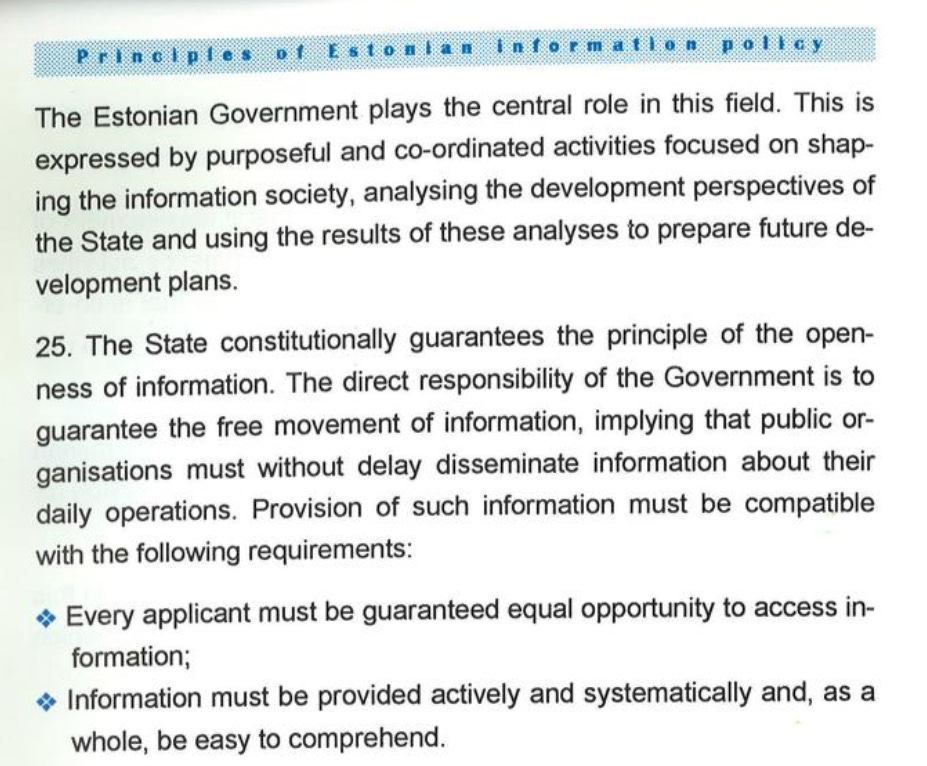 Un estratto per capire la maturità dei principi
E dal ‘94 in poi, nel giro di 15 anni, l’Estonia mette su l’infrastruttura digitale del Paese, che include i primi servizi di e-banking (1996), il pagamento delle tasse online (2000), l’interoperabilità dei dati dei cittadini (2001), il voto online (2005), e la sanità online (2009).
Di come questo sia stato possibile, di cosa c’è alla base di questo stato digitale, e quindi perché funziona così bene, ma anche di cosa ne traiamo, ne parla oggi Artifacts.
> ### La Storia
Come per ogni paese, ma anche come in ogni social network, il primo tassello è identificarsi. La chiave per fruire dello stato digitale, infatti, è la e-Identity.
Serve ad accedere a tutti i servizi, è obbligatoria quando si compiono 15 anni, e permette di avere anche la propria firma digitale, la e-Signature, per completare e verificare vari processi.
La e-Identity è, a tutti gli effetti, una carta (d’identità). Ma non è una carta semplice: contiene il codice di 11 cifre identificativo dei cittadini, e nel chip fisico è conservata la Public Key Infrastructure (PKY), ossia la “chiave” con cui identificarsi e “firmare” i documenti online. Naturalmente, oltre alla carta fisica, è possibile avere la e-ID sul proprio cellulare.
\[Embedded media — view original\]
Per averla bisogna farsi riconoscere in presenza almeno una volta, e poi è tutto digitale. Come lo SPID, in fondo. Una volta ottenuta, però, la e-ID diventa valida esattamente come il riconoscimento tramite documento cartaceo. Con la differenza che non serve mandare screenshot sgangherati, ma basta inserire un codice.
Tra l’altro, sempre all’interno del chip, si possono salvare dei documenti personali, che possono essere condivisi in maniera crittografata con chiunque si voglia.
------------------------------------------------------------------------
Bene, siamo dentro lo stato digitale. Ma questo è solo il primo tassello, ed è indubbiamente meno entusiasmante del secondo. Per capirlo, facciamo un esercizio di immaginazione.
Tra i documenti più complicati che io abbia mai dovuto reperire, c’è il certificato di nascita. Forse banalmente perché è il più vecchio di tutti. Ecco, immagina invece che quel certificato venga immediatamente condiviso dall’ospedale sul tuo dossier digitale quando tutto ciò che fai è piangere e bere latte, che quindi possa essere visualizzato e registrato dall’anagrafe e che venti anni dopo sia comodamente ancora nel tuo dossier e pronto per essere accettato dall’università che te lo richiede.
Non è fantascienza, ma è come funziona x-Road in Estonia, l’ecosistema di interoperabilità dei dati che permette a cittadini e vari servizi pubblici e privati di scambiarsi documenti con facilità. Come una fitta rete di strade, appunto.
X-Road connette centinaia di organizzazioni pubbliche e private, processa 500 milioni di transazioni l’anno (in un paese di 1mln di persone) e, soprattutto, non chiude mai: è attivo 24/7.
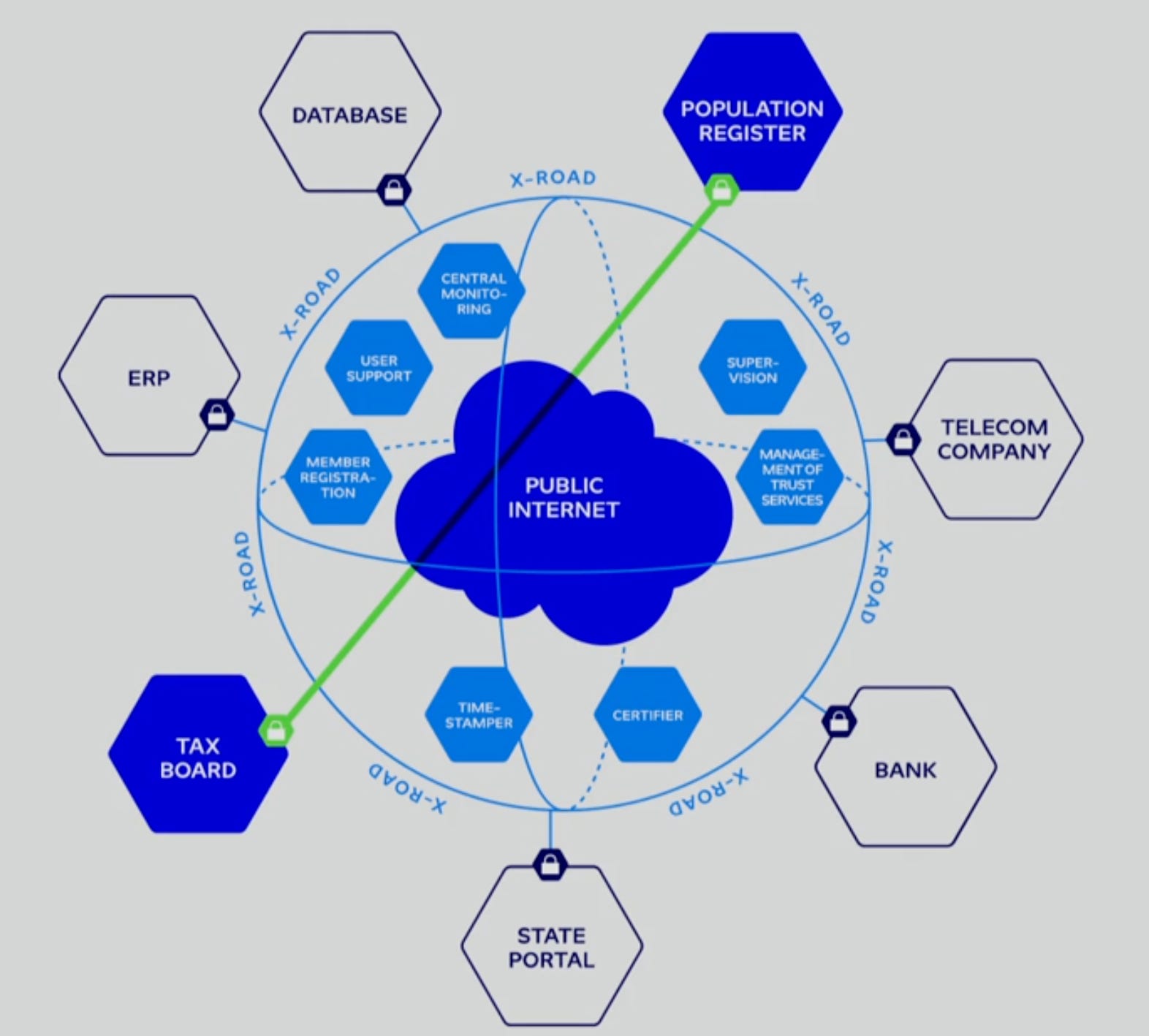 Questa è una bella visualizzazione di come funziona
E, poi, risponde ad un principio essenziale della privacy: l’utente è l’unico proprietario dei suoi dati. Sono tutti sotto il suo controllo, non possono essere conservati o duplicati altrove, e se serve condividerli è lui a dare l’accesso. Se, poi, un ente pubblico autorizzato accede ad uno dei suoi documenti, quell’accesso viene registrato. Questo favorisce sicurezza e integrità dei dati.
La conseguenza? Non c’è alcun tipo di centralizzazione dei dati. Ognuno controlla i suoi ed è X-Road a facilitare e permettere tutti gli scambi.
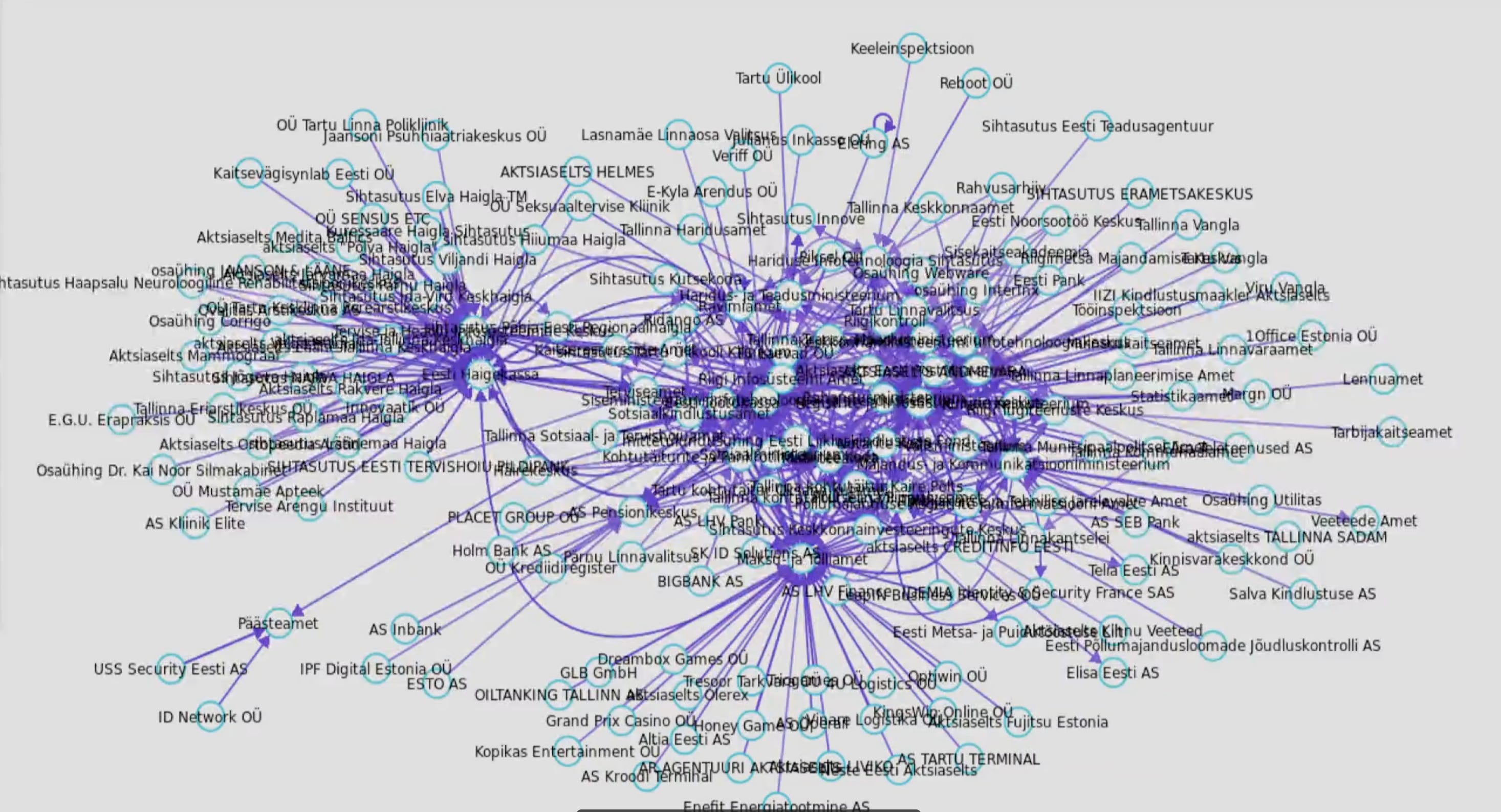 Come si vede, non c’è nessuna concentrazione ma una fitta rete
Il tutto risponde al “once-only principle”, che è esattamente quello a cui pensavo mentre condividevo la mia carta d’identità con lo Stato Italiano. Cioè? Che lo Stato non può richiedere lo stesso dato più di una singola volta, ma anche che lo stesso dato non possa essere conservato in più di un posto, e che quindi sia sempre sotto il controllo del cittadino, che ne è proprietario.
------------------------------------------------------------------------
I benefici di un sistema flessibile e all’avanguardia come questo sono tanti, e anche economici. Si stima infatti che ci sia un risparmio annuale del 2% del PIL grazie a X-Road, che è, tra l’altro, esattamente la quota che l’Estonia versa alla NATO. Insomma, X-Road regala l’atlantismo.
Ma poi, dato che tutto è online, e quindi senza vincoli geografici o di presenza, l’Estonia ha inventato la e-Residency, ossia l’accesso ai suoi servizi per cittadini non estoni che possono lanciare un’azienda beneficiando dell’efficienza estone.
 C’è anche un certo design nella e-residency
Non si tratta di paradiso fiscale o simili, e nemmeno di una cittadinanza, ma a tutti gli effetti di “vendere” una amministrazione estremamente leggera e efficiente. Il risultato? Dal 2014, la e-Residency ha attratto oltre 100 mila persone (1/10 della popolazione totale) che hanno lanciato oltre 20 mila nuove aziende o start-up in Estonia.
Insomma, un cittadino indiano può lanciare la sua start-up in Estonia, accedere al mercato europeo, e a potenziali finanziamenti. Il tutto comodamente dal divano di casa sua in India e in meno di un’ora: pare che ci vogliano 15 minuti e 33 secondi a metter su un’azienda in Estonia online.
------------------------------------------------------------------------
E sì, probabilmente è più facile fare tutto ciò in un Paese che ha la popolazione di 1/3 di Roma o uguale a quella di Milano. Ma l’intento qui non è tessere le lodi dell’Estonia, ma capire cosa se ne può trarre.
Innanzitutto, come la tecnologia sia stata in grado di costruire la fiducia tra stato e cittadini. Un esempio? Ho letto che gli estoni adorano pagare le tasse. E questo perché è semplicissimo: ricevi un form precompilato e paghi. Facile come comprare un libro su Amazon.
O, altra cosa che ho trovato formidabile: lo Stato ti notifica le opportunità per te. Tipo borse di studio, sussidi o simili. Una funzionalità che magari chi ha tempo e voglia di leggere il giornale tutti i giorni trova inutile, ma immaginate per chi - legittimamente - è fuori dal loop continuo di informazioni
Per finire, quello che probabilmente ha funzionato è che, dopo la caduta del muro e l’indipendenza dall’URSS, la digitalizzazione è stata prevista come principio alla base della nuova amministrazione, e non come ciliegina sulla torta per finire. E questo ha necessariamente imposto di rendere tutti i processi adeguati per diventare digitali.
Una differenza non da poco: il tecno-soluzionismo non è mai la formula magica. Digitalizzare processi fallaci o non pronti non li risolve e, anzi, probabilmente li rende anche peggiori, amplificandone i rischi e i danni.
Al contrario, re-inventare i servizi pubblici nell’ottica di una società dell’informazione e della digitalizzazione è, probabilmente, la strada corretta.
Leave a comment
> ### Rassegna (Stampa)
Si sapeva, ma fa comunque un certo effetto: Apple dovrà pagare 2 miliardi di multa all’UE. E in settimana ha avuto qualche problemino anche con Epic Games, quelli di Fortnite.
Qui è spiegato molto bene come funzionerà l’identità digitale dell’UE. UE che nel frattempo ha violato il suo stesso regolamento sulla protezione dei dati.
Dall’altro lato dell’oceano si parla seriamente di mettere i bastoni tra le ruote a TikTok negli Stati Uniti. Ma teniamo anche traccia di chi è licenziato dalle BigTech.
Torniamo in Italia, dove arrivano investimenti per fare i chip e dove il Garante Privacy investiga anche Sora, la nuova app dei video di OpenAI. E poi c’è anche un nuovo design per i siti della pubblica amministrazione
Il Digital Markets Act è entrato in vigore, e come i gatekeeper lo rispettano. Ne ha parlato anche il FT, poi anche Wired, e infine io l’ho raccontato per NOS (non bene come il FT, chiaramente)
 Visto che molto, quasi tutto, è design, “Hello World” di Alice Rawsthorn è un ottimo libro per capire dove nasce il termine, come si sviluppa e cosa arriva a noi. E anche fare uno stato digitale è indubbiamente design, come avevamo raccontato qua.
NOVITÀ: Per tenere traccia di tutti i libri consigliati finora, ho creato “Lo Scaffale di Artifacts”, a cui si accede da qui, e che è fatto così:
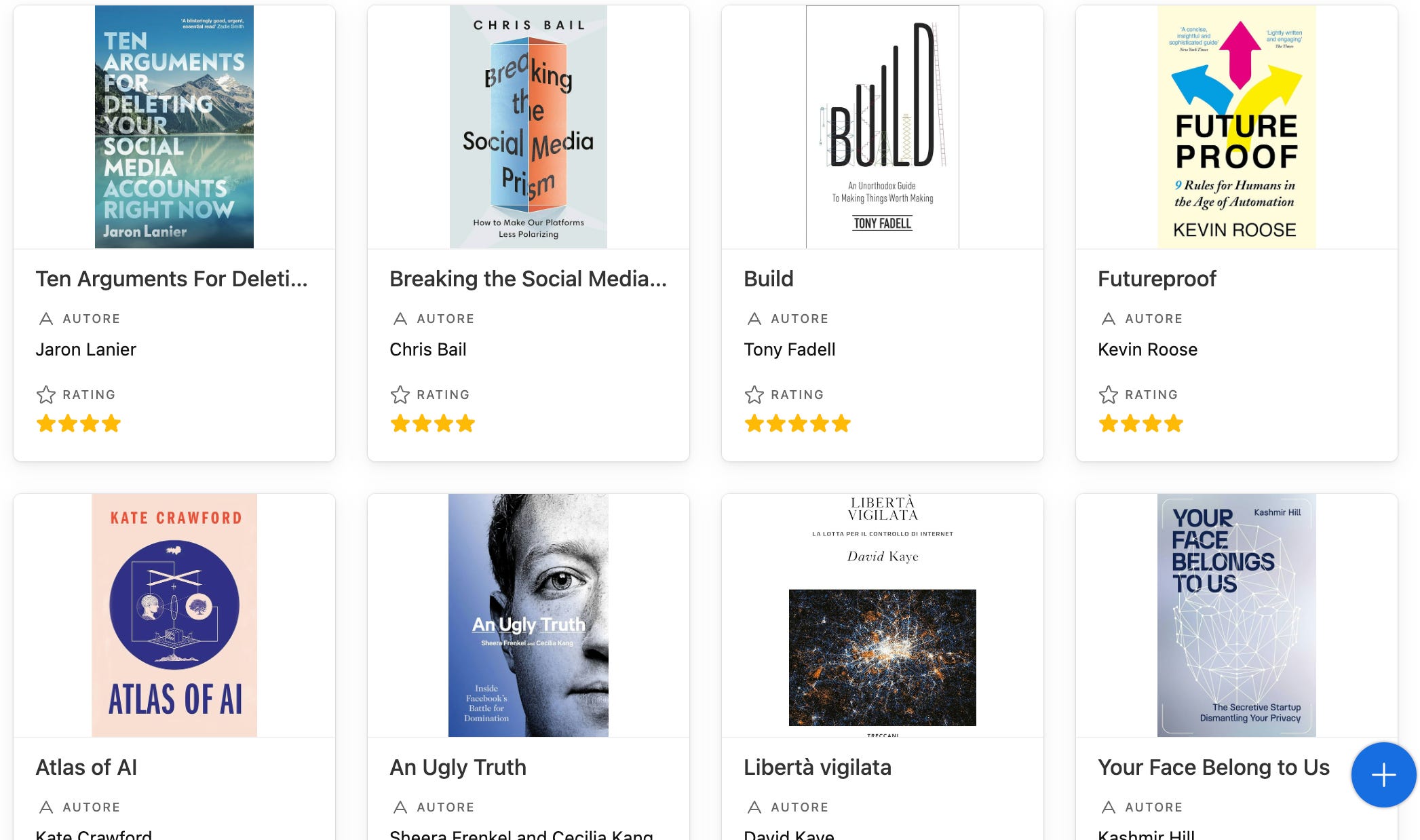 P.S. Idea ispirata da Alberto Sanino , che legge Artifacts ma soprattutto scrive Breeze, una newsletter sull’innovazione con una prospettiva economica. Consiglio di dare un’occhiata :)
 Chicca per i divoratori di cultura, film, serie, etc. Sequel permette di salvarti in maniera ordinata tutti i consigli del tuo amico che è stato sveglio per vedere la notte degli Oscar e che vuole farti fare bingewatching con lui.
======
# E tutta questa pubblicità
Date: 2024-03-05 | Language: it
Canonical: https://artifactstech.substack.com/p/e-tutta-questa-pubblicita
Cite as: E tutta questa pubblicità by Lorenzo Ancona, Artifacts, 2024-03-05. https://artifactstech.substack.com/p/e-tutta-questa-pubblicita (CC BY 4.0)
Nel 2012, Zuckerberg, CEO della società (fu) Facebook, lancia **“Open Graph”,** un programma che consentiva agli sviluppatori di far utilizzare le proprie app o siti tramite Facebook, il social.
**E così potevamo giocare a Candy Crush su Facebook** e vedere chi dei nostri amici mangiava più caramelle.
E Candy Crush cosa ci guadagnava? **Che la sua app andava virale, ma anche l’accesso a una manciata di informazioni degli utenti Facebook:** nomi, email, città, data di nascita, affiliazioni politiche, le nostre relazioni, i like. *Può bastare?*
Lo stesso anno, un dipendente, Sandy Parakilas, che faceva il Platform Operations Manager a Facebook, **presenta un Power Point al suo capo,** segnalando che questo giochetto (non Candy Crush) metteva a rischio i dati degli utenti. **Ma non gli danno retta e lui si licenzia.** Saranno stati i loghi non allineati nelle slide.
**Due anni dopo, nel 2014, Zuckerberg dismette Open Graph.** Per i dati? No, perché non portava l’engagement sperato.
**Quindi dati al sicuro? Non esattamente.** Pochi giorni prima che Open Graph venisse spento, **Alexandr Kogan**, accademico a Cambridge, carica il **quiz “thisisyourdigitallife”**, che fa domande personalizzate per “scopi accademici”.
**Partecipano “solo” 300.000 utenti, ma, per via di falle di sicurezza e privacy, Kogan riesce a raccogliere i dati personali di quasi 90 milioni di utenti legati ai partecipanti.** Un prodotto indubbiamente scalabile.
------------------------------------------------------------------------
Tutti questi dati, però, non vengono depositati in un hard disk e usati per la ricerca. **Kogan li vende a Cambridge Analytica,** una società di consulenza che crea profili di persone e li utilizza per creare messaggi e contenuti politici targetizzati.
[](https://substackcdn.com/image/fetch/$s_!oWnF!,f_auto,q_auto:good,fl_progressive:steep/https%3A%2F%2Fsubstack-post-media.s3.amazonaws.com%2Fpublic%2Fimages%2F9588b9ed-f20a-49b3-b1a1-ff26c31e33dc_372x338.png)
Tipo questi post qua.
E ok, probabilmente se sei iscritto/a a questa newsletter, **il nome “Cambridge Analytica” non ti è nuovo.** Anzi, è uno degli scandali più celebri. Molto si è scritto a riguardo e [“The Great Hack”](https://www.youtube.com/watch?v=iX8GxLP1FHo) è un ottimo documentario.
Secondo le investigazioni e l’inchiesta di [New York Times e Guardian](https://www.nytimes.com/2018/03/17/us/politics/cambridge-analytica-trump-campaign.html), nella campagna elettorale del 2016, **Donald Trump e Ted Cruz avrebbero utilizzato le profilazioni di Cambridge Analytica per raggiungere e convincere milioni di utenti con contenuti ad hoc sponzorizzati sui social.** E si pensa che abbiano avuto un ruolo anche in Brexit.
Tutto a partire dai dati prelevati da Kogan e venduti a Cambridge Analytica, **violando le linee guida di Facebook dell’epoca.** Ma, insomma, Kogan non era esattamente uno che si faceva scrupoli.
[](https://substackcdn.com/image/fetch/$s_!_y04!,f_auto,q_auto:good,fl_progressive:steep/https%3A%2F%2Fsubstack-post-media.s3.amazonaws.com%2Fpublic%2Fimages%2F44a7b483-0471-4118-ac27-e76bae7670da_1297x1445.png)
Diciamo che non era proprio un lupo solitario, per il [Guardian](https://www.theguardian.com/news/2018/mar/17/cambridge-analytica-facebook-influence-us-election)
E sì, Kogan è decisamente il cattivo della vicenda. **Ma a Meta non erano angeli.** Le impostazioni delle pubblicità permettevano una granularità probabilmente eccessiva: **gli utenti erano classificabili e raggiungibili dai contenuti sponsorizzati per religione, etnia, stipendio, affiliazioni politiche e altre cose che non andremmo proprio a dire in giro.**
Quindi a Cambridge Analytica creavano dei profili estremamente precisi, **ma Facebook (1) era la fonte dei dati e (2) permetteva di attuare una targetizzazione estrema.**
E, per questo ruolo di Facebook, **Zuckerberg passò delle ore non esattamente piacevoli al Congresso Americano.** Presumibilmente ne hai visto la foto in qualche meme.
[\[Embedded media — view original\]](https://www.youtube-nocookie.com/embed/TuIhb-xbW9I?rel=0&autoplay=0&showinfo=0&enablejsapi=0)
------------------------------------------------------------------------
Comunque, senza scendere nei dettagli, che sono tanti, quella di Cambridge Analytica è stata **una delle prime vicende in cui i social hanno cominciato a mostrare qualche frana per l’opinione pubblica.**
Soprattutto, **si è capito il potenziale estremo dei contenuti sponsorizzati per la politica, che mettevano praticamente in ridicolo spot televisivi o volantini.** Perché? In confronto con i formati “tradizionali”, secondo me, **per almeno due ragioni:**
- **la targetizzazione e granularità** permettevano ad un preciso contenuto con un preciso messaggio di raggiungere una precisa fetta di pubblico; altra storia rispetto agli adv generali in televisione;
- **l’interazione con i contenuti** non significa solo essere raggiunti, ma poter mettere like, ripostare, condividere e, in definitiva, **amplificare ulteriormente**; cosa che, invece, una pagina di giornale chiaramente non permette.
E, da non trascurare, il tutto praticamente **senza filtri o controllo sul contenuto stesso e la sua veridicità.**
Di come erano le cose nel 2016, come sono progredite nel 2020, e di come ci stiamo preparando al 2024, **ne parla oggi Artifacts.**
[](https://substackcdn.com/image/fetch/$s_!YqCd!,f_auto,q_auto:good,fl_progressive:steep/https%3A%2F%2Fsubstack-post-media.s3.amazonaws.com%2Fpublic%2Fimages%2F76bd10a3-9b10-4477-a00f-bc0dd421c8eb_1024x1024.webp)
Un vecchio cartellone pubblicitario. *Stavolta creato con Midjourney*
> ### La Storia
Va detto, e con grande chiarezza, che lo scenario del 2016 è praticamente **preistoria nelle linee guida e regolamentazione dei contenuti politici sponsorizzati sui social.**
Diverso, invece, il peso economico che già avevano: **Trump e Clinton spesero complessivamente 81 milioni in adv.**
Sempre rispetto all’allora Facebook, non solo le opzioni di *targeting* erano estremamente - troppo - precise e ad uso di chiunque fosse malintenzionato. **Ma anche quello che vedeva l’utente era vago e poco dettagliato.**
[](https://substackcdn.com/image/fetch/$s_!9esP!,f_auto,q_auto:good,fl_progressive:steep/https%3A%2F%2Fsubstack-post-media.s3.amazonaws.com%2Fpublic%2Fimages%2F250546a0-94ad-4a20-9930-a9bc8a260372_500x504.jpeg)
Uno screenshot a caso dalla campagna del 2016
Come (non) si vede bene, manca una informazione essenziale: **chi ha pagato per questa sponsorizzata**. Vero, presumibilmente qui è Hillary Clinton, ma **niente evitava che questo potesse essere un account fake e che dietro si celasse qualcuno che voleva, piuttosto, sabotare Clinton.**
E sì, questo adv sembra innocuo, ma chiunque avrebbe potuto, ad esempio, fare **un contenuto sponsorizzato con la data sbagliata delle elezioni e indirizzarlo a fasce meno informate di utenti.** O altri casi del video di AOC sopra.
Discorsi simili, chiaramente, valevano per le altre piattaforme.
------------------------------------------------------------------------
In questo senso, **Cambridge Analytica fu un bel terremoto.** Facebook, ad esempio, da dentro l’occhio del ciclone, tirò fuori **una serie di soluzioni per aumentare la trasparenza sui political ads.**
In primis, la **[Ad Library](https://www.facebook.com/ads/library/?active_status=all&ad_type=political_and_issue_ads&country=ALL&sort_data%5Bdirection%5D=desc&sort_data%5Bmode%5D=relevancy_monthly_grouped&media_type=all)**, dove chiunque può vedere quanto viene speso, la audience di una campagna pubblicitaria, chi ha pagato e chi ha visto il contenuto. Vale per tutte le sponsorizzate, ma c’è una sezione apposta sulla politica. **Roba da nerd, ma immagina il potenziale, ad esempio, per chi fa ricerca.**

Molto interessante farsi un giro su Ad Library
Se la Library, però, era per i fanatici della trasparenza, Facebook fece una cosa anche molto più immediata per tutti gli utenti: **mostrava chiaramente chi aveva pagato per un contenuto, dopo averlo validato e identificato.** Anche e soprattutto per evitare influenze straniere.
[](https://substackcdn.com/image/fetch/$s_!Qiad!,f_auto,q_auto:good,fl_progressive:steep/https%3A%2F%2Fsubstack-post-media.s3.amazonaws.com%2Fpublic%2Fimages%2Ff6240343-c558-46c7-a73e-90d5b4d2e11a_1078x1019.jpeg)
Ad esempio in questo post del 2018 si legge chiaramente che ha pagato il comitato di Trump.
Tutte mosse con uno scopo chiaro: **evitare il disastro del 2016 e prepararsi per le elezioni successive**, tra le quali le europee del 2019 e, soprattutto, quelle americane del 2020.
Tra l’altro, interessante da notare, se a Facebook venne fatto di tutto per limitare i rischi e aumentare la trasparenza, **decisamente diversa e più drastica fu la scelta di Twitter, l’altro social chiave per la politica.**
[](https://substackcdn.com/image/fetch/$s_!GgeV!,f_auto,q_auto:good,fl_progressive:steep/https%3A%2F%2Fsubstack-post-media.s3.amazonaws.com%2Fpublic%2Fimages%2Fd20c9564-e2af-4c35-9493-4ae1d3e99311_1180x593.png)
Consiglio davvero di leggersi tutto questo thread
Molto semplicemente, Jack Dorsey, il fu CEO della fu Twitter, comunicò che **non sarebbe stato possibile sponsorizzare contenuti politici.** Si appellò ad [una serie di motivazioni valide e interessanti](https://x.com/jack/status/1189634360472829952?s=20) da leggere, **ma anche la semplice volontà di limitare i danni è da assumere.** E, [come detto qualche settimana fa](https://artifactstech.substack.com/p/la-piazza-al-centro-del-villaggio), perfettamente in linea con la natura privata di questi spazi che pensiamo pubblici.
------------------------------------------------------------------------
Questa - andando molto veloce - è la traiettoria essenziale dei contenuti politici sponsorizzati, con alcuni degli step essenziali. **Elemento comune? Tutte scelte volontarie delle piattaforme,** indubbiamente sotto la luce dei riflettori dopo il 2016, **ma comunque senza particolari obblighi.**
Vero, **un misuso dei dati come quello di Cambridge Analytica, almeno in UE, sarebbe impensabile grazie al GDPR**, ma è solo tangenziale rispetto alle campagne pubblicitarie politiche.
Questo un po’ per ricordare che il Far West di pre-2016 è preistoria, **ma anche per evidenziare un vuoto importante da colmare per le istituzioni.** E chi meglio dell’Unione Europea quando si tratta di fare regole?
Così, **il Digital Services Act** (DSA), il nuovissimo regolamento sulla sicurezza dei servizi online, **stabilisce una serie di regole chiare sui cosiddetti** ***“advertisements”.***
In primis, **è vietata qualsiasi pubblicità che prevederebbe la profilazione di minori.** Ma **è poi anche vietato creare campagne pubblicitarie che usino “categorie speciali” di dati**, e quindi etnia, opinioni politiche, religione, orientamento sessuale e simili che piacevano particolarmente a Kogan e Cambridge Analytica, ma meno al GDPR. Da ultimo, **i registri di trasparenza sugli ads, prima volontari, sono ora obbligatori per le grandi piattaforme**, che a Bruxelles si chiamano VLOPs (Very Large Online Platforms).
Queste sono le regole valide in generale e per tutti i tipi di contenuti. Poi, ancora più nuovo del DSA, **è il nuovo regolamento specifico su** ***political advertising,*** **approvato dal Parlamento UE la settimana scorsa,** e ora solo in attesa del Consiglio.
**Ricalca in gran parte il DSA**, ma aggiunge, appunto, elementi relativi alla politica. Per esempio, **nei tre mesi prima di un’elezione sarà vietata qualsiasi campagna pubblcitaria sui social proveniente da paesi extra-UE.** Tipo la Russia, per dirne uno a caso.
E dov’è che mancano 3 mesi ad una elezione? **Esatto.**
> ### Rassegna (Stampa)
[L’UE ha fatto una multona ad Apple](https://www.theverge.com/2024/3/4/24005938/european-commission-antitrust-apple-investigation-anti-steering-rules-app-developers) perché non ci fa vedere i prezzi delle app di musica. E questa settimana [arriva il Digital Markets Act (!)](https://www.nytimes.com/2024/03/04/technology/europe-apple-meta-google-microsoft.html), a proposito di competizione.
Elon Musk ha fatto causa ad OpenAI. [Ma potrebbe non avere senso.](https://www.nytimes.com/2024/03/02/technology/elon-musk-openai-lawsuit-paradox.html) Ed anche altri media, come ha fatto il NYT, [fanno causa ad OpenAI.](https://www.theguardian.com/technology/2024/feb/28/media-outlets-sue-openai-copyright-infringement)
C’è una nuova IA in città, è [un gatto francese.](https://www.lemonde.fr/pixels/article/2024/03/01/on-a-teste-le-chat-l-etonnant-chatgpt-a-la-francaise-de-mistral-ai_6219436_4408996.html#) Si chiama Mistral, ha una partnernship con Microsoft, ed è [già oggetto di varie critiche.](https://www.linkedin.com/posts/luca-bertuzzi-186729130_introducing-mistral-large-on-azure-in-partnership-activity-7167962807827611649-fG3e?utm_source=share&utm_medium=member_desktop)
Ricordi la storia “pay or okay” di Meta? Ne avevamo parlato [qua](https://artifactstech.substack.com/p/si-ora-bisogna-fare-una-scelta). E [continua ad essere fortemente criticata.](https://techcrunch.com/2024/02/28/meta-consent-or-pay-consumer-gdpr-complaints/)
[Un fumetto bellissimo](https://www.technologyreview.com/2024/02/28/1088262/luddites-resisting-automated-future-technology/) sui Luddisti all’era dell’Intelligenza Artificiale. E anche [cosa se ne fa uno storico dell’IA.](https://www.theverge.com/24068716/ai-historians-academia-llm-chatgpt)
Ho provato a spiegare al podcast **“Ma Perché?”** questa storia qua:
[\[311 \| Ma perché TikTok e Universal stanno litigando?\]](https://open.spotify.com/episode/6B3JoHz1FStf0fcCFGlojk)
> ### Lo Scaffale
[](https://substackcdn.com/image/fetch/$s_!MXPM!,f_auto,q_auto:good,fl_progressive:steep/https%3A%2F%2Fsubstack-post-media.s3.amazonaws.com%2Fpublic%2Fimages%2F30951b0d-4c40-4806-a995-5c6095e95d3e_1080x1080.png)
Brittany **Kaiser** è la persona che ha inventato l’#DeleteFacebook nel 2016 e ha poi scritto **“La Dittatura dei Dati”** per raccontare tutta la vicenda di Cambridge Analytica e i meccanismi delle pubblicità sui social in generale. **È un pochino datato, mi ricordo che è stato uno dei primi libri che ho letto su questi temi, ma secondo me vale ancora la pena.** L’ho risfogliato: sembra passata una vita, ma era meno di 10 anni fa.
> ### Nerding
[](https://substackcdn.com/image/fetch/$s_!Y_ux!,f_auto,q_auto:good,fl_progressive:steep/https%3A%2F%2Fsubstack-post-media.s3.amazonaws.com%2Fpublic%2Fimages%2Fdddb884f-a7a1-45a6-af9f-8fb27c2ad363_1080x1080.png)
Se devi spiegare ad un *web developer* come vuoi il sito della tua ultima idea rivoluzionaria, **[Balsamiq](https://balsamiq.com/)** è perfetto per **letteralmente disegnare siti/app/qualsiasi interfaccia digitale.** Roba da product manager in erba prima che passi a Figma.
### ***Bonus***
[](https://substackcdn.com/image/fetch/$s_!ZM-I!,f_auto,q_auto:good,fl_progressive:steep/https%3A%2F%2Fsubstack-post-media.s3.amazonaws.com%2Fpublic%2Fimages%2F060eb412-080f-4a8d-b5c0-9e824e736ef0_2678x3307.jpeg)
Ho degli amici incredibili, che mi hanno regalato **questo nuovo, incredibile, taccuino per gli appunti di Artifacts.**
======
# Ho parlato con Internet
Date: 2024-02-27 | Language: it
Canonical: https://artifactstech.substack.com/p/ho-parlato-con-internet
Cite as: Ho parlato con Internet by Lorenzo Ancona, Artifacts, 2024-02-27. https://artifactstech.substack.com/p/ho-parlato-con-internet (CC BY 4.0)
Ricordi quando dicevamo **“Eh ma ChatGPT non può navigare su internet”?** Sembra una vita fa. **In realtà è passato poco più di un anno.**
E, comunque, ormai è solo storia.
**Ora i Large Language Models (LLM) possono accedere alla Rete.** Lo può fare ChatGPT nella versione Plus, ma anche tanti altri tool.
Insomma, **l’Intelligenza Artificiale può fare ricerche online.**
E allora, **nell’ultimo mese ho smesso di usare Google Search.** L’ho fatto per capire come potrebbe essere la ricerca da qui a qualche anno e le implicazioni di quella che potrebbe essere una bella, grossa novità.
**Mi sono affidato a [Perplexity](https://www.perplexity.ai/)**, un chatbot di IA che ambisce ad essere un motore di ricerca e nel quale stanno investendo in tanti, **tra cui Jeff Bezos.**
 E questo è l’artefatto di cui stiamo parlando.
È un punto chiave nel sogno dell’interazione uomo-macchina, e mostra che un computer può essere non solo efficiente e preciso, ma anche interattivo e divertente. Questa parte del video è estremamente affascinante anche oggi, e la reazione del pubblico non è distante da quella che a volte abbiamo noi rispetto all’intelligenza artificiale.
------------------------------------------------------------------------
Comunque, al di là del lancio, oggi Artifacts parla del Macintosh per una ragione semplice: è il “computer that changed everything”, come ha scritto Steven Levy.
Innanzitutto il Macintosh è uno dei primi esempi di “personal computer”. Se prima i computer erano artefatti da ufficio o da lavoro, Steve Jobs li vuole portare sulla scrivania di tutti. E quindi renderli belli fuori, a misura di casa, ma soprattutto facili da usare.
Oggi Artifacts racconta come Apple ha provato a realizzare quest’ambizione, e quindi di come un Macintosh appariva fuori, ma anche della rivoluzione del sistema operativo al suo interno. E anche perché ancora oggi è ben visibile che il Macintosh sia il computer che ha cambiato tutto.
 “What a computer is to me is it’s the most remarkable tool that we’ve ever come up with, and it’s the equivalent of a bicycle for our minds.” - Steve Jobs
> ### La Storia
Nell’immaginario collettivo, il Mac è strettamente legato ai professionisti del design. Questo fatto riflette un certo rispetto di questa comunità per i prodotti di Cupertino, in cui riconosce dei valori simili ai propri.
Infatti, la creazione di un prodotto che fosse bello, dentro e fuori, era tra le principali ossessioni di Jobs, che affronta questa sfida in modo maniacale.
Innanzitutto, il computer non era composto di diversi componenti collegati tra loro da cavi, ma era interamente contenuto in una semplice scocca beige. Poi, il Mac non doveva solo gratificare la vista, ma anche gli altri sensi, tra cui l’udito. Jobs vieta l’inclusione di una ventola per raffreddarne l’interno: scelta, questa, che ne comprometterà l’affidabilità.
Ma un bel design non è solo accessorio o un vezzo estetico. Serve a “spiegare” il Mac stesso, a renderlo semplice da usare, senza manuali e, insomma, a farne un computer per tutti. Questa pubblicità - che appare sul NYT il giorno del lancio del Macintosh - ne è un esempio chiarissimo:
 Leggi bene per capire quanto è successo negli ultimi 40 anni
Soprattutto, qui è lampante una delle tante novità: il mouse. “If you can point, you already know how to use it”. Mouse che non solo rende il Mac facile per tutti, ma è anche utile a capire perché è una rivoluzione nell’uso del computer.
------------------------------------------------------------------------
Come scrive Erik Sandberg-Diment nella stessa pagina dell’ad sul NYT, la differenza essenziale con gli altri computer è che il Mac è “visually oriented” invece che “word oriented”.
Non più una serie di righe di testo da selezionare facendo su e giù con le freccette, ma dei file spostabili, col mouse, come fossero su una scrivania. Su un desktop, appunto. Idea ripresa dallo Xerox Alto, che aveva però un prezzo inaccessibile.
 Questa dovrebbe aiutarti a capire di che rivoluzione stiamo parlando. IBM 1981 e Macintosh 1984, due idee radicalmente diverse.
La nuova interfaccia ha poi icone e font curatissimi, sviluppati esclusivamente per il Mac. Questo non è solo testimonianza della già citata ossessione per l’estetica, ma sfocia anche in applicazioni completamente nuove, come quella del desktop publishing.
Se prima l’impaginazione di riviste necessitava di apparecchiature specifiche da centinaia di migliaia di dollari, con l’avvento del Mac è sufficiente un computer ed un programma specializzato. Di lì a pochi anni, infatti, nasceranno i primi programmi di Adobe, Ilustrator (1987) e Photoshop (1989).
 Questo lo abbiamo fatto giocando su MacPaint con un simulatore del Macintosh. Il link è in fondo, in Nerding.
Il primo Macintosh viene messo in vendita ad un prezzo di 2495 dollari, equivalenti a più di 7000 dollari di oggi. Di certo non pochi, ma comparabili alla concorrenza dell’epoca. Sull’onda dello spot, Apple ne vende oltre 50.000 nei primi tre mesi.
Successivamente, però, i compromessi tecnici fatti in fase di progettazione ne limitano notevolmente il successo. A questo modello verrà infatti affiancato, nel settembre dello stesso anno, il Macintosh 512K, con performance molto migliorate.
Come scritto qui, il Macintosh originale era una straordinaria anteprima al futuro del computing, ma soffriva di troppe limitazioni. Nel desiderio di realizzare completamente la sua visione per questo prodotto, infatti, Jobs ne ha probabilmente sacrificato l’effettiva utilità.
------------------------------------------------------------------------
Per farsi un’idea dell’impatto del Macintosh, basta guardarsi intorno. Il paradigma tecnologico dominante rimane il suo: che sia un computer, un telefono, anche il nuovo Vision Pro, continuiamo a “puntare” e toccare. Con un mouse o con le dita, e ora anche con gli occhi.
Strumenti radicalmente diversi, come ad esempio gli assistenti vocali, hanno ormai grande diffusione, ma in oltre 10 anni di esistenza non sono riusciti a ritagliarsi un ruolo rilevante.
Il Macintosh nasce a metà strada tra noi e i primi computer elettronici. Nella prima metà, menti visionarie hanno sognato di “aumentare” l’umano, immaginando strumenti non troppo diversi dai nostri. Nella seconda metà, sembriamo esserci convinti che siano proprio le metafore introdotte dal Macintosh a raggiungere questo obiettivo al meglio.
Steve Jobs può aver avuto ragione nel dire che “Every computer is going to work this way. You can’t argue about that anymore. You can argue about how long it will take, but you can’t argue about it anymore”.
Su una cosa, poi, ci aveva sicuramente preso: chi costruisce artefatti tecnologici non può limitarsi a realizzarne l’hardware o il software, ma è tenuto ad esprimere un’idea.
La vera eredità del Mac è essere la dichiarazione di una precisa idea di interazione tra uomo e macchina.
Leave a comment
> ### Rassegna (Stampa)
Meta e Tik Tok hanno fatto causa alla Commissione Europea. Sempre per l’UE, PayPal potrà essere usato per pagare nei negozi.
Meta non vuole più che si parli troppo di politica. Tipo nonna a Natale. E vuole anche rivelare se un’immagine è stata generata con l’IA.
Google ha chiarito qual è la sua IA: Gemini. E sembra promettente. Nel frattempo, Sam Altman cerca 7 trilioni, qualora ti avanzino due spicci.
Questo tool di Mozilla serve a capire se i tuoi dati sono mai stati rubati. A proposito di criminali, c’è chi blocca Internet durante le elezioni. Invece, in Danimarca si vieta alle scuole di condividere dati con Google.
La Initiative for Digital Public Infrastructure ci aiuta a capire come studiare i social media. E intanto negli USA la politica si legge coi meme.
> ### Lo Scaffale
 Ne abbiamo parlato in abbondanza, ma questa è la sua copertina. “Insanely Great” di Steven Levy è uno dei (tanti) libri che raccontano del Macintosh, della sua storia, del suo design, e molto molto altro su cui speriamo questa Artifacts abbia scatenato un po’ di curiosità. Ancora, ha cambiato tutto.
> ### Nerding
 Hai presente la gif di MacPaint in cui scriviamo “Artifacts”? Lo abbiamo fatto con Infinite Mac, un tool per ricreare l’esperienza dei vari Mac dall’84 al ‘99. Moooolto nerd, ma merita un’occhiata da chi è Gen Z e gioca coi Vision Pro.
======
# I bambini non si toccano
Date: 2024-02-06 | Language: en
Canonical: https://artifactstech.substack.com/p/i-bambini-non-si-toccano
Cite as: I bambini non si toccano by Lorenzo Ancona, Artifacts, 2024-02-06. https://artifactstech.substack.com/p/i-bambini-non-si-toccano (CC BY 4.0)
Attenzione: immagine forte.
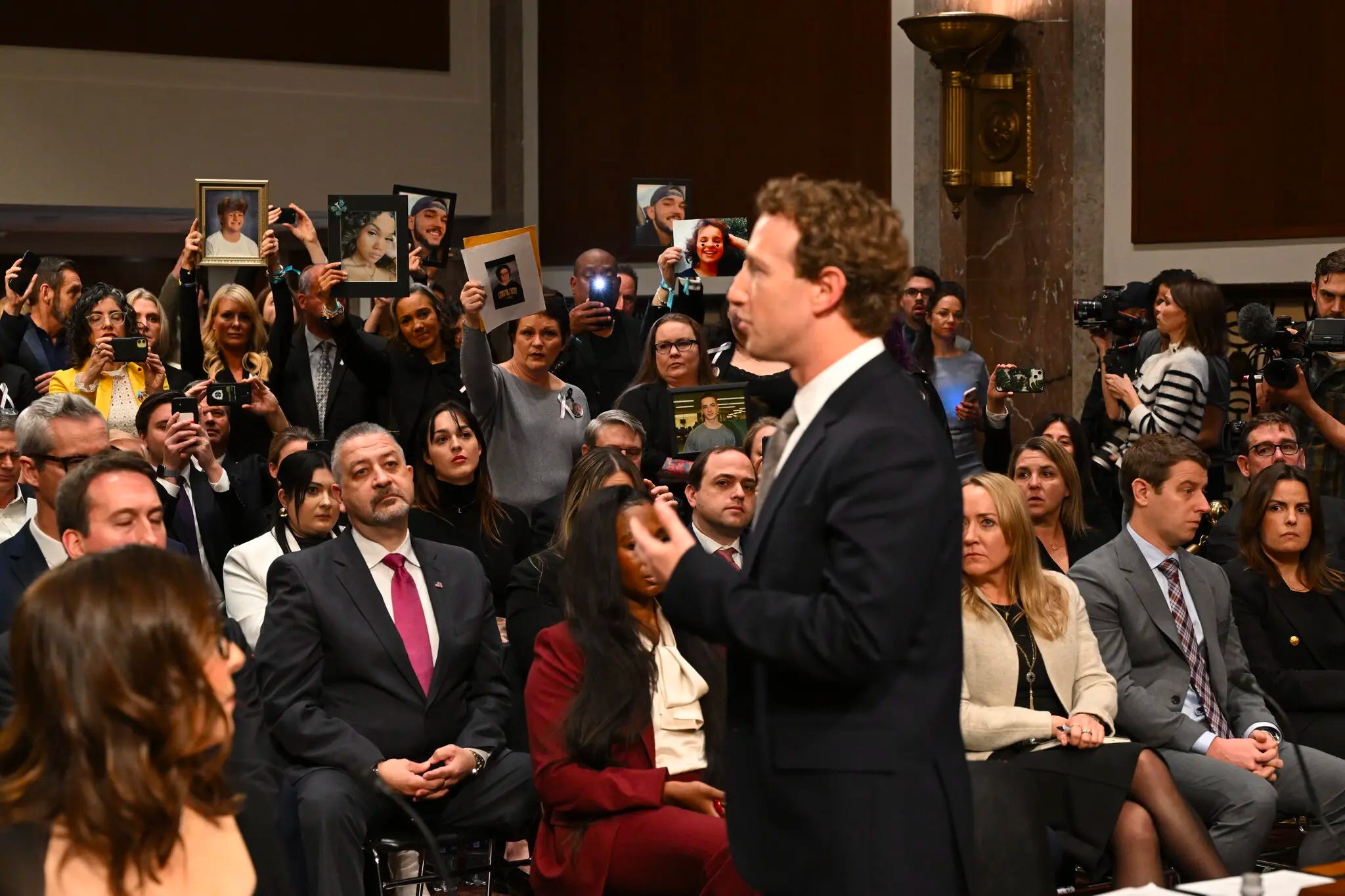 Seguita da parole altrettanto forti:
> “Mi scuso per tutto quello che avete passato. È terribile. Nessuno dovrebbe soffrire quello che le vostre famiglie hanno sofferto. È per questo che investiamo così tanto per essere sicuri che non ricapiti a nessun’altro”
Così, nell’aula del Senato degli Stati Uniti, qualche giorno fa Mark Zuckerberg si è rivolto alle famiglie i cui figli sono morti per tremende dinamiche legate all’uso dei social media.
Un’immagine forte per la sua tangibilità. Al di là delle sue parole, c’è Mark Zuckerberg, uno degli uomini più ricchi del pianeta, nella stessa stanza di chi ha sofferto delle perdite anche a causa dell’impero di Meta. O, almeno, delle famiglie che pensano che senza Instagram o Facebook probabilmente si sarebbero risparmiate delle sofferenze.
È così che Zuck ha passato uno dei giorni prima del ventesimo compleanno di Facebook.
------------------------------------------------------------------------
Ma cosa stava succedendo? Perché Zuckerberg era a Washington e non in Silicon Valley?
 Da dx: Facebook, X, TikTok, Snapchat, Discord
Non era solo. Insieme a lui c’erano i CEO di X, Snapchat, Discord e TikTok. Per certi versi, anche la presenza di CEO oltre Meta e X è un’innovazione. Tutti ricevuti al Senato per portare la loro testimoniaza sulla “Online Child Sexual Exploitation Crisis”. Esatto, sulla crisi in corso di sfruttamento sessuale dei bambini sui social media, ed i rischi connessi.
È un tema caldo, caldissimo negli USA. Basti pensare che negli ultimi due discorsi “State of the Union” al Congresso, Biden ha menzionato la necessità di misure per la protezione dei bambini online.
Ed è anche uno dei pochi temi su cui c’è addirittura consenso bipartisan tra Repubblicani e Democratici. Nonostante i due partiti siano divisi su (quasi) tutto anche rispetto alla regolamentazione della tecnologia, su una cosa concordano: i bambini non si toccano. E magari hanno una posizione comune per ragioni diverse, ma rimane comunque l’obiettivo di un Internet più sicuro.
Per questa ragione, i cronisti di Washington dicono che ci sia un “momentum” per fare leggi sulla sicurezza di Internet. Nessuna è ancora passata, ma gli assistenti parlamentari sono alle prese con le bozze di vari atti, tra cui:
- Kids Online Safety Act (KOSA), su cui torniamo dopo,
- Children and Teens’ Online Privacy Protection Act (COPPA 2.0),
- Strengthening Transparency and Obligation to Protect Children Suffering from Abuse and Mistreatment Act (STOP CSAM Act),
- Eliminating Abusive and Rampant Neglect of Interactive Technologies Act (EARN IT Act).
------------------------------------------------------------------------
E ok, ma perché la sicurezza dei bambini legata a crimini sessuali è così urgente negli Stati Uniti? Lascio parlare dei dati:
- I crimini di sextortion (minaccia di divulgare foto hot) sui bambini sono cresciuti del 1000% negli ultimi 18 mesi, sono 22.000 nel 2023;
- Un leak di un report interno di Meta rivela che 100,000 minori ricevono ogni giorno foto di genitali di adulti su Instagram e Facebook;
- Sempre secondo un leak di Meta, un under 16 su 8 ha ricevuto avances sessuali sui social.
Va ammesso che esiste molta confusione e opacità su questi dati. Spesso perché gli stessi social non rilasciano questi numeri, come aveva dimostrato la whistleblower Francis Haugen, quando aveva pubblicato documenti interni all’allora Facebook. Tra questi, appunto, c’erano ricerche in cui l’azienda sapeva dei rischi sui più giovani.
 Ma che gioco era la trottola da piccoli? Creata con DALL-E
Per questa e altre ragioni, questa storia dei crimini sessuali online è davvero molto complicata e non ambisco a trattarla esaustivamente in una Artifacts. Piuttosto, oggi colgo l’occasione per raccontare alcune delle dinamiche solite della politica americana quando fronteggia le BigTech, perché anche se tutti sono d’accordo sui problemi, lo sono meno sulle soluzioni, e cosa possiamo trarre dalle 4 ore di audizione in Senato, di cui ho letto il transcript.
> ### La Storia
Per prima cosa, l’audizione ha avuto una certa teatralità, che forse ha minato l’urgenza della questione in ballo. È iniziata con delle forti testimonianze dei familiari delle vittime, ed è proseguita col sen. Dick Durbin che ha detto “Le tech companies non hanno solo contribuito alla crisi dei crimini sessuali, ma sono responsabili per molti dei pericoli che i nostri bambini incontrano online”
E poi l’accusa di un altro senatore a Mark Zuckerberg di avere “le mani sporche di sangue” e un goffo tentativo di far dire al CEO di TikTok, che è di Singapore, che fosse cinese.
Come commentato da molti, il problema di queste scene è che servono più alla viralità dei senatori - nell’anno delle elezioni presidenziali - che al merito della questione. E, dato che la bagarre diventa più comunicativa, anche per i CEO diventa più facile aggirare le questioni topiche con frasi fatte o specchietti per le allodole, come ha scritto bene Vaishnavi J.
------------------------------------------------------------------------
Un aspetto comunicativo, però, aiuta ad andare in profondità. Ad un certo punto dell’audizione, il sen. Richard Blumenthal ha cominciato a chiedere ai CEO: “Supportate il Kids Online Safety Act? Yes or No?”. E un po’ come a scuola, appena i CEO dicevano “Eh, allora, sì, però…”, il senatore tagliava secco dicendo “I'll take that as a no”. Alla fine, il KOSA ha il supporto solo di Snapchat e X.
Ok, ma cosa prevederebbe il KOSA? Oltre a complicare lo scrivere, il KOSA ambisce ad evitare che i bambini vedano contenuti pericolosi sui social. E stabilisce un “duty of care”, per cui la Federal Trade Commission e i procuratori generali possono ritenere le piattaforme responsabili per i contenuti che possono colpire i minori.
Questo ultimo punto - per quanto limitato solo ai contenuti pericolosi per bambini - è per gli Stati Uniti come se l’Italia mettesse la pizza con l’ananas in Costituzione. Scherzi a parte, sarebbe una cosa enorme. Infatti, molto del perché i social sono stati (e sono, direi) a briglia sciolta risiede nella Section 230 del Communications Decency Act del 1996.
Cioè? Detta per strappare un 18 a diritto di Internet, negli USA i servizi online, e quindi i social, non hanno NESSUNA responsabilità se non rimuovono contenuti postati dagli utenti. E non la hanno nemmeno qualora decidano di rimuovere dei contenuti. Per saperne di più, il libro che consiglio oggi è perfetto.
------------------------------------------------------------------------
Insomma, la Section 230 ci dice perché il KOSA sarebbe parzialmente rivoluzionario. Soprattutto, insieme al First Amendment della Costituzione, ci aiuta a capire perché non solo Meta, Discord e TikTok sono contrari al KOSA, ma anche perché abbia ricevuto aspre critiche da molti addetti ai lavori.
Una delle critiche essenziali è sulla governance del KOSA. Molti pensano che permettere ai procuratori generali di decidere sui contenuti delle piattaforme mette a rischio la libertà di parola, con una politicizzazione dei giudizi. E, in effetti, il First Amendment aveva l’obiettivo di proteggere le libertà civili dalla politica.
Ad esempio, una aspra critica arriva dalle organizzazioni LGBTQ e quelle per i diritti umani. In una lettera scritta da Electronic Frontier Foundation, sostengono che il KOSA imporrebbe troppi limiti sulla circolazione delle opinioni, rischiando di limitare l’accesso alle informazioni dei cittadini.
Ad onor del vero, comunque, c’è molto supporto dei cittadini per il KOSA, ma questo non vuol dire che basti a superare il lobbying di attori più influenti.
Soprattutto, questa vicenda dice una cosa chiara: tutti negli USA sono d’accordo che la sicurezza dei bambini online sia una questione urgente, ma non per questo è allora facile affrontarla.
------------------------------------------------------------------------
Soprattutto, molti commentatori notano una certa caccia alle streghe nei confronti delle BigTech. Ed è qualcosa che a volte assomiglia più a una strategia di marketing della politica.
In primis, come si legge in questo paper, la politica americana (ma non solo) rischia di cadere nella trappola del techno-solutionism quando si tratta di child safety. Ossia l’idea che basti regolamentare la tecnologia e tutto andrà meglio.
Questo non significa che i social non abbiano un ruolo nel ridurre la diffusione di contenuti pericolosi o nel mettere un freno a dinamiche che colpiscono i minori, come la sextortion. Ma - com’è naturale - non possono essere additati come gli unici responsabili.
E - attenzione - con questo non voglio prendere le difese dei social, ma chiarire un punto essenziale: l’obiettivo deve essere proteggere i bambini e concentrare tutti gli sforzi solo sulla regolamentazione della tecnologia è uno sforzo miope, parziale. È una soluzione facile da vendere, ma non centra l’obiettivo.
E questa non è la conclusione di un pensiero, ma probabilmente - per me - solo l’inizio di una riflessione per capire cosa fare davvero. Se ti va, lascia un commento qui per dire la tua.
Leave a comment
> ### Rassegna (Stampa)
Grandi, grandi notizie: l’AI Act è stato approvato dal Consiglio, che era lo scoglio più duro, e ora manca solo il voto del Parlamento Europeo, dal quale Artifacts aveva avuto un racconto dei triloghi:
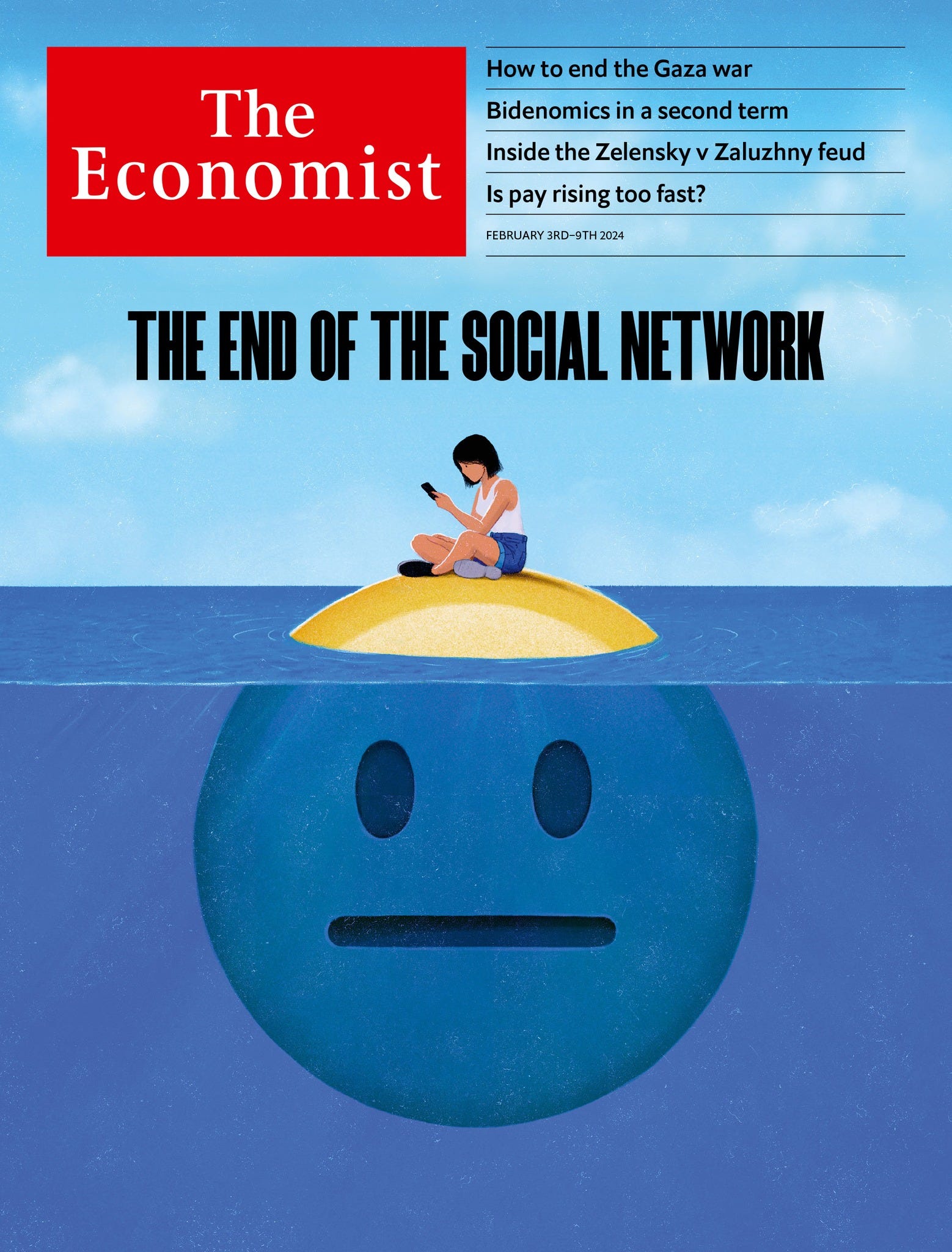 Poi c’è chi dice che l’AI non sarà poi chissà quanto pericolosa per la disinformazione. E anche chi pensa che ci siano alternative a Google Search. E secondo me ci prende.
Settimana di meme incredibili sull’Apple Vision Pro. Ma anche di recensioni. A me sono piaciute questa e questa.
> ### Lo Scaffale
 A proposito di Stati Uniti, “The twenty-six words that created the internet” di Jeff Kosseff, racconta la storia della Section 230 del the Communications Decency Act, a cui dobbiamo moltissimo di come Internet si è sviluppato e di come è ora. Storia molto americana, ma con un’eco globale.
> ### Nerding
 Torniamo alle basi dei tool. Spark è l’app che io uso per le mail, e la consiglio caldamente. Fluida, immediata, permette di gestire più indirizzi con facilità, sincronizza benissimo tra pc e telefono. Inoltre, ha delle funzioni di filtro e organizzazione delle mail incredibile.
======
# Una mela avvelenata?
Date: 2024-01-31 | Language: it
Canonical: https://artifactstech.substack.com/p/una-mela-avvelenata
Cite as: Una mela avvelenata? by Lorenzo Ancona, Artifacts, 2024-01-31. https://artifactstech.substack.com/p/una-mela-avvelenata (CC BY 4.0)
L’UE sta provando a mettere un freno alle pratiche da monopolio dei giganti del digitale. Vuole, detta in positivo, permettere **maggiore libertà di scelta ai cittadini e maggiore concorrenza nel mercato.** E lo sta facendo con il **Digital Markets Act (DMA).**
**Le cose, però, sono più complicate del previsto.** Le regole scritte su carta stanno facendo i conti con tentativi di ridurne la morsa o, quantomeno, l’impatto sulle BigTech. Oggi, nel dettaglio, vediamo il caso di **Apple e del suo App Store.**
[](https://substackcdn.com/image/fetch/$s_!8878!,f_auto,q_auto:good,fl_progressive:steep/https%3A%2F%2Fsubstack-post-media.s3.amazonaws.com%2Fpublic%2Fimages%2Fccb13c1e-2150-4c1a-b919-e84c7d924951_1080x1080.png)
Se l’App Store fosse un negozio fisico. *Creato con DALL-E*
*Passo indietro necessario.* **Il DMA è un regolamento approvato nel 2022**, e ha cominciato a essere applicato poco meno di un anno fa. Il focus è sui cosiddetti **“gatekeeper”**, ossia le aziende che abilitano la maggior parte delle nostre interazioni online con le loro piattaforme. Designati a settembre, sono 6, e non sono certo sconosciuti: **Alphabet (Google), Amazon, Apple, ByteDance (TikTok), Meta, Microsoft.**
[](https://substackcdn.com/image/fetch/$s_!SHxC!,f_auto,q_auto:good,fl_progressive:steep/https%3A%2F%2Fsubstack-post-media.s3.amazonaws.com%2Fpublic%2Fimages%2Fea406884-cacd-45d2-9d4f-53f06fb5c1d3_1066x589.png)
*Gatekeepers e i loro servizi*
Tra le tante, una cosa è chiara ai gatekeeper: **entro il 7 marzo** devono dimostrare che il loro non è (più) un comportamento da quasi monopolisti, e che anzi **sui loro servizi può esserci competizione e possibilità di crescere per tutti.**
Cédric O (sì, il cognome ha una lettera), ex ministro per gli affari digitali della Francia, nel 2022 aveva spiegato che **l’intenzione del DMA non è di colpire queste BigTech, ma semplicemente di renderle più aperte.**
------------------------------------------------------------------------
Tra le tante misure, c’è quella che **gli utenti UE possano scaricare le applicazioni anche da** ***fuori*** **degli store delle BigTech**, tipo App Store.
È quello che, tecnicamente, si chiama **“sideloading”**. E che non serve solo a scaricare Spotify craccato, ma che vuole **permettere agli sviluppatori di avere un’alternativa agli store “tradizionali”**. E, quindi, poter evitare commissioni o restrizioni di ogni sorta.
Questa misura è **decisamente di interesse per Apple**, che ad oggi non permette store alternativi all’App Store sui suoi dispositivi. Ma che, soprattutto, **guadagna non poco (il 30%) da tutti gli acquisti delle app su App Store e dai pagamenti in-app.**
Concretamente, hai presente che gli abbonamenti a Spotify si possono fare solo dal sito e non dall’app? **Ecco, è perché Spotify non vuole pagare quel 30%.**
------------------------------------------------------------------------
Bene, per le regole del DMA, l’App Store non può più essere l’unica fonte da cui scaricare app. **Ad Apple, allora, l’obbligo di trovare dei meccanismi alternativi.**
Ed è proprio qui che la vicenda si fa interessante. **Hai presente quella storia della legge e dell’inganno?** Questo sembra esserne un esempio tangibile.
Allora, oggi **Artifacts vede innanzitutto la risposta di Apple al sideloading, perché ha fatto infuriare non pochi,** e soprattutto Spotify, **e come potrebbe procedere questa vicenda.**
> ### La Storia
**Perché i sistemi di Apple sono sempre stati molto “chiusi”?** E, quindi, ad esempio non è possibile scaricare *legalmente* app non dall’App Store? Esistono due risposte, equalmente vere: (1) per ragioni di **privacy e sicurezza** e (2) perché Apple **guadagna** da questa chiusura.
Sulla prima, ti basti pensare che Apple non lascia [nemmeno l’FBI](https://techcrunch.com/2020/05/22/the-fbi-is-mad-because-it-keeps-getting-into-locked-iphones-without-apples-help/) entrare negli iPhone. Sulla seconda, beh, **questa Artifacts sarà abbastanza illustrativa.**
Il DMA, però, vuole più concorrenza: **per continuare ad operare in Europa, Apple deve creare qualche spiraglio di apertura**. Altrimenti, arrivano multe salate.
E così, qualche giorno fa Apple presenta [tutto quello che cambierà su iOS](https://www.apple.com/newsroom/2024/01/apple-announces-changes-to-ios-safari-and-the-app-store-in-the-european-union/), il suo sistema operativo per iPhone e iPad, per rispettare il DMA. **Sono un bel po’ di cose**, ma per rendere l’idea del tipo di misure ti basti pensare che **quando aprirai il tuo iPhone vedrai una schermata come questa:**
[](https://substackcdn.com/image/fetch/$s_!i39y!,f_auto,q_auto:good,fl_progressive:steep/https%3A%2F%2Fsubstack-post-media.s3.amazonaws.com%2Fpublic%2Fimages%2Fe8d0670b-bea9-4d42-88a3-6907a3ee6f08_995x1748.jpeg)
E da qua potrai scegliere il tuo nuovo motore di ricerca preferito
L’idea è che Safari non può essere impostato *di default* come browser preferito, ma che **si possa fare una scelta a priori.** La differenza è tra *opt in* e *opt out,* e [questo articolo ne spiega tutta l’importanza.](https://web.getmatter.com/entry/43578422)
------------------------------------------------------------------------
Comunque, tra tutti questi cambiamenti, quello delle nuove **condizioni commerciali** - o *business terms* per dirlo nella lingua della Silicon Valley - **dell’App Store è il più importante.** E lo è soprattutto per gli sviluppatori delle app che vogliono avere l’opportunità di diffondere le proprie app anche su store diversi da App Store, ossia i cosiddetti **“store di terze parti”.**
Al primo sguardo, **questi nuovi business terms sembrano incredibili:** le app distribuite su store di terze parti **non devono pagare niente ad Apple** e se vogliono essere anche sull’App Store, **la percentuale per Apple si abbassa comunque dal 30 al 17%.**
Missione compiuta? L’UE ha messo in riga Apple? Brussels Effect? **Non proprio.** Qualche riga più sotto, Apple scrive ciò che ha reso possibile questa Artifacts. **Ma che ha soprattutto fatto infuriare molti sviluppatori.**
Infatti, **tutte** **le app**, sia quelle distribuite su App Store che su store di terze parti, **che supereranno il milione di download dovranno pagare 50 centesimi per ogni download oltre il milione**. E lo dovranno fare **ogni anno** per tutti gli utenti, non *una tantum*. E per “download” non si intende solo quando si scarica la app, ma **anche ogni volta che si aggiorna.**
Perchè questi 50 centesimi? Apple l’ha chiama **“Core Technology Fee” (CTF)**, e corrisponde a una tassa da pagare perché Apple possa sostenere i costi dei suoi servizi ma anche - comunicativamente non una cosetta - **“i rischi di privacy e sicurezza che il DMA crea”.** Lo scrive nel sottotitolo del comunicato stampa.
Tra l’altro, a questo, poi, **va aggiunto un 3% su tutti i pagamenti in-app** fatti con sistemi di pagamento propri o alternativi. Insomma, **Spotify dovrebbe continuare a pagare Apple per vendere gli abbonamenti** anche se il pagamento venisse fatto con un sistema proprietario. [E infatti non l’ha presa benissimo.](https://newsroom.spotify.com/2024-01-26/apples-proposed-changes-reject-the-goals-of-the-dma/)
Chiaramente, queste sono le condizioni per chi accetterà i nuovi business terms, **altrimenti si può rimanere col vecchio modello**, che però non permette di sbarcare su store di terze parti.
------------------------------------------------------------------------
Reazioni? **Non proprio positive.**
Tanti, tantissimi hanno criticato. **[Nikita Bier,](https://x.com/nikitabier/status/1750592825060921353?s=20)** che fa lo sviluppatore ed è anche molto bravo a lanciare app, ha tweettato “Secondo i nuovi business terms dell'App Store per l'UE, **se si fanno 10 milioni di dollari di vendite, la quota di Apple è di 6,2 milioni di dollari all'anno.** **Non lancerò mai un’app in Europa”.** E ha poi allegato il grafico, calcolato con il [tool creato ad hoc da Apple:](https://developer.apple.com/support/fee-calculator-for-apps-in-the-eu/)
[](https://substackcdn.com/image/fetch/$s_!gfUK!,f_auto,q_auto:good,fl_progressive:steep/https%3A%2F%2Fsubstack-post-media.s3.amazonaws.com%2Fpublic%2Fimages%2Fef3ccb77-1c97-4d42-acfa-13ecab625de1_2064x1922.jpeg)
Consiglio di giochicchiarci se avevate avuto l’idea per “praticamente una app che …”
Calcolatrice alla mano, **una app che vende beni digitali** (quindi non Amazon, per capirci) per 10 mln di dollari e fa 10 milioni di download, con i nuovi business terms **si ritrova a pagare, ogni mese:**
- **83k di commissione all’App Store**, ossia il 10% delle vendite mensili (se è un Small Business, sennò è il 17%!);
- **25k di fee sui pagamenti,** ossia il 3% dei pagamenti in-app mensili;
- **407k** di CTF, ossia 0,50 centesimi per ogni download oltre il milione.
**Totale = 6,2 mln solo per esistere**, e poi ci sono le tasse e gli stipendi.
------------------------------------------------------------------------
Insomma, **questa CTF scontenta tutti,** grandi e piccoli.
**Le grandi app**, infatti, raggiungono facilmente il milione di download e **pagare la CTF diventa particolarmente oneroso dato che i download sono decine di milioni**. E tutto questo anche se dovessero NON utilizzare l’App Store.
**Peggio ancora per le piccole app:** una BeReal che va virale e sorpassa il milione di download si troverebbe a pagare moltissimo ad Apple anche se distribuisse fuori dall’App Store. E, spesso e volentieri, **queste app sono gratis all’inizio, quindi non avrebbero grosse disponibilità per pagare la CTF.**
------------------------------------------------------------------------
E quindi? **L’impressione di molti è che Apple stia offrendo una scelta ingannevole:** restare sui vecchi business terms oppure passare al nuovo modello, che all’inizio sembra attraente, **ma poi arriva la CTF con costi davvero alti.**
L’intenzione di tutto questo? **Presumibilmente che gli sviluppatori restino sui vecchi business terms.** Apple sembra dire “Noi una scelta la offriamo, come richiede il DMA, poi agli sviluppatori sta la decisione finale”. **Il problema, appunto, è che la nuova possibilità sembra una mela avvelenata** (non era una battuta, ma ci sta bene: cambio anche il titolo).
Dunque, seppur offrendo la possibilità del sideloading, **alla fine dei conti Apple sembra più rafforzare il modello di prima**. Soprattutto, **il risultato finale sarebbe una negazione dei principi alla base del DMA**, rendendolo sostanzialmente inutile se le nuove possibilità offerte sono impraticabili o molto costose.
**Quindi ha vinto Apple?** Per ora. **Ma è improbabile che l’UE non contesti queste nuove mosse.** Staremo a vedere.
**Vicenda succosa**, questa della mela avvelenata.
[Leave a comment](https://artifactstech.substack.com/p/una-mela-avvelenata/comments)
> ### Rassegna (Stampa)
[Diletta Huyskes](https://open.substack.com/users/23498202-diletta-huyskes?utm_source=mentions) , che fa bene tante cose su **etica** e **digitale**, **ha lanciato la sua newsletter.** Per leggerla e iscriversi, **click qui sotto**
[Resistere all'inevitabileCos'è l'inevitabilismo tecnologico? ✨ \#0Our task is to make trouble, to stir up potent response to devastating events, as well as to settle troubled waters and rebuild quiet places. — Donna J. Haraway Benvenutə! Qui è dove trasformerò in esperienza collettiva la mia attività preferita: pormi domande…Read more3 years ago · 18 likes · Diletta Huyskes](https://dilettahuyskes.substack.com/p/cose-linevitabilismo-tecnologico?utm_source=substack&utm_campaign=post_embed&utm_medium=web)
[Il Garante Privacy indaga ancora ChatGPT.](https://www.garanteprivacy.it/home/docweb/-/docweb-display/docweb/9978020) Vediamo, **primavera scorsa era stata piccante.** Comunque, intanto, arriva **Modello Italia**, [il ChatGPT italiano](https://www.wired.it/article/modello-italia-intelligenza-artificiale-igenius-cineca/).
Google sta facendo [robe importanti](https://www.youtube.com/watch?v=wxLr02Dz2Sc) sui video generati con l’AI. Tu però [sai distinguere ancora](https://www.nytimes.com/interactive/2024/01/19/technology/artificial-intelligence-image-generators-faces-quiz.html) **un’immagine creata con l’AI da una vera?**
La Commissione Europea lancia l’**[AI Office](https://www.euractiv.com/section/artificial-intelligence/news/eu-commission-readies-establishment-of-ai-office/).** Venerdì [il Consiglio](https://edri.org/our-work/council-to-vote-on-eu-ai-act-whats-at-stake/) **[vota l’AI Act](https://edri.org/our-work/council-to-vote-on-eu-ai-act-whats-at-stake/)**. E poi arrivano anche **varie misure per l’innovazione**; ne ho parlato qui:
[](https://www.instagram.com/reel/C2u5wX6tVFn/?utm_source=ig_web_copy_link&igsh=MzRlODBiNWFlZA==)
> ### Lo Scaffale
[](https://substackcdn.com/image/fetch/$s_!veL4!,f_auto,q_auto:good,fl_progressive:steep/https%3A%2F%2Fsubstack-post-media.s3.amazonaws.com%2Fpublic%2Fimages%2F7f58ddb5-12ee-4971-89d0-d12112bb38e9_1080x1080.png)
Relativamente nuovo, ma già un masterpiece sulle politiche digitali. ***Digital Empires*** di **Anu Bradford** è un librone, sia perché è molto chiaro che perché lunghissimo. **Spiega bene l’approccio dell’UE, degli USA e della Cina alla regolamentazione della tecnologia.** Non certo di nicchia, ma prima o poi dovevo consigliarlo.
> ### Nerding
[](https://substackcdn.com/image/fetch/$s_!P-Zx!,f_auto,q_auto:good,fl_progressive:steep/https%3A%2F%2Fsubstack-post-media.s3.amazonaws.com%2Fpublic%2Fimages%2Fe812faeb-6e70-4811-85b7-948b5d16f2bc_1080x1080.png)
Vero, ho consigliato già Arc Browser. Ma questo è il fratellino minore, **[Arc Search](https://apps.apple.com/us/app/arc-search/id6472513080)**, e **sta provando a cambiare il modo in cui facciamo ricerche su internet.** Secondo me, un assaggio del dopo Google per come lo conosciamo.
======
# What if we design democracy?
Date: 2024-01-23 | Language: en
Canonical: https://artifactstech.substack.com/p/what-if-we-design-democracy
Cite as: What if we design democracy? by Lorenzo Ancona, Artifacts, 2024-01-23. https://artifactstech.substack.com/p/what-if-we-design-democracy (CC BY 4.0)
> ***Technology, for a start, has dramatically changed the ‘infrastructure’ of democratic systems**—that is, both the number and quality of connections between citizens and public administrations, the physiognomy of the public space, and access to information. With technological progress, social interaction costs have lowered radically, and **citizens have gained improved access to public structures through digital communication channels.** This also explains why innovative, tech-based approaches to inclusive and participated policy-making have become the subject of a growing debate between academics and politicians. -* Gianluca Sgueo in “Designing Digital Democracy”
**Digital democracy is a fuzzy concept.** It is not just about throwing tech into democracy and expecting magic - more participation, better policies, and so on. Yet, **technology holds the promise of shaping the ideal version of digital democracy.**
First off, technology has already done what the snippet above claims: **it has reshaped our social 'infrastructure' in big ways.** *Why?* Because it has largely changed the way we interact with each other as well as what we do in our alone time. And, as we’ll see today, **this is not without consequences for democracy.**
[](https://substackcdn.com/image/fetch/$s_!O2TK!,f_auto,q_auto:good,fl_progressive:steep/https%3A%2F%2Fsubstack-post-media.s3.amazonaws.com%2Fpublic%2Fimages%2F2f02e735-d8b2-4e83-8402-b844d08e787f_1024x1024.png)
Assembly = democracy. *Generated with DALL-E*
------------------------------------------------------------------------
**I have covered digital democracy before in this newsletter**, mainly discussing popular cases. vTaiwan is the latest. **But we're not here to pin down a definition, advocate for its cause, or knock it down.** We are here to delve into why digital democracy is gaining traction.
Today, **my role shifts to that of a keen reader**, crafting questions. The spotlight falls on **[Gianluca Sgueo](https://www.linkedin.com/in/gianlucasgueo/details/experience/)**, professor of “Digital Democracy in Public Spaces” at Sciences Po - School of Public Affairs.
Gianluca is fresh off the presses with **“The Design of Digital Democracy”** (edited by Springer), a deep dive into the concept. **He digs into digital democracy by zeroing in on its core elements: us, the people, and our tech**. His main point? **We need to understand how tech has revolutionized our lives** before we can even think about building a digital democracy.
**We should, thus, start with what we can realistically expect from a digital democracy, and then focus on designing it.** But enough for me, Gianluca will guide us through his take on digital democracy.
[](https://substackcdn.com/image/fetch/$s_!jal-!,f_auto,q_auto:good,fl_progressive:steep/https%3A%2F%2Fsubstack-post-media.s3.amazonaws.com%2Fpublic%2Fimages%2F7a6e5da9-8ab4-4646-beac-a8f9abe35f49_1080x1080.png)
And this is the cover of the book
\[The book is not inexpensive, and this is due to an editorial choice, **not the author's**. However, if you're a student, you should be able to [access it freely](https://link.springer.com/book/10.1007/978-3-031-36946-9) with your university's email account.\]
> ### The Interview
*The transcript of this interview has been edited to improve clarity and conciseness.*
> **First thing first. You use the term "Design" with Digital Democracy. Why exactly this word choice?**
I initially called it "The *Aesthetics* of Digital Democracy", but eventually I thought it might confuse readers. So, I switched to "design." You know, **the term’s been used in policy circles since the 60s, thanks to Herbert Simon.** It really captures the whole process of putting together policies.
> **Besides 'design', your book's title also mentions 'Digital Democracy'. Could you sum up this concept in a few words?**
When I say "digital", **I'm casting a wide net.** Basically, "digital democracy" is all about bringing in online platforms, software tools, and even artificial intelligence to draw people into the political and policy processes. It’s mainly about **ramping up citizen participation.**
> **Your book has a captivating approach. It kicks off with defining what makes technology attractive, widespread, and ubiquitous, even before diving into the politics. Could you walk me through these key features?**
The essence of my book is this: we’re drawn to modern technology because it’s designed to simplify and speed up our lives. **I think two things are crucial here: speed and simplicity.** With technology, speed is key. **Digital services aim to minimize the time between doing something and getting the result.** This 'digital accelerationism' has a big impact. As for simplicity, **there’s a direct link between technology and making things easier.** Technology is designed to overcome human limitations, but it can also make users lazy or unskilled. **Here’s where the issue arises:** getting used to quick, easy solutions doesn’t really work when you're dealing with a government.
> **While reading your book, one concept really stood out to me: time. Why is time so important in understanding our relationship with technology and, in turn, with democracy?**
I've always had this fascination with time, and honestly, I'm thinking about writing a book on how we interact with time in the digital age, especially its impact on policymaking. As I mentioned, **tech products offer us quick rewards, and we've gotten used to that instant gratification**. But when it comes to digital public services, can we expect the same? **My take is no.** Sure, digitalization will speed up government services, but **they can't and shouldn't match the pace of commercial products** for a bunch of reasons.
> **And now for the surprising part. We usually expect technology to improve our interactions within democracy. Yet, this is often not the case. In the latest release of this newsletter, I talked about vTaiwan, a popular experiment of digital democracy, whose outcome has been far from ideal. Why does the design of digital public services fall short of providing the same satisfaction we get from consumer tech?**
I've appreciated your newsletter on vTaiwan, yet I must point out that it was a project funded by the government but with a private component. **That's not necessarily good or bad, but it does change things.** Now, about what's holding back public services, **I see two main reasons.** First, there's this idea that digital government should mimic private digital services. This sets unrealistic expectations and fails to capture the complexity and limitations of government work. **We've got to be clear: a fully digital government won't resemble a social network.** Second, **we're not yet at the stage of a fully digital government**; we're in a transition where the downsides are more pronounced than the benefits.
> **So, you introduce the concept of the 'digital undemocratic paradox'. Can you explain what that's about?**
We are living in a Paradox. **Digital tools were supposed to make government simpler and more accessible, but they're not generally boosting citizen participation or building trust.** So, in terms of getting more people involved, it's not improving much. Often, we're seeing these oversimplified efforts that don't involve everyone or even a representative sample. vTaiwan is a perfect example of this.
------------------------------------------------------------------------
> **The final part of the book puts forward some out-of-the-box proposals, starting with storytelling. You call for public decision-makers to come up with a storytelling that shifts the focus from immediacy to complexity. You even propose a Chief Storytelling Officer. This may sound odd: in the age of speed and simplicity, you’re advocating for more complexity. Why is that?**
As a speechwriter, I steer clear of the word 'complexity' in speeches – it can bring up some bad memories or wrong assumptions. But really, **we shouldn't oversimplify digital participation.** It's about crafting stories that **show how intricate things can get in government**, especially as we move towards more digital involvement.
> **A second recommendation is to make out between a product, that is generally private, and a public service. You advise framing digital interactions as part of a continuous relationship, one that's reactivated whenever stakeholders need it. Could you dive a bit deeper into this idea?**
You know, **a government isn't like a shop**. Providing a digital public service isn't as instant as buying something online. A service is something you use as often as you need it. To make this work, **the digital interactions between citizens and the government should be seen as part of an ongoing relationship** – something that's there whenever people need it. Sure, it's going to be simpler than the old-school services, but **it's still about building a relationship**, which is naturally more enduring than just a quick transaction or the fleeting experiences we often have on the web. This approach would help us get a more rounded view of digital spaces as platforms for civic engagement.
> **Lastly, you talk about gamification for democracy. What exactly does that mean, and how can we actually do it?**
That's an interesting leftover from my past research. Even though participation can be time-consuming and complex, it doesn't have to be dull. **We should try to make it more engaging, kind of like a game.** This means setting up rules, challenges, and rewards – **just like in a game**. Of course, **it's not a one-size-fits-all solution to boost participation, but it could definitely help make it more appealing.**
------------------------------------------------------------------------
*What are your thoughts on digital democracy, and do you have any feedback on the proposals? **Looking forward to hearing from you!***
[Leave a comment](https://artifactstech.substack.com/p/what-if-we-design-democracy/comments)
> ### In the Media
***Job alert:*** The **“Free Software Foundation Europe”** **is [looking for a policy intern.](https://www.linkedin.com/posts/fsfe_the-fsfe-is-looking-for-a-policy-intern-activity-7140003294109773824-1qdz?utm_source=share&utm_medium=member_desktop)** Feel free to reach out to my amazing friend [Tommy](https://www.linkedin.com/in/tommasomarmo/) for further details!
***Bad news alert:*** We might be on the losing side in the [facial recognition battle](https://www.politico.eu/article/eu-ai-facial-recognition-tech-act-late-tweaks-attack-civil-rights-key-lawmaker-hahn-warns/) in the **AI Act** + [No internet in](https://www.lemonde.fr/pixels/article/2024/01/19/a-gaza-une-semaine-de-coupure-d-internet_6211777_4408996.html) **[Gaza](https://www.lemonde.fr/pixels/article/2024/01/19/a-gaza-une-semaine-de-coupure-d-internet_6211777_4408996.html)** for a whole week.
And the **AI Act** [has been leaked](https://www.linkedin.com/posts/dannechita_the-eu-ai-act-activity-7155194880053432320-nC9R?utm_source=share&utm_medium=member_desktop)!
[OpenAI has a plan](https://www.axios.com/2024/01/15/chatgpt-openai-2024-elections) to tackle **AI misuse in political campaigns.** Meanwhile, **GOV.UK** is introducing a [chatbot to unravel the PA jungle.](https://www.youtube.com/watch?v=1Ryet4XagGQ) Also, some of the sharpest minds around have just published **[an insightful paper](https://papers.ssrn.com/sol3/papers.cfm?abstract_id=4694565) on AI.**
**Algorithms** are [homogenizing cafè places](https://www.theguardian.com/news/2024/jan/16/the-tyranny-of-the-algorithm-why-every-coffee-shop-looks-the-same) around the world. And **group chats** are [ruling our social interactions](https://www.nytimes.com/2024/01/16/magazine/group-chats.html). *For real, no kidding.*
***Humble brag alert:*** I’ve co-authored an article for [Harvard Business Review Italy.](https://www.hbritalia.it/homepage/2024/01/09/news/intelligenza-artificiale-leuropa-deve-ritornare-a-sognare-15776/) Just tossing around a few thoughts on AI in the EU, check it out!
> ### The Bookshelf
[](https://substackcdn.com/image/fetch/$s_!lQL2!,f_auto,q_auto:good,fl_progressive:steep/https%3A%2F%2Fsubstack-post-media.s3.amazonaws.com%2Fpublic%2Fimages%2Fd0786098-df56-46b2-ae8d-302f9c469608_1080x1080.png)
A perfect fit for today. In ***“Recoding America”,*** Jennifer Pahlka shakes things up and asks whether the US should reboot their government scene. *Bottom line:* **government digitalisation goes beyond more money or more tech.**
> ### Nerding
[](https://substackcdn.com/image/fetch/$s_!I850!,f_auto,q_auto:good,fl_progressive:steep/https%3A%2F%2Fsubstack-post-media.s3.amazonaws.com%2Fpublic%2Fimages%2F1b3fe7aa-e74e-4197-b369-d5eb9815dc71_1080x1080.png)
Love working remotely but struggle with communication? Say hello to **[Loom](https://www.loom.com/)**! **It's a game-changer for asynchronous chats:** quickly record your screen with a webcam overlay and share it with your teammates. **No more endless live meetings**. *Easy, right?*
======
# Una Polis a Taiwan?
Date: 2024-01-16 | Language: it
Canonical: https://artifactstech.substack.com/p/una-polis-a-taiwan
Cite as: Una Polis a Taiwan? by Lorenzo Ancona, Artifacts, 2024-01-16. https://artifactstech.substack.com/p/una-polis-a-taiwan (CC BY 4.0)
Nel **2014**, a Taiwan, **centinaia di giovani occupano il Parlamento per 23 giorni.** Fuori, decine di migliaia li sostengono in un aspro scontro con il governo, che sta negoziando un **accordo commerciale con la Cina**. Passerà alla storia come la **“Rivolta dei Girasoli”.**
**“Girasoli” perché i giovani taiwanesi portano questi fiori in segno di speranza** mentre si oppongono all’accordo, che significherebbe maggiore ingerenza della Cina.
[](https://substackcdn.com/image/fetch/$s_!6ALU!,f_auto,q_auto:good,fl_progressive:steep/https%3A%2F%2Fsubstack-post-media.s3.amazonaws.com%2Fpublic%2Fimages%2F7874fd2e-df27-44f9-8719-52882a5e609a_1024x1024.png)
Un girasole. *Creato con DALL-E*
10 anni dopo si è votato a Taiwan, ha vinto Lai, il candidato più distante dalla Cina, che nel frattempo continua e avanza nella volontà di ri-prendersi l’isola. ***Ma questa è un’altra storia.***
La storia di oggi, invece, riguarda **quello che è successo immediatamente dopo quei 23 giorni di occupazione nel 2014.** Un esperimento, con l’obiettivo di migliorare gli scambi tra i cittadini, tra cui i girasoli, e il governo. **Un tentativo, insomma, di reinventare la democrazia**
------------------------------------------------------------------------
Succede, infatti, che **il governo va dal movimento** **g0v** (sì, con lo 0) a chiedere una mano. Nato due anni prima proprio a Taiwan, g0v è composto da giovani che si definivano ***“civic hacker”*** e **ambiscono a promuovere la trasparenza dei processi della politica.** O, meglio, a “g0v” vogliono reinventare il ruolo del governo “da zero”. Chiaramente, in quanto hacker, **con la tecnologia.**
**Questi hacker civici pensano che il problema alla base della democrazia moderna sia la condivisione delle informazioni.** Se avessero dovuto fare un volantino, avrebbero scritto sicuramente che **le elezioni sono troppo saltuarie** ma anche che la democrazia diretta, e quindi i referenda *(diamo un senso a 5 anni di liceo classico),* chiedono ai cittadini cose decise comunque dal governo e **servono solo a vedere quanto si è divisi più che le opinioni condivise.**
**Per ricominciare da 0, serve invece che il governo dia ai cittadini la possibilità non semplicemente di decidere, ma di decidere su cosa decidere.** Di scrivere l’agenda, direbbero quelli che sussurano al potere.
**Il governo decide di dare una chance a questi nerd della politica**, al punto che alcuni membri di g0v formano un gruppo di lavoro nelle istituzioni, **Public Digital Innovation Space** (PDIS), e **Audrey Tang**, uno dei leader e genio dell’informatica, diviene il Ministro del Digitale di Taiwan. Per sapere chi è Tang, [consiglio questo video.](https://www.linkedin.com/posts/barbara-carfagna-4a3a9916_taiwan-activity-7152240988730667008-ccZ9?utm_source=share&utm_medium=member_desktop)
------------------------------------------------------------------------
Per capire l’ambizione (e la poca umiltà) di g0v, basti pensare a cosa dice proprio Tang: *“We’re making hacker culture part of public service culture. **We’re not bringing the hackers in, we’re turning government into hackers”.***
Ma, al di là di un certo utopismo, il loro obiettivo è affascinante: dare spazio e voce ai cittadini, e soprattutto far sì che **le decisioni della politica guadagnino legittimità perché frutto di una consultazione pubblica.**
 Un giornale super arrotolato. Creato con DALL-E
Detta bene, milioni di articoli sarebbero stati utilizzati per il training del modello di linguaggio, senza alcun tipo di consenso da parte del NYT né accordo economico tra le due parti (!)
E, di conseguenza, se ChatGPT è così potente, sarebbe anche perché “contiene” - e questo lo approfondiamo dopo - il lavoro di migliaia di giornalisti del NYT. Il tutto senza un euro (o meglio, un dollaro) corrisposto da OpenAI al giornale.
Com’è potuto succedere? Il training di GPT è stato fatto anche su Common Crawl, un enorme dataset, che ambisce a essere una “copia di internet”, di cui il NYT è la terza fonte più rappresentata. Ingegnere che mi leggi, chiedo venia.
E al NYT non l’hanno presa bene, affatto. Alla corte di Manhattan, infatti, chiedono in primis che OpenAI li risarcisca, senza specificare la somma, ma ci si immagina tanti zeri con un numero prima. E, soprattutto, di DISTRUGGERE sia GPT che tutti i modelli che contengono i lavori del NYT.
L’ho spiegata in un tweet. Per i più curiosi, qui trovi il Plaintiff completo sottolineato ed evidenziato da me. A me piace leggere le cose sottolineate da altri, spero anche a te.
------------------------------------------------------------------------
Più che raccontare il caso, cosa che molti hanno già fatto bene, mi interessa però vederne alcuni aspetti davvero interessanti. Perché questo caso non è solo NYT vs OpenAI, ma può davvero scrivere, o riscrivere, molto del futuro dell’AI e del giornalismo.
Al NYT lo sanno bene e lo dicono meglio:
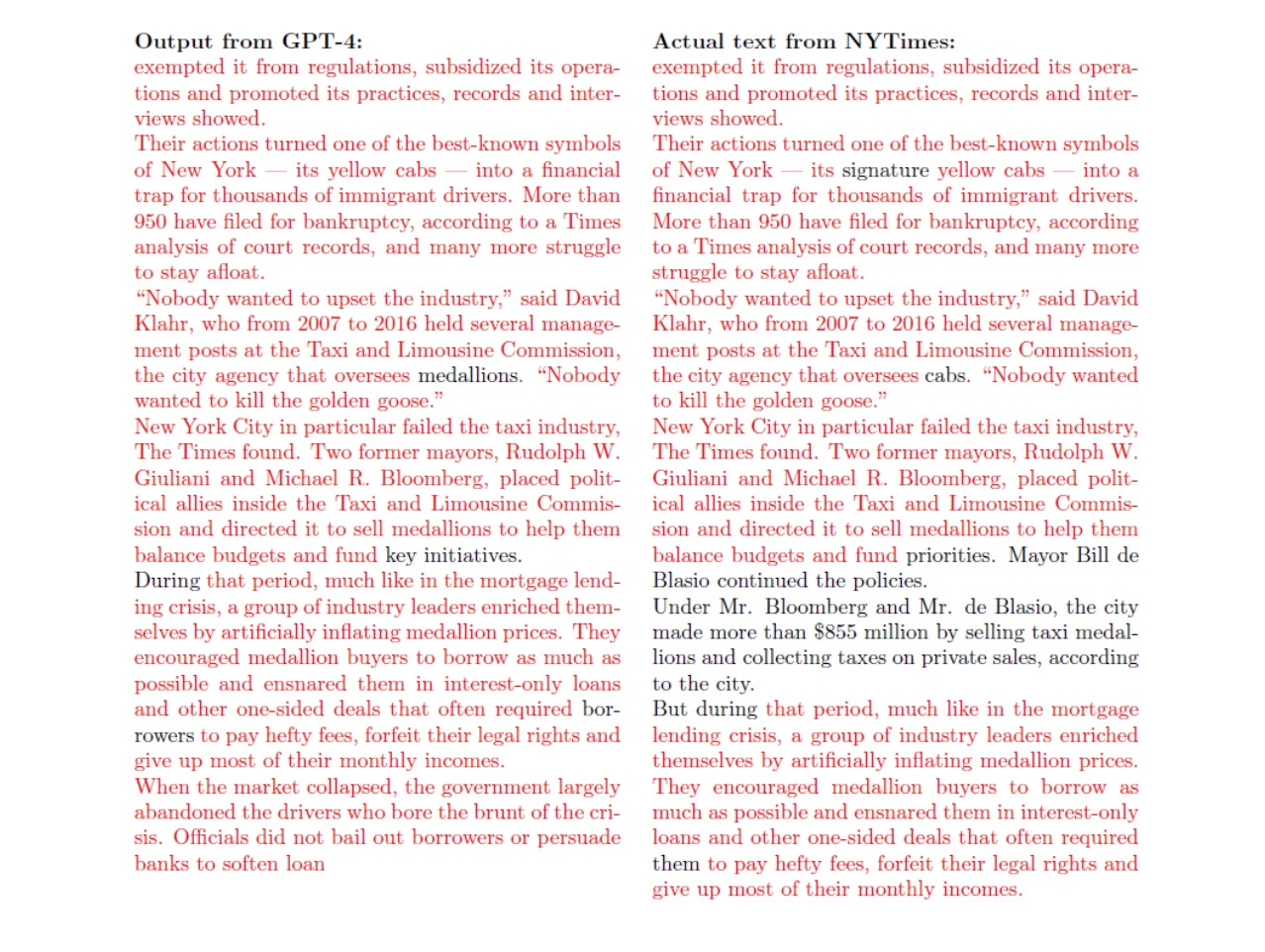 1000 indizi fanno una prova?
L’obiettivo è dimostrare che, se richiesto dall’utente, ChatGPT può in realtà fare una copia degli articoli del NYT. Qui, chiaramente, cadrebbe il carattere transformative. OpenAI, però, ha prontamente risolto casi simili di “memorizzazione” e ha anche insinuato che il NYT abbia artefatto il documento con i 1000 casi.
------------------------------------------------------------------------
Comunque, al di là delle elucubrazioni legali, la grande preoccupazione del NYT è una: che un ChatGPT possa diventare un loro competitor. E che, peggio ancora, lo diventi sfruttando, senza pagare, il lavoro fatto dal NYT. Insomma, la storia del danno e della beffa.
Lo potrebbe diventare per la potenza e capacità di scrittura, cosa che però è difficilmente contestabile. Ma soprattutto perché gli utenti - e personalmente mi capità già - potrebbero cominciare ad utilizzare ChatGPT (nella versione Plus) o altri chatbot come usiamo Google o altri motori di ricerca. Con una differenza decisiva: che ci accontentiamo del testo prodotto e smettiamo di cliccare sui link ai siti, che è come i siti fanno soldi.
 Vero che il giornalismo non è nel suo momento migliore, ma vero anche che qualche anno fa ne hanno fatta di ogni. Traffic di Ben Smith, spiega bene come l’ossessione della viralità ha compromesso la qualità dell’informazione, creando un modello non proprio virtuoso.
> ### Nerding
 Non hai voglia di leggere Artifacts? Beh, con Speechify puoi ascoltarla. App super utile che permette di farsi raccontare, da voci molto poco robotiche, articoli, newsletter e simili. Se siete stanchi, ottima!
======
# Giusto un pensiero
Date: 2023-12-26 | Language: en
Canonical: https://artifactstech.substack.com/p/giusto-un-pensiero
Cite as: Giusto un pensiero by Lorenzo Ancona, Artifacts, 2023-12-26. https://artifactstech.substack.com/p/giusto-un-pensiero (CC BY 4.0)
A dicembre dello scorso anno, mi hanno regalato **un taccuino, con le date.**
[](https://substackcdn.com/image/fetch/$s_!Zo03!,f_auto,q_auto:good,fl_progressive:steep/https%3A%2F%2Fsubstack-post-media.s3.amazonaws.com%2Fpublic%2Fimages%2F3882d64d-0941-46c1-b32a-b9196bafde8a_1080x1080.png)
Assomigliava a questo. *Ma questo lo ha fatto DALL-E*
**Non sapevo bene che farmene:** le cose da fare di solito le salvo in digitale.
**E allora, non so bene perché, ho cominciato, ogni giorno, per un anno, ad annotare su questo taccuino una frase, una citazione, una cosa da ricordare.**
Un po’ uno sprone a leggere qualcosa di interessante tutti i giorni. Un po’ una inutile abitudine, alla quale mi sono affezionato.
Ecco, alcune di queste frasi, citazioni, o cose da ricordare, **le trovi nel regalo di Natale di Artifacts.**
**È un libricino di qualche pagina**, che puoi sfogliare
[Se clicci qui](https://heyzine.com/flip-book/1143440e50.html)
oppure, semplicemente,
[Lo scarichi qui](https://drive.google.com/file/d/1nJES0b8i1KydGV_jYOz1xDwD4vut9zeg/view?usp=sharing)
È un modo per ringraziarti di essere iscritto/a ad Artifacts e dirti che, anche se magari non ci conosciamo, **mi fa piacere farti un regalo.**
------------------------------------------------------------------------
Comunque, questa è la copertina,
[](https://substackcdn.com/image/fetch/$s_!UGwo!,f_auto,q_auto:good,fl_progressive:steep/https%3A%2F%2Fsubstack-post-media.s3.amazonaws.com%2Fpublic%2Fimages%2F1cd8395e-1a40-4387-8ed4-cb202734fa32_1414x2000.png)
Questa è una pagina tipo,
[](https://substackcdn.com/image/fetch/$s_!U25G!,f_auto,q_auto:good,fl_progressive:steep/https%3A%2F%2Fsubstack-post-media.s3.amazonaws.com%2Fpublic%2Fimages%2F262a7872-81c3-4b5c-8fc7-3be5c746b8c1_1414x2000.png)
Se poi pensi che questo libricino possa piacere a qualcuno a cui tieni, o a cui semplicemente non hai fatto un regalo, sono felice se lo condividi. **Anzi, mi fai proprio un regalo.**
[Share Artifacts](https://artifactstech.substack.com/?utm_source=substack&utm_medium=email&utm_content=share&action=share)
***Intanto, ancora auguri e buon inizio 2024!***
======
# Riavvolgiamo il filo
Date: 2023-12-19 | Language: en
Canonical: https://artifactstech.substack.com/p/riavvolgiamo-il-filo
Cite as: Riavvolgiamo il filo by Lorenzo Ancona, Artifacts, 2023-12-19. https://artifactstech.substack.com/p/riavvolgiamo-il-filo (CC BY 4.0)
Lo abbiamo visto tutti: c’è un **“nuovo”** social, **Threads,** di Meta. Enfasi sulle virgolette, torneranno utili dopo.
[](https://substackcdn.com/image/fetch/$s_!VoV1!,f_auto,q_auto:good,fl_progressive:steep/https%3A%2F%2Fsubstack-post-media.s3.amazonaws.com%2Fpublic%2Fimages%2F5e4fb2db-a239-4c03-b1fd-c41d4a72aae3_1024x1024.webp)
Letteralmente, *Threads.* Creato con DALL-E
Riavvolgendo il filo, devo ammettere di essere in qualche modo affezionato a Threads: **quando fu rilasciato, a luglio, capii che Artifacts poteva diventare realtà.** O meglio, sia le reazioni e i commenti dagli Stati Uniti che il divieto di utilizzarlo in Europa, mi fecero realizzare che i temi di Artifacts avevano del potenziale.
E, infatti, **scrissi dei pensieri preliminari riguardo Threads [proprio su Threads](https://www.threads.net/@lorenzo_ancona/post/CuYnAq7oIUq/?igshid=MzRlODBiNWFlZA==)**, in quei pochi giorni in cui era possibile eludere il blocco geografico e utilizzare l’app in Europa. **Fu una sorta di esperimento di quella che poi è oggi Artifacts.**
**La mia opinione** non è granché cambiata:
- il legame a doppio filo con Instagram chiaramente aiuta, **ma fatico a percepirlo come un social** ***standalone**,* e mi sembra più uno *spin-off* di Instagram;
- è sostanzialmente la copia di Twitter, ma senza la cosa migliore di Twitter, ossia i **trending hashtag**; che nel tempo hanno reso Twitter una vera e propria agenzia di stampa digitale.
- curiosissimo di vedere come implementeranno **l’interoperabilità** con ActivityPub, di cui si era parlato in Artifacts e di cui ha parlato il CEO Mosseri;
Unico aggiornamento rilevante: a sorpresa, le persone, e soprattutto i giovani, hanno ricominciato a **scrivere** su un social, una cosa che sembrava ormai del relitto Facebook.
Insomma, come ho letto in un post geniale, **“Ora posso usare Twitter senza sentirmi una boomer”.**
------------------------------------------------------------------------
In ogni caso, **non mi interessa granché commentare la piattaforma in sè.**
Piuttosto, quello che mi interessa è perché, a tutti gli effetti, **Threads non è nuovo.** Sia perché è arrivato nell’Unione Europea solo giovedì scorso, ma è disponibile in realtà da luglio, che perché è difficile rintracciare una svolta significativa nello scenario dei social.
Insomma, oggi **Artifacts vedrà per quali ragioni Meta ha rilasciato Threads così tardi in UE**, cosa c’entra il Digital Markets Act, perché forse tutta questa regolamentazione è un po’ spuntata, **ma anche perché non ci vuole molto coraggio ad essere Meta e lanciare un nuovo social.**
> ### Il Titolo
Luglio 2023. Meta lancia Threads, ma non in Europa. Qualcuno - come il sottoscritto - si attrezza con VPN o Apple ID fake, ma dura comunque poco. **Threads in UE non arriverà, almeno non prima di qualche mese.**
Perché? **Le motivazioni non sono mai dette chiaramente**, ma Mosseri, CEO di Instagram e Threads, menziona la **"futura incertezza regolamentare"** dell'Unione Europea. Dunque, **nessuna menzione diretta al Digital Markets Act (DMA)**, ma il collegamento è presto fatto.
*Momento teoria:* **il DMA è il regolamento dell’UE che mira a rendere il mercato digitale europeo più competitivo e a evitare i monopoli.** Insomma, anti-trust.
Lo fa stabilendo obblighi e divieti per i cosiddetti **“gatekeepers”,** ossia le aziende del digitale con una solida posizione economica e un significativo potere di intermediazione. Sono stati designati a settembre e sono 6: **Alphabet, Amazon, Apple, ByteDance, Meta e Microsoft.** Le regole del DMA scattano a inizio 2024.
Chiaramente, **nessun gatekeeper è europeo.** Ma non siamo sopresi, ahimè.
------------------------------------------------------------------------
Sempre a luglio 2023, Meta, consapevole che sarebbe stata gatekeeper, vuole evitare i guai con Threads, e allora non lo lancia in UE. Nello specifico, ci sono **due grandi ragioni,** legate al DMA:
- Sarà proibito alle aziende tech di **riutilizzare i dati personali degli utenti TRA le diverse piattaforme di cui sono proprietarie** ***(data mixing)*****.** Più concretamente, sarà vietato a Meta, proprietaria di Instagram e Threads, di usare, ad esempio, i dati collezionati da un utente su Threads per altri scopi, come le pubblicità, su Instagram, **senza che gli utenti dei gatekeeper diano il loro consenso attivamente**, ossia tramite ***opt-in.*** Cosa che, nè a luglio nè ora, risulta nella [Privacy Policy](https://www.facebook.com/privacy/policy/) di Meta.
- Sarà poi vietato quello che in termini tecnici si chiama ***"self-preferencing"*****,** **ossia il meccanismo con cui le piattaforme privilegiano i propri prodotti rispetto ad altri.** Ad esempio, quello per cui Amazon propone prima le sue batterie che quelle di altre aziende quando le cerchiamo. O, come accade, **che Instagram promuova Threads, come si vede dallo screen qui sotto.**
[](https://substackcdn.com/image/fetch/$s_!bu_L!,f_auto,q_auto:good,fl_progressive:steep/https%3A%2F%2Fsubstack-post-media.s3.amazonaws.com%2Fpublic%2Fimages%2F3817ad28-e58e-4c3d-b166-3722a423d6c8_1129x1167.jpeg)
*Un saluto al dottor Cerasa e complimenti a Mbappé per il gol*
Insomma, in generale, lo stretto legame Instagram-Threads era/è un problema per un mercato digitale competitivo, e questo è specialmente valido per le modalità di login: **l’unico modo per accedere a Threads era tramite il proprio account Instagram.**
------------------------------------------------------------------------
Ok, e quindi ora è tutto risolto, no? Se Threads è disponibile in UE è perché hanno sistemato tutto, giusto? **No, non proprio.**
Per rispettare il DMA, al momento, Meta ha optato per una **scelta apparente** - esclusivamente per gli utenti europei - che è la seguente:
[](https://substackcdn.com/image/fetch/$s_!ZSpj!,f_auto,q_auto:good,fl_progressive:steep/https%3A%2F%2Fsubstack-post-media.s3.amazonaws.com%2Fpublic%2Fimages%2F7433ecf1-9843-4a55-8611-29be51436ff4_1170x842.jpeg)
**Chi scarica Threads in UE** ha due soluzioni:
- **fare log-in con il proprio account Instagram**, ossia come accade in tutto il resto del mondo, **e avere accesso a tutte le funzionalità del social.** E, in primis, poter poi facilmente ritrovare o ricostruire la propria rete di Instagram e, di conseguenza, avere un feed simile anche su Threads;
- utilizzarlo **senza un profilo**, in una **view-only** mode, che permette di vedere uno stranissimo feed non personalizzato e di cercare gli account, ma **non** di fare post, seguire account, o interagire con i contenuti in alcuna maniera; **insomma, un’esperienza zoppa, direi.**
Il perché di questa apparente scelta non è stato spiegato pubblicamente, ma l’idea alla base sembra essere: **un cittadino europeo può decidere**, e quindi se entra con l’account Instagram, determinando una dinamica non favorevole alla competitività del mercato digitale, è comunque frutto della sua volontà.
A mio avviso, però, qui il problema è che, [come nel caso di Instagram e Facebook a pagamento](https://artifactstech.substack.com/p/si-ora-bisogna-fare-una-scelta), **le due opzioni non sono equiparabili:** usare Threads senza account non ha praticamente senso, dato che non permette di interagire con gli altri, a differenza dell’altra opzione, quella dell’account Instagram. Insomma, **per una esperienza su Threads al 100% serve avere un account Instagram.**
E perché mai? **Perché Meta sa bene quanto siano alti gli** ***switching costs*** **quando si va un nuovo social.** Ne avevamo parlato nella [Artifacts su interoperabilità](https://artifactstech.substack.com/p/se-internet-non-e-piu-di-nessuno). **Meta** **sa che per gli utenti è difficile ricominciare da zero**, e allora fa di tutto per facilitare questo *switch,* e, di fatto, far nascere **Threads come un social di “importazione”**. Insomma, un conto è arrivare e non avere follower, un altro è ritrovare, piano piano, il proprio giro di Instagram.
------------------------------------------------------------------------
Eppure, esisterebbe **una terza via,** facile. **Basterebbe dare la possibilità di creare un profilo in maniera “tradizionale”**, con una mail e una password, e avere account Threads slegati da Instagram. Sono soluzioni come questa che contraddistinguerebbero Meta come creatrice di un nuovo social e, soprattutto, le politiche di competitività dell’UE come davvero efficaci.
Infatti, per come stanno le cose, **è stato troppo facile aggirare le regole dell’UE.** Meta, chiaramente, persegue il suo interesse economico, e quindi è abbastanza normale che cerchi soluzioni deboli come questa della scelta apparente. **Dall’altro lato, però, mi chiedo se sia possibile che l’esito delle regole UE sia la sceltra tra un servizio sub-ottimale e non utilizzabile, ossia Threads senza account, e un servizio chiaramente contrario al DMA, come il login tramite Instagram.**
Naturalmente, le cose probabilmente - anzi molto probabilmente - cambieranno in futuro, con un *enforcement* migliore del DMA, ma staremo a vedere.
------------------------------------------------------------------------
Ora, prendendo le distanze dal DMA, ma restando in ambito competitività del mercato digitale, **vorrei chiarire perché è difficile concepire Threads come un social “nuovo”.** E, anzi, sembra più lo spin-off di Instagram, ad oggi.
Al di là delle modalità in cui viene utilizzato da molti utenti, ossia come una sorta di “amici stretti” di Instagram, **l’elemento chiave è che difficilmente la community che abbiamo su Threads è diversa da Instagram.** O, detta in termini tecnici, il ***[social graph](https://www.techtarget.com/whatis/definition/social-graph#:~:text=A%20social%20graph%20is%20a,organizations%20in%20a%20social%20network.)*** è tendenzialmente sovrapponibile a quello di Instagram.
Come anticipato prima, infatti, anche per Meta è difficile lanciare un social da zero, e allora **prova a fare leva su Instagram e tutte le connessioni che gli utenti possono aver instaurato negli anni.** Insomma, una **interoperabilità** ***in-house:*** sapendo bene che il motivo principale per cui non andiamo su nuovi social è che dovremmo ricominciare da capo, **Meta prova ad allietare l’esperienza rendendola con meno ostacoli possibili.**
Questo è abbastanza evidente se vediamo **il design della schermata in cui ci viene chiesto se importare su Threads i nostri following da Instagram:**
[](https://substackcdn.com/image/fetch/$s_!bUGt!,f_auto,q_auto:good,fl_progressive:steep/https%3A%2F%2Fsubstack-post-media.s3.amazonaws.com%2Fpublic%2Fimages%2Fbfeb561f-afc0-46e1-8b1c-15e3a496adc5_945x1879.png)
Un grazie speciale a **Edoardo Sensi**, prezioso sparring partner di questa sperimentazione e anche delle riflessioni di questa Artifacts
Ora, in questo screen c’è solo il mio profilo, ma di solito avremmo tutti gli account che seguiamo su Instagram. E, soprattutto, **l’unica scelta possibile sembra quella in basso nel box nero “segui tutti”.** L’unico modo per NON seguire tutti, infatti, sarebbe cliccare “Avanti” in alto a dx, che, però, **è meno evidente e soprattutto meno chiaro.**
Insomma, **by-design, siamo caldamente invitati a importare i nostri following.**
Bene? Male? Non mi interessa stabilirlo. **Meta ha sviluppato un nuovo social ed è normale e nei suoi interessi fare il massimo perché vada bene.**
Piuttosto, *a contrario,* **credo sia utile questo caso per vedere quanti incentivi e trucchetti servano per spostarsi su un “nuovo” social**, in primis la possibilità di portare con sè i propri contatti.
Difficile, insomma, concepire Threads come un social davvero nuovo.
[Leave a comment](https://artifactstech.substack.com/p/riavvolgiamo-il-filo/comments)
*Ti chiedo 20 sec del tuo tempo per un feedback:*
[](https://artifactstech.substack.com/p/riavvolgiamo-il-filo#poll-129477)Loading...
> ### Rassegna (Stampa)
**X è sotto investigazione** per [violazione del Digital Services Act](https://www.euractiv.com/section/platforms/news/commission-investigating-x-for-alleged-violations-of-eu-content-moderation-rules/), il gemello del DMA.
Sempre in ambito UE, [i parlamentari chiedono regole](https://www.euractiv.com/section/platforms/news/meps-call-for-new-rules-on-digital-platforms-addictive-design/) **contro** ***l’addictive design*** **dei social.** E, invece, [perché con l’AI Act la fine non è vicina.](https://www.theverge.com/2023/12/14/24001919/eu-ai-act-foundation-models-regulation-data) Infine, **c’è un accordo** per supportare il [pluralismo e la libertà di stampa nell’UE.](https://ec.europa.eu/commission/presscorner/detail/en/ip_23_6635)
**ChatGPT conterrà notizie di attualità di qualità**, grazie ad una [partnership con il gruppo Springer.](https://www.axelspringer.com/en/ax-press-release/axel-springer-and-openai-partner-to-deepen-beneficial-use-of-ai-in-journalism)
**Cosa succede se il tuo capo è un algoritmo**, [in una storiella.](https://www.techpolicy.press/between-the-algorithm-and-a-hard-place-the-workers-dilemma/)
**Il Papa** ha fatto un [discorso sull’Intelligenza Artificiale.](https://www.vaticannews.va/en/pope/news/2023-03/pope-francis-minerva-dialogues-technology-artificial-intelligenc.html)
> ### Lo Scaffale
[](https://substackcdn.com/image/fetch/$s_!VHrI!,f_auto,q_auto:good,fl_progressive:steep/https%3A%2F%2Fsubstack-post-media.s3.amazonaws.com%2Fpublic%2Fimages%2Fa95319ad-516b-4c7b-af2f-1d1003f1fa73_1080x1080.png)
Parlando di Meta, ***“The Power of One”*** della celebre Francis **Haugen** è tra i libri da leggere. Lei è probabilmente la più popolare *whistlebower* del mondo tech, e ha raccontato come **Meta (all’epoca Facebook) non abbia fatto nulla per aggiustare il proprio algoritmo**, pur consapevole di alcune storture. Consigliato ad anti-Metiani e anche a chi è solo interessato.
> ### Nerding
[](https://substackcdn.com/image/fetch/$s_!pHuO!,f_auto,q_auto:good,fl_progressive:steep/https%3A%2F%2Fsubstack-post-media.s3.amazonaws.com%2Fpublic%2Fimages%2F6d3e0809-82f5-4678-b9b1-9d7bdd337e52_1080x1080.png)
Per creare dei form bellissimi e in maniera facilissima, consiglio **[Tally](https://tally.so/).** Il design ricorda un po’ Notion, ed è indubbiamente **stra-comodo per chiunque voglia portare i propri form ad un livello superiore.** E basta Google Forms e quel viola che mette ansia :)
*A questo punto, **Buon Natale!***
======
# Behind the Act
Date: 2023-12-12 | Language: en
Canonical: https://artifactstech.substack.com/p/behind-the-act
Cite as: Behind the Act by Lorenzo Ancona, Artifacts, 2023-12-12. https://artifactstech.substack.com/p/behind-the-act (CC BY 4.0)
**We have a deal on the AI Act.** Finally. To be more precise, it is a **political deal.**
*So, what is exactly the AI Act?* **It is the flagship law to regulate Artificial Intelligence in the European Union.**
The journey started with the AI Strategy in 2020 and the preliminary text from the Commission back in April 2021. Since then, both the Council and the Parliament have been busy shaping their own versions of the proposal. **But, as is often the case, trilogues were essential to hammer out a political agreement.**
*What is a trilogue?* **Basically, the most mixed-up (and informal) stage of the EU legislative process.** But for the nitty-gritty, you might want to check in directly with [THE mep-assistant.](https://x.com/mepassistants/status/1732701204826804243?s=20)
This latest trilogue, wrapping up on Friday night, made the headlines. Why? Because of its importance, for sure, and, probably, its marathon length. But, again, **we have a deal on the AI Act.**
------------------------------------------------------------------------
**I thought through how to best cover the AI Act in Artifacts.** A thorough analysis is probably a bit over my head, while merely reporting the deal would have been extremely boring. **Also, there is not a final text yet (!).**
Therefore, instead of me talking, **today we've got a very, super, special guest.** Someone who was in the thick of the negotiations and, most crucially, at the last trilogue of the AI Act.
**I am talking about [Francesco Vogelezang](https://www.linkedin.com/in/francesco-vogelezang-0b236a150/), Digital Policy advisor for the Greens/EFA group in the European Parliament.** He has been extremely kind, and we had an insightful 30-minute conversation.
Needless to say, this Artifacts will not dissect the whole Act. Rather, it will seek to **give you a sneak peek into the negotiations, the outcome and what lies ahead for the Act.**
[](https://substackcdn.com/image/fetch/$s_!5ni4!,f_auto,q_auto:good,fl_progressive:steep/https%3A%2F%2Fsubstack-post-media.s3.amazonaws.com%2Fpublic%2Fimages%2F60ebacfa-9018-46bd-b65a-b50797206465_1024x1024.png)
*Let’s go!*
> ### The Interview
***Disclaimer:** the views reported by the interviewee do not constitute his professional views and do not represent his employer's views.*
**Lorenzo Ancona: We read in the media about 36 hours of trilogue, split into 2 sessions of 22 hours and 14 hours. Why has it been so lengthy?**
**Francesco Vogelezang:** Actually, I have counted 39 hours. We kicked off on Wednesday at 3 PM with discussions on the regulation of foundation models. There were significant divergences in the positions of the Parliament and the Council, and it took us about 6 hours, until around 11 PM, to find a landing zone. Then, we spent long hours on law enforcement exemption and the bans, as the Parliament had strong reservations about the Council's demands on these issues. After the extended break from 3 PM on Thursday, we reconvened on Friday at 9 AM and worked through the day on the remaining agenda points, eventually reaching a deal by approximately 11 PM.
Yet, it is normal that this process took a lot of time: on some points, there were substantial differences between the Parliament and the Council, and it was indeed challenging to find a compromise under these circumstances.
**This newsletter has already discussed the importance of the EU being a frontrunner in AI regulation. A key reason for this is to leverage the so-called Brussels Effect. So, I assume that the AI Act was not just a regulatory challenge but, more significantly, a political one. Would you confirm this assumption? If so, could you comment on the extent of political pressure during the negotiations?**
Indeed, the political aspect was substantial, as reflected by the lengthy and complex nature of the negotiations. We were all aware of our shared responsibility in crafting a regulation that could serve as a benchmark for the rest of the world. This is why we stayed there for almost three days: the stakes were just incredibly high.
**In the past weeks, [Artifacts reported](https://artifactstech.substack.com/p/finire-dalle-fondamenta) the pushback against the regulation of Foundation Models (FMs) from Germany and France, aimed at protecting their national champions. How did negotiators navigate these divergent interests to reach a consensus on this contentious dossier? Would you describe the outcome as a victory for the EU and a retreat for national interests?**
I would say that it is definitely a win. From the start of trilogues, it was never clear whether we would have managed to include foundational models in the regulation's scope. Given quite some resistance from certain Member States, and the degree of attention that the file has received, this outcome was far from guaranteed.
The provisional agreement now regulates foundational models and adopts a future-proof approach by giving the AI Office and the Commission sufficient flexibility to adapt the Regulation’s scope in light of technological evolution. This ensures that the regulation remains technologically neutral and keeps pace with the rapid development of AI.
So, although we in the Parliament had a more ambitious mandate on this specific issue, I think we can be satisfied with the final outcome.
**The final text sets a threshold of 1025 for FMs posing systemic risks. Can you explain the rationale behind this specific limit? Additionally, Philip Hacker, a renowned expert in the field, has advocated for lowering the threshold to encompass other models. Do you foresee any adjustments to this parameter in upcoming phases?**
The 1025 parameter should be viewed as a reference number. We know that it is very high and it is only met by GPT-4 and a few Chinese models. However, it's meant to serve as a form of symbolic pressure. As I said above, such parameters could be subject to changes as the Commission may update this number via delegated acts in response to future technological developments. Not only that, they can add and remove specific criteria. So, yes, it is entirely plausible that this number will be adjusted, either upwards or downwards, or even complemented, in the future.
**Remote Biometric Identification (RBI) was one of the most contentious and controversial topics in the AI Act. As seen in [a past release of Artifacts](https://artifactstech.substack.com/p/di-chi-e-la-tua-faccia), there was a marked distance between the Parliament and the Council. The outcome is a full ban on RBI with some exceptions, which are yet to be fully clarified. Could you shed light on the discussions surrounding this? From the Parliament's perspective, is there satisfaction with the outcome? Or, as some NGOs claimed in the past few days, these exceptions may not be enough?**
As you know, the Parliament's initial stance was a full ban on real-time RBI. This was probably the most tricky point of the negotiations. We were aware that reaching a consensus would require a significant compromise between the two texts given national governments' push for wide exceptions. Considering the initial wide gap, I believe the agreement we reached is quite significant, perhaps even exceeding my initial expectations as we managed to include as many safeguards as possible.
**How important is this political agreement, and how important will be the technical work in the coming months? Is there potential for changes in the near future, or can we consider this agreement as finalized?**
Echoing the words of Carme Artigas (Spain's Secretary of State for Digitalization and AI, ed) in the press conference, this is not just an agreement in principle, but rather a full political agreement. The technical work will now be crucial to translate what we agreed upon at the political level and make sure that we have the most coherent text possible.
**To conclude, what are the next steps?**
We don’t have yet an AI ACT per se as it needs to be greenlighted in the Parliament and Council respectively. The political agreement and all the upcoming technical work will be subject to acceptance by the two co-legislators. We will eventually have a final text in Spring, I would say.
------------------------------------------------------------------------
*Writer’s note:* Yesterday, **Emmanuel Macron heavily criticized the AI Act**, warning that it may hamper innovation and slow down the EU’s competitiveness. He said: “We can decide to regulate much faster and much stronger than our major competitors. But we will regulate things that we will no longer produce or invent. This is never a good idea”. We will, thus, see whether France will accept the present compromise on FMs in the AI Act.
[Leave a comment](https://artifactstech.substack.com/p/behind-the-act/comments)
> ### In the Media
What’s in the **AI Act**, [explained](https://www.wired.com/story/eu-ai-act/).
**Google** takes on OpenAI with [Gemini](https://www.theverge.com/2023/12/6/23990466/google-gemini-llm-ai-model), its new AI flagship model. Yet, it came [under the fire of criticism.](https://www.bloomberg.com/opinion/articles/2023-12-07/google-s-gemini-ai-model-looks-remarkable-but-it-s-still-behind-openai-s-gpt-4)
**Meta** keeps having issues with [targeted advertising in the EU.](https://www.euractiv.com/section/data-privacy/news/eu-data-protection-authorities-ban-meta-from-personal-data-usage-in-behavioural-advertising/)
[Beeper](https://www.theverge.com/2023/12/5/23987817/beeper-mini-imessage-android-reverse-engineer) broke Apple’s monopoly on **iMessage.** But **Apple** wanted to protect its users, so it [reinstated the walled garden](https://www.theverge.com/2023/12/9/23995150/beeper-imessage-android-apple-statement).
AI is bringing **[Luigi Einaudi](https://www.wired.it/article/luigi-einaudi-avatar-intelligenza-artificiale/)** [back to life.](https://www.wired.it/article/luigi-einaudi-avatar-intelligenza-artificiale/) And **Bruno Vespa** now [speaks Chinese.](https://www.instagram.com/reel/C0uZ7pwLBbe/)
> ### The Bookshelf
[](https://substackcdn.com/image/fetch/$s_!2jEZ!,f_auto,q_auto:good,fl_progressive:steep/https%3A%2F%2Fsubstack-post-media.s3.amazonaws.com%2Fpublic%2Fimages%2F1046a2ba-d55b-4d85-b200-dacfd4319ebe_1080x1080.png)
Unrelated to AI or the EU, I am suggesting ***“Politics and The English Language”*** by George **Orwell** in light of the language shift of this Artifacts (for today). Citing it: “Modern English, especially written English, is full of bad habits which spread by imitation and which can be avoided if one is willing to take the necessary trouble. **If one gets rid of these habits one can think more clearly, and to think clearly is a necessary first step toward political regeneration”.** A thought-provoking book, at least.
> ### Nerding
[](https://substackcdn.com/image/fetch/$s_!2b9r!,f_auto,q_auto:good,fl_progressive:steep/https%3A%2F%2Fsubstack-post-media.s3.amazonaws.com%2Fpublic%2Fimages%2F01159a70-1337-41c6-9adb-3d9379c7ce3e_1080x1080.png)
When it comes to writing in English, and you’re not a native speaker, **[QuillBot](https://quillbot.com/)** can be handy. **It helps you rephrase sentences**, providing several suggestions and tips to make your text sound **more bbbritish.**
======
# Dimostrare chi sei, davvero
Date: 2023-12-05 | Language: en
Canonical: https://artifactstech.substack.com/p/dimostrare-chi-sei-davvero
Cite as: Dimostrare chi sei, davvero by Lorenzo Ancona, Artifacts, 2023-12-05. https://artifactstech.substack.com/p/dimostrare-chi-sei-davvero (CC BY 4.0)
‘We cannot build services for the post-industrial age using the identity infrastructure of the industrial age. We need a new digital identity infrastructure’ ha detto David Birch, che indaga monete e identità digitali.
È possibile, infatti, identificare 2 grandi spostamenti:
- dai servizi offline a quelli online, che sono, sì, più veloci e immediati, ma, essendo remoti, non permettono lo stesso livello di immediatezza, sicurezza e fiducia reciproca creata da un documento fisico;
- dalle identità ai profili: quello che abbiamo visto proliferare, più che delle identità digitali, sono stati i profili social, quindi appartenenti a privati, che riflettono però immagini frammentate, possono essere vari per la stessa persona e, chiaramente, non hanno alcun valore fiduciario.
Dato lo scenario, allora, da diversi anni si fa pressante la necessità di identità digitali, che siano (1) verificate e certificate dagli Stati, ossia gli stessi che rilasciano le identità “analogiche”, e (2) capaci di generare fiducia tra gli intermediari.
Per parlare di vita vera, far sì che per aprire un conto online il processo sia più facile e immediato che fare una foto al proprio documento e attendere che sia validata.
 Un portafoglio, dopo utile. Creato con DALL-E
Al centro di queste dinamiche c’è un elemento fondamentale: la fiducia.
Senza il semplice ma essenziale gesto di “dare il proprio documento”, è decisamente più complicato che, ad esempio, due persone possano fidarsi l’una dell’altra nell’ambito di una transazione online.
Più in generale, in un’ottica binaria, senza fiducia reciproca, organizzazioni e governi non saranno in grado di realizzare nessuna trasformazione digitale, mentre clienti e/o cittadini non si sentiranno a proprio agio nell’usufruire di servizi online, sia erogati da enti privati o pubblici.
Chiaro, quindi, che gli attori sono 3: non sono solo i governi e i cittadini, ma anche i privati.
Insomma, se la fiducia è al centro di qualsiasi relazione digitale, le identità digitali sono il mezzo attraverso cui tale fiducia viene prima rappresentanta e poi scambiata.
------------------------------------------------------------------------
Difficile dare una definizione precisa di identità digitale.
In breve, si può dire che è il mezzo con cui, online, dimostriamo di essere chi diciamo di essere.
Articolando, una identità digitale è qualcosa di più di un semplice documento d’identità fatto coi pixel, ma è una sorta di “portfolio” di tutta una serie di informazioni che ci riguardano. E, di conseguenza, può essere usata per accedere ad un servizio finanziario, interagire con lo Stato, magari votare online, o anche iscriversi all’università. Tutto questo con quello che dovrebbe essere poco più di un login.
Insomma, non una passeggiata: sebbene l’obiettivo sia abbastanza chiaro, ci sono diversi ostacoli in termini di realizzazione, di diffusione, di sicurezza e molto altro.
Eppure, come dice Birch, abbiamo bisogno di questo nuovo tipo di infrastruttura. Per questo, oggi Artifacts traccia brevemente la storia delle identità online e poi considera l’idea del portafoglio digitale dell’UE, che è un ottimo caso studio di come costruire questa infastruttura di fiducia per l’era digitale.
> ### Il Titolo
La storia dell’identità o, meglio, dell’identificazione online può essere riassunta in 3 tappe essenziali:
- quella delle password: ossia dei semplici login con nome utente e password che, chiaramente, non offrono la stessa sicurezza di un documento e sono anche ad alto rischio truffa;
- quella della Multi-Factor Authentication: e quindi magari una notifica sul cellulare oltre ad un login; più sicura della precedente, ma ancora a rischio;
- quella degli strumenti biometrici: un’evoluzione della precedente, in cui non basta confermare una notifica, ma ci è richiesto magari il volto o l’impronta; cosa che aumenta la sicurezza ma tiene ancora alta la complessità di utilizzo.
Questa è, chiaramente, una semplificazione, ma mostra come, nonostante si sia progrediti nella sicurezza e affdabilità di questi sistemi, non è stato lo stesso rispetto all’immediatezza e alla facilità di utilizzo.
Diversi Stati si sono dotati di sistemi di identificazione digitale, come l’Italia, la Francia, l’Estonia (avanzatissima sui servizi digitali per i cittadini), o il Belgio. E, soprattutto, molto è dovuto al Covid, che ha forzato la diffusione di strumenti simili.
 Queste grafiche dell’UE sono spesso utili :)
Primo scenario: mobilità per studenti. Registrarsi da cittadino tedesco ad una università italiana dovrebbe diventare tanto semplice quanto farlo per una università tedesca e, soprattutto, senza il peso di scansioni di doc o simili scartoffie.
Qui, il principio alla base è chiaro: l’interoperabilità. Grazie a standard comunitari, i sistemi amministrativi dei diversi paesi dell’UE dovrebbero poter facilmente parlare tra loro. E, quindi, la stessa identità digitale dovrebbe essere (1) valida tra i vari Paesi Membri e, soprattutto, (2) per identificarsi sia con servizi pubblici che privati. Bene precisare che l’UE si impegna per un minimo di interoperabilità, ma poi le caratteristiche specifiche dei wallet nazionali verranno decise dai paesi membri.
 Secondo scenario: chiedere un prestito in banca. Cosa che, se di solito pare essere un incubo, dovrebbe essere semplificata almeno sul lato documentazione. Come puoi leggere dall’infografica sopra, il cittadino ha già tutti i documenti sul Wallet e basta cliccare SOLO su quelli richiesti per completare la domanda di prestito. Insomma, niente più “aspetta che ce l’ho sul vecchio computer”.
Qui due principi: semplicità e data minimization. Il primo non ha bisogno di spiegazioni, il secondo è più complesso e affascinante. Scendendo a un livello più basso di un prestito in banca, quando dobbiamo dimostrare l’età per avere una birra potremo mostrare SOLO la data di nascita e non, ad esempio, il nostro nome o dove viviamo. Questa è data minimization: mostrare solo i dati che servono e non quelli superflui. Perché, come già visto in Artifacts, privacy non è avere qualcosa da nascondere, ma soprattutto poter controllare i propri dati.
------------------------------------------------------------------------
Quando tutto questo sarà realtà? Sembra entro il 2026. È un processo che va avanti dal 2014, quando è stato approvato il primo regolamento eIDAS (electronic Identification, Authentication and Trust Services), che è poi stato aggiornato negli scorsi mesi.
Due sono gli aspetti che motivano la lunghezza del processo, secondo me:
- “landing, not launching” è il principio guida di operazioni simili: prima di lanciare il EU Digital Wallet biosgna assicurarsi che i paesi membri abbiano il proprio sistema nazionale, che sia facilmente ricevibile dai cittadini, che i privati siano pronti ad accettarlo, etc.
- i dati personali, lo sappiamo, sono delicati: serve garantire standard di sicurezza elevatissimi per evitare qualsiasi fuga che sarebbe imperdonabile.
Insomma, la strada intrapresa sembra essere quella giusta, ma ancora c’è da fare per finalizzare questa nuova infrastruttura dell’identità e, davvero, dimostrare chi siamo.
Leave a comment
> ### Rassegna (Stampa)
Le due questioni che stanno bloccando l’AI Act, ancora. E due super interviste a due super personalità della grande Giulia Geneletti che aiutano a fare luce sulla prima questione, qui e qui.
Sempre su AI, consiglio:
1. Un anno di ChatGPT con Martino Wong X NOS, la nuova creatura diAlessandro Tommasi, che merita un occhio di riguardo :)
\[Embedded media — view original\]
2. L’IA che cambia il lavoro del giornalista, e come, secondo Francesco Oggiano
\[Embedded media — view original\]
Infine, dovrebbe arrivare Threads in Europa, a breve.
> ### Lo Scaffale
 A proposito di fiducia e tecnologia, “Who can you trust” di Rachel Botsman è IL libro da leggere. Non parla di identità digitale, ma in generale di fiducia su internet, della sharing economy e di come stiamo cambiando il modo di relazionarci. E spiega perché la fiducia è “una relazione ottimistica con l’ignoto”!
> ### Nerding
 Dicono sempre che ci stiamo scordando come si scrive a mano. E probabilmente è vero. Handwrytten ci dà una mano (pessima battuta): noi scriviamo un messaggio con la tastiera e il tool lo trasforma in un messaggio scritto a mano. Non il massimo dell’autenticità, ma mala tempora currunt.
======
# Non è una cosa per pochi
Date: 2023-11-28 | Language: it
Canonical: https://artifactstech.substack.com/p/non-e-una-cosa-per-pochi
Cite as: Non è una cosa per pochi by Lorenzo Ancona, Artifacts, 2023-11-28. https://artifactstech.substack.com/p/non-e-una-cosa-per-pochi (CC BY 4.0)
Senza nessuna spiegazione chiara, la scorsa settimana Sam Altman, CEO di OpenAI, la società che ha sviluppato ChatGPT, è stato licenziato e poi riassunto nel giro di 4 giorni.
Nel frattempo, per qualche ora era stato assunto da Microsoft e OpenAI stava per saltare in aria con quasi tutti i dipendenti che minacciavano di andarsene.
 Per aprire le cose servono le chiavi. Creata con DALL-E 3.
Come è stato possibile? OpenAI non è una azienda tecnologica come le altre, tipo Meta e Google. Quando è stata fondata, nel 2015, sembrava più un centro di ricerca o un think tank, ma soprattutto era non-profit.
L’obiettivo? Sviluppare la cosiddetta “Artificial General Intelligence” (AGI), ossia una AI più intelligente degli esseri umani, a beneficio del genere umano. Al punto che scrivevano “il nostro principale dovere fiduciario è nei confronti dell'umanità”. Ed essere non-profit assicurava che lo sviluppo dell’AGI, ritenuta un’opportunità ma anche un grosso rischio, fosse portato avanti secondo criteri di sicurezza e non logiche di profitto.
Un intento decisamente nobile. Che non è poi un unicum perché anche altre aziende, come DeepMind e Anthropic hanno strutture di governance in cui si cerca di anteporre la sicurezza al profitto.
Poi, nel 2019, dato che sviluppare l’IA ha un costo non indifferente, OpenAI ha previsto una sotto sezione for-profit per attrarre maggiori investimenti, ma comunque sempre sotto il controllo del board originario, quello non-profit. In ogni caso, si precisava che tutti i guadagni di questa nuova sezione sarebbero andati a quella non-profit per finanziare la ricerca. Ed è così che, negli anni, sono arrivati i 13 miliardi in finanziamenti di Microsoft, che hanno permesso a OpenAI di diventare quello che è oggi.
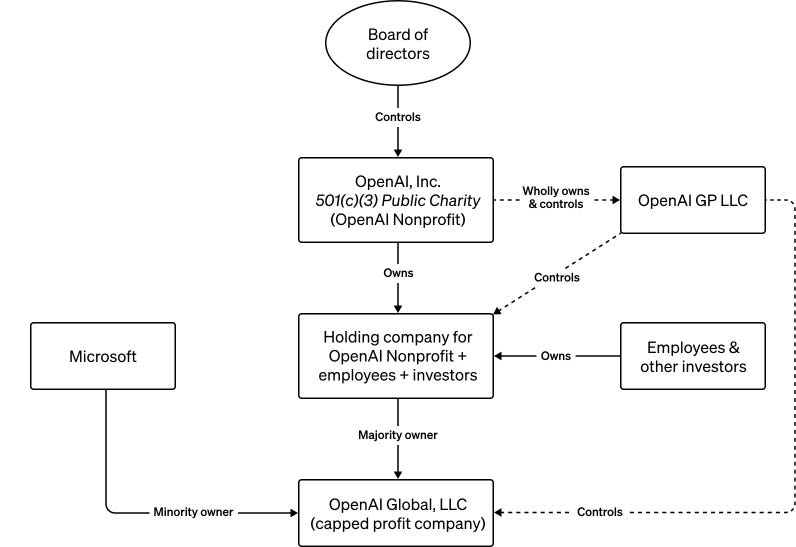 La non poco complessa struttura di governance di OpenAI. Il focus deve essere sul “Board of Directors” in alto e su "OpenAI Global” in basso
------------------------------------------------------------------------
Il caos-caso Altman degli ultimi giorni si origina, probabilmente, qui. Progressivamente, infatti, all’interno della società si sviluppano due fazioni:
1. Una estremamente preoccupata per l’evoluzione dell’IA, e che la vuole sviluppare con cautela per evitare che distrugga l’umanità (no, non è una battuta); qui ci stanno soprattutto i rappresentanti del “Board of Directors” che hanno fatto fuori Altman;
2. Una che considera l’IA uno strumento trasformativo, capace di aprire una nuova era di prosperità, e quindi più orientata al profitto; e qui c’è in prima fila Altman, che ha tentato (ed è riuscito) di trasformare OpenAI in una tech company come le altre;
E l’equilibrio tra le due non era affatto facile. Soprattutto nell’ultimo anno, quando ChatGPT guadagna una popolarità incredibile e gli investimenti si moltiplicano, l’appetito per una crescita repentina mette a dura prova il tentativo di rallentare l’IA per ragioni di sicurezza.
------------------------------------------------------------------------
Date queste premesse, l’evoluzione della vicenda Altman e le implicazioni per il futuro si fanno particolarmente interessanti. Con una idea, essenziale, da tenere in mente: benché si tratti di una società privata, le dinamiche interne ad OpenAI ci riguardano e, soprattutto, riguardano come i governi cercheranno di regolamentare l’IA.
Per questo, oggi Artifacts vedrà come è cambiata OpenAI, ma soprattutto perché il futuro prossimo conta più di quello remoto, perché è ancora meno “Open” di prima e cosa, invece, dovrebbe essere più “open”.
> ### Il Titolo
In OpenAI non è solo tornato Sam Altman, ma è cambiato quasi tutto il Board of Directors, ossia gli stessi che avevano cacciato Altman.
Senza avventurarci nei nomi, il risultato chiave è: ha vinto il Team Capitalismo, ha perso il Team Leviatano. O meglio, ha vinto il Team di chi vuole sviluppare l’IA per ragioni di profitto e ha perso il Team di quelli fortemente preoccupati dello sviluppo dell’IA e dei rischi per l’umanità.
Attenzione, però: non ci sono buoni o cattivi.
Da un lato, molti del board appartenevano al “lungotermismo”, una “filosofia” controversa che mira a massimizzare i benefici del genere umano nel lungo periodo, e per tale fine, pronta a giustificare qualsiasi “sfruttamento, manipolazione e trasformazione della natura in nome di un presunto e lontanissimo avvenire utopico”. Insomma, attenti ai rischi dell’IA, ma sempre in un futuro molto remoto più che nell’oggi. Conta diversi esponenti di valore nelle sue fila, ma sta anche ricevendo notevoli critiche, come quella del prof. Ghani, per il quale questo schiacciamento sul futuro “distrae totalmente dai rischi reali e concreti che si stanno verificando ora”.
Dall’altro, quelli del nuovo board sembrano essere più trasparenti: sviluppare l’IA per fare profitto e accelerare ulteriormente. Tuttavia, ancora è poco chiara la direzione ed esiste un elemento non di poco conto: ad oggi, nessuna donna fa parte del board. Cosa che, se stai costruendo una tecnologia trasformativa per il genere umano, non può non far storcere il naso.
------------------------------------------------------------------------
Chi, indubbiamente, da questa vicenda esce vincitore è Satya Nadella, CEO di Microsoft, che ha fatto di tutto per far riassumere Altman in OpenAI, persino assumerlo in Microsoft per qualche ora.
La ragione? Basta guardare questo grafico
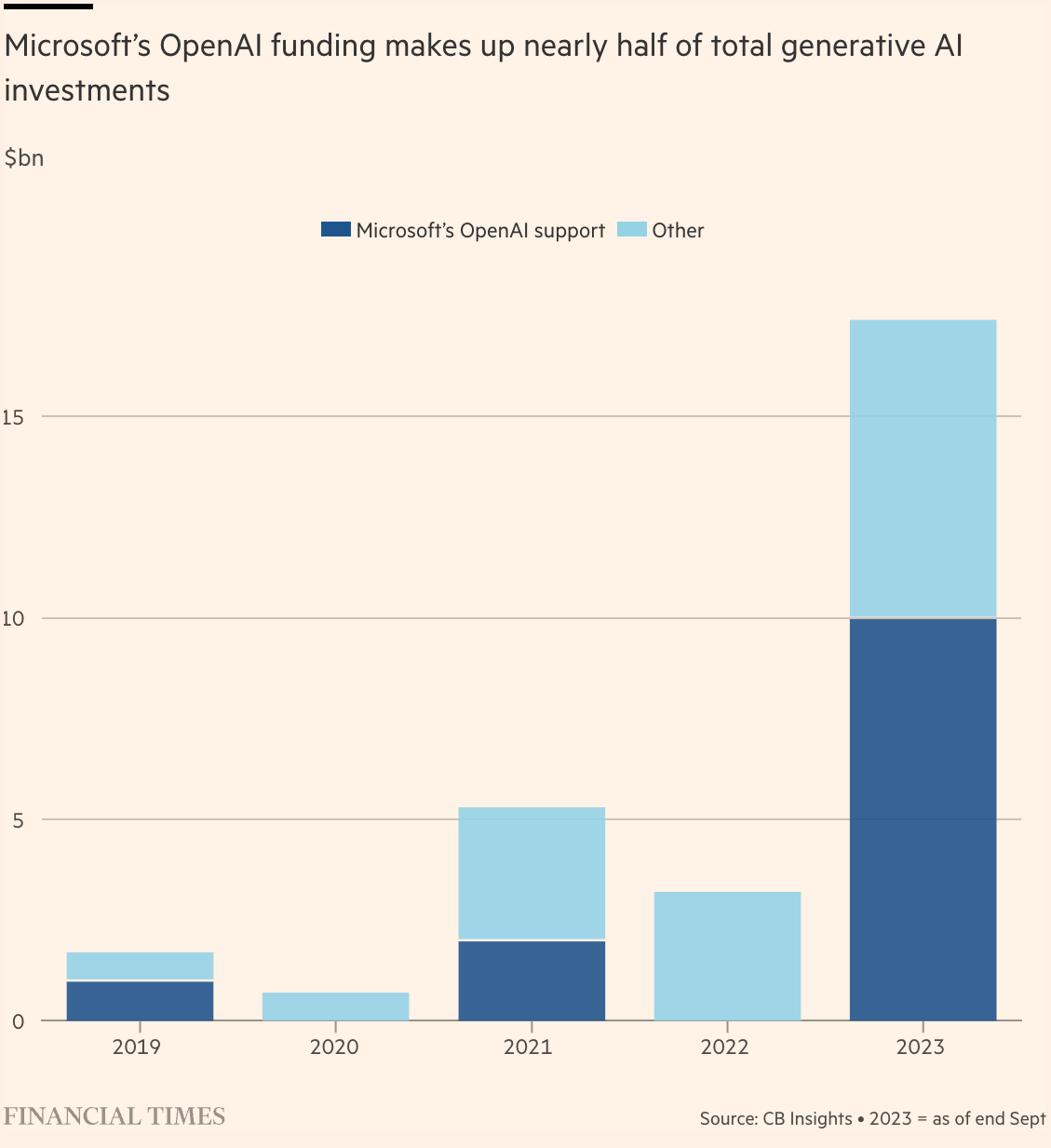 Microsoft bets big on OpenAI: oltre metà di tutti gli investimenti nel settore Generative AI dell’ultimo anno sono soldi che Microsoft ha dato all’azienda di Altman. Tra le due c’è un rapporto di dipendenza assoluta: senza i soldi di Microsoft, OpenAI non potrebbe fare tutto quello che fa, ma Microsoft senza OpenAI vedrebbe saltare in aria i suoi tool di IA, che sono 100% abilitati da OpenAI. Insomma, anche qui, follow the money.
Tra l’altro, non si esclude che Microsoft ora possa avere un posto nel Board, sempre non-profit, che controlla OpenAI. D’altronde, immaginate investire 13 miliardi in un’azienda e non poter dire una parola su come viene gestita.
Tuttavia, una conseguenza è lampante: un’altra volta, lo sviluppo della tecnologia gravita attorno agli stessi giganti. Se l’IA può sembrare portata avanti da delle start-up, alla fine dei conti tutte dipendono dalle risorse e dai mezzi delle BigTech, con un mercato sempre molto concentrato. Che - sia chiaro - non è un bene o un male, ma un elemento da non ignorare.
------------------------------------------------------------------------
Ma soprattutto, alzando lo sguardo da OpenAI, questa settimana rende chiaro che una manciata di persone in Silicon Valley ha il potere di decidere il futuro della tecnologia e, in questo caso, dell’IA. E, se davvero l’IA, come sostiene anche Sam Altman ha bisogno urgente di regolamentazione, questo scenario non è dei migliori.
Il nocciolo della questione, insomma, non è se un giorno l’IA arriverà a comandarci. Scenario che, a onor del vero, è inverosimile secondo molti. Piuttosto, è che oggi, e non in futuro, un potere enorme sull’IA è esercitato da pochi con conseguenze su tutti. Dinamica già vista, ma particolarmente pericolosa se davvero l’IA porta tutti i rischi descritti dagli stessi che hanno potere su di essa.
Una dimensione essenziale, allora, è quella temporale. A chi ha potere sull’IA conviene descrivere scenari futuri apocalittici per posizionarsi, de facto, come salvatore dell’umanità. Ma l’urgenza è qui ed oggi, con dei rischi (e delle opportunità, ovviamente), come l’impatto sul lavoro o sulla formazione - non l’estinzione dell’umanità - che sono già concreti.
E, di conseguenza, che molte delle conversazioni sull’IA avvengano a porte chiuse, e scatenino terremoti come quello di Altman senza grande trasparenza, è ciò che dovrebbe preoccuparci maggiormente.
Soprattutto, dovrebbe preoccupare le istituzioni che cercano di mettere delle regole all’IA. Al di là di OpenAI, quello che serve è la capacità “to open AI”, ossia di ascoltare e capire chi guida l’innovazione, come le aziende della Silicon Valley, ma non lasciare che siano loro, a porte chiuse, a decidere come deve procedere questa storia dell’Intelligenza Artificiale.
Ci sono tante, molte altre, voci da ascoltare e, soprattutto, la necessità che le dinamiche di profitto e mercato, essenziali perché ci sia innovazione (!), siano bilanciate e frenate da uno sviluppo sicuro. Non ce l’ha fatta, pare, la complessa struttura di governance di OpenAI, ma possono farcela i governments.
Lascia un commento
> ### Rassegna (Stampa)
AI Act, ancora, non nel suo momento migliore. Continuano le negoziazioni. Un appello, interessante, di alcuni esperti.
Ma l’Europa cosa impara da questa storia di OpenAI?
Ricordi la storia dei social a pagamento? Noyb attacca Meta sul GDPR
13 e 14 dicembre l’Italia vota online, ma per spendere dei soldi che andavano spesi.
Ho scritto il paper “Artificial intelligence: Europe needs to start dreaming again”. Se non per il testo, da aprire per vedere meglio la copertina cla-mo-ro-sa creata con l’AI!
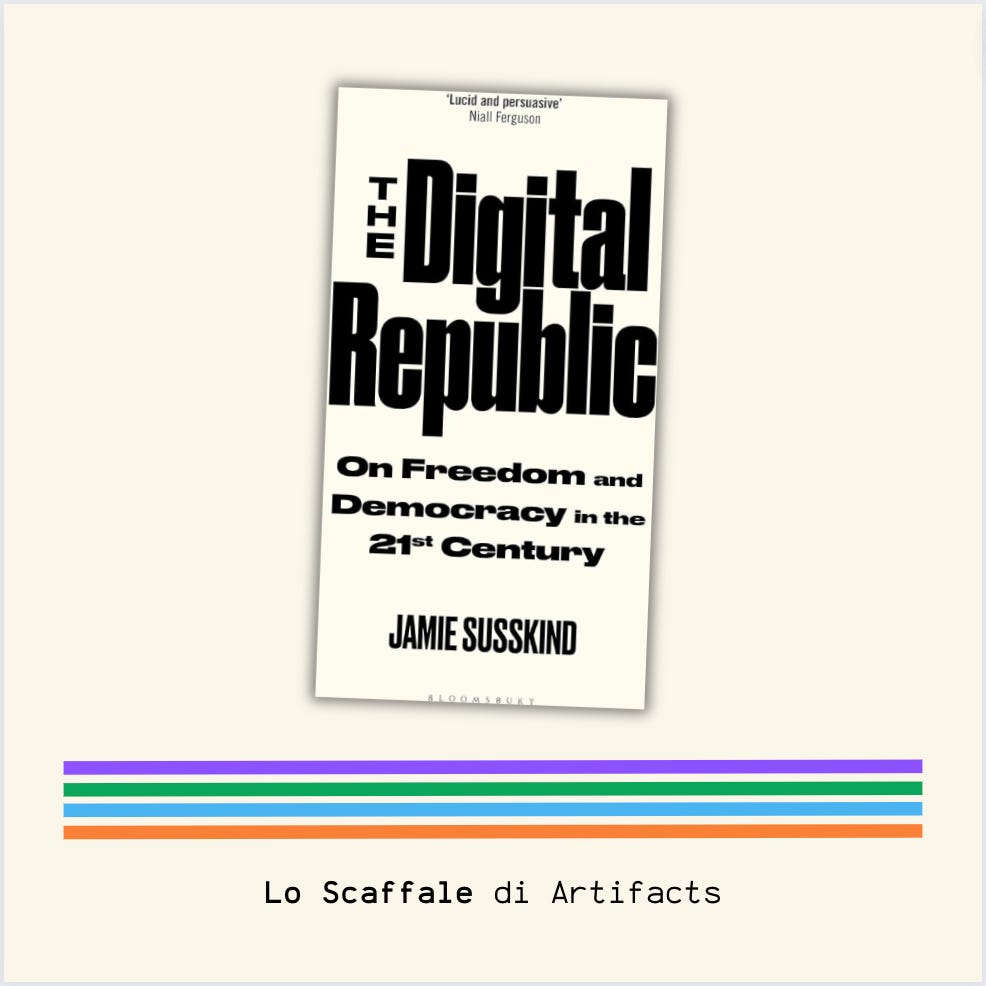 A proposito di governance e governments, “The Digital Republic” di Jamie Susskind è uno dei must-read su come governare la tecnologia ma anche su come usarla per governare. Ok, è un mattone, ma scorre. Giuro.
> ### Nerding
 Immagina una vetrina della tua vita digitale con i tuoi social, la tua newsletter, il tuo YouTube, i tuoi podcast e le tue foto. Una sorta di biglietto da visita del te online. Ecco, Bento ti permette di farlo con una User Interface semplice ma stra-intuitiva. In settimana faccio la mia Bento Box anche io ;)
P.S. Lo avevo in lista ma lo avevo dimenticato, è qui grazie a Giovanni Pernazza, amico e lettore di Artifacts :)
======
# Finire dalle fondamenta
Date: 2023-11-22 | Language: it
Canonical: https://artifactstech.substack.com/p/finire-dalle-fondamenta
Cite as: Finire dalle fondamenta by Lorenzo Ancona, Artifacts, 2023-11-22. https://artifactstech.substack.com/p/finire-dalle-fondamenta (CC BY 4.0)
Immagino sia plausibile che tu abbia sentito parlare dell’**AI Act**, il regolamento in discussione in UE per **stabilire delle norme sull’Intelligenza Artificiale.**
Dunque - detta come non la dovresti dire a un colloquio - l’AI Act è un regolamento di **“product safety”,** ossia mira a far sì che i prodotti di IA messi sul mercato siano sicuri. Come lo fa? Con un **risk-based approach,** esemplificato da **questa piramide,** pubblicata ad aprile 2021 (una vita fa!)**:**
[](https://substackcdn.com/image/fetch/$s_!5U8B!,f_auto,q_auto:good,fl_progressive:steep/https%3A%2F%2Fsubstack-post-media.s3.amazonaws.com%2Fpublic%2Fimages%2Fa4807c9c-1fb5-4427-8ae2-7536c66e6bf7_794x431.png)
Il criterio è abbastanza semplice: **invece di regolamentare le tecnologie in sè, l’UE ha stabilito 4 livelli di rischio**, secondo i quali sono poi classificate le tecnologie di IA. **Brando Benifei,** europarlamentare co-rapporteur dell’AI Act, mi ha recentemente spiegato che **“questo è il modo migliore per rendere l’AI Act a prova di futuro”.**[1](https://artifactstech.substack.com/p/finire-dalle-fondamenta#footnote-1)
Ed ha effettivamente funzionato. A parte una piccola, ma enorme, eccezione: **ChatGPT**. Sì, non è uno scherzo: **l’AI Act non aveva previsto non solo ChatGPT, ma tutti i sistemi simili.**
------------------------------------------------------------------------
Ma procediamo con calma. Dunque, non è proprio ChatGPT in sé a non essere stato previsto, ma GPT 3 o 4, ossia il **foundation model (FM)** che, come dice il nome, ne è alla base.
**Pausa tecnica:** per “foundation model” si intendono **“dei modelli di machine learning addestrati su grandi quantità di dati che possono essere adattati a un'ampia gamma di compiti”.**
**In italiano:** sistemi che hanno tantissimi dati e che **sono dei tuttofare:** possono scrivere una filastrocca per la mamma, correggerti i compiti di spagnolo, scrivere la lettera più cattiva che tu possa concepire, creare una fake news perfetta, programmare un virus, e molto altro.
**Ecco, proprio questa pluralità di task che ChatGPT, grazie a GPT, o altri chatbot, grazie ad altri FMs, hanno creato non pochi problemi a Bruxelles.**
Se, infatti, l’AI Act si basa sull’idea che ogni applicazione di IA possa essere assegnata a una categoria di rischio in base all'uso previsto, **con i FMs diventa impossibile fare ciò perché non esiste UN uso previsto, ma ce ne sono tantissimi e di difficile predizione.**
------------------------------------------------------------------------
E quindi, ancor prima di vedere la luce, l’AI Act incontra una difficoltà non da poco. **Che è sia tecnica che politica**, perché coinvolge non solo gli esperti di regolamentazione, ma **anche chi sviluppa foundation models e gli stati europei, tra cui l’Italia.** Tutti, disperatamente, alla ricerca di regole perché l’AI Act possa essere approvato.
**Di questa specifica questione dei FMs nell’AI Act, senza dilungarci, ne parla Artifacts.**
> ### Il Titolo
Diversamente dal solito, **partiamo dalla questione politica**, che si sta svolgendo proprio in queste ore prima dei triloghi sull’AI Act.
Semplificando, le posizioni vedono:
- **Parlamento UE,** che vuole promuovere il cosiddetto ‘tiered approach’, ossia classificare i FMs secondo vari criteri - **e su quali siano questi si sta giocando la questione** - e assegnare quindi poi livelli di regolamentazione diversi;
- **Il Consiglio Europeo,** ma soprattutto la cordata Germania - Francia - Italia, che invece vuole un approccio decisamente mooooolto di *laissez-faire;*
- **La Presidenza del Consiglio dell’UE** (che non è quello di sopra), ossia la Spagna, che sta cercando di mediare per chiudere l’AI Act. **Cosa decisamente prioritaria** perché il rischio è che possa poi essere rimandato a dopo le elezioni del Parlamento a giugno ‘24.
------------------------------------------------------------------------
**Presto per dire come andrà a finire.** Ad oggi, [Euractiv](https://www.euractiv.com/section/artificial-intelligence/news/spanish-eu-presidency-prepares-to-wrap-up-technical-work-on-ai-law/) riporta che sono in corso trattative per far sì che si trovi un compromesso.
Indubbiamente, è interessante fare luce sullo strappo di Germania - Francia - Italia, che non nasce certo dal nulla. **Al centro ci sono gli interessi nazionali e delle start-up che provano a sgomitare perché, per una volta, l’UE non resti indietro sull’innovazione.** Nello specifico, **Mistral AI** per la Francia e **Aleph Alpha** per la Germania. **Per l’Italia, ahimè, è mero calcolo politico** e al momento non ci sono grosse novità sul fronte innovazione.
In ogni caso, **la loro volontà è decisamente eccessiva:** il documento circolato nel weekend mirava a escludere una regolamentazione obbligatoria per i FMs e, invece, ad una non ben precisata **“mandatory self-regulation”,** che sembra, quantomeno, una contraddizione in termini. **Ed altre critiche interessanti**, di cui ha parlato [Philippe Hacker.](https://www.linkedin.com/posts/philipp-hacker-078940257_critical-comments-on-the-ai-act-found-model-ugcPost-7132016317053689856-p0bx/) Addirittura, Yoshua Bengio, computer scientist canadese, [ha detto a Politico](https://www.politico.eu/article/france-germany-power-grab-kill-eu-blockbuster-ai-artificial-intelligence-bill/) che una soluzione simile sarebbe **“folle”** e porterebbe ad un AI Act simile alla **“legge della giungla”.**
Come si evince dal grafico, il modello immaginato sarebbe carente su diversi aspetti, [sostiene il Future of Life Institute.](https://futureoflife.org/ai-policy/miles-apart/) Al contrario, **le altre soluzioni pensate in UE sembrano più ragionevoli in termini di efficacia.**
[](https://substackcdn.com/image/fetch/$s_!CxJj!,f_auto,q_auto:good,fl_progressive:steep/https%3A%2F%2Fsubstack-post-media.s3.amazonaws.com%2Fpublic%2Fimages%2Fbfd71abb-00e0-422f-9d3a-222e872155bb_1280x918.jpeg)
------------------------------------------------------------------------
Andando oltre le questioni politiche, comunque, **la complessità di regolamentare i FMs è sui criteri da utilizzare**, non tanto sul modello.
**Che si debba adottare un “tiered approach”, ossia su più livelli, è ampiamente approvato**, oltre che dalla Presidenza spagnola del Consiglio, anche dall’executive order di Biden o dalla community open-source. **Più problematiche sorgono sui criteri che vanno utilizzati per creare questi livelli differenti.**
[](https://substackcdn.com/image/fetch/$s_!bIjp!,f_auto,q_auto:good,fl_progressive:steep/https%3A%2F%2Fsubstack-post-media.s3.amazonaws.com%2Fpublic%2Fimages%2F63ebbd0e-71c0-43c0-8ad5-9e48c2d57fd8_745x739.png)
Un po’ la complessità, un po’ i diversi tier. *Creato con DALL-E*
Si tratta di una questione estremamente tecnica, che non è possibile approfondire su Artifacts, ma un elemento dovrebbe essere chiaro: **serve partire dagli utilizzi di questi FMs.** Che significa? Come suggerisce [Rishi Bommassani](https://crfm.stanford.edu/2023/11/18/tiers.html), dello Stanford Centre for Research of Foundation Models, per l’UE **la soluzione ideale sarebbe quella di provare a misurare l’impatto di questi modelli attraverso la loro diffusione**. Semplificando, che chi sviluppa un **sistema** basato su un **foundation model** sia tenuto a registrarlo, e che quindi poi **i modelli, e non i sistemi, siano classificati in questi diversi livelli di tiered approach di conseguenza.** Insomma, alla domanda “quanto è rischioso GPT-4?” si dovrebbe rispondere valutando quanto sia vastamente utilizzato.
 Si è confermato quello che era stato anticipato dal WSJ e di cui avevamo parlato in Artifacts diverse settimane fa: Meta ha ufficializzato che offrirà una versione a pagamento e priva di pubblicità di Facebook e Instagram agli utenti che non vogliono acconsentire all'uso dei loro dati. Se gli utenti acconsentono, invece, continuerà a essere disponibile una versione gratuita supportata da pubblicità.
In altre parole, Meta offre un'offerta a pagamento senza profilazione e una gratis con consenso alla profilazione, simile a un paywall.
------------------------------------------------------------------------
Però, prima di andare in profondità, è interessante vedere il design di questo pop-up. Gli elementi che mi hanno colpito, dall’alto verso il basso, sono:
- “Le leggi stanno cambiando nella tua area geografica”, che sì, è vero che stanno cambiando, ma, come avevamo visto nell’altra Artifacts, il regolamento che porta Meta a questa decisione è il GDPR, che è valido dal 2016. Non proprio l’altroieri;
- le icone accanto alle due scelte: una austera carta di credito, direi abbastanza auto-esplicativa, per l’opzione che NON profila gli utenti, mentre una non definita stellina volante per l’opzione gratis e con profilazione;
- “la tua esperienza attuale” scritto in verde, che nell’UX design è solitamente il colore della positività o della cosa giusta. Aggiungiamoci che è la situazione che già abbiamo e la generale riluttanza al cambiamento, specie se questo comporta un pagamento;
- la cosa più importante, poi, i pulsanti in fondo: più evidente e in blu, quindi più cliccabile, quello per continuare a usare Facebook e Instagram con la profilazione; in grigio, meno attraente, quello per pagare e interrompere la profilazione;
- ma guarda anche come viene espresso il concetto di gratuità: quando NON paghi c’è scritto “senza costi aggiuntivi”, e quindi facile, com’è ora; la cosa si ripete sia in inglese, dov’è “I want to use it for free”, e in francese, dove c’è scritto “gratuitement”. Il far fare la scelta sui soldi, ossia sul “paga o gratis”, non è indifferente, secondo me;
- elemento bonus: che questo pop-up esce, a caso, una delle varie volte che apriamo un social e non viene, invece, mandata ad esempio una mail. Mi ha fatto pensare che forse Meta vuole sbrigare velocemente la faccenda.
Forse, anche guardando a questi elementi, possiamo capire quale scelta Meta vorrebbe che sia preferita da parte degli utenti. Insomma, in una certa maniera, anche i pop up, oltre agli artefatti, “do have politics” :)
------------------------------------------------------------------------
Comunque questa di design è chiaramente solo parte della questione. Molto di più c’è da dire sulle implicazioni e il futuro di questa opzione. L’Artifacts di oggi si lega a quella a quella del 10 ottobre, dove avevamo visto perché Meta sarebbe potuta arrivare a questa situazione. E approfondisce, invece, alcune riflessioni iniziali che questo pop-up fa scaturire, se esista davvero il consenso previsto dal GDPR, se questi 13 euro siano appropriati e quali siano i prossimi passi.
 Quello che succede nel prendere questa scelta. Creato con DALL-E
> ### Il Titolo
In breve, quindi, queste sono le 3 scelte che abbiamo:
1. pagare 13 euro/mese per la versione ads-free se non vogliamo dare il consenso alla nostra profilazione;
2. usare gratis la versione con gli ads se vogliamo dare il consenso alla profilazione;
3. trovare un’alternativa ai servizi di Meta se non vogliamo né pagare né dare il consenso. Cosa che, immagino, sia in realtà la scelta ideale della maggior parte delle persone.
La situazione è spiegata bene da Meta così:
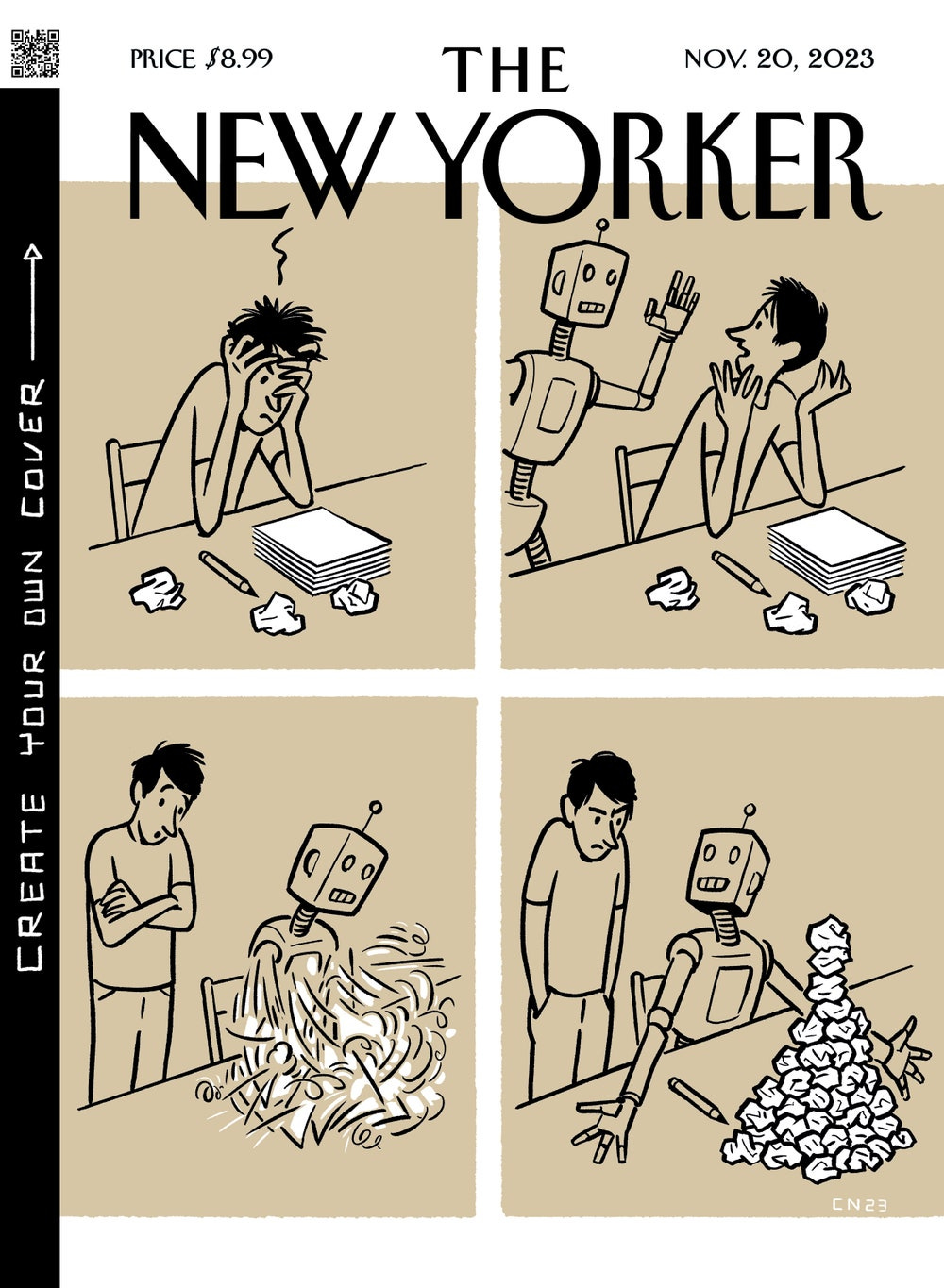 OECD ha dato una nuova definizione di Intelligenza Artificiale! Forse, però, trascura un po’ l’elemento umano in essa.
Nel frattempo, l’AI Act sembra essere in stallo, e questa è una cosa abbastanza pericolosa.
Questi qua, ex Apple, hanno presentato quello che dovrebbe essere il futuro degli smartphone: non avere uno smartphone.
> ### Lo Scaffale
 “La tecnologia ci consente una realtà, una sua rappresentazione, in cui il nostro corpo può essere in un luogo e la sostanza immateriale, attenzione compresa, in un altro.” Se è bastata questa frase a intrigarti, ok. Altrimenti, comunque, “La tecnologia è religione” di Chiara Valerio è una bella riflessione su noi, la tecnologia e come stiamo cambiando con essa.
> ### Nerding
 Nasce come tool per i giornalisti, ma in realtà è utile a tutti quelli, come me, che leggono, prendono appunti, e poi si scordano da dove hanno preso quegli appunti. Con Google Pinpoint puoi salvare tutti i docs che ti servono per una ricerca nello stesso posto, e poi cercare concetti/parole/qualsiasi cosa semplicemente digitando. Nice to have.
 Una bilancia. Fatta col nuovissimo DALL-E 3
Ma perché succede ciò? È una questione complessa, che riguarda il GDPR, ossia il regolamento europeo per la privacy, e due tappe “legali” del 2023 (qui dette semplici):
- a gennaio, Meta ha ricevuto dall’Irish Data Protection Commission (DPC) una multa di 390 milioni perché avrebbe obbligato, di fatto, gli utenti ad accettare il targeted advertising negli anni;
- a luglio, la Corte di Giustizia dell’Unione Europea ha ribadito che il consenso è l'unica base giuridica plausibile per fare del targeted advertising basato su tracciamento e profilazione.
E, quindi, Meta - che non ha altra scelta - ha comunicato che comincerà a operare secondo il principio del “consenso” del GDPR, ossia permettendo agli utenti di scegliere se essere profilati per ricevere della pubblicità personalizzata.
Tuttavia, il Diavolo sta nel dettaglio: nelle note dell’ultima sentenza, la Corte UE ha scritto che Meta potrebbe offrire agli utenti la scelta di non essere profilati “if necessary for an appropriate fee”. Ossia che per NON dare il consenso alla profilazione bisognerebbe pagare.
------------------------------------------------------------------------
Ed è proprio su queste 6 parole che si fonderebbe la notizia trapelata in settimana, che potrebbe cambiare molto della storia della regolamentazione social in UE.
Nel frattempo, Meta non ha commentato nello specifico, ma ha detto che, pur credendo nel valore dei propri servizi gratuiti supportati dal targeted advertising, continua a esplorare opzioni per rispettare le continue evoluzioni della regolamentazione.
Oggi Artifacts prova a vedere alcuni aspetti di questa questione, soprattutto cosa si intenda per “consenso” e perché, se confermata, questa storia potrebbe essere un discreto autogol per l’Unione Europea.
> ### Il Titolo
Sulla definizione di “consenso” l’UE è particolarmente precisa nel GDPR: deve trattarsi di consenso “informato, specifico e freely given”. Dove, tuttavia, per freely si intende più “liberamente”, ossia senza coercizioni, che “gratis”.
A questo punto, è lecito domandarsi se pagare attorno ai 13 euro al mese per proibire a Meta la profilazione rispetti gli standard di un consenso freely given. Difficile: sicuramente non è letteralmente ‘gratuito’, ma nemmeno un processo trasparente. Ma soprattutto, è difficile pensare che rispetti lo spirito dei diritti dell’UE, che non prevedono certo di dover pagare per avere accesso a dei diritti.
Tuttavia, non c’è nemmeno scritto che pagare questa fee significhi non rispettare il GDPR. Su questo vedremo l’interpretazione della Corte, che potrebbe però richiedere diverso tempo.
------------------------------------------------------------------------
Restando sulle parole, sarà interessante capire cosa si intenda per una tariffa “appropriate” e quando sarebbe “necessary”.
Sull’appropriatezza, è difficile immaginare o capire quanto far pagare una cosa che è sempre stata gratis. Ma, soprattutto, quale tariffa sia adeguato pagare per - di fatto - godere di un diritto.
Invece, sul “necessario” è altrettanto complesso capire come possa diventare necessario pagare per un servizio che non ha costi e i cui contenuti sono prodotti dagli stessi che dovrebbero pagare per vederli, ossia gli utenti. Insomma, che Instagram non è come Spotify che deve, ad esempio, poi pagare gli autori o le licenze delle canzoni.
Difficile che venga accettato l’approccio “Pay or Okay”, ossia quello per cui molti giornali online ora permettono di scegliere tra pagare un abbonamento o, invece, essere profilati con i cookies.
------------------------------------------------------------------------
Un punto importante è: se è già abbastanza complesso rendere chiaro il valore della privacy e della protezione dei dati personali, quanto ancora più complicato diventerebbe apprezzarlo se dovessimo pagare per goderne?
E, poi, ad un prezzo come quello trapelato, probabilmente pochi utenti pagherebbero, con la maggior parte che preferirebbe la profilazione. Cosa che, tra l’altro, probabilmente anche Meta si auspica, dato che il suo modello di business si fonda proprio sui dati degli utenti.
Qualora questa indiscrezione venisse confermata, sarebbe davvero difficile non percepirlo come un autogol dell’UE, dato che Meta farebbe leva su quelle 6 parole della Corte, o - quantomeno - come uno scacco (quasi) matto dell’azienda statunitense.
Ma staremo a vedere come evolve. E tu, pagheresti per la privacy sui social?
Leave a comment
> ### Rassegna (Stampa)
Sempre su Meta, Nick Clegg spiega come far coesistere IA e democrazia. Ad Atene, tra l’altro.
Sui social vediamo sempre meno i siti di informazione.
Wired ci spiega perché i nostri browser non sono davvero nostri.
Si starebbero scrivendo delle Costituzioni per l’IA, dice il FT.
> ### Lo Scaffale
 Dato che oggi abbiamo parlato di Meta, di profilazione e dati personali, An Ugly Truth - Inside Facebook’s Battle for Domination è il libro perfetto da consigliare. Racconta com’è nata la fu Facebook e come funzionano molte dinamiche che ci riguardano. Libro inchiesta, tono incalzante, si legge veloce.
> ### Nerding
 Non ti ricordi cosa ti ha detto Tizio nella riunione di sei mesi fa? Con Tactiq non avresti di questi problemi. Strumento super utile, che fa: transcript delle riunioni online in tutte le lingue, riassunti con l’AI, ti scrive la mail di follow-up, i principali takeaway e altre parole che non sapremmo spiegare a nostra nonna :)
------------------------------------------------------------------------
Grazie per aver letto Artifacts, e buona giornata!
======
# Le IA potrebbero star leggendo troppi libri
Date: 2023-10-03 | Language: en
Canonical: https://artifactstech.substack.com/p/le-ia-potrebbero-star-leggendo-troppi
Cite as: Le IA potrebbero star leggendo troppi libri by Lorenzo Ancona, Artifacts, 2023-10-03. https://artifactstech.substack.com/p/le-ia-potrebbero-star-leggendo-troppi (CC BY 4.0)
Su The Atlantic trovi il database dei libri utilizzati per il training di alcune delle Intelligenze Artificiali più diffuse, come LLaMa di Meta. Il problema? La maggior parte dei libri sono coperti da copyright, il cui utilizzo, quindi, sarebbe soggetto a delle regole per l’utilizzo.
 Un libro aperto. Generato con DALL-E
In maniera piuttosto diretta, Alex Reisner, autore e programmatore che ha condotto l’inchiesta, ha scritto: "The future promised by AI is written with stolen words”.
------------------------------------------------------------------------
Com’è potuto succedere? Senza addentrarci nei dettagli tecnici, le IA sono alimentate con un processo di estrazione di moli enormi di dati dal web, come Wikipedia, i social media (evitando i dati personali, almeno quella di Meta), e, in questo caso, i libri. Questo processo serve ad “allenare” le IA a riconoscere i pattern e ad essere poi capace di riprodurre testi simili a quelli di un umano. \[Mi perdoneranno i data scientist per questa descrizione poco accurata\]
Per questa inchiesta, il database contenente i libri sarebbe Books3, una raccolta che nasce per permettere a chiunque di sviluppare una propria IA, pur non avendo risorse e mezzi dei giganti del web. Quindi un intento anche nobile. Tuttavia, qualcosa potrebbe essere andato storto.
------------------------------------------------------------------------
Così, se spesso il focus è: “a chi appartiene un contenuto prodotto dall’IA?”, è invece necessario chiedersi anche: “ma è giusto usare opere sotto copyright per allenare le IA?”. E, poi, come comportarsi con gli scrittori o altri creativi, che hanno già rivolto accuse a OpenAI e Meta.
Oggi Artifacts vedrà cosa stanno facendo le istituzioni, perché secondo alcuni sarebbe da permettere l’utilizzo di opere sotto copyright per il “fair use”, e soprattutto perché sapere cosa c’è dentro le IA è tanto (o forse più) importante di chi sia il proprietario di ciò che viene prodotto.
> ### Il Titolo
Partiamo da quello che sta facendo l’Unione Europea:
- Gli sviluppatori di IA o i ricercatori possono utilizzare copie di database o opere per estrarre dati e informazioni e tenerli per il tempo necessario a questo processo. Tuttavia, chi detiene i diritti può esercitare l’opt-out, ossia impedire l’utilizzo delle proprie opere;
- Nell’AI Act viene richiesto alle aziende che sviluppano IA di “divulgare qualsiasi materiale protetto da copyright utilizzato per sviluppare i loro sistemi”.
Tuttavia, come nota Floridi, sapere se un contenuto è coperto o meno da copyright non risolve il problema. Piuttosto, quello che bisognerebbe chiedersi è se si applichi o meno il fair use, ossia la facoltà di utilizzare per il training delle IA materiale coperto da copyright per scopi di informazione o insegnamento, senza chiedere l’autorizzazione a chi ne ha i diritti.
------------------------------------------------------------------------
Il dibattito sul fair use per le IA Generative è complesso, affascinante, ma soprattutto lungo. Quindi, in breve, le posizioni sono:
- chi è contro perché sostiene che le opere generate grazie alla creatività degli autori potrebbero impattare negativamente il mercato degli autori stessi. E che, quindi, i creativi abbiano passato anni a produrre opere che ora vengono utilizzate, senza compenso, per il profitto di chi sviluppa le IA.
- chi è a favore, ad esempio Creative Commons, sostenendo che le IA non producano delle copie di lavori sotto copyright, ma che usi le informazioni per creare qualcosa di totalmente nuovo.
Difficile prendere una posizione. Piuttosto, quello che è interessante capire è se i contenuti prodotti dalle IA siano totalmente nuovi e originali. O meglio, se possiedano la caratteristica di ‘transformativeness’, e quindi non siano mere copie dei dati di training, ma opere originali e sufficientemente diverse. Questa caratteristica è essenziale per stabilire se si possa parlare di fair use.
Infatti, da un lato le IA percepiscono i libri come semplici moli enormi di testo per il training, e quindi creano a tutti gli effetti contenuti originali che non fanno riferimento ad autori specifici, ma sono semplicemente associazioni statistiche. E, quindi, c’è spazio per parlare di fair use e considerare il processo come ‘transformative’. Dall’altro, pur non copiando le opere, le IA non potrebbero fare alcun tipo di trasformazione senza quei testi. Per questo, alcuni non riconoscono i requisiti per il fair use.
Sarà un dibattito acceso, probabilmente centrale nei prossimi anni. Vedremo anche se sarà possibile continuare a usare le opere sotto copyright tutelando però gli autori in qualche modo..
------------------------------------------------------------------------
A prescindere da questo dilemma, un elemento torna essenziale: che le IA siano aperte e trasparenti, ossia che diventi possibile sapere quali dati contengono, da dove provengono e, quindi, perché dicano certe cose invece di altre. Requisiti che, al momento, solo alcune aziende soddisfano.
Perché? Come suggerisce lo stesso Reisner, il rischio è che “se internet ha democratizzato l’accesso all’informazione, rendendola facilmente accessibile a tutti, con l’IA si torni a dei gatekeeper opachi e unaccountable” di cui non conosciamo le informazioni alla base. Quindi, che i sistemi di IA, che già ora utilizziamo ampiamente per ottenere informazioni, privilegino delle visioni del mondo invece che altre. E che, poi, influenzino anche la nostra prospettiva.
Insomma, che le IA siano un libro aperto.
Leave a comment
> ### Rassegna (Stampa)
ChatGPT ora può navigare su Internet. E quindi sapere cosa è successo ieri.
Perché noi umani siamo fondamentali per costruire l’IA, e alcuni anche sfruttati
Mark Zuckerberg si è fatto intervistare nel Metaverso. E chi se non lui?
Meta ora fa sul serio con l’IA. Ci fa anche parlare con Paris Hilton.
L’UE ci dice come siamo messi con la digitalizzazione. Bene, ma potrebbe andare meglio.
> ### Lo Scaffale
 Con the Atlas of AI, Kate Crawford racconta il lato tangibile dell’IA. E quindi quali siano le implicazioni ambientali, le conseguenze sociali, le dinamiche geopolitiche e perché, ad esempio, l’Africa praticamente non esiste per l’Intelligenza Artificiale.
> ### Nerding
 Immagina di aver voglia di salsa ma con gli strumenti del jazz. O anche di avere dei gusti musicali decenti e volere una canzone che risponda alle tue esigenze. Con Stable Audio puoi farlo e creare la tua musica con una semplice descrizione di ciò che desideri.
------------------------------------------------------------------------
E anche oggi, grazie per essere arrivato fin qui :)
Ci sentiamo martedì prossimo!
======
# Se l'Intelligenza Artificiale va a scuola
Date: 2023-09-26 | Language: en
Canonical: https://artifactstech.substack.com/p/se-lintelligenza-artificiale-va-a
Cite as: Se l'Intelligenza Artificiale va a scuola by Lorenzo Ancona, Artifacts, 2023-09-26. https://artifactstech.substack.com/p/se-lintelligenza-artificiale-va-a (CC BY 4.0)
> *"The problem was, you can’t ask Aristotle a question. And I think, as we look towards the next fifty to one hundred years, if we really can come up with these machines that can capture an underlying spirit, or an underlying set of principles, or an underlying way of looking at the world, then, **when the next Aristotle comes around, \[...\] after this person’s dead and gone, we can ask this machine, “Hey, what would Aristotle have said? What about this?”***
Nel 1985 Steve Jobs immaginava che di lì a 50 o 100 anni si potesse *catturare* **lo spirito di Aristotele** dentro una macchina **e poterci dialogare.** 38 anni dopo, **eccoci qua.**
[](https://substackcdn.com/image/fetch/$s_!DrOc!,f_auto,q_auto:good,fl_progressive:steep/https%3A%2F%2Fsubstack-post-media.s3.amazonaws.com%2Fpublic%2Fimages%2F756eb5e6-1faf-46bb-8eed-fd557993c7cb_1024x1024.jpeg)
*Una statua di Aristotele. Creata con DALL-E*
*Provare per credere:* **chiedi a ChatGPT di impersonare Aristotele, e potrai parlare con il filosofo.** Ma anche con Platone o qualunque altra personalità sia celebre.
**Su ChatGPT si è scritto e letto molto** - spesso, soprattutto in Italia, in maniera superficiale - magari rispetto all’impatto sul mondo del lavoro. *Tendenzialmente* molto rumore, falsi miti e un certo pessimismo. **Che non aiutano di fronte a un cambiamento con un potenziale trasformativo enorme**, per diversi ambiti.
Tra questi, uno è più di altri essenziale: **la scuola**. E, in particolare, la domanda è: ***di fronte a un cambiamento simile, la scuola può permettersi di restare la stessa?*** **No, davvero difficile.**
------------------------------------------------------------------------
*Ma perché oggi ci occupiamo di IA e scuola?* Se non altro, per quella che percepiamo come una **scarsissima consapevolezza** rispetto a questi strumenti, e a come, di fatto, sia **difficile pensare che la scuola possa non adeguarsi a questo cambiamento.**
*Disclaimer*: è una **questione complessa.** Rivedere gli obiettivi di un sistema scolastico e cambiare le sensibilità dei suoi *stakeholder* non è immediato. Però, **parlarne è assolutamente necessario.** *Quindi proviamo.*
*Novità*: visto che **questa Artifacts è scritta in 2**, sarà un **dialogo**. In cui proveremo a capire ***perché ha poco senso vietare ChatGPT a scuola**, quale potrebbe essere un approccio corretto, e cosa farcene di questa Intelligenza Artificiale tra i banchi.*
> ### Il Titolo
**Lorenzo Ancona:** Sgombriamo il campo dai dubbi: **siamo d’accordo che, a scuola, non abbia senso vietare o, peggio ancora, far finta che ChatGPT non esista.** Che ne pensi?
**[Giacomo Da Ros:](https://www.linkedin.com/in/giacomodaros/)** *Come fa un’istituzione che non è curiosa ad attrarre la curiosità dei suoi studenti?* **Se lavori con la conoscenza e non sei perlomeno incuriosito da ChatGPT, non so se sei nel posto giusto.** Essere preoccupati, o *peggio*, negativi rispetto a questi strumenti è un approccio ottuso ed inutilmente limitante.
**LA:** Sì, e poi - aggiungerei - **che senso ha una scuola che prepara ad un mondo che non esiste?** *Mi spiego meglio:* perché gli studenti dovrebbero crescere in un ambiente che ignora l’IA **e poi ritrovarsi in un mondo che ne sarà** ***presumibilmente*** **pieno?**
**GDR:** Vero. **È come quando a scuola dicevano di non usare Wikipedia**, come se Internet fosse garanzia di inaffidabilità. Abbiamo visto lo stesso tipo di filosofia adottata in tante università rispetto all’IA generativa. È necessario un **cambio di approccio**, ma non penso si possa sperare nelle direttive ministeriali. **Ogni professore può decidere se educare al passato o provare ad esplorare il presente** ***insieme*** **ai suoi studenti.** Certo, probabilmente in una classe delle medie ora c’è più consapevolezza riguardo l’IA che nella sala insegnanti.
------------------------------------------------------------------------
**LA:** Sì, e poi un altro punto grave: **non esiste alcuna direttiva/linea guida del Ministero dell’Istruzione sull’IA.** C’è stata qualche dichiarazione - *di parziale apertura* - ma nulla di più. Non che l’ennesimo documento burocratico possa risolvere le cose magicamente, però mi sembra più il **sintomo di una totale assenza di consapevolezza del potenziale di - ad esempio - ChatGPT a scuola.** *Detto questo,* cosa intendi quando dici che un professore può “provare ad esplorare il presente *insieme* ai suoi studenti”?
**GDR:** **Anche se un insegnante non ha abbastanza dimestichezza con i tool IA per inventarsi dei nuovi compiti, non significa che non possa essere curioso.** Anche semplicemente assegnare gli stessi compiti e **chiedere agli studenti di raccontare come hanno usato ChatGPT**, se è stato loro utile, se continuerebbero ad usarlo, è certamente più utile di fare finta che non esista. In questo ho molto apprezzato [la policy dell’università TUDelft](https://drive.google.com/file/d/1fpjMN2FCutuIWv4exv9v3Z-vbsuepC_O/view?usp=sharing), che **chiede agli studenti di tenere un diario sul loro utilizzo dell’IA.** Mostrare questo tipo di curiosità può potenzialmente appassionare molto di più della didattica tradizionale.
**LA:** E soprattutto un approccio del genere, *costruttivo*, porta almeno **3 vantaggi:**
- genera **fiducia** tra chi insegna e chi impara
- dato che gli studenti probabilmente userebbero l’IA ugualmente, almeno c’è un **percorso condiviso**
- se se ne parla e indubbiamente **tutti imparano di più**, anche chi magari non è un *nerd.*
------------------------------------------------------------------------
**LA:** *Comunque, per chiudere, come si potrebbe usare concretamente l’IA in classe?*
**GDR:** La prima cosa che mi viene in mente è poter avere del **tutoring personalizzato alle esigenze di ognuno**. Riprendiamo le parole di Jobs dell’inizio. *Quanto incredibile sarebbe **poter imparare che ha da dirci Aristotele parlandoci**, invece di leggerne il pensiero già “confezionato” in un libro?*
**LA:** Sì, anche con la consapevolezza che ci possono essere delle imprecisioni: *comunque meglio educare a questa possibilità*. Sugli usi, aggiungerei **potenzialità enormi per gli insegnanti**. Ad esempio, ci sono professori che stanno usando i **chatbot come assistenti**, inserendoci articoli, testi, e risorse utili. Così, potenzialmente, *gli studenti possono dialogare con una versione “digitale” dell’insegnante.* Sostanzialmente un ChatGPT non generale, ma specifico per materie. **Che non significa sostituzione dei professori, piuttosto più possibilità di apprendere per gli alunni.** Non è utopia, sta succedendo: *dovremmo parlarne di più.*
*Argomento spinoso: che ne pensi? Dicci la tua!*
[Leave a comment](https://artifactstech.substack.com/p/se-lintelligenza-artificiale-va-a/comments)
> ### Rassegna (Stampa)
*Questa settimana ne sono successe davvero troppe troppe troppe:*
Bard, **il chatbot di Google**, ora può [leggerci le mail e i nostri documenti](https://blog.google/products/bard/google-bard-new-features-update-sept-2023/) ma può anche [verificare se è vero quello che dice](https://www.theverge.com/23881954/google-bard-ai-fact-checking)
**ChatGPT potrà generare immagini** grazie al [nuovo DALL-E](https://www.nytimes.com/2023/09/20/technology/chatgpt-dalle3-images-openai.html) 3 ma potrà [anche vedere, parlare e sentire](https://openai.com/blog/chatgpt-can-now-see-hear-and-speak)
**TikTok** comincia a verificare [se qualcosa è generato con l’IA](https://techcrunch.com/2023/09/19/tiktok-debuts-new-tools-and-technology-to-label-ai-content/) ma soprattutto ora permetterà di [fare le ricerche con Google](https://www.socialmediatoday.com/news/tiktoks-exploring-new-partnership-google-help-drive-more-search/694442/)
Arriva [l’Intelligenza Artificiale su Windows](https://www.theverge.com/2023/9/21/23882173/microsoft-windows-11-23h2-update-features-release-date), e **sembra essere incredibile**
**Spotify** comincerà a [clonare gli autori dei podcast con l’IA](https://www.theverge.com/2023/9/25/23888009/spotify-podcast-translation-voice-replication-open-ai)
Esistono [gli alcolisti anonimi](https://www.theguardian.com/technology/2023/sep/17/internet-addiction-support-groups-aa-12-step-program) del **Digital Detox**
> ### Lo Scaffale
[](https://substackcdn.com/image/fetch/$s_!vZH8!,f_auto,q_auto:good,fl_progressive:steep/https%3A%2F%2Fsubstack-post-media.s3.amazonaws.com%2Fpublic%2Fimages%2F6e507ebd-ecde-4b01-b7ec-27fce4370644_1080x1080.png)
Senza dubbio uno dei miei libri preferiti. Con ***[Futureproof - 9 Rules for Humans in the Age of Automation](https://www.kevinroose.com/futureproof),*** **Kevin Roose**, giornalista del NYT e autore del super podcast Hard Fork, spiega in 9 capitoli perché anche nell’era delle macchine e dell’IA quello che ci salverà sarà, semplicemente, **essere sempre e comunque ostinatamente più umani.**
> ### Nerding
[](https://substackcdn.com/image/fetch/$s_!ss_4!,f_auto,q_auto:good,fl_progressive:steep/https%3A%2F%2Fsubstack-post-media.s3.amazonaws.com%2Fpublic%2Fimages%2F9b4d3220-7166-4053-a1e3-b69517c0dc83_1080x1080.png)
Visto che ad OpenAI leggono sicuramente Artifacts, il prossimo DALL-E appena annunciato saprà scrivere, come il tool di Nerding della settimana scorsa. ***Allora rilancio.*** Con **[Glif](https://glif.app/@fab1an/glifs/clmqp99820001jn0f2xywz250)** non potete semplicemente scrivere, ma creare delle scritte dentro immagini. È sinceramente impressionante. *Tipo così:*

*Grazie per essere arrivato fin qua, ci sentiamo martedì prossimo!*
======
# Se anche ad Apple lo chiede Bruxelles
Date: 2023-09-19 | Language: en
Canonical: https://artifactstech.substack.com/p/se-anche-ad-apple-lo-chiede-bruxelles
Cite as: Se anche ad Apple lo chiede Bruxelles by Lorenzo Ancona, Artifacts, 2023-09-19. https://artifactstech.substack.com/p/se-anche-ad-apple-lo-chiede-bruxelles (CC BY 4.0)
Gli iPhone 15 avranno una porta di ricarica nuova. Ed è merito (o colpa) dell’Unione Europea. Vediamo perché e cosa significa.
 Una mela morsa e un cavo USB. Creato con DALL-E
Su quasi un’ora e mezza di Apple Event, sono stati dedicati solo 46 secondi ad una delle novità principali dei nuovi iPhone 15: la porta USB Type-c per caricarli. Moltissimi meno rispetto alle novità della fotocamera. Un caso? No, piuttosto un segnale: Apple non ha avuto molta scelta sulla porta di ricarica, e non ne sembra entusiasta.
Ok, ma allora perché questa decisione di Apple? Perché l’Unione Europea ha stabilito che, entro la fine del 2024, tutti i telefoni e tablet venduti in UE dovranno avere la la porta USB Type-c per la ricarica. E, quindi, anche gli iPhone devono abbandonare la loro Lightning e adeguarsi.
------------------------------------------------------------------------
Le motivazioni dell’UE sono 3:
1. semplificare la vita dei cittadini, che non dovranno più preoccuparsi di quale caricatore comprare perché saranno tutti uguali;
2. ridurre gli sprechi sia ambientali, e quindi non dover buttare il vecchio caricatore se si compra un telefono nuovo, che di portafoglio, sempre perché il vecchio caricatore sarà valido per un telefono nuovo;
3. incoraggiare l’innovazione tecnologica perché si è tutti allo stesso punto di partenza senza effetto di lock-in per i consumatori.
Apple - in maniera piuttosto brillante - ha criticato la decisione dell’UE, dicendo due cose:
1. non è vero che si riducono gli sprechi perché, ad esempio, chi ha un iPhone vecchio dovrà comprare un nuovo cavo di ricarica. E quelli di Apple non sono esattamente gratis, come puoi vedere sul sito.
2. non è vero che si favorisce l’innovazione perché, se si potrà utilizzare solo il Type-C, è difficile che qualcuno si metta a sviluppare un caricatore nuovo, che sarebbe, sostanzialmente, invendibile. Difficile dare torto ad Apple qui, anche se l’UE garantisce che adeguerà la regolamentazione all’innovazione.
------------------------------------------------------------------------
In ogni caso, non mi interessa stabilire chi ha torto o ragione. Piuttosto, la cosa incredibile è un’altra: che l’Unione Europea abbia portato Apple a cambiare i suoi iPhone, ma senza obbligarla.
Cosa mi fa impazzire di questa storia? La tangibilità. Molto più di altre leggi dell’UE sulla tecnologia, questa sarà molto chiara e diretta: per caricare l’iPhone serve il Type-c. Punto.
Ma non solo. È una vicenda che ci spiega il cosiddetto ‘Brussels effect’, come internet ha cambiato il concetto di sovranità e il ruolo che l’UE potrebbe ritagliarsi nella regolamentazione della tecnologia.
> ### Il Titolo
Primo punto, essenziale: la legge dell’UE, ovviamente, non è contro Apple, ma riguarda tutti i produttori di telefoni e tablet. Dunque, potenzialmente, Apple avrebbe potuto o fare degli iPhone “europei” con il Type-c e tenere il Lightning in quelli venduti altrove oppure anche abbandonare il mercato europeo.
Eppure, Apple non ha fatto nessuna delle due cose: la prima perché sarebbe estremamente costoso costruire due versioni per ciascun iPhone 15, e la seconda perché quasi un iPhone su 5 è venduto in UE. Piuttosto, ha cambiato i nuovi iPhone per non avere problemi in UE.
Questo è un chiaro esempio di quello che Anu Bradford ha chiamato Brussels Effect. Ossia, che le regole stabilite dall’Unione Europea per l’Unione Europea riescono a produrre effetti tangibili oltre i suoi confini anche in assenza di sforzi e contrattazioni multilaterali: sono le forze di mercato a rendere conveniente l’elevazione degli standard europei a globali. \[Questa definizione è oggetto di consulenza del mio amico ed esperto Pietro Sala\]
Un esempio con il digitale? Il GDPR, il regolamento dell’UE sulla privacy del 2016, ha portato Google, Meta etc. ad adeguare i loro standard sulla privacy secondo le regole dall’UE in tutto il mondo, e non solo nell’Unione. Perché è semplicemente più facile avere uno standard rispetto che due, tre o più. Inoltre, il modello e i principi del GDPR sono stati anche ripresi da altri ordinamenti come ispirazione per creare le loro norme.
------------------------------------------------------------------------
Ma c’è di più. Il Brussels Effect è la conseguenza di una dinamica maggiore. Ossia che legge e territorialità non sono più inscindibili nell’era digitale, e che, anzi, sia venuto meno il concetto di sovranità come lo conoscevamo prima. In termini pratici: se prima era possibile stabilire che una merce non entrasse in un paese, ora è molto molto più difficile fare lo stesso con i dati o con servizi digitali perché sono beni intangibili. Tutto questo lo spiega bene Luciano Floridi, non sorprendentemente.
Lo abbiamo visto Italia quando il Garante della Privacy ha bloccato ChatGPT: bastava una VPN per accedere e, metaforicamente, scavalcare i confini nazionali, e quindi la territorialità della legge.
Così, mentre gli sforzi globali per riconcepire il concetto di sovranità nell’era digitale sono notevoli, è interessante notare come l’UE con il Brussels Effect stia riuscendo ad essere influente oltre i suoi confini, e oltre la sua sovranità territoriale.
Rispetto a questo, il tempo è un fattore cruciale: l’UE sta arrivando prima: con il GDPR nel 2016, ma anche con Digital Markets Act o Artificial Intelligence Act. E chi arriva prima può stabilire degli standard che, come il Brussels Effect insegna, possono addirittura arrivare a diventare gli standard globali o, quantomeno, a essere di ispirazione per chi arriva dopo.
------------------------------------------------------------------------
Ovviamente, non è tutto oro quel che luccica: provare ad essere leader della regolamentazione non significa poter trascurare lo sviluppo tecnologico. Insomma, stabilire come caricare gli smartphone che producono altri non è abbastanza. Ma è una parte del puzzle.
Ed è così che Apple, pur non essendo in alcun modo obbligata ad adottare il Type-c, lo ha fatto comunque. Prova tangibilissima del Brussels Effect.
Se hai osservazioni o commenti, vai con il tasto qui sotto.
Leave a comment
> ### Rassegna (Stampa)
L’IA sta doppiando Checco Zalone in inglese.
Il FT ha spiegato magistralmente come funziona l’IA Generativa.
Apple è stata promossa da Madre Natura.
Potremmo vedere sempre meno notizie su Facebook.
I BigTech continuano a incontrare le istituzioni americane per parlare di IA.
> ### Lo Scaffale
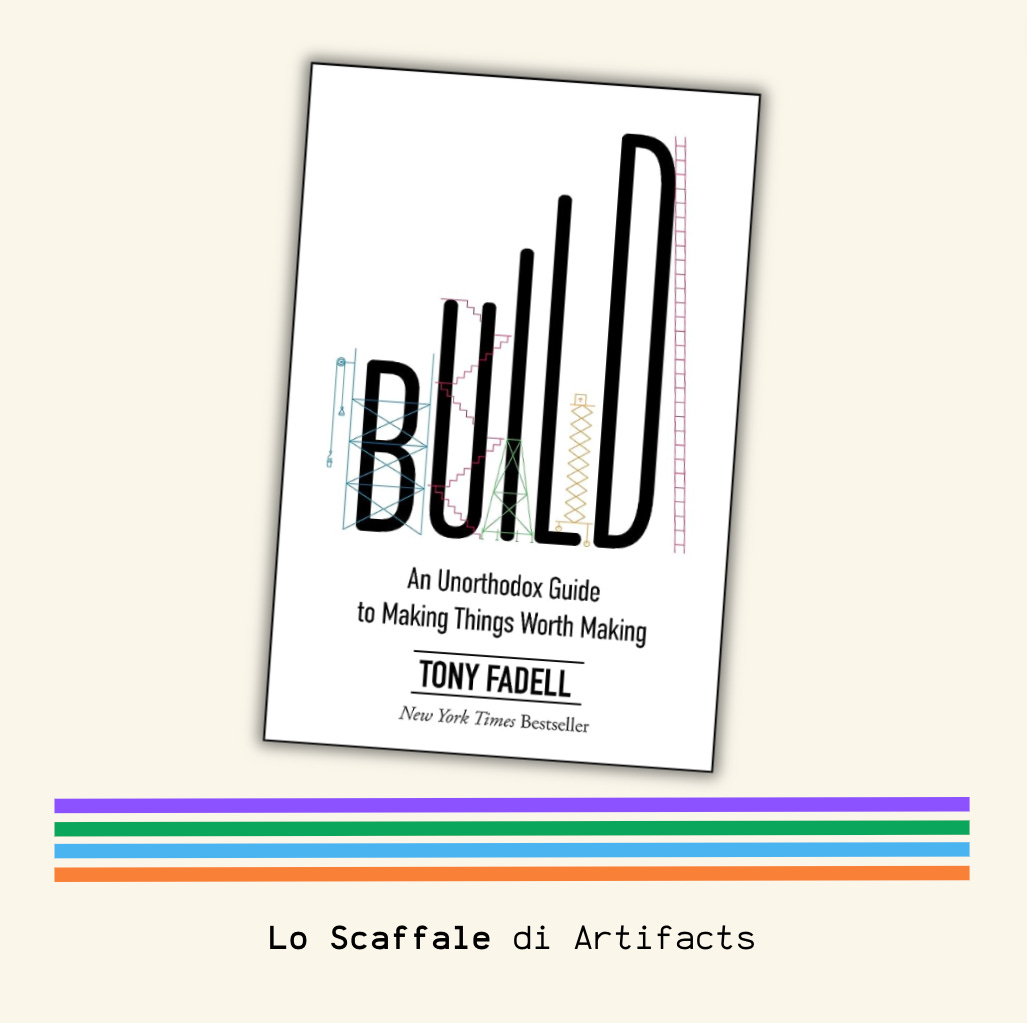 A proposito di iPhone, Build - An Unorthodox guide to Making Things Worth Making è una sorta di manifesto di Tony Fadell, il designer che ha pensato e creato l’iPod. Ma è anche un libro su come costruire la propria carriera, su come scegliere le persone di cui circondarsi e sul perché “What do you want to learn?” dovrebbe essere la domanda da farsi sempre. In più, è il libro che stavo leggendo quando ho pensato al nome di questa newsletter, quindi bonus.
> ### Nerding
 Detta semplice semplice: Hai presente che i tool AI di generazione immagini non sanno scrivere le parole? Ecco, Ideogram lo sa fare. È gratis e disponibile a tutti. Funziona bene, come puoi vedere dal robottino:
 Grazie, e ci sentiamo martedì prossimo!
======
# E se ci fosse meno eco del previsto?
Date: 2023-09-12 | Language: it
Canonical: https://artifactstech.substack.com/p/e-se-ci-fosse-meno-eco-del-previsto
Cite as: E se ci fosse meno eco del previsto? by Lorenzo Ancona, Artifacts, 2023-09-12. https://artifactstech.substack.com/p/e-se-ci-fosse-meno-eco-del-previsto (CC BY 4.0)
I social non sono uno specchio della realtà, ma un prisma.
 Un prisma. Creato con DALL-E
Sentiamo spesso che sui social vediamo solo quello che ci piace, parliamo solo con le persone che la pensano come noi e leggiamo solo opinioni con cui siamo d’accordo. Lo scrivevo anche nella scorsa Artifacts. E, allora, per molti, la diretta conseguenza è che i social media siano tra i fattori responsabili della crescente polarizzazione politica.
Echo Chamber e Filter Bubble sono i due termini solitamente usati per descrivere queste dinamiche di omofilia, ossia di esposizione a ciò con cui siamo d’accordo. In realtà, non sono sinonimi: piuttosto il secondo è l’evoluzione del primo. Se una echo chamber è uno spazio, anche offline, nel quale tendiamo a sentire sempre le stesse posizioni, anche per scelta nostra, una filter bubble fa riferimento a come gli algoritmi ci propongano contenuti allineati alle nostre opinioni, senza che noi possiamo farci niente.
------------------------------------------------------------------------
L’idea molto diffusa è che il filtro degli algoritmi crei delle bolle sui social, che funzionano come echo chamber, con idee tutte uguali, che amplificherebbero la polarizzazione.
Ed è così che, ad esempio, se il 50% dei democratici negli Stati Uniti del 2018 non voleva che il proprio figlio sposasse un repubblicano, o viceversa, sarebbe anche colpa dei social.
Ma non è proprio così.
> ### Il Titolo
Prima di tutto, le echo chamber esistono da molto prima dei social: nel 1960 uno studio dimostrava che le fonti di informazione influenzavano il voto degli elettori. Di conseguenza, anche la polarizzazione è da attribuire al sistema dei media ben prima dei social.
Fin qui tutto bene, anche abbastanza ovvio. Ma la convinzione che voglio sfidare è un’altra: non è vero che i social determinino o amplifichino chissà quanto la polarizzazione.
Il punto di oggi è che i social media non riflettono le opinioni delle persone come uno specchio, ma le amplificano, le distorcono e le riproducono come un prisma fa con la luce, mostrando solo quelle più estreme.
Hai presente il discorso che sulle storie Instagram mettiamo solo le cose da milionari, esagerate, che facciamo, e non il resto? Immaginalo applicato a come condividiamo posizioni politiche sui social.
L’immagine, geniale, del prisma è ideata da Chris Bail, direttore del Polarization Lab di Duke University.
------------------------------------------------------------------------
Sfatiamo qualche mito e poi arriviamo al prisma:
1. Non è vero che cambieremmo idea se gli algoritmi ci proponessero idee diverse dalle nostre, anzi le rafforzeremmo.
Con un esperimento, Bail ha mostrato tweet di repubblicani ai democratici, e viceversa. Cosa è successo? Entrambi i gruppi ne sono usciti con le stesse posizioni di prima, ma più estreme, dunque nessun avvicinamento. Probabilmente, un po’ a causa del confirmation bias, per cui se pensiamo che la terra sia piatta e ci dicono che non è vero, ce ne convinciamo ulteriormente. E poi, domanda aperta, se molti altri fattori influenzano le convinzioni politiche, c’è da chiedersi se sia nato prima l’uovo della polarizzazione social o la gallina delle convinzioni preesistenti.
2. Non è vero che sui social siamo esposti solo alle opinioni con cui siamo d’accordo, anzi è molto meglio che nel mondo fisico.
Siamo proprio sicuri che potendo leggere l’opinione sull’energia nucleare sia del segretario delle Nazioni Unite che di un contadino del Nevada, siamo esposti sempre e solo alle stesse opinioni più che se non avessimo accesso a internet e fossimo limitati ai nostri conoscenti? No, e infatti non è così. Uno studio ha dimostrato che, al contrario, online siamo esposti ad una diversità di opinioni maggiore che nel mondo reale. Ed infatti, la polarizzazione è crescente tra le persone che utilizzano meno i social media.
3. Non è vero che ormai esistono solo opinioni estreme, è solo che sui social sono molto più rumorose di quelle moderate.
Bail ha anche dimostrato che molto del dibattito politico sui social, percepito come estremamente polarizzato, avviene tra pochissimi individui con posizioni estreme, che sono però molto rumorosi. Al contrario, chi ha posizioni più moderate tende a non partecipare per timore di essere attaccato soprattutto da chi la pensa come lui, ma è più estremo. Non a caso, il 36% delle persone è un news avoider, ossia non vuole ricevere informazioni, e la percentuale è in decisa crescita. E allora, se chi è moderato non partecipa, la percezione è che esistano solo posizioni estreme e più rumorose. Si tratta, quindi, più di un problema di percezione della polarizzazione, che di polarizzazione effettiva.
------------------------------------------------------------------------
Insomma, quello che vediamo sui social - in questo caso rispetto alle opinioni politiche - è un’immagine distorta della realtà, che viene rifratta da un prisma, e non riflessa fedelmente.
Affermare ciò non significa negare che gli algoritmi propongano prevalentemente quello che ci piace e ci interessa. È il modello di business delle piattaforme. Ma solo capire che non creano tutto l’eco che pensiamo.
Inoltre, gli studi di Bail sostengono che avere posizioni estreme sui social non significa necessariamente essere estremisti. Parlando con individui percepiti come estremisti e rumorosi, dimostra che le versioni social di se stessi siano esagerate per affermare una propria identità, che non riflette quella effettiva, alla ricerca di un posto nella società e di se stessi. Insomma, il rumore per esistere.
Per finire, serve capire che la realtà proposta dai social non sia, appunto, reale, ma una che privilegia il rumore di pochissimi e che, d’altro canto, ci sia molta meno eco di quello che pensiamo.
Si tratta, insomma, di invertire la narrativa sull’eco. E di cambiare la prospettiva con cui pensiamo ai social: prismi, e non specchi.
Convinto? Da ridire? Dimmi la tua!
Leave a comment
> ### Rassegna (Stampa)
L’Unione Europea ha comunicato chi sono i gatekeeper che dovranno rispettare il Digital Markets Act. Volti noti.
Oggi presentano i nuovi iPhone. Cosa aspettarsi?
La lettera di Sundar Pichai, CEO di Google, per il 25esimo compleanno di Big G. Consiglio, guarda avanti.
Il TIME ha messo in copertina le 100 persone più influenti sull’Intelligenza Artificiale. Qua meno volti noti, credo.
> ### Lo Scaffale
 Se ti interessa approfondire questa vicenda dei social come prismi, Breaking the Social Media Prism fa al caso tuo. Molto interessanti le interviste ai presunti estremisti della rete. E, per chiudere in bellezza, i consigli di Bail su come contribuire a rendere le piattaforme meno polarizzanti. Si legge velocemente: è sostanzialmente il racconto della sua attività di ricerca.
> ### Nerding
 Cosa fa? È una app per ascoltare podcast, ma con gli steroidi. Grazie all’Intelligenza Artificiale, mostra i “capitoli” dei podcast, il transcript, permette di creare degli snippets per salvare le parti che ci sono interessate, e poi invia un riassunto degli “appunti” che abbiamo preso.
Perché la consiglio? Per trasformare i podcast in dei libri, di cui salvare parti, ricordare spezzoni e, soprattutto, grazie alla divisione in capitoli, saltare le parti che non ci interessano.
------------------------------------------------------------------------
Per oggi è tutto. Grazie per essere arrivato fin qui e per la fiducia.
A martedì prossimo!
======
# Una settimana senza algoritmi
Date: 2023-09-05 | Language: it
Canonical: https://artifactstech.substack.com/p/una-settimana-senza-algoritmi
Cite as: Una settimana senza algoritmi by Lorenzo Ancona, Artifacts, 2023-09-05. https://artifactstech.substack.com/p/una-settimana-senza-algoritmi (CC BY 4.0)
**Ho imparato che il telefono senza social è, sostanzialmente, un sasso.** ***Ma andiamo con calma.***
[](https://substackcdn.com/image/fetch/$s_!g8pY!,f_auto,q_auto:good,fl_progressive:steep/https%3A%2F%2Fsubstack-post-media.s3.amazonaws.com%2Fpublic%2Fimages%2F4d8f0d18-0a5a-4269-9184-9e1266d4e12a_1024x787.jpeg)
*Un telefono senza social media. Generato con DALL-E*
Non è certo un caso se Reels di Instagram o TikTok ci suggeriscano proprio **quello che ci piace o ci interessa.** Com'è noto, è *merito* dei sofisticati **algoritmi** che ne sono alla base. E che, di fatto, garantiscono il successo di tutti i social media.
Ma non solo: gli algoritmi sono anche la ragione per cui i social possono dare **dipendenza** o, in gergo, per cui sono ***addictive by design.*** Quindi, tra le varie caratteristiche, progettati per essere usati *potenzialmente* senza limiti, fornendo comunque sempre **nuovi stimoli.**
Quello che appare chiaro è che per gli algoritmi possa valere un discorso simile a quello dei bassissimi ponti di Long Island di cui ho parlato in Artifacts n.0: ***il modo in cui funzionano può dare forma alla nostra vita, determinando cosa vediamo sui social, come e con chi interagiamo e, anche, il perché arriviamo a passare diverse ore, tutti i giorni, sulle piattaforme.***
E se gli algoritmi plasmano **noi come singoli**, è possibile sostenere che abbiano un impatto anche **sulla società in senso lato.**
------------------------------------------------------------------------
Di questo se n'è resa conto l'**Unione Europea**, che con il **Digital Services Act** (DSA) stabilisce il **criterio di trasparenza degli algoritmi.** In sostanza, che le piattaforme, come Instagram o TikTok, debbano **dichiarare secondo quali parametri gli algoritmi propongono i contenuti agli utenti.**
**È** **affascinante e innovativo che un’istituzione politica voglia indagare come funzionino gli algoritmi dei social media.** La finalità primaria è capire perché vengano mostrati determinati contenuti - ed eventualmente **fermare la diffusione di quelli pericolosi** - ma di conseguenza anche come i social possano essere *addictive by design* e **portarci a passare diverse ore, ogni giorno, a** ***scrollare.***
Tutto questo ci rivela, di nuovo, che ha ragione Winner: ***artifacts -** in questo caso gli algoritmi dei social media - **have politics.*** E l’UE l’ha capito.
------------------------------------------------------------------------
Di DSA e regolamentazione ne parleremo - *ampiamente -* nelle prossime settimane. **Oggi, invece, voglio fare un passo indietro.**
Qualche settimana fa mi sono chiesto se ***sia possibile, per qualche giorno, impedire agli algoritmi dei social media di dare forma alle nostre interazioni, di consigliarci cosa leggere e, in generale, di influenzare la nostra vita.***
Ho scoperto di sì: facendo quello che gli esperti chiamano **“Digital Detox”.** Si tratta, sostanzialmente, di **azzerare l’utilizzo dei social media** e - direi di conseguenza - del cellulare o di altri dispositivi.
**In questa Artifacts vi racconto come ci ho provato, com’è andata e cosa ne penso.**
***È vero: è un’esperienza personale, ma penso possa avere validità generale.*** E, soprattutto, se hai mai fatto qualcosa di simile, scrivi nei commenti com’è andata!
> ## Il Titolo
***Disclaimer sul Digital Detox prima di essere additato di luddismo:***
1. Non credo sia fattibile sul lungo periodo: è **difficilmente immaginabile** non usare i social nel 2023;
2. Non implica un giudizio personale negativo dei social, è solo un **esperimento**;
3. Al contrario, pur riconoscendo i possibili aspetti negativi, sono un fautore di **tutti gli aspetti positivi dei social media** nelle nostre vite.
*Iniziamo.*
**Non è ovviamente un concetto inventato da me**, e i vari trucchetti sono presi da **diversi articoli**, che trovi - tra i tanti - [qui](https://www.nytimes.com/2020/11/25/technology/personaltech/digital-detox.html), [qui](https://www.nytimes.com/2018/07/25/well/how-not-to-let-your-phone-ruin-your-vacation.html) e anche [qui](https://www.nytimes.com/2019/02/23/business/cell-phone-addiction.html).
Poi importante precisare che il **periodo** che ho scelto, ossia la settimana **7-15 agosto**, in vacanza, è probabilmente la *settimana migliore dell’anno* per essere un po’ fuori del mondo. **Non che di solito riceva telefonate dal Presidente degli Stati Uniti**, ma probabilmente è quella settimana dell’anno in cui *quasi chiunque* potrebbe permettersi di staccare dal flusso. ***Quasi chiunque.***
Per impostare il Digital Detox, ho:
1. **fatto una valutazione iniziale** *per capire cosa non funzionasse del rapporto con il cellulare e i social.* Quindi - essenziale - **non smettere di utilizzare** ***in toto*** **il telefono, ma capire quali abitudini negative si hanno.** *Personalmente,* l’abitudine di aprire Twitter o Instagram in maniera abbastanza inconscia e il controllo costante delle notifiche.
2. **impostato degli obiettivi:** *cosa si vuole ottenere. Personalmente,* l’obiettivo è stato **azzerare l’utilizzo di Instagram, Twitter, Facebook e LinkedIn, e limitare al minimo Whatsapp e email.** *Su Whatsapp ho capito tardi che, probabilmente, serve avvertire in qualche modo i contatti per evitare che denuncino la tua scomparsa.* Da riflettere anche su questo.
Poi, ho adottato **5 trucchetti essenziali**, che riporto qui, *in ordine di importanza:*
1. Chiedersi ***“cosa posso fare altrimenti?”*** ogni qualvolta si sia tentati di prendere il telefono;
2. Come scrive il NYT, ***get over yourself,*** o *non prendersi troppo sul serio.* Essenzialmente pensare che è difficile - nella maggior parte dei casi - che il motivo per cui si venga contattati sia così urgente o fondamentale. Insomma, *che raramente ci scrivano per salvare il mondo;*
3. ***Ripensare le proprie abitudini:*** se in viaggio, come capitato a me, chiedere ai locali dove andare a mangiare oppure scaricare le mappe offline per poter tenere il telefono in modalità aereo. Per limitare il numero di volte che prendiamo il telefono in mano;
4. ***Creare delle zone no-phone:*** ad esempio, 0 cellulare a tavola oppure prima di andare a dormire o la mattina appena svegli. Proprio *fisicamente* distante;
5. **Cambiare l’organizzazione delle app:** mettere solo quelle essenziali in home page *per non essere tentato dalle altre.*
[](https://substackcdn.com/image/fetch/$s_!xZQH!,f_auto,q_auto:good,fl_progressive:steep/https%3A%2F%2Fsubstack-post-media.s3.amazonaws.com%2Fpublic%2Fimages%2Fa251e73d-c79e-470d-9e2c-1082f96a0648_1306x1078.png)
*A sinistra la mia home page in Digital Detox, a destra quella di tutti i giorni*
#### **Com’è andata?**
Direi abbastanza bene, nel senso che:
1. **Mai aperto Instagram, LinkedIn, Twitter o Facebook** e solo una volta al giorno un quotidiano online;
2. Di conseguenza, **20-30 minuti di media al giorno** di tempo di utilizzo del telefono. ***Qui ho capito che senza social il telefono è un sasso;***
3. Non mi sono propriamente isolato perché **ho usato abbastanza Whatsapp**. Ma se l’obiettivo era anche “scappare” dagli algoritmi, Whatsapp non è considerabile un ***[recommendation media](https://mignano.medium.com/the-end-of-social-media-a88ffed21f86)*****,** come invece Instagram o TikTok.
Ma, soprattutto, ***quali pensieri dopo una settimana senza algoritmi?***
1. **Dover trovare altri, nuovi stimoli** è stata la cosa più sorprendente. Sia chiaro, le nostre vite hanno ovviamente altri stimoli fuori dai social media, ma non averne *per niente* dal proprio cellulare - lo ammetto - è stato quantomeno peculiare.
2. **Ho capito cosa si fa se non si può usare il telefono: NIENTE.** Probabilmente, spesso, il telefono **riempie un vuoto,** ***letteralmente,*** **e non sostituisce altre attività.** Ho (non) fatto moltissimo niente. Ed è una cosa che scrive anche Ian Bogost in questo super articolo che consiglio: *[“What did people do before smartphones?”](https://www.theatlantic.com/technology/archive/2023/07/before-smartphones-boredom/674631/).*
3. **Non è poi negativo non essere costantemente aggiornati:** ad esempio, tra le tante notizie che ho “perso”, c’è stata la morte della giornalista Michela Murgia. **Con Twitter lo avrei saputo praticamente in real time**, ma invece l’ho saputo dopo due giorni chiamando un amico. E ci sta.
------------------------------------------------------------------------
Chiaramente - lo ripeto - si tratta di un’**esperienza radicale,** limitabile a qualche giorno. Sono tornato a pieno regime a *scrollare,* forse con un **po’ più di consapevolezza**. Però la consiglierei: non per diventare dei luddisti, ma solo **per provare qualcosa di** ***straordinario**,* fuori dal nostro ordinario fatto e influenzato da algoritmi.
**Insomma, nell’attesa che l’UE provi a capire come funzionano davvero gli algoritmi dei social media, è interessante provare cosa significhi farne a meno.**
E, di nuovo, se hai mai fatto un Digital Detox, *sono molto curioso di sapere com’è andata.*
[Leave a comment](https://artifactstech.substack.com/p/una-settimana-senza-algoritmi/comments)
> ## Rassegna (Stampa)
A proposito di Digital Detox, l’Unione Europea [monitora il rapporto degli adolescenti con i social.](https://www.politico.eu/article/eu-social-media-teens-smartphone-addiction/)
Sempre sugli algoritmi e i social, [a breve in Europa avremo la possibilità di poter tornare ai vecchi cari feed social cronologici](https://9to5mac.com/2023/08/22/opt-out-of-algorithmic-feeds/).
Sull’IA, Claire Lebowitz spiega [perché i watermark potrebbero non bastare a riconoscere quello che è generato con IA](https://www.technologyreview.com/2023/08/09/1077516/watermarking-ai-trust-online/).
E poi [il New York Times che se l’è presa con ChatGPT](https://www.theverge.com/2023/8/21/23840705/new-york-times-openai-web-crawler-ai-gpt). Ed anche il [Guardian](https://www.theguardian.com/technology/2023/sep/01/the-guardian-blocks-chatgpt-owner-openai-from-trawling-its-content)! Ne parleremo.
[Ieri Google ha fatto 25 anni.](https://x.com/jonerlichman/status/1698672031787569369?s=48&t=gbAqSAJ_FS1UsFjoLj51HQ) Auguri!
> ## Lo Scaffale
[](https://substackcdn.com/image/fetch/$s_!IIGB!,f_auto,q_auto:good,fl_progressive:steep/https%3A%2F%2Fsubstack-post-media.s3.amazonaws.com%2Fpublic%2Fimages%2F52054b88-6817-4ec5-9bca-94db951b31e4_1080x1080.png)
**Jaron Lanier** è tra i maggiori esperti globali sui social media e le implicazioni politiche e sociali. ***Ten Arguments For Deleting Your Social Media Accounts Right Now*** è uno dei suoi libri più celebri. È indubbiamente **radicale**, ma anche molto interessante. **Tra le mie ragioni preferite:**
1. Che i social ci rendono *stronzi;*
2. Che i social ci portano via un po’ di **empatia**;
3. Che i social possono renderci **più tristi.**
> ## Nerding
[](https://substackcdn.com/image/fetch/$s_!PQJh!,f_auto,q_auto:good,fl_progressive:steep/https%3A%2F%2Fsubstack-post-media.s3.amazonaws.com%2Fpublic%2Fimages%2F20af7a91-4a9e-4ed9-9b04-44e9dda70a5c_1080x1080.png)
***Cosa fa?*** È una delle mille tasks app sul mercato. Permette di creare fino a 5 spazi (tipo “Università”, “Lavoro”, “Personale”, etc.) e poi categorie all’interno con **tutte le task che uno deve fare.** È anche possibile mettere deadline, priorità, filtri.
***Perché la consiglio?** Prima di tutto, è* molto **semplice** e **intuitiva.** Accessibile da pc e smartphone, **organizza le task bene e in maniera essenziale.**
*Però, se preferisci, puoi continuare a usare la chat da solo su Whatsapp, come a me capita di fare spesso :).*
------------------------------------------------------------------------
Per oggi è tutto. **Grazie** per essere arrivato fin qui e per la fiducia.
A martedì prossimo!
Se ti è piaciuta Artifacts, condividila!
[Share](https://artifactstech.substack.com/p/una-settimana-senza-algoritmi?utm_source=substack&utm_medium=email&utm_content=share&action=share)
##
======
# Questa (non) è Artifacts
Date: 2023-09-01 | Language: en
Canonical: https://artifactstech.substack.com/p/questa-non-e-artifacts
Cite as: Questa (non) è Artifacts by Lorenzo Ancona, Artifacts, 2023-09-01. https://artifactstech.substack.com/p/questa-non-e-artifacts (CC BY 4.0)
> "La tecnologia è ciò che ci rende davvero umani. Attraverso gli strumenti che creiamo, non diventiamo né meno umani, né super-umani, né post-umani. Diventiamo, semplicemente, più umani".
ha scritto Reid Hoffman in questo incredibile articolo. Anche da qui, oltre che da tante persone, amici, articoli, libri, nasce Artifacts.
(Ma anche da molto tempo libero in estate, per fortuna).
 Un ponte molto basso. È legato al nome “Artifacts”, sotto il perché. Creato con DALL-E
> ### Perché si chiama “Artifacts”?
Il nome nasce da “Do Artifacts Have Politics?”, un celebre paper del 1980 di Langdon Winner, filosofo statunitense.
Winner dimostra che gli artefatti tecnologici possono avere delle proprietà politiche. E, quindi, plasmare la società e stabilire rapporti di potere. Insomma, fare politica.
Detto semplice: Winner racconta dei bassissimi ponti ideati dall’architetto Robert Moses sulla strada verso le spiagge di Long Island, a New York, e di come fossero, essenzialmente, razzisti.
In che modo? Facile: gli autobus, che erano usati prevalentemente dalle persone nere, non potevano passare sotto a questi ponti bassissimi, costruiti appositamente. Di conseguenza, in spiaggia arrivavano solo le persone bianche, che usavano invece le auto di loro proprietà.
Insomma, come la tecnologia è costruita ha dei riflessi sulla società. Come noi costruiamo la tecnologia è, di fatto, un modo per fare politica. O, detto in altre parole, un modo per esercitare potere. Anche razzismo.
Artifacts considererà gli effetti delle tecnologie sulla politica e la società, ma anche come la politica e le politiche (o policies) possono direzionare, abilitare e favorire un impatto positivo della tecnologia.
E, comunque, sì: Artifacts do have politics.
> ### E perché ho creato Artifacts?
Si tratta, prima di tutto, di un esperimento. Da diversi mesi leggo, studio e discuto di tecnologia e digitale. Sia in termini generali che, poi, con un focus sulle relative politiche (o, come dicono quelli bravi, digital policy) .
Insomma, di come la tecnologia abbia cambiato e cambi noi, la società e la politica. Ma anche di come la politica e le politiche si stiano occupando di tecnologia.
Artifacts, dunque, è un tentativo di sistematizzare, di dare forma, a tutte queste informazioni, provando a sviluppare ragionamenti.
Poi, Artifacts è anche la volontà di creare uno spazio. Uno spazio dove portare alla luce dei temi che, spesso, sono fuori dai radar del dibattito pubblico, in Italia e non.
Penso ai social media e l’uso intensivo che ne facciamo, all’Intelligenza Artificiale e alla regolamentazione, ma anche a cosa significhi una democrazia digitale. E tanto, tanto, altro. Lo farò in autonomia e anche conversando con esperti.
Infine, Artifacts è anche una sfida personale. Un amico di cui mi fido molto mi ha sempre detto di fare “‘na cosetta tua”. Finora mi era mancato un po’ il coraggio e un po’ l’ispirazione, ora penso di avere una buona intuizione.
Ci provo, vediamo cosa succede.
> ### Come è fatta Artifacts?
All’inizio avrà 4 sezioni:
- Il Titolo: la storia principale della settimana, che sarà il grosso della newsletter;
- Rassegna (Stampa): una raccolta di articoli e contenuti interessanti che trattano le interazioni tra tecnologia, politica e digitale;
- Lo Scaffale: un libro che consiglio e perché;
- Nerding: un tool da nerd che uso e che ritengo utile. Non ho sponsor ma possiamo parlarne signori miliardari :);
Successivamente potrebbero arrivare nuove sezioni. Non escludo anche qualche uscita in inglese per coinvolgere chi non parla la lingua di Dante e Manzoni.
> ### Quindi, come funziona?
Ogni martedì, verso le 9, Artifacts arriva nella tua casella di posta
Perché martedì? Non c’è un motivo preciso. Sicuramente il lunedì le persone leggono le mail del weekend e non leggerebbero Artifacts.
E poi, il lunedì non ho lezione quindi posso dedicarmi ad Artifacts.
> ### Come puoi aiutarmi?
So che stavi aspettando questa parte.
Innanzitutto, iscrivendoti e leggendo Artifacts. Questo sarebbe già incredibile e estremamente apprezzato.
Poi, se ti va, puoi fare due cose:
- Condividere o inoltrare Artifacts ai tuoi amici, colleghi, parenti che pensi possano essere interessati. Con il comodo bottone che trovi qui:
Share
- Scrivermi, commentare, domandare per aiutarmi a crescere e migliorare.
Prendiamo un caffè digitale
Per oggi è tutto. Grazie per essere arrivato fin qui e per la fiducia.
Ci vediamo martedì con Artifacts n.1!